Welcome to rascott.com.
This is a personal site that reflects my interests in news, current affairs, aviation and travel.
email me at robert@rascott.com
Now In Dubai

Photo Albums
My
photographs have been moved off this site and are now stored on Picasa. They
were simply taking up too much space on my web host.
Please use this link to see my list of photo albums.
Some
Useful links:
Information:
Met Office Volcano watch
World Time Clock
Exchange Rates
Journalism:
ForeignPolicy
Nationsonline.org
Project Syndicate
Amnesty International
Reporters w/o borders
The Guardian - UK
BBC World News
CNN Asia
Bangkok Post
Daylife.com - news
Gulf News
Arabian Business
Good causes:
Sister
Joan - Bangkok
Regional Info:
BKK Magazine
HK Magazine
In
Singapore Magazine
TimeOut Dubai
Travel:
Circle of Asia
Tales of Asia
Smart Travel Asia
Finance:
FinanceAsia
Aviation:
Amadeus (airline
schedules)
Airliners
- aviation forum
Flight Aware
Thailand Info
thailand.com
learningthai.com
sawadee.com
bangkok a-z
Back in the UK:
Newton Ferrers
Government:
The
"new" White House
Photography
Denis Olivier - black and white
And for fun:
Lin Ping live panda tv
EarthCam
History
BBC Archive
National Media
Museum
The British Library
Imperial War Museum

The opinions expressed on these pages are entirely personal unless they are credited; you may not agree with all, or anything, that I write. So please use the feedback page to respond, comment or berate me.
| Dubai Links | Dubai watch - 2007 and 2008 | |||||||||||||||||||||||||||||||||||||||||||||||||||||||||||||||||||||||||||||||||||||||||
| Dubai News Emirates Today Gulf News Khaleej Times Dubai News Dubai in Wikipedia Burj Dubai
The Burj Dubai tower
UAE Community Blog
- uniting all UAE bloggers
Dubai Tourism Dubai Aviation Dubai By Night Others Language:
English to Arabic Words
English to Arabic Numbers
|
How things
change. In 2007 I wrote that Dubai was arguably the
fastest growing city, relative to its size, on the planet. Dubai's ambitions
were staggering. There was little expectation then of how far Dubai could
fall.
|

 | Per-capita GDP is well over $30,000 … the highest in the Middle East and up there with the world’s top 25 economies. |
| GDP growth has been running at 13% annually since 2000. |
| Over the same period, the industrial and construction sectors have been rising around 30% a year. |
You could say that Dubai has "arrived." Its port is now home to 120 shipping lines and 105 airlines, connecting 136 nations to the region. The Dubai International Airport is the second-fastest growing airport in the world, based on international passenger movement and cargo traffic.
No wonder Emirates Airlines is one of the most successful
and profitable airlines in the world. It recently placed the largest order
in aviation history for a total of $19 billion of new airplanes from Airbus
and Boeing.
Dubai is the world’s fastest-growing tourist destination, with nearly six
million visitors in 2006, and 15 million expected by 2010. The richest ones
stay at the only seven-star hotel in the world, the famous Burj Al Arab,
where one night costs more than $1,500.
The city has 14 million square feet of existing commercial space, and 98% of
it is occupied. But another twenty-four million square feet of commercial
office space is in the works!
The current pace of commercial office construction in Dubai makes it the
largest and busiest new construction market in the world, even bigger than
Shanghai, China! Dubai has more construction cranes per square mile than any
other city in the world, new or old.
Just three of the enormous projects …
The Burj Dubai Tower: This, the most ambitious skyscraper in history, will
reach as high as 800 meters (2,624 feet) when complete. That’s a whopping
300 meters higher than 101 Taipei, the tallest building in the world right
now!
Dubailand: Set to become the most ambitious tourist destination ever
created, Dubailand will be more than twice the size of the Walt Disney World
Resort in Florida. This mega-project theme park will cover three billion
square feet!
The Dubai Mall: When completed, this will be the largest mall in the world,
with more than 1,000 stores spread over two million square feet of retail
shopping space.
There’s also something like $100 billion in residential developments going
up, including hundreds of man-made islands in the shape of palm trees and
one project called "The World," which is an entire seascape of man-made
islands arranged to look like a map of the world.
It all sounds great …
But Here’s the Big
Problem I See in Dubai
Dubai’s boom is being driven by oil money, and an international gang of the
rich and famous who are seeking a Middle Eastern paradise on the Persian
Gulf.
None of this is being done by or for the common Arab, or the scores of
construction workers and service employees that mostly come from Asia (the
Philippines, in particular) looking for work.
In short, there’s a big divide between what’s happening in Dubai and the
needs and desires of the resident masses.
What I’m seeing in Dubai differs dramatically from the events taking place
in China, India or almost anywhere else in Asia. In those places, billions
of people are just emerging from poverty. Here in Dubai, most people,
including the working class, are already relatively well off.
That’s a huge distinction, and it’s recognized by almost everyone I spoke to
here. I asked three separate taxi cab drivers, a half-dozen shopkeepers, and
a few hotel employees what they thought of the situation in Dubai. They all
said pretty much the same things to me:
"There’s way too much construction going on."
"The big money here is in for a fall."
"The elite here are out-of-touch with reality. So are the wealthy
international business community, and the tourists."
As I said, most of the money building up Dubai is directly or indirectly oil
money. It’s as if the ruling party in Dubai (the Maktoum royal family), and
other wealthy groups within the UAE, have nothing better to do with their
money but spend, spend, spend.
They say they’re aiming to diversify their economy away from oil revenues
and into other forms of trade and tourism, but I have to wonder about their
decisions. To me, it looks like there’s a lot of ego going into the projects
here. I see wasteful spending, and big bets that a huge future is in the
offing.
Mind you, I’ve enjoyed my stay here in Dubai. The climate is spectacular,
the city breathtakingly clean, the people wonderful.
But there seems to be a big gulf between the rich and the not-so-rich in
Dubai, and that worries me. They’re not on the same page. Contrast that with
many parts of Asia, where the masses want to get rich, and the leaders are
providing the means to do so.
Of course, there’s one thing that both the ultra-wealthy and the masses seem
to agree on in Dubai …
Gold: Loads of It Being Bought
By Almost Everyone in Dubai
Dubai’s Gold Souk, an open-air market that contains some 500 gold shops, is
the largest retail gold market in the world. An estimated 500 metric tonnes
of gold, or nearly 18 million ounces, are bought and sold each year.
I got to the market at three in the afternoon, about an hour before the
Islamic afternoon prayer session was to end. It was really exciting to watch
the shopkeepers pour out of the local mosques and hustle back to their gold
shops for the afternoon and evening trading sessions.
As the shops opened, gold buyers started pouring in by the masses. An hour
after opening, almost all the shops I visited were packed with buyers.
Gold in Dubai is either 20k or 22k, and can be found in ingots ranging from
roughly 1/10th of an ounce all the way up to incredible hand-crafted pieces
of Islamic jewelry weighing a pound and costing tens of thousands of
dollars.
But here’s the most important point: In the gold souks of Dubai, both the
ultra-rich and regular citizens are buying gold. I watched wealthy
businessmen, construction workers, and imams all snatching up the yellow
metal.
When I spoke with two Muslim women covered head-to-toe in
their blue burqas, one of them said, "Gold never goes out of style, whether
it’s jewelry or bars. It’s really money."
I couldn’t have said it better, nor could I have met a more gracious lady.
It’s rare for a devout Muslim woman to even acknowledge a strange man trying
to talk to her, but she even took that picture of me in front of the gold
shop when I asked her to.
I will visit Dubai again, perhaps next year. But if there’s one conclusion I
arrived at during my visit here, it’s that I wouldn’t make any big bets on
the area. There’s no doubt that it’s booming, but the funding is coming from
the richest of the rich, and the projects are mainly for the rich. They are
not backed by demand from billions of people.
I Wouldn’t Bet on Dubai,
But I Would Bet On Gold!
Gold’s recent performance has been terrific — it hit $673 last week, before
falling back to $665. Right now, I expect it to enter a new choppy trading
range between $645 and $670, lasting perhaps as long as another week.
But don’t let that bother you. In fact, consider buying on the dips! As long
as the price of the precious yellow metal holds $610 on a closing basis,
then gold’s next leg up is still forming. And I fully expect to see it back
above $732 an ounce, its highest level in 27 years.
All the ingredients are in place. Record demand for gold continues.
Meanwhile, available supplies are dwindling, as are new discoveries. On top
of that, central bankers around the world continue to print money freely,
depreciating their paper currencies in the process.
And then there’s the Iran situation. I’m sitting here in my hotel room,
looking at the Persian Gulf, the coastline of Iran just 100 miles away.
While I feel safe here in Dubai, I believe the Iran nuclear crisis is far
from over. In fact, I expect it to soon go full tilt, especially after the
recent Iranian detention of 15 British naval troops.
Bottom line: If you don’t own any gold, now looks like a good time to buy
some.
Bright Lights, Boom City
The Daily Telegraph, London - 6 March 2007
This Manhattan-on-speed city state in the United Arab Emirates is loved by many investors. Yet others regard it as a housing market on the edge of a crash with an oversupply of flats, a creaking infrastructure and worryingly-close to the Middle East's trouble-spots.
London sales manager Louise Jarvis has no such doubts. She has been wooed by the high rental income and capital appreciation that properties in Dubai have achieved since 2000. In August 2004, she bought a £140,000, two-bedroom apartment off-plan in a new suburb, Dubai Marina, the largest planned waterfront development in the world. With six weeks still to go before the completion of her flat, Louise says it has appreciated by 30 per cent and she expects to make a killing by letting it to corporate tenants. "I foresee a high demand, as it is near the new central business district, " she says.
Louise is already sitting pretty. In October 2004 she bought another flat near Dubai's Internet City, a suburb which is home to the headquarters of many Middle Eastern IT firms. She rented it out within three days and a year later sold it for a 25 per cent profit on the purchase price.
"The properties were of a very high specification and the developers delivered on what they promised. As it's a Middle Eastern culture, it's a safe place to invest your money," claims Louise, who says her experience of business in the region, in property and other investments, has been characterised by greater efficiency and honesty than in most other parts of the world.
Despite its proximity to the world's least stable region, and ongoing concerns about security in the Middle East, it is safety that is billed as Dubai's main allure to investors. "The troubles in Iraq, Kuwait, Lebanon, Iran - they all play into our hands. People displaced or worried in those countries have left and moved here," explains Issam Galadari of Dubai-based Emaar Properties, one of the world's largest residential developers. "This is a safe haven," he claims, "and demand is rising for property as a result." Dubai has 100,000 full-time British residents, a figure rising by about 900 a month. Over 85 per cent of the population consists of ex-pats from Pakistan, India and the Philippines in low-paid construction and service jobs and from Europe and Iran in well-paid executive posts. No one pays income tax.
The al-Maktoum ruling family holds all key government positions and effectively runs the three main house-building firms. This benevolent "dictatorship" seems popular and has transformed Dubai from an oil-dependent desert town with 170,000 people in 1975 to a super-wealthy city of 1·5million today, with 93 per cent of its income derived from property, tourism and trade.
Now the family wants to boost the population to 3·5million by 2010 and 5·5million by 2020. It markets Dubai's low corporation tax regime worldwide to attract companies; 3,000 multi-nationals are already there including Merrill Lynch, Microsoft and Credit Suisse.
All this is music to the ears of many British buy-to-let investors, who in the past two years have been tiring of poor returns in the UK and snapping up homes to let to Dubai's burgeoning population. As a result the property boom is in full swing.
I counted construction cranes from my 14th-floor hotel window in just one suburb of the city, and lost track at 120.
The latest schemes include the world's biggest shopping mall, its biggest airport, its biggest waterfront development, biggest amusement park and biggest reclaimed land project. All this is happening simultaneously, along with countless lesser developments.
The daddy of all these projects is the Burj Dubai, a tower and suburb being built in the Downtown area off Sheikh Zayed Road, the city's main drag. The tower (the world's tallest, naturally) will have 166 floors of apartments, offices and the first-ever Armani boutique hotel. "The tower will have 35,000 people at full capacity. The top will sway by 1·5 metres," explains Greg Sang, its project manager.
The project was conceived in 2003, work started in 2005 and it has already reached 109 storeys. Building is quick in Dubai, where the desert sands and coastal waters are already marked for development.
Planning permission takes weeks, not years. But quality is not compromised by speed. As with most schemes targeting foreign investors, the Burj Dubai apartments (prices will range from £550,000 to £2·5 million) will be expensively finished and offer good views.Surrounding it will be a 3·5 kilometre boulevard, fringed with hotels and 12,000 properties all now under construction.
Kelly Home, a public relations executive from Aberdeen who has worked in Dubai for 11 years, is going to buy in the area. "It'll be the new focus for Dubai, with the biggest cinema and clusters of bars and restaurants. I've rented until now but it seems the right place to commit to. It's a sign that Dubai has matured into a world city," she says.
"When I arrived in Dubai it was almost empty, with not many ex-pats and no major buildings. Now it's change all day, every day. It's a place constantly on the move." More conservative buyers head for the small number of villas and mansion schemes that are being constructed on the outskirts of Dubai city. Emirate Hills is a new, gated community near Dubai's Media and Internet cities. The properties are three- to seven-bedroom detached houses, starting at £450,000, and have private lawns as well as a meticulously-maintained golf course.
"There's a shortage of these houses in Dubai," says James Davies of Hamptons, the British estate agency now owned by Emaar. "They are wanted by executives and ex-pat families who like the space, European-style designs and the security of a gated community. These will give better returns than flats in the long run," he predicts.
So with building continuing apace, a burgeoning population needing places to rent, and plenty of evangelical locals, why would you hesitate over investing in Dubai?
Well firstly, there is an absence of authoritative statistics about the housing market. Despite a sophisticated mortgage industry there is no equivalent to the Halifax or Nationwide price indices to give neutral data on capital appreciation or rental yields.
"Data exists but no one's had time to correlate it," says Robin Teh of Hamptons International. "As long as properties have sold and rented, the industry hasn't seen the need to guide investors. Now the market is maturing and this information will be available by mid-year." Secondly, there is concern about infrastructure. At commuter times it takes an hour to drive five miles because planners massively under-estimated car usage. Families typically have gas-guzzling 4x4s; it costs only £15 to fill the tank.
The Palms, three artificial islands bearing 10,000 homes, have become synonymous with over-dense development and under-investment in infrastructure. Roads there are clogged as most residents leave for work at the same time each morning.
A two-line metro system opens in 2009. It is the first significant public transport project in Dubai, but what impact the 900-seat trains will make on the gridlock remains to be seen.
Thirdly, at a time when the world is going green, Dubai appears distinctly unenthusiastic. Despite 320 days of sun each year and grinding summers hitting 50°C (122°F) daily, the only solar panels are on parking meters and speed cameras. Builders say panels would be damaged by desert dust and in any case the sun could never supply enough energy to meet electricity demand, some 60 per cent of which is for air-conditioning.
Other sceptics concentrate on more traditional issues. The greatest concern is whether there will be enough rental demand for the 160,000 new homes due to be built in 2007 alone.
"I would be cautious," warns Stuart Law of Assetz, a property investment company. "I'm more optimistic about business areas where there's upward pressure on rents, as opposed to holiday lets in tourist areas where there is vast supply," he says.
"Investors should look at rental yields rather than capital growth. If the potential yield is a high proportion of the property price, this indicates the price is reasonable. If not, the property is probably not a good investment." Local property experts remain confident. They say, justifiably, that critics have written off Dubai's housing market as a bursting bubble for five years, yet investors have still enjoyed high returns. Whatever happens this year, there is little doubt that Dubai's love affair with property has already influenced markets in other parts of the Middle East.
In Ras-al Khaimah, one of the six other United Arab Emirates, along with Dubai, is Al Hamra Village, a marina scheme where Louise Jarvis has now bought yet another apartment.
"This is a hidden gem, an area that shows signs of stirring. At the moment the price is a lot lower per square foot than in Dubai," she says.
Nearby countries like Oman and Bahrain are also selling to foreigners, and schemes in Syria and even Libya could soon be available to western investors
Love it or loathe it Dubai is leading the way in opening up the Middle Eastern property market - and for investors it might just pay off.
Fantasy land in Dubai
From The Christian Science Monitor
20 February 2007
The tourist maps here can be confusing. Probably because about three quarters of the landmarks shown on them are nowhere to be found on the actual ground. "Dubailand (u/c)" and "The World (u/c)" are simply not there. "Dubai Waterfront (u/c)"? Nope. "iPod towers (u/c)"? Huh? "Falcon City (u/c)"? Not a trace.
And while on the subject of confusion, what does that (u/c) stand for, anyway, a visitor may start asking herself?
Welcome to Dubai, where many of its landmarks are "under construction." "This place is unreal," says Irishman David Hackett, who, years ago, did a stint as a construction worker in Las Vegas, building a 540-foot Eiffel Tower replica at the Paris Hotel.
"A tower like that, 60 per cent life-size" he shakes his head, "would just not be enough here."
On this recent weekday afternoon, Hackett, a production manager for a multinational construction company, is at the mega Mall of the Emirates, home to the only indoor ski slope in the Middle East. He's not slaloming down the quarter-mile ski run toward T.G.I. Fridays on this 73-degree F (23C) day, but rather standing in line waiting to get his George Foreman Next Generation Interchangeable Plates Grill.
The two-time world heavyweight boxing champion is in town for the weekend to shake customers' hands at the mega hardware store.
"The thing about Dubai," explains Hackett, is "they do it big, big ... bigger than anywhere else."
The Eiffel Tower at the planned Dubailand theme park‚ a $20 billion project that will be three times the size of Manhattan‚ is, for example, going to be life-size. So are the planned replicas of the Leaning Tower of Pisa, the Pyramids, and the Taj Mahal.
The Taj Mahal, too? Is that even possible? "Absolutely," says Hackett, inching closer to Big George. "It's on the maps." And this, as they say, was all desert just a few decades ago.
The late Shaikh Rashid bin Saeed Al Maktoum, who ruled Dubai from its independence in 1971 until his death in 1990, and his sons the late Shaikh Maktoum bin Rashid Al Maktoum, and His Highness Shaikh Mohammad bin Rashid Al Maktoum, Vice-President and Prime Minister of UAE and Ruler of Dubai, get much of the credit for the transformation.
They realised early on that oil riches were ephemeral and would one day run dry, and they started liberalising and broadening the economy to attract foreign investors.
Almost as fast as you could say, "outrageously bling-bling-tourism is our future," this little fishing port on a creek had been turned into a wonderland of artificial attractions.
Soon they had a growth rate bigger than that of China, more tourists than India, and‚ people here like to quip‚ more than half of the world's building cranes.
Rapid development
In the meantime, Dubai has been addressing the problems that come with rapid development such as labour abuse charges, taken up by the Human Rights Watch.
There has been also blame for looming environmental disasters (man-made islands upset the entire ecology of the western Arabian Gulf).
Tourism now accounts for almost 20 per cent of Dubai's $30 billion GDP‚ compared with less than 5 per cent for oil revenue.
Last year, close to six million visitors came here‚ a figure Dubai hopes will rise to 15 million by 2010. Where do they all stay?
Well, there is the Burj Al Arab option. The world's first seven-star hotel, in the shape of a giant billowing sail and covered in Teflon, the Burj features in-room marble staircases, an underwater restaurant reachable by submarine, and white Rolls Royce taxi service to the airport. If you book on TripAdvisor.com, you might get a steal at $2,156 for a simple room.
Or, you can go for the rack rate of $13,900 for a suite. Either way, you get to keep the Hermes goodie bag. Andre Agassi and Roger Federer played an exhibition match on the hotel's helipad rooftop a couple of years ago. Apparently it was very nice.
For those hankering to own a pied-a -terre, you could go the David Beckham route and purchase a second home on a fake island in the shape of a palm tree.
The Palm Jumeirah was created by dredging out sand and repositioning it in the shape of a date palm tree‚ complete with a trunk and 17 fronds‚ on the seafloor.
It is almost finished‚ and filling up with luxury hotels, residential villas and apartments, water theme parks, health spas, and cinemas‚ and, at $1.2 million a villa, almost sold out.
And what to do while in town? Shopping, maybe?
Shopping just happens to be Dubai's forte, with everyone from veiled local women to tank-topped Germans joining the mad rush‚ to the strains of Muzak‚ to get into the Victoria's Secret sales or get a new MP3 player in one of the mega-malls.
The recent Dubai Shopping Festival featured late-night shopping specials, carnival performances, Foreman-esque special appearances, a private island lottery (second prize: a private jet), and a whole range of Guinness World Record events.
Record breaking
In fact, breaking records is a national pursuit here. Among those contested in Dubai this year were the world's largest gathering of people reading at one time, longest line of footprints, and largest buffet; also the world''s biggest wallet, pillow, inflatable balloon, and spoon.
Results were not yet in, but Hisham Nammour, owner of the feng shui stall at the Emirates Mall was hopeful.
"We always win," he said over a mug of hot chocolate at the après-ski bar. "We excel at breaking records."
And indeed, last year, Dubai broke the record for the largest gathering of people sharing a name (2,500 Mohammads showed up)‚ leaving previous record-holder Spain (375 Marias) in the dust.
Also Dubai put together the largest display of rice dumplings: 23,000, trouncing dumpling doyen Singapore (13,192 in 1992).
And, let's not forget to mention the "Burj Dubai (u/c)" which aims to be the tallest skyscraper in the world.
They had a little celebration here last month when the building hit the 100-floor mark‚ 67 more are apparently on the way.
Meanwhile, in the realm of faux islands, there is a lot happening as well.
First of all, there is "The World (u/c)"‚ a "blank canvas in the azure waters of the Arabian Gulf with endless possibilities," as the website puts it.
In normal-speak, this translates into an archipelago of 300 man-made islands, each the size of several city blocks, which, when taken together, make up a map of the world. Fancy owning Italy? It's still up for grabs.
Developers aren't purists when it comes to exact world proportions, and island owners, it is promised, can re-shape the planet by "merely moving the sand," to create unique features such as coves and marinas.
And there is also the new palm tree project, known as "Palm Jebel Ali (u/c)," which is going to be 1-1/2 times bigger than Palm Jumeirah and is to be surrounded by houses on stilts that will take the shape of Arabic letters and spell out a poem by Shaikh Mohammad:
Take wisdom from the wise
Not everyone who rides a horse is a great jockey
It takes a man of great vision to write on water
Great men rise to great challenges.
All of this will be written there, they say, and be visible from space.
Sabir Ali Rehmani owns a small retail business selling simple cloth from Indonesia for the long dishdashs. He has been watching Dubai sprout around him for the past 20 years from his one-room office in the old souq on the creek.
"This is a fantasy land," says Rehmani, sitting down to a quiet morning cup of sweet Arabic tea. "You forget what is real."
Dubai: The Arab city of the future
19 January 2007
THE skyline of Dubai is a tangible testament to the most spectacular economic transformation in modern Arabia, an emirate whose unique milieu defines the heartbeat of the globalist ethos.
Of course, the Dubai Creek was a hub of trade and finance for centuries, with the silhouette of its moored dhows a symbol of the Arab pearl diving fleets and merchant princes whose networks once extended to Bombay, Kerala’s Malabar, Basra, East Africa’s Swahili coast, Zanzibar, Aden, Kuwait, Iran’s Gulf ports and even the Indonesian archipelago.
Dubai embraced the logic of tree trade, laissez faire capitalism, an absence of xenophobia, an obsessive commitment to infrastructure roll out, a liberal social ethos a generation before it was fashionable. Dubai’s entrepreneurial spirit suffuses its traders to move goods, money and cargo in some of the most high risk emerging markets of West, South and East Asia. The gold, electronics, and textile trades, Jebel Ali Free Zone, Port Rashid, the dry docks, DXB, the establishment of Emirates Airlines, the freehold property revolution, DSF, the Monaco/Singapore style branding as a tourism and services hub, the DIFC, DIC and Media City have created a city–state that, like Venice of the Serenessima or Rembrandt’s Amsterdam, has become an East–West entrepot of ideas, population exchanges and finance.
Dubai’s government is unique in the Arab world, with a ruler whose leadership model is the CEO and whose template for Arab socio economic renaissance is Cordoba, the medieval kingdom in Moorish Spain where Arabs, Jews and Christians created a unique mélange of cultures before the religious fanatics of the Reconquista engaged in one of history’s most ruthless examples of ethnic cleansing. In fact, even now, the Spanish word “convivencia” denotes more than tolerance, even pleasure in cross cultural exchanges, a recognition that the human family is a kaleidoscope, that values are relative and bigotry is abhorrent, that celebration of our common humanity is the essence of civilised existence. As the only global metropolis in the Islamic world, Dubai has resurrected the spirit of Cordoba, staked its claim as the Arabian city of the future. In fact, the Dubai model has become the DNA of iconic property projects and economic reinvention policies from Morocco to Oman at opposite ends of the Arab world.
The post 9/11 world of soaring oil prices, regional petrodollar flows, brand new financial markets, exponential wealth creation and capital flows in the emerging markets, cross–border mergers and acquisitions, the bidding war for overseas infrastructure assets, even war in Iraq and Lebanon, repatriation of Arab private wealth from the US and, above all, the real estate El Dorado has transformed the economic landscape of Dubai. Without the huge oil reserves of Abu Dhabi or Qatar, without the population of Saudi Arabia, without the military power of Egypt or Iran, Dubai has carved out a unique role in the global village, become Arabia’s daring incubator of the social, urban, even financial avante–garde. Bahrain was the offshore capital market of the Gulf ever since Beirut’s descent into the Stone Age in Lebanon’s civil war in the 1970’s but Dubai’s DIFC has positioned its financial free zone as the hot new destination of international banking and fund management in a mere four years. Economic change that was measured in decades in conventional Arab economies is now telescoped by the decision makers of Dubai Inc in virtually Internet time. The bureaucratic inertia that defines societies East of Suez has simply been leapfrogged into oblivion in Dubai.
Unlike Abu Dhabi and Kuwait, Dubai was not a major player in the international financial markets. No longer. Dubai Holding’s DIC, in takeover mode with Liverpool FC, was established as recently as 2004 as a conduit for the investment of surplus state funds into trophy franchises all over the world. DIC, whose portfolio includes Daimler Chrysler and Doncaster, is only the latest example of Dubai’s diversification and global brand strategy. With a mere seven per cent GDP in oil and gas, Dubai is not the traditional Arabian Gulf petrocurrency emirate but nothing less than the cosmopolitan portal to the Middle East whose existence in mission critical in a region where the collision between global capitalism and East–West geopolitics has been traumatic.
When Israel bombed Hezbollah last summer, the best and brightest of Lebanon considered Dubai in the same league as a haven destination as London and Paris. When Iranian political risk escalated after the election of President Ahmedinijad and the uranium enrichment dispute with the West, Tehran’s merchant elite often bought properties in New Dubai, an alternative to squirreling funds in Swiss banks, the traditional mode of Persian capital flight since the reign of the Shah.
Dubai hosts the Gulf’s benchmark conferences for hedge find managers, Islamic financiers, even for travel agents and software engineers. From Australian pilots at Emirates to Gujarati gold traders, Sindhi textile millionaires, Lebanese advertising yuppies and Bohra hardware merchants, Dubai has its own ethnic clusters and professional networks that create value for the entire society and contribute to its role as the magnet for the young, the rich, the restless in societies elsewhere in the region wounded by war, terror and economic sclerosis. In an age of hyperkinetic offshore capital, a mass communications revolution and digital culture, Dubai is a compelling model and catalyst for change in Arabia, the ideal place to live for those of us who define our identify not by our passport, tribe or ancestry but our determination to live lives of excitement and intellectual self discovery, to evolve into quintessential citizens of the world in the new millennium.
Matein Khalid is a Dubai based investment banker
Dubai skyscraper climbing 1 story every 3 days
DUBAI, United Arab Emirates — The Burj Dubai skyscraper under construction here reached its 100th story on Tuesday, nearly two-thirds of the way in its relentless climb to become the world's tallest building.
With 3,000 laborers adding a new floor nearly every three days, the $1 billion spire is days away from surpassing a neighboring skyscraper that is currently the tallest in the Middle East, Dubai-based developer Emaar Properties said.
"The tower is a symbol of the city's pride and a statement of our arrival on the global scene as one of the world-class cities," Emaar chairman Mohammed Ali Alabbar said.
When finished in two years, the silvery steel-and-glass building is expected to rise beyond 2,300 feet and more than 160 floors — dozens of stories taller than the world's current tallest building, the Taipei 101 tower in Taiwan, which measures 1,671 feet and 101 floors.
It will also top the world's tallest freestanding structure, Toronto's CN Tower, which stands 1,815 feet.
The tallest building in the United States, the Sears Tower in Chicago, comes in at 1,451 feet, while the Empire State Building measures 1,250 feet. Before they were destroyed in the Sept. 11 attacks, the World Trade Center towers both topped 1,360 feet. The Freedom Tower being planned for the site will measure 1,776 feet when it's completed in 2011.
Emaar isn't releasing its plans for the final height of the Burj Dubai so it can add more stories if a competing developer mounts a challenge. Predictions on skyscraper Web sites say the cylindrical Burj, which was designed by American architect Adrian Smith, will eventually loom over the city from a height of 2,600 feet or more.
Until the 1960s, the United Arab Emirates was an impoverished desert country whose residents survived through subsistence fishing, farming and small-time trade.
After it became rich from oil, Dubai began building skyscrapers to gain international prestige, not, like Hong Kong and New York, because of a shortage of land. But Dubai's skyscraper binge has jacked up land prices so much that tall buildings are now the only feasible use of coveted building lots in the city's central district.
Dubai has staked its fame on bold engineering, building attention-grabbing projects including manmade resort islands shaped like palm trees, a mall with indoor skiing, and a vast Disney World-style amusement complex that includes plans for an apartment building that rotates on its axis.
Exhibiting a flair for the luxurious that is typical of Dubai, one of the skyscraper's high-profile tenants will be the Armani Hotel, developed in conjunction with Italian fashion designer Giorgio Armani. The spire will also contain private apartments and offices.
Surrounding the dramatic concrete and steel tower is a $20 billion development project that includes several smaller towers set amid winding canals and a gargantuan shopping mall.
All of this development has angered many environmentalists, who say the Emirates is one of the biggest energy consumers and carbon dioxide emitters per capita on the planet. The World Wildlife Fund has asked the country to move toward renewable energy, especially solar power viable in one of the world's sunniest climates.
Although the government says it is making improvements, construction hasn't slowed on projects like the Burj Dubai. Motorists on the adjacent highway get dramatic daily views of the tower's progress, with 10 cranes and the world's fastest construction hoists zipping concrete slabs and giant bundles of steel rods to dizzying heights.
The construction division of South Korean conglomerate Samsung is building the tower, using a three-day-per-story construction technique pioneered on skyscrapers in South Korea.
"We're not breaking any speed records, just the height record," said Beejay Kim, Samsung's Dubai-based business manager.
Only one building in the Middle East currently remains taller: the nearby Emirates Office Tower, a skyscraper resembling a razor blade that rises to 1,165 feet. The Burj Dubai is approaching that height now — it stands at 1,140 feet — and should surpass it within days.
Asked how long the Burj Dubai would hold the world record when it's finished, Kim said he was unsure. "If anyone is looking for an even taller building, we are happy to build it," he said.
The Middle East previously held the record of the earth's tallest structure for about 43 centuries. Built around 2500 B.C., Egypt's Great Pyramid of Giza dwarfed the competition at about 481 feet until 1889 when the Eiffel Tower was completed in Paris at a height of 1,023 feet, including the flag pole.
Is Dubai still a good deal?
14 January 2006
From 7 Days
For those of you who think that Dubai’s property market has turned into a bubble waiting to burst, here’s a thought: it might not. Certainly, property prices have soared in recent years and many people think it is time for the market to fall - sharply. But increasingly, more experts are starting to believe that there isn’t enough evidence to elevate property prices in the emirate to bubble status just yet. So is buying property in Dubai still a good deal?
The answer is yes, if you go by what the ‘sunny-side’ market experts have to say. “Ten years from now, in 2017, property in Dubai will be much more expensive that it is now,” is the prediction from Danial Husain, vice-president, Dubai Lagoon. “Conservatively speaking, I believe property prices in 2017 should be at least 50 per cent higher from where they are today.” Dubai Lagoon is one of the emirate’s largest private sector real-estate projects under development. Located in Dubai Investment Park, the three-billion-dirham project comprises 53 residential buildings spread across 40 acres - equivalent to the size of about 40 football fields. Divided into two phases, the whole project is set to be completed by June 2008. With such a large project on his hands, it is possible to dismiss Husain’s optimism simply as a way of talking up the market. But he’s quick to reject the idea, pointing to the buyer response to the Lagoon project as proof that developers are not in chase of a dwindling catch: “We’ve already sold about 80 per cent of our project,” he says.
However, he does admit that the developers have had some moments of doubt. When the project w as first launched, industry consultants warned Husain not to expect to sell more than three apartments a day. As it turned out, the project sold all its Phase I apartments - 1,752 of them - in 52 days - making it an average of 31 apartments sold every day. That experience seems to have convinced Husain that Dubai’s property market is not bursting at the seams - not yet anyway. “This market still has a real need for affordable housing,” he argues. “About 80 per cent of projects currently under development are intended for upmarket buyers and investors looking to park their money.” But with the average salary of the Dubai income-earner ranging between dhs8,000 and dhs10,000, there is still strong demand for ‘real homes for real people’, says Husain, adding that that will keep prices buoyant. “Going ahead, I see property prices increasing by ten to 15 per cent a year.” Not s urprisingly, he’s also upbeat about Dubai Lagoon’s prospects: “I believe, on a conservative estimate, that on completion, its prices will go 30-35 per cent higher from where they are today.”
The prospect of easing mortgage rates is another reason why Husain believes demand is not in danger of collapsing any time soon. “Mortgage rates are extremely high,” says Husain. “As more competition comes into the market and the mortgage market matures, these rates will drop substantially and it will be easier to get mortgages. This will increase demand and prices.” Nevertheless, rising prices bring their own set of problems to developers, acknowledges Husain. “Contractors in Dubai are facing huge demand from all ends. Resources are extremely tied up.” According to a report by industry consultants EC Harris, constructions costs in Dubai jumped by 28 per cent in the first eight months of 2006. Copper prices rose by a hefty 66 per cent during the same period while cement prices gained ten per cent. Labour costs also experienced a 20 per cent leap. Indeed, Dubai Lagoon opted to bring in construction experts from Thailand and Myanmar to ease the financial pressures of constructing. “Because of the huge demand in Dubai, using foreign contractors ends up being more financially viable,” explains Husain. “They also have more experience than local contractors. They even source their supplies of steel, cement and other materials from the global market and that allows better rates and quality.”
Yet the pain of rising prices - for developers and buyers - is unlikely to curb the passion for investing in Dubai’s property market, says Husain, who continues to be optimistic about the city. There really is no mystery to Dubai’s appeal, he says: the emirate offers tax-free status for companies and individuals; good investment returns; is relatively crime-free; and promises a good standard of living. All this will continue to attract foreign workers to come and live here. “Over the next two years, 180,000 to 200,000 new housing units will come into the market. Still, demand will stay extremely strong due to an influx of new expatriates,” adds Husain. Besides, obsessing about high prices misses half the story. “In any real estate market in the world, the key criteria for investing is the rental yield. And Dubai still offers very good rental yields,” says Husain. Rental yields refer to what a landlord can expect to receive in rent, usually in a year, expressed as a percentage of the purchase price of the property.
“Dubai still offers rental yields of eight to 15 per cent, tax-free. This is much higher than anywhere in the world. In developed countries, average rental yields range between two and three per cent, after tax,” points out Husain. “Dubai is still a great place to invest in.” And that’s why Dubai still remains the ‘happening’ city for real-estate investors and second-home buyers. It’s crazy, yes, but it’s the kind of crazy we may have to live with, it seems.
Dubai's Skyline to get an Arab Man
12 January 2006
Passengers flying into Dubai's planned Jebel Ali airport should not be alarmed when greeted by the imposing figure of a 140-metre tall human figure.
The structure will in fact be a 35-storey tower designed to resemble a
man dressed in traditional Gulf Arab dress. The Dh500 million Burj Al Arabi
development will be built in Jumeirah Village and is set for hand over in
2009. When complete it is expected to be featured in the Guinness Book World
of Records as the biggest concrete and glass human-shaped building in the
world.
The building will join an iPOd, world-shaped islands, the elusive underwater
Hydropolis hotel and the world’s next tallest building - the Burj Dubai - on
the emirate’s rapidly expanding and occasionally bizarre skyline.
The latest design concept has left many wondering, ‘What next?’ for a city where anything seems possible. Speaking about the endless possibilities open to architects in Dubai, James Turford, assistant architect at Aedas, said : “There is the potential to create a truly incredible city, with the vast amount of money and space available here. “It’s really a playground of ideas, where anything - within reason - goes.”
The Burj Al Arabi building is the brainchild of AAA Group chairman Mohammed Al Syoufi, who wanted to create a concept representing national culture and identity.
The kandura will be made from a special fabric that allows light to permeate through and at the very top will be a boardroom for meetings - in the ‘brain’ of the building. Construction is expected to start in the first quarter of this year but it has not been launched for sale yet. Burj Al Arabi is not intended to be the statute of a person, but to symbolise a particular style of dress. It intends to honour the religion, culture and language of the Arab people from a real estate perspective.
Imagine a building in London dressed as a London policeman or a Toronto building in the form of a Mountie, or a Brazilian building designed as a footballer and you get the idea!
Dubai Sports City showcased in London
3 January 2007
Dubai Sports City in the United Arab Emirates is set to
showcase the world’s first ever fully-integrated purpose built sports city
at the Dubai Property Show at the Novotel London West, Hammersmith on the
20th and 21st January 2007.
The gigantic 50 million square foot City will be approximately twice the
size of the City of London (Europe’s largest business district)! This
mind-blowing concept will offer homebuyers an entirely new lifestyle model,
specifically designed to support an outstanding quality of life.
The mouth-watering scheme will incorporate world class sports facilities,
four magnificent stadiums, global brand sports academies, leisure
facilities, hotels, cinemas, entertainment outlets, internationally renowned
schools, healthcare and a sports themed shopping mall to name a few.
As part of this staggering project, Dubai Sports City will be showcasing one
of many magnificent residential elements called Canal Residence West, an
elegant collection of five buildings comprising studio, one, two and three
bedroom penthouse apartments.
These, the schemes only waterfront homes, will boast unrivalled access to
the worlds top sporting events and facilities all incorporated within the
scheme. The 18-hole Ernie Els signature golf course, world class academies
such as Manchester United Soccer School, the David Lloyd Tennis Academy, the
International Cricket Council’s first ever ICC Global Cricket Academy, the
worlds first ‘WorldHockey’ Academy, a Butch Harmon School of Golf and a
world renowned health club will all be on the door step.
As for those other great passions; food, drink and other day-to-day social
therapy – Canal Residence West will feature a vibrant waterside promenade
where residents will find an exciting and eclectic mix of stylish
restaurants and chic cafes to satisfy even the most demanding devotee of
cosmopolitan urban living.
U.Balasubramaniam, CEO of Dubai Sports City comments: “Our vision and
masterplan for Dubai Sports City will set new lifestyle standards across the
world. Sports and leisure facilities will enable people to live life to the
full by exercising every positive human emotion. Based on the scientific
principle that a healthy life is a happier life, the scheme will cater for
every aspect of well-being: physical, mental and emotional.”
Private resident facilities will include a state-of-the-art health club,
beauty salons, elevated swimming pools and sundecks, children’s play areas,
communal gardens and barbeque areas, 24 hour security and concierge and
dedicated and secure private parking facilities.
Other essential amenities within a stones throw from the front door will
include community centres, supermarkets, parks and open spaces.
Every element of human requirement is located either within Canal Residence
West or is a short walk away making this a truly sustainable, self-contained
development. What’s more, if you’re not in the mood to walk, or drive for
that matter, an Arabian style pleasure boat will transport you down the
canal to more sports or leisure venues, further accentuating the therapeutic
nature of Canal Residence West.
The buildings at Canal Residence West will be designed in Arabic,
Mediterranean, Classic European, Venetian and Spanish Andalusia
architectural styles. Each apartment will benefit from balconies and
terraces bringing natural light and space into the home and making the most
of stunning views across Dubai Sports City.
Dubai Sports City has released apartments in three of the five buildings for
sale – the Mediterranean, the Classic European and the Venetian buildings
with apartments ranging from 488 sq ft to a sizeable 3,227 sq ft. Prices
will start from approx. £55,000 for a studio apartment.
The Dubai Shopping Festival
16 December 2006
Shortened from the Khaleej Times
It’s celebration time in Dubai. The combined special edition of the 11th and 12th Dubai Shopping Festival (DSF) 2006 – 2007, (the shopping extravaganza) — will run from December 20, 2006 to February 2, 2007. With a whopping budget of Dh90 million, the festival promises 45 days of fun and entertainment, bargains and sales, raffles and promotions.
Since its inception in 1996, the DSF concept has been growing each year. DSF 2005 had 3.3 million visitors registering a six per cent increase while spending crossed Dh6.67 billion registering a 15 per cent increase over the previous year.40 shopping malls and over 3,000 outlets get ready to welcome shoppers.
Living the core theme, ‘One World. One Family. One Festival,’ DSF has 100 events supported by 27 key sponsors and $25 million up for grabs. However, the overall theme revolves around ‘A World of Festivals’ a mix of over a dozen festivals,” adds Laila Suhail, Chief Marketing Officer, DSF.
They are World Cultures Festival, Family Entertainment Festival, Art and Culture Festival, Musical Festival, Dubai Fashion Festival, the Sports Festival, Food Festival, Records Breaking Festival, Heritage Festival, Shopping Malls Festival and the Raffles and Winnings Festival.
Laila notes, “Once again we have set high standards for DSF, with a new approach and a diversified calendar of events that has several events to meet the requirements of different nationalities and age groups. We are expecting 3.6 million visitors this year. We have opened the way for a new era of organising festivals emphasising on Dubai’s leading role as a regional hub for tourism and family shopping with its state-of-the-art infrastructure facilities.”
This year’s DSF will focus on ‘New Dubai’, as the festival in its new reinvented form widens its horizons and extends to magnificent venues like the Mall of the Emirates and Ibn Battuta Mall which have become shopping resorts and to Dubai Festival City which opened on December 14.
The opening ceremony will be on the evening of December 20 when sixty hot-air balloons will illuminate the night sky at Dubailand.
All activities will culminate in a dazzling display of fireworks from Global Village, the Dubai Creek and the Dubai World Trade Centre (DWTC) setting Dubai skies aglow in a scintillating interplay of light and colour.
The cultural events lined up are the Bazaars of the World at Al Seef Street that will recreate the aura and magic of world-renowned traditional souqs of the Middle East. They will include Khan Al Khalili of Egypt, El Madina Souq (Syria), Samsara Souk (Sana) Samareen Souq (Yemen and Morocco) and Shah Souq (Iran) showcasing developments of Islamic culture through different periods in history with workshops on crafts, painting, carpet weaving, copper engraving and many more.
The Family Entertainment Festival includes the renowned circus Cirque du Soleil that will run from January 4 until February 18. This Montreal-based live entertainment company, is all set to perform with Quidam, an intense and imaginative journey that transforms an alienated world into a place of hope and connection. Quidam will be held in a 2,500 seat air-conditioned Grand Chapiteau (big top), which will be located on the grounds of Ibn Battuta Mall. The two-and-a-half hour show will feature world-class lighting, live music and an amazing array of costumes and special production effects.
The Family Entertainment Festival has much more to offer and will include fireworks, carnivals and GCC traditional celebrations. There will be a magnificent display of fireworks daily throughout DSF at 9pm. Another new attraction to this colourful bouquet is the Dubai Mela, a unique funfair at Zabeel Park which will be held every day from 4 to I0pm.
Then there is the Sports Festival for those who love the outdoors. It offers a host of traditional and modern sports to attract sports lovers. Events under this category are Race Zone Units, Urban Ultra on January 19 and Dubai Marathon on January 12 adjacent to DWTC.
A unique event titled Food-e-tainment takes place from January 13 to 19 at Zabeel Park. Also apart of the Food Festival will be the third Cyber Food Festival at Dubai Internet City from noon to 3pm daily.
Since its inception, DSF has been setting records and the Records Breaking Festival this DSF is no exception. The event will take place from January 30 to February 1 at Al Safa Park inviting all those who would like to witness history in the making. These entail the largest reading gathering/marathon, longest game of Chinese Whisper, longest line of footprints, world’s largest house key, largest buffet of the world comprising 505 dishes, largest gathering of General Motors cars, biggest mattress, biggest gold coin, largest photo exhibition, and many more.
The Heritage Festival will have several cultural and heritage events showcasing glimpses of the past and chapters from the history of UAE at the Dubai Heritage and Diving Village in Shindagah. Souvenir hunters can look for some unique collectibles at the traditional souq held there.
Dubai’s magnificent shopping malls, which form an intrinsic part of the DSF, have a Shopping Malls Festival and Fringe Festival with world-class performers entertaining the crowds. The main participating malls are Mall of the Emirates, Deira City Centre, BurJuman, Mercato, Al Ghurair City, Ibn Battuta Mall, Dubai Festival City and Dubai Outlet City.
Global Village
The Global Village recreated on 17.2 million square feet area in Dubailand along the Emirates Road by the Arabian Ranches has many attractions. It opened on December 13 and will run until February 9 (10am to 10pm) for 59 days.
New attractions this year are the Global Sales Office, a 3,000 capacity amphitheatre and an entrance canopy. Major events are the multicultural mock weddings, Al Kaheel Horseshow, AquaFantasia and fireworks and the RTA cabin replica.
For those who have not experienced Aqua Fantasia, this is a must see attraction more resplendent than ever complete with laser lights, dancing musical fountains and a multimedia image projection of screens of water.stival.
With 40 pavilions from all over the world and an array of family attractions, the Global Village best represents the DSF popular theme of “One World. One Family. One Festival.” Over 75 kiosks bring alive the unique skills of artistes from around the world, offering an immeasurable choice of cultural artefacts. When hunger pangs bite, over 50 diverse restaurants cater to aficionados of fine exotic cuisine, while the ‘Fun Area,’ with its giant wheels, thrill rides and instant prizes, will ensure a true adrenaline rush. Above all, at the Global Village amphitheatre, winners of all the major DSF raffles will be chosen at 9pm.
Put a Tiger in your oil tank
5 December 2006
Not content with being the greatest golfer to ever draw breath Tiger Woods popped into Dubai yesterday to set himself yet another tough challenge.
The World No.1 dropped in to announce plans for ‘The Tiger Woods – Dubai’ – which, in typical marketing speak, will be an “exclusive golf community that will include ‘Al Ruwaya’, a Tiger Woods designed golf course, professionally-staffed golf academy; a 60,000-square-foot clubhouse with the latest amenities and comforts; an 80-suite boutique hotel for VIP guests; 300 luxury villas; 20 mansions and a community retail area.”
All sounds rather impressive doesn’t it? But I cannot help feeling that maybe he has bitten off more than he can chew. Don’t get me wrong, the idea of being able to play on a Tiger Woods’ designed course here in Dubai is an exciting one. When he says: “I am excited about the challenge of transforming a desert terrain into a world-class golf course,” and “I have a vision of creating something that is uniquely mine”, which golfer, be they hacker like me or low-handicapper wouldn’t get a buzz standing on the first tee in Tiger’s vision of a perfect golf course?
And aren’t we privileged that the current Dubai Desert Classic champion has chosen to begin his designing here?
But, Tiger, not averse to a challenge, really has set himself a tough one here. While the 7,700 yards, par 72 ‘Al Ruwaya’ course with its dramatic elevation changes, lush landscaping, stunning water features, sounds impressive there is no getting away from the fact that in Dubai alone the competition for the ‘best course tag’ is stiff. And, with a host of new developments, such as Ernie Els’ ‘The Dunes’ and the earth, fire, water and wind courses due to be located just off the Emirates Road, coming up, it is only going to get stiffer.
Mr Woods won’t settle for being second-best though.
But does he really need the hassle? Surely he can settle for just being the best golfer, leaving the locker room chinwag over who’s designed the best course (not the most interesting chat I admit) to the likes of Greg Norman, Vijay Singh and Nick Faldo.
While those boys need course designs in order keep them in their learjets and marriage payoffs Tiger has already made enough cash to live the life of a legend forever. Why put himself through the extra workload?
Well, the answer to that little conundrum is illuminating and may well depress the likes of Jim Furyk, Phil Mickelson.
I know a plethora of people who like nothing more than escaping the daily grind of their jobs by doing something completely different.
Some lawyer chums escape days of pouring over dull documents by playing rugby or going sailing.
That Tiger has decided to get away from the golf course by, err, designing one, highlights the focus of the man and suggests his stay at the top could be an extremely long one. If I was being harsh I would say it shows him to be rather dull. But if being dull means you are head and shoulders above anyone in your field then good luck to him. What is not in doubt is that Tiger rarely prowls far away from the game he has revolutionised.
Even The Tiger Woods Foundation, the charity he and his
father set up, has a strong focus on golf - getting under-privileged kids
off the streets and on to a fairway. There is little doubt that Furyk et al
would prefer him to escape the rigours of play by taking up something like
bungee jumping or shark-diving - anything to take his mind off the game,
winning yet more Majors, and showing he is more than a fairway ahead of the
rest in world golf.
RACE IS ON TO BE THE
MAIN COURSE IN DUBAI
With Tiger Woods announcing that his first course is to be
built in Dubai the question as to which player will have designed the
Emirate’s best course will be a tough one.
Here 7DAYS gives Tiger an insight into what he has to beat.
The Montgomerie - Unsurprisingly, given its name, designed by Ryder Cup star Colin ‘Monty’ Montgomerie, this course, with the ‘largest green in the world’, has already established itself as one of the best here.
The Wadi by Faldo - Located at Emirates Golf Club, this course has just recently opened for play having been redesigned by British golfing legend Nick Faldo. He has challenged the Dubai golfer by creating many well-protected greens.
Arabian Ranches – Designed by former British Open winner Ian Baker Finch, the concept for this course was to build a true desert style course similar to those found in Palm Springs, California and Scottsdale, Arizona. It has its own unique character.
And there are more on the way over the next few years. Ernie Els’ The Dunes course will be in Dubai Sports City, while Greg Norman and Vijay Singh are adding their visions for Nakheel’s Jumeirah Golf Estates.
Bursting the property bubble
3 December 2006
Those that bought early in the Dubai property market made a very good investment, and the doom merchants missed the opportunity of a lifetime. But that does not mean that later comers will enjoy the same success, or that early winners who are now loading up on property again will be a winner for a second time.
For property moves in cycles and anyone who ignores this
fact of life is going to get burned as truly as if they stuck their hand
into a fire. Some people say it never rains in the
UAE but it did so yesterday.
Readers of this column will recall its bullish comment which lasted until a
couple of months ago. Those who took this advice and bought property have
generally had a good experience. But nothing lasts forever, and more and
more players have entered the Dubai property market creating what can only
be described as an investment bubble.
In such circumstances there are two choices for individual investors: sell
out before others decide to do so; or take a long term view of the cost of
renting as an alternative to owning and stick it out.
Error of optimism
What you should not be doing at or near the top of a real
estate cycle is borrowing a lot of money and buying more property,
especially if you are doing so by putting down a small deposit thinking that
you will always be able to sell out at a profit.
The investors who are going to get really caught out by a reversal of this
market - and all history suggests that what goes up just has to come down -
are those buying off-plan units on a five per cent or even zero deposit
basis from a developer without a good track record.
For in a downturn they will find themselves liable for 100 per cent of a
property and at best owning units bought at the highest prices with few
potential buyers; and at worse without property at all because the developer
has vanished, or has announced an indefinite construction delay.
So any real estate buyer should now be very cautious about how far they
stretch their finances, as well as being exceedingly careful with whom they
are doing business. Beware of novel ideas from new developers and projects
that are self-financing because no bank will touch them.
Bubble, what bubble?
Last week at the 'Leaders in Dubai' the world-respected
forecaster Harry S. Dent thought the Dubai property bubble was obvious from
even a casual inspection of the skyline.
But such is the enthusiasm of the moment that few people care to acknowledge
this simple reflection. They find comfort in the rush of money into this
sector, and think that so many investors can not be wrong.
In the real world those that have done well should concentrate on paying
down debts and consolidating their holdings into a long term portfolio
strategy. And those considering entering the market should recall the recent
losses experienced by local stock market investors, also a bullish crowd who
argued that this time was different.
Dubai police keeping an eye on oglers at the beach
By Hassan M. Fattah
The New York Times, 13 November 2006
DUBAI, United Arab Emirates — Temperatures have dropped from blazing hot to balmy, the turquoise waters now have a refreshing chill and the sand is just about bearable to walk on.
As winter arrives in this Persian Gulf city, the masses are thronging by the tens of thousands to its white sandy beaches, wearing, in an unlikely exercise in maritime co-existence, everything from black flowing abayas to slinky bikinis.
Thronging right alongside them are Dubai's "beach pests," the gangs of men who trudge through the sand, fully dressed, to ogle the women.
Mostly laborers at the front lines of Dubai's building boom — toiling on man-made islands, innumerable high-rises, even a dome in the desert for the world's largest indoor snow park — they flood the beaches every weekend to leer at women, photograph them and occasionally try to grope them in the water.
"They pretend to take pictures of their friends, but they are really taking pictures of you," said Anika Graichen, 23, a German hotel receptionist who has lived here for three years. She lay on the beach last week trying to ignore various groups of men who passed by with their eyes locked on her.
She is almost used to them now, she said. "I think I can understand it," she said. "It's the only place they can have a look at women."
Hard lives
Indeed, for the estimated 500,000 foreign workers here, most from the Indian subcontinent, the chance to see a woman in a bikini may be hard to pass up.
They typically live in a Dickensian world of squalor, working 12-hour shifts six days a week, often denied their wages of about $150 per month for months at a time. Most of them secure work by taking out loans from recruiting agencies at home to get here, forcing most to stay on for years without seeing their families and loved ones. The workmen have become prevalent in Dubai's public parks and beaches as their numbers have swelled, and they are especially noticeable at this time of year.
They tend to beachcomb in groups, their camera-equipped cellphones always at the ready. Many do not know how to swim; some enter the water wearing their traditional robes, made of thin white cloth that becomes transparent when wet — and reveals far more of their anatomy than most beachgoers want to see. Incidents of physical harm to women are rare, though the police have arrested nude flashers and men committing lewd acts in public.
On Friday, Saifi, a metalworker who would give only his first name, walked along a beach with four friends, pausing from time to time to look around and chat. All in their mid-20s, the men were dressed in jeans and slacks. Saifi's bright orange shirt made him impossible to miss.
"I come here almost every weekend," he said. "This beach has no problems, but the others have become more problematic for men."
He said he was stopped at another beach two weeks earlier.
"The police said to me, 'Why are you here, why aren't you wearing a bathing suit?' " he said. "Then they told me to leave."
With a giggle, he admitted that the cause for his eviction was that he had been staring at women. "Every man looks at a woman in a bathing suit when he sees her," he said. "What can I do? I'm a normal man."
Pressure on police
At a ladies-only day at a local beach earlier last week, Nisrine Ben-Stitou, 28, a Moroccan citizen who moved here and works in a clothing store, said the harassment was such that she no longer went to the park or the beach on the weekend.
"Some people take pictures, which makes me crazy, or they stay and they watch you," Ben-Stitou said. "I went one time, and I said I will never go back. I feel so free in this country and I feel safe, but what happens on the beach — I don't know why the authorities don't do something about it."
Dubai officials, keen to attract tourists to the beaches, say they are trying. They have vowed to crack down with a security plan that includes plainclothes officers and a "three-strikes policy" aimed at keeping out the worst of the offenders.
"The goal is to get people to use the beaches for what they're meant to be used for," said Brig. Khamis al-Mazeina, director of Dubai's Criminal Investigation Department, which polices the harbors and beaches. "There are naturally people who create problems and who are ignorant, but we intend to deal with them."
Mazeina said his department had built new watchtowers to scan the beaches and added 35 undercover policemen to patrol as beach bums, looking for the first signs of trouble. Though many workmen fear being barred outright, Mazeina insists he intends to protect their rights, too, by ensuring that they are treated with courtesy and respect.
"When they see people hanging around for no reason other than to harass women or to try to speak with them, police are authorized to take action," he said. "We want people to feel secure on our beaches, and we can easily spot people who are not there for the beach. We'll be watching, and if we see anything, we will be getting involved."
On a recent day, plainclothes officers stood atop a watchtower as several officers approached a man who had been photographing a group of women. The man and several of his friends were quickly brought up to the air-conditioned watchtower.
"If we see someone taking pictures like that, we are going to demand to see the photos," said one officer, who identified himself only as Abdullah because he was not authorized to speak to reporters. He took the man's camera phone and began flipping through the photos. "We would then delete the suspect photos and give him a warning."
If the men are seen taking photos again, Abdullah said, the police will make a formal notice; on a third episode, they will be barred from the beach.
The police say they have arrested more than 500 people under the new policy, the vast majority of them on immigration violations, and several more for outstanding warrants. But 15 were detained, according to Police Department records, for "a breakdown in public behavior."
"You try to scare them a bit just to get them to stop," Abdullah said. "Ask him, 'What are you going to do with this picture? Would you like it if someone was photographing your sister?' That's usually enough to get the point across."
We all want the bomb
11 November 2006
India has it; Israel has it; Iran is working on it; Pakistan has it. God help us, North Korea has it. And now, so it seems will the Middle East.
In a region where conflicts over land, ideology and religion have raged for centuries, we have plenty of reason to be alarmed.
Apparently Algeria, Egypt, Morocco, Saudi Arabia and smaller states such as Tunisia and the UAE want to acquire nuclear technology.
Most Arab leaders have traditionally supported a nuclear-free zone to force Israel to give up its nuclear arsenal and to discourage Iran, which is pursuing a controversial atomic programme many suspect will give the regime a nuclear weapons capability.
But Iran, under the leadership of President Ahmadinejad, has snubbed the international community and began uranium enrichment work.
The North Koreans have shown that a country with limited resources can build an atomic weapon and use its nuclear status to blackmail the international community.
In the Middle East it is widely accepted that an Iran armed with nuclear weapons would fundamentally alter the balance of power in the region. Beyond that is a greater concern for Iran’s brand of Islam and the impact it is having on Shia brethren in countries such as Iraq, Lebanon, Saudi Arabia and the Gulf states.
An Iran that is a member of the nuclear club would have far more clout in the region.
Nuclear power has never been an issue in the oil rich Middle East. So the interest in nuclear technology is more about weaponry that fuel. The first country to signal an interest in nuclear power was Turkey. In June Recep Tayyip Erdogan, the Prime Minister, announced the country planned to build three power stations by 2015, the first near the Black Sea coast town of Sinop by 2014.
Next came Egypt. President Mubarak told members of his ruling National Democratic Party (NDP) in late September that the time had come “for a serious debate” about a nuclear programme, which Egypt abandoned 20 years ago.
This week it became clear that the debate was over. During a visit to Moscow his Russian hosts were delighted to learn that he had decided to build up to four nuclear power stations and would consider bids from Moscow.
The first Egyptian nuclear power plant is due to be completed at Dabaa by 2015.
Algeria is expected to be next in line. It already explored the possibility of nuclear power in the 1980s and is ready to pick up where it left off.
Most interest will be focused on Saudi Arabia, traditionally Iran’s main rival for control of the Gulf.
Are we now seeing the first evidence of a nuclear race beginning in the region.
Taking F1 to Dubai
10 November 2006
Dubai's Union Properties has won the rights to develop Formula One theme parks around the world, the official Formula1.com Web site reported on Thursday.
The property development company signed an agreement last year to build a $360-million theme park, due to open to the public in 2009, in the Gulf emirate.
The Web site said Union Properties CEO Simon Azzam and Formula One's commercial supremo Bernie Ecclestone had signed an agreement in London on Thursday allowing the concept to become global.
"We are starting in Dubai with the first ever F1 theme park, but this will only be one of many that eventually will be developed around the world," said Azzam.
Construction on the Dubai project, at the emirate's existing MotorCity facility, will start next month and will include a hotel and conference centres.
"Formula One is a worldwide brand and it is logical that if we do something it will be for the whole world at large," said Ecclestone.
Dates for 2007 Dubai jazz festival
1 November 2006
Chillout
Productions, winner of the Award for the Best Festival in the UAE has
announced the dates for the 5th edition of the Dubai International Jazz
Festival 2007, which will run for nine days instead of three. The festival
will take place between March 1, and 9, at Dubai Media City and at Madinat
Jumeirah Outdoor Amphitheater.
This year, the festival will showcase an incredibly diverse array of more
than 24 internationally recognized recording artists. Featured genres
include everything with a jazzy flavor: singer-songwriter, rocket-fueled
funk and bluegrass, pop, blues, rock, reggae, and afro-centric music.
The Dubai International Jazz Festival 2007 is the only mutli-day music event
of its caliber in the UAE and the region where music-loving souls meet. This
year the 1st six nights “March 1-6” will take place at Madinat Jumeirah
outdoor amphitheater and will feature 12 mainstream jazz bands and artists
from different parts of the world whereby the admission is free for all.
The last three nights, “March 7-9” will remain at the Dubai Media City
outdoor amphitheater park and will host 12 world-recognized, legends and pop
acts.
The web site with details of artists and tickets is here.
Dubai's coastal expansion and a retirement gift for Schumacher
25 October 2006
NASA has released new images showing artificial islands being constructed in
Dubai, a city-state in the United Arab Emirates.
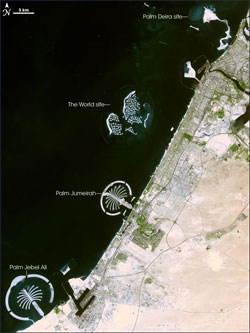 The
sand islands, which are the largest human-made islands in the world, are
being built at an incredible cost in both monetary -- "The World" alone will
cost more than $14 billion -- and environmental terms.
The
sand islands, which are the largest human-made islands in the world, are
being built at an incredible cost in both monetary -- "The World" alone will
cost more than $14 billion -- and environmental terms.
Two
of the islands -- Palm Jebel Ali and Palm Jumeirah -- resemble encircled
palm trees, while "The World" island will resemble a world map once
completed, though this will only be apparent from aerial photos.
Palm Jumeirah when complete will have 17 huge fronds
framed by a 12-kilometer protective barrier. When completed, the resort will
sport 2,000 villas, 40 luxury hotels, shopping centers, cinemas, and other
facilities. When completed, the resort is expected to support a population
of approximately 500,000 people.
Dubai's crown prince, Sheikh Mohammed bin Rashid Al Maktoum, has given Michael Schumacher a piece of the man-made island paradise The World. located off the coast of the United Arab Emirates, as a parting gift after his last grand prix in Brazil. Schumacher's island, apparently part of "Antarctica" on the artificial globe, is worth about $7 million.
From south to
north the artificial island sites in this image are Palm Jebel Ali, Palm
Jumeirah, The World, and Palm Deira. Palm Jebel Ali and Palm Jumeirah appear
largely complete in this image, looking like giant palm trees enclosed in
huge arcs. Palm Deira, intended to be an even bigger palm tree when
complete, is in the earliest stages of construction. In between Palm
Jumeirah and the site for Palm Deira is the site for The World, which, when
complete, will resemble a world map. NASA images courtesy of the NASA/GSFC/MITI/ERSDAC/JAROS,
and U.S./Japan ASTER Science Team.
More pictures of Dubai from the sky can be
seen
here.
Trying to balance growth and identity in Dubai
20 October 2006
From the New York Times
UBAI, United Arab Emirates South Asians call it "the best-run Indian city," Arabs celebrate it as a model of Arab accomplishment, and Westerners have embraced it for its endless sunshine and luxury lifestyle.
With more than 150 nationalities and almost as many expressions of culture, Dubai is one of the most diverse cities in the Middle East. But after decades of selling dreams to foreigners, this Gulf emirate has begun debating the limits of multiculturalism.
Tensions burst into the open in early October when an English-language newspaper published an article decrying the growing disrespect for Muslim customs here during the holy month of Ramadan, setting off a rare public debate about Dubai's cultural identity.
"Too much flesh on show is wrong in a Muslim country at any time - but offense is being felt especially during Ramadan," said the front-page editorial in 7Days, a free daily tabloid.
The article included photographs of women walking in sleeveless tops and shorts at a shopping mall under the headline "Show Some Respect." 7Days, which is run and edited largely by Westerners, advised its readers to "please remember that this is a Muslim country and many of us are guests here."
Within hours, the newspaper was flooded with e-mails and phone calls, many praising the paper for acknowledging the sensitivities of Muslims but many others lambasting it for seeming to toe an official line.
Soon the entire emirate was talking.
"We fear that the expatriate is going to impose his culture on us," said Maya Rashid Ghadeer, a columnist with the daily Al Bayan in Dubai, who writes about the local community. "Most locals are afraid that they are losing their basic identity forever."
For decades the emirate, part of the federation of seven principalities that make up the United Arab Emirates, sought to broaden its economy by welcoming foreigners and their investment dollars, turning itself into a shipping hub, a regional business hub and, more recently, a tourist hub with luxury hotels and resorts.
The city's openness has helped produce dramatic economic growth and development, with wide swaths under construction and more projects in the works. The boom has brought big-city problems like inflation, rising crime, higher divorce rates and traffic.
But beyond that, it has taken a toll on local culture as many young Emaratis have begun looking abroad, abandoning many traditions and even marrying foreigners. With only about 200,000 local citizens, the demographics are daunting, said Abdulkhaliq Abdallah, a professor of political science at United Arab Emirates University.
"Usually minorities assimilate into the majority," Abdallah said. "But we don't want to assimilate into the majority. We want to preserve the localness, the Emaratiness of this city."
At the same time, Dubai is famous for offering a kind of Disneyland fantasy to its tourists. In December, luxury resort hotels have large Christmas trees, and it can be hard to orient oneself. Many outsiders say that is what makes Dubai stand out in the region, and that the reaction to the article on Muslim modesty involved some pushing back.
"Hello, this is 2006, not 1666," wrote one critical reader, who demanded to know what was wrong with the clothing styles. "Does Dubai want to move forward in time where women are no longer regarded as second-class citizens?"
Dubai has implemented strict rules about public behavior - a man and woman kissing in public can be arrested; it is an offense to dress inappropriately during Ramadan; and altercations with locals can land expatriates in detention.
But with millions of tourists passing through here, few of the laws are actually implemented. Ramadan, which ends this weekend, is a month when Muslims fast during daylight as part of what is supposed to be an intense focus on spirituality, then eat at night. This Ramadan, however, stores stayed open throughout the day, rather than closing during the afternoon, and many restaurants continued to serve during fasting hours. Locals and expatriate Muslims have continued to complain of a lack of Ramadan spirit compared with previous years.
"This is still a salad platter with a tomato and cucumber that don't mix," Abdallah said, stressing that Dubai could never be a melting pot because foreigners are ineligible for citizenship. "It is a massive experiment in social tolerance, and it should be promoted as such. But being tolerant should not come at the expense of the local and national identity."
At least part of the tensions stem from the deep cultural divide here. For the most part, locals tend to live apart from expatriates and rarely interact socially with them.
As in many Gulf states, Dubai's ethnic groups also exist in clearly defined socioeconomic stratifications - locals are typically owners, Westerners earn the top salaries, and south Asians generally do the menial labor.
"Here you don't taste the cultural food and you don't have a chance to wear the clothes, because there is no mandate to do so," said Rima Sabban, a sociologist at Emirates University. "There is nothing for you to do; there is no one culture for you to learn. The model that nationals have provided is that it's OK to stay close to your community."
Seizing on that division, the Sheikh Muhammed Center for Cultural Understanding, financed by Dubai's ruler, Sheik Muhammed Al Maktoum, has invited expatriates to locals' homes for dinner and organized tours and meals throughout the city. Inside a local shopping mall this month, Khulood al Atiyat and several other college students have manned a booth inviting shoppers to meet and speak with an Emarati.
"This is a place where they can come and talk to us and ask questions," Atiyat said.
"We are proud of who we are, and we intend to stick to who we are."
FEAR AND MONEY IN DUBAI
New Left Review 41, September-October 2006
On the rim of the war zone, a new Mecca of conspicuous consumption and economic crime, under the iron rule of Sheikh al-Maktoum. Skyscrapers half a mile high, artificial archipelagoes, fantasy theme parks—and the indentured Asian labour force that sustains them.
‘As your jet starts its descent, you are glued to your window. The scene below is astonishing: a 24-square-mile archipelago of coral-coloured islands in the shape of an almost-finished puzzle of the world. In the shallow green waters between continents, the sunken shapes of the Pyramids of Giza and the Roman Colosseum are clearly visible. In the distance, three other large island groups are configured as palms within crescents and planted with high-rise resorts, amusement parks and a thousand mansions built on stilts over the water. The ‘Palms’ are connected by causeways to a Miami-like beachfront crammed with mega-hotels, apartment skyscrapers and yachting marinas.

‘As the plane slowly banks toward the desert mainland, you gasp at the even more improbable vision ahead. Out of a chrome forest of skyscrapers soars a new Tower of Babel. It is an impossible half-mile high: taller than the Empire State Building stacked on top of itself. You are still rubbing your eyes with wonderment as the plane lands and you are welcomed into an airport shopping emporium where seductive goods entice: Gucci bags, Cartier watches and one-kilogram bars of solid gold. The hotel driver is waiting for you in a Rolls Royce Silver Seraph. Friends had recommended the Armani Inn in the 170-storey tower, or the 7-star hotel with an atrium so huge that the Statue of Liberty would fit inside it, and service so exclusive that the rooms come with personal butlers; but instead you have opted to fulfill a childhood fantasy. You always have wanted to play Captain Nemo in Twenty Thousand Leagues Under the Sea.
‘Your jellyfish-shaped hotel, the Hydropolis, is, in fact, exactly 66 feet below the surface of the sea. Each of its 220 luxury suites has clear plexiglass walls that provide spectacular views of passing mermaids and of the famed ‘underwater fireworks’: a hallucinatory exhibition of ‘water bubbles, swirled sand and carefully deployed lighting’. Any initial anxiety about the safety of your sea-bottom resort is dispelled by the smiling concierge. The structure has a multi-level fail-safe security system which includes protection against terrorist submarines as well as missiles and aircraft.
‘Although you have an important business meeting at Internet City with clients from Hyderabad and Taipei, you have arrived a day early to treat yourself to one of the famed adventures at the ‘Restless Planet’ themepark. After a soothing night’s sleep under the sea, you board a monorail for this Jurassic jungle. Your first encounter is with some peacefully grazing brontosaurs. Next you are attacked by a flock of velociraptors, the animatronic beasts—designed by experts from the British Natural History Museum—so flawlessly lifelike that you shriek in fear and delight. With your adrenaline pumped up by this close call, you round off the afternoon with some snowboarding on the local indoor snow mountain (outdoors, the temperature is 105°). Nearby is the world’s largest mall—the altar of the city’s famed Shopping Festival, which attracts millions of frenetic consumers each January—but you postpone the temptation. Instead, you indulge in some expensive Thai fusion cuisine. The gorgeous Russian blonde at the restaurant bar stares at you with vampirish hunger, and you wonder whether the local sin is as extravagant as the shopping . . . ’
Fantasy levitated
Welcome to a strange paradise. But where are you? Is this a new Margaret Atwood novel, Philip K. Dick’s unpublished sequel to Blade Runner or Donald Trump on acid? No. It is the Persian Gulf city-state of Dubai in 2010. After Shanghai (current population 15 million), Dubai (current population 1.5 million) is the planet’s biggest building site: an emerging dreamworld of conspicuous consumption and what the locals boast as ‘supreme lifestyles’. Despite its blast-furnace climate (on typical 120° summer days, the swankier hotels refrigerate their swimming pools) and edge-of-the-war-zone location, Dubai confidently predicts that its enchanted forest of 600 skyscrapers and malls will attract 15 million overseas visitors a year by 2010, three times as many as New York City. Emirates Airlines has placed a staggering $37-billion order for new Boeings and Airbuses to fly these tourists in and out of Dubai’s new global air hub, the vast Jebel Ali airport. Indeed, thanks to a dying planet’s terminal addiction to Arabian oil, this former fishing village and smugglers’ cove proposes to become one of the world capitals of the 21st century. Favouring diamonds over rhinestones, Dubai has already surpassed that other desert arcade of capitalist desire, Las Vegas, both in sheer scale of spectacle and the profligate consumption of water and power.
Dozens of outlandish mega-projects—including the artificial ‘island world’ (where Rod Stewart has reportedly spent $33 million to buy ‘Britain’), the earth’s tallest building (Burj Dubai, designed by Skidmore, Owings & Merrill), the underwater luxury hotel, the carnivorous dinosaurs, the domed ski resort and the hyper-mall—are already under construction or about to leave the drawing board. The 7-star hotel, the spinnaker-shaped Burj Al-Arab—looking much like the set of a James Bond film—is already world-famous for its $5,000 per-night rooms with 100-mile views and an exclusive clientele of Arab royalty, English rock stars and Russian billionaires. And the dinosaurs, according to the finance director of the Natural History Museum, ‘will have the full stamp of authority of the Museum in London, and will demonstrate that education and science can be fun’; and profitable, since the ‘only way into the dinosaur park will be through the shopping mall’.
The biggest project, Dubailand, represents a vertiginous new stage in fantasy environments. Literally a ‘themepark of themeparks’, it will be more than twice the size of Disney World and employ 300,000 workers who, in turn, will entertain 15 million visitors per year (each spending a minimum of $100 per day, not including accommodation). Like a surrealist encyclopaedia, its 45 major ‘world class’ projects include replicas of the Hanging Gardens of Babylon, the Taj Mahal and the Pyramids, as well as a snow mountain with ski lifts and polar bears, a centre for ‘extreme sports’, a Nubian village, ‘Eco-Tourism World’, a vast Andalusian spa and wellness complex, golf courses, autodromes, race tracks, ‘Giants’ World’, ‘Fantasia’, the largest zoo in the Middle East, several new 5-star hotels, a modern art gallery and the Mall of Arabia.
Gigantism
Under the enlightened despotism of its Emir and ceo, 58-year-old Sheikh Mohammed al-Maktoum, Dubai has become the new global icon of imagineered urbanism. Multi-billionaire Sheikh Mo—as he is known to Dubai’s expats—has a straightforward if immodest goal: ‘I want to be Number One in the world’. Although he is an ardent collector of thoroughbreds (the world’s largest stable) and super-yachts (the 525-foot-long ‘Project Platinum’, which has its own submarine and flight deck), his consuming passion is over-the-top, monumental architecture. Indeed, he seems to have imprinted Scott and Venturi’s bible of hyper-reality, Learning From Las Vegas, in the same way that pious Muslims memorize the Qur’an. One of his proudest achievements, he often tells visitors, is to have introduced gated communities to Arabia, the land of nomads and tents.
Thanks to his boundless enthusiasm for concrete and steel, the coastal desert has become a huge circuit board upon which the elite of transnational engineering firms and retail developers are invited to plug in high-tech clusters, entertainment zones, artificial islands, glass-domed ‘snow mountains’, Truman Show suburbs, cities within cities—whatever is big enough to be seen from space and bursting with architectural steroids. The result is not a hybrid but an eerie chimera: a promiscuous coupling of all the cyclopean fantasies of Barnum, Eiffel, Disney, Spielberg, Jon Jerde, Steve Wynn and Skidmore, Owings & Merrill. Although compared variously to Las Vegas, Manhattan, Orlando, Monaco and Singapore, the sheikhdom is more like their collective summation and mythologization: a hallucinatory pastiche of the big, the bad and the ugly.
The same phantasmagoric but generic Lego
blocks, of course, can be found in dozens of aspiring cities these days
(including Dubai’s envious neighbours, the wealthy oil oases of Doha and
Bahrain), but al-Maktoum has a distinctive and inviolable criterion:
everything must be ‘world class’, by which he means Number One in the
Guinness Book of Records. Thus Dubai is building the world’s largest theme
park, the biggest mall (and within it, the largest aquarium), the tallest
building, the largest international airport, the biggest artificial island,
the first sunken hotel and so on (see below). Although such architectural
megalomania is eerily reminiscent of Albert Speer and his patron’s vision of
imperial Berlin, it is not irrational. Having ‘learned from Las Vegas’, al-Maktoum
understands that if Dubai wants to become the luxury-consumer paradise of
the Middle East and South Asia (its officially defined ‘home market’ of 1.6
billion), it must ceaselessly strive for visual and environmental excess.
If, as Rowan Moore has suggested, immense, psychotic assemblages of fantasy
kitsch inspire vertigo, then al-Maktoum wants us to swoon.
From a booster’s viewpoint, the city’s monstrous caricature
of futurism is simply shrewd branding for the world market. As one developer
told the Financial Times, ‘If there was no Burj Dubai, no Palm, no
World, would anyone be speaking of Dubai today? You shouldn’t look at
projects as crazy stand-alones. It’s part of building the brand’. And its
owners love it when architects and urbanists, like George Katodrytis, anoint
it as the cutting edge:
Dubai is a prototype of the new post-global city, which creates appetites rather than solves problems . . . If Rome was the ‘Eternal City’ and New York’s Manhattan the apotheosis of twentieth-century congested urbanism, then Dubai may be considered the emerging prototype for the 21st century: prosthetic and nomadic oases presented as isolated cities that extend out over the land and sea.
In its exponential quest to conquer the architectural record-books, moreover, Dubai has only one real rival: China—a country that now has 300,000 millionaires and is predicted to become the world’s largest market for luxury goods (from Gucci to Mercedes) in a few years. Starting from feudalism and peasant Maoism, respectively, both have arrived at the stage of hyper-capitalism through what Trotsky called the ‘dialectic of uneven and combined development’. As Baruch Knei-Paz writes in his admirable précis of Trotsky’s thought:
In appending new forms the backward society takes not their beginnings, nor the stages of their evolution, but the finished product itself. In fact it goes even further; it copies not the product as it exists in its countries of origin but its ‘ideal type’, and it is able to do so for the very reason that it is in a position to append instead of going through the process of development. This explains why the new forms, in a backward society, appear more perfected than in an advanced society where they are approximations only to the ‘ideal’ for having been arrived at piecemeal and with the framework of historical possibilities.
In the cases of Dubai and China, all the arduous intermediate stages of commercial evolution have been telescoped or short-circuited to embrace the ‘perfected’ synthesis of shopping, entertainment and architectural spectacle, on the most pharaonic scale.
As a sweepstake in national pride—Arabs versus Chinese—this frantic quest for hyperbole is not of course, unprecedented; recall the famed competition between Britain and imperial Germany to build dreadnoughts in the early 1900s. But is it an economically sustainable strategy of development? The textbook answer is probably not. Architectural gigantism has always been a perverse symptom of economies in speculative overdrive, and each modern boom has left behind overweening skyscrapers, the Empire State Building or the former World Trade Center, as its tombstones. Cynics rightly point out that the hypertrophic real-estate markets in Dubai and urban China are the sinks for global excess profits—of oil and manufacturing exports, respectively—currently being pyramided by rich countries’ inability to reduce oil consumption and, in the case of the United States, to balance current accounts. If past business cycles are any guide, the end could be nigh and very messy. Yet, like the king of the enigmatic floating island of Laputa in Gulliver’s Travels, al-Maktoum believes that he has discovered the secret of eternal levitation.
The lodestone of Dubai, of course, is ‘peak oil’ and each time you spend $50 to fill your tank, you are helping to irrigate al-Maktoum’s oasis. Fuel prices are currently inflated by industrial China’s soaring demand as well as growing fears of war and terrorism in the global oil patch. According to the Wall Street Journal, ‘consumers will [have paid] $1.2 trillion more in 2004 and 2005 together for oil products than they did in 2003’ As in the 1970s, a huge and disruptive transfer of wealth is taking place between oil-consuming and oil-producing nations. Already visible on the horizon, moreover, is Hubbert’s Peak, the tipping point when new petroleum reserves will no longer offset global demand, and thereafter oil prices will become truly stratospheric. In some utopian economic model, perhaps, this windfall would become an investment fund for shifting the global economy to renewable energy while reducing greenhouse gas output and raising the environmental efficiency of urban systems. In the real world of capitalism, however, it has become a subsidy for the apocalyptic luxuries that Dubai is coming to epitomize.
Miami of the Persian Gulf
According to his hagiographers, Dubai has arrived at its blessed state thanks largely to the entrepreneurial vision that al-Maktoum inherited from his father, Sheikh Rashid, who ‘committed himself and his resources to turning his emirate into a modern world-class entrepôt where free enterprise flourished’. In fact, Dubai’s irresistible rise, like that of its parent, the United Arab Emirates, owes as much to a sequence of fortuitous geopolitical accidents. Dubai’s chief regional advantage, paradoxically, has been its modest endowment, now rapidly being exhausted, of offshore oil. With a tiny hinterland lacking the geological wealth of Kuwait or Abu Dhabi, Dubai has escaped poverty by a Singaporean strategy of becoming the key commercial, financial and recreational hub of the Gulf. It is a postmodern ‘city of nets’—as Brecht called ‘Mahagonny’—where the super-profits of the international oil trade are intercepted and then reinvested in Arabia’s one truly inexhaustible natural resource: sand. (Indeed, mega-projects in Dubai are typically measured by volumes of sand moved: one billion cubic feet in the case of the ‘island world’.) If the current mega-project blitzkrieg, exemplified by Dubailand, succeeds as planned, Dubai will derive all of its gdp from non-oil activities like tourism and finance by 2010.
The platform for Dubai’s extraordinary ambitions has been its long history as a haven for smugglers, gold dealers and pirates. A late-Victorian treaty gave London control over Dubai’s foreign affairs, keeping the Ottomans and their tax collectors out of the region, but otherwise allowing the al-Maktoum dynasty to exploit their ownership of the only natural deepwater port along 400 miles of what was then known as the ‘Pirates’ Coast’. Pearl fishing and smuggling were the mainstays until oil wealth began to generate increased demand for Dubai’s commercial savvy and port services. Up to 1956, when the first concrete building was constructed, the entire population lived in traditional ‘barastri’ homes made from palm fronds, drawing water from communal wells and tethering their goats in the narrow streets.
After the British withdrawal from East of Suez in 1968, Sheikh Rashid joined with the ruler of Abu Dhabi, Sheikh Zayed, to create the United Arab Emirates in 1971, a feudal federation bound together by the common threat of the Marxists in Oman and, later, the Islamists in Iran. Abu Dhabi possessed the greater share of the uae’s oil wealth (almost one-twelfth of the world’s proven hydrocarbon reserves) but Dubai was the more logical port and commercial centre. When the city’s original deep-water ‘creek’ proved too small to handle burgeoning trade, the uae’s leadership used some of their earnings from the first ‘oil shock’ to help Dubai finance construction of the world’s largest man-made port, completed in 1976.
Following Khomeini’s revolution in 1979, it also became the Persian Gulf’s Miami, providing refuge to a large community of Iranian exiles, many of whom specialized in smuggling gold, untaxed cigarettes and liquor to their puritanical homeland, and to India. More recently, Dubai under the tolerant gaze of Tehran has attracted large numbers of wealthy Iranians who use the city—more like Hong Kong than Miami —as a base for trade and bi-national life-styles. They are estimated to control as much as 30 per cent of Dubai’s current real-estate development. Building on such clandestine connections, Dubai in the 1980s and early 1990s became the Gulf’s principal dirty-money laundry as well as a bolthole for some of the region’s most notorious gangsters and terrorists. As the Wall Street Journal recently described the city’s underside:
Its gold and diamond souks, houses of barter and informal cash-transfer storefronts have long formed an opaque business world based on connections and clan allegiances. Black-market operators, arms dealers, terrorist financiers and money launderers have taken advantage of the freewheeling environment, even if the vast bulk of business is legitimate.
In early 2006 the us Congress erupted in a furore over Dubai Port World’s imminent takeover of the London-based Peninsular and Oriental Steam Navigation Company, which operates docks from New York to Miami. Despite support from the Bush Administration, Dubai was forced to withdraw from the deal after a firestorm of accusations on cable news programmes and radio talk-shows about the supposed dangers of ceding control of American commercial ports to a Middle Eastern government. Much of the controversy was unquestionably fuelled by anti-Arab bigotry pure and simple (us port operations are already largely under management of foreign-owned firms), but Dubai’s ‘terrorist connection’, an outgrowth of its role as the Switzerland of the Gulf, has been well documented.
Indeed, since 9/11 a huge investigative literature has explored Dubai’s role as ‘the financial hub for Islamic militant groups’, especially al-Qaeda and the Taliban: ‘all roads lead to Dubai when it comes to [terrorist] money’, claims a former high-ranking us Treasury official. Bin Laden reportedly transferred large sums through the government-owned Dubai Islamic Bank, while the Taliban used the city’s unregulated gold markets to transform their opium taxes, paid in gold bullion, into laundered dollars.In his best-selling Ghost Wars, Steve Coll claims that after the catastrophic al-Qaeda bombings of the us embassies in Nairobi and Dar es Salaam, a cia scheme to target bin Laden with cruise missiles while he was falcon hunting in southern Afghanistan had to be aborted because he was in the company of unnamed Emirati royalty. Coll adds that the cia ‘also suspected that C-130s flying out of Dubai carried weapons to the Taliban’.
In addition, al-Maktoum for almost a decade provided luxurious sanctuary for Bombay’s Al Capone, the legendary gangster Dawood Ibrahim. His presence in the sheikhdom in the late 1980s was hardly low-key. ‘Dubai’, writes Suketu Mehta, ‘suited Dawood; he re-created Bombay in lavish parties, flying in scores of the city’s top film stars and cricketers as guests, and took a film starlet, Mandakini, as his mistress’. In early 1993, according to the Indian government, Dawood, working with Pakistani intelligence officials, used Dubai as a base for organizing the infamous ‘Black Friday’ bombings in Bombay that killed 257 people. Although India immediately requested Dubai to arrest Dawood, he was allowed to flee to Karachi, where he is still sheltered by the Pakistani government; his criminal organization, ‘D-Company’, meanwhile, has reportedly continued to be active in the sheikhdom.
War zone
Dubai now enjoys high marks from Washington as a partner in the War on Terror and, in particular, as a base for spying on Iran; but it is probable that al-Maktoum, like the other Emirati rulers, still keeps a channel open to radical Islamists. If al-Qaeda so desired, for example, it could presumably turn the Burj Al-Arab and Dubai’s other soaring landmarks into so many towering infernos. Yet so far Dubai is one of the few cities in the region to have entirely avoided car-bombings and attacks on Western tourists: eloquent testament, one might suppose, to the city-state’s continuing role as a money laundry and upscale hideout, like Tangiers in the 1940s or Macao in the 1960s. Dubai’s burgeoning black economy is its insurance policy against the car-bombers and airplane hijackers.
In many complex and surprising ways, Dubai actually earns its living from fear. Its huge port complex at Jebel Ali, for example, has profited immeasurably from the trade generated by the us invasion of Iraq, while Terminal Two at the Dubai airport, always crowded with Halliburton employees, private mercenaries and American soldiers en route to Baghdad or Kabul, has been described as ‘the busiest commercial terminal in the world’ for America’s Middle East wars. Post-9/11 developments have also shifted global investment patterns to Dubai’s benefit. Thus after al-Qaeda’s attacks on America, the Muslim oil states, traumatized by the angry Christians in Washington and lawsuits by wtc survivors, no longer considered the United States the safest harbour for their petrodollars. Panicky Saudis alone are estimated to have repatriated at least one-third of their trillion-dollar overseas portfolio. Although nerves are now calmer, Dubai has benefited enormously from the continuing inclination of the oil sheikhs to invest within, rather than outside, the region. As Edward Chancellor has emphasized, ‘unlike the last oil boom of the late 1970s, relatively little of the current Arab oil surplus has been directly invested in us assets or even deposited in the international banking system. This time much of the oil money has remained at home where a classic speculative mania is now being played out.’
In 2004, the Saudis (500,000 of whom are estimated to visit Dubai at least once a year) were believed to have ploughed at least $7 billion into al-Maktoum’s major properties. Saudis, together with investors from Abu Dhabi, Kuwait, Iran and even emulous Qatar, bankroll the hubris of Dubailand (officially developed by Dubai’s billionaire Galadari brothers) and other colossal fantasy projects. Although economists stress the driving role of equity investment in the current Gulf boom, the region is also awash with cheap bank credit thanks to a 60 per cent increase in the local deposit base and the slipstreaming of the us Federal Reserve’s easy money policies (the currencies of the Gulf emirates are all linked to the dollar).
Much of this money, of course, dances to an old tune. ‘A majority of new Dubai properties’, explains Business Week, ‘are being acquired for speculative purposes, with only small deposits put down. They are being flipped in the contemporary Miami manner.’ But what is too often ‘flipped’, some economists predict, may ultimately flop. Will Dubai someday fall from the sky when this real-estate balloon bursts, or will peak oil keep this desert Laputa floating above the contradictions of the world economy? Al-Maktoum remains a mountain of self-confidence: ‘I would like to tell capitalists that Dubai does not need investors; investors need Dubai. And I tell you that the risk lies not in using your money, but in letting it pile up.’
Dubai’s philosopher-king (one of the huge offshore island projects will actually spell out an epigram of his in Arabic script) is well aware that fear is also the most dynamic component of the oil revenues that turn his sand dunes into malls and skyscrapers. Every time insurgents blow up a pipeline in the Niger Delta, a martyr drives his truck bomb into a Riyadh housing complex, or Washington and Tel Aviv rattle their sabres at Tehran, the price of oil (and thus Dubai’s ultimate income) increases by some increment of anxiety in the all-important futures market. The Gulf economies, in other words, are now capitalized not just on oil production, but also on the fear of its disruption. According to a recent survey of experts by Business Week, ‘the world paid the Persian Gulf oil states an extra $120 billion or so last year because of the premium in prices due to fear of unexpected supply disruptions. Some cynics argue that oil producers welcome the fear of disruption because it boosts their revenues’. ‘Fear’, according to one of the senior energy analysts that the magazine consulted, ‘is a gift to oil producers’.
But it is a gift that the oil rich would rather spend in a tranquil oasis surrounded by very high walls. With its sovereignty ultimately guaranteed by the American nuclear super-carriers usually berthed at Jebel Ali, as well as by whatever secret protocols (negotiated during falcon hunting trips in Afghanistan?) govern the Emiratis’ relationship to Islamic terrorism, Dubai is a paradise of personal security, from the Swiss-style laws governing financial secrecy to the armies of concierges, watchmen and bodyguards who protect its sanctums of luxury. Tourists are customarily ordered away by the security guards if they attempt to sneak a peek at Burj Al-Arab on its private island. Hotel guests, of course, arrive in Rolls Royces.
Milton Friedman’s beach club
Dubai, in other words, is a vast gated community, the ultimate Green Zone. But even more than Singapore or Texas, it is also the apotheosis of the neo-liberal values of contemporary capitalism: a society that might have been designed by the Economics Department of the University of Chicago. Dubai, indeed, has achieved what American reactionaries only dream of—an oasis of free enterprise without income taxes, trade unions or opposition parties (there are no elections). As befits a paradise of consumption, its unofficial national holiday, as well as its global logo, is the celebrated Shopping Festival, a month-long extravaganza sponsored by the city’s 25 malls that begins on 12 January and attracts 4 million upscale shoppers, primarily from the Middle East and South Asia.
Feudal absolutism—the Maktoum dynasty owns the land area of Dubai —meanwhile has been spruced up as the last word in enlightened corporate administration, and the political sphere has been officially collapsed into the managerial. ‘People refer to our crown prince as the chief executive officer of Dubai. It’s because, genuinely, he runs government as a private business for the sake of the private sector, not for the sake of the state’, says Saeed al-Muntafiq, head of the Dubai Development and Investment Authority. Moreover, if the country is a single business, as al-Maktoum maintains, then ‘representative government’ is besides the point: after all, General Electric and Exxon are not democracies and no one—except for raving socialists—expects either to be so.
The state, accordingly, is almost indistinguishable from private enterprise. Dubai’s top managers—all commoners, hired meritocratically—simultaneously hold strategic government portfolios and manage a major Maktoum-controlled real-estate development company. ‘Government’, indeed, is really an equities management team led by three top players who compete with one another to earn the highest returns for al-Maktoum (see Table 2). ‘In such a system’, writes William Wallis, ‘the concept of a conflict of interest is barely recognized’. Because the country has one ultimate landlord, and myriad streams of rent and lease payments all flow to a single beneficiary, Dubai is able to dispense with most of the sales, customs and income taxes essential to governments elsewhere. The minimal tax burden, in turn, leverages the sale or lease of Dubai’s golden sands. Oil-rich Abu Dhabi, meanwhile, subsidizes the residual state functions, including foreign relations and defence, entrusted to the Emirates’ federal administration—itself a condominium of the interests of the ruling sheikhs and their relatives.
In a similar spirit, personal liberty in Dubai derives strictly from the business plan, not from a constitution, much less ‘inalienable rights’. Al-Maktoum and his executives have to arbitrate between lineage-based power and Islamic law, on the one hand, and Western business culture and recreational decadence on the other. Their ingenious solution is a regime of what might be called ‘modular liberties’ based on the rigorous spatial segregation of economic functions and ethnically circumscribed social classes. To understand how this works in practice, it is necessary briefly to survey Dubai’s overall development strategy.
Although tourist development and its excesses generate most of the ‘buzz’ about Dubai, the city-state has extraordinary ambitions to capture as much value-added as possible through a series of specialized free-trade zones and high-tech clusters. ‘One of the ways that this trading town along a creek has reformulated itself into a megalopolis’, writes an abc News commentator, ‘is by throwing in everything and the kitchen sink as incentives for companies to invest in and relocate to Dubai. There are free-trade zones where 100 per cent foreign ownership is allowed, with no individual or corporate taxes or import/export duties whatsoever.’ The original free-trade zone in the port district of Jebel Ali now has several thousand resident trading and industrial firms, and is the major base for American corporations selling to the Saudi and Gulf markets.
Most future growth, however, is expected to be generated within an archipelago of specialized ‘clusters’. The largest of these cities-within-the-city are Internet City, already the Arab world’s principal information technology hub, with local subsidiaries of Dell, Hewlett-Packard, Microsoft, and others; Media City, home to the Al Arabiya satellite network and various international news organizations; and the Dubai International Financial Centre, whose dfix al-Maktoum hopes will grow into the largest stock exchange between Europe and East Asia as foreign investors rush to tap the Gulf’s vast reservoir of oil earnings. In addition to these mega-enclaves, each with tens of thousands of employees, Dubai also hosts or is planning to build a Humanitarian Aid City, as a base for disaster relief; a free-trade zone dedicated to the sale of used cars; a Dubai Metals and Commodities Centre; a ‘Chess City’ headquartering the International Chess Association and designed as a vast chess board with two ‘King’ towers, each 64 storeys high; and a $6 billion Healthcare Village, in collaboration with the Harvard Medical School, that will offer the wealthy classes of the Gulf region state-of-the-art American medical technology.
Other cities in the region, of course, have free-trade zones and high-tech clusters, but only Dubai has allowed each enclave to operate under regulatory and legal bubble-domes tailored to the specific needs of foreign capital and expat professionals. ‘Carving out lucrative niches with their own special rules’, claims the Financial Times, ‘has been at the heart of Dubai’s development strategy’.Thus press censorship (flagrant in the rest of Dubai) is largely suspended inside Media City, while internet access (regulated for content elsewhere) is absolutely unfettered inside Internet City. The uae has permitted Dubai to set up ‘an entirely separate, Western-based commercial system for its financial district that would do business in dollars, and in English’. Although not without ensuing controversy, Dubai even imported British financial regulators and retired judges to bolster confidence that dfix plays by the same rules as Zurich, London and New York. Meanwhile, to promote the sell-off of Palm Jumeirah mansions and the private islands that make up the ‘island world’, al-Maktoum in May 2002 announced a ‘freehold revolution’, unique in the region, that allows foreigners to buy luxury property outright and not just as a 99-year lease.
In addition to these enclaved regimes of greater media and business freedom, Dubai is also famously tolerant of Western vices, with the exception of recreational drugs. In contrast to Saudi Arabia or even Kuwait City, booze flows freely in the city’s hotels and expat bars, and no one looks askance at halter tops or even string bikinis on the beach. Dubai—any of the hipper guidebooks will advise—is also the ‘Bangkok of the Middle East’, with thousands of Russian, Armenian, Indian and Iranian prostitutes controlled by various transnational gangs and mafias. The Russian girls at the bar are the glamorous façade of a sinister sex trade built on kidnapping, slavery and sadistic violence. Al-Maktoum and his thoroughly modern regime, of course, disavow any collusion with this burgeoning red-light industry, although insiders know that the whores are essential to keeping the 5-star hotels full of European and Arab businessmen. When expats extol Dubai’s unique ‘openness’, it is this freedom to carouse and debauch—not to organize unions or publish critical opinions—that they are usually praising.
An indentured, invisible majority
Dubai, together with its emirate neighbors, has achieved the state of the art in the disenfranchisement of labour. In a country that only abolished slavery in 1963, trade unions, most strikes and all agitators are illegal, and 99 per cent of the private-sector workforce are immediately deportable non-citizens. Indeed, the deep thinkers at the American Enterprise and Cato Institutes must salivate when they contemplate the system of classes and entitlements in Dubai.
At the top of the social pyramid, of course, are the al-Maktoums and their cousins who own every lucrative grain of sand in the sheikhdom. Next, the native 15 per cent of the population (many of them originally Arab-speakers from southern Iran) constitutes a leisure class whose uniform of privilege is the traditional white dishdash. Their obedience to the dynasty is rewarded by income transfers, free education, subsidized homes and government jobs. A step below are the pampered mercenaries: more than 100,000 British expatriates (another 100,000 uk citizens own second homes or condos in Dubai), along with other European, Lebanese, Iranian and Indian managers and professionals, who take full advantage of their air-conditioned affluence and two months of overseas leave every summer. The Brits, led by David Beckham (who owns a beach) and Rod Stewart (who owns an island), are probably the biggest cheerleaders for al-Maktoum’s paradise, and many of them luxuriate in a social world that recalls the lost splendour of gin-and-tonics at Raffles and white mischief in Simla’s bungalows. Dubai is expert at catering to colonial nostalgia.
The city-state is also a miniature Raj in a more important and notorious aspect. The great mass of the population are South Asian contract labourers, legally bound to a single employer and subject to totalitarian social controls. Dubai’s luxury lifestyles are attended by vast numbers of Filipina, Sri Lankan and Indian maids, while the building boom (which employs fully one-quarter of the workforce) is carried on the shoulders of an army of poorly paid Pakistanis and Indians, the largest contingent from Kerala, working twelve-hour shifts, six and a half days a week, in the asphalt-melting desert heat.
Dubai, like its neighbours, flouts ilo labour regulations and refuses to adopt the international Migrant Workers Convention. Human Rights Watch in 2003 accused the Emirates of building prosperity on ‘forced labour’. Indeed, as the Independent recently emphasized, ‘the labour market closely resembles the old indentured labour system brought to Dubai by its former colonial master, the British.’ ‘Like their impoverished forefathers’, the London paper continued, ‘today’s Asian workers are forced to sign themselves into virtual slavery for years when they arrive in the United Arab Emirates. Their rights disappear at the airport where recruitment agents confiscate their passports and visas to control them.’
In addition to being super-exploited, Dubai’s helots—like the proletariat in Fritz Lang’s Metropolis—are also expected to be generally invisible. The local press (the uae ranks a dismal 137th on the global Press Freedom Index) is restrained from reporting on migrant workers, exploitative working conditions, and prostitution. Likewise, ‘Asian labourers are banned from the glitzy shopping malls, new golf courses and smart restaurants.’ Nor are the bleak work camps on the city’s outskirts—where labourers are crowded six, eight, even twelve to a room, often without air-conditioning or functioning toilets—part of the official tourist image of a city of luxury, without poverty or slums.In a recent visit, even the uae Minister of Labour was reported to be shocked by the squalid, almost unbearable conditions in a remote work camp maintained by a large construction contractor. Yet when the labourers attempted to form a union to win back pay and improve living conditions, they were promptly arrested.
Dubai’s police may turn a blind eye to illicit diamond and gold imports, prostitution rings, and shady characters who buy 25 villas at a time in cash, but they are diligent in deporting Pakistani workers who complain about being cheated out of their wages by unscrupulous contractors, or jailing Filipina maids for ‘adultery’ when they report being raped by their employers. To avoid the simmering volcano of Shiite unrest that so worries Bahrain and Saudi Arabia, Dubai and its uae neighbours have favoured a non-Arab workforce drawn from western India, Pakistan, Sri Lanka, Bangladesh, Nepal and the Philippines. But as Asian workers have become an increasingly restive majority, the uae has reversed course and adopted a ‘cultural diversity policy’—‘we have been asked not to recruit any more Asians’, explained one contractor—to reinforce control over the workforce by diluting the existing national concentrations with more Arab workers.
Discrimination against Asians, however, has failed to recruit enough Arabs willing to work at the lowly wages ($100 to $150 per month) paid to construction labourers to meet the insatiable demands of the exploding skyline and half-built mega-projects. Indeed the building boom, with its appalling safety record and negligence of workers’ most basic needs, has incubated Dubai’s first labour rebellion. In 2004 alone, Human Rights Watch estimated that as many as 880 construction workers were killed on the job, with most of the fatal accidents unreported by employers or covered up by the government. At the same time, the giant construction companies and their subcontractors have failed to guarantee minimum facilities for sanitation or adequate supplies of potable water at remote desert labour camps. Workers also have been exasperated by longer commutes to worksites, the petty tyranny (often with a racial or religious bias) of their supervisors, the spies and company guards in their camps, the debt-bondage of their labour contracts, and the government’s failure to prosecute fly-by-night contractors who leave Dubai or declare bankruptcy without paying back wages. As one embittered labourer from Kerala told the New York Times, ‘I wish the rich people would realize who is building these towers. I wish they could come and see how sad this life is.’
The first tremor of unrest came in fall 2004 when several thousand Asian workers courageously marched down the eight-lane Sheikh Zayed Highway toward the Ministry of Labour, only to be met by riot police and officials threatening mass deportations. Smaller demonstrations and strikes, protesting unpaid wages or unsafe working conditions, continued through 2005, drawing inspiration from a large uprising of Bangladeshi workers in Kuwait during the spring. In September, an estimated 7,000 workers demonstrated for three hours, the largest protest in Dubai history. Then, on 22 March 2006, bullying security men ignited a riot at the vast Burj Dubai tower site.
Some 2,500 exhausted workers were waiting after the end of their shift for long overdue buses to take them back to their dormitories in the desert, when the guards began to harass them. The enraged labourers, many of them Indian Muslims, overwhelmed and beat the guards, then attacked the construction headquarters: burning company cars, ransacking offices, destroying computers and smashing files. The following morning, the army of labourers defied police to return to the site, where they refused to work until Dubai-based Al Naboodah Laing O’Rourke raised wages and improved working conditions. Thousands of construction workers at a new airport terminal also joined the wildcat strike. Although some minor concessions along with draconian threats forced most of the labourers back to work at the Burj Dubai and the airport, the underlying grievances continue to fester. In July, hundreds of labourers at the Arabian Ranches project on Emirates Road rioted to protest the chronic shortage of water for cooking and bathing at their camp. Other workers have held clandestine union meetings and reportedly threatened to picket hotels and malls.
The unruly voice of labour echoes louder in the deserts of the uae than it might elsewhere. At the end of the day, Dubai is capitalized just as much on cheap labour as it is on expensive oil, and the Maktoums, like their cousins in the other emirates, are exquisitely aware that they reign over a kingdom built on the backs of a South Asian workforce. So much has been invested in Dubai’s image as an imperturbable paradise of capital that even small disturbances can have exaggerated impacts on investors’ confidence. Dubai Inc. is thus currently considering a variety of responses to worker unrest, ranging from expulsions and mass arrests to some limited franchising of collective bargaining. But any tolerance of protest risks future demands not just for unions, but for citizenship, and thereby threatens the absolutist foundations of Maktoum rule. None of the shareholders in Dubai—whether the American Navy, the Saudi billionaires, or the frolicking expats—want to see the emergence of a Solidarnosc in the desert.
Al-Maktoum, who fancies himself the Gulf’s prophet of modernization, likes to impress visitors with clever proverbs and heavy aphorisms. A favourite: ‘Anyone who does not attempt to change the future will stay a captive of the past.’ Yet the future that he is building in Dubai—to the applause of billionaires and transnational corporations everywhere—looks like nothing so much as a nightmare of the past: Speer meets Disney on the shores of Araby.


