Welcome to rascott.com
This is a
personal site that reflects my interests in news,
current affairs, aviation and travel.
email me: robert@rascott.com
Now In Dubai:
Scott
Consulting
Photo Albums
My photographs have been moved off this site and are now stored on Picasa. They
were simply taking up too much space on my web host.
Please use
this link to see my list of photo albums.
Some
Useful links:
Information:
World Time
Clock
Exchange Rates
Journalism:
ForeignPolicy
Nationsonline.org
Project Syndicate
Amnesty International
Reporters w/o borders
The Guardian
BBC World News
CNN Asia
Bangkok Post
Daylife.com - news
Gulf News
Arabian Business
World News
WSJ - Asia
SCMP
Good causes:
Sister
Joan - Bangkok
Regional Info:
BKK Magazine
HK Magazine
In
Singapore Magazine
TimeOut Dubai
Back in the UK:
Newton Ferrers
And for fun:
Lin Ping live panda tv
EarthCam
History
BBC Archive
National Media
Museum
The British Library
Imperial War Museum
There are many other links on my AOB blog page.
Emirates Airline - 2010 Review of Flight operations
Source - Airliners.net - and quoted directly.
"This analysis is based on timetable data for the IATA 2010
Northern Winter schedules for the week of December 06 to 12, 2010.
While airline operations are terribly dynamic and changes will occur to these
data, the overall picture will remain valid.
During the week recorded in these data, Emirates plans to operate 1,146
departures and 1,146 arrivals at its Dubai hub for a total of 2,292 DXB
movements. Some of these flights include multiple segments, so the total number
of operated cycles is higher than the number of movements at DXB.
The airline’s active fleet will at that moment consist of 145 aircraft, built up
by 29 Airbus A330-200s, 8 Airbus A340-300s, 10 Airbus A340-500s, 13 Airbus
A380-800s, 9 Boeing B777-200/200ERs, 12 Boeing B777-300As, 10 Boeing B777-200LRs
and 54 Boeing B777-300ERs. The total fleet count may slightly vary depending on
exact delivery dates, but the global picture remains valid.
EK will operate flights to 25 destinations in Europe (flight numbers 1 – 200), 6
destinations in the Americas (flight numbers 201 – 300), 12 destinations in Asia
except the Indian peninsula (flight numbers 301 – 400), 6 destinations in
Oceania (flight numbers 401 – 499), 11 destinations in India and Bangladesh
(flight numbers 500 – 599), 6 destinations in Pakistan/Sri Lanka/Maldives
(flight numbers 600 – 699), 18 destinations in Africa (flight numbers 700 –
799), 7 destinations in the Persian Gulf area (flight numbers 800 – 899) and
another 6 destinations in other parts of the Middle East (flight numbers 900 –
999). Total number of passenger destinations stands as such at 97.
Part I:
Operational Analysis of the Emirates Hub and Spoke Organization (ed: - this
is key - all the Middle East carriers rely on a hub and spoke business rather
than a point to point service)
I.1. The Hub and Spoke Model at work on a daily basis
The majority of EK’s passenger traffic is merely connecting through DXB and the
airline’s organizational model at its home base is geared towards catering to
these flows of connecting traffic. Emirates operates a single hub and spoke
operational model that is based on a number of arrival banks followed by
departure banks that allow for passengers to connect via the hub between various
end points.
The Hub and Spoke operational model has been practiced by airlines around the
world, and although it contains a number of negative aspects pertaining to such
issues as airport congestion around peak times and the uneven use of human
resources at the hub, the Hub and Spoke system remains very popular with medium
and large sized airlines.
At its Dubai home base, Emirates operates the following number of weekly
arrivals, departures and total movements split up per hour:

A graphic representation of both the arrival and departure
movements over the course of a day gives an even better impression of the tidal
character of the arrival and departure banks within the operation:
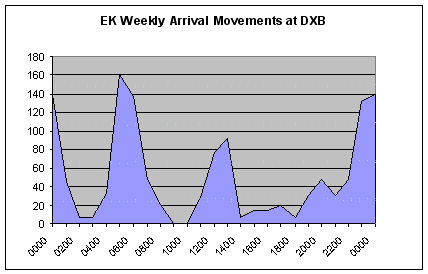
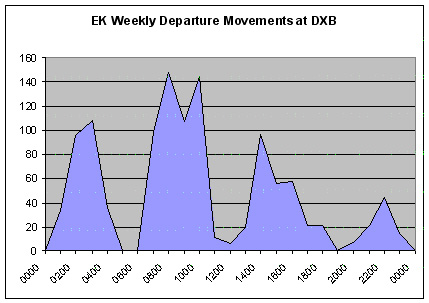
In the above graphs, the x-axis contains the time of the day and the y-axis
represents the total number of weekly movements within that time frame.
At Emirates, the operational day starts with a departure bank between 2 and 4am.
This bank is fed by a corresponding arrivals bank that starts before midnight
the previous day and consists largely of inbound traffic from the airline’s
European network.
A lot of the flights in this departure bank are Asia bound,
and carry Europe-originating traffic.
Shortly after the end of this departure wave, Emirates’ main arrival wave of the
day is starting. The 4 – 7am arrival bank sees inbound traffic from the entire
EK network and will feed into the ensuing main departure wave. Not surprisingly,
right around 5am, the DXB airport starts getting very busy.
After all of this inbound traffic, a new departure wave ensues. The 7 – 11am departure is the airline’s main departure event of the day. Virtually all European destinations are served from this bank, which also caters to North American and African destinations. Towards the end of this wave, a number of Australia bound flights are scheduled.
At 11am, a new, smaller arrival movement starts. This smaller arrivals bank caters to the afternoon secondary European departure wave and carries mainly traffic from Asia and the region. Most of this traffic allows for a daylight trip between the East and Europe.
The secondary European departure wave starts at 2pm and also contains traffic for a number of African destinations. While nowhere nearly as busy as the morning departure grid, this wave is sure to see additional traffic in the future as an increasing number of European and African destinations receive reinforced frequencies.
At 5pm, the quietest hours of the EK DXB operation start. There are relatively few arrivals and departures, and the airline is operating a handful of regional and Indian flights to provide connectivity to some of the inbound North American flights between 7 and 8pm. While the airline is awaiting the main arrivals bank later in the evening, there are a limited number of arrivals and departures.
The last main event of the day is at the same time the start
of the new operational day: from 10pm onwards, DXB is receiving a large number
of arrivals, mainly from Europe, but also from Africa and Asia, which will feed
into the 2 – 4am departure wave.
Combining the arrival and departure movements results in the following graphical
representation of the total number of weekly EK movements at Dubai:
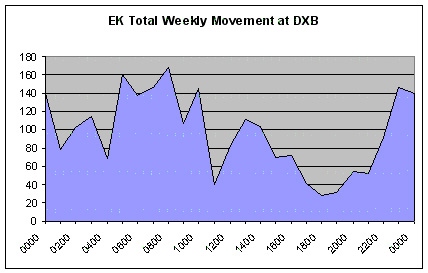
While the separate figures for arrival and departure
movements, which were inserted earlier, give a good idea of the different waves
of inbound and outbound traffic and how these waves flow into each other, the
aggregate figure above clearly shows the degree of operational activity at the
airline’s home base.
DXB is at its busiest between 6am and 10am when the airline’s main overnight
arrivals bank morphs into its main morning departure bank. The second busiest
period is between midnight and 2am, when an identical move, albeit largely in
the opposite direction takes place. The graph also clearly illustrates the
smaller afternoon arrival and departure waves and the relative hibernation of
DXB between the hours of 5 and 10pm.
Given the graph above, some may believe that future growth of the Emirates
operational model will be situated in those quieter times of the day, yet it is
clear that that will not be the case. A similar graph of EK’s arrival and
departure movements in 5 years from now is likely to have largely the same
shape, as the airline is more or less stuck with its own Hub and Spoke model.
Additional departures will be added to existing departure banks so as to provoke
optimal feed. In the same way, additional arrival traffic will be located in the
existing arrivals banks to provide optimal connectivity.
(Ed: the problem here will be airport capacity at DXB - at
peak times there are EK flights going around in circles waiting for a landing
slot. This is why the new Jebel Ali airport is critical for the growth of EK.)
Furthermore, geographical elements dictate a number of schedule characteristics
and the airline has little or no means to break out of these patterns if it
wants to be able to offer competitive and commercially viable schedule options
to its passengers. As such, any new European destinations will almost certainly
depart from the 7-11am bank and arrive in the midnight bank. Growth to existing
European destinations will be established by adding secondary frequencies in the
afternoon departure bank, which in turn makes the already busy early morning
departure bank even busier. Apart from that, the airline will also resort to
aircraft up-gauges, which allow to grow capacity without adding arrival or
departure movements within the busiest periods of the day.
I.2. Geographic Characteristics
As briefly mentioned above, geographic determinants are largely steering the
development of the Hub and Spoke models of airlines around the world. The
geographic location of the hub airport combined with the need to provide optimal
connectivity there is linked to the relative location of areas containing sets
of destinations and this relationship often dictates schedule patterns along
which most if not all of the traffic moves.
Emirates is no exception to this rule and an analysis of schedule details shows
remarkable symmetries in its schedule built up. Broken down by region, the
following picture appears:
EK001–148 DXB – Europe – DXB
As mentioned before, most of the Europe bound traffic is operated from the
airline’s 7-11am departure wave. European airports receive these flights in the
early afternoon and send them back to Dubai for an arrival in the midnight
arrivals bank. These European flights feed into the 2am departure wave to
Africa, Asia and beyond and are fed by the global overnight departure bank.
An increasing number of more established European destinations are seeing second
daily frequencies, which are typically located in the secondary afternoon
departure wave, fed by the 11am arrivals bank from Asia and Africa. As this
arrivals bank is smaller, so is the afternoon departure bank and the airline is
typically deploying smaller capacity aircraft on these European flights than on
the morning departures. These aircraft make a late evening turn around in Europe
and then return to Dubai for an early morning arrival feeding into the non
European components of the 7-11am departure bank.
EK201-262 DXB – Americas – DXB
With up to 9 daily departures, EK’s network to the Americas remains relatively
small, albeit growing.
All destinations are served from the morning departure wave and these flights
return to Dubai the evening of the following day. Outbound flights are obviously
optimally fed by the airline’s early morning arrivals wave, but with a 7pm
arrival time, the inbound flights provide limited direct connectivity with the
exception of those subcontinent and regional destinations served between 9 and
11pm. It goes to show that EK’s North American flights largely cater to regional
and subcontinent destinations, as those are the only ones that are provided with
direct connectivity. All North and South America flights provide a commercially
interesting evening departure from the outstation.
Next winter, EK will be operating second daily frequencies not only to New York,
but for the first time also to Los Angeles and Houston. All of these secondary
flights will leave from the 2am departure wave, fed by the midnight arrivals
bank and return to Dubai the next day in the course of the morning after a
morning turn around in the US. These morning departures from the outstation may
make these flights less popular with premium passengers than the primary evening
departures.
EK302-385 DXB – Asia – DXB
Asia is a growth area for EK, and apart from Australia bound and originating
flights that stop over in the region, the airline is currently operating the
following roster of terminator flights to and from Asia:
Asia terminator flights are equally spread over the 2am and 8-10am departure
banks with respective return flights in the midnight and early morning arrivals
banks, thereby offering seamless connectivity to the rest of the Emirates
network, be that Europe, Africa, the Americas or the region.
EK404-435 DXB – Oceania – DXB
Emirates is operating 63 weekly roundtrips between its Dubai home base and
Australia and New Zealand:
As with the Asia terminator flights, EK’s Australia operations
are located in the 2am and 8-10am departure waves and are thereby optimally fed
by both European arrival banks. DXB arrival times in the early morning and early
afternoon are equally designed to cater for optimal connectivity to European
departure banks, while regional and African connections are also available.
Some of EK’s morning arrivals in Australia make an additional trans Tasman
roundtrip to optimize aircraft utilization and to take advantage of some
additional local traffic on those sectors. Return flights from Australia are
mostly in the evening hours although EK has been struggling with some of the
more ungodly departures times and has recently been forced to withdraw one of
its SYD frequencies that was less commercially viably timed. (Ed - this was
the flight via KUL)
EK500-586 DXB – India/Bangladesh – DXB
Emirates is operating an impressive roster of flights to and from India:
With an average stage length of around 3 hours, most of these flights are
considered regional feeder flights for the remainder of the airline’s network.
As some destinations see higher frequency flights, EK is operating flights to
and from India at all times of the day to ensure optimal connectivity to and
from the essential components of its longhaul operation, not the least to and
from its North American and African networks.
EK600-659 DXB – Pakistan/Sri Lanka/Maldives – DXB
As with the India flights, this sector is largely considered regional and
therefore designed as a feeder for longhaul traffic:
EK has been struggling with an acute lack of additional frequencies for Pakistan
and this region features the smallest growth within the airline’s network.
EK700-798 DXB – Africa – DXB
Africa is becoming increasingly important for airlines around the world and that
is not different for Emirates. It is a region with tremendous growth potential
both in terms of new destinations and reinforced frequencies.
Unlike flights to other regions, flights to Africa may be
found in the airline’s 3 main departure waves at 2-4am, 8-10am and 2-4pm.
Flights are fed through a multitude of inbound flights from the entire EK
network and on their return, these flights are equally to be found in the
airline’s 3 main arrival waves at midnight, 6am and 1pm.
The reason these flights are not confined to one particular arrivals or
departure banks is likely that the airline needs to establish connectivity
between the relatively underserved African region and virtually all components
of its global network.
EK803-867 DXB – Persian Gulf – DXB
Emirates’ shorthaul operations are grouped in this series of flight numbers and
comprise flights to Saudi Arabia, where EK boasts the A388 to Jeddah in order to
compensate for limited frequencies, as well as to other neighboring Gulf States:
More than any other component of the EK network, these flights
serve as feeders for the airline’s global network of medium and longhaul
flights. As such, these flights are scheduled to connect from and feed into the
various arrival and departures waves mentioned before.
EK901-978 DXB – Middle East – DXB
The remaining set of Middle East flights are grouped in the 900-series flight
numbers:
These flights are by and large grouped in the airline’s morning and afternoon
departure banks and are being fed by the arrival waves that come just before
those banks. On their return, these flights feed into the afternoon and midnight
departure banks so as to allow for connections to Asia, Oceania, Africa and
other components of the EK network.
I.3. Future Growth
A lot of speculation is continuously going on about Emirates’ expansion plans.
From an operational perspective, though, not much is left to the imagination as
to the future design of the EK Hub and Spoke model.
As mentioned before, the design of departure and arrival banks as well as the
scheduling within these banks will be very much according to the existing
patterns. The volume of the existing banks will grow and the off peak times of
the hub will remain just that.
With an impressive list of outstanding aircraft orders, Emirates will be able to
fill up existing holes in its network, and, depending on their geographic
location, these destinations will be served according to schedule patterns that
are very similar to the ones presented in the previous paragraph.
As such, any new European destinations are certain to be located in the already
busy morning departure bank and return to Dubai by midnight after an afternoon
turnaround at the outstation. Further growth in the European network will also
come by adding secondary and tertiary flights to high volume destinations.
Secondary flights are located in the afternoon departure wave and return to
Dubai the following morning. So far, only the London airports receive tertiary
flights, but if and when additional airports, such as Paris or Frankfurt were to
be served with a third daily flight, then it is virtually certain that this
flight would leave from the 2am departure bank.
Further North and South American growth has been heavily speculated, with a
number of additional destinations being named. These flights will operate
according to existing patterns, i.e. departing from the morning bank and
returning in the evening of the next day after an evening departure from the
outstation.
Equally so, further Asian and African growth will follow established operational
patters that offer optimal connectivity as part of the EK Hub and Spoke network
strategy.
An interesting question in this regard pertains to the sustainability of this
system. Will certain departure or arrival banks at DXB at some point become
oversaturated? At this point, the 6am to 10am time window seems to be the prime
candidate for such saturation issues as it features a partial overlap of the end
of EK’s busiest arrival bank with its busiest departure bank.
One may expect that the airline will try to steer away from over saturation of
certain parts of its operational setup by resorting to the up gauging of the
equipment for some of its busiest flights to avoid having to add extra
frequencies which tend to clog the airport and airspace. As such we may very
well see more and more A388 capacity deployed in the busiest of arrival and
departure banks, with the smaller equipment migrating to smaller banks and off
peak times.
In any case, Emirates will need to plan carefully to harmonize future
sustainability of its Hub Operation with the constant demand of additional
volume that is inherent to such a system. The large outstanding order for A388
equipment should be viewed in this light: not only will it ensure that the
airline can offer sufficient capacity to satisfy its market demand, but, equally
important, the airline should be able to operate this capacity in a manner that
least jeopardizes the operational sustainability of its hub operation by
avoiding the imminent risk of over-saturation.
On the other hand, from a purely commercial perspective, the airline is of
course not able to operate VLA equipment to every destination in its network,
much less open new destinations with such equipment, and as such it will need to
strike a balance between volume and frequency, taking into account a full range
of commercial and operational aspects so as to keep both the money and the
traffic flowing.
Future growth models, both from a commercial and operational perspective, are an
incredibly exciting part of airline management that is still in full
development. Mathematical models simulating and predicting future operational
flows and their impact on the airline’s bottom line are increasingly part of
strategic decision making in airline boardrooms.
Part II:
Analysis of the Emirates’ Fleet Operational Characteristics
As Emirates is building its network and increasing its traffic volumes, there
have been a number of remarkable developments in its fleet deployment policy. In
order to get a better insight into the airline’s fleet strategy, one has to
start by taking a close look at the exact flying program of each fleet component
and the operational characteristics arising from those flying programs.
The flight program of this analysis is sustained by a fleet of 145 aircraft
comprising 29 Airbus A330-200s (332), 8 Airbus A340-300s (343), 10 Airbus
A340-500s (345), 13 Airbus A380-800s (388), 9 Boeing B777-200A/200ERs (772), 12
Boeing B777-300As (773), 10 Boeing B777-200LRs (77L) and 54 Boeing B777-300ERs
(77W).
Some of these groups of aircraft are featuring different on board
configurations, which typically complicate the operational organization and as
such tend to bring down utilization rates and increase the risk for operational
irregularities because of lower inherent back up capacity. For the purpose of
this basic operational research, these configuration differences will initially
not be taken into account.
II.1. Flying Program and Operational Characteristics of Individual Fleet
Components
Airbus A330-200 (332)
The A332 was once a very important component of the EK fleet,
covering destinations as far as Australia. However, this preeminence is no
longer there, and when looking at the flying program of this fleet component,
one gets the distinct impression that this aircraft type has been relegated to
mostly regional routes:
While the A332 is still serving a number of secondary destinations in Europe as
well as a number of second frequencies to other European destinations, the chunk
of its flying program is on regional flights within the Middle East and to and
from the peninsula.
The result of this relocation of A332 equipment has been a dramatic drop in
average daily utilization of this subfleet and one wonders whether this in turn
is dictating the airline’s apparent inactivity when it comes to cabin
refurbishments for these aircraft. It has been rumored that a part of the
29-strong A332 fleet will soon leave the airline’s active fleet.
For the current flying program, all 29 aircraft are however supposed to be
operational with the following operational characteristics:
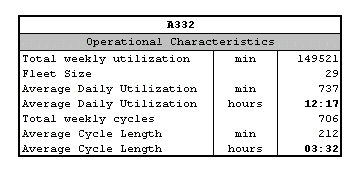
The most striking element of the A332 operation is its very
low average cycle length. At just 3 hours 32 minutes, the A332 is flying sectors
that are far below the typical mission it was designed for. Among some of the
larger A332 operators, EK is definitely deploying its fleet with some of the
shortest average stage lengths.
A natural consequence of shorter cycles, is a decrease of utilization rates.
While an average daily utilization of just above 12 hours is still respectable,
it makes the aircraft slightly underused when compared to international
standards. In view of the respectable size of this fleet component, EK should be
able to easily squeeze utilization rates of around 13.5 hours out of its A332
fleet.
All in all, the A332 fleet seems to be underused and not used on the type of
missions it was designed for. EK could easily open a couple of secondary
European stations with the spare A332 capacity it has inherently available.
Airbus A340-300 (343)
With just 8 aircraft, the leased A343 armada is an oddball in the Emirates fleet, but the airline seems to nevertheless hold on to these aircraft for which it has found a number of niche markets in which the A343 is apparently right sized.
The A343 is serving a number of European destinations apart
from select flights to Africa and Asia. Its flying program is further filled
with a number of regional flights. The operational characteristics pertaining to
these flights are the following:
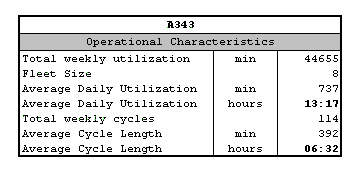
With an average daily aircraft utilization of above 13 hours,
Emirates is positioning itself around industry standards for a fleet of this
type. The average cycle length is 6.5 hours, which seems short for this aircraft
type, but the number of actual longhaul flights for which this aircraft type was
designed is limited in the EK operation, and the airline has more suitable
equipment to operate these flights.
It is safe to say that the A343 is not a strategic and long term component of
the Emirates fleet and its relatively small fleet size makes the aircraft rather
insignificant and even invisible in the airline’s global operation.
Airbus A340-500 (345)
The most striking example of changing priorities in fleet planning at
Emirates is exemplified by the airline’s 10-strong fleet of ultra longhaul
Airbus A340-500 aircraft. Once hailed as the airline’s flagship and deployed on
some of its most prestigious ultra longhaul nonstops, this aircraft has now been
relegated to a secondary role with very similar characteristics to those of the
A343 fleet.
With the exception of a single Brisbane roundtrip, the A345 does not fly a
single mission for which it was actually designed. Gone are the days of the
nonstop New York, Sydney and Melbourne trips, and the radically changing flying
program has equally radically changed this subfleet’s operational
characteristics:
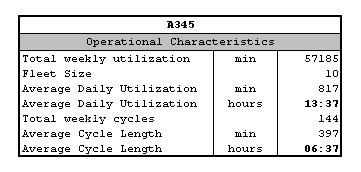
While the airline remains capable of extracting 13.5 hours of
average daily utilization out of this fleet component, it is worth noticing that
this number is down from a utilization of over 16 hours just a couple of years
ago. The current average daily utilization is below what the aircraft was
designed for and is indicative of the dramatically changing average stage length
of the flying program.
With average cycle times of just 6.5 hours, the A345 has been moved away from
segments for which is was designed, and it seems therefore that the airline is
merely using this aircraft to fill its schedule rather than assigning it to the
role it was designed for. This aircraft type should perform average sector
lengths of 14 hours and above.
It seems as if there is little future left for the A345 at EK. With a flying
program containing SEZ, DAR and KRT, its glory days are certainly over.
Airbus A380-800 (388)
The Airbus A380 has rapidly become the new flagship of the Emirates fleet. With
13 aircraft in the fleet by December and tens more still on order, this aircraft
will at some point move the chunk of EK traffic through its network.
A lot has been said about the EK’s deployment of the A388, but the airline seems
to move the aircraft where it needs the capacity, without necessarily making use
of its full operational capabilities.
Here is what the operational characteristics look like:
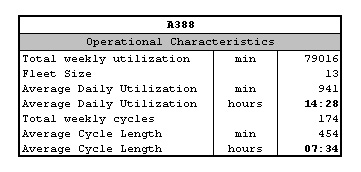
With an average daily utilization of 14 hours 28 minutes, the
A388 fleet is well used. Even if an additional aircraft is added to operate this
flying program, the fleet will still be very well used, and this high proposed
utilization speaks for the airline’s confidence in its young A388 fleet, which
is likely displaying very solid dispatch reliability levels.
At just over 7.5 hours, the average stage length for the A388s flying program
may seem smallish, but, as mentioned, the airline is deploying the aircraft
where it needs the capacity without necessarily making use of its full range
capabilities. Furthermore, the geographical position of the Dubai hub is such
that there are but a limited number of real longhaul flights, as represented by
an network wide average stage length of just 5 hours 44 minutes for the entire
Emirates flying program.
As more aircraft of this type are added, one may expect operational
characteristics to remain pretty stable. Utilization will remain high, while
sector length will be over average within the airline but rather small for
international standards for A388 operations.
Boeing B777-200/200ER (772)
The 9-strong Boeing B777-200 fleet, featuring both ER and
non-ER models, is deployed on missions that are similar to those of the A332
fleet, but are atypical for what one would normally expect of this aircraft
type. This subfleet is rather small and does not play a very significant role in
the airline’s worldwide operation.
While the aircraft is taking care of a number of off-peak European roundtrips,
it is otherwise deployed mainly in the regional sectors and this type of
scheduling is impacting both the utilization and average stage length for these
aircraft:
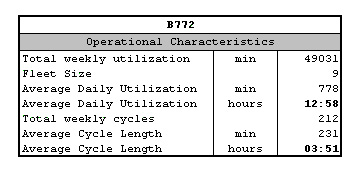
At almost 13 hours, these aircraft are used at levels just
below international standards. The fleet is not purposely underused, but the
utilization rates are what they are because of the high cycle numbers and low
average stage lengths. The average B772 cycle lasts just under 4 hours, which is
far below international standards and even below averages for the entire EK
network. It goes to show that EK is deploying these aircraft typically on
shorter sectors.
Boeing B777-300A (773)
Of all the fleet components, the 12-strong B773A fleet is
displaying the most average operational deployment in the EK fleet. Both its
average daily utilization rates and average sector lengths are nearly identical
to those of the entire Emirates fleet.
The B773A is deployed to a number of medium haul destinations in Europe, Asia
and Africa as well as on a number of high density regional routes that need the
additional capacity provided by this aircraft type.
Operational characteristics are as follows:
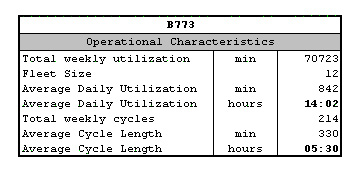
At over 14 hours of daily utilization, the B773s in EK’s fleet
are rather well used. The average sector length stands at 5 hours 30 minutes,
which is right around the average for the entire Emirates flying program. That
number is rather low for international standards, but, as mentioned above, EK
does not have all that many real longhaul routes, and the airline does also not
operate any narrowbodies to its regional destinations. The absence of
narrowbodies is inevitably bringing down utilization levels and average stage
lengths for certain components of the widebody fleet.
Boeing B777-200LR (77L)
With just 10 aircraft in the fleet, and with no apparent plans
for additional aircraft of this type, Emirates is squeezing a lot of utilization
out of its fleet of long range B77Ls. This aircraft has all but taken over the
missions that were previously designed for the A345 and is operating some of the
very longest flights in the EK flying program.
Apart from the ultra long haul flights, Emirates is complementing the flight
program of these aircraft with a limited number of medium and shorthaul flights.
The airline could, however, add additional ultra longhaul flights with the
existing B77L fleet if the need were to arise. A detailed discussion later
pertaining to the daily deployment of this fleet will make that point clear.
The operational characteristics of the B77L fleet are as follows:
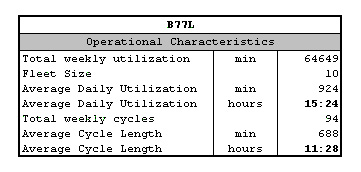
In typical ULH style, these aircraft are high in utilization,
high in average stage length yet low in operated cycles. The aircraft are
clearly deployed for the types of missions they were designed for. For a
detailed micro-level review of the B77L operation, refer to section II.3.
Boeing B777-300ER (77W)
With 54 aircraft in the active fleet next December, the B77W
is the current main stay of the Emirates fleet, and the aircraft is deployed on
a wide variety of missions to all parts of the EK network. The airline seems to
be very content with this aircraft type and plans to add quite some more units.
In addition to its core flying program on trunk routes to Europe, Asia,
Australia and Africa, Emirates has been pioneering the use of the B77W on some
of its ultra long haul flights. As such the B77W is now seen operating nonstop
routes to the US West Coast, Brazil and Australia and there are indications that
Emirates will continue to deploy the B77W on these kinds of missions.
The operational characteristics of the B77Ws flight program are summarized
below:
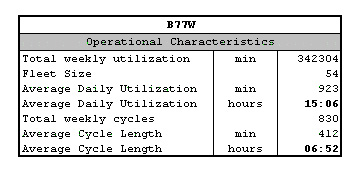
The large B77W fleet is displaying an impressive average daily
utilization, which is on par with that obtained by an airline like KLM, which is
known for very high utilization levels, and above B77W utilization rates of
other large operators of this type such as Air France, Singapore Airlines and
Cathay Pacific.
In contrast with the aforementioned airlines, however, the average stage length
of B77W flights at EK is a smallish 6 hours 52 minutes, which is above the
average for the entire EK operation, but well below industry standards. Here
again, one notices some of the effects of an all widebody fleet, which provokes
the use of wide body equipment on atypical shorter sectors.
The B77W will remain the backbone of the Emirates fleet for another couple of
years and its operational characteristics within the airline’s operation are
unlikely to change very much. As no more ULH aircraft are currently on order,
one may expect the B77W to be deployed on some future route with block times
well above 12 hours.
II.2. Comparison of Operational Characteristics for different Fleet Types
As discussed above for each of the different fleet components, Emirates has over
the past couple of years made some radical changes to its fleet deployment
policies. The arrival of the B77W has pushed the A332 and B772 fleets
increasingly towards the regional network. In the same way, the B77L has
relegated to A345 to missions that are outside of what is was designed for.
These strategic decisions have first and foremost had some consequences for the
average daily utilization rates of the different fleet components. The following
is an overview of both absolute and relative utilization rates:

The table above lists, for each fleet component, its size
(number of aircraft) as well as its relative size in the entire fleet. The next
block recapitulates the total weekly utilization, and then states the relative
utilization of each fleet component as part of the total network wide
utilization.
The ratio util:size column lists the ratio of the relative utilization to the
relative fleet size of each fleet component. This number is indicative of the
relative utilization of each aircraft type with ratios above 100 being
relatively overused versus ratios below 100 being relatively underused when
compared within this operation.
The final column list the average daily utilization for each fleet component as
already discussed in the previous paragraphs.
Apart from the remarks made before for individual fleet components, this table
clearly illustrates how the A332 fleet is relatively underused, both in absolute
and relative terms. EK could easily squeeze more utilization out of this fleet
and this observation is reinforced by the relatively large fleet size of 29
units, which guarantees operational stability and reliability even at
utilization rates above 14 hours. The frequent remarks that EK does not have the
capacity to rapidly open new stations to cover for gaps in its network seem
somewhat specious in light of these observations.
As stated above, the B772 fleet is also ever so slightly underused, but not to
the same extent as the A332. In comparison to international standards though,
this fleet is indeed displaying low utilization levels.
The A343, A345, A388 and B773 fleet are scheduled with pretty normal utilization
rates, both within the EK fleet and in comparison to international standards of
airline operations. Their ratio scores are in the vicinity of 100.
With utilization ratio scores of well over 100, the B77L and B77W fleets are
clearly scheduled above average in terms of daily utilization. It is not
surprising that these aircraft are also some of the newer additions to the EK
fleet, and are displaying very satisfactory dispatch reliability levels.
Utilization rates of over 15 hours are world leading and are typically only
achieved by high quality carriers who have their act together in every aspect of
their operational organization.
As already mentioned a couple of times before, the discussion of average daily
utilization rates as an operational indicator has to be looked at in view of
EK’s unique position as a wide body-only operator. The absence of narrow bodied
aircraft implies that the airline’s shorthaul sectors need to be carried out by
widebody equipment, although such missions are normally atypical for those types
of aircraft. Regional and shorthaul flight operations tend to increase the
aircraft’s ground time in between flights, hence decreasing utilization rates,
increasing total number of cycles and decreasing average stage lengths.
As indicated on the bottom line of the table above, for its entire operation of
145 aircraft, Emirates is achieving an aggregate average daily utilization rate
of 14 hours 16 minutes. That number is very respectable, because, while the
widebody fleets of other major airlines may actually display higher utilization
levels, when the narrow body fleets are brought into the equation, fleet wide
utilization levels are dropping below those of EK.
To fully comprehend the fleet wide operational characteristics, one has to also
look at a comparative table of average stage lengths for different fleet types:
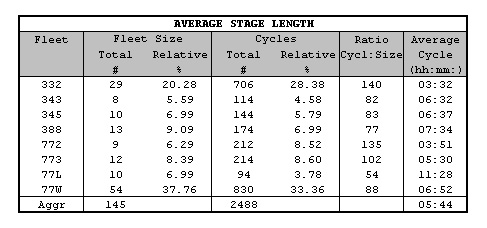
This table is very similar to the one before. It re-lists the
absolute and relative fleet sizes of each fleet component, followed by the
absolute and relative number of cycles performed by each of those aircraft. The
ratio of relative cycles to relative fleet size is indicative of what is the
typical cycle length within the airline’s operation. The higher the number, the
shorter the average sector this aircraft type operates. This ratio is
standardized to a score of 100.
The high ratio scores of the A332 and B772 fleet are indicative of the very
short average stage lengths of these aircraft compared to the average stage
length for the entire airline. As discussed above, these aircraft have been
moved to mostly regional routes provoking these kinds of operational
characteristics.
The B77L fleet is displaying a ratio score of just 54, indicating exceptionally
long average cycle lengths in comparison to the fleet wide averages. The B77L is
deployed on relatively few sectors with relatively high average length. Such a
low score increases the likelihood of operational irregularities to arise and
the only way to operate a stable operation with these indicators is by deploying
an aircraft type with a very high dispatch reliability rate. The B77L is such an
aircraft and EK is obtaining a dispatch reliability of well over 99% out of
these aircraft.
As discussed above, the overall average stage length for the airline’s entire
operation is just 5 hours 44 minutes, which seems short for an wide body
operation, but because of the absence of narrow body equipment, the airline is
deploying wide body capacity on regional routes, bringing down the average stage
length numbers. The numbers are in this respect not comparable to European and
US airlines.
II.3. Detailed Operational Analysis for selected Fleet Types
An operational analysis is not complete without some flow charts pertaining to
the deployment of individual aircraft throughout the network. A complete
overview for the entire Emirates operation would be lengthy and space consuming,
but the flow charts of the deployment of select aircraft types provides a nice
illustration of how the aircraft cycle through the network and are as such
integral part of the operational flow.
Below is an illustrative diagram representing the flow chart of the entire A388
operation. The chart indicates arrival and departure times of individual
roundtrips from the DXB hub and how they fit in the entire schedule for this
aircraft type. The resulting pattern illustrates how aircraft cycle through the
network.
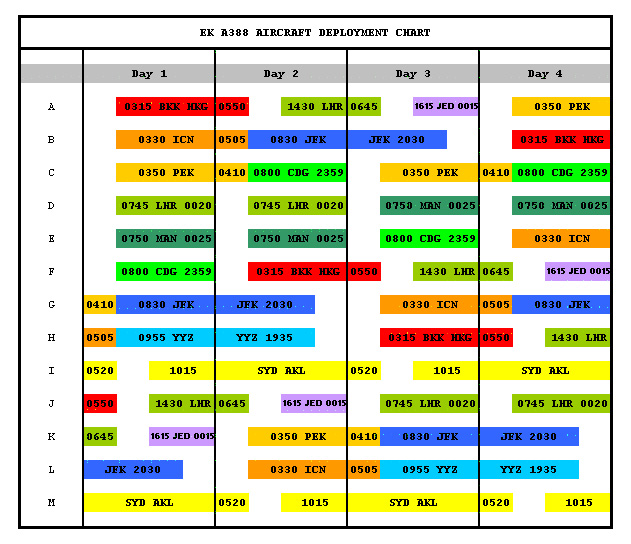

It is important to stress that this diagram provides a mere
illustration of a potential operational patterns for this fleet component.
Obviously, there are a very large number of degrees of freedom that allow the
airline to interchange certain aircraft at certain times of the day, so the flow
chart above represents just one of thousands of patterns, and the airline’s
Operations Control Center will assign aircraft to certain routes based on the
day’s particular dynamics. No two days are ever the same in airline operations
and the diagram above clearly demonstrates where aircraft swaps are possible in
case of irregular operations.
While the A388 operational setup caters for healthy sets of grounds times at the
DXB homebase, it is worth noting that there are very few if any extended ground
times that would allow for a permanent spare capacity to be available. It is
clear then that any serious operational irregularities, which would require the
temporary grounding of one of the airframes in this sub fleet will inevitably
lead to escalating operational issues. Emirates can, however, get around these
issues by deploying different equipment to stations such as LHR and CDG. LHR has
in the past seen a number of B77W subs because of irregular A388 operations and
the presence of LHR in the A388 operations is not only a commercial necessity
but also an operationally stabilizing factor.
A final illustration of operational flow charts within the Emirates operation is
that of the B77L operation:

Again, the above flowchart is merely illustrative and does in
no way represent the unique way in which the airline’s 10-strong B77L fleet
moves through its network. The operational setup of this subfleet caters for
even more operational degrees of freedom than that of the A388 operation above,
and there are thousands of alternative layouts to the one illustrated in the
figure.
In comparison with the A388 flow chart, it is clear that the B77L operation
includes more extensive DXB ground times. These prolonged ground times are
essential to ensure a stable operation. This subfleet is not only relatively
small, but it is also operating some of the longest sectors in the schedule, and
this combination makes for a heightened susceptibility to operational
irregularities to escalate throughout the network.
The airline has included a number of shorter flights in the flying schedule of
this subfleet, not only to fill up holes in its schedule, but also to increase
operational stability. In case of irregular operations, the Operations Control
Center could, for instance, easily take the AMS rotation out of the program and
replace it with B77W equipment, thereby almost immediately stabilizing the B77L
operation.
The above flow charts are not only illustrative for the dynamics of an
international airline operation, but they also testify to the professionalism of
the people behind the scenes of the Emirates operation, which is run by some of
the best and brightest in the industry.
Part III:
Concluding Remarks
Emirates of Dubai may be as enigmatic as it is mesmerizing to those outsiders
who may be aviation enthusiasts but are not engaged in the daily running of an
airline. While there may be legitimate questions about some aspects of this
airline, it is clear that from an operational perspective, Emirates has
surrounded itself with sufficient know how to build a stable operation which
adequately caters to its customers.
The Emirates operation is built up consistently and with the necessary symmetry
to extract as much advantage out of the Hub and Spoke model as possible. With
the addition of each new aircraft to the operational setup, extra demand will be
provoked because of the unique commercial characteristics of the Hub and Spoke
model.
So far, this model seems to work for the airline, but, apart from some
commercial risks, the airline is facing operational issues pertaining to over
saturation of its hub operation around peak times. The preeminent challenge
facing the airline will be to strike an adequate balance between commercial and
operational viability and without a doubt, the airline’s future fleet decision
have been taken with those elements in mind.
For those aviation enthusiasts and professionals who like to engage in
operational analysis behind the scenes of the airline, Emirates and is and will
remain one of the most interesting case studies in the industry."
Emirates Winter 2010/2011 route network
effective 1 November 2010
| Route |
Freq & A/C | Remarks/Flight No |
| Dubai – Houston | 7 77L 6 77L 1 77W |
EK211/212 EK213/214 |
| Dubai – Los Angeles | 7 77L 7 77L |
EK215/216 EK217/218 |
| Dubai – New York JFK | 7 388 7 77W |
EK201/202 EK203/204 |
| Dubai – San Francisco | 7 77W | |
| Dubai – Sao Paulo | 7 77L 7 77W |
to 30NOV10 from 01DEC10- |
| Dubai – Toronto | 3 388 | |
| Dubai – Amsterdam | 7 77W | |
| Dubai – Athens EK103/104 |
4 332 4 345 |
to 31DEC10 from 02JAN11 |
| EK105/106 | 7 332 | |
| Dubai – Birmingham | 7 77W 7 77W |
EK037/038 EK039/040 |
| Dubai – Dusseldorf | 7 773 7 332 |
EK055/056 EK057/058 |
| Dubai – Frankfurt | 7 77W 7 77W |
EK045/046 EK047/048 |
| Dubai – Glasgow | 7 77W | |
| Dubai – Hamburg | 2 77W 5 773 |
|
| Dubai – Istanbul | 4 772 7 77W |
EK123/124 EK121/122 |
| Dubai – Larnaca – Malta | 7 332 | |
| Dubai – London Gatwick | 7 77W 7 77W 7 772 |
EK009/010 EK015/016 EK011/012 |
| Dubai – London Heathrow | 7 773 7 388 7 77W 7 388 7 773 |
EK007/008 EK001/002 EK029/030 EK003/004 EK005/006 |
| Dubai – Madrid | 7 343 | |
| Dubai – Manchester | 7 388 7 77W |
EK017/018 EK019/020 |
| Dubai – Milan Malpensa | 7 343 7 343 |
EK091/092 EK093/094 |
| Dubai – Moscow Domodedovo | 7 345 5 77W 2 77L |
EK133/134 EK131/132 |
| Dubai – Munich | 7 332 7 773 |
EK051/052 EK049/050 |
| Dubai – Newcastle | 7 332 | |
| Dubai – Nice | 7 332 | |
| Dubai – Paris CDG | 7 388 6 773 1 772 |
EK073/074 EK075/076 |
| Dubai – Prague | 7 332 | |
| Dubai – Rome | 7 332 7 773 |
EK095/096 EK097/098 |
| Dubai – Venice | 7 343 | |
| Dubai – Vienna | 7 77W | |
| Dubai – Zurich | 7 772 7 77W |
EK085/086 EK087/088 |
| * | ||
| Dubai – Accra – Abidjan | 7 343 | |
| Dubai – Addis Ababa – Entebbe | 7 77W 7 345 |
to 31DEC10 from 01JAN11 |
| Dubai – Cairo | 4 77W 3 772 3 332 3 772 |
EK923/924 EK927/928 |
| Dubai – Cae Town | 7 77W | |
| Dubai – Casablanca | 7 345 | |
| Dubai – Dakar | 5 343 | |
| Dubai – Dar es Salaam | 7 345 | |
| Dubai – Durban | 7 332 | |
| Dubai – Johannesburg | 7 77W 7 77W 7 77W |
EK761/762 EK763/764 EK765/766 |
| Dubai – Khartoum | 7 345 | |
| Dubai – Lagos | 7 345 7 77W |
EK781/782 EK783/784 |
| Dubai – Luanda | 3 772 | |
| Dubai – Mauritius | 4 773 2 773 1 77W 2 77W |
EK701/702 EK3703/3704 EK3705/3706 |
| Dubai – Nairobi | 7 332 7 772 |
EK719/720 EK721/722 |
| Dubai – Seychelles | 5 345 2 345 |
EK705/706 EK707/708 |
| Dubai – Tripoli EK743/744 |
3 332 3 345 |
to 02JAN11 from 03JAN11 |
| EK745/746 | 7 345 | |
| Dubai – Tunis | 5 332 | |
| * | ||
| Dubai – Ahmedabad | 6 332 4 332 |
EK538/539 EK540/541 |
| Dubai – Bangalore | 7 332 5 332 1 772 7 332 |
EK564/565 EK566/567 EK568/569 |
| Dubai – Bangkok | 7 388 6 773 |
EK372/373 EK374/375 |
| Dubai – Bangkok – Hong Kong | 7 388 | |
| Dubai – Bangkok – Sydney – Christchurch | 7 77W | |
| Dubai – Beijing | 7 345 7 388 |
EK308/309 EK306/307 |
| Dubai – Brisbane – Auckland | 7 345 7 77W |
-31DEC10 01JAN11- |
| Dubai – Chennai EK542/543 |
6 332 1 773 3 772 3 332 1 773 |
-28JAN11 29JAN11- |
| Dubai – Chennai EK544/545 |
2 772 2 773 2 77W 1 332 |
|
| EK546/547 | 3 772 4 332 | |
| Dubai – Colombo | 5 77W 2 773 4 77W 3 773 |
-09EB11 10EB11- |
| Dubai – Colombo – Singapore | 5 77W 2 773 | |
| Dubai – Delhi | 6 772 1 77W 5 773 2 772 7 332 7 332 |
EK510/511 EK512/513 EK514/515 EK516/517 |
| Dubai – Dhaka | 7 77W 6 77W 1 772 3 332 |
EK582/583 EK584/585 EK586/587 |
| Dubai – Guangzhou | 7 77W | |
| Dubai – Hong Kong | 7 77W 7 772 |
-31DEC10 01JAN11- |
| Dubai – Hyderabad | 7 332 7 332 |
EK526/527 EK528/529 |
| EK524/525 | 4 332 1 773 2 772 |
|
| Dubai – Islamabad | 2 77W 2 77W 1 772 |
EK612/613 EK614/615 |
| Dubai – Jakarta | 7 77W 7 77W |
EK356/357 EK358/359 |
| Dubai – Karachi EK600/601 * EK602/603 EK604/605 EK606/607 |
2 773 1 332 4 77W 2 772 5 332 7 332 6 332 1 77W |
|
| Dubai – Kochi EK530/531 * EK532/533 |
5 772 1 77W 1 332 4 772 3 332 |
|
| Dubai – Kolkata | 5 332 7 332 |
EK572/573 EK570/571 |
| Dubai – Kozhikode | 5 772 5 332 1 772 |
EK560/561 EK562/563 |
| Dubai – Kuala Lumur | 7 773 7 77W |
EK342/343 EK346/347 |
| Dubai – Kuala Lumur – Melbourne | 7 77W | |
| Dubai – Lahore | 3 77W 1 77W |
EK622/623 EK624/625 |
| Dubai – Male | 7 77W | |
| Dubai – Male – Colombo | 5 773 2 772 | |
| Dubai – Manila | 7 77W 7 77W |
EK332/333 EK334/335 |
| Dubai – Melbourne – Auckland | 7 77W | |
| Dubai – Mumbai EK500/501 EK502/503 EK504/504 * EK506/507 EK508/509 |
7 77W 6 77W 1 772 1 77W 3 773 3 772 7 332 7 332 |
|
| Dubai – Osaka Kansai | 7 77W | |
| Dubai – Peshawar | 2 772 | |
| Dubai – Perth EK420/421 |
6 77L 1 77W | |
| Dubai – Perth EK424/425 |
7 77W 7 77L |
-30NOV10 01DEC10- |
| Dubai – Seoul Incheon | 7 388 | |
| Dubai – Shanghai Pu Dong | 7 77W 7 343 |
EK302/303 EK304/305 |
| Dubai – Singapore – Brisbane | 7 77W | |
| Dubai – Singapore – Melbourne | 7 77W | |
| Dubai – Sydney – Auckland | 7 388 | |
| Dubai – Thiruvananthauram | 5 332 7 332 |
EK520/521 EK522/523 |
| Dubai – Tokyo Narita | 5 77W | |
| * | ||
| Dubai – Amman EK901/902 * EK903/904 |
3 772 3 332 1 77W 4 332 2 772 1 773 |
|
| Dubai – Bahrain EK835/836 EK837/838 EK839/840 |
7 332 7 332 4 332 2 772 1 773 |
|
| Dubai – Beirut EK953/954 EK955/956 EK957/958 |
4 77L 2 345 1 77W 3 332 4 332 2 345 1 77W |
|
| Dubai – Damascus | 7 332 4 772 3 332 |
EK911/912 EK913/914 |
| Doha – Dammam EK821/822 * EK823/824 EK825/826 |
1 77W 1 332 1 772 2 332 1 77W 1 772 |
|
| Dubai – Doha EK847/848 EK841/842 EK843/844 EK849/850 EK845/846 |
7 332 2 77W 3 332 2 772 6 332 1 773 6 332 1 77W 3 332 3 772 1 77W |
|
| Dubai – Jeddah | 7 388 | |
| Dubai – Kuwait EK853/854 EK855/856 EK857/858 EK859/860 |
7 332 1 773 3 332 2 77W 1 772 2 772 1 773 3 332 1 77W 5 332 1 773 1 772 |
|
| Dubai – Muscat | 7 332 3 772 4 332 |
EK866/867 EK862/863 |
| Dubai – Riyadh | 4 77W 3 772 | |
| Dubai – Sana’a | 7 332 |
| Dubai – Tehran EK975/976 EK971/972 EK977/978 |
1 343 2 77W 4 332 3 332 4 77W 2 332 2 77L 2 77W 1 772 |