SQ cuts
salaries after Q1 loss
31 July 2009
The big question
in Dubai is will Emirates follow Singapore Airlines by cutting salaries
after an estimated 12,000 non-management staff at Singapore Airlines (SIA)
were told of a pay cut of 10 per cent for at least three months starting
from August 1.
This comes after the carrier posted a S$271 million loss at the company
level in the first quarter.
As a group, SIA's net loss was S$307.1 million for the three months ended
June 30, compared to a net profit of S$358.6 million a year earlier.
Under current union agreements, a pay cut is automatically triggered if the
airline suffers a net loss of S$50 million at the company level in any given
quarter.
The quantum is determined by the amount of losses. The pay cuts start at 2.5
per cent if the carrier loses S$50 million at the company level, and go up
to as much as 10 per cent if the losses exceed S$200 million.
The 10 per cent pay cut involves non-managerial staff, as managerial staff
have already taken pay cuts ranging from 10 to 20 per cent, according to an
SIA spokesman.
The salary cut affects cabin crew, pilots and ground staff employed in
Singapore.
The SIA spokesman told Channel NewsAsia that the pay reduction may continue
beyond November even if the carrier posts a profit in the second quarter.
This is because the losses are calculated accumulatively throughout the
financial year.
On my flight into
Birmingham two Emirates crew in the rear galley were loudly (too loudly)
discussing a 20% salary reduction. One of the crew had heard the news from a
friend who heard it from her cabin crew manager.
Thus are rumours
started. But with Singapore Air implementing a salary reduction Emirates may
not be far behind and there are no air crew unions in the UAE to argue such
an action.
Pilots tell the
miracle on the Hudson
31 July 2009
"All pilots say
that any landing they can walk away from is a good one.
"We needed a boat," Jeff Skiles told a packed crowd at EAA AirVenture
Thursday afternoon.
Actually, several boats were needed to carry the 155 passengers and crew
members of U.S. Airways Flight 1549 to shore after they miraculously
survived a landing in the Hudson River last January. Canada geese were
sucked into both engines shortly after takeoff from LaGuardia Airport.
Capt. Chesley "Sully" Sullenberger, who served in the Air Force, said he got
a letter from a Navy pilot friend who told him the water landing was pretty
good for an Air Force pilot, "but a Navy pilot would have tied it up at the
pier."
For more than an hour, the "Miracle on the Hudson" cockpit crew talked and
joked with a rapt audience of aviation enthusiasts about their five-minute
flight on Jan. 15 and how much their lives have changed since then.
Skiles, who lives in Oregon, Wis., has spent much of the week at AirVenture
and has been coming to the EAA gatherings each summer since his parents, who
are both pilots, began bringing him in the 1960s. This is Sullenberger's
first visit to AirVenture.
Dressed in jeans and khakis, the pilots joked that they have spent so much
time together - they had never met before the January trip - that "pretty
soon we'll be like an old married couple finishing each other's sentences,"
Sullenberger said.
When asked if, in hindsight, they would have done things differently, Skiles
said he would have ditched in the Hudson in July, when it would have been
warmer.
As first officer, Skiles was at the controls when the plane took off Jan.
15. Everything was normal until the plane reached 3,000 feet and Skiles
looked out the window to see a line of birds in front of the Airbus 320. He
was relieved to see them descend below the cockpit windows, figuring the
plane would fly over them.
Then the engines began to make a terrible noise and almost immediately went
to idle, meaning they were no longer providing thrust to the 150,000-pound
plane. It was supposed to be the last leg of a four-day trip for the flight
crew.
"I was the guy who flew the plane into the birds. So I'd like a little
credit for making Sully Sullenberger the (hero) he is," Skiles said as the
crowd laughed.
Almost immediately after hitting the birds, Sullenberger said "my aircraft"
- signaling that as captain he was taking over control - while Skiles tried
to restart the engines. Both pilots had taken off from LaGuardia many times
and knew that if they couldn't return to the airport, which Sullenberger
quickly ruled out because he didn't think the plane had enough altitude and
power, they faced a horizon filled with skyscrapers and roads.
The only other option was the Hudson.
As the smell of dead birds wafted into the cockpit, Sullenberger looked
outside at the banks of the river rapidly rising up to meet them while
Skiles called out altitude and air speed. After they splashed down and
scooted to a stop, the pilots turned to each other "and almost at the same
instant we said, 'Boy, that could've been a lot worse,' " Sullenberger said.
When Skiles walked back to the water-filled cabin, most of the front rows
had already emptied, but he saw a man coming up the aisle who had stripped
down to boxer shorts and socks, planning to swim to shore. But within four
minutes, tugs and ferries arrived to rescue the passengers and crew -
including one tug captained by a man who told Skiles, a lifelong Packers
fan, that his name was Vince Lombardi.
Little did Sullenberger and Skiles know, that as soon as they left the plane
their lives were really about to change.
Five days later, they attended the presidential inauguration, followed by
the Super Bowl and a number of other events, as well as numerous press
interviews. Sullenberger was invited to the Airbus headquarters in France,
where he was given a chance to the fly the new A380, the world's largest
passenger airliner, and dined with Airbus executives, wryly noting that he
was served goose paté.
While Sullenberger has become almost instantly recognizable, Skiles said
good-naturedly that he's now used to getting out of the way of crowds
pressing to see the captain and is often handed cameras by fans who want
their picture taken with Sullenberger. Skiles noted that as the pilots and
three flight attendants were looking for their seats at the inauguration, he
spotted a chair with Sullenberger's name on it next to his chair, which
simply said "crew."
The affection and warmth between the two men forever linked by a chilly
January morning in New York was apparent throughout the session Thursday
afternoon. Skiles, who returned to work several months later, said he will
be proud to fly with Sullenberger when he returns to the cockpit in
September and he hopes to fly with him on his last flight whenever
Sullenberger retires.
Sullenberger quickly returned the praise.
"This was about more than one person," Sullenberger said. "This gentleman
was sitting next to me in the crucible of the cockpit as we were fighting
for our passengers' lives and the lives of our crew," he said."
Thaksin
paranoia hurts Thai government
31 July 2009
The Thai
government is paranoid. Not of swine flu. Not of the dwindling economy. But
of the exiled man that they ousted from power 3 years ago.
The red shirted
supporters of ex Prime Minister Thaksin have been running a petition to get
signatures on a plea for a royal pardon for Thaksin. The red shirt United
Front for Democracy against Dictatorship which claims to have gathered close
to a million signatures.
The petition is expected to be submitted to the Office of His Majesty's
Principal Private Secretary on Aug 7.
The over reaction
from the Democrats is predictable and foolish.
In Thailand
tonight there is a TV program tonight to denounce the signature campaign.
The Interior
Ministry has asked Village Heads throughout the country to set up stalls so
people can withdraw their names; there is a Bhum-Jai Thai lead campaign for
the reds to stop - see this New Mandala guest post by Nick Nostitz and this
short Matichon article (where taxi drivers said they were forced to go by
the taxi owner) to see how voluntarly their attendance was.
(For the Bhum-Jai Thai campaign read here).
The government
says that the campaign is illegal, improper and/or inappropriate - seemingly
they can't make their mind up what to do about it.
The most astounding claim is that the campaign the monarchy in politics and
that this is somehow wrong. The royal pardon system does this precisely as
it was set up to show benevolence and this is the very purpose of it!
Needless to say
the same people outraged today are the same ones who petitioned HM the King
under Article 7 in 2006 to remove Thaksin. But of course that was a "good"
petition unlike this one which is reported as "evil". And the trouble is so
many of the elite do not see the irony of their position.
Even Abhisit himself has resorted to harsh rhetoric: "It's not possible for
people to sign up to seek a royal pardon," he said, adding that those behind
the document were "manipulating innocent people." He says that "we have to
be cautious because these masterminds have complicated matters and people
could fall victim to their provocations."
There is a long
tradition of Thai people petitioning the king. There really is no reason why
a free people cannot petition their own King on any matter that they choose.
The government's over reaction just makes the red-shirts look ever stronger.
Meanwhile the
Democrat party's propaganda machine is in full flow; on Prime Minister
Abhisit's birthday, August 3, a performance report will be released,
along with the launch of a month-long publicity campaign.
About 10,000 copies a book with the dubious title of, "Six Months, 100
Measures, 10 Million Happiness", will be handed out to media, MPs and
senators. A second book titled "Stories from the Fence: Thai People's
Happiness is the Government's Goal" will be printed and distributed to the
public through village funds, school libraries, universities and government
banks.
The Democrats may
be forgetting that they are in a coalition and survive only with the support
of the Newin faction.
- also
worth a read is this
Asia
Times article - on the colour coded contest for Thailand's north!
Thailand's
karaoke crackdown!
30 July 2009
What to do? The
polls show PM Abhisit is less popular than exiled Thaksin. The economy is in
a poor state with increasing unemployment. So the latest solution. A social
order campaign.
The Nation reports
the the Thai Cabinet has approved new regulations that prohibit karaoke
parlours from providing drinking or singing partners to customers, with
their business licences being revoked if they do.
Deputy government spokes-man Phumin Leetheeraprasert said the Cabinet also
assigned the Office of the Council of State to adjust some of the wording
before the regulations are implemented.
The new rules, which also cover Internet cafes, allow children to play
computer games for more than three hours and up to six hours a day, says
Culture Minister Teera Salakpetch.
Those under 15 will be allowed to use the service from 2pm to 8pm from
Monday to Friday and from 10am to 8pm during holidays and school breaks,
while those aged 15 to 18 can play games until 10pm, Teera says.
The Cabinet also agreed that an IT system to keep kids under 18 from playing
computer games for more than three hours a day should be ready before a
ministerial regulation amendment is proposed later, he added.
How will this new rule be implemented. Does it only apply to karaoke
parlors? What about all the girlie bars and gentleman's club bars so loved
by well to do Thais throughout Bangkok? Apparently their can still be
greetings girls, but based on TV reports they will not be allowed to sit
with customers. How on earth can this be enforced?
EK now world's
largest 777 operator
30 July 2009
Emirates announced
yesterday that it is now the world’s largest airline operator of Boeing 777
aircraft after taking delivery of its 78th plane on Thursday.
Another 28 Boeing 777s, valued at $7bn, were pending delivery, it said in a
release.
The latest arrival - a Boeing 777-300ER configured for long distance
journeys - brought Emirates’ total fleet to 137 wide-body Boeing and Airbus
aircraft.
Emirates was the only airline to operate every model in the Boeing 777
family including 200s, 200ERs, 200LRS, 300s, 300ERs and freighters, it said.
No sex in this city
30 July 2009
The big-screen
sequel of the infamous TV series ‘Sex and the City’ has hit a stumbling
block, after UAE authorities reportedly blocked a move to film a number of
scenes in Dubai.
Plans to base a part of the plot in the emirate are now on hold, a source
told US Weekly, as the show’s salacious content is seen to be at odds with
the UAE’s more conservative culture.
This seems a
little strange given that the show is regularly broadcast on Showtime/
“The UAE authorities aren't keen on the title because of the word 'sex',” a
source told Arabian Business.
The news is a second blow for the production team behind the film, which has
reportedly already postponed filming in New York until the end of August.
Studio bosses are hoping the sequel will match the massive success of last
year’s movie debut, which grossed more than $400m at the worldwide box
office.
Delays expected
in Dubai metro launch
28 July 2009
Most stations on
Dubai Metro’s red line will “almost certainly” be delayed beyond the
system’s September 9 launch date, a transport analyst, Jose Paul, automotive
and transportation expert at consulting firm Frost & Sullivan, has claimed.
The comments
follow RTA claims that all metro stations will be open next month. A
spokesperson for the authority dismissed suggestions of delays when speaking
with Arabian Business yesterday.
But doubts remain over whether all stations will be ready on time. There is
just over one month to go and a drive along Sheihk Zayeed Road indicates
that despite 24 hour construction efforts there is a lot of work still to be
done.
There has also
been no full testing of the rail system, stations and ticketing operations.
Paul insisted any public backlash, should the $4.2bn metro not be fully
operational next month, would be temporary. He also said a delay to the
stations’ openings would have no long-term effect on demand.
Stations in areas of public interest, such as Deira City Centre and Mall of
the Emirates, would apparently be opened first.
I suspect that the
RTA will shortly need to announce a limited opening from 9 September with
restricted schedules and only certain stations open.
EK
cries slander in Canada
27 July 2009 -
The Toronto Star
"As federal
cabinet ministers boast about opening Canadian skies to foreign airlines,
transport officials have been quietly undermining plans by one of the
world's biggest airlines to expand service to Toronto, documents obtained by
the Star show.
In private briefings, Transport Canada officials have gone on the offensive
against Emirates Airlines' request for greater access to the Canadian
market, charging that the Middle Eastern carrier is "an instrument of
government policy" and is heavily subsidized by the public purse.
They also suggest Transport Canada should shelter Canadian carriers from
competition.
The federal government's response to Emirates' request has sparked a sharp
rebuke from a senior airline executive, who accuses Transport Canada
officials of making "slanderous" allegations.
In a letter to the department, Emirates Senior Vice-President Andrew Parker
claims that despite the promise of extra tourism, new jobs and other
economic benefits, Transport Canada wants to keep Emirates – a global
carrier serving 60 countries – out of the Canadian market.
"The language Transport Canada has used over the past decade is aggressive,
often biased and deeply objectionable to this carrier," Parker writes in the
letter obtained by the Star.
"The real aim of these rejections is sadly to keep Emirates permanently away
from Canada. ... Emirates will not be deterred," Parker writes.
The spat offers a window into the world of international air treaties, where
visions of a global economy often clash with deep-seated sentiments of
protectionism, national self-interest and economics.
Senior Canadian cabinet ministers have pushed for closer ties to the United
Arab Emirates. That suggests the resistance to Emirates' bid to fly more
often to Canada lies within the federal bureaucracy.
At the heart of the growing dispute is a request from Emirates Airlines to
increase flights between Dubai and Toronto, as well as start service to
Calgary and Vancouver.
The request has won broad support among municipal and provincial
governments, who say the extra flights would mean more tourism, new
investment and more jobs. It's estimated allowing Emirates and another UAE
airline, Etihad Airways, to boost flights into Pearson alone would produce
more than 500 jobs, $20 million in salaries and $13.5 million in tax
revenues.
However, Transport Canada insists the current cap of six flights a week from
the United Arab Emirates to Canada – split between Emirates and Etihad – is
enough to serve the market.
But in a presentation obtained by the Star, titled "Blue Sky, Canada's
International Air Policy," given to stakeholders this spring, senior
Transport Canada officials voiced other reasons for not moving on Emirates'
request, including:
"Emirates and Etihad are instruments of government policy. ... The
governments are helping finance massive wide-body aircraft orders and
massive expansion of airport infrastructure."
They say the market between Canada and UAE is small, suggesting it's not
worth the attention.
It cites an independent study that says the public-financed expansion of
aviation in the Persian Gulf will lead to "unhealthy competition and
irrational commercial behaviour."
It suggests Canadian carriers need to be protected. "In international
aviation, as in other strategic areas, countries are very much driven by
self-interest. Canada forgets this rule at its peril," the briefing paper
says. "Our sky is open, at least as open as can be given ... our national
interest."
But in a six-page rebuttal to Brigita Gravitis-Beck, Transport Canada's
director-general of air policy, Parker says the government allegations are
ill-informed and "strongly in error."
"We are particularly offended at the suggestion – without any substantive
foundation – that Emirates receives government support for aircraft
purchases. We receive no subsidies or government support," Parker writes.
While Emirates is state-owned, Parker says the airline operates on a fully
commercial footing with no public subsidies.
And he charges that federal bureaucrats are deliberately trying to shelter
Air Canada from competition, though it doesn't fly to the UAE.
"Unlike Air Canada, Emirates does not enjoy any aero-political protection –
the greatest form of subsidy," he writes.
Parker also ridicules the government claim that the existing market is
insignificant, saying the true potential of the Canada-Dubai route cannot be
realized because Ottawa has restricted the flights.
He says Ottawa's hard-line attitude has not changed in the last decade,
despite "extraordinary" trade growth between the two nations.
"We do hope that Transport Canada will adopt a more balanced and accurate
view on Emirates."
Transport officials said yesterday they were unable to comment on the
dispute or their own allegations involving Emirates."
After the birthday bash, what's next?
July 27, 2009 - Nation Multimedia
"It was a day when superstition, high technology and artistic creation
blended almost perfectly together. And arguably only Thaksin Shinawatra can
make that happen.
Rituals - from basic to extraordinary - were conducted at various temples
all over Thailand, barring the Democrat-dominated southern region, to mark
his 60th birthday. Red-shirted members gave alms to monks in the morning and
then had their faith in Buddhism strongly tested by taking part in
ceremonies that could have made Lord Buddha shake his head.
The came the "twitter" exchanges between Thaksin and Prime Minister Abhisit
Vejjajiva and the much-anticipated "big surprise". There was no hologram nor
concrete reconciliation announcement, and analysts could only watch
wide-eyed when a video of Thaksin singing a specially-composed song, "I'll
be back", was played and described as the "big surprise" everyone had been
talking about.
In all, Thaksin's "sae yid" events were meant for superstitious results as
much as political ones. Holy knives were used to "cut" his karma (sins).
Clods of earth were gathered from eight directions and blessed in order to
reinforce his stars. His photo was attached to a coffin in a "sadoh kroh"
ceremony to dispel his misfortunes. Overturned monks' bowls were put right
side up to signify that the boycott he had endured would come to an end. One
of his portraits was bound with thorny wintergreen branches, which were
later cut off. Wintergreen's name in Thai is rakam, which also means
suffering.
Politically, Thaksin has shown his opponents that his support in Thailand
remains strong. This can also go a long way to repairing the international
damage to his reputation from the Songkran events. Thaksin over the past few
days has tried to repaint himself as a peaceful man and erase the image of
the belligerent one whose rabblerousing helped shove the country to the
brink of bloodshed in April.
Whether or not those political aims of his "sae yid" events will be met, the
latest Abac poll gave him a narrow edge in popularity against Abhisit for
the first time in months. Abhisit, who remains more liked in Bangkok and the
South, sent Thaksin an ambiguous tweet saying the former leader would be
happier on his birthday if his eyes could see dharma. Thaksin gave a polite
twitter thank-you reply that ended with "If you need any help on national
affairs, I'm pleased to help".
As with various Thaksin big shows, yesterday's events carried various
objectives so he must have met some targets. But since a person can have
only one birthday a year, the question after the sae yid parties has to be
"Now, what's next?""
How hard is it to find Mr T?
26 July 2009
The Thai
government does make me laugh when they say that they cannot find Mr.T.
Now
Mr. Thaksin has a twitter account. His son
also has a twitter account. This is
his son's account says for the last few days. So guys - just look in Dubai.
"on the way to
celebrate my dad's 60th ;)
8 minutes ago from mobile web
getting my hair cut in dubai ?!?
about 5 hours ago from mobile
web
tum boon in dubai
about 10 hours ago from mobile
web
dxb
4:00 PM Jul 25th from mobile
web
dubai
3:59 PM Jul 25th from mobile
web
on my way to wish my dad happy birthday"
11:00 AM Jul 23rd from web
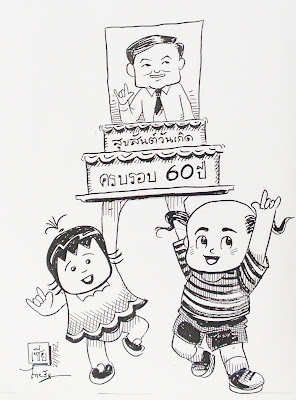
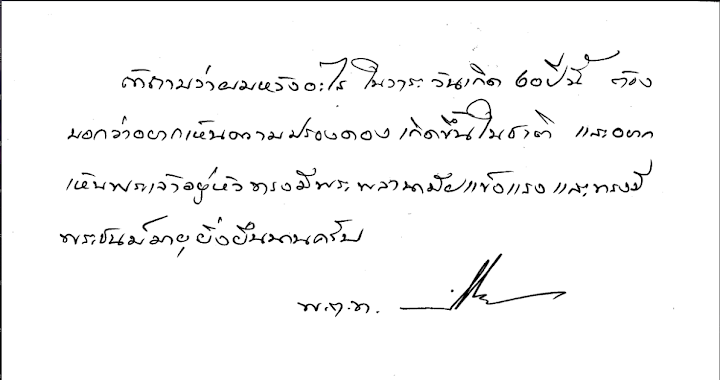
Thaksin's
birthday gift
26 July 2009
Thaksin was
planning a big 60th birthday announcement.
He teased his
audience with an amuse bouche - a song that was especially written for him
and sung by him. The song "I'll be back" was shown in a video footage played
out to his supporters at the Kaewfah Temple, who sang along.
Many people hoped
that the announcement was that he would retire from politics; that he would
seek peace and reconciliation.
But no - the "big
surprise" is his plan to set up "global TV networks" to promote Thai Otop
products, broadcast reality shows about Thai poverty and possible solutions,
as well as provide education programmes for Thai students. Coming from a
former telecom tycoon the plan may even have some substance.
The announcement came in the form of video footage aired at a birthday
dinner party organized by the red shirts at the Mangkorn Luang Restaurant in
Bangkok and two other venues. Dressed in a red shirt, Thaksin said he spent
his birthday meditating and conveying his "compassion" to everyone of his
political enemies.
After Thaksin was done with the "compassion" speech, red-shirt leaders were
quick to declare that an all-out rally to remove the Abhisit government from
office will begin on August 7. Earlier, on July 31, red shirts plan to
gather at Sanam Luang to declare success in their pardon-Thaksin petition
campaign which they say is expected to have been signed by 5 million people
on that day. Now, it is claimed, more than 1 million Thais have signed the
petition.
Passing of a generation
26 July 2009
Yesterday Harry
Patch died. Hew was 111 years old. Seven days ago, 113 year old Henry
Alllingham died.
These two men were
the last survivors of the fighting in the trenches in the Great War of 1914
to 1918.
This should have
been the war to end all wars; it was the war that eliminated almost an
entire generation of young men. It was a war of almost mindless slaughter in
the most appalling of conditions
Patch fought at
Ypres, at Passchendaele. As he passes on, our access to the memories of that
appalling war is diminished but their sacrifice should never be forgotten.
How bad was
Thailand Elite?
26 July 2008
Thailand Elite started with a fanfare and may end in a whimper. Next
Wednesday the Tourism Authority of Thailand is due to decide whether the
managing company should be closed, privatised, form a joint partnership with
the private sector, or, come under the control of the TAT.
Thailand Elite was
one of the most ambitious plans initiated under the Thaksin Shinawatra
regime and intended to give birth to the country's richest state enterprise.
In November 2003, Mr Thaksin proudly presented 80 gold Thailand Elite cards
to international VIPs and eminent people, including Japanese trade chiefs
and US banking and financial supremos. The cards promised fast-tracked
immigration, discounts at luxury resorts and golf courses, and many other
perks.
The optimistic estimates to attract the world's wealthy were mind-boggling;
a million subscribers to generate a trillion baht in revenue.
But early signs were not encouraging. After four months, a meagre 400
memberships had been sold, barely a dent in the 100,000 target for the first
year of operation. Panicky officials talked of targeting China's nouveau
riche, and predicted they would attract 30,000 Chinese within 12 months.
But six years later, the total number of members is a meagre 2,570, and the
Thailand Privilege Card Company (TPC), set up by the Tourism Authority of
Thailand (TAT), to run the scheme has a crippling net loss of 1.4 billion
baht.
Under the scheme, members obtained five-year visa entry, which was renewable
once it expired. They also had access to unlimited privileged leisure
services which included golf, spas and VIP transport in BMW 7 series
vehicles.
In the first year of operation, the company sold 139 Elite Card lifetime
memberships. However, the number so far this year is a just 2.
After the
Democrat-led government instructed the company to review its operations in
January, one option that emerged is closure.
If it does close, it risks having to pay back 2.5 billion baht to present
members and the prospects of lawsuits if it cannot fulfil its commitments.
The company has
cut the company's costs for this year to 200 million baht. This has angered
card holders as a number of premium leisure services and venues have been
removed. The membership contract carries a clause that the company "reserves
the right to change, revise, or withdraw the service without advance
notice".
China launches
Arabic international TV
26 July 2009 - Agence France-Press
"On Saturday China
state television launched an international Arabic-language television
channel as part of an ambitious programme to promote the communist country's
views abroad.
State-run China Central Television (CCTV) said the new service would
broadcast news, entertainment and education programmes 24 hours a day to a
potential audience of about 300 million people in 22 countries.
CCTV vice-president Zhang Changming said in a statement the channel "would
serve as an important bridge to strengthen communication and understanding
between China and the Arab countries."
The network, which already broadcasts in English, French and Spanish, also
has plans for a Russian-language service.
CCTV began work last September on launching its new Arabic channel.
The satellite channel can be received across the Middle East, North Africa
and in the Asia-Pacific region, the statement said.
The move is part of an ambitious programme of international expansion by the
state-controlled media to promote the image of China abroad. Xinhua news
agency, which already reports from more than 100 countries and territories,
also plans to open more foreign bureaus.
"We must increase our broadcasting capacity to positively influence
international public opinion and to give an good image of our nation,"
propaganda chief Wang Chen declared in January, as quoted by Xinhua.
Hong Kong daily the South China Morning Post has reported that Beijing was
prepared to put 45 billion yuan (6.6 billion dollars) into the development
of its media, an amount which could not be confirmed by Chinese sources.
Beijing has complained about "biased" coverage of China by foreign media but
strictly controls its own media."
Thai government
can't find Thaksin
26 July 2009
Once again the
Thai government does not appear able to find Mr Thaksin who is due to make a
60th birthday phone-in address to supporters later this evening.
If Thaksin makes his phone call from Dubai in the United Arab Emirates, the
Foreign Ministry will ask the Gulf state to honour its word that it will not
allow Thaksin to agitate politically in the UAE, said Panich Wikitset,
assistant to the foreign minister.
The Foreign Ministry saya that the UAE has promised to expel Thaksin and
send him to Thailand if he is found in Dubai. Sorry, I just dont beleive
that the UAE has made any such commitment irrespective of what the Thai
government says to its supporters. The two countries do not have an
extradition treaty.
However, Mr Panich said it was still not known where Thaksin was based who
said that the former prime minister was thought to have been travelling
around from country to country.
Thaksin is scheduled to make his phone-in to celebrations at Kaew Fa Chula
Manee temple in Nonthaburi's Bang Kruai district, where religious rites will
be held to mark his birthday today.
The address will also be relayed to other provinces where similar ceremonies
will be held by his supporters.
Happy birthday Mr.
Thaksin. The Thai government and media are giving you all the publicity that
you crave. If they ignored you you might be forgotten. And no one wants that
on their 60th birthday.
Cleaning up
Suvarnabhumi
23 July 2009
The Thai government has announced a major crackdown on
illegal taxis and unlicensed guides at Bangkok's Suvarnabhumi airport
starting July 28, according to a notice put up by the Airports of Thailand
Plc.
As always this is unlikely to last for long.
The crackdown will
be managed by AoT, which is the airport operator. But AoT is guilty of some
of the most misleading activities at the airport. It is also guilty of
making access to public transport and taxis almost impossible in order to
protect its own limousine monopoly.
AoT is enlisting
the Land Transport Department and Special Operations Division, provincial
police from Samut Prakan and tourist police to help.
The move came
after Transport Minister Sohpon Zarum made an inspection trip to the airport
and ordered the AoT to step up measures to prevent extortion gangs preying
on foreign air passengers. No surprise given the adverse publicity in the
European media concerning various airport scams in particular the arrests of
foreigners shopping ath duty free stores. These reports claim that the
gangs, apparently operating in collusion with shop employees of King Power
and rogue policemen, intimidate and browbeat accused foreign shoppers into
paying large "fines" in order to escape lengthy incarceration and trial and
return to their own countries.
At least one
European country has warned its citizens not to shop in the duty-free area
of Suvarnabhumi at all, and the alleged cheating has been featured in
reports by the BBC, among others.
The duty-free scams are in addition to the longtime Bangkok airport problems
of airport touts who try to steer naive arriving tourists to unwanted hotels
and shady businesses.
Yet the AoT has
staff throughout customs and the arrivals hall who harrass arriving
passengers - taxi, taxi, where you go to? These are not public taxis. They
are an expensice limousine service, The public taxis meanwhile are herded
into remote areas poorly signposted from the arrivals hall.
The AoT needs to
clean its own act up before it can lay claim to cracking down on other
airport activities,
A good week for
the oldies
21 July 2009
It has been a good
week to celebrate the oldies; or perhaps to show that age really is only a
state of mind.
Last night the
President of the USA had a private function with three of the bravest people
on this planet. One is 79, the other two are both 78. All three are as alert
and articulate as they were 40 years ago as they started their journey back
from the Moon to Earth.
The three men are
not close; yet the bond they share is unique. Two of them are the first men
to have walked on the moon; and the third, Michael Collins, took them there
and brought them home again. They want to see mankind continuing to explore
space. We thrilled this week at what was achieved 40 years ago. The
exploration of space will not be cheap. But it will dwarf in comparison to
the trillions committed in the last year to financial bail-outs.
We will go because
we have to boldly go where no one has been before.
Not unlike Tom
Watson. What on earth (no pun intended) was he doing leading the Open golf
tournament this weekend for 71 of the 72 holes of the tournament. A 59 year
old man with a hip made from titanium, stainless steel and ceramic. His face
more lined now than when he won the same tournament 32 years ago. But with
the same desire to win. With the same quality in everything he does.
There are few
other sporting arenas where a 59 year old can challenge men more than half
is age as an equal; where a 59 year old with 5 opens already can play as an
equal with the 16 year old amateur champion and look as though they
thoroughly enjoyed eachother's company.
Watson was six
inches away from creating the greatest sports story ever told. But despite
our, and his, deep deep disappointment, he, like the Apollo astronauts gave
us a lesson in humility and decency.
There is no
arrogance about these men. Watson's supreme grace on Sunday evening; what he
said and the way that he said it, shows him as a great champion. For 4 days
he had us all believing the impossible. Forty years ago and for a week's
long mission the Apollo crew had us all dreaming the unimaginable and living
our fantasies through their brave reality.
It has been a good
week for the oldies; and a week to be stunned by what we have achieved and
will achieve in the future.
Thai
government's terror prison denial
21 July 2009
Sometimes it is
better not to say anything. But Thai authorities continue to deny their
complicity in post 9/11 torture of terrorist suspects.
Abu Zubaida was
captured in March 2002 in Faisalabad, Pakistan. After being treated there
for his injuries, he was flown to Thailand for interrogation. The Washington
Post this weekend carried a detailed account of his lengthy interrogation.
It is a story that
shocks. The torture techniques are almost medieval. That they were carried
out by USA agents in Thailand is a shame on both countries.
Yet the Thai
Foreign Ministry today denied an earlier Washington Post report that there
was a secret prison in Thailand.
Ministry's Asean Affairs Department director Vitavas Srivihok said on
Tuesday that there must be an investigation into this matter.
The Department of Information will look into the source of this report and
will release the facts to the public, he said.
"The report may aim to discredit Thailand, as the chair of the Association
of Southeast Asian Nations (Asean)," Mr Vitavas said.
Foreign Affairs Minister Kasit Piromya's secretary Chavanond
Intarakomalyasut also insisted the country had no secret prison and the Thai
government had never let the United States build a torture chamber in the
country.
"Mr Kasit said even though the report is groundless but this issue must be
clear as it is discrediting the country," added the secretary.
In March 2009 in
the Bangkok Post Thai Army chief Anupong Paojinda insists the United States
has no secret jail in Thailand for captured terror suspects.
"I insist there's no such place in the army. I guarantee a million per cent
with my position as guarantee," Gen Anupong said.
The army chief said there were no such secret places in Udon Thani.
" You can go everywhere, every district, every tambon in the province [to
check]," he said.
Asked why the information the US has a secret jail in Thailand had been
confirmed in the US, Gen Anupong declined to comment.
Technically he may
have been correct. Has no secret prison is very different to "Had."
Other Al Qaeda
terrorists were captured in Thailand and/or detained and probably tortured
there, including Hamblai.
It is not the
secret prisons that discredit the country. These were bad bad people. It is
lieing about them that discredits the country. The USA has a freedom of
information act that is ensuring that the truth of US torture activities is
known and that a new government is making people accountable for past
actions. The USA under Obama is committed to a no torture policy but you
cannot undo the past.
The Thai
Information Department is sadly less likely to be open and honest about the
past than the high quality of the investigative reporting of the Washington
Post.
Further,
suggesting that this story is somehow intended to discredit Thailand's role
as the current chair of ASEAN is laughable. After the Pattaya farce Thailand
has done more than enough to discredit itself.
Thailand at War - horror and freedom
21 July 2009
I was sitting last
night with Tai and her friends watching "To End All Wars" and it quickly
became apparent how little many Thais know about the role of their country
during the Second World War, their pact with the Japanese and the atrocities
that were committed by the Japanese occupying forces.
It is a part of
Thai history largely ignored in the nation's history books.
"To End All Wars"
is based upon Captain Ernest Gordon’s own true story of his capture by the
Japanese, together with men of his regiment, the Argyll and Sutherland
Highlanders, who end up forced to build the infamous Railway of Death. The
railroad was over 400 kms long and built in less than 18 months. Diet was
terrible and the POWs were weakened by illness and brutalised by the
Japanese guards.
Facing 18 hour
work days, shocking conditions and brutal discipline the POWs realize
respect is the key, and earn some from the camp staff by taking efficient
charge of the engineering challenge, and give themselves hope and belief
through their 'jungle university'.
At the end of the
film; and again a true story, Captain Gordon meets the Japanese prison camp
translator in Kanchanaburi confirming the film’s profoundly felt message:
the courage and strength to forgive, and so to heal. War makes everyone
victims.
Thailand's role in
the second world war was largely determined by the leadership of one man.
Field Marshal Luang Plaek Pibulsonggram (Thai: แปลก พิบูลสงคราม or ป.
พิบูลสงคราม, commonly called Por, often known during his lifetime as Field
Marshal Pibun Songkhram or simply Marshal Pibun; born Plaek Khittasangkha)
(July 14, 1897 – June 11, 1964) he was Prime Minister and military dictator
of Thailand from 1938 to 1944 and 1948 to 1957.
Together with
Luang Wichitwathakan, the Minister of Propaganda, Pibun built a leadership
cult in 1938 and thereafter. Photographs of Pibun were to be found
everywhere and those of the abdicated King Prajadhipok (abdicated in 1935)
were banned.
In 1940, most of France was occupied by Nazi Germany, and Phibun immediately
set out to avenge Siam's humiliations by France in 1893 and 1904, when the
French had redrawn the borders of Siam with Laos and Cambodia by forcing a
series of treaties.
The Propanganda
Minister - Luang Wichit - wrote a number of popular dramas that glorified
the idea of many ethnic groups belonging to one greater "Thai" empire and
condemned the evils of European colonial rule. Anti-French demonstrations
were incessantly held around Bangkok, and in late 1940 border skirmishes
erupted along the Mekong frontier. On January 9 1941, Thailand attacked
southern Vietnam, giving Tokyo a reason to move on Saigon (now Hồ Chí Minh
City). In 1941, the skirmishes became a small scale war between Vichy France
and Thailand. The Thai forces dominated the war on the ground and in the
air, but suffered a crushing naval defeat at the battle of Koh Chang. The
Japanese then stepped in to mediate the conflict. The final settlement thus
gave the disputed areas in Laos and Cambodia back to Thailand. These are at
the heart of the current Thai - Cambodia border dispute.
Thailand's
campaign for territorial expansion came to an end on December 8, 1941 when
Japan invaded the country along its southern coastline and from Cambodia.
After initially resisting, the Phibun regime allowed the Japanese to pass
through the country in order to attack Burma and invade Malaya. Convinced by
the Allied defeats of early 1942 that Japan was winning the war, Phibun
decide to form an actual military alliance with the Japanese.
As a reward, Japan allowed Thailand to invade and annex the Shan States in
northern Burma, and to resume sovereignty over the sultanates of northern
Malaya which had previously been lost in a treaty with Britain.
In January 1942
Phibun declared war on Britain and the United States, but the Thai
Ambassador in Washington, Seni Pramoj, refused to deliver it to the State
Department. Instead, Seni denounced the Phibun regime as illegal and formed
a Seri Thai Movement in Washington. (Seri Thai was the Free Thailand
movement).
Pridi Banomyong[1] Thai: ปรีดี พนมยงค์, by now serving in the role of an
apparently powerless regent to the underage King Ananda Mahidol who was
studying in Switzerland, led the resistance movement inside Thailand, while
former Queen Ramphaiphanni was the nominal head of the movement in Great
Britain.
The Japanese were also allowed to build their supply rail line through
Thailand to Burma and to establish POW labour camps throughout the region.
The Death Railway was constructed by forced labour with about 180,000 Asian
labourers and 60,000 Allied prisoners of war (POWs). Of these, around 90,000
Asian labourers and 16,000 Allied POWs died as a direct result of the
project. The dead POWs included 6,318 British personnel, 2,815 Australians,
2,490 Dutch, about 356 Americans and a smaller number of Canadians.
The majority of
deaths occurred amongst labourers whom the Japanese enticed to come to help
build the line with promises of good jobs. These labourers, mostly Malayans
(Chinese, Malays and Tamils from Malaya), suffered mostly the same as the
POWs at the hands of the Japanese. The Japanese kept no records of these
deaths.
On 17 October
1943, the two sections of the line met about 18 km south of the Three
Pagodas Pass at Konkuita (Kaeng Khoi Tha), Sangkhla Buri district,
Kanchanaburi Province). Most of the POWs were then transferred to Japan.
Those left to maintain the line still suffered from the appalling living
conditions as well as Allied air raids.
Secret Seri Thai training camps were set up, the majority by the populist
politician Tiang Sirikhanth in the northeast region of the country. There
were a dozen camps alone in Sakhon Nakhon Province. Secret airfields also
appeared in the northeast, where Royal Air Force and United States Army Air
Force planes brought in supplies, as well as Special Operations Executive,
Office of Strategic Services, and Seri Thai agents, while at the same time
evacuating out prisoners of war. By early 1945, Thai air force officers were
performing liaison duties with South East Asia Command in Kandy and
Calcutta.
The Seri Thai are
remember as having preserved Thailand's honour by demonstrating that despite
Phibun's actions, the Thais were not willing partners of Japanese
imperialism.
By 1944 it was evident that the Japanese were going to lose the war, and
their behaviour in Thailand had become increasingly arrogant. Bangkok also
suffered heavily from Allied bombing raids. This, coupled with the economic
hardship caused by the loss of Thailand's rice export markets, made both the
war and Phibun's regime very unpopular.
In July 1944
Phibun was ousted by the Seri Thai-infiltrated government. The National
Assembly reconvened and appointed the liberal lawyer Khuang Aphaiwong as
Prime Minister. The new government hastily evacuated the British territories
that Phibun had occupied and surreptitiously aided the Seri Thai movement,
while at the same time maintaining ostensibly friendly relations with the
Japanese.
The Japanese surrendered on August 15, 1945. Immediately, the Allied
military responsibility for Thailand fell to the British. As soon as
practicable, British troops were flown in and these rapidly secured the
release of surviving POWs. The British were surprised to find that the
disarmament of the Japanese soldiers had already been largely completed by
the Thais.
The British regarded Thailand as having been partly responsible for the
immeasurable damage dealt upon the Allied cause and favoured treating the
kingdom as a defeated enemy. However, the Americans had no sympathy for what
they considered to be British and French colonialism and supported the new
government. Thailand thus received little punishment for its wartime role
under Phibun.
Some links
for further research:
Artist on the Burma–Thailand Railway: the drawings of Jack
Chalker
Images of Death Railway
Frank Larkin - Australian Prisoner of
War - a site dedicated to a father's survival and with a first class
collection of links for anyone interested in the history of the war in Asia.
Cemeteries
and memorials
The graves of the people who died a brutal death were transferred from camp
burial grounds and solitary sites along the railway to three war cemeteries
after the war, except for Americans, who were repatriated. The main POW
cemetery is in the city of Kanchanaburi, where 6,982 POWs are buried, mostly
British, Australian, Dutch and Canadians. A smaller cemetery a bit farther
outside city is Chung Kai with 1,750 graves. At Thanbyuzayat in Myanmar
there are 3,617 burials of POWs {3,149 Commonwealth and 621 Dutch} who died
on the northern part of the line, to Nieke. The three cemeteries are
maintained by the Commonwealth War Graves Commission. Of 902 US POws from
the 131st Field Artillery Regiment and survivors of the USS Houston
(CA-30)-668 were sent to work on the Railway of whom 133 died.
There are several museums dedicated to those who lost their lives
constructing the railway, the largest of which is at Hellfire Pass (north of
the current terminus at Nam Tok), a cutting where the greatest number of
lives were lost. There is also an Australian memorial at Hellfire Pass.
Two other museums are in Kanchanaburi, the Thailand-Burma Railway Museum
(opened in March 2003), and the JEATH War Museum.
At the Khwae bridge (River Kwai Bridge) there is a memorial plaque and a
historic locomotive is on display.
A preserved section of line is at the National Memorial Arboretum, in
England.
Hong Kong by night
20 July 2009
From
http://laowai.blogspot.com/ -
I do miss Hong Kong.
![[DSC_1108.JPG]](http://2.bp.blogspot.com/_f22CuCnXNoE/SmGCgCNyIlI/AAAAAAAACq0/i2obRlddENc/s1600/DSC_1108.JPG)
40
years ago
19 July 2009

NASA Picture:
Most of Africa and portions of Europe and Asia can be seen in this
photograph taken from the Apollo 11 spacecraft during its translunar coast
toward the moon. Apollo 11 was already 98,000 nautical miles from Earth when
this picture was made on July 17th, 1969.
Another Thai
riddle
18 July 2009
The Thai press is
reporting that the unsolved mysteries surrounding the assassination attempt
on Sondhi Limtrongkul, a key leader of the People's Alliance for Democracy
(PAD), took a new twist yesterday when it was alleged that a high-ranking
administration official was involved.
Panthep Puapongpan, a spokesman for the PAD, said an army colonel believed
to be involved in the failed assassination attempt had phoned a powerful
(but nameless) figure, who was closely connected with the military and
police.
The move followed Deputy National Police Chief Thani Somboonsap's public
outcry that he had run into a major stumbling block while investigating the
Sondhi case.
Prime Minister Abhisit Vejjajiva, who met Thani, the chief investor, last
week, is expected to make a crucial decision shortly regarding the course of
this highly sensitive case.
Another mystery - surely he should just be telling the law to solve the
case?
Panthep said the army colonel, whose name was withheld, had made the phone
call to the powerful figure in connection with the assassination case
because results of the investigation could be highly damaging.
So far Thani's investigation team has sought the arrests of Worawut
Mungsanti, a non-commissioned officer of the Narcotics Suppression Bureau,
and Master Sgt Panya Srihaerais, a non-commissioned officer attached to the
Special Warfare Command in Lop Buri province, in connection with the attempt
on Sondhi's life.
Citing well-informed sources, Panthep (remember he is a Sondthi ally at the
PAD) said there had been three attempts by military figures to tamper with
the case.
A high-ranking military official summoned police and threatened to destroy
evidence pertaining to the case, then another army general intimidated
police investigators, and thirdly Gen Somjet Boonthanom, a former
secretary-general of the Council for National Security (CNS), said Thani
should not have made his case in public, Panthep said.
Former Army chief General Chettha Thanajaro also insisted he was not the
mastermind in the Sondhi case. After all who would want to be mastermind of
such a botched operation !
Meanwhile an opinion survey concluded that most respondents believe the
suspects are scapegoats and doubt police will be able to bring the
mastermind to justice.
This is more than
a riddle; it is a mess; and it is likely that there are plenty of people who
never want the truth to be known.
Arrested for a
public kiss
18 July 2009
The Gulf News is
reporting today that an Arab man is in police custody and could face
deportation after being accused of kissing his girlfriend while they were
both in a taxi in Dubai.
A police source from Al Rifaa police station said that the Lebanese
businessman working in Dubai, was arrested by Criminal and Investigation
police officials recently while he was accompanying his Ukrainian girlfriend
in a taxi.
The man - in his late thirties - is being detained at Al Rifa'a police
station. He was later transferred to Al Aweer central jail.
The man said he was leaving a hotel in Dubai's Al Rifaa area with his
girlfriend. They were sitting next to each other in the taxi. "We took a
taxi and I was sitting next to my girlfriend. I was leaning at her showing
her a video clip on my mobile phone," he said.
He said that after a few minutes the taxi was stopped by undercover police.
"We were asked to leave the taxi. They asked me why I was kissing her in
public. They said this is not allowed here," he said.
The man said he and his girlfriend were arrested and taken to Al Rifa'a
police station.
Police said that the man and his girlfriend have been arrested for
committing an indecent gesture in public.
The rules about
kissing in public are vague at best. I suppose the best advise is - don't.
What is
happening at Dubai's Westin?
17 July 2009
5 star hotels do
not close for a day and send their guests elsewhere.
But that is
exactly what Dubai's Westin hotel is doing. The hotel will close for 24
hours while its air conditioning system undergoes maintenance work, a
spokesperson has confirmed.
Earlier this year the hotel was the subject of a public health inquiry after
three recent guests were diagnosed with Legionnaires’ disease. However, the
spokesperson denied that the imminent closure was due to fresh concerns.
So why exactly
does the hospital have to close.
The hotel
spokesman said that “on Sunday [July 18] we’re having some maintenance work
done on our air conditioning, and due to that fact, we will be closed for
one day...it has absolutely nothing to do with Legionnaires...as you know
we’re a new hotel and we need to do our maintenance work; the air
conditioning needs to be checked and worked on.”
All guests that have booked to stay in the hotel are being moved over to the
Meridien Mina Seyahi, and will be moved back again on Monday. Nobody will
stay in the hotel on Saturday night: guests will be booked out on Saturday
morning and return on Monday morning.
In February, infectious disease experts were unable to determine whether
legionella was present in the hotel. The tests came after the British
cricket scorer and broadcaster Bill Frindall died days after leaving Dubai.
He had been a guest at the Westin although it remains unclear where he
contracted the disease, a form of pneumonia spread through airborne water
droplets.
But air
conditioning maintenance is standard in the Middle East and to completely
close the hotel suggests something more serious behind the closure.
The Westin's management need to give a more thorough explanation of why they
would shut the hotel for a day. The lack of transparency will alarm
potential guests. I would not stay there.
Coping with
Chaos
14 July 2009
A detailed
summary of Thailand's current political and economic malaise from Bloomberg
(with apologies to my old Reuters friends): written by William Mellor and
Daniel Ten Kate. Nothing new but a good background document for anyone who
has missed the last few years !
"Thailand’s prime
minister pauses briefly and swallows hard as he addresses the question few
of his compatriots dare contemplate: life without King Bhumibol Adulyadej,
the world’s longest-reigning monarch. “I am under no illusion—it will be a
very difficult time for all of us,” says Abhisit Vejjajiva, who in December
patched together a multiparty coalition government and became troubled
Thailand’s fifth prime minister in four years.
American-born King Bhumibol, 81, whom many Thais regard as semi-divine,
ascended the lotus throne in 1946, when Harry Truman was in the White House
and Josef Stalin ruled the former Soviet Union. He has been the lone
stabilizing presence in a land that has been rocked by 15 successful or
attempted coups d’état, 16 different constitutions and 27 changes of prime
minister during his reign. The stern-faced monarch with few official powers
but much influence has at least twice intervened to halt bloodletting.
Thailand’s need for stability has grown more acute with the emergence of a
seemingly unbridgeable, color-coded societal chasm between wealthier city
dwellers and those that live in the countryside—warring factions that use
symbolic hues to literally wear their allegiances on their sleeves.
On one side: the urban elite, based largely in Bangkok, who have adopted the
king’s traditional color of yellow. On the other: the majority rural poor,
who pledge equal loyalty to the king yet sport red shirts to show their
support for billionaire Thaksin Shinawatra, the populist prime minister
overthrown in a 2006 coup.
Street demonstrations organized by the rival factions led to the occupation
of Bangkok’s two main airports in November and triggered the cancellation of
an April meeting of Asian leaders—events that brought unwelcome publicity to
the Land of Smiles. A more orderly mass protest was staged on June 27 and
others are planned in the coming months.
Amid the chaos, some investors see opportunity in Southeast Asia’s
second-largest economy behind Indonesia. As of July 7, Thailand’s stock
index had surged 30 percent this year compared with a 0.8-decline in the
Standard & Poor’s 500 Index. During the same period, overseas investors
increased their shareholdings by a net $621.4 million after being net
sellers of $4.8 billion in stocks last year.
Publicly traded companies in Thailand are trading at just 11 times estimated
2009 earnings, making them the second-cheapest in Asia after Pakistan. They
currently offer a dividend yield that averages 4.7 percent compared with 3
percent for US stocks and as little as 1 percent for Chinese equities,
according to data compiled by Bloomberg. That makes Thailand a buy, says
Marc Faber, who manages $300 million in Asian shares at Hong Kong-based Marc
Faber Ltd.
“I can get here relatively recession-resistant businesses that are well run
with a dividend yield of 6 percent or 7 percent,” says Faber, publisher of
the Gloom, Boom & Doom Report, who has been buying shares in Thai banks and
food producers this year. “If you buy good businesses, it would be most
unusual if you did not make good money in five or 10 years. And with these
dividends, in Thailand you are paid to wait.”
Investors with that kind of time horizon may need to consider what will
happen when Thailand has a new sovereign. Already, concerns about the king’s
advanced age and uncertainty over the succession have begun to blunt
confidence that the royal prerogative will remain powerful.
That could trigger Thailand’s biggest crisis since 1932, when the military
and civil servants overthrew the absolute monarchy, says Stephen Vickers,
Hong Kong-based chief executive officer of FTI International Risk Ltd.,
which advises investors in Thailand.
“In Thailand, the king is the God-bolt that holds the rotor blades to the
helicopter,” Vickers says. “Investors have lived through many coups and it’s
easy to become blasé, but when the king passes away, it will be
significantly more serious than before.”
A smooth royal succession would be welcomed throughout Southeast Asia, a
market of 575 million people. Fertile, tropical Thailand, with a population
of 67 million, is the world’s biggest exporter of rubber and rice, two
mainstays of the regional economy.
Even with an abundance of natural resources and a business-friendly
environment, Thailand hasn’t been immune from the global recession.
Unemployment will nearly double this year to 2.5 percent from 1.3 percent in
2008, according to the National Economic and Social Development Board. That
jobless rate is still low by international standards. Global unemployment
may reach 7.4 percent, according to a May 28 forecast by the Geneva-based
International Labor Organization.
Thailand’s economy shrank 7.1 percent in the first quarter—the worst
contraction since the 1998 Asian financial crisis. Exports plunged 26.5
percent and industrial production 10 percent in May—the seventh such monthly
declines in both categories. In June, Standard & Poor’s said it may lower
Thailand’s BBB+ credit rating. In April, Fitch Ratings lowered its rating
for Thai foreign-currency debt for the first time in more than a decade,
cutting it to BBB, the second-lowest investment grade.
Prime Minister Abhisit on May 29 introduced a stimulus package worth 1.4
trillion baht ($41 billion) to spur growth. If the program works, Thailand’s
economy may shrink by only 3.5 percent this year, the Finance Ministry
forecasts.
The king’s influence over the economy is personal. He’s the country’s
leading investor. Through the monarchy’s asset manager, the Crown Property
Bureau, Bhumibol controls property and shares worth about $33 billion,
according to Porphant Ouyyanont, a Thai academic who has studied royal
finances.
Bhumibol’s investment arm holds controlling stakes in the country’s No. 2
bank by market value, Siam Commercial Bank Pcl, and the largest publicly
traded conglomerate, Siam Cement Pcl, and owns shares in hotel companies.
The fate of that business empire—along with who controls it—is also tied to
the royal succession because the king appoints the CPB director general.
Under the constitution, the king can also choose his own successor. The
government has disclosed that the next monarch will be Crown Prince
Vajiralongkorn, 57, a career soldier. Unlike his popular unmarried sister
Princess Sirindhorn, 54, a one-time candidate for the throne who does
charitable work, the twice-divorced crown prince has fought off unwelcome
publicity about his personal life.
Whatever the rules, the 227-year-old Chakri dynasty, which has provided
Thailand’s last nine kings, has been the one constant in a land of frequent
political chaos. Bhumibol’s great-grandfather Mongkut was immortalized in
the Rodgers and Hammerstein musical The King and I. The filmed version of
the work, starring Russian-born actor Yul Brynner, isn’t shown in Thailand
for being disrespectful of the monarchy.
The Chakri dynasty has a history of murky successions. The seventh king,
Prajadhipok, abdicated in 1935 three years after losing his absolute powers
in a coup by military officers and top civil servants. The throne was then
passed to a 10-year-old nephew, Ananda—Bhumibol’s older brother—who spent
most of his reign at school and university in Switzerland and did not live
long enough to have a coronation.
In June 1946, Ananda, then 20, was found dead in bed in the Grand Palace in
Bangkok with a bullet in his forehead and a Colt pistol beside his body.
Three men convicted of the murder were executed in 1955, although some
historians describe the death as an unsolved mystery.
Next in line was Bhumibol, who was born in Boston while his father, Prince
Mahidol, was studying medicine at Harvard University. Like his brother,
Bhumibol was schooled in Switzerland and returned there after his 1950
coronation and didn’t officially resettle in Bangkok until the following
year, by which time Thailand hadn’t had a resident monarch for 16 years.
Bhumibol rebuilt the royal family’s reputation by traveling throughout the
countryside setting up model farms and irrigation projects. The king’s
popularity also gave him the power to halt military strongmen in their
tracks. In 1973, he threw open the gates of his home, Chitrlada Palace, to
provide an escape route for students protesting the military dictatorship
after troops had opened fire on them.
In 1992, Thais watched on live television as a military commander who had
seized power in a coup and whose soldiers fired on unarmed middle-class
protesters prostrated himself before the monarch alongside a rival former
general who had led the street protests. After a royal dressing down, the
coup leader relinquished power.
Thailand, the only Southeast Asian country not to be colonized by the West,
supported the US during the Vietnam War. Bordered by Myanmar, Laos, Cambodia
and Malaysia, the Land of Smiles prospered economically even in the face of
frequent political upheavals.
Financial incentives for new business along with a cheap and skilled labor
force helped Thailand establish itself as a world-class manufacturer of
products ranging from cars to disk drives, according to Michael Dunne,
Shanghai-based Asia Pacific managing director at J.D. Power & Associates, a
marketing information services company. “It’s Japan’s industrial
backyard—the place they’re most comfortable,” he says.
In 1978, Thailand’s economic growth topped 10 percent for the first time.
From 1987 to 1993, its average expansion of 10.1 percent outpaced even that
of China.
Just as Thailand was in the vanguard of Asian economic growth, it also led
the region off a cliff in the late 1990s. “Thailand had gone deeply into
debt, had invested in many projects that were clearly inappropriate and had
allowed speculative markets in stocks and property to run riot,” according
to a 2007 United Nations Development Program report.
In July 1997, Thailand could no longer keep its currency, the baht, pegged
at 25 to the US dollar. Within six months, the baht halved in value and half
of the loans held by Thai banks defaulted. Hundreds of companies collapsed.
Within weeks, the currency contagion had spread through most of Asia.
“Thailand was at the forefront of the East Asian miracle and was then
pivotal in bringing things to an end,” says Uwe von Parpart, Hong Kong-based
chief Asian economist at Cantor Fitzgerald Capital Markets Ltd. “It has been
at the forefront of the good and the bad.”
Thailand, with its golden temples and ancient history, also ranks high as a
tourist attraction. Its diversions, ranging from grand hotels near coral
reefs to raunchy pole-dancing bars, attracted 14.6 million visitors and
$27.4 billion in revenue last year, according to the government. As street
violence blunts Thailand’s reputation as a vacation paradise, visitor
arrivals are expected to fall to 10 million people this year.
The country has expanded its manufacturing capacity, as carmakers including
Toyota Motor Corp., Isuzu Motors Ltd., Honda Motor Co., General Motors Corp.
and Ford Motor Co. produced 1.4 million vehicles valued at $20 billion in
Thailand last year and exported vehicles to 130 countries, according to J.D.
Power.
Even amid the prosperity, the gap between rich and poor has continued to
grow. While many Bangkok-based investors grew prosperous from the boom
years, farmers missed out. Average household income in the capital was
35,000 baht a month in 2007, according to the National Statistic Office. In
the northeast, monthly household income was the equivalent of about $340 and
some 13 percent of the population lives on less than $1.35 a day—the
official poverty line.
That divide has transformed the country’s political life into a color-coded
conflict. The Yellow Shirts are largely based in Bangkok, a city of 9
million people whose streets are jammed with traffic as Mercedes-Benz sedans
vie for space alongside emission-spewing tuk-tuk motorized rickshaws and the
occasional elephant.
Opposing them are the Red Shirts, largely rural poor hailing from the
impoverished northeast. They back Thaksin, 59, a billionaire businessman who
was ousted three years ago for what the military claimed was corruption. Red
Shirt leaders play down the revolutionary significance of their chosen
color, with one advocate, Veera Musikapong, telling reporters it simply
looked better against dark skin.
In the past four elections from 2001 to 2007, voters have returned pro-Thaksin
governments. On the past three occasions, the elected governments have been
removed from office by a combination of street protests, military pressure
and censure in the courts.
In 1998, Thaksin, a former police officer turned telecommunications tycoon,
established his own political party, Thai Rak Thai (Thais Love Thais). Three
years later, the party swept to power by winning 248 of 500 parliamentary
seats.
The first Thaksin government gave microcredit grants to villages to start
businesses and introduced a low-cost health-care program—crucial support in
a country where 1.4 percent of the population are HIV positive, according to
2008 UN estimates. At the same time, he sent police squads after drug
traffickers. Some 2,500 people died in the enforcement effort, not all of
them involved in drugs, an operation condemned by Amnesty International for
its brutality.
In 2005, Thaksin was reelected with an even bigger parliamentary tally of
377 seats. That same year, Yellow Shirt leader Sondhi Limthongkul, a former
Thaksin supporter, began a campaign of street protests against the prime
minister, saying that Thaksin used his office to advance his business
interests.
In January 2006, Thaksin’s family sold its controlling stake in publicly
listed Shin Corp. to Temasek Holdings Pte., an investment arm of the
Singapore government, for the equivalent of $2.15 billion, in a deal
structured so that the Shinawatras paid no tax. That arrangement inspired
Yellow Shirt demonstrations in Bangkok led by television station owner
Sondhi. Thaksin dismissed the protest, saying Sondhi’s real motivation was
vengeance for being denied a broadcast license.
Thaksin responded by calling a snap general election, which the three main
opposition parties boycotted. After Thaksin’s inevitable victory, the king
made his most significant intervention in politics since the 1992 bloodbath.
He gave a speech in April 2006 calling the election undemocratic because of
the absence of serious opposition. Two weeks later, the courts annulled the
election, and Thaksin remained as head of a caretaker administration pending
a new poll.
Before voting could take place, the military staged its coup on September
19, 2006, while Thaksin was in New York attending a meeting of the United
Nations General Assembly.
In December 2007, the military-backed government held new elections, which a
pro-Thaksin party named People Power won. In February 2008, Thaksin returned
to Thailand. He fled the country six months later to avoid corruption
charges, saying he wouldn’t get a fair trial. In October 2008, he was
sentenced to two years in jail in absentia for helping his wife buy
government land while he was in office.
People Power’s first prime minister, Samak Sundaravej, 74, was removed from
power after nine months by the courts for taking money—the equivalent of
just $2,345—to host a television cooking show. The party then chose
Thaksin’s brother-in-law Somchai Wongsawat, 61, as prime minister in a
parliamentary vote.
In November 2008, rampaging Yellow Shirts, who claimed Thaksin bought the
votes of ignorant farmers, invaded and succeeded in shutting down Bangkok’s
two main airports, stranding 400,000 travelers for a week and costing the
country $8 billion in lost tourism and airline revenues, according to the
Bank of Thailand.
A week later, the courts dissolved the government for alleged vote buying in
a suit brought at the recommendation of Thailand’s Election Commission after
one of the government’s senior politicians was found guilty of committing
election fraud. The airport protest then ended.
In July, charges were filed against leaders of the yellow shirt airport
protests, which include breach of aviation law and illegal assembly, Thai
newspapers reported. Among those facing charges is Thailand’s foreign
minister, Kasit Piromya, who reported to police on July 6 to hear the
charges, Foreign Ministry spokesman Thani Thongphakdi confirmed to Bloomberg
News. Kasit earlier this year told reporters in Bangkok that he had done
nothing wrong. The ministry spokesman said Kasit, who addressed the crowds
from a stage at the airport during the protests, would keep his ministerial
position.
“Thailand has a bonsai democracy,” says Jaran Ditapichai, a Red Shirt
leader. “Whenever it grows up, someone cuts it back.”
In April, the Red Shirts agitated for a new election by gate-crashing a
summit meeting of Asian leaders in the Thai coastal resort of Pattaya. The
siege forced some of the region’s most powerful figures, including Chinese
Premier Wen Jiabao, to flee by helicopter.
Meanwhile, the exiled Thaksin was broadcasting speeches his opponents
interpreted as calls for a republic. In messages played at mass rallies, he
used the phrase “patiwat prachochoen,” which roughly translates to “people’s
coup.” Nevertheless, Thaksin—whose exact whereabouts are often unknown—has
been careful to pledge loyalty to the king.
His words resonate among the 80,000 inhabitants of Bangkok’s Klong Toey
shantytown, says Prateep Unsongtham Hata, a 5-foot-tall activist known
throughout Thailand as the “angel of the slums.” Born in Klong Toey, as a
teenager she organized slum dwellers to fight the bulldozing of their homes
and was a leader of the 1992 pro-democracy protest that was fired on by the
army before the king intervened.
“In the past, people had no hope,” Prateep, 57, says. “Then, when Thaksin
came in, they could see tangible democracy. They could be healthier, have
more food and better job opportunities. But now they find democracy has two
classes.”
Thailand, which is 95-percent Buddhist, is already beset by another security
problem—a secessionist Muslim insurgency in three southern provinces near
the Malaysian border that has claimed more than 3,400 lives since 2004. In
June, Abhisit said Thailand may allow more local autonomy and consider
Shariah law to defuse the insurgency, which has recently targeted teachers,
Muslim worshippers and policemen.
By comparison, the toll in the yellow-red confrontation has been small. Last
year, at least seven people died and hundreds were injured in street
battles, grenade attacks and shootings related to the protests. In April,
Yellow Shirt leader Sondhi escaped death when gunmen sprayed his car with
more than 50 bullets. Red Shirt leaders claim that at least 10 of their
people were killed during protests the same month.
The king has remained above the political fray in recent years and his
nonattendance at several key ceremonies has triggered speculation in the
international press about his health. On December 5, Bhumibol failed to
deliver his customary birthday address to the nation for the first time. The
king, now bent with age, appeared on television in June presiding over a
Buddhist ceremony marking the anniversary of his brother’s death and was
also seen receiving an award in government pictures dated June 24.
The task of maintaining stability is in the hands of 44-year-old Prime
Minister Abhisit, a leader whose résumé mirrors that of a UK politician.
Born in Newcastle upon Tyne, England, to parents who were medical
professors, Abhisit attended Eton College, the alma mater of 18 British
prime ministers, before earning a degree in politics, philosophy and
economics at the University of Oxford.
Returning to Thailand in 1986, he lectured at Chulachomklao Royal Military
Academy before being elected to Thailand’s parliament in 1992 as a member of
the country’s oldest party, the center-right Democrats.
Abhisit joined others in his party pledging to strengthen Thailand’s
UK-style parliamentary system. In 1997, when the Democrats formed a
coalition and introduced a new constitution that gave more powers to the
parliament, Abhisit won a cabinet position advising then Prime Minister
Chuan Leekpai.
In 2005, four years after the Democrats lost power to Thaksin’s party,
Abhisit became opposition leader. His coalition now controls 280 of 480
seats, though the pro-Thaksin opposition, now known as Puea Thai, is the
largest single party.
To calm Thai politics, Abhisit has introduced a program for political
reconciliation, which includes an election-free period to avoid poll-induced
violence, possible amnesty for banned politicians and the promise of new
elections after the constitution is changed.
“The question is: Will the government be able to guarantee both the
succession and political stability?” Cantor Fitzgerald’s von Parpart says.
“That’s going to be a lot easier under circumstances of economic normality
rather than economic crisis.”
Stability would also be welcome news for entrepreneurs such as Bill Heinecke,
American-born founder of Minor International Pcl, a hotel and restaurant
chain that has attracted investment from the king, who, together with the
CPB, owns about 4 percent of shares.
The son of a Voice of America correspondent, Heinecke arrived in Bangkok as
a teenager in the 1960s. Today his business runs 27 hotels, including Four
Seasons and Marriott properties and the luxury Anantara resort chain.
At the height of the airport demonstrations in December, occupancy at the
Bangkok Marriott plunged to 20 percent from 80 percent; it bounced back to
65 percent in the first quarter of this year. Minor’s share price, which
soared more than 700 percent between 1998 and 2008, has fallen 1 percent
this year, trading at 7.8 baht on July 7.
To shore up overseas-investor confidence, Abhisit made a one-day visit to
Hong Kong on May 15 and followed that up with visits to Singapore and
Beijing in June.
“Thailand continues to get back to business,” he said at a press conference
in Hong Kong. Abhisit said the king is still performing his duties. “I can
tell you His Majesty is very well aware of all the issues that are pertinent
to the current situation.”
In an interview at his Italianate office in Government House in Bangkok five
days later, Abhisit discloses that Bhumibol, who has four children and 11
surviving grandchildren, has already endorsed his only son as the next king.
“The crown prince is the designated heir,” Abhisit says.
A visit to investor Faber’s home 700 kilometers north of Bangkok highlights
both Thailand’s allure and its risks for future investors.
Swiss-born Faber first visited Thailand 36 years ago and moved his home
there in 2000. Today, he lives in baronial splendor, surrounded by first
editions of books such as Adam Smith’s The Wealth of Nations, in a teak
house on the banks of the Ping River just outside the 1,000-year-old walled
city of Chiang Mai.
As night descends on the ancient city’s golden temples, Faber decides it’s
time for a beer and leaps astride a blue 1,150-cc Kawasaki motorcycle,
arriving a few minutes later outside a neon-lit strip of tiny bars, where
friendly girls from the poverty-stricken northeast become friendlier still
for the price of an 80 baht “lady’s drink.”
Even at 8 p.m. on a Saturday, the bar girls far outnumber customers at Bar
Linda, Faber’s favored watering hole. “A few months ago, this place would
have been packed by now,” he says, gesturing down the row of near-empty
bars.
Just up the road, a 10-meter-high illuminated portrait of the monarch gazes
benignly upon the city. “Long Live the King,” the sign proclaims. That’s a
sentiment investors, as well as Thais, endorse, even as they also quietly
accept that the Land of Smiles will one day shed tears over the end of the
Bhumibol era."
Dubai deal
delivers much-needed consolidation
July 14 2009 - The Financial Times
Interesting
piece from The Financial Times. EMAAR shareholders should be very concerned
at this mega merger that they appear to have no control over and certainly
have not voted for. I was at the Dubai Properties head office in Media Coty
today. It is new, expensive, appears to have lots of people with little to
do. Bloated. And paid for with investors' funds.
"The announcement of the merger of Dubai Holding's three real estate
entities with Emaar Properties is likely to be received with equal amounts
of relief and concern.
The relief comes from the government finally pushing though consolidation in
the bloated corridors of Dubai Inc. Personal and business rivalries in the
government's sprawling commercial arms helped Dubai's expansion in the
growth years but have exacerbated the ongoing bust.
Bungled execution is however raising as many questions as it answers. Hence
the concern.
Dubai Properties, Sama Dubai and Tatweer, the troubled entities, are owned
by a conglomerate that belongs to Sheikh Mohammed bin Rashid Al Maktoum, the
ruler, and are effectively being bailed out by a listed company that is
one-third owned by the government.
Moreover Emaar and Dubai Holding's real estate arms will have to answer
several questions. What are the implications for minority shareholders? What
is the size of the government and ruler's stake in the combined company, and
what is its future strategy?
The real estate landscape around the world, and particularly in overstocked
Dubai, is in a dire state.
Mohammed Alabbar, Emaar's mercurial chairman, argues that the deal will
provide existing shareholders with enormous value.
Despite shareholder concerns about dividend payments, Mr Alabbar has largely
been proved correct in the past: Emaar has managed to diversify outside
Dubai and gain new revenue streams from retail and hotels and its prudent
financial management and history of execution have left it stronger than its
peers.
For its part, Dubai Holding brings with it a prodigious land bank, which
will be dangled in front of shareholders' noses
But this does not necessarily translate into value in an environment of
diminishing valuations. Large tracts of desert offered by Dubai Holding to
Emaar were an opportunity in 2007, but they may represent a huge unwanted
risk in 2009.
Analysts are concerned about unknown liabilities in privately held Dubai
Holding. They say the three property entities had been operating separately,
and sometimes at odds, and have failed to use one another to execute
projects. The analysts say that most of Dubai Holding's projects are for
sale and are concerned that these schemes are either still on the drawing
board or are generating limited recurring revenues.
Sama Dubai, the Lagoons developer, is also known to be facing serious legal
challenges.
Consolidating these real estate companies certainly makes sense in terms of
market efficiency.
But the terms of the deal will have to be sweet to bring Emaar shareholders
round to what is, overall, the right direction for Dubai.
In Emaar, they will find a brand that is known and trusted.
More importantly, this merger should help assuage concerns that the emirate
lacks the tenacity to shrink its bloated, overlapping network of
state-related companies.
In terms of power politics, the winner is Mr Alabbar. Always the subject of
speculation, the move is an endorsement of his stewardship at Emaar, the
company he helped found in 1997.
There is no sector more in need of attention than property which, along with
the emirate's debt pile, is the biggest millstone around Dubai's neck as it
seeks to chart its course to recovery.
Blithe official denials last September that the real estate sector would
suffer have now been replaced by worries that the overhang in the property
market could take years to work itself through.
Investors may yet baulk at the terms on offer. Let us hope that the
valuation of Dubai Holding's land bank is reasonable.
So what may be next?
Analysts will be looking at government-owned Dubai World, which has merged
some, but not all, of its real estate arms and forced through severe job
cuts.
There is a long way to go, and it is an idea inimical to the powers that be,
but dismantling Dubai Inc could secure the emirate's future."
Publicity stunt
or good sense?
14 July 2009
Is this a
publicity stunt or is it good sense? I suspect the former dressed up as the
latter!
The Bangkok
Metropolitan Administration has ordered closed all of its 435 schools, 200
nurseries and 13 occupational training centres for five days from July 15 to
19 to prevent the spread of the A/H1N1 flu.
M.R. Sukhumbhand Paribatra, the BMA governor, said after a meeting of the
city administrators on Tuesday that the BMA will concentrate on campaigning
for the people to wear a protective mask, especially in crowded places.
Of course as soon
as someone wants to sneeze they will take their mask off ! And regular hand
washing is almost unheard of in Thailand.
The BMA will distribute 2 million masks to the people at various crowded
locations such as at the BTS electric train stations and Hua Lampong railway
station. Billboards to campaign for the people to wear a mask and wash their
hands will be put up at various corners of the city starting Tuesday. All
community radios will also be asked to join the campaign.
The BMA also plans to close all of its schoolz on Aug 10-11 to allow
officials concerned to conduct a major clean up of the schools five days
from August 8 to 12. However, this can be changed if the cabinet makes a
resolution for schools to close for a clean up before this period.
Closing schools
will perhaps placate some but expect shopping malls and other teen hang-outs
to absolutely swell with hand-holding, nose tweaking, food-sharing teens.
We are but a sniff
and a cough away from closing down Thailand; malls, bars, clubs, buses,
trains. What is left? Airports? As this story breaks internationally how
many more tourists will cancel there Thailand summer vacation.
How we die
14 July 2009
One of the perils
of getting older is seeing parents age; another is thinking that after them
it is your turn next.
The Guardian
publishes today
this report on a day in the life of an old peopl'e care home in the UK.
As the report
states, more of us will end our lives in these institutions, about which
(unless we have admitted family members to one) we know so little. They
remain shut away, forgotten about, only the focus of occasional media
attention when something scandalous happens.
In the UK alone
over the next 20 years, the number of people over 85 will double, the number
over 100 will quadruple, and officials expect that 1.7 million people will
need care and support.
The Asian and
Middle eastern culture is so different from the West - as part of the Asian
culture families look after our grandmothers and grandfathers at home until
they pass away. They say, you looked after us as children, you dedicated
your life to us and we pay our elders back by looking after them in old age.
In the West, so
often, elderly relatives are confined to homes. Government policy has
increasingly been directed at providing more nursing help for people in
their own homes. Although funding for more home visits has increased, the
experience can be very isolating for the most sick, who are unable to do
anything during the long stretches when they are alone. Those who are
admitted to homes now are much older, frailer, and sometimes traumatised by
the prolonged effort of coping for themselves at home.
Is this how it
ends: "In room one, an 82-year-old woman has arrived by bus to spend the day
sitting alongside her 87-year-old husband, as she has done six days a week
for the last year and a half, ever since he was paralysed by a stroke and
moved here. She passes the time in an armchair next to his wheelchair,
watching television, holding his hand, sometimes sleeping.
"You want me here, don't you?" she asks.
"Definitely," he replies and squeezes her wrist."
The arguments for
voluntary euthanasia seem to me to have never been stronger. There is a time
when we should all be allowed to pass on with dignity.
flydubai's india launch delayed
12 July 2009
Flydubai - the
Dubai low cost carrier - has put the launch of its Indian service on hold
because of "operational issues." I wonder if the airline has not negotiated
its own traffic rights and was using Emirates' traffic rights.
Ghaith Al Ghaith,
CEO of flydubai said in a statement today, "“flydubai had planned to begin
operations to India with flights to Lucknow on July 13, Coimbatore on July
14 and Chandigarh on July 23, however, due to operational issues, we have
had to delay these flights.
It is a bit
feeble. "Operational reasons" explains nothing. People have paid good money;
made reservations and holiday and travel arrangements in good faith. And
they may not be able to make alternative arrangements; or will be paying
significantly more.
“We understand that this is very inconvenient for the passengers who have
booked flights with us to India and we apologise for the disruption and
disappointment caused.
“All passengers who have booked flights to India will be contacted within
the next few days and will be given a full refund, plus a voucher for a free
return flight to India or anywhere on the flydubai network, which will be
valid for travel until the end of November 2009.
“India remains an important market for us and we will make an announcement
in the very near future on when our flights to the region will begin.”
The low cost carrier has just sign a lease deal with GECAS for more Boeing
737s for the India routing. The new planes are apparently arriving as
planned. It is just that they wont be flying anywhere soon. This looks like
early egg on face for flydubai. And their pr has not handled this well.
EK pilot tells
the story of EK407
12 July 2009
From the
Melbourne Herald Sun - the newspaper in an editorial described the pilot as
a hero for saving 275 lives. But it was a mess of the crew's own making.
Emirates Airline has been telling its pilots that the crew offered their
resignation on return to Dubai. This was clearly not the case. It would have
probably been more appropriate to suspend the pilots pending completion of
the ATSB investigation and Emirates own investigation. What the Herald Sun
does not pursue is questions about what happened in the cockpit prior to
take off. How could such a basic error have been made. Anyway here is the
pilot's story as told to the newspaper.
"The pilot at the
controls of an Emirates jet that almost crashed at Melbourne Airport has
revealed how he saved 275 lives.
Breaking a four-month silence, the pilot told how he managed to wrench the
fully-loaded plane into the air just seconds before it almost crashed.
"I still don't know how we got it off the ground," the pilot said.
"I thought we were going to die, it was that close.
"It was the worst thing in 20 years (of flying). It was the worst thing I've
felt, but thank God we got it safely around."
The pilot, a 42-year-old European man, spoke to the Sunday Herald Sun on the
condition his identity not be revealed.
Realising the plane had not reached a high enough speed to get airborne, and
with the end of the runway rapidly approaching, the pilot and co-pilot were
desperately checking controls in the cockpit, trying to find out what had
gone wrong.
At the last second, the pilot engaged a rapid acceleration known as TOGA
(take-off go-around) and lifted the plane off the ground.
With 257 passengers and 18 crew aboard, the Airbus A340-500
struck its tail three times, wiped out lights and a navigation antennae at
the end of the runway - some of the equipment struck was just 70cm high -
and sustained $100 million damage as it barely cleared the airport boundary
fence.
After limping into the air, the pilot took the jet out over Port Phillip Bay
to dump its load of highly flammable aviation fuel, then returned to
Melbourne Airport 30 minutes later.
Passengers had seen smoke and dust swirl into the cabin and felt the impact
as the tail struck the ground, but the pilot did not tell them how bad the
situation was, fearing it would cause them to panic.
The pilot said that when he left the plane after safely returning to
Melbourne Airport he saw a number of the passengers disembarking, unaware of
how close to death they had come.
"There were a lot of passengers left the airplane smiling," he said.
He said the landing afterwards was a "textbook landing".
"From take-off until we landed I am extremely proud of what we did from
push-off to landing.
"The cabin crew were outstanding. We did extremely well under the
circumstances. We kept it very, very simple."
He said he did not know to this day exactly how he manoeuvred the Airbus
into the air.
"I . . . sort of reacted on instinct," he said.
"I had a feeling that (something) wasn't working, but I couldn't find out
what was wrong.
"I knew I couldn't stop.
"At that point I knew we just had to go.
"And we got it off the ground, miraculously."
The accident was later described as the closest Australia had come to a
major aviation catastrophe.
Tail strikes are extremely dangerous and can result in a plane breaking in
two.
A report by air safety investigators found the co-pilot was at the controls
when the pilot, a captain, called on him to "rotate", or lift the plane's
nose.
When the plane failed to lift, the pilot again called for him to rotate the
plane, which saw the plane's nose lift and its tail strike the ground.
The pilot then took over, commanding and selecting TOGA, which provides the
maximum thrust the plane's engines will deliver.
Once the plane was in the air, the crew realised the take-off weight
programmed into the plane's computer was 100 tonnes lighter than the actual
weight of the plane.
The typing error meant the wrong take-off speed and thrust settings had been
calculated.
Emirates has said there were four layers of checks that should have picked
up the error, and the failure to do so was "perplexing".
The pilot did not type in the numbers, but was responsible for checking
them.
The pilot said he almost collapsed after bringing the plane safely back to
land.
"One of my friends almost admitted me to hospital I was so stressed," he
said.
"If you have a near-death experience your body reacts in a particular way."
In multiple interviews conducted with the Sunday Herald Sun over a period of
weeks, the pilot who has left Dubai with his family and returned to his home
country in Europe also revealed:
HE had slept for only 3 1/2 hours in the 24 hours before the flight taking
off on March 20.
THE brush with death upset him so badly he had not slept for four days after
the accident.
HE and his co-pilot were ordered to resign. They were handed pre-prepared
letters of resignation when they returned to Emirates headquarters.
HE was still so horrified by the accident that he could not bear to think
about it.
HE needed to find a job, but did not know if he would fly again.
HE was reluctant to reveal exactly what happened in the cockpit in case his
recollection was different from what Australian Transport Safety Bureau
investigators would find.
The veteran pilot, who has 22 years' experience with the military and
commercial airlines, said he knew Melbourne Airport quite well.
In his 4 1/2 years of flying for Emirates he had flown in and out of
Melbourne many times.
"Maybe four, five times in the past six months," he said.
"Melbourne was one of the places I knew well.
"Maybe (I flew there) once every other month.
"It was quite emotional to have to say goodbye."
Since the accident, several Emirates pilots have spoken to the Sunday Herald
Sun, saying fatigue was a major problem with the airline, which is one of
the world's largest long-haul carriers.
The ATSB has also been told of fatigue problems, though its preliminary
report into the tail strike revealed fatigue was probably not a factor.
The pilot said it was hard for him to know if he was fatigued or not, but
that he had very little sleep when the near-fatal error was made.
"I had the flown the maximum in the last 30 days. One hundred hours in 28
days, it's an Emirates rule," he said.
"I'd flown 99 hours. You can fly 100 hours in a month. There a big
difference in long-haul, nights, it's a mix of everything."
He said he had told ATSB investigators he had little sleep in the day before
to the 10.30pm flight on Friday, March 20.
"This long-haul flying is really, really fatiguing. Really demanding on your
body," he said.
"When I did that take-off in Melbourne I had slept 3 1/2 hours in 24 hours.
"You feel sort of normal, abnormal."
He said he had been in Melbourne for 24 hours before his flight.
"That (the Melbourne-Dubai flight) is the most tiring trip I have done in my
career.
"You're always out of whack."
The pilot said he and other pilots tried hard not to make any mistakes, but
occasionally errors happened.
"It's never on purpose," he said.
"No fingers point in our direction. It happens because of a range of things
coming together at the time.
"Until now, I had a perfect record.
"I was just a pilot."
He said he had told the ATSB everything about the period leading up to the
accident, and he praised the Australian investigators for their thoroughness
and sensitivity.
"I told them everything about what happens. Eating, exercise, I was dead
honest. It's always like that when you fly," he said.
"I was really scared of going to jail when I got back to Dubai."
He said there had been four pilots in the cockpit - he and the co-pilot, who
had been at the controls as the plane taxied along the runway, and two
augmenting pilots who were on board because of the length of the 14 1/2 hour
flight to Dubai."
Thailand needs
to move past swine fly paranoia
10 July 2009
Thai Prime
Minister Abhisit Vejjajiva said Friday that it is urgently necessary to
suspend tutorial schools' classes to prevent the spreading of new strain of
influenza.
The cabinet
ordered on Thursday closing of tutorial schools nationwide for 15 days,
starting from July 13, as the means to block the influenza pandemic.
The cabinet aslo asked that internet cafes be closed.
The Prime Minister
also supported the idea to use face masks in risk areas.
All this is good
for helping his beleaguered government look like it is doing something. And
is a good diversion from the other political confusions in the country. But
really - it is a useless token action.
But why pick on
tutorial schools and internet cafes. Why deprive the people who run these
businesses of their livelihoods.
Why not close the
following: All Embassies in Bangkok - where Thais are queuing for visas and
might spread the flu when going abroad. Close Thai Consulates and Embassies
abroad, so that foreigners don't arrive and pass on an infection. Close
go-go bars and nightclubs. Close all temples in the Kingdom where people
meet in large numbers. Close all public transportation in Bangkok, including
buses, trains, BTS and public taxis? Close the shopping malls and
night markets.
The UK has quickly
reached a conclusion that the pandemic cannot be controlled. Efforts to
trace people who had been in contact with swine flu cases have stopped;
schools no longer needed to close when hit by the virus; there are no
scanners at airports and no health forms to be completed.
The UK government has also stopped the daily collation of swine flu cases as
it is time-consuming and largely irrelevant.
The UK recognition
is that swine flu has been spreading far beyond those official figures. It
is clear that trying to stop the spread is a King Canute exercise.
This new strain of
flu is for the most part mild and does not seem to attack those who have met
a part of it before. Some people will have had it without realising. Not
everybody is unmistakably flu-ridden. Some people will have only coughs and
sneezes or a headache, as if they had a common cold.
The contingency
planning experts in the UK suggest that the UK could reach 100,000 cases a
day by the end of August. Thailand may have a similar number; which is why
the current panic is inappropriate.
The practical UK
approach also says that if you have flu symptoms you don't go and see a
doctor. You call a designated "flu line" to report your symptoms and be told
what action you should take. Keeping the doctor's surgery free of flu cases
is important for obvious reasons. Tamiflu will be delivered to the patient
or can be picked up by a flu buddy!
What we can be sure of is that this strain of flu will not go away. As more
people have it and recover from it, there will be more immunity and the
spread will slow. But it will not disappear. Swine flu will become another
strain of seasonal flu that claims more victims each winter.
Obama's new
stimulus package
10 July 2009
When in
Italy......
Hanging around the
Italian President too long can lead even the best of men to behave in a
manner more typical of the Italian leader.
Also casting an
admiring glance, albeit a little less obviously is French leader Nicolas
Sarkozy.
What is a man to
do? There are cameras everywhere. And President Obama probably did not know
that the girl getting his attention is a sixteen (or maybe seventeen - the
media does not seem sure) year old Brazilian teenager.

Emirates close
call
10 July 2009
A Dubai bound
Emirates 777 was involved in a near miss with a Canadian forces business jet
over Canada on 24 April according to emerging reports.
Canadian federal
aviation officials are investigating the near miss incident. According to
the Transportation Safety Board, a Canadian Forces CC-144 Challenger jet was
flying eastbound on April 24 to Ottawa from Vancouver with an unknown number
of passengers on board. An Emirates Boeing 777, which can carry up to 266
people, was flying from Los Angeles to Dubai.
The government's fleet of Challenger jets is reserved for high-level
officials, including the prime minister and Governor General, as well as
foreign dignitaries who use it to fly in utmost security. Canadian officials
will not say who was on the Challenger jet.
Both aircraft were cruising at about 11,200 metres (37,000 feet) when their
collision avoidance systems (TCAS) sounded, indicating the two planes could
collide.
The Emirates plane quickly climbed, while the government jet performed a
dive. The planes passed each other within 213 metres (700 feet) vertically,
breaking the "safety bubble" of 300 metres (1,000 feet) around aircraft.
But why the two aircraft came so close to each other has not been
determined, said Bill Yearwood, the TSB's Pacific regional manager of air
investigations.
"The reason for the investigation is to answer the question of why the
aircraft were on a conflicting course and why the action taken by the
controllers or pilots weren't sufficient to avoid penetrating the safety
bubble," Yearwood told CBC News.
The Transportation Safety Board report won't be complete for several months;
it is a mystery why such a simple report should take so long.
An Emirates spokesperson told Gulf News the incident is under investigation
by the Transportation Safety Board of Canada, and Emirates is unable to
provide further comment.
Airlines on the Web 2.0
10 July 2009
How to make a
dollar in the airline business? Start with a million. It is one of the
toughest businesses to manage. Profits are modest during boom times, largely
dismal in the bad times.
Some airlines have
consistently broken the mould. Some of the low cost airlines and some of the
newer airlines without the legacy of unions, aging fleets and high operating
costs.
The industry is messed up by government protection, strict aviation
regulations, high fixed costs, high operating costs, powerful labour unions,
international security issues and volatile oil prices; not to mention the
media's love of a bad news airline stories from strikes to accidents.
So how do some
airlines stand out from the unkind realities of the industry. Build a brand;
create loyalty; get talked about; and make sure that the perceptions that
are created by, and of you, are strong and favourable.
What are the
perceptions; Singapore Airlines is perceived to be best-in-class for
customer service while Southwest Airlines is seen to be cost-efficient and
fun. Ryanair is thought to have shocking customer service but has opened up
flying for a whole new market. Lufthansa is German and works; United is
American and hardly works at all. And all "third world" airlines appear to
fly older planes and are unsafe and unreliable. Perceptions can be very
unfair.
But beware; in the
world of Web 2.0 airline branding and marketing claims are likely to be
challenged. I was a great supporter of Air Asia; but one bad experience; and
one unanswered letter to their customer services and I will try and never
fly them again. And this was before my facebook and twitter accounts where I
could have instantly vented.
The airlines have
to do better. We are held captive by them for hours. It's not like a quick
trip to MacDonalds; the airline may have me for a whole day and usually for
the return trip as well. This is a great chance to change passenger
perceptions. If an airline delivers what it promises, interacts with its
customers consistently, in a responsible manner over time, and continues to
innovate, people will continue to support it.
What does an
airline have control over? There are certain things that should be constant
- the purchasing process; the process of boarding and flying; the look and
feel of the flying experience and the feedback process and customer
interaction after a flight. This should all create a certain brand
familiarity. A comfort level between the airline and the passenger.
But airlines also
have to deal with many issues beyond their control, from pilot unions, lousy
weather and government regulations to events like 9/11. How they respond to
those issues will set them apart from the competition. A strong, consistent
set of core values should drive any crisis response.
But so much of brand building is old fashioned. Old style advertising.
Uniform consistency. The same dull announcements. Lounges for high valued
customers. Upgrades occasionally.
I will argue below
that Web 2.0 helps the airlines.
But before that
another rant; the airlines have let governments and airport authorities walk
all over them. Airports exist because airlines (and their passengers) pay
landing fees. The airport experience is near universally unpleasant. The
airlines have allowed terminals to be turned into shopping malls full of
frenetic people carrying or pushing overweight cabin baggage. Even new
terminals such as Dubai's terminal 3 or Heathrow's terminal 5 have all the
charm of a frenzied new year sale on opening day.
The airlines (and
the passengers) need to fight back; to be allowed to board a plane rested,
relaxed and calm. One attempted shoe bomber a decade ago and many airports
still want us to go shoeless. Beltless. Take out your computer or don't take
out your computer. It is a mystery.
Meanwhile in the
bowels of the airport someone paid minimum wage is prying open the lock of
your case to ransack your suitcase and personal belongings which has already
been scanned but your bag just happened to be chosen for selection. Do I
feel any safer. Not at all.
So back to the
Web. Now we can fight back; we can instantly create an image for an airline;
and they may not like what we write. But it also is an efficient, effective,
low-cost and real-time tool for the airline to meet its customers. In Web
2.0 a brand is not what you say it is, rather, it is what your customers say
it is.
Some airlines have
moved fast. AirAsia has a blog on
which absolutely anyone can write a post — customers, employees and everyone
else. I am not sure that I trust this. There is still someone in control of
content; I don't believe that every Air Asia rant gets published.
But
AirAsia is also on Twitter
and uses this to promote special fares, competitions and prizes. 5,285
followers as of today.
JetBlue Airways has mastered Twitter
with 850,000 followers (yep closing in on 1 million!).
Southwest has 250,000
followers; they use Twitter to advertise jobs; share news and pictures, to
announce the flights that have wifi connections; anything that is relevant!
Both JetBlue and Southwest have staff monitoring the site and answering
passenger questions.
Meanwhile
Emirates twitter page is a
blank. How sad is that? British
Airways with some 4,000 followers keeps up to date; for instance
highlighting that today's Times newspaper gave BA first place in its economy
food test. Emirates does a better job with its
Facebook
account but it is more a parade of cabin crew want-to-bes than a marketing
tool.
Yet the value of
Twitter to Emirates should have been clear after Paris Hilton's unsolicited
review of the first class suite as "Huge." Seen by her 315,000 followers and
picked up by many news outlets as well.
Emirates just
delayed the launch of its Angola service from August to October. That news
is not on the opening page of their website. It was not on an airline Web2.0
account. I found out from another web site that monitors airline schedules.
Keep control of your news. Tell your passengers and your want to be
passengers and tell them why.
Indeed use
Facebook and Twitter and LinkedIn to announce new initiatives. I suspect
that the cost of Web2.0 promotion is a fraction of the cots of traditional
television and news campaigns but the response and awareness could be
better.
CRM is an integral
part of brand building and the airlines really are not very good at this
yet. Not as good as they should be given how much they know about us.
Even as a regular
traveler you will often still be asked aisle or window; what would you like
to drink. The only special treatment is reserved in advance by the customer,
vegetarian meal; wheelchair. A purser wandering around the plane with a
laptop that list her high valued customers may be a step in the right
direction but it looks a little bit too pre-planned and too much like a
duty.
The airlines could
do so much better. You have our passport details; you note (without being
told) that it is a passenger's birthday; the crew are alerted and the
passenger gets a special welcome; we the passenger should not need to tell
you all of this in advance ! How about a twitter user grumbling that she is
in Dubai and her bags are still in London, Next time she is on Emirates the
ticket agent offers her free lounge access or an upgrade. How hard is that
now?
That happened to
me recently; I landed from Bangkok in Dubai; my bags did not arrive. I
waited there like a lemon until the last bags were delivered. I went to the
baggage office and the guy looked at his computer and said - oh yes; we have
a message that you bag is on the next flight. Would it have been so hard to
put a message on the baggage carousel for me to contact them or that the bag
was delayed to the later flight. You have the information already. Use it.
Look at the
airline feedback on sites such as
www.airlinequality.com - I know the airlines read these reviews. Do they
do anything about them. This is the
latest Emirates
review - actually most of the recent reviews should be of concern
to the airline.
"EMIRATES review :
8 July 2009 by Isabella Jacobs (Belgium)
| |
Trip Rating : 3/10 |
 |
Recommended: |
 |
Value for Money: |
|
Cabin Flown: |
Economy |
I flew end March
2009 to Dubai from Paris. Really, I do not understand all that fuss about
this company. The crew was rude with the passengers, the food was poor. Lots
of very young stewardesses with no experience whatsoever. However, the
entertainment was great. Sorry to say this but as the price of the ticket
was about 20% higher than other companies, this is my first and last
experience with Emirates."
I guess Ms Jacobs
was not impressed. Has anyone at the airline made a point of contacting her
to understand her disappointment. And then when you have contacted her
publish the outcome in your own airline blog. Write about the positive
action that an airline can take. You cant simply ignore the image of you
that your customer creates.
Thaksin looks
to Fiji
9 July 2009
So Thaksin is
looking at safe haven in Fiji and possibly Tonga - he has visited both this
week. Maybe he feels at home in countries run by dictators !
He flew into Nadi
on Monday aboard his private Learjet and according to Pacnews he met Fijian
dictator Voreqe Bainimarama. Apparently he is offering an investment package
of US$280 million in return for being offered asylum.
As all Fiji media
are subjected to tight military censorship it is fair to assume that reports
of his possible investment would have been approved.
Thaksin is said to
be looking for a country that has no extradition treaty. I am surprised he
cannot just settle in the UAE. Fiji is very cut off and distant from
Thailand. Apparently Thaksin arrived in Fiji using his Montenegro passport.
In return for his investment he would presumably be assured safety there
from extradition, if he should choose to use Fiji as one of his bases in
exile.
The Fiji economy is in considerable trouble, tourism is struggling and the
sugar industry is suffering from the withdrawal of subsidies from the
European Union following the failure of the Fiji government to announce
elections.
Mr Bainimarama's military-installed government has said it will not hold an
election until September 2014, providing Mr Thaksin with five years'
security if necessary, reinforced by the Fiji government's control of the
courts.
China's
restless regions
8 July 2009
Authoritarian
states are typically less stable than they appear, and China is no
exception. This week's ethnic riots in western Xinjiang province are the
deadliest on record since the end of the Cultural Revolution in the 1970s.
Remember that the predominantly Muslim Xinjiang Uyghurs are closer to Tehran
than they are to Beijing.
China's post 1949
occupation of Xinjiang largely mirrors its occupation of Tibet. Part of its
colonisation has been to move large numbers of Ham Chinese into these
western regions to try to unify the country. But therein lies the problem.
Human Rights Watch
reports Beijing has established "a multi-tiered system of surveillance,
control, and suppression of religious activity aimed at Xinjiang's Uyghurs."
The group goes on to state, "peaceful activists who practice their religion
in a manner deemed unacceptable by state authorities or Chinese Communist
Party officials are arrested, tortured, and at times executed."
Human Rights Watch continues, "the harshest punishments are meted out to
those accused of involvement in separatist activity, which is increasingly
equated by officials with 'terrorism'." This focus on alleged separatists is
not accidental. The Chinese Communist Party cannot afford to be perceived as
incapable of maintaining a unified China. This explains the continuing
crackdowns in Tibet, the development of military capabilities sufficient to
corral Taiwan, and curtailment of civil liberties in Xinjiang.
Yet China attempts to protect minority populations in her constitution,
legal system, and via official statements guaranteeing religious freedom.
The intent is noble; the execution is atrocious. As Human Rights Watch
notes, "The reality is that Muslims in Xinjiang have only as much religious
freedom as local and national authorities choose to allow at any given
moment. For many who experience state repression, arbitrariness is the
touchstone: what is permissible for some can result in harsh punishment for
others, particularly those suspected of having separatist tendencies,
leadership qualities, or disloyal political views." The riots are basically
race riots; not so much a cry for separatism but a cry for equality. Think
America in the 1960s. Or South Africa.
The Chinese will
like most Asians deny that racism is an issue; that it even exists. But it
is deeply entrenched across Asia.
The American position post 9/11 on terrorism has not helped the Uyghur
minority. Xinhua's explanation for this riots of the last week is the
standard party-line: terrorism, separatism, and extremism driven by outside
influences." The Bush administration's blind haste to launch a global war on
terrorism provided Beijing with the ultimate excuse to crackdown on the
Uyghurs. China's pledge of support for the U.S. campaign was secured by
having our State Department place an obscure Uyghur group on the watch list
of global terrorist organizations.
Sunday's riots started when around 3,000 ethnic Uighurs, including many
high-school and college students, gathered to protest killings in a factory
in China's southern Guangdong province.
Government news
sources blamed Uighur "separatists" and labeled U.S.-based Rebiya Kadeer,
president of the World Uighur Congress, the "mastermind" of the violence.
Then thousands of Han Chinese, armed with homemade weapons, swarmed
the streets of Urumqi, calling for revenge. Police stopped them with tear
gas, but not before they had destroyed some Uighur shops. Other protests and
violent outbreaks ripped across the city.
The protests
continue today despite a massive military presence.
China's draconian policies in Xinjiang stem in part from fears that the
Uyghurs, a Muslim ethnic group who speak a Turkic language, want to secede
from China. The province is rich in oil and gas reserves and shares a
sensitive border with Kazakhstan, Kyrgyzstan, Pakistan and Russia. There are
about 10 million Uighurs in Xinjiang.
To integrate this
sensitive area Beijing has poured money into a quasimilitary conglomerate,
the "Bingtuan," which runs businesses and large farms in the region.
Bingtuan jobs often go to Han Chinese immigrants who receive economic
incentives to move west. Meanwhile, a 2006 government policy encourages
migration in the opposite direction i.e., getting young Uighur men and women
to work in coastal factories. The program is designed to get young Uighurs
to "integrate" (read: marry) into Han society and to move from their home
province.
These policies threaten the very existence of Uighur culture. Today Uighurs
comprise less than half of the population of Xinjiang, according to official
Chinese government statistics, down from around 75% in 1949, when Mao
Zedong's army took control of the area.
Recently the
government announced it would tear down the old city of Kashgar, the
Uighur's cultural home, and replace it with a "new" old city. China also
restricts the use of the Uighur language in schools and requires state
employees to eat during Ramadan, when devout Muslims fast during the day.
Beijing has been fairly open with news access and western reporters are
broadcasting from the region. Although they do have government minders - for
their own portection of course. This year marks the 60th anniversary of the
new Chinese state. The authorities want to celebrate a unified, prosperous
China. In Xinjiang the government wants the rest of the World to see Han
Chinese as the victims. A very different media approach than in last year's
Tibet riots.
The riots have
prompted Chinese President Hu Jintao to abandon plans to attend today's G8
summit in Italy. Chinese security forces have rushed in reinforcements to
all parts of Xinjiang to try to nip any new protests in the bud, making a
repetition of Sunday's riots unlikely though not impossible.
Xinjiang is too strategic for China to do anything except reinforce its
control.
PAD summonses
issued
4 July 2009
Interesting to
note that six months after the event police have now issued a summons for
leaders of the People's Alliance for Democracy to question them on alleged
involvement in last year's seizure of Suvarnabhumi and Don Mueang airports.
Hard to imagine
why this is alleged when those summonsed are in all the videos from the
international airport.
Among those
summonsed is Foreign Minister Kasit Piromya, who led the protests at
Suvarnabhumi.
Racha Thewa police station issued a summons dated July 1 endorsed by Pol
Lt-General Wuthi Puawes in regard to a complaint filed by the Airports of
Thailand (AOT) against Sondhi Limthongkul and Maj-General Chamlong Srimuang
and 23 other leaders of the PAD on suspicion of invasion and destruction of
property, inciting unrest and an act of terrorism causing the AOT to
temporarily close down operations.
Why did this take
almost seven months. I dont expect anything will happen. Just like the
Santika fire investigation. It will come to nothing.
Among other PAD leaders summonsed are Suriyasai Katasila, Samran Rodpet,
Somsak Kosaisuk, Somkiat Pongpaiboon, Amorn Amornrattananont, Chaiwat
Sinsuwong, Sirichai Mai-ngam and Maleerat Kaewka.
Meanwhile, Don Mueang police station issued a summons dated July 1 in the
case filed by the Office of the Secretary-General to the PM against Sondhi,
Chamlong, Somsak and 24 other PAD leaders to give statements on suspicion
that their actions led to the seizure of Don Mueang Airport from November 25
to December 3.
Other well-known figures among the 27 summonsed are General Pathompong
Kesornsuk and actor Saranyoo Wongkrajang.
Suwat Apaipak, lawyer for the PAD, said all PAD leaders would turn
themselves in to police at the Police Club on Vibhavadi-Rangsit Road on July
16. He said they would deny all charges, insisting that the PAD's gatherings
had been within the frame of the law. That makes sense. Bringing the nation
to a grinding halt for a week.
Those involved in the Don Mueang seizure will turn up at 9.30am and those
involved in the Suvarnabhumi seizure at 1pm.
"Oh my god" country
4 July 2009
I had always held
a few anti-Swiss prejudices - banking systems, collaboration with Nazi
Germany, some bad memories from Reuters etc
But in all honesty
it is a very attractive country; and maybe the Swiss like to cultivate these
prejudices to keep the rest of us out.
I do have a
preference for French speaking Switzerland largely because I can read and
speak enough French to get by. And because German has been my least
favourite language since my German teacher described me as a third rate
cynic - I always thought it was just that he did not like the competition.
But French
speakers are only about 20% of the Swiss population in the South West of the
country around Geneva.
We landed at
Geneva's sleepy airport last night and drove past Lausanne to a small little
village called Charmey in Gruyere in French Switzerland. Even leaving Geneva
on the highway the views are spectacular. And as you get onto highway 12 the
rural scenery just gets better. We got off the highway at Bulle and wound
our way through the lanes to our night stop in the mountains.
Dinner was a beef
foundue - sitting in the open. Very friendly. Hardly a word of English
spoken.
This morning we
drive across the Jaun Pass in the direction of Berne and Interlaken. As soon
as you cross the pass the signage changes from French to German. But the
drive is spectacular. As you go round each hairpin you say "oh my god" as
another stunning view opens in front of you. Each village looks like the
cover of a chocolate box. The window boxes are in full bloom. The bikers are
out everywhere - those who climb the Jaun Pass get my hugs respect! Going
down must feel good.
FCCT board
under investigation
2 July 2009
From the Nation
newspaper:
"For the first
time in its five-decade history, the whole board of the Foreign
Correspondents' Club of Thailand (FCCT) has been accused of committing lese
majeste, a crime with a maximum jail sentence of 15 years.
Laksana Kornsilpa,
57, a translator and a critic of ousted and convicted former premier Thaksin
Shinawatra filed a lese majeste complaint against the 13-member board at
Lumpini police station on Tuesday night.
Laksana was quoted on ASTV Manager website as claiming the board's decision
to sell DVD copies of Jakrapob Penkair's controversial speech at the club
back in 2007 constituted an act of lese majeste.
She alleged that the whole board "may be acting in an organised fashion and
the goal may be to undermine the credibility of the high institution of
Thailand".
ASTV Manager daily also quoted Laksana as saying some major local newspapers
may also part of a movement to undermine the monarchy.
FCCT president Marwaan Macan-Markar said the board members have decided not
to give separate interviews. It issued a statement saying: "The FCCT will
cooperate with such an inquiry [by the police]."
The board, includes three British nationals including the BBC's Bangkok
correspondent Jonathan Head, three American nationals, including two working
for Bloomberg and the Wall Street Journal, an Australian national and a Thai
news reader for Channel 3, Karuna Buakamsri.
Social critic and lese majeste case defendant Sulak Sivaraksa, reacting to
the news, told The Nation yesterday that "the problem of [abusing] lese
majeste law is now utterly messy".
"The fact that leading world intellectuals like Noam Chomsky and others have
petitioned to [PM] Abhisit [Vejjajiva to reform the law] is a testimony to
it. If we let it goes on like this it will get even messier. It's time for
the government to do something."
A source within the FCCT, speaking on condition of anonymity, said he was
"surprised" at the latest allegation, which came after two years of the
speech being made, adding that "it places Thailand in a very poor light".
DVDs were set up largely for club members who missed interesting talks and
sales are restricted solely for FCCT members. Few copies of the Jakrapob
talk are understood to have been sold because a manuscript of his talk
circulated in Bangkok shortly after he was charged, and the video can be
downloaded free from some websites.
In the comments' section on ASTV Manager's website, most posters expressed
support for Laksana and praised her for the move.
One said: "Put them in jail for 99 years."
Another asked the site to post a picture of Jonathan Head so the person
could attack him if he or she ran into him."
Yemenia crash
raises airport safety concerns
2 July 2009
Airbus is having
an unhappy 2009. But the sad crash of Yemenia'a A310 flight IY-626 (dep Jun
29th) from Sana'a (Yemen) to Moroni Hahaia (Comores) with 142 passengers and
11 crew, is likely not to be related to any technical fault or defect in the
airplane.
One young survivor
was miraculously found. There are no other survivors.
The consensus in
the industry is that the Comores capital's airport is a difficult place to
land at any time and at night it is especially hazardous. The risks involved
are too high and the services available are very minimal. The non-precision
approach to Runway 20 at night is a ridiculously difficult approach in good
weather, add turbulence and strong winds and the Yemenia pilots had
problems.
Yemenia pilots operate out of very difficult airports in tough conditions on
a daily basis, Sanaa their home base can be a very tough place to operate a
wide body jet. Emirates Airline pulled out of Moroni 5 or 6 years ago
because of those dangers.
Pandamonium in
Thailand
2 July 2009
Soap opera divas
here suddenly look minor-league celebs next to Thailand’s new superstar.
Only a few weeks old, she’s still just the size of a guinea pig, with a
mangy, amorphously babylike appearance.
It’s love at first sight for Thais, who have gone gaga over the country’s
first native-born giant panda cub. Her daily doings at Chiang Mai Zoo in
northern Thailand have captivated the nation.
“We’ve had so many problems in Thailand, and this little panda is such a
welcome change,” says Kannika Yuyen, a government administrator in Bangkok.
Media outlets invariably lead the day’s top stories with breathless updates
about the cub’s progress. “Panda cub learns to suckle,” blares a front-page
headline in a mass-circulation daily one day. “Lovely mom Lin Hui teaches
her cub to crawl,” announces another headline the next day.
A closed-circuit TV system monitors the 1-1/2-lb. cub’s every movement.
Images of her are becoming standard souvenirs as Chiang Mai cashes in on her
fame to revive its flagging tourism industry.
The cub was born May 27 to Chuang Chuang and Lin Hui, pandas on loan from
China. The Thai Foreign Ministry is already busy lobbying to keep the pandas
beyond their planned return in 2013.
Despite her fame, the cub doesn’t yet have a name. She’ll get one in
mid-August on Thai Mother’s Day after a national naming contest. Her
caretakers, though, already call her Thai-zin-oheh, or “Thailand’s little
superstar.”
Standing room only
2 July 2009
Privately-owned Chinese low-cost carrier Spring Airlines has spoken to
Airbus about adding standing-seats on its Airbus A320s so it can have 40%
more passengers on board.
Zhang Wuan, an official at the Shanghai airline who works closely with the
CEO, says: "We are planning to have standing seats" and have had "initial
discussions with the Airbus side to see if the safety question can be"
addressed.
"We want to have it so more people can afford to fly," says Zhang, adding
that the carrier estimates it can fit 40% more passengers on board its
A320s.
The standing seats will reportedly look like a bar stool and have a safety
strap.
Zhang says Spring today has 13 aircraft but is adding two or three more this
year.