Hong Kong Is Ready For Democracy, But China Isn’t Ready for a Free Hong Kong
29
September 2014
Anson Chan for Time magazine
China
is not ready for a democratically governed Hong Kong it fears it cannot
totally control
For
me the most heart-breaking aspect of the current unrest in Hong Kong has
been to see our police force, kitted out in full riot gear like Star
Wars Stormtroopers with gas masks donned, firing pepper spray and tear
gas indiscriminately into the faces of crowds of very young unarmed student
protesters, most of whom had their arms in the air to show that they were
not holding any weapon. These pictures have shamed our city and its
government in front of the whole world.
Hong
Kong has a long tradition of peaceful protest, dating back to the outpouring
of grief following the 1989 Tiananmen crackdown, and now including annual
June 4 candlelight vigils, and pro-democracy marches that take place each
year on the July 1 anniversary of the return of sovereignty to China. Hong
Kong protesters don’t hurl rocks and Molotov cocktails, they don’t burn
tires or set fire to police vehicles, they don’t smash windows and loot
shops. Fulfilling their side of the bargain, they have trusted that the
police will fulfill theirs by managing the demonstration with a light touch
and supporting their right to peaceful demonstration.
In a
few short hours last Sunday, our police sacrificed decades of goodwill;
their mandate having clearly changed from one of supporting freedom of
expression to acting as a tool of an increasingly repressive and
authoritarian government that seems committed to rule by law, rather than
the rule of law. These sorts of tactics may be par for the course in
Mainland China; they are totally unacceptable under the policy of “one
country, two systems” laid down by the terms of the Sino-British Joint
Declaration — the treaty signed by China and Britain that paved the way for
Hong Kong to be handed back to Chinese rule in 1997.
As I
write, the protest is ongoing. This is no longer just about the Occupy
Central movement, which planned to block roads in Hong Kong Island’s main
business district. Peaceful sit-ins have spread up-town and across Hong Kong
Harbor to Kowloon. The numbers of students are being swelled by supporters
of all ages and walks of life.
For the time being, our government seems to have recognized the error of its
ways. Riot police have withdrawn and the mood of the crowds is more relaxed.
The question now is can trust be repaired? What will it take to defuse the
current stand-off?
First, the governments in Hong Kong and Beijing must acknowledge that Hong
Kong’s people have a right to be angry. Our constitution, the Basic Law,
promises that we will have the right to elect our head of government and all
members of our legislature by universal suffrage. Yet, 17 years after the
return of sovereignty to China, we are still being told that we are not
really ready for full democracy. We can have one person, one vote — to elect
our next head of government in 2017 — but the two or three candidates
allowed to stand for election must all be pre-screened by a nominating
committee loaded with pro-Beijing sympathizers.
Having waited so long, Hong Kong people are outraged at this insult to their
intelligence. Not surprisingly, it is young people, the students, who are
most incensed. They can see that Hong Kong is slipping down a perilous slope
toward becoming just another Chinese city. This is about their future, the
preservation of their way of life and the core values and freedoms they want
to be able to pass on to their children and grandchildren.
The
truth is Hong Kong is more than ready for democracy; it is China that is not
ready for a democratically governed Hong Kong it fears it cannot totally
control.
Hong Kong’s Government has paved the way for the current crisis by
acquiescing in a phoney process of public consultation on constitutional
reform, the results of which were completely ignored by Beijing. The vast
majority of protesters want nothing less than for our current head of
government, C.Y. Leung, and his senior ministers, to step down.
Realistically, this won’t happen — at least anytime soon. In the meantime,
he and his team must come up with something that will give the protesters a
reason to pack up and go home. And they must come up with it soon.
Anson Maria Elizabeth Chan Fang On-sang, GBM, GCMG, CBE, JP (born 17
January 1940) is the former Chief Secretary in both the British colonial
government of Hong Kong and the Hong Kong Special Administrative Region
government under the Chinese rule. She was also an elected member of the
Legislative Council of Hong Kong for Hong Kong Island between 2007 and 2008
ANA - another night awake
29
September 2014
A few
thoughts on two flights yesterday long haul in Economy with ANA.
I
flew on NH806 - the 06.50am departure from Bangkok to Narita and then on
NH1078 from Narita to Seattle.
The
first flight was an older 777-200 and the second flight a new 787-800.
The
only thing consistent between the flights were the friendly and very
efficient cabin crews. They are also quiet and unobtrusive. Very different
from too many Emirates crews who seeem to have a party in the galley on many
flights.
The
777-200 had an old style 3-3-3 configuration with good legroom but a first
generation small-screen IFE that was pretty well useless for anything other
than the flight map.
Oddly
despite the 06.50 departure the only breakfast served was a very small
banana muffin.
A hot
lunch was then served 2 hours out of Narita - about 4 hours into the flight.
If you have been awake since 3.45am and have not eaten at the airport you
will be hungry.
I had
to clear immigration at Narita to change planes - just a function of the
ticket I was using. Arrivals was very speedy; departure immigration a bit of
a shambles with just 5 of 14 desks working and 20 to 30 minute queues.
Online check in was available for the flight from Narita but not from
Bangkok.
The
787 may be the most over-hyped plane in modern aviation. Yes it has bigger
windows. But the cabin is not quiet - certainly not at quiet as the A380.
That
is it. ANA used a 3-3-3 configuration for this airplane. The seats are
small, short, limited in legroom and have the smallest of armrests. They are
very like the Emirates 777 seats but without the extra legroom that EK
offers which compensates in part for the lack of seat width. These are not
seats that you sleep in.
The
aisles are narrow adding to the sense of claustrophobia.
For a
new airplane ANA's IFE is very disappointing. A small choice of
international films; no boxed set dramas and no wi-fi.
Good
job the crew are as capable and unobtrusive as they are.
Too Young to Die, Too Old to Worry
29 September 2014 - The New York Times
This weekend, the singer and songwriter Leonard Cohen is celebrating his
80th birthday — with a cigarette. Last year he announced that he would
resume smoking when he turned 80. “It’s the right age to recommence,” he
explained.
At any age, taking up smoking is not sensible. Both the smoker and those who
breathe his secondhand smoke can suffer not only long-term but acute health
problems, including infections and asthma. And yet, Mr. Cohen’s plan
presents a provocative question: When should we set aside a life lived for
the future and, instead, embrace the pleasures of the present?
At the start of the 20th century, only one-half of 1 percent of the United
States population was over the age of 80. Industrialized nations were
preoccupied with infectious diseases such as tuberculosis and polio. Many of
the common diseases of aging, such as osteoporosis, were not even thought of
as diseases.
Today, 3.6 percent of the population is over 80, and life is heavily
prescribed not only with the behaviors we should avoid, but the medications
we ought to take. More than half of adults age 65 and older are taking five
or more prescription medications, over-the-counter medications or dietary
supplements, many of them designed not to treat acute suffering, but
instead, to reduce the chances of future suffering. Stroke, heart attacks,
heart failure, kidney failure, hip fracture — the list is long, and with the
United States Department of Health and Human Services’ plan to prevent
Alzheimer’s disease by 2025, it grows ever more ambitious.
Aging in the 21st century is all about risk and its reduction. Insurers
reward customers for regular attendance at a gym or punish them if they
smoke. Physicians are warned by pharmaceutical companies that even after
they have prescribed drugs to reduce their patients’ risk of heart disease,
a “residual risk” remains — more drugs are often prescribed. One fitness
product tagline captures the zeitgeist: “Your health account is your wealth
account! Long live living long!”
But when is it time to stop saving and spend some of our principal? If you
thought you were going to die soon, you just might light up, as well as stop
taking your daily aspirin, statin and blood pressure pill. You would spend
more time and money on present pleasures, like a dinner out with friends,
than on future anxieties.
When it comes to prevention, there can be too much of a good thing. Groups
like the United States Preventive Services Task Force regularly review the
evidence that supports prevention guidelines, and find that after certain
ages, the benefits of prevention are not worth the risks and hassles of
testing, surgeries and medications. Recent guidelines for cholesterol
treatment from the American College of Cardiology and the American Heart
Association, for example, set 79 years as the upper limit for calculating
the 10-year risk of developing or dying from heart attack, stroke or heart
disease. They also suggest that, after 75, it may not be beneficial for a
person without heart disease to start taking statins. But that doesn’t mean
everyone follows this advice.
Besides, isn’t 75 the new 65? Age seems a blunt criterion to decide when to
stop. Is Mr. Cohen at 80 really 80? In his mid-70s, he maintained a rigorous
touring schedule, often skipping off the stage. Maybe 80 is too young for
him to start smoking again.
Advances in the science of forecasting are held out as the answers to these
questions. Physician researchers at the University of California, San
Francisco, and at Harvard, have developed ePrognosis, a website that
collates 19 risk calculators that an older adult can use to calculate her
likelihood of dying in the next six months to 10 years. The developers of
ePrognosis report that frail older adults want to know their life expectancy
so they can not only plan their health care but also make financial choices,
such as giving away some of their savings.
Even more revolutionary is RealAge, a product of Sharecare Inc. that has
quantified our impression that as we age, some of us are really older, while
others are younger than the count of their years. It uses an algorithm that
assesses a variety of habits and medical data to calculate how old you
“really” are.
Websites like these can be a convenient vehicle to disseminate information
(and marketing materials) to patients. But complex actuarial data —
including its uncertainties and limitations — is best conveyed during a
face-to-face, doctor-patient conversation.
We are becoming a nation of planners living quantified lives. But life
accumulates competing risks. By preventing heart disease and cancer, we live
longer and so increase our risk of suffering cognitive losses so disabling
that our caregivers then have to decide not just how, but how long, we will
live. The bioethicist Dena Davis has argued that emerging biomarkers that
may someday predict whether one is developing the earliest pathology of
Alzheimer’s disease (like brain amyloid, measured with a PET scan) are an
opportunity for people to schedule their suicide. Or at least start smoking.
Our culture of aging is one of extremes. You are either healthy and
executing vigorous efforts to build your health account, or you are dying.
And yet, as we start to “ache in the places where [we] used to play,” as one
of Mr. Cohen’s songs puts it, we want to focus on the present. Many of my
older patients and their caregivers complain that they spend their days
going from one doctor visit to the next, and data from the National Health
Interview Survey suggests one reason. Among older adults whose nine-year
mortality risk is 75 percent or greater, from one-third to as many as
one-half are still receiving cancer-screening tests that are no longer
recommended.
I don’t plan to celebrate my 80th birthday with a cigarette or a
colonoscopy, and I don’t want my aging experience reduced to an online,
actuarial accounting exercise. I recently gave a talk about Alzheimer’s
disease to a community group. During the question and answer session, one
man exclaimed, “Why doesn’t Medicare pay us all to have dinner and two
glasses of wine once a week with friends?” What he was getting at is that we
desire not simply to pursue life, but happiness, and that medicine is
important, but it’s not the only means to this happiness. A national
investment in communities and services that improve the quality of our aging
lives might help us to achieve this. Perhaps, instead of Death Panels, we
can start talking about Pleasure Panels.
Jason Karlawish is a professor of medicine, medical ethics and health
policy at the University of Pennsylvania.
Flying High - The Improbable Rise of the Gulf Airlines
23 September 2014 -
By Jim Krane for Foreign Affairs magazine
“Shiraz or Chardonnay?” the stewardess asked, brandishing a bottle of each.
Our London-bound Emirates Airline flight had recently left Dubai. I glanced
out the window and noted a sprawling city amid the jagged landscape below.
The seat back map told me we were flying over Shiraz, Iran.
“Shiraz, please,” I responded, in sympathy for those inhabiting the city
below, not many of whom were being offered a similar choice.
The socially conservative Persian Gulf is not a region generally associated
with free-flowing wine or, at least until recently, the finer side of air
travel. The relentless rise of its state-owned airlines thus comes as a
surprise, especially given the region’s tendency toward political unrest.
Indeed, one might have been forgiven for thinking that a rise in air piracy
was a more likely outcome. But for the executives of legacy carriers across
the developed world -- think British Airways, Lufthansa, and Qantas -- the
competition from airlines flying out of the Persian Gulf is already causing
a good deal of indigestion, and probably ulcers. Gulf airlines have steadily
added routes, grabbed passengers, and poached crews, while leveraging their
buying power to successfully demand discounts and impose design preferences
on the latest Boeing and Airbus planes.
In the United Arab Emirates, homeland of two of the September 11 hijackers,
two state-owned airlines are amassing huge fleets unabashedly adorned with
Arabic calligraphy. Next month, they will fly tens of thousands of pilgrims
in their white ihram robes to Saudi Arabia for the annual pilgrimage -- hajj
-- to Mecca, steering around Syrian airspace along the way. But they will
also carry on with hundreds of flights outside the region, on schedule as
usual. These carriers, the so-called Big Three -- Abu Dhabi’s Etihad
Airways, Dubai’s Emirates Airline, and neighboring Qatar Airways -- have
already become major global brands associated with hospitality, convenience,
and safety. Their arrival has been to the airline business what the
dreadnought battleship was to naval supremacy: a game changer.
TAKING OFF
The Gulf carriers owe their recent success to a host of factors, including
geography, state involvement, new aircraft technology, and economic forces
that are tilting the market their way.
The story starts nearly two decades ago, in 1985, with Dubai’s frustrated
crown prince, Sheikh Mohammed bin Rashid al-Maktoum. Unable to attract
enough international traffic to Dubai’s modest airport, he decided to launch
his own airline. Sheikh Mohammed, now Dubai’s ruler, leased a plane from
Pakistan International Airlines, and donated a Boeing 727 from his own
family’s private fleet. He tasked his chain-smoking uncle, Sheikh Ahmed bin
Saeed al-Maktoum, with running the operation and hired Maurice Flanagan, a
retired British airline executive, to advise him. He gave the two men $10
million in seed capital, and they succeeded beyond anyone’s wildest
expectations.
Emirates’ maiden flight linked Dubai to Karachi. By 1990, the airline was
flying to 21 cities, including Frankfurt, London, and Singapore. A year
later, Sheikh Ahmed made the first of what would become a series of dramatic
gestures, slapping down $64.5 million for seven Boeing 777s. In 2001, he
capitalized on the panic following September 11 to secure big discounts on
58 aircraft, including Airbus’ double-decker A380, the world’s largest
passenger jet.
Now Emirates is the world’s fourth-biggest international airline. It has 227
planes flying 143 routes, most of them of the lucrative long-haul variety.
In terms of passengers flown it ranks ahead of British Airways, but behind
Lufthansa and budget carriers Ryanair and EasyJet. Last year, Emirates was
the top-ranked airline in terms of passenger-kilometers flown.
How could an upstart in what is portrayed as a low-margin business take such
a commanding position?
The region’s geographical advantage is undeniable, an analogue to the
providential geology that allowed an underdeveloped backwater in the 1950s
to quickly became the crucible of global energy. The Big Three Gulf carriers
are located in a sweet spot for air traffic, astride the most direct pathway
connecting the major population centers of Europe and Asia. Two-thirds of
the world’s population lives within an eight-hour flight, and nearly 90
percent of humanity resides within the range of an A380 or 777 departing
from the Gulf. By this measure, the skyscrapers of Doha and Dubai stand at
the center of the world.
Studies show that flights of around seven hours are the most profitable for
large carriers. Much shorter and the market favors budget airlines with
stripped-down services. Much longer and the weight of additional fuel
impinges on efficiency. As it happens, all of Europe and much of Asia lies
within that ideal five-to-nine-hour range from the Gulf.
A route map comparison underscores the Gulf’s competitive advantage.
Frankfurt and London are to the north, at the far end of the prevailing
southeast–northwest traffic flow. Hong Kong and Singapore sit at the far
southeastern end of that flow. The U.S. hubs are simply on the wrong side of
the globe.
For Americans flying to Asia, it makes more sense to layover in Abu Dhabi,
Doha, or Dubai than to make a northerly detour to Europe. Given the
increasing numbers of U.S. cities served by Gulf carriers, analysts such as
London-based Chris Tarry expect North America–Asia routes to shift from
layovers in Europe to those in the Gulf. For similar reasons, Gulf carriers
are capturing passengers flying from Europe to Australia and Southeast Asia.
They are also poised to vacuum up traffic on the “commodity” routes from
Northeast Asia to Africa and South America. The hubs of legacy carriers are
simply in the wrong spots. “It’s tough to siphon away others’ traffic when
you’re at the far end of everybody’s route map,” says Richard Aboulafia, an
industry analyst with the Teal Group in Washington.
What’s more, the parts of the world the Gulf airlines serve best, such as
Africa, northeast Asia, and India, also happen to be those experiencing the
world’s fastest economic growth. It’s not just air traffic, but trade,
investment, and political attention that are shifting toward emerging
markets. By comparison, developed countries and their carriers look
stagnant, with aging infrastructure built for a previous era, and high
legacy costs in the form of health benefits and pensions.
IN IT FOR THE LONG HAUL
Geography and demographics don’t tell the entire story. Other countries with
the same locational advantage, such as Iran and Yemen, are not vying for the
rich world’s air traffic. And some of the Gulf airlines, such as those in
Bahrain, Kuwait, Saudi Arabia, and probably Oman, are unlikely to make the
same leap. Given the proliferation of competing carriers, some may not even
survive. Money-losing Gulf Air, once owned by a consortium of regional
governments, has been left to cash-strapped Bahrain.
Part of what has distinguished the Big Three has been well-timed
infrastructure investments. A few decades ago, Dubai’s airport was a
flyblown strip next to an open shed where sweaty officials hand-stamped
passports. The airport now processes 66 million passengers a year, vying
with London’s Heathrow as the busiest international hub. Dubai bet big on
the double-decker A380, designing an entire terminal around the lumbering
plane that causes traffic tie-ups at older airports. Dubai handles nearly
300 A380 departures per week, far more than anywhere else.
Doha, meanwhile, has attempted to woo elite travelers by building separate
infrastructure for business class and economy passengers -- including
separate terminals and shops -- so that the two groups need not mingle at
all. Abu Dhabi has ingratiated itself to U.S.-bound passengers by offering
pre-clearance through U.S. immigration, while Etihad is training 500 of its
personnel as “flying nannies” to entertain children.
Bosses of competing airlines allege that Gulf carriers’ advantage is built
on unfair subsidies on fuel or other perks. In the case of Emirates, it’s
probably safe to conclude that the airline gets no state subsidy beyond the
cash, planes, and facilities Sheikh Mohammed handed over in its early days.
In fact, money more often flows the other way: Emirates makes periodic
contributions to the government budget. Other Gulf carriers, however, have
sometimes counted on state financial support to cover losses; this past May,
reports surfaced that Etihad had received an interest-free $3 billion loan
from the Abu Dhabi ruling family.
The state provides more crucial support in other ways, however. The Gulf
airlines benefit from favorable labor migration policies, which cut costs in
ways unavailable to their competitors. Since there is no minimum wage in the
Gulf, the airlines recruit cabin and ground crew from such countries as
Ethiopia and India, paying wages based on prevailing rates in their home
countries. Gulf airlines also benefit from the lack of taxation in their
home countries.
High oil prices help Gulf carriers in two ways: they increase cash flow into
the region, which, in turn, allows the state to invest in airport
infrastructure; and they translate into higher fuel costs, which intensifies
the efficiency advantages of the well-placed Gulf carriers over their
rivals.
Another factor driving the airlines’ 15–20 percent yearly growth has been
the ability to gain coveted landing rights in some of the world’s busiest
airports, which Aboulafia credits to their huge purchases of Boeing and
Airbus jets. The Gulf carriers have taken full advantage of favorable
financing from the U.S. Export-Import Bank, which provided $8.3 billion in
loan guarantees last year that Boeing used to ease its sales to overseas
customers. If congressional Republicans succeed in their effort to block the
bank’s reauthorization, Gulf airlines and other Boeing customers will have
to turn elsewhere for their financing. In Europe, Emirates’ purchases of
Airbus A380s in particular are said to be keeping production of that
money-losing aircraft afloat, and authorities there have rewarded Gulf
carriers with landing slots. Aboulafia argues that these benefits have
enabled Emirates to siphon away passengers from the likes of Air France/KLM,
Lufthansa, and British Airways. The seamlessness of the process carries an
air of inevitability.
“Europe is subsidizing the aeronautical rope that Emirates is using to hang
European airlines,” he writes.
At the same time, Gulf states, and especially Dubai -- the only post-oil
state in the Mideast -- have more at stake than their counterparts
elsewhere. The aviation sector is a key piece of their economic strategies.
Dubai’s tourism- and investment-driven economy would collapse without its
air hub. That is why Emirates is managed directly by Sheikh Ahmed, a member
of the ruling family who also controls Dubai’s civil aviation authority. He
makes sure both get what they need.
Can the airlines keep up the pace? Two factors could dampen the trend. A
drop in world oil prices could undercut their cost advantage. This factor is
compounded by the arrival of long-range planes like the Boeing 787 that link
far-flung markets -- such as London and Sydney -- without a stopover.
However, most signs point to the Gulf carriers' continued and improbable
rise.
FASTEN YOUR SEATBELTS
There are, of course, broader issues behind what looks like a synchronized
launch of Arab business competition with the West. Aside from less tangible
gains in prestige and influence, strong air links to the world are crucial
to the Gulf states’ development strategies. As post-oil Dubai has
demonstrated, airlines are the bedrock elements of the monarchies’ larger
plans to diversify their economies and reduce their dependence on fossil
fuel rents.
Without its shiny new fleets, the UAE would be unable to host real estate
conferences, fill its beach resorts, or attract players in its growing
financial services sector. Abu Dhabi would struggle to host its Formula 1
races or bring visitors to its Ferrari World theme park. Qatar would have
trouble hosting its diplomatic summits involving Hamas and the Taliban,
while crews from Doha-based Al Jazeera might find it more difficult to
gather news in regional conflict zones.
Further, air travel is a greater necessity in the Gulf than elsewhere. The
same geography that provides an advantage for long-haul flights is hostile
to overland travel. The Gulf monarchies lie on a long peninsula, hemmed in
by sea and sand. Travel is made more difficult by tetchy borders, civil
strife, and a lack of rail networks and other land-based options.
Travelers bring their wallets with them, and Dubai, especially, has
leveraged its airline to create lucrative side businesses that are anathema
to certain Arab sensibilities. It dabbles in the diamond trade, which
inevitably links it to Israel. It engages in sea-and-sand tourism, which
forces it to host drunken and promiscuous Europeans. And it maintains
friendly and extremely profitable trade relations with Iran, despite
attracting the umbrage of neighbors and allies. Nearly 10,000 Iranian
companies are registered in Dubai, and more than 300 flights a week flow
between Dubai and Iran, many of them on Emirates. Outside Tehran, Dubai is
arguably the most important city to the Islamic Republic. The U.S. State
Department has placed its so-called Iran Regional Presence Office, a mission
focused exclusively on the Islamic Republic, in Dubai to capitalize on its
role as a regional hub.
Imagine, for a moment, that the state-owned airlines of the Gulf allowed
foreign investors to buy shares. One of the first questions a potential
investor might ask would relate to the business effects of regional unrest.
Does civil war in Iraq and Syria, revolution in Egypt and Libya, or Arab
Spring disorder in Bahrain impinge on business? From outside the region,
such events certainly appear threatening. But from within the region, they
take on a different hue. Nearby unrest has long been a boon to the more
stable political economies of the Gulf. When tourism in Egypt is off limits,
hotels in the UAE and Oman are overbooked. When Iran falls prey to
revolution or sanctions, its businessmen move their operations across the
Gulf. Saddam Hussein’s misadventures in Iran and Kuwait made millionaires in
Dubai, exiling educated refugees and their businesses. And when the Pentagon
sends not just one but two carrier battle groups to the Gulf, the U.S. Navy
makes twice as many resupply calls at Dubai’s Jebel Ali port. In other
words, political stability in the Gulf monarchies has created safe havens
for foreign investment.
A few years ago, I asked Essa Kazim, the chair of Dubai’s stock exchange,
how the country’s business climate might be affected by a terrorist attack.
It wasn’t one of his top worries. “We’ve never had sustainable periods of
peace and tranquility in the region. But Dubai is still here and we’re
growing. So what’s the worst that can happen?” he said.
A Dubaian looks at regional unrest in the same way that a Floridian looks at
an alligator in his yard. What might be alarming in one context is part of
the landscape in another. But things could get more complicated as travelers
grow more dependent on the Gulf’s carriers and airports. Conflicts that
affect their performance or viability could drag down the global economy.
For now, the Gulf carriers are enhancing the efficiency of international
travel, thereby providing an increase in global productivity. At the same
time, the world economy is growing even more exposed to the Middle East,
relying on not only energy commodities, but also travel and logistics
services. In the long run, it is probably a good thing for everyone if the
Middle East becomes more integrated with the global economy. Over the short
term, however, there could be hiccups. After all, the Gulf monarchies have
not always been responsible stewards of oil. But if the inevitable patches
of turbulence subside, there’s all the more reason to hope for a
complimentary upgrade.
How Victory in the Scottish Vote is Tearing the UK Apart
22 September 2014
At
the end of the movie Sherlock Holmes: A Game of Shadows, when it looks like
our hero has the upper hand, he lets his adversary Moriarty get a
stranglehold on him. This causes both men to fall to their doom in the
Reichenbach waterfall.
That, more or less, is what David Cameron just tried to do to Ed Miliband
and the opposition Labour Party.
To recap the plot: Scotland voted “No” to independence, but not by a massive
margin. To help win the referendum, the British Conservatives, led by
Cameron, had to promise major tax devolution powers, which they had opposed
until the eve of the vote.
So instead of stability, we have constitutional chaos. Like a family in a
soap opera, politicians are now bickering over issues that were previously
containable.
The UK’s faultlines exist because one of its four nations –- Scotland –- has
oil, a left-leaning electorate, but little real power. Meanwhile the biggest
nation, England, has more power and is showing disturbing signs of veering
towards nationalist, anti-European politics.
That the argument broke out over Scotland was only due to the timing. Now it
has moved to this core issue: who does Westminster really represent?
All three main parties in the Westminster parliament –- Conservatives,
Liberals and Labour –- opposed Scottish independence. But because the
Conservatives have weak support in Scotland, they left it to Labour to run
the campaign.
The campaign was a disaster. Labour, its activists partly bussed in from
other parts of the UK, could not really hear what young, tech-savvy Scottish
people were saying to them. They mobilized the over 65s with scare stories
of lost pensions and economic doom, but still only managed to get a 55% no
vote in the referendum.
To win, they had to promise further devolution of tax powers. Now, as a
price for that, David Cameron wants Scottish MPs in the British parliament
to be shorn of the right to vote on issues that only affect England.
To understand why this is emotive, think: healthcare, welfare, student
tuition fees and criminal justice. All these areas of government are
devolved to Scotland.
With 85% of the UK population living in England, English MPs have long asked
–- why do the Scottish lawmakers get a say on English-only stuff?
So now there is big political pressure in England to make “English votes” a
precondition for extra Scottish tax powers. You get more power in Scotland,
but you lose the power to swing votes in Westminster, goes the argument.
This is a curveball for Labour leader Ed Miliband. Scotland is one of
Labour’s heartlands, and barring 59 Scottish lawmakers from voting on the
English law, healthcare and education system is a big deal. It fragments
British sovereignty into the four separate nations of the UK and makes it
more difficult for Labour to form a government.
Suppose Labour wins a national election, including Scotland, but then can’t
get its programme for England through the English-only process in
Westminster. If that happens, you have split power with the national
parliament being in charge in name only. This is not some theoretical
scenario: it is highly likely.
By proposing “English votes in Westminster”, Cameron gained the initiative
-– but it’s not clear if he will win.
On another level, he is weakened. Cameron has been quietly vilified by
English Tories for a) nearly losing Scotland and b) failing to make
English-only votes a precondition for giving Scotland more powers.
And here’s the biggest challenge for Cameron. At the European elections in
May, which people tend to use for protest votes, the United Kingdom
Independence Party won with 27%. UKIP stands for leaving the EU, a crackdown
on migration and numerous other right-wing, anti-globalisation policies.
Up to now, UKIP has been an insurgent party of the hard right. But this
month one of Cameron’s MPs crossed over to UKIP, resigned from parliament,
and is standing in a by-election he is tipped to win. So from October UKIP
may have a member of parliament going in to the 2015 election, potentially
splitting the Conservative vote.
Overshadowing the whole spat about Scotland and English parliamentary votes
is Cameron’s plan to hold an in-or-out referendum on the EU in 2017. He
wants to stay in Europe; many of his voters want to leave, as do many of his
MPs and ministers.
This is why Cameron has emerged victorious, but weaker, in the wake of the
Scottish vote. He has lost an MP to a party he described as “fruitcakes”; he
nearly lost a territory containing 1/3 of Britain’s land and all its nuclear
weapons. He had to offer in haste -– almost scrawled on the back of an
envelope -– a level of tax devolution to Scotland he had previously opposed.
So like Sherlock Holmes, Cameron gets Miliband in a chokehold on the issue
of English-only votes in parliament, and they plunge together into the
foaming torrent to see who comes up alive. As in Sherlock Holmes, this is
all done with decorum and politeness. But just as in the movie, it is life
or death.
Ultimately, the people who will decide how weakened Cameron is are the
electorate. Right now, many are simply confused, deluged in detail erupting
from a question they were told was no big thing until it exploded two weeks
ago.
If the British vote Cameron in for a second term, they get –- probably –- a
fragmentation of the powers of the Westminster parliament and then a
referendum on leaving Europe.
So maybe the best strategy for the Tories is just to pull their enemies over
the balustrade, into the waterfall, where a constitutional crisis can drown
the weakest and leave the strongest alive.
That’s what happened in Sherlock Holmes. Except in the movie, the hero had a
secret oxygen supply. In British politics, it's anyone's guess who has one
of those, or what it even looks like.
Paul Mason is Economics Editor at Channel 4 News in London. Follow him
on Twitter at @PaulMasonNews.
Scotland's missed opportunity
21
September 2014
So
Scotland voted to retain its umbilical cord to England and the union.
I
have been thinking a lot about this over the last few weeks and I still fear
that the Scottish people have missed a glorious opportunity to build a
better future for their country and its people; a future where they control
their own destiny.
Yes
the links to Britain would always be there - as a member of the Commonwealth
of nations - and linked by trade, language, and a shared history.
Two
weeks before the referendum a poll suddenly suggested that the "yes"
supporters had maybe just enough momentum for an independent nation.
Suddenly Westminster sprung into action. Political leaders of all parties
flooded over the border in a last-ditch, stoic defence of the union. Two
weeks of sudden interest after a "no" campaign that was both confused and
weak.
Suddenly Westminster was promising the one thing that was not on the
referendum ballot - the so-called devo-max - giving much greater
self-government to Scotland. There were no clear plans - just a promise that
something would be done. Meanwhile the rest of the establishment provided
enough fear mongering over currency, passports and the migration south of
business to persuade a small majority to give Westminster a chance.
At
the start of the campaign the no campaign expected a rout. In the end PM
Cameron had to rush north, in realisation that his abiding political legacy
might be the end of the union.
The vibrant and euphoric yes movement, which, during the debate, evolved
from a small base to come within a whisker of a sensational victory, will be
massively disappointed that they didn't manage to get it done.
The
supporters of independence will wait for some time but anybody believing
they'll stop now is indulging in wishful thinking. Why would they? Support
for independence rose during the campaign from around 30% to 45%. And the no
votes were dominated only in a declining constituency of elderly voters. Yes
may have lost this battle, but the war is being won.
Polls
taken after the vote indicate that had voting been restricted only to the
under 55s the yes vote would have won. Remarkably Scotland's future was
decided by those people who have the least vested in the future.
Without a major change in the way Britain is governed Scottish independence
has been postponed only - maybe 10 years - maybe 20 years. But the time will
come again.
Forty-five percent of the Scottish people still voted to leave the union.
That is an astonishingly high figure. This union is more than 300 years’
old. If just five voters in a hundred had voted the other way, the
independence campaign would have won.
As part of the same Westminster panic, politicians promised that if Scotland
voted ‘no’ to independence the country would get substantial and continued
subsidies from the rest of Great Britain. It is a sweetheart deal. Yet 45%
of voters in Scotland still rejected it. And that deal is now,
understandably, causing resentment and a backlash in England. Politicians in
Westminster may even renege on the pledge. It would not be the first time.
The
referendum could be a disaster for Westminster's politicians. The Tories, at
least had enough self-awareness to realise how detested they are in
Scotland, stood aside to let Labour run the no campaign. But for Labour, the
outcome may be costly; when the dust settles they will be seen, probably on
both sides of the border, to have used their power and influence against the
aspiration towards democracy. Labour voters moved from the no to the yes tea
in large numbers and it may be that the Labour leadership has acted as
recruiters for the SNP.
The
simple fact that Labour was acting as a proxy for the Conservative
government will alienate voters. It provided more (and probably decisive)
evidence of just how the party has been co-opted by the establishment.
Worryingly at the 2015 election the main benefactors in England of the
failure of the Tory and Labour parties could be the fringe groups such as
UKIP. Xenophobia at its worst.
Cameron was at first absent and uninterested, then finally fearful. Miliband
looked just as ineffective and totally lost during this campaign.
Others dancing the no tune included senior officials of banks and
supermarkets dancing and of course the London press. They will have few
friends among the yes generation.
The problem for the establishment is that the narrow no decision and the
promises they were compelled to make now demand and require action. The
referendum galvanised and excited Scots in a way that no UK-wide election
has done. Like it or not, unless they come up with a winning devo-max
settlement, every general election in Scotland will now be dominated by the
independence issue.
And
devo-max for Scotland means what for Wales, Northern Ireland and England?
And there lies just one of the problems - and one of the major stumbling
blocks to taking any action.
Wise
yes campaigners see independence as a process, not an event. And they are
right. The referendum is a beginning only. a permission to proceed. A
rematch is almost inevitable.
The
biggest problem for the Westminster elites now is not just to decide what to
do about Scotland but, crucially, to do it without antagonising English
people – who might justly feel that the 10% no majority (5 votes in
every 100) is now starting to wag the dog of the rest of the UK.
Some of my friends will no doubt think differently but the yes campaign
excited Scots to the possibilities of people power; the no campaign showed
the political classes at their worst with a campaign based on negativity and
manipulative celebrity "love-bombing."
Last week the Scots struck a blow for democracy, with an unprecedented 97%
voter registration for an election the establishment had wearily declared
nobody wanted. One way or another the old empire is broken.
The
no campaign found enough momentum to win the day; but for Scotland this was
their day on the world stage. There will be more ahead.
(One
final thought - having campaigned so actively for Scotland to remain in the
Union it is not without irony that Cameron will campaign in 2015 on a
promise for a referendum on Britain's membership of the European Union -
where it is likely that the politicians in Westminster will be less active
in their attempts to save the Union. And to be honest the Europeans are
unlikely to miss us and will happily go on led by the French and Germans.)
The Guardian view on the Scottish referendum: a big moment that demands a
big response
20
September 2014
Scotland’s historic verdict was clear and decisive. So much so that, within
hours, it toppled the man who has dominated Scottish politics for a decade.
By 55% to 45%, a larger margin than polls had implied, Scots looked
independence squarely in the eye on Thursday and said no. Most parts of
Scotland voted no. The no side won 28 out of the 32 local government areas,
with the majorities particularly strong in the Borders and in the northern
islands. The vote sliced dramatically across electoral lines. SNP electoral
strongholds in the north-east overwhelmingly rejected independence, while
Labour’s deepest heartlands in the west equally emphatically embraced it.
The fact that Scotland’s largest and traditionally reddest city, Glasgow,
should have voted to leave the United Kingdom is particularly resonant, even
though the conclusive votes for the union in so much else of Scotland –
including Edinburgh, Aberdeen and the Highlands – delivered an
incontrovertible final result.
That was a welcome outcome. It should settle the issue beyond argument. A
narrow win for either side would have hung over Scotland for years to come,
perhaps dooming the Scots to have to revisit the issue too soon. That is now
unlikely, and was surely one of the reasons why Alex Salmond announced his
exit from the political stage Friday afternoon. Second, the whole process
was so positive. The energy and commitment of the campaign has dazzled not
just Scots themselves, but the rest of Britain too. Turnout on Thursday, at
85%, was awesome, a reprimand to fashionable political fatalism. The opening
of the franchise to 16- and 17-year-olds has also been thoroughly
vindicated. Third, Britain can indeed confront its many defects better
together than apart. The yes side may have run the better and certainly the
noisier campaign, but the no side had the more solidly based arguments.
Finally, the result, while decisive, was close enough to mean the minority
cannot be brushed aside. When 45% of your citizens tell you they want out,
they are saying that the system needs changing, as it must be and will be.
A new Scottish settlement
In April 1865, when General Grant met General Lee at Appomattox to bring the
American civil war to an end, the Union commander told his Confederate
counterpart that he wanted Lee’s men to keep their horses, because they
would need them for the spring ploughing. An equivalent reaching out and
healing spirit was required from Britain’s politicians on Friday after the
union’s near-death experience – and in many cases they rose to the occasion.
Mr Salmond was right to say that the SNP government would work with the UK
government to deliver promised new powers. Alistair Darling, who has had a
rollercoaster campaign, was right to stress what Scots have in common in a
victory speech which scrupulously avoided any triumphalism. And even David
Cameron, who has got many things wrong over Scotland, was right to make it
clear that he too was in the business of honouring campaign commitments on
the new powers. This is a good start.
Mr Cameron is one of many UK politicians who has promises to keep to
Scotland. It would always have been unforgivable if a no victory in the
referendum had led the UK government to pull up the duvet and forget about
Scotland. As it turned out, that option disappeared two weeks ago when an
opinion poll put the yes campaign briefly in front, triggering a furious
campaign fightback from the no side. The commitments to further powers that
were then set out by Gordon Brown were clearly influential with many voters.
They must now be honoured. But they need to be honoured in the same spirit
that the campaigners brought to the Scottish referendum – openly, generously
and rationally.
To the extent that Mr Cameron recognised this in his Downing Street
statement on Friday morning, he has done the first part of what he ought to
do. Scotland will now get further taxing and governing powers, he confirmed,
in addition to the new powers that are due to come into force in 2016. The
parties differ on important details of these powers, including the
proportion of revenue to be raised by the devolved parliament and the policy
areas to be brought under Holyrood’s control. Compromise on these
differences is surely achievable. What is crucial, in the Guardian’s view,
is that the new plans give greater control to Holyrood in as many areas as
practicable while continuing to give the UK government a meaningful role in
defending the things that bind the people of these islands together. That
means retaining at least some ties of social and tax policy as well as those
in defence and foreign affairs. Mr Brown’s ideas on this are a good basis on
which to begin detailed discussions.
The English question
The political parties are also committed to coming up with a wider set of
constitutional reforms affecting the rest of the UK. Reforms of this kind
are undoubtedly needed. But they must not be stitched up in private between
the parties. Most of all, they should not be driven through the Commons for
partisan advantage. This is now a real danger. Too many Conservative
politicians are far more interested in the politics of England than in those
of Scotland or the UK as a whole. This would be a terrible response to a
contest in Scotland which has again exposed the disconnect between the
political parties and the people – a problem that is particularly stark for
Labour, and that may get worse if the leftwing and popular Nicola Sturgeon
replaces Mr Salmond. It would be much better for parliament to embrace the
McKay commission’s sensible proposals on the handling of English affairs at
Westminster – proposals which involve no major legislation – while taking
time to get the bigger, possibly federal, approach right.
Characteristically, however, Mr Cameron seems to have decided to take the
partisan route, in the hope that he can calm his rightwing English
backbenchers and seize an initiative from Ukip. This is in every way the
wrong and short-sighted approach. The political parties should open up this
process not close it down. They should embrace proposals from the Institute
for Public Policy Research, the Green party and others for a constitutional
convention. The Scottish model from the 1990s, involving civil society
groups as well as parties, with the purpose of reaching a settled and shared
proposal, is a good pattern. This one could also draw, as IPPR has
suggested, on Irish citizens’ jury experience. It should not be rushed. The
better balanced the process, the better balanced the outcome.
In the end, though, we should not kid ourselves. The grievances that
animated this campaign were above all material rather than constitutional.
The economic model which dominates the lives of Scots is broken. Nationalism
offered an escape, but it was one with too many risks. Yet the economic
model is still broken and is still at the root of discontents that should
unite England, Scotland, Wales and Northern Ireland, not force them apart.
Guardian says no to Scottish independence
13
September 2014
Here
is the editorial headline - "The Guardian view on the Scottish referendum:
Britain deserves another chance - Nationalism is not the answer to social
injustice. For that fundamental reason, we urge Scots to vote no to
independence next week."
This
is a
link to the editorial.
The
trouble with the Guardian's position is that it promises jam tomorrow - with
no evidence of any real change being forthcoming from Westminster's cosy
establishment. The Guardian argues that "in Britain, in Europe and even in
the world as a whole, we are indeed better together not better apart"
arguing that "voting no cannot be a vote against change, and there is now at
last the real hope that it can be a vote for reform and decentralisation in
Britain."
The
Guardian suggests that we are better together - yet the Tories have promised
a referendum on Europe in 2017. The connection between these two events is
already intriguing. If Scotland votes yes, it’s possible that Scotland will
be knocking on Brussels’ door, asking to join the EEC, just as the residual
UK is heading out.
So
much for better together - the Tories argue that Britain is better together
but that Britain is better outside the European community. How does that
make sense?
There is no plan for reform and decentralization in Britain. I am surprised
by the Guardian's position - but then this was the newspaper that in 2010
endorsed the LibDems as a way of keeping the Tories out of power. So their
finger is not exactly on the political pulse.
A few
comments following on from the editorial are worth quoting:
- the
Guardian is singing from the Establishment hymn sheet
-
Time and again the press, media and the UK establishment fail to understand
what this referendum is about. It's about self determination. It's about a
people getting the representation it votes for. It's about striving for
democracy. It's not about nationalism.
- I
am disappointed that a paper which recognises the great social injustices in
this country would not support Scotland breaking away from the Westminster
elite who propagate and worsen them
-
From the paper that urged us to vote liberal to keep the Tories out....
- The
Scottish vote isn't about nationalism. It is about freeing themselves from
the neo-liberal consensus in westminster, a consensus that this paper has
done very little to hold to account.
- I am from England, but the Yes camp has my moral support. I look forward
to the positive example they will provide to English political parties after
independence
- So
basically, the UK needs two major reforms (a political system which targets
inequality, rather than running for London and the City; and
federalism/localism), neither of which is realistically going to happen. And
Scotland should vote to stay in it ... why? There's nothing approaching a
case for the union from Scotland's perspective here, only a hint of why EWNI
might be worse off without Scotland
Our obligation to the memory of the victims of 9/11
11 September 2014 - Jon Snow (Channel 4 news)
Thirteen years on have we learned from 9/11? Could any of us have imagined
that the attack on America by mainly Saudi-born radicals on this very day
thirteen years ago, would represent one of the most defining events of
modern history?
From my own experience reporting sporadically across the region for over
three decades, my fear is that we have not learned.
For most of the years since the second world war the contract has been
clear: Gulf oil for the west in exchange for Western weapons, security,
banking and commerce – no questions asked. Across the west our generous
gates have allowed the most radical Muslim preachers to criss-cross the
globe carrying their Wahabi messages of extremism.
Pakistan, once so recognisable a legacy of Empire, now represents the most
unstable nuclear power in the world – its landscape dotted with radical
Madrassas and Mosques. A whole generation of Muslim children far beyond
Saudi borders, from Birmingham to Bombay, know no other view of the world
than the Saudi-spawned Wahabi view of their faith.
11 US r w Our obligation to the memory of the victims of 9/11
Thirteen years after 9/11, an English speaking voice articulates the
beheading of an American hostage. There are hundreds of western Muslims in
the ranks of Islamic State (IS).
In waging unwise and horrific war themselves in Iraq, western powers have
forfeited their capacity overtly to bolster moderate regional forces in
Syria and Iraq.
In spite of the warrior pose President Obama deployed on Wednesday night,
his instinct is still for the regional powers around Syria and Iraq to
resolve the Islamic State madness themselves.
One is tempted to ask how many of the 1,700 military jets that the
collective west has sold to Saudi and Gulf states down the years, have yet
left the ground in anger against IS. How many of the Sandhurst trained
officers from the region have yet been spotted in the field?
We may be part of IS’s target, just as New York and Washington were the
targets of other regional radicals on 9/11.
But this time those same regional states from which the 9/11 gang sprang,
know that they are now the targets too.
Watching regional events from Iran in the last week, I observed a quiet
acceptance that the Shia forces in Iraq needed leadership, strategy, and
gumption that only Iran’s revolutionary guard and ancillary resources could
provide – and providing it they are.
And let us not forget what a top Iranian Foreign Ministry official told me
which I reported several years ago; “you think we sit here in Iran fearing
Israel, or America. We don’t, our fear is the radical implosion of Pakistan
and nuclear implications of radical Sunni Muslims with their hands on
nuclear weapons firing them at Shia Iran”.
There is a fire raging in Arabia today, which we in the west are not
competent to extinguish. There is regional power to do the job, and we
should not interfere with them getting on with it.
But those same regional powers should know, should even be told, that they
cannot enjoy our friendship, our open gates, our Mayfair Hotels, our city
finance unconditionally. Our condition must surely be that they distinguish
themselves from the extremist forces that some of them knowingly, or
unknowingly, have spawned, and deal with the effluent that is IS.
If the 3,000 dead of 9/11 are to be remembered with honour, we have an
obligation to get this crisis right this time.
On
the brink
10
September 2014
In
the interests of balance this is today's better together editorial in the
FT.
Scotland’s fateful choice. The case for union is overwhelming. The path of
separation is a fool’s errand
Today has felt like the beast awakening - London politicians and media
suddenly realizing that they are about to preside over potentially the
biggest event in the history of the British Isles since WW2. Sky News has
Kay McBurley on the streets of Edinburgh; the three stooges came for a
photo-op; MacPrescott talked about a combined Scotland-England football team
beating the Germans (he is delusional). The FT reminds us of our shared
history and hints at the potential economic issues ahead. Mark Carney, a
Canadian, tells Scotland, it cannot have the pound basically saying that
currency union is not possible. Yet despite is flaws (mainly due to poor
oversight and weak rules enforcement) the Euro works well for a much larger
ad disparate group of nations.
It all feels a bit desperate; after years/decades of being taken for granted
the rallying cry from an embarrassed and complacent Westminster is please
don't leave me and we promise (though we do not know how) to make it up to
you.
Even if the vote next week is "no" the cause of independence has found its
voice and I am not sure that can be calmed by any form of devo-max. It has
also sent a message across the rest of Britain that the current political
system is unsustainable....
Better together keeps reminding me of a Rick Astley song - another reason to
vote Yes!
Brits, booze and airplanes can be a toxic mix
10
September 2014
A
Dubai court today heard that an airline passenger threatened to kill an
Emirates Airline flight attendant after she refused to serve him more
alcohol.
Briton AM, 40, assaulted the attendant before telling her he would chop her
into pieces, Dubai Criminal Court was told on Wednesday.
The incident on June 2 took place on board a Dubai-bound Emirates flight
from London.
The defendant ordered alcohol before take off, and then again 20 minutes
into the journey, said prosecutors.
“He was eating and throwing away food on the floor, then eating off the
floor,” said BS, 30, an Indian flight attendant.
“I went to him and asked him to return to his seat and have his meal there.
I then brought a garbage bag and started picking up the food he threw away.
“He also threw food on passengers around him and jumped from his seat to the
aisle and started making a mess. Some passengers asked to change seats from
near him,” she said.
As she cleaned up after him, said B S, A M pulled her shirt so hard she felt
pain. When she asked him to stop touching her, he got up from his seat and
began insulting her.
“He stood up and told me I was trash and a sex slave,” she said, adding AM
also insulted some of her colleagues.
The verbal abuse continued, with AM threatening to slap BS, kill her and
chop her up if she did not provide more alcohol. Fellow attendant EM, 26,
from Egypt said: “I was ordered to attend to the problem and, when I did, I
saw him jumping on his seat and pulling BS from her shirt, then insulting
her with very bad words.”
After the other members of the crew tried and failed to calm AM down, the
court heard, he proceeded to the toilet where he lit a cigarette, setting
off the fire alarm and alarming his fellow passengers.
AM fell asleep shortly before the plane landed in Dubai, though not before
making further insults when told he would be met by police upon his arrival,
court records showed.
He denies all the charges, including one of illegal consumption of alcohol.
Why
is it always the Brits - there is something toxic about the British, alcohol
and airplanes?
But
why do airlines even serve alcohol? Drunk passengers are a hazard in an
emergency and regularly cause unnecessary unpleasantness for crew and other
passengers. Airlines banned smoking. Now ban alcohol. It really is not so
hard to travel for 8 hours without a drink.
And
finally why is he being charged for illegal consumption of alcohol. That
makes no sense at all. Emirates serves alcohol; indeed almost encourages its
use. It is also unlikely that the passenger ever expected to enter Dubai as
he was presumably seeking to transit to another destination.
If
consuming alcohol is illegal on a flight to Dubai then Emirates is an
accessory to a crime that is committed tens of thousands of times every day.
The case was adjourned until September 24.
Preliminary Dutch report offers nothing new
9
September 2014
The
first official report on the fatal 17 July 2014 crash of Malaysia Airlines
Flight 17 near the Ukraine-Russia border concludes what many already
suspected: It was struck in mid-air by "high-energy objects from outside the
aircraft."
But the preliminary report released by the Dutch Safety Board on Tuesday did
not say that the plane was hit by a missile, and it did not point the finger
at anyone.
The
Dutch Safety Board's report will offer little consolation to the families of
the victims. Dutch investigators have not been able to access the crash
site. They have not been able to examine significant parts of the wreckage.
Their
report is based on evidence from photographs; discussions with Ukrainian and
Malaysian investigators who have accessed the site and on analysisi of the
flight data and cockpit voice recorders.
The
likely explanation of the crash near the village of Hrabove, which killed
298 people, remains that the plane was shot down by a Buk missile fired by
rebel forces with or without Russian support.
The
report says quite simply that "flight MH17 ... broke up in the air probably
as the result of structural damage caused by a large number of high-energy
objects that penetrated the aircraft from outside ... There are no
indications that the MH17 crash was caused by a technical fault or by
actions of the crew."
"The cockpit voice recorder, the flight data recorder and data from air
traffic control all suggest that flight MH17 proceeded as normal until
13:20:03 (UTC), after which it ended abruptly. A full listening of the
communications among the crew members in the cockpit recorded on the cockpit
voice recorder revealed no signs of any technical faults or an emergency
situation. Neither were any warning tones heard in the cockpit that might
have pointed to technical problems. The flight data recorder registered no
aircraft system warnings, and aircraft engine parameters were consistent
with normal operation during the flight. The radio communications with
Ukrainian air traffic control confirm that no emergency call was made by the
cockpit crew. The final calls by Ukrainian air traffic control made between
13.20:00 and 13.22:02 (UTC) remained unanswered."
The
CVR transcript is the saddest part of the report.

"The pattern of wreckage on the ground suggests that the aircraft split into
pieces during flight (an in-flight break up). Based on the available
maintenance history the airplane was airworthy when it took off from
Amsterdam and there were no known technical problems. The aircraft was
manned by a qualified and experienced crew."
"As yet it has not been possible to conduct a detailed study of the
wreckage. However, the available images show that the pieces of wreckage
were pierced in numerous places. The pattern of damage to the aircraft
fuselage and the cockpit is consistent with that which may be expected from
a large number of high-energy objects that penetrated the aircraft from
outside. It’s likely that this damage resulted in a loss of structural
integrity of the aircraft, leading to an in-flight break up. This also
explains the abrupt end to the data registration on the recorders, the
simultaneous loss of contact with air traffic control and the aircraft’s
disappearance from radar."
The
board's report is the first one coming out of the official investigation
into the crash, and its cautious assessment is also due to the fact that the
Dutch aviation investigators who made the report have yet to gain full
access to the site where MH17 crashed to the ground, due to the ongoing
conflict in the region.
The
report, while not fully conclusive in establishing the cause of the crash,
should but will not end some misleading, and in some cases offensive,
conspiracy theories.
The report is clear... there was no pilot error. No aircraft problems. No
warnings. No issue with flight route.
Reality - 298 people were murdered. Probably not intentionally. Mistaken
identity and a trigger happy, untrained, missile crew. But the families
deserve to know what really happened. Someone or some group does know. If
they had any respect for the bereaved the truth would be known.
The initial report is here:
Dutch Safety Board Preliminary Report on MH17 Crash
Spiritual spruce-up for Thai PM’s compound
9 September 2014 The Financial Times
Thailand’s ruling junta has pledged to wage war on government waste – but
that hasn’t stopped it setting aside a little money to make sure it can rule
in suitable style.
As General Prayuth Chan-ocha, coup leader and prime minister, prepares to
host his first cabinet meeting on Tuesday in an office in the midst of a
near-$8m revamp, officials are playing down reports that the changes are
driven by feng shui.
Perhaps as revealing as the disclosures is the muted public reaction to them
in a country where a military that has long portrayed itself as the guardian
of the nation does more or less as it pleases, including forbidding
criticism of the four and a half month old junta’s actions. Reverence for
the supernatural in the everyday has also long loomed large in Thai society
and politics, making even Gen Prayuth’s assertion last week that his
opponents were now targeting him with black magic an unremarkable addition
to a long tradition.
“No matter which administration is in power, one constant seems to be their
belief in superstition,” tweeted Pravit Rojanaphruk, a journalist detained
for almost a week by the junta after May’s coup, on Monday. “Not a good sign
for Thailand.”
The makeover of the prime minister’s vast Bangkok canalside offices and
residence, whose large grounds host state occasions such as the king’s
birthday, comes courtesy of a $7.9m provision in a junta budget that saw
funding slashed for departments including tourism and finance. The refurb
had already caused some raised eyebrows late last week, when government
officials unveiled the installation of almost 200 multimedia conference
units, complete with anti-snooping software, at a cost of as much as $4,500
each.
Now fresh claims have emerged from a reporter historically close to the
military of feng shui masters offering to oversee a modernisation spree that
has included the replacement of the prime ministerial chair and the building
of a Buddhist shrine. Red flowers have allegedly been replaced with yellow
blooms, the colour of Thailand’s monarchy and of a pro-military conservative
political movement that has long battled “red shirt” supporters of the
ousted civilian government.
A government spokeswoman played down the reports, saying the compound’s
refurbishment was planned under the toppled administration and was needed
because the building was old. While some of the claimed alterations were
“beyond the truth”, she said a new chair had been designed by the prime
minister’s secretariat “to be more unique and suitable for the leader” and
that the main building was being repainted yellow only because it had always
been that colour. However, she said she had not yet spotted any yellow
flowers and there was “no sign of feng shui as now”.
What is undeniable is that Gen Prayuth has in the past shown a taste for
auspicious symbols, such as being acclaimed as prime minister by the
country’s puppet parliament on August 21 – a good number for a man who
served in the 21st Infantry and was born on March 21.
And the sprucing up of the premier’s offices also adds to the weight of
opinion that the army chief turned premier plans to stick around, as he
himself hinted in his latest weekly television broadcast to the nation last
Friday.
“You do not have to love us a lot,” he signed off, echoing the words of a
famous Thai folk singer. “But please love us for a long time.”
Burj Al Mars
9 September 2014
A law formally establishing the UAE Space Agency has been
signed by Sheikh Khalifa, President of the UAE.
The agency was announced in July with the goal of sending an unmanned
mission to Mars by 2021.
The law, which was published in the Official Gazette, stated that the agency
would have its headquarters in Abu Dhabi and have a branch in Dubai.
The first meeting of the UAE Space Agency was held in July and was led by
Sheikh Mohammed bin Rashid, Vice President and Ruler of Dubai, who directed
all government institutions to provide maximum support.
The unmanned probe will travel more than 60 million kilometres in nine
months and will be launched to coincide with the UAE’s 50th anniversary.
“We aim for the UAE to be among the top countries in aerospace by 2021,”
Sheikh Khalifa has said. “We have a great belief in the talents of our young
people and the strongest determination, the greatest ambitions and a clear
plan to reach our targets.”
DWC plans announced
8 September 2014
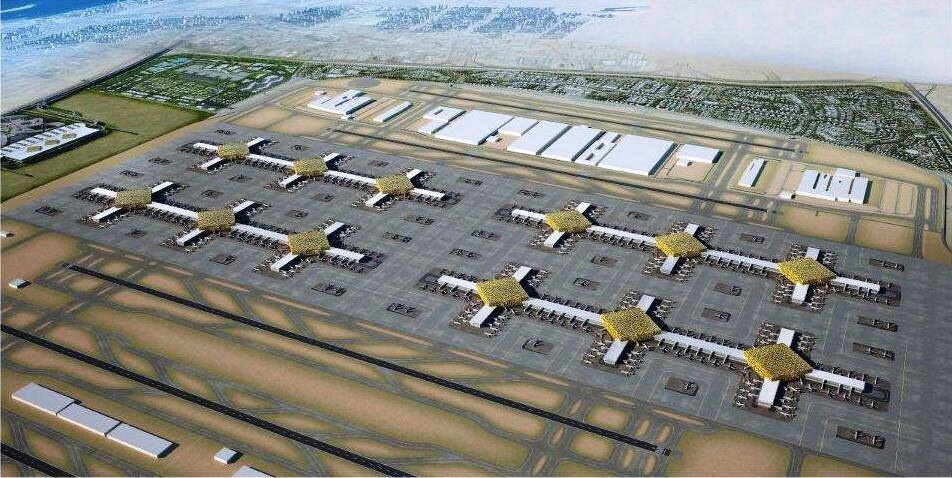
It is late - by about 10 years - but at last there is some
direction about the expansion of and future for the AED120bn (US$ 32bn)
expansion of Al Maktoum International at Dubai World Central (DWC) which
will ultimately accommodate more than 200 million passengers a year.
Originally planned for initial completion by around 2015/2016
the build out of the new airport was delayed dramatically by the 2008/2009
financial crisis. Instead the existing Dubai international airport has been
expanded well beyond its original capacity with a view to generating
cashflow to fund future construction at DWC.
Al-Maktoum International airport was launched before the
global financial crisis hit Dubai in 2009, with plans to build the world's
largest airport, featuring a 160-million-passenger capacity and six runways.
The ambitious plan appeared to have been put on the back burner due to the
crisis, and the airport instead opened operations for cargo only in 2010,
while small passenger operations began in October 2013 after repeated
delays.
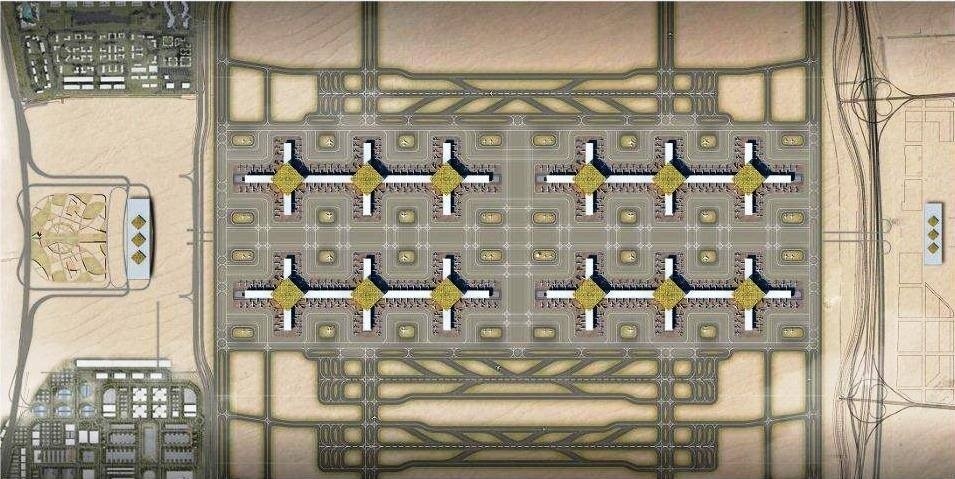
The development is anticipated to be the biggest airport project in the
world and will be built in two phases. The first phase includes two
satellite buildings with a collectively capacity of 120 million passengers
annually, accommodate 100 A380 aircraft at any one time and will take
between six and eight years to complete. The entire development will cover
an area of 56 square kilometres.
For what its worth I do not like the design. Every passenger
will need to take a train to a remote gate. Inevitably this means escalators
and elevators, waits for over-crowded trains that are standing room only and
at busy times some healthy pushing and shoving - together with a longer walk
than the designers suggest.
It is not just the airport build that is critical and will
need to commence at the earliest date. There are also plans for rapid rail
transit from the city and surrounding area to the airport that are under
preparation with the Dubai’s Roads and Transport Authority.
The rail connections are critical given the airport's remote
location from downtown Dubai - being some 60kms away from DXB.
At the moment DWC has a single runway and a temporary
terminal with hard stands only and a capacity of about 5 million passengers
a year. There are only a handful of passenger flights each day.
The airport authorities suggest that the new airport’s
uniqueness lies in a radically new approach to ensure that the latest
technology and efficient processes will cut the time spent completing travel
formalities and reduce walking distances, enabling passengers to make fast
and efficient connections between hundreds of destinations worldwide.
The decision follows months of planning by the key stakeholders in the
aviation sector, including Dubai Airports, Dubai Airports Engineering
Projects, Emirates airline and dnata, to ensure that a design was selected
that facilitates the future growth of Dubai’s aviation industry.
The expectation is that Emirates would relocate their
intercontinental hub operations to DWC by the mid-2020s. Today's
announcement makes no mention of the future plans for the existing airfield
at DXB.
Timing will be critical. DXB has seen capacity maximised with
the construction of Concourse A (completed in January 2013), the doubling of
capacity at Terminal 2 (by the end 2014), the construction of Concourse D
(2015), Concourse C upgrade (after completion of Concourse D) to accommodate
Emirates as the sole user, combined with associated stand upgrades,
enhancements to airfield and air traffic control capacity, as well as the
upgrading of existing facilities to improve the passenger experience.
The trouble is there is no room for a third runway and the
existing runways are too close to allow simultaneous operations. So DXB will
reach a limit of around 100 million passengers a year.
Dubai Airports expects passenger numbers at DXB and DWC to
exceed 100m passengers a year in 2017. Therefore passenger facilities will
also continue to be expanded at Dubai World Central (DWC) to accommodate
traffic that cannot be accommodated at DXB. Dubai airports is forecasting
126 million passengers in 2020 which means DWC will need to accommodate over
20 million a year by that date. That becomes a signficant operation.
It does not take much maths to realise that at 120m
passengers a year when opened DWC will not be able to handle all passenger
traffic into Dubai which will require DXB to remain open. The logical move
is for Emirates and flyDubai to operate from one airport and all other
carriers from the other airport. Since EK's business is substantially about
taking passengers from A to B via a change at its Dubai hub it will make
more sense for EK and flyDubai to occupy the new airport.
Paul Griffiths, CEO of Dubai Airports, thanked Sheikh Mohammed for his
visionary support of the project, and described the new airport as a vital
investment in the future of Dubai. He confirmed that the aviation sector was
projected to remain a cornerstone of Dubai’s economy, and was expected to
support more than 322,000 jobs and contribute 28 per cent of Dubai’s GDP by
2020.
“Our future lies at DWC. The announcement of this AED120bn development of
DWC is both timely and a strong endorsement of Dubai’s aviation industry.
With limited options for further growth at Dubai International, we are
taking that next step to securing our future by building a brand new airport
that will not only create the capacity we will need in the coming decades
but also provide state of the art facilities that revolutionise the airport
experience on an unprecedented scale,” said Griffiths.
Dubai Airports have launches a new website giving more
details of the planning for DWC.
The Dubai Airports
Future of Aviation PDF
Ultimate Airport Dubai is back and hopefully better
8 September 2014
Well the first series looked more like an advertisement for
Emirates Airline. There was barely a mention of Terminals 1 and 2 and who
would have known that flyDubai is a hometown airline.
Like it or not it did appear that there was a very heavy hand
controlling what we were allowed to see in Ultimate Airport Dubai season 1.
But here we go again. National Geographic Channels International (NGCI) has
selected Arrow Media to produce a second series of Ultimate Airport Dubai,
following outstanding ratings for the show’s first season across territories
in Europe, Asia-Pacific and Latin America.
Ultimate Airport Dubai will air its new 10-part season later this year on
National Geographic Channel in 170 countries and 45 languages.
In Ultimate Airport Dubai, NGCI goes behind-the-scenes of Dubai
International, the world’s second busiest airport for international
passengers.
With unprecedented access to all facets of the airport season two follows
the renovation of both the airport’s runways – a tricky enterprise that has
the airport operating using only one runway for several months with huge
pressure to finish the build on time. The series will be at the heart of
passenger operations, customs, the control tower and flight services to see
how the teams cope during a particularly stressful and demanding time.
Actually the airport fared rather well with a significant
reduction in flight delays.
“Ultimate Airport Dubai is a great hit for us, which rated in all markets.
The show offers a fantastic blend of airport docu-soap and mega engineering
show – all set against the backdrop of a highly modern, 21st century city
filled with exciting innovation. The high level of access, which the
production team secured makes this show different and we are delighted to
have it back in our schedules,” said Hamish Mykura, executive vice president
and head of international content.
A President among the fossils
6 September 2014
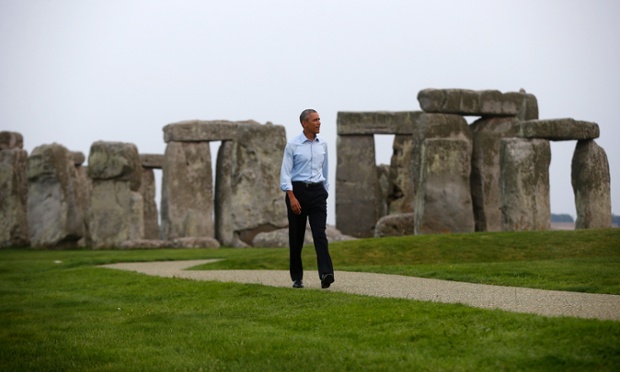
The struggle for Hong Kong
The territory’s citizens must not give up demanding full democracy—for their
sake and for China’s
6 September 2014 - The Economist
Chinese officials have called it a “leap forward” for democracy in Hong
Kong. Yet their announcement on August 31st of plans to allow, for the first
time, every Hong Kong citizen to vote for the territory’s leader has met
only anger and indifference. Joy was conspicuously absent. This is not
because Hong Kong’s citizens care little for the right to vote, but because
China has made it abundantly clear that the next election for Hong Kong’s
chief executive, due in 2017, will be rigged. The only candidates allowed to
stand will be those approved by the Communist Party in Beijing, half a
continent away.
At its worst, this risks provoking a disaster which even China cannot want.
Democrats are planning protests. It is unclear how many people will join in,
but the fear is that the territory’s long history of peaceful campaigning
for political reform will give way to skirmishes with police, mass arrests
and possibly even intervention by the People’s Liberation Army. That would
disrupt one of Asia’s wealthiest and most orderly economies, and set China
against the West. But even if, as is likely, such a calamity is avoided,
this leap sideways is a huge missed opportunity not just for Hong Kong but
also for the mainland. A chance to experiment with the sort of local
democracy that might have benefited all of China has been missed.
China’s announcement marks the end of an era. No longer is it possible to
argue that the development of democracy in Hong Kong can forge ahead even in
the absence of political reform in Beijing. The arrangements, set out by
China’s party-controlled parliament, the National People’s Congress, were
needed because of a pledge to grant the territory a “high degree of
autonomy” and eventually “universal suffrage” when it took over from Britain
in 1997. To most people, that meant having the right to choose their leader
themselves.
China has stuck to the letter of its promise, but not the spirit. In 2012
the chief executive was appointed by a 1,200-strong committee stacked with
the party’s yes-men from among Hong Kong’s business and political elite. The
proposal for 2017 is that a similar committee will select candidates who
will then be presented to all Hong Kong’s voters for election. In theory the
committee could allow through candidates of many political stripes. In
practice, pessimism is more than justified. Only two or three candidates
will be allowed, and each must win the support of at least half of the
committee. Under this arrangement, democracy will mean little more in Hong
Kong than it does elsewhere in China, where every adult citizen can vote for
local legislators—as long as the party approves.
This is bad for Hong Kong. The territory’s four leaders since the handover
in 1997 were all chosen in Beijing and rubber-stamped into office. All of
them, including the incumbent Leung Chun-ying, proved highly unpopular.
Under a government in thrall to Beijing, the press has been subdued by
intimidation and by pressure from advertisers. The judiciary fears that it
may face a test of loyalty to the mainland. Some Hong Kongers complain that
even the postal service is compromised—it refused to deliver leaflets urging
civil disobedience.
The story may not be over. Activists in Hong Kong have vowed to launch a
campaign of civil disobedience which they call, disarmingly, “Occupy Central
with Love and Peace”, but whose declared mission is to paralyse the
territory’s main financial district with sit-ins. This would be the first
large-scale flouting of the law by the pro-democracy camp.
The activists’ aim is correct and their courage impressive, but their
tactics may be mistaken. If the unrest gets out of control and troops are
deployed, it would be a calamity for Hong Kong—and would probably set back
the activists’ cause. Better to stick to what the democrats have always done
best: staging the kind of peaceful protests that have made the territory a
model of rational political discourse in a part of the world where it is
often sorely lacking. And there is another form of peaceful protest
available: Hong Kong’s legislators can reject China’s proposals, even though
that would mean reverting to the equally undemocratic system used in 2012.
Only a few dozen democrats now sit in the electoral college. They should, in
future, boycott it. There is no point in propagating a falsehood.
If Hong Kong’s people keep marching without damaging the territory’s
economy, China may well simply shrug. But not necessarily. It was thanks in
part to a huge and orderly protest in 2003 that Hong Kong’s puppet
government shelved plans to introduce an anti-subversion bill and that the
hapless chief executive, Tung Chee-hwa, stepped down. Rather than break the
law, Hong Kong’s democrats would do better to wield the weapon of
embarrassment.
But it is not only in Hong Kong that China’s decision to strangle the
territory’s democratic aspirations will be felt. China’s government has
alienated opinion in Taiwan, which it dreams of bringing under its umbrella
in the same way. The party appears to have concluded that the damage done to
the prospects of union with Taiwan is less important than the threat that
one of its opponents might win an election in Hong Kong and stoke demands
across China for political reform. The territory would also become
independent in all but name. That, the government worries, would encourage
separatists around China’s periphery, from Tibet to Xinjiang.
But discontent is growing all over China, and Beijing cannot just sit on it.
The huge new middle class is becoming increasingly frustrated with its
powerlessness over issues such as education, health care, the environment
and property rights. In terms of their day-to-day worries, mainlanders have
a lot in common with Hong Kong’s citizens. China’s government is going to
have to work out a way of satisfying their aspirations for more control over
their lives. Hong Kong would have been a good place to start.
Xi Jinping, the party chief and president, had the opportunity to use Hong
Kong as a test-bed for political change in China. Had he taken this
opportunity, he might have gone down in history as a true reformer. Instead,
he has squandered it.
NATO's Welsh invasion
5 September 2014
So the two day NATO summit in Cardiff is over. There are 28
NATO member countries though the meeting was attended by leaders from 60
countries. Seven warships, including the destroyer HMS Duncan. An army of
10,000 assorted police and guards. A twelve kilometer ring of steel around
the Celtic Manor venue and Cardiff Castle.
A city under lock down.
A banquet in Cardiff castle.
This summit was originally called to discuss the withdrawal
of NATO forces from Afghanistan after 13 years of fighting Taliban militants
there. There are questions over how many, if any, foreign soldiers will
remain after the 2014 deadline. There are even bigger questions about
Afghanistan's future.
Instead the conference saw statesmen making empty threats at Russia and
Islamic State, who are currently dismembering Ukraine and Iraq, two nations
the west claimed only recently to have “liberated”.
The Russian intrusion into Eastern Ukraine may have
re-enforced NATO and re-established its purpose. Article five of Nato's
constitution says an attack on one member country is an attack on all member
countries. Ukraine of course is a partner rather than a member of Nato; a
convenience for Nato.
But Nato's defence forces have been stimulated by a recent
article by Russian strategist Andrey Piontkovsky which argues that Mr
Putin's aims were "the maximum extension of the Russian world, the
destruction of Nato, and the discrediting and humiliation of the US".
It added that Nato countries such as the US and Germany would not stand by
the Baltic republics, and that, if necessary, the Kremlin would carry out a
limited nuclear strike in Europe in order to break apart the two sides of
the Atlantic alliance.
While Mr Piontkovsky was not writing in any official role - far from it -
his pronouncements were considered a sufficiently accurate assessment of
some of the more extreme thinking in the Kremlin.
Meanwhile Ukraine and Russia have negotiated a ceasefire;
agreed by Russia on the very day of the Nato summit just as Nato was
announcing new sanctions. There will be no ceasefire. Neither side is going
to back down now.
Meanwhile delegates ploughed on with discussions on the
Middle Easat but without the presence of any Arab leaders who could provide
support or balance. After all the west's incursions into Libya and Iraq have
not exactly provided for stability or peace. Instead they appear to have
fermented extremism.
Obama's in his closing statment said that "we are going to
achieve our goal. We are going to degrade and ultimately defeat [Isis], the
same way that we have gone after al Qaeda. You initially push them back, you
systematically degrade their capabilities, you narrow their scope of action,
you slowly shrink the space, the territory that they may control, you take
out their leadership, and over time they are not able to conduct the same
kinds of terrorist attacks as they once could."
Mark Urban for the BBC noted on twitter an "interesting
rumour on margin of #NATOSummitUK No UK bombing in Iraq until after Scotland
votes. Seen as possible gift to Salmond."
Somehow it feels like more talk in a world that in 2014
appears to be more dangerous than at any time since the cold war.
So our leaders stopped talking and had a dinner instead.
Thursday night's three-course meal kicked off with smoked salmon from the
Black Mountain Smokery and Cardigan Bay Crab served with avocado and lemon
jelly.
For their main, the world leaders enjoyed roast saddle of Brecon Beacon lamb
with Welsh new potatoes, heirloom tomato and Wye Valley asparagus.
The meal was finished off with a jar of Welsh fruit summer pudding and Neal
Yard’s Creamery creme fraiche.
As a reward for attending heads of state and government were
also given bumper willow baskets packed full to the brim of gifts.
They include Welsh cakes, whiskey, Welsh rugby balls, a book of selected
poems, woollen journals and even socks.
There really was little time to discuss anything of substance
let alone agree anything decisive. Next time try Skype.
Playing down the pomp and dealing with the circumstances would do so much
more to impress the people of Europe and the Americas.
New statement on fight against ISIS from UAE
5 September 2014
This is a just released statement from the United Arab Emirates (UAE)..
about the fight against ISIS.. and Islamic extremism overall. (statement
comes from the UAE Ambassador to the USA)
This is strong language from the UAE which is the first Arab country to
issue such a statement.
FROM UAE: Statement of Ambassador Yousef Al Otaiba On Challenging Regional
Extremism
Islamic extremism is a Middle East problem but it is quickly becoming the
world's problem too. It is a transnational challenge, the most destabilizing
and dangerous global force since fascism.
For certain, the United States and the West have a big interest in this
battle. But no one has more at stake than the UAE and other moderate
countries in the region that have rejected the regressive Islamist creed and
embraced a different, forward-looking path.
Now is the time to act. The UAE is ready to join the international community
in an urgent, coordinated and sustained effort to confront a threat that
will, if unchecked, have global ramifications for decades to come.
Any action must begin with a clear plan for direct intervention against ISIS
but must address the other dangerous extremist groups in the region. It is
also critical to tackle the support networks, the entire militant
ideological and financial complex that is the lifeblood of extremism.”
Something incredible is happening in Scotland
1 September 2014
The Guardian
You could tell it was getting serious when Gordon Brown made friends with
Alistair Darling; and when the Scottish Daily Mail began running doom
headlines about the future of the Union. I don't know whether the narrowing
of the poll lead for the no campaign was just a blip, but it doesn't feel
like it.
Something incredible is happening in Scotland. The little pin badges – Yes
or No – that people wear are sparking open conversation: in the pub, the
swimming baths, the post office queue. An entire country of 5 million people
is asking itself, sometimes quite vociferously, what it wants to be.
It's even more incredible if you consider the possible outcome. If enough
people tick the yes box, then come 2016 the flag of Great Britain will have
to go minus a whole colour.
It probably won't happen. But few south of the border realise how volatile
the outcome is. Yes, the polls reflect bookie William Hill's confidence that
there's just a one in five chance of a majority for independence – but the
variables are bigger than for most political events.
Having spent last week in Glasgow, I would say the biggest variable is going
to be turnout. When political enthusiasm reaches the relatively apolitical
world of the council estate, the pub, the nightclub and energises people,
turnout can do weird things to poll predictions. Alex Salmond claimed there
would be 80% turnout. I think the chances are even higher – and if the polls
actually cope with such volume, every percentage point above normal
introduces volatility not captured by normal polling.
At the Sub Club, a world-famous nightspot in Glasgow, the debate was
remarkably coherent, even at 2am among the intoxicated smokers huddled
outside. If I could distil the vox pops among those under-30s to a single
thought it would be: "We want to run our own country."
They have heard all the dire macro-economic warnings – about the pound, the
banks, the debt, the non-reliability of oil money. Set against the idea of
making a clean break with Westminster politics and neoliberal economics,
these are risks many of them are prepared to take.
One reason the political class is not hearing the debate properly is that,
on each side, there are mismatched political leaderships and tin-eared
campaign groups. On the yes side, many of the young people I spoke to
despise Alex Salmond. On the no side, it's fair to say Alistair Darling is
not hugely representative of a coalition that includes people from the
Orange lodges and the Scottish Tories, and the gay clubbers I met who were
firm no voters.
If, on the morning of 19 September, we wake up and that 4/1 horse of
independence has come in, the levels of shock in official circles will be
extreme. The Conservatives will have presided over the breakup of the Union.
Even compared with handing Zimbabwe to Zanu-PF, and Hong Kong to the Chinese
Communist party, that will be a major psychological moment.
Even more traumatised will be Labour. The prospect of a majority Labour
government at Westminster after 2016 will be remote. The party in Scotland
will likely go into meltdown, with a Podemos-style left emerging among the
pro-independence Labour camp, the Greens and the progressives around groups
like Common Weal.
There will be immediate ramifications beyond the UK: in Madrid and Brussels
there will be outcry; in Barcelona public joy; in Moscow quiet glee.
But the official narrative does not allow us to consider the possibility of
a yes victory. The political class – and I include Salmond's SNP in this –
is like the tightroper wobbling on a wire between two skyscrapers. Its
members can't allow themselves to think of the consequence of falling off.
The old certainties will be so dead anyway that it will scarcely matter.
What we can say, already, is that the no campaign – for all its resilience
in the opinion polls – failed in its plan to turn the referendum into an
issue of macro-economic risk. If it has worked, it is among the older
population and not the majority of the young.
The most coherent of the young people I spoke to understood the
macro-economic risk. But they weighed it against two increasingly
intolerable burdens: the inability of Scotland's relatively left-leaning
electorate to influence Westminster; and the inability to budge Scottish
Labour away from the free-market and pro-austerity policies associated with
Brown and Darling.
What this means is, even if the yes vote fails on 18 September, scoring
somewhere in the mid 40s, the pattern of all future Scottish independence
debates is set.
Independence has become a narrative of the people against big government;
about an energised Scottish street, bar and nightclub versus the sleazy
elite of official politics.
And in response, the left part of the pro-union camp has had to develop its
own, "more radical than Darling" rationales. It's not something you hear
from the Westminster parties, but via social media I have picked up a strong
meme among Scottish trade union members that independence under the SNP is
"not radical enough to bother".
Once established, political psychologies like this do not go away. History
shows they intensify until something gives, and at some point it is usually
the borders of a nation state.
What we know already is that a significant number of Scottish people have a
dream: where statehood, social justice and cultural self-confidence fit
together into a clear and popular project.
The rest of Britain may be stunned, but should not be surprised if the
enthusiasm for this dream propels enough people into the voting booths to
give the yes camp a narrow victory.
If it happens there'll be a lot of finger pointing, but it's obvious in
advance where the biggest problem lies: it's become impossible to express
opposition to free market economics via the main Westminster parties.
Some English and Welsh voters think they're doing it by voting Ukip. But the
referendum offered Scottish voters a way to do it by destroying the union.
Whether you think that's illusory or mistaken, it's formed the narrative on
the streets.
That's where we should be watching now; the high-camp shouting match of men
in suits is a diversion.
Paul Mason is economics editor at Channel 4 News. Follow him @paulmasonnews
Grumpy, green, yellow, old and male...and unelected
1 September 2014
Grumpy, unelected. old men. It is hard to find a better
description of Thailand's junta appointed cabinet.
The new cabinet is dominated by the military junta who have
13 Ministers including the PM and control over most of the key positions
ranging from PM, Defence, Education, Transport, Interior, Justice, Foreign
Affairs and Commerce (only key ones they don’t have are Public Health,
Finance, and Agriculture). Essentially, Prayuth and his clique dominate.
Prayuth’s former superior General Prawit Wongsuwan is deputy PM and Defence
Minister, while another of his ex-superiors, General Anupong Paochinda, is
Interior Minister.
Four of the premier’s former classmates have portfolios. General Dapong
Ratanasuwan was appointed Natural Resources and Environment Minister,
General Tanasak Patimapragorn is deputy PM and Foreign Minister, Gen
Chatchai Sarikalya was named Commerce Minister, and permanent secretary for
defence General Surasak Kanjanarat is the Labour Minister.
Prayuth’s ‘junior’ friends from pre-cadet school days, Navy chief ADM Narong
Pipatanasai and Air Force chief ACM Prajin Juntong, were appointed Education
Minister and Transport Minister respectively.
The Navy Chief as Education Minister will oversee a
curriculum that goes back to traditional Thai values - ie know your place;
rather than develops critical talents for a globalised world.
The premier’s subordinates from the armed forces who will help him
administer the country include deputy Army chief General Udomdej Sitabutr,
the Deputy Defence Minister, and assistant Army chief General Paiboon
Koomchaya, the Justice Minister.
Other posts are taken up by former bureaucrats mostly with
strong yellow shirt credentials"
Don Pramudwinai (Deputy Foreign Minister) He was a career civil servant with
the Foreign Ministry. His final posting was as Thai Ambassador to the UN. An
experience diplomat but still number two to General Tanasak Patimapragorn;
appointing a general as the Foreign Minister is hardly going to help the
junta's credibility with the international community though no dount Burma
and China will approve.
Sommai Phasee (Finance Minister) Was Deputy Finance Minister in the amt
appointed post 2006 coup Surayud government.
In each of the Education, Interior, Foreign Affairs, Transport and Commerce
ministries the junta controls the main minister position, but a
current/former civil servant is the deputy.
Kobkarn Wattanavrangkul is Tourism and Sports Minister and was previously.
She was Chairperson of Toshiba Thailand. Strange appointment as she appears
to have no relevant experience.
Wissanu Krea-Ngam is Deputy Prime Minister and was a NLA member and
Constitutional Drafter of the 2007 Constitution .
MR Pridiyathorn Devakula is Deputy Prime Minister; he was spokesperson for
PM’s Office under Chatchai, Deputy Minister of Commerce under the Anand and
Suchina governments, BOT Governor under Thaksin, and Finance Minister in
Surayud government.
There are noticeably few people from the business world. The cabinet are
almost all 60+ years old and are current and former bureaucrats and those
who have been in the sphere of the bureaucracy and periphery of politics. It
is a very Bangkok-centric cabinet. There is no room for alternative voices.
It is basically a rubber stamp cabinet - the NCPO is in
charge and that is where decisions will be made.
Thailand's military run government
31 August 2014
So Thailand has a new government with the King's endorsement
of junta leader Prayuth Chan-Ocha’s new cabinet.
Military men are in charge of almost every key ministry. Not
one of them has been elected.
Prayuth, who took power in a May 22 coup, placed 11 military officers in the
32-member cabinet, including as defense minister, foreign minister, interior
minister, commerce minister, education minister and justice minister. The
new finance minister is a civilian, Sommai Phasee, who was part of the
government installed by the Thai army following Thailand’s last coup in
2006.
The appointments, which include two former army chiefs from Prayuth’s
faction of the military, indicate that Prayuth will continue to rely on
those close to his junta.
Even those not from the military are “at least people who are devoted to one
side of the political divide and see themselves as more righteous leaders,”
said Andrew Stotz, chief executive officer of A. Stotz Investment Research
in Bangkok. “These people may see a rebalancing of power as a higher
priority” than a rush to elections, he said.
There will be no rush to elections. Let us be clear here.
There will be no election until after the next succession. And the electoral
map will be rewritten such that there can only be one winner of the
election....and that will not be the red shirts, Thaksin or anyone
affiliated to them.
The junta and its appointed bodies have to write a new
constitution and enact unspecified measures to “reform” Thai politics and
society.
Several members of Prayuth’s new cabinet were also members of the government
appointed after the 2006 coup. Pridiyathorn Devakula, a former Bank of
Thailand governor who will serve as Prayuth’s deputy premier for the
economy, was finance minister after that coup. Sommai, the new finance
minister, served as Pridiyathorn’s deputy before resigning in 2007 after a
court convicted him of abuse of power over suspension of state agency
official three years earlier.
“Recently, Sommai Phasee has said he would focus on tax reforms and boosting
the economy,” said Tim Leelahaphan, an economist at Maybank Kim Eng. “We
believe it is hard to see exciting policies from him or this interim cabinet
that focuses on economic reforms rather than populist policies.”
From the military, Prawit Wongsuwan, a former army chief and defense
minister, will be a deputy prime minister and defense minister, Thanasak
Patimaprakorn, the supreme commander of the armed forces, will be a deputy
prime minister and foreign minister and Anupong Paochinda, a former army
chief, will be interior minister.
Prajin Juntong, the air force chief who has overseen the economy for the
junta since the coup, will be transport minister, Chatchai Sarikulya, the
assistant army chief, will be commerce minister, Paibool Khumchaya, the army
assistant commander-in-chief, will be justice minster, and Narong
Pipathanasai, the head of the navy, will be education minister, for which he
is clearly well - qualified!
The NCPO has control over the ministires that have always
been considered the wealthiest for the people in power - transport, interior
and finance.
The new cabinet has only two female members, Tourism and Sports Minister
Kobkarn Wattanavrangkul and Deputy Commerce Minister Apiradi Tantraporn.