|
Welcome to rascott.com
This is a
personal site that reflects my interests in news,
current affairs, aviation and travel.
email me:
robert@rascott.com
Home
Up
Now In Dubai:
Scott
Consulting
Photo Albums
My photographs have been moved off this site and are now stored on Picasa. They
were simply taking up too much space on my web host.
Please use
this link to see my list of photo albums.
Some
Useful links:
Information:
World Time
Clock
Exchange Rates
Journalism:
ForeignPolicy
Nationsonline.org
Project Syndicate
Amnesty International
Reporters w/o borders
The Guardian
BBC World News
CNN Asia
Bangkok Post
Daylife.com - news
Gulf News
Arabian Business
World News
WSJ - Asia
SCMP
Good causes:
Sister
Joan - Bangkok
Regional Info:
BKK Magazine
HK Magazine
In
Singapore Magazine
TimeOut Dubai
Back in the UK:
Newton Ferrers
And for fun:
Lin Ping live panda tv
EarthCam
History
BBC Archive
National Media
Museum
The British Library
Imperial War Museum
There are many other links on my
AOB blog page.
| |
|
Burma awakes to glasnost
25 February
2012 The Guardian
At Bangon Books, a second-hand shop in the beating heart of Rangoon, U Htay
Hong is doing a brisk trade in Aung San Suu Kyi's collected writings,
Freedom from Fear. That well-known "subversive" George Orwell is also
prominently displayed, as are weditions of Thant Myint-U's unauthorised
history of Burma, The River of Lost Footsteps. "In the old days, these were
considered 'dissident' books and I had to keep them hidden in a back room,"
Hong explains. "Now, the intelligence police no longer seem to care."
And what is true for Bangon Books, it seems, is increasingly true for other
media outlets in Burma. For decades, journalists lived in fear of
imprisonment and worse. Owning a computer or fax machine without permission
was forbidden and access to the internet was strictly controlled.
Officially, these restrictions are still in place, but in practice the
regime is waiving many censorship rules, ushering in a sort of Burmese
"glasnost", the process of opening up after political repression.
The most visible sign of the new freedoms are the ubiquitous images of the
National League of Democracy (NLD) leader, Aung San Suu Kyi. During her
years under house arrest, it was illegal to publish her photograph. Now,
with parliamentary elections looming, T-shirts emblazoned with her image are
sold openly on Rangoon street corners and not a week passes without
photographs of her on the front pages of privately owned newspapers, such as
the Yangon Times and Flower News.
In March, in another "first" for the junta, President Thein Sein's
administration is to permit party political broadcasts by Aung San Suu Kyi
and other political leaders. Before receiving the final go-ahead, however,
the NLD must submit the text of her address to the censors at the Ministry
of Information.
And therein lies the catch, for in the looking-glass world of Burmese
politics, working out what is and isn't "permitted" is still something of a
guessing game. "The line is continually shifting," explained an editorial
spokesman for the Myanmar Times, a non-government weekly with dual Burmese
and English language editions. "We seem to be able to publish stories that
would have been unthinkable a year to six months ago."
However, he explained, it was still a "trial-and-error process. The only way
to be sure is to submit the pages and see what gets through."
Every week, two days before publication, the Myanmar Times, along with other
private weeklies (only government newspapers are permitted to publish
daily), sends its proofs to the Press Scrutiny and Registration Division, a
coinage of which Orwell would have been proud. There, some 100 clerks pore
over the text, excising paragraphs and, on occasion, whole articles deemed
antithetical to the promotion of what – in a classic example of Burmese
doublespeak – the regime calls a "discipline-flourishing democracy". In the
past, the censors might have excised as many as 10 articles. Now, the red
ink runs to an average of just three a week.
Recent editions of the Myanmar Times have featured articles on land reform;
the "flawed" 2010 election, which returned a military government despite an
NLD majority at the polls; and the long-running conflict in Kachin state,
where the regime is accused of human rights violations. The paper has also
run editorials calling for greater government "transparency" and the
publication of draft legislation to ensure that bills are subjected to
public scrutiny.
Some topics are still forbidden, however. For instance, the Myanmar Times
was not permitted to report on a recent strike at a Chinese-owned Rangoon
factory. Similarly, in an article on land reform, censors insisted on
striking out references to a lawsuit brought against an MP accused of
illegal land acquisitions.
Another item that got the red-ink treatment was a quotation from student
activist Min Ko Naing, who was only recently released from jail after being
imprisoned for his part in the 1988 student protests. In an otherwise
inocuous article about plans for a biopic about Suu Kyi's father, the
national independence leader Aung San, Naing expressed the hope that the
producers would feature the student union building where Aung San spent his
formative university days as well as the student union flag. Since the flag
is embazoned with a white star and a gold peacock, which is also an symbol
for the military, this proved too much for the censors and the reference was
deleted.
Other no-go areas are reports of ethnic conflicts and allegations of
military forced labour. In addition, the authorities continue to deny
journalists access to Kachin and other conflict zones, making it impossible
to report independently on claims of abuses there.
After decades of isolation, however, most Burmese are cautiously optimistic
that the new freedoms will not prove a flash in the pan and that, with time,
the process will become irreversible. The problem is that none of the
changes has been codified and there is no guarantee that, should new strikes
or protests break out, the junta won't revert to its former bad practices.
That is why many Burmese believe the real test will come later this year,
when a new press law comes up for discussion in parliament. According to
those who have seen a draft of the bill, it calls for the elimination of the
censorship board and its replacement with a press code similar to that of
other countries in the region. In another nod to a truly free and
independent press, the bill envisages daily publication by private
companies.
In an effort to prove that the relaxation of censorship is more than window
dressing, the Ministry of Information has been inviting journalists to
workshops to help retrain its staff in the art of public communications. But
while the country's top censor, Tin Shwe, is said to support the reforms,
his boss, Kyaw Hsan, the minister of information, is more hostile,
describing journalists as "vicious red ants".
For now, at least, the Burmese seem to be revelling in their glasnost
moment. On a election tour to the Irrawaddy delta nine days ago, Aung San
Suu Kyi was mobbed by supporters waving placards emblazoned with her image.
As she took to the stage in support of the local NLD candidate, huge
speakers blasted a popular Burmese anthem, giving the rally a carnival feel.
With the local and international press looking on, she talked about the
importance of "poverty reduction", "social justice" and the "rule of law" –
three phrases rarely heard in Burma and almost never in the same sentence.
The following week, the Myanmar Post published Aung San Suu Kyi's picture on
its front page next to a detailed report quoting extracts of her speech. The
government's official mouthpiece, The New Light of Myanmar, ignored it.
For those in the delta that day, it was an electrifying moment and
afterwards I was thronged by supporters eager for me to take their picture –
something that would have been inconceivable in the old Burma. "We are so
happy," said one. "Please tell the world that we are free."
I promised I would. Only time will tell whether it is true.
UAE aviation news
23 February
2012
From 1 September
2012, Emirates will introduce its two-class 428 seat Boeing 777-300ER
aircraft on its daily Dubai – Newcastle rotation. The 777-300ER aircraft
replaces the existing 278 seat Airbus A330-200 service.
Schedule:
EK035 DXB0720 – 1205NCL 77W D
EK036 NCL1335 – 2359DXB 77W D
This will be by far the largest airplane flying scheduled flights in and out
of the northeast city. Emirates says that the airbus has been running at
close to capacity for almost 18 months.
Emirates
operations into regional UK airports are one of the big success stories of
the airline's growth.
Meanwhile down the
road AirFrance/KLM are reported to be in codeshare talks with Etihad.
AirFrance has also suspended it's AbuDhabi services in its summer schedule.
More details here.
And in more Etihad
news the airline says it will make Washington its fourth North American
destination - but not until next year.
Etihad CEO James Hogan detailed the new route Wednesday at the National
Press Club in downtown Washington. He adds the carrier likely will add two
additional U.S. cities in 2014 as it begins to take delivery of the Boeing
787 Dreamliners it has ordered.
As for Washington, Etihad says daily flights between Washington Dulles and
Abu Dhabi will start March 31, 2013, pending government approval. Etihad
will fly the flights on Airbus A340-500 jets, which will feature 12
first-class seats, 28 in business and 200 in coach.
This is a very early announcement and possibly a way of preempting an
impending EK announcement of DXB to IAD.
Irrespective I
suspect that EK will be flying to IAD before EY, although conventional
wisdom seems to indicate that ORD (Chicago) will be first.
England's own
goal
23 February
2012 The Guardian
One of Fabio
Capello's final acts as England manager was his perplexing decision to base
the team in the Polish city of Krakow during Euro 2012, even though all
England's group games were subsequently drawn to take place hundreds of
miles away in Ukraine.
Markiyan Lubkivskyi, Ukraine's Euro 2012 tournament director, suggested that
England may come to regret choosing Krakow's modestly equipped Hutnik
Municipality Stadium, the home of a fourth division Polish side, as their
distant training headquarters this June. "I only wish that this decision
will not influence the successful performance of the English team,"
Lubkivskyi told the Guardian. "Training facilities are very good in Ukraine;
the quality of our pitches is excellent."
In the wake of Capello's departure the Football Association expressed
immense faith in its choice of Krakow, a lively party city in which
England's players should not succumb to the "boredom" suffered at their
secluded Rustenburg base during the last World Cup in South Africa.
Elsewhere in Europe, however, that decision is widely regarded as misplaced,
not to mention somewhat geographically illiterate.
England face a 930-mile excursion to Donetsk – a slightly longer journey
than that between London and Krakow – where they meet France on 11 June,
before returning to Poland immediately afterwards. They then head 540 miles
to Kiev to play Sweden before embarking on another near 2,000-mile round
trip to Donetsk to face Ukraine on 19 June. Should England win the group
their quarter-final would be in Kiev, while finishing runners-up consigns
them to a third jaunt to Donetsk.
France will be based at Shakhtar Donetsk's training headquarters. One of
three top-class sports complexes in the eastern Ukrainian city, it is
regarded as among the best in Europe. Indeed Eduardo, the former Arsenal
striker now with Shakhtar, has described its nine pitches, state-of-the-art
medical centre, restaurant and five-star hotel accommodation as being at
least the equal of the facilities he enjoyed in north London.
Sweden, unlike England, took the precaution of booking bases in Poland and
Ukraine before December's draw while retaining the option of cancelling the
less geographically appropriate one, and they are borrowing Dynamo Kiev's
ultra-modern training ground in the capital.
Under tournament rules Capello had until the end of January to make a
last-minute change of base but he said he had "absolutely no intention" of
staying in Ukraine. The downside of such dogma is that commuting from Poland
not only involves lengthy plane journeys, but the need for temporary
overnight pre-match accommodation.
While Kiev boasts a wide selection of hotels, Uefa's decision to block-book
the five-star Donbass Palace hotel in Donetsk dictates England's only option
is the more modest Ramada, built in the Soviet era. "There are some issues
here with transport and hotels but training facilities are the one area
where Donetsk is genuinely up there with the best in Europe," said Alexander
Atamanenko, chief executive of Shakhtar Donetsk's Donbass Arena. "When I saw
the photographs of England's training camp in Poland, I was surprised."
While the FA is adamant England's reportedly sub-standard training pitches
in Krakow will be repaired before their arrival and the sparse medical
facilities totally revamped, the feeling they have chosen badly persists.
"We are surprised by England's decision," said Borys Kolensikov, Ukraine's
deputy prime minister. "We may be a former Soviet country but in terms of
sports infrastructure, ours is better than many in Europe."
Lubkivskyi is determined to alter the sort of negative perceptions of
Ukraine presumably harboured by Capello. "Today our readiness is around 90%
but I can confidently say that, at the start of the tournament, Ukraine will
be 100% ready.
"The championship is an opportunity to make a leap in quality of life, for
our citizens and visitors. New roads, infrastructure, comfortable transport,
high-speed trains, new modern airports, reconstructed train stations, new
hotels and so many other things will change the face of our country and be
implemented for the tournament."He is also proud that, with Poland, Ukraine
is implementing a Respect Diversity programme in conjunction with Football
Against Racism in Europe. This involves more than 80,000 police officers and
stewards having anti-discrimination training. "Hundreds of inclusivity zones
will be created," Lubkivskyi said. "Spaces open and accessible to all,
regardless of ethnic or national background, gender, disability or sexual
orientation."
IAH/SEA changes for EK
22 February
2012
Bit of a change of
plans for Emirates Houston and Seattle flights. Seattle bookings are light -
and reducing Houston from two flights a day to a single 77L has reduced
Houston capacity too far.
So Emirates will
swap the Houston and Seattle airplanes.
From 1 March 2012
to 3 March 2012, the airline is operating Boeing 777-300ER (P12J42Y304)
aircraft to Seattle as planned. However, starting 4 March 2012 this route
will be operated by 777-200LR (P8J42Y216) instead.
Schedule:
Dubai – Houston
EK211 DXB0930 – 1600IAH 77W D
EK212 IAH1825 – 1905+1DXB 77W D
Dubai – Seattle
EK229 DXB0940 – 1340SEA 77L D
EK230 SEA1730 – 1900+1DXB 77L D
Clinton -
compulsive tv viewing
21 February
2012
This is The
Independent's review of the first episode of PBS' "Clinton" documentary:
"There's a
stick-to-itness in this man that's just phenomenal," someone said at the
beginning of Clinton, PBS's four-part documentary about the 42nd President
of the United States. There wasn't much doubt in the tone of voice that
"stick-to-itness" is a virtue, but then what makes Clinton such an
intriguing subject for a biographical profile is that it was usually his own
vices that made him come unstuck in the first place. And that this was to be
the portrait of a flawed man, and not a great one, was explicit from the
opening frames of the film, which began with Clinton's moist-eyed apology to
America from the White House Rose Garden: "Quite simply, I gave in to my
shame," he said.
The anecdotes that immediately followed reinforced the sense of an
opportunity squandered. Joe Klein recalled an instance of his genius as a
stump campaigner, when Clinton impulsively knelt to comfort a distressed
woman in a town hall meeting. And then Dee Dee Myers, his one-time press
secretary, said something mordantly undercutting of such moments of empathy.
"The only way you can have that moment over and over," she said, "is if you
really aren't interested."
The full political disillusion will be explored in later episodes, I
suspect, but this opener was concerned with precocious talent and early
achievements. And one of the odd things about it was how easily it might
have been the first episode of a biography of the first female President of
the United States. Hillary wasn't always an electoral asset to Clinton –
when he was first running for office in Arkansas they preferred to hide her
in a back office because her Chicago liberalism frightened the voters – but
the implication here was that she was essential as backbone, belief and
brains. When Clinton's ambition was catalysed by hers it became something
prodigious. Unfortunately, from the very earliest days, his appetites were
large in other respects too. He had so many skeletons in the cupboard that
there was barely room for a wire coat-hanger alongside them – a fact that
forced him to draw back at the very last minute from his first run at the
Presidency. Instead, he had to settle for giving the nomination speech for
Michael Dukakis at the national convention, an occasion that went
catastrophically wrong for him, with the crowd jeering his dullness.
Typically, he went on The Tonight Show with Johnny Carson the next night,
did some self-deprecating stuff and had turned it to his advantage by the
end of the broadcast. If you loved The West Wing – but like a few warts with
your idealism – this is for you."
Top Executive
Recruiters Agree There Are Only Three True Job Interview Questions
21 February 2012
Forbes.com (adapted)
The only three true job interview questions are:
1. Can you do the job?
2. Will you love the job?
3. Can we tolerate working with you?
That’s it. Those three. Think back, every question you’ve ever posed to
others or had asked of you in a job interview is a subset of a deeper
in-depth follow-up to one of these three key questions. Each question
potentially may be asked using different words, but every question, however
it is phrased, is just a variation on one of these topics: Strengths,
Motivation, and Fit.
Can You Do the Job? – Strengths
Executive Search firm Heidrick & Struggles CEO, Kevin Kelly explained to me
that it’s not just about the technical skills, but also about leadership and
interpersonal strengths. Technical skills help you climb the ladder. As you
get there, managing up, down and across become more important.
“You can’t tell by looking at a piece of paper what some of the strengths
and weaknesses really are…We ask for specific examples of not only what’s
been successful but what they’ve done that hasn’t gone well or a task they
they’ve, quite frankly, failed at and how they learned from that experience
and what they’d do different in a new scenario.
Not only is it important to look at the technical skill set they have…but
also the strengths on what I call the EQ side of the equation in terms of
getting along and dealing or interacting with people.
Will You Love the Job? -Motivation
Cornerstone International Group CEO, Bill Guy emphasizes the changing nature
of motivation,
“…younger employees do not wish to get paid merely for working hard—just the
reverse: they will work hard because they enjoy their environment and the
challenges associated with their work…. Executiveswho embrace this new
management style are attracting and retaining better employees.
Can We Tolerate Working With You? – Fit
Continuing on with our conversation, Heidrick’s Kelly went on to explain the
importance of cultural fit:
“A lot of it is cultural fit and whether they are going to fit well into the
organization… The perception is that when (senior leaders) come into the
firm, a totally new environment, they know everything. And they could do
little things such as send emails in a voicemail culture that tend to
negatively snowball over time. Feedback or onboarding is critical. If you
don’t get that feedback, you will get turnover later on.
He made the same point earlier in an interview with Smart Business,
referencing Heidrick’s internal study of 20,000 searches.
“40 percent of senior executives leave organizations or are fired or pushed
out within 18 months. It’s not because they’re dumb; it’s because a lot of
times culturally they may not fit in with the organization or it’s not
clearly articulated to them as they joined."
Preparing for Interviews
If you’re the one doing the interviewing, get clear on what strengths,
motivational and fit insights you’re looking for before you go into your
interviews.
If you’re the one being interviewed, prepare by thinking through examples
that illustrate your strengths, what motivates you about the organization
and role you’re interviewing for, and the fit between your own preferences
and the organization’s Behaviors, Relationships, Attitudes, Values, and
Environment (BRAVE). But remember that interviews are exercises in solution
selling. They are not about you.
Think of the interview process as a chance for you to show your ability to
solve the organization and interviewer’s problem. That’s why you need to
highlight strengths in the areas most important to the interviewers, talk
about how you would be motivated by the role’s challenges, and discuss why
you would be a BRAVE fit with the organization’s culture.
Pan Am - episode 14 - watch and blog.
20 February 2012
Problem with episode is that I am
not sure where we are after last weeks out of order episode...:
Here we go:
Kennedy is dead, New York airport
is renamed...flight deck is morbid....Ted is confused not helped by a
wedding that is turning into the social event of the year. Dad's advice is
that a partnership can be better than love! Capt Lowry is grounded for a
hearing over his Haiti crash; Maggie is smuggling. Richrad has been shot so
goes straight to see Kate - the microfilm has to get to the CIA the next day
- but the shooting is an inside job....next person who contacts her from the
CIA will be the double agent.
Omar the prince is courting
Collette and wants to relocate her for a six month courtship!
Ted is buying cameras for Laura -
then asks her when did you realise that Greg was not the one - I always knew
she says but my parents loved him, I needed more she says.....and she things
Andy Warhol is a genius. Laura sends him off to Amanda just before things
can get interesting.
Capt Lowry goes to see Collette-
he is so jealous. Are you in love with him - love is not something I care to
discuss with you she wonderfully replies...how does she know he has a
hearing - he had not told her.
Kate is off to the CIA. Anderson
bumps into Kate and asks after Richard - so Anderson is the double agent.
Back in Kate's apartment Richard has disappeared.
Ted tells Amanda that he cannot
share his wife....that he wants a traditional marriage -Amanda says this is
about Laura isn't it - I cant marry you says Ted. Amanda turns up to see
Maggie and Laura. Amanda says to Laura - I would like you to be Ted's
mistress....I don't want to be anyone's mistress - Amanda explains that I am
willing to share him- but also says that Laura can never be with Teddie.
Meanwhile Collette is now being
grilled by Omar's minders - and giving then her life history. She is such a
romantic....this inquisition will push her away.....
The jewellery smuggling is not
going well - but Maggie is a pain. And so is Captain Broyles (??).
Richard is back - now which one
is the double agent....
Laura is off to see Ted - oh
dear. He confesses there is someone else that grew on him...it has always
been you ever since that first flight in London- and they kiss....I guess a
threesome with Amanda is out of the question.
Now for the Lowry hearing.
Maggie is now making the deal on
her own....negotiating in Portugese - and making out with her captain on a
bed of dollars.
Omar says the background
investigation has revealed something - your name is not the same as your
parents - the nuns change your name to protect you - your parents were
Jewish Omar tells her - and her parents were gassed in Dachau at the
concentration camp. Since he is Omar the prince and Collette is Jewish the
courting ends immediately.
All my life I have only known
lies; even my name. Collette is so vulnerable - and so strong.
At the hearing Captain Broyles
(??) comes in to rescue Captain Lowry with a letter from Juan Trippe.
You will not be terminated but
your flying privileges will be withdrawn for six months - bizarre.
Kate finds Anderson who takes a
gun out to threaten her in a rail station. But Kate has set him up and
Anderson is arrested.
Amanda goes to see Ted and tells
him she went to a doctor and that she is pregnant. It seems unlikely. But it
will get her man.
Kate is watching over Richard in
hospital on New Year's Eve....Richard says they want Kate to be a real
agent....trained at Langley. Can she leave Pan Am.
Ted and Capt Lowry are drinking
in an empty airplane....Ted tells Dean that Omar and Collette are over.
The new year party has the girls
celebrating alone....until Ted and Dean turn up....the new year's eve
dresses and hairstyles are fabulous....its the new year and Dean and
Collette kiss - Dean is going to spend 6 months looking for Collette's
brother - Laura looks so happy with Ted - he has not told her about Amanda -
and where is Amanda - shouldn't she be with her future's baby's father at
the new year - guess that helps the intrigue. So question is was this the
last of Pan Am - or will it be back....
In Race to Run
Hong Kong, Scandal Taints Beijing’s Choice
19 February 2012 - New York Times
An unauthorized addition to a luxury house may be sinking the hopes of the
man thought to be China’s favorite to be Hong Kong’s next leader.
Henry Tang, a former senior government official, is facing increasing
pressure to end his campaign to become chief executive, Hong Kong’s top
government position.
Long seen as the candidate favored by Beijing, Mr. Tang has seen his
popularity plummet over months of missteps, capped last week when he
acknowledged that structures built at his wife’s home did not have
government approval. Mr. Tang insists on continuing his candidacy, but the
unauthorized construction, a favorite topic in local media coverage of
public figures, was seized on by his political opponents.
“I don’t think he can hope to salvage his credibility,” said Alan Leong of
the Civic Party. “If he can’t handle his own affairs, how can he run a
government?”
The scandal has provided more than just tabloid headlines. Political
observers say the concerns dogging Mr. Tang reveal a growing public
frustration that the local political and economic system is ruled by a small
elite out of touch with the rest of the population. Mr. Tang’s candidacy,
analysts add, also suggests a need to rethink the vetting process for
candidates, and has fueled a growing local anxiety over Hong Kong’s
relationship with mainland China.
The challenge facing all Hong Kong candidates “is whether they can be seen
defending Hong Kong’s interests and autonomy,” said Jean-Pierre Cabestan,
head of government and international studies at Hong Kong Baptist
University. “One of the themes of the campaign should be addressing social
inequalities and creating a fair competition law. I don’t know if there’s
anyone willing to fight these forces, any politician with the courage to
speak out.”
This year’s election for Hong Kong chief executive was expected to be like
previous campaigns since the territory was returned to China in 1997, a
buttoned-down affair that would have little drama. A 1,200-person election
committee representing various business and social constituencies across
Hong Kong will elect the chief executive on March 25. The majority of the
committee’s members are seen by many political observers and academics as
taking their cues from Beijing as to whom to support.
Both Mr. Tang and his main rival in the campaign, CY Leung, a former
convener of Hong Kong’s Legislative Council, are viewed as acceptable
candidates by the establishment in Beijing. A third candidate, Albert Ho of
the Democratic Party, is seen as having little chance of winning the
election.
Last week, Mr. Tang labored to explain the structures built at the home
owned by his wife. Local news reports said that one of them, a basement
occupying 2,200 square feet, or roughly 200 square meters, contained
features like a wine cellar, a home movie theater and a Japanese-style bath.
Mr. Tang has rejected those claims and said the basement was used as a
storage space. He said his wife had carried out the work without his
knowledge.
But the reported extravagance and Mr. Tang’s explanation, seen by many as
shifting blame onto his wife, have sharply influenced public opinion. A poll
conducted by the University of Hong Kong showed that most people surveyed
doubted the integrity of Mr. Tang, the 59-year-old scion of a wealthy family
from Shanghai. The poll was published by The South China Morning Post over
the weekend.
The sagging ratings culminate months of gaffes by Mr. Tang, who last
September resigned as chief secretary, the government’s No. 2 position, to
run for chief executive. In October, amid public speculation about an
extramarital affair, he acknowledged simply that he had made a mistake in
his romantic life.
Last May, Mr. Tang said Hong Kong’s youth should try to emulate Li-Ka-shing,
Hong Kong’s wealthiest tycoon, rather than complain about the growing gap
between the rich and the middle class. The remarks were made during a year
in which Hong Kong residents staged several demonstrations to protest
housing prices and what they have called an economic system run by a small
group of wealthy individuals.
Analysts say those protests were part of a larger movement reflecting
growing frustration among Hong Kong residents over their voice in the
political system and access to housing and public services.
“In Hong Kong, you have a coterie of people who are rich and powerful,” said
Michael DeGolyer of the Hong Kong Transition Project, an independent
research organization. “You have a rigged economy that is full of cartels,
not truly open and competitive. People are concerned by that.”
That sense of frustration has spilled into public perceptions of mainland
China. Many observers say Hong Kong residents fault people from the mainland
for driving up the costs of housing and clogging public services. The number
of mainland women coming to Hong Kong to give birth has grown so
dramatically that the local government placed a cap on how many pregnant
mainland women are allowed into hospitals.
Surveys by both the Transition Project and the University of Hong Kong have
shown that a growing number of people identify themselves as Hong Kong
residents rather than Chinese. Such studies do not surprise local analysts
and politicians, who say the existing system for choosing Hong Kong’s chief
executive presents many challenges for mainland China’s leadership.
“Beijing has to be careful,” said Mr. Cabestan of Hong Kong Baptist
University. “Local society is more frustrated than ever, and an increasing
number of people feel sidelined by the mainland nouveaux riches coming
here.”
Added Mr. Leong of the Civic Party: “The cultural differences between Hong
Kong and the mainland have not been properly addressed for the past 15
years,” a reference to the period since the territory’s handover to China.
“Beijing should bring some humility when dealing with Hong Kong.”
Imperial
Outpost in the Gulf
18 February
2012
This is very
timely if you read my 5 February entry below. Coming soon on Amazon and
hopefully to a bookshop near me is:
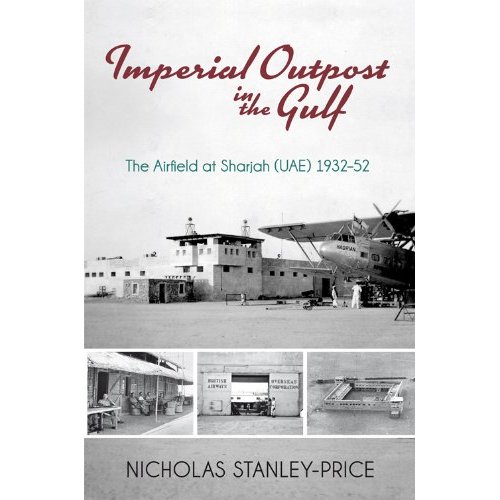
This is the book
description from
Amazon:
In 1932 the
Sharjah airfield was created out of nothing in the open desert, an overnight
stop on Imperial Airways' route carrying mail and passengers to India and
eventually to Australia. The British government drew upon the RAF's
experience in the Middle East to build a fortified rest house there, for
fear of possible attacks from the Beduin. Air travel then was a luxury
beyond most people's means. But passengers in transit praised the comfort of
the Rest House in the desert. Imperial Airways switched during the 1930s to
using flying-boats that landed on the creek at Dubai, a move that favoured
Dubai's emergence as a commercial hub. Then, during WWII, the airfield
became a transit point for troops going to India and the Far East. For RAF
and American air force personnel, a posting to Sharjah made the heart sink
as it was notorious for its extreme heat, isolation and poor rations.
The history of Sharjah airfield is central to the story of the modern
Emirates. In this meticulous account, Nicholas Stanley-Price brings the past
vividly to life, using an impressive array of unpublished contemporary
photographs and records, and fascinating stills from documentary footage
shot at Sharjah in the 1930s.
About the Author: Nicholas Stanley-Price is a specialist in the conservation
of cultural heritage. Originally educated in the classics, he earned a
doctorate from Oxford for his research on prehistoric Cyprus and he has
lectured and published widely on archaeology and conservation theory and
practice. He has twice spent a year as a government advisor in the Gulf
region, the first in the late 1970s as Assistant Archaeological Advisor in
the Ministry of National Heritage and Culture of Oman, and the second in
2007-8 as Strategic Advisor in the Sharjah Museums Department in the United
Arab Emirates. He is now an independent consultant living in Rome.
Passengers and staff should have been protected from Air Australia failure
17 February
2012
The failure of Air
Australia, previously known as Strategic Airlines, has been likely for
weeks. Indeed it may be that the company was actually trading while
insolvent. The airline last week denied reports of substantial unpaid bills
but the final straw came last night when the refueller at Phuket demanded
cash payment instead of extending further credit.
It may well be
that the Australian regulators should have done a better job of protecting
passengers and staff who are now in financial difficulty or stranded.
It will take days for all 4,000 people stranded by the collapse of the
Brisbane-based airline to make their own way home. Qantas, Jetstar and
Virgin Blue are all helping but passengers have to buy new tickets and then
try and recover the cost of their now cancelled flights.
Air Australia was placed in voluntary administration overnight, grounding
all flights. This was after it spent all week denying rumours of financial
problems. ir Australia dives, passengers stranded
Mark Korda, a spokesman for administrators KordaMentha, said
"there's about 4,000 people overseas and they
actively need to manage their own affairs. Our call centre can take the
calls but they should not be relying on Air Australia to get them back." Mr
Korda said the airline had run out of money to refuel its planes overnight.
The administrators said people who had paid by credit card or have travel
insurance are highly likely to get refunds, but those who paid in cash may
have lost their money as the airline had no cash for refunds. "Unfortunately
if you paid by cash, it is likely you will not be entitled to a refund
unless you took out insurance and that insurance covers an event of
insolvency," the administrators said in a statement.
Six Air Australia flights were due to depart Melbourne today, two to Phuket
and four domestic flights to Brisbane. Another four were due to depart
tomorrow including two to Honolulu in Hawaii. A total of 40 flights were due
to fly from Melbourne over the next week and all have been cancelled.
In the wake of the grounding, there have been calls for the Australian
aviation industry to be investigated.
The people hit
hardest were the group checked in at Phuket and ready to leave for home at
7.30pm local time. Their plane's departure was delayed a number of times
before passengers were handed a press release from KordaMentha after
midnight. It said: "In the short term, the fleet will be grounded. It
currently appears that there are no funds available to meet operational
expenses so flights will be suspended immediately. For clarity, it also
appears highly unlikely there will be any flights in the short to medium
term. You should make alternate travel arrangements."
That rather ruins
your vacation. Stuck at the airport. No accommodation. No flight. No one to
help.
Air Australia was re-launched three months ago as a discount holiday
airline, flying to Hawaii, Phuket and Bali from its home base in Brisbane.
But it also flew to Hawaii from Melbourne, with daily flights from Wednesday
to Sunday.
Its domestic routes included a daily flight Melbourne to Brisbane and it
also served the booming mining areas of Western Australia, with flights from
Perth to Derby and Port Hedland.
Only yesterday Air Australia, which has five aircraft including two
twin-aisle Airbus A330s and two smaller Airbus A320s, was still taking
bookings over the internet. The first sign of trouble for the airline came
this week when it was revealed that it had been unable to pay aviation fees
and charges to Air Services Australia.
The airline was also being pursued over debts for terminal leasing at Perth
Airport and over other charges it had not paid to Melbourne Airport.
It claimed less than 48 hours ago it was in no financial strife and denied
claims it had also been late with payments to Flight Centre.
Air Australia leased some aircraft via its European arm, including enlisting
one aircraft from Turkish airways Atlas Air to operate on routes from
Australia into Asia. That aircraft was crewed by Turkish nationals, about a
dozen of whom worked with Air Australia, with a number of Thai aircrew also
employed on Thai wages and conditions. Some of the Thai crew, which were
reputedly on a wage of around $90 a day in Australia and have been stranded
in Melbourne.
Cash is king. And
Air Australia had none. The company were minimally staffed and their costs
should have been reasonably good. But without deeper pockets the airline was
always going to struggle.
Conversations
with Thaksin: a sycophantic approach to biography
17 February 2012 Sholto Byrnes in The National
"Conversations with Thaksin is the third in the Giants of Asia series, a set
of very strange but nonetheless fascinating books by Tom Plate, a former Los
Angeles Times executive who now insists on calling himself "Professor Tom".
I say strange because outside of court biographers, it is unlikely that any
writer would approach these subjects - before the former Thai premier he
covered Malaysia's Dr Mahathir Mohamad and Lee Kuan Yew of Singapore - in so
relentlessly sycophantic a manner. Even fellow admirers of these men would
cavil at the way "Professor Tom", who has taught courses at universities in
America and lectured at the UAE University in Al Ain, bends over backwards
to share their sense of being misunderstood by the international community
and the western world in particular.
Lee, for instance, has been completely synonymous with Singapore's
governance and its phenomenal success even since before full independence in
1965; but he has never made any secret of his dismissive views about
democracy and individual rights. "We decide what is right. Never mind what
the people think," as he once put it. Plate is quite right to state that Lee
is not the authoritarian ogre he is sometimes caricatured as - "not remotely
... some crackpot Pol Pot, nor some hare-brained 'Little Hitler'" (the
latter insult famously came courtesy of William Safire in The New York
Times). One might, however, not go as far as Plate by saying instead that he
is "the Clint Eastwood of Asia, a definite straight shooter", the "Masterful
Mind" mesmerised "by the dance of brilliant ideas ... And - gosh! - consider
that his own autobiography (two immense volumes) is almost as lengthy as
Winston Churchill's. Think about that." Gosh! - or should that be gush? -
indeed.
Likewise, I would agree with Plate - although many would not - that Dr
Mahathir, the almost equally dominant leader of Malaysia from 1981-2003,
"was in fact the best living example of an effective moderate Muslim leader
that in recent memory the world had seen". I'm not sure I'd want to begin by
addressing him thus, however: "This book ... it's the reader having a long
and maybe somewhat intimate conversation with Dr M. The idea is to feel his
personality, his flair, his instincts, his brain. Nobody else is like you."
Beyond that, the tone is folksy, often to the point of grating, and we learn
far more about Plate's own life than is desirable: his problems with his
waistline, what he did when he realised he was going to be fired from the LA
Times, the fact that his father had a temper and so did his best friend at
college, his wife's opinion of his wish to be liked; and so on and so on.
This is all the more irritating because despite their apparent ubiquity in
their heydays, these "Giants of Asia" could be difficult to get to. My own
efforts to interview Lee Kuan Yew began with a three-hour grilling by both
the Singapore High Commissioner and his deputy in London, followed by the
demand that for the request to go further, I must partner publication in the
boutique, left-leaning New Statesman with a more mass-market right-of-centre
journal. I came up with The Daily Telegraph - Britain's best-selling quality
newspaper - but, alas, Mr Lee and I are still no better acquainted. And when
access is granted, the subject may not be in a revealing mood. My interview
with Dr Mahathir, granted specifically so he could discuss a rather
unflattering new biography of him, got off to an unpromising start when he
pretended not to know what book I was talking about. All of which is to say:
hasn't Plate, granted hours of one-on-one interviews with his subjects,
seriously missed the chance to ask penetrating questions of three men who
have so divided opinion that there is almost no ground between those who
regard them as heroes and those who see them as tyrannical dictators?
Up to a point, Lord Copper. Perhaps stung by criticism of his first two
books, Plate explains his softly-softly approach in his new volume on
Thaksin Shinawatra: "You probably know that Sixty Minutes-style
dice-and-slice questions usually get nowhere with major political figures.
Instead you harden up, into the shell like that of a well-weathered
tortoise. Bang on it as much and as hard as you want and all that will
happen is the head will duck inside and you will be left all alone in the
room by yourself."
Well, "Professor Tom" is certainly not one to wield the knife. He is prone
to come up with analyses that other commentators have unaccountably
overlooked, such as his suggestion that what Thailand needs is an
international commission of reconciliation, on the board of which should sit
Bill Clinton, Nelson Mandela, Aung San Suu Kyi (assuming she is at liberty,
which she has never been thus far, to leave and re-enter Myanmar), the Pope,
Jimmy Carter and "every saint, all the goody types, you know?" How Plate
thinks that Thailand and its king could possibly countenance such an
intrusion into the country's politics is beyond comprehension.
But Plate's "Gee shucks, did they really say that about you?" style has a
huge upside. His subjects open up to him in a way they may not have intended
to, and the insights the reader gains into their characters are
considerable; to the point that Plate's books, for all their faults, will be
incomparable tools for historians, biographers and anyone who ever wants to
figure out what made these men, who do deserve to be called "Giants of
Asia", tick.
These insights do not always show these men in their best light. I'm not
sure that Thaksin, who was widely accused during his premiership (2001-2006)
of heavy-handedness in dealing with insurgencies in the Muslim south of
Thailand, did himself any favours by letting slip his thoughts on the
inhabitants of those parts. "Often the husband is very lazy. They want to
stay all day in tea-houses, drinking tea, and then playing with the cuckoo
bird, the one that can sing. It is the lady of the house who goes to work."
Similarly his aside that when he plays golf with his friend Hun Sen, prime
minister of Cambodia, sometimes they "tell boys' jokes" too off-colour to
reproduce here. His reminiscence about the former Japanese leader Junichiro
Koizumi is better: "Once he told me, in front of China's Premier Zhu Rongji,
'You know, before my prime ministership I had a lot of girlfriends. Now,
after becoming prime minister, I have a lot of security people!'"
Admittedly, Thaksin's fortune did originally come from telecommunications,
but it is nevertheless telling to discover that he has an extraordinary 12
mobile phones permanently on the go (he fibs and says the number is only
eight, but Plate finds him out). Likewise not many interviews with former
premiers end up yielding confessions such as "I lose weight, and now I am
very proud of my tummy" - a line Plate interprets to mean that Thaksin is
image-conscious as only a man keen to return to the limelight would be,
despite his protestations that he wishes merely for a role "beneficial for
the country and the people". All these, as well as Plate's perception that
Thaksin suffers from "severe loneliness", add to a rounding out of his
character and win him a degree of sympathy that appears to justify his
interlocutor's approach.
More serious are Thaksin's admissions that he ignored the warnings about the
military coup that toppled him in 2006, responsibility for which he points
squarely at General Prem Tinsulanonda, the head of the Privy Council and the
king's closest adviser - thus risking the charges of antimonarchism that his
enemies always alleged. He also undermines his ardent professions about
national reconciliation and forgiveness when he offhandedly remarks that he
believes his foes will eventually be hauled up in front of the International
Criminal Court. Given that his sister, Yingluck, is now prime minister, and
that his chances of returning to Thailand without being arrested or
assassinated must be reckoned as better than at any point since his ousting,
such comments are highly relevant, if not necessarily helpful to his cause.
But they are all part of why this new book on Thaksin is the most successful
of Plate's series so far. Dr Mahathir and Lee Kuan Yew may remain very vocal
(too vocal for his successors' comfort, in the case of Dr M), but they are
retired. There is no chance they will lead their countries again, and while
their records deserve to be examined more even-handedly than their western
detractors tend to do, in those books Plate comes across as too much the
apologist keen to readjust the political obituaries. In the case of Thaksin,
it is clear that he burns to return from exile and that he still hungers
after power. The "deliverance" to which Plate refers in the title of this
book has yet to happen. This lends it an urgency the others lack. It also
adds a little more bite to "Professor Tom's questioning. He should
concentrate in future on other leaders whose careers have come to a
premature halt but who hope to resume them. Other such "Giants" are, after
all, not in short supply in Asia."
Sholto Byrnes is a contributing editor of the New Statesman and a frequent
commentator on South-east Asian politics and religion.
Why this year's
Bahrain Grand Prix should not be taking place
16 February
2012 - The Guardian
"When I started
this weekly blog I wanted it to be light and fluffy, like freshly beaten egg
white, the top of a cappuccino or the economic musings of George Osborne.
But today this corner feels as dark as Pluto's armpit and I feel in sombre
mood. I'm talking about the Bahrain Grand Prix, which is scheduled to take
place on 22 April. From this distance the race will probably take place,
barring another flashpoint of major significance.
But should it? I mean, all things considered, should it really go ahead? I'm
not banging on about human rights now, even morality, because we'd be here
all day. No, I'm looking at the Bahrain Grand Prix purely as a sporting
event.
I first met John Arlott, the great former cricket correspondent of the
Guardian, in 1970. This sounds like a digression, but it's not. I had just
landed my first newspaper job, working on a small weekly in Lewes, and used
to mooch about the County Ground in Hove hoping to meet the leviathans of
the press box, Woodcock (the Times), Swanton (Telegraph) and Arlott.
Arlott was my favourite, a judgment only partly influenced by the fact that
whenever I met him he would give me a pound note. Perhaps he felt sorry for
this apprentice, with his scuffed shoes, drip-dry nylon shirts, greasy black
hair and acne.
For his pound he wanted me to dictate his typewritten reports to the
copytakers at the Guardian. He didn't like doing this himself because when
he read out his own stuff, he was always tempted to revise and rewrite it.
In 1970 the sporting talk, apart from England's chances of retaining the
football World Cup in Mexico, centred on the cricket tour by South Africa,
and we longed to see such great players as Barry Richards, Mike Procter and
Graeme Pollock.
"It shouldn't take place," I will always remember Arlott telling me, rolling
his rheumy-red eyes which always looked as though they had been invaded by a
bottle of his favourite claret.
"Why, because of apartheid?" I asked. "No," he said. "Well, yes, of course
because of the system of apartheid in South Africa [once, when presented by
an immigration landing card and asked his "Race" Arlott entered "human".]
"But what I mean is that if the South Africa tour does take place the
cricket will be played behind barbed wire. There will be dogs and police and
protesters and violence and not many spectators. And sport should never be
played in that environment. Sport is an enjoyment, a celebration, and it
should always be played in that setting."
The tour, of course, was cancelled and Arlott's profound wisdom survives the
test of time. I was reminded of his words when, 20 years later, I covered
Mike Gatting's rebel tour of South Africa by a group of misguided and
mercenary England cricketers. At least I covered the tour until I was flung
out of the country and banned for life for penning my thoughts on apartheid.
When Gatting was asked about one particular riot he replied, infamously:
"There were a few people singing and dancing and that was it."
I was reminded of that less than appropriate summation when Formula One's
commercial-rights holder Bernie Ecclestone, responding to this week's
violence that marked the anniversary of Bahrain's "Day of Rage", told me:
"There were a lot of kids having a go at the police. I don't think it's
anything serious at all."
Well, I've never been to Bahrain, though I may have the opportunity in a
couple of months' time. Meanwhile, though, I feel a deep unease. I know the
country is changing, but there are still too many surviving hardliners in
the police and military.
I have spoken to people who are out there and their reports of violence and
torture are just too vivid to be untrue.
It took me back to 1990 and the terrors of South Africa, to a time when some
naive folk still clung to the notion that politics and sport could be kept
apart.
South Africa was never going to stay the same, but the country's sporting
isolation played a big part in the changes that took place.
Last year the debate about the Bahrain Grand Prix, which was ultimately
abandoned by that country's government, wounded Formula One. It is doing so
once again. It may well go ahead but against a backdrop of protest and
repression and few spectators, will it be a true sporting event? I think I
know what John Arlott would have said."
EK's A380 goes
Dutch in August
15 February
2012
Emirates Airline
said today that it is to upgrade its Amsterdam service to an A380 from
August.
Since launching passenger flights to the Netherlands in May 2010, the route
has seen strong demand, the Dubai airline said, necessitating the move to
the flagship Airbus A380.
The A380 will operate to Amsterdam from August 1.
Emirates currently has a fleet of 20 A380s which serve Auckland, Bangkok,
Beijing, Hong Kong, Jeddah, Johannesburg, Kuala Lumpur, London Heathrow,
Manchester, Munich, New York JFK, Paris, Rome, Seoul, Shanghai, Sydney and
Toronto.
Amsterdam will become the 19th A380 point after an A380 deployment to Tokyo
in July.
Bombs in
Bangkok and the Iranian connection
15 February
2012
Iranians are
suspecyed in what appears to have been a badly botched bomb plot in the Thai
capital put yesterday.
The bombs have
raised U.S. and Israeli warnings of a heightened threat of terrorism
sponsored by Tehran.
Three explosions tore through Sukhumvit soi 71 in Bangkok on Tuesday
afternoon, wounding four bystanders and blowing off the legs of a bomber who
Thai police said was an Iranian national. A second Iranian passport holder
who fled the scene was detained at the city's international airport,
according to Thai police.
The blasts follow alleged plots in India and Georgia on Monday, and in
Azerbaijan and Thailand last month, which Israel has blamed on Iran or its
Lebanese militant ally, Hezbollah. Iran denied involvement in Monday's
incidents and didn't comment on the Bangkok blasts.
The accusations come as Iran faces growing international pressure. On
Tuesday, senior European and American officials said the European Union was
moving as early as this month to ban blacklisted Iranian entities from using
a clearing system for international financial transactions, a move that
would drastically cut Tehran's ability to access the global financial
system.
Shipping giants AP Moller Maersk A/S, Frontline Ltd. and Teekay Tankers Ltd
said their ships will no longer call at Iranian ports as an EU embargo on
Iranian oil begins to take hold months before its July 1 launch.
A security lockdown in Iranian cities on Tuesday stifled antigovernment
protests, but the political opposition is hoping a boycott of the March 2
vote will send a message of discontent with the government from a public
coping with rising inflation and a plummeting currency.
Shows of aggressiveness abroad play well with regime supporters in Iran. In
a sign of defiance, Iran today announced new advances in its nuclear
program.
The suggestion is that Iran has begun to follow through on a threat to
target Israeli or U.S. interests around the world in retaliation for the
killing of an Iranian nuclear scientist in Tehran on January 11th. The U.S.
and U.K. denied involvement in the Tehran incident, while Israel hasn't
commented.
Thai police said the first of Tuesday's explosions occurred in an apartment
rented by three foreigners, at least two of whom held Iranian passports.
After the men fled the building, one of them, bleeding heavily, threw what
appeared to be an improvised bomb at a taxi after the driver refused to let
him in.
The injured man then attempted to throw another explosive device when he
encountered a police patrol nearby, said Police Maj.-Gen. Pisit Pisutsak.
"The bomb instead dropped next to him and blew off his legs," Gen. Pisit
said.
Thai authorities identified the injured man as an Iranian national, Saeid
Moradi. A second Iranian who fled the explosion, identified as Muhammad
Hazei, was detained at the airport as he attempted to leave for Malaysia,
according to Thai police. At least two unexploded devices were found in
their house, police said.
Thailand isn't considered a major terrorist target, but is a popular tourist
destination for Israelis, especially young people finishing their military
service. It is also a hub for American and other Western expatriates.
Last month the USA
and other embassies issued a travel warning for their citizens traveling to
Thailand. Thai officials demanded that the Americans retract their
warning; yellow shirt protestors gathered outside the US embassy. Now. as
the terror warning for Bangkok turns out to have been well advised, will
Thais protesters now go and apologise to the US Embassy? Thought not.
The one troubling aspect of this rush to blame Iran is that the handling of
the weapons was highly amateurish, and lacked the sophistication that would
normally be expected from an operation executed by either Hezbollah or
Iran’s own external operations wing, the Quds Force.
As always the Thai authorities will try and insist that the city is safe;
the bombs were intended for "foreign nationals" in Thailand, national police
chief Priewpan Damapong said. He did not give further details but said only
that the targets were not Thais.
Which explains why
the only no Iranians who were injured yesterday were all Thai.
Khasab is home
for tourists and smugglers
14 February
2012
Khasab is the local capital of the Musandam peninsular; and it is in Oman;
but cut off from the rest of Oman by the UAE. Khasab is 500 kilometers from
Muscat and is locally nicknamed the "Norway of Arabia" more for the scenery
than the temperature.
It was the
Portuguese who built Khasab at the beginning of the 17th century at the
height of their naval presence in the region.
This
sparsely populated peninsula enclave belongs to Oman but is
encircled on land by the UAE, a legacy of how the area was carved up in the
final days of British rule here in the last century that resulted in Oman
holding joint control with Iran over the strait.
The natural harbor
gives shelter from rough seas and Khasab was designed as a supply point for
dates and water for Portuguese ships sailing through the straits of Hormuz.
Access to the area by land was virtually impossible until a modern coast
road was built from Ras al Khaimah. This has made Khasab a popular weekend
destination for people living in the Emirates and tour guides have replaced
fishermen in the local economy. Khasab's main hotel is the Golden Tulip
Hotel, which sits on a cliff overlooking the gulf.
First you have to
cross the border. The UAE-Oman border is about 40 minutes drive beyond Ras
Al Khaimah and is in something of a frontier town. UAE residents who are not
GCC nationals should leave their car and enter the departure building. Do
have your passport and car registration and aed35 per person.
You then drive 200
yards to the Omani border. Again leave the car. You need passports, your car
insurance for Oman and aed50 per person. Bad luck if you are stuck behind a
coachload of tourists as their is only one person to issue your visa.
It is all very
friendly.
The return is more
or less the same. Except no payment is required and their is a customs point
as you cross back to the UAE.
The drive to
Khasab is spectacular. The mountains have no life or vegetation. There are
small villages, sandy clean beaches and the air feels clean. Driving back to
RAK at dusk you can see football being played in every Omani village that
you pass through with pitches chiseled out of the rock and sand.
The biggest event
in recent times in Khasab was last month with the opening of a Lulu
Hypermarket right on the harbourfront.
The store is so
large that you could fit the entire population of Khasab inside. Although
opened for over a month now there are still few people shopping and the near
expiry date of many goods suggests little stock turnover.
It is a good place
to get a picnic lunch and to stock up on Omani dates!
Khasab is also the
launch point for Dhow Cruises to Khor Sham, a majestic 16 km fjord (khor),
surrounded by spectacular mountains. You will pass small remote fishing
villages; you do not stop out of respect for the local population. There is
also a chance of dolphin watching but this may be more by chance. And I
suspect the dolphins were not too enthused at out dhow captain's tastes in
music. Depending on whether you sail for a half or full day the dhow may
anchor at various places during the cruise for swimming and snorkeling (it
is too cold at the moment) so we simply fed the colorful fish, who knew that
fish like banana.
Khasab has an interesting trading position, which hinges on its proximity to
Iran. Iranians import sheep and goats into the local port, from where the
animals are dispatched to the United Arab Emirates and Saudi Arabia in
trucks. On their return trip to the Islamic Republic, the sailors load their
boats up with electronic goods and American cigarettes. They arrive in
Khasab after sunrise and leave before sunset to conform with Omani
immigration laws.
Since the trading
is illegal under Iranian law, they must avoid the Islamic Republic's
coastguard as well as all other shipping in the busy waters of the Strait of
Hormuz.
The crossing is hazardous since the vessels, piled high either with
livestock or with numerous boxes must avoid the path of the scores of
oil-tankers which pass through the Strait in a transverse direction daily.
Khasab's small airport is located a few miles inland from the coast, and on
27 June 2011 recorded the world's highest minimum temperature of 41.2
°C for a calendar day. WHich gives you a good indication of when you should
not visit!
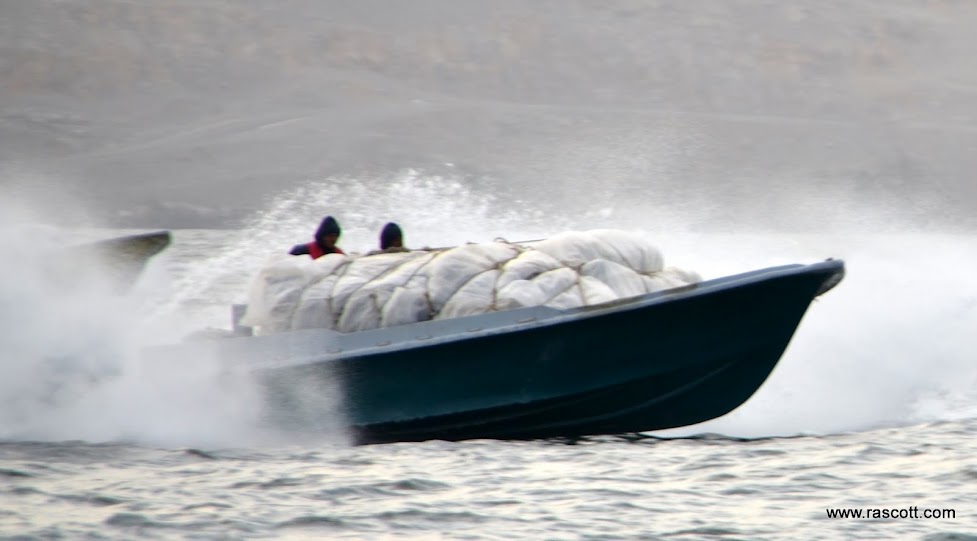
The smuggling
trade is remarkable. These boats are small fast speedboats. And we saw some
20 of them leaving Khasab at about 4.30pm.
They have arrived
at dawn and then in the evening theyBy dusk, they are racing back across the
Strait of Hormuz loaded with smuggled consumer goods ranging from
Chinese-made shoes to cut flowers from Holland.
The journey across this short sea is about 35 miles and can take up to 90
minutes.
But the sanctions
are hurting and the slumping Iranian currency leaves fewer customers for the
smuggled wares. Business is down. At the same time, the risks of
interception are higher as Iranian authorities step up patrols near the
strategic oil tanker lanes at the mouth of the Gulf.
What is clear is
that on this side of the gulf, the smugglers operate under a tacit tolerance
from authorities, even though Oman and the United Arab Emirates are close
U.S. allies and have pledged to enforce sanctions. There is hardly any other
activity in Khasab except for the tourist trade so smuggling is an accepted
part of the local economy.
Everything that is bound to Iran has been legally imported into the UAE;
truck drivers then take them across the border into Oman, paying the
customary 50 dirham ($13.50) entry fee. In Khasab, the merchandise is taken
to warehouses and then piled on the docks less than 100 yards (100 meters)
from the port police headquarters.
The Khasab speedboats are far from the only back channel into Iran. Drug
traffickers easily cross the hinterland borders with Pakistan and
Afghanistan, and black market networks stretch across the frontiers with
Iraq and Turkey. Authorities in Iraq's Kurdish region have been under
pressure for years to crack down on fuel trucks heading into Iran in
violation of U.S. sanctions.
But Khasab stands out for its openness and for lying on the highly sensitive
Strait.
Our boat operator was explaining to us
how the smugglers avoid Iranian authorities. Spotters off the coast — on the
island of Qeshm and near the port of Bandar Abbas — call in coast guard
movements to Khasab. The speedboat drivers keep close attention to the water
conditions on the Strait and try to approach the Iranian coast just after
sunset. The trip can take as little as 90 minutes in calm seas and up to
four hours in rough water. Remember these are open boats. This is not
comfortable sailing.
|
 |
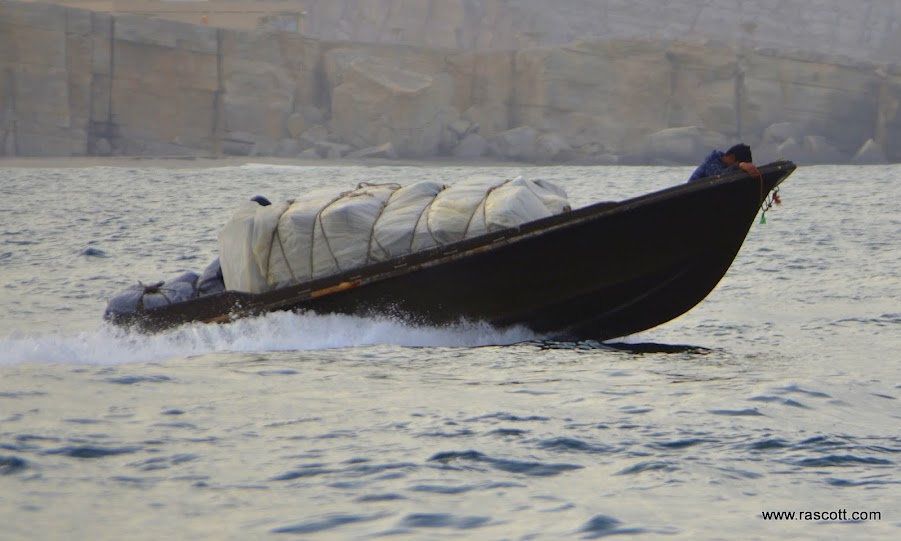 |
Each day dozens of
boats are packed and secured for the trip. There areno names or markings on
the speedboats. But the items loaded on carried familiar logos: LG 42-inch
flatscreen TVs, Discovery Channel DVDs, Panasonic microwaves, Yamaha
motorcycle parts. Also in the stacks were textiles, satellite dishes and
Chinese-made clothes and shoes. Cigarettes are commonly shipped.
The return run usually is to Qeshm, a long arrow-shaped island near the
Iranian coast which is a main waystation for the smugglers.
If spotted by
patrols the two-man boat crews try to heave the goods overboard. They then
must pay back the smuggling network, which can amount to thousands of
dollars.
It more ways than
one Khasab is anther world and I hope it stays that way.
Emirates adds
Lisbon
14 February
2012
Emirates will fly
to Lisbon from in Portugal from 9th July.
Emirates will serve Lisbon with a modern Boeing 777-200ER aircraft. EK 191
will leave Dubai at 09:15hrs each day and arrive in Lisbon at 14:45hrs. The
return flight, EK 192 departs Lisbon at 17:55hrs and gets into Dubai at
04:35hrs the next day. The Portuguese capital becomes Emirates’ 31st
European destination.
A bit of a surprise for EK watchers as this is the first time a Europe
flight leaves from the morning departure bank and does not return into the
midnight arrivals bank but rather uses the early morning arrivals window.
While this means
that travelers from Lisbon will miss some of the Asia connections in the
3.00am departure bank they are still well served by connections to BKK, HKG,
SIN and particularly in Africa where Laounde is an important destination
from Lisbon.
The aircraft for
the new LIS service seems to be sourced from the LCA-MLA service, which,
contrary to earlier plans, will not upgrade to B772ER equipment, but rather
operate with its current A332 equipment through the summer.
Currently EK0107/0108 DXB LCA MLA is planned to upgrade to A343 equipment
for the winter and then likely to transition into B772ER once the A343 will
be retired from the fleet. At that point, LIS should become a B77W
destination.
Greece and the
euro: the crisis continues
11 February
2012 - The Guardian editorial
What's Greek for constructive dismissal? Because that's an apt term to
describe how Greece is being treated by the other members of the eurozone.
Consider: party leaders in Athens have spent days agonising over how to make
€3bn (£2.5bn) of extra spending cuts (or over 1% of Greek GDP), apparently
essential to qualify for the next round of loans from the EU and the IMF
(these are relatively high interest loans, not a free bailout). After
drawing up a list of painful reductions, including a 20% cut to the minimum
wage and public sector job losses, the Greeks were told this week to go away
and find another €300m. Or consider the insistence by Luxembourg prime
minister Jean-Claude Juncker that Greece's politicians must turn these cuts
into law, without allowing the public a vote. This is reminiscent of the
disclosure last month that Germany wanted to install a European commissar in
Athens to oversee Greece's budget-setting process. And here's the clincher:
consider the number of briefings in Berlin suggesting that were Greece to
leave the euro it would not be such a calamity.
Official or unofficial, on the record or off, the message from all these
communications is much the same: Greece does not deserve the full suite of
democratic policymaking; nor does it merit the kind of consideration that
would be given to any heavyweight economy. At one level, of course, this is
simply what happens to bankrupt countries. Countless Asian and Latin
American nations have undergone the same torture at the hands of the IMF.
The big difference here is that this is happening in Europe, within a
single-currency club that was meant to protect its members from such
indignity. There are two main problems with this constructive dismissal
strategy. First, it is indefensible to the Greeks – and indeed to anyone
else who follows the economics. Second, if these tactics don't come off the
very existence of the euro will be imperilled – all over again.
It must be obvious by now that the cuts strategy is not working in Greece:
not economically, not socially and certainly not politically. To take three
numbers from this week, industrial production in Greece dropped over 11% in
December from a year ago, while 20.9% of all adults are now out of work –
and just about half of all young Greeks are also on the dole. In a corner of
the eurozone, one member is going through an under-reported depression – and
it is one that has largely been imposed on it by its neighbours. The severe
austerity ordered on Greece by the troika of IMF, the EU and the European
Central Bank was never going to improve the country's growth prospects; it
has also failed in its own terms of reducing the national debt pile. No
wonder then that the country is racked by regular protests, or that
ministers are quitting the coalition rather than get pushed out of power by
their constituents. Four senior Greek MPs resigned from government yesterday
and it is a fair bet that more will go before the end of next week. The
northern-European strategy of forcing Greece's caretaker government to go
faster and harder on spending cuts is meanwhile feeding support for
extremist parties.
The gamble for the rest of Europe is this: what if Greece does go? The
calculation between the constructive dismissal strategy is that the euro
will get back to business as usual. There is every reason to believe it
won't. If Greece goes, investors will speculate that Portugal will be next.
There will be much testing of the eurozone's famous firewall that's meant to
protect Italy and Spain from the contagion. And in any case, companies and
banks have abandoned the idea that a euro is a euro, wherever it is kept in
the eurozone. Vodafone reportedly takes all spare cash out of Greece every
night; and other multinationals are meanwhile preparing contracts accounting
for a break-up of the single currency. It would be a brave gambler who
wagered that this crisis could be contained.
SQ ends 747 passenger service next month
10 February
2012
Singapore Airlines
is down to its last three remaining passenger Boeing 747-400s - one of which
will be on display at next week's Singapore Airshow 2012, marking the launch
of a series of events to commemorate the retirement of its B747 fleet after
nearly 40 years of service.
Aircraft ‘9V-SPQ’, which was the last B747-400 delivered to SIA in 2001,
will be on static display at the Airshow over 17-19 February 2012.
A series of events commemorating the B747’s many years of service with SIA
will also be announced at the Airshow next week.
“The B747 was the flagship aircraft in SIA’s fleet for nearly four decades,
serving us through much of our history, and it is only fitting that we mark
its retirement in a special way,” said SIA’s Executive Vice President
Commercial, Mr Mak Swee Wah.
The B747-400 is scheduled to operate its last commercial flight to Melbourne
on 24 March 2012, returning to Singapore on 25 March 2012. An additional
commemorative flight is also being considered and details will be announced
once plans are firmed up.
It is hard to
imagine SQ without its iconic 747s. I flew in them so many times especially
when I was based in Singapore between 1997 and 2001.
Singapore Airlines took delivery of its first B747-200 in 1973. Ten years
later, the Airline received its first B747-300 BIGTOP, which enabled SIA to
fly non-stop from London to Singapore in 1984. SIA’s first B747-400, also
known then as the MEGATOP, arrived in 1989, enabling the Airline to launch
non-stop daily services between Singapore and London. In 1994, SIA took
delivery of its 23rd B747-400, making the Airline the largest B747-400
operator in the world. By 2003 the SIA Group had a record 51 B747s,
comprising 39 B747-400s and 12 B747-400 Freighters. Three B747-400 passenger
aircraft remain in service today, while SIA Cargo operates 13 B747-400
Freighters.
A high-resolution photograph of aircraft ‘9V-SPQ’ is available for
download here.
Has Etihad Airways turned profitable after eight years?
The Gulf News is reporting that after eight years since it was founded,
Etihad Airways has earned its first profit in 2011 with a net $14 million
(Dh51.4 million) for the full year.
The Abu Dhabi-based airline said yesterday it achieved $4.1 billion in
revenues last year, a 36 per cent increase over $2.98 billion earned in
2010.
"Five years ago we said we would be profitable by 2011. Despite the global
financial crisis, continued high oil prices, regional instability and
natural disasters, we have delivered," said James Hogan, President and CEO.
Convenient.
The carrier also said it flew 8.3 million passengers last year, up 17 per
cent over the year before, and is aiming to carry 10 million in 2012.
Hogan added that the airline is targeting $5 billion in revenues this year
despite the tough global economic environment.'
Etihad's strongest markets in 2011 included Australia, Southeast Asia and
the Americas, according to Hogan, who further said that China is starting to
grow.
The carrier added five new routes last year to its global network in
addition to signing eight new codeshare agreements, taking Etihad Airways'
codeshare partners to 35 airlines, thus increasing its worldwide network to
269 destinations.
Seven new planes are expected to join Etihad's current fleet of 64 aircraft
and to fund deliveries of these, the carrier will consider Islamic
structures among other financing options, according to its CFO, James Rigney.
The record results, audited by global accounting firm KPMG, included
earnings before interest, tax, depreciation, amortisation and rentals (EBITDAR)
of $648 million.
It will be
interesting to see if Etihad publishes its financial statements - and a
comparison of its cost structure with that of Emirates would be interesting.
The Glocer Legacy
9 February 2012
Thomson Reuters revealed a $3bn charge related to the declining value of its
troubled financial services business, swinging the company to a steep
operating loss for the fourth quarter.
For the last three months of 2011 the media and financial information group
reported an operating loss of $2.59bn, compared to a profit of $307m a year
earlier.
The charge reflects the tumult at Thomson Reuters’ markets division, which
makes products that compete with Bloomberg. Its flagship product, Eikon, has
not been embraced by businesses, leading the division to report quarterly
revenues up just 1 per cent to $912m.
The company said on Thursday there were now 15,000 installations of Eikon,
compared to 8,000 three months before.
This is the first quarterly report under new chief executive Jim Smith, who
took over from Tom Glocer in January after several management shake-ups.
Thomson Reuters shares have fallen by a third in the past year.
The $3bn charge was the result of the company’s annual goodwill testing.
“This non-cash charge will not impact the company’s normal business
operations, nor will it affect liquidity, cash flow from operations or
financial covenants under the company’s outstanding public debt securities
or syndicated credit facility,” the company said.
Overall revenues for the quarter were up 5 per cent before currency changes
to $3.35bn, thanks to strong sales in the company’s legal and tax and
accounting businesses.
“We have simplified our organisation; we have strengthened our management
team; and we are making progress toward improving our execution capability,”
Mr Smith said in a statement.
Air Asia's new Bangkok routes
7 February 2012
Thai AirAsia is
starting off the year with 3 new routes, including direct flights from
Bangkok to Trang, Nakhon Phanom and Colombo (Sri Lanka).
All the flights
will operate daily.
The Trang route started on 15 January 2012. The beach destination is a
popular tourist spot and is famous for Trang barbecue pork.
The Bangkok-Nakhon Phanom route will start flying on 15 February 2012. The
strategic location of Nakhon Phanom makes it a gateway to Laos via the third
Thai-Laos Friendship Bridge which connects Nakhon Phanom to Khammouane,
Laos. Main attractions include an important stupa at Wat Phra That Phanom,
in a city full of cultural diversity with influences from Thailand, Laos,
and Vietnam.
Lastly, the daily direct flights from Bangkok to Colombo, Sri Lanka will
start flying on 1 March 2012. Sri Lanka’s main attractions include places of
significance to many Buddhists who embark on religious pilgrimages every
year. Or for cricket! Or beaches.
AirAsia's fares start from 700THB from Bangkok-Nakhon Phanom and 800THB from
Bangkok-Trang, per way, all-inclusive of tax and fees. These fares are only
available online. Bookings must be made at www.airasia.com between 2-14
February 2012, for travel during 1 May-30 June 2012.
For the Bangkok-Colombo (Sri Lanka) route, promotional fares start from
2,290THB per way, all-inclusive of tax and fees. Tickets must be booked
online during 25 January-5 February for travel on 1 March-30 June 2012.
The land of the
aging sun
7 February 2012
Interesting
article in the Guardian today which is something of a warning shot for all
developed nations - and yet another indicator of the coming shifts in the
world's economies and influence.
The forecast is
that Japan's population of 128 million will shrink by a third, and over-65s
will account for 40% of people by 2060, placing an ever-increasing burden on
the working-age population to support the country's social security and tax
systems.
The new figures, released on Monday by the Japanese health and welfare
ministry, also showed that the national workforce of people between the ages
of 15 and 65 will shrink to about half of the total population.
The estimated fertility rate, or the expected number of children born per
woman over their lifetime, is put at 1.35 for 2060, down from 1.39 in 2010
and – well below the level needed to keep the country's population from
declining.
At the same time, Japanese people will live longer. The average life
expectancy for 2060 is estimated at 90.93 for women, up from 86.39 in 2010,
and 84.19 for men, up from 79.64.
The Japanese prime minister, Yoshihiko Noda, has pledged to push for social
security and tax reforms this year. A bill he promised to submit by the end
of March would raise the country's 5% sales tax in two stages – to 8% in
2014 and 10% by 2015, but opposition both in parliament and among the public
is significant.
As if Japan was
not already expensive. What I fail to understand is the strength of the
Japanes Yen against the stagnation of its economy.
The national institute of population and social security research, which
produced the estimates, said Japan was the world's fastest-ageing country,
and with its birthrate among the lowest, its population decline would be
among the steepest globally in the coming decades.
Experts say that Japan's population will drop by a million every year and
that the country urgently needs to overhaul its social security and tax
system to reflect the demographic shift.
Of course one
option would be to encourage new immigrants to the nation; much as Singapore
has, thereby boosting its economy. Would Japan dare to do this? It may be
their key to survival.
Milan gets
third daily EK flight
6 February 2012
Emirates Airline
said today that it will expand its services to Milan by introducing a third
daily flight from June 1.
The additional daily service will take the Dubai carrier's Italian
operations to a total of 49 weekly flights.
EK 101 will leave Dubai in the early hours of the morning and arrive in
Milan Malpensa in time for the start of business hours in the city
considered the engine room of Italy’s economy and home to the nation’s stock
exchange.
The flight will use at A330-200 and continues the expansion of the 3am
departure bank to from DXB to Europe.
After LHR, LGW,
MAN, FRA and CDG, a sixth destination in the 3am departure bank.
EK0101 DXB MXP 0340 0825
EK0102 MXP DXB 1110 1920
The latest expansion in Italy comes after news that the airline’s Venice
flight would go twice daily from March 25.
In February 2010, Emirates signed a five year, $78m shirt sponsorship deal
with AC Milan, part of a $4.6bn trade relationship between Italy and the UAE.
With a fleet of 169 aircraft, Emirates is now flying to 121 destinations,
having just launched Dallas, Lusaka and Harare.
China's defence of its UN veto
6 February 2012
China's top
newspaper on Monday defended Beijing's rejection of a U.N. resolution
pressing Syria's President Bashar al-Assad to abandon power, saying Western
campaigns in Libya, Afghanistan and Iraq showed the error of forced regime
change.
Of course the
Chinese ignore the UN's successful actions to halt the genocide in Serbia in
1999, again without the unanimous support of the security counsel.
The commentary in the People's Daily, the top newspaper of China's ruling
Communist Party, was Beijing's clearest defence of its decision to join
Moscow at the weekend in vetoing a draft United Nations resolution that
would have backed an Arab plan urging Assad to quit after months of
bloodshed.
After all the
Chinese do not want to legitimise the overthrow of non - elected regimes -
such as their own.
The commentary suggested that Chinese distrust of Western intervention lay
behind the veto, which was described by U.S. Secretary of State Hillary
Clinton as a "travesty".
"The situation in Syria continues to deteriorate and numbers of civilian
casualties keep rising. Vetoing the draft Security Council resolution does
not mean we are giving free rein to letting this heart-rending state of
affairs continue," said the commentary in the paper, which echoes government
thinking.
China, not its Western critics, was acting "responsibly" for the sake of the
Syrian people, it said. The author used the pen name "Zhong Sheng", which
can mean "voice of China" and is often used to give Beijing's position on
foreign policy.
"Currently, the situation in Syria is extremely complex. Simplistically
supporting one side and suppressing the other might seem a helpful way of
turning things around, but in fact it would be sowing fresh seeds of
disaster," said the paper.
China's siding with Russia over Syria could add to irritants with the United
States. Vice President Xi Jinping is due to visit there next week,
burnishing his credentials as the Communist Party's likely next top leader.
Beijing and Washington have also sparred over Iran, which faces tightened
Western sanctions over its nuclear ambitions.
The commentary also laid bare broader Chinese concerns about Western-backed
intervention in the Arab world and beyond.
China is one of the five permanent U.N. Security Council members that hold
the power to veto resolutions.
In March, China abstained from a Council vote that authorised Western
military intervention in Libya. That resolution became the basis for a NATO
air campaign that led to the overthrow of Muammar Gaddafi, despite
misgivings from Beijing and Moscow about the expanded campaign, which they
said went beyond the resolution.
"Libya offers a negative case study. NATO abused the Security Council
resolution about establishing a no-fly zone, and directly provided firepower
assistance to one side in the Libyan war," said the People's Daily
Commentary.
"The calamities of
Iraq and Afghanistan should be ample to wipe clear the world's eyes.
Forceful prevention of a humanitarian disaster sounds filled with a sense of
justice and responsibility," said the paper.
"But are not the unstoppable attacks and explosions over a decade after
regime change a humanitarian disaster?" it said.
Trying to sound
like it is taking the moral high ground China instead stands alongside
Russia, which is arming Assad's forces, in supporting the regime's violence
against its own people.
Beyond the Blue Horizon
5 February 2012
A few hours in
Sharjah gives aviation enthusiasts a wonderful opportunity to take a step
back into history and imagine a simpler time when Sharjah was a staging post
on the early commercial flights from Britain to India and Australia.
The Al Mahatta
Museum is a gem. It is also very quiet despite now being in the heart of the
city.
If you do go to look for the museum take a map!
The Sharjah
Museums department has preserved the fort-like barracks and accommodation at
Sharjah's original airport first opened in 1932. Also on the site is the
first control tower and a hangar with four aircraft from Gulf Aviation's
fleet from the 1940s to 1960s.
The museum is
surrounded by the high rise of modern Sharjah, and is just down the road
from the Central (Blue) Souk. Its preservation is something of a miracle;
and lends itself to the debate that there is a wonderful opportunity to
create a first class museum of gulf aviation for the UAE.
The airfield
opened in 1932 as an overnight station on the early Imperial Airways route
to India and Australia. Sharjah was an overnight stop both east and west
bound for the weekly flights. It was some 5 days flying from England and the
plane would arrive as the sun set over the desert; crew and passengers ate,
rested and slept while mechanics serviced and refueled the airplane to leave
at sunrise. There were no duty time limitations in those days; you flew when
daylight was available.
These were
pioneers, as travelers and aviators; the time was researched and revisited
in Alexander Frater's book "Beyond the Blue Horizon." In 1984 Frater went to
Statesman-Aldwych Travel and asked them to provide him with a ticket to all
the places that Imperial Airways used on their route to Australia in 1935.
He recreated on modern airliners the the adventure, excitement and no little
risk of the Imperial Airways Eastbound Empire service.
During World War 2
the RAF made Sharjah into a base and the RAF continued to use it until the
1970s. A new control tower was built next to the fort and a new terminal
followed in 1968. But the rapidly growing town of Sharjah was now too close,
and a new airport opened in the desert south of Sharjah in 1977. The runway
at RAF Sharjah become King Abdul Aziz Street, now right in the town centre.
One pilot's
description of Sharjah in WW2 was fairly damning: "This far in those days
was the arse-end of the world, Sharjah in the UAE. July 1942, temps about
50C, humidity 90. Poor food, short of water, worn-out Blenheims, antiquated
Vincents.7000 foot mountains to cross. Fun, fun, fun. 23 flights for the
month. Anti sub. patrols carrying depth charges, practice gunnery, Sharjah -
Muscat - Ras Al Hadd - Masirah and return several times in Vincent K6359
taking passengers."
Following its
closure, Al Mahatta was eventually transformed into an air museum in 1998.
On display in the
hangar are
a Douglas C-47 G-AMZZ which has pride of place, in the
center of the hangar. a deHavilland DH.114 Heron G-ANFE, an Avro Anson G-AKVW
and a deHavilland DH.104 Dove Series 1 G-AJPR. Details of the four airframes
are contained on a number of sites:
Heron "G-ANFE" is
actually constructor's number 14072, a Heron 2 originally owned by West
African Airways Corporation, as VR-NAQ. It was then registered G-ARKU with
Overseas Aviation Ltd. In 1961 it was transferred to the Royal Navy, and
converted to a Sea Heron C20 (XR443). Withdrawn from use in 1989 it was sold
as G-ORSJ, later changed to G-ODLG. Sold again in 1993 it became VH-NJP with
Heron Airlines in Australia. It was acquired for the museum and painted to
represent G-ANFE in 2003. There is a constructor's number on a plate just
behind the co-pilot's head "14072", and also a hand-written "NJP" on the
captain's roof
The Anson "G-AKVW" is ex TX183, built at Yeadon in 1946. It was with Bomber
Command Communications Flight at Booker, then Abingdon Station Flight,
before moving on to No.1 ANS at Hullavington. It went later to Shawbury, and
A&AEE Boscombe Down where its service career finished in 1968. It was then
sold to the Shuttleworth Trust, who were planning on a restoration programme,
but that never came to fruition. It was registered G-BSMF. The flaps are
half lowered, so you can see identity plates on both sides. It is quite
clearly marked as "Type no 652A" and Mk XXI on one side and Mk 21 on the
other! The flaps carry the dates 22/10/48 on one side and 9/1/51 on the
other! Maybe the flaps were taken from a Mk 21, and fitted to this C19
airframe. There is, of course, no way it could be a Mark I, which is a
completely different aircraft!
Dove 6 "G-AJPR" was built in 1956; its constructor's number is 04469. It was
on the Italian register as I-TONY and then became G-ARDE.
The DC3 "G-AMZZ" has a tiny label on the roof between the pilots "C-GCXE".
In the undercarriage bays there are "RCAF" labels. The aircraft is actually
constructor's number 12254, a C47A delivered to the USAF as 42-92452 and
almost immediately passed on to the RAF at Montreal as FZ669. It served with
the RAF in Canada until 1946 when it was officially passed to the RCAF.
Pensioned off 1976, it became C-GCXE with Aero Trades Western. Cancelled
from the Canadian register in 1977, it next appeared on the Dominican
register as HI-502. Re-registered as N688EA in 1993.
There is also the original nose and cockpit of Comet R2 XK655 which was
added to the collection in 2007. It was the first production Comet 2 (G-AMXA)
making its first flight in 1953. It was the first to go to the Royal Air
Force. In 1955 it was modified at Marshalls of Cambridge to the Mk R2
electronic intelligence gathering (ELINT) version, and flew with 51
Squadron. It patrolled with experimental surveillance and radar equipment,
frequently being detached to Sharjah. When retired from flying it was sold
to the Strathallan collection in Scotland. On landing at Strathallan it
damaged the undercarriage, but was repaired for static display. When the
Strathallan Museum closed in 1990 it was scrapped with only the cockpit
section surviving. It was put on the roof at Gatwick Airport in 1995. After
spending about 10 years outside it was restored again before shipping to the
Al Mahatta Museum as the first jet airliner to land at Sharjah.
And as you wander
through into the old rest house bedrooms, you can see an assortment of
historic photographs, models and paraphernalia from the “golden age of
flying”, with pieces of tailfin, displays of engines and wheels, and even a
black box (or flight data recorder).
There are also
some more modern items and models; including a sales pitch for home based
airline, Air Arabia.
It would be
wonderful if the old rooms could be restored and a small boutique hotel
re-established on the site.
Here are some
pictures from our visit:
One of the rooms
at the museum shows a Strand Film video made with Imperial Airways called
Air Outpost. Made in about 1937 this shows life in Sharjah and the
preparations for and arrival of the weekly Imperial Airways flight. It is a
wonderful piece of nostalgia.
The video
can be viewed online here. In those days the
vast expanses of Sharjah are seen as hardly more than a
featureless desert stretching all the way to the horizon.
Some other links
for Imperial Airways and Sharjah Airport.
Imperial Airways
timetables
A short history of Imperial Airways and its aircraft
Imperial Airways on WIkipedia
RAF
Sharjah, Al Mahatta Museum
To Sharjah and Beyond
Sharjah and Dubai - 1960s pics from a Sharjah Air Traffic
Controller
Planning for
the LCCs at DWC
5 February 2012
Low-cost airlines
operating from Dubai International Airport are likely to transfer services
to Dubai World Central when the emirate’s second airport starts passenger
flights in 2013, analysts have said.
Paul Griffiths, CEO, Dubai Airports, announced on Monday that operational
trails for Dubai World Central’s passenger terminal are set to start during
the second quarter of this year and “we could see commercial passenger
operations commence in 2013."
Analysts have speculated that low-costs airlines, currently operating mainly
from Dubai International Terminal 2, will move to the new airport to free up
space at Dubai International.
“My understanding is that low cost airlines will commence operations at DWC
first however I would caveat that by saying no airline has publicly
committed to a move… Discussions are likely to be ongoing behind the scenes
and it’s very unlikely that carriers will split operations between the
current airport and DWC,” Saj Ahmad, chief analyst at StrategicAero
Research, told Arabian Business.
Low-cost carriers currently operating from Dubai International include
flydubai, Jazeera Airways and Air India Express. Flydubai did not respond
when contacted by Arabian Business for comment.
Griffith stated that Dubai International will continue to serve as the
primary focus of expansion and Dubai Airports is planning to invest $7.8bn
to boost capacity to 90 million passengers by 2018.
Dubai International, the world's fourth busiest airport in terms of
international passenger and cargo traffic, handled 51.0 million passengers
last year, up from 47.2 million in 2010, it said earlier this month.
In terms of cargo, Dubai's two airports handled 2.3 million tonnes of cargo
last year and Dubai Airport forecast that volumes are expected to hit 3m
tones by 2015.
"Although the airport is in its infancy, incremental cargo traffic growth
has been steady and continues to ramp up as new operations are launched,"
Griffiths said.
Phase 1 of Dubai World Central's cargo facilities has been built and has the
capacity to handle 600,000 tonnes of cargo per year. When the airport is
fully completed, it will be able to handle 12 million tonnes of cargo and
120 million passengers a year, according to its website.
“I don't think DWC will be a white elephant at all. It is a longer term
project and must be viewed as such. It has years of development to undergo
and it will complement the current airport with more capacity as both growth
and new competition enters Dubai,” Ahmad said.
“I'd say the prospects are good but the litmus test will be to secure the
services of airlines who already serve the current airport,” he added.
Trade and logistics are key drivers of growth in Dubai, which lacks the oil
wealth of neighbouring Abu Dhabi. The emirate accounts for around 80 percent
of the United Arab Emirates' non-oil trade but only 28 percent of its
economic output.
EK in trouble down under
5 February 2012
The Sydney Morning Herald is reporting that Emirates Airline could face
fines of more than $1 million for multiple breaches of the Sydney Airport
curfew after it defied repeated warnings by air traffic control not to fly
after 11pm.
This is very
strange. Would an airplane really take off without permission from ATC. And
if they were seriously denying an airplane from taking off why not just turn
off the runway lights.
The federal Department of Infrastructure and Transport is investigating
three breaches by Emirates, and has strong hopes of a successful prosecution
for two of the incidents.
The most glaring breach of the curfew - which is intended to prevent planes
taking off or arriving at Sydney Airport between 11pm and 6am - occurred on
January 8.
The department will allege Emirates flight EK413 from Sydney to Dubai
departed well after 11pm despite being refused permission many times during
the day to do so.
It is understood several airlines requested permission to breach the curfew
that night, after flights were delayed for wet weather. But they were denied
permission on the grounds the airlines were given plenty of warning they
might not be able to depart.
The Emirates flight, however, departed some time after 11.15pm despite being
denied permission.
The maximum fine for a breach of Sydney Airport's curfew is $550,000.
Emirates has provided a detailed response to the department about the
breaches. The department will provide a brief to the Director of Public
Prosecutions, who will then have to decide whether to press charges.
If Emirates were charged, it would be the first time an airline has been
prosecuted for a breach of the Sydney Airport curfew since Jetstar was
prosecuted in 2007 over a flight that left Mascot at 11.28pm.
The federal Transport Minister, Anthony Albanese, said: ''The curfew at
Sydney Airport is not optional. It is a legal requirement, which the
community expects to be enforced.''
Mr Albanese, whose inner-west electorate of Grayndler suffers heavily from
aircraft noise, has long maintained that Sydney needs a second airport.
But a study commissioned by Mr Albanese two years ago, due to report in
weeks, is unlikely to propose an imminent solution to Sydney's airport noise
woes.
The study is likely to entrench the role of Mascot as Sydney's main airport,
recommend improved transport links to Mascot and suggest alternatives for a
possible future second site.
The study will state the most attractive site remains Badgerys Creek, which
the government has for decades ruled out. Wilton, in the south-west, is
likely to be the second-most attractive site.
A spokeswoman for Emirates said the January 8 flight was delayed because of
fuel delivery problems caused by a thunderstorm. She said the airline
decided to continue the flight to limit any inconvenience to passengers.
"Only on rare occasions such as this does the airline seek dispensations,
and when doing so follows the normal process,'' the spokeswoman said, adding
the airline was discussing the regulations with authorities and could not
comment further.
Dogs and
locusts
5 February 2012
The Economist
Despite a plethora of festive new-year dragons and a few days of holiday, it
has been a season of ill will in Hong Kong. On January 15th a young
Mandarin-speaking girl dropped some dried noodles she had been nibbling on a
Hong Kong underground train. Perhaps her family, from mainland China, did
not know that eating and drinking is banned on the spotless metro. When a
local Cantonese speaker objected to the noodle-eating in bad Mandarin, a
quarrel erupted. The whole incident, recorded on a mobile phone, was soon
viewed online by millions in Hong Kong and in China.
“That’s what mainlanders are like,” was perhaps the nastiest thing said by
any Hong Konger in the metro carriage. But soon a well-known loudmouth
professor at Peking University was suggesting that some in the former colony
were “British running dogs”. This caused some Hong Kongers to take to the
streets to protest. On February 1st another group took out a full-page
advertisement in a Hong Kong newspaper complaining about mainland “locusts”
swarming into the territory; it called for the government to stop the
“infiltration”.
In the past two months Hong Kong has seen a spate of related protests: one
against the thousands of expectant mothers who pour in from the mainland to
give birth in local hospitals; another involving a march against Dolce &
Gabbana, a prominent Italian retailer, when it was thought to be favouring
shoppers from the mainland. Though Hong Kong reverted to Chinese sovereignty
in 1997, a border still runs between the territory and mainland China, and
access from the mainland is restricted. The Hong Kongers’ broad complaint is
longstanding: they see hordes of mainlanders putting a strain on public
resources. Mainlanders in turn feel that Hong Kongers are arrogant and
disloyal to the motherland.
What has changed drastically in the past few years is that the old fear of
poor mainland Chinese swamping Hong Kong has been washed away by floods of
rich mainland shoppers. Where once Hong Kongers disdained their countrymen
from the mainland as Ah Chan, the derisory term for a bumpkin, they are now
more likely to hear themselves disparaged as Kong Chan, Hong Kong bumpkins,
by mainlanders flush with cash.
Where paradoxes reign supreme
5 February 2012
An old article by Shashi Tharoor in the Times of India. Still interesting
and relevant today.
"It has become a cliche to speak of India as a land of paradoxes. The old
joke about our country is that anything you say about India, the opposite is
also true. We like to think of ourselves as an ancient civilisation but we
are also a young republic; our IT experts stride confidently into the 21st
century but much of our population seems to live in each of the other 20
centuries. Quite often the opposites co-exist quite cheerfully.
One of my favourite images of India is from the last Kumbha mela, of a naked
sadhu, with matted hair, ash-smeared forehead and scraggly beard, for all
the world a picture of timeless other-worldliness, chatting away on a
cellphone. I even suggested it to the publishers of my newest book of essays
on India as a perfect cover image, but they assured me it was so well-known
that it had become a cliche in itself.
And yet, cliches are cliches because they are true, and the paradoxes of
India say something painfully real about our society.
How does one come to terms with a country whose population is still nearly
40% illiterate but which has educated the world's second-largest pool of
trained scientists and engineers, many of whom are making a flourishing
living in Silicon Valley? How does one explain a land where peasant
organisations and suspicious officials once attempted to close down Kentucky
Fried Chicken as a threat to the nation, where a former prime minister
bitterly criticised the sale of Pepsi-Cola since 250 million of our
countrymen and women don't have access to clean drinking water, and which
yet invents more sophisticated software for the world's computer
manufacturers than any other country on the planet? A place where bullock
carts are still an indispensable mode of transportation for millions, but
whose rocket and satellite programmes are amongst the most advanced on
earth?
The paradoxes go well beyond the nature of our entry into the 21st century.
Our teeming cities overflow while two out of three Indians still scratch a
living from the soil. We have been recognised, for all practical purposes,
as a leading nuclear power, but 600 million Indians still have no access to
electricity and there are daily power cuts even in the nation's capital.
Ours is a culture which elevated non-violence to an effective moral
principle, but whose freedom was born in blood and whose independence still
soaks in it. We are the world's leading manufacturers of generic medication
for illnesses such as AIDS, but we have three million of our own citizens
without access to AIDS medication, another two million with TB, and tens of
millions with no health centre or clinic within 10 kilometres of their
places of residence.
Bollywood makes four times as many movies as Hollywood, but 150 million
Indians cannot see them, because they are blind. India holds the world
record for the number of cellphones sold (8.5 million last month), but also
for the number of farmer suicides (4000 in the Vidarbha district of
Maharashtra alone last year).
This month, in mid-November, the prestigious Forbes magazine list of the
world's top billionaires made room for 10 new Indian names. The four richest
Indians in the world are collectively worth a staggering $180 billion,
greater than the GDP of a majority of member states of the United Nations.
Indian papers have reported with undisguised glee that these four (Lakshmi
Mittal, the two Ambani brothers, and DLF chief K P Singh) are worth more
than the 40 richest Chinese combined.
We seem to find less space in our papers to note that though we have more
dollar billionaires than in any country in Asia - even more than Japan,
which has been richer longer - we also have 260 million people living below
the poverty line. And it's not the World Bank's poverty line of $1 a day,
but the Indian poverty line of Rs 360 a month, or 30 cents a day - in other
words, a line that's been drawn just this side of the funeral pyre.
Last month, the Bombay Stock Exchange's Sensex crossed 20,000, just 20
months after it had first hit 10,000; but on the same day, some 25,000
landless people marched to Parliament, clamouring for land reform and
justice. We have trained world-class scientists and engineers, but 400
million of our compatriots are illiterate, and we also have more children
who have not seen the inside of a school than any other country in the world
does.
We have a great demographic advantage in 540 million young people under 25
(which means we should have a dynamic, youthful and productive workforce for
the next 40 years when the rest of the world, including China, is ageing)
but we also have 60 million child labourers, and 72% of the children in our
government schools drop out by the eighth standard. We celebrate India's IT
triumphs, but information technology has employed a grand total of 1 million
people in the last five years, while 10 million are entering the workforce
each year and we don't have jobs for them.
Many of our urban youth rightly say with confidence that their future will
be better than their parents' past, but there are Maoist insurgencies
violently disturbing the peace in 165 of India's 602 districts, and these
are largely made up of unemployed young men.
So yes, we are a land of paradoxes, and amongst those paradoxes is that so
many of us speak about India as a great power of the 21st century when we
are not yet able to feed, educate and employ our people. And yet, India is
more than the sum of its contradictions. It may be a country rife with
despair and disrepair, but it nonetheless moved a Mughal Emperor to declaim,
''if on earth there be paradise of bliss, it is this, it is this, it is
this...'' We just have a lot more to do before it can be anything like
paradise for the vast majority of our fellow citizens."
Shame at the UN
5 February 2012
Russia and China
this evening vetoed a key UN resolution, supported by the Arab Leagu, on
Syria calling for the resignation of President Bashar al-Assad following the
massacre of more than 200 people by security forces in the city of Homs.
The other 13 council members, including the US, France and Britain, voted in
favor of the resolution aimed at stopping the ongoing violence.
Reacting to the vote, France's ambassador to the UN, Gerard Araud, said: "It
is a sad day for the council. It is a sad day for Syria ... History has
compounded our shame."
The defeat came despite concerted efforts by western leaders to get security
council backing for the resolution censuring the Damascus regime.
Speaking before the vote, Barack Obama called for Assad to step down
following the latest bloodshed. The US president said Assad had lost his
legitimacy as a ruler and had "no right" to cling to power. He said the
regime's policy of terrorising its people "only indicates its inherent
weakness and inevitable collapse".
Britain and France also condemned the violence and called for decisive
action by the international community in an apparent rebuke to Russia, which
carried out its threat to veto the draft resolution.
Death tolls cited by activists and opposition groups ranged from 217 to 260,
making the Homs attack the deadliest so far in Assad's crackdown on protests
that erupted 11 months ago in response to uprisings that overthrew three
Arab leaders.
"The time is long past for the international community, particularly those
that have so far sheltered the Assad regime, to intensify the pressure to
end over 10 months of violence."
The French foreign minister, Alain Juppe, said the Homs bloodshed was a
crime against humanity and "those who block the adoption of such a
resolution are taking a grave historical responsibility".
But the Russian foreign minister, Sergey Lavrov, criticised the UN
resolution, saying it made too few demands of anti-government armed groups,
and could prejudge the outcome of a dialogue among political forces in the
country. Syria has been a key Russian ally since Soviet times and Moscow has
opposed any UN demands that could be interpreted as advocating military
intervention or regime change.
Earlier on Saturday, Tunisia decided to expel Syria's ambassador in response
to the "bloody massacre" in Homs and said it no longer recognised the Assad
regime. As news of the violence spread, a crowd of Syrians stormed their
country's embassy in Cairo and protests broke out outside Syrian missions in
Britain, Germany and the US.
The opposition Syrian National Council said 260 civilians were killed,
describing it as "one of the most horrific massacres since the beginning of
the uprising in Syria". It said it believed Assad's forces were preparing
for similar attacks around Damascus and in the northern town of Jisr al-Shughour.
Another group, the Local Co-ordination Committees, gave a death toll of more
than 200. It is not possible to verify activist or state media reports as
Syria restricts independent media access. Video footage on the internet
showed at least eight bodies assembled in a room, one of them with the top
half of its head blown off. A voice on the video said the bombardment was
continuing as the video was being filmed.
The resolution had
no mention of weapons, no mention of sanctions. It was thoroughly watered
down. Yet the killings will continue in Syria.
The other 13 council members voted in favor of the resolution, which would
have said that the council "fully supports" the Arab League plan.
Mohammed Loulichki, the U.N. ambassador of Morocco, the sole Arab member of
the 15-nation council, voiced his "great regret and disappointment" that
Moscow and Beijing joined forces to strike down the resolution.
Susan Rice, the US
ambassador to the UN used unusually strong and undiplomatic language: On
twitter she said "Disgusted that Russia and China prevented the #UN Security
Council from fulfilling its sole purpose."
Just for the
record the Syrian ambassador to the UN, while enjoying his comfortable
Manhattan lifestyle, said that "the UN has become instrument of war instead
of preventing war."
The Russians
appear to see this resolution as the first step of a Saudi Arabian war
against Iran - of the sunni muslims against the shiites. The fact that the
Russians have been arming the Syrian and Iranian armies seems to have been
conveniently ignored. The Syrian regime is controlled by Assad’s minority
Alawite sect, which is an offshoot of Shiite Islam.
No one wants to
see military intervention in Syria. But the international community does
want to see an end to the bloodshed and suffering in Syria.
Simply a
significant proportion of the Syrian people want to see an end of the
current regime. Violence against the demonstrators has led to huge
escalation and the use of heavy weaponry against the civilian population.
The increase in violence will lead to increased sectarian tensions.
In the big picture
there are many that would like to see a weaker USA; imagine a weaker USA
with a stronger Russia and China. Sure the USA makes mistakes and some of
its actions are wrong, but it is a democracy, as a nation it reflects on its
failings, and then it adapts its behavior. China and Russia may never get to
that level of sophisticated participation.
This Washington
Post editorial helps to make sense of the issue and the key players in what
could be a major middle east conflict:
Syria’s outcome has high stakes for the entire Mideast
Survival of the
fittest
5 February 2012
-
The Economist
THE future of
Malev, Hungary’s 66-year-old national flag-carrier, has looked bleak since
the European Commission ruled last month that government aid it had received
between 2007 and its renationalisation in 2010 was illegal and must be
repaid. The deeply indebted airline had no way of paying the money back and
indeed was relying on continuing state backing to keep going while a buyer
was sought. Early on Friday it ceased flying after the government—which is
suffering a debt crisis of its own—decided to stop financing it.
Viktor Orban, the prime minister, said that restarting Malev was “not
impossible”. Earlier this week the airline’s boss had used the same
half-hearted phrase to express his hopes of reviving takeover talks with the
Chinese state owners of Hainan Airlines. However, in the absence of a
deep-pocketed rescuer, the loss of confidence an airline suffers on
grounding its planes tends to prove fatal. Especially when, as in this case,
stronger rivals immediately swoop in to grab its customers. Ryanair, which
only ten days ago had announced plans to open five new routes out of
Budapest airport, said on Friday that it would increase that to 31 routes,
basing a fleet of brand-new Boeing 737-800s at Budapest from February 17th.
Likewise Wizz Air, a Hungarian low-cost carrier, also said it would expand
its Budapest schedules to fill the gaps left by Malev.
Ryanair has laid up a portion of its fleet for the winter season so it has
plenty of spare planes ready to start flying on Malev’s old routes. But no
doubt its wily boss, Michael O’Leary, will be driving a hard bargain with
the authorities in Budapest over such things as landing fees, as the price
of rescuing both Malev’s staff (who are being invited to apply for jobs with
Ryanair) and the airport itself, whose future was at risk if its main
customer went out of business.
The airline business is a fiercely Darwinian, survival-of-the-fittest affair
these days, and Malev’s demise comes just a few days after the collapse of
Spanair, a Barcelona-based carrier, and Cirrus, a German regional airline.
In Spanair’s case, both Ryanair and its rival easyJet already have extensive
routes out of Barcelona El Prat, and both have rushed to scoop up stranded
Spanair passengers with cheap “rescue” fares.
Casting around for suitors
Although, as my fellow blogger noted earlier, air traffic has been growing
in much of Europe, we are likely to see a continuation of this process of
weaker airlines going under or being taken over, and stronger ones getting
stronger still. A number of smaller carriers are casting around for
sugar-daddies to to come and rescue them, some because their own finances
are in a dire state, others because their state shareholders are deeply in
debt and need to flog them off. Air Berlin recently fell into the arms of
Abu Dhabi’s Etihad, but Spanair’s hopes of being swept off its feet by
another swashbuckling Arab sheikh, from Qatar Airways, were dashed.
Emirates, the third of the Gulf’s fast-growing “super-connectors”, has just
started flying to Dublin, and would no doubt be welcomed with open arms were
it to express an interest in the local carrier Aer Lingus. The Irish
government wants to sell its stake, and there had been speculation that
Etihad might buy it, but so far nothing has come of this.
Turkish Airlines, which dreams of building an international network to rival
the super-connectors’, is eyeing up Poland’s money-losing LOT. The Czech
government is seeking suitors for its flag-carrier, CSA. Likewise Portugal
and its carrier, TAP. Last year the expectation was that IAG—the merged
British Airways and Iberia—would buy TAP, though at the moment IAG is busy
absorbing BMI, a British rival.
Apart from a bit of short-term confusion, for travellers in Europe there
seems so far to be little to worry about in this wave of takeovers and
closures. It seems that, in most cases, wherever there is sufficient
passenger demand for flights, someone will quickly step in and meet it. The
continued expansion of Ryanair, easyJet and the Gulf’s super-connectors is
providing plenty of competition and choice. And as some familiar names
disappear from the skies, we will soon get used to others—such as Norwegian
Air Shuttle, which has just announced a huge aircraft order and plans to
join the big league of European carriers
Lewis looks like he's in for the long haul
3 February 2012 - published 1 November 2012 in The Irish Times
CADDIE’S ROLE: Tom Lewis’ victory in the Portugal Masters three weeks ago
means he now has greater control over his schedule, writes COLIN BYRNE
BLEARY EYED, quite disoriented and at about 35,000 feet over Outer Mongolia
in an Airbus A330 sometime early yesterday morning local time, I found
myself contemplating the unpredictable nature of trying to eke a living out
of worldwide professional golf.
It may not have been my most lucid moment, especially as I was trying to
remain horizontal enough to lay claim to most of the free seats in the
middle of row 39 and pretend to myself that spreading out would both secure
my extra leg-room and slumber. Instead it only caused hip and back
discomfort, my attempts at snagging a business class seat were foiled, last
minute, at the departure gate in Abu Dhabi.
The fact I have headed east to the HSBC Champions Tournament in Shanghai
when realistically a few weeks back I was thinking more of a jet-lag free
jaunt down to Spain for the second stage qualifier of the European Tour
school is another example of the whimsical nature of the great, galavanting
gamble of professional golf.
In the professional game, and particularly starting to caddie for a young
player, Tom Lewis, who at that time had no official playing status, you need
to be pretty much on stand-by, in anticipation of a trip to who knows where.
The early stages of a young professional’s career can be almost as
capricious as the recent contest to elect the ninth President of our own
little land. Where there is chaos there would appear to be opportunity.
Where there is despondency with a system and our public representatives it
looked like anyone with a thick enough neck had a chance of contesting for
the highest office in the land, until the final hour when sense and
integrity prevailed.
With the heroic exploits of my young, and at the time status-less, player in
the final round of the Portugal Masters three weeks ago, both Tom’s and his
bagman’s schedules have changed dramatically. From the arduous quest of
trying to gain a playing status through some tournament invitations,
including the tournament he won, the more realistic journey was going to be
through the long and rocky road that is the tour school.
There are three stages of the tour school in Europe and by a stroke of luck,
resulting in another competitor pulling out of the school Tom gained
exemption to the second stage which takes place early December. The top 10
on the world amateur rankings are exempted from the first stage qualifier.
This was a fortuitous break already as we saw that the very talented and top
points scorer in the Walker Cup, Paul Cutler, did not make it through the
first stage qualifier.
There are twists and turns along anyone’s career path which determine the
ease of passage to the upper echelons of the game, or if indeed they ever
make that transition. On top of Tom Lewis and his team of advisers securing
some invites for him to try to slip in the back door and out onto the
European Tour, and some other subtle twists of fate like not having to
endure the first stage of qualification, it was Tom himself who seized the
moment to seal his immediate fate on tour.
It is a remarkable achievement to win so early in a young career. Along with
the morale boost it will give Tom, almost as significantly he now has the
chance to plan his early steps as a professional. This is almost as
important an advantage as having won.
Top golfing is about routines and so too is scheduling. An annual plan, with
performance optimisation at a premium is something that normally only
established players have the luxury of hatching.
Tom has already put himself in the position of competing at the highest
level with many of the top players on the PGA Tour who will be playing in
Shanghai this week. Knowing the respect he has for his fellow competitors it
will just be another event that he is going to compete in and although the
names may carry a little more kudos the objective of playing the course as
best he can will still be the ultimate objective. He will have a healthy
respect but not a capitulating one.
It is not such a great surprise Tom has already catapulted himself onto the
world arena of golf. You just need to spend a little time around him in
order to get a sense of his prowess.
It is a surprise to be back trawling the globe quite so soon after myself
and Tom’s recent initiation. I am now in Shanghai shaking off the numbing
effects of my first long trip in a while, amongst the hacking and herding of
daily life in a metropolis with well over 20 million inhabitants.
We have arrived early amongst the sounds and smells that tell you are in a
very different part of the world, in preparation for his first World Golf
event and another challenge to whet the appetite of my young master.
Some more columns from Colin Byrne
Unique blend of golf living in harmony with daily life
Women in blue pick right time to strike for glory
Best of luck Edoardo, it was a pleasure carrying your bag
The young boy who never forgot a legend's hug
Sadly - older articles are behind the Irish Times firewall.
BBC decides that rimming is humour
3 February 2012
I have been
entertained by the BBC's rather delayed response to my email to them on
Christmas Day objecting to a show's detailed descriptions of "rimming" on
early evening television courtesy of BBC Entertainment.
I do think that a
detailed description of “rimming” is neither family entertainment nor
“humour of a sexual nature.”
Nor I suspect is it very appropriate for the UAE market.
Here are the emails. The BBC really should do better But it dumps old
programmes into this market with little thought for content and it would
appear little control over what is shown and when.
"Dear Robert,
Thank you for your message to our Contact Us site. Firstly may we offer our
very sincere apologies for the delay in responding to your concerns.
We are sorry that your mother was offended by comments made in this edition
of Jam and Jerusalem broadcast on Christmas Day on BBC Entertainment.
Regarding the comments you refer to, there was a presentation announcement
before the start of the programme which advised:
“This programme includes humour of a sexual nature. Parental guidance is
advised”
Feedback from viewers such as yourself regarding the content and scheduling
of our programmes is extremely helpful and important to us and please be
assured that your feedback has been noted and will be passed to the
scheduling team for BBC Entertainment.
Thank you for taking the time and trouble to contact us.
Best wishes,
BBC Entertainment
Your message
Christmas Day 8.30pm in Dubai and Jam and Jerusalem gives us a detailed
description of "rimming." My 78 year old mother choked on her turkey.
Some things may be better broadcast later in the evening - or in this case
not at all; as it was sadly unfunny.
Merry Christmas. Who should I send the dry cleaning bill to?
Robert"
Reuters journalists to strike
3 February 2012
The Guardian
Journalists at
Thomson Reuters have voted to strike – the first at the news agency in more
than 25 years – over a below-inflation pay offer.
The National Union of Journalists chapel at the company voted
"overwhelmingly" for a 48-hour strike next week, to coincide with the
release of Thomson Reuters' full-year financial results.
"We tried very hard to reach a settlement with management but the company's
refusal to improve its below-inflation offer of 1.75%, which follows years
of effective pay cuts, has compelled Thomson Reuters journalists to vote
overwhelmingly for strike action for the first time in more than 25 years,"
said the Thomson Reuters NUJ chapel officers, Mike Roddy and Helen Long.
"Thomson Reuters must shoulder the responsibility for this dispute. The
company ignored repeated warnings that members had reached a tipping point,
after years of below-inflation pay rises, combined with rising costs, that
are pricing many members out of their jobs."
The NUJ said that the pay offer had hit journalists whose families cannot
afford to live in London.
A ballot for industrial action saw 83% of NUJ members at Thomson Reuters
voting in favour and the strike is scheduled to begin at midnight on
Thursday 9 February, for 48 hours.
The NUJ claimed that Thomson Reuters was also "under fire" over its
treatment of cleaning staff at its Canary Wharf offices.
Barry Fitzpatrick, deputy general secretary of the NUJ, said: "This strike
is about fairness. The management is proposing a below-inflation pay deal,
while holding back money for a merit scheme.
"This is just not on. While our members struggle to make ends meet on their
wages, the management should be putting all the money into an
across-the-board pay increase."
NUJ members at the news agency last threatened to strike in 2008 and 2009
over job cuts and working conditions following the merger of Reuters and
Thomson.
Thomson Reuters declined to comment.
Thai Smile is all about lower costs
3 February 2012
Thai Airways
International has confirmed that its new business division Thai Smile Air
will launch services on 1July 2012 as recruitment commences for the
start-up’s own cabin staff.
The airline will
be positioned as a low-to-medium-cost carrier between the mainline operation
and low-cost venture Nok Air, but will not be a standalone operation like
Nok Air but an internal business unit.
The reality is
that Thai Smile will recruit a new crew with new contracts and operate at
lower costs.
Thai Smile will commence operations with four leased Airbus 320s, increasing
its fleet to eleven aircraft in the future. These were initially expected to
be used to start services to domestic destinations bu it now appears that
the start-up will initially have more of a focus on international routes.
This may be due to
Thai Airways International increasing its shareholding in Nok Air and
expanded its domestic role. Thai Smile is expected to offer flights within a
three to four hour range from Bangkok and Thai is understood to be
discussing traffic rights for a number of new overseas destinations to be se
served from Thai Smile’s launch in July.
It is expected to inaugurate operations on July 1 initially with a twice
daily link between Bangkok and Macau. As additional aircraft arrive THAI
Smile will introduce daily services on the Bangkok – Chiang Mai and Chiang
Mai – Phuket routes from August 1, while the carrier will replace Thai
Airways on international links from Bangkok to Jakarta, Kolkata and Phnom
Penh from the same date. According to Thai’s provisional schedule THAI Smile
will also take over the operation of the daily Bangkok – Surat Thani route
from September 1 and will operate the four-times weekly winter seasonal
Bangkok – Gaya – Varansai – Bangkok rotation from October 1.
Thai Smile looks like it will continue to take over routes from Thai Airways
International as additional aircraft arrive. These are likely to be markets
with limited premium demand and where the Thai Smile brand will fit the
operation better.
The airline will offer a two-class product using Thai’s current ‘TG’ flight
code. With a lower cost structure than its parent Thai Smile will able to
fly to a number of locations that cannot be served profitably by the
mainline division, or serve existing routes more efficiently. Possible new
destinations may include Amritsar, Brunei, Danang, Macau, Medan and Penang.
A day on the
Yas links
31 January 2012
Yas we can said
Scotland’s Richie Ramsay as he produced an outstanding ten under par 62 over
the Yas Links Golf Cub to win the 2012 Emirates Airline Invitational hosted
by Abdullah Al Naboodah yesterday.
Ramsay topped the field of 50 European Tour players in the pro-am event in
Abu Dhabi, which helps raise money for a number of charities including the
Tour Players Foundation along with Friends of Cancer Patients, the UAE Down
Syndrome Association, the Special Care Centre Abu Dhabi. The Gala dinner
following the Invitational was aiming to raise over$250,000 through a
charity auction.
It was a lovely sunny day for your writer to make his caddying debut on the
European Tour. I was caddying for professional golfer Russell McIntyre who
is based in Portugal. Russell's day did not start well when he cracked his
Taylor Made driver on the first tee. On a long course using the 3 wood off
the tee was great for accuracy but little help for distance. The downside
for Russell yesterday - he really made only one good putt all day; plenty
were close; none would drop.
Ramsay finished
three ahead of Richard Finch and Thorbjorn Olesen (65 was a good score
yesterday) in a field that also included Sergio Garcia and Graeme McDowell,
last year’s champion Retief Goosen – who made a hole-in-one on the eighth –
and Ryder Cup Captains past and present Colin Montgomerie and Jose Maria
Olazabal (who were in the group behind us) in a star line-up.
The other pro in
our group was Tom Lewis, who made such an impact at the 2011 British Open
before turning professional. Tom is still only 21, he is a genuinely nice
guy, was a great partner for his amateur colleague, and is a terrific ball
striker. He eased a 69 yesterday. With a little good fortune, some good
advice, and with a few putts going in, he could become very, very good.
Our two amateurs
were Russell's father - Stewart McIntyre - and Keven LeCocq, a UK based
American, who plays most of his golf at Wentworth. Links for our fourball
are below.
Caddying is tough
- its a long hike with a heavy bag on a warm day. And you do need to pay
attention to the game and to your golfer. Tom Lewis' caddy is the
experienced Irishman, Colin Byrne, very composed and thoughtful; he has won
majors with Retief Goosen and should be a great help to Tom Lewis in his
first full year as a pro.
Colin is my kind
of caddy - asked in 2008 who would be in his dream foursome he replied : the
Dalai Lama, Mahatma Ghandi and Gene Sarazen.
Me - I think my
caddying career may be a once off - though Kevin LeCocq was kind enough to
ask me if I had been a pro caddy before.
It was a very good
day; a top course in lovely condition, and a chance to watch some of the
best golfers from the best vantage point. I even got to chat to Monty and
Jose-Maria Olazabal.
The modern golfers
are very different - they are not necessarily tall; but they are very lean
and have great body turns and swing speed. And their control over ball
distance and flight puts my efforts to shame.
Some links to our
fourball:
Russell McIntyre - Pro golfer at Quinta do Lago. Likes snooker and snakes.
Stewart McIntyre - A Captain of the Super Yacht Industry: Summer 2011
Kevin LeCocq - Head of Global Investment Solutions : Deutsche Bank’s Private
Wealth Management
Tom Lewis
Caddies like Colin Byrne double up as on-course psychologists
Chuck Culpepper The National Jan 25, 2012
Any notion of caddies having cushy jobs is so very last century.
"The more you do it, the longer you spend at the golf course," said Colin
Byrne, the veteran caddie of the 21-year-old English wunderkind Tom Lewis.
"Everyone's looking for an edge, and I think everyone's afraid to leave the
golf course."
One reason: "We're all influenced by what happens around us."
What happens around them nowadays is toil. Twenty years ago, Byrne said,
some players traded on talent; now players trade on moderate talent plus
diligence or considerable talent plus diligence. Even away from the course,
they frequent hotel gyms alongside physios.
Byrne noticed the rigour upgrade with Swedish players in the 1990s (for yet
another case of Swedish excellence).
The caddie's job thus has become "a lot more than the four to five hours on
the course," bloating to more hours of driving ranges and practice rounds,
hunting balance between practice and competition.
The yang might have trumped the yin sometimes, Byrne said, as when Padraig
Harrington, his fellow Irishman, "finally admitted" that in golf's eternal
mystery, he might have won more had he worked less.
Don't picture caddies standing in museums absorbing local culture.
The "old days" - you know, that 20th century - allowed for marginally more
travel glamour and cultural edification, before so many people became so
good that time grew so limited.
"I've come to South Africa," Byrne said from the tournament last week, "and
I've come for work. I'm in a beautiful part of the world. I'm, you know,
close to it, but I'm not really seeing it."
That "sense of being somewhere different" has grown fainter.
Some call them on-course psychologists.
"You know, you kind of get in the back door to a very big arena," said
Byrne, who has written newspaper columns in Ireland.
"You know, because we're not skilled … There's no caddie school, no way to
study it. It's probably something a lot of us have stumbled upon."
Then again, it is a hard to teach -and learn - art.
While discussing the two-time US Open champion Retief Goosen's brutal Sunday
at the 2005 US Open, Byrne said: "Probably the art of caddying is
understanding whom your dealing with, what would motivate him and what
wouldn't motivate him.
"Some people need to be pumped up, and some need quiet words of
encouragement."
"You can say the right thing and the wrong thing, even though it's the same
thing and at the right time," Byrne said, likening it to how saying "Good
morning" can work - or, not.
The job security amounts to …
"There's absolutely no security in the job," Byrne said, "which makes a very
clean case if you're not getting on with the person or you're not doing your
job. There's no contract.
"It keeps people with an eye on the job. It kind of makes you hungry, as
well."
Unlike the slightly raffish days of yore, caddies must be more organised,
more "stable", he said. They outnumber available jobs, so those just hoping
to fill in would be more populous in tournament parking areas had mobile
phones not enabled players in need to locate alternates.
And then, one quirk: "If the economy's doing badly, there are more caddies
out here," Byrne said. "It's not an indicator you'd see in any financial
papers, but it's not a bad one to look at."
But then, that soaring moment …
On a golden Sunday on Long Island, at the 2004 US Open in Shinnecock Hills,
New York, as players bemoaned the barbaric course, Goosen edged Phil
Mickelson even as the American tried to claim the first two majors on offer
that year.
Upshot: Goosen won a road match, with a caddie who has worked for - at least
- Goosen, Greg Turner, Paul Lawrie, Alex Noren, Edoardo Molinari, Lewis.
"Obviously it was a very hostile environment but I think that secretly
helped Retief, because the harder you push him, the better he gets, the more
obnoxious you get, the better he gets," Byrne said.
So: "He holes the final putt to win. Wasn't a fist pump. Was very simple. A
double flip of the cap.
"For him that was probably a big thing, to flip his cap twice as opposed to
doffing it.
"He did a double doff. Just the understatedness of it, that's what I like
about him."
A guy in through the back door stood amid a huge moment that "justified all
the times when you've caddied when you've lost money, or you've got
absolutely no satisfaction out of it." His adjective: "indelible".
Twitter turns evil?
30 January 2012
I was waiting
until I understood Twitter's new censorship policy before commenting on it.
But perhaps the
saddest comment is how quickly both China and Thailand embraced the new
policy. The fact that the new policy has been so rapidly embraced by
countries determined to censor freedom of speech so that the only message
heard is the official message says it all.
Last week, Twitter
announced changes to the way it handles content takedowns. What the company
had announced was that they'd built in the capability to censor content per
country... in response to official requests.
Prior to Twitter’s
announcement, the company had the power to delete tweets, of course, but not
the ability to do so on a country-by-country basis. What’s new, the company
said in a blog post, is “the ability to reactively withhold content from
users in a specific country — while keeping it available in the rest of the
world.” As part of the new policy, Twitter is setting up a new transparency
regime whereby “if and when we are required to withhold a Tweet in a
specific country, we will attempt to let the user know, and we will clearly
mark when the content has been withheld.”
The truth is, Twitter has indeed instituted a method whereby they can - upon
receipt of a "valid and applicable legal request" - take down tweets. The
company also states that they will only respond "reactively"; in other
words, to content that has already been posted. There is a safety feature
built in: Users can change their location if they think the one Twitter has
listed based on their IP address is wrong.
This is censorship, but Twitter isn't above the law. When the company enters
a new jurisdiction, setting up offices and putting employees on the payroll,
it is bound by the laws of that jurisdiction.
It may not be too
much of a change. One day Twitter will be ordered to take something down.
Now they are ready and can do so transparently.
But that has not
stopped the Thai authorities from sensing an opportunity and the Information
and Communication Technology Ministry will work with Twitter to ensure that
tweets disseminated in Thailand are in compliance with local law.
ICT permanent secretary Jeerawan Boonperm said Twitter's move to censor or
block content regarded as offensive in particular countries was a "welcome
development".
The ICT Ministry will contact Twitter shortly to discuss ways in which they
could collaborate, she said. The trouble is that the Thai authorities see
this as am opportunity to clamp down on political views that do not agree
with their own.
Rather bizarrely
Chavarong Limpattamapanee, president of the Thai Journalists Association,
expressed support for the new policy. "Local users must still comply with
local law. Freedom of speech is a human right, but this freedom is not
borderless. One must be responsible," he said.
Thailand has
embraced web censorship. Last year alone the nation asked Facebook to remove
more than 10,000 pages deemed insulting or critical of the Thai royal
family, in violation of Thailand's lese majeste law.
Though there have been no reported arrests relating to Twitter in Thailand,
a number of Thais have been jailed for posting messages on Facebook and the
Internet. There were a number of high profile lese majeste cases last year,
including a 61 year old man who got a 20 year prison sentence for sending
SMS messages and a dual Thai-US citizen who received a two and a half year
prison term for translating a banned book about the king into Thai.
Meanwhile the Chinese have also embraced the new policy. A bit unnecessary
as Twitter is blocked in China anyway. Global Times insisted that "it is
important for it to respect the cultures and ideas of different countries so
as to blend into local environments harmoniously. This is normal practice."
But we should be
concerned. Twitter has been one of a number of tools used to support and
organise the Arab Spring. Of course it was also used in the UK riots last
summer. The risk is that Twitter is depriving cyberdissidents in repressive
countries of a crucial tool for information and organization.
The Twitter view
is that that freedom of expression is interpreted differently from country
to country is unacceptable. Twitter is wrong. Freedom of expression is a
fundamental principle enshrined in the Universal Declaration of Human
Rights.” |
| |
|