|
Welcome to rascott.com
This is a
personal site that reflects my interests in news,
current affairs, aviation and travel.
email me:
robert@rascott.com
Home
Up
Now In Dubai:
Scott
Consulting
Photo Albums
My photographs have been moved off this site and are now stored on Picasa. They
were simply taking up too much space on my web host.
Please use
this link to see my list of photo albums.
Some
Useful links:
Information:
World Time
Clock
Exchange Rates
Journalism:
ForeignPolicy
Nationsonline.org
Project Syndicate
Amnesty International
Reporters w/o borders
The Guardian
BBC World News
CNN Asia
Bangkok Post
Daylife.com - news
Gulf News
Arabian Business
World News
WSJ - Asia
SCMP
Good causes:
Sister
Joan - Bangkok
Regional Info:
BKK Magazine
HK Magazine
In
Singapore Magazine
TimeOut Dubai
Back in the UK:
Newton Ferrers
And for fun:
Lin Ping live panda tv
EarthCam
History
BBC Archive
National Media
Museum
The British Library
Imperial War Museum
There are many other links on my
AOB blog page.
| |
|
How to have a conversation
31 March 2012 Financial Times
Perhaps it was the opium talking, but Thomas de Quincey once wrote that an
evening in the company of Samuel Coleridge was “like some great river”. The
poet “swept at once into a continuous strain of dissertation, certainly the
most novel, the most finely illustrated, and traversing the most spacious
fields of thought, by transitions the most just and logical, that it was
possible to conceive”.
Most of us have hopefully felt the unmoored elation of staying up all night
talking with a friend or a lover. But Coleridge was that rare thing, a
conversationalist: eloquent, witty, with a seemingly bottomless reservoir of
cultural knowledge. Nor was he the only one back then who could claim his
company was a performance art. David Hume once engaged in so much raillery
at a dinner party he left Jean-Jacques Rousseau clinging to a table leg.
What makes a good conversationalist has changed little over the years. The
basics remain the same as when Cicero became the first scholar to write down
some rules, which were summarised in 2006 by The Economist: “Speak clearly;
speak easily but not too much, especially when others want their turn; do
not interrupt; be courteous; deal seriously with serious matters and
gracefully with lighter ones; never criticise people behind their backs;
stick to subjects of general interest; do not talk about yourself; and,
above all, never lose your temper.” But Cicero was lucky: he never went on a
first date with someone more interested in their iPhone than his company.
And so I found myself one cold Tuesday evening in February talking to
complete strangers, nibbling on vegetable quiche and sipping blackcurrant
cordial. I had enrolled in The School of Life, an academy of “self-help” on
Bloomsbury’s Marchmont Street, co-founded by philosopher Alain de Botton.
For about £30 per session, students can take classes with resident “fellows”
of the school on subjects such as “How to fill the God-shaped hole” or “How
to make love last”. Tuesday’s topic was “How to have a conversation”.
I had arrived about 20 minutes early but the rest of the class was already
there, talking to each other in the school shop that served that evening as
a reception room. On the walls were shelves stocking manuals for how to be a
better person. I felt like I was in Richard Curtis’s London: diverse,
sincere and hip. I overheard an American accent.
Another pupil shuffled over and kindly invited me into her circle. A
freelance television producer in her early forties, she was wearing a blue
puffer dress covered in images of stars and planets. She was finding it hard
to have meaningful relationships. Technology was partly to blame: “Sometimes
you feel the BlackBerry is like a third person,” she said. This was a
generational issue, too. Her nieces and nephews barely looked up from their
gadgets when she entered a room. Another new acquaintance agreed, and
described how Google had blocked off avenues of conversation with her
boyfriend. “Before we would argue about this or that, but now we just look
it up on Wikipedia,” she said.
Worries about the effect of technology on conversation are not new; George
Orwell bemoaned houses having a radio in every room. And this was no class
of Luddites. Everyone said they were on Facebook and several were avid
tweeters.
However, there was unease about how email, instant messaging and texting had
crept into the space formerly occupied by conversation. What was the point,
asked a young man, of asking how someone’s day was when you’ve been emailing
them from the office?
My classmates also spoke of more personal reasons for their attendance. An
IT worker in her fifties had found that her conversations with her husband
“meandered” and wanted to learn ways to become a better partner. A man in
his late twenties, who had bought his girlfriend an annual pass to the
school as a Christmas gift, said he wanted to have fewer rows. Two other
classmates later mentioned they were trying to help someone overcome
bereavement.
Listening to these stories, I felt slightly disappointed. My idea of a good
conversationalist was an erudite entertainer. I had ambitions of learning
how to host a good table. I had imagined finding out how to emulate
Christopher Hitchens, quoting Yeats and quaffing scotch. But none of my new
friends said they wanted to be a raconteur in the Coleridge or the Hitchens
mould. Instead, there was a genuine, quiet determination to learn how to be
better friends and better lovers. And to have a bit of fun on a Tuesday
night. We were Boswells, not Johnsons.
The basement classroom looked as if an avant-garde theatre company had
designed a corporate training room. I descended the 14 steps of the white
staircase that formed the back wall. In the middle of the room, two
elliptical rows of 15 spindly chairs poked into a plush aubergine carpet.
They faced a white wall that had been attacked by black paint, which had
left behind a monochromatic mural: countryside, trees, bookshelves,
paintings, the cover of David Bowie’s Aladdin Sane and a racing bike. A
blood-orange velvet curtain covered the wall to the class’s left; on the
right, the mural made way for a pantry gently warmed by magnolia-coloured
walls.
Our teacher was Cathy Haynes, an elegant woman wearing a Rothko painting of
a dress, all scarlet block and magenta stripe, who surprised the class when
she said she was approaching 40. She was a “fellow” at the school. Haynes
flicked to the first slide in her PowerPoint presentation and we sat
attentively as she talked about how the nature of conversation had changed
over the past 300 years.
The Enlightenment was the age of conversation, when ladies and gentlemen in
Scottish pubs, English dining rooms and French salons could become famous
through eloquence alone. In an age of humours – the idea that bodily fluids
determined character – conversation was seen as a corrective to a
melancholic temperament.
A similar view continued to be held throughout the 19th century (we were
told to think of how Elizabeth’s incessant chit-chat finally cures the aloof
sadness of Mr Darcy) but with the publication in 1936 of Dale Carnegie’s How
to Win Friends and Influence People, conversation became a more manipulative
pursuit, according to Haynes. “Be a good listener” and “encourage others to
talk about themselves” made up item four on Carnegie’s list of six ways to
make people like you.
Carnegie was said to set the tone for conversation in the 20th century. I
happen to have a copy of Reader’s Digest’s How to Write and Speak Better
from 1991. The cold war may have averted nuclear meltdown but it was
radioactive to small talk, according to the Digest: “People will converse
happily about the weighty matters of the day, such as what is happening in
Moscow and Washington ... but discussing the weather with a stranger is
beyond them!” the book exclaims. These days are not so different, though we
are more distracted and more open about our feelings, Haynes said.
Thus contextualised, we were told to break off into groups of two and answer
the question “Which three words describe your conversations with A. Friends,
B. Family and C. Colleagues?” My partner said “banter”, “sarcastic” and
“sporadic” were the words he would use to describe all three types of
conversation. His social circle had been the same since university;
self-referential stories and in-jokes had accumulated, making casual talk
easy but shutting off more emotional discussions. I was about to share my
three words, but then it was snack time.
After 10 minutes in the pantry with cordial, lemon cake and more quiche, we
retook our seats. Haynes continued her PowerPoint presentation, asking us to
reflect on the meaning of a René Magritte painting, a picture of a Welsh
miner-cum-opera singer, Monty Python’s argument sketch (“Is this the right
room for an argument?”; “I told you once”; “No you haven’t”; “Yes I have”),
the Danish political drama Borgen and a book called Passionate Marriage:
Keeping Love & Intimacy Alive in Committed Relationships, by the presumably
happy David Schnarch, PhD.
All of these examples were meant to encourage us to stop seeing
conversations as a means to an end, and to avoid stereotyping the other
person. And once we had done all that, we had reached the final part of the
class. It was time to learn the “six ways to have a better conversation”.
These, according to the school, are: 1. Be curious about others; 2. Take off
your mask; 3. Empathise with others; 4. Get behind the job title; 5. Use
adventurous openings; 6. Have courage.
Again, there were examples to go along with each instruction. Haynes told us
of a man that shared his bubble blower with fellow passengers on the New
York subway.
In our groups we were asked to come up with ideas for unusual openings. A
man in his early twenties who joked that he had thought of this before, as a
chat-up line, suggested: “Tell me something I want to know.” A more
challenging opener came from another group member: “If you were coming to
the end of your life, what would you have wanted to have done that you
hadn’t?” Someone in a different group had the most popular suggestion:
explaining how you felt about something and asking your companion what they
thought.
After this enjoyable burst of role play, Haynes put up a slide that said:
“What conversation are you not having?” and the class was over. She said
there was a pub across the road if anyone wanted to continue talking. I
brushed the crumbs off my lap and retrieved my coat from the pantry. I
watched my fellow graduates gather their belongings and climb the stairs;
they left alone or accompanied by the people they had brought along. I
didn’t hear much conversation now that the class structure had been
dismantled. It was as if a permission-to-speak slip had to be returned at
the door.
Despite our excellent teacher, I suspect the class was too abstract to be
useful. Nearly three-quarters of the session was spent listening to theories
of conversation. Genuine discussions were stopped in mid-flow, with the
class asked to return its attention to the presentation. Frustration grew.
Perhaps all this intellectualising reflected the school’s keenness to avoid
a US-style “self-help” model, complete with charlatans peddling snake oil
for the soul. Perhaps Brits would find a more direct approach too cheesy.
But I suspect my classmates were after that most basic thing, human
connection. Whatever it was – technology, break-up, bereavement – that made
them attend, all wanted stronger relationships. They just weren’t sure how.
It would be sad if we needed to dress that up in an intellectual costume.
Sad and unhelpful. Nowhere in Cicero’s rules does it say good conversation
requires a mastery of literature.
For I had misjudged the evening, too. I was wrong to think of conversation
primarily as a performance art, mastered by the likes of Coleridge and
Hitchens. Indeed, conversation needn’t be anything. It needn’t have a
purpose. The very act of talking and listening and learning is what my
classmates sought. It’s what Ian McEwan said Hitchens wanted in his final
days. And that desire is as pure and right as any Coleridge poem.
John McDermott is the FT’s executive comment editor
Myanmar’s Newest Challenge: Hungry Journos
30 March 2012 Wall Street Journal
For years the country’s secretive military regime refused to let in
most foreign reporters, leaving the Western world’s scribes and TV
personalities to seek entry posing as tourists or by other means. Those who
succeeded tended to skulk around trying to look inconspicuous, while
bouncing around from hotel to hotel to avoid detection. The more imaginative
among them pretended to be antique dealers or “consultants” of various
stripes.
So it has come as quite a shock to many residents – and journalists – that
Myanmar’s commercial capital of Yangon is now crawling with nosy reporters.
They can be seen prowling the streets with big, bulky cameras and fuzzy
microphones ahead of Sunday’s crucial parliamentary by-election that will be
contested by none other than dissident Aung San Suu Kyi.
A planeload of the reporters descended upon Yangon Thursday, the day when
most officially approved journalist visas became valid. They were issued
laminated press badges upon their arrival. Since journalists often move in
packs, many of them proceeded quickly to the headquarters of Ms. Suu Kyi’s
National League for Democracy, where camera-ready dissidents were gathering.
A few of the most intrepid reporters disappeared in search of “visuals,” or
camera footage of election rallies. There weren’t many.
“I never thought I’d see the day when journalists would be walking around
wearing badges” in Myanmar, one of the reporters said as he hung about
outside of the NLD headquarters.
On Friday, reporters moved on to Ms. Suu Kyi’s residence, where the famed
democracy leader was planning to hold a press conference. It was unclear how
the journalists would occupy themselves on Saturday, the day before the big
vote, though Ms. Suu Kyi’s followers were expected to organize other events.
Most of the journalists on hand were at least happy to see the country
changing after so many years. That meant it was possible to lounge freely
sipping espresso in the spacious lobby of the Traders Hotel, a main business
hotel in the center of Yangon, without worrying about government spies or
wiretaps in the plants, as were believed to be common in the old days. The
lounge’s wifi service meant many journalists were even able to communicate
with their editors by email, though that was an annoyance to some.
It also meant they could demand a little bit better service, since staff
were thrilled to see reporters from the likes of CNN, BBC and other outlets
in their midst. Certainly the appearance of more foreign reporters
represents another important step forward for Myanmar, which over the past
year has released hundreds of political prisoners, eased local media
restrictions, and pursued a number of economic reforms to open the country
to more foreign investment. Getting more complete and accurate information
about the country’s changes should help educate the outside world about the
changes in one of Southeast Asia’s most fascinating countries.
But locals shouldn’t worry – the journalists likely won’t have enough time
to make a nuisance of themselves, as they so often do in other countries.
Official visas to cover the election expire on Tuesday.
Thailand: Don’t Block Accountability for Political Violence
30 March 2012 Human Rights Watch
The Thai government should undertake a transparent and
impartial investigation into violence and abuses by all sides in the 2010
political upheavals and hold accountable all those responsible, Human Rights
Watch said today. Serious investigations and appropriate prosecutions are
important for promoting lasting reconciliation.
At least 90 people died and more than 2,000 were wounded during the 2010
political confrontations between the previous government of Prime Minister
Abhisit Vejjajiva and the United Front for Democracy against Dictatorship (UDD)
protesters, known as “Red Shirts,” backed by former Prime Minister Thaksin
Shinawatra. Arson attacks in and outside Bangkok also caused billions of
dollars in damage.
“The victims of the violence in 2010 deserve justice and accountability, not
another round of political whitewash,” said Brad Adams, Asia director at
Human Rights Watch. “A parliamentary proposal now under debate would let
people with influence get away with grievous crimes at the expense of the
victims.”
Parliamentary support for the proposal undermines hopes for justice,
particularly among the many rank-and-file members of the Red Shirts and
supporters of the current ruling Pheu Thai Party who were the main victims
of the violence, Human Rights Watch said.
On March 27, 2012, the parliamentary Committee on National Reconciliation
presented to a joint session of the House of Representatives and the Senate
a proposal submitted by the King Prajadhipok’s Institute (KPI). The KPI
recommended releasing the fact-finding report of the government-appointed
Truth for Reconciliation Commission (TRCT) “when the time and conditions are
suitable” and with the names of those responsible for violence removed. The
report also proposed a broad amnesty for leaders and supporters of all
political movements, politicians, government officials, and members of the
security forces involved in the violence.
The Pheu Thai Party, together with its coalition partners and a majority of
senators, voted in favor of a motion to place the report on the
parliamentary agenda for urgent consideration on April 4 and 5. Deputy Prime
Minister Chalerm Yubamrung also said a reconciliation bill based on similar
principles will soon be submitted to the parliament by the party and its
coalition partners.
While welcoming Prime Minister Yingluck Shinawatra’s decision to provide
financial reparation to those affected by political violence, victims from
all sides told Human Rights Watch that they were disappointed that the
actions by the parliament would result in keeping the truth buried and block
accountability.
Human Rights Watch’s 2010 report “Descent Into Chaos” documented deaths and
injuries resulting from excessive and unnecessary use of lethal force by the
security forces and attacks by “Black Shirts,” the armed elements within the
UDD. Since the new government took office in August 2011, the focus of
criminal investigations has been entirely on the cases in which soldiers
were implicated.
To date, the police have found evidence that soldiers were responsible for
18 deaths of civilians, including Red Shirts protesters, medical volunteers,
and news reporters. At the same time, despite clear evidence to the
contrary, the government claims that there were no armed elements within the
UDD.
Impunity has very deep roots in Thailand. For decades, the term
“reconciliation” has been used in Thailand not to bring communities
together, but to protect powerful politicians and military leaders. It has
been a convenient device for suppressing the truth and denying justice to
victims of human rights abuses, Human Rights Watch said.
In the name of “reconciliation” there were no independent investigations
into the crackdowns on students and pro-democracy protesters in 1973 and
1976, which led to the deaths of over 100 people. The complete findings of a
government inquiry into the bloody 1992 repression of protesters calling for
an end to military rule have never been released. In each of these cases, in
the name of “reconciliation,” amnesty was given to those responsible for the
violence.
To end the cycle of impunity in Thailand, Prime Minister Yingluck and her
government should promptly bring charges against those responsible for
crimes committed during the 2010 violence, whatever their political
affiliation or official position in the military or government, Human Rights
Watch said. No amnesty should be given for serious human rights abuses.
“Thai people should no longer suffer in silence, while generals and
politicians make peace with each other in the interests of escaping
accountability for criminal conduct,” Adams said.
From Prisoner to law-maker
30 March 2012 - Reuters
Aung San Suu Kyi, the long-time standard-bearer for democracy in Myanmar, is
taking a leap of faith in running for parliament on Sunday, opting to enter
a political system crafted and run by the soldiers who kept her locked up
for a total of 15 years.
Her party's participation in this weekend's by-elections marks a change of
heart for the Nobel Peace Prize winner who repeatedly rebuffed the
military's attempts to bring her into a political apparatus in which it
dictated the terms.
But since a general election in November 2010, followed by Suu Kyi's release
from house arrest the same month, the pace of change in the former Burma
under a nominally civilian government has been staggering, enough to
convince her to compromise with the apparently reform-minded ex-generals now
in charge.
Some Burmese fear it is a deal with the devil that will serve mainly to
endorse a military-dominated legislature.
Suu Kyi is keeping an open mind.
"Some are a little bit too optimistic about the situation. We are cautiously
optimistic. We are at the beginning of a road," the 66-year-old Suu Kyi said
last month.
"Many people are beginning to say that the democratization process here is
irreversible. It's not so."
There is little doubt that without her National League for Democracy (NLD)
party's participation, Sunday's by-elections for 45 seats - just 7 percent
of the elected seats in a legislature dominated by the military - would have
barely registered on the global news agenda.
Instead, the polls have captured the world's imagination and, if they are
deemed free and fair, could persuade the West to start to lift economic
sanctions imposed under the junta.
It was the Oxford-educated Suu Kyi's steely determination in confronting the
authoritarian generals that kept her country in the spotlight during its
isolation, winning the hearts of her people and giving her a crucial role in
the West's targeted policies to squeeze Myanmar's junta.
Suu Kyi was living in Britain but returned to her family home in April 1988
to care for her ailing mother just as resentment of junta rule boiled over
into nationwide protests.
As the daughter of the General Aung San, Myanmar's assassinated independence
hero, Suu Kyi was persuaded to enter politics, giving a rousing speech to
hundreds of thousands of people near Yangon's Shwedagon Pagoda that
catapulted her to the forefront of the fight against dictatorship.
"I could not, as my father's daughter, remain indifferent to all that was
going on," Suu Kyi told the crowd in August 1988.
The military crushed the uprising the following month. Thousands were killed
and imprisoned. Paying the price for her popular appeal, Suu Kyi was placed
under house arrest on July 19, 1989, and remained there for six years.
Even without her, the NLD overwhelmingly won an election in 1990 for an
assembly to draft a new constitution, trouncing the military's proxy party.
The junta simply refused to allow the assembly to convene.
The NLD continued to reject the military's demand for a leading role in
politics. The top generals refused to hold dialogue with Suu Kyi and
questioned her patriotism by calling her by her British married name, Mrs
Michael Aris.
Even in her brief periods of freedom after 1989, she never left Myanmar,
afraid that the military would not let back in. For that reason she was
unable to be with Aris, an Oxford academic, when he was diagnosed with
prostate cancer and died in Britain in 1999.
Their love story has been played out on the big screen, with Malaysian star
Michelle Yeoh playing Suu Kyi in a 2011 film "The Lady", as she is
affectionately known in Myanmar.
A final stint of house arrest - after she was found guilty of breaching an
obsolete security law when an American intruder swam to her home and stayed
for two nights - kept her out of the 2010 election, which the NLD boycotted
and a military-backed won easily.
Insiders say the NLD was split on whether to run but Suu Kyi said she
personally "would not dream" of taking part, which decided the matter.
Upon her release on November 13, 2010, thousands greeted her amid jubilation
in Yangon.
The election held just six days earlier had promised little but, against all
odds, the civilian administration under President Thein Sein has released
more than 600 political prisoners, reached ceasefires with ethnic militias
and begun to overhaul the economy.
Suu Kyi and Thein Sein, a softly spoken former junta general, have found
some mutual understanding: she has called him "honest" and "sincere" and in
November she accepted his appeal for the NLD to take part in the
by-elections.
It will not be plain sailing. The campaign trail has left Suu Kyi suffering
from sickness and exhaustion and the NLD has alleged irregularities in the
run-up to the ballot.
Suu Kyi has made no secret of the fact she wants to change a constitution
that enshrines the military's role in politics.
"There are certain laws which are obstacles to the freedom of the people,"
she said during a rally. "We will strive to abolish these laws within the
framework of the parliament."
That puts her on a collision course with hardliners and an armed forces
commander who just this week vowed to protect the military's place in the
corridors of power.
Blue Rodeo Day in Ottawa
29 March 2012
Ottawa, the Canadian capital, is declaring Friday, March 30,
"Blue Rodeo Day" in recognition of the iconic Canadian band's impending
induction into the Canadian Music Hall of Fame.
Known for hits like "Lost Together" and "Diamond Mine," the veteran Toronto
country rockers—as in, they've been churning out music since 1984—will be
inducted into the hall as part of the Juno Awards ceremonies taking place
April 1 at Scotiabank Place.
So what does "Blue Rodeo Day" involve? Nothing too exciting; according to the city's announcement, the band will be invited to
City Hall where Mayor Jim Watson will be presenting them with a "unique
gift." Sadly there is not a communal rendition of Lost Together!
Blue Rodeo will then be inducted into Canada's Rock and Roll
Hall of Fame during the Juno Awards this Sunday (April 1).
"Taking your place with all those other Canadian artists that we know and
love, it's a unique prize," says Jim Cuddy.
It's joining the ranks of legends like singer-songwriter Gordon Lightfoot
that has Blue Rodeo's leader so pleased.
"He represents the real icon of Canadian music. We love his music, who he is
and how he operates and represents Canada. So taking our place next to him
is exciting."
Blue Rodeo -- who are also marking this year with the silver anniversary
(yep 25 years !) of
their debut, Outskirts -- will take the stage in Ottawa during the televised
Juno Award ceremony to perform a number with another national treasure,
Sarah McLachlan.
"Having Sarah with us is very special because she came and did 5 Days in
July and that was a seminal record for us, it really changed our band," says
Cuddy. "So we're glad she's going to do a song with us, a song that will be
a real celebration."
The row over leaving DXB
28 March 2012
So the big press announcement in Dubai earlier this week
was that Dubai World Central, the emirate's second airport, would
begin passenger operations in early 2013 with budget airline FlyDubai. This
was reported in Gulf News and attributed to Mohsen Ahmad, DWC's director of operation development said.
The passenger terminal would cater to low-cost carriers, while Emirates SkyCargo would also move to the new facility, Ahmad said in an interview in
Dubai on Tuesday.
But then what happened. Denials all around. And the Gulf news
pulled the original story from their web site.
Now Flydubai and civil aviation officials have denied
that they will be moving to DWC by 2013.
“Flydubai does not have any plans to move operations to Dubai World Central
by early 2013. We are happy with our current home at Dubai Terminal 2, which
is convenient for passengers while offering us operational efficiency,” a
Flydubai spokesperson said in an email to Gulf News.
Paul Griffiths, chief executive of Dubai Airports, confirmed that there are
no plans for the relocation of Flydubai to DWC airport from Dubai
International Airport at this stage.
“Flydubai is an important customer in Dubai Airpots. We are expanding
Terminal 2 and work is underway to accommodate the expansion of Flydubai,”
he said
So what on earth is going on.
Two closely connected companies; with a common owner, cannot
get their story agreed. There has to be huge pressure on Flydubai to move
and to free up departure and arrival slots at peak times for Emirates. There
is also a clear need create a minimum amount of business at DWC to enourage
other airlines to move.
But Flydubai clearly does not want to move and sees much of
its business arising from acting as a feeder from secondary regional/GCC
airports into Emirates global network.
It is a mess. And I imagine Mr. Ahmad will be discouraged
from talking directly to the media in future.
Hong Kong court overturns landmark ruling on maids
28 March 2012
A landmark ruling that would have let foreign maids gain permanent residency
in Hong Kong was overturned on appeal Wednesday in the latest twist for a
case that has divided the city.
A three-member panel of High Court judges overturned a September lower court
ruling that would have allowed a Filipino maid to apply to settle
permanently in the southern Chinese city after living here at least seven
years, as other foreign residents can.
They unanimously rejected arguments by the maid's lawyers that an
immigration provision barring domestic workers from permanent residency was
unconstitutional.
The case has split the city, home to nearly 300,000 maids from mainly
Southeast Asian countries. Some argue that barring maids from applying for
residency amounts to ethnic discrimination. But other groups have raised
fears that the case would result in a massive influx of maids' family
members arriving in Hong Kong, straining the densely populated city's social
services and health and education systems. Supporters of the maids say those
fears are overblown.
Hong Kong is a special administrative region of China and permanent
residency is the closest thing it has to citizenship. Those who have it can
vote and work without needing a visa.
Evangeline Banao Vallejos, a Filipino woman who has worked as a maid in Hong
Kong since 1986, launched the case after her bid for permanent residency was
rejected.
Government lawyers argued in their appeal that the September ruling was
wrong because it placed limits on lawmakers' ability to decide who is
eligible to permanently settle in Hong Kong.
The judges in the High Court's Court of Appeal agreed with the government's
arguments.
"A foreign domestic helper's stay in Hong Kong is for a very special,
limited purpose," which is to do a job that cannot be filled by local
workers, High Court Chief Justice Andrew Cheung said in the panel's written
ruling.
"Hence, their stays in Hong Kong are highly regulated so as to ensure that
they are here to fulfill the special, limited purpose for which they have
been allowed to come here in the first place, and no more."
The case could still go to Hong Kong's top court, the Court of Final Appeal.
By the end of 2010, 117,000 foreign maids had been in Hong Kong for more
than seven years, the September ruling said, citing government figures.
Many middle-class families in Hong Kong employ maids to do household chores
and look after children for a minimum wage of about $450 a month and room
and board.
"Hello Tomorrow"
27 March 2012
So this is the new Emirates tagline - and advertising
campaign. I don't like it and the trouble is I like it less every day!
The new brand platform, led by a global multimedia marketing
campaign carrying a “Hello Tomorrow” strapline, aims to position the airline
as the “enabler of global connectivity and meaningful experiences”. Yawn.
The use of over cliche-ed words does not help.
Emirates wants to evolve its brand from a travel / airline
brand to a global lifestyle brand. Not a good start. Emirates is an airline.
Emirates has partnered with ad agency "Strawberry Frog" and will launch
promotions it feels will represent the spirit of Tomorrow – Tomorrow Brings
Us Closer to; New People, New Experiences, New Styles, New Friends.
The airline is also targeting a younger audience, launching its official
facebook page at the same time.
Emirates is appealing to a group of global individuals they call ‘globalistas’.
Another awful word. Globalistas represent individuals who are looking and
living for new experiences. They are well traveled, or have ambitions to
join the ranks of the well-traveled. The ‘globalista’ is not defined by
typical demographic statistics but by the places they have visited and the
experiences they have shared.
The carrier says “globalistas” also represent its global 45,000-strong
workforce.
Has Emirates invented something that does not really exist. Are there
Globalistas as defined by the airline and in significant numbers?
Sure we would all like to just travel the blue skies, but don't people have
to work long hard hours to earn the money to pay Emirates to fly us there?
Who is Emirates flying; business people whose tickets are paid by their
company. A few of the rich and famous who can afford a first class shower.
But the majority of passengers - 427 of them in an A380 for instance - are
traveling on their vacation or to see relatives/family. They want to get
safely from A to B with the minimum of fuss....and I suspect most of them
have no interest in being known as a globalista. Are there globalistas in
Newcastle or Glasgow - not just a bunch of people drinking the bar dry
before they arrive.
Your economy class globlista meanwhile will enjoy
bone crunching 10 abreast, 17 inch wide seats in the economy class or near
obsolete seats and entertainment in the airlines dated A330 and A340
products.
Emirates also hopes the “Hello Tomorrow” positioning will spark a “global
movement”, encouraging people from different communities to join together
and make a positive impact on society, rather than just purely serving as a
series of adverts for the brand.
Again, horribly pretentious - this is an airline - not a
global political or humanitarian movement. Live Aid united the world;
Emirates just flies people around it.
Sir Maurice Flanagan, vice chairman of Emirates Airline and Group, allegedly
said that “Emirates is not just offering a way to connect people from point
A to point B but is the catalyst to connect people’s hopes, dreams and
aspirations.” I assume that the press release was written by the agency.
Emirates is predicted by Boston Consulting Group to become the world’s
largest airline by capacity by 2015, overtaking rivals such as Delta, United
Airlines and American Airlines.
Another RAK based budget carrier
26 March 2012
MMA Group, which appears to be a Pakistan based finance
company, has advertised its plans to launch a budget airline in May from Ras
Al Khaimah, UAE, with inaugural flight to Karachi.
MMA Airline's first flight will take off from Ras Al Khaimah to Karachi
between May 1 to 15. The airline plans 10 flights a week to Karachi. The
airline's CEO is a 26-year-old Pakistani businessman from Abbottabad, Malek
Naureed Awan.
Awan told Gulf News that MMA Airline has been registered with the Ras Al
Khaimah Free Zone and had also received an Air Operators Certificate [from
the General Civil Aviation Authority GCAA] on March 14.
The airline plans to launch flights from Ras Al Khaimah International
Airport to Karachi and Lahore initially and then add destinations in India
and other countries when it secures traffic rights.
"We have already acquired two Airbus A320s to start flights. Two Boeing
777-300s are expected to join the fleet when we plan to add more
destinations, such as Mumbai after traffic rights are granted," Awan said.
777s flying full from RAK - this seems very unlikely.
The airline says that it will fly from Dubai after 5-6 months
time when it has four aircraft.
The UAE already has five state-owned airlines owned by the governments of
Abu Dhabi, Dubai, Sharjah and Ras Al Khaimah. The country has, so far, not
allowed any private airline to operate scheduled commercial flights.
However, a number of private companies operate freighters and charter
flights, including business jet operations such as Royal Jet, ExecuJet and
EliteJet.
This will be the first private commercial airline to operate from the UAE.
MMA group is one of the world's leading online forex trading brokers, with
over 100,000 registered customers worldwide and volumes of more than $20
billion a month. Its business interests include a bank, online forex
trading, online radio, social networking site ‘Konnects’, heavy machinery
and advertisement.
They had better fix their web site quickly -
www.mmaairline.com - it boasts a
picture of a LOT Poland 787 and this bizarre script : "Welcome aboard MMA
Airlines, where you are prefab to reason similar an worthy impermanent and
not just a passenger. At MMA Airlines, a flight is not a travel between two
airports but a journey where you can enjoy the elite services of MMA...As
our prestigious traveler you can live MMA Airlines in tierce unequalled
classes of delivery."
All in all - very ambitions - but not much substance.
The A380 and the Aviation Engineering Dilemma
26 March 2012 - Spiegel Online
"To reduce fuel consumption, Airbus used extremely lightweight materials in
its flagship A380. Now cracks have appeared in the wings, and repairs will
cost the company hundreds of millions of euros. The problem highlights the
engineering dilemma caused by the industry drive for fuel efficiency."
"The short, wiry engineer scribbles the names of complicated components onto
a pad of paper. He cheerfully explains how they work. The warm spring wind
of southern France is blowing through the window. But the floral Advent
arrangement on the sideboard behind him is gathering dust. The engineer, a
Scotsman, has been so busy since Christmas that he hasn't had time to clean
up the conference room.
In the middle of the winter vacation period, his technicians alerted him
that they had found cracks in the wing of an aircraft -- not just any
aircraft, but the A380 superjumbo, European aircraft maker Airbus's flagship
model. At that moment Tom Williams, the executive vice president of programs
at Toulouse-based Airbus, realized that his holiday was over.
Since then, he has been pushing his engineers to figure out how the cracks
could have developed and how they can be rectified. But the real question
is: Whose fault is it? "Ultimately, I'm responsible for this," says
Williams, 59, as he twists his cufflinks, which feature an engraved horse's
head.
His boss Tom Enders was furious. "We screwed that up," the future CEO of
Airbus parent EADS said at the Singapore Airshow in February. But it would
be easy to assign most of the blame for the wing debacle to Tom Williams.
More than 10 years ago, the Scotsman took over a team of 900 people tasked
with developing the innovative wings for the world's largest passenger
plane. Now Williams has become the victim of a development that makes the
construction of airplanes, especially such large ones, a hard-to-predict
economic adventure, as airlines are demanding that aircraft manufacturers
produce increasingly fuel-efficient planes. This creates a dilemma for
engineers, especially with the A380, because they were also expected to
design the giant new Airbus to be even bigger than the Boeing 747 jumbo jet.
The laws of physics also apply to experts in aerodynamics, engine engineers
and materials scientists at Airbus. When an aircraft becomes bigger and
heavier, the size of the turbines and wings also increase, which in turn
increases weight and fuel consumption. On the other hand, the European
megaliner was also required to be 20 percent more efficient than the
competing Boeing 747. This was almost impossible to achieve, given that the
giant plane was already substantially overweight before it even left the
factory.
As a result, Williams and his creative engineers were told to subject the
A380 to a radical diet. They used innovative composite material and
extremely lightweight aluminum alloys, even for important parts of the
wings. But now the results of this effort to economize are coming home to
roost, as hairline cracks, some as long as a centimeter, are forming in the
connecting elements between the inner frame and the outer skin of the wings.
From his office, Williams can see the buildings in Toulouse where the final
assembly of the A380 takes place. At the site, known as Station 45, heavy
hydraulic legs lift the wing, which is almost 40 meters (131 feet) long, and
bring it into position against a two-meter seam on the fuselage. The plane
being assembled on this morning is numbered MSN089. But before the wings are
attached to the aircraft, engineer Paul McKenzie stops the hydraulic system.
McKenzie is responsible for production and is feeling a little uneasy at the
moment, because his workers are installing parts with a built-in material
defect. "All the wings that we are now delivering will have to be repaired
later on," says McKenzie.
The gaunt British engineer sticks his head into a porthole on the underside
of the wing and shines a flashlight inside. A cross strut becomes visible in
the light beam, one of the 60 ribs that support the aerodynamic shape of
each wing. "These are precisely the ones that are causing all this trouble,"
says McKenzie.
The ribs are made of innovative composite materials containing carbon
fibers. "The corresponding brackets are the real problem," McKenzie
explains. They connect the cross strut with the outer skin of the wing and
are made of an especially lightweight aluminum alloy, which has the
unfortunate drawback that it is subject to cracking in this particular
location. By using these high-tech materials, the Airbus engineers were able
to reduce the weight of the aircraft by a few hundred kilograms, which is
considerable. They did not see the use of the materials as a risk. "We've
used this alloy in many other aircraft in the past," says A380 designer
Williams.
The problem is that the aluminum in the brackets begins to crack after a few
hundred takeoffs and landings. A somewhat larger gap between the base and
the outer skin also plays a role. "We're talking about less than a
millimeter," says McKenzie. But this apparently resulted in the excessive
strain. The wing of the A380 is exposed to tremendous forces so that, during
flight, the tip can bend upward by more than two meters or downward by one
meter. Huge temperature differences are also a problem. "When the aircraft
is sitting on the tarmac in Dubai, the material heats up to 70 degrees
Celsius (158 degrees Fahrenheit)," says Williams. "And while flying at
cruising altitude, it cools down to minus 50 degrees Celsius (minus 58
degrees Fahrenheit)."
According to Airbus, the damage to the wings is not very dangerous, because
there are 4,000 of the brackets in question. Nevertheless, the hairline
cracks have to be repaired, and the large number of defective brackets makes
it a costly and complex procedure. First the kerosene has to be drained from
the tanks. Then the mechanics climb through the small portholes and into the
wing. "With my narrow shoulders, I can get in, but people who are too broad
can't do the job," Williams says.
Before the repair begins, the wings have to be jacked up to relieve any
structural tension. "Then we cut out the parts and insert new ones," the
engineer explains. But simply replacing the brackets is not a permanent
solution to the problem, he adds, because hairline cracks can also occur in
the new brackets. Because the same alloy is still being used in production,
the repair remains a patchwork solution. "We will be dealing with the entire
problem for years to come," says Williams.
He and his engineers are under a lot of time pressure. More defective wings
are constantly being produced at a plant in Broughton, Wales -- wings that
McKenzie and his team then attach to the fuselages in Toulouse -- and later
have to repair. Williams plans to present management with a permanent
solution in April. That solution will presumably involve the use of a
stronger alloy, although it will first have to undergo the usual approval
procedure. Installation of the new parts is expected to begin by the end of
the year. The A380 will gain about 90 kilograms as a result.
How much the troublesome wing cracks will ultimately cost Airbus parent EADS
remains to be seen. The company has currently earmarked in its budget more
than €100 million ($131 million) for the costs of repairing all aircraft
produced by the end of 2012. But that amount could quickly double or even
triple if the planes, which are very popular among passengers, require
further repairs. Mechanics at Australian carrier Qantas assume that the
procedure will take two weeks, which Airbus is unwilling to confirm.
Dubai-based Emirates has already demanded €60 million in damages for the
amount of time already lost for repairs. Competitor Qantas states: "Qantas
has no plans to ask for compensation from Airbus." Secret negotiations over
compensation are allegedly underway with Singapore Airlines, but Airbus had
no comment.
Executive Vice President of Programs Williams portrays the cracks as one of
the typical growing pains that always afflict new aircraft. "You just have
to get through it," he says. "Boeing faces similar challenges." But the
A380, as the representative of a new class of aircraft, was under more
scrutiny from the start. Is the obsession with bigger and bigger aircraft
worth the trouble? "Don't get in your rival's way when he's making
mistakes," the legendary former Boeing executive Harry Stonecipher said when
Airbus decided to build the A380.
Boeing is convinced that the future belongs to the somewhat smaller
long-range aircraft that carry 300 passengers, and not to the giant,
600-seat superjumbo, because passengers prefer to be flown directly to their
destinations instead of to major hubs like London. In fact, things could be
better for the A380. The bad news began with problems in the wiring of the
giant jet. At the end of 2010, an engine exploded on a Qantas Airbus near
Singapore. The shrapnel from the disintegrating turbine penetrated the wing,
and shocked Qantas mechanics later discovered marks showing that it had also
scraped along the fuselage. It was a stroke of luck that the fragments did
not slice through the cabin like a knife cutting through butter.
After that near-disaster, the hairline crack issue has become the latest of
the superjumbo's problems. The A380 has not even contributed to the
company's bottom line yet. At first, Airbus officials said that it would
have to sell about 250 aircraft to recoup its costs. That number was later
almost doubled. Now Airbus executives aren't even citing a break-even sales
figure anymore, and for good reason. According to the latest estimates by
aviation experts, the company will have to sell at least 600 units of the
world's largest aircraft to make a profit. But with a total of 253 orders on
its books so far, Airbus is still a long way from that target.
The order books also reveal a major weakness. Although Airbus sells large
numbers of smaller aircraft like the new A320neo, it is having trouble
finding buyers for its long-range aircraft. Last year, airlines ordered only
19 A380s. Contrary to Airbus's expectations, no orders at all were placed
for the A380 at the most important Asian aviation convention in Singapore in
mid-February. Instead, the airlines ordered their large aircraft from
Boeing, especially the B777, a top seller among long-range aircraft.
Airbus executives find some comfort in the fact that Boeing is currently
having trouble selling its 747. But the US competitor also appears to have
drawn the consequences from weak sales of the 747, announcing plans to
develop an even longer version of the twin-engine 777. It would carry more
than 400 passengers, or about as many as a jumbo jet.
With few comparable models in its current lineup, Airbus is working on a
redesigned A350 long-range model to fill the gap. But the new aircraft will
not be ready for delivery until at least 2014. Meanwhile, the struggle to
reduce aircraft weight continues, as does the conflict between two
engineering cultures: Should engineers use even more of the new high-tech
materials to save weight? Or should they stick with tried-and-true materials
to avoid unpleasant surprises like the hairline cracks in the A380 wings?
Williams warns against erring too much on the side of caution because of
just this one disaster. "If we had never dared to embark on new paths,
aircraft would still be made of wood and canvas."
Translated from the German by Christopher Sultan
Jetstars appearing everywhere
26 March 2012
Yet another Jetstar on the horizon: this time it is Jetstar Hong Kong
being brought to you rather strangely by Qantas from One World and China
Eastern from Sky Team.
Qantas and China Eastern Airlines are joining
together to create a new budget carrier for the Chinese market Both airlines
will be equal partners in this venture. The plan is to tie the networks
together, with Jetstar Asia based in Singapore and Jetstar Pacific, based in
Vietnam, complimenting the Australia and New Zealand units, and the start-up
of Jetstar Japan.
The unit will be based out of Hong Kong International Airport, initially
with a fleet of three Airbus A320 aircraft, with plans to expand to 18
frames based out of Hong Kong.
Now this has to annoy fellow One World member Cathay Pacific
who can be non too happy with Qantas taking on the DragonAir business from
HKG into China.
Service commencement has been pegged for 2013, with the major expansion
complete by 2015. Services have not been announced at this time, but it is a
fair guess to say that destinations in Mainland China, Japan, South Korea
and South East Asia are probably on the target list.
There have to be reservations about how you can run an LCC in
high cost Hong Kong; landing fees are pricey; the crew base will be
expensive. How much of a cost advantage can Jetstar have over home based
DragonAir?
Why do we continue to ignore China's rise? Arrogance
Martin Jacques, author of a bestseller on China, asks why the west continues
to approach the rise of the new global powerhouse with a closed mind. We
obsess over details of the race for the White House, yet give scant regard
to the battle to replace China's current leadership. If we fail to pay heed
to the political and economic shift of gravity, we will be sidelined by
history
25 March 2012 The Observer
History is passing our country and our continent by. Once we were the centre
of the world, the place from where power, ideas and the future emanated. If
we drew a map of the world, Europe was at its centre. That was how it was
for 200 years. No more. The world is tilting on its axis in even more
dramatic style than when Europe was on the rise. We are witnessing the
greatest changes the world has seen for more than two centuries. We are
barely aware of the fact. And therein lies the problem.
I vividly recall when the first edition of my book When China Rules the
World was published almost three years ago. At the many talks I gave, I
showed a Goldman Sachs chart that projected that the Chinese economy would
overtake the US economy in size in 2027. Invariably someone would point out
this was only a projection, that the future was never an extrapolation of
the past, that it was most unlikely the forecast would come to pass and
certainly not in this time frame. No one suggested that the projection
underestimated the date, even though the western financial crisis was
already almost a year old.
The latest Economist projection suggests China will overtake America in
2018. So why are we – and Europe – so far behind the curve? Why do we insist
on living in a world that was rather than is? Why are we so out of touch
with both the speed and import of China's rise?
Our ascendancy of the past two centuries – first Europe and then the US –
has bred a western-centric mentality: the west is the fount of all wisdom.
We think of ourselves as open-minded but our sense of superiority has closed
our minds. We never entertained the idea that China could surpass the US.
Backward, lacking democracy, bereft of Enlightenment principles, the product
of a very different history, it was not western. So how could it? We were
the universal model that everyone else had to embrace to succeed. The only
form of modernisation that worked was westernisation. China would inevitably
fail: the project was unsustainable. By insisting on seeing China through a
western prism, we refused to understand China in its own terms. Our
arrogance bred ignorance: we were not even curious.
China is, indeed, in so many ways, not like the west. It is not even
primarily a nation state but a civilisation state. Whereas the west has
primarily been shaped by its experience of nation, China has been moulded by
its sense of civilisation. This helps to explain why the Chinese place such
a huge emphasis on unity and stability, their reverence for the state and
their embrace of ideas such as "one country, two systems" in Hong Kong.
Similarly, unlike Europe, China never sought to acquire overseas colonies
but established a tribute system in east Asia. The Chinese state bears a
fundamentally different relationship to society compared with any western
state. The state is seen as an intimate, as a member of the family, rather
than, as in western discourse, a problem, a threat, or even the enemy. For
the Chinese, the state is the embodiment of its civilisation: as such, it
could not be more important, it lies at the heart of the Chinese pysche.
It is impossible to understand or make sense of China through a western
prism. As China becomes a great power and, over the next two decades,
steadily usurps America as the dominant global power, we will no longer have
any alternative but to abandon our western parochialism and seek to
understand China on its own terms. But the shift in mindset that faces us is
colossal.
What does it mean to be a civilisation state? What was the tributary system
and how will it shape China's future behaviour? Why is China's idea and
experience of race so different from ours? Just as every non-western country
was compelled during the 19th and 20th centuries to understand the west in
its own terms, it is now our turn to make sense of a country so different
from our own.
It will be a Herculean task: we always look west, hardly ever east. When Bo
Xilai, a leading contender for one of China's top positions, was dismissed
more than a week ago, it received little attention in our media even though
it was the most important event of its kind for more than two decades.
Compare, if you will, the attention, devoted by the British media – notably
the BBC and quality newspapers – to the Republican primaries with that given
to China in the build-up to the Communist party congress in November, when
President Hu Jintao and Premier Wen Jiabao will be replaced by Xi Jinping
and Li Keqiang. The latter is of far greater consequence yet the coverage is
paltry in comparison.
We have an enormous China deficit that urgently needs addressing. It is
replicated throughout our culture; there has been much talk of promoting
Mandarin in our schools and yet, in both the state and private sectors,
pitifully few offer it as a serious option. Our economy exhibits the same
morbid symptoms: Britain exports more to Ireland than it does to China,
India, Russia and Brazil combined. Unless we address these questions, we
face the prospect of being sidelined by history.
China's remarkable economic growth started in 1978, but as its economy was
then only a 20th the size of America's, its global impact was minuscule. By
the turn of the century, however, after more than two decades of
double-digit growth, the Chinese economy was more like a quarter of the size
of America's, with the consequence that its global effect was of an entirely
different order. The story, moreover, was no longer simply about China
because by then its rise had begun to transform the world. Only with the
financial crisis in 2008, however, did the west finally begin to wake up to
the implications.
Although countless commentators speak lazily of the global financial crisis,
this is a misnomer. A visit to Beijing will soon dispel the illusion. The
place is brimming with energy, elan, confidence and brio. While the west is
mired in austerity and stagnation, with a psychology to match, China is
riding an extraordinary wave of optimism. In 2010, according to a Pew poll,
91% of Chinese felt good about their country's economy compared with 24% in
the US and 20% in Britain. While most western economies are still smaller
than they were before 2008, the Chinese economy has been growing in the
region of 9-10% a year. That is why it will overtake the US almost a decade
earlier than previously predicted.
2008 ushered in a new era, the beginning of a Chinese world economic order.
Until recently the US largely shaped globalisation but now China is
increasingly assuming that role. Its most dramatic expression is trade.
China will shortly become the world's largest trading nation. It imports
huge amounts of natural resources and exports a massive volume of
manufactured goods: in 2011, it overtook the US to become the world's
largest producer of manufactured goods, a position America had previously
held for 110 years. In 1990, there was hardly a country in the world for
which China was its chief trading partner. By 2000, there were a few, but
nearly all were in east Asia. By 2010 the list stretched around the world,
including Japan, South Africa, Australia, Chile, Brazil, India, Pakistan,
the US and Egypt. Imagine how long the list will be in 2020.
China is rapidly emerging as a great financial power. In 2009 and 2010 the
China Development Bank and the China Exim Bank – which I would guess the
great majority of Observer readers have never even heard of – lent more to
the developing world than the World Bank. Just as the Rothschilds funded
much of Europe's industrialisation in the 19th century, so these two banks
are now doing the same on a far larger canvas, namely the entire developing
world, comprising 85% of the world's population. Meanwhile, in late 2008,
China began making the renminbi, hitherto a currency that circulated only in
China, available for the settlement of trade. The HSBC has predicted that by
2013-15 half of China's trade with the developing world (which constitutes
more than half of China's total trade) will be paid for in renminbi. It is
the first stage in the process by which the renminbi will replace the dollar
as the world's dominant currency.
The centre of gravity of the global economy is remorselessly shifting from
the developed to the developing world. China is the main player and the
outcome will be the rapidly declining influence of the developed world and
the reconstitution of all major global institutions, notably the
International Monetary Fund and the World Bank, to reflect this.
Pause for a moment and think what it feels like to be in Beijing these days.
The place is on fire. It is alive with argument and debate. A country
growing at 10% a year is constantly throwing up huge and novel problems that
require response and solution. It is a far cry from Britain mired in
stagnation, where debate rarely ever breaks new ground and for the most part
is backdated. In contrast, China is not only remaking itself with
extraordinary speed, but is also remaking the world. Beijing resembles
London in 1850 or Washington in 1950, but on an epic scale. It is the most
interesting and stimulating city in the world.
I spent much of last autumn as a visiting professor at Tsinghua University
in Beijing. My stay was a whirl of talks and discussions. Far from the
western image of China being devoid of debate, Beijing is positively
throbbing with it. And it is extraordinarily open-minded and open-ended. I
was invited to give a lecture at the ministry of foreign affairs to around
100 young diplomats at which I suggested that a foreign policy based on Deng
Xiaoping's principles was no longer appropriate: a new approach was required
that reflected Chinese growing global interests while also drawing on its
history. Far from being taken aback, those present entered into a vigorous
discussion. These debates, furthermore, are infused with huge significance.
As China becomes a great global power they will shape its future policies
and priorities – and thereby the world.
One might think that in such times, and with such glittering prospects,
China would be full of hubris, bordering even on arrogance. On the contrary,
the opposite is the case. The Chinese are still deeply preoccupied with the
colossal problems that confront a still poor and developing country of 1.3
billion people. Inequality has soared, sowing the seeds of growing
resentment against the rich; land seizures, as events in Wukan recently
demonstrated, provide a continuing threat to social stability; massive
corruption is corroding the sense of justice and fairness. While possessed
of the kind of inner confidence and experience that comes from being the
heirs of a great civilisation, the Chinese have no illusions about where
they have got to and the tasks that lie ahead.
In November, the Communist party will hold its 18th congress. It will elect
a new leadership for the next 10 years during which time China will undergo
profound change. Already, there is a major shift under way in economic
priorities from low value-added production and massive exports towards
higher-end production and domestic consumption. During the next decade we
can expect important political reforms.
In Britain, meanwhile, China will continue to receive scant coverage. But,
kicking and screaming, forever looking backwards to the age of the west, we
will, nevertheless, be dragged into the age of China. Time waits for no
country. Over the next decade, we will increasingly come under China's
spell.
It is worth reminding ourselves that last October, when the future of the
euro was in grave doubt, European leaders pleaded with China to extend a
huge loan. Britain is also broke and needs Chinese money for its
infrastructure projects. There will be a growing clamour to learn Mandarin.
And, as yet hardly recognised, we will find ourselves coming under the
growing influence of Chinese soft power, be it the influence of Chinese
parenting or the country's stellar educational performance. China will
irresistibly shape our future.
HKG gets China's approved CEO
25 March 2012
The Hong Kong election committee of 1,200 of the city's rich,
famous and selected by Beijing has chosen Leung Chun-ying, clearly Beijing's
preferred choice, as its next leader today following a campaign marred by
scandals that created a tide of public discontent and brought street
protests.
Leung, a self-made Hong Kong-born surveyor with deep China connections and a
reputation as a tough political operator, secured 689 votes to beat main
rival Henry Tang, the affluent scion of an industrialist and a former civil
service chief.
Of 1,132 votes cast, Tang got 285, while 76 people voted for the Democratic
Party's Albert Ho. Ho never had a chance.
Initially considered the underdog to become Hong Kong's chief executive,
Leung staged a late charge as early front runner Tang's campaign suffered
from a string of scandals including allegations of an illegitimate child, a
love affair and illegal construction at his family villa.
Hong Kong's seven million people have no say in who becomes chief executive.
Instead, an election committee filled with business professionals, tycoons
and Beijing loyalists, selected Leung as successor to the bow tie-wearing
Donald Tsang, who has served two terms and cannot stand again.
About 1,000 protesters, some who camped out overnight, gathered outside the
election venue at a harbour-front convention centre to show their anger at
being denied a voice
Europe’s airline brew must find a way to lose some froth
24 March 2012 - The Financial Times
You are not a real country unless you have a beer and an airline, Frank
Zappa once observed. In 1993, the year of his death, there was much truth to
the rock musician’s aphorism. Twenty years later, there isn’t – at least as
regard Europe and its airlines.
One by one, Europe’s medium-sized and small nations are discovering that
independence can survive the disappearance of an independent national
airline. Several former flag carriers, such as Austrian Airlines, Brussels
Airlines and Swiss, are under full or partial foreign control. Others, such
as the Czech Republic’s CSA, Lot of Poland and Portugal’s TAP, are going
along the same flight path. Two have gone bust this year: Hungary’s Malev
and, to stretch the definition of a national airline, Spanair of Catalonia.
The rest are turning into zombies, which stronger rivals cannot be bothered
either to absorb or to kill off.
Europe still has too many airlines, but the contours of a consolidated
sector are emerging. It is reasonable to expect that the five dominant
operators of the future will be Germany’s Lufthansa, Air France-KLM,
International Airlines Group (consisting of the old British Airways and
Spain’s Iberia), Ryanair and EasyJet.
The latter two low-fare airlines are famously nimble, cost-conscious and
quick-thinking. No sooner did Malev bite the dust last month than Michael
O’Leary, Ryanair chief executive, announced that his aircraft would replace
most of the traffic and routes lost at Budapest airport. EasyJet knows its
onions too: its 12.7 per cent return on capital employed last year was an
impressive achievement.
What of Lufthansa, Air France-KLM and IAG? Thanks to their state-controlled
legacy, these are often considered lumbering beasts, scarred by recurring
outbreaks of labour unrest. How well placed are they to deliver profits and
compete with the fast-growing airlines of the Gulf, China and south-east
Asia?
In the short term there is no question that conditions will be difficult.
According to the International Air Transport Association, which represents
the world’s airlines, the industry as a whole will eke out a $3.5bn profit
this year but European carriers will lose $600m. Rising fuel prices and
Europe’s bleak macroeconomic outlook will bite into their profits.
That said, Lufthansa, Air France-KLM and IAG are striving to adapt to the
harsh climate. Arguably, their most frustrating problem is Europe’s clumsy
strategic approach to the development of air transport. Take Lufthansa’s
cargo business. This division is one of the company’s most precious assets.
It chalked up €249m in operating profit last year, the unit’s second-best
annual result. Without the contribution of Lufthansa Cargo, the group’s net
loss would have exceeded €13m and – who knows? – shareholders might not have
received a dividend.
Almost certainly, Lufthansa Cargo will this year record a lower profit. One
reason is that a German court imposed a ban last October on night flights
over Lufthansa’s Frankfurt hub. Whether or not this ruling satisfied people
who live near the airport, it seemed a peculiar decision: Frankfurt airport
had just opened a fourth runway, partly with a view to helping Lufthansa. If
a higher court backs the ruling next month, Lufthansa Cargo estimates it
will lose €40m in annual earnings.
Similar policymaking confusion hinders the expansion of airport capacity in
other parts of Europe. One glaring example is the UK, whose coalition
government has ruled out a third runway at London Heathrow – Europe’s
busiest hub – but seems in two minds about whether to follow the alternative
route of building an airport in the Thames estuary.
This indecision exasperates Willie Walsh, IAG chief executive. A €485m
operating profit last year demonstrated his ability to maximise returns from
the North Atlantic routes that are his group’s main strength. A takeover of
TAP, which Portugal’s debt-stricken government is putting up for sale, would
add useful South Atlantic routes. The proposed acquisition of BMI would
strengthen its UK position. But bolt-on acquisitions such as these are less
important than the modern London hub that IAG needs to flourish in the long
term.
Most embarrassing of all is the failure of Europe’s governments to make
meaningful progress on creating a so-called “single European sky” for air
traffic management. At present no fewer than 38 national air navigation
services manage Europe’s airspace. Airlines justifiably regard the cost of
such inefficiency as unacceptable.
The European Union deserves praise for having liberalised the aviation
market in the 1990s. But the ensuing 54 per cent increase in air traffic
makes it inexcusable that governments lack the political will to unify
Europe’s airspace or to build more capacity in its airports. If Europe wants
an airline industry that thrives as well as consolidates, this is the place
to start.
Etihad bans discussion on PPRUNE
24 March 2012
Whatever next? The pilots' rumour network (www.pprune.org)
will no longer allow discussions regarding Etihad Airlines, its employees,
executives, agents, or other representatives. Such threads will be deleted
the site informs its readers.
Now if I was looking for a job I would use any useful source
of information about my potential employer. And pprune is widely used by
both cockpit and cabin crew. But there can be few better reasons to stay
away from an employer than one that goes so far as to ban its name on an
industry rumour/information network.
Even the cabin crew forum on pprune.org now bans any discussion of Etihad.
This forum was widely used by crew to network and discuss recruitment
procedures and joining dates.
So what next - ban trip reports on airliners.net; ban
frequent flyer discussions on flyertalk.com or pictures of meals or
airplanefood.net? Or do other airlines demand the same action on pprune and
kill the forum completely.
Clearly there was a threat of legal action - but why not just
remove an offending thread rather than all discussion.
The real air rage is airfares
23 March 2012
Macleans Magazine Canada
It’s been five years since U.S. low-cost airline JetBlue Airways applied
for, and received, a licence to fly to Canadian cities like Toronto, Montreal
and Vancouver. And yet there has yet to be a single JetBlue flight venturing
north of the border. Why? “It’s hard to stimulate travel with low fares
while operating in a high-cost environment,” says airline spokesperson
Allison Steinberg.
JetBlue isn’t the only airline that says flying in Canada is too expensive.
Over the years, a host of foreign airlines, from Hong Kong’s Cathay Pacific
and Israel’s El Al to Virgin America and Frontier Airlines, have either
shelved expansion plans or stopped flying to Canada altogether because of a
panoply of aviation taxes and fees in this country, which have contributed
to airfares that are, on average, up to $120 more expensive than in the
United States, according to some estimates. When coupled with a soaring
loonie, the result is an increasingly uncompetitive industry. “There has
been a significant increase in airfares,” says Fred Lazar, an associate
professor of economics at York University. “Now fuel prices have driven that
somewhat, but so too have operating costs at airports.” For instance, last
year it cost US$20,885 to land an Airbus A330 at Toronto’s Pearson
International Airport, among the world’s most expensive airports, according
to data provided by the International Air Transport Association (IATA). By
contrast, it cost just US$12,367 to land the same plane at Tokyo’s Narita
International Airport and US$13,114 at Frankfurt International Airport.
It’s a reality Canada’s domestic airlines and their passengers know all too
well. Last week, hundreds of Canadians faced the prospect of a major strike
at Air Canada, potentially throwing their March break travel plans into
chaos. Big and bloated, Air Canada has been struggling to convince skeptical
employees to make labour concessions in a bid to make the airline more
cost-competitive with foreign rivals. With a potential strike by mechanics
and a lockout of pilots looming, Labour Minister Lisa Raitt stepped in this
week with legislation barring strikes or lockouts, citing the potential
impact of a work stoppage on the country’s fragile economy.
The irony is that the government’s own policies are partly to blame for Air
Canada’s predicament. CEO Calin Rovinescu has said the airline could save as
much as $1 billion annually if it were able to pick up and move to the
United States, where the taxes and fees imposed on the industry are far
lower. That’s about the same amount Air Canada sought in labour concessions
from employees during its 2003 restructuring. Ottawa is treating the
industry “like a cash cow, instead of a powerful draught horse,” warned IATA
chief executive Tony Tyler during a recent speech in Montreal.
The impact of our pricey skies is most easily seen south of the border. As
many as five million Canadians (15 per cent of the population) drive to U.S.
airports to take advantage of lower airfares in cities like Buffalo, N.Y.,
Burlington, Vt., or Bellingham, Wash. A recent survey by the Hotel
Association of Canada found that 30 per cent of Canadians say they plan to
make the trek to the U.S. to fly next year. “That’s embarrassing,” says
George Petsikas, the president of the National Airlines Council of Canada,
which represents Air Canada, WestJet, Transat and regional carrier Jazz.
“You would think we were a Third World country when it comes to aviation,
when in fact it’s the exact opposite. But it’s all pointing to the fact that
the system is too expensive. People are voting with their feet.”
So why, exactly, is it so expensive to fly in Canada? Petsikas refers to it
as “a club sandwich of taxes, fees and surcharges.” And only some of them
are spelled out when you buy your ticket (though are now being included in
advertised prices due to new regulatory rules). By far the biggest “tax” on
the industry is Ottawa’s current scheme of charging tens or hundreds of
millions a year in ground rent to airports—the legacy of a federal
government decision in the 1990s to spin off the infrastructure to non-profit
airport authorities. The country’s eight largest airports paid a total of
$241 million to Ottawa in 2010, with nearly 50 per cent of that coming from
Toronto’s Pearson. By contrast, airports in the U.S. remain largely
government owned and operated, and therefore don’t make similar lease
payments. Ottawa maintains that the current scheme isn’t onerous, accounting
for less than one per cent of the cost of an average ticket. “Airport rent
represents a fair return to taxpayers for the economic opportunity provided
to airport authorities to manage airport operations,” says Maryse Durette, a
spokesperson for Transport Canada.
But that’s just one layer of the sandwich. A 2008 report by InterVISTAS
Consulting Group found that, unlike in the U.S., Canadian airports also pay
a significant amount of money to municipalities in lieu of property taxes
(because they are on federal lands) and are not allowed to issue bonds that
are tax-free to pay for expansion projects or facility upgrades. Canadian
passengers must also pay for the cost of providing airport security (fees
were raised, depending on the route, by between $2.58 to $8.91 per passenger
a few years ago to pay for new body scanners) and for air navigation
services. In the U.S., by contrast, the government foots at least part of
the bill for both.
Add it up, and government policies account for anywhere from 16 per cent to
40 per cent of domestic airfares charged by Air Canada and WestJet, notes a
report written last year by York University’s Lazar. Another study, by the
World Economic Forum, ranked Canada 125th out of 139 countries when it comes
to competitive ticket taxes and airport charges.
But convincing Ottawa to give up roughly $1 billion in annual tax revenue
won’t be easy in an age of budget deficits. As a result, the industry is
trying to convince Ottawa of the potential for economic growth if airport
rents, security fees and taxes on jet fuel are scrapped. Lazar’s report
estimated that the industry could see an increase of as many as 2.9 million
passengers annually and boost economic output by as much as $3.5 billion.
There are also calls to borrow a page from places like Dubai, which views
its airline industry as a key pillar of the economy and has tried to
establish itself as a hub for global air traffic. “Canada is well-suited
geographically to be that type of international hub,” says Daniel-Robert
Gooch, the president of the Canadian Airports Council, citing the country’s
proximity to the huge U.S. market and connections to Asia and Europe.
The complaints seem to be gaining traction in some parts of the country. In
B.C., Premier Christy Clark’s government recently scrapped its carbon tax on
jet fuel for international flights, collectively saving airlines flying
through Vancouver between $12 million and $16 million a year. The move,
designed to make B.C. more competitive with airports south of the border, is
especially significant given that drivers in Vancouver are paying a motor
fuel tax of 23.5 cents per litre on top of the B.C. carbon tax, which will
rise to 6.67 cents a litre on July 1. “Carriers in other countries have
choices in where they fly,” Gooch says. “And whether they come to Canada is
dependent on whether they think it makes sense for them financially.” In the
meantime, air travellers will just have to dig a little deeper.
The airline industry in trouble?
22 March 2012
Tim Clark, President of Emirates Airline told Bloomberg that
more airlines will go bust this year as fuel costs and sluggish economies
undermine profitability.
“We can reel off a whole load of airlines that are teetering on the brink or
are really gone,” Clark said in an interview. “Roll this forward to
Christmas, another eight or nine months, and we’re going to see this
industry in serious trouble.”
Airline profits will plunge 62 percent in 2012 to $3 billion, equal to a 0.5
percent margin on sales, as oil prices rise, the International Air Transport
Association said this week.
Emirates’s fuel bill accounts for 45 percent of costs and may
jump by an “incredibly challenging” $1.7 billion in the year ending March
31, according to Clark, who says he’s sticking with a no-hedging strategy
rather than risking a losing bet.
“You think you’re going to win, but in the long term you always lose,” Clark
said yesterday at the Gulf carrier’s head office near Dubai International
Airport. “When we enter into derivatives, betting whatever it may be with
counterparties who actually control the price of fuel in the first place,
you have to ask yourself, ‘Is that smart?’”
American Airlines is restructuring after filing for Chapter 11 bankruptcy
and India’s Kingfisher Airlines Ltd. may lose its license as it struggles
with cash shortages and losses. That’s after Barcelona-based Spanair SA
collapsed January 27th, followed that week by Hungarian national carrier
Malev.
Clark said some private airlines will need to be bailed out by governments
in the countries where they’re based, though that will raise aid issues with
the European Union and other parties.
In the U.S., more filings for Chapter 11 protection are likely, while
smaller carriers operating in the Indian Ocean region and in Africa face
“difficulties,” the executive said.
“This is what the fuel prices are doing,” he said. “It’s about time somebody
sitting there, controlling the fuel prices, began to look a little bit more
seriously at the devastation it’s causing, not only to airlines but to the
global economy.”
The industry couldn’t survive a further 10 or 15 percent increase in fuel
prices, especially with the European Union’s carbon emissions trading system
about to add to costs, he said.
At Emirates the fuel bill, while not over budget, has “zapped the bottom
line,” and that will be evident in annual results scheduled to be published
next month, Clark said.
Earnings at Emirates are also being hurt by the continued grounding of
Airbus SAS A380 superjumbos, of which it’s the No. 1 operator, after the
discovery of wing cracks. Six of the jets, which generate $50,000 an hour 15
hours a day, are out of action for repairs, idling 830 cabin crew and 160
pilots, and the carrier is having to compensate people set on an A380 trip.
“That’s had a poleaxing affect in the last nearly three months,” Clark said,
estimating the revenue loss so far at $90 million. “Those airplanes are
always full, they’re always popular. We’ve had multiple cancellations. We’ve
had people telling us ‘Well you sold me the A380’, so we had to throw in
5,000 or 10,000 air miles or give money back. It’s a mess.”
Emirates operates 21 A380s, with 69 more on order as it seeks to establish
Dubai as a global hub in competition with Abu Dhabi-based Etihad Airways,
Qatar Airways Ltd. and European carriers including Air France-KLM Group
(AF), Lufthansa and British Airways.
The company is due to get five more A380s by September, and Clark said he’ll
meet Airbus next week to determine whether that could change and what the
solution to the wing cracks will be.
Clark said Emirates passed on an opportunity to invest in Air Berlin Plc
(AB1), Europe’s third-biggest discount carrier, which sold stock to Etihad.
“We decided it wasn’t for us,” he said.
Though Qatar Air is also buying 35 percent of cargo specialist Cargolux
Airlines International SA, the CEO said he’s not interested in purchases in
Europe or elsewhere, having ended a decade-long management accord with
SriLankan Airlines in 2008 after the Asian country’s government sought more
control.
“We have enough to do without getting involved in the running of other
businesses, even though they are related,” he said. “We had our fair share
of that in Sri Lanka for 10 years.”
As part of a strategy of tapping demand in secondary cities such as
Dusseldorf and Hamburg in Germany, Emirates will select a new French
destination from Lyon, Marseille and Toulouse, operating five to seven
flights a week, Clark said.
In the U.K., where Emirates serves London Heathrow, London Gatwick,
Birmingham, Manchester, Newcastle upon Tyne and Glasgow, there’s the
possibility of it adding a further destination which “could be north of the
border or further west,” he said.
I love it when Clark talks in riddles; so in the UK it must
be between Edinburgh, Cardiff and Belfast. In France - probably Lyon.
It maybe worth putting Clark’s comments into financial
context: at the September 2011 half year Emirates reported net profit of
Dh827m ($225m) for the six months on Dh30.3 billion ($8.3 billion) revenues.
This reflected a collapse in net profit of 76 percent from Dh3.39 billion
dirhams a year earlier.
Continuing high oil costs; the global slowdown; A380 issues and the cost of
opening up new routes will have hurt second half year profitability. It will
now be a surprise if Emirates reports year end profits much exceeding Dh 1.0
billion after reporting AED5.5 billion for the year ended 31 March 2011.
It would be interesting to know how much of the additional fuel costs EK
believes that it recovers through fuel surcharges.
A cultural centre for Downtown Dubai
21 March 2012
Just when you thought Dubai had learned a little moderation
you realise that ambition will always win out over more moderate common
sense. Dubai burst onto the global stage with a series of extravagant
projects, world's tallest tower, man made islands etc. which all resulted in
a crippling debt, a housing glut and a property crash. So rather than wait
until supply and demand are better matched Dubai has revived plans for an
opera house and cultural centre in a bid to boost tourism.
Trouble is the project is more than a cultural centre.
Predictably it is planned to include a series of condo blocks and high-rise
hotels.
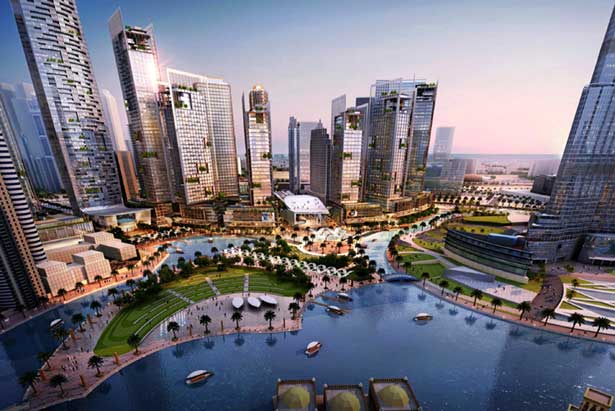 The
planned modern art museum and opera house district is in the shadow of the
Burj Khalifa, the tallest building in the world. The
planned modern art museum and opera house district is in the shadow of the
Burj Khalifa, the tallest building in the world.
The entertainment complex will include an opera house, modern art museum,
art galleries, two new hotels and residential housing, the government
announced today.
But unlike its heyday, when everything was aimed at making Dubai's name
shine brighter, the government was careful to couch the new development as
"the UAE's news arts and cultural nerve
centre," a sign of the closer federal ties forged in the aftermath of
Dubai's 2009 debt fiasco, and recognising the tower's name change from Burj
Dubai to Burj Khalifa.
Original plans for a dune-shaped opera house and cultural centre, designed
by British architect Zaha Hadid and built on a island in Dubai Creek, were
shelved as its struggling developer, Sama Dubai, slashed projects in 2009.
This was part of the 'Khor Dubai' Cultural Project announced in March 2008
around the Dubai Creek.
The government did not say how the project would be funded or who would
design it. "The design and architectural elements... are now being finalised
and work will commence shortly," the statement said.
Why bilinguals are smarter
21 March 2012
The New York Times
Speaking two languages rather than just one has obvious
practical benefits in an increasingly globalized world. But in recent years,
scientists have begun to show that the advantages of bilingualism are even
more fundamental than being able to converse with a wider range of people.
Being bilingual, it turns out, makes you smarter. It can have a profound
effect on your brain, improving cognitive skills not related to language and
even shielding against dementia in old age.
This view of bilingualism is remarkably different from the understanding of
bilingualism through much of the 20th century. Researchers, educators and
policy makers long considered a second language to be an interference,
cognitively speaking, that hindered a child’s academic and intellectual
development.
They were not wrong about the interference: there is ample evidence that in
a bilingual’s brain both language systems are active even when he is using
only one language, thus creating situations in which one system obstructs
the other. But this interference, researchers are finding out, isn’t so much
a handicap as a blessing in disguise. It forces the brain to resolve
internal conflict, giving the mind a workout that strengthens its cognitive
muscles.
Bilinguals, for instance, seem to be more adept than monolinguals at solving
certain kinds of mental puzzles. In a 2004 study by the psychologists Ellen
Bialystok and Michelle Martin-Rhee, bilingual and monolingual preschoolers
were asked to sort blue circles and red squares presented on a computer
screen into two digital bins — one marked with a blue square and the other
marked with a red circle.
In the first task, the children had to sort the shapes by color, placing
blue circles in the bin marked with the blue square and red squares in the
bin marked with the red circle. Both groups did this with comparable ease.
Next, the children were asked to sort by shape, which was more challenging
because it required placing the images in a bin marked with a conflicting
color. The bilinguals were quicker at performing this task.
The collective evidence from a number of such studies suggests that the
bilingual experience improves the brain’s so-called executive function — a
command system that directs the attention processes that we use for
planning, solving problems and performing various other mentally demanding
tasks. These processes include ignoring distractions to stay focused,
switching attention willfully from one thing to another and holding
information in mind — like remembering a sequence of directions while
driving.
Why does the tussle between two simultaneously active language systems
improve these aspects of cognition? Until recently, researchers thought the
bilingual advantage stemmed primarily from an ability for inhibition that
was honed by the exercise of suppressing one language system: this
suppression, it was thought, would help train the bilingual mind to ignore
distractions in other contexts. But that explanation increasingly appears to
be inadequate, since studies have shown that bilinguals perform better than
monolinguals even at tasks that do not require inhibition, like threading a
line through an ascending series of numbers scattered randomly on a page.
The key difference between bilinguals and monolinguals may be more basic: a
heightened ability to monitor the environment. “Bilinguals have to switch
languages quite often — you may talk to your father in one language and to
your mother in another language,” says Albert Costa, a researcher at the
University of Pompeu Fabra in Spain. “It requires keeping track of changes
around you in the same way that we monitor our surroundings when driving.”
In a study comparing German-Italian bilinguals with Italian monolinguals on
monitoring tasks, Mr. Costa and his colleagues found that the bilingual
subjects not only performed better, but they also did so with less activity
in parts of the brain involved in monitoring, indicating that they were more
efficient at it.
The bilingual experience appears to influence the brain from infancy to old
age (and there is reason to believe that it may also apply to those who
learn a second language later in life).
In a 2009 study led by Agnes Kovacs of the International School for Advanced
Studies in Trieste, Italy, 7-month-old babies exposed to two languages from
birth were compared with peers raised with one language. In an initial set
of trials, the infants were presented with an audio cue and then shown a
puppet on one side of a screen. Both infant groups learned to look at that
side of the screen in anticipation of the puppet. But in a later set of
trials, when the puppet began appearing on the opposite side of the screen,
the babies exposed to a bilingual environment quickly learned to switch
their anticipatory gaze in the new direction while the other babies did not.
Bilingualism’s effects also extend into the twilight years. In a recent
study of 44 elderly Spanish-English bilinguals, scientists led by the
neuropsychologist Tamar Gollan of the University of California, San Diego,
found that individuals with a higher degree of bilingualism — measured
through a comparative evaluation of proficiency in each language — were more
resistant than others to the onset of dementia and other symptoms of
Alzheimer’s disease: the higher the degree of bilingualism, the later the
age of onset.
Nobody ever doubted the power of language. But who would have imagined that
the words we hear and the sentences we speak might be leaving such a deep
imprint?
Thailand struggles to teach the basics of sex education to students
20 March 2012 - The Guardian
Her hands running with sultry precision down her teen curves, she sashays
across the stage, her bikini-sized jean shorts stretching just barely below
her bottom. Pop sensation Turbo Music is so young she still has braces on
her teeth, but that doesn't stop myriad middle-aged men from clawing at her
legs and private parts, eager to put paper bills anywhere their fingers
might reach.
This is modern Thailand: a nation home to the first-ever airline staffed by
ladyboys, the highest number of sex-change surgeries worldwide and a seeming
openness to sex rarely seen – or enjoyed – anywhere else in the world. But
ask a local teen how to put on a condom, or the ways in which HIV is
contracted, and you will likely be met with a blank stare and shy giggle.
Despite an education system that has created one of Asia's highest rates of
literacy, Thailand has the second-highest number of teen pregnancies in the
world, the highest rate of HIV/Aids in Asia, and year-on-year increasing
rates of STD infection among its youth.
The country's "top-down control of thoughts and behaviour" in its schools is
partly to blame, says Bangkok-based blogger Kaewmala, author of Sex Talk,
which analyses Thai culture and sexuality. "Sex isn't always a taboo subject
in Thai culture ... [But] what is 'appropriate' is often narrowly and
strictly defined by those who aren't always in touch with reality."
Last year it was Turbo Music's single Itchy Ear that drew attention to the
divide between Thailand's hyper-eroticised image and its surprisingly
conservative culture. With lyrics describing a bodily "itch" desperate for a
scratch and a YouTube video watched over 17m times, the band – and its
message – attracted a flurry of criticism about "amoral Thai behaviour" and
the "taboo nature" of sex in Thai culture.
This year, it was an claim by the National Economic and Social Development
Board that Facebook was partly to blame for the country's unwanted teen
pregnancies, citing seducing messages and video clips as an issue.
Then there was a nationwide health exam for high school students that asked:
"If you have a sexual urge, what should you do?" Optional answers included:
a) Ask friends if you can play football together; b) Consult family members;
c) Try to sleep; d) Go out with a friend of the opposite sex; or, e) Invite
a close friend to watch a movie together.
The correct answer, according to Dr Samphan Phanphrut, director of the
National Institute of Educational Testing Services, which oversees the exam,
was (a): Ask friends if you can play football together, whether the exam
taker was a boy or girl. The question, he told local media, was intended to
verify students' ability to recognise – and act – on their sexual impulses.
Copies of the test posted online quickly attracted messages of outrage and
chagrin, with commentators lamenting the lack of parent-child dialogue on
sex and the state of the country's education system – sentiments that some
politicians echo. Dr Pusadee Tamthai, of Thailand's National Commission for
Women's Affairs, says the indirect wording of the question, coupled with its
many possible answers, only proved educators' inability to reach their
students.
"Children are growing up so much faster today than in the past, but because
sex is taboo in Thailand, they seldom learn about sex from their parents or
family, so they depend on magazines, the internet and their friends for
information," she says. "When they do learn about sex at school, the way
that students communicate with their teachers is hierarchical and
[therefore] not very open, because in our culture of respecting the elderly
there's an emphasis on taking care of what you say rather than talking
freely and without judgment."
Luckily, there are some educators in Thailand who are listening. Maytinee
Bhongsvej, executive director of the Association for the Promotion of the
Status of Women, has launched a frank approach to sex education in the
capital, where a comprehensive programme – encompassing self-esteem, bodily
and emotional changes, gender rights, STDs and intercourse – has been rolled
out to some 100 schools around Bangkok. The course, she says, far surpasses
the "sperm and ovary" biology focus of the national curriculum and – despite
being highly controversial – has met with great success anecdotally.
"People think that if you talk about sex, you encourage them to have it. But
if you keep preaching 'Maintain your virginity', you don't prepare kids for
reality," she says. "We believe that kids should be fully informed because
then they can avoid situations that would lead them to problems."
Tamthai, who hopes to see a programme like Maytinee's as part of the
national curriculum one day, is restrained in her hope. "That starts with
being honest with each other," she says, "and that's a lot to do."
'Mad Men' Returns: Who Knew Don Draper Was a True Believer?
20 April 2012
When we last saw Don Draper, he was in bed with a woman he barely knew. And
while in many ways that might seem like a typical day at the office for this
guy, this woman was wearing his engagement ring. The same diamond ring that
Lt. Don Draper put on Anna's finger all those years ago, and the ring that
represents yet another one of the former Dick Whitman's attempts to make a
fresh start. That's what makes Don Draper such a quintessential American
fool, and helps explain our obsession with him. Every American wants a clean
slate, but nobody wants to lose what they've got.
Which is why every American's a sucker for the next scam artist who promises
them a new tomorrow – and Don Draper, as the greatest of scam artists, the
one who never fails to seduce the rubes, is also the biggest sucker of them
all. As Peggy said to Joan, shaking her head in disbelief, "A pretty face
comes along and everything goes out the window." Don Draper knows how that
works – he's a pretty face himself, and he's built a career hustling in the
dirty world of American dreams. But nobody falls for a con harder than a con
man.
Mad Men is the most astonishing, revelatory drama of our time, in any medium
or format, and it's coming off two of the most sensational seasons in TV
history. Judging by the premiere episode, Season Five is on the same level.
In other words, we're still in the prime of our Mad Men moment. And without
getting into any of the details of what's happened or how long it's been
since we last saw these characters, suffice to say, it's correct to assume
they are as glamorously fucked as ever. This is still a world where people
pick up babies while clenching lit cigarettes between their teeth. It's a
world where pot is "tea," and business meetings mean martinis.
Season Four ended with the most shocking plot twist Mad Men has ever seen:
Don impulsively gives that engagement ring to Megan, a secretary he's
basically just met, after a trip to (where else?) Disneyland. As Mad Men
viewers, we haven't spent much time with Megan, either. All we really knew
was that she was a sultry young hipster from Montreal, which can only mean
she's banged Leonard Cohen and inspired him to write at least one miserable
love ballad. (My money's on "Famous Blue Raincoat.")
Many fans were horrified to see Don act like a starry-eyed sucker, instead
of the cool customer we need him to be. It turns out this guy believes in
Hollywood happy endings. He's not satisfied to sell the American dream – he
wants to believe. And if even Don Draper falls for his own promises, what
hope is there for the rest of us?
One of the reasons Mad Men inspires such passion is that it's always a
pleasure to knock a few back with these characters. We know too much to
trust them, but they're likable – as any long-con grifter needs to be.
However, there's a new anxiety that lurks right below the bravado. Their
world is changing, and some of the sharks at Sterling Cooper Draper Pryce
are adjusting more smoothly than others. Yet for all of them, survival means
turning on the surface charm even when they're falling apart inside.
Early in the new season, a jazz band tootles away at the 1965 hit "The 'In'
Crowd," and it's a stunningly understated bit of music commentary. Everyone
on Mad Men wants to be in with the in crowd. And they're desperate to
imitate anyone who can show them how it's done. Don Draper wins people over
by coming on like the innest of the in crowd – he's the guy who knows. On
Mad Men, that's part of the Sixties scene – this is a moment in American
history where everybody wants some role in the Don Draper story. But the man
is a masquerade, and that's the reason Mad Men keeps getting more
fascinating. The secret of the in crowd is that there's nothing in there –
except more mystery.
This story is from the March 29th, 2012 issue of Rolling Stone.
EK A380 equipment changes for April
20 March 2012
If there are any Emirates crew who want to know why their
rosters are going to be late for April then this is a pretty good clue.
The continuing program of checking the A380 wing joints means
the new planes are being taken out of service on a regular basis I read as
many as six of the planes are out of action at any one time.
This means that 777s are having to fly routes previously
given up to the A380s; this has to be delaying the launch of new 777 routes.
Anyway here are the known changes for April from
airlineroute.net
Dubai – Kuala Lumpur EK346/347 till 21APR12 Boeing 777-300ER
replaces A380, except 01APR12
Dubai – Paris CDG EK073/074 27MAR12 – 05APR12 Day 245 operates with Boeing
777-300ER instead of A380 - 777 crews will like this as it must mean two 2
day and one 3 day layover in Paris...unless scheduling juggle the afternoon
flight rosters.
Dubai – Rome EK097/098 till 27APR12 A380 replaced by 777-300ER
Dubai – Seoul Incheon till 14APR12 Boeing 777-300ER replaces A380
Note also that EK372 to BKK appears to be operated by a 777
for the whole month rather than the A380 that is operating in March.
Planned A380 service changes on following routes remain unchanged:
Dubai – Johannesburg EK761/762 till 30APR12 Boeing 777-300ER replaces A380
Dubai – London Heathrow Changes to existing A380 service, which temporary
reduced from 3 to 2 Daily. 4th Daily A380 service postponed till 01MAY12
EK001/002 A380
EK003/004 A380
EK005/006 A380 replacing 777-300 from 25MAR12 remains unchanged
EK029/030 A380 replaced by 777-300 until 24MAR12, 777-300ER from 25MAR12 to
30APR12
Other A380 service may see last minute aircraft changes when necessary.
Bangkok's airport woes
18 March 2012
Bangkok's futuristic $4 billion Suvarnabhumi airport opened six years ago.
There were problems when it opened. There are still problems now.
The trouble is that the problems are related to management of
the airport; where the Thai authorities have been wholly ineffective.
Today, it is beset by two-hour immigration queues and passenger numbers far
beyond the original capacity.
Immigration queues for departing flights have grown so long travellers have
been told to arrive three hours before a flight.
The government's solution is to
try to convince growing numbers of low-cost carriers to move operations
to Don Muang, a domestic airport. Which misses the point completely. The
problem is with immigration. Domestic passengers do not require immigration
facilities.
Suvarnabhumi is expected to handle about 50 million
passengers this year, well above its planned capacity of 45 million. The
trouble is no additional terminal facilities are under construction.
At the moment the departure immigration areas are under
redevelopment adding to the problems. But travellers also grumble at the frequent site of empty immigration kiosks and
lines for foreigner nationals stretching far longer than those of Thais.
Others say kiosks designed to hold two officers are often manned by one.
The new airport's construction was marred by graft scandals, delays and design problems.
It was first proposed more than 40 years ago. Even before it was christened
in 2006, aviation experts predicted it would reach capacity in just a few
short years.
Don Muang, the old airport, was re-opened in 2007 for domestic flights due to the capacity
problems. Nok Air and Orient Thai both used the old airport; but they were
forced to move to Suvarnabhumi after the old airport flooded for months at
the end of last year.
There are also no transport links between Suvarnabhumi, in the east of the city, and Don
Muang to the north.
The trouble is that Suvarnabhumi's development was
caught up in a combination of endemic corruption and cultural incompetence.
With all the resources of the world at their disposal for a project that
attracted the best talent in the world, this was the best Thailand could do.
The hub of scams - with Suvarnabhumi at its centre. It will
likely take five more years to complete terminal and runway expansion to
handle the additional passengers.
Princess Bejaratana
18 March 2012
As I walked around Sanam Luang on Saturday I saw the
cremation buildings being constructed for HRH Princess Bejaratana who died
last July. But ask most Thais and they know little about the Princess.
All night entertainment venues will be instructed to suspend their
businesses from April 8-10 during her funeral. Other private enterprises will be asked to fly national
flags at half-mast on their premises. No alcohol will be sold or served.
Respect for the royal institution is a key building block of
Thai society; however the closure of so many businesses over the Easter
weekend when so many people visit Thailand will not be good for tourism or
business; it is also during the week leading up to Songkran when Thailand is
always busy with visitors.
The crematorium for the late Princess is coloured in gold - the standard
colour for a royal funeral - and pink, the shade representing Tuesday, the
day of the princess' birth.
This crematorium is smaller than that built for the late HRH Princess
Galyani Vadhana, because HRH Princess Bejaratana's body is contained in an
urn, while that of HRH Princess Galyani Vadhana was placed in a casket.
The main pavilion, crematorium and other buildings will be open for the
public to visit from April 11-17. A permanent exhibition in honour of the
late princess will be installed at Nakhon Pathom's Sanam Chandra Palace,
which was built by King Rama VI.
Princess Bejaratana was born on 24 November 1925 in the Royal
Grand Palace, Bangkok, as the only child of King Vajiravudh (Rama VI) and
Princess Suvadhana. King Rama VI died on 25 November 1925 and was succeeded
by his brother, King Prajadhipok (Rama VII), who performed the naming
ceremony for the princess on 30 December 1925.
In 1937 mother and daughter moved to England and stayed there
for twenty years before returning to Thailand in 1959. Princess Bejaratana
died on 27 July 2011, aged 85.
Princess Bejaratana is first cousin with HM King Bhumibol
Adulyadej and third cousin with HM King Norodom Sihanouk of Cambodia.
EK to DC
15 March 2012
Emirates announced today that it would start flights to
Washington Dulles International Airport from 12th September 2012.
Emirates will operate a Boeing 777-300 ER aircraft on its DC route. This
will be Emirates’ seventh U.S. gateway and the third new American route to
launch in 2012.
The greater Washington, DC area is highly diverse, with over 15% of its
population born outside the US. The region is home to more than 1,000
international institutions and over 1,000 foreign-owned companies from 50
countries.
Washington, DC is also a must-see destination for visitors to the United
States. From learning about flight at the National Air and Space Museum to
feeding tarantulas at the National History Museum’s Insect Zoo, America’s
capital is packed with fascinating attractions, not to mention iconic
landmarks such as The White House, The US Capitol and The Washington
Monument.
Disclosure - I think Washington is a great city. If something
happens in the world Washington responds. No other city can match that.
Emirates’ network now encompasses 122 cities globally, with 22 destinations
in Africa, 17 in the Middle East and 18 in the Far East and Australasia.
The flight will leave as EK 231 from Dubai daily at 02:20hrs
and arrive at Washington Dulles International Airport (IAD) at 08:50hrs. EK
232 will depart Dulles at 10:55hrs arriving in Dubai at 08:00hrs the
following day.
EK to add 3rd daily to Rome
12 March 2012
Emirates Airline said today that it will boost its operations in Italy this
October as the airline adds a third daily flight to Rome.
This will take the total number of flights offered to Italy to 56 a week,
the Dubai-based carrier said in a statement.
Starting October 1, EK 099 will be operated by a 237-seat Airbus A330-200,
which will also add a total of 15 tonnes of cargo-carrying capacity to the
route.
The flight number and times are:
EK 099 DXB-FCO 0315 0735 - A332
EK 100 FCO-DXB 1120 1910 - A332
Yet another addition to the European 3am departure bank.
It may be time for Emirates to start adding extra Asian
departures around 11pm; such as the existing BKK flight. This works if the
flights can connect into the afternoon European departures.
Rome is currently served twice daily by Emirates. Coupled with a triple
daily service to Milan commencing on June 1 and a double daily flight to
Venice beginning March 25, the increased weekly frequencies add three new
flights to Italy over 6 months.
Fabrizio Palenzona, chairman of Aeroporti di Roma (ADR), added: “Without a
doubt, Emirates represents a strategic partner in ensuring further traffic
growth between Rome and all the main long haul routes in Asia, Australia and
a large part of Africa.
"After being the first airport in Italy able to welcome the A380, thanks to
the investment for a new dedicated loading bridge, we’re now looking forward
in cutting the ribbon next October 1 for this new additional flight,” he
said.
Emirates is increasing services to mainland Europe with flights being
launched to Barcelona on July 3 and Lisbon from July 9.
Qatar Airways pushes back plans for IPO
12 March 2012
Qatar Airways has indicated that any partial public listing will not happen
for 5 to 8 years. The airline's CEO, Akbar Al Baker, told journalists at the
ITB Berlin travel fair that the
IPO "will be postponed for a long time because we feel it will take a long
time to recover from the economic situation that the world is in."
Qatar Airways indicated late in 2010 it was planning an initial public
offering in early 2012 after three consecutive years of profit. Last June,
Al Baker had said the carrier could seek a stock market listing by the end
of 2011.
Al Baker said the IPO plan would have been to list 50 percent of the
company's shares, but limit foreign ownership of stock to 20-25 percent.
He said profit would slump at the airline due to the Arab Spring uprisings
and high fuel prices. He added that he expected revenue of $6bn, up from
$5.1bn the previous year.
Al Baker said in June the airline made net profit of $205 million for
2009/10 and more than $230m in 2010/2011 .
Now those figures are interesting - Qatar does not publish
its financial statements - but these at least give some basis for comparison
with Emirates.
| US$ |
Emirates Airline |
Qatar |
| Revenue year ended 31 March 2011 |
14.8 billion |
5.1 billion |
| Profit year ended 31 March 2011 |
1.5 billion |
230 million |
High-pressure game without a net when you hang up gloves
11 March 2012 - David James in The Guardian.
The former England goalkeeper, and in the eyes of this ex-goalkeeper one of
the very best, is addicted to the game and wonders how he will cope
when he finally retires. David will likely be fine; he is articulate
and aware and can have a successful career in or out of the sport. But his
article does say a lot about the demands on professional sportsmen and
women. It may be even more of an issue for cricketers who at the top level
are away from home and family for months on end.
"Stepping out on to the field for my 900th club appearance on Saturday
evening, it was becoming harder than ever to escape the fact that my playing
days are numbered. At 41 years old the realisation is finally beginning to
hit home – I can't play football forever. At some point in the not too
distant future I'm going to have to hang up my boots. The change is
unimaginable.
After 26 years in the game I'm as institutionalised as they come. How will I
cope? The unexplained death of Gary Speed has prompted many players to speak
candidly about depression following their retirement, bringing the issue
into stark focus. From Dean Windass to Stan Collymore, players who were once
regarded as stars suddenly find themselves lost. My generation of
footballers won't become pub landlords like our predecessors, so what will
we do instead? An awful lot of soul searching, I imagine.
Football has been our addiction. We have lived the dream but for many it
comes to an abrupt end. Last weekend, doing a bit of punditry for the BBC,
Robbie Savage told me that since retiring there are days where he just
doesn't know what to do with himself. Having spent our entire adult lives
following orders – infantilised by the system – suddenly we have to make our
own decisions, to grow up, to reintegrate back into mainstream society.
On retiring many players simply disappear from public life. Where once they
were lauded on TV every week, suddenly they are a nobody. It can be very
hard to take. Already I have had a taste of that – from playing for England
at the World Cup when it felt like the whole nation was talking about us, to
playing in the Championship, a league that receives a fraction of the media
coverage of the Premier League. No wonder former sports people end up on
shows like Strictly Come Dancing, they miss being the centre of attention.
I can't see myself ever doing one of those shows and yet it was only a few
years ago that I wrote in this column about my dislike of punditry. But last
weekend there I was on the BBC. I really enjoyed myself – even if the lads
did hammer me for the waistcoat I was wearing.
Some might wonder what footballers have to be depressed about, playing the
beautiful game, earning millions of pounds (though not all of us do), but
while it is a wonderful way to earn a living, football is not real life and
even if we try to remain in the game – through management or punditry – we
can't escape the real world forever.
So what do I mean by institutionalised? Well, at 41 I'm pretty childish. I
remember the record producer Pete Waterman once saying that as soon as a boy
band tell you they want to write their own songs you know they're finished.
Football is no different. Players remain juvenile well into their late 20s
and 30s. It suits the industry to keep us that way. And the longer you stay
in the industry, the deeper that goes.
Football has been everything to us. It rules our home lives. We live for the
highs – a man-of-the-match performance watched by millions on live TV – and
crumble at the lows, a never-ending oscillation between extreme emotional
states. It affects our relationships with our partners, children, friends
and colleagues. In my 26 years of professional football I've been a
nightmare to be around. At Liverpool I'd come off the field after winning
3-1 and be in a terrible mood because I had conceded a goal. Anyone who came
near me after a defeat – strewth, it bothers me how horrible I used to be.
The game puts a great deal of strain on those around you. Children in
particular suffer. In my own life I gave much more to football than I did to
being a father. Whether it was mood swings affecting the atmosphere at home,
or just physically not being there – travelling to away games, training
camps, pre-season tours, training on Christmas Day. When you retire,
suddenly you are forced to pick up the pieces. You have to become a real
dad, a real husband, a real son. No one warns you that this will happen and
who do you turn to for help? You could be the richest retired footballer in
the world but you can't pay someone to sort out your family for you.
There is a misconception that all footballers are very confident, but it is
the opposite for most. While as individuals we are often put in a position
of prestige, our power in real terms is pretty limited. No wonder so many
young players go off the rails. Idolised as God's gift in one sphere, within
the workplace they are expected to bow down to the authority of the club. It
is a strange and confusing dynamic, forever in conflict. It is no
coincidence that footballers tend to be extremely insecure. We feed off
praise, and it is a harsh reality check when you realise that most people
around you are feeding you absolute rubbish.
It is a great irony that in a game where we routinely talk about confidence
on the pitch, psychological support off it is so appallingly neglected. Many
years ago when I was going through a bad time at Liverpool I approached the
club for some support. Back then I was told, "shut up and deal with it".
Sadly, I don't think that football has moved on from that position. Even
when clubs are forward thinking enough to invite a sports psychologist into
the fold players are apprehensive about making use of them. They are too
worried about what their team-mates and management will think. "Will
everyone think I'm mad?" "What if he tells the manager about me?" "What if
it jeopardises my position in the team?"
I always say it: we have nutritionists to help with our diets, sports
scientists to help our strength and conditioning, technical coaches to help
our performance but the one area that essentially determines everything –
psychology – is always missing. Ask about a psychology coach and you are
guaranteed to be met with a frown.
Our industry is crying out for an independent support network to help
current and former players deal with the pressures of the game. Until then
I'll probably put off retirement for a while yet. At least until I reach
1,000 club appearances."
David James donates his Guardian fees to charity
Emirates seeks A380 compensation
9 March 2012
Emirates Airline , the world's largest operator of Airbus's A380 superjumbo,
plans to seek compensation from the aircraft maker after complaining of
widespread disruption and an expected loss of revenue, the airline's
president told the Financial Times on Friday.
Emirates President Tim Clark said the airline expected to lose up to $90
million by the end of March because of the A380 groundings that began in
January.
The Financial Times cited Clark as saying that the Dubai-based carrier would be seeking
compensation from Airbus.
"From a commercial point of view, it's a dreadful experience. It has caused
a lot of commercial hardship and we are not very happy with the way this has
gone," Clark is quoted as saying.
European air safety regulators last month ordered checks for Airbus A380
wing cracks for the entire superjumbo fleet after safety engineers found
cracks in almost all the planes inspected.
Emirates has found wing cracks on the 10 A380s that have been inspected so
far, and Clark says that all 21 in its fleet
would need remedial work.
Clark criticised Airbus' handling of the wing cracking issue, accusing the
company of initially being in a state of "denial" about the scale of the
problem, although he accepted that the company was now seeking to rectify
the situation. Emirates has a further 69 A380s on order with Airbus.
Airbus could not be reached for immediate comment.
Expect to see even more pressure from Emirates on Airbus as
the manufacturer faces potential delays in its A350 programme.
SQ's woes
9 March 2012
Singapore Airlines Ltd , the world's second-largest carrier
by market value, said on Friday it has asked its pilots to volunteer for a
no-pay leave of up to two years as the industry was hit by weak demand and
soaring jet fuel prices.
The move comes on the heels of a 53 percent plunge in third-quarter net
profits for the Singapore flag-carrier, which recently also announced a 20
percent capacity cut for its cargo operation and higher fuel surcharges.
The offer is open to senior first officers, first officers, second officers
and cadet pilots, for durations of between one week and two years to address
a surplus of pilots, according to Singapore Air spokesman Nicholas Ionides.
"The global financial crisis in 2009-10 was a factor and resulted in some
excess capacity at the time. Growth was also slower than anticipated after
that," Ionides said, adding that pilots opting for no-pay leave can work for
other carriers during the period subject to a written approval from
Singapore Airlines.
The carrier has no plans to make the scheme compulsory at this point and
sees the situation as temporary, he said.
Singapore Air has been badly hit by a slowdown in corporate travel as major
companies, mainly financial firms, cut costs.
Singapore Air appears to have lots its edge in recent years;
it still has a good product; but the network growth is not there and
management appears distracted in its focus as it tries to leverage Scoot and
Tiger for the LCC/leisure business and Silk Air for second tier regional
traffic from Singapore.
Ionides did say that SIA has no plans to reduce flights and downsize its
operating fleet in the near term. "To the question of why we are offering
the scheme, the global financial crisis in 2009-10 was a factor and resulted
in some excess capacity at the time. Growth was also slower than anticipated
after that," Ionides added.
Captain P. James, president of the Airline Pilots Association Singapore,
questioned why pilots were being asked to go on leave when there's a need
for them in other airlines with the SIA Group.
"We can understand that there's a downturn but what we cannot understand and
cannot accept is why pilots are being asked to go on leave where there's a
need for them in other airlines within the group," James told the Straits
Times.
More analysis of SQ here from Aspire Aviation
2027 is new date for Dubai's new airport
7 March 2012
It was inevitable but it needed to be announced. Dubai’s
major airport project, the US$34bn Al Maktoum International Airport, will
not begin full commercial passenger services until at least 2027, the CEO of
Dubai Airports has said.
“The original [plan] was to have some capacity online for 2017, we’ve pushed
that back by about ten years... something around [2027],” Dubai Airports’
CEO Paul Griffiths told Arabian Business in an interview.
Confirming the plan to move all airlines to the new airport
he added that “the idea is to build a facility that’s large enough so that
Emirates and other airlines could move, not necessarily at the same time,
but within a fairly short timeframe.”
The global financial crisis and a lack of available financing have delayed
the development of Al Maktoum International.
Instead Dubai Airports have focused on maximising capacity at
existing DXB by spending US$7.8bn to build an additional concourse for
terminal 3 and a new terminal 4. This will take capacity at DXB from 50
million passengers a year to 90 million.
The plan is to generate cash from DXB to finance the
development of Al Maktoum.
By the middle of the next decade, the aim is to have a
capacity for 80m passengers at the new airport, allowing Dubai’s state-owned
carrier Emirates to move its entire operation to the new hub. But the new
airport was planned with a capacity of 120 million and will need all of that
to move all the airlines from DXB.
The immediate focus is to increase cargo operations at the second airport.
The
airport has announced plans to develop more cargo terminals at Al Maktoum,
of a similar size to the existing shed which can handle around 250,000
tonnes of cargo per year.
As for passengers - a passenger terminal building has been
constructed. It is a budget terminal which will be ready for operation
during the course of 2012. It has a capacity of around 7m passengers. Enough
for instance for flydubai.
The problem is that no airline will want to move there and
lose their connections at DXB. So plans are for the passenger operation are
far from clear.
However this is dressed up it is a far cry from the original plans: back in
March 2007
Emirates Airline president Tim Clark says that he hopes discussions will
start in "a couple of months" about accelerating the airport's development.
"The existing airport will be reaching maximum capacity by 2013, so by 2016,
we should be moving to Jebel Ali," he said at the time.
That was then - this is now ! It is OK to extend the life of DXB. But the
problem is landing and take-off slots which are no longer available at peak
times. The LCCs need to move to Jebel Ali to free up slots at DXB; but no
airline will want to move - including flydubai as that will limit
connections to EK.
As peak time slots are not available
EK itself will have to make use of less
convenient arrival and departure times. And as the number of flights
increase through the day the airport regulators will need to find ways to
better use the two existing runways - using both runways for landings at
peak times would be a start. At peak times 12L or 30L are used for arrivals;
but at this time there are almost no departures meaning that 12R or 30R are
not in use.
One final thought is that by 2018
Emirates fleet will have doubled; including 90 A380s. Just where will all
those airplanes be parked. The only solution is for the LCCs and business
traffic to move to Jebel Ali. But there will need to be a significant
improvement in road and bus access to the new airport.
Thaksin talks of return this year
7 March 2012
Bloomberg
Thaksin Shinawatra, deposed as Thai premier in a 2006 coup,
said his sister's seven-month-old government will avoid the same fate due to
her good ties with the army and expressed hope he'd return from exile this
year.
"As long as there is no issue related to the monarchy, as long as there is
no issue about internal security, the military will stay in the barracks,"
Thaksin, whose sister Yingluck Shinawatra become prime minister in August,
said in an interview yesterday in Seoul. "My sister works hard for the
people, she respects the monarchy very much and she can work with the
military without conflict."
Yingluck's push to rewrite the constitution risks sparking violence like in
2008 when a similar effort by Thaksin's allies led to protests by his
yellow-shirted opponents who shut down parts of Bangkok and seized the
city's airports. Yingluck, a political novice before standing in July
elections, is seeking to reassure foreign investors after floods last year
swamped thousands of factories and caused the economy to shrink for the
first time since 2009.
Changing the constitution to make it more democratic has "almost consensus"
support among Thailand's 66 million people, Thaksin said in an interview
that spanned calls for diversifying some of the nation's foreign-exchange
reserves to advocating lower interest rates to spur growth.
"History will not repeat itself," Thaksin said, referring to street battles
that have claimed more than 100 lives since his ouster. Thailand "will move
toward reconciliation" as early as this year, he said.
The proposal to create a 99-member Constitution Drafting Assembly passed 399
to 199 on Feb. 24, the first of three required votes in the National
Assembly. The People's Alliance for Democracy, which led anti-Thaksin
protests in 2006 and 2008, plans to meet on March 10 to decide whether to
return to the streets in a bid to block its passage.
Events in recent weeks point to a detente between Thaksin and his opponents,
including the presence of top royal adviser Prem Tinsulanonda, who Thaksin
earlier accused of backing the coup, at a dinner hosted by Yingluck,
according to Michael Montesano, a visiting research fellow at the Institute
of Southeast Asian Studies in Singapore. Court decisions upholding
government spending plans and convicting anti-Thaksin protest leader Sondhi
Limthongkul of fraud are further evidence, he said.
"There's been a string of indications that the groups we expected to see
undermining this government are not doing so," Montesano said. "For once,
Thaksin's sweeping statements are perhaps not all bluster."
Thaksin, 62, became a billionaire after winning a mobile- phone concession
in 1990 for what became Thailand's biggest operator. He soon entered
politics and appealed to voters in the poorer northeast region with cheap
health care and small loans, a platform that underpinned his tenure as prime
minister from 2001 until his ouster.
Thaksin has lived overseas since fleeing a two-year jail sentence in 2008
for helping his wife buy land from the government. A court seized 46.4
billion baht ($1.5 billion) of his family's money in 2010, two weeks before
his supporters started protests that shut down Bangkok's commercial center
and ended in a military crackdown and arson attacks.
"I've done nothing wrong," Thaksin said when asked if he'd ever spend a day
in jail to foster reconciliation.
In July, Yingluck's Pheu Thai won 265 seats in the 500-seat parliament on
pledges to raise the minimum wage, buy rice at above-market rates and give
students tablet computers. It was the fifth straight election win since 2001
for allies of Thaksin.
Yingluck "will start delivering campaign promises and the economy will move
accordingly," Thaksin said. "The flood maybe slowed down her performance a
little bit, but now I think she performs very well -- better than I
expected."
Thailand's consumer confidence rose for a third straight month in February,
the latest indicator of a recovery after the nation's worst floods in almost
70 years disrupted supply chains for companies such as Apple Inc. and Toyota
Motor Corp. The state planning agency forecasts the economy may expand as
much as 6.5 percent this year after the deluge slowed annual growth to 0.1
percent in 2011.
Since King Bhumibol Adulyadej confirmed Yingluck as premier on August 8,
Thailand's SET Index has risen 7 percent, more than benchmarks in Malaysia,
Indonesia and Singapore. The baht fell 3 percent in that time.
Thaksin criticized Thailand's central bank, saying policy makers were overly
concerned about inflation and should keep interest rates low to boost
growth. Foreign reserves of $181 billion are "unnecessarily high" and should
be invested in large-scale infrastructure projects, he said.
"Sometimes government officials don't want to take any risks," he said,
adding that he respects the central bank's autonomy.
Thaksin considers himself an encyclopedia that Yingluck "can open anytime
she wants to." He said he has no ambition to serve again as prime minister
and will seek to become her adviser if he returns to Thailand.
"A Thaksin government without Thaksin is absolutely perfect at the moment,"
said Chris Baker, a Bangkok-based political analyst and author of a
biography on Thaksin. "Yingluck is doing a brilliant job of empathetic,
slightly low- key leadership. We are back on the path before the coup. The
one thing that can throw this is if Thaksin tries to return."
Emirates planning update
5 March 2012
There were a few hints dropped in Seattle about Emirates
route plans - which clearly involve increasing frequencies on many of its global
routes and maybe a new Australian destination; assume Adelaide.
Shaikh Ahmad Bin Saeed Al Maktoum told Gulf News that
"you will see the frequency increasing in some flights from once to twice or
even more daily; there will be new points in South and North America, Europe
and China while in Australia there is a big chance of introducing a new
destination."
Shaikh Ahmad also said: "Concourse 3 should open by the first
quarter of next year and that itself can accommodate up to 20 Airbus 380s.
The plan by 2020, however, is to finish Terminal 4, following which all the
international carriers will be moved there while terminals 1and 3 will be
devoted to us."
On the growing number of competitors in the region — including Qatar Airways
and Etihad — Shaikh Ahmad said: "I always believe that competition will be
there, but what can you do about it? The way I see it, Qatar and Etihad are
now complementing what we are doing for the whole region.
"At the end of the day, we look at the numbers to see whether our seat
factor dropped and the answer is no," he said.
"In the UAE itself, you now have Air Arabia, flydubai and RAK Airways. There
could be more airlines from Saudi Arabia as well. That's life for you," he
said.
Emirates has already announced the launch of direct flights to Ho Chi Minh City, Barcelona and Lisbon
later this year.
What new announcements are likely in the next 12 months; here
is some current thinking:
In North America: Vancouver and Montreal if Emirates finally finds an
agreement with the Canadian government. But most certainly Chicago and
Washington DC in the near future as well as Atlanta, Boston and Miami later
on.
In South America: Mexico City and Caracas. Mexico would likely be flown as
an add-on to Miami.
In Europe: Brussels, Stockholm, Oslo and Kiev
In China: Chengdu and Chongqing
In Australia: Adelaide
In the Far East; Phuket, Bali (as an add on to the most
recent flight to Singapore, Hanoi (assuming HCM City launches successfully).
Emirates plotting USA expansion
4 March 2011
In speeches made at the Seattle route launch Emirates'
Chairman, Shaikh Ahmad Bin Saeed Al Maktoum, told Gulf News that "wwe are
looking to add more flights and Washington DC is very much on our radar,"
Asked whether it could happen this year, he nodded in affirmation.
Seattle was the airline's seventh new destination in three months when
flight EK229 touched down at Seattle Tacoma International Airport this week.
Seattle joins Dallas as new US routes, while other added destinations
include Rio de Janeiro, Buenos Aires, Dublin, Lusaka in Zambia and Harare in
Zimbabwe.
"It's the sixth stop for us in the US and we can assure you that a lot of
feasibility study has been done before arriving at the decision," said an
Emirates spokesperson on the flight, who agreed it would offset restricted
landing rights in Canada.
There are more details of the launch event and Emirates and
Boeing's plans for a next generation 777 in this Seattle Times article:
Emirates eager for updated 777.
|
|