|
A high-wire act
in Thailand
By Philip Bowring
Sunday, August 31, 2008 International Herald Tribune
Now playing here
is a balancing act between political theater and deadly serious power
struggle that both fascinates and alarms the public.
Will mass demonstrations, the occupation of the seat of government and of
some airports force the resignation of the elected prime minister, Samak
Sundaravej, whom opponents see as surrogate for the prime minister deposed
in 2006, Thaksin Shinawatra?
Will these high profile, well-funded but disparate activists fail to foment
a full-blown crisis? Or will the military step in with another coup? Or will
the king impose a compromise which implicitly undermines rule by ballot box?
So far, Thailand has just about kept its balance as shifting alliances make
the issues more complex than a simple struggle between the pro- and anti-Thaksin
forces. The former prime minister himself is now in Britain, having jumped
bail when faced with corruption charges.
At stake for the longer run are fundamental issues: What form of democracy,
if any, should Thailand have? What will be the role of the monarchy when
King Bhumipol, 80, whose standing has risen in step with his 62 years on the
throne, is no longer there.
The protesters under the banner of the Peoples Alliance for Democracy
include both liberals and conservatives - liberal, constitutionalist
democrats outraged by the corruption and authoritarianism to which
democracy, they allege, degenerated under Thaksin; right-wing royalists who
loathe populism and would like rule by a military and bureaucratic elite
blessed by the monarch. With them are assorted opportunists better known for
their love of the limelight than for principles.
As for Prime Minister Samak, 73, at one level he is a Thaksin surrogate
whose legitimacy stems from last year's election won by the People Power
Party created by Thaksin loyalists. But at another he has long associations
with right-wing royalists and with the military and police who accord him
some trust even though they remain mostly anti-Thaksin. So far, the army has
stood aside.
While Samak remains under pressure to quit, Thaksin loyalists are beginning
to wonder if he will opt to survive in office and let the judiciary press on
with the prosecution of Thaksin and the appropriation of huge assets held by
his family and associates.
Thaksin himself was clearly surprised that he was not able to do a deal with
the Samak government, in part due to pressure from the royal palace to let
the law take its course. To many, Thaksin's crime was not so much
corruption, which has been rampant in every government, as his
centralization of power and largesse.
Some monarchists also hint that Thaksin is a covert republican. But what
they really fear is that King Bhumipol's successor, lacking his authority,
will be unable to act as a balance to populist democracy and will revert to
the purely ceremonial institution the monarchy was during Bhumipol's first
two decades, when military strongmen ran the country.
They know that whatever case is made against him, Thaksin will remain
admired by the poor, whom he helped with health and credit schemes, and by
businessmen, who praised his "get things done" approach.
The Bangkok middle class espouses democracy but in practice fears that it
could threaten not just their liberties but the income disparities that make
their lives comfortable. Likewise the bureaucracy in this highly centralized
state is hardly corruption-free but resents being bossed by the likes of
Thaksin.
As for the army, it still sees itself as the ultimate defender of stability
and the monarchy. But it has learned from experience that direct
interventions are not solutions. Indeed, things are much the same now as
before the 2006 coup when Thaksin was facing daily demonstrations by the
same people as Samak today.
Thailand is an open society, and most Thais want democratic participation.
The military and most of the monarchists accept that. But the question of
what kind of democracy and to what extent it should be balanced by the
courts, the army, the Bangkok mob or the king remains unsettled.
Unstable but manageable politics is likely to continue - at least until the
succession, at which points predictions are impossible.
Counting the cost in Phuket
30 August 2008
Phuket's economy
survives on tourism.
But the island is
effectively cut off to tourists due to the pro PAD demonstrations. A
total of 118 flights which were scheduled to land or depart from Phuket
international airport in southern Thailand were canceled today, while more
than 15,000 passengers were unable to proceed on their journeys as
protesters continued blocking access to all airport entrances for the second
day Saturday.
A similar situation occurred at the airport in the adjacent resort province
of Krabi, where six domestic flights were unable to land since early
Saturday.
Of Saturday's canceled flights, 93 were domestic and the remainder 25 served
international destinations.
Meanwhile, PAD activists who had earlier blocked roads leading to Krabi
airport successfully occupied the landing strip and access tarmac.
They said they would not leave the airport's runway until their colleagues
in Bangkok achieved victory – ousting the coalition government of Prime
Minister Samak Sundaravej.
As six flights of two airlines were unable to land at Krabi airport,
officials arranged three air-conditioned coaches for passengers to travel to
Bangkok.
Palin may be the new Dan Quayle
30 August 2008
Is Sarah Palin the
new Dan Quayle or is she a long term force in Republican politics?
She looks like an
opportunistic choice. The old man (McCain is 72) needed a younger female to
try to take the vote that the Democrats have passed on by choosing Joe Biden
as their VP candidate rather than Hillary Clinton.
Palin has been
governor of Alaska for just two years, preceded by two terms as mayor of
Wasilla, population 9,780. She has no foreign policy or national security
experience beyond running the Alaska national guard.
A little
background; Palin is the former point guard and captain of the Wasilla High
School Warriors who went on to become the Miss Wasilla 1984 beauty queen.
You would not know that from her latest hair styling; 1950s revisited. From
there she became a local sports reporter. She's married to her high school
sweetheart who is a commercial fisherman, member of the steelworkers union
and a world champion snowmobile racer. She has five children—one of whom is
deploying with the Army to Iraq in September.
Suddenly Obama
looks like the risk adverse conservative. In a race where Obama is supposed
to represent bold change, he chose his running mate conservatively. And
McCain, who is supposed to be the Washington insider, chose a Washington
outsider who has fought her state party establishment, battled corruption
and won. Importantly, Palin has no discernible ties to the desperately
unpopular Bush administration.
She is also a
strident conservative; so I dislike her politics already. She is
anti-abortion and wants to see Roe v. Wade overturned. She opposes same-sex
marriage and supports the teaching of creationism alongside evolution. She
is a member of the National Rifle Association. In high school, she headed
the school Fellowship of Christian Athletes.
The catch here is
that McCain is 72. If he does win he is at best a one term President. It
maybe that the Republicans have underestimated concerns about McCain's age.
That said in the
end vice presidential nominees as shaky as Dan Quayle seldom affect the
outcome of an election. The US election is little about either ideologies or
VP candidates. It is about who is elected as President.
Coup leader
30 August 2008
The Thai media is
talking of Pallop Pinmanee as the designated successor of PAD leader
Chamlong Srimuang.
The PAD leaders
themselves remain protected by their black shirted (so nationalistic) guards
who have erected barriers and employed tight security measures at Government
House in fear of police infiltration. It appears as hard to get out as it is
to get in.
The Wikipedia
entry on Pallop Pinmanee is alarming. This is a guy who appears to seriously
need a PR makeover: it follows unedited:
Pallop Pinmanee
- From Wikipedia, the free encyclopedia
"General Pallop Pinmanee (Thai: พัลลภ ปิ่นมณี)(born 25 May 1936) is a former
Thai commando and assassin who took part in several coups, ordered the
massacre of insurgents at Krue Sae Mosque, and allegedly played a role in
the attempted car bomb assassination of Prime Minister Thaksin Shinawatra.
In May 2007, he was appointed the public relations advisor for the Internal
Security Operations Command of Thailand.
Pallop graduated from Class 7 of the Chulachomklao Royal Military Academy,
the so called "Young Turks". He began his career as a commando and
self-professed assassin.[1] With his Young Turk classmates, he was involved
in military coups against the governments of Seni Pramoj, Tanin Kraivixien,
and the unsuccessful 1981 coup against the government of Prem Tinsulanonda.
He admitted to being the mastermind behind a series of assassination
attempts against General Arthit Kamlang-ek, commander of the Army under
Prem. Pallop was later "rehabilitated" and retired from the Royal Thai Army
in 1966 with the rank of full general in 1996, but was appointed deputy
director-general of the Internal Security Operations Command. It was in this
position that he ordered military forces to storm Krue Sae Mosque during a
tense stand-off with Southern insurgents. Dozens of insurgents died in the
controversial move.
Later, Pallop's driver was found driving near the residence of Prime
Minister Thaksin Shinawatra in a car containing 67 kilograms of explosives.
Pallop was immediately dismissed from his position. After the Thaksin
government was deposed by a military coup, the junta appointed Pallop public
relations adviser of the ISOC.
Pallop is married to Khunying Naruedee Pinmanee.[2] He has a son and two
daughters."
Thailand's battle for power continues
30 August 2008
Sadly the foreign
press does not appear to understand the situation in Thailand. The Guardian
(see below) rather naively calls for fresh elections. Which without any
change to the electoral process will almost certainly mean another win for
any party that can buy or earn the support of the rural vote and ensure more
of the same.
It is increasingly
clear that this is a battle between old and new money; between those who
have had power for decades and those who are new to power. The old elite
against Thailand's equivalent of the nouveau riche. It is a standoff that
may not get resolved for years... perhaps only after a period of stability
following the inevitable (but to Thai hearts hopefully far off) succession
of King Bhumibol.
A PAD leader told
The Associated Press this in a simple sentence: "after the current
government is ousted, we will propose a totally new political system with
those corrupt guys prosecuted and we will have a clean and efficient
political system."
The PAD
sympathizers — a peculiar mix of monarchists, the military and the urban
elite — complain that Western-style democracy of one man, one vote gives too
much weight to Thailand's rural majority, whom they consider unsophisticated
and susceptible to vote buying. So rather than educate them to give them a
greater understanding of their political influence there are many in
Thailand who would revert to a feudal system where only the educated and
moneyed and trusted are enabled to vote.
It is easy to dislike Samak and his cronies but remember that those people
have been elected. Over and over again in 2001, 2005, 2006 and 2007. And if
new elections were to be organized tomorrow, they would win again.
Meanwhile the PAD
stridently pushes its ultra nationalist theme of structural hatred and
division in Thai society. This is worse that anything achieved by the
previous government under ousted premier Thaksin Shinawatra.
Never-ending coup
Editorial
The Guardian, Saturday August 30 2008
Two years after a coup which forced Thaksin
Shinawatra into exile, the same establishment forces are rattling the cage
of the Thai prime minister, Samak Sundaravej - the man they accuse of being
the media tycoon's proxy. As a report this week by the International Crisis
Group says, this is a struggle between two deep-seated and irreconcilable
forces: the older, traditional Thailand of the bureaucracy, military and
monarchy, and a populist nouveau riche from the rural areas whose support
Thaksin has tapped into. This particular premiership encounter appeared to
be going into extra time yesterday.
The options for Samak appear to be running out fast, but he has so far
resisted the temptation of imposing a state of emergency, which would allow
him to put troops on to the streets. The demonstrations spread yesterday
from the prime minister's residence, where thousands of anti-government
protesters have been encamped for four days, to the rest of the Thai capital
and across the nation. Protesters attacked the police headquarters, invaded
the runways of three southern airports, and brought a third of the country's
rail network to a halt.
Samak's political problems have only been compounded by the loss of three
cabinet ministers and a series of legal challenges. The mass demonstrations
have been organised by the People's Alliance for Democracy, whose campaigns
led to the coup that ousted Thaksin. This is not as the name suggests. It is
a rightwing group of businessmen, academics and activists who claim to be
the defenders of the revered - but in these circumstances silent - King
Bhumibol Adulyadej. The king is officially above politics, but he has
intervened several times during his six decades on the throne. The challenge
the opposition poses to Samak is a serious one, especially since Thaksin,
who jumped bail on corruption charges, is again back in London. Samak, a
73-year-old political bruiser, should resign or call a snap election. The
demonstrations, which started as a cross between a festival and a political
rally, could swiftly turn violent.
The army - which Samak has allowed a freer hand in dealing with the
insurgency by the Malay Muslim minority in the south of the country - has so
far stayed out of this growing conflict. One retired general, Chamlong
Srimuang, an influential former politician and army officer, said the
protesters were doing nothing wrong. Samak said earlier this week that he
had a sword - the riot police closing in on the prime ministerial compound -
but would not use it. He must now realise that his government can not last,
and call fresh elections.
Doom for Zoom
29 August 2008
Another airline
casualty. Zoom Airlines Inc., whose Canadian operations were headquartered
in Ottawa, abruptly shut down operations on Thursday after suffering about
$50 million in unanticipated costs, mostly related to high fuel prices. This
left hundreds of passengers stranded in Canada, Europe and the Caribbean,
and resulted in job losses for 450 staff in Canada and another 260 with its
U.K. sister organization, Zoom Airlines Limited.
There will be more
casualties. Every airline is struggling with high fuel costs. In June, Air
Canada announced plans to cut as many as 2,000 jobs. It is a terrible
business right now.
The first sign of trouble at Zoom came in Calgary Wednesday, when a flight
bound for Britain with 69 people aboard was grounded after the company that
owned the Boeing 767 plane terminated its lease with Zoom. The fuel supplier
also refused to refuel the aircraft because of outstanding debts.
A further 213 passengers were stranded in Halifax after a Zoom flight
destined for Ottawa was grounded after arrival from London. Baggage handlers
refused to service the plane because their company hadn't been paid.
Then yesterday, airport authorities in Glasgow wouldn't allow a Zoom flight
bound for Halifax and Ottawa to depart because of non-payment of fees,
stranding another 200 people.
The squeeze by creditors forced the company's hand. And the company died.

What next for Thailand?
29 August 2008
I am very confused
by events in Thailand. The protests continue in Bangkok and have spread to
the regions. Three airports have been blocked by protesters; and a number of
unions (from the national airline to the electricity provider) have called
on staff to strike in support of the PAD protesters.
In the last week
the PAD has blocked airports, blocked highways to the capital, taken over a
government run tv station and occupied the grounds of government house.
It is easy to be
outraged at the current government - policies, corruptions, influences,
greed, inappropriate placements for office. Yet does that condone the PAD's
recent actions. They look like and behave like an ugly and threatening mob.
No one should want
to see Thais committing acts of violence against their own people simply
because they disagree with each other. Thaksin and his cronies need to go.
The courts have gone a long way to asserting their independence and dealing
with Thaksin. But the process takes time and needs patience.
But the PAD does
not represent the Thai people. Their demands for a
national (and largely appointed) government is not realistic.
How does this move
forward. People should protest. But Samak's government will need to
negotiate with the PAD so they don't disrupt too much of the country's day
to day business.
At a minimum the
government should confirm that it will not change the constitution and will
need to open a dialogue with the Democrats. This will give everyone a little
breathing space and maybe things will calm down.
Most Thais
continue to get on with their day to day lives and will be hoping that these
protests end peacefully.
What are Sondhi's
aims. Does he want control? Probably. He certainly wants to remove Samak and
the present government
The impact is
widely felt. The stock exchange is suffering; the baht is weakening.
Travelers are disrupted. The fear is that if Samak stands down Thailand
simply replaces one group of self promoting, power brokers with another.
The protesters are
right about one thing. Thailand deserves better from its elected leaders.
Who knows what
will happen next; but is is two years since the 2006 coup and Thai politics
is no closer to stability.
Only in Thailand
26 August 2008
A former Bangkok
senator, Chirmsak Pinthong, yesterday sued the director of Nakhon Si
Thammarat provincial airport and the budget airline Nok Air for negligence
over alleged lax security.
The suit was the
first to be filed with the newly-established Consumer Court set up under the
2008 Consumer Case Procedures Act which took effect on Aug 23.
The law provides a fast-track legal process for people who claim they have
been affected by substandard products, services and medical treatment.
Affected people can file charges against providers of substandard goods or
services at provincial courts.
The suit named the director of the Nakhon Si Thammarat provincial airport
and Nok Air, an affiliate of Thai Airways, as first and second defendants.
Mr Chirmsak said he boarded a Nok Air flight from the southern province to
Bangkok on Aug 16. He alleges that as he was about to board the flight, he
found that check-in staff of Nok Air had not searched passengers for
weapons. He was told by a female staff member that the airline's scanner
detectors had been borrowed by Walailak University. Very bizarre.
Chirmsak said that he did not "feel good and was worried as there were 150
passengers on board the flight. If someone had hidden explosives, we would
have died en mass.''
He added that "this is a case of negligence and a reckless act that might
cause serious damage to the lives and property of passengers. I decided to
bring the case to the court's attention.''
Chaisak Angsuwan, the director-general of the Civil Aviation Department,
yesterday said he had asked Nakhon Si Thammarat provincial airport about the
alleged lax security measures and was told that Walailak University had
borrowed its walk-through metal detector for use during its graduation
ceremony. However, the airport had hand-held scanners which were used to
scan passengers before boarding the plane.
The legislation appears to give consumers the right to complain about poor
services, including medical services at clinics, drug stores and private
hospitals. Chirmsak is setting the trend for multiple frivolous cases to be
brought.
Bangkok Airport expansion approved - maybe
26 August 2008
Airports of Thailand Plc (AoT) has at last agreed to proceed with the
78-billion-baht programme to expand Bangkok's new airport. Safe to assume
therefore that this includes consultants' fees and that a smaller number
will actually be spent on airport facilities.
The majority state-owned and SET-listed airport operator's board last Friday
endorsed the Phase 2 development and will soon seek final consent from the
Transport Ministry and the Cabinet. That should hold things up!
The expansion will increase the passenger handling capacity of Thailand's
gateway airport by 33%, to 60 million in the next six years from 45 million
currently.
The expansion involves building a midfield terminal and a third runway.
AoT aims to call a tender for the airport expansion work next year and hopes
to be able to start construction by the end of 2009.
About 33 billion baht of the estimated project cost would come from loans
from the Japan Bank for International Co-operation (JBIC), which was a major
lender for the phase-one project that cost 155 billion baht.
The payments start
with a consulting company conducting an environmental impact study for the
expansion project. It will hold public hearings to explain plans to mitigate
noise pollution resulting from the increased air traffic.
The price of China's Olympic
Games
August 26, 2008 Editorial in the Los Angeles Times - a view from the
USA.
"Although Beijing spent lavishly on Olympic
spectacle and medals, that doesn't make it a winner."
"Juan Antonio Samaranch, the former head of the International Olympic
Committee who helped engineer Beijing's successful bid to host this summer's
Games, was quick to dub the extravaganza "the best Olympics ever" as the
proceedings closed on Sunday. Such pronouncements are as subjective as a
gymnastics score, but it's beyond question that China can say it has hosted
the most expensive Olympics ever and, quite possibly, the most rigidly
controlled.
Historians might debate the latter point. Adolf Hitler's 1936 Berlin Games
were just as much an international propaganda campaign as the 2008 event,
carefully choreographed to demonstrate the glory of the Third Reich. But
even Hitler couldn't control the weather. Chinese leaders, terrified that
Beijing's lung-blackening air pollution would cast a pall over the city's
image as well as its skies, directed the Weather Modification Office (yes,
there really is such an agency) to seed clouds throughout the Games so that
rainfall could flush away the filth. Yet rain wouldn't do during the opening
and closing ceremonies at the open-air Bird's Nest stadium, so hundreds of
rockets were fired into the clouds to chase them away.
In the end, China got precisely what it paid more than $41 billion for. It
won far more gold medals than any other nation, persuaded world leaders to
attend the Games despite their misgivings about Beijing's horrific human
rights record both domestically and abroad, and announced with a clamor as
loud as the 2,008 drummers who performed at the opening ceremony that it is
a rising power that should command respect.
Yet what planners in Beijing miscalculated is that no matter how well you
teach performers to smile, the strain behind the lips is still detectable.
The near-hysterical drive by Chinese leaders to put on the biggest, most
spectacular sporting event ever, and to engineer a generation of Chinese
medalists regardless of the financial or human costs, is rather more
disconcerting to the outside world than convincing. If it was Beijing's
intention to prove China's greatness via the Games, what it has demonstrated
instead is the fragility of its ego.
British officials are no doubt wondering how they can possibly top the
spectacle of Beijing when London hosts the Summer Games in 2012. They
shouldn't even try. The British have nothing to prove, and it will be
refreshing to watch an eventin which athleticism matters more than image.
The London Olympics will probably be messier and less awe-inspiring than the
Chinese Games, but it's a good bet they'll be more fun."
The PAD is anything but
26 August 2008
The People’s
Alliance for Democracy (PAD) is anything but. It is not a people’s alliance
and it is certainly not pro-democracy.
What is also clear is that Thailand's battered and bruised democracy has
reached a crucial juncture. The PAD's rally cry is for a "new politics" in
which future parliaments would be 30% elected and 70% appointed. The
proposal was clearly in response to the fact that pro-Thaksin parties have
continued to win elections, even after his original Thai Rak Thai party was
disbanded by a military tribunal, and would likely prevail again if Samak
opted to dissolve parliament and call for new polls.
While the PAD has consistently claimed its movement aims above all at
protecting the monarchy from usurping politicians, its attacks today on
government buildings which bear royal insignia make those claims as doubtful
as its so called commitment to democracy.
On Tuesday thousands of protesters took to the streets of Bangkok on behalf
of the PAD to demand the resignation of Prime Minister Samak Sundaravej and
his cabinet. They occupied the offices of the state broadcaster NBT and
surrounded the main government offices. At one point they forced their way
into Mr Samak's offices - prompting him to take shelter in an army base.
Mr Samak has appeared on television promising decisive action, saying: "We
will do everything to bring the situation back to normal."
The PAD protest was troubling in that this one was threatening and
occasionally violent. It was also trespass;
Police at the National Broadcasting Service of Thailand (NBT) apparently
seized weapons from the protesters and made 80 arrests, but the attackers
stormed the building at the second attempt and took the station's
programming off air.
A news anchor was reportedly punched in the face when the protesters
attempted, but failed, to broadcast their own programmes.
The People's Alliance for Democracy, is at heart a Rightwing front led by a
group of retired generals and businessmen. Their aim is to overthrow the
government and replace the elected parliament with mostly appointed
legislators.
Police estimated that around 10 000 people were involved. The protesters
declared the number was double that.
SPrime Minister
Samak says he is on good terms with everybody, including the military and
the monarchy and insists that he is not a proxy of Thaksin or receiving
funding and instruction from the ousted premier - a claim that has long been
dismissed by the PAD and his critics.
The question is
just how far will the PAD go to force a change of government. Thaksin has
gone and fled into exile. That really should have been enough; a little
stability would be good for the country.
Xinhua wins trumpet blowing gold
25 August 2008
The Xinhua news
agency, that bastion of truth and accuracy in journalism, is going to have
to find something else to write about now that the Games are over.
But they signed
off their games coverage by finding and reporting every piece of good news
that they could find from around the world. There is no discussion of human
rights issues in Xinhua. It is a massive exercise in patriotic trumpet
blowing.
There are a few
good examples in today's coverage from the Chinese news agency:
From Iranian media
Xinhua reports that "Iranian media on
Monday hailed Beijing Olympics as a great success. Iran's official
IRNA news agency said that Beijing Olympics is one of the most memorable
summer Olympic Games in which a lot of marvels took place and many dreams
came true."
Meanwhile
Venezuelan President Hugo Chavez, during his TV and radio program "Alo
Presidente," said "China made the best Olympics in history."
And Xinhua found
that "Swiss media have highly praised the organization work of the Beijing
Olympic Games, saying the Games presented a modern and high-efficient China
to the world."
And that "Mexican
media and citizens hailed on Sunday the closing of the Olympic Games of
Beijing and it graded them as the best ones in the history, for the sports
results and their organization."
While across the
border Xinhua reported that "Different walks of life in Myanmar Monday
appraised China's successful hosting of the 29th Beijing Olympic Games with
China topping the gold medal table for the first time."
Even Reuters (oops Thomson Reuters was apparently fulsome in its praise;
"Thomson Reuters senior official: Xinhuanet provides very successful
service" screamed the headline.
In their final moment of self delusion Xinhua observed that :
'Through the
Beijing Olympic Games, the world has had a better knowledge of what China is
like - a country that makes constant progress, emphasizes friendship and
harmony, keeps its promises, and respects all international rules,' said the
Xinhua commentary.
Are the Chinese cheating?
22 August 2008
The answer has to
be yes. But I suspect there will be a careful IOC/Chinese cover up to
protect what has in reality been a very successful Olympics.
The Chinese have
produced passports for He KeXin the gold medal winning Chinese gymnast
showing her age as 16. He Kexin has become the darling of the host nation
since winning gold in the both the individual and team events.
Chinese coaches registered He as 16 years old. But an official inquiry has
been launched after it was claimed she may only be 14 and, therefore,
ineligible to compete in the games, which require a gymnast to be at least
16 in the year of the games.
She could be stripped of her medals if the allegations are proven. There
would be uproar in China. But let's face it - neither she or her teammates
look 16. At least not to western eyes.
Miss He narrowly won gold on the uneven bars on Monday. Despite recording an
identical score as US gymnast Nastia Liukin judges moved her into first
place for style. She was also part of the gold-winning Chinese all-round
team.
Bela Karolyi, a former gymnastics coach whose wife, Martha, trains the US
women's team, has repeatedly accused the Chinese of fielding underage female
gymnasts.
The ages of two other team members, Jiang Yuyuan and Yang Yilin have also
aroused suspicion. Time magazine reported that government records, that have
since disappeared, showed both girls to be 14.
The minimum age for female gymnasts was increased from 14 to 15 in 1981, and
up to 16 in 1997, to protect the physical and mental health of young
athletes.
Dubai's terminal 3 to open from 14 October
22 August 2008
Dubai
International Airport's new Terminal 3 will begin operations from October 14
in a phased roll out, Dubai Airports has announced.
Terminal 3 is dedicated to Emirates Airline and the opening will be
implemented in four phases to ensure systems and processes that need to make
the transition to the new building are working.
This presumably
means that only a limited number of flights will initially use the new
terminal.
The terminal is currently undergoing operational readiness trials to ensure
customers have an "unmatched experience", whether arriving, departing or in
transit, said Dubai Airports.
Dubai Airports conducted the first major operational trial, involving more
than 2,000 volunteers, on August 9. Some 6,000 volunteers will participate
in similar trials scheduled to be conducted later this month and at the end
of September.
Aussies in a lather
19 August 2008
You have to feel a
bit sorry for the Aussies. So far away that they are almost forgotten about
the only thing that gave them some attention every couple of years was their
medal winning Olympians and the cleaning up of medals at the Commonwealth
Games.
This success was
accompanied by unpleasant gloating sounds and that dreadful chant of Aussie
Aussie Aussie OyOyOy.
Now the noise you
can hear in Beijing is Land of Hope and Glory! The Brits are loving it. And
why not? It is Day 11 and the Brits already have 16 gold medals.
Australia
meanwhile is a nation that is giving way to the MacDonalds Generation and
where sport is best watched on a 32 inch flat screen. The Sydney Morning
Herald reports today that "something utterly jaw-dropping has happened at
these Games, and it has nothing to do with a tall man with the weight a
nation on his shoulders stumbling before the first hurdle. The Brits have
overtaken Australia on the medals table."
The SMH continues "Once, not so long ago, Australians were a proud people
who walked tall with jutted jaws. The Poms were a source of amusement, a
fallen imperial master weeping over a dog-eared scrapbook, its tattered
images of Steve Redgrave, Seb Coe, Mary Rand and those blokes from Chariots
Of Fire fading by the day."
The Aussies then
claim that British success is all down to Aussie leadership - that they
showed the Brits how to fund sport and then sent their coaches to Britain to
transform sport.
If treading sour
grapes was an Olympic sport the Aussies would do well.
Medal silliness
17 August 2008
Olympians will
always tell you that the Games are about personal performances and not about
international success and geographical boundaries. Yet given the hype over
who will top the medal table (China or the USA?) and given the country
rankings that are produced from the medal table the following alternative
analysis produced today by a Guardian reader and is too good to pass
unreported:
Based on medals
awarded as at 13.00GMT on 17 August:
Medals won:
Gold, silver, bronze, total
1. 2nd (Communist) World:
58, 55, 65, 178
2. British (Anglosphere inc USA):
45, 42, 49, 136
3. Third Reich/European Axis:
35, 42, 43, 120
4. Roman Empire:
37, 34, 44, 115
5. Evil (Former Eastern Bloc):
25, 37, 47, 109
6. Napoleonic Empire:
26, 27, 32, 80
7. British Empire (19th Century):
26, 23, 25, 74
8. USSR:
14, 23, 37, 74
9. Current Communist Bloc:
33, 18, 18, 69
10. Chinese Empire (China 2008):
31, 13, 11, 55
11. French Colonial Empire:
5, 11, 16, 32
Notes:
Communist World = ALL the current or former communist countries of the 20th
century – i.e; pre-1989 communism (I may have left some out but Cuba,
Vietnam, North Korea, PRC & the whole eastern bloc are included)
Third Reich/European Axis: I have only counted the European Axis powers
although of course if Imperial Japan and her colonies (inc South Korea) were
to have been included then likely they would top the table – especially if
one counts the parts of the Chinese mainland that the Japanese conquered.
Roman & French Empire numbers likely to significantly increase as the
Africans come to the fore on the track over the coming week (ditto British)
Roman Empire includes ALL figures for Germany even though they conquered
less than half of modern Germany
French Colonial Empire includes ALL figures for Canada even though they
didn't really administer most of the country.
No Time to consider Mongol, Ottoman, Habsburg, Prussia, Spanish, Portugese,
Dutch , Japanese empires and COUNTLESS others! But these are some of the
main players.
I have no idea what any of this means - except maybe that the French
sporting legacy left a lot to be desired !
Ramadan set for 1 September
17 August 2008
The Islamic holy
month of Ramadan will begin on Sept. 1, while the religious festival of Eid
Al-Fitr will begin on Oct. 1, according to astronomists.
Researcher and supervisor of Sharjah Planetarium Ibrahim Al-Jarwan said
calculations show the Hilal (crescent moon) will be born on Aug. 30 at
11.58pm, but it will not be visible to the naked eye until the next day,
state news agency WAM reported on Saturday.
In Islam, Moon sighting determines the beginning and ending of Ramadan.
Al-Jarwan said the last day of dawn-to-dusk fasting will be on Sept. 30 and
therefore Eid Al-Fitr will fall the following day.
Both the private and public sector are granted a holiday to mark Eid.
If Eid starts on Oct. 1, which is a Wednesday, residents in the UAE could be
looking at going back to work on the Oct. 5, which is a Sunday.
Beijing's flawed planning
16 August 2008
The sport is going
well. The facilities appear to be popular. The events run smoothly.
But these are the
games of a totalitarian state. They are not fun games. They are not
accessible games. And Beijing has been so concerned about how the games
appear to the world that they have forgotten the basics of human dignity and
decency. And that makes these games depressing.
The latest news to
break is that thousands of young Chinese women applicants for the 200 jobs
to lead each country's athletes into the National Stadium for last week's
opening ceremony of the 2008 Olympic Games went through an unusual
humiliation during their interview. They had to be at least 1.66 metres
tall, have a pretty face - and strip naked for the job recruiters.
The Beijing News, in a story detailing the latest opening-ceremony outrage,
said stripping naked for measurements was a requirement merely to apply for
the position.
Thousands of young women from colleges and dance academies in Beijing
competed for the chance to appear before a huge worldwide audience.
During the selection process, the women were required to strip so teachers
judging whether they were qualified could measure their body proportions,
The Beijing News said.
In addition there were 400 cheerleaders chosen for the stadium who were to
perform throughout the three-and-a-half-hour long extravaganza on August 8.
Dressed in short white dresses, boots and caps (and looking far too cute!),
the women had to constantly dance and cheer, to create a good atmosphere and
rouse the audience of 91,000 people at the stadium.
The 400 women also performed the earlier smiling programme - in which they
danced and opened umbrellas each with a smiling face on them.
For that three-minute performance, the women had to undergo half a year of
training, rising every day at 5 am to get to the practice site by 6 am and
returning to their school dormitory as late as 8 or 9 pm, Zhang said.
Sometimes when the training starts at noon, the women would practice till 1
am or 2 am.
They practiced standing in a row at different positions on the stadium, and
also rehearsed dance movements and the opening and closing of umbrellas - a
simple task which each women had to practise doing for more than 1,000
times, the report said.
Details about how China put together the spectacular opening ceremony are
slowly being revealed - including revelations that were controversial.
After the ceremony, organisers admitted that most of the fireworks display
shown on television were actually not the fireworks set off that evening,
but were recorded in advance.
They also said a girl whose song during the ceremony won wide praise did not
actually appear in the stadium and her song was mimed by another girl who
was considered more attractive to foreign audiences.
And on Friday, state media said the nearly 900 soldiers operating the huge
scroll that formed the centrepiece of last week's show had to stay hidden
under the structure for up to seven hours, wearing nappies because they were
not allowed toilet breaks.
Meanwhile stories
of excessive security; half empty stadiums; restrictions on journalists,
suggest that Beijing has used these games to assert its authority rather
than to open up to the world. The International Olympic Committee may think
the sport is outstanding; but the Olympic objectives are so much bolder and
are about so much more than sport.
How Russia reshaped the world in a week
16 August 2008
It will take
history to assess how much the world has change in one week. But change it
has. We have seen the re-emergence of a cold war; the beginnings of a Soviet
rebirth and possibly the demise of NATO as a force of any useful value,
The Russians seem
to have an interesting idea of a cease fire. Their occupation of Georgia is
now within 35 kilometres of the Georgian capital, Tbiblisi.
The Georgian army
is in tatters. The Russians have occupied the Black Sea port cities and
scuttled the navy.
On the outskirts
of Joseph Stalin's hometown of Gori, reconnaissance units of Russia's 58th
army have dismantled the shiny new military base inaugurated only last
January for the first infantry, the army engineers, and an artillery
brigade.
To the west in the town of Senaki, it's the same picture. A flagship
military base, home to the second infantry brigade, is in Russian hands. And
down on the Black Sea coast, the radars and installations for Georgia's sole
naval base at Poti have been scrupulously pinpointed by the Russians and
destroyed.
Gori and Senaki are not outposts of the old Red Arm. They were home to bases
that had recently been upgraded to Nato standard. The Russian justification
is that of peacekeepers who say they are there to defuse an enormous arsenal
of weapons and military hardware.
These weapons are mainly American-made or American-supplied. This was all
about bringing Nato membership to Georgia.
The American "train and equip" mission for the Georgian military is six
years old. It has been destroyed in less than a week. Georgia's Nato
ambitions are history.
What does it all mean. A thrashing for Georgia and Nato are a triumph in
Russia for Vladimir Putin. The regional and the global balance of power
looks to have tilted, against the west and in favour of the rising or
resurgent players of the east.
In a keynote speech in Munich last year, Putin confidently warned the west
that he would not tolerate the age of American hyperpower. Seven years in
office at the time and at the height of his powers, he delivered his most
anti-western tirade. To an audience that included John McCain, the White
House contender, and Robert Gates, the US defence secretary and
ex-Kremlinologist, he served notice: "What is a unipolar world? It refers to
one type of situation, one centre of authority, one centre of force, one
centre of decision-making. It is world in which there is one master, one
sovereign. This is pernicious ... unacceptable ... impossible."
This week, he turned those words into action. The US has proven toothless.
Nato worthless. The Russians have routed Georgia and could do the same in
any of the other FSU states.
Putin is
determined to make Russian mighty again. He has oil, gas, and a strong
military that can make the world listen to Moscow. Europe has been left to
arrange and shore up a fragile ceasefire. Appeasing the Kremlin has been the
goal. Not defending Georgia. The Italians went as far as to warn against
building an "anti-Moscow coalition". They would!
Britain and the USA have been lone voices talking of Russian aggression.
Where next for Putin; a peacekeeping (occupation) force in the Ukraine? All
around Russia's rim, the former Soviet "captive states" are trembling. Even
Belarus, the slavishly loyal "last dictatorship in Europe", went strangely
silent, taking days before the regime offered Moscow its support.
The EU states of the Baltic and Poland are drumming up support for Georgia,
with the Polish president Lech Kaczynski declaring that Russia has revealed
"its true face". That divides the EU since the French and the Germans refuse
to take sides and are scornful of east European "hysteria" towards Russia.
Just how strong is
Russia. Is this a huge bluff from a financially weak and poorly equipped
Russia. Its economy struggles to develop goods or services, depends on raw
material exports and on European consumption and the price of oil for its
current wealth.
But Putin can take advantage of western uncertainty over what to do. Having
taken Georgia so easily this may just be the beginning. A first step to a
much greater goal. And the West's response is limited to words.
The wild west wanted poster
15 August 2008
The only thing
missing on the police warrant now circulated for the arrest of Thaksin is
the wanted dead or alive heading from the Wild West.
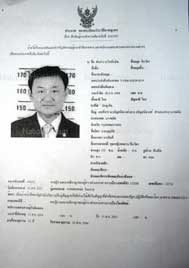 
Pammie has her Milkie Way
15 August 2008
A couple weeks
ago, Pamela Anderson announced that she was partnering with the Abu Dhabi
royal family to create a magnificent green hotel in Middle Eastern city. Now
we know why the UAE has a sudden appeal for this rather average entertainer.
I doubt she knows a whole lot about architecture; but she does know about
money and keeping herself in the public eye. So what ties the former
Baywatch babe to the project. A matter of the heart.
It has been revealed that Anderson is dating a prince in the Abu Dhabi royal
family. The web is saying that she’s only mentioned her new beau’s name to a
few select friends, but refers to him in conversation by the pet name she
made up for him - Milk-Sheik or Milk for short. How very unoriginal.
Supposedly, the prince has also visited her in LA already. Anderson
apparently met her prince when she visited Abu Dhabi in June with the Make a
Wish Foundation. Since then, she has announced she is partnering with the
royal family to build an ecofriendly hotel in the area. The hotel will be a
vegan-friendly resort featuring things such as organic linens and bath
products not tested on animals.
SQ wins annual Skytrax award
14 August 2008
For
the 3rd time in 10 years, Singapore Airlines has been named World's Best
Airline, winning the 2008 Airline of the Year title in the latest Skytrax
World Airline Awards. These awards are among the most respected of airline
awards and are based upon over 15 million eligible survey interviews
completed during the 11 month survey period. From Seoul to Sao Paulo,
Copenhagen to Cape Town, the scale and breadth of the 2008 survey
strengthens Skytrax's reputation as one of the world's largest passenger
surveys.
Singapore Airlines also collected the award for Best Business Class in a
very competitive section of the survey where the whole business class
package is evaluated, from airport lounges, ground services to the quality
of cabin seating, inflight entertainment, catering and of course the cabin
staff service."
Cathay Pacific took 2nd place overall in the 2008 Awards (up from 3rd in
2007), and picked up the award for World's best First Class thanks to its
new onboard 1st Class product and service concept.
Qantas ranked 3rd worldwide (5th in 2007) and won the award for the Best
First Class Lounge - achieved in a period where the airline has seen
competition ramped up both in its domestic and regional market. Presumably
the survey was completed before the recent series of safety scares!
Surprisingly, Thai Airways maintained a strong ranking, placed 4th worldwide
(2nd in 2007) together with picking up 4th place in the Best Cabin Staff
section of the awards.
Asiana Airlines was one of the biggest improvers across the 2008 results,
ranked 5th worldwide (up from 12th in 2007), as well as taking the
sought-after World's Best Cabin Staff Award and also collecting the Award
for Best Economy Class.
Malaysia Airlines ranked 6th worldwide (as in 2007), and was also the
runner-up for the title of World's best Cabin Staff.
Qatar
Airways is another 5-Star airline achieving a top-10 ranking (placed 7th
worldwide), and collecting the award for Best Airline and Best Cabin Staff
for the Middle East region, as well as the Best Business Class Catering
category.
Air
New Zealand ranked 8th worldwide (7th in 2007), and also collects the 2008
Award for Best Airline Transpacific, ahead of Qantas in that category.
Emirates maintained the same ranking as last year, placed 9th worldwide. The
Dubai-based airline picked up the award for Best Airline Inflight
Entertainment for the 4th year in succession, ahead of Singapore
Airlines in 2nd. Emirates is probably a little disappointed with this
ranking. Their growing network and their huge media/advertising spend should
be leading to a better ranked product.
The
move to the Emirates dedicated terminal 3 at Dubai late in 2008 should
improve the overall perception of the Emirates product.
A new
entrant to the world's Top-10 airlines is Abu Dhabi based Etihad Airways,
securing 10th position in the 2008 Awards.
A
repeat win was achieved by Virgin Atlantic in being named winner of the Best
Business Class Lounge Award, having secured the title in 2007 for their
Clubhouse facility at London Heathrow Airport.
Cathay Pacific won the Best First Class Onboard Catering Award.
In
the year that Austrian Airlines celebrates it's 50th anniversary, the
airline has another honour to mark the achievement, winning the award for
Best Business Class Onboard Catering for the second year running. Qantas was
named winner of the Best Economy Class Onboard Catering Award, based on
their longer haul, international operations.
Thailand's new internet watch
14 August 2008
Regular readers of
rascott.com will be under greater surveillance in Thailand from August 23
when private firms, organisations and government agencies will be required
to store all internet traffic data for 90 days so it is available as digital
evidence for police. Pol Col Yannapol Youngyuen, commander of the Bureau of
Technology and Cyber Crime at the Department of Special Investigation, said
the IT Ministry order has no exceptions and will include banks, hotels,
schools and internet cafes.
He said digital evidence gathered from computers is useful in tracking those
engaged in cyber crime.
Cyber offences, ranging from email forwarding of pornographic pictures to
posting libellous messages on forums, are on the rise, Pol Col Yannapol
said, but police agencies find it hard to gather the evidence to bring the
perpetrators to justice.
He said internet cafes will also be required to collect information to
identify computer users, such as ID cards, time of logging in and sites
visited. Shops that fail to heed the rules will face fines up to 500,000
baht, he said.
The two sides of Beijing
13 April 2008
The trouble with
Beijing is that there are two sides to the city; there are the ordinary
people; welcoming, commercial, entrepreneurial, curious, engaging and
genuinely friendly.
It must be a
friendly place - down by the old workers stadium there is now a branch of
that infamous US bar and restaurant institution - Hooters. Employing bright,
English speaking, decently paid, graduates in the trademark skimpy t-shirt
and shorts.
For them politics
is a million miles away. Survival, making money, sweating through the
summer, bettering themselves, trying their newly discovered English skills;
that is what gets them through each and every day.
Then there are the
authorities; and as one ITN reporter from the UK has discovered today they
are not welcoming; John Ray of ITV News was driven away in a police van
and detained after he covered a Free Tibet protest close to the city's main
Olympic zone.
Around a dozen activists from Students for a Free Tibet had gathered outside
Ethnic Minorities Park. Police also forcibly removed the protesters after
driving away the journalist.
Speaking by telephone from the back of the police van as he was driven away,
Ray said: "I have been roughed up. They dragged me, pulled me and knocked me
to the ground. Now they are filming me."
He could then be heard asking the officers with him: "Why are you filming? I
am a British journalist. I have all the Olympic accreditation I need."
Police officers could then be heard asking: "What's your opinion on Tibet?"
Ray replied: "I have no opinion on Tibet. I am a journalist."
A police officer could then be heard telling him he was not allowed to use
his telephone. The line went dead.
Police were also filming and taking pictures of other journalists at the
scene.
A tale of two
sides of the city.
Thaksin flees
11 August 2008
Thailand's ex-premier Thaksin Shinawatra has arrived in England in exile
from his homeland. He alleges security threats to him and his family; in
reality he is fleeing justice and a series of un-winable law suits.
In his statement read out on a state-run NBT TV channel, Thaksin said he and
his family will remain in exile in England indefinitely and did not say when
he would return to the country.
Thaksin must have thought that the election result of February 23, which saw
the People Power Party (PPP), many of whose members came from his now
defunct Thai Rak Thai Party, would be beneficial to him. But while he had
bought the politicians he had not bought the judiciary.
Thaksin returned to Thailand; but the tide had turned. He has now claimed
that there was "intervention in judicial system" with a hidden agenda to
"get rid of me and my family". He continued "these individuals see me as
political enemy. They have no consideration to judicial system, truth and
legal principle...my family and I have been continuously treated unjustly."
Thaksin's comments will have done little to
endear him to the judiciary which responded swiftly as the Supreme court
ordered bail money seized and issued warrants for his arrest and that of his
wife, Pojaman Shinawatra. In addition to nearly $400,000 in forfeited bail,
the government has frozen more than $2 billion of Mr. Thaksin’s assets,
money that the family unsuccessfully sought to access in recent weeks.
The question is whether the Thai authorities will push hard to get Thaksin
back to Thailand to face justice. The government has said that it will seek
Thaksin's extradition. Arguably they are better with him out of the way in
exile. Show trials and supreme court appeals would only bring the potential
for clashes between pro and anti Thaksin groups. Getting Thaksin out of the
country may be a master stroke - and just possibly Prime Minister Samak is
proving much cannier than he has been given credit for. That said it still
looks unlikely that his faction based PPP party has much life left in it and
another general election could happen even by year end.
Thaksin and his wife, who had already been
sentenced to three years in jail and who was on bail pending appeal, had
applied for permission to leave the country to attend the Beijing Games
opening ceremony. It is likely the Thai authorities knew that neither would
return.
It was not clear if Thaksin will seek
political asylum in the United Kingdom where he owns the Manchester City
football club.
London to produce the credit crunch Games
10 August 2008
The London 2012
Olympic organisers must have been truly alarmed at the Beoijing opening
ceremony. "Follow that" will be the cry from China. "No chance" will be the
British response. London may be the first modern Olympics of the Ryanair
era. The first LCO - low cost Olympics. Indeed I would be asking Ryanair
management for their ideas on what should be on show in London in four years
time.
Beijing's
memorable ceremony cost US$100m (£52m). Already under pressure over costs
London's organisers are going to have to produce a show that may be more
memorable for its amateurism that its pyrotechnics.
The most obvious
difference between London and Beijing will be scale. London is already
talking about manageable, affordable and sustainable Games.
Beijing's show
involved 15,000 performers in the ceremony, 2008 of them in the opening
minutes beating on "fou", traditional drums that flashed in time to the
percussion. That set the tone for a series of tableaux evoking Chinese
history, none of which involved fewer than 100 colour-coordinated dancers
London can't
compete with that. A few Morris dancers; a Maypole, some dancing members of
the Womens' Institute, the pearly kings and queen's of London's east end.
And don't expect the flame to be lit in the style of Li NIng with his
gravity-defying lap on the stadium roof.
Of course the
Olympic theme in 2012 will have to be the EastEnders TV theme; by then into
its billionth episode. Maybe Cliff Richard could sing it.
London will also
need to repair every broken window and cracked paving stone of the East End;
to remove all the grime and graffiti between Heathrow and Stratford East and
to get athletes and visitors around town by something other than the
Docklands light railway.
Sure Britain has
creative talent. It just doesn't have the budget; or 15,000 unemployed
dancers who can train for four years. make it British and classy; Elgar not
Spice Girls.
At least the
parade will be the same - a crazed display of relative national wealth and
bad clothes, where all teams are equal regardless of size. Come 2012,
Bermuda's team will still wear shorts and Panama's their hats, and the
Americans will be booed by as many people as cheer them.
Don't match
Beijing; be different. The best London can do - give the Olympics to the
people; avoid the crazy security of Beijing; recognise that only a handful
of people will be able to get tickets to the big events so put up big
screens across the country, invite the ticketless hordes to watch in
Trafalgar Square, turn the event into a giant street party; hold arts and
music festivals at the same time. Then you have an accessible game so
different from Beijing. A games for the athletes and for the people.
EK's A380 on medical diversion - update
10 August 2008
EK's new A380 had
its first diversion today.
Outbound from
Dubai to New York a 9 year old girl suffered a seizure in Y class.
Medlink demanded
immediate diversion. The closest airport was Vienna, which is not suitable
for A380, therefore the crew elected to divert to Munich.
Some inevitable fuel dumping as the plane was heavy with fuel for New York;
but to get the girl to hospital the crew did an overweight landing saving
some 60 tons of fuel in the process. By all accounts the Airbus standard
operating procedures for overweight landings are very comprehensive.
The airplane
resumed its flight to JFK.
The unlikely producer of China's biggest show
9 August 2008
Adapted from
the New York Times.
Pictures from the opening ceremony
For much of the past quarter century, the
Chinese director Zhang Yimou made films that showcased his country's
struggle against poverty, war and political misrule to the outside world,
films that Chinese, for the most part, never saw. Time and again, Mr Zhang's
terse, gritty epics were banned by government censors for portraying China's
ugly side. When he won an award at the Cannes Film Festival in 1994, the
authorities stopped him from attending. Up for an Oscar one year, officials
lobbied to have his film withdrawn from the competition.
His films were visually spectacular,
emotionally strong, wonderfully colourful. They made Gong Li a recognised
international star. She was his lead actress in Red Sorghun, Jou Dou, Raise
the Red Lantern, To Live, The Story of Qiu Diu and Shanghai Triad.
Made in 1994, To
Live led to bans for both Zhang and Gong Li. The film weaves an ambitious
tapestry of personal and political events, following the struggles of an
impoverished husband and wife (Ge You, Gong Li) from their heyday in the
1940s to the hardships that accompanied the Cultural Revolution in the
1960s. They raise two children amidst a Communist regime, surviving numerous
setbacks and yet manage, somehow, to live. Both intimate and epic, the film
showed the simplest and most profound realities of Chinese life during this
controversial period. Too honest and too frank the film was not shown in
China.
The Road Home introduced a very young Zhang
ZiYi. Hero and The House of Flying Daggers brought him commercial success
and wider acceptance in China. Both are spectacular martial arts epics; and
the closing ceremony yesterday was like the tree running in House of Flying
Daggers.
But when the Olympics kicked off yesterday at China's new National Stadium,
with President Hu Jintao of China, President Bush and other world leaders in
attendance and some billion plus people watching live on television, Mr
Zhang presided over the opening ceremonies.
Nearly two years in the making, his spectacle was intended to present
China's new face to the world with stagecraft and pyrotechnics that
organisers boast have no equal in the history of the Games. While it
certainly succeeded, it also underscored one reality of a rising China: many
leading artists now work with, or at least not against, the ruling Communist
Party. Rising nationalism and pride in China's emergence as an economic
power, and robust state support for artists who steer clear of political
defiance, have transformed China's cultural landscape since the early part
of this decade. Today, directors, writers and painters who seek to expose
the darker side of authoritarian rule not only enrage the censors, but also
often find themselves shut out of the lucrative market for Chinese art,
books and film. Many of those who find less political outlets for their
talent, on the other hand, can get rich.
The opening ceremony represented a particularly momentous conversion for Mr
Zhang, whose experience during the horrors of Mao's Cultural Revolution
appeared to inform several of his internationally acclaimed, and
domestically banned, films. Mr Zhang said in a recent interview that he
never had political aims. His supporters say it is the Communist Party that
has become more sophisticated, seeking to harness the country's top talent
and embrace a broader notion of national culture.
But critics accuse Mr Zhang of making a pact with a political leadership
that has a long record of restricting artistic freedom, playing the role of
favoured court artist, a kind of Chinese Leni Riefenstahl, creating
beautiful backdrops for iron-fisted rulers.
'He went from being this renegade making films that were banned and an
eyesore for the Chinese government, to kind of being the pet of the
government, in some people's eyes,'' said Michael Berry, who teaches
contemporary Chinese culture at the University of California, Santa Barbara.
''It's almost a complete turnaround from his early days.
Other artists, including a few who fled into exile after the crackdown on
Tiananmen Square in 1989, now seem to be searching for ways to partner with
Beijing as well.
The Academy Award-winning composer Tan Dun and the celebrated pianist Lang
Lang performed for the country's leaders at Beijing's new National Theatre
and serve as cultural ambassadors overseas. Xu Bing, a painter and
calligrapher whose work in the 1980s was viewed as subversive, is now a vice
president at Beijing's Central Academy of Fine Arts.
Few artists, though, have embraced the government the way Mr Zhang has. He
has served as an artistic adviser to Beijing, promoted the nation's image
abroad and produced a short film to help China win the right to host the
2008 Olympics. He is now a member of the Chinese People's Political
Consultative Conference, the country's top political advisory body.
Beijing, in turn, has promoted Mr Zhang, giving his recent films favourable
opening dates that bolster box office returns. Cultural authorities even
lobbied Hollywood executives to get his big-budget martial arts film Hero an
Oscar. Some Chinese critics panned Hero as an implicit homage to
authoritarian rule. While it did not win an Oscar, it became one of the
highest grossing foreign films in the American market.
Its success gave rise to the rapid commercialisation _ and de-politicisation
_ of Chinese art. China's cultural landscape is now filled with big-budget
historical dramas, multi-million-dollar art auctions, government-backed
opera and dance extravaganzas, and bold new state-funded entertainment
venues that suggest a melding of art, culture, power and national pride.
Like Mr Zhang, the director Feng Xiaogang said he tired of battling censors
long ago and switched to making more entertaining films that could deliver
box-office riches. Chen Kaige, another prominent director with a history of
provocative and rebellious films, has also been embraced by Beijing, which a
few years ago allowed him use of one of the country's most important
government buildings for the premiere of his big-budget film The Promise.
''Now, the government wants directors to promote the country's economic
development,'' said Wu Tianming, a well-known producer and director. ''And
the directors need money and fame and they can earn even more money with
government support.''
For months, Mr Zhang and his crew were closeted in a secure Olympics
compound, preparing the opening and closing ceremonies of the Olympics. In
the three-and-a-half-hour show, Mr Zhang used more than 15,000 performers
and fireworks by the renowned artist Cai Guoqiang. Acrobats danced through
the air as in Mr Zhang's martial arts films. Friends said Mr Zhang's
stewardship of the opening ceremony was the ultimate reward for a man who
was once tarred as an enemy of the state. ''Although he started with no
interest in politics,'' said Bai Yuguo, a long-time friend, ''he's now at
the centre of China.'' "
Georgia and Russia on the brink of war
8
August 2008
Russian Prime Minister Vladimir Putin said
"war has started'' over the breakaway region of South Ossetia as Georgian
President Mikheil Saakashvili accused its neighbor of a "well-planned
invasion.''
The timing may not be a coincidence with eyes all looking at China. Georgia
attacked Russian forces in South Ossetia on Friday and the Russians have
responded with tanks, troops and bombing.
South Ossetia broke away from U.S.-backed Georgia in the early 1990s and now
is a de facto independent state with Russian peacekeepers and economic
support. The peacekeepers are deployed under a Commonwealth of Independent
States mandate.
Georgia called today for an emergency meeting of the United Nations Security
Council on South Ossetia.
Fighting escalated throughout the day. Russian television showed tanks
heading over the border to South Ossetia. But it is hardly a battle of
equals; Georgia last month increased the size of its military to 37,000
soldiers and today the President called up reservists. Russia has a standing
army of about 1.1 million.
Georgia is a key link in a U.S.-backed "southern energy corridor'' that
links the Caspian Sea region with world markets, bypassing Russia, the
world's biggest energy producer. Two pipelines pass through the country
linking Azerbaijan and Turkey.
The BP Plc-led Baku-Tbilisi-Ceyhan oil pipeline, which has been closed since
Aug. 5 due to an explosion in Turkey, runs about 100 kilometers south of the
South Ossetian capital of Tskhinvali.
The most recent violence in the region erupted on Aug. 1, when South Ossetia
said Georgian shelling of the regional capital Tskhinvali claimed six lives.
Georgia said South Ossetian forces sparked the fighting.
The question is
how committed are western nations to supporting Georgia in the face of a
resurgent militarised Russia?
Time to Change
Banks?
8 August 2008
HSBC Middle East
has announced a series of tariff increases for its services to new and
existing customers.
The bank has increased the monthly service charge for its Status customers
by 43 percent to 100 dirhams ($27). It has also announced it will charge
customers for new chequebooks for the first time.
The new charges will affect HSBC Bank Middle East customers (including me)
throughout the UAE, and come into effect on September 1, the bank said.
The bank is
sitting on a decent sized personal account and paying every falling interest
rates......and now want AED100 a month to run my account. This is getting
expensive.
The first chequebook is free with every chequing account, but HSBC will now
charge its customers 25 dirhams ($7) for each subsequent chequebook.
The bank is also halving the number of free over-the-counter transactions
allowed to each client every month, and doubling its card replacement fee
for lost or damaged ATM cards to 50 dirhams ($14).
HSBC has some real
problems in the UAE - too few skilled resources, lack of product
transparency, limited responsiveness and follow up on customer requests.
Research by AT Kearney in the USA has found that a five percent increase in
customer retention increases product profitability by 20 to 80 percent. I
think it is time to vote with my feet.
Stop bashing Beijing
6
August 2008
Everyone is doing
it. The Games have not started and the newspapers are having a blast bashing
poor old Beijing. But we are all getting confused between bashing the
Chinese authorities, bashing the Chinese, bashing IOC greed and bashing the
disappearance of old amateurism.
The Olympic
movement sold its soul a long time ago. The Olympics used to be fun - they
were about amateur athletes, blind courage and out-of-nowhere triumph.
It all changed in 1984 when Peter Ubberoth turned the Los Angeles Olympics
into a hugely profitable commercial event. The IOC mantra became to ensure
that the sponsors are satisfied with their investment.
The athletes got lost in the business of the Olympics, a business that has
become so adulterated on so many levels. Awash with bribes, favors, scandals
and doping the Olympics has been taken over by money - and a lot of it.
So frustrated with the Olympics we have turned on China alleging that she
has not kept promises about smog-control, spying, media access and
democracy. No surprise there. For the right price the IOC will sellout to
just about anyone.
The rest of us
have little to be proud of. The US, Canada, Australia and the UK have all
been compliant in creating the modern commercial Olympics propped up by
corporate sponsors and steroids.
The Olympics is
all about doping, corporate sponsors, professional athletes and endorsement
deals, all made possible by an ethically-challenged IOC. As for the
corporate sponsors.
And bashing
Beijing and the Chinese is unfair. They did not exactly vote for the
government that brought them the Olympics. But they will be grateful for two
weeks of livable air and for many of the changes in the makeover that has
come to their city; a new subway system; sports facilities, accommodation,
and even many of the new new "social" habits that are preached by the
authorities.
The USA cycling
team were rude enough to get off the plane wearingt face masks. It is like
being invited to a dinner party and taking your own meal. The cyclists
should try a smoggy day in Los Angeles.
China has faced an
unprecedented barrage of negative publicity, verging on hysteria. It is time
to stop. The people of Beijing will be welcoming, smiling and trying their
new English skills. And many of them will be trying to profit from the games
and the unprecedented attention and number of tourists/
Truth be told
Beijing is one of the world's great cities with a breathtaking history and a
dynamic present. The people are undergoing a modern day industrial
revolution. Their focus is on making money; on finding the prosperity that
other peoples have enjoyed for decades; on living the consumer revolution
that their families could not live before.
Complaints about
the air sound like early day excuses for a mega Chinese medal haul; a
distraction from doping; maybe even an excuse for doping.
The tens of
thousands of athletes and grouchy journalists are gathered for three weeks
at the center of a great and historic civilization that is now after years
if neglect emerging to take its place on the world stage. Get used to it.
China has arrived. Sure it is not a western mannered democracy; but maybe
that is not a bad thing.
Now let the games
begin !
Let the doping Olympics begin
1 August 2008
Every four years it is time for the chemists' dream - the Olympics; further,
faster, higher and all fuelled by drugs. The Olympic creed says that the
most important thing is not winning, but participating.
Not now; there is too much at stake and
Olympic champions are feted for their achievements.
Athletes, coaches, even entire nations (East
Germany led the way, most others followed) have resorted to
performance-enhancing drugs. The cases are numerous, though some stand out
in collective memory – Ben Johnson when he became the fastest man alive at
the 1988 Seoul Olympics, only to be stripped of his gold medal and 100m
world record when a urine sample showed he used steroids; or Marion Jones,
who lost the three gold medals and two bronzes she won in Sydney eight years
ago, after it was proved that she used the erythropoietin
performance-enhancing hormone.
Marion Jones was a five times an Olympic
champion; she is now in jail for perjury with her tarnished medals returned
to Lausanne. Jones never failed a drugs test, and was only outed when FBI
officers investigating the Balco lab in California began to pursue her. So
sophisticated has doping become that sport will only keep up by calling on
the resources of national governments, law-enforcement agencies and by
seeking closer cooperation with the pharmaceutical industry that is the
legitimate source of many of the products being abused.
But it is not just athletics; any sport that requires stamina, strength and
speed is likely to see athletes cheat.
The World Anti-Doping Agency (WADA) keeps
improving scientific methods to detect doping, but their is so much money at
stake that athletes and chemists and coaches seem able to stay ahead. Even
before the Games have started, Greece and Bulgaria both had to withdraw
their weightlifting teams from the Olympics after their competitors tested
positive for banned substances.
To fight doping, the organisers in Beijing, together with WADA and the
International Olympic Committee (IOC), plan to carry out 4500 tests, more
than ever before, including blood tests and tests for the human growth
hormone.
This is anti-doping on a military scale.
It is a multimillion-dollar operation. The saddest part is that it is
necessary. And this is why it is so hard to care about the Olympics.
The Athens Games began with the Greek sprinters Kostas Kenteris and Katerina
Thanou fleeing from the testers and the fours years since have been scarred
by regular revelations about the doping exploits of Olympic champions.
The trouble is that despite, or because of,
all the testing there will still be many positive tests in Beijing and it is
certain that, for all the testing, medals will still be won by cheats. The
dopers gathering in Beijing have the dice loaded in their favour and anyone
who gets caught by a random test can probably count themselves stupid or
unlucky. The use of blood-doping, EPO, growth hormone, testosterone and
designer steroids, all hugely beneficial to a cheat and equally difficult to
detect, has changed the rules of engagement between the athlete and the
authorities.
It's looking grim for Thaksin
1 August 2008
It has been a grim
week for Thaksin Shinawatra and this may be the time for him to say enough
and to flee into exile. At long last the coup may actually be achieving the
objectives that it set.
Early in the week the ousted Thai Prime Minister was charged, along with his
entire former cabinet, with breaking gambling laws, and the week ended with
his wife being sentenced to three years in jail for tax fraud.
In between, the Supreme Court agreed to hear charges that he arranged dodgy
state loans to Myanmar's junta in order to benefit his family's telecoms
empire. If true then the little sympathy that I may have had for him will be
long gone.
But worse may be yet be in store for Thaksin, removed in a 2006 coup on the
pretext of "rampant corruption", and a six-month-old coalition government
elected in December but widely seen as his puppet.
More charges and graft trials against him and his inner circle are in the
pipeline, and the judiciary, if its form over the last five days is anything
to go by, is on a mission. The contrast could not be greater than during
Thaksin's time in power when the courts were reluctant to tackle Thaksin and
his interests out of concern for their own skins, analysts say.
Next week, prosecutors are due to decide whether to ask the Supreme Court to
seize 76 billion baht ($2.3 billion) in Thaksin bank accounts frozen by
anti-graft investigators appointed by the coup leaders.
The same court is also churning through allegations that Thaksin used his
influence as prime minister to help his wife win a state auction of a prime
plot of land in central Bangkok. A verdict, expected by the end of the year,
would probably involve jail time and has no avenue of appeal.
The turning of the legal tide so swiftly has intensified speculation that
Thaksin, exiled after the coup, is trying to cut a deal with his foes in the
military and royalist establishment to accept another stint in exile to
escape jail.
Hours after Thursday's stunning ruling against his wife, Thaksin left for
Japan and then China after receiving court permission to give business
lectures in Tokyo and attend the opening of the Olympic Games in Beijing.
His lawyers denied he was fleeing justice and said he would be back in
Thailand on Aug. 10, as demanded by the courts.
As Thaksin struggles for his own survival, Prime Minister Samak Sundaravej,
a veteran right-winger who came to power on an avowedly pro-Thaksin ticket,
is facing his own battles. His popularity is at rock bottom, inflation is at
a 10-year high and his administration faces a relentless barrage of
invective from anti-Thaksin street protesters who see it as nothing but a
Thaksin proxy.
To add to his woes, the Thai baht is being pressured by foreign investor
sales due to the country's political roilings and the government is
perceived at being at odds with Thailand's central bank.
Thailand's National Counter Corruption Commission is presently trying to
decide whether the cabinet violated the constitution in supporting
Cambodia's bid to list a disputed 900-year-old temple as a World Heritage
site. If the anti-graft body decides it did, the entire cabinet would be
suspended from duty while impeachment proceedings rumble through the Senate
-- an eventuality created by a 2007 constitution that gives judges huge
oversight in the political arena.
Any attempt by Samak to amend this constitution, designed by the military to
prevent Thaksin making a comeback, according to most analysts, is only
likely to stir up yet more opposition.
There are some
good things happening in Thailand. And maybe greed and corruption are now to
be actively prosecuted !!
Grim murder of singer in Dubai
1 August 2008
It is unusual for
Dubai to witness an ugly high profile murder but in the last few days Lebanese
singer Suzanne Tamim has been found dead at her home in Jumeirah Beach
Residences.
Media reports say her body was stabbed repeatedly and her face mutilated.
Decapitation was reported by one newspaper.
Tamim won fame after appearing on a TV talent show in Lebanon in 1996, but
her career was marred by stories about a troubled private life.
After winning a Gold Medal on the Studio al-Fann programme, she was a hailed
both for her beauty and as well as a voice that was equally suited to pop
tunes and classical Arabic melodies.
Tamim was reported to have fled Lebanon to Egypt some years ago after a
number of bitter legal battles with her estranged second husband, music
producer Adel Maatouk.
Reports say she disappeared from public view in Cairo in 2007.
Dubai expats face legal limbo
By Ben Thompson
Business reporter, BBC World, Dubai
"Dubai is the expat dream. Year-round
sunshine, sandy beaches and a tax-free lifestyle to boot.
Every year, thousands of people come here to seek adventure, to start a new
life or to find a new job.
For some of them, the dream destination quickly turns into a nightmare as
they inadvertently find themselves on the wrong side of the law, which has
been laid down by the ruling Maktoum family of Dubai and is based on Sharia.
In the rush to start a new life in the sun, many - especially expats from
Western countries - overlook the local laws that could land them a heavy
fine, or worse; a deportation order.
In some cases, breaking those laws can even lead to lengthy prison
sentences.
This fact has become widespread knowledge around the world after British
expat Michelle Palmer was charged with indecent behaviour in a public place,
as well as alcohol related charges, following an alleged affair with fellow
Brit, Vince Acors. She has yet to be sentenced.
Dubai’s hardline stance on drugs has also generated its fair share of
international headlines in recent years, including high profile cases of
visitors jailed for carrying prescription medicines.
Illegal drugs that would carry little more than a warning in the West can
lead to prison sentences of up to six years. In the last 12 months, 64
British nationals have been arrested in the UAE for drugs offences.
And yet, many Western expats here choose to compare Dubai with its
neighbours, where laws are often perceived as stricter.
Dubai knows that without the influx of expats, it would not have transformed
itself from a sleepy fishing village just 30 years ago, into the global
financial and tourist powerhouse it is today.
Expats now make up more than 80% of Dubai's population, so in the past the
authorities have often deliberately tolerated much of their behaviour - in
some cases even when such behaviour is in breach of Dubai's laws.
It is common for expats to be let off with a warning for some offences. For
instance, it is not uncommon for a policeman to take a drunk driver home,
instead of locking him up.
But for expats and visitors from Western countries who are not used to
visiting Islamic countries, it is still worth remembering that much of what
is acceptable at home could well be a punishable offence in Dubai, and that
some of those offences carry heavy penalities.
Being drunk in public, swearing or making rude gestures – especially whilst
driving - and public shows of affection - such as kissing, are all offences.
It is illegal to live with someone of the opposite sex for those not
married, and homosexuality is a crime here.
Obviously, much of this still goes on. And in many ways the authorities
choose to ignore such behaviour a lot of the time. However, clamping down on
what it deems the most offensive breaches of the law only serves to create a
sort of legal limbo where nobody is clear about exactly what is and what is
not acceptable.
Companies that recruit expats from overseas are calling for more information
from the authorities.
"There's just not enough advice for new expats coming here," says
recruitment manager Simon Rogers-Bedelle, "so people rely on blogs, online
forums, word of mouth and the Dubai urban myths that you get told by the
taxi drivers when you arrive."
Indeed, in cases where illegal behaviour does end up in court it is not a
useful defence to plead ignorance, observes local lawyer Obaid Busit.
"Saying you don't know about the law is not an excuse," he says. "The law
will not accept it. If you've been acting inappropriately in a common place
or a public place, whether you're in Hyde Park or on Jumeirah Beach, I think
you will face the same consequences."
Indeed, sometimes what is illegal in Dubai is also illegal in many Western
countries, though the enforcement and penalties can be much more severe
here.
So to prevent new recruits falling foul of the law, more and more firms here
are sending their staff on "cultural awareness courses" - or lectures given
by Emiratis – explaining local customs and cultures.
They are increasingly popular as firms look to avoid the negative publicity
of having their staff caught up in lengthy and, at best, potentially
embarassing court-case.
But according to one of the trainers, Dr Alromaithy, the courses are not
about providing a list of what is right and wrong.
Rather, they are about understanding more about the country and culture they
are working in.
"Business people go along [wanting] easy answers and they just come and they
say 'tell me, the dos and don'ts'," says Dr Alromaithy.
"But all these dos and don'ts are based on looking at the external
perceptions of culture.
"You can't tell the expat 'you can't do this, you can't do that'," he
reasons.
"It's about understanding each other.""
Emaar delays Dubai Mall opening
1
August 2008
More egg on face
for Dubai mega-developer - Emaar - who up until yesterday were planning an
August opening of their new Dubai Mall. The opening has now been
postponed to October 30.
Looking for silver linings Emaar said that the later date should benefit
some retailers as this allows for more time for fit-out as well as for
training of staff.
They added that the new date coincides with the extended retail season in
the Gulf region marked by the UAE National Day, Eid Al Adha, New Year and
the Dubai Shopping Festival, according to Emaar Malls Group, a subsidiary of
the Middle East's biggest real-estate developer Emaar Properties, in a
statement yesterday.
The problem apppears to be having adequate service infrastructure; roads and
parking.
The mall will have 14,000 car park spaces and a dedicated bridge from Shaikh
Zayed Road for direct access. A drive along Qatar Road suggests that the
August opening date was impossible.
The Dubai Aquarium & Discovery Centre, the Olympic-size Dubai Ice Rink, the
world's largest indoor gold souk as well as hundreds of retailers in the
mall are expected to now open on October 30.
All very
predictable.
Emirates A380: The inside view
31 July 2008
Emirates has
unveiled it A380. Business Traveller went on board for a look - this is
their report.
www.businesstraveller.com
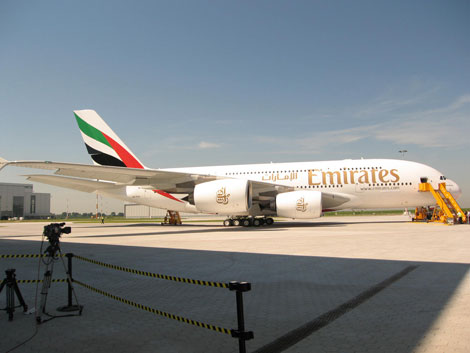
Economy class
This takes up the
whole of the lower deck – 88 rows in a 3-4-3 configuration, making a grand
total of 399 economy seats. There is mood lighting, the fibre-optic
star-effect lights in the ceiling, and large windows. All seats have
Emirates’ AVOD in-flight entertainment system "ICE" with e new larger
screen.
Seat pitch is 32-33 inches, width is 18 inches, and recline is six inches,
with an extra one inch “due to seat articulation”. The seats also have
individual laptop power.

At the back, up the stairs, and into the bar area for business class.
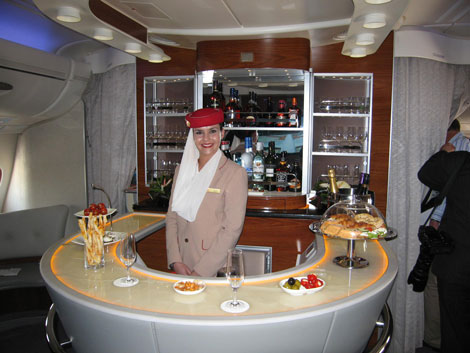
Business class
Starting from the
rear (since this is the way we walked), the bar area is a good size,
although it might get crowded if more than a few of the 20 rows of business
class passengers (1-2-1 configuration) decide to stretch their legs. Through
into the first cabin – there are bassinet attachment points in both of these
two business class cabins, so no certainty on one of these being child-free.
It’s an unusual configuration and what you notice immediately is that every
other row has no walkway. If the seats are close together, there is one, if
not, they don’t. The problem with flat-bed seating, of course, is how you
recline and extend the seat to fully-flat without having several feet of
dead space between the rows.
British Airways
has a yin-yang configuration, with half the seats facing backwards, while
Virgin goes for a herringbone layout and Etihad staggers the seating. What
Emirates has done is arrange for the feet to extend under the side table of
the row in front, meaning the next row has to be sitting to one side.
For those seats
pressed together, there is an optional divider which rises between the
seats, although whether people will realise they are booking seats so close
to one another (or so far apart if they want to travel together) will be a
challenge for the airline to manage for the first few months. For those who
are further apart, it would be difficult to hold a conversation, assuming
they wanted to.
The seat has
several pre-set positions, laptop power, your own minibar replenished with
drinks during the flight and a good-sized table for working and eating.

What is
extraordinary about this new arrangement is that the seats have a different
pitch depending on whether you choose an inner seat or an outer one. The
stats are as follows: seat pitch is 39 and 48 inches, which extends to form
70 to 79-inch lie-flat beds. What that means is that if you go for an
outside seat, you get more legroom both for sitting and sleeping, while the
inside seats have less. Just how Emirates will sell both types of seat for
the same price remains to be seen, yet it is doing so at the moment.
I spoke with Terry
Daly, Emirates’ divisional senior vice-president of service delivery, about
this, and he said the difference was necessary because of the design of the
seat. As for how it would be sold, he said that he didn't think it would
make any difference because the seat is so long anyway (ie: even in its
shorter form).
On the matter of
pricing, note that although Emirates is not charging a premium for flying on
the A380, you will find the aircraft is on the most expensive flight on a
route (whether that is New York from August, or London in December).

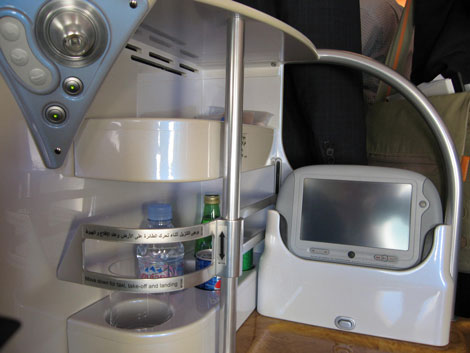
First class
As you’d expect,
there are sliding doors on the suites (which are more like cabins, really,
but that terminology would be confusing). Inside, there is a fully-flat bed,
lots of space, a giant TV and a real sense of privacy once you shut the
door. What’s more, first class passengers have access to showers at the
front, either side of a stairway down to the exit and straight off the
plane.
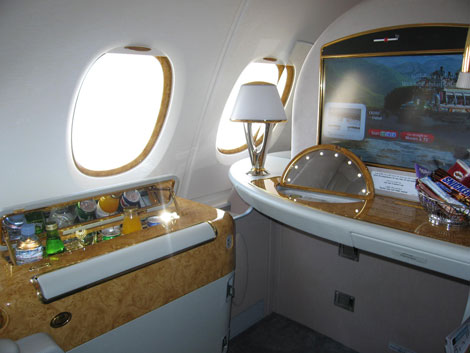
|