Photo Albums
My photographs have been moved off this site and are now stored on Picasa. They
were simply taking up too much space on my web host.
Please use
this link to see my list of photo albums.
The Qantas -
Emirates rumours are running wild at the moment. Something will be
announced. No one knows quite what it will be.
But Tim Clarke -
Emirates CEO - will arrive in Sydney on 5 September. There will follow a
number of announcements.
Speculation: The
removal of FRA from the QF schedule - Frankfurt and Heathrow are the only
European destinations flown by Qantas. Qantas flights to LHR will presumably
also be taken over by Emirates - maybe not immediately.
Qantas to
codeshare on all Emirates flights to Dubai and onward flights to Europe.
This will not be
just a code share - there is more to the deal that simply putting Qantas
passengers onto Emirates jets.
There is
speculation that Qantas will get some of the near future slots for 777
deliveries to Emirates. Emirates has some 100 airframes on order. Emirates
would get two of Qantas' existing Heathrow landing slots; taking the daily
DXB- LHR flights from 5 to 7.
The code-share agreement is believed to include route swaps whereby Emirates
would operate the majority of flights on some routes such as those out of
Perth to Europe. Qantas would give up Perth to Singapore and passengers
would fly on Emirates through Dubai.
There are concerns
- what happens to Qantas’s longstanding revenue-sharing agreement with
British Airways on the kangaroo route between Australia and the UK. What
happens to Qantas' membership of the One World alliance.
"I don't understand this – it just means less and less Qantas," was one
analyst quote adding that "it is just a huge downgrading of the Qantas
presence and handing it over to Emirates."
Last week Qantas cancelled orders for 35 Boeing Dreamliner aircraft.
Although the cancellation will boost Qantas's bottom-line earnings in
2012-13, it has raised questions about a further shrinking of the airline’s
international network. Some 777s would at least replace some of that
capacity.
For the highly
paid Alan Joyce this is all about turning around the Qantas international
operations, which lost $450 million last financial year.
The selling point of the code-share deal to investors and consumers is that
the two airlines would have a combined eight A380 superjumbos flying each
day from Australia to Dubai, and offer a large number of destinations beyond
the Emirates base.
An Emirates equity
stake in Qantas remains unlikely; although a successful commercial agreement
might bring the two airlines much closer together.
Pan Am's view
of Thailand from 1960
31 August 2012
Why the
Paralympics matter so much
30 August 2012
There is a risk of
being patronising about the Paralympics; there is also a risk of being too
politically correct. But the sheer happiness of the 4,500 plus athletes at
the Olympics opening ceremony said all that needed to be said.
For these athletes
this is their achievement; their ambitions realised. And in reality it does
mean more than the able bodied games; because these athletes have looked at
adversity and said sod it - I can beat this.
And for the rest
of us watching the twin messages are ever clearer; be grateful for what you
have and make the very best of what you are given.
But the ceremony
did not beat home this message. It was a ceremony of ideas based on the
theme of enlightenment from the 18th-century onrush of scientific knowledge
and the quest for the rights of man to the Hadon collider.
The opening
ceremony was lower budget; it might have erred on the over-serious; it
probably over did the umbrella theme. But it had Stephen Hawking who
declared: "Look up at the stars and not down at your feet. Try to make sense
of what you see, and wonder about what makes the universe exist. Be
curious."
The opening
ceremony covered everything from the Big Bang to Black Holes to Newton's
theories of gravity (62,000 apples all bitten at the same time!) to the
universal declaration of human rights; to a recreation of the Large Hadron
Collider at CERN.
It was more
profound than playful. More classical than pop.
The musical
highlight was Elin Manahan Thomas singing Handel's Eternal Source of Light
Divine accompanied by a solo trumpeter. The music changed to an aerial
ballet featuring the disabled dancer David Toole and the 42 disabled
volunteers. The soundtrack to the performance, a rendition of the Antony
Johnson song Bird Gerhl by 16-year-old singer Birdy. This was followed by
the joyful badness of Ian Dury's Spasticus Autisticus.
The closing music
- a rousing gospel rendition of "I am what I am" felt entirely appropriate.
The only problem
with the ceremony was its length - largely due to the parade of athletes
from 164 teams; this took time. I fell asleep at G and woke up at R....so
don't ask me what the Mexican team were wearing but apparently they looked
great.
Even the national
anthem sounds better in sign language.
In welcoming the
athletes, officials and spectators Lord Coe said that "sport is about what
you can do, what you can achieve, the limits you can reach, the barriers you
can break. Sport shows what is possible. Sport refuses to take no for an
answer."
Embracing these
games is about changing (or evolving) perceptions of the rights and roles of
disabled people in our national life. The opening ceremony – passionate,
smart, moving and original – honoured the athletes and set the tone.
Baby EK
29 August 2012
A baby born on
Emirates flight 322 to Manila last week has been named Ek; EK is the
two letter flight code for Emirates.
The plane had to make an emergency landing in Vietnam for the Filipina woman
and her baby to receive treatment on August 22.
Two nurses and four flight attendants reportedly helped deliver and care for
the child, who was premature at 27 weeks. One of the nurses says after
seeing the mother in pain, she followed her to bathroom where she found the
newborn inside the toilet turning bluish-brown.
Pilots landed the Boeing 777 (EK332) at Ho Chi Minh City’s Tan Son Nhat
airport after mid-day on August 22 to offload the Filipina mother,
identified as ‘Nedz’, and her new-born son, whom the parents planned to name
‘EK’ (the Emirates airline code), for emergency treatment.
The baby was delivered thousands of feet over Indo-China and about
two-and-a-half hours before expected touchdown in Manila.
“I was sitting beside them,” Karen Caballes-Santos, one of the two nurses,
told Dubai's XPRESS newspaper. A licensed nurse in the Philippines, she flew
back to Manila unexpectedly after finding a job in Dubai, though not as a
nurse.
“When I saw the mother walking toward the toilet, she seemed to be in pain.
The father was restless… walking back and forth, nearly in tears, so I
offered to help,” she said.
Caballes-Santos said she found the baby inside the toilet turning
bluish-brown. “He was in a cyanotic condition due to lack of oxygen.”
The nurses then helped aspirate amniotic fluid from the baby’s mouth, nose
and ears. Four flight attendants also attended the mother after the
delivery. Oxygen masks were given to the mother and child. “I told the
mother, ‘Your baby is alive, don’t worry.’ That’s when they calmed a
little.”
The nurses helped clean the baby with cabin blankets and wash the mother.
They kept him warm with two LED reading lamps attached to the passenger
seats.
The baby’s parents work as hotel staff in Dubai. The 35-year-old mother and
her husband had decided to deliver their first-born at home in Manila to
save on costs.
XPRESS has learnt the mother was discharged on Friday, but the baby remains
in critical care.
Happy and Glorious
29 August 2012
As the Paralympics
start tonight lets go back a couple of week's to the Queen and James Bond
from the opening ceremony. Brilliant. Sorry about the Barry Davies comentary.
And this is the
IOC's best of London 2012 condensing two weeks into just over 4 minutes
The London
Airports debate
29 August 2012
The expansion of
London Heathrow Airport is under debate in the UK at the moment. The trouble
is the debate seems to have been hijacked by the operators of Heathrow
Airport - determined to maximise the return on their investment rather than
as part of any clear sighted strategy for London's airports.
The expansion of
Heathrow was supported by businesses, some of the aviation industry, the
British Chambers of Commerce, the Confederation of British Industry, the
Trades Union Congress and the then Labour government. It was opposed by
Conservative and Liberal Democrat parties as opposition parties and now as a
coalition government.
The expansion
would see a shorter third runway built to the north of the existing runways
with a new terminal six. There would be significant property demolition and
relocation required.
The principal
argument stated in favour of expanding Heathrow is to enhance the economic
growth of the UK. As the UK's major hub airport, Heathrow is able to attract
many transfer passengers and so is able to support a very wide range of
direct flight destinations at high frequencies.
It remains (just)
the world's busiest airport based on the number of international passengers.
The government claims that Heathrow's connectivity helps London and the
South East compete with other European cities for business investment, which
in turn produces economic benefits for the rest of the UK.
I am less than
convinced about this claim of Heathrow to be a transfer hub. To some extent
it is for British Airways (and the One World alliance) at terminal 5; flying
passengers from Europe and then onto the USA, Asia and Africa. But for most
other airlines Heathrow is a spoke not a hub. The same is true for most of
the major European airports that serve as a hub primarily for their national
airlines and its alliance partners; eg Frankfurt for Lufthansa and Star
Alliance.
The government's argument is that Heathrow is on the brink of suffering a
decline in connectivity. Heathrow’s runways are now operating at around 99%
capacity, which increases delays when flights are disrupted, and risks
competing European airports gaining destinations at Heathrow's expense.
But the reality is
that passengers from most airlines flying into London are coming to see
London not to go somewhere else. It is very different to Dubai for instance.
Take the middle
east airlines; passengers from Emirates, Qatar, Gulf Air, Etihad are not
connecting in London. The reality is that they use London for its
convenience.
The same with
passengers from the UK; for most of the country it is easier to travel to
Heathrow than it is to Gatwick or Stansted. Though as the middle east
carriers and some US carriers have discovered passengers are very happy to
avoid London altogether and fly from their local airport. If you live in
Manchester and want to holiday in Thailand you fly to Doha, Abu Dhabi or
Dubai and connect their. It is far more agreeable than taking a car or train
to London and leaving from Heathrow.
Another argument
for Heathrow's third runway is that it would improve flight connections to
UK cities. Several cities have seen their connections to Heathrow reduced or
lost over recent years as airlines have reallocated the airport's limited
capacity to more profitable long-haul flights. The last thing Heathrow needs
is more domestic flights. It does need to be at the hub of an improved high
speed rail system.
London is well
supplied with airports; but the lack of investment in Gatwick and Stansted
have hurt; as have the poor connections between the airfields. Both airports
are still single runway operations.
Gatwick Airport
(formerly London Gatwick Airport), in Crawley, West Sussex was purchased by
Global Infrastructure Partners (GIP), the owners of London City Airport, for
£1.51 billion in October 2009. Since late-2011, Gatwick has attracted a
number of new full-service airlines, including Air China, Air Nigeria,
Caribbean Airlines, Hong Kong Airlines (now cancelled), Korean Air,
Lufthansa, Turkish Airlines and Vietnam Airlines. This is part of the
airport's sensible strategy to get more higher-spending business travellers
to use it to counterbalance its dependence on European low-cost and charter
markets, as well as to increase year-round capacity utilisation by smoothing
out peaks and troughs in slot usage.
Several options to
expand Gatwick have been considered, including a third terminal and a second
runway to the south of the existing runway. This would allow Gatwick to
handle more passengers than Heathrow does today. If a second runway is
approved, a new terminal could be sited between the two runways. This could
either complement or replace the current South Terminal, depending on
expected future traffic developments.
The problem for
Gatwick is that under an agreement with the local community, a second runway
could not be built before 2019. But it must be inevitable that it will be
built. This is far more likely than a 3rd runway at Heathrow.
Even with its
single runway it appears that Gatwick can manage up to 45million passengers
a year. Air China is starting daily direct flights from Beijing to Gatwick,
and Korean Air is launching services to Seoul.
Another plan is for a high-speed rail link between Gatwick and Heathrow
Airport. This rail link would form part of a plan to combine the UK's two
biggest airports into a "collective" or "virtual hub" dubbed Heathwick. The
scheme envisages a 35-mile high-speed rail route linking the two airports in
15 minutes, with trains travelling at a top speed of 180 mph parallel to the
M25 and passengers passing through immigration or check-in only once. Maybe
a cut down version makes more sense. The virtual hub is unlikely; improved
rail connections should be a must have.
London Stansted Airport in Essex is a hub for a number of major European
low-cost carriers, being the largest base for low-cost giant Ryanair with
over 100 destinations served by the airline. In 2011 it was the fourth
busiest airport in the United Kingdom after Heathrow, Gatwick and
Manchester.
There is also London Luton Airport in Bedfordshire. This is only used by
about ten passenger airlines. The largest operator by far is EasyJet, which
is headquartered there, and for whom Luton is among their largest bases.
Easyjet flights account for approximately a half of passenger movements
through the airport.
Wizz Air is
comfortably the second largest, however Luton is not a base of the airline.
Half of its movements are between 07:00 and 08:00, and there are periods of
up to 5 hours where there are no arrivals or departures of Wizz Air flights.
El Al operates the largest passenger aircraft to Luton, a Boeing 767-200,
but very occasionally will substitute for this a Boeing 777-200 when there
is exceptionally high demand. Again poor transport connections have harmed
the growth of this airport.
There is also little London City Airport in Docklands with a short runway;
limited apron space and a curfew. And more recently London Southend Airport
has expanded with EasyJet signing a ten-year contract with Stobart Group in
June 2011. The airline now operates around 70 flights per week from Southend,
using three Airbus A319 aircraft based at the airport.
Even Oxford
Airport is known as London Oxford Airport.
The Boris airport
in the Thames estuary will not happen. The East of London is simply too
inaccessible for the rest of the country. But what is needed is a sensible
aviation policy that expands Stansted and Gatwick and provides better
connections between the three major airports.
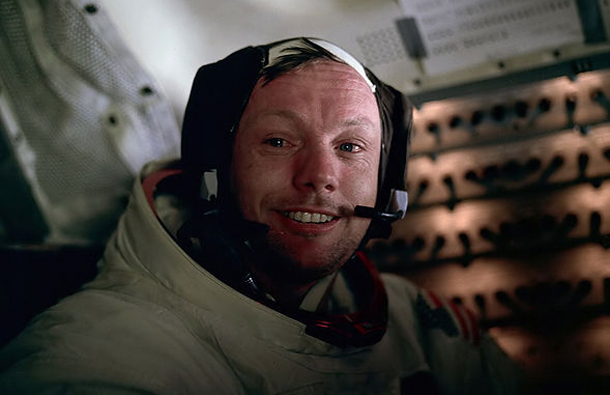
"I put up my thumb
and shut one eye, and my thumb blotted out the planet Earth. I didn't feel
like a giant. I felt very, very small." -- Neil Armstrong.
Obituary - from
The Guardian.
Neil Armstrong,
the first man to walk on the moon, has died aged 82. The former US
astronaut, who will go down on history as the most famous pioneer of space
exploration, passed away as the result of heart complications following
surgery.
As commander of the Apollo 11 mission, he became the first person to set
foot on the moon, on 20 July 1969, fulfilling the longheld dream of the
United States to get there before the Soviet Union. His first words as he
stepped on to the surface – "That's one small step for (a) man, one giant
leap for mankind" – instantly became one of the most recognisable phrases
ever spoken.
Armstrong underwent heart bypass surgery earlier this month, just two days
after his birthday on 5 August, to relieve blocked arteries.
His family released a statement on Saturday describing him as a "reluctant
American hero who always believed he was just doing his job".
It read: "We are heartbroken to share the news that Neil Armstrong has
passed away following complications resulting from cardiovascular
procedures. Neil was our loving husband, father, grandfather, brother and
friend. Neil Armstrong was also a reluctant American hero who always
believed he was just doing his job. He served his nation proudly as a Navy
fighter pilot, test pilot, and astronaut.
"While we mourn the loss of a very good man we also celebrate his remarkable
life and hope that it serves as an example to young people around the world
to work hard to make their dreams come true, to be willing to explore and
push the limits, and to selflessly serve a cause greater than themselves."
Other tributes have come flooding in for the astronaut as news of his death
spread across the world. US president Barack Obama hailed Armstrong as one
of America's greatest heroes. In a statement issued by the White House, he
said the crew of Apollo 11 carried with them the aspirations of an entire
nation when they set out for the moon in 1969. He later tweeted: "Neil
Armstrong was a hero not just of his time, but of all time. Thank you, Neil,
for showing us the power of one small step."
Armstrong was joined on his moon landing by Buzz Aldrin and the pair spent
nearly three hours walking on the lunar surface, collecting samples,
conducting experiments and taking photographs. Last night Aldrin called
Armstrong "a true American hero and the best pilot I ever knew". The Apollo
11 mission turned out to be Armstrong's last space flight. The following
year he was appointed to a desk job at Nasa, later becoming a lecturer in
engineering at Cincinnati University.
In 1961 President Kennedy had declared before the United States Congress
that the US would have a man on the moon before the turn of the decade and
the moon walk marked America's victory in the cold war space race. An
estimated 600 million people – a fifth of the world's population – watched
and listened to the moon landing, the largest audience for any single event
in history.
The crew of Apollo 11 were not chosen for the mission because they were in
any way special among the elite group of test pilots who comprised the corps
of American astronauts: it was simply their turn on the flight roster. If an
earlier plan had succeeded, the crew of Apollo 10 would have made the first
moon walk in May 1969, but because of delays in the development of the lunar
module that mission became a full dress rehearsal for a lunar landing, all
bar a touchdown.
Armstrong cut his teeth as an astronaut in March 1966 as commander of the
Gemini 8. The mission also involved the first serious space emergency,
highlighting the dangers of manned space launches when the public were
beginning to take their seemingly effortless success for granted. The Gemini
8 mission was designed to perform the first docking in space by astronauts.
The Soviet Union had already demonstrated automated docking of two unmanned
vehicles in orbit. Armstrong and his crewmate, David Scott, were to
rendezvous with a 7,000lb Agena rocket target vehicle.
They found the Agena and docked successfully, but when they tried a
pre-arranged manoeuvre of the combined spacecraft it went into a spin.
Armstrong disengaged from the Agena, thinking the problem was there, but the
tumbling worsened. The Agena steadied but the Gemini capsule kept turning at
360 degrees a second and was in danger of colliding with the Agena.
The fault was clearly on Gemini. It was discovered later that one of 16
Gemini thruster rockets was stuck. As he was unable to stop the spacecraft
turning with the main thrusters, Armstrong shut them down and brought the
Gemini craft under control using a second set of 16 thrusters that were
intended only to control the capsule's re-entry in to the Earth's
atmosphere.
Mission Control ordered Armstrong and Scott to cut the flight short and they
splashed down in a contingency recovery area in the Pacific Ocean. The drama
of surviving man's first space emergency completely obscured the fact that
it was on the Gemini 8 mission that the US had overtaken the Soviet Union in
space technology
Armstrong was born in Wapakoneta, Ohio, and from a young age was fascinated
with aviation, experimenting with model airplanes and a home-built wind
tunnel. At 15 he began flying lessons in an Aeronca Champion, and by 16
acquired his student pilot's licence. In 1947, he enrolled at Purdue
University on a Navy scholarship to pursue a degree in aeronautical
engineering, but in 1949 the Navy called him to active duty in the Korean
War. As a navy pilot, he flew 78 combat missions. He was shot down once and
received three medals for his military service. In 1952 he returned to his
studies and completed his BSc at Purdue and an MSc in aerospace engineering
at the University of Southern California.
In 1955 he became a civilian research pilot at the Lewis research centre of
the National Advisory Committee for Aeronautics (Naca), the forerunner of
the National Aeronautics and Space Administration (Nasa). Later that year,
he transferred to Naca's high-speed flight station (today, Nasa's Dryden
flight research centre) at Edwards Air Force Base in California as an
aeronautical research scientist, and then as a pilot. He was a test pilot on
many pioneering high-speed aircraft, including the 4,000mph X-15. He flew
over 200 different models of aircraft, including jets, rockets, helicopters
and gliders.
Armstrong was engaged in both piloting and engineering aspects of the X-15
programme from its inception. He completed the first flight in the aircraft
equipped with a new self-adaptive flight control system and made seven
flights in the rocket plane. In 1962 he was of the nine test pilots chosen
by Nasa for its second astronaut-training programme.
Four years later Armstrong made his successful recovery of the Gemini 8
spacecraft in a situation that, if misjudged, could easily have resulted in
the death of the crew. That achievement was also invaluable in helping Nasa
meet the target set in May 1961 by President John F Kennedy for the USA to
establish, as a national goal, a manned landing on the moon by the end of
the decade.
The choice among competing techniques for achieving a moon landing still
needed some intensive research and development. The method ultimately
employed, of a lunar-orbit rendezvous, was influenced strongly by the
experience with Gemini 8, and there was an element of poetic justice in
Armstrong being at the helm again for the first manned lunar landing
attempt.
On 16 July 1969, Apollo 11 blasted off for the moon. Four days later, at
4.18pm EDT (Eastern Daylight Time), the Eagle lunar lander was guided to
land on a plain near the southwesten edge of the Sea of Tranquility. At
10.56pm Armstrong stepped off the ladder of the Apollo 11 lunar module and
became the first human being to set foot on the moon. Twenty minutes later
Buzz Aldrin joined him for two hours of ceremonies and moon-rock collecting.
They unveiled a plaque and read the text to a worldwide TV audience, "Here
men from the planet earth first set foot on the moon July 1969 AD. We came
in peace for all mankind."
After raising the American flag and talking to President Nixon by
radiotelephone, the two astronauts took numerous photographs, carried out
the lunar surface experiments assigned to the mission and collected 22kg of
samples of lunar soil and rocks. All the astronauts' lunar activities were
televised in black-and-white. Meanwhile, Michael Collins continued orbiting
the moon alone in the Columbia command module. Armstrong and Aldrin
re-entered the lunar module and closed the hatch at 1.11am on 21 July. The
Eagle took off from the moon at 1.54pm, having spent 21 hours 36 minutes on
the lunar surface. It docked with Columbia at 5.35pm.
After splashdown in the Pacific on 24 July, decontamination procedures
began. The astronauts were carried by helicopter to the recovery ship, USS
Hornet, where they entered a mobile quarantine facility to begin a period of
observation under strict quarantine conditions. The command module was
recovered and also removed to the quarantine facility, and the rock samples
and film were flown to Houston.
Following the moon landing and the subsequent world tours by the crew of
Apollo 11, Armstrong became deputy association administrator for
aeronautics, Nasa headquarters office of advanced research and technology
from 1969 to 1971, when he resigned. For the next eight years he was
professor of aerospace engineering at the University of Cincinnati. Numerous
industrial appointments followed, including New York's AIL Systems, where he
was chairman from 1981 until 2001. In 1979 he was chairman of the board of
Ohio's Cardwell International; from 1982 to 1992 chairman of Computing
Technologies for Aviation, in Virginia.
In 1985-86 he served on the National Commission on Space, a presidential
committee to develop goals for a national space programme into the 21st
century; and was also vice-chairman of the committee investigating the Space
Shuttle Challenger disaster in 1986. During the early 1990s he presented an
aviation documentary series for television entitled First Flights. Earlier
this year he spoke at an event to mark the 50th anniversary of the orbiting
of the Earth by the first American to do so, John Glenn.
Armstrong is survived by his second wife, Carol, and two sons from his first
marriage, which ended in divorce.
• Neil Alden Armstrong, astronaut, born 5 August 1930; died 25 August 2012
The rise and fall of the Lance Armstrong myth
25 August 2012
Before Bradley
Wiggins the nest known racing biker in the world was Lance Armstrong. But
Armstrong's story is of both triumph and deceit. Sadly he will now be
remembered for the latter.
Armstrong overcame
life-threatening testicular cancer to win the Tour de France seven times and
put the race on the map in the US. He has also done more than most athletes
for charity in building a global foundation helping millions of cancer
survivors. He went mountain biking with former US president George W Bush
and even talked of running for governor of Texas.
But doping accusations pursued him for years. And late last Thursday he
finally did what he rarely has in the past and abandoned the fight. He still
claims his innocence. However, in abandoning any defence he must be hoping
that the most damning of evidence against him is ever made public and that
some part of his reputation remains intact.
Armstrong, 40, announced he would no longer challenge an investigation by
the US Anti-Doping Agency (Usada) into allegations that every one of his
Tour de France victories from 1999 to 2005 was tainted by the use of banned
substances such as the blood-booster EPO and steroids, as well as blood
transfusions, testosterone and cortisone.
Usada immediately
banned him from competition cycling for life and stripped of his Tour de
France titles.
Armstrong has
still not admitted to drug use. He simply protests that the media attention
is overwhelming and that he is the subject of an unfair witch-hunt.
"There comes a point in every man's life when he has to say: 'Enough is
enough.' For me, that time is now," he said. "I have been dealing with
claims that I cheated and had an unfair advantage in winning my seven Tours
since 1999. The toll this has taken on my family and my work for our
foundation and on me leads me to where I am today – finished with this
nonsense."
The move came after a US court ruled against Armstrong's attempts to block
Usada's investigation. He consistently maintained he never failed a test for
banned substances, although that is disputed. But Usada said its
investigation revealed a systematic programme of drug misuse in Armstrong's
team and claimed 10 of the cyclist's former team mates would testify that he
was at the heart of it. The agency also told Armstrong it has blood samples
from two and three years ago that are "fully consistent" with illegal
doping.
His withdrawal from the case is widely interpreted as an admission of guilt
– albeit of a crime in a sport that was saturated in illegal drug use at the
time. Armstrong was doing what so many other bikers were doing.
Bicycling magazine greeted the news with the headline "The Truth Hurts" on
its cover. Its editor, Peter Flax, said the case against Armstrong was
overwhelming. "In my mind there's no doubt that these activities
transpired," he said. "But he's also an inspiration to millions."
Bernard Hinault, the French five times winner of the Tour de France, told
ouest-france.fr: "This is a problem that should have been sorted out 10 or
15 years ago but which never was."
Jan Ullrich, a German former rider who was three times runner-up to
Armstrong – and has faced doping allegations of his own – said: "I've ended
my career and I have always said that I'm proud of my second places. It
doesn't really bother me that much."
His climb down leaves in its wake the wreckage of a career now widely
accepted to have been built on a lie, and raises questions over the future
of his sporting legacy. Armstrong's sponsors, which have paid a total of
about $10m a year, will be embarrassed and some are likely to drop him
although his principal backer, Nike, said it would stand by the shamed
athlete.
"Lance has stated
his innocence and has been unwavering on this position. Nike plans to
continue to support Lance and the Lance Armstrong Foundation, a foundation
that Lance created to serve cancer survivors," it said. I suspect that
position ay change over time.
Among the adverts Armstrong made for Nike was one in which he toyed with the
doping allegations: "Everyone wants to know what I'm on. What am I on? I'm
on my bike busting my ass six hours a day."
The Armstrong case
has yet to rest, with cycling's global governing body, the International
Cycling Union, demanding USADA hand over its evidence. The Court of
Arbitration for Sport could ultimately have a final say on his guilt or
innocence.
Microsoft
makeover
25 August 2012
The Associated Press
Microsoft’s
corporate logo has a new look, setting the stage for a wave of products
designed to cast the world’s largest software maker in a new light.
The makeover unveiled Thursday marks the first time that Microsoft has
revamped its logo since February 1987. The Internet was barely around then,
and cellphones were considered a luxury.
At the time, Microsoft was putting the finishing touches on the second
version of its Windows operating system. Two of Microsoft’s biggest nemeses
— Google co-founders Larry Page and Sergey Brin — were just 13 years old.
And Apple co-founder Steve Jobs was just in the second year of an 11-year
exile from the company that went on to invent the iPod, iPhone and iPad
after he returned.
The new Microsoft logo is seen at the company’s latest store inside the
Prudential Center mall in Boston. — AP
By revamping its logo, Microsoft is trying to signal that it has changed its
thinking and its products to cater to people who are interacting with
technology much differently than just a decade ago, let alone a quarter
century.
Now, more computing tasks are being done on touch-based devices such as
smartphones and tablets instead of personal computers tethered to keyboards
and mice. Many software applications are now supplied over high-speed
Internet connections for a monthly fee instead of being installed on
individual computers.
Microsoft believes a radical change to Windows will ensure that the company
survives the technological upheaval. Windows 8, due to hit the market on
October 26, displays software applications in a mosaic of tiles and has been
engineered so it works on both touch-based tablets and traditional PCs. The
company also is releasing its own Windows 8-powered tablet to compete
against the iPad, accompanied by a new version of Office applications
tailored for such devices. There also will be a Windows 8 operating system
for smartphones. The new logo ushers in “one of the most significant waves
of product launches in Microsoft’s history,” Jeff Hansen, the company’s
general manager of brand strategy, wrote in a blog post.
The redesign features the Microsoft name in a lighter, straight font called
Segoe to replace the italic bold type used in the old standby. The new logo
also includes the familiar red, blue, yellow and green colours used in the
flag on Microsoft’s Windows operating system, but the colours will be in a
square box instead of the curvy template that has been in place for years.
Those colour boxes invoke the tiles that will be central to Windows 8.
“The ways people experience our products are our most important ‘brand
impressions,’” Hansen wrote. “That’s why the new Microsoft logo takes its
inspiration from our product design principles while drawing upon the
heritage of our brand values, fonts and colours.”
The new logo made its debut on Thursday on Microsoft’s websites, as well as
three of its stores in Boston, Bellevue, Washington and Seattle, which is
located near the company’s Redmond, Washington, headquarters.
This is Microsoft’s fifth logo since Bill Gates and Paul Allen founded the
company 37 years ago.
Apple's sour taste
25 August 2012
On Friday a San Jose, California court found Samsung guilty of infringing
upon six out of seven Apple patents and awared more than $1 billion in
damages awarded to Apple.
The jury accepted
Apple’s claim that Samsung devices were “slavishly copies” of Apple’s iPhone
and iPad.
So what next. Samsung will of course appeal.
But what will
Apple do: it has the precedent now to go after any and every OEM out there.
Apple self
righteously claim that “we make these products to delight our customers, not
for our competitors to flagrantly copy....the lawsuits between Apple and
Samsung were about much more than patents or money. They were about values.”
Values that are now abundantly clear to everyone playing in the smartphone
space. Value that apparently support a monopoly position and that say there
is only one technology - ours.
Samsung said the verdict should be viewed "as a loss for the American
consumer...it will lead to fewer choices, less innovation, and potentially
higher prices...it is unfortunate that patent law can be manipulated to give
one company a monopoly over rectangles with rounded corners, or technology
that is being improved every day by Samsung and other companies....consumers
have the right to choices, and they know what they are buying when they
purchase Samsung products. This is not the final word in this case or in
battles being waged in courts and tribunals around the world, some of which
have already rejected many of Apple's claims. Samsung will continue to
innovate and offer choices for the consumer."
Apple praised the court for "sending a loud and clear message that stealing
isn't right...the mountain of evidence presented during the trial showed
that Samsung's copying went far deeper than even we knew."
This fight is only
just starting; there is simply too mush at stake.
One issue still to
be decided is whether to grant injunctions that could prevent Samsung from
selling products that infringe on Apple's patents. A hearing is scheduled
for September 20.
But this really is a home town win - it is a Californian court preserving,
rather bizarrely, Chinese jobs!
The court verdict
suggest that at least in the USA there will be a ban on many mobile devices
from Samsung and other manufacturers as an emboldened Apple tries to create
an unprecedented monopoly.
The ultimate loser
will be competition in the technology marketplace, with even more power
accruing to a company that already has too much.
Crucially, the jury found none of Apple's patents invalid, despite
substantial evidence that others anticipated many of the innovations that
Apple put together when it released its first iPhone.
It is likely that Samsung did mimic much of the functionality of the iPhone.
But Samsung is not the first company to take a technology and make it
better. Did the company that put rubber onto metal wheels to give a softer
ride infringe patents or make something good better?
Apple is winning no friends - it has used its huge cash reserves to become a
corporate bully.
Apple will settle
for nothing less than outright capitulation by Samsung – and, by extension,
other Android device makers. If Apple is successful, either all Android
manufacturers will pay Apple a license fee, or Apple will simply make it too
expensive, via lawsuits, for other phone makers to compete.
Apple wants control over how we use technology. It locks down the iOS,
requiring that apps be offered or sold only though its own portal, and
limits competition when a developer is doing anything that might have an
impact on its own business.
Apple fans are ecstatic at the prospect.
But no one who
believes in invention and creativity should want Apple, or any other
company, dictating – in fundamental ways – how we compute and communicate.
Air Asia seeks
Singapore license
23 August 2012
After almost a
decade of trying and failing to set up a Singapore-based budget carrier,
AirAsia is planning to give it another go.
Its new Singapore CEO Logan Velaitham has confirmed that Asia's largest
budget airline group is preparing to apply for a Singapore Air Operator's
Certificate (AOC), effectively enabling it to set up a Singapore-based
airline.
He said that as a precursor to the application, AirAsia has made a
preliminary presentation to the Ministry of Transport to "demonstrate"
AirAsia's commitment and contribution to Singapore.
"Singapore is critical for us and we have been delivering the numbers," he
said. "Even without an AOC, our arrivals, tourist numbers and contribution
to the Singapore economy have been growing rapidly. Imagine what we could do
if we have a Singapore-based carrier?"
AirAsia is believed to have applied for a Singapore AOC several times in the
past eight years; the last time was in December 2010. But in a one-sentence
response late yesterday evening, a Civil Aviation Authority of Singapore (CAAS)
spokesman said the regulator "has not received any formal AOC application
from AirAsia".
But having a carrier based out of one of Asia's biggest hub airports would
fill a bit gap in AirAsia founder Tony Fernandes's ambition to establish a
pan-Asean carrier group. The now Jakarta-based Mr Fernandes already oversees
a thriving airline group headquartered in Malaysia, but with associates in
Thailand, Indonesia, the Philippines and Japan.
Last year Air Asia flew 3.52 million passengers into Changi. The airline
operates 277 flights here, employs over 80 people and enjoys a load factor
of around 80 per cent on our Singapore services.
AirAsia's Changi operation also provides a significant volume of feeds to
the networks of AirAsia and AirAsia X through Kuala Lumpur to destinations
like Australia, the Indian sub- continent and elsewhere.
Under existing rules, a Singapore AirAsia would need to be 51 per cent held
by Singaporean entities, with Malaysia's AirAsia Bhd controlling the
remaining 49 per cent stake. The airline is evaluating various potential
Singapore partners.
A Singapore AOC could see many of the airline's new jets being based here.
AirAsia hit the headlines in June last year when it placed a record order
for 200 new A320s at the Paris Air Show. It currently has 105 planes in its
fleet.
A new airline would also boost budget airline passenger numbers at Changi,
where the 13 low-cost carriers currently already account for almost 30 per
cent of total traffic.
It would also
provide significant competition to SIngapore Airlines' regional interests
held through SilkAir and Tiger Airways.
"I have flown over two million miles, and I have witnessed so many weird,
dumb, and rude things while flying. But I have also witnessed many good and
noble things. I recently saw a person give up his seat to a soldier who was
on standby. The soldier was returning from Afghanistan and had not seen his
family in over a year.
So with the perspective of the good, the bad, and the ugly, I have devised
my own ten commandments for flying. Some are positive and some are, well,
not.
1.Thou shall be kind to your fellow passengers. Everyone has struggles and
problems. A kind word can make a world of difference.
2.Thou shall not talk loudly on your cell phone during those times you are
permitted to talk. We are glad you love your spouse and that the burger was
great, but that's not for the world to know.
3.Thou shall help elderly passengers and others who need assistance.
Traveling for many is a big physical burden. Help lighten their burden.
4.Thou shall not wear heavy perfume or cologne. If the passenger next to you
is gagging, you know you overdid it.
5.Thou shall be kind to young moms who have crying children. These moms are
stressed and don't need your indignation to stress them further.
6.Thou shall not eat smelly foods on the plane. Not only do the foods smell,
flatulence typically follows.
7.Thou shall make certain your carry-on luggage fits in the overhead bins.
We may be delayed as the flight attendants take your luggage and check it
in.
8.Thou shall not take off your shoes during the flight. You may think it's
comfortable, but the rest of the passengers will be tempted to find the
nearest midair exit.
9.Thou shall fly only when you're healthy. Otherwise the recycled air will
deliver your influenza germs to all the passengers.
10.Thou shall not make dumb comments that include words like "bomb," "gun,"
"hijack," or "terrorist." If thou does make those dumb comments, be prepared
to spend time with a lot of new friends in confined quarters."
Not a bad
list.....especially the smelly feet note!
Hangover 3 - The Royals
23 August 2012
Prince Harry is trending
on Twitter ! But the English newspapers don't want to publish the pictures
of Prince (he really can be an idiot) Harry naked in a high rollers' suite
in Las Vegas this week while playing strip billiards.
The Leveson inquiry is
being blamed for the English press not touching this. But Buck (rhymes with
"Oh **ck") House has confirmed that the pictures on the TMZ celebrity news
site are genuine.
As TMZ gleefully reports:
"We're told Harry, along with a large entourage, went down to the hotel bar
and met a bunch of hot chicks ... and invited them up to his VIP suite.
Once in the room, things got WILD ... with the group playing a game of strip
pool that quickly escalated into full-on royal nudity.
Some of the partiers snapped photos of the madness. In one photo, a fully
nude Harry cups his genitals while a seemingly topless woman stands behind
him.
In another photo, a naked Harry is bear-hugging a woman who appears to be
completely naked as well. "
It was the Wynn Hotel
btw. The next revelation will be who was the girl being groped in the
pictures.
The Guardian
idiotically reports that "Royal aides are understood to be urging the
British media to respect the prince's privacy and not republish the
photographs, which are likely to have been taken without his consent."
Nonsense - in the days of
smart phones everyone takes pictures at a party. Consent is irrelevant and
of course he knew pictures were being taken.
After the royals tried to
make him look respectable and useful by allowing Harry to represent them at
the Olympics closing ceremony.
I don't care what he does
- it is just the self righteoous hypocrisy that annoys me. In the end the
royals are rich brats paid for by the British taxpayer.
Of course it could just
be that Prince Harry was playing charades and had only been asked to act out
Julian Assange.
You could almost feel
sorry for him: He wears a Nazi SS uniform and people complain, he takes it
all off and they still complain.
Though maybe Harry should
choose his friends better - one is clearly far from loyal! And where were
his minders and security people - taking the pictures maybe!
Turning a blind
eye
22 August 2012
The Nation
newspaper's headline today - "Tiger Pub declared unsafe; new rules to be
enforced on island"
No sh*t
Sherlock.....the pub burned down at 4am on 17 August killing four young
people and seriously burning another eleven.
The Nation says that "a team comprising the Phuket governor, an architect, a
building inspector, a civil engineer and a provincial electricity official
inspected the scene on Monday and found that most of the steel bars on the
second floor had been badly damaged by the heat. The pub is 15 years old."
With an army of
media in tow to make it look like the officials are doing something.
The paper
continues: "Phuket Governor Tri Akkaradecha, said entertainment venues were
inspected nightly to ensure safety and check that operators abided by the
law on operating hours, drugs and arms possession."
Nonsense. if there
are any daily visits is is just for tea money to be allowed to stay open
after the official 2am close. Do the officials who make the useless
statements actually believe what they are saying?
"Police said an initial inspection found that the building was fitted with
required emergency exits, extinguishers and exit signs." Making sure that no
one says that the police ar eto blame then!
The bigger tragedy is that this keeps happening and will keep on happening.
Is Ordos the
next Dubai?
18 August 2012
Miss Yu Wenxia
Miss China today
won the title of Miss World, triumphing on home soil in a mining city on the
edge of the Gobi desert.
The first
runner-up was Sophie Elizabeth Moulds of Wales and the second runner-up was
Jessica Michelle Kahawaty of Australia. Both mining nations - which cannot
be a coincidence in Ordos.
Built on the arid and sparsely populated steppes of Inner Mongolia and
around 700km from the nearest beach, Ordos makes an unlikely setting for the
world's biggest beauty pageant.
But 116 contestants - the highest number ever - still wore their finest
evening gowns and swimwear on Saturday night for the contest, which is
watched annually by around a billion people around the globe; mostly in
China!
Ordos has been built over the last decade on the back of a coal mining boom
that has transformed it but it is still widely considered a ghost town as
the pictures show in this link:
Ordos, China: A Modern Ghost Town.
The beauty queens
have been in China rehearsing for nearly a month, soaking up traditional
Mongolian culture by churning yoghurt in a nomad's yurt and donning local
attire to climb a sand dune.
The city has a vast town square dedicated to the mighty Mongolian warrior
Genghis Khan. The mining boom triggered a frenzy of building in the city,
but the local government has been unable to fill the vast tower blocks that
have sprung up.
Enthusiastic competitors seemed unfazed, expressing optimism that with the
help of the pageant, the city could leave that reputation behind and take
its place alongside other global centres of glitz and glamour.
"Ordos could be the next Dubai," said Marielle Wilkie, representing the
Caribbean nation of Barbados.
Albanian contestant Floriana Garo chimed in with her own bold prediction.
"In ten years, this city will be booming," she said.
Architecture in Ordos -- where the city museum is shaped like an undulating
blob -- is "world class", added Markysa O'Loughlin, representing St. Kitts
and Nevis, also in the Caribbean.
The mostly Chinese audience erupted in cheers when it was announced that the
home candidate, Yu Wenxia, had been awarded the title.
"When I was young I felt very lucky because so many people helped me and I
hope in the future, I can help more children to feel lucky," said Yu, who
was wearing a glittering blue dress, after the result was announced.
Thaksin lives
17 August 2012 by Nicholas Farrelly for Inside Story - Australia
Thailand’s former prime minister, Thaksin Shinawatra, just won’t go away.
Since 2005 his opponents have thrown everything at him – a coup, a jail
sentence, a terrorism charge – in a dogged campaign to remove the country’s
most popular politician from its political future. His supporters, the
telegenic Red Shirts, have been threatened, imprisoned, beaten up and, in
dozens of cases, shot dead on the streets of Bangkok during the unruly
protests that punctuated the country’s political conflict in 2010.
But Thaksin lives to fight another round. And now, with his sister, Yingluck
Shinawatra, celebrating her first year in the prime ministerial hot seat,
the telecommunications billionaire and creator of Southeast Asia’s most
successful recipe for populist politics is more aggressively pursuing his
options for a triumphant return to the kingdom.
In April, he was in neighbouring Laos, to make offerings and generate good
karma. Then he visited Cambodia to address tens of thousands of cheering Red
Shirt supporters bussed across the border to welcome their hero; while
there, he also scheduled a round of golf with Cambodian strongman Hun Sen.
This swaggering regional tour, conducted under one of the heaviest security
blankets imaginable, certainly served its purpose: it got tongues wagging.
Thaksin’s international movements are becoming more frequent and high
profile. His travel to democracies that were wary of his presence, such as
Britain and the United States, is adding to his statesmanlike mystique. He
is the roving, unofficial ambassador for his sister’s government, a
government elected in the glow of his enduring popularity.
Through all of the ups and downs – ever since his Thai Rak Thai (Thais Love
Thais) political party was first elected back in 2001 – Thaksin has enjoyed
consistent voter support at a level unprecedented in Thai history. This
means that his plan to return to Thailand, perhaps before the end of 2012,
presents a special conundrum for a society where old wounds are unhealed and
the stench of recent violence infuses political debate.
It was in April and May 2010 that Thais last experienced the horror of
raging battles on the streets of Bangkok: Thais killing Thais for political
ends. Over ninety died, and hundreds were injured. Culpability for those
events is yet to be fully apportioned and partisan judgments about
responsibility still prevail. A recipe for “reconciliation” – still only
half-cooked, and considered unpalatable by many on all sides of politics –
has served to muddle assessments of exactly what should happen next.
Earlier this year the ban on political activities by 111 former executives
of the Thai Rak Thai party expired. This means that Thaksin’s “A-team,”
including former ministers, tacticians and dealmakers, is available for
political appointments. Some of them may no longer feel energised by
politics and will opt to stay out of the fray; others are likely to be
reintroduced to the battle with renewed vigour. Among Thaksin’s most trusted
lieutenants are a few still very much spoiling for a fight.
Their unfinished business centres on the September 2006 coup that ousted
Thaksin and Thai Rak Thai from power. The move was attributed to a nexus of
palace and military interests threatened by Thaksin’s overwhelming
popularity, ego, wealth and ambition.
In the years since then, Thailand’s military, palace, bureaucratic and
judicial power brokers have remained sensitive about any discussion of the
political role of the royal family. In recent years the country’s
lese-majesty law, which demands harsh penalties for any perceived slights
against the king or senior royals, has become newly problematic. Since the
crackdown on the Red Shirt protests of April and May 2010, anti-palace
graffiti and slogans have infused rallies with radical sentiments.
But those Red Shirts who had hoped that Prime Minister Yingluck would
support the reformist or revolutionary impulses among rank-and-file Red
Shirts have been disappointed. Instead, she has been pictured paying her
respects to the king’s enforcer, Privy Council chairman General Prem
Tinsulanonda, and doing whatever else she can to remain cosy with military
and palace insiders.
Under her government, Thailand continues to lock up critics of the palace
and determinedly pursues legal proceedings against any minnows who dare
challenge royal prestige. What Yingluck’s government knows is that the
lese-majesty law holds back an avalanche of scrutiny and criticism looming
over the palace. They have decided that this is not the time to unleash its
destructive potential.
The perverse consequence of continuing to clamp down on critical references
to the royal family is that intrigue, scuttlebutt and animosity multiply.
Discussions of the most sensitive topics have not been eradicated and, like
a festering wound, are left to draw attention in ways unwanted and
uncomfortable. The current consensus that Thai society benefits from
restrictions on royal commentary has become Yingluck’s only defence against
more radical Red Shirt elements.
In return for deference to certain palace priorities, Yingluck appears to
enjoy the connivance of the military officers who deposed her brother in
2006. They are still deeply uncomfortable with the Shinawatra dynasty, and
on occasion uniformed officers voice their concerns in public. Perhaps they
now also appreciate that a coup, no matter how appealing in the short-term,
is profoundly disruptive to long-term political planning.
During this fragile stalemate between the warring sides, some important
disputes have been taken to the courts. In July, Thailand’s Constitutional
Court was forced to pass judgement on the legality of the government’s
efforts to amend the post-coup constitution. Opponents of constitutional
change, who are drawn from the anti-Thaksin ranks, have asserted that
Yingluck’s government is quietly working to undermine the monarchy through
changes to the law. The ruling, if it went against the government, had the
potential to ignite yet another storm of protest and counter-protest. Many
in Thailand breathed a sigh of relief when the court ruled in the
government’s favour.
Intriguingly, no large-scale anti-government demonstrations have taken place
during the first year of Yingluck’s prime ministership. Even the most active
anti-Thaksin street campaigner, Sondhi Limthongkul, has found himself
distracted and exposed. In a sign that the high level backing he received
for his earlier political activism has thinned, he was sentenced in February
2012 to twenty years’ imprisonment.
But the confrontation between pro- and anti-Thaksin forces is definitely not
over. New groups of anti-Thaksin activists have emerged and appear to be
readying themselves for future struggles.
The battle will not end until the relationship between the palace and
political power is settled once and for all. There are a number of factors
that have emerged in the past year to make the intersection of charismatic
royal authority and popular political mandates all the more problematic.
First, the electoral popularity of Thaksin is, on the evidence from 2011, a
strong as ever. The Pheua Thai (For the Thais) party, the third iteration of
Thaksin’s original Thai Rak Thai, won 265 of the 500 seats. It governs in
coalition with five other parties, including Chart Thai Pattana and Phalang
Chon.
Thaksin commands the affection of the many Thais who feel that his rule from
2001 to 2006 was a golden age. They relish the thought of a Thailand that is
strong and proud, able to take its place at the highest tables
internationally. They still crave the attention that he lavished on the
concerns of ordinary folk: the labourers, farmers and other workers who
rallied to his side. They may not feel Thaksin was their saviour but he did,
at least, make an effort to speak their language. And as memories have faded
during his years of absence, his spin doctors have increasingly been able to
present his rule as a blissful time.
Indeed, the politics of Thailand’s recent past is caught in a chamber of
realities and counter-realities where self-serving narratives are filled
with half-truths. There is no disinterested version of the story on which
reconciliation and peace can be built.
Second, Thaksin is explicitly mulling the timing of a possible return to
Thailand. Partly he is seeking to salvage his legacy and write yet another
chapter in the country’s political history. But he also has assets at stake
– perhaps $2 billion, confiscated after the 2006 coup.
In exile, his disembodied presence, a regular fixture of phone-ins,
conference calls and interviews, has replaced the flesh-and-blood Thaksin.
There are signs that he is tired of that role: his 390,000 followers on
Twitter have not heard from him since November last year.
What Thaksin now needs is a deal. He is seeking an amnesty for his 2008
corruption conviction and some arrangement to return confiscated assets.
Beyond that, the terms of any deal with his enemies are the subject of great
speculation.
His opponents remain preoccupied with the palace succession and the need to
ensure the continuity of the Chakri dynasty. There are also those hoping to
keep control of what Forbes estimates could be a $30 billion royal fortune.
With this up for grabs, those who launched the coup in 2006 may feel that
while Thaksin is a nuisance he is not the main enemy. For some, the
bloodshed and lost opportunities since 2006 could also have catalysed a
sense that endless struggle with Thaksin is counterproductive. And they also
know that many Thais are quietly sick and tired of the political conflict
that has become so prevalent since Thaksin was deposed.
The $30 billion question is: what happens when eighty-four-year-old King
Bhumibol dies? It remains the question that nobody is prepared to touch. But
if we have understood anything of Thailand’s political action since the 2006
coup then any tentative answer matters a great deal. It provides an
explanation for what we have seen and what, we assume, lurks just out of
sight. On everyone’s lips there is an unspoken view that things could get
very bad as Thailand seeks to clarify its longer term political future.
Unresolved questions about Crown Prince Vajiralongkorn’s reckless behaviour
haunt the equation. His apparent incapacity to generate consistent popular
goodwill must infuriate those pragmatic types who have sought to provide
every chance for his success. Innuendo about his lifestyle has only been
reinforced in recent years by WikiLeaks’s release of confidential – and
critical – official commentary, which has shifted longstanding speculation
into a new realm of plausibility and awkwardness. Millions of Thais have
stopped believing in the official, benign portrayal of the Crown Prince.
From this perspective, Thaksin’s rule, for all of its problems of patronage,
violence and greed, is comparatively appealing. At the ballot box it wins
every time.
Under these circumstances the final months of 2012 are likely to see more
aggressive efforts by Thaksin to return to the kingdom. He will not want to
miss an opportunity to pay his final respects to King Bhumibol. It is easy
to overlook Thaksin’s own royalist views and the fact that he has worked
very closely with the palace and the military in the past. The coup put an
end to that, but Yingluck’s words and actions have signalled that
rapprochement is conceivable.
Radical shifts in allegiance have happened before in Thai politics and they
will happen again. Far from being a republican trouble-maker, Thaksin may
ultimately prove a key ally for the palace in any future crisis. His
capacity for personal reinvention is legendary, and this means that as he
and the palace both face the challenges of the years ahead they may find
that a common cause can guarantee mutual survival.
Thaksin has a track record of indestructibility. It makes sense that in the
difficult years to come the palace will want him on their side. •
Nicholas Farrelly is a Research Fellow in the Australian National
University’s College of Asia and the Pacific. In 2006 he co-founded New
Mandala, a website on Southeast Asian politics.
Bad news for
Reuters
As far as its customers are concerned, the value of the agency's services is
diminishing
15 August 2012 Stephen Foley for The Independent
It is 161 years since Paul Julius Reuter, a German-born entrepreneur whose
first venture in the news business was sending carrier pigeons across
Europe, installed himself in the London Stock Exchange, called himself the
Reuter's Telegram Company and started selling the latest market-moving
information from around the world to the City's share traders. His company
has never since questioned the value of being first with the news. Perhaps
until now.
Reuters was the agency that broke the news of President Abraham Lincoln's
assassination in 1865, hours before its competition in Europe, as it has
never tired of repeating.
Today, 2,800 journalists globally feed information back for sale to the
descendants of those Victorian traders, through news and data software on
the desktops of bankers and fund managers. Except that the relative value of
breaking news is diminishing, Reuters' financial customers are retrenching
and, thanks to a string of operational mis-steps since the company was taken
over five years ago by Canada's Thomson Group, the historic business is
facing an unprecedented identity crisis.
As far as Thomson goes, the £8.7bn acquisition has been a disaster, with the
Reuters financial data and news business still dragging down otherwise
decent results from the company's other (smaller) units, which sell legal
and intellectual property databases and accounting software. The Canadians
initially ceded the top jobs to Reuters executives but, since ousting chief
executive Tom Glocer last autumn, the controlling Thomson family has finally
asserted itself. With shareholders expressing impatience, and the Thomson
team in charge, under new boss James Smith, many aspects of the old Reuters
are up for review. What happens next?
"There is no question that the Thomson culture and the Thomson business
sense is running the group now," says Douglas Taylor, who has previously
worked as a director of product marketing at both Thomson's old financial
division and Reuters and who now runs Burton-Taylor International
Consulting. "Thomson makes smart, unemotional decisions. If Thomson stays in
the news business, it is because it is a smart business decision, not a
political or agenda-driven decision. What is relevant to Thomson is the
future of the company and the question of how shareholders are going to be
satisfied."
Right now, satisfied, they ain't. "I've been covering this stock since 1992
and sentiment has never been as bad as it has over the past year," said Tim
Casey, an analyst at BMO Capital Markets in Toronto. "Nobody likes this
name."
Thomson shares are bumping along at levels not far from the nadir of the
credit crisis, after an annus horribilis in 2011. The company attempted to
make a big leap forward last year, promising to shift its customers from a
hodge-podge of different software platform from the old Thomson Financial
and from Reuters, onto a single, new kind of terminal called Eikon, which
promised to put all the latest financial news and data at financiers'
fingertips. But the take-up not only failed to live up to the hype, the
product was so buggy it actually hurt Reuters' reputation – driving
customers further into the arms of arch-rival Bloomberg.
In its 2011 results released this February, Thomson Reuters wrote down the
value of the Reuters business by $3bn, but even that line in the sand has
been washed away. Less than two weeks ago it warned it would have to jack up
spending on customer service to fend off the Bloomberg challenge.
BMO's Mr Casey goes on: "Though quantifying market share is very hard, there
is no doubt that Bloomberg has the momentum. The most obvious way you can
tell that is by listening to customers bitch about their Reuters terminals.
The buy side loves Bloomberg; you would have to pry their Bloomberg
terminals out of hedge fund managers' cold, dead hands. That forces the sell
side [brokers] on the platform, too, because their customers are on there."
The Thomson Reuters market news and data division – now renamed the
Financial & Risk division – is trying to regain its footing at a time when
its Wall Street customers are searching for cost cuts to replace money lost
because of post-credit crisis regulation and financial turmoil in Europe.
The company said this month Eikon is making slow and steady progress, and
that it was also working on a new generation of products, too – though Mr
Smith added "one lesson we have learned from the past is that we're not
going to be trumpeting new products before we know that they're scalable and
they're ready to be released on the market".
The news operation is facing questions of its own now it has lost its
champion in Mr Glocer who steeped himself in its history and traditions.
Stephen Adler, who was appointed editor-in-chief last year, set out his
philosophy after two months on the job: "We must be second-to-none in speed,
accuracy, relevance, and fairness, but also – and crucially – in enterprise,
insight, analysis and originality."
Mr Adler has set Reuters to compete for other consumers of news beyond the
confines of the feeds into financiers' desktops, and engaged in what Mr
Taylor called a "byline arms race" with Bloomberg, hiring commentators such
as Anatole Kaletsky from The Times.
Mr Taylor said: "It is the perennial debate within Reuters, how important is
the news operation to the value of the financial data business... Now
Twitter and other places on the web serve as a place where events are
announced, and you are as likely to hear about an earthquake somewhere else
before Reuters or Bloomberg."
Meanwhile, as news is being re-evaluated in the context of the Financial &
Risk business, that division is being re-evaluated in the context of the
wider Thomson Reuters group.
Mr Casey asks: "Is the financial business going to have more capital
allocated to it, or will they take capital out of it? My guess is that it
will be a relatively smaller part of the business."
KP is worse than nuts
12 August 2012
Nuts are harmless.
KP is not. For all his wonderful talent he is a mendacious troll who seems
to have surrounded himself with a combination of poor advisors and
sychophants.
He will disappear
into the pyjama world of 20/20 cricket where no one is interested in and no
one cares who wins.
No one has left a
legacy by playing 20/20. The great cricketers throughout history have always
been and will always be test cricketers.
But after a week
of repetitive foolishness Kevin Pietersen has been left out of the England
team for the third and final Test against South Africa.
Pietersen signed a
contract to play for England. He broke (shattered) that contract. He is
already extremely well paid. But he wants the fame and fortune of Indian
20/20.
During the week
Pietersen has commented about his differences with England management and
certain players. It is now clear that
he sent text messages to South Africa players during the Headingley
Test. These were not flattering about either captain Andrew Strauss or team
director Andrew Flower. Pietersen was asked to apologise for those text
messages and he has not done so.
There was also a
Kevin Pieterson parody account on twitter - widely thought to be by another
England player. KP was not amused.
Then yesterday he released
a YouTube interview
to explain that after a week of nonsense he would make himself available to
England again in all forms of cricket. The video is both a violation of his
contract and a last-ditch attempt to salvage his place. He was asked not to
do it and yet he still did.
So despite
apologising for some of his recent comments, renouncing his one-day
international retirement, and expressing his desire to play in "Straussy's
100th Test" – indeed apparently taking his participation in the game for
granted – Pietersen was sensationally excluded from the 13-man squad for
Lord's that was announced by the England selectors on Sunday, with Jonny
Bairstow recalled in his place
The decision to omit Pietersen is a real statement by the selectors - and
one backed by the board - that the team comes first.
The South Africans
will be joyous. On his day Pietersen is a very special player and can
demolish the best bowling attacks. But the Aussies call him the Big Show
when he comes out to bat, that should tell you all about him and what he is
about.....ego.
The message to Pietersen is clear: he has to be a team man, fully committed
and nothing less.
The consensus is that most of the players will think it is the right
decision to leave him out. They buy into the team ethos.England bowler Jimmy
Anderson said on Sunday that the Pietersen saga has been a distraction.
The irony will not be lost on many that we have this rather sorry saga
running alongside the Olympics, where the commitment and delight of the
athletes is there for all to see, achieving great things on lottery grants.
Geoff Boycott was
quoted as follows:
“The problem is
players of today want the adulation, the publicity, the praise and kudos
from competing in the international arena, but they also demand the riches
from the Indian Premier League as well....No country is ever going to be
able to pay its players as well as the IPL does. The IPL has untold riches.
Chris Gayle tried it on with the West Indies Cricket Board and now Kevin is
miffed with the England and Wales Cricket Board for not letting him have the
jam and cream on the same cake...Kevin wants to play when and where he
wants. Kevin wants to miss the two New Zealand Test matches early next year
so that he can complete the full IPLand pocket lots of lovely lolly,”
Sounds about
right.
New air routes to Myanmar
11 August 2012
Budget carrier
Thai AirAsia is to launch a second route to Myanmar this autumn with a new
four times weekly service between Bangkok Don Mueang and Mandalay due to
commence on October 4, 2012. The carrier will be the first low-cost operator
to fly to the city, the second-largest city and the last royal capital of
Burma.
Mandalay is the economic hub of Upper Burma and considered the centre of
Burmese culture. A continuing influx of Chinese immigrants, mostly from
Yunnan Province, in the past twenty years, has reshaped the city's ethnic
makeup and increased commerce with China and despite the recent rise of
Naypyidaw, the city remains Upper Burma's main commercial, educational and
health centre.
There are currently only very limited international air connections to
Mandalay International Airport. China Eastern Airlines has provided a link
to the Chinese city of Kunming since March 2003 and added non-stop services
to Mangshi in April last year.
Thai AirAsia entered the Myanmar market in August 2006 when it inaugurated
flights between Bangkok and Yangon. These were initially operated on a daily
basis but a second daily rotation was introduced in late 2010 to support
growing demand on the route and now a third will be introduced from October
4, 2012. The budget carrier believes its network expansion in the Southeast
Asian country will help it develop a leadership position ahead of the launch
of the Asean Economic Community in 2015. It is also reported to be looking
to serve Bagan and Naypyitaw in the future.
Air Canada goes
Jetstar route
9 August 2012
Air Canada appears
to be following the Qantas-Jetstar path with plans to start a new low cost
airline offering cheap flights to leisure destinations next year.
Air Canada
revealed the timing of the launch on Wednesday this week after reporting
weaker-than-expected quarterly results for the second quarter.
Air Canada argues that a low-cost division will cut its high costs and boost
revenue and market share after years of stagnation.
The plan was a non-starter until nine days ago when a federal arbitrator
imposed a new labour agreement on its pilots, who oppose the discount
operation. Air Canada plans to pay less for pilots flying for the new
carrier.
The company said on Wednesday the discount unit's rollout would in part
depend on the timing of deliveries of new, bigger planes for its mainline
carrier, allowing it to move smaller aircraft to the new routes.
The new airline
will have only three to five aircraft by the end of 2013 and will grow as
Air Canada releases planes to the carrier.
The new airline plans to use Boeing 767s and Airbus A319s to fly to sun belt
destinations in the United States, such as Florida and Nevada, as well as to
the Caribbean and Europe. It does not plan domestic flights in Canada.
Air Canada reported that its net loss widened to CAD$96 million, from CAD$46
million a year earlier.
Air Canada's passenger revenue per available seat mile RASM was particularly
disappointing, analysts said. It rose only 2 percent compared with a 6
percent increase at competitor WestJet.
On some of the routes that produced lower yields, including flights to
Montreal and New York, the carrier is experiencing more competition from
WestJet and Porter Airlines.
Air Canada's contract with its pilots, imposed by a government-appointed
arbitrator on July 30 after the two sides couldn't reach an agreement,
marked the end of more than a year of fractious negotiations with its
unions.
None of this looks
particularly promising. Westjet continues to prosper and is planning its own
smaller regional airline and Porter successfully chips away at Air Canada's
business from Toronto New York and Montreal.
The Emirates Crackdown (this
is not an airline article - ed)
Rarely reported in the West has been the concerted repression of democracy
activists on the Arabian Peninsula. Saudi Arabia, the first among equals in
the peninsula, has been ruthless against any suggestion of democratic
reform. Most recently, the Saudi authorities arrested the Qatif-based cleric
Nimr al-Nimr, shooting him in the leg and killing several people during the
operation in the village of al-Awwamiyya. Interior Minister Prince Ahmed bin
Abdulaziz said that al-Nimr is “the spreader of sedition” and “a man of
dubious scholarship and dubious mental condition, and the issues he raises
and speaks about show a deficiency or imbalance of the mind.” In the
Kingdom, to champion democracy is a mental illness. Al-Nimr is not alone.
The authorities have arrested Ra’if Badawi, editor of Free Saudi Liberals,
and activists such as Mohammed al-Shakouri of Qatif, the hotbed of unrest.
The Saudis cleverly use blasphemy laws to hit the democracy activists hard.
The activists are “those who have gone astray” (al-fi’at al-dhallah), and it
is the truncheon that is tasked with bringing them back to their senses.
For a year, the Bahraini authorities have been unrelenting in their
crackdown against democracy campaigners. Most recently Nabeel Rajab, the
head of the Bahrain Centre for Human Rights, a veteran of the al-Khalifa
prisons, was arrested for an insulting tweet. On June 22, about thirty
activists of the al-Wefaq party, led by their leader Sheikh Ali Salman,
marched east of Manama with flowers in hand. The police fired tear gas and
sound bombs, injuring most of the demonstrators. Things are so bad in
Bahrain that the UN Human Rights Council passed a declaration calling on
King Hamad bin Isa Al Khalifa to implement the recommendations of his own
appointed Bahrain Independent Commission of Inquiry. Unsurprisingly, the
United States, the United Kingdom and seven European Union states (including
Sweden) sat silently and did not endorse the declaration.
Matters have taken a turn for the worse in the United Arab Emirates (of the
seven emirates in this union the most famous are Dubai and Abu Dhabi). There
the authorities have shown no mercy to al-Islah, the Association of Reform
and Social Guidance. Since March of this year, the UAE has arrested at least
fifty activists, including the human rights lawyers Mohammed al-Roken and
Mohammed Mansoori as well as Khaifa al-Nu`aimi, a young blogger and twitter
user. The attack on al-Islah began in December 2011, when the full
enthusiasm of the Arab Spring reached the gilded cities. The government
promptly arrested its main leaders, and stripped seven of them of their UAE
citizenship. The UAE Seven, as they fashioned themselves, released a
statement calling for reforms “in the legislative authority so as to prepare
the climate for a wholesome parliamentary election.” Nothing of the sort has
happened, and indeed the crushing blow to the activists has been swifter and
more powerful.
On July 24, University of Sharjah law professor and a former judge, Ahmed
Yusuf al-Zaabi, was sentenced to twelve months in prison for fraud. The
government alleged that he had impersonated someone else (his passport said
he was a judge even as he had been dismissed from the bench for his support
of the 2003 call for political reforms). The recent arrests are a piece of
this general policy of intolerance for political diversity, and for any call
to reform. On August 1, Human Rights Watch’s Joe Stork called upon the US
and Britain to “speak out clearly, in public as well as in meetings with UAE
officials, about this draconian response to the mildest calls for modest
democratic reforms.” There is silence from US Secretary of State Hillary
Clinton, who said, in February 2011, that the US would “support citizens
working to make their governments more open, transparent and accountable.”
The asterix to that statement said the following: “citizens of the Gulf need
not apply.”
John Harris, the architect of Dubai, wrote in a 1971 master plan that the
UAE’s political system was a “traditional Arab desert democracy [which]
grants the leader ultimate authority” (this is quoted in Ahmed Kanna’s
fabulous 2011 book Dubai: The City as Corporation). The term “desert
democracy” had become clichéd by the 1970s. In 1967, Time ran a story on
Kuwait as the “desert democracy,” a title the magazine reused in 1978 for
its story on Saudi Arabia. The idea of “desert democracy” refers to the Gulf
monarchies allowance of a majlis, a council, to offer advice to the monarch,
at the same time as the oil-rich monarchs pledge to provide transfer
payments to the citizens for their good behavior (in 1985 the leader of the
illegal Saudi Communist Party said that these payments made the Saudi
workers “the favorites of fortune”). If this basic compact is violated by
the call for greater democracy, for instance, the monarch is enshrined to
crack down. It is almost as if the Gulf Arab monarchs had read their Bernard
Lewis, the venerable Princeton professor, whose What Went Wrong? The Clash
Between Modernity and Islam in the Middle East (2001) notes that the “Middle
Easterners created a democracy without freedom.” All the usual Orientalist
props come tumbling in: tribal society, Arab factionalism and so on.
The fog of culture is convenient, but it does blind one to much simpler
explanations. The emirs of the Gulf have no interest in sharing power with
their people who might ask embarrassing questions about the extravagant
living of the royal families off the petro-dollars. No elite willingly
submits to democracy, the “most shameless thing in the world,” as Edmund
Burke put it. It has been piously hoped since the 1950s that the “next
generation” of the Gulf Arabs will be more moderate then their forbearers,
that distance from their Bedouin tents will turn them into Liberals. The
Saudi King Abdulla is 87, his crown prince Salman is 77 and sick. Their
younger descendants have not shown any eagerness to move a reform agenda.
The costs would be catastrophic to their family’s control of the wealth. The
US government is well aware of this situation. A 1996 State Department cable
points out that the “Royals still seem more adept at squandering than
accumulating wealth… As long as the royal family views (Saudi Arabia) and
its oil wealth as Al Saud Inc., the thousand of princes and princesses will
see it as their birthright to receive dividend payments and raid the till.”
Reform is a distraction to their plunder.
US Ambassador James Smith wrote to Secretary Clinton in February 2010 that
the US-Saudi relationship has “proven durable.” Much the same has been said
of the US and European relationship with the rest of the Gulf. Oil is of
course key, but it is not the only thing. Political control through the
military bases is equally important. Of the many bases, the most significant
are the Naval Support Activity Station in Bahrain, the air base at al-Dhafra
in the UAE, and the air base at al-Udeid in Qatar. Democracy and other such
illusions can be squandered by the West to forge a realistic alliance with
the Gulf Arabs who share, as Ambassador Smith put it, “a common view of
threats posed by terrorism and extremism [and] the dangers posed by Iran.”
One of Iran’s great threats is its attempt to export its style of Islamic
democracy, anathema to the Gulf Arab monarchies. The US has lined up behind
aristocracy against democracy.
The power of the Gulf sovereigns is increasing, although the sovereigns are
less stable. The people have already been through the stages of al-mithaq
(the pact) and al-hiwar (the dialogue). Far more is wanted. Night descends.
The mukhabarat (political police) and the mutaween (religious police) are on
the move. There is gunfire. There are shreaks. There is silence.
Vijay Prashad’s new book, Arab Spring, Libyan Winter , is published by AK
Press.
Raising more than a flag for Singapore
3 August 2012
Singapore’s normally staid airwaves are being shaken up with a raunchy rap
video urging the city-state’s population to do what it takes to get the
birth rate up. But rather stangely this seems to be a requirement on one day
only - Singapore's National Day.
You know you want
to see it - not just to read about it !
As the tiny nation of 5.2m gears up to mark 47 years since it was founded (9
August), candy maker Mentos has issued a call to action in the bedroom,
urging Singaporeans in a video to raise their flag and give the country “the
population spurt it so desperately needs”.
“We’ve got to go all the way for Singapore, baby, you know what I’m saying,”
a male voice sings to a female companion audible in the background. “Let’s
put a bao” — bun — “ in your oven”.
Later he tells her that he wants to “explore your body like a night safari”
— a reference to the night safaris that have made Singapore zoo famous.
The backdrop is some unfortunate mathematics that threaten the
sustainability of Singapore’s economic miracle. This is hardly a new story -
it has been an issue in Singapore for the last 15 years.
Like many Asian nations the number of “baby boomers” reaching 65 is rising.
But what’s really hurting is that the birth rate among “heartlanders”, as
native Singaporeans are sometimes called, has been in steady decline for
some time.
So concerned is the government that a special unit in the office of prime
minister Lee Hsien Loong – the “national population and talent division” –
last month issued a 40-page paper that was part of a wider campaign for
ideas from the public on getting the birth rate up. (The answer is surely
hinted at in the Mentos video).
Alarm bells also have been rung by none other than the 88-year-old founder
of Singapore, Lee Kuan Yew, warning that getting the birth rate up is the
country’s “biggest challenge”.
He noted that some 44.2 per cent of men and 31 per cent of women between the
ages of 30 and 34 in Singapore are still single.
But the issue has become intensely political, amid signs of a backlash over
an influx of immigrants who are a key part of keeping the economy going.
Friction between heartlanders and mainland Chinese immigrants in particular
has boiled over in the blogosphere. Some locals even blame mainlanders
working in hawker food stalls for altering the taste of traditional
Singaporean dishes with mainland-inspired flavours.
The government has openly acknowledged worries over “the weakening of social
cohesion”.
It has also realised it needs to connect more with young Singaporeans who,
it seems, are neglecting their patriotic duty in the bedroom.
This week Mr Lee created a new Ministry of Culture, Community and Youth, and
appointing three men under 44 to his cabinet — each with polished Facebook
credentials, for added good measure.
The new attitude seems to extend to the Mentos video. “We didn’t need to get
any [government] clearance or go through any vetting,” says Adrian Chan, who
led the team at advertising agency Bartle Bogle Hegarty, which created the
campaign.
Giving Thaksin a run for his money
3 August 2012 -
The Economist
It is not much of
an article - and may only be of interest in showing that the international
community is aware of just how inept the Democrats are. But the artocle
makes Thailand's democrats sound like an elite party of snobs, rather than
surrogates for most of undemocratic elements in Thai society.
For a mainstream
political party comprising men and women who think of themselves as the
natural rulers of Thailand, the Democrat Party (DP) has a truly terrible
election record. It was founded in 1946 as a conservative, royalist party in
a country that reveres the monarchy. Yet despite its advantages of history,
organisation and money, it has never won an outright majority in parliament.
Indeed, since 1992 it has not even won the most seats. And since 2001 the DP
has lost four elections in a row, often by wide margins, to parties led or
controlled by a billionaire businessman, Thaksin Shinawatra. His younger
sister, Yingluck, is now prime minister. The leader of the DP, Abhisit
Vejjajiva, a well-mannered old Etonian, managed to become prime minister
from 2008 to 2011, but only as a result of some shady back-room dealings
with other minor parties after Mr Thaksin was ousted in a coup in 2006.
Perhaps this dismal record should not worry anyone much beyond the cadres of
the DP. However, some argue that the failings of the DP are partly
responsible for Thailand’s dysfunctional democracy, with its tendency for
politics to be played out on the streets or through military coups. That the
DP has failed to channel legitimate political sentiments and policies into
election-winning platforms has all too often encouraged conservative and
royalist activists (such as the Yellow Shirts) to bring central Bangkok to a
halt or occupy the capital’s main airport instead.
At last the DP appears to be responding to such criticisms. In the general
election in July last year Mr Thaksin’s Pheu Thai (PT) party ran an
impressively slick and largely content-free campaign perfectly suited to the
age of 24-hour television and social media, fronted by the ever-smiling Ms
Yingluck. The well-bred leaders of the DP, by contrast, looked as if
campaigning was rather beneath them. The next time round, they are
determined to adapt to the media age and give Mr Thaksin more of a run for
his (considerable) money.
Korn Chatikavanij, a former finance minister under Mr Abhisit, also educated
at an English boarding school, outlines several steps that the DP is taking
to close the campaigning gap. At the last election the PT had a huge
advantage in media coverage, having its own radio stations and a
satellite-television channel, Asia Update. Mr Korn admits to having had “no
strategy like this”. Now, however, a group of sympathetic entrepreneurs has
set up a rival satellite-TV channel, Blue Sky, to get the DP’s message
across.
In terms of what Mr Korn calls the “ground war”, the DP has also lost out to
the PT at the grassroots. The party can boast over 2m members, but it has
barely ever communicated with them. Now it does, mainly through Facebook
(which has over 15m users in Thailand) and Blue Sky. Mr Abhisit alone has
960,000 Facebook followers (and Mr Korn a more modest 265,000). The hope is
that a dormant party membership can be turned into a vote-winning weapon.
The party will also have to change its whole attitude towards campaigning,
Mr Korn admits. “We are now on a four-year campaign,” he says. “We can’t
just go out and win votes in the final three months [before an election].”
More time, in other words, will need to be spent by party leaders at mass
rallies, and less addressing a nearly empty parliamentary chamber.
All this, it is hoped, will enable the DP to break out of its heartlands in
the south and start encroaching on Mr Thaksin’s political territory in the
central plains and the north. Domination of the south is all very well, but
it yields relatively few parliamentary seats. It is in the largely rural
north that Mr Thaksin’s parties stack up their majorities, and where the DP
will need to perfect the new campaigning tactics. It is an uphill task. But
success would bring a bit more equilibrium into Thai politics.
The failure of Kofi Annan
3 August 2012
So Kofi Annan has
resigned as the UN's special envoy for Syria.
He was the wrong
man for an impossible job. Five months on Syria has sunk to near civil war.
Annan has failed to get the support of Russia and China in the Security
Council for any resolution in the UN that puts any pressure on Syria.
Remember, Kofi
Annan's track record in conflict resolution is not stellar. In 2004, ten
years after the Rwanda genocide in which an estimated 800,000 people were
killed, Annan said, "I could and should have done more to sound the alarm
and rally support." Annan was in charge of UN Peacekeeping operations at
that time.
UN leader Ban Ki-moon
announced "with deep regret" the resignation of Annan.
Annan's six-point
peace plan was far from flawed and it was not fully supported by the UN.
The international community has tried to manage this conflict, not resolve
it – underestimating its seriousness for regional peace and security.
Worse, some
actively stoked the tensions, even as they feigned support for Annan's
mission. Russia and Iran have armed and financed the Assad regime. Saudi
Arabia and Qatar have stated that they would finance the armed opposition.
Annan desperately
attempted to galvanise international consensus. At Geneva in June he
succeeded in getting Russian and Chinese to agree to a transition plan for
Syria but incredibly he was left alone to do the follow-up. Now that may be
in part due to his own lack of influence.
The reality with the UN is that its effectiveness is always dependent on the
consensus of its key members. With Syria, the international community
remains deeply divided. Russia and China fear western intervention. The US
and EU powers do not want to get sucked in. Middle Eastern regional powers
are increasingly fighting a turf war in Syria, just as they did in Lebanon
during its 15-year civil war. It is these divisions that allowed the Assad
regime to manipulate Annan's mission, play for time and toy with the UN
observers.
Full-scale intervention is still unlikely. Annan's resignation will have
little impact on a regime now solely concerned with smashing the armed
uprising by all means possible.
The bloodshed and
destruction in Syria will escalate and the various sides and their external
backers will slug it out.
Annan told Ban and Nabil El Araby, the general-secretary of the Arab League,
of his intention not to renew his mandate when it expires on August 31,
2012.
Speaking to reporters in Geneva, Annan cited "finger-pointing and
name-calling" in the 15-nation Security Council as one of the reasons for
his decision to step down. In his resignation letter he said that : "My
central concern, from the start – and I think I mentioned it to you – has
been the welfare of the Syrian people. Syria can still be saved from the
worst calamity – if the international community can show the courage and
leadership necessary to compromise on their partial interests for the sake
of the Syrian people - for the men, women and children who have already
suffered far too much."
His departing
comments were damning: "As an envoy, I can't want peace more than the
protagonists, more than the security council or the international community,
for that matter."
The sheer hypocrisy of Aung San Suu Kyi
1 August 2012 Gulf News
A strong
editorial from the Gulf News. But the world has been turning its back on the
Rohingyas for too long. That said, the Gulf News should have been stronger
years ago in condemning South East Asia's treatment of the Rohingya
minority.
"As the Muslim
world is stunned by the horrific news of Muslims being slaughtered in
Myanmar, the country’s leading politician and a supposed human rights
defender, Aung San Suu Kyi, has chosen not to see evil.
Hundreds of Rohingyas Muslims, a minority in the Asian country, have
reportedly been killed at the hands of the majority Buddhists in the Rakhine
province. The massacres have been going on for weeks. The United Nations
just woke up and decided to send an envoy “to investigate”. But the
disturbing reports — images of burnt bodies and wailing mothers — have been
steaming in for weeks. Reports by Amnesty International and Human Rights
Watch were released, calling for the world to condemn the massacres.
All that does not seem to bother the Noble Laureate and so-called “democracy
advocate”. Suu Kyi just sits silent even as children, women and helpless
elderly are being massacred by monks and mob. Her “humanitarian values” do
not obviously embrace the poor of Rohingyas Muslims. We are shocked by the
flagrant hypocrisy of this woman. The entire Muslim world stood by and
supported her when she was reeling under the injustice of the ruling junta.
We don’t regret that. But we condemn her hypocrisy and the hypocrisy of the
western world which has yet to react to the plight of a defenceless
minority."
Nakheel's shame
1 August 2012
The Chairman of
Dubai's Nakheel, interviewed by Gulf Business, stated that his company has
Dhs5 billion in outstanding trade creditor claims. But Company
Chairman Ali Rashid Lootah says he expects contractors to take an up to 80
per cent reduction on submitted invoices before settlement.
These are debts
from work undertaken before 2008/2009. So in addition to an 80% write off
these debts are over three years old.
It is shameful.
And even worse that the company seems proud of this claim
Nakheel is the
property developer behind Dubai’s palm-shaped island and the dreadful
International City.
“The total claim was about Dhs8 billion. We’ve settled Dhs3 billion....We
expect to bring it (the balance) down to not exceeding Dhs1 billion total."
The arrogance of
these statements as Al Lootah adds that "We’re patient. I’m not in a hurry
to pay – if they want to settle, they have to be reasonable.”
Lets explain this.
The contractor has done their work according to a signed contract. Nakheel
now proudly announces that it sees no requirement to meet its debts under
these contracts. The contractor meanwhile has sub contractors, suppliers and
staff that will have had to be paid.
Nakheel was at the heart of Dubai’s debt crisis in 2009 after an
emirate-wide property crash saw house prices more than halve as speculators
fled the market. That has not stopped Nakeel from demanding full payment
from property purchasers despite massive delays in completion dates.
Hilariously -
Nakheel told Arabian Business in a statement that it had engaged consultants
and legal teams to
ensure that negotiations are fair to both Nakheel and to the creditors.
Bizarre.
Nakheel remember is a Dubai Government owned company, and I am sure other
developers (Dubai Properties for instance) have taken the same approach.
There is a huge risk
here that statements as bold as this will
damage any remaining goodwill associated with Dubai.
Meanwhile Nakheel
continues its prosecution of Safi Qurashi and has filed a new criminal
charge against him over another alleged bounced cheque in relation to the
purchase of a plot of land on the firm’s Dubai Waterfront development.
Nakheel used to
advertise the Waterfront as bigger than Hong Kong....it is just sand. There
has been no development.
It really does appear to
be different rules for different people.
For instance if I owed money on my credit card and
subsequently lost my job and went to the bank and said to them 'I am in no
hurry to pay - if you want to settle, you must be reasonable, how you about
accept 20% of what I owe you', guess what the response would be.
Sadly the mantra from Dubai's developers is that no lessons
have been learned; overcharge, underdeliver, delay payments to contractors,
control the property managers, maintenance and building security and ensure
RERA is toothless. On the Palm Nakheel has been locking out residents and
draining swimming pools where owners have not paid service fees - those
service fees being paid to companies that Nakheel controls as Owners
Associations have not been registered and have no legal standing.