|
New Year confusion
31 December 2008
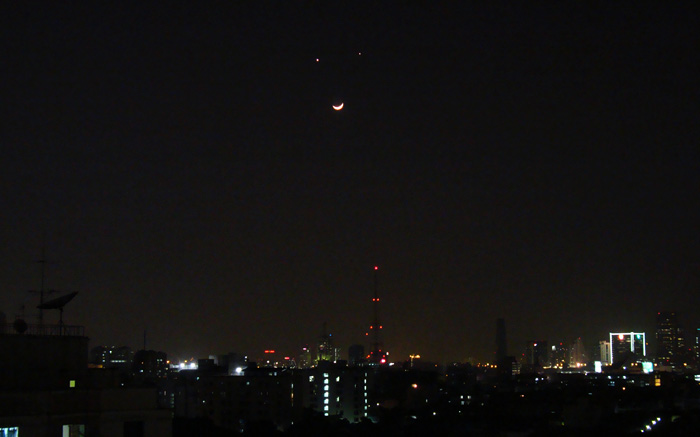
At 7pm this evening there is a big fog rolling into a cool
Dubai. So it may be a good thing that all outdoor events to celebrate the
New Year in Dubai, including fireworks and loud music, have been banned,
following a decision by Sheikh Mohammed bin Rashid Al Maktoum to cancel all
events.
According to Sheikh Mohammed's order, Dubai will mark the New Year with a
"sombre tone" as a token of solidarity with the Palestinian people in
general and Gaza Strip in particular which is currently under the barrage of
Israeli's military fire.
But there is much confusion about what type of event will be
banned.
According to Arabian Business the Dubai government's
Department of Tourism and Commerce Marketing (DTCM) permission department
said all New Year celebrations would be cancelled and no fireworks or
outdoor music would be allowed. Any hotel found to be violating the rules
would be fined.
Apparently a spokesperson said that "if it’s a normal dinner, for instance
people have booked it three months in advance, in a hotel that’s fine, but
if it’s specifically a New Year’s party - that should be cancelled.
Now that is nonsense. Any dinner on 31 December will be a
special New Year Dinner and hotels take bookings for these dinners months in
advance.
Tour operator Desert Safari Dubai said it had cancelled all
its New Year parties. At the Irish Village in Garhoud live music has been
cancelled and dancing banned.
Century Village's street party has been cancelled and the all you can eat
and drink packages have been replaced with seperate food and beverage bills.
A member of staff at Dubai Marine Resort where guests have
paid up to 2,000 dirhams each to attend the hotel's Gala Dinner, told
Arabian Business that the hotel was still waiting for official confirmation
but had been advised to dispense of decorations and fireworks and keep noise
to a minimum.
Meanwhile, Egypt has also cancelled official New Year's Eve events.
Meanwhile the Shakira concert 'will go ahead' at Emirates Palace as the Abu
Dhabi gig is not affected by Dubai ruler's New Year order.
New Year Uncertainty for Dubai
30 December 2008
Dubai's ruler has
ordered the cancellation of all New Year's celebrations in the freewheeling
Gulf city state because of the violence in Gaza.
Sheikh Mohammed
bin Rashid al-Maktoum said the move was triggered by the "destruction,
killing and displacement caused by the Israeli military machine", the state
news agency WAM reported. WAM added that Sheik
Mohammed bin Rashid Al Maktoum called off "all forms of celebrations" but
did not elaborate.
The order calls
for Dubai instead to mark the new year "with a somber tone as a token of
solidarity" with the Palestinian people and with the Gaza Strip
in particular.
It was not
immediately clear when the ban would take effect or whether it would apply
to the scores of bars and restaurants planning pricey New Year's Eve events.
However the local media reports that
Sheikh Mohammed
has instructed all concerned authorities in Dubai
to put this order in place and take necessary procedures to circulate the
decision to all concerned parties.
But it is safe to expect significant confusion tomorrow. I
dont care much for the new year crowds, boozey Brits, overpriced bad dinners
and lousy traffic - so I am quite grateful for this; but realistically it
cannot be good for international perception of Dubai as a
welcoming,international,tourist-friendly nation.
Thai
Police put on a happy face
30 December 2008
The man in tight brown uniform waving you to a halt for no
apparent reason will now be doing so with a smile on his face ! he may now
even be offering holy water or sweets in return for the Baht 100 plus that
truly gives him something to smile about!

The latest item of Thai police fashion famous
is the bright red goofy grin painted onto their
white anti-pollution masks. For the first week of
the year - and longer if people seem to be smiling back - highway policemen
in Thailand will wear the masks "to lift the mood of motorists," according
to police officials.
"For our highway policemen, we have the policy that the police must be
friendly and smiling all the time, but the problem is, when we're tired,
it's hard to keep smiling," said Colonel Somyos Promnim, the Highway Police
commander.
It has been a rough year in Thailand, with revolving governments, restless
mobs and a weeklong takeover of Bangkok's airports that frightened away
tourists from the country that keeps on calling itself "The Land of Smiles."
It is a complicated thing, the Thai smile, as varied, nuanced and eloquent
as the bow in Japan, and apparently requiring just as many muscles.
Foreign visitors are charmed, but the truth is, it can often be as difficult
to know what is behind the Thai smile as it is to guess the real expression
of a police officer hiding behind a smiley mask.
Happiness or sadness, regret or anticipation, triumph or embarrassment,
warmth or wickedness, the important thing - and apparently sometimes the
hardest thing nowadays - is just to keep on smiling.
Earlier this month a leading polling agency, Abac, spent three days
questioning 2,079 people in the Bangkok area and found that on a scale of 1
to 10, people gave Thailand only 5.77 points for being the Land of Smiles.
Starting out his new administration, the already embattled prime minister,
Abhisit Vejjajiva - the fourth prime minister this year - made a promise to
his people this month: "I will prove that once again Thailand can be the
land of the free, the land of opportunities, and the land of smiles."
The highway police seem to be as good a place to start as any.
The new cloth masks, which hook behind the ears and cover the mouth and
nose, will help "reduce the stress from drivers when they see the police,"
said Somyos, the Highway Police commander.
To that end, he said, some 200 police booths would also distribute holy
water, chewing gum and mints.
He defended his force when asked why drivers needed smiley masks and gum and
holy water to calm down when approached by a patrolman.
"The police are not that scary," he said. "When I was in the United States,
their highway police seemed to be more fierce than Thai police. I was scared
of them."
Arab-Israel Tensions worsen
30 December 2008
There have now been four days of Israeli air strikes on Gaza.
A land attack is possible. Israel appears determined to stop the Hamas
military presence at any cost. But across the Arab nations there has been an
outpouring of popular anger that is putting pressure on American allies in
the Arab world and appears to be worsening the region's internal divisions.
Their have been strong verbal attacks have aimed at Egypt (Gaza's only other
neighbour) widely seen as having aided the Israeli assault through its
closure of its Gaza border, preventing refugees from fleeing the fighting.
But in massive street demonstrations from north Africa to Yemen, some
marchers and opinion-makers have also lashed out angrily at other moderate
Arab governments - including Jordan and Saudi Arabia - for failing to take a
stronger stand. Syria and Iran, meanwhile, have drawn praise for their
militancy.
As the death toll in Gaza passed 370, President Hosni Mubarak of Egypt gave
a televised address to defend his decision not to open the border with Gaza
except for humanitarian purposes, and derided "those who are seeking
political gains at the expense of the Palestinian people."
President Mahmoud Ahmadinejad of Iran, in an apparent reference to Egypt,
said "those who link their interests to the interests of the Zionists will
go to hell."
Although Jordan and Saudi Arabia have been careful not to blame Hamas, the
violence has put them on the defensive.The tentative thaw of the past year
is unravelling quickly. Syria had been holding indirect peace talks with
Israel. Lebanon's political factions reached a peace deal. Syria and Saudi
Arabia made gestures toward resolving their long-running feud.
Now the fault lines that were so painfully visible during the summer 2006
war between Israel and Hezbollah have reappeared. Syria has been pressing
for an emergency Arab summit meeting, but Egypt and Saudi Arabia have
resisted the call, apparently fearing they could be portrayed as appeasers.
Egypt is in effect trapped between Israel, with which it has a peace treaty,
and Hamas, which enjoys popular support among Egyptians. The Egyptian
government has struggled with its own Islamist opposition, and would clearly
like to be rid of Hamas. But it faces tremendous popular anger if it appears
to endorse violence against Palestinians.
The Gaza violence has exacerbated that dilemma. It has happened before, but
now Hamas is ruling Gaza and is politically isolated from the West Bank -
which puts more onus on Egypt.
In taking on Hamas Israel runs the risk of undoing all of the
moves that have been made towards peace in the middle east. Israel also runs
the risk of making Iran a strong leader of the more militant Arab nations.
Iran's rhetoric will get a great deal of support across the Arab nations.
Egyptian officials (and probably American as well) see the
hand of Iran - a patron of Hamas - in the conflict. Iran was already
pressing Egypt before the Israeli attack began, apparently eager to
undermine Egypt's role as a mediator between the Palestinian factions.
Demonstrators gathered in front of the Egyptian Embassy in Tehran on Dec. 17
to protest Egypt's position toward Hamas.
In recent days, government-allied newspapers in Egypt have lashed out at
Iran and its ally Hezbollah, whose leader demanded that Egypt open its
border.
For their part, TV stations and newspapers allied with Iran and Syria
continued to portray Egypt as a traitor. There were also harsh words for
other Arab states.
Reflections
28 December
2008
The end of the
year is always a rather introspective time. It is also a time to think about
the new year - even to contemplate new year resolutions….though I am not
very good with resolutions.
But this year I am
finding the process of looking both back and forward rather more complex
than usual.
It has been quite
a year.
The high point of
the year was a spectacular wedding day in Hua Hin on October 16th. Tai
looked beautiful. We had never been closer. Or more connected. Yes it was a
little stressful; there were a couple of tense moments. That was inevitable
after all the planning. It was a really nice day spent among friends and
family and in a great location with kind weather. People went to a lot of
trouble to fly in and join us. Our Dubai friends were wonderfully supportive
and there was a great team of bridesmaids. My dear friend Dennis who I must
have known for almost 14 years was a calming and entertaining best man. It
was a day that everyone who was there will remember for all the right
reasons.
I guess much of
the personal part of our year was spent getting ready for the wedding –
finding the resort; taking pre wedding pictures; getting the marriage
registered. So there were a number of trips to Bangkok and they all seemed
busy. It is nice to be able to go back now and to simply relax.
With marriage
comes responsibility; and I feel at the end of the year that I am not
fulfilling that part of my duty. I am out of work again – and not hugely
motivated to find new work. I know I need to – for my own well being; for
the stimulation and challenge that comes with work and
helping colleagues; and to make sure that I can look after Tai and I as I
want to.
But I put a lot
into my previous job. It was not easy coming to a new city, a new part of
the world, with no local contacts, and to seek out a new role. And I enjoyed
the business. There are some wonderful and committed people in education.
But it was a
company that struggled internally to come close to the values that it was
committed to externally. And being torn between two shareholders, with often
very different objectives, was challenging. Too many senior people came and
left. The hours were long; but I did want the business to succeed. And I
believed that I was one of a number of people who were changing the way
people worked and thought for the better.
Going away from
work can be hazardous; however, I wonder just how many people come back from
honeymoon; head cheerfully off to the office; greet friends and colleagues;
and find out within an hour of being back that their position no longer
exists ! It was a bit surreal. But predictable. As indeed I had predicted it
while we were on vacation.
It has given me
time in December to spend every day of Alex’s vacation with him and that is
a true joy. No working, no interviews. Just time together that is good for
us both. As he gets older he may want to spend vacation time with his
friends; maybe less with his father. So I am happy to have all this time
with him. His interest in all that happens around him is unabated. He is
bright, confident, articulate and sensitive.
So what next. I
promised Tai when we came here that we would stay as long as she wanted –
through at least her first contract. She is shortly to take her first class
upgrade. Promotion in Emirates is fast as the airline continues to grow. And
she has done well there and continues to explore the world and enjoy the
experience.
It is a strange lifestyle. Even after two years it is hard to get used to
her trips away and having to adjust from life together to life apart; having
to manage the late night and early morning arrivals; departures; tiredness
and jet-lag. Our Executive Towers apartment is still not ready – so we are
still living out of two apartments. I have been in mine for 19 months now.
But it still feels temporary. It is not our home. It is rented; white washed
walls; prison like lighting; and surrounded by building site noise, dust and
pools or standing water and sewage. The windows have not been cleaned since
I moved in. Not much point to be honest. They would be covered in the same
dust a day later. I have never invited friends here for dinner – there is no
dining table !!
I know I could
have lived in a different part of Dubai. Somewhere
that has community. Somewhere where you can walk out of the building and
walk to a stor or coffee shop. But Emirates moved Tai to the newly completed
Millennium Tower building and it was important for us that I could live as
close as possible. The trouble is the slow down in construction means that
we are in the only two completed buildings in this part of Dubai – and to go
anywhere means getting the car; heading out on the dirt track; navigating
the potholes and getting out onto the highway. I promise you when it rains
in January you will be reading about floods around our buildings and that
they are probably inaccessible.
I don’t sound
happy here do I? How do I manage the need to be responsible for my family
with a sense of personal under achievement. I need to do something that I
thoroughly enjoy and am challenged by.
I have been
thinking how much I wish I could travel. Ideally with Tai. We are very happy
travel companions. But she has her work…..
I want to be in
Sydney and Melbourne; I want to go to Nepal and Tibet; I miss my trips to
China; I want to have a week hitting golf balls in Thailand; I want to see
the sea and walk on a beach breathing in cool clean air; not to breathe my
building site. I want to go and help my Mum sort out everything that was
left by my Dad….the great hoarder ! Some time in London would be nice – some
theatre and music. I want to explore South America. I want to go back to
Toronto and Vancouver. I want to take a car across the US without having to
worry about which direction I am heading in. I want to be back in Japan. I
really should go back to Hong Kong for a visit to make sure my residency
remains valid and to see the changes in one of my favourite cities.
I would like to explore the Mediterranean; to go back to
Greece, to see more of Turkey and Italy. To see peace in Cyprus.
I want to speak
decent Thai.
I would still like
to learn to fly.
But I need to
work. And I need to do that here in Dubai and make the best of what we have
here.
It is four years
now since the tsunami hit the Indian ocean; causing devestation in
Indonesia, Sri Lanka and parts of Thailand. There have been a number of big
and small lessons that always remind you how true it is that you need to
capture the best in every day and avoid conflict with the people that you
love and care for.
When Harold Pinter died last week one of the nicest tributes
was someone saying that he had the strongest sense of right and wrong and of
what is just and fair. Always nagging at my mind is the simple truth I
should be able to do more to support a fairer world. Just writing about it
is not be enough. One look at a country like Burma; one look out of my
window at the tired and expressionless men building Dubai's new towers; one
look at events in Thailand over the last few months; one look at the Israeli
attacks on Gaza in the last 24 hours; and you know that there is much that
is wrong; that there are elites protecting what they have at the expense of
those who have not.
My baby brother is heading back to school. Pursuing a degree
course in Nursing. For once he is doing something that he really wants to
do; for himself. So that he can give hope back to people in return for the
hope that others gave him. Am happy for him. He may genuinely have found his
calling.
It is a time of
uncertainty. Global economies are in meltdown; many people who are working
are far from secure in their work. There is huge uncertainty about asset
prices; property values and pension entitlements. The economy recovers; it
always does; but people will be damaged along the way. A number of good
friends have left Dubai. It is a transient place; more so than any other
country I have lived in.
So lets see what
2009 brings; one thing is for certain; you will be able to read all about it
here and I am sure there will be another update at the end of the year.
Elite still calls the shots
Ruling class sees rise of rural masses as threat to
its dominance
By Nirmal Ghosh, Thailand Correspondent In Bangkok for
The Straits Times
"Discreetly tucked away on a high floor of a
building in Bangkok's Sukhumvit Road is the elegant, dark wood panelled
Pacific City Club. The club, where membership is by invitation only, was
founded in 1995 by a group of prominent businessmen to offer 'Bangkok's
corporate and diplomatic elite a proper setting to meet in a comfortable and
relaxed environment', according to its official website.
The board of governors reads like a Who's Who of Thailand's 'hi-so' or high
society. The club's chairman for many years since its inception - though he
resigned about a year ago and has not been replaced yet - was Mr Arsa
Sarasin, the principal private secretary to King Bhumibol Adulyadej.
The club offers a small insight into just who is regarded as 'elite' in
Thailand.
From self-exile in England, former prime minister Thaksin Shinawatra - a
fugitive from the law in Thailand - complained in October that the ruling by
the Supreme Court, which found him guilty of corruption, had been driven by
politically motivated 'privileged elites'.
Chulalongkorn University political science lecturer Giles Ji Ungpakorn has
described the political situation as a 'struggle between the elites (in
which) it is democracy and the poor majority who will suffer'.
Author Pasuk Phongpaichit, in an interview with the magazine Fa Deaw Kan
held just before the 2006 coup that led to Thaksin's ouster, said the Thai
ruling class has always had a purely elitist tradition, as opposed to one
that emphasises equality in society.
Academic Michael Connors, in his 2007 book Democracy And National Identity
In Thailand, refers to 'elite-defined democracy'.
Professor Connors quotes former premier Anand Panyara- chun - a member of
the elite and also a liberal - as having argued that the cycle in which
rural people elect vote-buying MPs and 'middle-class' Bangkokians bring down
governments with cries against corruption and incompetence, will end when
the status of the rural population is lifted.
Currently, the people are 'not interested in whether the government is good
or not'. Rather, they are just interested in a government that 'digs wells
and makes roads'.
Prof Connors wrote: 'The 'democracy' expressed (by Anand) is an urban one -
dependent on an educated middle class and their presumed rationality.'
On the night of Sept 19, 2006, immediately following the operational part of
the coup that unseated Thaksin, then army chief General Sonthi
Boonyarataglin was granted an audience with King Bhumibol.
Conspicuously present was the King's top adviser, Privy Council president
General Prem Tinsulanonda, a former appointed premier as well as a former
armed forces chief.
Former general Surayud Chulanont, who was on the Privy Council then, had to
resign to serve as prime minister.
There is clearly a near-seamless connectivity between the top echelons of
the armed forces and the inner circles of the palace. Also, an army
officer's first oath of allegiance is to the King, not the government.
General Prem, in a speech in early 2006, famously likened the army to a
racehorse and the government to a jockey. Jockeys come and go, but the owner
of the racehorse was the King, he said.
The post-coup appointed government was stacked with conservatives from the
Bangkok establishment. One example was finance minister Pridiyathorn
Devakula, who bears the royal title Mom Ratchawong (MR). General Sonthi
himself became a deputy prime minister. Many other Cabinet members were,
like MR Pridiyathorn, former senior bureaucrats.
Current Prime Minister Abhisit Vejjajiva, an Eton and Oxford man, is from
the same clubby Bangkok elite. His father, Dr Athasit Vejjajiva, was once an
appointed Cabinet minister, and also served as president of The Royal
Institute, a venerable think-tank for select academics.
Like the military, big business also protects its interests through
alliances with those in power. Thaksin said in an interview in 1992:
'Politics and business are inseparable. We have to accept this reality.
Politics is like the sun, and business like the earth.'
Thaksin's Thai Rak Thai party had its share of big business interests: At
one time, the Cabinet was thought to account for well over 10 per cent of
the market capitalisation of the Thai stock exchange.
But Thaksin also made many enemies in the world of big business. Tycoon
Prachai Leophairatna, thought to have funded the People's Alliance for
Democracy (PAD) in 2006, was a prime example. He fought Thaksin to exact
revenge after he lost control of his debt-ridden Thai Petrochemical Industry
empire.
The pro-democracy, pro-Thaksin 'red shirts' have a list of nearly 100
companies that they claim funded the PAD's months-long protests this year,
which among other things led to the devastating shutdown of Suvarnabhumi
airport last month. Some of them have stalwarts of the Bangkok establishment
on their boards.
Prof Pasuk and co-author Chris Baker wrote in their 2004 book, Thaksin: The
Business Of Politics In Thailand, of how, during the era of military
dictatorships, 'businessmen shared some of their profits with the generals,
who in return constructed a friendly environment for business, and rewarded
their particular friends with contracts, favours and other profit-generating
advantages'.
With the army receding from politics after 1992, the nexus became more
tenuous - only to return in 2006.
Chulalongkorn University political scientist Thitinan Pongsudhirak, in a
recent paper in the Journal of Democracy, wrote: 'Thaksin...sought to usher
Thailand into a new era, up-ending its anachronistic, neofeudal hierarchy,
even as his opponents tagged him for corrupt cronyism, graft and abuses of
power.
'Chief among these opponents were the bureaucrats, the military and the
monarchy - a troika that has called the shots in Thailand for decades.''
On their side is much of Bangkok's upper middle class, who share a distaste
for corruption in politics and see the rise of the rural masses through the
vote as a threat to their dominance of Thailand."
Emirates update for 2009
27 December 2008
Updates for Summer 2009...from March 2009 Emirates focus for
2009 appears to be on maximising schedules/revenues from existing routes
rather than launching new routes. Although expect at least one new US route
- Chicago.
LHR EK007/008 - aircraft switched from B777-300ER to B777-300
CMN EK751/752 - aircraft upgraded from A332/A343 to B777-300ER
TIP EK745/746 - de-linked from TUN and now operates dedicated terminator
service DXB-TIP-DXB using A332
TUN EK747/748 - de-linked from TIP and now operates dedicated terminator
service DXB-TUN-DXB using A332
DAR EK725/726 - aircraft upgrade from A332 to B777-300ER
NBO - increase from 12x to 14x weekly (additional freq. on EK721/722 on
Sat). EK719/720 aircraft upgraded to A343 from A332 Tue-Sun, Mon ops with
A332.
JNB - increase from 2x to 3x daily (EK765/766 re-instated)
HKG - EK380/381 aircraft upgraded from A332 to B777-200ER
BKK - EK372/373 aircraft switched to B777-300 on all days - currently
operates with an A330 two days a week.
CMB - increase from 14x to 15x weekly (additional freq. on EK650 on Fri)
MLE - increase from 9x to 11x weekly (additional freqs. on EK658/659 on Wed
and Fri)
KIX - EK316/317 aircraft switched from A340-500 to B777-200LR
MAA - increased from 19x to 20x weekly (additional freq on EK546/547 on Sun)
- effective Winter 09/10 schedule
TRV - increased from 8x to 10x weekly
AMD - increased from 8x weekly to double daily (effective Winter 09/10
schedule)
KWI - from 26x weekly to 4x daily (additional freqs on EK855/856 on Tue and
Sat)DAM - increased from 11x weekly to double daily
AMM - increased from 12x weekly to double daily
SAH - increased from 6x weekly to daily
IKA - increased from 19x weekly to triple daily
BEY - increased from 14x weekly to 17x weekly.
DOH - increased from 28x weekly to 32x weekly
Also coming in 2009: Dubai to Chicago O'Hare.
And for 2009/10
Effective 1 December 2009 - Airbus 380s will go to Singapore
and Rome. And BKK goes 4 daily.
EK097/098 DXB-FCO-DXB aircraft upgrades from B777-300 to A380-800 - Rome
gets a 380 service.
EK787/788 DXB-ACC-ABJ-ACC-DXB aircraft upgraded from A340-300 to B777-300ER
EK721/722 DXB-NBO-DXB upgraded from 6x weekly to daily (additional freq on
Fri). NBO as a result moves up to a double-daily.
EK404/405 DXB-SIN-MEL-SIN-DXB aircraft upgrades from B777-300 to B777-300ER
on Mon, Thu, Sat. Other 4 days of week remains B777-300.
3rd daily SYD service introduced operated by A340-500 non-stop from DXB.
EK414 DEP DXB 0140 ARR SYD 2235
EK415 DEP SYD 0600 ARR DXB 1345
EK424/425 DXB-PER-DXB aircraft upgrades from A340-500 to B777-300ER
4th daily BKK service introduced operated by B777-300/B777-200 (3-class)
EK374 DEP DXB 2300 ARR BKK 0800 (next day)
EK375 DEP BKK 0930 ARR DXB 1300
EK362/363 DXB-CAN-DXB aircraft upgrades from A330-200 to A340-300EK352/353
DXB-SIN-DXB frequency increased from 3x to 4x weekly. Aircraft upgraded from
B777-300ER to A380-800. 380 to Singapore
EK975/976 DXB-IKA-DXB aircraft upgraded from A330-200 to B777-300ER
EK849/850 DXB-DOH-DXB frequency increased from 4x weekly to daily. As a
result DOH becomes 5x daily.
EK546/547 DXB-MAA-DXB frequency increased from 6x weekly to daily. As a
result MAA becomes 3x daily.
EK570/571 DXB-CCU-DXB frequency increased from 4x weekly to daily.
EK572/573 DXB-CCU-DXB frequency increased from 3x weekly to 5x weekly.As a
result CCU goes from 7x weekly to 11x weekly.
EK522/523 DXB-TRV-DXB frequency increased to daily.
EK520/521 DXB-TRV-DXB frequency increased to 5x weekly.As a result TRV goes
from 10x to 12x weekly.
EK560/561 DXB-CCJ-DXB frequency increased from 2x weekly to 5x weekly
EK562/563 DXB-CCJ-DXB frequency increased from 4x weekly to 6x weekly. As a
result CCJ goes from 6x weekly to 11x weekly.
Time to free Harry
Nicolaides
26 December 2008
Please read the following letter sent by Mr. Nicolaides from
his remand jail in Bangkok.
If the new Thai government wants to win any friends in the
international community (rather than appointing a PAD leader as foreign
minister) then arranging for the earliest release of theis man would be a
good start.
http://www.neoskosmos.com.au/081222/nkew/community/community_index.shtml
FCCT under Thai police investigation
24 December 2008
It is sad to see the FCCT coming under police scrutiny in
Thaialnd.
It has always been a place where there can be well argued
debate about Thailand, past, present and future, and where Thailand's
newsmakers can debate with foreign journalists in an open environment.
But the December 9 event appears to be under scrutiny.
In a statement today the FCCT said:
The FCCT regrets
to announce that since the Dec 9, 2008 event ''The State of Politics and the
Way Forward for Thailand '' is apparently the subject of a police inquiry,
the Executive Committee deems it appropriate to suspend the further
distribution of the DVD recording of the event with immediate effect.
The event itself was - The State
of Politics and the Way Forward for Thailand - An evening with Veera
Musigapong from Truth Today. For
those with short memories this was just after the PAD ended its occupation
of Government House and the two Bangkok airports.
This is not the first time that an event at the FCCT has led
to police investigation. Jonathan Head, the BBC's South East Asia
correspondent remains under investigation on lese majeste charges from April
2008 for a presentation he delivered at the FCCT
UAE airlines get Tokyo rights
24 December 2008
The UAE and Japanese governments have agreed to boost air
links between the two countries, allowing Emirates and Etihad the prospect
of expanding their Asia services.
Starting from March 2010, the UAE-based carriers will be able to have 35
weekly passenger flights to Osaka and Nagoya using any type of aircraft.
They will also have the rights to operate 10 weekly flights to Tokyo, shared
equally between Emirates and Etihad, the General Civil Aviation Authority (GCAA),
the federal regulatory body said in a statement yesterday.
Japan and the UAE have also agreed to have nine weekly cargo services.
Emirates operates daily services to Osaka and Nagoya and hopes eventually to
have daily services to the Japanese capital as well. So that currently
accounts for 14 of the 35 weekly flights to Osaka and Nagoya.
It began flying to Osaka in 2002 and to Nagoya in 2006.
Emirates will not be satisfied with just five weekly services to Tokyo
(effective March 2010). They will clearly want a daily service."
Malaysian FM's foot in mouth
21 December 2008
Some things may be thought but really should remain unsaid.
Malaysian Foreign Minister, Rais Yatim, has talked in
laudatory terms about Muntadar al-Zeidi, whom he called "that remarkable
reporter who gave President Bush his final farewell last week".
He went on to say: "That shoe-throwing episode, in my view, is truly the
best weapon of mass destruction to the leader who coined the phrase 'axis of
evil' to denote Iran, Iraq and North Korea."
His speech, delivered at a dinner to mark the founding of the United
Nations, was notable for its lack of diplomatic tact.
Mr Zeidi, who was subsequently arrested amid allegations he was beaten by
Iraqi police, hurled his shoes at Mr Bush on Sunday during a press
conference.
Throwing shoes is one thing; but whatever your feelings about
Mr. Bush, he is President of the United States; Mr. Zeidi as an invited and
accredited reporter was there to report the news not to make the news. The
office of President requires basic levels of respect, irrespective of the
incumbent.
Now lets assume an American reporter takes off his shoes and
throws them at the Malaysian Prime Minister during a press briefing. There
must have been many times when certain reporters would have loved to do that
to Dr Mahathir Mohammed; but they did not.
So what now; all journalists remove their shoes and belts
before a press briefing? Mr. Zeidi should be prosecuted and forgotten about.
And Mr. Yatim needs to understand the diplomacy that is due of a foreign
minister rather than playing for the local press. He needs to put a sock in
it. He needs to pull himself up by the bootlaces.
Prosecuting Thailand's PAD
21 December 2008
There appears to be little chance that anyone connected with
the PAD will be charged for any crime for their occupation of Government
House or Bangkok's two airports.
But the following article from UPI Asia is alarming in its
description of the damage done and the weapons accumulated by the yellow
shirts. Do not expect the same leniency for any red shirt action.
The saddest part of all is the lack of any sort of
condemnation of the PAD action by either the Democrat party (who were silent
throughout and who have been the major beneficiary) or Bangkok's english
media who have printed little on the damage done, weapons found, and
potential security issues relating to stolen hard drive data.
The article was written by Awzar Thi; this is the pen name of
a member of the Asian Human Rights Commission with over 15 years of
experience as an advocate of human rights and the rule of law in Thailand
and Burma. His Rule of Lords blog can be read at http://ratchasima.net
"According to news from Thailand this week, police are set to
file charges against protesters responsible for blockading Parliament after
the leader of the main opposition party finally succeeded in becoming prime
minister without having to win an election.
News reports said police were compiling video footage and other evidence of
demonstrators that threw rocks at vehicles, assaulted passersby, damaged
public property and kept parliamentarians trapped within the legislature.
These are serious offenses, and if the police have the evidence they need,
they should certainly try to prosecute. But the crimes of this group pale by
comparison to the scale of criminality demonstrated by their opponents,
those who occupied Government House – the complex that houses the prime
minister’s and Cabinet ministers’ offices – for three months from August and
the two main airports for a week from the end of November.
In fact, the number of serious crimes committed under the banner of the
group calling itself the People’s Alliance for Democracy is so large that
it’s hard to imagine police officers even having time to investigate the
melee outside Parliament on Monday.
From all accounts, parts of the prime minister’s offices had, over the three
months that they were besieged, been completely ransacked. The occupiers
stole computers, televisions and personal items of public servants. They
raided arsenals and made off with pistols and, possibly, semi-automatic
weapons.
They vandalized furniture and the buildings themselves, smashing and ripping
chairs and wallpaper. They drove off a number of cars and motorcycles and
took religious statues and amulets.
The costs to the government will run into the millions of dollars. To
replace the damaged and missing computer equipment alone is expected to be
over US$1 million, although bureaucrats could perhaps save some money by
repurchasing the stolen items as they appear in secondhand markets around
Bangkok during the coming days and weeks.
The damage was not only financial. According to several reports, a number of
high-security computer hard drives, including servers, were among those
items that have disappeared. So far, there have been no public reports on
the precise contents of these, or the threat posed to the government and
public from their falling into private hands.
That’s what was taken. Then there’s what was left behind. The list allegedly
includes hundreds of homemade explosives of various types, including Molotov
cocktails, firecrackers, fertilizer and ping-pong bombs. There were also
bottles of acid and large numbers of assorted objects to use as weapons,
including golf clubs, iron bars and slingshots with various types of
pellets.
Oh, yes, and there was a dead body found at the Don Muang airport, stuffed
into a plastic bag out back. According to news reports, the unidentified man
had apparently been dead for some days and had been assaulted before he
died. He may have been one of the proxy police force that patrolled the
perimeters of occupied buildings and who interrogated, detained and
assaulted other citizens.
Others left for dead survived. Among them, a 26-year-old man was reported to
have been found near the international airport on the night of Dec. 1,
stripped naked and shot in the neck. At the time of the report, he had been
unable to speak about what had happened.
Although it may take the police some time to sift through the mountains of
evidence in order to bring charges against people accused of these offenses,
the ringleaders and some of the most visible perpetrators could be legally
brought in at any time.
There has been some talk about the possibility of charging them with
terrorism, which under the penal code consists of acts of violence causing
danger to life or liberty, serious damage to transport and communications,
or acts effecting significant economic damage with intent to threaten the
government.
By these criteria, the people who took over state premises and killed – or
attempted to kill – and illegally detained other citizens have, on the
surface of it, committed terrorist acts.
But there are innumerable other sections in the code under which they could
be charged.
Why not begin with the usual bundle of offenses that is thrown at
protesters? That includes trespass, coercion, upsetting the peace,
confinement and damaging public property. Police usually routinely start
with these, whether they have any evidence or not.
Then there are all of the other ordinary criminal offenses, including
murder, attempted murder, manslaughter, bodily harm, theft, mischief and
destroying or stealing official documents or materials, which carries a
three-year jail term; or criminal conspiracy, which carries five.
After that, there’s still the chapter of offenses against internal security.
These include attempts to change the law or government through violence,
raising civil unrest to upset public tranquility or inciting people to
violate the law, all of which carry a seven-year sentence. The PAD
leadership seems to have met every one of those criteria too.
And there are many other assorted crimes. For instance, by refusing police
access to sites where bomb blasts occurred, they seem to have violated
section 138, which is obstructing officials from performing their duties.
That section has a penalty of two years; if threatening officials with
violence at the same time, four years; if doing the same with arms or in a
group of three or more, five years. And so it goes on.
There is no shortage of crimes, perpetrators, evidence and penalties with
which to bring charges against the PAD. What is lacking is only the legal
and political will to do it.
The gang outside Parliament this week threatened the building and its
occupants. The gang that took over Government House and the airports has
threatened what that building and its occupants represent. As a matter of
urgency, the police must prosecute both. But their unmistakable priority
must be the latter. Prosecute the PAD.
2008 in pictures
21 December 2008
As we approach the end of a remarkable year the following
links show 120 pictures that provide memories of the year from agency
photographers around the world. It is a remarkable collection of pictures
and worth a few minutes of your time. Parts 1,2 and 3 are linked below.
http://www.boston.com/bigpicture/2008/12/the_year_2008_in_photographs_p.html?id=fark
http://www.boston.com/bigpicture/2008/12/2008_in_photographs_part_2_of.html
http://www.boston.com/bigpicture/2008/12/2008_the_year_in_photographs_p.html
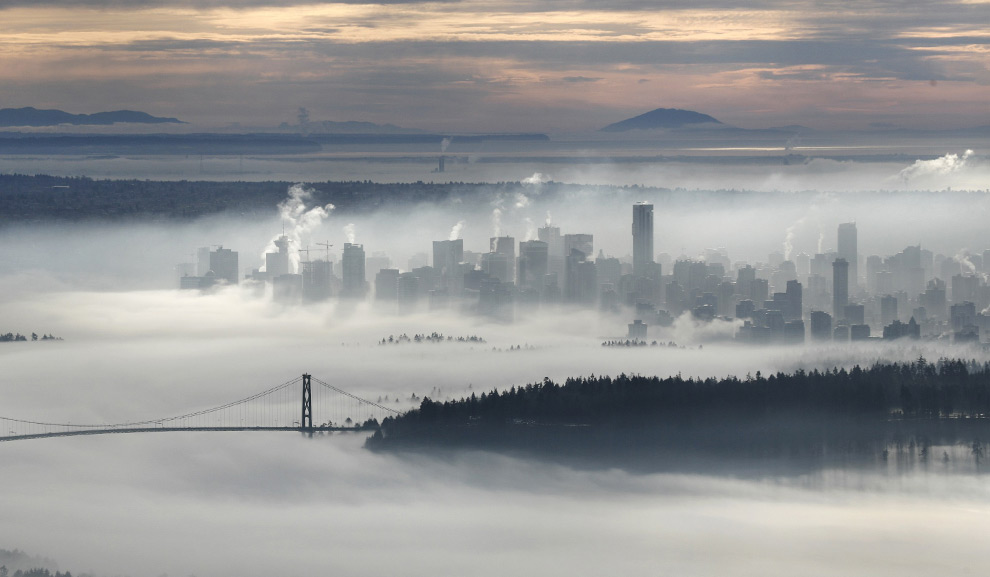
Andy Clarke, an old friend at Reuters in Canada took this
wonderful picture of Vancouver in the morning mist:
Planning a
coup? Here’s how
This is a short story for people with short memories -
perhaps the only thing that should be added is that the story is unlikely to
be finished just yet and that there are further chapters or volumes to
follow.
By PHILIP GOLINGAI
The Star - Malaysia.
20 December 2008
"PSST, do you want to bring down a
democratically-elected government? Here’s a blueprint on how to install a
squeaky clean politician whose party does not have an overall majority in
parliament as prime minister.
While the targeted prime minister is out of the country – say, in New York
to address the United Nations general assembly – get the military to launch
a coup.
Call it “Happy Coup”. Impose martial law and install a former general as
prime minister.
But that’s not quite enough. A military junta can’t rule forever; the
civilised world demands an elected leader.
Before the election, get the court to dissolve the most powerful party (the
only party to have won an outright majority in your country’s political
history) and – for good measure – ban its 111 executives, including the
ousted prime minister, from politics for five years.
Oops! Your party failed to win the election although it outspent the
reincarnated party of the disbanded party by three to one.
Mai pen rai (Thai for “don’t worry”). It’s not your fault. Voters –
especially the poor from the north and north-east – don’t understand
democracy.
Although your party has only 166 MPs (in the 480-MP parliament) propose the
squeaky clean politician as prime minister. Don’t be too disappointed,
however, when MPs from the reincarnated party and its five coalition
partners vote in for a loud-mouthed prime minister.
Four months later, unleash a movement (give it a name with democratic
sounding words like “People”, “Alliance” and “Democracy”) to attack the
government for being the puppet of the deposed prime minister.
Don’t forget to storm Government House (the prime minister’s office).
Don’t worry when the prime minister declares a state of emergency as the
military will refuse to enforce the rule of law. Plus you have sen (Thai for
“connection”) to a powerful invisible hand.
Despite losing his office, the premier still clings to power. It’s time for
a judicial coup. Get the court to remove him from office for moonlighting as
a chef in a television cooking show.
For the second time, propose the squeaky clean politician as prime minister.
He loses again? Ah, the ruling party has the numbers.
But, mai pen rai, as the newly elected premier is a brother-in-law of the
deposed prime minister, this will legitimise the anti-government movement’s
claim that a puppet government is running the country.
Now for a TV coup. Get the army chief – flanked by the navy chief, the air
force chief and the police chief – to appear on television, demanding that
the prime minister resign, as surely somebody must take responsibility for
the bloody clash between the police and the movement with the
democratic-sounding name.
The army chief’s demand is ignored? It’s time to close an airport or two.
Mai pen rai. When the government declares emergency rule at the besieged
airports the invisible hand will order the soldiers to refuse to enforce the
rule of law.
The stubborn government is still clinging to power? Well, it’s time for
another judicial coup.
Dissolve the ruling party and its two coalition partners for electoral fraud
and ban 109 of the executives – including the prime minister and 29 MPs –
from politics for five years.
Let’s look at the latest numbers now. The disbanded ruling party has 219 MPs
and its five coalition allies 65, compared with your party’s 165. Mai pen
rai. For the sake of national unity or a lucrative Cabinet portfolio or 40
million baht (RM4mil), there are parliamentarians who can be persuaded to
support your coalition government.
If the politicians still need persuasion, arrange for the army chief to
“advise” them in his home. But make sure they know the location of the
general’s house. If not, a military escort will have to fetch them at a
nearby petrol station; and those pesky reporters will find out about this
super secret deal.
On the eve of the parliament vote, lock the parliamentarians whose loyalty
you’ve secured in a safe hotel. And don’t forget to confiscate their
handphones so they do not receive any calls topping up the price of loyalty.
Congratulations, your coalition has won a slender parliamentary majority
(235 votes to 198). Now your squeaky clean and very handsome politician is a
prime minister."
Defence Minister shows
Democrats' weakness
20 December 2008
The appointment of Kasit Piromya as foreign minister show
just how weak the Thai Democrat government truly is. Kasit was a strong
supporter of the actions of the PAD.
He does not have the credibility to represent Thailand
internationally. In a speech he hailed the shutdown of the capital's city's
international airport, which left over 200,000 passengers stranded, as a
"new innovation for public protests".
Foreign Ministry officials are non too thrilled either after
Mr Kasit's criticism of the ministry's handling of the Preah Vihear issue.
He joined other PAD speakers in accusing the ministry of helping Cambodia
get the ancient Hindu temple listed as a World Heritage site.
The ministry said it tried to protect Thai interests by making sure the
listing would not affect Thai territory.
Meanwhile former army chief Gen Prawit Wongsuwan becomes defence minister as
presumably agreed with army chief Gen Anupong Paojinda.
The Ministries for Transport (An ATM accessing a very fat
bank account) and Interior (power) will go to Newin’s friends (defectors
from Thaksin). With all the new infrastructure projects on the table the
Newin team should be well rewarded for their new found loyalty and as they
control the Interior Ministry as well there is no one to question any
irregularities! The Fox will be guarding the hen house.
The old
Thailand returns
By Gwynne Dyer from (of all places) The Tehran Times -
but widely available in syndication.
20 December 2008
The political crisis in Thailand is over, and so is the ten-year experiment
with democracy. The rich and the comfortably off have risen in outraged
revolt against equal treatment for the poor, and it’s back to the bad old
days of shaky coalitions and bought-and-paid-for politicians. The
misleadingly named People’ Alliance for Democracy (PAD) has won.
It was the PAD’s yellow-clad protesters and street-fighters who occupied
government offices, and eventually both of Bangkok’s airports, in a non-stop
campaign to oust the People Power Party (PPP) from power. (The yellow was to
signify their allegiance to the revered 81-year-old king of Thailand,
Bhumibol Adulyadej, although it was never clear if he shared their goal.)
The government had to be overthrown by street demonstrations, not by a
legitimate vote in parliament, because the People Power Party actually had a
majority in parliament. The PPP’s crime, in the view of the PAD, the army,
the police, the Bangkok middle class, and perhaps even the royal palace, was
that the wrong people had voted for it: the rural poor.
The PPP was the descendant of Thai Rak Thai (Thais Love Thais), the creation
of Thaksin Shinawatra, the telecommunications billionaire who turned to
politics in 1998. It was a new style of party for Thailand, appealing
directly to the urban poor and the rural majority of Thai voters over the
heads of the political bosses who had traditionally bought up their votes.
Thai Rak Thai won the 2001 election, delivering Thaksin to the prime
minister’s office, and he actually kept many of his promises. Development
funds flowed into the rural areas, his “30-baht” scheme for universal health
care brought medical aid to remote villages for the first time, and farmers
got cheap loans. It alienated the urban elite, who had previously gotten the
biggest share of state spending, but Thaksin’s popularity soared even higher
in rural areas.
He was the first prime minister ever to complete a four-year term, and in
the 2005 election his party won an absolute majority of the seats in
parliament -- another first. Even more importantly, the political godfathers
who used to buy and sell the rural vote flocked to his banner, giving him a
virtually impregnable political position.
For a moment there, it looked as though Thaksin had succeeded in
transforming Thai politics. He was quite autocratic in power, seeking to
punish media outlets that criticized him and authorizing an anti-drugs
campaign that resulted in many illegal killings, but his popularity was
unquestionable. And then it all fell apart.
The counter-attack by the old guard came in the form of street
demonstrations against Thaksin’s new government that were used as the excuse
for a military coup in 2006. The courts, which have not been exactly
impartial in this affair, then ordered Thai Rak Thai disbanded because of
alleged election irregularities (doubtless true, but equally true for all
the other parties).
Thaksin’s party was immediately re-founded as the People Power Party, but he
was not so easily able to evade a court judgment finding him guilty of
conflict of interest over the purchase of land in Bangkok. The amount of
money involved was paltry for a man of Thaksin’s wealth, and other Thai
politicians have gone unpunished for far graver offences, but he ended up
fleeing from Thailand in order to avoid a jail sentence.
The military then reckoned that it was safe to hold another election, but
Thaksin’s renamed PPP won again last year: the poor knew who was on their
side. Thaksin stayed in exile, but his close ally Samak Sundaravej became
prime minister in his stead -- and immediately faced the same legal
vendetta. Early this year the courts got him for conflict of interest. The
charge? He was moonlighting as the host of a television cooking show. In
this struggle, no pretext is too petty.
Samak was replaced as prime minister in late September by Thaksin’s
brother-in-law Somchai Wongsawat. The PAD then launched non-stop
demonstrations that gradually paralyzed the government. Four weeks ago they
seized control of both Bangkok’s airports, shutting down the tourist trade
that accounts for 6 percent of Thailand’s economy. And in early December the
courts came through for them again, ordering the disbanding of the PPP and
two allied parties for electoral fraud.
That was the final blow. The regional godfathers, recognizing that Thaksin
is finished, have begun selling their services to the old-line Democratic
Party again. It won’t even be necessary to carry out the PAD’s project to
take the vote away from the rural population -- they were proposing a
parliament that was 70 percent appointed and only 30 percent elected --
because the regional bosses will go back to brokering the rural vote in the
good old-fashioned way.
It is a sad outcome, but not a surprising one. Relatively few Asian
countries are openly run as dictatorships nowadays -- China, Vietnam and
Burma are the main exceptions -- but the urban elites and the big
land-owners really still call the tune in most of the so-called democracies.
Thaksin had his faults, but he was trying to break Thailand free from that
model. Unfortunately, he failed.
Apollo 8 - 40 years on
20 December 2008
Forty years ago this Christmas the first human beings reached
the moon. They did not land on it; but they were the first men to leave
Earth orbit. As a result their historic feat is better remembered for an
image of what they left behind - planet Earth.
Looking back from more than 200,000 miles away, the crew of Apollo 8 saw
Earth floating "like a Christmas tree ornament lit up in space,
fragile-looking". They pointed their cameras through smeared porthole
windows and began snapping. It seems almost incredible now, but nobody
thought to take a photo of Earth until they saw it, because nobody had seen
it before.
One of those photos, an Earthrise over the grey and inhospitable lunar
horizon, has become one of the most reproduced and recognised pictures of
our planet. LIFE magazine selected it as one of 100 photographs that changed
the world; more recently it featured in an Oscar-winning film about climate
change, An Inconvenient Truth.
"That one picture exploded in the consciousness of humans," said Al Gore,
the film's Nobel prize-winning narrator and campaigner. "It led to dramatic
changes. Within 18 months of this picture the environment movement had
begun."
There is still some dispute over which of Apollo 8's crew took the first
Earthrise photo, but the official version selected by the American space
agency, Nasa, was by Bill Anders.
Anders and fellow crew members Frank Borman and Jim Lovell left on December
21 and began orbiting the moon on Christmas Eve. For the first and second
loops, Apollo 8's crew faced backwards, but on the third revolution Borman,
the commander, turned their capsule around. "Suddenly Borman said something
like 'look at that' and here was the Earth coming up," recalled Anders.
"There was a mad scramble for cameras: I just happened to have one with
colour film in it and a long lens. All I did was to keep snapping.
"It's not a very good photo as photos go, but it's a special one. It was the
first statement of our planet Earth and it was particularly impressive
because it's contrasted against this startling horizon."
In the following weeks it is estimated that 2 billion people - more than
half the humans alive at the time - watched the blurred black and grey TV
film of the moon and listened to crackling voices speaking to them across
space as Apollo 8's crew read from Genesis, through the first 10 verses of
the Bible.
In what now seems symbolic of the impact of seeing the whole planet for the
first time with human eyes, Borman appeared to cast off the nationalistic
cold war fervour surrounding the mission and ended the broadcast saying: "A
merry Christmas and God bless all of you, all of you on the good Earth."
For Anders, the fragility of life on Earth is shown even more powerfully by
three photos of the Earth alone in space: "Earthrise has a reference -
there's the moon and the Earth, you don't get a vastness - whereas the other
ones, particularly the smaller one, it's Earth and black to the frame ... it
goes on and on."
He added: "I think it's important for people to understand they are just
going around on one of the smaller grains of sand on one of the spiral arms
of this kind of puny galaxy ... it [Earth] is insignificant, but it's the
only one we've got."
Emirates golfing ambassadors
19 December 2008
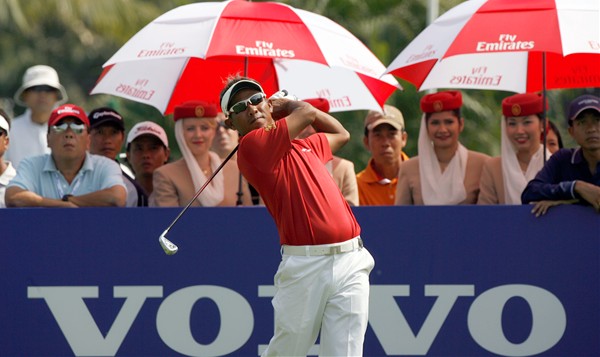
Seen casting an admiring gaze over Thongchai Jaidee's follow
through are members of the Emirates marketing team. Three of the team can be
seen at the back of this picture, including one of EK's finest who will be
well known to regular readers of this web site.
The umbrellas do not mean that it was raining in Bangkok.
They are used to fend of unwanted advances from spectators seeking upgrades
and to ensure that no one standing behind them can see any of the action.
But happy to see that the umbrella was properly held; with
the logo facing the cameras. The umbrellas are presumably deliberately huge
to make sure that the cameras spot them among all the Volvo signs!
The tournament is the Asian PGA season ending Volvo Masters
of Asia played at the Thai Country Club course outside Bangkok.
After Day 1 Australian Neven Basic stole the show with
six-under-par 66 to take the first round lead. Thongchai Jaidee, clearly
distracted by the Emirates team, shot a one-over 73.
DXB to SFO
18 December 2008
For anyone who is curious - here is the great circle route
from Dubai to San Francisco. Interesting to know what the diversion airports
are that allow ETOPS operation along this route!

Questioning EK's so called green flight
17 December 2008
On 15th December, Emirates Airline flew its first flight non
stop to San Francisco. The airline rather optimistically announced a new
environmental programme and called this the world's longest green journey.
Emirates said that it has worked closely with government agencies in Dubai,
Russia, Iceland, Canada and the United States and other countries to plot
this the most environmentally-sophisticated route and trip possible to help
save an estimated 2,000 gallons of fuel and 30,000 pounds of carbon
emissions on the 16-hour non-stop service.
But how real is this:
Here are Emirates claims and a few questions that the
journalists have failed to ask as they merrily regurgitate Emirates press
releases:
• The new 777-200LR will be specially washed beforehand to
minimize drag.
Question:
Why only this flight? Does it cost more than
the fuel savings? What kind of detergent will be used? Does it contain any
toxins?)
• The aircraft will use electrical power on the ground in
Dubai rather than running its auxiliary power unit.
Question: Is the electricity generated by burning
fuel?
• Dubai Air Traffic Control will give the aircraft priority
clearance for both taxiing and departure.
Question: Does this mean that other airlines will be burning
more fuel while the SFO flight gets priority?
• A pre-planned priority departure route out of Dubai will provide an
unimpeded climb through to cruise altitude, allowing the aircraft to reach
its optimum cruise altitude as quickly and efficiently as possible.
Question: Will other planes burn more fuel getting
out of its way?
• Recent Emirates negotiations with the Russian Government
will allow for a preferred route over Russian and Canadian airspace for the
most efficient path, taking into account prevailing winds and the aircraft’s
weight.
Comment: Nothing new here; this is now standard operating
practice for many airlines flying over Russia.
• Real time updates of current weather and wind conditions will allow the
flight crew to modify their flight path on route.
Comment: This should be standard operating
procedure. As far as I know onboard weather radars
already give flights these updates?
• The aircraft will track close to the North Pole following
extensive work by Emirates and aircraft manufacturers to open this new
routing. Flexible routings will be pursued over Canadian airspace.
Comment: The shorter route, the
less fuel burned, saving money. Nothing new here.
Airlines have been flying the polar route for decades.
• The FAA and San Francisco Air Traffic Control will seek to offer optimal
routings for arrival and if possible a continuous descent approach to
minimize fuel burn.
Question: Again - what is the potential impact on other
flights?
Comment: an Francisco is famous for a) questionable weather
meaning that parallel runway use is sometimes not possible and b) shocking
delays in getting from the gate to the runway; I was no 27 in line for take
off on a United flight to Chicago a few years ago.
• The aircraft will use minimal thrust on landing and a
single-engine taxi to its gate.
Comment: Should be standard operating procedure.
• All on-board glass, newspapers, aluminium and paper will be
collected for recycling.
Comment: Many airlines already do this. Will this only apply
on flights into SFO? Dubai is not set up for recycling.
And perhaps the biggest reason why this cannot be an
environmentally friendly flight -
by definition
a 16 hour ultra-long flight uses a lot of fuel hauling its own fuel
around. It must be more fuel efficient to take
off lighter and stop to pick up fuel in Europe before
flying onto the USA or returning to Dubai.
This is
really all about symbolism; about giving the right
message to environmentally aware Californians. Fuel saving is a good
idea, and it saves money. But the reality is that this
flight is being operated so that it can fly non stop for passenger
convenience and try to save some fuel cost to Emirates advantage not
necessarily to the advantage of other carriers.
How badly hit is Thai tourism?
16 December 2008
A few statistics from a trawl around the media; mainly the
overseas media as the Thai media seem to carry on as though nothing
happened!
Airlines and luxury hotels have slashed rates, some offering
two nights for the price of one. The Grand Hyatt is offering a room rate of
Baht2009 ! About US$65 for one of the best hotels in the city.
The Peninsula in Bangkok has temporarily closed its bar and two of its six
restaurants. The occupancy rate sank below 10 percent earlier this month.
The lebua hotel, where occupancy is 16 percent compared to 80 percent this
time last year, has stopped all advertising until June. All expatriate staff
working there have taken 25 to 30 percent salary cuts.
AirAsia is collaborating with an offer of 100,000 free
tickets to Thailand under a regional marketing campaign — "Get Your Baht to
Thailand." This is for fares in Q1 2009; and must mean that Q1 bookings were
horrible.
The biggest falloff is among Asian tourists, who accounted for more than
half of the 14.8 million visitors to Thailand last year. Some 90 percent of
Japanese and Chinese travelers have canceled upcoming trips, according to
the Association of Thai Travel Agents.
Many hotels are trying to lure domestic travelers to fill some of the gap by
halving room rates.
I suspect many people canceled Xmas and New year holidays in
Thailand while the airport occupation was underway. When you only have a few
weeks vacation a year why spend it worrying whether you can get in or out of
the country?
There will be other people who are concerned that there could
be further action and possible violence. They are right to be concerned; but
I doubt we will see another occupation of the airport. And the action of
either white or red shirts is likely to be localised around Thai government
institutions that tourists never see.
What will happen in the short to medium term is that the high
end tourists that Thailand thinks it wants will go elsewhere. There are
many, many attractive and safe alternatives.
But Thailand will remain backpacker heaven; a destination for
people that are on long term vacations, not subject to a vacation deadline
and who like a little adventure and uncertainty. And for these tourists
their baht will now go further as Thailand discounts hotel rooms and travel
packages to keep a flow of tourists coming to Bangkok and using it as a base
for travel around the region and country.
After all Thailand is an amazing country, with one of the
richest and most beautiful cultures in the world. It has a cuisine which is
celebrated and enjoyed daily the world over. There are decent beaches, and
now there are excellent deals in every price range.
Is Thailand safe? "Yes", is the answer. The "But" is the need
to prepare for the unexpected and maybe be flexible for now with travel
plans.
Thaksin loses diplomatic passport
16 December 2008
The pressure grows on Thaksin.
The Thai government said yesterday that it had revoked the
diplomatic passport of ousted premier Thaksin Shinawatra, shortly after the
country's opposition leader was elected prime minister.
The withdrawal of the passport was the latest in a series of
sanctions against the influential former premier, including his sentencing
in absentia to two years in prison on corruption charges and the freezing of
his assets.
This leaves Thaksin as an ordinary citizen and Thais are
limited in the number of countries that will grant visa free access.
To add to the pressure the Council of State, the country's
top legal body, would 'consider the issue of rights and liberties under the
constitution before the ministry decides about his ordinary passport.'
It does look like a continued persecution of the former prime
minister; which might be acceptable given his conviction in a Thai court,
but which looks like a vendetta when no one has been prosecuted in Thailand
for the actions that occupied and closed down government house and Bangkok's
two airports.
Thailand
reverts to old-style politics
By Jonathan Head BBC News, Bangkok
13 December 2008
"It's over, Boss." With those three words, veteran politician Newin Chidchob
finally broke the deadlock that has paralysed Thailand for the past three
years.
They were uttered in a phone conversation with Thaksin Shinawatra last week,
the man to whom Mr Newin had been faithful for almost eight years, as the
exiled former prime minister pleaded with him to reconsider his decision to
defect to the opposition Democrats.
Mr Newin was also the first to break the bonds of money and genuine loyalty
which have made the Thaksinistas the most powerful political force in
Thailand for the past decade.
And he shattered any final illusions that might still have been harboured
here that, a decade ago, Thailand's politics had entered a new age with the
adoption of a new, populist constitution, and the rise of a new, populist
party.
For Newin Chidchob has now reverted to type - the type being a provincial
strongman, schooled in the rough-house politics of one of Thailand's
roughest neighbourhoods, Buri Ram, who simply sells his team of MPs to the
highest bidder.
This is what Mr Newin (who was named by his father after the notorious
Burmese General Ne Win) did before the formation of Thaksin Shinawatra's
Thai Rak Thai party in 1998. It is what every other provincial godfather
did.
Corruption scandals
These men dominated business and politics in their regions, offering voters
a tantalising vision of abundant new development money if their votes gave
the faction a shot at a cabinet position.
They would then
collect as many loyal MPs around them as they could after the election
campaign, which they funded generously, and offer the support of those MPs
in parliament to whichever prospective government made them the most
attractive offer.
This practice delivered Thailand a succession of short-lived, messy
coalition governments in the 1990s, better known for corruption scandals
than good governance.
It was under such governments - in which Mr Newin participated - that
Thailand sleep-walked into the catastrophic 1997 financial crisis.
Appalled by the calibre of their politicians, Thailand's middle-class
applauded the birth of a new constitution in the same year - the country's
16th, but the first to be drawn up after extensive consultation with NGOs
and other representatives of civil society.
A party emerges
This constitution was the first to enshrine protection of human rights and
freedom of expression. It created a number of independent bodies that were
given legal powers to rein in corruption.
But the new charter also had another objective. Several of its articles,
like the one restricting MPs' freedom to jump from one party to another,
were intended to strengthen political parties in the hope that Thailand
would progress to a more stable parliamentary system, as in western Europe.
Its drafters hoped this would nurture a new breed of clean, professional
politicians to replace the corrupt old godfathers.
One of those goals, producing stronger parties, was realised with surprising
speed.
Thaksin Shinawatra, an ambitious provincial
businessman who had made a fortune from telecoms, and managed to keep it
during the financial crisis, built a new-style party called Thai Rak Thai
(Thais Love Thais).
It used modern marketing methods and a raft of new, populist policies to win
the support of the rural electorate. It encouraged mass party membership,
and its appeal went right over the heads of the godfathers, making Mr
Thaksin an instant political superstar.
The godfathers did not go away. Instead, recognising this new political
phenomenon, they opted to move under the Thai Rak Thai umbrella. Newin
Chidchob was one of them.
Mr Thaksin's wealth and personal popularity gave him a far stronger hand in
dealing with the godfathers than any other party in Thailand's history, so
his governments were not crippled by the demands of coalition partners, as
his predecessors had been.
In 2001 he won his first election, and became the first prime minister in
Thai history to complete a four year term in office. In the 2005 election he
became the first prime minister to win an outright majority.
He inspired passionate loyalty among his lieutenants, among them Mr Newin,
and he left the Democrats, Thailand's oldest party, floundering.
Thailand seemed to have put the era of weak coalition governments behind it.
Fading force
The story of how Mr Thaksin turned a position of such strength into his
situation today - where he is a fading political force, stuck in exile - has
been written about extensively elsewhere.
But it is only now, when the newspapers are carrying front-page photographs
of the clean-cut Democrat leader Abhisit Vejjajiva giving a bunch of roses
to Newin Chidchob, once the mortal enemy of the Democrats and every bit the
old-style godfather, that it is clear Thailand has come full-circle.
After three years
of turmoil, old politics is back, where politicians of whatever persuasion
can climb into bed with whoever gives them a shot at power.
It is a depressing scenario, one which finally buries all the high hopes
that were raised by the 1997 constitution.
Doubtless many of those now embracing old politics again, perhaps even Mr
Abhisit and Mr Newin, do not feel particularly good about it.
Blame for this will be fired in many directions - at Mr Thaksin, at the
military, at the Democrats, at the monarchy even, whose role in recent
events is till unclear.
But at a time when Thailand is confronting its worst economic outlook since
the disastrous events of 1997, old politics is unlikely to give it a
government capable of meeting the challenge.
Africa needs to deal with Mugabe
13 December 2008
The man is dangerous, deranged and delusional.
There is a massive cholera epidemic in his country. The
causes are all too obvious.
To all except Mr. Mugabe and his fawning henchmen.
On Thursday, Mr
Mugabe said the spread of cholera had been halted. Aid
workers are clear that the situation
is worsening and the outbreak could last for
months. Already over 800 are dead and thousands are sick.
Much of the
population of Zimbabwe has either fled to neighbouring countries or is
struggling to keep itself alive when unemployment at 80 percent is the rule,
prices double every 24 hours and the non-existent health care system
cannot cope with the cholera outbreak.
Mr. Mugabe blames the West for the epidemic that is spread by water
contaminated with human excrement. His (mis)information
mininster, Ndlovu, likened the appearance
of cholera in Zimbabwe to a "serious biological chemical weapon" used by the
British. He described it as "a calculated, racist, terrorist attack on
Zimbabwe".
The blame is
with Mugabe. Water taps in the capital’s dense suburbs went dry
last week, so people could not wash their hands or food. Hospitals are
closed. Garbage is everywhere. Sludge spews from burst sewer lines.
There will be no end to these horrors until Mr. Mugabe is gone. He stole
this year’s election and has blocked a unity government. South Africa and
other states that insist on an African-led solution to this crisis must stop
enabling Mr. Mugabe and lead. The risk is that the
cholera outbreak becomes regional extending byond Zimbabwe.
African states must renounce
their recognition of Mr. Mugabe as president and press him and his cronies
to cede power.
Chinese
celebrity catch up
12 December
2008
Long term readers
of this site will know that I am a fan of singer/song-writer Faye Wong and
have been for some 14 years now ! So it is sad to read rumours from the
Chinese media that Faye Wong has separated from her husband of three years,
Li Ya Peng. Industry insiders leaked to sina.com that the couple are
secretly negotiating a divorce.
Reporters were frantically trying to reach her friends and agent to confirm
the rumours, but they refused to comment.
Concerns that their marriage was on the rocks in September. Her husband, Li
Ya Peng was even photographed hand in hand with a third party - actress Miao
Pu.
At the time, they refuted the rumours and presented a united front to the
media. Wong even picked Li up from the airport when he flew back for his
birthday.
But more recently, Faye Wong was photographed by the paparazzi window
shopping and singing karaoke alone.
There is much speculation surrounding the rumoured breakup, with some saying
that it was due to her miscarriage, others that Li has been seeing someone
else.
Meanwhile Gong Li
(the lady who brought Chinese films to the West) has given up her Chinese
passport. Gong Li is famous for her roles in movies like Raise the Red
Lantern and Farewell My Concubine. She has now swapped her Chinese
citizenship for that of Singapore.
The news
immediately stirred up a storm of discussion and criticism in China with one
online survey showing two thirds of the public saw her decision as being
unpatriotic. In fan and news blogs, some contributors say they're shocked at
what they called a betrayal of the country and the fans that made Gong Li
rich and famous in the first place. Others expressed jealousy that
celebrities can change their citizenship at the snap of a finger while
commoners in China have to fight for small things such as the right to live
in another city.
Some of the
Chinese blogging vitriol is extreme. Ms Li has been married to a Singaporean
since 1996.
Meanwhile back to
Faye; the wonderful movie, Chungking Express has been released on Criterion
DVD (and Blu-ray disc) with updated subtitles, a new HD transfer, commentary
from Tony Rayns, and a 1996 British TV episode featuring an interview with
the director, Wong Kar Wai, and his cinematographer Christopher Doyle.
Just in time for
Christmas!
And as a reminder
- here is a review of the new release:
"Chungking Express
is about two heartsick cops (Tony Leung and Takeshi Kaneshiro) who spend
late nights together at a take-out restaurant called the Midnight Express.
Both of them are heartsick and the film spins off into their two stories.
Wong Kar-Wai made Chungking Express while he was taking a break from Ashes
of Time with nearly the same cast and the film reflects a director working
with themes of romance, loss, emotion, and fate. The film only has four
characters and two stories - "Part 1 - Chung King House" and "Part 2 -
Midnight Express". Badge 223 (Kaneshiro) has just broken up with a
never-seen ex before he meets Brigitte Lin's drug dealer and Badge 663
(Leung) finds himself falling for a quirky girl (the wonderful Faye Wong)
who completely shakes up his life. The two men are similar and yet
contrasting, dealing with love and change in different ways.
Chungking is a wonderful movie made even better with a flawless, beautiful,
restored high-definition digital transfer with Dolby Digital 5.1 soundtrack
supervised by director Wong Kar-Wai. The film is one of the first that
Criterion is releasing on Blu-Ray next month (although just the standard
version was available for review) and it's easy to see why it was one of the
first choices for HD from the studio with one of the best video transfer
track records in the history of the medium. Chungking Express hints at the
visual mastery that Wong Kar-Wai would display in In the Mood For Love and
2046 and is arguably this excellent writer/director's best screenplay.
Special features include an excellent commentary by an Asian cinema critic
named Tony Rayns (WKW himself is pretty reclusive, so the lack of an audio
track by him is not surprising), an episode of the 1996 show Moving Pictures
that features Wong and the amazing cinematographer Christopher Doyle, the
U.S. theatrical trailer, and a great booklet by critic Amy Taubin. The
subtitles have also been slightly adjusted in a new and improved
translation.
The special features collected for Chungking Express are a little
disappointing only because Criterion usually provides such a perfect
collection of background material and I would have like more than just the
Moving Pictures episode to represent the actual making of the film, but the
transfer and the film itself make the DVD a must-own. Sometimes movies that
live so vividly in your memory don't stand up to the test of time. We have a
habit of romanticizing them and they can often pale in comparison to our
trumped-up vision of what they were 13 years ago. Not Chungking Express. It
was great then, it's great now, and it will be great many, many years in the
future. You won't forget it.
-- Brian Tallerico"
www.thedeadbolt.com
Bye buy
Woolworths
12 December
20008
Every UK high
street had one. Woolworths was where you went for things that you did not
need.
It sold just about
everything; newspapers, stationery, toys, pic n mix sweets, badly made
clothes, records and cds (woolworths always had the cheap compliations!),
low priced electricals. It was the ultimate non specialist store. It was
where you bought a Christmas present for a relative that you did not know.
But it was the
symbol of the english town high street. And there were 815 branches across
the UK.
And now Woolies is
closing down. The final sales are under way and some 30,000 staff are likely
to be unemployed by Christmas.
Woolworths was
just a year shy of celebrating its centenary after opening its first store
in Liverpool, northern England, in 1909. At the height of its success,
a new store was opening every 17 days.
In recent years the company has struggled to remain relevant as supermarket
chains have expanded aggressively into its traditional business, selling
everything from bed linen to toys and underwear.
In the meantime
the administrators are still looking (more in hope than expectation) for a
buyer. And a major store wide clearance sale has been launched.
Viva Macau to
launch UAE service
12 December
2008
Low-cost Macanese
airline Viva Macau has announced it will be launching flights to the UAE in
mid-2009.
The Chinese carrier is now in talks with Dubai, Abu Dhabi and Al Ain
International airports and hopes to pick one as a destination before March.
If all goes well, the airline could start marketing flights from as soon as
February 2009. Viva Macau won the rights to fly to the UAE in 2006 and
already flies to Japan, Indonesia and Australia.
The airline operates three destinations with two aircraft but plans to
double in fleet size by March next year. It aims to have nine aircraft by
May 2010.
Rich Dubai
Flirts With Hard Times, But its Airline Is Still Flying High
Emirates Flight Attendants Live It Up; Champagne and Strict Rules on
Weight
FARNAZ FASSIHI in the Wall Street Journal
11 December 2008
After checking
that passengers' seat belts were fastened and the cabin was prepared for
takeoff, Alex Rodriguez, a 26-year-old Spaniard and Emirates airline flight
attendant, reached into her pocket for a tube of bright red lipstick. "I
retouch it every 15 minutes," she said. "Otherwise, my supervisor will
remind me."
The global economic slump is just now touching the glittering shores of the
oil-rich Persian Gulf. But when it comes to the 10,000 flight attendants
working for Emirates, the government-owned airline here, Dubai isn't cutting
any corners. In an industry in a tailspin in much of the rest of the world,
this city-state of man-made island developments, luxury resorts and an
indoor ski slope has put some of the glamour back into air travel.
The glamour comes with a price. The airline is a demanding employer, flight
attendants say. Tough rules are enforced, including some that would be
deemed discriminatory in the West, such as weight requirements and a
no-pregnancy policy for unwed women.
The carrier
meticulously recruits attractive young men and women from around the world,
like Ms. Rodriguez, a brunette with big green eyes and high cheek bones. As
part of the airline's standard training, Ms. Rodriguez attended beauty and
etiquette training. She's required to keep her makeup fresh, even on long
flights. High-heels are a must when she's in uniform, even on the ground.
Both men and women are expected to get manicures and facials.
Innocuous onboard flirting is condoned: Emirates' rules require attendants
to politely accept a business card or phone number if it's proffered by a
passenger. (The airline doesn't require the attendants to call or give out
their own numbers, unless they want to.)
The uniform for women -- pillbox hat and beige scarf attached to one side,
flowing sideways over the shoulder -- evokes traditional Persian and Turkish
attire.
Earlier this month, dozens of uniformed and perfectly made-up Emirates
flight attendants greeted and mixed with a star-studded, black-tie crowd,
including Charlize Theron and Robert De Niro, at a $20 million grand-opening
party for the new Atlantis hotel here. "Our crew always sticks out," says
Ms. Rodriguez.
Many of the airline's recruits are from developing countries in Asia,
Eastern Europe and across the Middle East. For them, the airline is a rare
ticket to see the world in style, and for women from conservative countries
like Iran and Egypt, it's a chance for independence. For many Western
airline veterans drawn here, Emirates has so far been a safe haven from the
economic storms buffeting the rest of the industry.
Layovers aren't so bad, either. "We work hard in the air, but we also party
hard when we are on the ground," said Neha Masillamani, a flight attendant
from New Delhi, as she got her hair styled and her nails done at a crowded
Dubai salon popular with Emirates attendants.
Young, single crew members are paired with roommates and housed in blocks of
luxury-apartment towers across Dubai. The night life is reminiscent of
college. Ms. Masillamani recalled a recent party at a room in the 21st
Century, on Dubai's neon-lighted main strip. Female crew members danced in
bikinis while young men sprayed champagne.
At night, flight attendants flock to Zinc, a throbbing night club tucked
into the ground floor of the Crowne Plaza hotel here. Male attendants, hair
gelled in spikes and sporting tight-fitting designer shirts, earrings and
leather necklaces, order pitchers of vodka mixes. The manager of the club
estimates up to 70% of its revenue comes from Emirates' crew.
"It's so much fun, like being on a dreamy vacation. They take care of us
here," said Jane Park, a 24-year-old from Korea, dressed in a tiny black
dress and stiletto heels as she greeted her friends and colleagues.
There are limits. Despite its tolerant attitude toward foreigners, Dubai
still harbors a conservative Muslim culture. If a single female attendant
shows up pregnant, she's fired. Openly gay male attendants need not apply.
Premarital sex and homosexuality are both illegal in Dubai.
"We aren't above the law here," says Kevin Griffiths, Emirates' senior vice
president for cabin crew.
On duty, attendants are kept on a short leash. Crew members aren't allowed
to drink in the 12 hours before a flight. Smoking and eating in uniform are
prohibited. If an attendant gains too much weight, he or she is put on a
diet by the airline's resident nutritionists.
A regulation manual prescribing everything from dress to posture on duty is
also clear about the underwear women should have on under their light
camel-color skirt and pants: white or beige, and "well fitted."
Emirates draws young recruits. The average age of a flight attendant is 26.
By comparison, the average age of an attendant on a U.S. flight is in the
mid-40s, according to a spokeswoman for the Association of Flight
Attendants. According to the union's statistics, just 12% of members in the
U. S. are under 30.
Emirates also prefers women to men: Seventy-five percent of total flight
crew must be female. "It's a little stifling," says a 25-year-old European
female attendant, who asked not to be named. "We are human beings, not just
a marketing tool."
Emirates hasn't been immune to the current global economic downturn. The
airlines posted an 88% drop in first half-year profit last month. But
Valerie Tan, a company spokeswoman, said it is hiring more attendants to
staff new routes to North and South America. And new planes are on order.
In the past 12 months, the airline says, it received 93,079 flight-attendant
applications. Using photos, interviews, psychological profiling and group
sessions with candidates, executives hire just 6% of job seekers. Recruiters
hunt for promising hires around the world.
In some countries, applicants are put on a scale and weighed. (The practice
is against the law in many Western countries because it's considered
discriminatory, according to the company.)
After a six-week training course at Emirates headquarters near Dubai's
sprawling airport, the airline graduates about 90 new flight attendants per
week.
Michael Miller, a 29-year-old from Miami, has flown with Southwest Airlines
Co. and JetBlue Airways Corp. He says Emirates pays less than his former
employers, but the perks and lifestyle are better.
Emirates also offers free living accommodations and transport to and from
work. Married personnel are offered either company housing or generous
housing stipends. The crew also gets up to 50% off at local bars,
restaurants and health clubs.
Emirates' routes -- including nonstop flights to Los Angeles and São Paulo
-- beat the U.S. domestic circuit, where most young American attendants wind
up. And Emirates puts its attendants up at luxury hotels and gives them
generous per diem allowances while traveling.
"I would have to fly 30 years in the U.S. before I could travel like this,"
says a bronzed Mr. Miller, lounging with a blonde colleague at the rooftop
pool of one of Emirates' high-rise apartment towers. "There is no comparison
to what we get here," he said.
Abhisit's attract
9 December 2008
It was a case of
love at first baht as Messrs Newin and Abhisit held hands at the Siam City
Hotel this afternoon
Newin Chidchob,
leader of a group of northeastern MPs, assured Democrat Party leader Abhisit
Vejjajiva of support from his group for the Democrat's bid to lead the next
government. The same support that he had previously given to TRT and the
PPP.
Is there any Thai
politician that still has principles and maybe who works for a cause other
than their own?
Newin gave the assurance after Abhisit led some Democrat MPs to visit him at
the Siam City Hotel at 1:45 pm.
"I would like to assure the Democrat that nothing will change from now on
until the day the House elects the new prime minister. This is my
gentleman's promise," Newin said. The same promise that he had given Thaksin.
He gave the promise after Abhisit gave him red roses and the two held hands
and Newin held Abhisit in his right arm. Maybe with his hand firmly up his
back and speaking on his behalf at the same time ?
Newin also asked Abhisit to ensure that the next government would continue
the policies to help the grassroots and would fairly enforce the laws and
push for national unity.
So how does this
satisfy the PPP? The same MPs (that have according to the PPP all been
elected by vote buying from Thailand's rural peasants who did not know any
better and needed to be re-educated) are now nominating a different Party to
lead with a different Prime Minister. But it is still the same MPs and it is
Newin's 35 or so MPs that have proven to be the king maker.
Will a Democrat
led government now be forced to make the constitutional changes that the PAD
are demanding - to create a less democratic nation that supports a
government elected by a select elite. Hardly Democratic.
Emirates
schedule updates
8 December 2008
The late delivery
of 77s and A380s means the following schedules changes at Emirates:
Effective 1 Feb 2009 the EK412/413 DXB-SYD-AKL will operate using A380s, 3x
weekly (Wed, Fri, Sun ex-DXB) and 4x weekly (Mon, Tue, Thu, Sat ex-DXB)
using B777-200LR. This schedule will be valid till the end of March 2009.
EK420/421 DXB-PER-DXB will now operate using a B777-200LR on a daily basis
effective 1 Feb instead of B777-300ER.
As a result, the upgrade of LAX and SFO to a daily operation has been
deferred. Both flights will remain at 3x weekly through to end of March
2009. The delay to both destinations is due to a delay in delivery of one
B77W (Boeing strike related) hence 2x B77Ls are being allocated to SYD and
PER.
The 2nd daily Athens (ATH) service also appears to be deferred until 29
March 2009.
Effective beginning of February 2009, JED and RUH will be upgraded to daily
operations.
EK803/804 DXB-JED-DXB gets a 7th weekly on Tuesdays, operated by B777-300ER
EK817/818 DXB-RUH-DXB gets a 7th weekly on Sundays, operated by B777-200.
Stansted copycats
8 December 2008
Over fifty
protesters from the climate action group Plane Stupid have this morning
attempted to close Stansted Airport outside London by camping inside the
airport and surrounding themselves with fortified security fencing.
They appear to
have broken through the fencing in darkness and to then chain themselves
together on a taxiway.
That they were
able to get airside and beyond the perimeter fence should be a concern,
The protest began at 3.15am this morning (Monday). Despite the claims of
planestupid (which they probably are) they have failed to shut down the
airport which is now operating normally. However 56 flights were cancelled
and other delayed.
The right to
debate
7 December 2008
The Economist
articles have sparked a serous and valid public debate on the future of
Thailand.
In reality the
country is caught in a power struggle between two elite camps which has
little to do with democracy or class struggle, as popularly presented. Both
business-minded groups have limited democratic credentials. One is led by
Thaksin and backed by his northern and northeastern popular power base, and
the other by a more traditional elite led by the opposition Democrats and
buoyed by the party's southern, Bangkok and outlying central regions popular
support,
The Economist in focusing on the Monarchy rather ignored the fact that the
current crisis is due to the fallout from the six year government of Thaksin
Shinawatra. He should not be seen as a democratic symbol. He was the first
PM to have a single party working majority and he used that power to abuse
human rights, to rule by decree and to line the pockets of family and
friends. His government systematically undermined the free press and lent
overt support to rights abuses in state-sponsored campaigns against drugs,
dark influences and a Muslim insurgency. How we forget some of these dark
parts of his government is alarming.
Traditional interests, many affiliated with the Democrat Party were
politically excluded from Thaksin's generous bailouts and state-directed
credit schemes. They wish to maintain the status quo. And they want their
turn at managing the state's cash flows.
Both camps are
able to call upon and finance their own army of supporters. The yellow shirt
has the ascendancy at the moment. The red shirts, presumably alarmed at the
shifting powerbase to a Democrat led coalition will be developing their own
disruption plans. Civil war is unlikely. Significant and possibly violent
civil unrest is very possible.
Thailand's dysfunctional democracy and collapsing social order is not the
result of royal intervention or non intervention. It is politics and power.
The monarch's silence on this issue speaks volumes.
Thailand's
problems are its own and need their own solutions. Last week the internal
problems became issues that affected citizens of many other nations. This
gives the international community some legitimacy to review Thailand's
political morass. Thais may find the debate painful. They may find it rather
confrontational. But Thailand is now the chair of ASEAN; it is a country
with significant regional influence. It's problems become international
problems. To ignore the debate could cause long-term damage.
Thais accuse
foreigners of "not understanding Thailand." It is the lazy response of
people without a valid argument. The west has fought its own battles over
tyranny and dictatorship through history. Westerners also understand the
damage that an overly-powerful, unchecked force can do in any country.
Checks and balances that reign in power are essential for culture, economy
and society to flourish.
The Economist
breaks the taboos
7 December 2008
The Economist ahs
hopefully done a favour to everyone who genuinely cares for the long term
future of Thailand by saying openly what many people are thinking, both
foreigners and Thais, but have feared to say.
The Economist
articles are essential reading as an analysis of the monarchy's role in
Thailand's politics. The Economist is a well-respected, influential and
widely-read news magazine. Its editors will have thought long and hard about
such unprecedented criticism of the role of the Thai monarchy and the need
for change.
The writers have
said what needs to be said. The lese majeste rules damage free speech and
informed debate in Thailand and are used by politicians and even individuals
with vendettas.
This reporting
shows the value of a free press. I suspect that the Economist may have to
sacrifice its Thai subscribers and circulation. There will be demands for
the magazine to be banned. A tactic Thaksin also used in the past.
Lets hope the
articles creates a serious and intelligent debate; rather than the self
serving, hypocritical reaction that I fear is more likely.
The two Economist
articles are as follows:
The king and them
The untold story of the palace’s role behind the collapse of Thai
democracy
A right royal mess
Thailand’s interminable political conflict has much to do with the taboo
subject of its monarchy. That is why the taboo must be broken
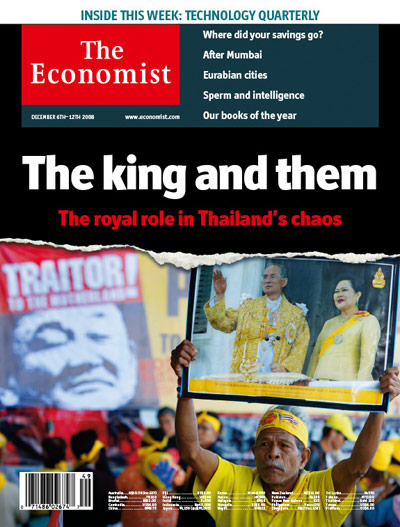
Air Asia's cash
cow
6 December 2008
The following
complaint has been filed with Air Asia; after today I will do all I can to
avoid flying with them.
In addition I can
only counsel against trying to connect from the Low Cost terminal to the
(High Cost) terminal at Kuala Lumpur. It took 100 minutes from landing to
get to the main terminal. The bus is a shocker with no storage room for
bags. When they describe the LCCT terminal as low cost they mean it -
overcrowded and very very basic.
Sir/Madam,
You lost a passenger today - and an old friend of Air Asia. After today I
will do all I can to avoid flying with you again.
I was a passenger on AK873 from Phuket to KUL on 6 December.
This was not my original itinerary. I had been flying Dubai to Bangkok to
Hong Kong and back to Dubai.
Due to the protests in BKK I had to take a 12 hour bus ride to Phuket, fly
Air Asia to KUL and catch the Emirates flight from KUL. My baggage allowance
on EK is 32kg. My bag weighed 27kg.
I had booked for two passengers on the same itinerary for this trip. The
other passenger, Khun Parida, is Emirates Crew and was able to leave BKK on
an EK flight on the night of the 5th after the airport re-opened.
Therefore I was the only passenger though I had paid for two passengers and
two bags.
By the time we knew she could catch the EK flight it was too late to change
her itinerary.
I knew my bag was over the 15kg limit (and I carry as little hand baggage as
possible). But I assumed after reading section 8.5 of your terms and and
conditions that I could use her baggage allowance as we were booked on the
same itinerary and the total weight was less than 32kg.
Your staff member (Bancha Pandam - 1816) at check in was smug and unhelpful
- he said I had to pay a further Baht 1,980 for my baggage - he explained
that i could not use her baggage allowance "for security reasons" and that
this is company policy.
I hate being patronised and treated as though I am stupid.
There is no sensible security reason. This just seems like ill considered
price gouging.
If the other
passenger had been there - and we had only one suitcase between us that
would have been satisfactory.
While so many
people have tried to assist passengers caught up in the problems in BKK I
seem to have been a victim of AA making as much money as possible.
That is unacceptable. And your staff seemed unable and untrained to make any
allowance for the circumstances.
I was so annoyed - I have had to pay the cost of an additional week in BKK
and the cost of travel home to Dubai via Phuket and been greatly
inconvenienced. Being patronised by your staff was the final straw.
I was upset enough to be quite rude to your colleague which is out of
character - but frankly no more than he deserved for his attitude.
Please do explain to me why section 8.5 of your terms and conditions did not
apply in this instance.
Yours sincerely,
Robert Scott
8.5 Trems and Conditions:
Baggage Allowance: You may transport Checked Baggage up to a maximum weight
of 15 kg subject to the conditions and limitations contained in our Terms &
Conditions. However, Checked Baggage will incur a Baggage Handling Fee on a
per piece basis per one way. This may be paid at a discounted rate at the
point of booking or at full rate at the Airport check-in counter. Please
refer to the fee schedule. This fee is non-refundable and non-transferable.
Baby buggies, manual wheelchairs, mobility devices and walking frames are
carried free of charge. There is no baggage allowance for infants, although
a pram/buggy will be carried free of charge.
Guests may not use the unused Checked Baggage weight and pieces of other
guests unless traveling on the same Itinerary. For health and safety reasons
the Carrier will not accept any individual item exceeding 32 kg and with
combined dimensions of more than 81cm height, 119cm wide and 119cm depth.
This weight limit does not apply to mobility equipment.
The battle of
the classes
5 December 2008
I am a bit bored
with writing about the PAD but they really have influenced my life over the
last week.
So a few final
thoughts on this bizarre insurrection which within a few days will just be a
surreal memory.
The big question their actions have raised about the state of Thailand will
continue long after the last plastic hand-clapper has been disposed of.
How could a country as advanced and as dependent on exports and tourism as
Thailand allow such a vital transport hub to be stormed by a mob that never
numbered more than a few thousand? What gives the PAD movement the
confidence to commit its dramatic acts of economic sabotage without fearing
any legal sanction?
When the first PAD convoys approached the airport last Tuesday, they said
they were only going to protest against then-Prime Minister Somchai
Wongsawat, who was due to arrive back from the ApEC summit in Peru.
The government had a strategy of avoiding confrontation - it did not want a
repeat of the disastrous events in October, when several PAD supporters were
seriously injured in clashes with the police.
The police were under orders not to use force and retreated. No-one thought
the PAD would try to take over one of the world's biggest and busiest
airport terminals.
In fact, PAD organisers told the BBC they had carefully planned the seizure
of the airport weeks before. I wonder; is this true or was it opportunism.
It was so easy to get in - let's stay?
The Thai police are sadly no match for this determined and organised
movement. They are poorly trained in riot control, and lack the status of
the army. And the army refuses to help contain the PAD.
The PAD is well
organised and funded. One of the many retired generals supporting its
occupation at the airport observed that it should be seen as a military, not
a civilian organisation.
Behind the "aunties with clappers" and well-groomed young women clutching
lap-dogs that are the public face of the movement are squads of hoodlums,
armed with batons, metal spikes and hand-guns who man the barricades and
hunt down intruders.
On TV these thugs could be seen dragging an alleged government spy off to an
undisclosed location, kicking and punching him. No one has asked what
happened to him. Or to the female police officer who was held hostage.
Within hours of occupying the airport the PAD had ample supplies of food,
water, blankets and medicines for the thousands of supporters who joined the
sit-in.
The food never ran out. You could get your mobile phone charged, or have a
massage. PAD cleaners were brought in to keep the floors and toilets in
order. The duty-free and check-in areas were sealed off and vigilantly
protected by PAD guards.
The PAD's also has its own television station, ASTV, which is widely
broadcast and pours vitriol on the government.
Everywhere the movement goes it takes mobile stages, on the back of trucks,
which blare out speeches and music from dawn until the small hours of the
following morning.
Does this sound
like some of the more infamous fascist movements of the past.
The message is simple: Former Prime Minister Thaksin Shinawatra is evil,
stole the people's money and will destroy the country. The poor rural people
who voted for his party were all bribed, and unable to think for themselves.
There are genuinely people who passionately believe their actions are
necessary to see the end of Thaksin and his followers. And they accept all
the PAD propoganda as gospel.
The question of who is behind the PAD is a subject of intense speculation in
Thailand. There appear to be big Thai businesses that are believed to be
financing the movement, including at least two national banks.
No question Thaksin Shinawatra made a lot of powerful enemies while he was
in office with his aggressive efforts to re-shape the country. And those
enemies are now using the PAD militants to get back at his party.
There are also plenty of former military commanders offering their help to
the PAD - people like General Pathompong Kesornsuk, who has openly urged the
army to launch a coup against the government.
One of the top PAD leaders is Chamlong Srimuang, a former general with close
ties to Gen Prem Tinsulanonda, the king's most senior advisor.
Which leads to a very sensitive question - is their a royal
connection. The PAD justifies its actions as being in defence of the
monarchy; the king's portrait has been displayed prominently during all its
protests. The protestors where the royal yellow colour of the King.
Coincidently, no one in Bangkok is wearing either a yellow or red short now.
Only a year ago everyone would wear yellow shirts, especially on a Monday,
in honour of the King. Now a yellow shirt is an invitation to a hostile
reaction from someone.
The queen did preside over the funeral last month of a PAD protestor killed
during clashes with the police. This was widely seen as support for the
movement.
Hard evidence is difficult to come by. But people's actions in Thailand are
now being driven as much by what they believe as what they know to be true.
The government and its rural followers believe there is an elite conspiracy
to rob them of their electoral mandate. The actions of the constitutional
court last week are seen as part of that conspiracy.
The PAD and its followers believe the pro-Thaksin camp intends to turn
Thailand into a republic, and overthrow the existing social order.
With so much believed to be at stake, compromise between the two sides is
almost impossible.
Emirates - Final Update on Bangkok
5 December 2008
Daily service from
5th December
Double-daily service from 6th December
Full, triple-daily service from 9th December
After conducting a comprehensive security and infrastructure review of
Suvarnabhumi Airport, Emirates has concluded that it is the right time to
resume full Bangkok operations.
We will re-instate full Bangkok services starting Tuesday 9th December.
Effective 5th December, Emirates flights EK372/373 will operate daily
between Dubai and Bangkok.
Effective 6th December, Emirates flights EK8384/8385 will operate daily
between Dubai and Bangkok. Emirates flight EK8384 will depart Dubai at
12:40hrs, arriving in Bangkok at 21:30hrs. Return Emirates flight EK8385
will take off from Bangkok at 01:05hrs, arriving in Dubai at 04:35hrs. From
9th December the flight will re-instate its Hong Kong landing and operate as
Emirates flights EK384/385, Dubai-Bangkok-Hong Kong-Bangkok-Dubai.
Effective 9th December, Emirates flights EK418/419 will re-instate its
Bangkok landing and operate as
Dubai-Bangkok-Sydney-Auckland-Sydney-Bangkok-Dubai.
Our first priority remains to clear the backlog of passengers stranded in
Bangkok, after which we will accept new bookings.
We thank our customers for their patience during this challenging period,
and regret the inconvenience caused by factors beyond our control.
Shuffling towards fascism
The Guardian -
3 December 2008
"Thailand has in a
sense been colonised by its own middle class, many of whom live like
colonial settlers.
Thailand's main
airport is now re-opening, having been blocked by the PAD (People's Alliance
for Democracy, or People Against Democracy, to put it more accurately), at
an estimated cost of 1bn baht ($28m) a day to the Thai tourist industry.
Airports are supposed to be high security areas, but not here, not if you
have enough people, enough weapons and the right backing (which is the army
and, to a greater or lesser extent, the conservative forces behind the
army). Sunday's attempt to send in the police ended up with the cops getting
beaten back and having their tyres slashed.
The police were largely resistant to using force, after their previous
attempt to clear Government House with tear gas led to the death of a
protester (highly explosive Chinese teargas canisters were to apparently to
blame). Meanwhile, the Thai Chamber of Commerce suggested businesses refuse
to pay their taxes until the government got the airport open. So the police
were basically damned if they did and damned if they didn't.
Politics in Thailand has in the past functioned via relatively weak
coalition governments deferring to the holy trinity of the army, the
bureaucracy and the monarchy. This changed with Thaksin, who became popular
enough with the rural poor to achieve a large majority for his party (TRT).
Able to push through any law he wanted, he deferred to no one, and by
putting his people into all of the top positions within reach (the army, the
legislature, etc), set about turning himself into a Thai version of
Singapore's Lee Kwan Yew. He was the self-styled "CEO of the Nation". (Note
the implication of that title – the Thai citizens are his employees?) He ran
a war on drugs that reduced the amount of amphetamine use in the country at
the cost, it has been alleged, of very many police executions, often of the
innocent, to achieve the quotas the police had been set.
He attacked press freedom, built Suvanaphumi Airport, the Skytrain, the
underground, introduced cheap healthcare for the poor, and made sure all of
his businesses did very well. (When he visited heads of state, it sometimes
wasn't clear whether he was doing the country's business or Shincorp's.)
Against a background of unease (largely middle-class) over the way Thaksin
had centralised power, the protests of PAD began. From the start, they tried
to ally themselves with the monarchy in the eyes of the people – for
example, wearing yellow, the king's colour. It is not clear how much this
support was actually reciprocated. When the PAD protester was killed by the
teargas canister, the queen paid for her funeral, attended, and described
the woman as a "defender of the monarchy".
Thaksin's reply to PAD's initial protests was to hold an election, which he
inevitably won. There was some vote-buying by the TRT, and by everyone else,
as there always is, but overall the election underlined his safety.
However, appointing his people to the top jobs in the army was a step too
far. Hence the coup.
When the post-coup elections were eventually held (with Thaksin holed up in
England), they were won by a new party (the PPP) consisting mostly of ex-TRT
MPs. The leader, Samak, was accused of taking his orders from Thaksin. Samak
has now gone, having been found guilty of a conflict of interest (the
conflict being the fact that he was paid for presenting a TV cookery show –
count on a Thai court to keep a sense of perspective) to be replaced by
Somchai, who, just for good measure, is Thaksin's brother-in-law. Somchai
has now stepped down after the PPP was disolved by the Thai courts.
Meanwhile, the PPP MPs left eligible by the courts have formed the Peuea
Thai party, and are expected to form the same coalitions PPP did. This
coalition will chose the next prime minister, and therefore leaves open the
possibility of the protests starting all over again.
It's fairly clear that to win an election, you have to be allied to Thaksin
in the mind of the people, whether or not you are following the man's actual
instructions. The party of the holy trinity – the Democrats – led by
Oxford-educated Abhisit is seen as an urban elite, out of touch with the
concerns of the rural poor. Plus, over the last months, it has been fatally
compromised by its closeness to PAD.
Maj-Gen Chamlong Srimuang, one of PAD's core leaders, responded to this
electoral lock-out by proposing a "new politics", in which only 30% of the
house is elected and the other 70% appointed by the great and good. The
rationale is that the uneducated poor need to be protected from themselves.
It will no longer matter if they vote for corrupt politicians: they will
take what they are given.
Meanwhile, just to add another element into the mix, the leader of PAD, a
media mogul called Sondhi Limthongkul, is gradually starting to believe in
his own culthood. Having convinced himself Thaksin was using Cambodian black
magic from his mansion in Surrey, Sondhi performed a protecting ceremony
involving placing used tampons around a statue of King Chulalongkorn. This
is the man who shut down Thailand.
One of the first things you are sure to be told, in this least nationalistic
of countries, is that Thailand has never been colonised. But look closer.
Thailand has, in a sense, been colonised by its own middle class, many of
whom live in this country like colonial settlers. As with all colonisers,
they see the true centres of culture and education as being elsewhere (the
US, Britain, etc). They send their children to school abroad; they try to
look as western as possible (white = attractive, brown = unattractive). They
have the coloniser's exasperation and disdain for the natives, who are
treated with paternal benevolence provided they know their place. Poverty in
this setting is an ongoing problem; it is not to be solved but is to remain
ongoing, since good works provide the middle classes with their validation:
moments of up-country, genuine "Thai-ness", before air-conditioned cars
return them to their shopping malls.
To read the English-language Thai press is to appreciate the full depths of
this disdain. From an article in the Nation (October 14 2008, before the
airport takeover), written by Thanong Khantong, the Nation's editor, in
favour of PAD's protests: "I don't see Thailand backtracking against the
democratic process ... It is a joke to believe that the rural voters love or
have a better understanding of democracy than the Bangkok middle class ...
The foreign media and foreign experts must stop distorting Thai politics
with their convenient definition of democracy." From earlier in the article:
"A country can survive without democracy but it can't survive without law"
... "The politicians are the main problem and a liability in our democracy."
The last two quotes are what I mean by fascism, since I don't know what else
you'd call it.
It is not possible to have contempt for democracy without first having
contempt for people, since democracy is, after all, meant to deliver the
people's will. Likewise, contempt for people, or at least for a significant
section of a country's population, will eventually lead to a corroding of
democracy. That corrosion is occurring now, and, here, at this moment in
time, is what contempt gets you – a ring of used tampons around a statue and
a shuttered-up economy. And a feeling, growing among many – the poor, the
dismissed, the unnoticed – that rights taken from them will never be
returned."
"Thailand turns
banana republic"
5 December 2008
Sin-ming Shaw
is a former visiting fellow at Oxford University - this View was in the
Daily Times of Pakistan.
"Until and unless
the anti-Thaksin civil elite can convince the rest of the country that they
are serious about winning the hearts and minds of the poor, Thailand will
remain on a knife edge between banana republic and failed state
“Thailand’s future is up for grabs,” proclaimed the eminent Thai scholar
Thitinan Pongsudhirak just before the country’s Constitutional Court ruled,
in effect, that the ruling People Power Party (PPP) and its two smaller
coalition partners are “illegal”, and hence must disband due to “election
frauds” committed by party executives a year ago. Party leaders, including
Prime Minister Somchai Wongsawat, are barred from politics for five years.
With that one stroke, Thailand’s popularly elected government fell.
Parliament must now reconstitute itself without the three parties loyal to
Somchai.
In Thailand’s current crisis, history is repeating itself, for the PPP under
Somchai was the same Thai Rak Thai (Thais Love Thais) Party formed by the
ousted Prime Minister Thaksin Shinawatra, a figure much-hated by the
country’s Bangkok-based elite. The PPP was created because TRT had been
outlawed at the time of Thaksin’s removal.
What is perverse about this is that every recent poll in Thailand shows that
Thaksin remains wildly popular with the vast majority of Thais, most of whom
live outside Bangkok. So, despite the ousting of two Thaksin proxies in a
row by the court and the elite, Thais are likely to return yet another
Thaksin loyalist if they are allowed to vote in an unrigged election.
The current crisis has been brewing for some time, but the breaking point
came when anti-government protestors occupied Bangkok’s main airport. The
protestors marched under the banner of the “People’s Alliance for
Democracy”, but the truth is that they have resorted to undemocratic means
to topple a democratically elected government.
This parade of toppled and ousted governments has led Pavin Chchavalpongpun,
another eminent Thai scholar, to call his country a “failed state”. That
description may not yet be true, but the shadow of state failure is
certainly growing.
Thaksin’s unforgivable sin was his violation of Thailand’s unwritten rules
about how the country’s ruling elites are to behave. The key rule here is
that the winner in any power play must not shut out his opponents. In a land
of “smiles” and plenty, the winner must not take all.
But Thaksin, a self-made billionaire, allowed his greed and huge electoral
successes to get the better of him. After his two landslide victories, he
thought he could have it all. The traditional Bangkok elites had always
thought of him as an uncouth upstart. Once in power, he essentially shut
them out of the “grabbing” game, preserving it for himself and his cronies.
Thaksin’s supposedly legal “tax planning”, which allowed him to pay zero
capital gains tax on the billion dollar sale of his flagship telecom
company, Shin Corporation, in 2006, offended the rising urban professional
classes.
But Thaksin had by then won over Thailand’s rural population through popular
policies including handouts. Some of these projects were the proverbial
bridges to nowhere. But others did meet real rural needs: cutting medical
costs, providing subsidised agricultural loans, and maintaining price
supports. Thaksin’s rural base rewarded him by returning him to power,
ignoring his personal corruption.
Thaksin’s detractors call his rural strategy (which his proxy successors
have followed) cynical vote buying. But Thaksin’s rural base wonders why the
anti-Thaksin groups and his predecessors in power never tried to do much for
them. Such vote buying to win hearts and minds is, after all, a fair game
for any party to indulge in.
The going “wage” for the “Rent-A-Crowds” at the heart of the crisis was 300
Baht a day per person, plus food, transportation, and a clean yellow T-shirt
— yellow being the royal colour. These protests have run, on and off, for
nearly 200 days, with crowd sizes ranging from a few hundred to tens of
thousands. It is widely known that the anti-Thaksin business elites provided
the money to keep people in the street.
Thailand’s universally loved and respected King has not taken a public stand
on the occupation of the airports or on any other recent public
demonstrations. Some analysts say anti-government leaders have hijacked the
royal colour to pretend that they have his support.
Nevertheless it is widely believed that Thaksin committed lèse majesté by
attempting to undermine the moral authority of the crown, a cornerstone of
the kingdom, perhaps replacing it with a republic that he would control.
Lèse majesté is a grave crime in Thailand.
It is true that Thailand’s queen herself recently presided over the funeral
of a protestor killed in a clash with the police. From that point on,
policing of the protests became utterly passive. The queen is rumoured to
have said she would pay the medical expenses of any injured demonstrators.
The anti-Thaksin factions have failed to produce a knockout in any recent
general election. Street protests to paralyse the government remain their
sole weapon. But until and unless the anti-Thaksin civilian elite can
convince the rest of the country that they are serious about winning the
hearts and minds of the poor, Thailand will remain on a knife edge between
banana republic and failed state. —DT-PS"
One-Two-Die is back today
5 December 2008
The bus trip from
Bangkok to Phuket is not fun. It is an 11 hour marathon.
But I felt safer
than if I was on 1-2-Go which has mysteriously been given back its flying
license and is back in the air today.
Banned from flying
by the Department of Civil Aviation on safety grounds, One-Two-Go has now
won back its licence.
The Director-General of the Civil Aviation Department says that the airline
was relicensed on November 25 after passing safety checks.
He added that One-Two-Go was renting planes from Orient Thai and employing
Orient Thai pilots. The airline had initially been suspended for 30 days,
but that was extended three times.
Dear oh dear.
Orient Thai and One-Two-Go are a common airline with common ownership.
Hiding One-Two-Go behind Orient Thai is a sham.
A full report of the findings of the investigation into the crash of
One-Two-Go Flight 269 on September 16, 2007, is in the hands of Thai
authorities but has yet to be released. It should have been released before
this airline was allowed to fly again.
Thai authorities say that the release of the full findings was unlikely
before January, 2009.
While holding back the full report, Thai aviation officials have said that
the crash was largely the result of pilot error combined with a sudden gusty
storm that drove the aircraft into the tarmac as it attempted to land.
Critics have since raised the issue of the reaction time of rescuers and the
effect of a mound of earth beside the tarmac.
Forty of the 130 people on board the MD-80 survived.
EK pilots find A380 too quiet
4 December 2008
Weary Emirates
Airbus A380 pilots are complaining that they cannot sleep in their crew-rest
area in the aft main cabin because the aircraft is too quiet.
The pilots say that the lack of engine noise in the A380's cabin compared
with other long-haul airliners means they are constantly disturbed by sounds
created by passengers, such as crying babies, flushing vacuum toilets and
call bells. Passengers also mistake the rest area for a lavatory, and pull
the door handle.
It really is a
problem of EK's own making. As with the 777 Emirates chose to put the pilot
and cabin crew rest areas together as the back (aft!!) of the airplane.
Other airlines have a pilot rest area behind the cockpit.
So welcome to the
world of the average passenger.
The Dubai-based carrier has asked Airbus for a solution that does not
involve substantially adding weight, which rules out insulating the walls of
the rest area, situated at the rear of the all-economy main deck, says
Emirates senior vice-president, fleet, Capt Ed Davidson.
We are expecting to hear back from them by the middle of the month," says
Davidson, who admits that the airframer has "overdelivered" on its noise
promises on the airline's Engine Alliance GP7200-powered A380s. One option
could be installing lightweight generators to create ambient noise.
Maybe Ipods that
play the noise of spooling engines.
"We're getting a lot of complaints. It's not something we expected," says
Davidson. "On our other aircraft, the engines drown out the cabin noise. On
the A380 the pilots sleep with earplugs but the cabin noise goes straight
through them."
Emirates is the only A380 operator so far to have situated the crew-rest
areas at the rear of the main deck. It did not opt for Airbus' standard
option of locating the pilots' compartment behind the cockpit as it would
have compromised the design of the airline's upper deck first-class cabin
(the showers), while the alternative location of the cargo hold was rejected
as it thought crew would find it "claustrophobic".
King too ill to
deliver birthday speech
4 December 2008
Anyone who thinks
the worst is over does not yet realise that the worst may be still to come.
Today the nation
was waiting for words of wisdom and guidance from His Majesty the King.
The King has a
throat infection and for the first time in his reign he failed to deliver
his annual birthday eve speech. And what a time to be unable to talk to his
nation. Instead of his wise words, people will be greatly concerned for the
health of their revered King, and concerned that he has not spoken about the
turmoil of the last week.
There was also no
written speech for his son the Crown Prince to deliver.
Add to that the
fact that the Parliament session that was due to meet on Monday and appoint
a new Prime Minister has been postponed. And it has been postponed because
the King has apparently not summonsed Parliament to meet.
Meanwhile Forbes
Magazine in its annual review advises that, with a fortune estimated at $35
billion US, Thailand's King Bhumibol Adulyadej is the world's richest royal
sovereign, and oil-rich Sheikh Khalifa Bin Zayed Al Nahyan of Abu Dhabi is a
distant second.
BA and Qantas
tie up is all about costs
3 December 2008
Other than obvious
benefits of scale, the BA Qantas merger does little to benefit either party
strategically.
BA became an
investor in the privatised Qantas back in September 1992, chose ahead of
Singapore Airways on the basis that Singapore would exercise too much
control.
BA and Qantas already share routes between Australia and the UK and don’t
really compete anywhere in the world, so strategically this deal is purely a
cost-saving mechanism.
There are plenty of costs to save with scale allowing better fuel,
maintenance, aircraft and labour savings.
BA would get
access to Qantas' A380s which BA has not yet ordered.
Longer term this alliance may be part of a trans-Atlantic deal with probably
American Airlines which would be of more strategic benefit to the merged
company. deal.
Jetstar, or an equivalent of course, could also end up flying around Europe
for the combined airline, because while BA disposed of its GO subsidiary,
Qantas has successfully combined a low cost and full service airline in the
same group.
Both sides say the talks are at early stages, and while merger parties
always do say that it should be noted airline deals are notoriously hard to
close. a
Emirates Update
3 December 2008
Emirates is
pleased to note that Bangkok’s international airport is slowly resuming
operations.
We are boosting ongoing initiatives to facilitate travel for stranded
passengers.
We are operating two additional, special flights to U-Taphao Airport until
5th December as well as re-instating our scheduled Emirates flights
EK372/373 (Dubai-Bangkok-Dubai) effective 6th December. Emirates flight EK
372 will depart Dubai daily at 09:40hrs and touch down in Bangkok at
18:40hrs. Return Emirates flight EK373 will depart Bangkok at 20:25hrs and
arrive in Dubai at 23:55hrs.
Emirates flights EK384/385 (Dubai-Bangkok-Hong Kong-Bangkok-Dubai) will
remain cancelled until 12th December. Emirates flights EK418/419
(Dubai-Bangkok-Sydney-Auckland-Sydney-Bangkok-Dubai) will overfly Bangkok
and operate on direct routes until further notice. Emirates hopes to resume
these services once the airport facility is fully operational.
Emirates offers the following options, valid for bookings made until 12th
December:
Passengers can choose to travel into or out of another airport that Emirates
operates in the vicinity of Bangkok, such as Kuala Lumpur, Singapore or Hong
Kong. Re-booking or re-issue charges will be waived, and the fare paid
to/from Bangkok will be honoured for travel to/from the alternative
airports. This re-routing is subject to seat availability. The passenger
will have to bear the cost of ground transportation between Bangkok and the
alternative airports.
Passengers can choose to travel into or out of another airport in Thailand,
and their tickets will be reissued as per standard involuntary rerouting
procedures at no additional cost. The passenger will have to bear the cost
of ground transportation between Bangkok and the other airports in Thailand.
Passengers to/from Bangkok who do not wish to re-route can be re-booked on
the first available flight when the airport re-opens by contacting their
local Emirates office.
Passengers travelling on tickets issued as part of an inclusive tour by a
tour operator/ travel agent are requested to contact their tour operator/
travel agent for refund or cancellation.
Dark rumours in Thailand
3 December 2008
To the quarter of
a million tourists stranded for the past week in hotels and departure
lounges it looks like a merciful resolution to an absurd situation. Last
night, after the Thai Prime Minister was forced from power, the People’s
Alliance for Democracy (PAD) announced a big victory and that it was calling
off its action and leaving Bangkok's airports.
The PAD protestors
are ecstatic. But this may just be a lull before the next round of protests.
To assume that Thailand is now at peace would be a mistake. The Prime
Minister is gone. The same people will remain in power.
Tourism and export industries of an entire country have been held to ransom
by a few thousand middle-class zealots in what used to be one of the more
stable nations in SouthEast Asia.
The key question is how such a mob, with a few light arms at best, was able
to occupy a key strategic installation such as an airport so easily and for
so long.
If foreign soldiers or terrorists, such as the ones who attacked Mumbai last
week, had stormed Suvarnabhumi airport, there is little doubt that the Thai
police and Army would have fought against them. It was not that they could
not keep out the PAD, but that they chose not to.
And this raises the crucial question – who is really running Thailand?
Despite its name, the PAD favours a constitutional restriction of democracy
to reduce the influence of rural voters. The majority of voters may reject
the politics of the PAD, but its apparent immunity in the past week shows
that it has backing from institutions powerful enough to intimidate the
police and the Army.
Who might they be? The answers one hears, even from the best-informed Thais,
are vague and hard to prove. No doubt many of the PAD supporters are genuine
in their disgust at the now-exiled Thaksin Shinawatra and the adulation that
he won among the rural poor – but this does not explain how they were able
so blatantly to flout the law and do so without any threat of arrest.
Sondhi Limthongkul, the chief leader of the movement, is a wealthy media
mogul, but he alone could not have sustained the PAD for so long.
Darker rumours – and they are little more than that – infer higher support.
All of this is difficult even to talk about in Thailand.
The sinister PAD
will continue to exert its influence long after the unhappy tourists have
gone home. The PAD will regroup, celebrated the King's birthday this
weekend, re-arm and get their logistics planned. Then they will be ready for
the next chapter in this long saga.
Confusion
continues over airport reopening
3 December 2008
Airports of
Thailand Plc Acting President Serirat Prasutanond said Wednesday commercial
flights may be resumed at the Suvarnabhumi International Airport at noon on
Friday although it will take at least a week before the airport could resume
full operations.
Serirat said passengers would still be required to check in at Bitec
exhibition centre on Friday but the first passenger flight could be resumed
at the Suvarnabhumi Airport at noon Friday.
He said all the systems would have to be checked before the airport could
resume the full opertions.
The checking would be completed in one week at the soonest or would take no
more than two weeks, he said.
PAD to leave airport, declaring victory
2 December 2008
The People's
Alliance for Democracy which seized the Government House and two Bangkok
airports announced an end to its protests at all three locations effective
at 10.00am on the 3rd.
The PAD's co-leaders said they decided to end the protests as they argue
that they have acheived victory over the government.
Nonsense; this was
not a win by the PAD. The government was removed by judicial intervention;
only expedited because of the PAD's protests. The Constitutional Court
dissolved People Power Party, Matchima Tipatayai and Chart Thai parties
early today.
The PAD leaders took turn to declare victories on a stage at Suvarnabhumi
Airport at about 7pm. "All people can go home now. We are the victors now.
However we will be ready to come back if the country wants us too," they
told the cheering crowds.
In a statement issued on Tuesday, PAD said they gained the victory because
objectives of the protests have already been met following the Constitution
Court's ruling to disband the three parties which were nominees of former PM
Thaksin Shinawatra.
The PAD-led protests have lasted 192 days.
The airport will
not reopen immediately other than for cargo flights. The only declared date
so far is 15 December; though it could now be earlier.
Who runs this
country?
2 December 2008
There is a
bizarre annoucement from the PAD and the AOT this afternoon. This is a
complete farce and could be dangerous.
Apparently the PAD
and the AOT (Airports of Thailand Authority) have jointly agreed that
Suvarnabhumi International Airport will resume its service as soon as
technical officials have examined functional and operational systems.
The PAD say that a
meeting with the AOT agreed that all flights in and out of the airport will
be resumed as soon as possible. The PAD, which has seized the airport since
last week, will divide channels and space for passengers from the
protesters. A trespassing mob is now in charge of the airport.
The PAD appears to
be making the decisions at the airport. They will be allowed to continue
their occupation. And passengers will have to walk a gauntlet of protestors!
Meanwhile the AOT say they will jointly inspect the readiness of the airport
with the PAD as soon as possible. Who is in charge? What do the PAD know
about airport operations?
Referring to checkpoints set up by PAD at the entrances of the airport, the
AOT and PAD will jointly conduct the screening of passengers into the
airport. I don't want to be screened by a PAD thug. They have no authority.
No one gave them the right to run who can come in and out of the country.
The AOT initially said that they would resume service on December 3. They
have since amended this to December 15th.
Breaking news
2 December
20008
The Constitutional
Court has ruled that the PPP must be dissolved. No surprise there then. The
court has said that they have committed election fraud.
Prime Minister
Somchai and 36 executives of the PPP have been banned from politics from 5
years.
Somchai's 15
minutes of fame is over!
Now what happens.
There is no appeal
against a ruling of the constitutional court.
The remaining
members of the PPP will join a new party.
The PAD is
meanwhile calling this a victory of the people.
The court of
course is doing what it has been told (by who?) to do.
Tourists die
escaping Bangkok
2 December 2008
Tourist deaths
have now been caused by the PAD action and the chaos that is now travel in
Thailand. Two Canadian tourists stranded by Bangkok's airport closures were
killed and a Briton seriously injured in a car crash as they rushed to catch
a flight out of southern Thailand, police said on Tuesday.
Two Canadian men aged 63 and 48 were killed early on Monday morning in
southern Surat Thani province, as they headed to Phuket international
airport, while a British woman was also wounded in the crash.
'The van overturned and plunged into the roadside after it tried to avoid
crashing with a car in front, which suddenly slammed on the brakes,' said
Captain Charkrit Nima of the local police force.
He said six tourists were travelling in the van in the hope of catching a
Cathay Pacific flight from Phuket, which is handling extra flights out of
the kingdom because of the week-long siege of Bangkok's two airports.
A Hong Kong national was killed in a similar traffic accident on Sunday as
he also tried to get to Phuket to catch a flight back home.
Many tourists are flying out of provincial airports including Phuket and
Chiang Mai. France, Spain and Australia have sent special flights to
evacuate desperate citizens stuck in Thailand.
Tourists are also scrambling to leave via the small, Vietnam-era U-Tapao
airport south-east of Bangkok, where queues snake round the basic terminal
and thousands of passengers jostle to get their luggage through one scanner.
Thai Airways check-in facilities have also been opened at the BITEC
convention centre in Bangkok to try to work through the backlog of
frustrated holidaymakers.
Canada's coup
2 December 2008
It is not just
Thailand that is in political upheaval. Canada is having its own coup;
albeit without an airport takeover. The leaders of Canada's three opposition
parties have signed a deal aimed at toppling the country's minority
government, accusing it of failing to act over the nation's economic crisis.
The three parties have said a no-confidence vote will be held on December 8
in a bid to wrest power from Stephen Harper, the prime minister, and his
Conservative party.
The Liberals and New Democrats signed a formal deal splitting cabinet posts
between them while the third party - the Bloc Quebecois - is promising to
back the government for 18 months.
The parties are also angry that Harper proposed last week to end public
financing for political parties, a move that would have hit the opposition
particularly hard.
The coalition parties agreed that Liberal leader Stepane Dion would head a
coalition government if it were formed after a successful no-confidence
vote, despite the Liberal party suffering a heavy defeat in national
elections only six weeks ago.
The coalition would reportedly try to govern for up to 18 months without
seeking a new mandate, with the Conservatives in opposition. It would also
develop an immediate C$24bn economic stimulus package.
The three parties began negotiating to oust Harper last week after the
Conservatives released a financial plan the opposition criticised for not
including measures to stimulate the weakening Canadian economy.
Conservatives have criticised the move by the three parties as illegal and
as an undemocratic power grab by the Liberal party and its leader. Analysts
also say that Harper is unlikely to give up the reins of power without a
fierce fight and some said this could lead to a constitutional crisis.
The conservatives only took 37% of the vote in the recent election and hold
143 seats in Parliament. A minority; but enough votes, until now, to have
been able to form a government as the biggest party.
The Liberals, New
Democrats and Bloc Quebecois command 163 seats.
Dion was the
biggest Liberal loser in the party's electoral history, he has advocated
carbon taxes as sound economy policy and he lacks significant Western Canada
representation. The Liberals have always positioned themselves as the one
true alternative to conservative government. The Ontario based NDP has never
been big enough to form a federal government and the BQ is self explanatory,
separatist French Canadians. Long term, through this alliance the Liberals
may be the biggest losers; unable ever to form a government in their own
name.
The coalition government -- which would last until at least June 30, 2011 --
would involve a cabinet of 24 members, with six coming from the NDP. The
finance minister would be a Liberal MP.
The Bloc has agreed to support the Liberal-NDPcoalition until at least June
30, 2010.
The opportunity to defeat the Conservatives will come next Monday in a
confidence vote. The government could attempt to avoid defeat, however, by
asking the Governor General to prorogue Parliament. But that is likely to
cause no more than a delay leading to the first governing coalition in
almost 100 years.
It may even divide
the country as the Western based conservative from Alberta and BC see power
seized by Toronto-based Liberals partnered with separatist forces in Quebec.
For Canadians it
is going to be a very strange sight to see Mr. Dion as a prime minister
power-sharing with Jack Layton. So who actually won the last election?
Foreign
reporters question PAD funding
2 December 2008
The UK's Daily
Telegraph is asking and answering the key question of who has got the power
to hold Thailand - and a good sized chunk of global aviation - hostage?
"In the weird and
manipulative world of Thai politics, where the real players hide behind
proxies, its not an easy question to answer.
Some of the most powerful people in Thailand are rarely mentioned in
newspapers. They hold themselves above questioning and above answers.
But a few things are clear. The anti-government People's Alliance for
Democracy (PAD), which has illegally occupied Government House since August
and now occupies Bangkok's two airports, has only limited support.
On a big day their crowds swell to twenty or thirty thousand, but just two
or three thousand is more typical. At Bangkok's international airport on
Monday afternoon there appeared to be only a few hundred die-hards occupying
one of Asia's most important transportation hubs.
The PAD will not disclose their donors, but the protest is known to have
cost tens of thousands of pounds a day for the last six months. Anyone who
turns up gets free food, free iced water and free live music.
The PAD seems to enjoy complete legal impunity for its actions. On Sunday
one of the group's leaders, retired Major General Chamlong Srimuang, met
with police to complain about a string of mysterious attacks against his
supporters. He was not arrested for hijacking the country's two most
important airports.
Bangkok's international airport carries about 3 per cent of global air-
freight and 100 000 passengers a day, many of them transit passengers. Thai
exporters say they are losing £56 million a day.
The loss of tourism during the Christmas peak system could knock 1.5 per
cent off the country's GDP this year, industry leaders claim, and if tourist
arrivals fall by half next year it could cost a million jobs.
On Monday the finance minister lowered his GDP growth forecast for 2009 from
4.5 to 2 per cent.
It is widely assumed in Thailand that the green light to do all this comes
from senior figures in the royal palace or the army. The army has refused to
intervene. Queen Sirikit signalled her support by attending a PAD funeral in
October.
Meanwhile Thailand's elected government - chosen by the poor but loathed by
the urban and aristocratic elite- has been driven into a kind of internal
exile, holed up in their electoral stronghold in the northern city of Chiang
Mai."
Smiley face
over Bangkok
1 December 2008
It took a heavenly
moment to lighten up the gloom over Thailand this evening.
People stopped on
BTS platforms and at any high points to look south into the night sky and
see a smiley face over the city. Mobile phones became the camera of choice
for a very unusual night sky. A smiley face low in the sky to the south.
The planets Venus
and Jupiter formed the two brilliant eyes. Directly below, the crescent moon
was the happy mouth. For those concerned with details Venus was the left eye
and giant Jupiter the right.
This heavenly show
was not seen in the US or Europe.
This is not the only celestial event that will take place this first winter
month, since on December 12, the full moon is set to be the closest to Earth
since 1993, 221,554 miles away from our planet. The moon will not come this
close to Earth again until 2016.
Bizarre driving
license rules
1 December 2008
Certain foreigners
living and working in the UAE will no longer be able to obtain driving
licences if they are doing jobs considered to be menial, UAE daily the Gulf
News reported on Sunday.
Nurses, cooks, housemaids, gardeners and tailors top a list of 100
occupations in which workers without a university education will no longer
be granted licences, the English-language daily said.
It quoted a Sharjah police official as saying the authorities were invoking
an existing law, rarely applied in the past, to curb the number of cars on
the roads.
Licensing
officials and driving schools were ordered last week to check applicants'
residency permits to determine if they were eligible to drive, he added.
"The move is meant to reduce the huge number of vehicles by limiting the
number of professionals allowed to obtain driving licences," the official
was quoted as saying.
It was not clear from the report whether the rule was being imposed across
the country or only in Sharjah.
The UAE has also decided to ban renewing the road licences of vehicles more
than 15 years old as of 2010, in a bid to curb congestion and pollution.
I think this policy may get a re-think!
UAE public sector gets a 10 day holiday
1 December 2008
The UAE public
sector has been given a 10 days off work to mark National Day, Arafat Day
and Eid Al Adha.
Federal
ministries, department and entities would remain closed from Dec. 2 to Dec.
11.
UAE National day falls on Dec. 2 and marks 37 years since the United Arab
Emirates was formed.
Arafat Day falls on the 9th day of Dhu Al Hijja of the lunar Islamic
calendar. Arafat Day marks the second day of the Haj pilgrimage and the day
after it is the start of Eid Al Adha.
Eid Al Adha is the Muslim feast of sacrifice marking the end of annual Haj
pilgrimage to Mecca in Saudi Arabia.
The festival lasts for two to three days or more depending on the country
and starts on the 10th day of Dhu Al Hijja.
The fall out from the Mumbai atrocity
1 December 2008
There is massive
public anger in India; resignations among the government, and calls for
revenge. But against who?
There now seems to
be a growing consensus that the attacks are the work of Pakistan-based
jihadi unit, Lashkar-e-Taiba, whose leader, Hafiz Muhammad Sayeed, operates
openly from his base at Muridhke outside Lahore. As an additional twist
people are saying that the planning and financing could have been done by
terror groups led by Al Qaeda.
Possible financing
maybe from Ibrahim Dawood, now a multi-millionaire owner of a construction
company in Karachi, Pakistan. Perhaps he also helped select the targets and
provide guides to the hotels; the Taj Palace is an old hotel and something
of a rabbit warren.
All the attackers
appear to have been Pakistani. But that does not mean they are government
sponsored. But id does mean that the horrific events have to be seen
in the context of the wider disaster of Western policy in the region since
9/11.
The west
(especially the Bush administration) have not separated the the people of
Pakistan and Afghanistan away from the Islamist extremists as is witnessed
by a gathering catastrophe in Afghanistan where the once-hated Taliban
are now again at the gates of Kabul.
And to make the
whole business more extreme the Taliban appear to be supported by
significant funding and military hardware from Iran.
These were suicide
attacks. A fight to the death at ten different locations in Mumbai. And this
needs a massive organisation to coordinate the attacks. And you need maybe 5
to 7 willing and trained suicide attackers for each target. Reality check -
supplies of young Pakistanis in a hurry to find martyrdom are abundant.
Pakistan was
always the real base for al-Qa'ida. It was the Pakistani ISI military
intelligence which fostered and partly directed the Taliban before 2001 and
revived it afterwards. Thanks to the CIA, ISI and Saudi funding, there are
apparently more than 4000 madrassas, martyrdom academies, in Pakistan.
This was a not a 9-11 style attack. The terrorists did not need months of
learning to fly a plane; they did not need to integrate into Indian society.
They just stormed in through the front door. This was more like a kamikaze
attack.
Which is why talk about whether security at the hotels was adequate is
ridiculous. Hotel security is aimed at stopping sneak attacks,
bomb-planters.
To stop the sort
of heavily-armed suicide squads that hit these hotels would need a full
division of infantry. That cannot be defended against. It could happen just
about anywhere. Thailand would be a soft target. Five star hotel security is
laughable. Anything less than 5 star has no security.
One thing is for
sure; this wont be the last terrorist attack to be led out of Pakistan.
Abu Dhabi wants
stake in Emirates?
1 December 2008
The UK's Sunday Times newspaper is reporting that Abu Dhabi has demanded
control of Emirates, Dubai’s flagship airline, as the price of a
multi-billion pound cash injection for the Gulf kingdom.
The fast-growing airline, long the envy of neighbouring Arab states, has
emerged in recent days as the centrepiece of negotiations over a financial
bail-out for cash-strapped Dubai.
Dubai has been hit hard by the credit crunch. Its property market, in which
the big players are state-owned or backed, has enjoyed explosive growth over
the last decade but prices are now tumbling, leaving heavily indebted
developers badly exposed.
Government sources in Dubai confirmed last week that talks had begun with
Abu Dhabi, which has huge oil and gas reserves, about funding. Rather than
ploughing cash into the Dubai state, Abu Dhabi has offered to invest in its
neighbour’s strategic assets.
The Sunday Times has learnt that Abu Dhabi is eyeing a stake in Emirates,
along with investments in other industries, such as the state water company.
The airline alone is estimated to be worth about £10 billion and selling a
stake in it could generate enough cash to prop up much of Dubai’s economy.
The proposal is controversial, however, as the airline is regarded as the
embodiment of Dubai’s rapid rise to international prominence and an
important symbol of the emirate’s identity. It is owned by the Dubai
government, which is reluctant to relinquish control.
Although other Gulf states are thought to be monitoring the situation, Abu
Dhabi is believed to be keen to offer Dubai a deal that keeps the airline
within the United Arab Emirates.
Airlines have long been a contentious issue in the United Arab Emirates, a
confederation of Gulf states that includes Abu Dhabi and Dubai. In the 1970s
the two states, along with Oman and Bahrain, took strategic stakes in Gulf
Air, intending to turn it into a national carrier for the region.
By 1985, however, Dubai had decided to set up a rival and created Emirates,
backing a largely expatriate management led by Briton Maurice Flanagan.
Emirates has been a success story of international aviation, turning Dubai
into one of the largest hubs, and in the process helping the government
fulfil its ambition of growing tourism and financial services. Abu Dhabi
followed Dubai’s example, setting up its own national carrier, Etihad, in
July 2003.
Meanwhile both UAE-based
airlines Etihad Airways and Emirates denied the Sunday Times report that the
two companies may merge. However, discussions may be at the level of the
owners rather than the airline executives.
Embarrassed
citizens plan retaliation
The Australian
- 1 December 2008
"A relatively
small but well-funded group of middle-class Bangkokians have turned Thailand
into an embarrassment internationally.
If you travel beyond the trendy enclaves of inner Bangkok, you'll find many
Thais are embarrassed and angry about what the People's Alliance for
Democracy (PAD) is doing to the country - hijacking airports and now
threatening to do the same with sea ports if Prime Minister Somchai
Wongsawat doesn't resign.
There is so much anger that it feels like the country is about to erupt. It
will take a miracle for there not to be widespread bloodshed in Bangkok this
week.
Until now, pro-government supporters have been lobbing a few grenades, but
there are rumours that they are arming themselves with more strategic
weapons for an assault on Suvarnabhumi airport.
"We want to free the airport," one pro-government supporter told The
Australian.
And they don't believe the police or army will stop them.
The situation has deteriorated so much that some commentators are now
talking about civil war, as they believe the situation is beyond peaceful
resolution.
And while the PAD protesters detest Mr Somchai and his links to former prime
minister Thaksin Shinawatra, pro-government supporters are also growing
increasingly frustrated with Mr Somchai's inability to solve the crisis.
The army and police don't support him either, with yet another round of
rumours of a coup racing around Bangkok.
A coup, however, would need the tacit approval of King Bhumibol Adulyadej,
but he is said to be ailing, with many decisions being made by Crown Prince
Maha Vajiralongkorn. The prince is a good mate of Thaksin, so it is unlikely
he will want to get rid of the Government that is seen as Thaksin's puppet.
This leaves a situation where pro- and anti-government supporters are set
for a showdown.
But despite their country being in chaos, the sly sense of humour of the
Thais is still evident.
"Let's go to Mumbai. At least they have an airport," is one the blackest
examples of the many jokes circulating, and bringing albeit brief grins back
to the land famous for its smiles."
|