|
How versatile is your shower cap?
May 31 2008
I have never given
the shower cap a great deal of thought until a friend described the critical
role that it plays in her life.
Which set me
thinking - what else can you do with a shower cap. Some web research is
instructive. It is clear that a shower cap has more uses than just keeping
your hair dry when showering. One writer suggested that you can use it to
wrap bowls and plates. The elastic band of the cap will seal the bowls and
dishes. When watering plants, you can also wrap shower caps underneath
flower pots to catch any drips. In addition, you can wrap shower caps around
your shoes when you need to step in from outside.
They can be used
to protect electronics in the rain, when traveling, use them to protect
toothbrushes or other small objects, catch water dripping from hanging
plants or use them to cover bowls of food in the kitchen. They are commonly
used by bikers to keep their heads warm under their helmets during cold
weather. When trying to clean a clogged shower head, fill a shower cap with
vinegar and water, securing over the shower head with rubber bands. After
soaking over night, remove the shower cap and the shower head should be
working properly.
A tip for camera
users: You don't need to keep your camera inside just because there are a
few drizzles outside. A standard hotel shower cap is the perfect rain
protector for your compact camera. Just poke a hole in the middle of the cap
for the lens to protrude through, then put your hands through the "stretchy"
opening and let the elastic close tight around your wrists.
You now have a water resistant cover that enables you to work all of the
controls - perfect for those shots of the kids splashing water in the gutter
on a rainy day.
Bike users also
find that a plastic shower cap is just the thing to keep the saddle dry when
your bike has to be out over night.
Bread bakers use a
clean plastic shower cap to cover their rising dough. It's easier than
plastic wrap, and a large cap will allow enough room for the dough to rise
without becoming uncovered. You can keep the cap from sticking to your dough
by spraying the inside of it with non-stick cooking spray before putting it
over your dough. When you're done, you can wash the cap out and use it
again.
Shower caps
clearly need a massive rebranding; they undersell themselves. These are not
shower caps; these are multi purpose protective accessories; more commonly
known as MPPAs. They deserve more respect.
None of this has
anything to do with why our friend needs a large supply of MPPAs/shower
caps. But there are some things I just cant tell you about!
Dubai's sewage
woes
May 31 2008 -
"Wall Street Journal"
"This Persian Gulf
sheikdom, in the middle of a massive building and tourism boom, has a big
sewage problem.
By one estimate, some $300 billion in new projects are going up in Dubai in
the next 10 years -- including the world's tallest building and a man-made
archipelago of luxury homes on islands shaped like palm trees.
But Dubai's single, 30-year-old sewage-treatment plant isn't keeping up.
Sewage output here is rising by 25% a year. That has officials in this
city-state, one of seven emirates that make up the UAE, scrambling for
innovative places to store the waste, or ways to put it to good use.
In Mirdiff, an area popular with upper- and middle-income expatriates, city
officials have installed underground sewage tanks between newly built
villas. The tanks are designed to store raw sewage until homes are connected
to the city's main sewage system. But the tanks, which are emptied by tanker
trucks two to three times a month, sometimes overflow before they are
drained, residents say.
The smell is unbearable, says Egyptian Mohamed El Hady Ibrahim Salah, a
company car driver. "I hate to think what it will be like in the summer
heat."
At International City, a development close to the Dubai sewage plant, sewage
recently overflowed into the development's streets, submerging roads and
parking areas. The development, which caters to middle- and lower-income
expatriates, was built by government-owned Nakheel, the same developer of
the emirate's palm-shaped islands. A Nakheel spokesman says that the
overflow was the result of a "surge in the sewage system" and that it has
cleaned up the spill. Residents still contend with foul odors.
Every day, hundreds of tanker trucks line up for almost two miles at the
three approaches to the Dubai treatment plant to dump sewage. The wait can
be as long as 10 hours, drivers say.
In order to avoid the wait and processing fees, some truckers have been
discharging loads onto streets of desolate areas in the city, Dubai
officials say, adding that they have fined several violators.
"We're trying to educate people about the problems of doing this," says Ijaz
Ahmed Thir, from the municipality's drainage and irrigation department.
"We've got teams of people on the streets to impose heavy fines when they
find the culprits."
Aisha al Abdooli, head of operations at Dubai's sewage-treatment department,
says the city is doing all it can to cope with the rising amounts of sewage.
A big expansion project to boost capacity is under way at Dubai's current
plant, and a new $500 million sewage-treatment plant is being built at
nearby Jebel Ali. The first phase of the new plant is scheduled to open in
April 2009, and a second phase a year later.
In the meantime, Mrs. Abdooli says some of the city's excess
"tertiary-treated sewage effluent" is used to water the landscaping and
public gardens that now dot much of this desert city. That is shorthand for
treated sewage.
"Most of the city's green areas and public parks are irrigated with this
water," she says.
The practice is increasingly used in other places, but it still comes as a
surprise to many Western visitors and residents, who aren't used to smelly
sprinklers. There could also be health concerns if the water isn't treated
properly. A Dubai Ministry of Health spokeswoman didn't respond to emailed
questions about the safety of the system.
At Dubai's Arabian Ranches, a development of million-dollar homes, parents
whisk children inside when the sprinkler systems start working.
"I try to keep them away from grassy areas as much as possible," says one
English expatriate. The developer of the project, Emaar Properties PJSC,
says it uses some of the water from the Dubai plant for irrigation, as well
as treated water from its own, smaller plants.
"We are aware that the authorities have taken measures to reduce odor
problems, and such measures have had some success," says an Emaar
spokeswoman.
John Robins, managing director of a media group here, quickly closes the top
of his convertible when he drives along a Dubai boulevard where sprinklers
are watering the landscaped medians.
"It's quite nauseous," he says."
No Silver(jet)
lining
May 30 2008
Another airline
casualty as British business-class airline Silverjet became the latest
victim of soaring fuel costs; the airline ceased operations on Thursday
night suspending its flights after failing to secure a crucial funding.
Siverjet was the last of the business class airlines; US based EOS and
MaxJet have both ceased operations this year.
The airline, which operates from London's Luton Airport to New York and
Dubai and is listed on London's Alternative Investment Market, was suspended
from trading last week. The company had signed a funding deal with Middle
Eastern fund Viceroy Holdings for $100.0 million and had sought an initial
installment of $5.0 million, but the funds failed to materialize.
Silverjet says it is in talks with other investors, but with fuel prices
continuing to head north the airline is unlikely to fly again.
Silverjet had a
good reputation in its niche market. Emirates and British Airways will be
happy to pick up the business class traffic.
Thailand's
squabbling elites seem intent on ruining the country
May 30 2008 from AFP/The Economist
"When an elected government took office in January, after 16 months of
military rule, Thailand looked as if it might be returning to stable
democracy. The army chiefs who had removed Thaksin Shinawatra's government
in a coup in September 2006 accepted being overruled by the public, who
voted into office a coalition led by Mr Thaksin's supporters. But political
tension is now rising again. Anti-government protests have returned, raising
fears that the army might use street violence, or the supposed threats to
the monarchy from Mr Thaksin's allies, as pretexts for another coup.
On May 25th the People's Alliance for Democracy (PAD), an anti-Thaksin
group, returned to the streets with a rally in central Bangkok. Only a few
thousand people turned up, nothing like the masses who poured onto the
streets before the 2006 coup and far fewer than the 30,000 the organisers
had predicted. But it was enough to trigger a counter-demonstration from
Thaksinites, with each side chucking plastic bottles at the other. More
protests are promised. The police can contain such minor disorder easily. In
2006, however, similarly small-scale clashes were among the coup leaders'
excuses for deposing the elected government.
The protests' return may mark the end of several months of phoney war
between the two main camps in Thai politics. On one side are the Thaksinites,
led by Samak Sundaravej, the new prime minister. (Mr Thaksin himself has
kept a low profile, busying himself with Manchester City, the English
football team he owns.) On the other is a fuzzy coalition of conservative
and royalist bureaucrats, academics and soldiers, middle-class Bangkokians
and the opposition Democrat Party. The Thaksinites believe the guiding force
behind their opponents is General Prem Tinsulanonda, the elderly chief
adviser to King Bhumibol, though the general denies this.
What has prompted the PAD's return to the streets is Mr Samak's plan to undo
some of the constitutional changes made during the former military-backed
government. One of these is a measure making it easier to ban a political
party. Under this, the Thaksinites' new political vehicle, the People's
Power Party (PPP), and two of its coalition partners face disbandment for
alleged vote-fiddling in December's elections. Another constitutional change
the Thaksinites want to undo is one that legitimised all the coupmakers'
actions—including the creation of a powerful panel to investigate corruption
allegations against Mr Thaksin. Removing this clause from the charter could
get Mr Thaksin off the hook and open the possibility of putting the
coupmakers themselves in the dock.
Mr Samak wants to hold a referendum to ask voters if they wish the
constitution changed again. He hopes thereby to demonstrate his party's
continuing popularity among the poorer, rural majority of Thais and to
undermine the claims of his opponents—a group of mostly elite Bangkokians—to
be “defending democracy”. This week, despite rising worries about the street
clashes, the cabinet backed Mr Samak's plan to hold the referendum.
General Sonthi Boonyaratglin, the former army chief who led the 2006 coup,
seems to have gone quietly into retirement. His successor, General Anupong
Paojinda, keeps insisting that there is no coup plot—but then so did General
Sonthi, right up until the tanks rolled. Mr Samak is said to have built good
relations with General Anupong, perhaps as a hedge against being dumped by
Mr Thaksin. This might make a coup less likely. However, lower down the
army's ranks Mr Thaksin has both supporters and diehard opponents, any of
whom might conceivably hatch their own plots.
The anti-Thaksin movement's language, accusing the government of
“divisiveness”, sounds much as it did in the build-up to the last coup. So
do its accusations of lèse-majesté. Mr Thaksin's supposed disrespect for the
king was yet another of the coupmakers' excuses, though they failed to
produce any evidence of it. Now the same accusations are being made against
Jakrapob Penkair, a minister in Mr Samak's government, over a speech he gave
to foreign correspondents last year about Thailand's “patronage system” and
how it hinders the country's development. The anti-Thaksinites interpret
this as criticism of the monarchy, an offence punishable by 15 years in
jail.
Mr Jakrapob is correct that the system under which Thais owe loyalty to
their patrons, rather than the institutions they are supposed to serve,
undermines the rule of law and fosters corruption. That said, Mr Thaksin's
government, far from ridding Thailand of this feudal mindset, was busy
creating its own patronage system. Whether the patronage mentality derives
from the monarchy or not is something Thais surely have a right to discuss.
The king has said he would accept criticism. But it suits the conservative
establishment to retain the severe lèse-majesté law as a weapon against
anyone who threatens their privileges.
After the 2006 coup the army and its allies in the bureaucracy ran the
country dismally, and Thailand's economy is now among the region's
slowest-growing. Even so, both sides in the conflict are talking up the
chances of another coup—which would be the country's 19th since the absolute
monarchy came to an end in 1932. Even if it does not go that far, prolonged
political strife risks doing further economic damage. Instead of regaining
its reputation as an admired, fast-developing tiger, Thailand risks becoming
one of those perennially unstable, tragi-comic countries, such as the
Philippines, which the outside world overlooks."
Time for another coup?
30 May 2008
Having failed to
get rid of Thaksin and his cronies after the 2006 coup; and having failed to
get a friendly government installed at the last election their are hints
that a bored and frustrated military are thinking of further intervention.
If you dont succeed the first time try, try and try again! Yesterday
Thailand's most senior military commander refused to rule out a fresh coup,
five months after elections restored democracy.
Concern is growing
that a mass anti-government demonstration planned for today could spiral out
of control and turn deadly, giving the army an excuse to step in, after
police failed to quell violence at another rally last weekend. But a police
decision last night to formally charge a senior minister, Jakrapob Penkair,
with lèse majesté for allegedly insulting Thailand's revered King Bhumibol
Adulyadej may calm the tense atmosphere.
What is all the
fuss about - this 21 May 208 translation and summary from
Phujatkan; Author: Panthep Puapongphan, (source
www.2Bangkok.com) may help:
"The actions of our military must come under close scrutiny, as rumors of an
impending coup d’état are spreading by the day. We really should have
learned some vital lessons from the apparent worthlessness of previous
coups, since they have usually done nothing to prevent the return of bad
politicians soon after. We should have already learned that coups can
inflict great damage on our economy. We should now know that military
dictatorships are unacceptable to those other nations with whom we do
business.
Military dictatorships frequently violate the constitution, as they attempt
to thwart the abuse of power by parliamentary dictatorships. At the same
time, parliamentary dictatorships abuse the constitution to absolve
themselves of any responsibility for criminal acts carried out by their
members during their tenure. Both forms of dictatorship show absolutely no
regard for public opinion.
We are currently under the thumb of an extremely powerful parliamentary
dictatorship. This government has placed power in the hands of a number of
dirty politicians. These politicians have shown that they are willing to
abuse their power to protect bad people. These politicians are also willing
to support their ministerial colleagues who pose a grave threat to the
reputation of our royalty. Crisis now seems to be around every corner. The
stability and sovereignty of our nation is clearly affected by these
political developments.
Our three southernmost provinces face violence on an almost daily basis, but
the government seems to be largely ignoring that problem. Additionally,
Cambodia seems intent on invading our territory and stealing our heritage.
Religion is also being used as a political football by this government, as
part of its current attempt to convince people that constitutional
amendments are necessary.
The reputation of our royalty is being defamed on a regular basis. Ordinary
people are suffering from galloping inflation, with higher prices for many
goods. In the face of so many crises, we might well ask ourselves what
exactly the military is doing about all these things. Have they not always
promised to protect the nation, its people and the monarchy? That said, we
must also remember that it is vital that we do not once again make the big
mistake of thinking that a coup is the only solution to all our problems."
One of the demands
of demonstrators was that the police take action against Jakrapob, a
minister in the office of the prime minister, Samak Sundarvej, for remarks
he made last August.
It is remarkable
that a nation's political fate appears to dwell on the August 2007 speech of
one man. This speech was given at the Foreign Correspondents Club in
Bangkok. It was probably meant to be a little controversial for that
audience. But is Jakrapob the defiant "freedom fighter" who spoke at the
Foreign Correspondents' Club of Thailand (FCCT), or another very typical
wealthy Thai politician complaining "conspiracy" and vowing to sue all those
who oppose him.At the FCCT he argued that Thailand's dependence on
"patronage" was regressive, but on the other hand he desperately clings on
to Thaksin Shinawatra, Chavalit Yongchaiyudh and Samak Sundaravej to save
his job. The man is clearly confused between patronage and patronage !!
Meanwhile, the
protesters are also fighting plans by the coalition government led by the
People Power party, a direct descendant of Thaksin's Thai Rak Thai party, to
amend the constitution. Critics say the government wants to prevent Thaksin
being prosecuted on corruption charges and consolidate its hold on power.
"No soldier wants
to stage a coup, but I cannot guarantee there will be no more coups," said
the supreme commander, General Boonsang Niempradit, as he urged Jakrapob to
resign from his cabinet post. Later he claimed he had been misinterpreted.
He said no coup was in the offing, just as the leaders of the 2006 coup had
said before their putsch. "I simply said anyone plotting a coup would not
tell you in advance," he said. "I believe there will not be any coup."
However, the
commander of the army units based in Bangkok was summoned back from a
European trip, amid alarm over today's demonstration.
The temperature is clearly rising.
Burj base
jumper faces jail
30
May 2008

The
unnamed British man who leapt from the Burj Dubai to successfully complete
the world’s highest BASE jump from a building has now appeared in a Dubai
court.
His
25th April feat was achieved after climbing up 150 floors of stairs, hiding
for seven hours and then leaping with a parachute just after 5am as dawn
broke. He was detained on landing and arrested. He evaded all security
checks as he climbed the tower. I hate to say it but being white probably
helped. Anyone who saw him probably decided he was a big biss and was
supposed to be there.
Our jumper told the local 7DAYS newspaper that “The Burj Dubai is the
world’s tallest building and is a marvel of the world. I wanted to honour
it, Emaar and Dubai by jumping safely from it."
He
also had a video camera strapped to his body and the video must at some
stage make good youtube viewing.
He
was charged with illegally entering a property and could face one year in
jail and a fine of dhs5,000.
Defence lawyer Hamdan Al-Harmi, a partner in Al-Sharif Advocates, maintained
that his client was not guilty of anything. “Jumping from a building is not
a crime because my client is professional and was secured,” he said. “He has
done many jumps before and he knew what he was doing. It is not a crime to
enter an under-construction building and he didn’t know that it was
forbidden to do so. He had no evil intentions.”
The term BASE jumping is derived from the four categories of fixed objects
from which a parachute jump can be made - building, antenna, span and earth.
Burj Dubai is also seeking compensation of Dh20,500.
Burj Dubai, in the UAE's trade and tourism hub of Dubai, became the tallest
building in the world in July, measuring 512.1 metres (1,680 ft), a title
previously held by Taipei 101 in Taiwan. Emaar has not revealed how tall the
building will be when it is finished later this year.
More bad news
on taxes
30 May 2008
The United Arab
Emirates is will become the first oil-rich Gulf Arab state to introduce
value added tax; probably by early 2009. Consumers are likely to find a VAT
of up to five percent slapped on their receipts.
Dubai Customs is in charge of developing the VAT infrastructure which once
imposed will aim to gradually replace customs duties that should be slashed
due to commitments made in free trade agreements.
The tax will be applied across the seven emirates that make up the UAE
federation once the decision is taken.
The UAE has established a reputation of being largely a tax-free country
where personal income tax does not exist, while corporate taxation applies
only to foreign oil firms and banks, and municipal tax is imposed on house
rentals.
In an apparent attempt to ease fears of rising taxation among expatriate
workers who represent the bulk of the UAE's manpower, Emirati authorities
have implied that VAT will not exceed the five percent currently levied
through customs duties on imported goods. However, VAT will go beyond
imported goods to include services.
The biggest risk
is of VAT leading to further inflation in the UAE where inflation is already
a major problem. A semi-official report yesterday announced that 2007
inflation was at 14% in the UAE. Introducing VAT may add a point or two to
the inflation rate.
The UAE and other GCC countries have been battling with high inflation over
the past few years, combined with a drop in the value of their currencies,
all of which except Kuwait's are pegged to the weakened US dollar.
Salik shocker
27 May 2008
My birthday
present from the Dubai Road and Transports Authority is a Salik Shocker. The
transport authority announced today an expansion to the unpopular Salik road
toll scheme.
The RTA said on Tuesday it was adding an extra two toll gates - one on
Sheikh Zayed Road at the Al Safa Park Bridge (this will get me at least
twice a day) and the other on Al Maktoum Bridge - bringing the total number
of toll gates to four.
Currently there are toll gates on Al Garhoud Bridge and on Sheikh Zayed Road
opposite Mall of the Emirates.
The new gates will go live from September 9, the RTA said.
The RTA has been dogged by talk of a massive expansion to Salik ever since
the scheme was launched in July last year.
Media reports have claimed there are plans to introduction additional toll
gates on Emirates Road, Al Khail Road, Al Ittihad Road, Shindagha Tunnel,
Business Bay Crossing and Maktoum Bridge by 2009, and on the yet-to-be-built
Shindagha Bridge and a fifth bridge spanning Dubai Creek by 2010.
Motorists are charged 4 dirhams ($1.1) each time they pass through the toll
gates, paying a maximum of 24 dirhams in any one day.
The RTA said motorists passing through Al Safa and the gate opposite Mall of
the Emirates would be charged a toll fee of 4 dirhams once if they pass the
two gates in the same journey.
The authority said the gates were being installed to reduce congestion
caused by motorists trying to avoid the toll gates opposite Mall of the
Emirates and on Al Garhoud Bridge.
In an amazing piece of fiction the RTA said the first phase of Salik had
reduced traffic at toll areas by 25%, and lowered journey times on Sheikh
Zayed Road by 50% and increased average speeds from 40 to 80 km/h. Anyone
who drives this road will simply tell you this makes no sense.
Emirates
increases India flights
26 May 2008
EK cabin crew will
be rejoicing at this news. More long turnarounds.
Emirates will be
increasing its frequencies to key Indian destinations effective July 2008.
This is being made possible due to the recent bilateral enhancements allowed
for UAE carriers to increase capacity to India from their respective hub
airports. The additional operational highlights for EK in India are as
follows:
Hyderabad - increased from 11 to 18 times a week. Effective 2 July EK526/527
gets 3 additional weekly frequencies on Monday, Wednesday and Sunday.
Operated by A330-200.
Effective 3 July a new service is added on Thursday operated by B777-300 and
Saturday by A330-200.
EK528 DEP DXB 1515 ARR HYD 2025
EK529 DEP HYD 2150 ARR DXB 2350
Effective 5 October 2 additional frequencies will be added on EK528/529 on
Monday and Sunday operated by B777-200.
Delhi - increased from 14 to 18 times a week. From July, all 4 additional
flights will be flown using a B 772. Effective 2 July an additional
frequency is added on Wednesday on EK510/511 operated by B777-200.
Effective 4 July three additional fequencies are added on Monday, Friday and
Sunday on EK510/511 operated by B777-200.
Bangalore - Effective 1 July two additional frequencies are added on Tuesday
and Thursday on a new service EK564/565 operated by B777-200.
EK564 DEP DXB 0330 ARR BLR 0900
EK565 DEP BLR 1025 ARR DXB 1255
Effective 1 October five additional frequencies will be added on EK564/565
on Monday, Wednesday, Friday, Saturday and Sunday, all operated by B777-200.
There are likely to be some additions of capacity to other India
destinations in coming weeks.
Dubai searches
for identity as it grows worldly
From The Associated Press
26 May 2008
"DUBAI, United Arab Emirates — Along the creek that runs through the heart
of old Dubai, hundreds of smartly dressed Indians waited in line barefoot to
enter a Hindu temple on a recent weekend. Nearby were joggers, romantic
couples, picnicking families — but hardly any of Dubai's Muslim Arab
citizens.
Across the waterway in the Deira district, thousands of young Asian workers
were out on the streets, drinking tea, shopping or just chatting. Some were
calling family back home, shouting into cellphones in Hindi, Urdu, Pashtu
and Dari.
The only Arab presence was a pair of policemen cruising through in a patrol
car.
Hundreds of thousands of foreign workers — from taxi drivers, cooks and
housemaids to doctors, bankers and judges — have been imported to Dubai,
mainly from South Asia, to run what is perhaps the world's fastest-growing
city.
Amid this flood, Dubai's natives — about 20 percent of the emirate's 1.2
million residents — find their way of life threatened and often react by
isolating themselves.
They once lived on or close to the shores of the Persian Gulf, which
provided past generations with livelihoods from fishing or pearl diving. Now
they mainly dwell in closed communities of luxury villas on the desert
fringes of Dubai, bound by an unspoken pact not to sell or rent their homes
to foreigners.
Where their old homes once stood are gleaming skyscrapers, shopping malls
and fast-food restaurants. The few traditional Arab houses that remain —
one-story, flat-roofed structures with interior courtyards — are home these
days to poor Asian workers, living six or seven to a room.
Arabic, Dubai's native tongue, is another casualty, with English now the
lingua franca for the estimated 200 nationalities living in the emirate.
"We feel like strangers in our own country," said Mohammed al-Roken, a
lawyer and human-rights activist whose calls for political reform and views
on development have gotten him banned from writing in the press and teaching
at his university.
"We cannot safeguard our identity without raising our percentage of the
population," said al-Roken. He wants longtime Arab Muslim residents to be
naturalized, as well as the children of emirate women married to foreigners.
Al-Roken and other Muslim Arab natives have been the chief beneficiaries of
the city-state's rise to global banking and business hub with double-digit
economic growth. But they also feel a loss of identity and way of life.
The citizens' grumbling reflects just one downside of success. More
dramatically, poorly paid South Asian construction workers are showing signs
of unrest, striking and protesting more frequently over pay and living
conditions.
Dubai today is the product of its ruler's ambitions.
"We want Dubai to be the world's number one city for commerce, tourism and
services," Sheikh Mohammed bin Rashid al-Maktoum wrote in a book titled "My
Vision."
That vision has turned the city-state into one of the most
contradiction-laden societies in the Middle East: a Gulf state that doesn't
produce much oil, a multicultural society with religious and social freedoms
unseen elsewhere in the conservative Gulf, yet lagging in political reform.
Despite spectacular growth, many complain Dubai has become a soulless place
where everyone seems to be in transit. A skyscraper boom has turned the city
into a massive construction site with virtually round-the-clock traffic
congestion. Residents say they find the skyline changed each time they
return from a month or two away.
Abdul-Khaleq Abdullah, a political-science lecturer and a native of Dubai,
says his home city's progress fills him with pride.
"But there is a deeply buried sentiment — it is not alienation, but rather
fear — that we may lose everything that we have built," he said. "This
feeling comes from the fact that we are a small minority in a city that's
full of foreigners. We are very scared."
Citizens — but not foreign residents — get cradle-to-grave welfare that
includes free education and health care plus business and housing loans. Now
the government has moved to address the fears that Dubai is losing its
Muslim and Arab identity.
It has declared 2008 "The Year of Identity." It sponsored a two-day
conference on national identity last month and has created an independent
body to promote indigenous art and culture, and is celebrating one of the
country's traditional products by publishing an illustrated encyclopedia of
the date palm.
In other ways, too, Dubai seeks to remind everyone it's a Muslim state.
Stores and restaurants close Friday mornings until after the noontime Muslim
weekly prayers. In the Mall of the Emirates — the largest in the Middle East
— the music dies down five times a day and the muezzin's call to prayer
fills the trendy shops.
Yet permissive ways that are frowned upon by the more conservative six other
sheikdoms of the United Arab Emirates appear to prevail.
Prostitution, for example, is so widespread that many suspect that it
operates with at least some degree of official consent. In one downtown bar,
prostitutes cluster along ethnic lines, with women from former Soviet
republics at one end, Chinese in the middle, and east Africans and Arabs on
the far end.
Foreigners on the beach in bikinis and on the streets in shorts and tank
tops are a source of concern to the native Arabs.
"No kissing or overt displays of affection," advise large stickers recently
plastered on the mall's doors."
Wedding studio
primer
25 May 2008
What does a
wedding studio do? After a difficult weekend in Bangkok that seems a
reasonable question to be asking. There is no tradition of wedding studios
in western counties. Although wedding planners are increasingly common. In
Bangkok there are plenty of weddings studios to choose between and their
roles are very similar.
First made popular in Taiwan, wedding studios kicked off in Bangkok over ten
years ago and their focus remains on the wedding photos themselves - which
are usually taken three to four months before the wedding day.
The busiest months for weddings are May, November and December, so as with
venues, it's advisable to book well in advance.
Prior to the day the wedding studios can also arrange invitation cards,
thank you cards and personalised giveaway gifts for your guests. On the day
itself, they will hire or sell to the bride and groom a dress and outfits
for the wedding; these in theory are the same outfits that are worn for the
photoshoot though in reality they appear to be very different. They also
provide a make-up and hair service. A photographer can also attend the
wedding.
Most recently, studios have started to provide CD-ROM or video packages
about the couple and how they met and fell in love, which are shown to the
guests at the wedding. These are becoming very popular. And no we have not
had a video made!
Three main categories of studios have developed in Bangkok: low-priced,
mid-range and high-end studios. The low-priced are mostly located in the
Banglamphu area, where attention to touching up photos is minimal. Although
the quality is lower, the price is lower as well.
Then there are the mid-range and high-end studios, both of which are mostly
in the Thong Lor and Ekamai areas, were much more expensive when the market
first developed in Bangkok. Apparently couples tend to buy a basic
package but once they see the photographs, they will often order more and
end up spending double the amount. The studios appear to rely on the fact
that most couples don't care about the price because it's a
once-in-a-lifetime thing - quality is much more important to them.
You may also wish to consider where the photographs themselves will be
taken. The wedding studios have there own rooms to take pictures; some may
have a garden; others can recommend venues to suit the happy couple.
Wedding studio blues
25 May 2008
There are wedding
studios all over Bangkok; including a large number on Thonglor. They provide
packages that include the wedding dress and a pre wedding photo shoot and
album. But a word of warning; know what you are getting and not getting. And
try to meet as many of the team as you can to see how they will work and
maybe to let them know your expectations.
We were signed up
with Victoria Wedding Studio; previously known as Picasso. Where do they get
these names! We got off to a good start a couple of months ago. Tai tried a
selection of wedding dresses and found one that she really likes which will
be worn in October.
But it is a case
of bait and switch when it comes to taking pictures. The wedding dresses
that were available for yesterday's photoshoot were no where near as
attractive and in some cases have been well used !
We dutifully
turned up at the studio at 10.00am; and it was a long day; we finished at
about 8pm. Lets quickly mention the good points - the hairdresser/make up
guy did a good job with frequent changes to Tai's hair; even if there was a
lot of gel used ! As well as pictures in the studio Tai had found a great
venue for a location shoot - the Al Majlis Moroccan tea house; the Arabic
theme seemed appropriate.
It was everything
else that was strange and left a bad feeling at the end of the day! We did
not like the photographer at all. Young, off-hand, humourless in both
languages; he looked like he would be happier anywhere else. It is not much
use when the sales girl says - don't worry, he is always like that. And the
way they tool the photographs was strange. Every picture was posed for.
There were no natural or candid pictures; no pictures of us relaxing and
being ourselves. In 10 hours they probably only took 100 pictures. It was as
though they were photographing on film and not digital. And then Tai made
the mistake of asking for to see the pictures. Just a look at the LCD screen
on the back of the camera.
A blunt "no" was
the reply. They would not let us look at any of the pictures. How about
letting us see a contact sheet or thumbnails we asked. No. The message was
that the pictures belong to the studio. We will be allowed to see them when
they are ready; the pictures will then be printed and included in the album.
It is not clear whether we get the jpegs of the pictures that we choose. The
contract is entirely in Thai and I should probably have asked Tai to
translate it so that I was clear what we were committing to.
Whenever I take
pictures with Tai and her friends we are constantly looking at the pictures
as we take them. That instant gratification is part of the fun.
I did take my
camera there thinking I could take a few pictures of Tai. But we were told
very clearly that we could could not take out own pictures. They really do
try to make sure that they keep all the value to themselves. And this is
after paying then Baht 60,000 - the better part of US$2,000. Our friend,
Apple, was there with us for the day (very sweet of her) and she had
smuggled in her little Canon camera and she sneaked a couple of pictures for
us.
They wanted Baht
100 for the taxi that took the photographer and team to the Al Majlis tea
house. They were too lazy to arrange transport for us; so Tai and I are all
dressed up and in a taxi to get there. Given we are paying the studio Baht
60,000 they might have made some effort themselves.
Worst of all was
that my beautiful bride to be was unhappy at the end of what should have
been a fun day and these miserable people really did not seem to care.
The few pictures
that we were able to take are
here.
The reality of
flying Emirates
24 May 2008
My flight from
Dubai to Bangkok, EK384, at 3.15am on Thursday morning was not the best.
Save by the fact that it was
on time.
I was away from my
seat when the food trolley went past. But no one then offered me a
food tray - I was hungry and the crew were rushing by at such speed that I
did not want to stop them and say feed me! The guy next to me was far too
large of the narrow EK seats and he was badly in need of a shower and some
deodorant.
There was no ICE
system and the plane had the old EK seats with no cushion support and the
lumbar support that is fixed and digs like a wooden board into my back.
And for an unknown
reason EK has removed all the footrests from economy. This may be a weight
saving measure. But it adds to the discomfort.
The trouble for EK
is that it has undergone such rapid
growth in recent years that the product is inconsistent. What is advertised
cannot always be delivered. And it is hard to maintain the level of
quality and service that earned the carrier its good reputation.
The pricing out of Dubai is also higher than other carriers.
Emirates boasts of the best in-flight entertainment system; but it is not in
all the fleet and instead you can get a broken seat, an old small screen and
a smelly neighbour who you will be far to close to because of EK's 10 across
EY seating!
Emirates has a
great marketing organisation. Just like Dubai. But in both cases the hype
and the reality can be rather different.
It's raining concrete
19 May 2008
From 7Days -
the Dubai daily free newspaper
"At least 40
cars in a car park were left damaged when construction debris consisting of
concrete and cement fell on top of them on Saturday night, residents of
Falcon Towers on Sheikh Zayed Road in Dubai have said
They said that
police came to the scene and noted down the number plates of all the
vehicles that were damaged in the incident. “It was like raining
stones. People who were parking their cars scrambled for cover after seeing
debris fall from a nearby construction site. There could have been
casualties if the debris had hit them,” said Fadi Abu Hali, a resident
living in the building.
“It is not the first time thats happened. There have been similar incidents
when the windshield of cars were smashed due to falling debris,” said a
resident."
That's my building
that they are talking about. But there are some problems with this story.
Fortunately I parked inside the car park on Saturday night. The cars that
were hit cannot have been in the car park. That would have protected them.
They were parked in the dirt track between Falcon Tower and the construction
site. And this would mainly be used by visitors who cannot get through the
gate to the residents car park. There cannot have been forty cars parked
there. There is no room for forty. Maybe twenty at most.
There are new
signs up at the side of Falcon - construction site - parking is at your own
risk. Yet this side road is now the only passable access to and from our
building so declaring it a building site that we use at our own risk should
be a matter for the RTA, who as usual will do nothing.
Dubai then and now
17 May 2008

Sheikh Zayeed
Road in 1990

In 2003
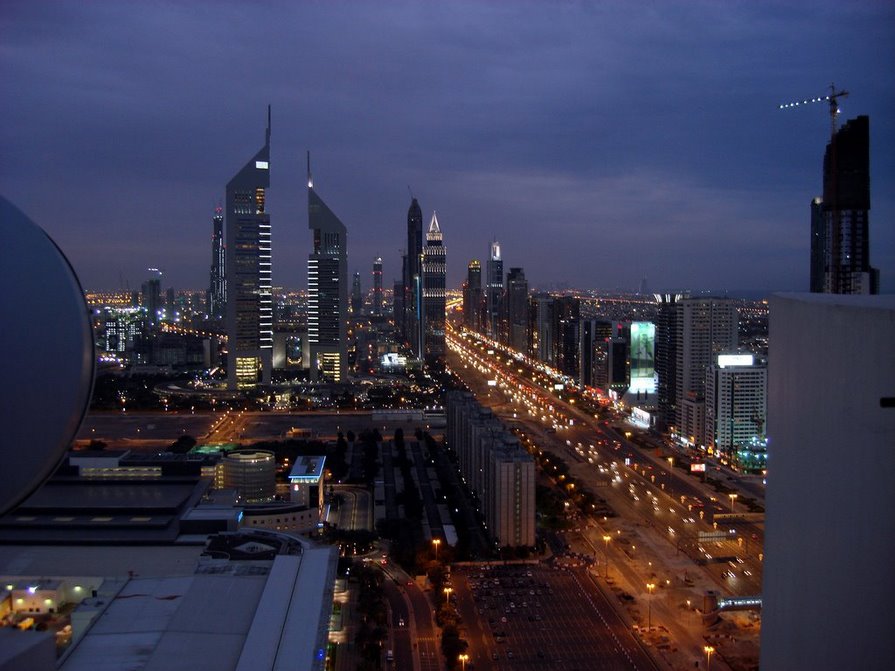
In 2007
Burma's Junta Will Survive the Cyclone
17 May 2008
Asian Wall
Street Journal
It
is tempting to see the destruction wrought by Cyclone Nargis as a catalyst
for democratic change in Burma. After all, other unpopular regimes have been
undermined by natural disasters – think Managua in 1972, or Mexico City in
1985. But the key lesson of Nargis's aftermath is that the military junta
may be here to stay.
The
generals have no other goal. Led by Than Shwe, they manage a vast security
apparatus of 400,000 soldiers. Education, health care and infrastructure?
Ignored. Democratic legitimacy? Who cares. This week, as if to ram this
home, state media announced that the country had approved a new constitution
enshrining the military's power through a rigged referendum that reported
99% turnout and a 92% "yes" vote.
Over
the past 46 years, the generals have signed peace treaties or cease-fire
agreements with most rebel ethnic groups, including the Shan and the Wa. The
political opposition is mostly in jail or in exile. The generals fund their
lifestyle by selling the country's rich natural resources to Thailand, China
and India. That's enough to keep them solvent, even though the United
States, European Union and Australia all have strict financial sanctions
against the rulers, their businesses, and many Burmese exports.
Meanwhile, the Burmese people live in utter poverty, unable to mount any
significant opposition. Most farm for their livelihood and food, surviving
on less than $1 a day.
The
junta's paranoid reaction to Nargis was utterly predictable. This week the
military erected checkpoints along major roads in the Irrawaddy Delta to
prevent foreign-aid workers from traveling to affected areas. What foreign
aid the government has accepted is channeled first to the military – perhaps
so it can be repackaged as Burmese government aid, or squirreled away for
the elites.
The
junta has also squashed any nascent civic organization. Since Nargis hit,
soldiers have ordered homeless refugees in the delta to leave the
monasteries in which they were taking shelter, and forbidden some
monasteries from distributing aid.
"Many Burmese communities themselves who are organizing relief efforts are
being harassed by the authorities," reports Debbie Stothard, the coordinator
for Altsean-Burma, an advocacy group. Burmese citizens who try to take aid
to affected areas have been forced to turn the supplies over to the army.
The
generals, too, have been selective about which foreign nations they'll deal
with in the wake of Nargis. Friends like Thailand are welcomed – 30 Thai
doctors were granted visas to enter the country, and 130 more foreign-aid
workers will be allowed in from India, Bangladesh and China in the coming
days. That's more than double the number of aid experts admitted from all
other aid organizations, including the United Nations.
Enemies like America are allowed to send aid supplies, such as water,
mosquito nets and blankets, but cannot have a physical relief effort on the
ground that the Burmese people could see. Four U.S. Navy ships are anchored
off the coast, ready to deliver 70,000 gallons of fresh water a day to the
delta area – where people are dying from lack of clean water – as soon as
the junta gives the green light. That supply will be lucky to see the beach.
All
this jibes with how Burma's leaders have approached the international
community in the past: shunning outside pressure, while knowing that their
friends will continue to trade with them and that their domestic opposition
has been defanged. That leaves only one real way for anything to change
inside Burma – a military coup.
Before Nargis, this scenario was unlikely at best. After Nargis, it seems
possible. Gen. Than Shwe, the head of state who has been calling the shots
on how aid is distributed, is old and ill. Mid-ranking officers displeased
with the regime's handling of the cyclone crisis have started complaining to
exile publications such as Chiang Mai, the Thailand-based Irrawaddy
magazine. Civil servants and army officers are reportedly deserting their
posts to go home and help their families.
It's
unlikely that a successful grass-roots movement for democracy can be born
out of all this. Cyclone Nargis, which so far has killed more than 60,000
people and displaced a million more, has certainly changed Burma. Whether
it's changed it enough to catalyze a change in government is another
question altogether.
Avoid the Krispy Kremes
16
May 2008
A
study released on thursday in Hong Kong found that a single doughnut can
contain as much as 2.2 grams of trans fats, more than the World Health
Organization's recommended intake for a whole day, the Hong Kong Consumer
Council found.
A Krispy Kreme doughnut was among 85 food products tested by the consumer
watchdog and the Hong Kong government's Centre for Food Safety for trans
fats, synthetic fats linked to obesity and heart problems.
The tests found 4.7 grams of trans fats in every 100 grams of Krispy Kreme
doughnuts, compared with 0.7 grams in a Cadbury chocolate bar, 0.01 grams in
Planters crunchy peanut butter and 0.03 grams in Kettle Chips.
"Eating just one doughnut will boost your trans fats intake to its daily
limit," a Consumer Council spokesman warned. "There is growing evidence
indicating that trans fats intake is linked to an increased risk of coronary
heart disease. Trans fats are now considered to be more harmful to health
than saturated fats."
There was no immediate response from Krispy Kreme Doughnuts in Hong Kong to
calls for comment on the report.
The good news for doughnut lovers is that other doughnut brands tested by
the researchers found significantly lower levels of trans fats. Two other
unbranded doughnuts contained 0.25 grams and 0.46 grams of trans fats per
100 grams.
The spokesman urged consumers to choose food with fewer trans fats as well
as fewer saturated fats and cholesterol, to maintain a balanced diet, use
less hydrogenated vegetable oil or butter fat in cooking, and steam and boil
rather than fry.
Trans fats, which have already been banned by some government, are popular
with food manufacturers because they enhance flavour and make food last
longer.
Hong Kong, where waistlines have expanded rapidly in the past 30 years as
more people abandon their traditional rice diet for more Western-style food,
is introducing legislation for mandatory nutrition labels on food.
Turning a blind eye
14
May 2008
In
Burma today the junta told visiting Thai Prime Minister Samak Sundaravej
that it is in control of the relief operations and doesn't need foreign
experts.
Worse
than this lie, Prime Minister Samak appears to have accepted this statement
and to be telling the world that it need not interfere. This is somewhere
between incompetence, laziness and idiocy,
Samak visited a government relief center in Yangon and told reporters after
returning to Bangkok that the junta has given him the "guarantee" that there
are no disease outbreaks and no starvation among the cyclone survivors.
Samak did not visit the delta region where the cyclone had the worst impact.
"They have their own team to cope with the situation," Samak said, citing
Myanmar Prime Minister Lt. Gen. Thein Sein. "From what I have seen I am
impressed with their management."
International agencies say bottlenecks, poor logistics, limited
infrastructure and the military government's refusal to allow foreign aid
workers have left most of the delta's survivors living in miserable
conditions without food or clean water. The government's efforts have been
criticized as woefully slow.
Samak's negligence is killing people who need aid now. He and the rest of
the ASEAN leaders should be ashamed of their feeble response.
Invade Myanmar now
13
May 2008
Is
this the time for a unilateral - and potentially United Nations-approved -
US military intervention in Myanmar. For simple humanitarian reasons this is
the time to remove that country's bizarre military leaders and move to
a genuine democracy committed to nation building.
Myanmar's ruling junta has responded woefully to the cyclone disaster.
People are dieing because of their failure to approve a swift international
response.
The
US can rapidly deliver aid to the worst-hit areas using US Air Force and
naval vessels, including the US C-130 military aircraft now in neighboring
Thailand, and the USS Kitty Hawk and USS Nimitz naval warships, currently on
standby in nearby waters. Instead the Myanmar military restricts US and UN
aid; takes away the aid that the junta itself wants to stockpile and
rebrands aid containers with the names of the ruling generals. How bizarre.
Washington has long-held economic sanctions against the regime, which were
recently enhanced through financial sanctions against individual junta
members, their families and business associates. Early last year, the US
tried to have Myanmar's abysmal rights record put onto the UN Security
Council's agenda, but the motion was later vetoed by Myanmar allies China
and Russia.
There has been a massive human tragedy in Myanmar. The Junta does not care.
The rest of the world has to. The UN should be taking a strong lead, If it
does not then new hard questions will fast arise about the UN's own
relevance and ability to manage global calamities.
This week, French Foreign Minister Bernard Koucher suggested that the UN
invoke its so-called "responsibility to protect" civilians as legitimate
grounds to force aid delivery, regardless of the military government's
objections. On Friday, a UN spokesman called the junta's refusal to issue
visas to aid workers "unprecedented" in the history of humanitarian work.
How can the UN force aid delivery? Only through the support of US military
management and assets. The moral case for a UN-approved, US-led humanitarian
intervention exists. There are already fights over food supplies in Yangon,
raising the risk that Myanmar troops could soon be called to put down unrest
in the midst of a humanitarian crisis. Last September, Myanmar's army opened
fire against and killed an unknown number of street demonstrators.
I have to believe that US policymakers in Washington are now weighing the
potential pros and cons of a pre-emptive humanitarian mission in a
geo-strategically pivotal and suddenly weakened country. It is likely that
Myanmar's impoverished population would warmly welcome a US-led humanitarian
intervention, considering that its own government is now withholding
emergency supplies.
It is along way from a US military intervention in the name of
humanitarianism to an armed attempt at regime change and nation-building.
Much would depend upon the population's and Myanmar military's response to
the first landing of US troops. Some political analysts speculate that
Myanmar's woefully under-resourced and widely unpopular troops would defect
en masse rather than confront US troops.
While Myanmar ally China would likely oppose a US military intervention,
Beijing has so far been telling the junta to work with rather than against
international organizations like the UN. In its Olympic year Beijing might
decide that it needs to be seen to be supporting a humanitarian initiative
to offset the adverse publicity from Tibet and Somalia.
In
addition the US could call upon the supporters and leadership of a globally
respected and once democratically elected leader in Aung San Suu Kyi to lead
a transitional government to full democracy.
It is
time for the UN to save lives and if in doing so ensure the overthrow of the
generals.
Tremors hit China and Thailand
12
May 2008
A
major earthquake shook China’s Sichuan province on Monday, the US Geological
Survey said.
It was not immediately clear if the 7.8 magnitude earthquake caused any
damage or casualties.
Minutes later, another earthquake also shook buildings in the Thai capital
of Bangkok.
The tremors were also felt in Hanoi, the capital of Vietnam, and high
buildings in Bangkok were continuing to sway seven minutes after the first
movements were felt.
Tearing down Burma's bamboo curtain
12
May 208 from The Australian
THERE
seems to be no underestimating the brutality of Burma's regime as millions
of people struggle to stay alive in the wake of the world's worst natural
disaster since the 2004 tsunami. Parts of the Irrawaddy Delta have been
turned into a mass graveyard, with bloated bodies strewn across the
devastated landscape. Estimates of those killed in the days since Cyclone
Nargis slammed into the Burmese coast on the night of May 2 range from the
official figure of 22,000 (unchanged for almost a week) to 400,000. Now aid
officials are bracing for a second, potentially greater disaster with up to
two million people at risk from malnutrition and disease.
Yet 10 days after the cyclone hit, Burma's generals have done their level
best to ensure that precious little aid has reached the needy. In what the
UN has called an unprecedented situation, hundreds of foreign aid workers
are stuck in neighouring Thailand waiting for visas. Thousands of tonnes of
food, medicines and tarpaulins are sitting in warehouses just a few hours'
flight away. Instead of using its own resources, the regime has insisted on
going ahead with a sham referendum on a new constitution. Voting in those
areas worst affected by the cyclone has been delayed by two weeks. But if
the junta continues to block a massive disaster relief operation, there may
be too few survivors to bundle together for even a stage-managed vote.
Senior General Than Shwe, sequestered in the custom-built and isolated
capital of Naypyidaw and refusing to take calls from even the UN
Secretary-General, Ban Ki-moon, must surely rank as the one of the world's
most despotic rulers. He combines the very worst of Robert Mugabe's contempt
for the welfare of his own people with Kim Jong-il's paranoia about the
outside world. Like Mugabe and Kim, Than Shwe knows that the moment he
loosens his grip, his own survival is at stake. But Burma is not Zimbabwe or
North Korea. It is a fully fledged member of ASEAN and sits astride the most
dynamic region in the world. Yet 46 years of military rule have created one
of the world's poorest nations. About 90 per cent of the population lives on
less than a dollar a day and the country's health system is considered the
second-worst on the globe. Like Mugabe, Burma's rulers have attempted to
seek legitimacy through the ballot box. Ostensibly designed to pave the way
for elections in 2010, the referendum is in reality designed to extend
military rule. The proposed multiparty system is described as a
"discipline-flourishing democracy" - crude shorthand for the military
retaining key powers. As the UN's chief human rights investigator, Paulo
Sergio Pinheiro, said: "If you believe in gnomes, trolls and elves, you can
believe in this democratic process in Myanmar (Burma)".
The Orwellian character of the regime has been reflected in its management
of the disaster response. As thousands starved, state television aired
programs with smiling actors singing about "national unity", and happy army
officers handing out international food aid packages with their names
embossed to thankful peasants. The state-run media yesterday trumpted a
"massive turnout" in the national referendum, but made no mention of the
tens of thousands still missing in the cyclone's wake. Behind this bamboo
curtain lies a different story - one of starving soldiers pillaging what
little food is left from survivors and of bodies being secretly buried by
officials hoping to downplay the extent of the tragedy. The few aid workers
on the ground say the Government wants total control of the situation, even
though it has no experience in relief efforts.
It is little wonder that the international community is growing increasingly
impatient with the Burmese regime. French Foreign Minister Bernard Kouchner
has proposed a UN resolution compelling Burma to accept outside aid. Mr
Kouchner's proposal is based on the notion that the international community
has a right and a duty to intervene in another country's affairs if it is
not upholding its responsibilities to its own citizens. There have been also
calls for the Security Council to suspend or even evict Burma from the UN.
That such drastic action is being talked about should be a wake-up call -
not only to the Burmese regime but also to its allies - that the world's
patience is running out. Short of carrying through with such threats, it is
imperative that countries such as China, India and Thailand, which have some
influence in Burma, keep reminding the generals that humanitarian
obligations must take priority over politics.
A delegation from Thailand was due to meet with Burmese leaders late
yesterday, but its bargaining power has been reduced by the silence from
Beijing and New Delhi over the crisis. Last week, China blocked a proposal
to have the UN humanitarian chief brief the Security Council on Burma,
saying governments should not politicise the issue. A meeting between US
Secretary of State Condoleezza Rice and Indian Foreign Minister Pranab
Mukherjee in which Burma was discussed ended without a strong statement from
New Delhi condemning the actions of its eastern neighbour. Of all these
countries, China has the most to win and the most to lose. An unequivocal
stand in favour of an international humanitarian relief effort would help
China regain some of the moral standing it lost over Tibet as it prepares
for the Beijing Olympics. Inaction could lead to instability in Burma, which
China views as being of immense strategic and economic importance.
International pressure led China to urge the Sudanese Government to tone
down the worst of its excesses in Darfur. It could work in Burma.
Unfortunately, even if Burma was to relent tomorrow, it may be too late for
thousands of survivors. Reaching the needy will be a herculean task. There
are no all-weather roads, airstrips or servicable ports in the
worst-affected areas. Bridges have been washed away and boats sunk. The
impact of the cyclone has already caused a doubling of food prices in the
rest of the country. Reconstruction work will take years and require
continuing international involvement and support. That is the reality that
Burma and its supporters need to understand.
Myanmar places votes before relief
9 May 2008
The Myanmar Junta appears to be blissfully unaware of the disaster that has
hit this poor nation and remains bent on holding a(n) (un)constitutional
referendum on Saturday that is clearly aimed to enhance the junta's grip
over the country.
According to the Myanmar government, over 70,000 people were killed and
30,000 more are missing or presumed dead due to the cyclone last Saturday.
Local Myanmar aid officials believe that the death toll could rise to over a
quarter of a million. At least 2 million people have been left homeless.
Yet for the government's the referendum is the top priority and the cyclone
is an inconvenience. The regime continues to call on the people to endorse
the new constitution on Saturday. "To approve the state constitution is a
national duty of the entire people, let us all cast a 'Yes' vote in the
national interest," state-run newspapers continue to urge.
Yet very few people have actually seen the draft constitution. In Yangon, it
sells for at least 1,000 kyat, the equivalent of US$1, in a country where
80% of families live on less than $2 a day.
The cost apparently varies in other parts of the country - from the
equivalent of $2 a copy in Mon state, near the border with Thailand, to more
than $4 in the predominantly Muslim areas of Arakan and Rakhine states in
the west near Bangladesh.
The government is hoping for a unanimous vote. That is inconceivable unless
the results are rigged. Inevitable.
In the villages in the Irrawaddy area destroyed by the cyclone, the farmers
may no longer have an opportunity to make any sort of vote. The vote has
been postponed there - and may never happen.
There is no doubt though that the real vote is not going to be announced -
it has been rigged from the start. The junta has carried out a concerted
campaign of harassing and intimidating voters. The latest intimidation
appears to be simply to enhance the suffering of over a million.
Keeping the foreigners out
The Guardian, Friday May 9 2008
"Six days after the typhoon that devastated southern Burma,
bloated corpses are floating in the mangrove in the Irrawaddy delta.
Meanwhile, growing numbers of disaster-hardened aid workers are queueing in
neighbouring Bangkok for their visas. Only two UN flights have so far been
allowed to land in Rangoon, but they are not the main problem for Burma's
paranoid junta. It is the army of foreign aid workers who come in with them.
The military regime can not reconcile the crying need for a massive
international aid programme with the openness needed to direct it.
Cyclone Nargis did not just strike one of the world's poorest delta regions
with devastating force. It also came just seven days before a referendum due
to be held on a constitution that will institutionalise the junta's grip.
Keeping foreigners out of the politically sensitive countryside, where
Burma's unfortunate citizens will be frogmarched to the polling booths on
Saturday, is more important to the junta than the need to respond to a
national emergency. No aid agency can even make a preliminary estimate of
the casualties, but it is thought that over 100,000 people could have died
and tens of thousands more could be at risk. The aid workers, however, will
continue to wait for their visas.
Aid agencies are congenitally cautious in their criticism of rogue regimes
because of the access they require for their programmes. But they are
privately furious at what is going on, not least because they are impotent
to do anything about it. Airdrops have been discussed, but the two most
critical needs of the survivors are fresh water and medical attention,
neither of which can be delivered from the air.
It gets worse. The three countries with any purchase over the regime in
Rangoon are China, India and Thailand. After the uprising of Burma's monks
last year, China helped get the UN special envoy Ibrahim Gambari into the
country for a largely fruitless round of talks with the junta. After the
Tibetan uprising this year, that lever over the Burma regime is now gone.
China can hardly demand access for foreign aid workers in Burma when it is
denying foreign human rights workers access to Tibet.
Within 72 hours of the tsunami that swept Asia in 2004, an air bridge of
military aircraft was opened to Indonesia, saving many lives. Even though
Indonesian soldiers were fighting a bitter war in Aceh at the time, the aid
got through to the shoreline that took the brunt of the tsunami and a peace
deal was eventually declared. Analysts will look in vain today for an Aceh
effect in Burma. Not for the first time the junta has shown complete
contempt for the fate of its people."
Inflation in Dubai
9 May 2008
Based on its price
monitoring from first quarter 2007 to the same period this year, the Dubai
Chamber of Commerce and Industry said the prices of staple food items such
as bread, flour, milk and rice in Dubai have soared past the UAE's 2006
headline inflation rate of 9.3 per cent.
The Dubai Chamber
has studied the average increase in the price of ten different product
groups that are considered staple for the consumer's diet. For each product
group, between 29 and 68 different products have been analysed on a
quarterly basis.
The study found that
all ten major food groups have posted significant increases, with flour
experiencing the highest average rise of 57.72 per cent over the past year.
The prices of some
wheat flour brands surged by as much as 145 per cent, corn flour by 162 per
cent and wholemeal by 164 per cent between 2007 and 2008.
The prices of rice,
bread, eggs and powdered milk have also increased by 44 per cent, 36 per
cent, 49 per cent and 35 per cent respectively.
These are
significantly more than the headline inflation and are thus adding to the
overall cost of living in the UAE.
Food comprises 14.4
per cent of the total basket, according to the weights in the Ministry of
Economy's consumer price index.
The Ministry of
Economy has formed alliances with various hypermarkets in the UAE to freeze
the prices of certain essential food items at their 2007 levels after
inflation rose to a 19-year peak of 9.3 per cent in 2006, the latest
available official government figure.
The increasing food
costs in the country have been exacerbated by the weakening of the UAE
dirham, which remains pegged to the US dollar, against currencies of major
food suppliers and have put additional pressure on domestic inflation.
Sanity prevails
9
May 2008
Emirates crew is a bit happier about one flight. From June 1 the non stop
sixteen hour plus Houston flight changes from a 24 hour to a 48 hour
layover. Mauritius, an exhausting 12 hour stop will have an augment pilot
till 1 July; after 1 July it will become a 36 hour layover.
Presumably LAX and SFO will both be launched with 48 hour layovers.
Not so motivational
9
May 2008
For
Emirates it is an HR gamble. Offer a high bonus and then next to nothing by
way of annual pay review. And then link the two. When in all reality they
have nothing to do with eachother. The profit share is a reward to all crew
for a hugely successful past year. The salary increase is meant to offset
rising costs in the current year and ensure that the Emirates is offering a
market competitive salary. A four per cent salary increase is one way of
keeping costs low!
I
suspect Emirates may see a high level of resignations after receipt of the
annual bonus. Given current inflation levels in Dubai (see above) the salary
review looks woeful.
But
EK gets about 60,000 cabin crew applications a year - and it will continue
to do so. It recruits somewhere over 3,000 crew a year. This is not a career
for life; it is a short term way of life to travel the world on EK's
substantial route network.
Keep
recovering!
Emirates gets a nose job
7
May 2008
From
Flight International

Emirates has become the first A350 customer to release images of the XWB
with the revamped nose and cockpit window arrangement adopted by Airbus as
it refines the aircraft's design from the original 2006 concept.
The
revised nose, which dispenses with the dramatic four-window panel layout
illustrated on all artists' impressions released of the A350 to date, was
adopted last year when Airbus decided to incorporate the A380's nose
structural design.
This installs the nose gear bay at the front of the aircraft. In tandem with
this, the refinement incorporates a six-windscreen layout that is less of a
design departure from the original XWB concept, bearing more resemblance to
the A380's window arrangement.
The
A350 is also the first Airbus to do away with opening direct vision cockpit
windows for flightcrew emergency evacuation, with an escape hatch
incorporated in the flightdeck roof instead.
Airbus will reach the A350's design freeze milestone in the fourth quarter,
by which time it is expected to have published images of the aircraft's
definitive shape and configuration.
Burma's twin disasters: A cyclone and the generals
Tuesday, May 6, 2008 - International Herald Tribune
By all accounts, Cyclone Nargis has devastated Burma - a 12-foot wall of
water swept away entire villages, leaving the coastal plain under water,
thousands dead, missing or homeless, and much of the capital city of Rangoon
without electricity or water.
It is the sort of disaster that brings the world together in a single-minded
and unconditional desire to help, and the reaction of national governments,
the United Nations and international humanitarian organizations has been
swift and noble. There is no time to waste.
We wish we could also say that this is no time for politics, but that would
not be true. Burma - or Myanmar, as its junta wants it called - has been
under the dictatorial rule of the military for 46 years, increasingly
isolated from the rest of the world and struggling under economic sanctions
by the United States and Europe. Last September, the world was forcibly
reminded of the junta's brutality when it crushed peaceful protest marches
by Buddhist monks.
These repressive policies contributed greatly to the disaster. Crushing
poverty left many coastal communities more vulnerable to the storm than they
otherwise would have been, and, as Laura Bush correctly observed, the
government-controlled media failed to issue timely warnings. The fear now is
that the paranoia of the generals may create obstacles to the rescue
operation, which will require moving huge volumes of supplies over sea, land
and air, as well as large number of aid workers, many from countries hostile
to the regime.
Though the junta took the unusual step of actually asking for foreign
assistance, the information minister suggested that only "friendly
countries" would be allowed to help. It is not clear whether aid workers
will require visas. The junta also has so far refused to cancel a referendum
scheduled for next Saturday on a constitution that purports to be a step
toward democracy. The referendum will not only effectively leave the
military in control but will divert attention from the urgent task of
recovery.
None of this should dissuade any government or agency from trying to help
with the aftermath of the cyclone. President George W. Bush on Tuesday urged
the generals to open the country to outside help and said the United States
stood ready to "do a lot more."
Burma's fate rests now with the generals, who must summon the decency to
assist their countrymen. In time, of course, the world must redouble its
effort to free Burma from the greater disaster of the junta itself.
Thailand's next coup - when not if?
6
May 2008
From the Nation newspaper
In
Thailand, there is a saying that rumours are factual events that take a bit
longer to become reality. Previous rumours of a military coup usually
preceded an eventual occurrence, like a self-fulfilling prophesy.
Over the past weeks, there have been talks about a coup in different
circumstances. Some people scoffed at such a suggestion as wild and
unthinkable in light of the military's retreat from active politics.
Realists or pessimists refused to reject such a possibility outright after
experiencing such seizures of power by the military, unhappy with an
unstable political situation, blatant corruption by politicians, or by
whatever reasons cited for the putsch.
After each coup, and the troops' return to barracks, it was said that such
use of force to change a government should be the last. Coups are an
outdated mode of political change, condemned by the international community,
pundits usually claim.
Each time, they were proven wrong by real events. There was always a new
claim, excuse, or provocation for the military to act. Each one left a
different scar on the country's political history.
The new rumours came too soon, not even before the Samak government
completed its first 100 days in office. They began with idle talk and
wishful thinking resulting from frustration over the despicable conduct of
wild-eyed politicians, whose arrogance knows no bounds.
They are the same politicians who have had experience of being toppled by
military coup, and still refuse to learn the bitter lesson due to the idea
that their bold challenge through insolence and audacity would not be
answered by extreme measures.
This time, the latest coup rumours were fanned by Prime Minister Samak
Sundaravej through his Sunday radio talk show. He even made startling
revelations that Cabinet members would be captured and herded onto
helicopters to unknown destinations.
Why so? Samak did not elaborate, and he just left it at that, like a cliff
hanger thriller, with an untold climax.
His way of telling the coup plot, with traces of sarcasm in his tone, made
the audience think that he did not believe one bit of the rumour. He even
jeered at the idea of a coup. "Would they have the nerve to do it again, so
soon?"
Oddly, there were mixed responses from the generals. Those who were
ambiguous just uttered a few non-committal sentences, not rejecting and not
admitting anything. They were playing safe, obviously, keeping all options
open. These groups are usually going along with their comrades-in-arms when
persuaded to join the real action. Not the leaders, just those who do not
want to disappoint friends or create an atmosphere of distrust during
testing times.
The commanders who shot down the coup rumours too quickly are traditionally
the ones who decide on the real action. They are highly suspect and should
be watched closely to see whether their devious moves lead to the order for
the troops to move. Did Samak and his fellow Cabinet members have sufficient
reason to worry about being unceremoniously booted out? If they are honest
with themselves, they should admit that there are some grounds for concern.
Whether it was habitual bravado or real courage, Samak made it clear that he
would not flinch or be discouraged from the all-out drive to amend the
charter, come hell or high water.
The attempt to push through constitutional amendments at any cost by the
People Power Party is the prime reason. There are also other factors such as
the repeated demeaning of revered institutions, the national flag and other
conspiratorial moves.
All combined, it is not easy to pinpoint which one will end up being the
last straw. Not that there were just rumours of a coup, there was conjecture
over which side will launch a preemptive strike.
Thaksin's homecoming again on Sunday serves as another variable. He is in a
hurry to end the ongoing legal process to bring him to criminal trial for
several cases of malfeasance and corruption during his premiership. His
presence is needed to decide who should be House Speaker and approve new
moves.
What comes next is an inevitable political confrontation. Those against the
charter amendments will risk facing pro-Thaksin political goons spoiling for
violent street clashes. The showdown could be quite messy.
If the crisis gets out of control and the anti-riot police fail to quell any
upheaval, then it is not difficult to predict the unfolding consequences of
the power play. It does not have to be a coup in the true sense of the word
this time around.
Watford squeeze into play-offs
5
May 2008
It
was a local boy, Tommy Smith, who took Watford into the playoffs for the
last Premiership place. His equalizer against Blackpool sealed 6th place in
a league that Watford were at one time top of for 99 days with a nine point
gap to second place.
The
Hornets came from behind to draw 1-1 at Blackpool to finish the season on 70
points - the same as Wolves but with a superior goal difference of just one
goal. The margins between success and failure can be very narrow indeed.
It has been a stuttering second half of the season but don't count the
Hornets out. They have always been a good cup team! Watford now play Hull
City over two legs while Crystal Place play Bristol City. The winners of
both semi finals meet in the final play off match.
With
only one win in the last 14 games Watford are hardly the form team. But all
the league form is history now. It will be simply who takes their chances
and holds their nerve over the last three games. Watford have been here
before; two years ago when we on promotion to the Premeirship beating Leeds
at the Millennium stadium.
EK
announces Durban in time for summer sun
5
May 2008
Emirates announced today that it will start a new daily service to Durban
from 1 December 2008. The new service will be Emirates' third direct
connection between Dubai and South Africa and is part of the build up of
services before the 2010 World Cup of which Emirates is a major sponsor.
Durban lies in the heart of KwaZulu Natal, otherwise known as the Zulu
Kingdom, and is a fascinating blend of British, Zulu and Indian history.
Located on the east coast of South Africa Durban is a natural hub for trade
with the Indian Ocean and Asia Pacific countries, boosting its status as
Africa's largest port and the world's ninth busiest.
Durban is Emirates 16th passenger destination in Africa.
Emirates will serve Durban with an Airbus A330-200 aircraft offering 27
Business Class and 251 Economy Class seats. The Dubai-Durban flight will
cover a distance of over 6,600 kms in 8 hours 40 minutes. The flight
schedule is:
EK774 departs Dubai daily at 04:45 hours and arrives in Durban at 11:25
hours
EK775 departs Durban at 13:15 hours and arrives in Dubai at 23:45 hours
Emirates will move to new Jebel Ali airport
2
May 2008
Emirates Business 24/7 reports that Emirates plans to eventually
shift its base to the Al Maktoum International airport coming up in Jebel
Ali's Dubai World Central development. This makes sense given the scale of
the investment in the new six runway, 125 million passenger airport.
My
guess is that the existing Dubai airport would not be used for low cost or
business traffic, which can also be housed at the new airport. The existing
site is better being returned to commercial developers. However this could
all be 5 to 10 years into the future.
Tim
Clark, the airline's president. said "clearly, in the future, the whole of
Emirates operations would be moved to the new airport in Jebel Ali. Emirates
has to go to a hub that it has been heavily involved in the design of. It
would not make much sense if we would do that and not go there."
"The government has got consultants working on the airport project at the
moment, who are at a very advanced stage of the preparation of the master
plan. By the end of the year, they will have a detailed plan of what the
airport is going to look like, the final design and so on," he added.
Clark further said the two airports – Dubai International and Al Maktoum
International – cannot co-exist.
"Personally, I do not see a place for two airports in Dubai. The new airport
has to be built to the scale that Dubai needs. Today, we have real
constraints in the current Dubai airport. We have carriers who want to come
here and can't and carriers who want to come in at a particular time and
they can't," Clark said.
"The Terminal 2 expansion for the regional carriers, on the other hand, is
going at such a pace, it is really an airport under pressure," he added. "I
am sure the government is taking cognizance of the fact whether there will
be one or two airports. If there are two, there will be pros and cons. But I
eventually see just one airport in Dubai."
So what about the investment being pumped into the new Terminal 3 and
Concourse 2, which are especially being built for Emirates?
"Tough one, isn't it? You have got to look at the big picture. If the
government is spending $30bn (Dh1.1trn) on a place such as Jebel Ali, then
the reality is what you do with your existing airport structures would have
to be faced," said Clark.
Meanwhile, Terminal 2 and Concourse 3 are both scheduled for opening in the
fourth quarter of this year. "We should be able to move into Terminal 3 by
Q4."
|
