|
Welcome to rascott.com
This is a
personal site that reflects my interests in news,
current affairs, aviation and travel.
email me:
robert@rascott.com
Home
Up
Now In Dubai:
Scott
Consulting
Photo Albums
My photographs have been moved off this site and are now stored on Picasa. They
were simply taking up too much space on my web host.
Please use
this link to see my list of photo albums.
Some
Useful links:
Information:
World Time
Clock
Exchange Rates
Journalism:
ForeignPolicy
Nationsonline.org
Project Syndicate
Amnesty International
Reporters w/o borders
The Guardian
BBC World News
CNN Asia
Bangkok Post
Daylife.com - news
Gulf News
Arabian Business
World News
WSJ - Asia
SCMP
Good causes:
Sister
Joan - Bangkok
Regional Info:
BKK Magazine
HK Magazine
In
Singapore Magazine
TimeOut Dubai
Back in the UK:
Newton Ferrers
And for fun:
Lin Ping live panda tv
EarthCam
History
BBC Archive
National Media
Museum
The British Library
Imperial War Museum
There are many other links on my
AOB blog page.
| |
|
60 years
1 June 2012
The English
monarchy means little to me. As the New Statesman wrote this week: "it seems
churlish to point out that awarding great privileges and pseudo-medieval
deference to members of an otherwise undistinguished Anglo-German family ill
befits a nation that wants to see itself as democratic, meritocratic and
modern."
But many people
love the royals, they are good for tourism, they may indeed be better than
an elected President in a republic and if you have to have a monarch then
you may as well have a decent hard working one.
The four-day Bank
Holiday gives the country the opportunity to gather together to mark the
Queen's historic 60-year reign.
I can remember her
Silver 25th anniversary. I was still at university. In Redbourn, where my
parents lived, there was a huge Elizabethan street party. 35 years later
this will be a far bigger event with three days of events.
Up to a million people are expected to line the banks of the River Thames
and nearby open spaces to watch a majestic 1,000-strong flotilla sail
through London on Sunday. And stars like Stevie Wonder, Sir Paul McCartney
and Sir Elton John will perform at a concert on Monday day in honour of the
longest reigning monarch since Queen Victoria.
Almost six million Britons plan to throw a Jubilee party this weekend,
according to a study. It really is an excuse for a four day party: bunting,
Pimm's and gnomes have become sell-out products as people hold outdoor
parties to mark the Diamond Jubilee.
Waitrose said sales of Pimm's were up by more than 260 per cent on last
year, with trifle up 28 per cent and picnic or party paperware up 182 per
cent.
The DIY retailer B&Q said it had sold 100,000 metres of Union Flag bunting,
10,500 jubilee cushions and 3,100 jubilee gnomes.
Sainsbury's reported sales of 364 miles of bunting and is expecting to sell
nearly 10 million servings of strawberries.
Marks & Spencer said it had sold more than 50,000 commemorative jubilee
biscuit tins and 31 miles of bunting – enough to line the Mall 155 times.
The Queen's
great-great-grandmother Victoria is the only other British sovereign to have
celebrated a Diamond Jubilee.
All the evidence suggests that Britain remains a nation which is
overwhelmingly comfortable with the monarchy, and which feels that the
qualities offered by a queen such as Elizabeth II are qualities which it
values and would not wish to lose.
For those reasons, on the River Thames on Sunday, outside Buckingham Palace
on Monday; at St Paul's Cathedral and along the route back to the Palace on
Tuesday, and at countless street parties and beacon lightings, Britain will
reaffirm its commitment and gratitude to its Queen. Across the commonwealth
there will also be events and tributes.
And in all honesty
the Queen has given sixty years of remarkable service to her country. Not
all her family are quite such shining successes but the crown does appear to
be in capable hands.
A special visual tribute will see Diamond Jubilee Beacons light up the night
sky across the UK on Monday, with more than 4,000 expected to be lit in the
UK and across the Commonwealth.
A St Paul's Cathedral service of thanksgiving will be the highlight of
Tuesday, ending with the Queen appearing on Buckingham Palace's balcony to
acknowledge the tens of thousands expected to fill The Mall. There will be a
fly-past at 3.30pm UK time.
Prime Minister David Cameron, the Duke of Edinburgh, Prince of Wales and
other senior royals will join prominent individuals from the UK and abroad
at many of the events.
The celebrations begin with the Queen enjoying her traditional outing to the
Epsom Derby. As a passionate horse breeder, she rarely misses the famous
race meeting and will take her usual place in the Royal Box to study the
form - but we are told (with some scepticism) that she does not bet.
The Thames River
Pageant takes place on Sunday. The 1,000 boats will be led by the “herald
barge” which will carry eight newly cast giant bells — each one named after
a senior member of the royal family.
The bells of the churches along the Thames will reply to the peal sounded by
the barge as it sails downriver.
Next in line will be Gloriana, the £1.5 million rowbarge gifted to the Queen
on behalf of the nation and with a team of 18 rowers led by Olympic
champions Sir Steve Redgrave and Sir Matthew Pinsent.
The crew also includes three injured soldiers who were part of a six-man
Row2Recovery team that rowed across the Atlantic earlier this year, Lt Will
Dixon, 27, Cpl Rory Mackenzie, 30, and Cpl Neil Heritage, 31.
Also on board, but as passengers, will be Major Kate Philp, who was the
first British woman soldier to lose a leg in combat when her Warrior tank
ran over a bomb in Afghanistan in 2008, former royal protection officer
Andrew Child and former firefighter David Melrose, who was left paralysed
when a beam crashed into his back while tackling a blaze at a golf club.
The Queen will pass a guard of honour of Chelsea pensioners as she heads for
the royal barge, which she will board at Cadogan Pier after setting off on
the tender from the former Royal Yacht Britannia.
She will be accompanied on the royal barge by the Prince of Wales, the
Duchess of Cornwall, the Duke and Duchess of Cambridge and Prince Harry.
A second herald barge will carry the Academy of Ancient Music, playing
Handel’s Water Music. The Royal Marines herald fanfare team are next,
followed by the Band of the Royal Marines, which will sail alongside dozens
of Dunkirk little ships.
Others in the 10 musical barges are a pipe band, a Commonwealth chorus, the
Mayor’s Jubilee band of young musicians and the London Philharmonic
Orchestra, which will play classic British tunes such as Jerusalem and Land
Of Hope And Glory as it brings up the rear.
This is an event
that the Thames has never seen before and will unlikely see again.
As for the Queen - she is the 40th monarch since William the Conqueror; she
has overseen 12 Prime Ministers during her reign; has attended 35 Royal
Variety performances; has owned 30 corgis, starting with Susan — an 18th
birthday present. She currently has three, Monty, Willow and Holly. She is
the patron of 600 charities.
The threat to Thailand's internet economy
1 June 2012
Google has
released a statement in English and Thai entitled “A threat to the potential
of Thailand’s Internet economy” (การคุกคามต่อระบบเศรษฐกิจอินเตอร์เน็ตที่มีศักยภาพของประเทศไทย).
Below are some excerpts from the statement in English:
"Today, a decision was made in a Thai courtroom that runs counter to the
country’s exciting and important role in bringing a free, open and
prosperous Internet to life. To summarise the case quite simply – a Thai
woman who runs a website has been fined and sentenced to eight months in
prison (though that sentence has been suspended) for offensive comments left
on her site by users, comments that she removed once notified. Though she
was only convicted on one of ten counts, convicting her for something she
never wrote sends a clear message to the entrepreneurs and business leaders
who run Internet platforms in Thailand that they can and will be penalized
for the independent actions of users.
The precedent set by this decision is deeply concerning because Internet
platforms, often referred to as ‘intermediaries’ – basically, the tools and
sites many of us use every day to connect with friends, family and customers
around the world, such as social networks, online marketplaces and web
forums – are the foundation of the web.
Imagine if tomorrow your favorite online services decide to shut down
because their owners, fearing prison time, start seeing the risks as far
outweighing potential returns. We would not just lose the services we love
or rely on, we would lose our ability to connect with the world, to innovate
and to experience the opportunities available in countries that embrace the
digital economy.
The Internet connects us and our ideas. A free and open Internet ensures
that great ideas, the ones that spark innovation and have the potential to
change our world for the better, have a platform to be seen, heard and
shared.
Telephone companies are not penalized for things people say on the phone and
responsible website owners should not be punished for comments users post on
their sites. Unfortunately, Thailand’s Computer Crimes Act is being used in
this case to do just that.
The Computer Crimes Act stifles innovation and deters investment in a
country and a people full of potential. We understand this is not simple. It
is complicated and it is often not black and white. But if there were
transparent rules about how to identify and react to unlawful content,
Thailand will have a more free and open Internet and in doing so, allow
millions of Thais, from small business owners to students to civil servants,
to connect with the world and grow the Thai economy.
Google is committed to Thailand and our Thai users. We are here for the long
term. And we look forward to a future that keeps all of us connected."
6 reasons Spain will leave the euro first
Commentary: Spain is too big to rescue, and doesn’t want it anyway
30 May 2012 Wall Street Journal - Matthew Lynn
The euro debt crisis, like any really spectacular geoeconomic event, is
spawning its own special vocabulary.
We’ve already had Merkozy, now relegated to the footnotes, and are slowly
getting used to the clunkier Merlande or Merkellande, as the oddly matched
pairing of the German Chancellor Angela Merkel and the French President
Francois Hollande has been dubbed. The Grexit, short for Greece finally
giving up on the single currency, has been trending for the last few weeks.
And coming up next: the Spexit.
What’s that? It’s shorthand for Spain quitting the euro — and we’re going to
hear a lot of it over what promises to be a turbulent summer.
The Spanish are a lot more likely to pull out of the euro than the Greeks,
or indeed any of the peripheral countries. They are too big to rescue, they
have no political hang-ups about rupturing their relations with the European
Union, they are already fed up with austerity, and there is a bigger
Spanish-speaking world for them to grow into. There are few good reasons for
the country to stay in the euro — and little sign it has the will to endure
the sacrifices the currency will demand of them.
Even with the fresh Greek elections looming, Spain has moved center stage in
the euro crisis and is likely to remain in the spotlight for the rest of the
summer. Its economy stumbles from bad to worse. The bond markets have turned
on it decisively, pushing rates on 10-year bonds to 6.45%, close to the
levels hit at the depths of the crisis.
The banking system is teetering on the edge of a full-scale run. Bankia has
already had to be bailed out by the government, and there are fears that
others might be in just as bad shape. In the entire recorded history of
capitalism there has never been a property crash that hasn’t been followed
by a banking crisis. Spain has a huge property crash, and it’s not likely to
be the first exception to that rule.
Its economy is already back in recession, and is likely to shrink further.
Unemployment is up to 24%. One in four Spanish households now have no
breadwinner. Retail sales are now falling at 10% year-on-year. Yet the
prescription from Brussels and Berlin is precisely the same as it has been
for every other country struggling with the euro. Endure a deep recession.
Let unemployment rise. Allow wages to fall until you claw back
competitiveness.
In Greece, people have just about put up with it — until now. So have the
Irish, the Portuguese, and the Italians. The Spanish won’t. Here’s why.
One: Spain is too big too rescue. When it comes to the crunch, the EU will
always bail out the Greeks. Its economy is only worth 230 billion euros. It
can be subsidized forever. If the Greeks vote for a government that rejects
the bailout package, some more money can be thrown at them. Pumping 10% of
gross domestic product into the economy only costs 23 billion euros —
peanuts. That is not true of Spain. If the economy collapses, it can’t be
rescued. It will have to do the hard work by itself.
Two: Spain has tired of austerity already. Remember, the protests against
cuts began in Madrid a year ago with the “indignados” movement, which
started sit-ins across major cities in 2011. The protests spread from there
to Greece, and other euro-zone countries. The austerity had hardly even
begun, yet already it has provoked strong opposition. The country faces many
tough years in the euro zone, and there is little sign it is prepared for
that.
Three: Spain has a real economy. The Greeks understandably feel nervous
about life outside the euro zone. They don’t really make anything. Spain is
a successful economy with a perfectly respectable industrial base – its
export to GDP ratio is 26%, similar to the U.K., France or Italy. Only last
week the Japanese car-maker Nissan announced a major new investment there.
Spain’s problem was a deranged currency that created an insane property
bubble, which burst with calamitous results. But there is no reason for
Spain to fear it doesn’t have a prosperous future outside the euro. It has
plenty of successful export industries.
Four: Spain is politically secure. For many countries, euro membership is
more about politics than economics. The Greeks stay in because it locks them
into Europe (rather than being part of the Turkish sphere of influence).
Latvia wanted in because it made it part of the EU rather than being
dominated by Russia. For the Irish, it is about separating themselves from
Britain. The Germans stick with the euro because the EU still represents a
break with its troubled past, even if that is fading for the younger
generation. For the French, the currency boosts their influence in a world
where medium-sized Europeans states don’t count for much anymore. But Spain
does not have any of those issues. It can take or leave the euro and the EU
depending on whether it works or not. And right now it clearly isn’t
working.
Five: Spain has bigger horizons. The Spanish economy looks partly to Europe.
But it looks just as much to the booming Spanish-speaking economies of Latin
America (and indeed the huge Hispanic market in the U.S.). Rather like the
U.K., Spanish business has always looked to the global rather than the
European market. Why tie yourself to a failing project when there are much
bigger opportunities out there?
Six: The debate has already started. There is already a serious discussion
underway in Spain about the future of the currency. Plenty of mainstream
economists and pundits are arguing that the real problem is the euro, and
Spain will only recover once it gets the peseta back. The taboo has been
broken. That isn’t true in Greece, where even the far-left Syriza party
still clings to the idea that it should stay in the euro.
For all those reasons, the Spain is the nation within the single currency
that might conclude first that a negotiated departure from the single
currency is a logical step. It might not be alphabetically correct, but the
Spexit will come before the Grexit.
BKK airport to
be expanded (at last)
30 May 2012
Airports of
Thailand Pcl is to spend about $1.9 billion over the next five years to
expand capacity at Bangkok's overcrowded Suvarnabhumi airport by a third,
its president said on Wednesday.
AOT which runs the country's six main airports, aims to boost capacity at
Suvarnabhumi by 15 million to serve up to 60 million passengers in 2017,
Anirut Thanomkulbutra told reporters.
The $4 billion airport, which opened in September 2006 on what was once
flooded marshland known as "cobra swamp", is expected to serve about 51
million passengers in AOT's fiscal year ending in September 2012, up from 48
million a year earlier and above annual capacity put at 45 million now,
Anirut said.
Construction is due to begin in 2015. Some 80 percent of the budget will
come from AOT's cash and the remaining 20 percent from a domestic loan, he
said, adding it had hired ECM Consortium to manage the expansion.
Bangkok's old Don Muang airport, which these days is used by private planes,
budget airlines and freight carriers, will take some of the strain from July
2012 when some scheduled commercial operations will move back there, Anirut
said.
"Don Muang will be opened in July and serve both domestic and international
airlines and we aim to have about 8 million passengers a year," he said. The
question is who if anyone wants to move there. Maybe Orient Thai and Nok
Air. But Air Asia does not want to leave Suvarnabhumi.
The airport operator made a net profit of 2.99 billion baht in the second
quarter ending March 31, up more than two-thirds from a year earlier, thanks
to the growing number of developing-world travellers and growth in low-cost
air travel.
Passenger numbers to Thailand through its six airports are expected to reach
70 million this fiscal year, up from 66 million last year, Anirut said.
Webmaster
Sentenced in Free-Speech Case
30 May 2012
A Thai court
sentenced a local webmaster Wednesday to an eight-month suspended sentence
for failing to act quickly enough to remove Internet posts deemed insulting
to the country's royalty in a case widely seen as a test of freedom of
expression in this Southeast Asian nation.
Google and human
rights groups reacted strongly. Taj Meadows, a spokesman for Google, said in
an e-mailed statement that the verdict was “a serious threat to the future
of the Internet in Thailand.”
Courts in Thailand have with increasing frequency jailed people convicted of
lèse-majesté, as royal insults are known. But the verdict on Wednesday was
different: Chiranuch Premchaiporn, who was sentenced to a suspended one-year
prison term, was not the author of the offending comments. She managed the
Web site that hosted them.
“Telephone companies are not penalized for things people say on the phone
and responsible Web site owners should not be punished for comments users
post on their sites — but Thailand’s Computer Crimes Act is being used to do
just that,” Mr. Meadows said.
The Computer Crimes Act is controversial in Thailand partly because it was
enacted in 2007 by an unelected government installed after the military coup
in 2006. The act also has a far-reaching extraterritorial feature built in:
an American citizen was sentenced to two and a half years in prison last
year for uploading from his computer in the United States a translation of a
book banned in Thailand. He was arrested during a visit to Thailand.
In Ms. Chiranuch’s case, Judge Kampol Rungrat, who had postpones his
judgment for one month, ruled that she was liable for the delayed removal of
one out of ten comments posted on Prachatai, a popular forum for discussions
about politics and culture.
But the judge
appeared ambivalent in making the ruling. Prosecutors could not prove that
Ms. Chiranuch “intentionally supported” the insulting comments and it would
be “unfair” to expect that a webmaster could immediately remove offending
comments from a Web site, he said. Under the law, however, it was
nonetheless Ms. Chiranuch’s “duty and responsibility” to remove them, the
judge ruled.
Ms. Chiranuch had argued that she removed the comments as soon as she was
made aware of them. The judge agreed in all but one instance and said
leaving a comment for 20 days was beyond a reasonable period of time.
Benjamin Zawacki, a Thailand researcher for Amnesty International, the human
rights group, said the case was a disincentive for anyone wanting to start
up an Internet business in Thailand.
“International media corporations need to sit up and take notice. Even
‘liking’ something on Facebook could have legal implications,” he said.
The Chiranuch case centers on the larger question of responsibility for
speech in the digital age.
Faced with a torrent of digital content — 72 hours of video are uploaded
onto YouTube every second — some governments are trying to put the
responsibility for policing offensive or illegal content on intermediaries
like Facebook, YouTube or any services that allow or encourage public
participation of their sites.
Some governments seek to control the Internet directly. China, Cuba, North
Korea, Singapore, Syria, and Vietnam are among countries with significant
controls over politically-related content. Iran is seeking to build a
“halal” Internet.
In Thailand’s case, control over the Internet has been closely intertwined
with the issue of the monarchy. King Bhumibol Adulyadej is 84 and Thais are
anxious both about succession and the future of the institution overall.
Successive governments have stepped up enforcement of the country’s
lèse-majesté laws.
Human Rights Watch said in a statement that Wednesday’s conviction had
“added to a climate of fear and self-censorship in Thailand’s media” and
marked a “new low in Thailand’s intolerance of free speech.”
The ruling did show leniency toward Chiranuch Premchaiporn, who faced up to
20 years in prison for 10 comments posted on her Prachatai news website, but
it still sends the message that Internet content in Thailand must be
self-censored. It is probably a rather different ruling from that which
would have been handed down a month ago and it is likely that the ruling was
influenced by a significant outcry from the international media.
Ms. Chiranuch was initially given a one-year suspended sentence that was
immediately reduced to eight months. She also was fined 20,000 baht ($625),
which she quickly paid with help from supporters and colleagues who handed
her cash.
Thailand's freedom of speech reputation has taken a battering in recent
years, with its standing in the Press Freedom Index issued by the
Paris-based group Reporters Without Borders sliding to 137th out of 179 last
year from 65th in 2002, when the ratings were initiated.
Husband accused of killing Japanese stewardess in Dubai
29 May 2012
The Emirates crew
portal had nothing more than a note of condolence on the death of a Japanese
cabin crew.
The local media
however does pick up the story and provide a little more information. Dubai
Public Prosecution told 7DAYS newspaper that a 29-year-old Tunisian man
called police saying he had found his 28-year-old Japanese wife in the
bathroom at their flat in Al Nahda, Dubai.
“He claimed he had returned to the flat and found her dead so he called
police. Our forensic doctor confirmed criminal intent because the woman had
been strangled,” a prosecution official said adding that “our doctor said
the woman had been murdered eight hours before police were called.”
Rather strangely,
the police appear more concerned about the nature of the couple's
relationship than probing the cause of death. Officials in the Family and
Juveniles section of Dubai Public Prosecution are now probing the
relationship between the pair. The Tunisian suspect gave a document that was
in Japanese and claimed it was a marriage certificate.
“Some witnesses and friends of the couple have denied they were married so
we contacted the Japanese Consulate to translate the document and make sure
it is authentic,” the official said.
“If we discover the two were having an illegal affair then we will refer the
case to Deira Public Prosecution because it will be out of our jurisdiction.
Meanwhile Al Bayan
Arabic language daily quoted police sources as saying the Tunisian man had
been arrested on murder charges after forensic examination showed the victim
had been strangled from the back.
The sources told the paper that a film taken from the building’s security
cameras showed the man leaving his apartment nearly half an hour after the
estimated time of death of the woman.
They said police arrested the Tunisian after he gave contradicting
statements and that his marriage document presented to the police was not
official as it was in Japanese language and signed only by the couple.
The film showed that the victim had returned home from work around 6.05am
and her presumed husband left about 6.40am.
“The film showed that the defendant was the only one who was in the
apartment at that time….forensic examination showed that the woman was
strangled from the back neck and her lean body shows that the defendant
could have forced her on her stomach, grabbed her legs by his and strangled
her from the back,” the paper said, quoting a police source.
“The man claimed he found his wife dead when he returned home from work in
the evening….the examination showed she died in the morning nearly eight
hours after he reported her death.”
The paper said police also found a large sum of money and jewellery
belonging to the stewardess in the defendant’s car.
It is always sad
to read of young people dieing far from home; her family must be distraught
and hopefully justice will focus on prosecuting her murder.
Update: The first
thing my wife asked when she read this is was the girl's husband also cabin
crew. The answer appears to be yes - and if the notes on PPRUNE are to be
believed he is still flying. While innocent until proven guilty is
sacrosanct the company needs to protect its staff and a grounding on full
pay while the investigation continues would be the minimum the company
should do.
EK scales back
flights due to A380 delays
29 May 2012
The knock on
effect of a slow down, and even a rethink, of A380 deliveries to Emirates is
beginning to show across the airlines network.
While the airline
is committed to route launches to Ho Chi Minh City, Washington, Barcelona
and Lisbon there are also reductions being made elsewhere in the network and
no new route announcements.
The first casualty
is to reduce frequency on the DXB-LAX route from twice daily to just once
daily from August 1st. The airline will be terminating the earlier EK217/218
roundtrip, which is operating with B77W and keep the daily EK215/216, which
is currently operated with the B77L.
This is just a few months after reducing Houston to a single daily flight.
With LAX there may also have been capacity issues on the route, prompting EK
to redeploy the capacity elsewhere in the network.
It is likely that
Emirates will replace the currently scheduled B77L with the B77W for the
sole remaining flight increasing economy seats from around 216 to 275
depending on load retsrictions.
Emirates is also
reducing frequency on the DXB CPT route from twice daily to daily from
September 01 onwards when the early morning rotation EK772/773 will be
suspended. This is a surprise as the South African routes always appear very
well supported. The second flight is due to be re-instated from 1 December
2012.
The reality is that EK reacts quickly, very quickly, to changing needs in
the business. The commercial and marketing departments are very capable.
As to the A380 rumours: One new one says that EK is going to return 11 A380s
to Airbus and won't take them back until it is permanently fix. There would
be no new deliveries in 2012 and 2013. This is just a rumour so don't shoot
the messenger.
Meanwhile it is
clear that there are two A380s - A6-EDV and A6-EDW - that are still sitting
in Toulouse awaiting delivery. Delivery dates for these aircraft are still
unknown. I presume until Emirates and Airbus come to an agreement. Until
then I'd expect A6-EDX and A6-EDY to be held as well.
Airbus A380
wing flaws may cost USD$629m
29 May 2012 - Reuters
European Aeronautic, Defence & Space Co. has cautioned that delivering 30
Airbus A380 superjumbos this year will be a challenge and that fixing wing
cracks on the double-decker airliner will occupy the company for years.
Airbus is being forced to devote more attention to its flagship aircraft
just as the manufacturer struggles to keep its A350 wide-body program on
track and the company prepares for a management switch at the beginning of
next month. Airbus said the A350 program, aimed at competing with Boeing Co.
(BA) (BA)’s new 787 and bestselling 777 aircraft, remains “very challenging”
After discovering the cracks last year, Airbus diagnosed the issue, saying
it stemmed from a combination of manufacturing processes and materials, and
is now working on a two-step fix for cracked wing brackets.
For now, the approach involves inserting a piece where the wing bracket
isn’t sufficiently strong. This is temporary. Eventually, Airbus will
address the issue by changing the materials and process used to manufacture
the wing. It can’t put that change into practice until the European Aviation
Safety Agency gives approval.
The wings for the A380 are built in Broughton in the U.K., where Airbus
employs more than 5,000 people. The structures are partly made from carbon
fiber material and are transported by road and river to the sea from where
they are shipped to the Airbus headquarters in Toulouse in France for final
assembly.
Airbus is now in discussions with A380 customers about deliveries and it is
clear that many deliveries are now being delayed.
Airlines eager to put their new A380s into service can fly the planes
without immediately fixing wing brackets, as EASA directives require fixes
only after a certain number of landings and takeoffs. Some airlines may
prefer to insist that Airbus make the fix first, before they accept
delivery.
Airbus says that repair costs look set to climb towards EUR€500 million
(USD$629 million).
EADS subsidiary Airbus reported the cracks in January, leading to checks on
the worldwide fleet of A380s, which authorities say are safe to fly.
Airbus chief executive Tom Enders said the discovery inside the superjumbo's
wings, where new lightweight carbon-composite materials and traditional
metal meet, showed the difficulty of pushing technical boundaries in the
ultra-competitive industry.
"Certainly when it was designed some 10 years ago, it was an innovation. We
thought it was a great idea to make wings lighter with a hybrid (of) carbon-fibre
ribs and metal ribs. It was supposed to bring a lot of weight reduction, and
to a certain extent it did," Enders told a group of aviation journalists.
The A380 was designed in the early part of the last decade. At the time, the
aircraft needed to lose weight, in part because of efforts to make it
quieter, which required larger and heavier engine fans.
To drive down weight, a decision was made to mix metal and lightweight
carbon components inside the wings, but engineers could not tell how this
would stand up to extreme temperatures.
"We were confident at the time that we had mastered the technology, that we
were selecting the right materials (and) understood their properties and the
interface between carbon fibre and metal," Enders said.
"We found out the hard way that we didn't know everything we should have
before taking this decision."
The willingness to tackle the issue head-on in his last major media
appearance before stepping up to chief executive of parent EADS later this
month, contrasts with the industry's usually conservative tone and marks
efforts to draw a line under a damaging episode for the world's largest
civil plane maker.
People familiar with the matter said EADS and two groups of auditors had
been brought in to assist with an investigation which Enders launched in
February.
Airbus will also be looking for certainty that similar problems could not
crop up elsewhere.
The problem comes at a time when Airbus and rival Boeing are investing
billions of dollars in a more radical technological leap towards new
lightweight aircraft such as the Boeing 787 Dreamliner and the future Airbus
A350.
Boeing was hit with composite-related fuselage problems on its 787
Dreamliner and had a potentially serious fire on a 787 test flight.
Both the 787 and A380 have been declared airworthy but authorities have
ordered a tighter timetable of regular checks on the A380 until a permanent
fix is introduced.
A350 head Didier Evrard said extra fatigue tests would be carried out on the
company's future A350 test planes during development.
The A380 cracks were found in L-shaped components called rib feet, which
connect the wing's skeleton to the outer skin. Airbus said it had decided to
change the type of aluminium alloy used for the parts to one less brittle.
It takes a year for completely fresh wings to work though the production
system, and it will not be before 2014 that entirely fresh aircraft will
start rolling off assembly lines.
Meanwhile, the cost of the mistakes made a decade ago under a mainly
different management team appears to be rising.
Last week, EADS took EUR€158 million of provisions for the cost of
retrofitting planes already built, while getting ready for a permanent fix
in 2014.
The question is
will there be airlines that defer deliveries until they can be made with the
permanent fix already in place.
Reconciliation, whitewash and the PAD - another day in amazing Thailand
27 May 2012
These are strange
times in Thailand. A reconciliation bill has been proposed by the leader of
the 2006 coup, now a politican, that will basically take Thailand back to 1
January 2006 as though none of the events of the last 6 years ever happened.
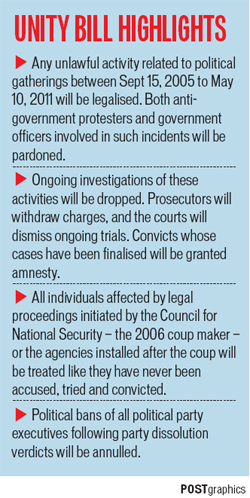
His bill proposes
that:
Gen Sondhi
Boonyaratglin, MP, coup leader and now leader of Matuphum Party, has
proposed the bill and it was listed on the agenda to be considered in the
House session next Wednesday.
Ms Yingluck said the bill was proposed by Gen Sondhi. She says that her Pheu
Thai party did not have any resolution on the matter as the government's
priority at the moment is to administer the country.
One of the key
clauses of the bill is that it paves the way for the return of Thaksin
Shinawatra. And predictably this has yellow shirts, multi-coloured shirts,
the PAD and the Democrats in a terrible state. Though of course they all
benefit hugely from this bill.
Ms Yingluck said that any proposal which could lead to national
reconciliation should be considered and the entire process will be concluded
within parliament with a majority vote from the people's representatives.
But this is not
reconciliation; this is a whitewash.
The Democrat Party
on Saturday reaffirmed that it will oppose the reconciliation bill; not
surprising really as it was the coup that put the Democrats into government.
The Democrat party spokesman Chavanond Intarakomalsut explained that the
proposed bill has a "hidden agenda" to help Mr Thaksin and nothing in the
two-page bill indicates that this is for the general public, instead
allowing for Mr Thaksin to return to the country without having to serve a
jail term and returning his seized assets to him.
But the bill also grants amnesty to those who ordered the May 2010 crackdown
including 91 deaths.
Mr Chavanond added the party's legal team is now considering a petition to
the Constitution Court to rule whether or not the drafted bill violates the
law. It is remarkable how political debate in Thailand turns so quickly and
so often to threatened and real legal action.
Opposition and
Democrat Party leader Abhisit Vejjajiva also said the opposition would move
to oppose the reconciliation bill, as it believes the legislation aims to
whitewash individuals who committed wrongdoing in connection with Assets
Examination Committee (AEC) cases.
Thaksin remains
hugely divisive; but behind the scenes (see below) there are indications of
a reconciliation between the Royal family, the privy council and the
Shinawatras.
Of course what the Democrats and the opposition want is a reconciliation law
that excludes Thaksin, and his AEC case, but includes every other wrong
doing that occurred under their watch.
Now to add to the
fun People's Alliance for Democracy leader Sondhi Limthongkul returned to
the rally stage yesterday to address a large gathering of yellow shirts
protesting against a proposed reconciliation bill, saying his next public
appearance will be his "final battle".
The PAD have
called for a massive rally of supporters on Wednesday at the Royal Plaza to
march on parliament where the House of Representatives is expected to begin
deliberating the proposed bill.
The PAD of course
occupied Bangkok's airports in 2008. The reconciliation bill would grant
amnesty to anyone involved in that occupation. As though it never happened.
Yet to the PAD "the draft bill goes against the rule of law and one of PAD's
established principles. The PAD is justified in holding the rally," PAD
leader Somkiat Pongpaiboon said.
He said it was nothing but a blatant attempt to whitewash the crimes of
deposed prime minister Thaksin Shinawatra and help him to avoid
imprisonment.
What was Thaksin's crime - it is worth remembering that he was sentenced in
absentia to two years in jail by the Supreme Court's Criminal Division for
Holders of Political Positions in 2008 for helping his ex-wife Khunying
Potjaman na Pombejra buy prime state land in the Ratchadaphisek area.
Not much of a
crime compared to either the occupation of international airports or the
killing of 91 Thai and foreign civilians.
Expect some
further drama this week.
What does the King's trip mean?
27 May 2012
Amid widespread
anxiety in Thailand about his health, King Bhumibol Adulyadej made a rare
visit outside his hospital suite on Friday in what senior Thai officials
described as a demonstration of his improved fitness.
It was the first
time in two years that the king, who is 84, had traveled outside greater
Bangkok, Thai television said. The king has suffered from a number of
illnesses not completely explained by the palace.
The palace did not offer an official explanation for the trip, which was
broadcast live on national television, but the head of the Thai Army, Gen.
Prayuth Chan-ocha, said the trip was an opportunity for all Thais “to see
that the king is healthy and can proceed to visit the people once again.”
Unusually the King
was dressed in his military uniform for this trip signifying his rank as
supreme commander of the army.
In a very staged event and in the deeply reverential tone used in Thailand
when publicly discussing royalty, the narrator of the live telecast said the
visit was an opportunity for the King's subjects to show their “loyalty,
respect and care for their beloved king.”
The king, the world’s longest-reigning monarch, has made very few public
appearances over the past two years. And political turbulence in recent
years has included countless accusations that some Thais are not respectful
to the king.
The area that the
king visited is royal land now partly used as a reservoir, one element in a
royally inspired plan to lessen flooding in Bangkok.
Palakorn Suwanarat,
a member of the king’s privy council, said on Thursday that the king would
be leaving the hospital soon. The king will stay in his palace, Mr. Palakorn
said, because he is “back to good health.”
But the reality is
that the King is 84 years old. Frailty is part of the aging process.
The Nation
newspaper eulogised that "millions of people were glued to their TV sets and
rejoiced at the sight of His Majesty. Many of them were moved to tears. "I
love him so much," Napaporn Thaveethanakij, 76, said from her home in Samut
Prakan, tears of joy glittering in her eyes."
Fine Arts Department deputy director general Sureerat Wongsangiam said the
trip would be recorded in the National Archives of Thailand.
In a sign of the
growing truce Prime Minister Yingluck Shinawatra presented the King a title
deed of the paddy field where Their Majesties had harvested a rice crop in
1996. "My family and I would like to present the plot that covers 7 rai and
3 ngarn to His Majesty," Yingluck said. The Shinawatras had acquired the
land only a few days previously.
The Democrats were
quick to make political capital from the visit with their spokesman
Chavanond urging the government to show sincerity by expressing a clear
stance towards lese majeste moves and websites, plus politicians who
criticise Article 112 of the Criminal Code about lese majeste offences, as
well as cable TV and local radio people making comments that border on lese
majeste.
You have to love
how the so called Democrats are the first in the queue to muzzle any
openness of speech and expression.
How symbolic was
this visit and is the King truly returning to the Palace. If he does then
suggestion of a rift in the royal family appear to have been healed and the
role of the army in managing political affairs in Thailand will have
strengthened.
Will Emirates
invest down under?
27 May 2012
Arabian Business
reports that Qantas Airways, seeking to turn around losses on international
flights, is looking at getting separate licences for its international and
domestic businesses amid interest from Emirates Airline in an enhanced
tie-up between the carriers.
Qantas has a group looking at whether a split licence would be the best way
of running the businesses after announcing a restructure May 22, CEO Alan
Joyce told a media event in Sydney on Saturday.
“We’re exploring that as we speak” he said. While Qantas’s constitution and
a 1992 Australian law cap foreign investment in the carrier at 49 percent,
second-ranked Virgin Australia Holdings recently separated its international
and domestic businesses to get around similar rules.
Qantas earlier this week said it will split its businesses into domestic and
international units, a move that could lead to Emirates buying a stake in
the Sydney-based carrier’s domestic service, according to Deutsche Bank.
Tim Clark, president of Dubai-based Emirates, the largest international
airline, this week said both carriers would benefit from a tie-up, the
Australian Financial Review reported.
“If I was a shareholder I’d love that,” Neil Hansford, chairman of
consultants Strategic Aviation Solutions, said by phone yesterday from
Salamander Bay, Australia.
Emirates could take a stake of as much as 30 percent in a Qantas domestic
unit, with its share of debt and equity worth as much as A$1.9bn,
Sydney-based Deutsche Bank analyst Cameron McDonald wrote in a May 24 note.
This is despite
Thierry Antinori, Emirates' executive vice president for passenger sales,
telling reporters in Lisbon on May 24 that the Dubai-based carrier has no
interest in buying stakes in other airlines,
Goo Goo Ga Ga
25 May 2012
In case no one had
noticed - Lady Gaga is in Bangkok.
And the Thais have
come over all sensitive.
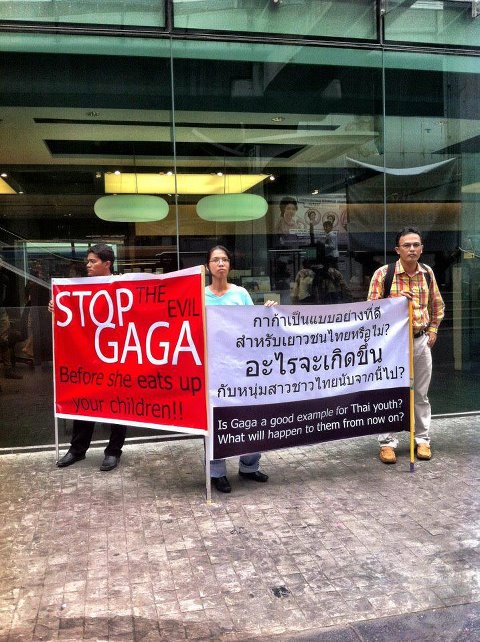
Miss GaGa gets off
her airplanes and send this tweet to her 24 million followers: "I just
landed in Bangkok baby! Ready for 50,000 screaming Thai monsters. I wanna
get lost in a lady market and buy fake Rolex."
And the Thais are up in arms. "We are more civilised than you think,"
tweeted DJ Suharit Siamwalla, who has a ticket to tonight's show but now
plans to boycott it. Sadly - no you are not!
"She came to our home, but instead of admiring us she insulted us," a
commentator on the Pantip.com Web forum said.
Note to all those offended: tip: if you are worried about your image, then
clean it up.
We walked out onto
Silom around 11am yesterday and there was some poor farang getting the
shakedown from the police in a little hut opposite soi 15 - an area
notorious for the thai litter police while less than five yards away was a
table top on the pavement where guys were selling porn dvds. Copies of
course.
But it is a
classic Thai response: either ignore the problem...or pretend that something
obvious doesn't exist. It's all about the unfortunate concept of "saving
face" at all costs.
As for Thailand's
image - go and protest the folks who made "Hangover 2."
Time to plan a velvet divorce for the euro
23 May 2012 By Gideon Rachman Financial Times
As I read the umpteenth article on the “Grexit”, a phrase from the film
Marathon Man ran around my head. In this cult-thriller, Laurence Olivier
plays a war criminal turned dentist who tortures Dustin Hoffman by drilling
through his dental nerves without anaesthetic. As he does so, he asks
repeatedly “Is it safe?”
“Is it safe?” is the question European leaders have been asking themselves
for months, as they contemplate Greece leaving the eurozone. Late last year
I found myself discussing this very question with a senior European
politician. He had noticed that I had written repeatedly that the eurozone
was a flawed construction that was likely to collapse. If that was the case,
I was asked, would it not be better to break the whole thing up now?
At this point, I heard myself becoming shifty and evasive – “The trouble,” I
replied, “is that I keep being told that a break-up would cause a
catastrophe. Until I can tell you convincingly why that’s untrue, I can’t
responsibly advocate it.”
But prevarication is no longer good enough. In the coming months, Europe may
be forced to decide.
So – to answer the question that I dodged back in December – yes, I do think
that it would ultimately be better if the eurozone broke up. This might not
involve a complete reversion to national currencies. A hard core of
euro-users, centred on Germany, might survive. But the current euro will
have to go.
It is true that the transition from here to there will be painful and
dangerous. My colleague Martin Wolf laid out an updated version of the full
horror scenario in Friday’s FT – involving a breakdown of law and order in
Greece, and financial collapse across Europe. How could anyone responsibly
run that risk?
The answer is that the alternatives to eurozone break-up are inherently
implausible and deeply unattractive. At the weekend G8 leaders called for
Greece to stay in the eurozone. Their present plan seems to involve some
magical mix of stimulus and austerity that restores both budgetary balance
and growth. But even if they can agree a real plan and even if it works –
and neither outcome is likely – the eurozone’s structural problems would
remain.
Without the option of devaluing their currencies, uncompetitive economies
are left with “internal devaluation” – otherwise known as wage cuts and mass
unemployment. It is true that countries such as Greece badly need economic
reforms. But these reforms – conducted within the straitjacket of monetary
union with Germany – are causing political and economic turmoil.
The real problem, however, is political. The euro does not have a political
union behind it so it simply lacks the key institutions needed to make
monetary union work. There is no strong central government to enforce
budgetary discipline and no large federal budget to fund transfers from rich
to poor areas. And, as we are discovering, there is no euro-wide
bank-deposit insurance scheme.
In theory, the eurozone might rectify this error by moving to a real
political union. But the idea of a permanent transfer of sovereignty from
Athens to Brussels has been rejected by all sides in Greece. Meanwhile, in
Germany, the idea of a transfer union – involving a permanent gush of
subsidies from northern to southern Europe – remains anathema.
Even if EU politicians were able to overcome such objections and create a
real federal union, this giant new entity would essentially hollow out the
powers of national democracies. Sacrificing national self-rule on the altar
of the euro is inherently objectionable – and would invite a nationalist
backlash across Europe. This “cure” for the ills of the euro would be worse
than the disease.
Since the long-term alternatives to the break-up of the eurozone lack
credibility, it is necessary to think about how to manage such an event –
rather than simply dismissing it as too dangerous to contemplate.
Unfortunately, the break-up plans that Europeans are already drawing up
behind closed doors are too limited.
They envisage a Greek exit, followed by a determined effort to throw up a
firewall that prevents other countries being sucked into the crisis. This
has unfortunate echoes of the past two years, during which the EU has
consistently tried and failed to confine the crisis to Greece.
In fact, the exit of Greece would unleash contagion, by making it clear that
membership of the euro need not be permanent. Markets would inevitably round
on the next vulnerable countries.
Allowing the fate of the euro to be driven by a succession of market panics
would be the worst possible way of breaking up the single currency. It would
involve the loss of billions of euros of public money as the EU burnt
through its firewall. The political and economic turmoil that followed would
cause public panic and discredit the politicians in charge.
It would be infinitely preferable if EU leaders were to make a rational
assessment of which countries are willing and able to stay in the euro – and
announce plans to work on an amicable and orderly divorce between the
stayers and the goers. Only by acting in this way might they finally achieve
their oft-stated goal of “getting ahead of events”. Almost all euro-users
adopted the currency without a referendum, and they could leave the same
way.
It is true that even a “velvet divorce” for the eurozone would involve
enormous dangers. But at least it would offer a believable exit from the
present maze. As a (very) German proverb puts it – “Better an end with
horror, than a horror without end.”
Chen arrives in America
20 May 2012
A quick update on
Chen Guangcheng who has now arrived in America with his wife and two
children.
The lawyer and his family touched down at Newark Liberty International
Airport almost exactly a month after his escape from house arrest sparked a
diplomatic struggle that reached the highest levels of the US and Chinese
governments.
Still walking on crutches after breaking his foot during the escape, Mr Chen
said that his new position as a law student at New York University would
give him a chance "for reparation in body and spirit".
He also struck a conciliatory note towards the Chinese government, possibly
out of fear of antagonising the security officials still holding supporters
who helped him flee eastern China for the refuge of the US Embassy in
Beijing.
"I am gratified the Chinese government dealt with the situation with
restraint and calm," he said.
However, he vowed to keep fighting for human rights in China and said: "I
hope to see that [the government] continues to open discourse and earn the
respect and trust of the people."
The 40-year-old, his wife and two children spent the day resting in their
new apartment in Manhattan's Greenwich Village, which the university had
stocked with Chinese food ahead of their arrival.
Well-wishers left presents at his building, including a large stuffed Snoopy
toy, but only Jerome Cohen, the professor who secured his place at the law
school, is believed to have seen him.
Bob Fu, a US-based human rights activist who has been one of the key voices
lobbying the American government to help Mr Chen, said that the dissident
would be thinking of supporters in China who may be left more vulnerable by
his departure.
Mr Fu also expressed concern that the Chinese government would continue to
monitor Mr Chen in New York, saying he had several "suspicious encounters"
and was some times followed after his own flight from China in 1997.
The State Department refused to comment on whether it was providing the Chen
family with protection.
Mr Chen, who helped exposed the forced abortions carried out under China's
one-child policy, had been held prisoner in his own home for nearly 20
months before escaping on April 22 and making his way to the US Embassy.
After initially saying he wanted to stay in China, he changed his mind and
asked to come to the US, beseeching the help of Hillary Clinton and making
two dramatic calls to a Congressional hearing in Washington.
While China has accused the US of meddling in its internal affairs,
authorities are thought to be pleased to have Mr Chen out of the country, in
the hope it will reduce his impact as a dissident.
A380 speculation in Dubai
18 May 2012
There is some A380
speculation running around Dubai and it should worry Airbus.
The suggestion is
that EK will stop accepting any deliveries of new A380s because of the
issues with wing cracks. Apparently the last 3-4 aircraft (two of which are
ready for delivery) will be accepted by EK to make the fleet up to 25 A380s
in total, but then no further aircraft will be accepted until a permanent
fix is found for the A380.
Obviously further
speculation points to EK cancelling the remaining A380s in favour of
ordering more B777s. This seems unlikely. The A380s generate significant
revenue when they are flying and they are hugely popular as a 'flagship'
aircraft.
That said, Airbus is expecting one-off charges to implement a retrofit
solution to the A380 wing-rib cracking problem to reach €260 million ($330
million) over 2012.
The airframer's parent, EADS, revealed in its first-quarter results that it
had already taken a €158 million charge relating to fixing 71 in-service
A380s - a fix which, it says, is "more complex" than originally anticipated
in March this year.
The company is
still expecting to deliver 30 A380s this year. EADS will continue to treat
the matter on a one-off charge basis. But that number has to be suspect as
airlines wait for a permanent rather than temporary solution.
The 30 figure is
even more unlikely given that EADS only handed over four A380s delivered in
the first quarter of 2012.
EADS says the final wing-fix solution was finalised over the "last few days"
and discussions are taking place with certification authorities.
Once the changes secure approval from the European Aviation Safety Agency,
implementation of the retrofit will begin towards the end of this year with
initial deliveries in 2013.
But while implementation of the line-fit solution will take place around the
same time, the lead times mean that the first A380s with the line-fit fix
will be delivered in 2014.
There has been no
announcement from Emirates but given the chaos caused by A380 repairs to Q1
and Q2 schedules it would not be a surprise if deliveries are delayed.
What does it mean to be Canadian?
18 May 2012 By
Lorraine Mallinder for the BBC - The reality is - what does it mean to be
Canadian - you know who Blue Rodeo are and can hum along to "Try" !
Canada is anything but a homogenous Commonwealth state; nearly one million
indigenous people rub shoulders with immigrants from around the world,
including many from Asia. What does it mean to be Canadian now? What are the
traits which help make up modern-day Canada?
In 2009, Hollywood actor Billy Bob Thornton, plugging his music on a radio
show, seemed to be in a most undiplomatic mood. With apparent disdain, he
dismissed his Canadian audiences as "mashed potatoes with no gravy".
"Oh, we've got some gravy up here as well," came the host's riposte,
immediately turning him into a national hero. A beleaguered Thornton
cancelled his tour and left the country.
The host had a point. This is, after all, the land of fries and cheese curds
slathered in gravy, a French-Canadian classic called poutine. With
mid-winter temperatures dipping to, say, -30.9C (-24F) in towns such as
Yellowknife, it's a must. Canadians need food which sticks to their ribs.
Defining this nation of six time zones is not easy. What could an English
speaker in Vancouver possibly have in common with a francophone 3,000 miles
(5,000 km) away in Quebec City? What, for that matter, could either have in
common with a Gaelic speaker in easterly Nova Scotia? And, that's without
taking into account the 200-plus ethnic groups across the land.
John Ralston Saul, author of several books on Canadian culture, believes his
country has a distinct approach to identity. "They accept that difference is
actually quite interesting. What makes it possible to live together is
agreement on things like ethics and public policy. Not agreement on accents
and religion," he says.
While most Canadians live in a narrow corridor hugging the US border, one
thing they must never be considered is American. Indeed, when polled on
national identity, Canadians defined themselves by characteristics such as
free healthcare (53%) and by being more polite than their southern
neighbours (15%).
Lately, the country's gaze seems to be turning back to Britain. The ruling
Conservatives are strengthening ties with the monarchy, hanging the Queen's
portrait in federal buildings and restoring the 'royal' prefix to the
country's navy and air force.
After last year's honeymoon visit by Will and Kate, over two-thirds of
Canadians said they believed the couple would help keep the monarchy
relevant.
It's all part of what Noah Richler, author of the book What We Talk About
When We Talk About War, calls a battle for Canadian identity. Prime Minister
Stephen Harper's government, he says, is currently re-defining the country
as a "warrior nation" harking to battles ranging from the colonial War of
1812 to Afghanistan and Libya.
He believes the return to the crown is part of this. "It's a farce. To
suddenly go back to having a royal label, that's good for marmalade. It
doesn't serve an independent state," he says.
Mr Harper's recasting of the nation's identity has gone down especially
badly in Quebec, where the vast majority of the country's francophone
population lives. In 2011, during the royal visit to the province,
two-thirds of respondents in one poll said they wanted to get rid of the
monarchy. Back in 2009, Prince Charles' official visit to the province was
marred by egg-throwing anti-monarchy protesters.
Bilingualism, a political priority under the premiership of Pierre Elliott
Trudeau in the 1960s and 70s, is a core element of the country's identity.
Today, 17.4% of Canadians are able to conduct a conversation in both
languages, a marked increase on the 13.5% reported in 1971. "Is there
enough? No. Should there be more? Yes. People take it for granted now, but
if you want to be a cabinet minister or a supreme court judge, you have to
be bilingual," says Mr Ralston Saul.
Just to confuse matters, immigration has added more than 200 other languages
to the mix, with one-fifth of the population speaking a mother tongue other
than English or French. Immigration is currently at a 75-year high, with
newcomers accounting for two-thirds of the country's recent population
growth.
More than half come from Asia, with a substantial proportion from Europe and
Latin America. Most head to the bright lights of Montreal, Toronto and
Vancouver, though there is also increasing interest in the province of
Alberta, where oil jobs beckon.
Canadians, generally open-minded and tolerant, have mixed feelings about
immigration. According to a recent poll, nearly two-thirds want their
country to become a melting pot like the US, a unified culture into which
newcomers must assimilate.
The country's attitude towards newcomers is changing - recently, the
government introduced new rules allowing employers to pay temporary workers
15% less than the average wage, provoking an outcry from immigrant rights
groups.
"The very nature of our open multicultural society is being changed. For all
of our history, we have been the welcoming country that offered immigrants a
new start. Paying one group less than another… cleaves the idea of Canada
being a place of refuge and generosity," says Mr Richler.
What about the country's original population? Canada's relationship with its
more than one million First Nations people - native Indian, Metis and Inuit
- is a controversial issue.
In 2011, the Red Cross was called on to the remote reservation of
Attawapiskat, Ontario, where residents were struggling in sub-standard
housing without electricity or plumbing. Nearly half of Canada's native
people live in homes needing major repair. In other areas too, such as
health and education, people of the First Nations invariably come last.
But, behind the headlines, Mr Ralston Saul maintains a different story is
emerging. "There are enormous problems, but the interesting thing is that
there's a remarkable new aboriginal elite, whether in universities or
politics. They're gaining more and more legal power, with more influence
over the use of the land," he says. "My message is that everybody had better
get used to it. It's good because it will take Canadians back to the roots
of their identity."
Canadians are a highly connected population, with nearly three-quarters of
the population on social networking site Facebook They are also
well-informed, with the vast majority (89%) following current affairs
frequently.
Four in ten consider jobs and the economy to be the country's most pressing
concern, ahead of healthcare and the environment.
No surprises, then, when Mr Harper was re-elected with a majority last year
on a jobs and growth ticket, having successfully steered the country through
the global financial crisis.
Under his stewardship the country is also becoming tougher on crime.
Recently approved crime laws will usher in minimum mandatory sentences for
drugs offences and a crackdown on young offenders.
Is Canada really such a dangerous place? Not according to official figures,
which show that the crime rate has gone down substantially over the past
decade.
Yet, in a recent survey, roughly half of Canadians agreed with government
plans to build more prisons.
Overall, however, it appears a contented country, with a high quality of
life.
Canadians love to give back too, devoting some of their free time to raising
funds for good causes, stocking food banks and tidying parks.
In 2010, nearly half of the adult population gave more than two billion
hours of their time to volunteer work.
"The defining trait of being a Canadian is understanding our good fortune,
knowing that we're not actually better than anybody else," Mr Richler says.
"We're not better than the Americans. We're not better than the Britons.
But, in a way, we're fundamentally lucky."
Apocalypse Fairly Soon
18 May 2012 By PAUL KRUGMAN New York Times
A simple and clear analysis of the Euro crisis; how we got there; how we
might get out and the risks if we do not.
"Suddenly, it has become easy to see how the euro — that grand, flawed
experiment in monetary union without political union — could come apart at
the seams. We’re not talking about a distant prospect, either. Things could
fall apart with stunning speed, in a matter of months, not years. And the
costs — both economic and, arguably even more important, political — could
be huge.
This doesn’t have to happen; the euro (or at least most of it) could still
be saved. But this will require that European leaders, especially in Germany
and at the European Central Bank, start acting very differently from the way
they’ve acted these past few years. They need to stop moralizing and deal
with reality; they need to stop temporizing and, for once, get ahead of the
curve.
I wish I could say that I was optimistic.
The story so far: When the euro came into existence, there was a great wave
of optimism in Europe — and that, it turned out, was the worst thing that
could have happened. Money poured into Spain and other nations, which were
now seen as safe investments; this flood of capital fueled huge housing
bubbles and huge trade deficits. Then, with the financial crisis of 2008,
the flood dried up, causing severe slumps in the very nations that had
boomed before.
At that point, Europe’s lack of political union became a severe liability.
Florida and Spain both had housing bubbles, but when Florida’s bubble burst,
retirees could still count on getting their Social Security and Medicare
checks from Washington. Spain receives no comparable support. So the burst
bubble turned into a fiscal crisis, too.
Europe’s answer has been austerity: savage spending cuts in an attempt to
reassure bond markets. Yet as any sensible economist could have told you
(and we did, we did), these cuts deepened the depression in Europe’s
troubled economies, which both further undermined investor confidence and
led to growing political instability.
And now comes the moment of truth.
Greece is, for the moment, the focal point. Voters who are understandably
angry at policies that have produced 22 percent unemployment — more than 50
percent among the young — turned on the parties enforcing those policies.
And because the entire Greek political establishment was, in effect, bullied
into endorsing a doomed economic orthodoxy, the result of voter revulsion
has been rising power for extremists. Even if the polls are wrong and the
governing coalition somehow ekes out a majority in the next round of voting,
this game is basically up: Greece won’t, can’t pursue the policies that
Germany and the European Central Bank are demanding.
So now what? Right now, Greece is experiencing what’s being called a “bank
jog” — a somewhat slow-motion bank run, as more and more depositors pull out
their cash in anticipation of a possible Greek exit from the euro. Europe’s
central bank is, in effect, financing this bank run by lending Greece the
necessary euros; if and (probably) when the central bank decides it can lend
no more, Greece will be forced to abandon the euro and issue its own
currency again.
This demonstration that the euro is, in fact, reversible would lead, in
turn, to runs on Spanish and Italian banks. Once again the European Central
Bank would have to choose whether to provide open-ended financing; if it
were to say no, the euro as a whole would blow up.
Yet financing isn’t enough. Italy and, in particular, Spain must be offered
hope — an economic environment in which they have some reasonable prospect
of emerging from austerity and depression. Realistically, the only way to
provide such an environment would be for the central bank to drop its
obsession with price stability, to accept and indeed encourage several years
of 3 percent or 4 percent inflation in Europe (and more than that in
Germany).
Both the central bankers and the Germans hate this idea, but it’s the only
plausible way the euro might be saved. For the past two-and-a-half years,
European leaders have responded to crisis with half-measures that buy time,
yet they have made no use of that time. Now time has run out.
So will Europe finally rise to the occasion? Let’s hope so — and not just
because a euro breakup would have negative ripple effects throughout the
world. For the biggest costs of European policy failure would probably be
political.
Think of it this way: Failure of the euro would amount to a huge defeat for
the broader European project, the attempt to bring peace, prosperity and
democracy to a continent with a terrible history. It would also have much
the same effect that the failure of austerity is having in Greece,
discrediting the political mainstream and empowering extremists.
All of us, then, have a big stake in European success — yet it’s up to the
Europeans themselves to deliver that success. The whole world is waiting to
see whether they’re up to the task."
A Greek tragedy
18 May 2012
The drachma could
make a comeback if Greek elections on 17 June do not provide a solution to
the crisis.
How would Greece leave the eurozone?
Greeks go to the polls again on 17 June after the vote on 6 May proved
inclusive. The new election is seen as a referendum on the euro. If the
anti-austerity Syriza party wins control and cannot force Germany to relax
its opposition to lower and slower cuts, there may be no option but for
Greece to leave the eurozone – or be kicked out.
So it's down to democracy then?
Not quite. If outflows from the Greek banks continue at this current pace
then the instability could force Greece out of the eurozone before the
election.
What would happen if Greece left?
It would have to be carried out almost overnight – most likely over a
weekend. The banks would have to shut their doors, bank accounts would be
frozen and capital controls imposed to stop any more money leaving the
country. The new currency would be likely to lose at least 50% of its value
relative to the euro so any saver in Greece who has left their money in a
bank will instantly find it is worth considerably less. Opinion polls show
that while Greeks do not want austerity, most of them want to stay in the
euro – which explains why savings are still sitting in Greek banks.
What will the new drachma look like?
Unless a load of forgotten drachma are found in a vault, Greece will need to
print a new currency. It is possible that the authorities have thought ahead
as Slovakia did when it split from Czechoslovakia in 1993, printing a new
currency and hiding it away in London until it was needed. A more likely
option could involve tweaking euros already in circulation in Greece. Some
suggest a D could be emblazoned across euros, while others suggest corners
could be clipped off. It would also need a new symbol for currency traders
on the money markets. Before the euro, the drachma was known as GRD and by
the numeric symbol 300 for international trading. The financial markets –
and their computers – would need a new symbol for the currency quickly so
that it could be traded.
Would it only have an impact in Greece?
The key question and hardest to answer. It could cause mayhem, just as the
collapse of Lehman Bros did in 2008: sparking a wave of market panic and the
biggest global recession since the 1930s. Marchel Alexandrovich, of
Jefferies International, is so concerned that he reckons Greece should be
"persuaded and paid to stay in the euro, which would much cheaper than the
alternative".
My peace prize is bigger than theirs
17 May 2012
So Dubai
progresses from the biggest tower to the biggest peace prize. Which may be
noble but is already being over-hyped before it has first been granted. The
prize is that "Mohammed bin Rashid Al Maktoum World Peace Award."
The prize, which will be awarded every two years, will honour those who have
made outstanding contributions to international peacekeeping issues.
The excess hype
comes from officials for the new peace award who have said the prize will be
“more distinguished” - and worth more money - than the famous Nobel and
Gandhi Peace awards. Sort of my prize is bigger than yours and must be
better!
His Excellency Dr Hamad bin Sheikh Ahmed Al Shaibani, Chairman of the board
of trustees for the Award outlined the goals of the award saying: “The world
is now facing many troubles and here in the UAE we have safety and security
for all people. This award will be a reward for contributing to world
peace,” he said.
“We expect it will be more distinguished than other peace awards, like Nobel
and Gandhi awards, because the prize will be worth more financially.”
“The award strives to recognise and acknowledge those who dedicate
themselves to noble causes pertaining to world peace. We want to spread the
inspiring values of Islam throughout the world because we believe that Dubai
is an exemplary emirate by harmoniously accommodating over 200 nationalities
who exist in peace,” Al Shaibani said.
I suspect this
prize will be seeking candidates from the Arab countries and the Muslim
world countering a perception of the
Nobel prize as a western prize won by government heads of state.
The first award will be presented in 2014 and every two years from then. Al
Shaibani said the board still had to decide on the mechanism for the award
and whether there would be just one award or a series of categories.
The Nobel Peace Prize, bequeathed by the Swedish industrialist and inventor
Alfred Nobel, is presented yearly on December 10 each year (the anniversary
of Nobel's death) and is worth about $1.5 million. The Gandhi Peace Award is
an annual award and cash prize bestowed by the peace education organisation.
The difference
here is that the Nobel Prize has a legacy and a history that goes back to
1901. The Nobel Peace Prize has been awarded 92 times to 124 Nobel Laureates
between 1901 and 2011 – 99 times to individuals and 23 times to
organizations. Since International Committee of the Red Cross was awarded
the Nobel Peace Prize in 1917, 1944 and 1963, and the Office of the United
Nations High Commissioner for Refugees was awarded the Nobel Peace Prize in
1954 and 1981, that means 101 individuals and 20 organizations have been
awarded the Nobel Peace Prize.
You cannot just
buy prestige, history or reputation.
The UK's hopeless visa process
16 May 2012
To: Mr. Damian
Green, The UK Immigration Minister
Mr. Dominic Jermey The British Ambassador to the UAE
Mr. Guy Warrington, The British Consul in Dubai
Entry Clearance Manager at the British Embassy Abu Dhabi, PO Box 248, Abu
Dhabi, UAE, or by e-mail to
visa.abudhabi@fco.gov.uk
Dear Sirs,
Visa Applications to the United Kingdom
For many people in Dubai, in the UAE and in other nations, their first
contact with the United Kingdom is the visa application process. This
process is seriously flawed and in Dubai it is made particularly unpleasant
as it involves dealing with an outsourced agency that is inefficient and
which poorly represents the UK.
My wife is from a
country that requires her to have a visit visa to travel to the UK. She has
already received two previous two-year visas. She has holidayed in the UK on
a number of occasions. She has been employed in the UAE for six years as
cabin crew for the country's largest airline and thereby in her employment
makes regular additional visits to the UK.
Yet to apply for a
new UK visa she once again is required to complete an eight page form,
provide evidentiary documents, a letter from her company, provide details of
her last 10 years of travel to the UK and elsewhere and provide evidence of
flight and hotel bookings.
Here is the
simplest of suggestions: for applicants that have previously been granted a
UK visit visa then surely a much simpler application process is justified
that asks whether the applicant has any change in personal circumstances
including their employment. If there is no change then you already have all
their personal data on record. Why ask for it once again? This would allow
the agency to devote more time and provide a faster service to new
applicants.
As cabin crew her
situation is more difficult because of the poor processing times. These
times have deteriorated significantly since the use of VFS Global to process
applications. By virtue of their work cabin crew (and pilots) need their
passports at all times. Occasionally they have three of four off days when
they can carry out administrative tasks such as visa applications. These
should be among the easiest applications to process. The crew are already
frequent travellers and have full time employment to return to.
So crew by default
have to apply for the premium visa service at an additional cost of AED275.
The main benefit of the premium service in Dubai is that no prior
appointment is necessary so crew can apply for a visa when their flying
roster allows them to. But this is no guarantee of a fast service. A further
AED 360 will then get you a priority service. In reality a priority service
is no more than any potential visitor to the UK should receive.
The performance
targets are embarrassing: Your targets state that 90 per cent of
non-settlement applications within 3 weeks, 98 per cent within 6 weeks and
100 per cent within 12 weeks of the application date. If you substituted
days where it says weeks you would be providing a respectable quality of
service.
Unfortunately
there is no avoiding a visit to VFS Global; a company which (with a number
of honourable exceptions) employs staff who are rude and untrained. They
represent the UK very poorly and you should be both aware of this and taking
corrective action.
A comparison of
visa costs and access is interesting: the UK visit visa currently offers two
countries: the UK and, courtesy of a recent waiver scheme, Ireland. The
Schengen visa covers 25 countries. The Schengen visa application form is
three pages long; that for the UK is eight pages.
As for UK visa
fees they are now close to extortion and significantly more expensive than
USA and Schengen visas:
A two year visit visa is:
US$446 (AED 1,636)
Premium service:
AED 275
Priority Service:
AED 360 (this was recently withdrawn by VFS in Dubai and then re-instated).
Prime Time Appointment: AED 180
Without the cost of a prime time appointment a two year UK visa application
is approximately US$600. For comparison a USA visit visa fee is a simple
once off payment of US$160 (AED587).
A Schengen tourist visa application costs: (Source:
http://www.vfsglobal-fr-ae.com/tourist_visafees.html)
Visa Fee:
AED300 (the visa may be single or multiple entry)
VFS Processing Fee: AED 80
Premium Service Fee: AED150
A more radical solution would be to admit the UK into the Schengen region
allowing much greater freedom of movement for visitors and business
travellers across Europe.
Remember these are all people that want to travel to the UK to spend money
in your country, your stores, hotels and restaurants etc. They do have a
choice.
The current visa process is alienating and expensive (especially for
families). Many applicants must give up on visiting the UK and decide to go
elsewhere.
Sadly the visa application process also comes down to prejudice. The UAE
admits Britons for thirty days which can be extended. There is no visa
requirement. There is no fee. The same courtesy does not exist in return
despite the significant spending of UAE citizens in the UK.
The same with Thailand; a country that provides a home for many Britons and
again provides 30 days visa free access.
The UK introduced visas for South Africans in 2009. In the same year, visas
were abolished for Taiwanese traveling to the UK. How can those decisions by
justified? And why should the Taiwanese (a state not recognised by the UN)
be treated differently from Chinese citizens?
If the country insists that visa have a valid role in border control and
security then at least make the process pleasant, efficient and fairly
priced. Given the benefits to jobs and investment the visa rules, and
application processes, need to be radically reviewed.
Yours faithfully,
Robert Scott
Lufthansa loss brings change in the air
16 May 2012 The Financial Times
Christoph Franz is seeking to bring some order to the sprawling empire
created by his predecessors.
Lufthansa’s chief executive is busy selling assets and cutting costs at
Europe’s largest airline by revenue after it slipped to a €13m net loss in
2011, his first year in charge.
The eurozone crisis, high fuel costs and intense competition all took their
toll on the company last year, as well as regulatory decisions led by the
ban on night flights at Frankfurt airport, the German airline’s cargo and
passenger hub.
“The night flight ban – that is the German equivalent of not creating a
third runway in Heathrow,” says Mr Franz, in a light-hearted but ultimately
serious comparison with how the UK government has angered British airlines
by refusing to allow runway expansion at London’s Heathrow airport.
While Mr Franz is powerless to overturn the night flight ban at Frankfurt
that will reduce Lufthansa’s annual earnings by €40m, he is starting to take
some drastic steps to improve profitability.
BMI British Midland, the loss-making UK airline that Lufthansa took control
of in 2009, was sold last month to International Airlines Group, parent of
British Airways.
BMI has struggled on multiple fronts, and Lufthansa blamed the €199m
operating loss at its UK subsidiary last year for pushing the group into the
red.
Mr Franz insists Lufthansa was always going to find it difficult to mount a
strong challenge to IAG at Heathrow – even though BMI has the second largest
portfolio of take-off and landing slots at the capacity-constrained airport
after BA.
“Though it’s an important portfolio, it’s still too small with regard to
market share,” he says.
He should know when to cut and run because the 52-year-old is well-versed in
restructuring. He was involved in Lufthansa’s turnround following the first
Gulf war, when he served in the office of Jurgen Weber, the then chief
executive.
In 2004 he became chief executive of Swiss International Air Lines, where he
cut costs before its acquisition by Lufthansa.
The restructuring now being implemented at Austrian Airlines, which
Lufthansa bought in 2009, has parallels with what happened at Swiss.
Austrian ran up a €62m operating loss in 2011, and the airline’s pilots were
told last month that they must transfer to Tyrolean Airways, a regional
airline controlled by the Austrian flag carrier.
The pilots face having to work longer hours and are being asked to switch
from attractive final salary pensions to less lucrative defined-contribution
schemes.
But Mr Franz’s restructuring skills may well find their severest test in
Lufthansa’s home market of Germany.
Air Berlin, easyJet and Ryanair, the low-cost carriers, are encroaching on
Lufthansa’s short-haul routes, while Gulf airlines led by Emirates are
putting pressure on long-distance flights between Germany and Asia.
Mr Franz is seeking to fight back against the budget airlines by stripping
out duplication between Lufthansa’s point-to-point short-haul services and
Germanwings, the group’s German low-cost carrier, which recorded a €52m
operating loss in 2011.
With greater coordination, he is hoping the group can maximise profitability
through Lufthansa’s premium fares and Germanwings’ low-cost structure. If
not, he suggests Lufthansa could decide to abandon its premium brand
positioning on short-haul routes.
This decision may be accelerated by the likely rejuvenation of Air Berlin,
the loss-making German airline which last year secured Etihad, the
deep-pocketed Abu Dhabi carrier, as its largest investor.
Mr Franz complains that Lufthansa is not competing on a level playing field
with the Gulf carriers, highlighting how these state-controlled airlines
benefit from government-funded hub airport infrastructure.
But he sees little or no chance of any redress. “The [European] airlines are
fairly weak to defend their interests,” he says.
While he may have to spend much of his time improving Lufthansa’s efficiency
in the face of a competitive onslaught, Mr Franz is keen not to be seen as a
simple cost cutter.
He says he is willing to consider deals, albeit in a more cautious manner
than his predecessors, and will examine the case for buying Transportes
Aéreos Portugueses, the Portuguese carrier that is a leading European
provider of flights to Brazil.
“Buying airlines is . . . exciting,” he says. “I do not perceive myself in
[the role] of a pure cost cutter.”
South China conflict looms
15 May 2012
More for a month, the Philippines and the People’s Republic of China (PRC)
have been deadlocked in a sovereignty dispute off the Philippine main island
of Luzon, around Scarborough Shoal.
This latest dispute which began with a Philippine warship challenging
private Chinese fishermen/poachers (depends on your point of view) in the
waters around the shoal, has evolved into something on which no less than
the credibility of America’s commitment to peace and security in the Pacific
hinges.
The U.S. has two major interests at stake in the impasse: the security of
treaty allies and freedom of navigation.
The Chinese fishing boats that precipitated the crisis left the shoal for
home early in the conflict, as has the Philippine naval vessel that sought
to apprehend them. Sending a naval vessel to deal with a law enforcement
issue was either a tactical mistake or, as the Philippine government
maintains, a matter of expediency for a nation strapped for maritime
resources. Either way, a subsequent decision by Philippine authorities not
to return it to the disputed area after replenishment was a gesture intended
to de-escalate the conflict.
On the PRC side, the state media have been in hyper zenophobia mode. The
Global Times has written openly of possible conflict. Rumors of war
preparations (denied by the PRC Ministry of National Defense) and
unconfirmed media reports of PLA Navy warships en route toward the
Philippines have only added to the sense of crisis.
The Chinese
Foreign Ministry continues to publicly declare its sovereign rights to
Scarborough Shoal and the waters around it. It has summoned the Philippine
chargé d’affaires three times to protest. And although it remains to be seen
whether the PRC can successfully leverage its considerable economic strength
in such diplomatic disputes, suspension of tours to the Philippines by
Chinese tourist agencies, cancelled air flights to Manila, and increased
scrutiny of agricultural imports from the Philippines at Chinese ports raise
concerns that it intends to try.
The U.S. has long been neutral on the sovereignty issues involved in the
South China Sea. Unfortunately the South China Sea is a maze of conflicting
territorial claims involving six active claimants.
This is not to say, however, that the U.S. is neutral in the current
standoff between the PRC and the Philippines. America has very specific
treaty obligations to the Philippines, and other treaty allies in the
Pacific are assuredly watching very closely to see how it executes those
obligations under the current circumstances.
The U.S.–Philippines Mutual Defense Treaty (MDT) “recognizes that an armed
attack in the Pacific Area on either of the Parties would be dangerous to
its own peace and safety and declares that it would act to meet the common
dangers in accordance with its constitutional processes.” It envisions three
contingencies:
An attack on the territory of the Philippines (or the U.S.);
An attack on the “island territories under its (the Philippines or the U.S.)
jurisdiction in the Pacific”; or
An attack on either party’s “armed forces, public vessels or aircraft in the
Pacific.”
The implications
of the first are obvious; it is not in any way in play in the current
conflict. For the second, the USA does not consider Filipino claims beyond
its recognized borders subject to the treaty. In the current month-long
standoff, the third part of this equation is very much in play.
In 1979, American Secretary of State Cyrus Vance confirmed in an official
letter to Philippine Foreign Secretary Carlos P. Romulo that the MDT covers
an “attack on Philippines armed forces, public vessels or aircraft” even if
such attack does not occur in the “metropolitan territory of the Philippines
or island territories under its jurisdiction,” thus separating the issue of
territorial sovereignty from attack on Philippine military and public
vessels. The Philippine ships currently deployed off Scarborough Shoal are
“public vessels.”
What this series of statements means in the current context is that if any
Philippine “public vessel” comes under Chinese fire, such an act will result
in the U.S. invoking the treaty. Invoking the treaty does not mean automatic
armed response, but by invoking it, the U.S. formally recognizes the attack
as “dangerous to its own peace and safety and declares that it (will) act to
meet the common dangers.” The attack triggers formal bilateral consultations
under the treaty to determine an appropriate course of action. (There is
nothing uniquely tentative about the U.S.–Philippines MDT in this regard.
All of America’s security treaties in the region contain similar diplomatic
nuance and consultation mechanisms.)
Formally invoking the treaty would require a response that could range from
diplomatic censure to armed defense of Philippine vessels. The decision over
what specific response to choose would be a political one and dependent on
the circumstances of the conflict. Declaring Chinese activity in the South
China Sea “dangerous to peace and security,” however, would have powerful
effects in and of itself. With such a declaration on the table, it is
difficult to imagine life as usual in the U.S.–China relationship.
It would be a huge change to regional (in)stability if the Chinese were to
provoke such a response from the USA. At least not now. It will happen; but
China is not ready yet.
On its face, the PRC’s asserting sovereignty so close to the Philippines—as
it has done so often over the past year and a half—is suspect. Its famous
nine-dash map encompassing virtually the entire expanse of the South China
Sea and repeated official references to “indisputable sovereignty over the
islands of the South China Sea and their adjacent waters” are reflective of
an expansive extra-legal claim.
The dispute over Scarborough Shoal, per se, is not the problem for the U.S.
The problem is the nature of the Chinese claim that encompasses it. If the
nine-dash map reflects a claim to all the water within it, then freedom of
navigation is a right controlled by the PRC, and the U.S. Navy and
international shipping sail there only at the PRC’s forbearance.
This is why China’s assurances that it will honor freedom of navigation in
the South China Sea regardless of sovereignty disputes have fallen on deaf
ears in Washington. Developments over the past three years have only
confirmed American concerns about the way the PRC views the rights of others
in these waters. Since the Impeccable incident of 2009, the Filipinos and
others have been subject to multiple incidents of Chinese violations of
their navigational rights.
In 1951, the U.S. signed a security treaty with the Philippines. The Obama
Administration has done much over the past three years to indicate America’s
continued commitment to it. The current impasse over Scarborough Shoal is
the first real test of these efforts. If the Administration mishandles this
situation, not only will America’s commitment to the security of the
Philippines and freedom of navigation be called into question, but so will
the very credibility of its position in the Western Pacific. That will not
be good for anyone on either side of the Pacific. As I said China may not
challenge this now. But it will in time.
Background:
Scarborough Shoal
or Scarborough Reef (Chinese name: Huangyan Island; simplified Chinese: 黄岩岛;
traditional Chinese: 黃岩島; pinyin: Huángyán Dǎo; Philippine name: Panatag
Shoal, Bajo de Masinlóc), more correctly described as a group of rocks or
very small islands plus reefs in an atoll shape, rather than as a shoal, is
located between the Macclesfield Bank and Luzon Island of the Philippines in
the South China Sea.
The shoal was named after the East India Company tea-trade ship Scarborough
which was wrecked on one of its rocks with everyone perishing on board on 12
September 1784.
The shoal forms a triangle-shaped chain of reefs and rocks or very small
islands 55 kilometres (34 mi) around with a total area including shallow
water areas of 150 square kilometers. It has a lagoon with area of 130 km²
and depth of about 15 metres (49 ft). The shoal is a protrusion from a 3,500
m deep abyssal plain. Several of the rocks or small islands including "South
Rock" are 1/2 m to 3 m high, and many of the reefs are just below water at
high tide. Near the mouth of the lagoon are the ruins of an iron tower, 8.3
m high. To the east, the 5,000 - 6,000 meter deep Manila Trench separates
the shoal from the Philippine archipelago.
It is about 123 miles (198 km) west of Subic Bay. The nearest landmass is
Palauig, Zambales, on Luzon Island in the Philippines, 137 miles (220 km)
away.
Three new projects in Dubai approved
13 May 2012 (via WAM)
Three prestigious projects were approved on Sunday by Vice President and
Prime Minister of the UAE and Ruler of Dubai His Highness Shaikh Mohammed
bin Rashid Al Maktoum, the Director General of Dubai Municipality Eng
Hussain Nassir Lootah announced at a press conference at the Municipality.
The biggest of the three is Dubai Safari Project, in Al Warqa 5,
Aweer Road, on an area of 400 hectares includes Dubai Safari, Butterfly
Park, golf courses, entertainment and recreational areas, Lootah said.
Dubai Safari facility that covers 60 hectares of the total area is aimed at
establishing the best center for wildlife in the world, providing a variety
of environments appropriate to different animals, attract visitors from
different parts of the world and use modern interactive methods in control
and movement to ensure the distinctive and unique experience for visitors.
The stages of project include site preparation, preparing internal roads and
infrastructure, gardening, landscaping and water bodies, transfer the
existing zoo in Jumeirah to the new location and other facilities such as
means of transport, restaurants, rest areas ... etc.)
Director of General Projects Department Eng. Mohammed Noor Mashroom
explained the second project, Dhow Wharfage Development at Deira Corniche,
is aimed at constructing additional integrated infrastructure to facilitate
an increase in dhow trade through Dubai, which will make Dubai the
economical center of import and export activities in the region.
The project consists of a comprehensive wharfage of 3 km in length between
the Deira Corniche and Palm Deira, in front of Hayatt Regency Hotel. The
wharfage will be divided into 30 loading/unloading areas, which will allow
around 400 dhows of different sizes to berth at the same time.The project
provides a loading/unloading area of 90,000 m2, which is more than half the
loading/unloading area existing currently in Dubai Creek; and facilitates
loading/unloading of cargo of more than 1.7 million tons per year.
The wharfage was designed with a depth of 7 meters below the low water level
and with all necessary anchorage elements; this will allow Dubai Creek to
receive and anchor bigger dhows which couldn’t enter before. This project
includes new quay structures and associated dredging and reclamation,
including the supporting services and infrastructure such as entry and exit
reporting wharves, administrative and control buildings, sailor’s facilities
and re-fuelling wharf.
All safety precautions have been followed according to international
standards through providing an integrated fire fighting network as well as
security services, police, rescue and civil defense facilities and berths.
The project works include providing all major services including internal
roads, water, electricity, telecommunication, and sewage networks. Also, a
lighting network will be provided for the whole wharfage area which will
facilitate cargo handling work during the evening hours.
Construction of the project will require the excavation and dredging of
390,000 m3 of sand from the seabed adjacent to the wharf site, and this
amount will be re-used for the reclamation works of the wharfage. According
to the project plan, construction works will commence at the beginning of
June 2012, with the completion and operation of Phase 1 (60% of the wharf)
after 12 months, and the second phase will be completed by end of year 2013.
Head of Coastal Engineering Unit Eng. Ibrahim Mohammed Ibrahim Ali Juma
explained the project of Completion of Business Bay Canal and its
Connection to the Sea.
Ibrahim said that the aim of this project is to revive Business Bay Canal as
a part of an integrated marine system which will improve the environmental
state of the canal, as well as the upper part of the creek. Also, this
project will enhance the economical state of the area adjacent to canal by
transformation into an attractive business waterfront. It will also provide
a chance to use the Business Bay Canal for navigation. It will create a
unique water body suitable for leisure navigation purposes
A complete hydrodynamic study has been done by Dubai Municipality to ensure
proper water circulation in both Business Bay Canal and the inner part of
Dubai Creek, as well as, the efficiency of the near future inclusion of
Meydan canal in the overall system.
The project consists of two phases:
Phase 1: involves the connection of Business Bay Canal with sea through a
pipeline system connecting the sea to the side of canal adjacent to Sheikh
Zayed Road.
The pipeline system of an overall length of about 3 km will be realized by
adopting “Micro-Tunneling” technique, which will allow the pumping process
to proceed without impacting any existing utilities or services as well as
not requiring any diversions to be done to roads or services lines.
Also, the water intake will be done using the “Pipeline Intake” technique,
which does not require the construction of any breakwaters, thus preventing
any harm to the coastal and marine environment.
Phase 2: Completion of the canal waterway through connecting the existing
lagoons.
This phase consists of carrying out the dredging works for the remaining
parts of the canal, estimated by an amount of 750,000 m3. In addition, the
canal quay wall of a length of 1.2 km will be completed.
The duration of design works will be 7 months and the implementation works
will be 18 months.
Blue moon tweeting
13 May 2012
So Manchester
City win the Premiership for the first time in 44 years. The Guardian's
match report starts: "The only word to describe it is bedlam. Manchester
City are the champions of England but where do you start? How, seriously,
can it be possible to sum up the raw, shredded emotion of those final,
exhilarating moments, the scale of what it means and the sheer drama that
unravelled before the party could begin and the Premier League trophy was in
Roberto Mancini's hands?" For a neutral - this was raw, astonishing drama.
For anyone connected to either of the Manchester teams it was an emotional,
gut wrenching, wringer !
As tweeted during
the match:
Robert Scott@rascottdotcom
Etihad's investment in Manchester City now looks like one of the great
branding bargains - massive global exposure....mabrook indeed.
43m Mick Twister@twitmericks Retweeted by Robert Scott
Ferguson & Man United/Are starting to get quite excited/Until the last
minute/When Man City win it/Mancini & co now delighted. #mcfc #mufc
49m Catboy@Catboy_Dubai Retweeted by Robert Scott
Looking forward to tomorrow's UAE headlines regarding Abu Dhabi winning the
Premiership, like they won that Oscar earlier this year.
49m Robert Scott@rascottdotcom
Wonderful, articulate interview from Vincent Kompany - final proof that
Manchester City really deserve this.
56m Sport 360°@Sport_360 Retweeted by Robert Scott
Breathless, brilliant, bewildering..... nothing, and we mean nothing, beats
the sheer drama of the English Premier League.
54m Robert Scott@rascottdotcom
It will probably be September before Manchester City fans can truly believe
that they won the premiership....congratulations....
59m Robert Scott@rascottdotcom
Sergio Aguero will get the freedom of at least half of Manchester -
wonderful gutsy goal to finish the season....
1h bangkokpundit@bangkokpundit Retweeted by Robert Scott
Unfucking believable.
1h Sport 360°@Sport_360 Retweeted by Robert Scott
Not quite sure we can believe what we've just seen.. Manchester City win the
league with two goals in the final four minutes of the season.
1h Robert Scott@rascottdotcom
@gerald_d I know I know.......clairvoyant !!
1h Robert Scott@rascottdotcom
QPR are safe as Bolton only drew at Stoke. Well done Mark Hughes.
1h Robert Scott@rascottdotcom
Love a duck !!
1h Robert Scott@rascottdotcom
So true..............and Dzeko as well....RT @gerald_d: One last twist?
1h Robert Scott@rascottdotcom
Late heroics from Paddy Kenny - all is forgiven.....
1h Robert Scott@rascottdotcom
Does one man make a football team - city have also looked a far lesser team
without Yaya Toure......
1h Robert Scott@rascottdotcom
Anton Ferdinand - outstanding today....bet John Terry is impressed.......
1h Robert Scott@rascottdotcom
@Sport_360 Good job it is only a game..... :)
1h Robert Scott@rascottdotcom
@gerald_d Good job I was never a betting person - my predictions are
useless.....
1h Robert Scott@rascottdotcom
@gerald_d Indeed - heroic stuff from QPR !
1h Robert Scott@rascottdotcom
Horrible from Man City - zero imagination. Badly needs Adam Johnson - some
pace and width. Look clueless at the moment.
1h Robert Scott@rascottdotcom
Dzeko on for Man City - when did he last score ??
1h Robert Scott@rascottdotcom
If linesman genuinely saw the Barton elbow on Tevez then fair play to him -
did a great job - just shown it on tv - correct decision.
1h Henry Winter@henrywinter Retweeted by Robert Scott
Traore great run down left, beat Kompany, crossed for Mackie to score with a
downward header. Unbelievable game. Unbelievable final day
1h Robert Scott@rascottdotcom
Only Man City could implode this badly with so much at stake - badly need to
change something - Barry and De Jong wont win it for them....
1h Robert Scott@rascottdotcom
Ho ho ho - brilliant from QPR !!
1h talkSPORTDrive@talkSPORTDrive Retweeted by Robert Scott
Barton elbowed Tevez, shown red, then kicked Aguero, head butted Kompany,
went for Ballotelli #helmet #melt #newsnight
1h Robert Scott@rascottdotcom
Have to assume that was Mr Barton's last appearance in the Premiership.....
1h Robert Scott@rascottdotcom
Barton - brain - disconnect ! Meltdown. Commentators having apoplexy. But
City still have work to do.
1h Robert Scott@rascottdotcom
@gerald_d I do indeed - there is some really awful last day defending around
the league.....
1h Robert Scott@rascottdotcom
Well done @dutweets - the tv picture is about 5 seconds ahead of the very
poor sound #fail
1h Robert Scott@rascottdotcom
And people say that Lescott is an England defender !!! Awful.
2h Robert Scott@rascottdotcom
Biggest football game of the season and the Du TV feed is useless - sound
and pics totally out of synch - typicallu useless @dutweets
4h Robert Scott@rascottdotcom
@gerald_d Sunderland 1 Man U 1; Man City 4 QPR 0; Stoke 1 Bolton 2. You read
it here first !!
6h Robert Scott@rascottdotcom
@gerald_d Man City are the only team who could blow this - though for a
neutral I am happy for Man City to win - time for a change :)
Amazing Thailand - Warrant sought to open Karun's car
13 May 2012
The Bangkok Post reports - without any sense of irony or humour - that
Police have sought a court warrant to force open a car in which People's
Alliance for Democracy (PAD) core member Karun Sai-ngam has locked himself
and is refusing to get out.
Pol Col Apichart Sirisith, deputy commander of the Crime Suppression
Division, said since Mr Karun insisted on remaining in the car after it was
brought to the CSD headquarters in Bangkok from Buri Ram he had ordered
police investigators to seek a court warrant to force open the vehicle.
A combined police force this morning broke through a cordon of PAD
supporters to arrest the former senator but he locked himself in his car
which was in Pakhonchai district and refused to get out.
Police had to use another vehicle to tow the car, with Mr Karun remaining
inside, from Buri Ram to the CSD headquarters on Sunday afternoon.
Mr Karun is wanted along with other leading PAD members on several charges
in connection with the seizure of Don Mueang and Suvarnabhumi airports in
late 2008.
He has refused to surrender to hear the charges while other PAD leaders have
given themselves up to police and been released on bail.
Note that it is
four years since the airport occupations and not one person has yet been
brought to trial or sentenced.
One story - two versions
12 May 2012
There is something
a little unethical about a commercial newspaper taking an article from
another newspaper; editing it and then still publishing it with the same
credit to the author.
On the left is the
original Guardian article by Jane Kinninmont; on the right os the version
printed three days later by the Gulf News without any indication that it has
been edited. I have highlighted the differences; references to Bahrain, the
UAE, Qatat and Saudi Arabia were all removed.
Yesterday the
article's author noted : "Today's Gulf News has reprinted a piece that I
wrote for Guardian.com last week - but has deleted all the bits about the
Gulf" and added: "My article talked about cosmetic reforms in Syria, Mubarak-era
Egypt and Bahrain. Gulf News has reprinted it without the para on Bahrain!"
and that "Gulf News also deleted a line noting that in Arab world only Saudi
Arabia, UAE & Qatar lack any kind of parliaments. #censorship"
Today the Gulf
News editor tweeted: "sorry for late reply. There was an editing lapse. We
did not censor. Full version on web now@rupertbu @gulf_news @janekinninmont
@seerwan"
Of course not - no
censorship - we just removed the bits that we did not agree with!
|
Original Guardian article
Syria's
election charade could trigger yet more unrest
Monday's election in Syria was part of cosmetic reform familiar to many
Arab countries that will only inflame the opposition
Jane Kinninmont guardian.co.uk, Wed 9 May 2012 12.50 BST
Middle Eastern rulers are well acquainted with the arts of cosmetic
reform. But Syria's electoral charade is only likely to anger the
opposition. On Tuesday, the UN peace envoy to Syria, Kofi Annan, gave a
sobering press conference saying that torture in Syria was worsening,
that the government still appeared to be using heavy weapons, and that
there is a high risk of civil war. His spokesman added that there are
credible reports that Syrians who speak to the UN observers – who number
just 60 – are at risk of being arrested or even killed.
The same day, the head of the Red Cross said 1.5 million Syrians were in
need of humanitarian aid; and opposition activists at the London-based
Syrian Observatory for Human Rights said more than 800 people, mostly
civilians, have been killed since the internationally brokered
"ceasefire" began on 25 April. The Turkish prime minister, Recip Erdogan,
said there had been 10,000 deaths, 25,000 refugees in Turkey and 100,000
in Jordan, and that President Bashar al-Assad's regime is "finished".
Meanwhile, in Damascus, officials enthused about the country's
parliamentary election, held on Monday. The ever-friendly Tehran Times
described the "environment of democracy" and quoted the interior
minister saying there were "no problems, except some minor things that
usually occur in elections". The Syrian government will be hoping that
the election will help it to regain legitimacy and marginalise an
opposition it continues to brand as terrorists and thugs.
It follows a
February referendum on constitutional amendments that – in theory –
ended the one-party rule of the Syrian Ba'ath, and limited any holder of
the presidency to a maximum of two seven-year terms (Assad has been in
office for 12 years). The government also formally lifted the emergency
law that had been in place in Syria for decades. But in the
context of the uprising and the subsequent state-led violence, it's
clear these "reforms" are too little, too late.
These changes might have seemed impressive if they had taken place 18
months ago. The official ending of the Ba'ath party's monopoly on power
is a precondition to democratisation. However, it is unlikely to
be implemented in any meaningful way. A comparison can be drawn
with Hosni Mubarak's constitutional reforms in 2006, which permitted
more than one candidate to run for the presidency – but in practice led
to no real contest.
The Arab world has long had a deficit of democracy, but has had no
shortage of elections. Since the end of the second world war, as
democracy and self-determination have emerged as international norms, it
has become de rigueur for every authoritarian state to claim it has its
own form of democracy. Almost all the authoritarian rulers of the Arab
world have set up weak parliaments that are under varying degrees of
control. Only Saudi Arabia, the UAE and Qatar openly lack
parliamentary elections, and Qatar has promised to introduce them next
year.
Regimes have become experts in manipulating the appearance of reform.
This has sometimes placated western critics (for whom democracy is
never the number one factor in foreign policymaking, but is nonetheless
a consideration in terms of domestic public opinion). But
focusing on legalistic reforms is misleading in political contexts
dominated by the executive branch, where the rule of law is usually
selective and politicised.
In several cases, the weakness of parliaments, which were intended to
contain dissent within a manageable framework, has simply encouraged
people to take to the streets instead. In Egypt, one of the triggers for
the January 2011 uprising was the perception that the 2010 election was
more crudely and blatantly rigged than the previous one. Before the
election, the Muslim Brotherhood leadership had argued that
participation in the existing system, albeit flawed, was more productive
than the boycott followed by liberal candidate Mohammed El Baradei and
others. Then the official results suggested an implausible surge in
support for the increasingly unpopular ruling party, supposedly up from
73% to 86.4%. Observers described "breathtaking" fraud and a
Brotherhood leader said the regime was destroying people's hopes for
peaceful change.
In Bahrain last year, byelections were boycotted by the opposition
because they were held amid an atmosphere of intimidation, with hundreds
jailed for crimes relating to free expression and with a number of
restive Shia villages kept under security lockdown. Yet the government
was able to use the polls to reassure its supporters; the local media
used some rather creative accounting to suggest turnout was over 50%,
whereas the full results showed it was 17%. Syria, which is
experiencing far worse violence and repression, uses a comparable
discourse, telling government supporters that the opposition, which has
boycotted the polls, are simply foreign-instigated trouble-makers who
want to sabotage "comprehensive reforms".
Many people would prefer peaceful, evolutionary reforms rather than
risking instability and violence. But the Arab revolutions have come
about partly because of the failure of regimes to build credible
processes of evolutionary reform. Other rulers should learn from Syria
that postponing reform will only increase its eventual costs. |
As
printed in the Gulf News
Syria’s poll
farce could lead to more unrest
Elections have been part of cosmetic reform familiar to many Arab
countries that will only inflame the opposition
By Jane Kinninmont, Guardian News & Media Ltd
Published: 00:00 May 12, 2012 (three days after the original article)
Middle Eastern rulers are well acquainted with the arts of cosmetic
reform. But Syria's electoral charade is only likely to anger the
opposition. On May 8, the UN peace envoy to Syria, Kofi Annan, gave a
sobering press conference saying that torture in Syria was worsening,
that the government still appeared to be using heavy weapons, and that
there is a high risk of civil war. His spokesman added that there are
credible reports that Syrians who speak to the UN observers — who number
just 60 — are at risk of being arrested or even killed.
The same day, the head of the Red Cross said 1.5 million Syrians were in
need of humanitarian aid; and opposition activists at the London-based
Syrian Observatory for Human Rights said more than 800 people, mostly
civilians, have been killed since the internationally brokered
‘ceasefire' began on April 25. Turkish Prime Minister Recep Tayyip
Erdogan said there had been 10,000 deaths, 25,000 refugees in Turkey and
100,000 in Jordan, and that President Bashar Al Assad' s regime is
"finished".
Meanwhile, in Damascus, officials enthused about the country's
parliamentary election, held on May 7. The ever-friendly Tehran Times
described the "environment of democracy" and quoted the interior
minister saying there were "no problems, except some minor things that
usually occur in elections". The Syrian government will be hoping that
the election will help it to regain legitimacy and marginalise an
opposition it continues to brand as terrorists and thugs.
It follows a February referendum on constitutional amendments that — in
theory — ended the one-party rule of the Syrian Baath party, and limited
any holder of the presidency to a maximum of two seven-year terms. The
government also formally lifted the emergency law that had been in place
in Syria for decades.
These changes
might have seemed impressive if they had taken place 18 months ago. The
official ending of the Baath party's monopoly on power is a precondition
to democratisation. A comparison can be drawn with Hosni Mubarak's
constitutional reforms in 2006, which permitted more than one candidate
to run for the presidency — but in practice led to no real contest.
The Arab world has long had a deficit of democracy, but has had no
shortage of elections. Since the end of the Second World War, as
democracy and self-determination have emerged as international norms, it
has become de rigueur for every authoritarian state to claim it has its
own form of democracy. Almost all the authoritarian rulers of the Arab
world have set up weak parliaments that are under varying degrees of
control.
Regimes have become experts in manipulating the appearance of reform.
This has sometimes placated western critics. But focusing on legalistic
reforms is misleading in political contexts dominated by the executive
branch, where the rule of law is usually selective and politicised.
In several
cases, the weakness of parliaments, which were intended to contain
dissent within a manageable framework, has simply encouraged people to
take to the streets instead. In Egypt, one of the triggers for the
January 2011 uprising was the perception that the 2010 election was more
crudely and blatantly rigged than the previous one. Before the election,
the Muslim Brotherhood leadership had argued that participation in the
existing system, albeit flawed, was more productive than the boycott
followed by liberal candidate Mohammad El Baradei and others. Then the
official results suggested an implausible surge in support for the
increasingly unpopular ruling party, supposedly up from 73 per cent to
86.4 per cent.
Syria, which is experiencing far worse violence and repression, uses a
comparable discourse, telling government supporters that the opposition,
which has boycotted the polls, are simply foreign-instigated
trouble-makers who want to sabotage "comprehensive reforms".
Many people
would prefer peaceful, evolutionary reforms rather than risking
instability and violence. But the Arab revolutions have come about
partly because of the failure of regimes to build credible processes of
evolutionary reform. Other rulers should learn from Syria that
postponing reform will only increase its eventual costs.
— Guardian News & Media Ltd
Jane Kinninmont is a senior research fellow, Middle East and north
Africa at Chatham House.
|
Wall Street is
just kids playing with dynamite
12 May 2012 Business Insider Henry Blodget
Yesterday's JP Morgan blowup (details below) has now put any lingering questions to rest.
Wall Street banks simply cannot be trusted to manage the massive risks they
are taking.
After the financial crisis, when most of the world's banks were revealed to
have been run by reckless gamblers, a couple of institutions stood above the
fray.
JP Morgan was one of them.
The idiocy of a handful of gamblers should not be construed as a problem
with the system as a whole, institutions like JP Morgan said.
Well-run banks should be trusted not to be so colossally reckless and
stupid. Well-run banks should be allowed to manage their own risks. Well-run
banks should not be hammered with strait-jacket regulations that would
stymie their marvelous money-making innovation. Well-run banks should be
free to look after themselves, like responsible adults.
And the banking lobbying engine rushed this message to Washington and threw
money around. And the lobby quickly persuaded Congress that Wall Street was
fine, that the financial crisis was an aberration, that Wall Street should
be left alone.
JP Morgan was the prime engine of this message. And its brilliant CEO, Jamie
Dimon, was Wall Street's defiant Adult In Chief.
(And I mean "brilliant" in all seriousness. I am a huge Jamie Dimon fan. The
fact that this could happen to his bank makes clear that it could happen to
anyone's.)
Dimon had credibility, because unlike all the other incompetent banks, his
bank hadn't imploded and brought the system to the edge of catastrophe.
And unlike all the other CEOs, to his great credit, Dimon actually talked
like a human, with language and confidence that persuaded even skeptics that
he knew what he was talking about.
But now JP Morgan has blown up.
So we finally know the truth about Wall Street, a truth most Wall Street
observers have known all along:
Wall Street can't be trusted to manage—or even correctly assess—its own
risks.
This is in part because, time and again, Wall Street has demonstrated that
it doesn't even KNOW what risks it is taking.
In short, Wall Street bankers are just a bunch of kids playing with
dynamite.
There are two reasons for this, neither of which boil down to the
"stupidity" that most people generally assume is involved. The bankers who
place these bets are anything but stupid.
The first reason is that the gambling instruments the banks now use are
mind-bogglingly complicated. Warren Buffett once described derivatives as
"weapons of mass destruction." And those weapons have gotten a lot more
complex in the past few years.
The second reason is that Wall Street's incentive structure is fundamentally
flawed: Bankers get all of the upside for winning bets, and someone else—the
government or shareholders—covers the downside.
The second reason is particularly insidious. The worst thing that can happen
to a trader who blows a huge bet and demolishes his firm—literally the worst
thing—is that he will get fired. Then he will immediately go get a job at a
hedge fund and make more than he was making before he blew up the firm.
Meanwhile, if the trader's bet works—and the bigger the better—he'll look
like a hero and collect an absolutely massive bonus.
If you had those incentives, you would do exactly the same thing that Wall
Street traders do: Bet the company, day after day. (It's not your company,
after all, so who the heck cares?)
So, what's the solution?
It's very simple.
Congress needs to:
Radically increase bank capital requirements, so even massive bets can't
threaten the system
Once again, separate "banking" from Wall Street gambling.
Lay out a plan, in advance, to manage the failure of even the largest
financial institutions—by stepping in, seizing the bank, firing management,
zeroing out shareholders, haircutting bondholders, and then injecting new
SENIOR capital (fully protected) and re-floating or selling off the firm.
This will allow the entity to keep operating, and it will stick the losses
where they belong—with the idiots who bought the bank's stock or loaned it
money. Meanwhile, the systemic threat will be eliminated.
That's the answer.
And now that JP Morgan has proven that even "the best" banks haven't the
faintest idea what they're doing (or don't care), it's time for Congress to
finally make it happen.
That nothing changed after the financial crisis is outrageous. But if
nothing happens now, our entire government should resign in shame.
JP Morgan's $2bn hole
12 May 2012
A city trader
with JP Morgan in London has shown that just how flawed the banking system
remains. The repercussions of his failed $2bn bet have wiped some $13bn off the value of America's largest bank after it
admitted the scale of the trading activities of.
The trader's name
is Bruno Iksil – nicknamed the
London Whale for his bullish trading.
He and his colleagues
worked in the bank's
little known "chief investment office".
The US Securities and Exchange
financial watchdog was said to have begun reviewing the losses, the rating
agency Standard & Poor's revised its outlook on the bank from stable to
negative and Fitch Ratings downgraded it from A-plus to AA-minus.
A graduate in engineering from the École Centrale in Paris 20 years ago,
Iksil had become so well known in the opaque $10tn market for credit default
swaps – a complex type of insurance product – that he was nicknamed the
"London Whale" and also known as Voldemort, after Harry Potter's nemesis.
Iksil is thought to be one of the highest-paid bankers in London and his New
York-based boss, Ina Drew, whose pay has to be published, received $14m last
year.
The Financial Services Authority has been informed and will liaise closely
with the bank, which had earned an unrivalled reputation for navigating
successfully through the 2008 banking crisis.
Iksil was part of team based in JP Morgan's London head office, which was
supposed to hedge – or insure – the risks the bank was running. The biggest
was credit risk, essentially the chance of customers failing to pay their
bills – and the bank had a new strategy to hedge this risk.
Iksil was one of a number of traders involved in this, but the size of his
trade in credit default swaps attracted the attention of his rivals. His
positions were so large that he was said to be moving prices in this market.
In particular, Iksil offered insurance against companies defaulting on an
obscure index of 125 companies known as CDX IG 9. The companies on the IG 9
index were as varied as Campbell's Soup, Time Warner and Walt Disney. During
his time at JP Morgan, Iksil is reported to have generated $100m, and is
usually known for his bearish stances, performing particularly well during
downturns.
There is thought to be more than one high-profile trade behind the losses –
which the bank has admitted could escalate. JP Morgan is being selective
about the information being disclosed because its rivals might try to move
prices against it as it attempts to unwind the trades.
Reports of Iksil's risky transactions surfaced in the US a month ago, but
were dismissed by Dimon as "a complete tempest in a teapot". But in a
hastily arranged conference call to investors on Thursday night he said:
"The portfolio has proved to be riskier, more volatile and less effective as
an economic hedge than we thought. There were many errors, sloppiness and
bad judgment."
The bank usually makes $5bn profits per quarter and should recover the lost
ground.
Meanwhile bank shares were knocked as dealers digested JP Morgan Chase
losses and the implications for regulatory reforms.
What is critical
is that the losses
occurred right at the heart of the bank – its so-called chief investment
office, which is responsible for managing JP Morgan's entire balance sheet.
This was a failure at mission control.
Second, JP Morgan had been warned that something was amiss. The Wall Street
Journal, Bloomberg and the Zero Hedge website have been writing for weeks
about the out-sized positions taken by the so-called London Whale. JP
Morgan's response was to say it was "comfortable" with its positions. When
outsiders know more about what's going on inside a big bank than the bank's
own management something is seriously amiss. Maybe they should read the
newspapers.
Dimon's
view is clear: the bank wasn't engaging in speculation, it merely got a
hedging position wrong. But the line between betting the bank's capital and
hedging is always thin. If Dimon wishes to defend his position he should be
obliged, when the bank has unwound its positions, to give a full account of
what went wrong. The incident should also prompt regulators around the world
to rethink their assumptions about ring-fencing and what can take place
within too-big-to-fail banks. The suggestion in this case is that JP
Morgan's positions were so large that they dominated a corner of the market.
If that is correct, the trading activity seems miles away from any
commonsense understanding of hedging.
In the meantime, the phrase that truly resonates from Thursday night's
confession is that the losses "could get worse". There is comfort in the
fact that JP Morgan is big enough and strong enough to withstand losses much
greater than $2bn. But if a top-tier Wall Street institution can lose so
much in six weeks in a relatively stable market climate, heavens knows what
financial chaos would caused more volatile times.
Thailand’s lèse-majesté laws - An inconvenient death
A sad story of bad law, absurd sentences and political expediency
May 10th 2012 - The Economist
His only crime, allegedly, was to send four text messages to a government
official about Thailand’s royal family. But they were deemed by a court to
be offensive to the monarchy, and under the country’s strict and oppressive
lèse-majesté laws Ampon Tangnoppakul was sentenced, in November, to 20 years
in prison. The whole case, and especially the wildly inappropriate sentence,
sparked an outcry, both in Thailand and abroad. Mr Ampon, a hitherto
blameless and unrevolutionary 61-year-old, became known as “Uncle SMS”. He
denied all charges, claiming that he did not even know how to send a text
message.
On May 8th Mr Ampon died in a Bangkok prison hospital. He had been unwell,
but the exact cause of his death has still to be determined. It has provoked
renewed concern over the increasingly harsh application of the lèse-majesté
laws, enshrined in Thailand’s criminal code and a newer Computer Crime Act.
“Red shirt” activists, supporters of a former prime minister, Thaksin
Shinawatra, who was deposed in a coup engineered by royalist generals in
2006, protested and delivered funeral wreaths to the hospital.
Some red shirts also express growing frustration on this issue with the
present government, headed by Mr Thaksin’s younger sister, Yingluck
Shinawatra. Red shirts helped her Pheu Thai party to a landslide victory in
a general election last July, and were hoping to see the new government tone
down, or even repeal, the lèse-majesté laws.
After all, as they see it these laws in the past have been used mainly
against Thaksin supporters for partisan political purposes, including to
snuff out opposition to the coup against Mr Thaksin. Indeed, before 2006 the
lèse-majesté laws were used sparingly. Since then, however, the number of
convictions has shot up, and the sentences have got harsher. Critics argue
that these laws are not only anachronistic, but also widely abused. Designed
to prevent insults against the monarchy, they are now used to curb freedom
of speech in general, and to prevent criticism even of the royal bureaucracy
and the constitution.
Ms Yingluck, however, has barely objected. She appears to want to appease
the royal bureaucracy, embodied in the figure of General Prem Tinsulanonda,
the head of the privy council, so as to smooth the way for the return to
Thailand of her elder brother by the end of the year. Mr Thaksin has been
living in self-imposed exile in order to avoid a prison term for corruption
in his homeland. Meanwhile, Mr Ampon has died a lonely death in a prison
hospital, and the country’s reputation is tarnished.
Emirates profits hit by fuel costs
10 May 2012
Dubai's flagship
carrier Emirates reported a 72-percent drop in 2011 profits on Thursday as
soaring fuel prices accounted for nearly half of the Gulf carrier's costs.
Emirates reported a profit of 1.5 billion dirhams ($409 million) for the
fiscal year ended March 31, compared to profit of 5.4 billion dirhams in
2010.
Revenue at the Dubai government-owned airline was 62.3 billion dirhams in
2011, up 14.9 percent.
The airline's fuel bill rose 44.4 percent in the 2011/2012 to 24.3 billion
dirhams, or 40 percent of total costs, it said. Fuel costs had already risen
by 41% in the previous year.
The Arab world's largest airline said in March that it may revive its fuel
hedging program to help guard against soaring costs.
"In addition to the cost of fuel, Emirates had an operationally challenging
year with the political unrest across the Middle East and North Africa
affecting flight schedules," the airline said in a statement on Thursday.
Rising fuel costs and the financial turmoil in Europe are expected to impact
earnings of most global carriers, the International Air Transport
Association said last month.
The airline's passenger seat factor was 80 percent, in line with the prior
year.
Profits for the wider Emirates Group was 2.3 billion dirhams, including
airline services arm, Dnata. Emirates paid a 500 million dirham dividend to
the Dubai government while Dnata paid 350 million dirhams. In 2010/2011,
Emirates' dividend payout was 2.3 billion dirhams.
Emirates' drop in profits is in line with its competitors like Air France-KLM,
German flagship airline Deutsche Lufthansa and Cathay Pacific.
Air France-KLM's first-quarter losses widened and Cathay posted a 61 percent
drop in 2011 profit -- both hit by high fuel costs and the slowing global
economy. ($1 = 3.6730 UAE dirhams).
Bonuses and
Motivation
10 May 2012
So there will be
on bonus for Emirates staff this year. Sorry guys - this is a mistake.
The profit target
was set at the same level as the 2010/2011 profit. But the target was also
set in the middle of the turmoil of the Asian spring. Oil prices were
escalating. UN forces were taking on Libya. The one certainty was that fuel
prices were going through the roof.
It was the daftest
of targets. 2010/2011 was a record year. It was not going to be repeated,
Now Management 101
suggests that if you appreciate and engage your workforce then they will
give back even more in monetary value than what you 'spend' on them -
whether that be time or money.
It doesn't even
have to be a monetary gesture.
But doing nothing
for your people will only alienate them. They wont go the extra mile for
you. Why should they.
Lets face it -
there are already plenty of Emirates crew that will do nothing for each
other or their passengers. All EK needed to do was to say, look, we missed
the target and there is no profit share - but we did make money and it has
been a hard year so as a small token here is a week or two of bonus.
What would this do
- it would have dramatically improved the morale of many of the cabin crew
who are the biggest customer facing section of the workforce and definitely
the biggest influencer on the customer.
Mistake.
No survivors
from crashed Sukhoi Superjet
10 May 2012
Indonesian authorities have confirmed that all 47 passengers and crew on
board the Sukhoi Superjet 100 that crashed in Indonesia on Wednesday have
died.
The country's Search and Rescue Agency (Barsanas) says that the wreckage was
found early this morning by a search helicopter on Mount Salak, about 5,797
feet (1,767 metres) above sea level.
Images from the scene appear to show that the aircraft crashed high into a
forested cliff, and with the wreckage spread out around the area.
Neither the flight data recorder nor the cockpit voice recorder has been
recovered, says Indonesian director general for civil aviation Herry Bakti.
The focus is now on recovering the bodies, he adds.
The case will also be handed over to the country's aircraft accident
investigation board, he says.
The aircraft, with the serial number 95004 and tail number 97004, was on an
Asian demonstration tour when the incident happened.
It was on its second demonstration flight of the day when it took off from
Jakarta's Halim Perdana Kusuma Airport at 14:35 local time on 9 May. The
aircraft had enough fuel for a 4h long flight, and radar contact was lost 20
minutes after take-off near the town of Bogor.
Unconfirmed local reports say that the pilot had, before the incident,
requested permission to descend from 10,000ft to 6,000ft in mountainous
terrain. Mount Salak rises to over 7,000ft.
Alenia and Sukhoi joint venture Superjet International confirmed that the
aircraft had completed a full pre-flight check and reported no technical
issues before taking off. The aircraft also did not report any failure
before disappearing from radar contact.
The 47 onboard include eight Russians, airline officials and journalists.
Reports say that they include journalists, pilots and engineers from Sukhoi,
and officials from Indonesian carriers Sky Aviation and Kartika Airlines
which have ordered the aircraft. Officials from Sriwijaya Air, Pelita Air,
Airfast, Air Maleo, KAL Star Aviation, and Aviastar - all Indonesian
airlines - were also on board.
Another BKK mall - though this one may be fun
9 May 2012
Opening every
night in Bangkok down by the river is a new mall that may bring much needed
life to the riverside.
Asiatique the
Riverfront, is a massive new shopping and lifestyle complex beside Bangkok's
Chao Phraya river, and it is set to become one of the city's top
entertainment destinations for tourists and residents.
With a design inspired by Bangkok's days as a riverside trading post during
King Rama V's reign, from 1868-1910, Asiatique resembles a tradional pier
with rows of warehouses. Suitably, it's actually on land once owned by the
Danish East Asiatic Company and some of the original architecture, over 100
years old, has been retained.
For now it's packed with locals, many of whom can't help but compare it to
the dearly departed Suan Lum Night Bazaar. And with good reason. Open from 5
p.m. to midnight, Asiatique has some of the same shops that were at the
Night Bazaar, and the traditional Joe Louis Puppet Theater and Calypso --
the ladyboy cabaret -- will be moving in next month.
But the reality is that Asiatique is far more contrived than the gritty
night bazaar, which closed in early 2011 after its lease expired.
But this is good news for the riverfront and may lead to a huge regeneration
of this area. The Chao Phraya River has until now been little more than a
destination for dinner cruises, five-star hotel guests or an occasional
seafood dinner.
Asiatique has four zones, filled with shops, bars, restaurants and even a
spa. But it is not fully operational yet and some of the dining venues will
not open until June.
One of the zones, Chaoroenkrung District, has 1,000 shops and an
entertainment theater. In the Factory and Waterfront districts, set back
closer to the river, are a mixture of upscale bistro-style restaurants, an
Irish pub and a wine bar, serving Thai, Japanese, French and Italian.
The Town Square has a beer garden and outdoor activity square covering an
area of over 2,000 square meters.
If you can, avoid taking a taxi to get there. Traffic jams Charoenkrung Road
nightly. The best way to get there is to hop on the free shuttle boat that
runs regularly from the BTS Thaksin pier.
Asiatique is at 2194 Charoenkrung 72-74 Road, Bangkok. It is open daily from
5 p.m. to midnight. The web site is :
www.asiatiquethailand.com
Singapore Air
financials
9 May 2012
Singapore Airlines
have published their group figures for the 2011-2012 financial year. With
high fuel prices and increasing yield pressure it seems recovery will be
slow for both the passenger and air cargo market. It will be interesting to
compare key numbers and ratios with Emirates who are expected to announce
their results tomorrow.
A quick read of
these results show an airline in stagnation; severely hit by fuel price
increases. There is no fleet growth; no expansion. And the group reported a
fourth quarter operating loss.
Singapore Airlines
Ltd. (C6L.SG) swung to a surprise net loss in its fiscal fourth-quarter--its
first quarterly loss in over two years--as soaring fuel prices pushed
expenses higher and earnings were hurt by a loss on the disposal of its last
Boeing 747-400 aircraft.
Net losses for the three months ended March 31 were S$38.2 million, compared
with a profit of S$171 million a year earlier, the airline said in a
statement to the Singapore Exchange on Wednesday.
It was the Singapore flag carrier's first loss since the second quarter of
its 2009-2010 financial year and contrasted with an average S$89 million net
profit predicted by a Dow Jones Newswires poll of five analysts, none of
whom had predicted a loss.
The carrier's loss highlights the turbulence global airlines faced this
year. In March, the International Air Transport Association, or IATA cut its
forecast for airlines' net profit for 2012 to US$3 billion from an earlier
estimate of US$3.5 billion because of rising fuel prices.
Singapore Airlines said group revenue rose 3.3% from a year earlier to
S$3.71 billion but was outpaced by an 8.5% rise in expenditure. Fuel costs
rose to S$1.45 billion in the fiscal fourth quarter from S$1.24 billion in
the same quarter a year earlier, it said.
"Fuel prices are expected to remain at high levels, which will adversely
impact the group's operating performance," Singapore Airlines said in the
statement.
Advance bookings for the coming quarter are higher year-on-year, albeit off
a low base from the post-Japanese earthquake period last year, it said.
Yields are also likely to come under pressure from intense competition,
especially in Europe and the U.S., where demand continues to be hurt by the
anaemic economic outlook.
Singapore Airlines said recovery of air freight demand will be gradual,
possibly only in the second half of the year. Cargo yields are likely to
remain stagnant in the next quarter.
Still, the company announced a final dividend of 10 Singapore cents a share
to be paid to shareholders in August.
During the January-March quarter, Singapore Airlines took delivery of two
Airbus A380-800s, decommissioned two Boeing B777-200s and one Boeing
B747-400. One each B777-200 and B747-400 were returned on expiry of their
leases, leaving it with a fleet of 100 jets with an average age of 6 years 2
months as of March 31. The company has stopped operating passenger flights
on the older 747 double decker jets that consume more fuel.
For the full year that ended in March, Singapore Airlines reported a 69%
decline in net profit to S$336 million while revenue rose 2% to S$14.86
billion.
Financial Year 2011-12 - all figures are in Singapore Dollars (S$=US$
0.80233).
High fuel prices and an uncertain global economy weighed heavily on the
Group’s earnings in the 2011-12 financial year, pushing net profit down by
$756 million or 69% to $336 million.
Group revenue grew by $333 million (+2%) to $14,858 million, on the back of
a 3.6% improvement in passenger carriage, partially offset by weaker yields.
Expenditure, however, rose at a faster pace. Jet fuel prices remained high
throughout the year, resulting in a 32% spike year-on-year in average jet
fuel prices to USD133 per barrel. This translated to a 29% (+$1,314 million)
increase in fuel cost before hedging, which contributed to the 10% (+$1,318
million) rise in Group expenditure.
Consequently, the Group’s operating profit fell $985 million (-77%) to $286
million.
(All monetary figures are in Singapore Dollars. The Company refers to
Singapore Airlines, the Parent Airline Company. The Group comprises the
Company and its subsidiary, joint venture and associated companies).
The operating results of the main companies in the Group for the financial
year are as follows:
•Parent Airline Company Operating profit of $181 million ($851 million
profit in 2010-11)
•SIA Engineering Operating profit of $130 million ($136 million profit in
2010-11)
•SilkAir Operating profit of $105 million ($121 million profit in 2010-11)
•SIA Cargo Operating loss of $119 million ($151 million profit in 2010-11)
The operating profit of the Parent Airline Company fell $670 million (-79%)
principally on account of higher fuel expenditure (+$1,134 million or 30%)
and weaker yields. With strict cost discipline, unit cost excluding fuel was
reduced by 7.5%.
Fourth Quarter 2011-12
•Group revenue grew 3% (+$118 million) to $3,705 million, driven by an
improvement in passenger carriage (+6.9%), partially offset by a drop in
yields.
•Group expenditure rose by 8% (+$289 million) to $3,710 million. Escalation
of the events in the Middle East during the last quarter of the financial
year pushed cost of fuel excluding hedging up by 15% (+$193 million).
•Consequently, the Group suffered an operating loss of $5 million against a
profit of $166 million in the comparable quarter last year.
•Including non-operating items and taxes, the Group net loss attributable to
equity holders was $38 million, arising mainly from a loss on disposal of
the last B747-400 aircraft.
FINANCIAL YEAR 2011-12 OPERATING PERFORMANCE COMMENTARY
In the financial year ended 31 March 2012, the Parent Airline Company
achieved 3.6% year-on-year growth in passenger carriage (in revenue
passenger kilometres). However, this lagged behind capacity expansion (in
available seat-kilometres) of 5.0%, resulting in a 1.1 percentage-point drop
in passenger load factor to 77.4%. On the other hand, passenger breakeven
load factor rose 3.2 percentage points to 78.0% on lower yields and higher
unit cost.
SilkAir recorded a 0.7 percentage-point dip in passenger load factor to
75.7% as its capacity injection of 11.7% outpaced the 10.6% increase in
passenger carriage. Unit cost increased at a faster pace (+8.5%) than yields
(+4.0%), resulting in an overall breakeven load factor of 59.7%, 2.5
percentage points higher than in the last financial year.
SIA Cargo’s load factor of 63.8% was marginally lower (by 0.2 percentage
point). Freight carriage (in load tonne-kilometres) was almost flat, while
cargo capacity (in capacity tonne-kilometres) rose 0.7%. Cargo breakeven
load factor however rose sharply by 5.7 percentage points to 67.3%, as unit
cost increased 5.4% from high fuel cost while yields fell 3.6%.
FLEET AND ROUTE DEVELOPMENT
During the January-March quarter, the Parent Airline Company took delivery
of two A380-800 Airbus superjumbos, decommissioned two B777-200 aircraft and
one B747-400, and returned one B777-200 and one B747-400 on expiry of their
leases. As at 31 March 2012, Singapore Airlines’ operating fleet comprised
100 passenger aircraft – one B747-400, 59 B777 aircraft, 19 A330-300
aircraft, 16 A380-800 aircraft and five A340-500 aircraft – with an average
age of 6 years 2 months.
The Parent Airline Company added capacity to several destinations with the
commencement of the Northern Summer 2012 season from 25 March 2012. In order
to cater to demand for Australia services, frequencies were increased to
Adelaide, Brisbane and Perth. Likewise, there was capacity injection to
Seoul, Male and Mumbai. On the other hand, frequencies to Houston (via
Moscow), Manchester (via Munich), Taipei and Abu Dhabi were scaled back.
In the year to March 2013, the Parent Airline Company expects to take
delivery of three A380-800 aircraft and one A330-300, while three B777 jets
and one B747-400 aircraft will be decommissioned. Furthermore, two
B777-200ER aircraft will return to the fleet upon expiry of the lease to
Royal Brunei Airlines. This will bring the Company’s operating fleet to a
total of 102 aircraft by March 2013. Capacity growth of about 3% is planned
for the full year.
As at 31 March 2012, SIA Cargo operated a fleet of 13 B747-400 freighter
aircraft. For the 2012-13 financial year, SIA Cargo’s freighter capacity
will remain unchanged.
SilkAir’s operating fleet as at 31 March 2012 comprised 20 aircraft – 14
A320-200 aircraft and six A319-100 aircraft. On 26 March 2012, SilkAir
introduced a four-times-weekly service to Darwin, its first Australian
destination. New destinations such as Wuhan and Hanoi are also being added
to its network in the Northern Summer 2012 season. Capacity is expected to
expand by approximately 22% in FY2012-13.
The Group will continue to monitor the patterns of demand, seeking out
growth opportunities and reviewing unprofitable routings.
OUTLOOK
Advance bookings for the coming quarter are higher year-on-year, albeit off
a low base from the post-Japanese earthquake period last year. Promotional
activities necessitated by intense competition amongst airlines are expected
to place downward pressure on passenger yields, especially in Europe and the
United States where demand continues to be impacted by the anaemic economic
outlook.
The recovery of air freight demand will be gradual, possibly only in the
second half of the year. Cargo yields are likely to remain stagnant for the
next quarter.
Fuel prices are expected to remain at high levels, which will adversely
impact the Group’s operating performance.
The Group will stay committed to maximising operating efficiency to ensure
containment of costs. With a strong balance sheet, the Group is well
positioned to meet the challenges ahead.
Long haul flight simulation
9 May 2012
You want to know
what it is like to fly a long haul airliner eastbound. Try this at home:
From:
Karlene Petitt's blog - Flight
to Success
1. Stay out of bed
all night
2. Sit in your most uncomfortable chair, in a closet, for nine or ten hours
facing a four-foot wide panoramic photo of a flight deck.
3. Have two or three noisy vacuum cleaners on high, out of sight but within
hearing distance and operating throughout the night. If a vacuum cleaner
fails, do the appropriate restart checklist.
4. Halfway through your nocturnal simulator course, arrange for a bright
spotlight to shine directly into your face for two or three hours,
simulating flying an eastbound flight into the sunrise.
5. Have bland overcooked food served on a tray midway through the night.
6. Have cold cups of coffee delivered from time to time. Ask your spouse to
slam the door frequently.
7. At the time when you must heed nature's call, force yourself to stand
outside the bathroom door for at least ten minutes, transferring your weight
from leg to leg, easing the discomfort. Don't forget to wear your hat.
8. Leave the closet after the prescribed nine or ten hours, turn on your
sprinklers and stand out in the cold and 'rain' for twenty minutes,
simulating the wait for the crew car....(or try 45C heat and blinding
sunlight. Depends where you are.)
9. Head for your bedroom, wet (or hot and sticky) and with your suitcase and
flight bag. Stand outside the door until your wife gets up and leaves,
simulating the wait while the maid makes up the hotel room.
10. When your spouse inquires, 'Just what in the hell have you been doing?'
just say, 'Recalling the allure of all night flying to romantic places.' as
you collapse into bed.
11. If you are a purist, do this two nights in a row.
12. To make this 'flight' more realistic find a stranger with gas and body
odor, who you dislike, is boring and keeps falling asleep, to be your
Captain.
From Truce to Reconciliation in Thailand
8 May 2012 -
The Wall Street Journal - THITINAN PONGSUDHIRAK
Thaksin Shinawatra just can't be kept down. The
Thai military, the minority Democrat Party, and monarchists clad in yellow
and other colors all cannot stand the former prime minister. They have
jointly kept him at bay after a military coup deposed him in September 2006.
But it hasn't worked. And now his fate has broader implications for
Thailand's democracy than first meet the eye.
Mr. Thaksin's opponents convicted him on a corruption charge, which he
denies; seized $1.4 billion of his assets; dissolved his political parties;
banned his politicians from running in elections; and repressed his
red-shirt supporters. And yet the party he effectively controls, Pheu Thai,
resoundingly triumphed in the election last July.
Since then Yingluck Shinawatra, Mr. Thaksin's younger sister, has governed.
Under her premiership, an uneasy truce has taken hold, but crucial steps are
needed before Thailand can arrive at a genuine reconciliation among
competing political factions and the military after years of protracted
tumult.
Under the current unspoken truce terms, the Yingluck government has gone out
of its way not to challenge the army's high command and to ensure the
monarchy remains sacrosanct in Thailand's hierarchical society. Challenges
against the monarchy must be put down through draconian lese-majeste laws.
In return, she gets to rule without the crippling street protests by
colorful royalists as happened in the recent past and Mr. Thaksin has to
remain in exile.
This deal is now broadening. Ms. Yingluck has proved to be a bridge-builder.
As Thailand's first female prime minister, her even-handed temperament and
disarming charm have endeared her to establishment figures and defused
tensions between them and her brother.
Thanks to her ability to read and cater to the public mood, Ms. Yingluck
increasingly has become a force to be reckoned with, leaving potential
opponents little choice but to go along. By accepting Ms. Yingluck,
establishment figures, particularly Privy Council President Gen. Prem
Tinsulanond and Army Commander in Chief Gen. Prayuth Chan-ocha, have tacitly
conceded their inability to put Mr. Thaksin away for good.
Yet Mr. Thaksin himself may still complicate Thai politics for some time to
come. He is already mobilizing supporters for a possible return home. Over
the traditional Thai New Year celebrations in mid-April, he was in Laos and
Cambodia, mobbed by tens of thousands of his red-shirt supporters who
crossed over from Thailand. It demonstrated his sticky appeal and the
resilience of his populist platform that catered to the rural poor and urban
downtrodden.
It might appear as though his opponents have resigned themselves to his
homecoming. As Mr. Thaksin angles for a return, members of the establishment
have sent conciliatory signals. Gen. Prem warmly received Ms. Yingluck at
his residence late last month. And she was recently awarded one of the
highest royal decorations.
But for the Democrat Party, genuine reconciliation would be tantamount to an
indefinite period in opposition. Absent any clear policy ideas of their own,
the Democrats know they'd have to wage elections on personality—a battle
that is simply unwinnable against the charismatic Mr. Thaksin. Or they'd
have to rely on another judicial dissolution of Mr. Thaksin's party, plus
the army's help to take power, as was the case in December 2008—an option
that would be as destabilizing now as it was back then.
And among the rank-and-file, yellow-shirted partisans fear that Mr. Thaksin
would bring revenge and retribution to those who have opposed him in the
past, and a return to his allegedly corrupt ways. Ironically, some of Mr.
Thaksin's red-shirt supporters are wary of his return for the opposite
reason—fear that a conciliatory deal to end his exile would preclude justice
for their comrades who were killed by the military in red-shirt protests two
years ago.
While a deal among key Thai elites seems in the offing, the color-coded
masses from yellows, reds and other stripes will not stand down easily.
These powerful and organic social movements may be beyond deactivation and
dismantlement. Mr. Thaksin would betray the red shirts if he makes a deal at
their expense. Establishment figures would risk the future of the monarchy
if they openly succumb to the forces of electoral democracy.
Ultimately, that last point is the key factor—and the underlying problem
confronting Thailand as Mr. Thaksin plans his return. An open and
constructive environment is required to broach and discuss issues such as
Mr. Thaksin's fate. That environment isn't possible so long as the political
system operates in constant fear that establishment intervention will
short-circuit democratic politics.
Yet right now, strict lese-majeste laws deter the debates Thailand needs to
undertake reforms and undergo an inevitable transformation in the twilight
of a 65-year reign and thereafter. In recent years, the number of lese-majeste
cases has risen dramatically from single digits to several hundred. Such
cases have become a weapon against political opponents rather than a way to
defend the monarchy's prestige.
Thailand needs to bring its monarchy squarely within its constitutional
confines, pre-empting future coups and extraconstitutional and
extraparliamentary power plays. The best window to recalibrate the
institution of the monarchy and its attendant privileges and perquisites is
during the current reign when King Bhumibol Adulyadej remains popular.
They danger is that these reforms will be delayed too long—past that window
when King Bhumibol himself can preside over the process. It is clear now
that the royalist establishment has lost the battle. Thailand's challenge is
to ensure that the winner is not Mr. Thaksin but the strengthening of
democratic institutions and the obsolescence of military coups and
extra-constitutional manipulation.
An honourable death
8 May 2012
I have been
thinking about the death of Akong all day and I start typing and then
deleting notes. Uncle sms' death is terribly sad. He should never have been
shackled or imprisoned.
There should be more transparent justice. We have no idea what was in the
four sms he is alleged to have sent. Thailand should be a nation that is
tolerant of, indeed welcomes, debate of any, and every, institution.
Thailand should be a nation of respect, tolerance, decency and peace. But
that is not the case. It is a nation that has been, and may again be, on the
brink of a very nasty civil war. It is a nation that is at war with itself
in the South. It is a nation run by the few at the expense of the many. It
is a nation where politics is a business venture not a calling.
This is not a nation seeking reconciliation - it is a nation (with
honourable exceptions) seeking a whitewash. Andrew says this is a huge
international story. It is of interest for a day or two and then the world
will get on with doing business with Thailand. The whitewash will also apply
to Akong's death. I really cannot see his death leading to any sort of
review of the lese majeste legislation or of existing cases. There is a
massive event coming in Thailand. It is inescapable. Most of today's media
coverage avoids discussing it. But in their efforts to secure some sort of
transition from a revered king to the future any discussion (that could be
deemed as critical) of the role of the monarchy or the individuals concerned
will not happen.
That reinforcement of the role of Thailand’s loyal subjects appears
everywhere. For instance the Thai airways magazine this month has two page
English language tributes and a pledge of loyalty to each of the Queen and
the Crown Prince.
How much real debate is there among Thais. Too many that I know will shake
their heads and ask who died. Then they will carry on with their lives.
But this is not true of everyone; Nick Nostitz - who incidentally doesn’t
like me much after I criticised him tweeting the CEO of Nok Air and calling
it journalism - attended the red shirt rally with Thaksin in Cambodia over
Songkran. This maybe the most interesting article that I have read recently
– he says that "the Red Shirts (of which the UDD is just its largest mass
organization) is still rising, in organizational, structural and ideological
terms. While there naturally is a fair amount of propaganda and
indoctrination, there is also much political discourse taking place – on all
levels." Perhaps that is the biggest hope here. That people are becoming
more politically aware - and they are finding a voice. And that appears to
be a voice of debate and not just a hate fuelled rant. Thaksin's apparent
alignment with the establishment may be expedient for him; but if that is
the case then the red shirt movement may find a new voice and new leaders.
The death of Akong may well encourage that voice and if it does it will not
have been in vain.
EK's message to Etihad
8 May 2012
Arabian Business
I for one am
convinced that Flanagan is right about both investments and alliances.
"Sir Maurice
Flanagan, executive vice chairman and one of the founders of Emirates
Airline, said he believed chasing stakes in smaller airlines was “just not
worth it” and he hoped the Dubai airline would continue to operate on a solo
basis.
While Flanagan did not rule out codesharing agreements, such as its linkup
with US carrier JetBlue, he believed Emirates’ acquisition of a stake in
SriLankan Airlines proved to be a negative experience for the carrier and it
was not one he would like to see it repeat.
“Absolutely not… It eats up an enormous amount of senior management time,”
he said in relation to acquiring stakes in smaller carriers. “They want you
to develop that airline to be like Emirates.”
While Abu Dhabi’s Etihad Airways has bought up stakes in a number of
international carriers, such as Ireland’s Aer Lingus, Germany’s Air Berlin
and Air Seychelles, Flanagan said he hoped the Dubai airline did not follow
suit.
“To do that, you have to base staff there and have senior managers going to
and fro... It’s just not worth it,” he added.
The airline chief also ruled out joining any international aviation
alliances, such as Oneworld or Star Alliance.
“We would never dream of it,” he said. “You have to compromise too many
things, including the IT system to conform with theirs and that is the
nervous system of the business…. You just wouldn’t do that.”
While alliances and acquisitions have been ruled out, Flanagan believed
Emirates can still pursue a global footprint, as evident by its new
advertising and marketing campaign – branded ‘Hello Tomorrow’ – which is
designed to portray it as a truly global business player.
“It is very global,” he said. “It also has an internal effect as it shows
the staff we are growing all the time and tomorrow we will bigger and better
all the time.”
As evidence of this, the Dubai carrier has launched new routes to
Copenhagen, Geneva, Dublin, Buenos Ares, Seattle, Dallas, Lusaka, Harare, St
Petersburg, Baghdad and Rio de Janeiro in the last year, while Ho Chi Min
City, Washington, Barcelona and Lisbon are also set to be added to the its
global reach from Dubai.
“We cover practically everywhere you care to mention now… With the aircraft
we have, we can connect any two points in the world, from east to west and
north to south,” he said proudly."
Airbus finds
solution to A380 cracks
8 May 2012
An Airbus boss says the company has found a long-term solution to small
cracks in some of the A380 super jumbo wings.
Tom Williams, an Airbus executive vice president, said the issue had been an
embarrassment and customers had been let down.
He said there were no safety worries caused by the problem. Passengers
remain unconvinced. Small cracks tend to become larger over time.
Small cracks were discovered last year in a small number of brackets within
the Broughton-made wings. The brackets connect the internal structure of the
A380 wings with the outer skin.
It prompted the European Aviation Safety Agency to order inspections at
designated times for the entire fleet currently in service.
Mr Williams, speaking at the Airbus headquarters in Toulouse, said mistakes
had been made in the choice of material for the brackets, and in the way
they were designed.
Temporary repairs are being carried out on existing A380s though this has
caused significant disruption to airline schedules.
Airbus now
believes that it has a permanent solution; "We have now got to develop the
design and put it in real components, build and test those because we do not
just flick a switch and say okay let's turn everything over tonight.We are
now in a situation that by the end of the year we will have a good fix, but
keeping in mind the lag it will be well into 2014 before you see aircraft
going through the production system that are completely clean."
The problem with
this is that airliners that have a temporary solution now will need to be
taken out of service for the permanent solution to be completed.
Lufthansa v
Emirates
8 May 2012
Sir Maurice
Flanagan, executive vice chairman and one of the founders of Emirates
Airline, has said he is determined to see the Dubai carrier secure further
landing rights in Germany, regardless of opposition from domestic carrier
Lufthansa.
“Lufthansa hates us with a passion,” Flanagan said of Europe’s second
largest carrier.
Emirates has been looking to acquire further landings rights in Germany
since 2004, and Flanagan said he was confident the Dubai airline would
eventually secure the extra routes as there was sufficient market demand.
“[Lufthansa] can’t touch us in Germany as the government seems to quite like
us. Berlin is asking for us; Stuttgard is asking for us and we’ll get them
sooner or later,” Flanagan said.
The vice chairman is not the only Emirates executive to accuse the German
carrier of trying to undermine it. Tim Clark, the Middle Eastern carrier’s
president, told Bloomberg last year Lufthansa’s “mantra is to take the Gulf
carriers down.”
“It has taken European carriers donkeys’ years to adapt their business
models to the changing dynamics of global civil aviation,” he said. “They
haven’t been able to align their traffic flows to what is going on, whereas
we have.”
“It's no surprise European airlines have a slight "distaste" to Emirates'
existence. Just two or more decades ago, many of Europe's carriers were
state owned and had billions of dollars thrown at them at will - and now,
many of the EU's airlines are saddled with crippling legacy costs, high cost
structures, ageing fleets and inept management with an EU policy on aviation
that is shameful,” said Saj Ahmad, chief analyst at StrategicAero Research.
(Note - someone needs to muzzle Mr Ahmad who is rent a quote for Arabian
Business and appears clueless)
“The irony is that European carriers have long since had what Emirates has,
but they categorically failed to utilise it to their advantage. The fact is
that Europe's airlines are in a quagmire - they are too slow to change and
spend far too much time whining about more agile competitors,” he added.
Uncle SMS dies
in Thai jail
8 May 2012
A 62-year-old Thai man considered a "prisoner of conscience" by Amnesty
International for his 20-year sentence for royal defamation has died in
jail, his lawyer said Tuesday.
Ampon Tangnoppakul was convicted by the Bangkok criminal court in November
for sending text messages deemed insulting to the monarchy in 2010. The
European Union said at the time it was "deeply concerned" by the sentence.
"His wife called me this morning and told me that he has passed away in
prison," Ampon's lawyer Anon Numpa told AFP, adding that his client had been
hoping for a royal pardon.
The cause of death was still being investigated, according to a doctor at
the Corrections Department hospital where Ampon's body was taken from the
Bangkok Remand Prison.
"His medical record showed that he used to have mouth cancer and currently
his stomach was swollen which is under investigation," he said. "A witness
said last night he was fine but this morning he wasn't moving and was
already dead."
Ampon, who became known in Thailand as "Uncle SMS", pleaded not guilty
during his trial, one in a series under the kingdom's strict lese majeste
legislation, which critics say is used to stifle free speech.
"He had come to represent the enormous degree of injustice that was this
lese majeste law and yet he wanted nothing more than to be a grandfather and
to enjoy his old age," Amnesty researcher Benjamin Zawacki told AFP.
The royal family is a very sensitive subject in the politically turbulent
kingdom. King Bhumibol Adulyadej, 84, has reigned for 66 years but has been
in hospital since September 2009.
By way of
background Khun Ampon (also known as 'Arkong') was sentenced to twenty years
in prison for four alleged violations of Article 112 of the Thai Criminal
Code and the 2007 Computer Crimes Act.
Ampon’s crime was
to allegedly send four SMS messages to Somkiat Klongwattanasak, personal
secretary of the former prime minister, Abhisit Vejjajiva.
The four SMS
messages were alleged by the authorities to contain vulgar language and to
defame the Thai queen and to insult the honor of the monarchy. The precise
content of the SMS messages has not been made public by the authorities and
because repetition of alleged lesè majesté content itself constitutes a
violation of the law, reporters are unable to report the precise content of
the messages without then becoming subject to criminal prosecution
themselves.
At the time of his sentence Ampon was known to be suffering from laryngeal
cancer. He had been unable to access proper treatment during detention
before and during his trial.
On 3 August 2010, a group of 15 police officers raided Ampon Tangnoppakul’s
house and arrested him. He was detained for 63 days of pre-charge detention
before being granted bail on 4 October 2010. He was then formally charged by
the prosecutor on 18 January 2011 with violations of Article 112 and the
Computer Crimes Act, and had been incarcerated since then. The court refused
bail on the basis of the gravity of his crime and the possibility of flight.
His trial took
place on 23 and 27-30 September 2011. From the beginning, Ampon maintained
his innocence, noting that he did not know to send SMS messages and that the
number that sent the message to Somkiat was not his number.
The response of
the prosecutor to this was to discount it, and note that as the IMEI number
of the cell phone that sent the messages to Somkiat belonged to Ampon, then
he was responsible.
The International
Mobile Equipment Identity or IMEI is a number, usually unique, to identify
GSM, WCDMA, and iDEN mobile phones. The IMEI is only used for identifying
the device and has no permanent or semi-permanent relation to the
subscriber. Instead, the subscriber is identified by transmission of an IMSI
number, which is stored on a SIM card that can (in theory) be transferred to
any handset.
On the day of
Ampon's conviction a a letter written from Ampon’s daughter to another
detainee who was taking care of her father in jail noted:
"What we are most concerned about is our father’s mental fatigue and
despondency. Strength is almost gone already. Our requests for bail is
always denied ... But the suffering of our family is eased because of you
being by our father's side giving him strength...I know that we are not
alone fighting for justice , there are many other people who also fight
injustice. They fight for justice and freedom for the people who face
injustice like us. We are all brothers and sisters, so do not get
discouraged and keep on fighting for our father. We must be strong for
people who are detained inside. We never thought that this would happen to
us as it seem unreal for our family as Thais who greatly love and admire the
monarchy. We are regretful that this institution is used for political
purposes without them knowing it. It is painful for all us Thais because we
love and respect the monarchy more than anything else. We have to fight
against injustices in this country because this kind of case is used as a
political tool against small people like us whom are treated like ants,
termites and used as scapegoats."
The Asian Human Rights Commission and other organisations called for the
immediate release of Ampon Tangnoppakul. Without success. Now he is dead.
Sadly the new
government, which might have offered change, has positioned itself as a part
of the establishment. With a succession looming the suppression of honest
and serious debate will likely get worse not better.
Chen to study
in USA
8 March 2012
American diplomats
apparently were not allowed to meet with blind legal activist Chen
Guangcheng over the weekend, but Chinese authorities on Monday apparently
told Chen they will issue the documents he needs to leave the country so
that he can study in the United States.
The willingness of Beijing to do so will make or break a tentative agreement
that the U.S. State Department announced on Friday following several days of
criticism that American diplomats erred grievously when they brokered a deal
for Chen to leave their embassy with no way of guaranteeing his safety.
The case has attracted worldwide attention and threatened to become a major
point of tension between the United States and China and a serious
embarrassment for the American diplomats involved. As the crisis unfolded
last week, it overshadowed previously scheduled meetings in Beijing between
Secretary of State Hillary Clinton and senior Chinese leadership.
Before Clinton left Beijing, the State Department released a statement
saying that China “has indicated that it will accept Mr. Chen’s applications
for appropriate travel documents.”
This sounds like a
solution that works for everyone. Credit to NYU for stepping in quickly to
offer a fellowship. This means that he can go overseas with his family to
study and avoids the embarrassment of a prolonged asylum application.
Chen has been offered a fellowship at New York University. He’s repeatedly
asserted that he would not seek asylum after entering the United States and
plans to return to China at some point.
It is unlikely that he will be allowed to return to China.
Reap what you sow
6 May 2012
This may be the
best twitter retort that I have ever seen - and comes from Jon Snow at
Channel4 news:

Dreaming of a sultanate
4 May 2012 The Economist on Thailand's southern
conflict.
From Pui’s fruit stall in central Yala it is easy to see, just up the road,
the charred remains of the shophouses blown apart by car bombs on March
31st. Eleven people were killed, and about 100 more injured. Yet Pui appears
unperturbed. After all, she explains, she has already seen seven bombs go
off just in her half of the street over the past few years, including two
outside the same car-repair business only yards away (one person was
killed). She just has to live with it, she says.
The bombers are almost certainly Muslims from shadowy groups including the
Pattani-Malay National Revolutionary Front Co-ordinate (known by its Malay
initials, BRN-C). Though Thailand is predominantly Buddhist, in the south
ethnic Malays form a Muslim majority. For years armed groups have fought for
the restoration of the ancient sultanate of Pattani, which Thailand (then
called Siam) annexed in 1909. The insurgents do not issue statements or
release videos, but it is reasonable to assume that they target Pui’s road
because it is at the heart of Yala’s ethnic-Chinese community, which
accounts for two-fifths of the town’s people. The aim is presumably to scare
ethnic Thais and Chinese out of this bit of Yala and to break up a
multi-ethnic community that once prospered here.
If so, they are succeeding. Many have fled. The whole area is now a “safety
zone”. Access is controlled by checkpoints, sometimes manned by officially
sanctioned local militias. Business is being choked off. Pui, a
third-generation Chinese immigrant, will give only her nickname, for fear of
reprisals from the bombers. Her Muslim friends are afraid to visit her. A
few blocks away, by contrast, the Muslim quarter carries on much as before.
Such are the consequences of allowing southern Thailand’s decades-old
insurgency to fester. Since 2004, when a modern campaign of terrorism began,
over 5,000 people have been killed in the four provinces of Pattani, Yala,
Narathiwat and Songkhla. The violence has ebbed and flowed, but this year it
is building up again. Insurgents killed 128 people to the end of March and
injured 657 others.
Despite years of bloodshed, few politicians have devoted energy to ending
the insurgency. The deep south is remote from Bangkok, and the problems
appear intractable. Besides, the capital’s elite has been preoccupied with
its own coups and confrontations. And so the south gets treated mainly as a
security or a criminal headache. Some 60,000 soldiers have been dispatched
to keep a lid on the cauldron.
However, after the latest atrocities in Yala (and also in the city of Hat
Yai), that might change. On April 30th the prime minister, Yingluck
Shinawatra, paid a visit to Pattani, promising to do more to help restore
peace. But to put an end to the violence, local experts agree, the
government will have to do more than just promise better security and more
jobs, as Ms Yingluck did. It will have to make hard political decisions as
well.
At the root of the conflict is the feeling among Malay Muslims that they
lack proper political representation. They make up four-fifths of the
population in the deep south. They often speak only Malay and are proud of
their particular history. In contrast, only one of the governors in the
three Muslim-majority provinces of Yala, Pattani and Narathiwat is a Malay
Muslim, while the other two are Thai Buddhists. All are appointed by the
government in Bangkok. Poverty and drug-running contribute to the problems
in the south. But armed groups feed off a sense of political grievance and
discrimination, says Muhammad Ayub Pathan of Deep South Watch, a local
think-tank. Despite some signs of progress, he says, the younger generation
is more radical than its parents—and just as much in favour of restoring the
sultanate.
Experts say that the insurgents have grown more sophisticated, and that
their numbers have increased. Though accounts vary as to how far the
insurgency is fuelled by Islamic radicals from abroad, many locals travel to
other Muslim countries to gather support.
Moderate Malay Muslims and Thais argue that if the conflict is ever to be
resolved, the government in Bangkok will have to grant a measure of autonomy
to the southernmost provinces. Perhaps they should also be united in one
administrative unit. More autonomy would certainly offend conservative Thais
who insist on the unitary nature of the country, with the king presiding.
The army, too, would object. Yet searching for a political solution is the
only way forward.
China: one man, two empires, an unholy mess
4 May 2012 The Guardian Editorial
Issuing predictions is a mug's game, but it's safe to make one forecast
about the unfolding saga of Chen Guangcheng: it will not be resolved to
everyone's satisfaction. Indeed, it cannot be. Either the blind Chinese
activist lawyer and his family will be hard done by, or the leadership in
Beijing will have to battle the party cadres in Chen's home of Shandong, or
Hillary Clinton and Barack Obama will come in for huge flak from the
American right for bungling a delicate bit of diplomacy (actually, that last
is going to happen, no matter what). This issue has got so far out of hand
that someone is going to lose out – and probably lose big.
Before turning over the various scenarios, it is worth bearing in mind a few
facts. First, the true hero of this story is Chen, the 40-year-old village
activist against forced abortions and other local injustices. Kept in jail
for four years, then under house arrest since 2010, he escaped and sought
protection 300 miles away in the US embassy in Beijing. Likewise, it is
worth remembering who the true villains of the piece are. Whatever else
might be said about American bungling in this case, they aren't the ones who
put him in prison, confined him at home behind a two-metre high concrete
wall, or beat up visitors to his house. Just who should take the blame in
each case is not always evident, but the Shandong regional government has
clearly been hounding a man for campaigning against violations of basic
human rights.
But this is where the intricacies of the situation really make themselves
felt, and where Chen's case also shows up the changing nature of global
power. The only other obvious instance of a dissident being granted custody
by a foreign diplomatic mission in communist China is the astrophysicist
Fang Lizhi, after the Tiananmen protests. But China had far less
international leverage in 1989; now it is crucial not just economically, but
in dealing with Iran and Pakistan, too. For their part, the free-trading
communists in Beijing are now more sensitive to international opinion than
two decades ago. Both Washington and Beijing are going through a change of
leaderships (in their different ways) at the moment: this affair adds to the
stress. The big Sino-American event this week was meant to be the annual
"strategic and economic dialogue" in Beijing.
Other Chinese dissidents have gone to America, and Chen should be supported
if he wants to leave – he will certainly not be safe in Shandong anymore.
But despite what some of the more overblown commentary suggests, this story
is no longer about him alone. There is also his family's safety to consider
– as well as those of his numerous associates and supporters who are already
suffering a crackdown. The more one looks at this issue, the messier and
more intractable it seems to get.
Betrayed or just an unhappy ending
3 May 2012
The events in
Beijing this last week may have been the biggest crisis in US/Chinese
relations since 1989. It is unclear what the final outcome will be though
sadly both states are of course bigger than a single individual.
But the story has
shades of the European cold war of the 1960s and could see years of distrust
between the two countries.
Lets start with
some background on who Chen is, why he matters and the events leading up to
yesterday.
40 year old Chen
became an international human rights figure and inspiration to many ordinary
Chinese after running afoul of local government officials for exposing
forced abortions carried out as part of China's one-child policy. He served
four years in prison on what supporters said were fabricated charges, then
was kept under house arrest with his wife, daughter and mother, with the
adults often being roughed up by local officials and his six year old
daughter searched and harassed.
Chen detailed the
imprisonment and assaults in a
letter to the Chinese premier Wen Jiabo dated 27 April 2012 after he
escaped from house arrest. This is the English translation of that letter.
Chen escaped from
his guarded farmhouse in eastern China's Shandong province at night on April
22. He made his way through fields and forest, along roads and across a
narrow river to meet the first of several supporters who helped bring him to
Beijing and the embassy. It took three days for his guards to realize he was
gone.
Chen took refuge
in the US Embassy.
Now there is an
issue here that concerns me. He must have known that if he hid with the
Americans he would a) create a massive diplomatic incident and b) he would
place his friends who had helped him and his families in peril.
Yesterday Chen
left the US embassy in Beijing and went to a hospital in Chaoyang for
treatment.
At this point
there are many different versions of why he left the embassy, what promises
and commitments were made and what were expected to be the next actions. For
the moment it does appear that Chen believes he has been hugely let down by
the USA.
To add to this
mess, and possibly contributing to it, Secretary of State Hillary Clinton
and Treasury Secretary Timothy Geithner arrived in Beijing yesterday to
discuss foreign policy and economic issues with their Chinese counterparts.
Now the US State
Department is scrambling to clarify the events leading up to the departure.
State Department spokeswoman Victoria Nuland said that “at no point during
his time in the Embassy did Chen ever request political asylum in the U.S.
At every opportunity, he expressed his desire to stay in China, reunify with
his family, continue his education and work for reform in his country. All
our diplomacy was directed at putting him in the best possible position to
achieve his objectives.”
What were the
options open to Chen and the Americans: He could leave and seek asylum in
the U.S. while his wife and daughter would likely remain under house arrest
in Shandong, or he could choose to stay in China. If he chose the latter,
U.S. negotiators would seek assurances from the Chinese government that Chen
and his family would not return to the abusive circumstances under which
they lived for the last seven years.
There was also a
middle path, based on a deal forged by Chinese activist Ai Weiwei. Chinese
officials released Ai from detention last June after 81 days and allowed him
to travel freely within Beijing; he recently gave a Skype speech to hundreds
of supporters. It is a degree of freedom though every action that Ai takes
is watched by the authorities who prefer this arrangement to the
international condemnation that they would receive by imprisoning him.
Chinese negotiators apparently offered to allow Chen to study law – a
long-standing request – at one of seven universities that also have blind
institutions – none in Beijing or Shanghai, though two in nearby cities. He
would be treated as any other law student, they said, and his family could
live with him.
The Americans
sought assurances not just from China’s Foreign Ministry, which has
relatively weak powers within China, but also China’s national and secret
police. They also made it a condition that Secretary of State Hillary
Clinton and President Barack Obama personally back the deal so as to make it
more difficult and embarrassing for China to amend the deal. But in reality
it is not clear how the U.S. could be party to an agreement on Chen's safety
inside China when it has no power to enforce the conditions of his life
there.
Throughout the
talks, the Americans say that Chen maintained that he wanted to remain in
China because he didn’t want to live without his family and felt he could
achieve more in China.
This unprecedented
diplomatic deal led to Chen leaving the embassy on Wednesday morning after
six days. The Americans say that Chen made the decision to leave the Embassy
after he knew his family was safe and at the hospital waiting for him, and
after twice being asked by U.S. Ambassador to China Gary Locke if he was
ready to go. Chen said, "‘zou,’ – let’s go. We were all there as
witnesses to his decision, and he hugged and thanked us all” said an
official.
Hillary Clinton spoke to Chen on the phone when he left the embassy and, in
a statement, welcomed the resettlement agreement as one that "reflected his
choices and our values."
But when Chen got
to the hospital the message started to change. He initially said he had been
assured that he would be safe in China, but hours later he said he fears for
his family's safety unless they are all spirited abroad.
Chen has
separately told the Associated Press, CNN and
Melinda Liu at the Daily Beast that from his hospital room that Chinese
authorities had warned he would lose his opportunity to be reunited with his
family if he stayed longer in the embassy.
Chen has also said
that one American diplomat had warned him of a threat from the Chinese that
his wife would be beaten to death if he did not get out of the embassy.
Chen now says that
American officials encouraged him to leave the safe haven of the embassy
building, in part by making promises that they failed to keep. In an
interview with CNN's Steven Jiang, he expressed deep disappointment with the
U.S. and with President Barack Obama personally. He said that embassy
officials were no longer picking up his calls and that he already felt his
rights being "violated" by the Chinese government, which had promised him
his freedom in exchange for him leaving the embassy. He strenuously and
repeatedly asked the US and Obama to help him and his family leave China.
Does Chen believe that he has been sold out by the Americans and if so what
will be the political fall out from this alleged betrayal.
Chen's comments portray the U.S. as manipulating him, cutting him off from
outside communication and encouraging him to leave the embassy rather than
seek asylum. He said he was denied his requests to call friends. He said he
felt the embassy officials had lied to him.
"The embassy kept lobbying me to leave and promised to have people stay with
me in the hospital. But this afternoon as soon as I checked into the
hospital room, I noticed they were all gone," he said. "I'm very
disappointed at the US government. ... I don't think [U.S. officials]
protected human rights in this case."
When asked why he had left the embassy rather than staying and perhaps
seeking asylum, Chen seemed to blame the embassy officials. "At the time I
didn't have a lot of information. I wasn't allowed to call my friends from
inside the embassy. I couldn't keep up with news so I didn't know a lot of
things that were happening," he said.
Chen also said that he had tried calling two U.S. embassy officials
"numerous times" but that no one had answered.
In the interview which is printed in full below he described the Chinese
police's brutal treatment of his wife while he was in detention, which
appears to have been a tool for coercing his departure from the embassy.
"[My wife] was tied to a chair by police for two days. Then they carried
sticks to our home, threatening to beat her to death," he said, adding that
they told her she would be sent home to Shandong province and beaten there
if Chen did not leave the embassy.
Chen is now pleading with the U.S. to remove him and his family from China.
Presumably that is much harder to do now he has been released from the US
Embassy.
A statement this
morning from Secretary of State Hillary Clinton read, "I am pleased that we
were able to facilitate Chen Guangcheng's stay and departure from the U.S.
Embassy in a way that reflected his choices and our values. I was glad to
have the chance to speak with him today and to congratulate him on being
reunited with his wife and children." In hindsight this could prove to be
very embarrassing.
If Chen's story is true, and it's hard to think of any reason it wouldn't
be, it certainly appears that U.S. officials manipulated him in an effort to
defuse what could have become a tense stand-off between the US and China on
the eve of Clinton's visit and the summit.
So has one blind
brave activist been sacrificed for political expediency? The Obama
administration needs China's support not just for its most pressing foreign
policy issues -- Iran, North Korea, Syria, etc. but for domestic issues too.
Obama is facing reelection in a few months, and his prospects then are
dependent on U.S. economic growth, which is in turn at least partially
dependent on Chinese economic policies.
At a minimum it
appears that American officials were eager to rush Chen out the door, and
it's hard to divorce that from the enormous incentives they had to avoid the
U.S.-China confrontation that could have followed had Chen sought asylum for
himself or for his family.
What remains
unknown is what if any threats were made by Chinese side to get him to
leave the Embassy. Another is what happens to those who helped him.
ok so mayb pundits
who said worst crisis since 89 will turn out 2b rt. if us thinks china acted
in bad faith & humiliated US,
CNN Transcript:
Chinese activist Chen Guangcheng
By Steven Jiang, CNN
Editor's note:
CNN spoke with Chinese activist Chen Guangcheng and his wife Yuan Weijing
from his Beijing hospital room just before 3 a.m. (3 p.m. ET) on
Wednesday, May 3, hours after he left the U.S. embassy of his own volition
to seek medical care. This is an English translation of a phone interview
conducted in Mandarin.
(CNN) -- Chen Guangcheng, activist
Q: Why did you change your mind about staying in China?
A: I think it's time for me to make such a choice.
Q: Why?
A: For safety.
Q: Fear for your life or your family's?
A: Both.
Q: What would happen if you stay in China?
A: Anything could happen.
Q: U.S. officials said you looked optimistic when you walked out of the
embassy, what happened?
A: At the time I didn't have a lot of information. I wasn't allowed to call
my friends from inside the embassy. I couldn't keep up with news so I didn't
know a lot of things that were happening.
Q: What prompted your change of heart?
A: The embassy kept lobbying me to leave and promised to have people stay
with me in the hospital. But this afternoon as soon as I checked into the
hospital room, I noticed they were all gone.
Q: Has the U.S. disappointed you?
A: I'm very disappointed at the U.S. government.
Q: Why?
A: I don't think (U.S. officials) protected human rights in this case.
Q: What would you say to U.S. President Obama?
A: I would like to say to (President Obama): Please do everything you can to
get our whole family out.
Q: Is this your most urgent wish?
A: That's right.
Q: What has your wife told you after you escaped?
A: (My wife) was tied to a chair by police for two days. Then they carried
sticks to our home, threatening to beat her to death. Now they have moved
into the house -- eating at our table and using our stuff. Our home is
teeming with security -- on the roof and in the yard. They have installed
seven surveillance cameras inside the house and built electric fences around
the yard.
Q: What did officials tell her if you didn't leave the embassy?
A: They said they would send her back (to Shandong) and people there would
beat her.
Q: If you stay in China, is there no future?
A: I tend to think so.
Q: You learned most information in the hospital after you left the embassy?
A: Yes, most of it.
Q: Are your wife and kids with you?
A: Yes. I just switched my cell phone back on. For a while, I couldn't make
or receive calls. Now I can receive calls but still can't dial out. I feel
my rights are already being violated.
Q: Is it true no one from the embassy picked up your calls?
A: Yes. I called two embassy people numerous times.
Q: What do you want to say to the U.S. government?
A: I want them to protect human rights through concrete actions. We are in
danger. If you can talk to Hillary (Clinton), I hope she can help my whole
family leave China.
Q: As soon as possible?
A: Yes, as soon as possible.
Q: The whole world is watching you -- how do you feel about this?
A: I feel very grateful. I feel they are sincere in their concern, not just
for show.
Q: Do you feel you were lied to by the embassy?
A: I feel a little like that.
Q: What has this ordeal taught you?
A: I feel everyone focuses too much on their self-interest at the expense of
their credibility.
Q: You're both still up at 3 a.m. -- feeling anxious?
A: Yes, we feel a lot of anxiety.... I told the embassy I would like to talk
to Rep. Smith (Congressman Chris Smith) but they somehow never managed to
arrange it. I feel a little puzzled.
Yuan Weijing, Chen Guangcheng's wife
Q: What do you want right now?
A: After seeing the reality, we both want to leave this place with our kids
as soon as possible. It's very dangerous for us.
Q: Has the situation gotten worse since his escape?
A: Yes, worse.
Q: What happened to you after he escaped -- where is his mother?
A: She's still back home and others have moved in. It used to be
plainclothes security hired locally but now it's all policemen. They've
threatened to cut our power. They are also digging something outside our
yard. It seems that they'll install something there.
Q: What happened when they took you into custody after his escape?
A: They wanted to know how exactly he escaped. Guangcheng is blind and we
hired so many guards, how did we lose him and what exactly would he do once
he was out?
Q: Is China the kind of country you want to bring your children up?
A: After Guangcheng got out, the government was persuading me to stay here.
But they were also tightening their grip on me. I became really worried. If
they ever get us back home, they would put us in an iron cage.
Q: What would you say to Secretary of State Hillary Clinton?
A: I know Sino-U.S. relations encompass many issues and they have to
consider many things. But the reality about my family is that our lives are
in obvious danger. If we stay here or get sent back to Shandong, our lives
would be at stake. Under such circumstances, I hope the U.S. government will
protect us and help us leave China based on its value of protecting human
rights.
Q: Are you prepared for not being allowed back?
A: We are prepared because our current situation is very dangerous... They
made many promises. But right now, we can't even freely use our phone. I
can't even freely walk out of the hospital. Friends can't visit us. It just
proves that our human rights are being protected.
Q: Are there people watching you at the hospital?
A: They have security guards here.
Q: Have the embassy people have left?
A: Yes. They promised to stay here with Guangcheng -- that would give us
some sense of security. But we haven't seen anyone since we checked into
this hospital room. I was actually persuading Guangcheng to seek treatment
in a hospital -- but I didn't know the embassy (people) were lobbying him to
leave (the embassy).
More reading:
Contradictions Temper Optimism in Deal on Chinese Lawyer
Activist Chen Guangcheng: Let Me Leave China on Hillary Clinton’s Plane
Sinocism
Malaysia
Airlines, AirAsia share swap officially terminated
3 May 2012
Flight Global
reports that the cross-ownership agreement between Malaysia Airlines (MAS)
and AirAsia has officially been terminated.
AirAsia's parent Tune Air and MAS' largest shareholder Khazanah Nasional
announced on 2 May the reversal of the share swap agreement inked in August
2011, while pledging to continue collaboration in certain key operation
areas.
The reversal will see Tune Air transfer its 20.5% stake in MAS back to
national investment agency Khazanah, while Khazanah will transfer its 10%
stake in AirAsia back to Tune Air.
On the same day, Tune Air director Kamarudin Meranum and AirAsia chief
executive Tony Fernandes resigned from MAS' board while Khazanah's Azman
Yahya resigned from the low-cost carrier's board.
"The cross-holding of shares was well-intended to simply better align the
economic interests on the part of the major shareholders Khazanah and Tune
Air. After eight months, however, our assessment now is that the
cross-holding of shares became a distraction to the management's efforts to
turn around MAS and win stakeholders' support for collaboration," says
Khazanah's managing director Azman Haji Mokhtar.
With the termination, however, MAS, AirAsia X and AirAsia have also inked a
supplemental collaboration agreement to work on areas such as procurement,
aircraft component repairs, training, technical and operational efficiency
and to champion common industry issues.
To push forward the collaboration, the three carriers signed a memorandum of
understanding (MoU) to cooperate on two initial areas - joint procurement
and aircraft component, maintenance support and repair services.
Industry sources earlier told Flightglobal Pro that the cross-ownership
agreement ran into opposition "from day one" as MAS employees felt they were
not consulted and subsequently sidelined and that Fernandes' "abrasive
style" did not go down well with employees.
In August 2011, a comprehensive collaboration framework was set up to enable
MAS, AirAsia and AirAsia X to collaborate on a broad range of areas to bring
about costs savings and efficiency.
Part of the framework includes entering into a share swap to align the
interests of the primary stakeholders of MAS and AirAsia.
"Although the share swap has to be unwound, the collaboration over the past
eight months has brought MAS and AirAsia closer together," says Meranum, who
adds: "10 years of non-collaboration and unnecessary struggle between us has
come to an end and we are now able to focus on our markets and core
competencies."
The question then
is what happens to MAS. It is loss making. Consensus is that it is over
staffed and lacks focus. On its own the MAS future must be perilous. Will
another buyer be found; an alignment with one of the major alliances.
Anti-competitive
concerns ay be used to justify the unwinding of the share swap. But the
Malaysian Star says that word on the street is that the decision is more
related to the wishes of some quarters within MAS.
But do those same people have a plan to fix MAS. If not the company could be
nose-diving into more financial trouble if not bankruptcy. And that must
surely mean huge pay cuts or worse, retrenchments.
Dubai World Central seeks anchor airline
2 May 2012
The trouble with
DWC is that no - one wants to move there. And why would they? The airport is
an incomplete building site in the middle of no where and there is no
supporting transport infrastructure.
And any airline
that does move there will lose the ease of connections that is a part of any
airport hub operation.
At a press
conference yesterday Dubai Airports supremo Paul Griffiths said that Dubai
World Central (DWC) Al Maktoum International is waiting for an anchor
airline to kick off passenger operations.
"We are in negotiations now with several airlines and we are looking for a
significant commitment before we want to put several hundred of our people
and our resources up into the new terminal. We don't want to have a terminal
that doesn't have any business. So we are making sure that we have got a
good anchor airline to start operations."
Remember that this
is basically a low cost minimum facility terminal without airbridges. Much
like terminal 2 at DXB currently.
He added that the airports body has had "some interesting discussions" with
a number of parties, "some of whom actually want to place airplanes at DWC".
Griffiths also said that no date has been decided to start passenger flights
from DWC. We already know that a full scale move of Emirates and other major
airlines will not happen until 2027.
The DWC passenger terminal will be ready for occupation once operational
trials are completed this year, Griffiths said. "However, we have made a
strategic decision that we don't want to open the terminal until such time
as we have got to find operations," he added.
So the airport
does not want to open until an airline signs up to operate there; but no
airline will want to move until they know what support they will get an the
new airfield. Messy.
Meanwhile, Dubai Airports also said that Dubai International's Concourse 3 —
the world's first purpose-built A380 facility — is on track for completion
by year-end, and will open to the public in the first quarter of next year.
Designing of the new Concourse 4 is now under way. Terminal 1 will be used
by Emirates and all other airlines will be relocated to terminal/concourse
4.
As for Flydubai - it is clear that the airline does not want to leave
terminal 2. Flydubai does act as a feeder from secondary cities to and from
Emirates with through check-in on some routes.
So now Dubai Airports are saying that FlyDubai operations may be split
between the two airports. There will not be a wholesale move.
As part of the Strategic Plan 2020, Terminal 2 will be expanded to almost
double its existing capacity. "For the time being, the expansion at Terminal
2 is predominantly about accommodating the growth of flydubai," Griffiths
added.
That does nothing
to solve the peak time congestion at DXB which can only get worse.
Nothing new
here
2 May 2012
Adam Schreck of Associated Press interview the CEO of Emirates Airline; the
story is here because it is Emirates related but for anyone who has any
interest in the airline ther eis nothing new here:
To say that the head of Dubai's Emirates airline wears many hats is
something of an understatement.
Sheik Ahmed bin Saeed Al Maktoum holds several government positions in the
Gulf city-state, and is an uncle of Dubai's ruler. He was appointed chairman
of Dubai World in 2010 to oversee the troubled state conglomerate's
turnaround plan.
But it is role at the helm of Emirates airline for which Sheik Ahmed is best
known. The University of Denver graduate became chairman of the newly formed
airline in 1985, and later took on the job of CEO too.
Today he oversees one of the world's fastest growing carriers, which boasts
more than 120 destinations in 73 countries. Emirates Group, which includes
the airline and related businesses, earned $1.6 billion in fiscal 2010. It
expects to post another annual profit later this month.
The airline is a huge buyer of new airplanes, with standing orders for more
than 230 jets. It operates the world's largest fleet of Boeing 777s, and was
one of the first carriers to use Airbus' double-decker A380.
Emirates' torrid growth means it is constantly adding new destinations. Some
are exotic, such as recently added Lusaka, Zambia, and Vietnam's Ho Chi Minh
City, starting next month.
But the company is also expanding its reach in the United States. It now
flies from Dubai to six American airports, including Dallas/Fort Worth and
Seattle, both added this year. It plans to add Washington flights in
September.
Two weeks ago, Emirates announced a new codeshare deal with New York-based
JetBlue Airways. That arrangement will tack an Emirates code and flight
number onto JetBlue flights from New York's JFK airport to a dozen U.S.
destinations, including Chicago and Boston.
Sheik Ahmed, 53, spoke with The Associated Press on Tuesday in Dubai. He
talked about the carrier's U.S. expansion, his thoughts on the A380, which
has faced worldwide checks after cracks were found on parts inside the
plane's wings, and Emirates' emergence as a global aviation powerhouse. Here
are excerpts, edited for clarity and style:
Q: Your new advertising campaign — "Hello Tomorrow" — focuses less on Dubai
and more on the fact that Emirates has become this global airline. Why?
A: If you take Emirates today, it's not about an airline only giving this
benefit to Dubai itself. Of course, Dubai had tremendous exposure because of
Emirates. ... But we think that other countries also have benefited from the
Emirates operation.
Q: You've recently added more U.S. destinations. Do you expect more?
A: The bilateral (agreements) between the UAE and the U.S. are very much
open. We always see more new destinations to be opened. Where? I think any
big cities within the U.S. are a possibility.
Q: You don't fly to Chicago, Atlanta or Detroit, for example. Are those
possibilities?
A: Oh yeah. I think one day we'll fly to Chicago, yes. Fly one day to
Florida? Yes. Flying to other destinations? Yes, why not?
Q: You recently announced a partnership with JetBlue. Why did you decide to
go with a codeshare in the U.S.?
A: We always, I think, remain open about it. We have to decide on a win-win
situation when we work with somebody else. ... They can cover a number of
destinations in the U.S. And maybe (there will be) others. I feel like
sometimes I don't want to decide for the commercial people to announce
something that is in the pipeline.
Q: So are you saying that something is in the pipeline? In the U.S. or
somewhere else?
A: I mean ... (Laughs)
Q: Does Emirates have any interest in acquisitions of other airlines?
A: I will be very frank with you. I will tell you, I don't have a number
that I give to my people, that you have to go and spend that amount. Because
I think that's the wrong way to do it, by allocating a budget and saying:
"Go and spend it."
It's opportunity, it's timing, it's (a question of) where. Is it going to be
something that in the long term, short term, is a benefit to the business
that we're in?
But we've been very active in the Dnata (travel and ground service division)
area, and that's part of the Group, where we did a lot last year acquiring
and buying shares in companies.
Q: So are you saying that acquisitions or partial acquisitions of airlines
are a possibility?
A: Yeah, I think I always say, if it is the right time, it's possible.
Q: How are fuel prices affecting your business?
A: For (fiscal) 2011/2012, they've been up from the previous year. It's
nearly 40 to 43 percent of our cost, and that's really hitting our bottom
line. It is something that we as an airline cannot do much about. Ok, you
have hedging ... but it's not as simple as a lot of people think.
Q: As one of the only operators of the A380, are you satisfied with the
steps Airbus is taking with the wing crack issue?
A: We are a big player in this program. If it wasn't for Emirates and its
order of 90 (A380s), maybe this program would not be able to go through. All
the orders from the other airlines are very small compared to Emirates'. We
believe in the product of the A380s.
We are very closely working with some of the problems with the A380 ... and
I think Airbus is trying to do their best to rectify this problem. Because
at the end of the day ... we always try to ensure the safety of our
passengers.
Q: So you're not planning to adjust or delay any orders?
A: We have nothing planned. Nothing like that.
Q: You have a lot of jobs in Dubai. How do you manage all of that, and how
do you keep your eye on Emirates?
A: I have good management. And I'm sure that they're doing all their best to
keep the business growing, and the product quality, and ensure it's up to
the standard we want to see.
Q: How often do you get to fly on your own airline?
A: Actually I was flying with Emirates to India about four weeks ago, five
weeks ago.
Q: Always first class?
A: I think, because ... (Clears throat) ... Most of the time. Maybe once I
flew business, or once I flew in the cockpit. But most of the time.
Dubai Properties makes money by not delivering
30 April 2012 -
The National
This is the
National newspaper's article published yesterday - where Dubai Properties
excitedly reports making US$179 million from failing to deliver their
projects on schedule. That the reporter simply publishes this as basically a
press release without question is hugely irresponsible.
What Dubai
Properties has done is delay the completion on their real estate projects;
at Executive Towers that delay was two years; and then force completion on
investors at a time that suited DP and was critical to their cash flow. They
them handed over developments that bore only passing resemblance to their
off-plan promotional literature. Developments that were also incomplete and
lacked promised facilities.
As property prices
collapsed from the bubble that DP had themselves helped to create DP ensured
that penalty clauses for cancellation or late payment were enforced without
any compensation being due on their part for late delivery or incomplete
projects.
Cancellation
clauses for delayed delivery were never unenforceable. DP would simply claim
force majeure - acts beyond their control. And any litigation taken by
individual investors would be both time consuming and expensive.
Pathetic.
The National's
report:
One of Dubai's
biggest developers earned more than Dh656 million (US$178.5m) from
cancellation fees last year as people who bought at the market peak were
unable to pay for their homes.
Dubai Holding Commercial Operations Group (DHCOG), which owns Dubai
Properties Group (DPG), earned Dh656.4m from cancellation penalties and
late-payment charges - an almost tenfold increase on 2010.
Dubai property developers are rushing to finish developments on which work
was well advanced to raise desperately needed revenue while shelving
projects that are less-than-halfway completed. At the same time, many
investors who bought at the peak of the market are seeking to escape
contracts binding them to properties that have lost as much as half of their
value.
"The irony is that the last thing the market needs at the moment is all that
extra stock," said Craig Plumb, the regional head of research at Jones Lang
LaSalle in Dubai. "But the financial realities are that they will complete
those properties, putting further downward pressure on prices."
Some 3,000 units were finished in Dubai in the first three months of this
year, while 28,000 additional units are expected to be finished by the end
of the year, according to research by Jones Lang LaSalle. That is an 8 per
cent increase in the current stock of homes. Most of the handovers will take
place in Dubailand, where DPG has already delivered thousands of new
apartments and villas in the past year.
Cancellation fees and late-payment charges have become a thorny issue
between developers and investors seeking to minimise their exposure to the
downturn in property prices.
"Dubai law allows a developer to cancel an agreement and retain a portion of
money paid depending on what stage construction is at on a development,"
said Brent Baldwin, a property lawyer at Hadef & Partners. "We get a lot of
cases where the developer is not building or the purchaser is not paying."
But while some buyers have taken their cases to court, others have chosen to
pay the fees demanded by developers so as to avoid potentially lengthy and
costly litigation.
"For the smaller investor, the cost of going to court can be prohibitive,"
said Mr Baldwin. "A lot of developers are relying on the unwillingness of a
purchaser to go the whole way." Like many developers in the emirate, DPG is
moving away from generating income from property sales, focusing instead on
steady lease revenue.
Emirates goes on the offensive
30 April 2012
Emirates Airline
has produced a brochure addressing the vexed subject of "Airlines and
Subsidy - our position."
The 27 page document is online here.
It is an odd
document - undated. Authorship unknown. Was it prepared by Emirates
internally or by Oxford Analytics who have done similar work before.
It is also both
disjointed and repetitive. Maybe the work of a number of authors. There is
no real explanation of the purpose of the document and no executive summary.
I will come back
to this in May when I have read it in full.
Verdict delayed
for Thai media site's webmaster
30 April 2012 - Associated Press
The AP report
follows - there is a great deal of speculation on why the judge has delayed
his decision. The suspicion is, and this may well be right, is that a guilty
verdict was lined up, until someone in power realised the massive
implications domestically and internationally, of a guilty verdict. The
postponement is probably a good thing - and means that someone is trying to
figure out a compromise solution
AP:
"A Thai judge
postponed a verdict that had been expected Monday for a webmaster accused of
failing to act quickly enough to remove Internet posts deemed insulting to
Thailand's royalty.
Judge Nittaya Yaemsri said more time was need to process documents in the
case, which has drawn global criticism because many see it as an assault on
freedom of speech. A new court date was set for May 30.
Chiranuch Premchaiporn - widely known by her nickname, Jiew - is facing up
to 20 years in jail for 10 comments posted on her paper's now-defunct web
board by readers she says she does not know.
She is being tried under Thailand's computer-crime laws, which were enacted
in 2007 under an interim, unelected government that came to power after a
coup a year earlier. The laws address hacking and other online offenses, but
also bar the circulation of material deemed detrimental to national
security, which includes defaming the monarchy.
New York-based Human Rights Watch said last week that the prosecution of
Chiranuch "sends a chilling message to webmasters and Internet companies."
Prachatai was founded by several respected journalists, senators and press
freedom activists to serve as an independent, nonprofit, daily Internet
newspaper. It has attracted an audience of critics of the status quo,
especially on the web board where the comments at issue in the court case
were posted between April and November 2008.
Most of the comments were removed within one or two days, but one remained
online for 20 days and another for 11.
Prosecutors say Chiranuch was guilty of "intentionally supporting or
consenting" to post unlawful content by failing to delete the offending
comments quickly enough. Her lawyers point out, among other arguments, that
there are no guidelines on the matter.
Chiranuch is the first webmaster prosecuted under the law and her case could
set a precedent for other media companies here.
The prosecution of Chiranuch has become a cause celebre. Last year she was
one of three winners of the Courage in Journalism award given by the
International Women's Media Foundation, and also one of 48 global writers
given grants under a Human Rights Watch program for their commitment to free
expression."
More background reading here:
Thailand Awaits Pivotal Verdict on Liability for Internet Intermediaries
Chiranuch Premchaiporn
|
| |
|