Photo Albums
My photographs have been moved off this site and are now stored on Picasa. They
were simply taking up too much space on my web host.
Please use
this link to see my list of photo albums.
How about ending
the month with some Emirates rumours. Well speculation really.
Firstly no 787s
for EK and the Airbus A350-10 is still four years away. So expect some new
orders at the Dubai AirShow in November - maybe even earlier at Paris.
Another top up order of 30 77Ws at DXB airshow to fill the developing
minibus/classic T7 void.
And also a big launch order for the new 77X at above venue - although
deliveries into service may not be until 2018.
The A380 will continue to replace the 777s on most flights to Australia and
the USA. This requires the longer range, lighter weight HGW A380s to be
delivered from March 14. Brisbane is already going A380 and the DXB/BNE/AKL
flight and Perth will also move at least one of its flights to the A380
later this year.
Look for the A380
to replace 77s on IAH/LAX/DFW/SFO/IAD.
The 777s can then
be deployed on new US expansion to DTW, PHL, BOS, MIA, ATL.
ORD will be the next US destination.
In Latam Rio will
go non stop to suit the World cup and Olympics. Double daily is possible.
Buenos Aires will
become a stop on the way to Santiago in Chile.
Asia - Bali
through SIN as a shuttle. This has been discussed for at least the last
year.
China. EK wants
more. The authorities are not cooperating. Chengdu would be first. Opening
up China would be a flood of new flights - Kunming, Shenzen, Chongqing,
Tianjin, Xiamen. Xian would all be possible.
Elsewhere in Asia
- Phnom Penh, Yangon and Hanoi must be on the radar. Taipei would probably
do well but would require mainland blessing.
In Europe Oslo and Brussels. Stansted would also welcome a daily two class
EK 777.
Growth is India flights depends of finalising the current bilateral
negotiation. Expect more flights and more 777 flights as the A330s ad A340s
are phased out.
Russia - Volgograd (Stalingrad).
Canada/Germany - so badly wanted by EK. So little political support. Change
will come but slowly. A trickle not a flood.
Africa - new flights will be required as this Continent grows. Abuja,
Mogadishu, Mombasa, Yaounde, Kinchasa, Windhoek.
Just guessing! And
none of this will happen tomorrow. But EK needs the growth to support its
business plans and its hub status.
Watford and
Crystal Palace tantalised by Premier League fortunes
27 May 2013 The Guardian
Delirium will overcome the owners of either Watford or Crystal Palace at
Wembley on Monday although, even as emotion erupts all around, the
victorious could be forgiven for skulking to the back of the royal box to
pinch themselves over what is to come. The spreadsheet projections scream
mind-boggling numbers, figures to transform. It has become cliched to refer
to the Championship play-off final as the richest game in world football,
but the reality is both these sides are one calm finish amid the
excruciating tension from an influx of at least £140m.
Those are the stakes at the national stadium, a staggering reward inflated
by the new £5.5bn television deal that will ensure the team that finishes
bottom next season walks away with around £63m. Manchester United claimed
"only" £61.4m in winning the title this time around, a sum comprised of £15m
in prize money, £33m from the Premier League share and £13.4m in live
television engagements. Even relegation guarantees £59m in future parachute
payments, to be spread over the next four seasons in tranches of £23m, £18m
and two of £9m. Forfeiting the Football League "solidarity money", worth
around £2.2m in the Championship, rather pales into insignificance.
Those headline figures draw the focus, the sums to which the Palace manager,
Ian Holloway, was referring when failing to contain his enthusiasm ahead of
his third play-off final in four years. "Just look at the size of the
prize," he said. "The last time I fought for this [with Blackpool against
West Ham last year] it was worth £90m. Now it's north of £120m. That's why
people are buying Championship clubs and throwing money at it. Look at
Cardiff. They've had seven goes, so well done to them this year. But, my
God, if they hadn't made it how much would they have owed?"
Yet there are other lavish perks that pursue promotion. The clubs who
collide at Wembley are roughly similar in terms of status, stadium potential
and turnover, which the most recent accounts put at around £11m for Watford
and £15m for Palace. Yet Gianfranco Zola believes success on Monday would
lead the Pozzo family to prioritise their English acquisition over their
other footballing interests, Udinese and Granada. Should the south London
club go up, their four owners would anticipate corporate revenues rising to
around £6m per year, and merchandise, advertising and sponsorship beyond
£2m. Rolling hoardings cost second-tier clubs around £700,000 to buy, with
the onus on the club to sell to prospective advertisers. In the Premier
League those same boards are donated free of charge, with the manufacturers
paying a further £1m fee to sell advertising themselves. It is a different
world.
Then there are increased attendances. Selhurst Park regularly heaved close
to its 26,000 capacity the last time Palace graced the top flight, in
2004-05, and increased ticket sales would swell the coffers by an estimated
£12m. They already have more than 10,000 season ticket holders for next term
courtesy of a late rush of sales in the week since they reached the final.
The club's current turnover leaves them ranked around 300th across Europe;
promotion could lift revenues closer to £100m, potentially hoisting them to
around the 30th highest turnover on the continent.
"There is almost too much at stake," said the co-chairman, Steve Parish.
"It's almost like walking into a casino and putting the future of the club
on red or black. It's a 50-50 bet with which you might be able to transform
your football club. Watford are not in a dissimilar position with us and I'm
sure we'll both be looking at the riches and thinking we could probably make
that go quite a long way and make a big change to the club."
There is, of course, a financial commitment that comes with promotion before
the victors can start strengthening their squad. Players and management
staff will be due bonuses for promotion, while former clubs will call in
similar fees detailed in the small print of the deals that took players to
either south London or Hertfordshire. The former Palace chairman, Simon
Jordan, paid bonuses totalling £3m to players and staff in 2004 when Iain
Dowie's side gatecrashed the elite, with the manager due a £500,000 one-off
payment and receiving a 500% pay rise on a new contract. While lower this
time, they would still amount to more than £3m in contractual obligations,
with salary increases to follow.
The annual wage bill at Palace currently stands at around £12.5m, a figure
that would rise dramatically even before attention turns to bolstering the
squad. The money required to make Holloway's side competitive would be
significant. "What would a win mean?" asked the Palace manager. "Total joy
on Tuesday. Total panic on Wednesday."
The installation of television cabling and formal interview rooms at the
stadium, so Sky, BT or foreign broadcasters can transmit smoothly from the
arena, will cost around £1m, while the size of the pitch must conform with
Uefa regulations. Watford already boast the required dimensions – with a
pristine Desso surface – but Palace would have to extend the turf from 100m
x 67m to 105m x 68m.
Yet these are niggles, acceptable costs in the context of the increased
income that would allow both clubs to speed up plans to redevelop their
respective stadiums. Watford's ramshackle East Stand is still condemned,
with the owners claiming they will rebuild it in the Premier League. The
derelict area between the Rous and Rookery stands will be renovated
regardless at a cost of £1m.
Palace hope to tear down Selhurst's Main Stand. "In the current stadium,
even if you are just in there over one season, you are looking at probably a
£70-80m boost in revenue," added Parish. "If we can't spend half of that to
have a good go, and the other half on the infrastructure of the club so that
if we did come down we've got an even better chance of staying up the next
time, there'd have to be something wrong." The opportunity is tantalising.
To the victor, the spoils.
Tim Clark's speech to the Royal Aeronautical Society
Delivered on May 15, 2013 as President of Emirates Airline
Thank you for that introduction; it is a great honour to be here tonight and
I appreciate the opportunity to address the Society in London, or as your
mayor likes to call it, the “eighth emirate” of the United Arab Emirates.
Yes, it was only a month ago that Boris Johnson visited Dubai and bestowed
London as an honorary and apparently seasonal member of the federation, on
the grounds that there are many UAE Nationals spending summer holidays in
Knightsbridge and Mayfair.
They no doubt give much to the London economy and in the same spirit, if any
of you want free tickets for the Emirates Air Line cable car crossing the
Thames between Greenwich and the Victoria Docks, see me after the speech –
and no, this is not a shameless ploy to boost passenger numbers.
Leaving aside Mr Johnson’s knack for a catchy headline for a moment, his
visit to the country where I have been living for many years, is central to
what I plan to talk about tonight.
In Dubai the London Mayor spoke of a vision for the future that would keep
London competitive with other world capitals and the need for investment in
business, infrastructure and property
As you know Mr Johnson took a leading, non-athletic role in the Olympics,
which was watched by 4 billion residents of this planet. Lord Coe was right
when he said, “When our time came – Britain, we did it right”
And taken together with the Paralympics and the Queen’s Golden Jubilee, in
many ways last year was an annus mirabilis for the UK.
However, now that we have had time to wake up from the reverie, the reality
is that we haven’t got everything right. I won't say it just yet but you
will guess it if I say these hints - Maplin Sands, White Paper on the 2003
Future of Air Transport, the 2006 Eddington Report, Heathwick and finally
the giveaway the Estuary project or Boris Island.
Yes, that little problem. For it seems that all of us in this room have been
trapped, to varying degrees, in what has become the longest running,
real-world episode of Yes Minister - "The airports dilemma", 40 years and
counting.
As you all know there is yet another Airports Commission due to report in
2015 and I am reminded of the immortal words of Sir Humphrey Appleby, who
survived by living inside the margins of bureaucratic double speak, that the
translation for any announcement of a commission is basically:
"This problem is a bloody nuisance, but we hope that by the time the Royal
Commission reports, everyone will have forgotten about it or we can find
someone else to blame”
I am not a Sir Humphrey character and I have never fancied myself in the
image of Jim Hacker. But I, and I am sure many of us, have become most like
poor suffering Bernard Woolley, utterly befuddled by a policy process that,
so far, prefers to go around in circles like a toy car with a broken front
wheel rather than going forward.
Why did I mention Maplin Sands? Why that was the name of yet another royal
commission on airport capacity for London – in 1974. The new royal
commission isn’t due to release its finding until 2015 – the same year
London Heathrow is expected to cede its crown as the world’s largest
international airport - to Dubai, as it happens.
So it seems the prognosis for the UK is “round and round we go”, but don’t
be fooled
Britain is a great country, and in modern history it was often aviation that
led the way, from the Gloster Meteor to the Harrier Jump Jet
And lest anyone think that only the Germans or the Japanese can master
large-scale infrastructure projects, let me remind you that the only thing
scurrying down the new runways of the bizarrely delayed Berlin Brandenburg
Airport these days are rabbits, and the German authorities have even stopped
offering an opening date after the third delay.
So at least we can enjoy some good-natured schadenfreude that we are not the
only ones who have had a few infrastructure issues
Despite the vexing nature of the airport issues facing the UK, what I’d like
to suggest this evening is that aviation will once again lead the way, and
infrastructure is the key
I am a Brit. I began my career in 1972 with British Caledonian
But I live in Dubai, a tiny emirate that has done very well for itself
despite having no wealth, no oil, and no real advantages to speak of, except
for being geographically close to other rich and prosperous nations and
critically, the government throwing its policy support towards growth and
development
So from the outside looking in, and from the admittedly privileged vantage
point of managing a global airline that helped to put the tiny city state of
Dubai on the map, I have a perspective to share on how Britain should act to
ensure it continues to swim in the fast lane of the global economy
The broad brush strokes are obvious to all. The world is always changing and
what is happening right now is truly momentous
We have new relationships being forged between the developed and developing
worlds; no longer is the US the first and only trading partner on a
country's wish list of export promotion
Everyone wants to create a hub because a hub creates wealth and prosperity.
Hubs are also about brand. And in London, and the Southeast of England more
generally, you've most certainly got it. London and the southeast account
for the lion's share of UK GDP and both have a massive pull effect for the
rest of the world.
Everyone wants to come here, BRICS nations want more connections to London,
so do countries in Eastern Europe, Latin America, Asia. Their people want to
vacation and work here and English is the primary international language.
What is the first route any new long haul airline wants to fly? London
Britain is a leader in its liberal approach to aviation and airline
competition, and these policies have strongly benefitted Emirates. Emirates
is the largest full-service foreign airline flying to the UK. It would be
easy to think that a large airline’s main business concern in Britain, would
be the two hub airports found in London.
These are of course key markets for us, but Emirates’ investment in the UK
is also a story about the great service, jobs and strategic sponsorships
that we support in the country’s regions and the people who live and do
business there. You will have noticed that the UK is increasingly looking to
its regions for business and creative inspiration and the same can be said
for Emirates from our regional hubs of Birmingham, Glasgow, Manchester and
Newcastle. But notwithstanding our own strategies with regard to the UK, the
Davies Commission, whether it likes or not, will inevitably focus its
attention on London and the Southeast.
And rightly so as this is where the real capacity pressures lie both now and
in the future. The fact remains, ladies and gentlemen that all other UK
airports operate well below their current capacities. It is a fact that the
interplay between the UK, primarily London, and the emerging markets of the
world produces a virtuous circle of trade, tourism and investment.
Consider these facts:
Tourism is a major part of the UK economy. It contributes £115 billion to
UK GDP, and provides employment for 2.6 million people – around 9% on both
measures.
The UK enjoyed a record level of spend in 2012 - £18.6 billion was
injected into the economy from overseas visitors.
Every £40,000 spent by overseas visitors to Britain can create a job.
One in twelve jobs in the UK is currently either directly or indirectly
supported by tourism. 44% of people employed in tourism are under 30,
compared with an average for the wider economy of 24%. One third of new jobs
created between 2009 and 2011 were in tourism.
The World Economic Forum now considers Britain to be the 5th most
competitive visitor economy in the world, up from 7th in 2011.
UK businesses trade 20 times as much with emerging market countries that
have a direct flight to the UK, than with those that don’t, according to the
Confederation of British Industry.
They also believe the UK could generate as much as £1 billion in trade every
year from just one daily flight to the eight fastest growing world
destinations, and I think they are right.
Increasingly, travel, trade and tourism is being funnelled between mega
hubs. This is why Airbus produces the A380, its wings built in Broughton,
and why Emirates has purchased 90 of these doubled-decker aircraft, with 12
scheduled for delivery this year alone.
The flow of people, finance and indeed ideas between mega hubs is like a
weather front, with pressure racing from high to low. This is in essence a
flight to quality and we are seeing mega hubs develop in each and every
region of the globe
The Prime Minister described it aptly last year when he said “we are in a
global race today - sink or swim, do or decline”
London, Dubai, Singapore, Hong Kong – these are today’s hubs. Other hubs
will grow in Africa and Asia and what will the picture look like in 10, 20,
30 years hence?
The question is an important one. For just as the super tanker needs to
start turning several miles early to avoid an iceberg, the UK needs to take
action now to avoid the dangers ahead of us.
I know that times are tough. There is great uncertainty in the Eurozone. We
may have felt a boost from the Olympics, tourism, but the overall trend is
flat-lining. There has been considerable dodgy dealings amongst our banker
friends in the UK and Europe over the past 20 years and finally, this has
caught up with them. But the International Financial Services system,
controls and corporate taxation regimes will be sorted out and the good
times will return.
The global economy will grow and demand for travel will accelerate, of that
I have no doubt. But when the taps turn back on again, will London miss out?
And should the UK start developing other sectors besides financial services,
infrastructure will be vital – especially if this includes new and tertiary
industries.
What I can tell you from managing the world’s largest airline by
international capacity is that traffic patterns are evolving quickly. New
trading partners are emerging; some countries that have barricaded
themselves from global trade are now embracing it. Look at what is happening
in Turkey today.
Countries with an expansionist and engaged view will reap the rewards of the
new global economy. Those that don’t, will suffer.
So, what are the consequences of the current in-action about UK’s aviation
infrastructure? We might start by looking at the unrealised potential of
London Heathrow. If Heathrow was allowed to grow unconstrained by runway
usage limits, or night curfews, the annual throughput would be closer to 130
million passengers per annum, not to today’s 70 million.
A lack of infrastructure investment has meant that in 20 years London
Heathrow has fallen from first in Europe to fifth in terms of international
destinations served.
What is the true cost of this? I couldn't say exactly – it is hard to
measure something that hasn’t come, but we know it is helping other European
airports to grow their business.
What is Europe's leading airport for emerging market destinations such as
China? The answer is Schipol - the same airport that likes to call itself
Heathrow’s third runway. Schipol actually has six runways. Will they soon
also claim to be Heathrow’s fourth runway?
A long lasting solution must be found – otherwise international airlines
will be forced to make strategic long-term solutions on the basis that there
may not be any additional capacity in London for at least the next 10-15
years. As an example Britain’s national carrier, British Airways now sees
its future expansion not at Heathrow but in the Iberian Peninsula.
Capacity is a must. Would Singapore be a major magnet for travel in
Southeast Asia if it had a curfewed runway. Where would Dubai be for that
matter, with just one curfewed runway? A pro-growth, expansionist view
towards the future is critical. That means action on infrastructure and a
check on policies that limit growth, such as the Air Passenger Duty.
The Government obviously understands the power of a favourable tax regime.
It continues to cut corporation tax in order to create the most competitive
tax regime in the G8 in order to encourage growth and investment.
Yet when we turn to aviation the script appears to have got lost. With the
latest rise in air passenger duty announced in the Budget, Britain is now on
par with Chad as being the world’s most expensive place to be an airline
passenger.
Meanwhile, other countries have scrapped or reduced their taxes on aviation.
In France, airport departure taxes are now ten times lower than in Britain –
and this all accessible for Britons with a single ride through the
Eurotunnel.
So clearly, something needs to be done, and hinges on building the right
infrastructure, and the right pro-growth policies that take the long view
towards British prosperity.
What, then, does London Heathrow have going for it? Heathrow has the
synergy and energy of being in such close proximity to London. It is a
legacy cluster and one can’t underestimate the importance of this. It enjoys
a strong and diverse mix of travel connections, from point to point travel
to onward transits to North America and elsewhere in the UK, Ireland and
Europe
Gatwick has been trying to share the spoils with Heathrow for decades but
the simple fact is that airlines want Heathrow. The average revenue per seat
that customers pay to fly out of Heathrow is considerably higher than
Gatwick, in fact it is the highest in the UK.
So where does this all take us?
If one accepts that the real capacity problem lies in London and the
Southeast then it is there that the focus must lie.
The Estuary project would be an incredible testament to the criticality of
aviation to the UK’s economy and if designed and delivered correctly would
come to dominate not just London and the UK’s Southeast, but the whole of
Europe.
The £50 billion project would be great if funded by foreign investors and
built by British companies – a ten year building boom. But after multiple
planning enquiries (T5 took 10 years) and the build timeline, we’re looking
at 2030 to 2033 at the earliest if we started now, and let’s face it,
Heathrow would then have to be closed.
Can we wait that long? – maybe but interim demand and the capacity shortfall
must be dealt with now. Can the regions deal with this demand? Partly but
the truth is Schipol, Paris, Frankfurt and, dare I say it, Dubai will take
up the slack.
So it’s back to Heathrow and Gatwick, I’m afraid. Like it or not, the third
runway at LHR is going to have to be built – and not just shorter landing
runways.
A second runway at Gatwick should be constructed post 2019, which is the
earliest date the planners will allow. In any event, these runways must be
completed by 2020 at the latest and for Gatwick, the reinstatement of the
Gatwick Express rail connection to Central London at a minimum of fifteen
minute intervals is a must, as would be considerable passenger terminal
expansion commensurate with its role as a meaningful hub for London.
As for the regional airports I can only point you in the direction of the
Heseltine Report published last year which advocated delegation and
empowerment to regional bodies, in other words, taking control of their own
destinies, and this would include their airports. But empowerment and
delegation theories depend on the ability of the regions to pick up the
mantle and this invariably requires the emergence of a forceful and
charismatic champion who has the means of stitching together the
multi-stakeholders into a cohesive economic entity which then powers the
regional economy.
Obvious examples of this at city and city state level are Lee Kuan Yew in
Singapore, Sheikh Mohammed Bin Rashid Al Maktoum in Dubai, Rudy Giuliani and
Michael Bloomberg in New York and closer to home, Mayor Johnson in London.
There are many other examples.
Finally, ladies and gentlemen, let me conclude by saying that doing nothing
in London and the Southeast remains a non-option. You might like to consider
that should the 2017 UK referendum on EU membership produce a negative
response, the need to get airport infrastructure upgraded and accelerated is
doubly compelling driven by the need to grow the direct air links to new
markets outside the EU.
Thank you so much for listening.
Thai Lion Air
starting up in BKK
22 May 2013
The plan by Lion Air, Indonesia's largest low-cost carrier, to join
Thailand's hotly contested airline market is coming to fruition, six years
after it was mooted.
The Jakarta-based airline is setting up a subsidiary airline, Thai Lion Air,
and has already started recruiting pilots, cabin attendants and ground
staff.
Thai Lion Air intends to start its operation strongly with the deployment of
up to six single-aisle twin-jet Boeing 737-800s and by using Bangkok's Don
Mueang airport as its base, according to people with knowledge of the
matter.
Woradej Harnprasert, director-general of the Civil Aviation Department,
yesterday confirmed Lion Air is launching a Thai subsidiary, although the
department has not yet received an application for air operator's
certificate.
The creation of Thai Lion Air comes in the form of joint venture with Thai
entities, which are required by law to have a minimum 51% holding.
However, the identities of the entities remain a mystery.
Reports suggest Phuket Airlines, which used to operate scheduled domestic
and international flights nearly a decade ago, is an investor.
But Mr Woradej discounted that possibility, saying Phuket Airlines, founded
by businessman and former senator Vikrom Aisiri, has been preoccupied with
charter services.
Lion Air's entry will intensify Thailand's s highly contested market. It
will compete with major players Thai AirAsia and Nok Air and, to a lesser
extent, with Orient Thai, which has significantly downsized its scheduled
operations over the past two years.
"Lion Air's entry is good for more healthy competition, giving passengers
choice," said Mr Woradej, noting that Thai skies are open to airlines as
long as they meet regulations.
Thai Lion Air aims to operate flights within Thailand and to neighbouring
countries, sources said.
Lion Air has sought to set up a sister carrier in Thailand since 2007. It
considered a tie-up with One-Two-Go, the now-defunct budget airline of
Orient Thai, or a partnership with a holder of an airline licence in
Thailand.
Chief executive Rusdi Kirana in March told reporters the airline was still
exploring earlier plans to set up subsidiaries in Australia and Thailand.
The airline reportedly reached a recent accord to acquire 49% of an unnamed
Australian company and base six aircraft in that country.
Executives have also said the airline is considering partnerships in
Myanmar, Vietnam, Bangladesh, Malaysia and the Philippines to grow its
operation, essentially to absorb its huge aircraft capacity.
In February 2012, Lion Air ordered 201 Boeing 737 MAXs and 29
next-generation 737-900ERs worth US$22.4 billion, the biggest single order
for the US aircraft maker in its history, measured by the number of planes
and the value of the order.
In March, it placed an order for 234 Airbus A320 aircraft worth $24 billion.
Executives have said the company wants to have 1,000 planes in 10 years.
As of last December, Lion Air operated nearly 100 aircraft, mostly Boeing
737-800 and 900 models.
Lion Air recently launched domestic carrier Malindo Air as a joint venture
in which it owns a 49% stake and is planning to set up full service carrier
Batik Air in Indonesia later this year.
The airline, founded in 2000 with the slogan "We make people fly", has a
poor safety record. Its fourth accident in 16 months occurred in April when
a Boeing 737-800 crashed into the sea at Bali airport.
Mr Woradej said Thai Lion Air will be regulated by the department's safety
standards.
This is a new, farcical low and David Cameron is losing control
18 May 2013 - Geoffrey Howe in the Guardian
Unfortunately, last week's events in the House of Commons have brought the
debate on Europe within the Conservative party to a new, almost farcical,
low. Having previously opposed the introduction of legislation in this
parliament to hold a referendum in the next one, the prime minister suddenly
allowed a free vote among backbenchers, with the government abstaining, on
the extraordinary basis that the party had no policy on the issue.
Then, once more than 100 backbenchers had voted for such a referendum, he
insisted that all Tory MPs, whatever their view, should from now on support
the proposal, on a three-line whip, whereas only the day before they could
take any position they chose. This saga looks more like the politics of the
French Fourth Republic than the serious practice of government and it is
especially disappointing and damaging on such an important issue – the place
of Britain in Europe and the world.
Sadly, by making it clear in January that he opposes the current terms of UK
membership of the EU, the prime minister has opened a Pandora's box
politically and seems to be losing control of his party in the process. The
ratchet-effect of Euroscepticism has now gone so far that the Conservative
leadership is in effect running scared of its own backbenchers, let alone
Ukip, having allowed deep anti-Europeanism to infect the very soul of the
party. The risk now is that, if it loses the next general election – a far
from negligible possibility – the Conservative party will move to a position
of simply opposing Britain's continued membership, with or without a
referendum.
Archimedes said: "Give me a place on which to stand and lever long enough,
and I will move the world." British foreign policy should be about
maximising and exploiting the levers we possess – whether through Europe,
the transatlantic relationship or the Commonwealth – not breaking them or
throwing them away.
In this context, I have yet to meet any significant western political figure
from beyond our shores who can understand why Britain would even contemplate
leaving the European Union, which is now a key point of leverage for this
country in the modern world.
In Washington, Tokyo, Beijing, New Delhi or Moscow, let alone in all other
EU national capitals, it seems obvious that the UK needs the union as the
platform and vehicle by which to influence events and policy in many
spheres. Nowadays, with the possible exception of Germany, a country such as
Britain, boasting about 1% of the world's population and 3% of the world's
GDP, is unlikely to be able to hold anything like the position of power to
which we continue to aspire, unless this is firmly anchored in a strong
alliances and, ideally, a credible regional framework. With the decline of
Nato, the only such framework available, unless we seek to join the United
States, is basically the European Union.
The Americans have always wanted Britain to play a leadership role in a
united Europe – from the early 1950s through to today. It has been a
constant of US foreign policy that any "special relationship" is not based
on nostalgia or some mystical solidarity among the "English-speaking
peoples", but on a realpolitik assessment of our capacity to help shape our
continent in a modern, outward-looking direction.
Half a century ago, in making Britain's first application, Harold Macmillan
understood this very well. He wrote: "If we remain outside the European
Community, it seems to me inevitable that the realities of power would
compel our American friends to attach increasing weight to the views and
interests of the six in Europe, with others who may join them, and to pay
less attention to our own. We would find the United States and the community
concerting policy together on major issues, with much less incentive than
now to secure our agreement or even consult our opinion. To lose influence
both in Europe and Washington, as this must mean, would seriously undermine
our international position and hence, one must add, our usefulness to the
Commonwealth."
Every one of Macmillan's words remains as true and powerful today as in 1962
– except that, first, the six are now the 27; and second, Britain is a much
lesser force in world affairs, making the problem he describes more acute.
Last week, President Obama called Britain's membership an "expression of the
UK's influence and role in the world". Leaving the union would, by contrast,
in my view, be a tragic expression of our shrinking influence and role in
the world – and the humbling of our ambitions, already sorely tested by the
current crisis, to remain a serious political or economic player on the
global stage.
Earlier this year, Obama made it clear that America wants "a strong United
Kingdom in a strong European Union", not a weak or isolated UK outside a
broken-backed EU. Ironically, his words echoed the "Strong Britain in a
Strong Europe" manifesto slogan on which the Conservatives fought the 1994
European elections. Almost two decades later, the Conservative party now
needs a US president to tell it what it once had the confidence to proclaim
as common sense itself.
Another irony was that the prime minister's main business in Washington was
to discuss the launch of negotiations for an EU-US free-trade agreement and
single market, officially known as the Transatlantic Trade and Investment
Partnership. It is the EU, not the member states individually, which will
negotiate TTIP. If successful, it will create the largest single open
economic area in the world, even bigger than Europe's existing single
market, and help us set global standards in a world where neither Europe nor
even America has that leverage on its own. Where would the UK fit into this,
as an independent island, stranded between markets of 450 million and 300
million apiece? Outside the EU, we would have to accept the terms of
whatever deal Washington and Brussels decide, with us enjoying no meaningful
influence on either side.
This pattern would be repeated across the board internationally. Outside the
EU, Britain would have to renegotiate hundreds of existing EU trade,
investment and aid deals with countries all around. I find it difficult to
imagine the Japanese, South Koreans or Brazilians queuing up to give us a
better deal than 26 (soon 27) other European countries, including Germany,
can extract as a bloc.
Creating and completing the European single market of 500 million consumers
– a major British objective – has already brought significant benefits, too
often ignored. They include greater competition, lower prices and a wider
choice for consumers. If we push for further progress in liberalising
services or digital commerce, these gains can be built on, with British
firms well placed to take advantage of the opportunities that result. Much
of our inward investment also depends on easy access to the £11tn EU
economy. Does anyone think that the UK's revival as a car manufacturing
nation is based on the appeal of the British market alone to foreign
investors?
Last week has shown that the Conservative party's long, nervous breakdown
over Europe continues and what is essentially a Tory problem is now, once
again, becoming a national problem. Serious mistakes have been made, but the
situation is not irretrievable.
What is needed is a mixture of clear thinking, strong leadership and an
overriding concern for the national interest, not party management or
advantage. If the Conservative party is losing its head, a heavy
responsibility now rests with Labour and the Liberal Democrats to hold their
nerve. In the complex and interdependent world we inhabit today, to walk
away from the European Union into the unknown would be a very dangerous
choice indeed.
Lord Howe was chancellor of the exchequer, foreign secretary and deputy
prime minister during the government of Margaret Thatcher
Three years on - a temporary peace
19 May 2013
Anyone who thinks
that Thailand's troubles are over is sadly mistaken.
Three years ago
today, the military backed government of Abhisit Vejjajiva ordered the army
to use all necessary force to end the protests in Bangkok.
At least 98 people
died between March and May 2010 and over 2,000 were injured.
Abhisit has a new
book (bizarrely called "The Simple Truth" which basically lays all the blame
at Thaksin while exonerating his and the Democrat Party's own actions.
Published by Post Publishing it is no surprise that the Bangkok Post has a
simpering interview with Abhisit today.
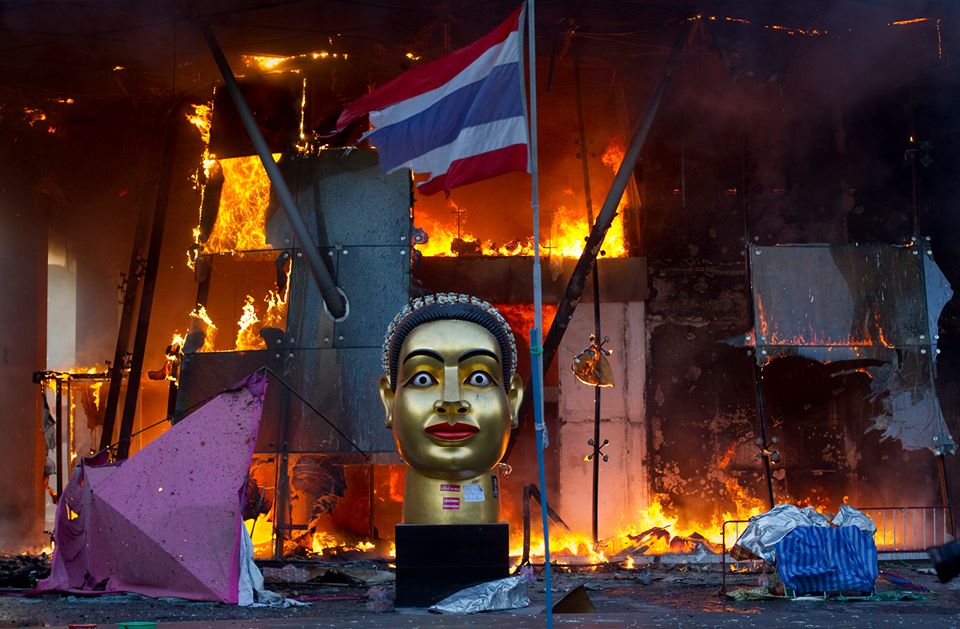
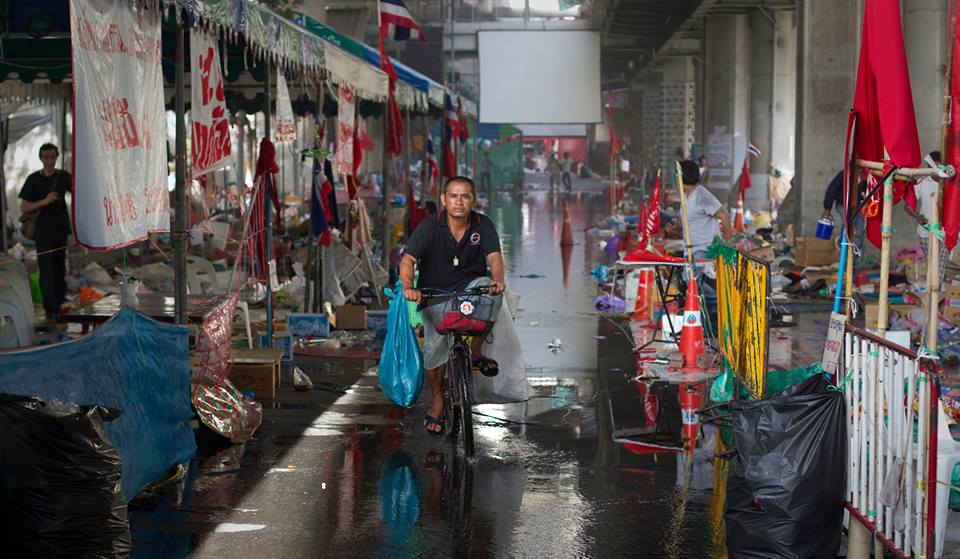
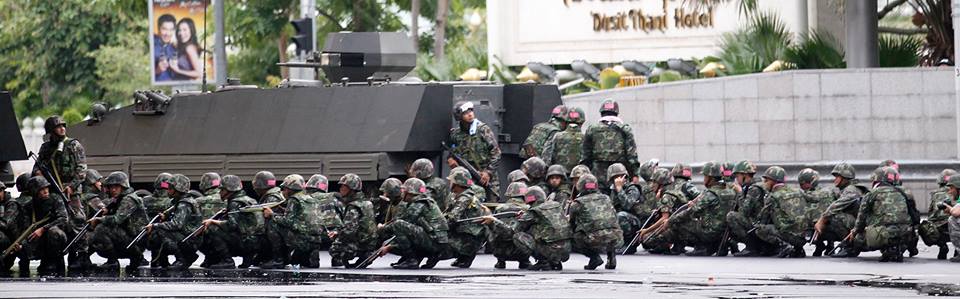
Below are a few
Reuters pictures from 19 May 2010.
I have seen one argument that Abhisit’s biggest mistake was he didn’t order
a containment of the demonstrators 3 years and 6 weeks ago before they took
over downtown Bangkok.
But you have to go
back further. Abhisit has never been elected by the people. Instead he
allowed himself to be appointed and supported by the same people that led
the military coup that overthrew Thaksin in 2006. He legitimized the coup
government by governing under its (2007) constitution; he boycotted an
election (he has never won at the polls) and he and his party became the
beneficiary of a military brokered deal. His actions have been the complete
antithesis democracy.
Three years on,
the Thai government has failed to fulfill its promise to impartially
prosecute all those responsible for the 2010 political violence. That is
part of the deal that allows Yingluck Shinawatra's government to remain in
power.
Worse still
amnesty legislation being proposed by leading members of the ruling Pheu
Thai Party which would shield perpetrators of the coup, the airport
occupation and closure and teh 2010 crackdown from accountability.
A Human Rights Watch May 2011 report, “Descent into Chaos: Thailand’s 2010
Red Shirt Protests and the Government Crackdown,” concluded that excessive
and unnecessary force by the Thai army caused many deaths and injuries
during the 2010 political confrontations. The high number of casualties –
including unarmed demonstrators, volunteer medics and first responders,
reporters, photographers, and bystanders – resulted in part from the
enforcement of “live fire zones” around the UDD protest sites in Bangkok.
The army deployed sharpshooters and snipers.
On September 17, 2012, the Truth for Reconciliation Commission of Thailand
presented its final report, which blamed both sides for the 2010 violence
but indicated that the security forces were responsible for the majority of
deaths and injuries. The commission urged the Yingluck government to
“address legal violations by all parties through the justice system, which
must be fair and impartial.”
The Truth and
Reconciliation Commission (TRC) had been set up by Abhisit's government. It
was anything but independent. It took two years to complete its findings.
The commission did not have any members from the Red Shirt movement, and
many of their investigators were members or sympathizers of the Democrat
Party and the People’s Alliance for Democracy (PAD), also known as the
Yellow Shirts.
The TRC findings was disputed and rejected by the Red Shirt groups, human
rights activists along with the Pheu Thai Party, partly because of
questionable accountability process and the absence of transparency.
Documents seen by Human Rights Watch make it clear that the Center for the
Resolution of the Emergency Situation (CRES), established by Abhisit and
chaired by then-Deputy Prime Minister Suthep Thaugsuban, approved the use of
live ammunition to contain and disperse the protests.
But three years on not a single soldier or official has been held
accountable for the deaths and injuries that took place during the political
confrontations three years ago.
We should not be
surprised; five years on from the occupation and closure of Bangkok's
airports there has been no trial or successful prosecution.
But all this is just a sideshow. The battle for the future of Thailand is
simply in a lull - sadly it is not over. The hatred remains vitriolic on
both sides.
Wing modification
work on Emirates' Airbus A380 fleet has begun around two months later than
planned due to late arrival of new aircraft.
The repair programme, designed to address wing cracks, will cover 34
Emirates A380s and is due to be completed by the end of next year.
"The modifications were due to begin in mid-March, but the first aircraft
only went into modification in early May," says Tim Clark, president of the
Dubai-based carrier. "We need to receive the new aircraft to backfill the
fleet and maintain the route network when we release A380s for modification.
There's been quite a long delay driven by the lateness of delivery of the
new aircraft."
Emirates has just received its 32nd A380, which Clark says was around six
weeks late, and has three more undergoing the delivery process in Toulouse.
Aircraft delivered from next year will be delivered with wings built to a
revised wing structure and will not need repairs after delivery. In the
interim, new-build A380s with the original wing specification are having
repairs undertaken prior to delivery.
Clark says that 34 of its A380s will undergo the repairs over the next 18
months or so, four aircraft at a time. The work was due to take about 20
months and be completed by November 2014. Although the programme has started
two months late, Clark hopes that the November target can still be achieved:
"We estimated the downtime is eight weeks, but Airbus hopes it will be able
to do it in six. So Airbus is relatively optimistic that it can recapture
the timeline after this delay at the front end, by shrinking the time it
takes to do the job."
Clark says the revisions to the wing incorporate some structural and
material changes, including the replacement of composite ribs with metal
ones, and has a small weight penalty of around 60kg (132lb). It is a
lifetime modification certificated to a flight limit 19,500 cycles, he adds.
The work on the Emirates fleet is being undertaken at four MRO organisations
around the world, under an Airbus-managed and funded programme. "It's not
our responsibility - Airbus takes the aircraft, modifies, certifies them and
brings them back to us," Clark says.
Bangkok confirmed as AirAsia X Thai base
16 May 2013
Kuala Lumpur-based
AirAsia X has confirmed that it intends to establish a second base in
Bangkok as part of its expansion strategy.
In a revised draft prospectus lodged with Malaysia's Securities Commission
ahead of a likely initial public offering, the airline says that in March,
it established a company in Thailand with the intention of using it to
launch a second base.
"We plan to operate our first new hub outside Kuala Lumpur in Thailand
through our newly-established associated company, THAI AAX, to tap into
Thailand's well-known leisure market and to leverage on AirAsia's already
established short-haul feeder network in Thailand," says the airline.
It adds that the company is currently dormant, and has given no indication
when it would be likely to start operations.
AirAsia X also estimates its initial cash commitment to the Thai company to
be at $3.3 million, but adds that "depending on the level of operations,
further capital contributions may be required in the near future".
It did not say who are the other shareholders in the company, but it may
include publicly-listed company Asia Aviation, the parent company of Thai
AirAsia.
AirAsia X had stated previously that it sees the best opportunities for
expansion coming from markets such as Indonesia, Thailand and the
Philippines, where AirAsia already has short-haul affiliate carriers that
would be able to act as feeders for a long-haul service.
Earlier this year, media reports from Thailand indicated that AirAsia X was
planning to start a new base at Bangkok's Don Mueang airport with two Airbus
A330-300s in the second half of this year, initially focusing on routes to
South Korea and Japan.
The existing Thai
Air Asia operations into Don Mueang will be an effective feeder network into
the new longer haul operations.
Flightglobal Pro data shows that AirAsia X has a fleet of 12 A330s and two
A340-300s and has orders for 17 more A330s and 10 A350-900s
Wonderful, joyous, heart-stopping
12 May 2013
This is the Watford Observer report
Watford are at
Wembley and one match away from promotion to the Premier League. The
incredible story of how they got there will go down in football folklore.
With the Hornets winning 2-1 and the semi-final locked at 2-2 on aggregate,
extra-time looked inevitable when referee Michael Oliver awarded Leicester
City a soft penalty. As with the 2-1 defeat to Leeds United that ended
Watford’s automatic promotion hopes, it looked like Gianfranco Zola’s men
would suffer last-gasp heartbreak again. But what followed in the next 20
seconds was frankly unbelievable.
Manuel Almunia not only saved Anthony Knockaert’s spot-kick but reacted
superbly to keep up the follow-up as well. The ball was cleared to the right
side of the pitch where Ikechi Anya found Fernando Forestieri, his cross was
nodded down by Jonathan Hogg and Troy Deeney blasted it into the net to
secure his side’s place in the Championship play-off final where they will
play either Crystal Palace or Brighton & Hove Albion on Monday, May 27.
It felt an age ago at the time but the manner in which Watford had got
themselves in the position to secure a 3-1 second-leg victory following
Thursday's 1-0 defeat should not be overlooked - and in particular the
contribution of Matej Vydra.
The Hornets' top scorer had not scored in his previous 13 appearances and
there was some surprise that he was chosen to start, and not Fernando
Forestieri.
However, the Czech international justified Zola's faith within 15 minutes of
the match getting underway, scoring with a sensational left-footed volley
from an acute angle on the left side of the area to make the tie level on
aggregate.
Within four minutes though, the Foxes were level on the day and had the
upper hand again as Dave Nugent got free in the area to head in a corner.
Watford though, continued to plug away and they levelled again on aggregate
when Deeney and Vydra combined for the latter to slot the ball beyond Kasper
Schmeichel to make it 2-1 with his second of the afternoon.
Extra-time began to look increasingly inevitable though, until the football
gods decided to conjure up an astonishing climax to the game that, even now,
defies belief.
There were a few surprises as Zola made three changes from Thursday’s first
leg at the King Power Stadium.
Most fans were probably expecting Fitz Hall and Forestieri to start but both
had to settle for places on the bench as the Hornets boss left his defence
unchanged and kept faith with Vydra, despite his goalless run stretching to
a 13th match in the 1-0 defeat.
There was no surprise that Deeney returned from his one-match ban to replace
Alex Geijo up front, Cristian Battocchio was preferred to Hogg in the
midfield engine room and Matthew Briggs came in for Daniel Pudil on the
left.
Nigel Pearson decided to leave well alone with his team holding the slender
advantage and named an unchanged starting line-up.
There was a change with the officials though, as Phil Dowd, who was meant to
be in charge, was replaced by another Premier League referee in Oliver.
The Hornets started confidently, enjoying some good early possession and
they nearly enjoyed their first opening in the fourth minute when Marco
Cassetti floated a lovely pass over the top looking for Deeney, but Wes
Morgan read it and was able to head away from the edge of his own penalty
area.
Leicester’s response was to force four corners in succession but the Hornets
held strong and so nearly got back on terms in the seventh minute.
Lloyd Doyley side-stepped Lloyd Dyer to bring the ball out of defence before
feeding Nathaniel Chalobah, who played it forward to Deeney. He then waited
for Vydra to make a run off the shoulder of Ritchie de Laet before slipping
a perfectly-weighted pass through the Foxes defence and the Hornets’ 20-goal
striker took it first time left-footed but placed his finish agonisingly
wide of Schmeichel’s left-hand post.
There wasn’t a lot the Leicester keeper could have done about that shot had
it been inside his upright but soon after Schmeichel was having to plunge
low to his right to keep out a superbly-struck right-footed drive from
Deeney from the edge of the 18-yard box.
However, the Hornets didn’t have long to wait to get back on terms on
aggregate when Vydra’s long wait for a goal was ended by a moment of
instinctive brilliance.
There didn’t appear to be too much on at first when Cassetti lofted a pass
down the inside left channel and into the area but with a defender goal-side
and the angle very much against, the Czech international spun and struck a
stunning left-footed volley on the turn that gave Schmeichel no chance as it
flashed past him to give the Hornets the lead to level up the semi-final.
But parity in the tie was to last just four minutes.
A sliced Cassetti clearance gave Leicester their sixth corner of the match
and when the set piece was taken from the left, Nugent pulled away from
Doyley at the far post to head down and beyond Almunia to follow up his
winner on Thursday with another goal to make it 1-1 and give his side the
upper hand again.
It was the striker’s eighth goal in 11 games against the Hornets and soon
after the visitors had another opening when Dyer laid the ball across from
the left to Knockaert, but he fired over with a first-time effort.
The equaliser didn’t appear to unduly affect Watford though, but they had to
wait until the 30th minute for their next effort when Deeney tried to catch
Schmeichel out with a shot from 20 yards but the keeper read it and made a
catch above his head.
Chris Wood picked up the game’s first yellow card in the 34th minute for
playing on after the whistle had blown for offside before Deeney when for an
acrobatic finish after Ikechi Anya had stood up a cross from the right side
of the area, but the striker’s finish went well wide.
Watford’s domination of possession continued but their next opening didn’t
arrive until a minute before the interval when Anya, who clearly had the
beating of Jeff Schlupp, nicked the ball past the left-back again before
sending over a low cross which Deeney hit first time on the turn but his
strike went over.
However, the Hornets had a close call shortly before the half-time whistle
when Nugent set Wood away but a marginal offside decision prevented the
striker from having a one-on-one opportunity against Almunia.
Zola’s men were soon back on the front foot after the restart, with Anya
crossing from the right and the ball was partially headed clear to Cassetti,
who powered the rebound high and wide from 25 yards.
Leicester’s first opportunity of the second period came when Almen Abdi was
penalised for a foul on Wood around 25 yards out in a central position but
Knockaert was unable to make the most of the set piece, curling it a yard or
so over Almunia’s goal.
Back came the Hornets though, with Battocchio showing some lovely close
footwork on the edge of the box to get away from two opponents before
striking a right-footed shot that was deflected narrowly wide of
Schmeichel’s right-hand post.
Watford might have had some joy from Abdi’s resultant corner had someone in
yellow gambled in the six-yard areas as the ball was allowed to bounce right
through the heart of the Foxes’ box.
Instead, the end-to-end nature of the early second-half exchanges continued
as de Laet got away from Briggs on the right side of the area before sending
over a cross which Wood had to back track to get to. Consequently, his
header lacked power and Almunia was able to drop to the floor to make a
comfortable save.
But the goal Watford craved so nearly arrived in the 56th minute when Vydra
found Briggs on the left. The wing-back side-stepped his man with ease to
get into the area before laying the ball across to Vydra, who in turn tapped
it to Abdi. His right-footed effort looked destined for the far corner but
the slightest of deflections just took it wide.
Pearson made the game’s first change in the 61st minute and it was a repeat
of Thursday, with Harry Kane coming on for Wood. Zola rapidly followed suit
as Doyley made way for Forestieri.
But within a minute of entering the fray, the Argentine was on the pitch to
see his side take the lead as Vydra confirmed he was right back on song.
Watford built from the right with Vydra initially looking like he might feed
Forestieri, who was on the left. However, he instead fed Deeney, who
returned the ball to Vydra and he slotted it past Schmeichel to make it 2-1
on the day and 2-2 on aggregate.
Danny Drinkwater came on for Dyer before the game had restarted and then
Cassetti was booked for a lunging challenge on Kane. However, the
substitute’s effort from the resultant free-kick was woeful as it cleared
the bar by yards.
Watford were now pouring forward in waves and Battocchio was the next to try
his luck, hitting a right-footed drive from the left angle of the area but
Schmeichel was able to save it at the second attempt as Deeney closed in.
The Hornets still had to be careful though, and when Nugent was fouled on
the edge of the area an even better free-kick opportunity presented itself.
But the Leicester striker was unable to get his attempt up and down quickly
enough and it went narrowly over the bar.
Kane fired at Almunia soon after as the home side got ragged at the back for
a few minutes. But Anya then won a corner and Abdi’s set piece from the
right ended with Forestieri hitting a piledriver across goal and wide.
Watford thought they had got the all-important third goal when Deeney
slotted the ball through Schmeichel’s legs after he had been released by
Vydra but the Rookery’s wild celebrations were cut short by a linesman’s
flag.
Forestieri had a shot from outside the area blocked behind for a corner,
Cassetti headed the resultant corner down and wide and then Battocchio made
way for Hogg with 11 minutes remaining.
The Hornets continued in the ascendency as the game entered the last five
minutes of normal time and additional 30 minutes looked an increasing
probability. To add to the tension, there was a lengthy delay in the game in
the final stages when the outstanding Joel Ekstrand made a superb challenge
on the edge of his area but got a kick in the head from Knockaert for his
troubles. The Swede needed a quite lengthy spell of treatment, during which
the fourth official signalled there would be a minimum of four additional
minutes, but he was able to continue.
It was no surprise that more was in fact played and in the sixth minute of
additional time it was heart in mouths time when Nugent crossed from the
right but Kane wasn’t able to get his shot away. But that was just the
prelude for the most incredible spell of drama arguably ever witnessed at
Vicarage Road.
It began when Cassetti got the wrong side of Knockaert in the area and as
the Hornets defender tried to get back, the Leicester striker went down
rather easily but the referee pointed to the spot. It looked like Watford’s
promotion dream was over but nobody told Almunia.
Knockaert took responsibility for the penalty but struck it too centrally
and the Hornets’ keeper not only saved it with his legs but reacted superbly
to block the follow up as well. The ball was hacked clear to the right side
of the pitch where Anya ran at Schlupp for one last time before feeding
Forestieri. He stood up a cross to the far post, Hogg showed superb
awareness to cushion a header down and Deeney powered through to rifle a
right-footed shot into the net and send the Hornets to Wembley.
Watford’s goal scorer immediately pulled off his shirt and raced to the Main
Stand where the players’ family and friends were sitting before the
inevitable pitch invasion ensued.
It took three to four minutes to clear the playing surface before play could
restart but all that was left was for Watford to survive one last ball
pumped into the area before Oliver blew the whistle for one last time and
the celebrations really began.
Watford: Almunia; Doyley (Forestieri 65), Ekstrand, Cassetti; Anya, Abdi,
Chalobah, Battocchio (Hogg 79), Briggs; Deeney, Vydra. Not used: Eustace,
Hall, Pudil, Bond and Geijo.
Leicester City: Schmeichel; de Laet, Morgan, Keane, Schlupp; James, King;
Knockaert, Nugent, Dyer (Drinkwater 66); Wood (Kane 61) Not used: Konchesky,
Marshall, Vardy, Logan and Moore.
Bookings: Wood for dissent (34); Cassetti for a foul on Kane (69).
Attendance: 16,142 (2,206 away).
Referee: Michael Oliver.
. Arabian Business has mega fail on Emirates profit story
The writer is so
confused - the AED 3.1bn profit was announced for 2012/2013 ie: the
financial year ended 31 March 2013. Not 2011/12 which should be your
comparison year.
I am not sure why you are using figures from 2009/2010; and your figures are
wrong here - Group Profit was AED4.2bn of which the airline made AED3.5bn.
AED 3.1 bn in 2012/2013 was the Group profit. The airline made AED 2.3 bn
and DNATA AED0.8bn. The US$ figure is wrong in the article: AED3.1bn does
not equal $622m.
Then to reinforce the story look at the first half of 2012/2013 where the
Group announced a Profit of AED2.1 bn - well on the way to the target of AED
3.5 bn. So the question that you should be asking is what happened in the
second half of the year with a profit for the six months that was less than
50% of the first half year.
I am sorry but the error in this article are embarrassing. I have left a
comment on the Arabian Business web site - but am sure they will not publish
it. At least they could do the decent think and correct the article....which
follows:
Emirates
defends no staff bonus, despite huge profit
By Courtney Trenwith Sunday, 12 May 2013 2:38 PM
"Emirates Airline has defended its decision not to award staff their annual
bonus for the second consecutive year, claiming the 52 percent increase in
profits was insufficient.
The Dubai-based carrier – one of the largest in the world by passenger
numbers – made AED3.1bn ($622m) profit during 2011-12, which was one of the
best results of any comparable international airline.
At the same time, Emirates Group – of which the airline is a subsidiary -
posted a 34 percent increase in profits to $845m.
However, the airline said its profit target was not achieved.
While the increase was significant, the profit was still lower than 2009-10
when the airline reached $703m.
Announcing the 2010-11 results last year, it blamed a skyrocketing fuel bill
(up 44.4 percent to $6.6bn) for the 72.1 percent slump in profit to $409m.
The below-bar result in2011-12 means bonuses will not be paid to about
60,000 Emirates’ staff, who are generally paid a low base wage that is
topped up with benefits such as a flying allowance for cabin crew, free or
subsidised housing and significant ticket discounts.
“The Emirates Group provides staff with a bonus based on the group’s
financial performance. A profit target is set each year and needs to be met
before bonuses are paid,” an Emirates spokesperson said in a statement
provided to Arabian Business.
“Although the Emirates Group posted a AED3.1 billion net profit for the
2011/12 financial year, unfortunately, in the face of very challenging
economic conditions, our profit target was not reached.
“Therefore, staff, whom we know continue to work very hard, will not receive
a bonus on this occasion. They will, however, continue to enjoy the generous
benefits package offered to all staff of the Emirates Group.”"
Duncan Welbourne.
Ken Furphy. Stewart Scullion. Keith Eddy. Terry Garbett. Tom Walley. Barry
Endean. Andy Rankin. Ross Jenkins. Alan Garner. Roger Joslyn. Luther
Blissett. Steve Sherwood. Graham Taylor. Ian Bolton. Steve Sims. Nigel
Callaghan. Kenny Jackett. Wilf Rostron. Les Taylor. John Barnes. Nigel
Gibbs. Gary Porter. Tony Coton. John McClelland. George Reilly, Mo Johnston,
Glyn Hodges. Paul Wilkinson. Keith Dublin. Andy Hessenthaler. Richard
Johnson. Paul Furlong. Colin Foster. Tommy Mooney. Craig Ramage. Kevin
Miller. Robert Page. Steve Palmer. Alec Chamberlain. David James. Gifton
Noel-Williams. Paul Robinson. Micah Hyde. Peter Kennedy. Ronnie Rosenthal.
Tommy Smith. Allan Smart. Nicky Wright. Neil Cox. Heidar Helguson. Marcus
Gayle. Gavin Mahon. Ray Lewington. Sean Dyche. Ashley Young. Jay DeMerit.
Clarke Carlisle. Ben Foster. Darius Henderson. Marlon King. Malky Mackay.
Adrian Mariappa. Tom Cleverley. Danny Graham.
From the Rookery
End. Blind, Stupid and Desperate. Look at the Stars. Clap Your Hands, Stamp
your Feet. Watford Junction. The Rookery. The High Street. The Rous Stand.
Market Street. The Parade. Watford General. Occupation Road. The Main Stand.
Elton John. The Scoreboard. Mike Vince. The Vic Road End. The Observer
Clock. Z-Cars. Benskins. Iveco. Solvite. Eagle Express. Herald & Post. RCI.
Blaupunkt. CTX. Phones4U. Toshiba. Total. Beko. Burrda. The Happy Egg Co.
Football Manager. Wembley 84. Away days to Luton. Kaiserslautern 83.
Liverpool 70. Anfield 99. Old Trafford 79. Leeds 92. Wembley 99. St Andrews
99. Cardiff 06. Fulham 98. Red Shorts. Black Shorts. Yellow everything.
Marco Cassetti. Almen Abdi. Jonathan Hogg. Matěj Vydra. Fernando Forestieri.
Manuel Almunia. Lloyd Doyley. Joel Ekstrand. Christian Battocchio. Jonathan
Bond. Fitz Hall. Sean Murray. Ikechi Anya. Troy Deeney. Matthew Briggs. Jack
Bonham. Adam Thompson. Steve Beleck. John Eustace. Connor Smith. Daniel
Pudil. Lee Hodson. Tommie Hoban. Nathaniel Chalobah. Britt Assombalonga.
Nyron Nosworthy. Mark Yeates. Prince Buaben. Craig Forsyth. Neuton. Geoffrey
Mujangi Bia. Alex Geijo. Carl Dickinson. Ross Jenkins. Piero Mingoia.
Gianfranco Zola. Gino Pozzo. Stephen Heeler. Noel Robson. My dear departed
Dad. Harry the Hornet. Everyone, anyone who has been and touched Watford FC.
Their mates. Your mates. You. Me.
Us.
Come. On. You. Horns.
David James
found at last - in Iceland
12 May 2013
I was wondering
where ex Watford and England goalkeeper, artist and writer David James had
disappeared to. He has been found. Though it is
doubtful that many could name the club that he is now playing
for.
MBE David James
signed to Icelandic football club ÍBV of Vestmanneyjar (the Westman Islands)
in April.
James was capped 53 times by England between 1997 and 2010. He started his
career with Watford in 1988 and played with Liverpool, Aston Villa, West
Ham, Manchester City and Portsmouth in the PL.
With Portsmouth he won the FA Cup in 2008 along with his friend and
Vestmannaeyjar local Hermann Hreiðarsson, now the new ÍBV manager.
IBV finished 3rd in the Icelandic league last year and has won the Icelandic
Championship three times, in 1979, 1997 and 1998, and the Cup four times, in
1968, 1972, 1981 and 1998.
The home ground, Hásteinsvöllur, has a capacity of 1,500. The population of
Vestmannaeyjar, the 12th largest town in Iceland, is 4,200, ten times less
than Welwyn Garden City, in Hertfordshire, where James was born on August 1,
1970.
Combining playing
time with the chance to coach alongside former Portsmouth team-mate and IBV
boss Hermann Hreidarsson is why he can be found thousands of miles from home
on the tiny North Atlantic island. He sees it as the first small step
towards management. Not the well-worn path of an ex-keeper coaching keepers,
the seldom-travelled route from between the sticks to the top job.
“We’ve got a group of young players, there are older players, but
predominantly they are around 21 and there’s a sense of enthusiasm I haven’t
seen for a long, long time,” James explained while in Abu Dhabi visiting
David Coles, his old Pompey and the current Al Jazira goalkeeping coach.
“A lot of these players are part-time, working on ships. There’s a lot of
women’s football out there too; they don’t get paid but spend five days a
week training. That sort of commitment and desire for a sport, you think,
well, this is a perfect environment to learn as a coach and help a group of
players achieve their aspirations.”
And it will give
David something and somewhere very different to write about.
The impact of
not looking after your staff
12 May 2013
So Emirates did
not pay a staff bonus this year. It did not last year either.
The profit share
is based on sharing profit in excess of a predefined target. For 2011/12 the
target was simply silly.
For 2012/2013 it
was a stretch but achievable. At the half year the group was on target. Then
something happened in the last six months that left the group well short of
target.
It is no great
secret that as a privately held company Emirates accounts are not held to
the same level of scrutiny as a public company. The reporting requirements
are not as onerous. Though the group does publish its annual report.
That said the net
profit can be managed and that appears to have happened this year.
The profit target
was not met. No token bonus was paid. Yet the Group made close to US$1
billion in net profit.
And staff feel let
down. That is clear from everyone that I talk to and from all the comments
that I have read. And let down means unmotivated. And let down means why
should staff go the extra mile to save costs as the company continually
exhorts people to do.
Remember that the
majority of Emirates staff are in the front line dealing with customers in
the air or on the ground every day. Upset these people and why should they
make the extra effort for the airline's passengers? Why should they answer
that call bell? Why should they taxi on a single engine etc.
For short term
gain Emirates appears myopic and self serving. As one writer commented
"its employees are a balance sheet asset; equally as valuable on the
airlines balance sheet as any aircraft, building, computer system or
executive lounge. An investment in each is required in order to maximize ROI,
efficiency and productivity in a service industry such as aviation."
People have been
proud to work for Emirates and to contribute to its success but this
decision may have tipped the balance.
And the cost to
Emirates will not be in losing upset crew or ground staff or engineers or
office team.
It will be pilots
uploading an extra tonne of gas every flight; cabin crew not answering call
bells; passengers will switch carriers (its the little things that keep
frequent flyers), ramp workers dragging their feet and causing every flight
to be delayed by 10 minutes every day. Passengers will leave for other
airlines if they are always delayed.
A small token
would have gone a long way to showing "our employees are still important to
us." The words are not enough.
Emirates results hype
10 May 2013
Emirates Airline
hits new heights with 52% rise in profit -
The National Abu Dhabi
Emirates airline profits up 34% to Dh3.1 billion -
Gulf News (getting it wrong - that was the Emirates Group profit including
DNATA)
Emirates Airline annual profit jumps 52% to $622 m -
The Hindu
Emirates thinks big as profit soars 52pc
- The Australian
Emirates reports 52 percent rise in
profits as growth of airline outpaces fuel prices -
Washington Post
They are all missing the point - see below.
Emirates
fluctuating fortunes
10 May 2013
Emirates announced
its full year results today for the year to 31 March 2013.
Profit soars 52%
cooed Reuters. The rest of the media followed. What no one has asked is what
happened in the last six months of 2012/2013 and why for two years in a row
has the Emirates Group failed to meet its targets leaving some 50,000 staff
upset at not receiving any profit share.
Rule 1. Set
realistic targets! Rule 2. Do not load provisions into the second half of
the year.
Emirates Results excluding
DNATA in AED billions
y/e 31
March 2103
6m to 31 Mar 2013
6m to 30 Sept 2012
y/e 31 Mar
2012
6m to 31 Mar 2012
6m to 30 Sept 2012
y/e 31
March 2011
y/e 31
March 2010
Revenue including other
operating income
73.1
37.7
35.4
62.3
32.0
30.3
54.2
43.5
Profit Attributable to Owner
2.3
0.6
1.7
1.5
0.7
0.8
5.4
3.5
Costs:
Fuel Costs
27.9
24.3
16.8
11.9
Staff Costs
9.0
7.9
7.6
6.3
Profit attributable to
shareholder as % of revenue
3.1%
1.6%
4.8%
2.4%
2.1%
2.6%
10.0%
8.1%
Passengers flown
39.4
20.7
18.7
34.0
17.8
16.2
31.4
27.4
Load factor
79.7%
80%
80%
79.3%
80%
78.1%
Total Group Revenue
77.5
39.3
38.2
67.4
34.5
32.9
57.4
45.4
Total Group profit
attributable to owner
3.1
1.0
2.1
2.3
1.1
1.2
6.0
4.2
Group Profit Share Target
3.5 billion
6.0 billion
?
Bonus
Zero
Zero
12 weeks
?
The full year
Group Profit for the year ended 31 March 2013 is just 51% of 2011 profit and
73% of 2010 profit.
The profit margin for the last six months is the weakest it has been in the
last for years.
In 2011 when Emirates had its record year of profitability management set up
a stage in the group hq with media, photographers etc. for the results
announcement. Staff received a 12 wks bonus. The last two years. Just an
email. No stage, no media, no profit share.
"Never in the
field of commercial aviation was so much owed by so few to so many" was just
one comment I saw today.
"It Takes a World", is the theme of EK's Annual Report 2012-13, it sounds
more like the World is not Enough.
On the plus side the year saw Emirates add 34 new aircraft and 10
destinations to its network.
As for next year - the profit target is Dhs4.255 billion.
Nord Anglia
Education to acquire WCL Group for USD222 million
3 May 2013 by The Asset
Nord Anglia Education, acquired by funds advised by Baring Private Equity
Asia (Baring Asia) in 2008, will purchase 100% of the shares in WCL Group
for US$222 million. WCL is London based World Class Learning
Nord Anglia has agreed to acquire WCL from affiliates of Sovereign Capital
Partners and WCL management in a transaction totaling about £153 million
(US$237 million) implying an enterprise value of £143 million (US$222
million).
Founded in 1972, Nord Anglia Education today operates international schools
in Europe, the Middle East and Asia, offering a British-style education to
about 10,000 students. Most schools follow a curriculum based on the
National Curriculum of England and Wales, adapted country by country to meet
local culture and local conditions. The schools offer IGCSEs and the
International Baccalaureate plus, in some locations, A-levels, the French
Baccalaureate and the Swiss Maturité.
WCL delivers K-12 education to approximately 4,500 students in eleven
international schools: six in the US, one in Spain and four in Qatar.
WCL’s eleven-school portfolio is expected to complement Nord Anglia
Education’s existing netowrk of schools and enables Nord Anglia Education to
enter the attractive North American market with a critical mass of six
established schools whilst strengthening its existing presence in the Middle
East.
The combined organization will operate 25 schools in 11 countries, employ
over 3,000 teaching staff and educate over 14,500 students.
The business of IVF in Dubai
9 March 2013
Ziad Makhzoumi
is joining Fakih IVF as their Chief Executive Officer. More evidence that
IVF treatment is becoming a business, and a big business, in the UAE.
In summary
Arabtec's CFO is joining an IVF treatment business as their CEO.
Ziad Makhzoumi
started his career in 1981 with Booz Allen&Hamilton. From 1985 till 2000,
Ziad Makhzoumi was the CFO of a Luxembourg based private holding company
with operations in North America, Europe, and the MENA region and assumed
executive and non-executive responsibilities in the group's subsidiaries....ie
a very private, anonymous company hiding in Luxembourg for tax reasons.
From 2001 till his appointment as the CFO of Arabtec Holding PJSC in 2008,
Ziad was involved in strategic consultancy and private equity buyouts and
restructuring activities in Europe, the Middle East and North America. Ziad
Makhzoumi holds a BSc in Electronics Engineering and an MBA in Banking and
Finance both from Manchester University.
None of the above
seems very relevant to IVF treatment.
Dr Michael Fakih, the leading expert in the sector and the Chairman of Fakih
IVF, said "Fakih IVF is recognized as the leading IVF center in the UAE. We
plan to expand further in the UAE and other GCC countries.We have just
completed our new state of the art center in Abu Dhabi and plan to open new
centers in the UAE and other GCC countries. Our new CEO, Ziad Makhzoumi, who
has an impressive history of corporate successes will develop our growth
strategy and implement the restructuring required to achieve our objective
of becoming the leader in the field in the GCC
In all of this I
just wonder if Fakih is losing sight of the people that it needs most to
look after - its patients.
Why is this
relevant now. Well I wrote to Dr Fakih four days ago following Tai and my
recent unsuccessful course of treatment.
My comments in the
letter included: I have not repeated the whole letter as some of it is
personal and the doctor's name has been redacted.
..."my comments below are meant to give you some thoughts from the patients’
perspective. I believe that the comments are objective enough that I would
have shared them whether we were successful or not.
My biggest concern is that you are in danger of de-humanizing the process
and becoming what is too typical of a Dubai business – a business that
focuses on profit rather than on your customers/patients.
I will explain this in more detail below – but my over-riding sense was that
we were processed; that time spent with the doctor was the minimal possible;
that patient care has been reduced to quick phone calls; in reality we
learned more through online research rather than through the clinic.
Not one of the appointments with Dr xxx started on time. The 10 April
appointment started an hour late at 11.45am. “We are busy” is not an excuse
for delayed appointments. It simply adds to the sense that the doctors had
more patients than they had time for. No apology was ever made for the late
appointments....
Our last appointment with Dr xxx was on 10 April. All contact with the
doctor since that date has been by telephone with either an update on the
embryo development and transfer date and subsequently with the results of
the blood tests. Sometimes these calls would be made by Dr xxx’s
assistant....
This is really the heart of my concern; most of your patients, I assume, are
going through IVF for the first time. We need support and encouragement. We
have placed a great deal of hope in your clinic. We need doctors to explain
the procedures, timings, medications, symptoms and results. To take us
through the process and to describe the treatments in language that the
layperson understands....
My overall concern which I hope I have explained is a sense that the clinic
is simply too busy and that, as a result, patient well-being is not being
fully addressed....
Your patients do place so much hope in your clinic. The emotional and
financial commitment is significant. I do wish that our interaction with the
clinic and our support from the doctors had felt more personal and a little
less like a processing line."
Dr Fakih has not replied.
R Airlines are
bust
6 May 2013
Another Thai start
up airline bites the dust. I did tell you.
R Airlines based at Bangkok's Don Mueang International has tentatively
suspended operations following the re-registration of its sole B737-400,
HS-RCA (msn 25313), as N353AS in the United States.
The 737 is
understood to again be with Florida-based aircraft leasor, AerSale, having
been parked in Bangkok Don Mueang International (DMK) for months.
Despite its
ambitious start-up plans which included flights to Frankfurt International (FRA)
using a wet-leased B777-200, the airline has been barely visible since
launching in September 2012.
Yingluck's strong speech on Democracy
After two years in office Thailand Prime Minister Yingluck Shinawatra has at
long last said what needed to be said on the state of Thai democracy. Her
speech was delivered at the 7th Ministerial Conference of the Community of
Democracies, Ulaanbaatar, Mongolia, 29 April 2013.
As a speech it
does not say all that it should; it is inevitable a little self serving. It
fails to address Thaksin's own attempts to undermine democracy through
manipulation of the media and alleged vote buying. It fails to address the
position of the Thai monarchy. It fails to address the fact that Yingluck's
own government has incarcerated people under Thailand's draconian Section
112 lese majeste laws.
It may just be
words; we may not see any action taken to support those words.
But the speech has
deeply upset the more extreme yellow, anti-democracy advocates in Thailand.
Already the former and unelected Thai Prime Minister, Abhisit Vejjajiva, has
condemned PM Yingluck’s call for greater democracy in Thailand. This comes
as no surprise – Abhisit’s main legacy is of a man committed to the
destruction of accountability, the continuation of impunity and the
subjugation of the Thai people. As Abhisit has done on several occasions in
the past he reveals, once again, his complete lack of understanding of the
most basic principles of democracy and rule of law. It is no great surprise
he leads a broken party that remains unelectable and unable to carry out its
basic democratic duties as the official party of opposition and, instead, is
reduced to the worst kind of demagoguery.
Thai Rath
newspaper cartoonist and political commentator Chai Ratchawatra (Somchai
Katanyutanon) wrote on Facebook: “Please understand. Prostitutes are not
evil. They just sell their bodies. But an evil woman sells her country”,
saying that Yingluck had betrayed Thailand.
He is known to be
deeply yellow and to hate the Shinawatras but his hateful mysogenistic
comments should be offensive to all Thais.
Among many
examples the Bangkok Post reported the
arch royalist Vasit Dejkunjorn's response that “accused the prime
minister of ‘telling a lie’ and of uttering ‘disgusting’ comments that tried
to blame others for the misconduct of her brother.” Vasit, of course, favors
military coups and undemocratic politics.
Anyway here is
Yingluck's speech; long overdue and hopefully a sign or more action and less
acquiescence.
"I wish to begin by expressing my appreciation to His Excellency the
President of Mongolia for inviting me to speak at this Conference of the
Community of Democracies.
I accepted this invitation not only because I wanted to visit a country that
has made many achievements regarding democracy, or to exchange ideas and
views on democracy. But I am here also because democracy is so important to
me, and more importantly, to the people of my beloved home, Thailand.
Democracy is not a new concept. Over the years, It has brought progress and
hope to a lot of people. At the same time, many people have sacrificed their
blood and lives in order to protect and build a democracy.
A government of the people, by the people and for the people does not come
without a price. Rights, liberties and the belief that all men and women are
created equal have to be fought, and sadly, died for.
Why? This is because there are people in this world who do not believe in
democracy. They are ready to grab power and wealth through suppression of
freedom. This means that they are willing to take advantage of other people
without respecting human rights and liberties. They use force to gain
submission and abuse the power. This happened in the past and still posed
challenges for all of us in the present.
In many countries, democracy has taken a firm root. And it is definitely
refreshing to see another wave of democracy in modern times, from Arab
Spring to the successful transition in Myanmar through the efforts of
President Thein Sein, and also the changes in my own country where the
people power in Thailand has brought me here today.
At the regional level, the key principles in the ASEAN Charter are the
commitment to rule of law, democracy and constitutional government. However,
we must always beware that anti-democratic forces never subside. Let me
share my story.
In 1997, Thailand had a new constitution that was created through the
participation from the people. Because of this, we all thought a new era of
democracy has finally arrived, an era without the cycle of coups d′etat.
It was not to be. An elected government which won two elections with a
majority was overthrown in 2006. Thailand lost track and the people spent
almost a decade to regain their democratic freedom.
Many of you here know that the government I am talking about was the one
with my brother, Thaksin Shinawatra, as the rightfully elected Prime
Minister.
Many who don′t know me say that why complain? It is a normal process that
governments come and go. And if I and my family were the only ones
suffering, I might just let it be.
But it was not. Thailand suffered a setback and lost international
credibility. Rule of law in the country was destroyed. Projects and
programmes started by my brother′s government that came from the people′s
wishes were removed. The people felt their rights and liberties were wrongly
taken away.
Thai means free, and the people of Thailand fought back for their freedom.
In May 2010, a crackdown on the protestors, the Red Shirts Movement, led to
91 deaths in the heart of the commercial district of Bangkok.
Many innocent people were shot dead by snipers, and the movement crushed
with the leaders jailed or fled abroad. Even today, many political victims
remain in jail.
However, the people pushed on, and finally the government then had to call
for an election, which they thought could be manipulated. In the end, the
will of people cannot be denied. I was elected with an absolute majority.
But the story is not over. It is clear that elements of anti-democratic
regime still exist. The new constitution, drafted under the coup leaders led
government, put in mechanisms to restrict democracy.
A good example of this is that half of the Thai Senate is elected, but the
other half is appointed by a small group of people. In addition, the so
called independent agencies have abused the power that should belong to the
people, for the benefit of the few rather than to the Thai society at large.
This is the challenge of Thai democracy. I would like to see reconciliation
and democracy gaining strength. This can only be achieved through
strengthening of the rule of law and due process. Only then will every
person from all walks of life can feel confident that they will be treated
fairly. I announced this as part of the government policy at Parliament
before I fully assumed my duties as Prime Minister.
Moreover, democracy will also promote political stability, providing an
environment for investments, creating more jobs and income. And most
importantly, I believe political freedom addresses long term social
disparities by opening economic opportunities that would lead to reducing
the income gap between the rich and the poor.
That is why it is so important to strengthen the grassroots. We can achieve
this through education reforms. Education creates opportunities through
knowledge, and democratic culture built into the ways of life of the people.
Only then will the people have the knowledge to be able to make informed
choices and defend their beliefs from those wishing to suppress them. That
is why Thailand supported Mongolia′s timely UNGA resolution on education for
democracy.
Also important is closing gaps between rich and poor. Everyone should be
given opportunities and no one should be left behind. This will allow the
people to become an active stakeholder in building the country′s economy and
democracy.
That is why my Government initiated policies to provide the people with the
opportunities to make their own living and contribute to the development of
our society. Some of these include creating the Women Development Fund,
supporting local products and SMEs as well as help raising income for the
farmers.
And I believe you need effective and innovative leadership. Effective in
implementing rule of law fairly. Innovative in finding creative peaceful
solutions to address the problems of the people.
You need leadership not only on the part of governments but also on the part
of the opposition and all stakeholders. All must respect the rule of law and
contribute to democracy.
Ladies and Gentlemen, another important lesson we have learnt was that
international friends matter. Pressure from countries who value democracy
kept democratic forces in Thailand alive. Sanctions and non-recognition are
essential mechanisms to stop anti-democratic regimes.
An international forum like Community of Democracies helps sustain
democracy, seeking to promote and protect democracy through dialogue and
cooperation. More importantly, if any country took the wrong turn against
the principle of democracy, all of us here need to unite to pressure for
change and return freedom to the people.
I will always support the Community of Democracies and the work of the
Governing Council. I also welcome the President′s Asian Partnership
Initiative for Democracy and will explore how to extend our cooperation with
it.
Ladies and Gentlemen, I would like to end my statement by declaring that, I
hope that the sufferings of my family, the families of the political
victims, and the families of the 91 people, who lost their lives in
defending democracy during the bloodshed in May 2010, will be the last.
Let us continue to support democracy so that the rights and liberties of all
human beings will be protected for future generations to come!"
Dubai gets Trumped again
5 May 2013
Luxury developer
Damac has announced plans to develop an 18-hole PGA championship golf course
in its latest project in Dubailand.
Strangely Damac said that construction of the 7,205-yard, par 71 course, to
be named Trump International Golf Club, Dubai is already underway and the
course will be ready for play next year.
Why strange - well
normally in Dubai a project is announced and then sometime later development
starts.
Trump International Golf Club, Dubai will include a 30,000 square foot
state-of-the-art club house and a luxurious Trump Spa and Wellness Centre,
which will be managed by the Trump Organization.
"We are thrilled to be expanding our portfolio of award-winning courses into
Dubai with Damac Properties. Dubai is an incredible city that truly
understands the meaning of luxury. Trump International Golf Club, Dubai will
be built to world-class levels, exceeding all expectations - there will be
nothing like it in the region and beyond," said Donald J Trump, the chairman
and president of The Trump Organization.
This is even odder
since Trump pulled very quickly out of Dubai in 2008 when he cancelled the
Trump International Hotel & Tower on the Jumeirah Palm which was to be
developed with Nakheel.
At the height of the crisis, Mr Trump questioned the reasoning behind
Dubai’s building boom as buyers deserted the city. “Where do these people
come from,” he told CNBC TV. “It turned out they didn’t come.”
Tiger Woods’ plans for a golf course were also abandoned during the crisis.
But three years on, the emirate has recovered by refocusing on trade and
tourism and emerging as a haven from the Arab revolutions.
Damac is also pushing ahead with new projects with brands such as Paramount
and Versace.
Real estate observers fear a return of that giddiness as investors once more
“flip” undeveloped properties for quick profits.
“This all goes to show how short people’s memories are,” said one private
developer working in Dubai.
How badly can it
go wrong - just take a drive to the remnants of the Tiger Woods course out
near the Sevens Stadium.
Boeing launches its 777X
5 May 2013
Boeing (BA.N) has started offering its long-awaited 777X long-range jet,
paving the way for a 'mini-jumbo' war with European rival Airbus, industry
sources said on Wednesday.
The move backed by Boeing's board means that the commercial aircraft
division can begin taking orders for a revamped version of its top-selling
wide-bodied jet, the 777, which could include folding wingtips and new
engines from General Electric (GE.N).
Until now, Boeing has enjoyed a virtual monopoly in the lucrative market for
large twin-engined jets, boosting its margins, but Airbus has started
challenging that position with its 350-seat A350-1000, due to enter service
in 2017.
Boeing's response is a substantial overhaul in the design of the 777,
expected to enter service around 2020.
People familiar with the matter said the Boeing board had approved the
so-called "authority to offer", allowing sales to proceed. The people
declined to be identified because they are not authorized to discuss actions
of the board.
After attracting enough orders, Boeing would go back to the board for
permission to start developing and building the jet.
The 777X is a planned successor to the industry's most popular large twin-engined
aircraft seating more than 300 passengers. The original 777 was introduced
in 1995 and is the last new plane Boeing developed before the 787. Its most
popular version is the more recent 777-300ER....which Emirates flies in
configurations ranging from 354 to 428 passengers.
The 777X would compete from around the turn of the decade with the Airbus
A350-1000 to carve up a potential market of at least 2,000 aircraft worth
about $500 billion over 20 years.
The cost of the 777X development has not been disclosed but after industrial
delays followed by a grounding of its 787 Dreamliner, Boeing will hope that
upgrading a familiar jet costs significantly less than the $15 billion for
an all-new aircraft.
Emirates, which runs the biggest fleet of 777s, is among airlines calling
for the cost-saving 777X as early as possible.
Airbus says that its carbon-composite A350 is lighter and cheaper to run
than the 777X, which will keep a metallic body. Boeing is expected to argue
that an all-new wing and new engine will make the 400-seat 777X cheaper to
operate per seat.
The timing should dominate discussion at the June 17-21 Paris air show and
could lead to a big order from Emirates at the Dubai Air Show in November.
The larger 777X is presumably the end of Boeing's four-engine 747-8.
Although the jumbo 747-8 can seat up to 467, its only operator so far,
Lufthansa, configures it for no more than 386 passengers.
The planned 777-8X and 777-9X will replace today's 777-200LR and 777-300ER.
The standard 777-200 is likely to be replaced by the 787-10. And the 777-9X
could replace the poor-selling 747-8.
Is Dubai the centre of the world again?
5 May 2013 CNN
During London
Mayor Boris Johnson's recent visit to Dubai on an investment promotion trip,
he jokingly declared that he is "mayor of the eighth emirate." Though
uttered in typical self-deprecating jest, the mayor of the world's greatest
city proclaiming that London is a mere province of the United Arab Emirates
is revealing about how Dubai's fortunes have revived since the punishing
real estate crash and debt restructuring following the financial crisis.
With the UK economy slumping so severely that the IMF has recommended it
reconsider its austerity policy, Johnson has to look abroad to maintain
London's economic dynamism. He particularly appealed to the UAE's sovereign
wealth funds (such as the Abu Dhabi Investment Authority and Mubadala) to
invest in London's underground subway upgrades (not that Emiratis are
regulars on the Tube, since they often ship their supercharged Italian
sports cars to London for the summer months).
Thirty years ago, when I was a child growing up in the UAE, Dubai's
highlights were a cheap revolving restaurant in the creek district of Deira
and the modest gold souk of nearby Sharjah. But a revolutionary
transformation was also just under way under the visionary leadership of
Sheikh Rashid bin Saeed al Maktoum, and subsequently carried forward by his
third son Sheikh Mohammed bin Rashid, who currently rules Dubai while also
serving as prime minister and vice president of the UAE.
Decades of heavy infrastructure investment built what is today one of the
world's busiest ports at Jebel Ali, and the world's most transited airport.
At any hour of the day, Dubai's Terminal 3 is the single most cosmopolitan
building in the world, with every conceivable nationality transiting,
visiting, or settling. The Dubai Mall, located at the base of the world's
tallest building, the Burj Khalifa, was visited 65 million times in 2012,
more than any other monument in the world. The increasingly populous and
built-up corridor connecting Abu Dhabi and Dubai have inspired many to refer
to this core axis as "Abu Dubai," the unofficial capital of the entire
Middle East. In time, all seven emirates -- and all the Gulf Cooperation
Council (GCC) countries -- will be linked by a coastal high-speed rail
network. Led by the largest economy of Saudi Arabia, the GCC collectively
deserves a place in any conversation about the "BRICS."
Huge real estate projects, central geography, and reconciliation with its
fraternal capital Abu Dhabi made Dubai resilient to the crisis in ways
almost every global analyst missed. Those who erroneously wrote gloating
"Dubai is finished" headlines are derisively referred to here as "the
haters." Ironically, they come from the same places -- Europe and America --
that now send officials and out-of-work executives desperately seeking
investment and jobs in the UAE. Would you rather be in Athens right now?
In his penetrating new book "The History of Future Cities," author Daniel
Brook matter-of-factly declares Dubai as the center of the world. But he
also sketches a portrait of a place that is not just a city, but an idea,
and a dream. In one generation, Dubai has graduated from a village that
people just fly over, to an instant city in the desert, to a destination for
migrant workers and expatriates, to a world financial center and demographic
microcosm of the planet. Just a couple of years after its economic crisis it
feels like the center of the world again. In the traditional but affluent
beachfront district of Jumeirah, the aesthetic matches the geography of
being halfway between Europe and India: patisseries next to sari shops. An
even further concentric circle of cultures is represented: Burger King and
Chinese massage parlors.
Geography plays a major role in Dubai's rebound. The UAE's largest trading
partners are China and India. Indians are the second largest investors in
the all-important property market (behind Emiratis); they flock here as the
most convenient meeting point for far-flung diaspora families. Like anyone
else, they also enjoy functioning infrastructure; hence the saying that
Dubai is India's best-run city. (If only Dubai were still administered by
the British Raj, when its currency was the rupee.)
Dubai has also become a crucial outpost for China, with more than 2,000
Chinese companies registered in the UAE. While many have visited the
sprawling Dragon Mart complex where low-cost Chinese goods are sold
wholesale, an estimated 180,000 Chinese people reside in the country,
including senior figures for state-run banks who negotiate joint investment
opportunities in Africa with Western companies. The Dubai International
Financial Center (DIFC) is their neutral meeting ground, offering a one-stop
shop for legal, financial, accounting and other services. The UAE also
wisely plays a neutral game of multi-alignment with the superpowers: major
arms deals with the U.S., massive energy exports to China, and billions in
investment from Europe. Whether or not China is able to avoid the "Malacca
trap" by building pipeline and railways across Central Asia to the Middle
East, it will still need Dubai as its hub for its growing reach into the
Middle East and Africa.
Last week's third consecutive government-sponsored Annual Investment Meeting
(AIM) in Dubai featured businessmen and officials from 114 emerging markets,
showing how the city is the most convenient meeting point for the
globe-spanning webs of commerce forming across Latin America, Africa, and
Asia. With its location at the intersection of three continents, Dubai
captures not only the shift in economic power from West to East, but also
the rise of the South. Forty percent of the world's population lives on the
Indian Ocean rim, and Dubai is the financial crossroads for their growing
trade and financial relationships. Dubai is increasingly the hub for
companies investing across Africa, and home to domestic powerhouses like
Dubai Ports World, which is operating ports from Djibouti to Senegal, and
Emirates Airlines, the only airline capable of flying non-stop from Dubai to
every major city in the world. When you fly on Emirates Airlines, the pilots
need several full breaths to list the languages spoken by the staff, usually
including English, Spanish, Portuguese, Russian, Afrikaans, Bulgarian and
half-dozen others.
In his forthcoming book Start-up Rising, veteran tech entrepreneur Chris
Schroeder points out that Dubai is effectively the commercial capital for
companies looking to gain access to about 300 million Arab consumers.
According to Standard Chartered Bank, the UAE itself has the highest rate of
mobile penetration in the world, with 176 phones per 100 people. Smart phone
penetration is expected to grow to 50% in Egypt in the next five years.
Schroeder argues that Western VCs need to be greater risk takers, the way
UAE-based ones already are. Abraaj, the largest private equity fund in the
Middle East, has investments in 43 countries from Peru to Pakistan. Only at
conferences in Dubai does one find billboards advertising Pakistan as
"vibrant," and find investors talking about the "huge opportunities" there.
Perhaps the greatest geopolitical risk to the region is also what will
become the UAE's next big opportunity: Iran. It is unlikely that Iran will
spend the rest of the decade as an isolated pariah. Whether by war or
diplomacy, with or without nuclear weapons, the giant Persian nation in the
region's heart will be open for business. The smuggling business that has
thrived for decades between Dubai and Iran will graduate to Dubai becoming
the full-blown staging point for all parties involved in Iran's economic
rehabilitation.
With such strong, unchallenged and popular leadership, the UAE has wound up
a beneficiary of the Arab Spring. Free of the troubles of Egypt, Syria, and
other Arab states, "Dubai is where you come to forget you're in the Middle
East," according to one commentator. Just as it benefited in the 1970s and
'80s from Lebanon's descent into civil war, the UAE is now absorbing an
estimated 15,000 Arabs a month from Iraq and Syria, but also Saudi Arabia
and Egypt. The best and the brightest -- and wealthiest -- are hedging their
bets, fed-up with civil war or democracy.
While the country is relatively open, tolerant and progressive, its freedoms
come at a price. Human Rights Watch has recently reported on crackdowns of
free speech, closure of Western NGO affiliates, intimidation and
imprisonment of dissidents, continued human trafficking, and poor protection
of foreign worker rights. And as in countries in West and East, security
cameras are now ubiquitous, reminding of the underlying securitization that
enables the peaceful daily order. Even as these issues receive growing
scrutiny, Dubai is undeniably the deserving favorite to host the World Expo
2020 (the winner will be announced in November).
The UAE biggest long-term challenge is demographic. The UAE and Qatar are
unique in the world as nations whose indigenous populations are all but
disappearing relative to the influx of foreigners. The country's population
has tripled in just the past decade to over ten million people, yet Emiratis
make up less than 10% of the entire population. The prominent academic
Abdulkhaleq Abdulla is a provocative and thoughtful embodiment of the
dilemma the UAE's success has brought about: on the one hand, he praises his
country's spectacular modernization, but he has also sounded the alarm that
Emirati identity is being extinguished, his tribe becoming extinct.
At the same time, though Dubai has by far the highest foreign-born
population rate in the world, it is not quite the melting pot New York is.
To achieve that level of permanent, inter-ethnic integration, the UAE will
have to transform itself from post-modern feudalism to an innovative
stakeholdership model in which foreigners are accorded long-term residency
rights, and both citizens and foreigners have meaningful rights as well as
responsibilities. If it does so, it can be a role model for dozens of other
cities that are becoming multi-ethnic global hubs. That is exactly what the
world expects from the city at its center.
The opinions expressed in this commentary are solely those of Parag Khanna.
Watford in play-offs after a day of drama
4 May 2013
Here is the last
20 minutes - summarised by Sky Sports:
It was high noon
plus 45 minutes as the final league day of the Championship got underway.
And what drama;
At the end of it all:
•Hull City are
promoted behind champions Cardiff City.
•Watford, Brighton & Hove Albion, Crystal Palace and Leicester City will
contest the play-offs.
•Peterborough United and Wolverhampton Wanderers are relegated alongside the
already doomed Bristol City.
And to recap how it all went down:
Peterborough were relegated after conceding an 89th-minute goal
Leicester grabbed their play-off berth with a 90th-minute winner
Hull won an injury-time penalty
Hull fans celebrated their promotion with a hubristic pitch invasion
Hull missed their injury-time penalty
Hull conceded an injury-time penalty
Hull let in that injury-time penalty
Hull fans suffered a collective nervous breakdown
Hull went up anyway after Watford lost at home to Leeds
A Watford goal in the last ten minutes (of a game delayed by 16mins of
injury time) would have broken Hull hearts.
Instead Leeds stole a pointless winner in injury time.
Watford lost two goalkeepers to injury
Watford's Troy Deeney got himself sent off
Watford's third choice goalkeeper ended up playing 70 minutes of a game he
will want to forget in a hurry.
Watford now meet
Leicester in the playoffs and Brighton play Crystal Palace.
What on earth
was going on at the BBC
3 May 2013
An organisation
that is not accountable to anyone inevitably ends up employing people that
are not accountable either.
And that appears
to be what happened at the BBC. The talent seems to have thought it was
untouchable.
The BBC has
commissioned its own report into harrassment at the BBC in the wake of the
Savile scandal. It is a sad criticism of a culture in which staff were left
terrified of some senior managers and on-screen stars, where "known bullies"
were allowed to prosper and even be promoted.
Dinah Rose QC, the
author of the review, said there was a "strong undercurrent" of fear at the
corporation; and that is the current state of affairs. Imagine what it was
like back in the 1970s.
The report says
just 35 members of staff were involved in 37 cases of alleged sexual
harassment at the BBC over the past six years; in other cases staff verbally
abused junior staff or made sexist remarks to young female workers.
The report was
published the same day as veteran BBC presenter Stuart Hall had pleaded
guilty to 14 counts of indecent assault against girls, including one victim
as young as nine.
Stuart Hall lured women to a BBC medical room and “entertained” them behind
closed doors, a former colleague revealed. Linda McDougall, once a producer
at the BBC in Manchester, said: “I can’t say he was having sex with them
because I wasn’t ever in there at the same time.
“But I always thought that they weren’t coming for cups of tea in the
afternoons.
“Everyone knew. We all made jokes about it. You would have had to have your
eyes shut to not know what was going on.”
Ms McDougall, who worked with Hall in the late 1960s and 1970s, said the
star used his celebrity status at the building in Piccadilly to keep the old
medical room for his personal use.
She said he often had “his hands all over anyone female” and was a “complete
nuisance” at the corporation.
A source told the Daily Mirror the It’s A Knockout star picked up girls as
young as 14 as they lined up at a BBC stage door and took them to a dressing
room at the studios in Oxford Road, Manchester.
Remember Hall was
part of the same vintage at the BBC as Jimmy Saville and Rolf Harris. DJ
Dave Lee Travis is also facing charges. It does make you wonder who else?
Finally outside
the BBC and in an operation that is separate from Yewtree (the Saville
investigations) but that reflects the current climate here, an
81-year-old actor was arrested Wednesday and questioned in connection with
allegations that he raped a 15-year-old girl in 1967. The actor, Bill Roache,
who since 1960 has played Ken Barlow on the soap opera “Coronation Street,”
has not been charged.
The British
HorseRacing Authority today published its report on last week's Godolphin
stables doping scandal; it makes for pretty grim reading. It does, however,
suggest that the trainer, Mohammed Al Zarooni, was acting on his own and
that no one else in a senior role at the stables was involved.
The BHA confirmed
that samples were taken from 45 horses on 9 April. Al Zarooni was not
present as he was in Dubai at the time. Mr Charlie Appleby, the yard manger,
accompanied the BHA staff and Mr Simon Crisford, Racing Manager to Godolphin,
arrived during the sampling to check what was happening. The Medication
Books were assessed and in the view of Dr Hillyer they appeared 'in good
order' with the overall use of medication seeming to have decreased compared
with a review three years previously.
After positive findings were identied Al Zarooni admitted being responsible
for the administration of Stanasol (which contains stanozolol) on 14 March
2013 to the four horses that returned positive samples for stanozolol. He
also admitted being responsible for the administration of Nitrotain to seven
horses (which contains ethylestranol), between 14 March and 7 April 2013 to
those horses which returned positive samples for ethylestranol .
At the interview
Al Zarooni produced the box of Nitrotain which was the source of the
ethylestranol and handed over the unused Nitrotain that had not yet been
dispensed together with a list of the horses that had received the
medication. He confirmed he no longer held any more stock of Stanasol.
Al Zarooni informed the BHA that he had also administered Stanasol to one
additional horse, and Nitrotain to three further horses which had not been
tested at the initial visit on 9 April 2013.
Al Zarooni explained at interview that his knowledge of the drug came from
working in Dubai where use of anabolic steroids in training is permitted. He
told the Investigating Officer that he thought the drug could be used if the
horse was not racing. Al Zarooni confirmed that he had not recorded the
administration of any of the anabolic steroids in the stable's Medication
Books. He could offer no explanation for this omission.
At the hearing Al Zarooni admitted, when questioned by the Panel, that he
personally brought the anabolic steroids into the UK in his luggage when
returning from Dubai. In relation to the administration of Stanasol, he
informed the Panel that on 14 March 2013 he made up five unmarked syringes
each containing 4ml of the drug from his bottle of the drug. He then drove
to Moulton Paddocks Stables and passed the syringes out of his car window to
an unqualified veterinary assistant, Sharif Mahboob, and asked him to give
the drugs to five horses which he listed on a piece of paper. All five
horses were under veterinary care at the time in respect of musculoskeletal
problems and in one case, colic. Al Zarooni said he thought the drug would
help improve the horses' condition.
In relation to the Ethylestranol, Al Zarooni told the Panel that he asked
his stable staff to include this medication, which was in paste form, to be
included in the feed of a number of horses to stimulate their appetite.
Al Zarooni explained to the Panel that in Dubai anabolic steroid drugs are
given to horses in training. Having received the drug, the horses are only
allowed to race following elapse of the 28 day withdrawal period for the
drug.
(This is alarming
- racing authorities say that steroids stay in the blood for up to six
months but in Dubai they can race after 28 days.)
Basically the BHA says that Al Zarooni is lying. They said that his
assertion at the hearing that he did not know that such administration was
not permitted in the UK was simply not truthful.
"The Panel
concluded that Al Zarooni sought to confer an unfair advantage on his horses
by the underhand administration of illegal medication. His attempt at
cheating was uncovered by the regulatory inspection and he had no
justifiable excuse for his behaviour."
The BHA found that "this was a widespread systematic misuse of illegal
substances which are absolutely prohibited under the Rules. Nearly a quarter
of the 45 horses tested at the stables had positive samples. These were
horses in training, some of which were entered into races in April and May."
The Panel
concluded that "this was a deliberate flouting of the governance framework
of British racing by one of the most high profile flat trainers working in
the racing industry."
But really - are we supposed to believe that no one else either knew or was
involved.
And - since Dubai
allows horses to race 28 days after being administered steroids what was the
condition of 2012 Dubai World Cup winner, Monterosso, also trained by Al
Zarooni.