|
Welcome to rascott.com
This is a
personal site that reflects my interests in news,
current affairs, aviation and travel.
Note that each Jan/Feb link leads to the remaining AOB
pages for that year. 12 years of diary keeping!
Photo Albums
My photographs are now stored on Picasa.
Please use
this link to see my list of photo albums.
Some
Useful links:
Information:
World Time
Clock
Exchange Rates
Journalism:
ForeignPolicy
Nationsonline.org
Project Syndicate
Amnesty International
Reporters w/o borders
The Guardian
BBC World News
CNN Asia
Bangkok Post
Daylife.com - news
Gulf News
Arabian Business
World News
WSJ - Asia
SCMP
Good causes:
Sister
Joan - Bangkok
Regional Info:
BKK Magazine
HK Magazine
In
Singapore Magazine
TimeOut Dubai
Back in the UK:
Newton Ferrers
Bournville News
And for fun:
EarthCam
History
BBC Archive
National Media
Museum
The British Library
Imperial War Museum
There are many other links on my
AOB blog page.
| |
|
Announcing the Emirates FA Cup
31 May 2015
In a deal that makes perfect sense for both
parties the Football Association yesterday confirmed a new three-year
sponsorship deal for its flagship competition, which from August will be
known as the Emirates FA Cup. At least that is what the two parties involved
hope is going to happen. The FA chairman, Greg Dyke, who promised that most
of the money raised in a deal thought to be worth £30m would be spent on
improving grassroots facilities, expects some opposition and criticism from
football traditionalists.
“Let me try and allay their fears by saying all the money will be going back
into the game at all levels,” Dyke said. “The vast majority of the funds
raised will be going to the parts of the game that need it most. Grassroots,
youth coaching and especially the development of all-weather pitches in
communities around the country. That is an area where we are miles behind
the Dutch and the Germans.
“I think that people who object to the name change are the same people who
are sentimental about kicking off at three o’clock. The world changes. The
reason we kick off at 5.30pm today is because that is the time when most
people are available to watch.
“When I took over this job I felt the FA Cup had been in decline for some
years. Now it is enjoying something of a revival. I don’t think it is ever
going to get back to what it was when I was a kid, when whole towns and
communities used to come to a halt, but I do think it has been rebuilt in
the past few years and the television audience the BBC can bring is part of
that. The Cup still captures the imagination, it is still one of the world’s
most iconic pieces of silverware.”
Emirates Airline was associated with Fifa until last year, and Sir Tim
Clark, the company president, was careful to draw a distinction between
supporting the FA and the discredited organisation still led by Sepp Blatter.
“The least said about last week’s events the better,” Clark said.“The FA is
not that organisation, and the FA Cup has an unrivalled heritage and draws a
global audience of more than 1.1 billion.
“I think we are regarded as a healthy, wholesome brand and we are proud to
be first title sponsors of such a great competition. We have enjoyed a very
successful partnership with Arsenal and I hope this will be the same. I hope
our partnership lasts for longer than three years.”
The FA had been looking for a new sponsor for the FA Cup since Budweiser
ended its three-year association with the 144-year-old tournament last year.
Emirates sponsors Arsenal and, as well as the club’s Emirates Stadium, an
annual pre-season tournament bears the company’s name. It also sponsors Real
Madrid, Paris Saint-Germain, Milan and Hamburg.
Etihad reveals profits but no published
accounts
28 May 2015
Etihad Airways announced its strongest
financial results to date, posting a net profit of US$ 73 million on total
revenues of US$ 7.6 billion for the year to 31 March 2015, up 52.1 percent
and 26.7 percent respectively over the previous year.
The airline says that this marked the airline’s fourth consecutive year of
net profitability, also saw earnings before interest and tax (EBIT) up 32.5
per cent to US$ 257 million. Earnings before interest, tax, depreciation,
amortisation and rentals (EBITDAR) were up 16.2 per cent to US$ 1.1 billion,
representing a 15 per cent margin on total revenues. Rather a misleading
number in a capital intensive business.
James Hogan, President and Chief Executive Officer of Etihad Airways, said:
“Our shareholder has set a clear commercial mandate for this business and we
continue to deliver against that mandate. Our focus is on sustainable
profitability and our fourth year of net profits, at a time when we continue
to invest in the new routes, new aircraft, new product and new
infrastructure needed to compete effectively, shows we are serious about
that goal.
“Our performance in 2014 has cemented Etihad Airways’ position as a
best-in-class, profitable and self-sustaining international airline. We have
continued to grow, not just in size, reputation and performance, but also in
maturity, evolving from an airline to a diverse global aviation and tourism
group. This has been achieved through a unique strategy that combines
industry-leading organic growth with wide-ranging partnerships and minority
equity investments in other airlines around the world.”
Etihad Airways carried a total of 14.8
million passengers in 2014, an increase of 22.3 per cent year-on-year.
Revenue Passenger Kilometres (RPKs) – measuring passenger journeys -
increased by 23.6 per cent to 68.6 billion (55.5 billion), while Available
Seat Kilometres (ASKs) – representing capacity - grew by 21.8 per cent to
86.6 billion (71.1 billion). The growth in passenger demand and revenue over
the 12-month period continued to outstrip Etihad Airways’ capacity increase,
highlighting the strength of its long-term growth strategy.
By the end of the year, the average
network-wide seat load factor was 79.2 per cent, compared to 78.0 per cent
in 2013.
Etihad does not publish its financial
statements.
A key driver of Etihad Airways’ growth in 2014 was its partnership strategy,
based on wide-ranging codeshares and its unique approach of minority equity
investments in strategically important, and in most cases worryingly
unprofitable, airlines. This has accelerated network growth, giving Etihad
Airways the largest route network of any Middle Eastern carrier, reaching
more than 500 destinations. It has boosted sales and marketing opportunities
in key markets, as well as allowing significant business synergies and cost
savings.
This strategy delivered revenues of US$ 1.1 billion in 2014, an increase of
37.7 per cent (US$ 820 million), and represented 24 per cent of Etihad
Airways’ total passenger revenues.
Thai Govt Unveils 12-Nation 'Friends of
Thailand' Bloc
27 May 2015
This is not an April Fool. But it could be.
Thailand has unveiled its new Friends of Thailand group. And the list of
twelve friends is bizarre.
news reports said that diplomats from twelve countries were visiting Bangkok
today as a part of the Foreign Ministry's effort to form a new diplomatic
bloc that promotes Thailand's standing in the international community, a
government spokesperson said.
"They visited Thailand through our program of creating a network of
alliances for Thailand - called Friends of Thailand - which has been formed
by the Ministry of Foreign Affairs," said Maj.Gen. Weerachon
Sukhonthapatipak.
The diplomats, who are ambassadors to the United Nations, hail from Antigua
and Barbuda, Burundi, Central African Republic, Comoros, Dominican Republic,
Gabon, Ghana, Kiribati, Hungary, Nauru, Vanuatu, and Cameroon. I guess they
will do and say anything for a sponsored ride to Thailand.
One European country - Hungary - where HRW
says "A discriminatory constitution and a raft of laws adopted by the ruling
Fidesz party undermine the judiciary, media, and other checks and balances
on the government." Not one Arab nation.
According to Maj.Gen. Weerachon, junta chairman and Prime Minister Gen.
Prayuth Chan-ocha met with the UN ambassadors today and told them that
Thailand is undergoing a period of national reforms, and will hold an
election by September 2016. He has given dates before that have proven
invalid. This may happen again.
Prayuth's military government and steady suppression of civil rights has
come under criticism from democratic nations, including the United States
and the European Union, who have said that full-scale diplomatic relations
will be not be restored until Thailand returns to democratic rule.
Speaking at a press conference today, Maj.Gen. Weerachon told reporters that
representatives from all twelve nations expressed support for Thailand's
military government. Of course they did. Just like the Australian ambassador
who had to deny quotes attributed to him earlier in the year.
"The diplomats spoke with one voice, that Thailand is a good place to live,
and it is full of friendship," Maj.Gen. Weerachon said. "They also gave
moral support to the administration, which has clearly proven to them that
it is working to benefit the Thai people and spread happiness. The diplomats
unanimously agreed that in order to move the country forward, stability and
national security have to come first, then other things will follow."
The "Friends of Thailand" ambassadors did not ask any questions related to
"allegations about human rights violations" in Thailand, the spokesperson
added.
On the one-year anniversary of the coup last week, Human Rights Watch
published a report describing how the junta has "systematically" suppressed
human rights in Thailand. The report noted the junta's ban on political
activities and protests, regular intimidation of the media, and use of
arbitrary detention and martial courts.
An EK v TG comparison
26 May 2015
A simple comparison of two flights to and
from Bangkok to Sydney in Economy.
| EK
418 19 May |
Flight |
TG
472 24 May |
|
Approx 150 in economy |
Load |
Approx 150 in economy |
|
Economy |
Class |
Economy |
|
777-300 |
Airplane |
700-300 |
|
3-4-3 |
Economy Configuration |
3-3-3 |
|
Available at entry to play |
Newspapers |
Ar entry to plane and delivered to seat |
|
Yes |
Hot Towel |
Yes - paper towel |
|
Yes |
Menu |
No |
|
Not the latest EK system. So no boxed
sets of tv drama and selection of new, recent, classic movies. EK's
newer planes (including all A380s) have far better entertainment
systems. |
Entertainment System |
Limited movie selection. New, recent and
classics. There is no newer entertainment system on TG. |
|
No |
Pre meal drinks |
Yes - delivered with mixed nuts - and a
second round of drinks offered as well |
|
Choice of two main courses. Fish was a
sloppy mush that you might feed to an invalid. Cold bread roll in a
plastic bag. Appetizer, dessert, savoury spread and biscuits.
Coffee/tea. |
First meal |
Choice of two main courses. One a good
thai chicken curry. Appetizer, dessert, biscuits and cheese. Hot roll
and butter. Coffee/tea. |
|
Wine and soft drinks with meal - and full
drinks card followed |
Drinks |
Wine, beer, soft drinks offered with meal |
|
Good - regular soft drink trays offered |
Crew visibility in cabin |
Good - regular soft drink trays offered |
|
Good |
Crew English competency |
Good |
|
Continental breakfast of fruit and a
cold, unpleasant croissant in a plastic bag |
Second meal |
Hot meal of chicken and noodles. Two
cookies. |
|
Yes |
On time departure/ arrival |
Yes |
|
No (available on all A380s) |
Wifi |
No |
|
Mostly friendly crew on this flight -
inexperienced but that is the case of many EK flights in economy. Were
uncertain how to respond to a frazzled father with a vomiting child!
Like all EK flights there is an unseemly rush to finish the meal
service. |
Crew |
Very experienced crew. Smiles were
genuine. Relaxed and easy-going crew who took time to talk and shake
hands with passengers. Relaxed service. Leisurely drinks and meal
service. On a flight that is over nine hours why rush? |
A Sydney affair
19 May 2015
It is almost exactly 31 years since I first
traveled to Sydney; and it is a city that has lived with me since that first
memorable trip.
I was a newly qualified chartered accountant.
And bless them, my old firm decided that for the first time they would send
three qualified staff from London to the Sydney office to help with the
winter workload.
Peter Taylor, Simon Scott and I all raised
out hands.
The firm would give us the equivalent of a
standard apex economy return and would find us accommodation. We would still
be paid, and taxed in the UK. This proved to be less than ideal at a time
when the Aussie dollar was strong and the pound did not go far down under.
Sydney was the seventh stop on a Garuda
flight that went from Gatwick to Frankfurt, Abu Dhabi, Jakarta, Denpasar and
Melbourne before wearily arriving in Syney.
Our apartment was a three bedroom flat at 44
Lamrock Avenue about a minute's walk from Bondi Beach. It is still there.
I was s stunning blue sky early winter day in
the low 20Cs.
Noel Robson and his wife Jane came around to
visit. It was probably a Saturday. Noel had spent a year with the London
office of our firm when I first joined and and among other achievements had
become a Watford FC fan.
Noel drove us to the Watsons Bay hotel and we
sat in outside on their lawn, eating ludicrously large t-bone steaks, taking
in one of the very best views in the world and drinking a efw beers. There
can be no better introduction to the city.
Work started on Monday and for three months I
was sent to work at Rupert Murdoch's news corporation. It was perfect for
me. A news junkie; ex editor of the university newspaper and now working in
what was about to become a media giant. At that time News Corp was primarily
Australian with morning and evening print media and Channel 10 tv. The war
chest had been filled through Reuters 2004 flotation but the assault on the
UK media was still in the planning stage.
BodyLine was showing for the first time on
Australian tv - with Hugo Weaving as the dastardly Douglas Jardine plotting
the bodyline attack on Australia's favorite son, Donald Bradman.
Walking past the sports desk the morning
after each show I met a barrage of complaints about what the pommie bastards
had done to their great cricket team a mere 52 years previously - or last
night if the sports desk was to be believed.
We played some golf; we spent lots of nights
in the Eastern suburbs RSL. We went to Rugby League tests to watch the
British get trampled on; we watched the State of the Union to see how the
game should be played.
I went to a greek wedding; thanks to a very
good friend that I met through work....
And i nearly stayed. I had a job offer to
move full time to Sydney - and how life could have been different if I had
said yes.
Instead I tool a leisurely and sunburned trip
home though Bali, Singapore, Penang and my first visit to Bangkok (without a
clue how big a role that city would play in my life).
I got back to London - saw that Reuters were
recruiting internal auditors for a job with significant travel - and that
was to be my future for the next 16 years.
I was back in Sydney in 1988 trying to make
sense of the work that a Canadian subsidiary of Reuters was doing in the
Australian financial market and merging the two offices together.
In 2004 I moved to Hong Kong with a
responsibility that covered all of the Asia Pacific region. There were
meetings in Sydney - the old Regent (now The Four Seaons) was the company
hotel. There was a splendid sales conference in Coolum memorable for the
Korean connection. There were work visits. There were holidays. A memorable
trip up to Port Douglas. A Christmas in a Sydney heatwave on the way to New
Zealand for the new year.
The city has evolved but never radically
changed. The harbour is still green and criss-crossed by busy ferries. The
coastline is more gentrified. The Bondi Tram has gone. But you can now walk
along the cliffs from Bondi to Coogee and Clovelly, one of the great walks.
The Japanese visitors have been replaced by larger numbers of Chinese
tourists. but for Sydney-siders life seems to simply go on in a fairly
laid-back manner.
I love the history; I love the idea of the
fatal shore. I remain stunned that 700 ill-equipped convicts and 400
soldiers on a fleet of eleven small ships could sail half way around the
world arriving in Port Jackson on January 1788, and lay the foundations for
one of the world's great cities.
I love how the country has evolved from
British empire to multi-culturalism. Loyalty to empire is long past; but
Australia embraces evolution not revolution. One day the British union flag
will not appear on the Australian flag but the history and values will
remain.
And now I have been able to explore the city
with Tai - they are short visits - but we see the city through different
eyes. I now know my way around Thai -town.
31 years. I still love the city - and that is
a love affair longer than many relationships!
Yingluck's trial
19 May 2015 vias The Financial Times
Thailand’s ousted prime minister faces a
criminal trial and up to ten years in jail as the ruling generals and their
establishment allies seek to tighten their hold on the country a year after
seizing power.
Yingluck Shinawatra was due in court today on negligence charges that are
widely seen as an effort to drive her electorally powerful family out of
public life in the Southeast Asian kingdom.
The case falls on the eve of the first anniversary of the 22 May 2014
military coup that deepened a long-running political battle gripping — and
crippling — the region’s second-largest economy.
Ms Yingluck is charged with negligence over her stewardship of a
multibillion-dollar rice subsidy scheme that anti-corruption authorities
allege was plagued with graft. She has denied wrongdoing and accused her
pursuers of conducting a politically driven witch-hunt.
Analysts say the action against Ms Yingluck is a means of attacking her
family, particularly her brother Thaksin Shinawatra, the self-exiled
plutocrat turned prime minister. Mr Thaksin’s parties have won every
election since 2001 thanks to popular policies such as the rice scheme and
subsidised healthcare, shattering the traditional aristocratic elite’s
dominance of politics.
Some analysts believe the courts will not impose a long jail term because
this would risk turning Ms Yingluck into a martyr. The trial may also be
drawn out, so she remains useful as a bargaining chip.
“The eventual outcome depends partly on timing, partly on reactions of
different power groups, and how the current regime evaluates the impact of a
guilty verdict on stability,” said Ambika Ahuja, Southeast Asia analyst at
Eurasia Group, the political risk consultancy. “Putting her behind bars
would be a very provocative and destabilising move, and this remains an
unlikely scenario for now.”
Mr Thaksin and his parties have long been accused of corruption and
cronyism, by independent observers as well as political enemies. But while
there are reasons to suspect graft in the rice scheme, critics say no
authority has yet provided solid evidence of its nature or scale, or had
those claims tested in a credible court.
Rights groups have also raised concerns that Ms Yingluck is threatened with
a long jail term despite not herself being accused of corruption, but rather
of failing to prevent it.
Ms Yingluck has already been banned from politics for five years by the
military’s puppet parliament, after a hearing that was widely criticised for
its procedural failings and lack of evidence.
Thai courts and regulatory institutions have deposed three Thaksin-allied
prime ministers in the past 10 years, including Ms Yingluck. This has drawn
accusations that they are acting as agents of the traditional ruling elite,
a charge they deny.
The military insists it took control of the country reluctantly to restore
stability after six months of debilitating protests against Ms Yingluck’s
government, during which demonstrators besieged official buildings and
sabotaged a general election. The generals have deferred polls initially
slated for this year and have overseen the drafting of a new constitution,
which would curb the power of elected politicians and give greater authority
to appointees and the military.
MAS set for a Muellering
16 May 2015
The full scale of staff cuts at Malaysia Airlines (MAS) should emerge on
June 1, when a huge number of employees are due to receive their marching
orders. New CEO Christoph Mueller – the man credited with turning Aer Lingus
around – has emailed the airline’s 20,000 staff to tell them that he will
focus on slashing costs rather than increasing revenues.
“The reason for our precarious situation is mainly our uncompetitive cost
levels,” Mueller wrote. “We share this problem with almost all legacy
carriers around the world, and new low-cost carriers are attacking us.”
Of the staff that are retained many will have to accept renegotiated pay and
conditions on a par with MAS’ competitors, though it is unclear whether that
means budget airlines such as AirAsia or other flag carriers in the region.
Even if the final settlement is closer to the former, MAS’ powerful unions
will have little room for manoeuvre given the moribund state of the airline.
An axe is also being taken to MAS’ widebody fleet.
Four of the carrier’s 777s, all six A380s and four A330 freighters thought
to be up for sale or lease.
At the other end of the scale the airline is looking to offload its regional
arm, MASwings, to the Malaysian Borneo administrations of Sabah and Sarawak.
MASwings mainly operates ATR turboprops.
Ditching the airline’s MH code also seems likely, given its associations
with the two worst air disasters of recent memory.
The biggest question mark hangs over the future of MAS’ European services,
and whether they are merely to be scaled back or fully eliminated. Kuala
Lumpur-Frankfurt is already for the chop and KL-Amsterdam could follow.
Paris and London, meanwhile, are both currently served by the A380s now in
MAS’ shop window.
Abandoning Europe would be a huge step, and could boost MAS’
tormentor-in-chief, Tony Fernandes, whose AirAsiaX is considering a second
go at low-cost Asia-Europe flights.
Thoughts on EK from PPRUNE
14 May 2014
A well thought through note from the
Emirates forum on PPRUNE discussing the good and not so good of working at
Emirates. But the message is wider. The issues raised apply to any
responsible role in almost any company in this region.
"We all seek three basic features from a job:
Money or value in benefits, Job satisfaction and Time off or, more
pertinently, time unencumbered by the employment. This is not necessarily in
order of priority and the value of each aspect is a personal choice.
Of course there are other aspects and features but I would argue that these
are the three main pillars. For example, the feeling of being valued and
respected by the company would be a subset of job satisfaction.
These three aspects, Money, Satisfaction and Time are almost always
counterweighted. If you want more time off be prepared to sacrifice money.
Some of the higher paying jobs require eating plenty of humble pie and
keeping your mouth shut as fools around you make decisions. Hardly
satisfying, depending on your tolerance of bullies.
Most of us try to strike a ratio that is constantly changing as we progress
through life.
As pilots early on we often chase the machine. The prospect of a heavy jet,
the kudos and the ego send us up the slippery pole, prostituting ourselves
as we climb.
Enter the wife and kids and suddenly a C172 looks good if the salary is
enormous. Unlikely I know but anything will do if it pays the bills!
Later, when we have flown it and been there and done it several times, our
mortality dawns upon us so the appeal of unstressed time off with the
children and grandchildren moves to center stage provided there have been no
major financial disasters along the way.
In aviation all three pillars have been eroded; less money, less time and
increasing stress.
I see many posts asking for information of salary, benefits and flying hours
at my company and it amazes me how naive the questions are.
Salary – That’s simple. As an absolute monthly value it has been decreasing
in real terms for the past 20 years. This is indisputable and provable to
anyone with a modicum of financial savvy. As a function of remuneration per
hour the picture gets rapidly worse. Equally provable. This is in line with
the industry as a whole.
Job Satisfaction – More complicated. The equipment is superb as is the route
structure. Work colleagues are a great bunch on the whole. Company ethos
however has been devastated by a punitive culture often devoid of empathy
and frequently disrespectful. See threads on punitive action and unexplained
major changes – An unexplained order to fly flat out being the latest
testament. Additionally there is no cognizance of previous record, you are
as good as your last flight and therein the Sword of Damocles hangs. It
hardly makes you feel valued or part of some “team”. Attempts to hear
concerns through “wash ups” are a placebo to an ever increasing resentment –
most issues never followed to a conclusion or even presented to someone who
can act or respond coherently.
This brings me to the final pillar…
Time – Arguably this is where the most damage has occurred. To look at
flying hours expected per month for an indication would be insanity for any
prospective joiner. If they asked that at an interview I would immediately
mark them as either having a low problem solving aptitude or a lamb to the
slaughter. It is way more complex than that.
The question must be: How much time does one spend in the service of the
company? Here is where it gets murky.
For a start any official indication would be false. For example you won’t
start work an hour before the flight as per FTLs nor will your work be over
half an hour after. There is much about unaccounted duty on this forum.
Then there is the question of how much actual time will be spent in
attaining the magic monthly productivity threshold target of enthusiastic
rostering clerks. This can vary by over 50% depending on fleet and roster.
Understand that if you spend more time at work in pursuit of your hour
target you will get less time off to recover. Insanity at its finest. Ask
the walking zombies on the No ULR/Turnaround fleet over the last years.
Next factor in time not accounted for in the productivity target but
nevertheless rostered. Simulator sessions, groundschools, SEP. Serious work
but the target hours will not be affected, look forward to real roster
compression.
Next factor in the time spent with other company related business. Online
learning, endless deluges of notices many accompanied with dire warnings on
failure to comply report and email writing to explain various online
occurrences.
Leave and Days off is a subject all on its own. Again there is much on this
forum. Leave is often used in for and in lieu of days off. A financial coup
for the company when they attain over 90 hours with 5 days leave in the
month.
Now drill down some more: Accommodation and Payroll issues, medical claims
and appointments, claims for various other legitimate expenditure, Roster
and Leave queries, HR compliance – the list is endless. Many of these
involve multiple unanswered emails and phone calls due to the inability or
reluctance to act or simply inadequate or incompetent staffing. Claims are
legendary. The system seems to be designed for every possible obstacle and
delay.
I have not even begun on the time spent simply living in the city. This
comes with a host of requirements to simply exist. Photos and original
copies are required for almost everything, the distances are vast, the
traffic frenetic, parking sparse and you are likely to be met by a blank
face advising you they require yet another form not mentioned on website or
phone. Banks are at liberty to do exactly what they like with little avenue
for recourse. The best of a bad bunch is another topic on this forum. Be
prepared to spend a great deal of time in monitoring the villains who will
attempt to extract another penny for every service you may need. Perhaps
other posters can flesh out this area – The multiple frustrations of living
in the Middle East.
I could go on but hopefully the essence is clear.
If you have eyes in this direction please do your homework and look at how
the three fundamentals are important to you both now and in the future.
However pay special attention to Time- You can’t buy it and lack of it makes
you sick and old. There won’t be nearly as much as there seems on paper. It
is extracted at every turn.
With low hour FO’s on the cards due to the recently reduced experience bar
and DECs in the offing, allegedly being lured by joining the salary scale
several steps above other captains, the package may look attractive but I
suggest they consider what is important in life and do a pragmatic review.
Don’t return home with a bank balance but a bankrupt and broken life."
FlyPlymouth vows to reopen Plymouth
City Airport within two years
Campaigners have pledged to reopen Plymouth’s airport within two years and
create a new airline bringing in passenger flights within three.
Members of the Viable group, set up to re-establish an air link to the city,
outlined ambitious plans at a post-general election public meeting at the
University of St Mark and St John. They intend to create a social enterprise
called FlyPlymouth which will reopen the facility and reintroduce passenger
services.
Re-establishing daily flights to London is key to the proposal.
The group is expecting the support of the new Tory Government to help them
do it, after transport minister Patrick McLoughlin last month said public
money could be used to reinstate passenger flights to Plymouth.
The airport, at Derriford, closed in 2011
when long-leaseholder Sutton Harbour Holdings activated an “Armageddon
clause”, telling freehold-owner Plymouth City Council it was not
commercially viable to continue flights.
SHH continues to view the land as an important site for development, and
wants to sell the lease.
With the 113-acre site protected from development in the proposed Plymouth
Plan, FlyPlymouth is looking to acquire a short lease on the site.
FlyPlymouth also outlined an intention to raise £150,000 immediately, while
it worked on securing a “separate multi-million pound package” to reopen the
airstrip and begin flights.
Raoul Witherall, FlyPlymouth’s chief executive, used the public meeting to
set out the company’s vision which would see the airport reopened within two
years and a new airline created within three.
He described FlyPlymouth as a locally-based social enterprise focused on
providing aviation services.
Richard Crocker, FlyPlymouth’s chief operating officer, said he believed a
new airline would succeed, despite SHH saying the airport was not
commercially viable when it closed.
“Rather than going for another low-cost volume model, our plans for the
airport and airline are adapted to the facilities that exist and needs of
the proven passenger market,” he said. “We have a stepped plan that is
designed to be profitable at each stage. “By 2018, a new airline will
provide daily services to a range of destinations including London,” he
said.
The Plymouth area is a big enough catchment area - some 50 miles from both
Exeter and Penzance airfields. Part of the problem that the city airport
were a limited runway and often adverse weather.....the location is
especially fog prone.
EK's results
10 May 2015
Here is a quick summary of the last five years financial results for the
Emirates Group.
| Emirates Results excluding
DNATA in AED billions |
y/e 31
March
2015 |
6m to
31 Mar 2015 |
6m to 30 Sept 2014 |
y/e 31
March
2014 |
6m to 31 Mar
2014 |
6m to 30 Sept
2013 |
y/e 31 March
2013 |
6m to 31 Mar
2013 |
6m to 30 Sept
2012 |
y/e
31 March
2012 |
y/e31March
2011 |
| Revenue including other
operating income |
88.8 |
44.6 |
44.2 |
82.6 |
42.8 |
39.8 |
73.1 |
37.7 |
35.4 |
62.3 |
54.2 |
| Profit Attributable to Owner |
4.6 |
2.7 |
1.9 |
3.3 |
1.6 |
1.7 |
2.3 |
0.6 |
1.7 |
1.5 |
5.4 |
| Costs: |
|
|
|
|
|
|
|
|
|
|
|
| Fuel Costs |
28.7 |
|
|
30.7 |
|
|
27.9 |
|
|
24.3 |
16.8 |
| Staff Costs |
11.9 |
|
|
10.2 |
|
|
9.0 |
|
|
7.9 |
7.6 |
|
|
|
|
|
|
|
|
|
|
|
|
| Profit attributable to
shareholder as % of revenue |
5.1 |
6.1% |
4.3% |
4.0% |
3.7% |
4.3% |
3.1% |
1.6% |
4.8% |
2.4% |
10.0% |
| Passengers flown |
49.3 |
26.5 |
23.0 |
44.5 |
23.0 |
21.5 |
39.4 |
20.7 |
18.7 |
34.0 |
31.4 |
| Load factor |
79.6 |
80.0 |
81.5 |
79.4% |
|
79.2% |
79.7% |
|
80% |
80% |
80% |
| Total Group Revenue inc
DNATA |
96.5 |
49.0 |
47.5 |
87.8 |
45.5 |
42.3 |
77.5 |
39.3 |
38.2 |
67.4 |
57.4 |
| Total Group profit inc
DNATA attributable to owner |
5.5 |
3.3 |
2.2 |
4.1 |
1.9 |
2.2 |
3.1
|
1.0 |
2.1 |
2.3 |
6.0 |
| Group Profit Share Target |
3.7 billion |
|
|
4.255
billion |
|
|
3.5 billion |
|
|
6.0 billion
? |
unknown |
| Profit Share |
9 weeks |
|
|
Profit share
target no achieved but nominal bonus of 3 weeks |
|
|
Zero |
|
|
Zero |
12 weeks |
There are some striking items in the above numbers; and the half year
trends are interesting.
Emirates benefited from the lower fuel costs during the second half of the
financial year with full year fuel costs reducing by 6.5% despite a 10%
greater fuel uplift. This clearly drove the extra 1.1 billion of profit in
the second half of the year - offset in part by a weakening of currencies
against the US$.
But it is the revenue number at Emirates that is interesting. The first half
of the year saw an 80-day runway closure at Dubai International airport
which impacted Group revenue by AED1.7 billion.
So
with that in mind the first half year revenue would have been 44.2bn plus
1.7bn for a total of 45.9bn.
So
why the flat revenue in the second half of the year after the last two years
when revenue has continued to grow in the second six months? Emirates argues
that the strong dollar mainly dented Emirates’ revenues and affected the
Group’s profits to the tune of Dhs1.5 billion. This would have been in the
second six months of the year. Which again implies that there is no revenue
growth in the second six months.
Six month trends at EK tend to be more interesting that the full year
figures.
As
for this year Emirates will receive 28 new aircraft. There will be a number
of older airplanes withdrawn from service including the last of the
A340-500s.
New services have been announced to Bali and Orlando. There will be more.
The profit share target for the financial year 2015-16 is Dhs7.7 billion.
Over double the 2014/5 target.
Maurice Flanagan - EK pioneer
9 May 2015
By Rory Jones for the Wall Street Journal
Maurice Flanagan, who helped build Emirates Airline from a desert start-up
to the world’s biggest international carrier, died Thursday. He was 86.
Mr. Flanagan navigated the carrier for more than a quarter century—through
regional wars and global recessions—to turn Emirates into a premier airline
and its home of Dubai into a global commercial hub.
Arriving in the city state in 1978 to run Dubai’s airport operator Dnata,
Mr. Flanagan began operating an airline at the request of current ruler
Sheikh Mohammed bin Rashid Al Maktoum. He had $10 million in government
funding in his pocket and two leased aircraft from Pakistan International
Airlines.
On setting up Emirates in 1985, Sheikh Mohammed said the airline had to “be
good, look good, and make money.” In his time at Emirates’ helm, Mr.
Flanagan accomplished all three.
Retiring as Executive Vice Chairman in 2013, Mr. Flanagan left an airline
flying 39 million annual passengers to more than 130 destinations and with
revenues of $15 billion. He had held the roles of Managing Director,
President and Vice Chairman during his time at Emirates
Born in Lancashire, United Kingdom in 1928, Mr. Flanagan earned a Bachelor
of Arts in History and French from the University of Liverpool before
serving in the Royal Air Force as a navigation officer. His career in
aviation started in 1953 as a graduate trainee with British Overseas Airways
Corporation, the forerunner to British Airways.
Mr. Flanagan was posted multiple times overseas before joining British
Airways senior management in 1974.
Sharing an office in the early years with Sheikh Ahmed bin Saeed Al Maktoum,
the current chairman of Emirates, Mr. Flanagan developed a bond with the
Emirati royal, according to people close to the executives. “He was generous
with his time, forthright in his views, and a person who gave 110% to
everything he did,” Sheikh Ahmed said in a statement on Thursday.
Still, the first few years of the airline were tumultuous, with the
Iran-Iraq war on Dubai’s doorstep and the launch of the first Gulf War in
1991. That same year Emirates launched its first flight to London Heathrow
airport, now one of its major destinations. Routes to Asia, Australasia and
the U.S. soon followed.
The UK media and the election
10 May 2015
In
the 1992 general election it was the Sun “wot won it” for John Major’s
Conservatives. Or so the Murdoch rag proclaimed. 1992 was a huge surprise -
and there has been nothing like it until this week.
Despite the influence of social media the newspapers are still influential:
whether by urging readers to vote tactically to “stop Red Ed” or by backing
the Tories, the campaigning coverage of the Rupert Murdoch-owned Sun and the
Times, Lord Rothermere’s Daily Mail and the Barclay brothers’ Telegraph
titles has been a marked feature of this campaign.
Even the Independent belied its name and took the Tory line.
One study found that the Sun, Murdoch’s biggest-selling title, was more
virulently anti-Labour in this campaign than it was in the runup to the 1992
election when Neil Kinnock was depicted in a lightbulb on polling day.
Few would argue that newspaper support sways voters’ intentions anywhere
near as much as, say, fears over Labour’s handling of the economy or the
leadership talents of Ed Miliband. Yet the fact that the bulk of UK
newspapers backed the eventual winner is noteworthy, and almost as much of a
surprise as the Conservative majority no one managed to predict.
What makes it more significant is that it comes in an era of declining
newspaper sales and worries about their relevance in the digital age.
It is likely that whoever replaces Miliband as Labour leader will be even
more wary of threatening Murdoch or any other press baron with increased
regulation and the breakup of their empires.
The Tory victory leaves intact Murdoch’s reputation for always backing poll
winners (he did briefly back Tony Blair), and hence the desire of party
leaders to court him. Since 1979 the Sun has urged its readers to support
every eventual election winner.
Tony Blair flew halfway across the world to address an annual meeting of
News Corp soon after being made party leader. Miliband used his own refusal
to do so as a way of divorcing himself from the mistakes of the Blairite
past in 2010. The Labour party manifesto was the only one to vow to protect
media plurality and implement the Leveson inquiry’s recommendations for
independent press regulation.
There is some debate over how influential the press is; maybe the media is
simply pandering to their own readers' views. But Murdoch and his like are
back - and as vocal as ever.
With a party now in power whose only manifesto pledge on the media was to
freeze the BBC’s licence fee, Murdoch and his UK executives can rest easy
that they can do business again. Calls for a Leveson-approved press
regulator are likely to diminish. And Vince Cable, the cabinet minister most
critical of Murdoch’s previous plans to buy Sky outright, has lost his
Commons seat.
When Murdoch appeared before the Leveson inquiry he argued that the Sun’s
“won it” headline had been “tasteless and wrong”, adding: “We don’t have
that sort of power.” The election of 2015 might just prove him wrong.
UK election thoughts
8 May 2015
7
May 2015 was election day in the UK. And what a day it was. The polls all
foretold a coalition; that no one party would win enough votes to form a
government.
The pollsters had no idea.
The Tories are back. Not with a coalition. But with a majority of their own
for the next five years.
The 2015 general election has dramatically redrawn the political map of
Britain.
There are two big winners' The Scottish Nationalists took 56 of 59 seats in
Scotland. The Tories won Englamd. UKIP has just one seat. The LibDems have
just eight seats. They were obliterated.
The losers; The LibDems - down to eight MPs and losing some 300+ deposits;
The Labour Party. Almost 100 seats adrift of the Tories. Three leaders - all
resigned - Clegg; Miliband; Farage.
Some commentators are comparing the Tories’ surprise win to 1992 when John
Major confounded the pundits and won the last Conservative majority. It was
a huge surprise. Major out-campaigned Neil Kinnock and won an election where
the voters were clearly happier with the devil that they knew.
Same again in 2015. But like 1992 Cameron will be operating with a with a
wafer-thin majority.
After his 1992 victory, Major found himself tormented by his Tory
eurosceptic right and thus relied on the Ulster Unionist party’s then nine
seats to prop up his majority in the Commons.
There will come a time sooner rather than later in this parliament when
Cameron may have to go to the eight Democratic Unionist MPs and the two new
Ulster Unionist MPs for support to keep his government in power.
By-elections can damage your government.
It
was a election where the media took the Tory line - and told readership that
a Labour government would be beholden to the SNP. Cameron said of
Mliband "he is weak and despicable and wants to crawl to power in Alex
Salmond's pocket." The media jumped to support this theme.
The English were not going to be dictated to by the Scots.
Plenty of Westminster casualties in this 2015 election: Vince Cable, David
Laws, the two Alexanders - Douglas and Danny. I was sad to see Simon Hughes
lose his seat. Decent man. But the scalp of the man who was Gordon Brown’s
closest adviser and who would have been chancellor in an Ed Miliband
government was the biggest of the lot, Ed Balls. And he is a genuine loss to
Parliament. If he decides to retire from frontline politics, he will be
missed.
In one of the nights better concession speeches Balls suggested five years
of Tory government would put the union, the NHS and Britain’s membership of
the EU at risk.
He
said that:
"Any personal disappointment I have at this result is as nothing compared to
the sense of sorrow I have at the result that Labour has achieved across the
United Kingdom tonight in Scotland, but also in England and Wales, and the
sense of concern I have about the future.
We will now face five years where questions will arise about the future of
our union, about whether or not we can stay as a member of the European
Union, and fight for jobs and investment, whether we can make sure we secure
our National Health Service at a time of public spending cuts. Those are
real concerns to me and to many people across the United Kingdom."
Ed
Balls will be missed. He was one of the very best minds in Parliament.
UKIP ended the day with 12% of the vote but still only one MP – Douglas
Carswell in Clacton. He was the Tory candidate in 2010. Nigel Farage’s lost
his seat in South Thanet. UKIP was second in 118 seats. Just a distraction
in reality.
The party is now likely to campaign hard for voting reform after picking up
about 2.5m votes across the country. But this is old ground. The Liberals
fought this ground from the 1970s onwards.
The reality is that the Conservative party had an economic record and
leadership that enabled it to capture enough of the centre ground in
England, at the expense of Labour and the Liberal Democrats, to claim a very
surprising majority at Westminster. In England it was, once more, the
economy. In Scotland, where the Labour and Lib Dem defeat was more clearly
signalled, there was quite simply a revolt. The change in favour of
nationalism is epochal.
It
is vital to grasp that, even in Scotland, the 2015 result has been produced
through the distortions of the first-past-the-post system. This is not the
sour grapes of the disappointed. That system has produced distorted results
in the past and this time it has produced an overall Commons majority for
the Tories on no more than 37% of the votes cast. The SNP has swept 56 out
of 59 seats in Scotland on half the votes cast there, leaving the half of
Scots that backed unionist parties all but unrepresented. Ukip meanwhile has
won around 4 million votes and secured only one MP. The Greens, more than
doubling their votes nationwide, have only a single MP too. There is
certainly no popular vote majority for a second Cameron government.
This as I said above is old news. Any change to the system is unlikely while
it still favours the major parties.
So what next: Europe. Cameron has pledged a renegotiation of Britain’s place
in the European Union and a referendum on the outcome before the end of
2017. The issue will dominate the government’s agenda at home and abroad for
the coming two years. This is a process which Britain and Europe do not
need.
To
leave the EU would be a catastrophe for Britain economically, politically
and socially – as well as hugely damaging to Europe too. But I fear the
combination of UKIP voters; the Tory right - and the apathy of the rest
could be enough for the Brits to leave the EU.
The German and Belgian leaders of the Greens in the European parliament,
Rebecca Harms and Philippe Lamberts, described the prospect of the UK
quitting the EU as “hara-kiri”.
“The UK is sleepwalking its way out of the EU,” they said. “This would have
dramatic and negative consequences for the UK and its component nations, as
well as for the rest of Europe. We can only hope David Cameron finally wakes
up to this risk.”
So what next: the future of the UK itself. Can Cameron keep the UK together?
Is it even necessary? The SNP has sent a very loud message from north of
hadrian's wall. Cameron is already talking about one nation but it is not.
It is a union of four countries with very different cultures, economies,
languages and values!
The final challenge is to do far more to bring the country back together
economically. Tory austerity is a significant threat to the union. And the
LibDems did at least put some restraint on Tory extremism.
The election outcome has been a shocking defeat for Labour. Ed Miliband has
now resigned as leader. The election almost wiped out the LibDems. Nick
Clegg has resigned as leader.
For the Tories you have to go back to Salisbury in 1900 to find an instance
of a Prime Minister increasing their share of the vote after being in power
for more than 18 months. Overall Labour will be just a point up on the
abysmal 30% of the GB vote that Gordon Brown achieved in 2010. Moreover
Labour are down from 258 seats to 232 (-26).
Labour were trounced in Scotland and made few gains in England and Wales. On
a smaller scale the Conservatives have benefited disproportionately, on
seats if not on votes, from the collapse of the Liberal Democrats. The rise
of UKIP that was expected to disproportionately hurt the Tories, but in fact
seems to undermined the Labour performance more, especially in the North.
The SNP positioned themselves as a more authentic ‘progressive’ proposition
than ‘red Tory’ Labour. When Mhairi Black, the 20-year-old student who
unseated Douglas Alexander, made her victory speech, she denounced
austerity, the bedroom tax and Trident. There are many on the Labour left
who will hear that kind of language as proof that Miliband vacated orthodox
socialist positions and paid a price for it in an epic Caledonian collapse.
Worth noting that on the BBC’s election programme, Andrew
Marr is making the point that, just as the Labour tradition in Scotland
seems to have been wiped out, the Liberal tradition in the south west of
England seems to have been obliterated too.
And that is it - another five years of Cameron's Tories - and as Patrick
Stewart tweeted: @SirPatStew "One nation"? When were the Tory's ever a one
nation party? They are a party of self interest, as we shall see.
Make it so!
Emirates announces 2015 results
7 May 2015
The Emirates Group has announced its results for the year
ended 31 Match 2015. Here are the highlights:
Group records 2nd highest profit ever with AED 5.5 billion (US$ 1.5
billion);
· Steady revenue and business growth in line with capacity increases,
significant investment in the business at AED 20.2 billion (US$ 5.5 billion)
· Declares a dividend of AED 2.6 billion (US$ 700 million) to the Investment
Corporation of Dubai.
Emirates makes profit of AED 4.6 billion (US$ 1.2 billion), as revenue
increases 7% to AED 88.8 billion (US$ 24.2 billion)
· Capacity crosses 50 billion ATKM for the first time in airline’s history
· dnatamakes profit of AED 906 million (US$ 247 million), highest-ever in 56
years
· Revenue of AED 10.3 billion (US$ 2.8 billion) exceeds AED 10 billion for
the first time
· International business now accounts for over 60% of revenue
The Emirates Group today announced its 27th consecutive year of profit and
steady growth across the company. The Emirates Group posted an AED 5.5
billion (US$ 1.5 billion) profit, up 34% from last year. The Group’s revenue
reached AED 96.5 billion (US$ 26.3 billion), an increase of 10% over last
year’s results, and the Group’s cash balance remained strong, growing to AED
20.0 billion (US$ 5.5 billion).
“2014-15 was a turbulent year for aviation. The fall in oil prices provided
cost relief in the second half of our financial year, however it did not
offset the hit to our profitability caused by significant currency
fluctuations, nor the hit to our revenue from operational adjustments in
addressing the Ebola outbreak, armed conflicts in several regions, and the
80-day runway upgrading works at Dubai International airport (DXB).
Achieving our 27th consecutive year of profit and one of our best
performances to date, is testimony to the strength of our brands and
business fundamentals, as well as the dedication and talent of our
workforce,” said His Highness (H.H.) Sheikh Ahmed bin Saeed Al Maktoum,
Chairman and Chief Executive, Emirates Airline and Group.
The strong rise of the US dollar against currencies in many of Emirates’ and
dnata’s key markets had an AED 1.5 billion (US$ 412 million) impact to the
Group’s bottom line, while the 80-day disruption at DXB had an estimated
impact of AED 1.7 billion (US$ 467 million) on Group revenue....which is
very odd as that was in the first half of the year - yet second half year
revenues are flat.
The Group declared a dividend of AED 2.6 billion (US$ 700 million) to the
Investment Corporation of Dubai.
In 2014-15, Emirates increased capacity by 4.0 billion Available Tonne
Kilometres (ATKMs). For the first time in the airline’s history, Emirates’
total passenger and cargo capacity crossed the 50 billion mark, to 50.8
billion ATKMs at the end of the financial year, cementing its position as
the world’s largest international airline.
Emirates received 24 new aircraft during the year, including 12 A380s, ten
Boeing 777-300ERs and two Boeing 777Fs, bringing its total fleet count to
231. At the same time 10 aircraft were phased out.
With the delivery of new aircraft, Emirates launched five new passenger
destinations: Abuja, Brussels, Budapest, Chicago, Oslo and four new
additional freighter-only destinations: Atlanta, Basel, Mexico City, and
Ouagadougou.
The 80-day runway closure at DXB necessitated the grounding of 19 Emirates
aircraft, reducing the airline’s capacity by 9%, and causing the reduction
of services to 41 destinations over this period. The estimated impact on
airline revenue was AED 1.6 billion (US$ 436 million).
Despite these challenges, Emirates revenue reached a new record of AED 88.8
billion (US$ 24.2 billion). The average price of jet fuel dropped
significantly during the second half of the financial year and has supported
Emirates’ bottom line improvement. Emirates’ fuel bill decreased by 7% over
last year to AED 28.7 billion (US$ 7.8 billion). Fuel is now 35% of
operating costs, down by 4%pts compared to last year. However, fuel remained
the biggest cost component for the airline. Total operating costs increased
by 6%, compared to a revenue increase of 7% over the 2013-14 financial year.
The airline recorded a profit of AED 4.6 billion (US$ 1.2 billion), an
increase of 40% over last year’s results, and a healthy profit margin of
5.1%, the strongest margin since 2010-11.
Carrying a record 49.3 million passengers, up 11% from last year, Emirates
managed to achieve a Passenger Seat Factor of 79.6%, an improvement compared
with last year’s results (79.4%).
Under pressure from the weakening of all major currencies against the USD,
passenger yield dropped to 29.7 fils (8.1 US cents) per Revenue Passenger
Kilometre (RPKM).
Looking forward to 2015-16, Emirates has to date announced two new routes
including Denpasar and Orlando aside from a number of capacity upgrades to
existing destinations.
The 2014-15 financial year has been a strong one for Emirates SkyCargo who
reported a revenue of AED 12.3 billion (US$ 3.4 billion), a very remarkable
9% increase over last year.
At the end of the financial year, the Emirates SkyCargo freighter fleet had
grown to 14 aircraft - 12 Boeing 777Fs, and 2 Boeing 747-400Fs.
Emirates’ hotels recorded revenue of AED 693 million (US$ 189 million), an
impressive increase of 23% over last year. This positive development was
supported by the opening of the second tower of the JW Marriott Marquis
Hotel in Dubai, the world’s tallest hotel.
In its 56 years of operation, 2014-15 has been dnata’s most profitable yet,
building on its strong results in the previous year. dnata's revenue grew to
AED 10.3 billion (US$ 2.8 billion), crossing AED 10 billion for the first
time. dnata’s international business now accounts for more than 60% of its
revenue.
This substantial revenue increase of 36% was achieved through organic
growth, and bolstered by the first full year of Gold Medal Travel Group
operations which dnata Travel acquired in March 2014 of the previous
financial year, the acquisition of Stella Travel in the UK in October 2014,
and the remaining 50% share in Toll dnata in Australia in February 2015.
Also the sale of mercator, dnata’s aviation IT business, was completed in
the 2014-15 financial year.
The full 2014-15 Annual Report of the Emirates Group – comprising Emirates,
dnata and their subsidiaries – is available at:
www.theemiratesgroup.com/annualreport
Thai police arrest Rohingya man suspected of running deadly jungle camp
4 May 2015 Reuters
Thai police have arrested a man they believe is the key figure behind a
brutal human trafficking network that ran a jungle camp where dozens of
bodies have been found.
Soe Naing, widely known as Anwar, was detained on Wednesday as authorities
closed in on a camp near the Thai-Malaysia border where as many as 400
trafficked migrants, mainly Rohingya and Bangladeshis, were imprisoned for
ransom, Police Colonel Anuchon Chamat, deputy commander of police in Nakhon
Si Thammarat province, told Reuters.
He was charged with fraud related to his failure to release a trafficked
Rohingya after receiving a ransom payment.
His arrest, and the uncovering of the camp containing 26 bodies on Friday,
is the first major bust of a trade in humans that activists and some Thai
officials say has been allowed to flourish for years amid indifference and,
sometimes, complicity by Thai authorities.
"This is huge. He's a big guy, a top guy," Anuchon said.
Anwar denies any involvement in trafficking and says he made a living
tapping rubber and selling fried bread. People with grudges against him
circulated his photo and accused him of trafficking, he told Reuters in
Nakhon Si Thammarat police station on Wednesday.
"There are many Anwars. I'm also called Anwar. But you have to consider
which Anwar is actually a human trafficker," he said.
Four other people have been arrested for alleged involvement in the network
since January, Anuchon said, adding that phone records indicated the
operation likely stretched to Malaysia, Myanmar and Bangladesh.
Police are collecting evidence with a view to laying charges against Anwar,
a Rohingya living in the southern Thai province of Songkhla, for murder,
human trafficking and cross-border criminal activity, said Anuchon. Phone
records, financial transactions and witness testimony point to Anwar
allegedly playing a central role in the operation, Anuchon said. Police are
also collecting DNA evidence from the grave site.
Case documents reviewed by Reuters, as well as interviews with police and
witnesses, provide some insight into one of the alleged networks involved in
the smuggling of the more than 100,000 stateless Rohingya Muslims who have
fled violence and poverty in Myanmar since 2012 - often held at sea and in
camps for months as they are shunted from Myanmar to Thailand, and then
Malaysia.
Amy Smith, executive director for Southeast Asia at rights group Fortify
Rights, said the camp uncovered on Friday was just one of the many that
trafficking survivors say are strewn across southern Thailand.
"To our understanding, this is the first mass grave that's been uncovered by
Thai authorities. This demonstrates Thailand's level of complacency in
conducting proper investigations," she said.
Reuters has previously documented the involvement of some members of Thai
security forces in trafficking, and Prime Minister Prayuth Chan-ocha has
acknowledged some official complicity.
Stung by being downgraded by the United States to the lowest category on its
annual Trafficking in Persons report - citing a lack of enforcement and the
involvement of some officials - Thailand's military junta has ordered a
crackdown on traffickers and introduced the death penalty in cases where
their victims died.
At the camp uncovered on Friday, just a few hundred meters from the
Malaysian border, rows of bamboo pens sit beneath a tree canopy; makeshift
water pipes run nearby. Discarded shoes litter the ground, a sign of what
police say was a hurried evacuation just days before police arrived.
During a visit by a Reuters reporter on Saturday, police and rescue teams
could be seen pulling bodies in various stages of decay from the earth.
Two police witnesses who spoke to Reuters recounted allegations of beatings
and murders in the camp.
One, a former inmate who helped lead police to the site, said those being
held were regularly beaten while on the phone to relatives in order to
extract money. Those who couldn't pay, or who crossed the traffickers, were
often killed.
The witness, who cannot be identified because he is in police protection,
said he saw 17 people bludgeoned to death in the 10 months he was in the
camp. "I saw four people beaten to death in the space of two hours," the
witness said.
Police said on Sunday that initial forensic examinations of the bodies found
at the site showed no signs of violent death, such as bone marks or
breakages.
One of those allegedly murdered was a 25-year-old identified only by his
first name, Kasim, whose family had paid 95,000 baht ($2,870) for his
release. Instead, hearing that Kasim's uncle had passed information on his
detention to authorities, Anwar ordered him killed, the witness said.
Kasim's uncle, Kullya Mei, separately told Reuters the camp guards called
him before they killed Kasim, and placed the phone to his nephew's face. "He
said: 'They're going to kill me. What did you do?'" Kullya Mei recalled.
The next thing he said he heard was his nephew screaming.
Reuters was unable to independently verify Kullya Mei's account. Anuchon
said police were investigating the allegation.
On Jan. 11, police intercepted a convoy with about 100 malnourished Rohingya
huddled in trucks in the southern district of Hua Sai, said Anuchon, the
police deputy commander. One woman was found dead, another two died later in
hospital.
Arrests following that interception yielded phone records that allowed
police to piece together some of the alleged network, Anuchon said. Kasim's
alleged killing helped yield further evidence, with police saying bank
transfer slips showed payments to suspected network members.
The network grossed about 10 million baht ($302,147) a month, said Police
Lieutenant Colonel Phongsathorn Kueaseng, an investigator on the case.
(Reporting By Amy Sawitta Lefevre in Sadao and Aubrey Belford in Nakhon
Si Thammarat, with additional reporting by Andrew R.C. Marshall in Bangkok;
Editing by Ian Geoghegan)
Emirates aims to introduce new ‘railway style’ first-class
cabin this year
4 May 2015 Bloomberg
Emirates, the world’s biggest airline on international routes, said it’ll
introduce a first-class cabin that allows more privacy at “commercially
viable” rates, following the success of premium suites on its super jumbos.
The product will initially be rolled out on the airline’s Airbus A380 planes
followed by the Boeing 777s, Sheikh Majid Al Mualla, Emirates’ divisional
senior vice president of commercial operations for the region, told
reporters in Dubai.
Emirates’ president, Tim Clark, last year said the airline is developing a
more exclusive first-class product centred around the bedroom concept. His
comments came after Etihad Airways last May unveiled the Residence cabin on
its first A380s, complete with a dedicated butler and three rooms.
“In the last two or three months, it has been in the final stage,” Mr Al
Mualla said, adding that the new cabin will be unveiled “hopefully” this
year and at “almost the same pricing” as current cabins. “It should be more
commercially viable for passengers.”
A small percentage of luxury travellers are willing to pay top dollar for
premium suites in the sky. Etihad’s Residence, which costs $20,000 for a
one-way trip between Abu Dhabi and London permitting dual occupancy, had
sold out the first 10 flights a month before it debuted in December.
Emirates’ product will be “more like if you’re in a railway and have a
private cabin,” Mr Al Mualla said, adding it will be installed on routes
that have a high load factor in first class.
Qatar Airways said it is working on a double-bed cabin with business-class
catering to compete with its rivals’ costlier first-class products.
“Emirates has been a trendsetter in first class, it has a first-comer’s
advantage,” said Mark Martin, founder and CEO of Dubai-based Martin
Consulting. “I don’t think Etihad will create a dent in the first-class
segment because Emirates has a bigger fleet. It’s going to help Emirates
with jam-and-jelly revenue where their bread and butter has been economy.”
A retrofit and refurbishment will be costly, he added.
Royal baby media hysteria
3 May 2015
Yes, a rich woman in the UK gave birth to a baby girl yesterday.
Lego celebrated:
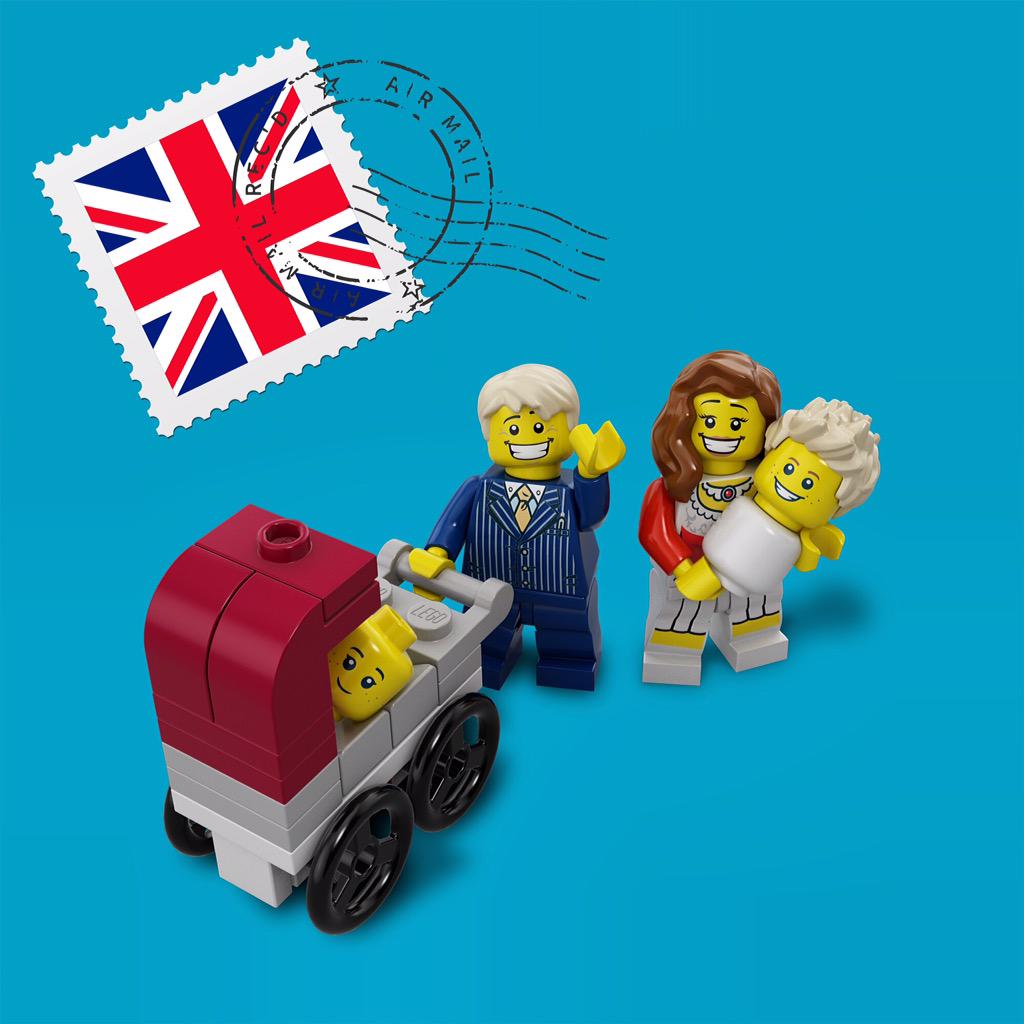
Meanwhile 7,000 people have died in the Nepal earthquake and a dreadful
Rohingya mass grave has been found in Thailand. There is even a general
election in four days.
A new family member is always a time for joy. But lets keep it to the
family.
If you believe the media only one story mattered; the nation came to a
grinding sycophantic halt. Bizarre really as the Cambridges (the name
bestowed upon them) don't even like the media.
So
here are some of the worst excesses:
The Royal Navy shared a photo of their tribute—members standing in formation
to spell "SISTER" on the deck of the HMS Lancaster.
Kate Middleton gives birth to the Princess the nation had longed for (The
Telegraph - really?)
William, Kate take new princess home (USA Today - what exactly were they
supposed to do with her?)
Let the cooing begin: America swoons over Britain's new royal baby (The
Guardian)
Kate Middleton Wears Yellow Floral Jenny Packham Dress for Royal Baby No. 2
(E! Online - honestly. Why not a Primark frock?)
after nearly two years of watching George’s evolution from chubby-cheeked
infant to even chubbier-cheeked toddler, it appears he has truly, admirably
handled his duties of being A Really Adorable Royal Baby. So, the natural
question becomes: Can the second royal baby possibly measure up? (Washington
Post - a once great newspaper).
Rumours the Duchess's hairdresser has arrived at the Lindo Wing (Telegraph -
with uncontrolled glee)
Heir and Spare cocktails, ice-cream made with
BREAST MILK and royal piglet sweets: How food fans will mark the birth of
William and Kate's little princess; Licklators Royal Baby Gaga ice-cream is
made with donated breast milk; The Rib Room Bar & Restaurant will serve two
special Hennessy cocktails; M&S Percy and Penny Pig sweets have two piglet
additions to the family (The Daily Mail - any story will do)
7 Prince George Outfits Royal Baby #2 Should
Totally Borrow, Because Gender Stereotypes Should Be A Thing Of The Past (Bustle.co
with a rather different angle!)
World celebrates Kate and Will's newest royal
addition (New York Daily News - fiction department)
Did the lunar cycle bring on Kate's labour?
Royal baby could have been affected by moon (Sunday Express - next story
will be about a baby delivered by aliens!)
Prince William and Catherine spend their
first day at home with new princess as Britain celebrates (ABC Australia -
in breaking news tomorrow - the royals spend the second day at home with the
baby!)
Who should govern Britain?
3 May 2015 - The Economist
Britain is a midsized island with outsized influence. Its parliamentary
tradition, the City’s global role, the union of England, Scotland, Wales and
Northern Ireland, membership of the European Union and a history of leading
revolutions in economic policy mean that British elections matter beyond
Britain’s shores. But few have mattered more than the one on May 7th, when
all these things are at stake.
Though you would never know it from the campaigns’ petty squabbling, the
country is heading for profound and potentially irrevocable change. The
polls suggest that no combination of parties will win a stable
majority—which could be the death knell for strong government (see article).
May 7th could also mark the point of no return for the troubled union
between England and Scotland, thanks to a surge in support for the
secessionist Scottish National Party (SNP). The Tories have promised to
renegotiate Britain’s relations with the EU and put the result to an in/out
referendum on membership by the end of 2017. Meanwhile Ed Miliband, Labour’s
leader, wants to remake British capitalism in pursuit of a fairer society.
If he had his way, he would be the most economically radical premier since
Margaret Thatcher.
If the stakes are high, the trade-offs are uncomfortable, at least for this
newspaper. Our fealty is not to a political tribe, but to the liberal values
that have guided us for 172 years. We believe in the radical centre: free
markets, a limited state and an open, meritocratic society. These values led
us to support Labour’s Tony Blair in 2001 and 2005. In 2010 we endorsed
David Cameron, the Tory leader, seeing in him a willingness to tackle a
yawning budget deficit and an ever-expanding state.
Five years on, the choice has become harder. The Tories’ Europhobia, which
we regretted last time, could now do grave damage. A British exit from the
EU would be a disaster, for both Britain and Europe. Labour and the Liberal
Democrats are better on this score. But such is the suspicion many Britons
feel towards Brussels that a referendum on Britain’s membership of the EU is
probably inevitable at some point. And we believe that the argument can be
won on its merits.
The Lib Dems share our welcoming attitude towards immigrants and are keen to
reform the voting system. But they can at most hope to be the junior partner
in a coalition. The electorate, and this newspaper, therefore face a choice
between a Conservative-dominated government and a Labour-dominated one.
Despite the risk on Europe, the better choice is Mr Cameron’s Conservatives.
Our decision is based on the economy, where the Conservative-Lib Dem
coalition has a stronger record than many realise and where Labour poses a
greater risk. Admittedly, the macroeconomic signals are mixed. The budget
deficit, at 5% of GDP, is still the second-highest in the G7. As Britons
consume more than they produce, the current-account deficit is a worrying
5.5% of GDP. And although employment is high, living standards have suffered
and productivity is weak. Adjusted for inflation, wages have fallen every
year since 2009.
The Tories have made this squeeze on British living standards more painful,
particularly for young people. They have protected pensioners from budget
cuts and showered them with tax giveaways, forcing bigger sacrifices
elsewhere. A failure to boost housing supply has led to soaring prices, also
hitting the young. Some of the Tories’ election promises—to spare houses
worth up to £1m ($1.5m) from inheritance tax and to sell social housing at a
discount—are economically indefensible vote-buying gestures that will only
add to the unfairness.
But three things count in the Tories’ favour. The coalition has cut the
deficit more pragmatically than it admits and more progressively than its
critics allow. When the economy weakened, the Tories eased the pace
(although not by as much as this newspaper would have liked). Though the
poorest Britons have been hit hard by spending cuts, the richest 10% have
borne the greatest burden of extra taxes. Full-time workers earning the
minimum wage pay a third as much income tax as in 2010. Overall, inequality
has not widened—in contrast to America.
The record on public services is good. Government spending has fallen from
45.7% of GDP in 2010 to 40.7%, yet public satisfaction with the police and
other services has gone up. Although almost 1m public-sector jobs have been
cut, Britain has a higher share of people in work than ever before. From
extra competition in education (with new free schools and academies) to the
overhaul of the benefits system, public services are being revitalised. Some
innovations have failed, including a rejigging of the National Health
Service (NHS), but Britain’s reform of the state has been energetic and
promising.
And lastly, in the short term, Britain’s weak productivity is the corollary
of a jobs-rich, squeezed-wage recovery. Wage stagnation, as our briefing
explains (see article), is not an exclusively British malaise. It is also
preferable, both in economic efficiency and social equity, to the French or
Italian disease of mass joblessness. Better to recover from a financial
crash and deep recession with a flexible labour market in which wages adjust
than through unemployment. Britain will be a model for Europe if the Tories
can boost productivity—and they aim to do so by improving schools and
infrastructure, giving power and money to cities and investing in science.
Labour has a different way to tackle what it calls the “crisis” in living
standards. In fiscal terms, its agenda belongs to the moderate centre-left.
Mr Miliband also promises deficit reduction, and at a pace that makes more
macroeconomic sense than the Tories’ plan—though his numbers are vaguer, and
Labour’s record makes them harder to believe. He proposes a bit more
redistribution: Labour plans tax increases for the wealthy, including
raising the top rate of tax back to 50%, from 45%, and imposing a “mansion
tax” on houses worth more than £2m. Individually, many of these proposals
are reasonable. (The annual mansion tax on a £3m London house would be only
£3,000, a fraction of the levy on New York property.) But, taken together,
these plans risk chasing away the most enterprising, particularly the
footloose global talent that London attracts.
Labour’s greater threat lies not in redistribution, but in meddling. Mr
Miliband believes that living standards are squeezed because markets are
rigged—and that the government can step in to fix them. He would freeze
prices while “reviewing” energy markets, clamp down on the most flexible
“zero-hour” labour contracts and limit rent rises. Along with this suspicion
of private markets is an aversion to competition in the public sector,
leading to proposals for, say, a cap on profit margins when private
companies contract to provide services for the NHS.
Mr Miliband is fond of comparing his progressivism to that of Teddy
Roosevelt, America’s trustbusting president. But the comparison is false.
Rather than using the state to boost competition, Mr Miliband wants a
heavier state hand in markets—which betrays an ill-founded faith in the
ingenuity and wisdom of government. Even a brief, limited intervention can
cast a lasting pall over investment and enterprise—witness the 75%
income-tax rate of France’s president, François Hollande. The danger is all
the greater because a Labour government looks fated to depend on the SNP,
which leans strongly to the left.
On May 7th voters must weigh the certainty of economic damage under Labour
against the possibility of a costly EU exit under the Tories. With Labour,
the likely partnership with the SNP increases the risk. For the Tories, a
coalition with the Lib Dems would reduce it. On that calculus, the best hope
for Britain is with a continuation of a Conservative-led coalition. That’s
why our vote is for Mr Cameron.
The Observer view on why you should vote Labour
3 May 2015 The Observer
The gap between the richest and the rest was never wider, spectacular
mergers produced giant companies that paid minimal taxes, and a democratic
stalemate exposed the shortcomings of a political system creaking at the
seams. No, not a retrospective look at 2015, but an account of late
19th-century America, a context that gave rise to the emergence of the
radical new politics ushered in by Republican President Theodore “Teddy”
Roosevelt.
In a country increasingly divided and impoverished, he brokered a different
kind of relationship between government and the people. The state intervened
in a rampant market – driven by rapacious oligarchs – that advantaged big
business at the expense of ordinary working men and women. Roosevelt pledged
to curb the power of business, support organised labour and spoke out in
support of the “common welfare”, and “a square deal” for all. Heaven knows
what the early 21st-century press in Britain would have made of Red Ted.
At the heart of Roosevelt’s vision was not economics, but morality. “We must
act upon the motto of all for each and each for all,” Teddy Roosevelt said
in 1905. “…We must treat each man on his worth and merits as a man. We must
see that each is given a square deal, because he is entitled to no more and
should receive no less.”
In her 2013 bestseller The Bully Pulpit, Pulitzer prize winner, Doris Kearns
Goodwin, described how the president challenged “a Congress long wedded to
the reigning concept of laissez-faire – a government interfering as little
as possible in the economic and social life of the people,” and proceeded to
move legislation that protected workers’ rights, regulated the railroad
industry, curbed the big food cartels and challenged the energy industry to
lower prices. SS McClure, a hugely successful magazine editor at the time,
said of Roosevelt: “He sounded in my heart the first trumpet call of our
time to be.”
The UK general election campaign, so far, has heard no trumpet calls, no
surges of enthusiasm for either of the two main parties. Instead, as the
writer Gerry Hassan points out, the language of bold political debate has
become defensive “pseudo-accountancy, spread sheets and promissory notes”.
The Conservative promise last week to introduce a law that would prevent any
rise in VAT and taxes over the life of a parliament, was met with the
derision it deserved. Not because it was a bad proposal (it was) but because
the chancellor George Osborne had criticised a similar measure proposed by
Alistair Darling in 2009. At the time Osborne said: “No other chancellor in
the long history of the office has felt the need to pass a law in order to
convince people that he has the political will to implement his own budget.”
Political feints such as this entrench apathy, if not antipathy.
Over-promising has been a mark of the campaign and the Institute of Fiscal
Studies has criticised both main parties for leaving voters “in the dark”
about their uncosted promises.
The debate over the economy has been no more inspiring. Both David Cameron
and Ed Miliband have lashed themselves to a form of austerity, or austerity
lite, even as the overwhelming view of macro economists in the US and the UK
is that this has been damaging for growth. Britain’s recovery is fraught
with weaknesses and made more fragile still by low productivity and low
wages. We hear little about why, at a time of zero interest rates as leading
economists such as Paul Krugman and Anthony Atkinson have argued, there is a
strong economic case for the government to use capital spending to invest in
social and physical infrastructure.
In the 1900s, SS McClure wrote that the “vitality of democracy” demanded
“popular knowledge of complex questions”. The most complex question of our
time domestically and globally has been the issue of inequality. As the
chief economics commentator at the Financial Times noted yesterday, the
debate “is just beginning. It will become louder.” Global inequality between
countries is falling, but inequality within countries is rising.
That kind of inequality is a danger to the civic health of any nation. It is
well-documented that those countries that enjoy the most equitable
distribution of wealth are also the happiest. But it doesn’t only make civic
sense to address inequality, it also makes economic sense. As Robert Reich,
President Clinton’s former labour secretary, has made clear in his
compelling documentary film Inequality For All, disposable income is the
engine of the economy. When that income shrinks – as it has done – we all
suffer. When income is increasingly concentrated in the hands of fewer and
fewer people – who have less and less reason to spend – then the very
foundations of capitalism are under real strain.
That is why this is a general election like none other. The country is at a
fork in the road. Britain has an opportunity to lead a debate that could
point us towards a more functional capitalism, a fairer society, and a
happier country.
Yet the political debate struggles to rise to the challenge. Too much of the
argument is about the narrow question of the public deficit, vastly
exaggerated as an existential threat to the country. Defining our national
problem in the language of book-keeping is part of the successful framing of
the debate on Conservative terms. The country is invited to back a long-term
economic plan and apparent recovery in what increasingly looks like an
excuse to continue shrinking the state. It offers much reduced welfare and
social provision, and promises never to increase but only decrease taxes.
This, runs the Conservative pitch, is the route to a moral society and the
good life alike. Free markets, the profit motive and entrepreneurial effort
will do the rest, liberated from the dead hand of government – British and
European.
Justice, fairness, looking out for each other, and sharing wealth are to be
relegated and at the mercy of the market. As Roosevelt recognised so many
years ago, when the market doesn’t work, you fix it. The market needs
fixing.
The Conservative doctrine – led by Osborne, fronted by Cameron – is at odds
with economic, social and political reality. Ensuring that Britain has a
critical mass of companies to exploit the multiple opportunities provided by
the great new technologies triggered by digitalisation is much more
problematic than just trusting in low tax and free markets. It requires a
recognition that 21st-century capitalism has to be shaped by government.
All the international evidence is that companies grow and flourish in an
ecosystem of public and private institutions – banks, research institutes,
universities, venture capitalists, training agencies, ownership structures,
pay systems – that are organised by governments to support company
development. The internet was built on the back of vast public investment by
the US government. The worldwide web came into being on the back of vast
public monies – from Europe – that created the Cern institute, where the web
was born.
But, under the prevailing orthodoxy, productivity has stagnated, but no
matter – labour is cheap. A significant number of British workers are so
poorly paid they pay no tax. Two thirds of the nearly three million children
living in poverty are part of working families. Workers’ share of national
income has significantly reduced in the last three decades.
Meanwhile, pay has exploded at the top – quadrupling in relation to average
pay in a generation. The privileged live in gated communities, educate their
young in private schools, are treated in private hospitals and feel no part
of – nor obligation to – the common good. They feel no compunction in
avoiding or even evading taxes: they share the conservative doctrine that
taxes are in essence immoral – the state’s coercive intrusion into private
lives, the confiscation of wealth to which it has no right and which it will
squander. They have become a class apart, comfortingly justifying their
wealth and position as a result of entrepreneurialism on which the rest of
us depend.
The rules have become so distorted that even the Financial Times is calling
for,”a new paradigm” in the high pay levels and disproportionate “rewards”
given to the bosses. Last year, one FTSE chief executive was paid £43m, one
thousand times more than his average employee.
All this against a set of challenges that are becoming increasingly evident
– an ageing population, globalisation, the advances of technology, the
decline of the trade unions, the deregulation of the financial sector, and
the rise of the “flexible” zero-hours, low-wage, labour market.
The neo-liberal project – which took root during the 1980s – has manifestly
failed. By its own metrics, it is working less and less well, for fewer and
fewer people. This isn’t an opinion. This is fact. The countries with the
highest levels of inequality among highest-income countries are the UK and
the US.
The Conservatives’ response to this shrinking pie has been jaundiced, weak,
and wrong-headed. They have helped create a dangerously divided society, and
an increasingly divided Union. And their pledge to stage a referendum on EU
membership could prove a reckless prelude to a bitter two-year struggle and
a possible retreat into feeble isolation. The Conservative narrative is one
where collectivism and the common good is diminished by a rhetoric that
divides north versus south, England versus Scotland, old versus young;
shirkers versus strivers; Britain versus Europe; immigrants versus the rest.
In an era of turbo-capitalism, the coalition’s dominant narrative has also
demonised the welfare state. Proportionately, the poorest have borne the
greater burden of the cuts; the most deprived local authorities have been
required to get by with even less.
We most certainly are not “all in this together”. Increasingly, the welfare
state offers support (housing benefit or tax credits) to those in work –
people on minimum wages who are not paid enough to live on.
The International Monetary Fund has identified “inequality … as the greatest
economic risk of the next decade”. Mark Carney, governor of the Bank of
England, argues that capitalism will destroy itself if it ignores its moral
obligations. “Just as any revolution eats its children, unchecked market
fundamentalism can devour the social capital essential for the long term
dynamism of capitalism itself.”
It is the defining issue of our age, and each of the two main parties offer
radically different approaches to how we can best rebuild a shattered
system, and a bruised society. The Institute for Fiscal Studies said last
month that the difference between Labour and Conservative was the biggest
since 1992. “The electorate has a real choice.”
The choice is as much a moral and civic as an economic one. While the
Conservatives would make £12bn in welfare cuts and attempt to eliminate the
deficit in one parliament, Labour intends to borrow for investment, and make
cuts of only £1bn, taking longer to tackle the deficit.
The Conservatives are not promising more of the same, but a newer phase of
its project to cut the state. This will not, over the long term, help build
a bigger economy, or help enrich growing numbers of people. It will not
build a bigger, better, society, or a “good life”. One shouldn’t mistake
ideology for good economics.
Such insurgency as there has been at least nominally tilted at austerity
politics has come from Scotland, where the SNP is enjoying a remarkable
surge in popularity. The “progressive” record of the SNP is patchy, though.
On the NHS, on redistribution, on higher education it has delivered poorly;
progressive in style but not substance. However, Sturgeon’s leadership has
helped invigorate politics in Scotland. The attacks on the SNP’s legitimacy
by the Conservatives are constitutionally inaccurate, short-termist and very
likely to damage not protect the Union. It’s tactics, not strategy.
The political discourse has also been enlivened by the Green party although,
interestingly, their participation has hardly increased our collective focus
on environmental issues. But they have struck an effective anti-austerity
note and have given voice to the importance of foregrounding the values of
community engagement and collective responses to those most blighted by the
aftermath of recession.
Ed Miliband, of the two main leaders with an opportunity to form a
government, has a far more sophisticated vision of economic and social
justice. But he is on course to increase his party’s share of the vote only
marginally since 2010. He has offered a courageous if still partial
reappraisal of contemporary capitalism on the one hand, while pursuing the
usual game of making retail offers to voters even as he fights off New
Labour’s reputation for risky profligacy and laxity on immigration.
Belatedly, though, Miliband is finding his voice. As he said yesterday, this
election is not about the choice between two nations – England and Scotland
– or between chaos and competence, but between two different visions.
Miliband has shown resilience in trying to “break the consensus rather than
succumb to it”.
His stand on Murdoch, his promise to freeze energy prices, his interest in
small business supported by a state investment bank, his belief in a
progressive capitalism that encourages long termism, invests in education
and skills and reforms the financial markets is not “anti-business”. It
stands for fair regulation, just taxation, strong redistribution,
partnership in the EU and a vital role for a more efficient accountable
state.
From the outset, Ed Miliband has staked his leadership on the bet that the
crash of 2008 sounded the death-knell for the market fundamentalism that
characterised the last three decades.
Progress in outlining a new capitalism has been fitful, piecemeal and
cautious. But Labour’s direction of travel under Miliband is clear.
Government, local and national, has a vital role in delivering the fair
society.
The market economy is not morality-free. The balance of power between the
competing interests in Britain needs to be tilted away from the powerful
towards the less powerful. Austerity on the basis of a false requirement to
balance accounts must not be the straitjacket that prevents the economy from
growing.
Labour does not have all the answers. Far from it. But it is the only party
which has correctly identified the task that faces our society. For that
reason, it deserves to form the next government.
Thailand's refugee shame
2 May 2015
Dozens of police and volunteers have now spent two days digging out a mass
grave near a suspected human trafficking camp on a hillside deep in a
southern Thai jungle.
The site is in Sadao district in Songkhla province. About 30 people are
thought to be buried at the site.
Illegal migrants, many of them Rohingya Muslims from western Myanmar and
Bangladesh, brave often perilous journeys by sea to escape religious and
ethnic persecution and to seek jobs in Malaysia and Thailand, a regional
trafficking hub.
At least one more human trafficking camp is thought to be located not far
from the graves, said Police Colonel Anuchon Chamat, deputy commander of
Nakorn Si Thammarat Provincial Police and a member of the investigation
team.
Identifying victims could take time as relatives would need to travel from
Myanmar and Bangladesh to offer DNA samples for testing and to identify
belongings, where possible, said Police General Jarumporn Suramanee.
The abandoned camp, hidden high on a hill, was strewn with shoes and
clothing. It had operated for about a year, police said.
"From the evidence given by witnesses who were in the camp, we believe there
was violence here and people died from the violence," said Jarumporn,
without giving further details.
Human Rights Watch called for an independent investigation with U.N.
involvement to find out what took place at the site and to bring justice.
"The discovery of these mass graves should shock the Thai government into
shutting down the trafficking networks that enrich officials but prey on
extremely vulnerable people," said Brad Adams, Asia director at Human Rights
Watch.
Police chief Somyot Pumpunmuang has described the site as a "virtual prison
camp" where migrants were held in makeshift bamboo cages.
A government spokesman issued a stern reaction on Saturday, saying Thailand
was determined "to eliminate every type of human trafficking and block
Thailand from being a transit point".
Maj Gen Sansern Kaewkamnerd said those behind the camp would be "severely
punished", regardless of whether they are common criminals or corrupt
officials.
So
the search for scapegoats will begin soon.
The border zone with Malaysia is criss-crossed by trafficking trails and is
notorious for its network of secret camps where smuggled migrants are held,
usually against their will, until relatives pay up hefty ransoms.
Thailand says it is cracking down on the trafficking networks on its soil
after revelations that government officers, police and navy officials have
been involved in the lucrative trade in humans fleeing poverty and
persecution.
In June the United States dumped Thailand to the bottom of its list, or to
"Tier 3", of countries accused of failing to tackle modern-day slavery.
Rights groups say traffickers are changing their tactics as the crackdown
bites and are also holding thousands of migrants at sea for endless weeks
awaiting payment before releasing them.
Thailand's human trafficking problem is "out of control", according to Brad
Adams, Asia director of Human Rights Watch.
"The finding of a mass grave at a trafficking camp sadly comes as little
surprise," he said, urging the UN to join the probe to bring those
responsible to justice.
But the story raises many questions: just how could the Thai Army miss a
concentration camp along the sensitive and regularly patrolled Thai/Malaysia
border? In reality the border area is totally under control of security
forces. So the likelihood is that the Thai Army and Navy control human
trafficking on land and sea.
The UN and others, including the United States, should urgently press the
government to end official complicity and willful blindness in rampant
trafficking in the country.
Rohingya who are apprehended in Thailand are treated as “illegal immigrants”
subject to deportation without regard to the threats facing them in Burma.
Rohingya men are sometimes detained in overcrowded immigration detention
facilities across the country, while women and children have been sent to
shelters operated by the Ministry of Social Development and Human Security.
Many more are believed to be transferred through corrupt arrangements into
the hands of human trafficking gangs where they face cruel treatment and no
prospect of assistance from Thai authorities.
As with previous Thai governments, the military junta of Prime Minister Gen.
Prayuth Chan-ocha does not permit the office of the UN High Commissioner for
Refugees (UNHCR) to properly conduct refugee status determination screenings
of Rohingya.
“Each year, tens of thousands of Rohingya flee the dire human rights
situation in Burma only to be further abused and exploited at the hands of
traffickers in Thailand,” said Brad Adams of Human Rights Watch. “The
discovery of these mass graves should shock the Thai government into
shutting down the trafficking networks that enrich officials but prey on
extremely vulnerable people. Instead of sticking Rohingya in border camps or
immigration lockups, the government should provide safety and protection.”
Watford through the ages
2 May 2015
Football League Division Two Play-off Final, 21/05/06, 3.00pm
Leeds United 0(0)
Watford 3(1)
Team: Foster, Doyley, Demerit, Mackay, Stewart, Chambers, Mahon, Spring,
Young, Henderson, King
Subs: Bangura (for Chambers, 72) , Chamberlain, Mariappa, Eagles, Bouazza
Booked: Spring, Doyley, Mahon
Scorers: Demerit (25), Sullivan (57, own goal), Henderson (84, pen)
Division 1 Playoff Final, 31/5/99
Watford 2(1)
Bolton Wanderers 0(0)
Team: Chamberlain, Bazeley, Kennedy, Page, Palmer, Robinson, Ngonge,
Hyde, Mooney, Johnson, Wright
Subs: Hazan (for Wright), Day, Smart (for Ngonge)
Scorers: Wright (38), Smart (89)
FA Cup Final, 19/5/84
Everton 2(1)
Watford 0(0)
Team: Sherwood, Bardsley, Sinnott, Terry, Price, Taylor, Jackett,
Callaghan, Johnston, Reilly, Barnes
Subs: Atkinson (for Price)
UEFA Cup 1st Round 2nd Leg, 28/9/83
Watford 3(2)
Kaiserslautern 0(0)
Team: Sherwood, Palmer, Rostron (Capt.), Jobson, Terry, Bolton,
Callaghan, Richardson, Gilligan, Jackett, Barnes
Scorers: Richardson 2, o.g.
Football League Division 1, 14/5/83
Watford 2(1)
Liverpool 1(0)
Team: Sherwood; Rice, Rostron, Patching, Sims, Franklin, Callaghan,
Blissett, Barnes, Jackett, Sterling
Scorers: Blissett, Patching
FA Cup 6th round
Watford 1 - 0 Liverpool
Saturday 21 February 1970
Attendance: 34,047
Team: Mike Walker, Duncan Welbourne, Johnny Williams, Ray Lugg, Walter Lees,
Tom Walley, Stewart Scullion, Terry Garbett, Barry Endean, Mike Packer,
Brian Owen - Manager - Ken Furphy
The Guardian view: Britain needs a new direction, Britain needs Labour
1 May 2015
The campaign is nearly over and it is time to choose. We
believe Britain needs a new direction. At home, the economic recovery is
only fragile, while social cohesion is threatened by the unequal impact of
the financial crisis and the continuing attempt to shrink the postwar state.
Abroad, Britain remains traumatised by its wars, and, like our neighbours,
is spooked by Vladimir Putin, the rise of jihadist terrorism and by mounting
migratory pressures. In parts of Britain, nationalist and religious
identities are threatening older solidarities, while privacy and freedom
sometimes feel under siege, even as we mark 800 years since Magna Carta.
More people in Britain are leading longer, healthier and more satisfying
lives than ever before – yet too many of those lives feel stressed in ways
to which politics struggles to respond, much less to shape.
This is the context in which we must judge the record of the outgoing
coalition and the choices on offer to voters on 7 May. Five years ago,
Labour was exhausted and conflicted, amid disenchantment over war, recession
and Gordon Brown’s leadership. The country was ready for a change, one we
hoped would see a greatly strengthened Liberal Democrat presence in
parliament combine with the core Labour tradition to reform politics after
the expenses scandal. That did not happen. Instead the Conservatives and the
Liberal Democrats have governed together for five difficult years.
That experiment has clearly run its course. The outgoing government proved
that coalitions can function, which is important, and it can be proud of its
achievements on equal marriage and foreign aid. But its record, as our
recent series of editorials on detailed themes has shown, is dominated by an
initial decision to pursue a needless and disastrous fiscal rigidity. That
turned into a moral failure, by insisting on making the neediest and the
least secure pay the highest price for an economic and financial crash that
they did not cause. The evidence is there in the one million annual visits
to foodbanks, a shocking figure in what is, still, a wealthy country.
David Cameron has been an increasingly weak prime minister. On issues such
as Europe, the integrity of the United Kingdom, climate change, human rights
and the spread of the low-wage economy, he has been content to lead the
Tories back towards their nastiest and most Thatcherite comfort zones. All
this is particularly disappointing after the promise of change that Mr
Cameron once embodied.
The Conservative campaign has redoubled all this. Economically, the party
offers more of the same, prioritising public-sector austerity which will
worsen life for the most needy – imposing £12bn of largely unspecified
welfare cuts – while doing little to ensure the rich and comfortable pay a
fair share. Internationally, the party is set on a referendum over Europe
which many of its activists hope will end in UK withdrawal. It’s also set on
an isolationist abandonment of British commitment to international human
rights conventions and norms, outcomes which this newspaper – unlike most
others – will always do all in its power to oppose. At the same time, the
Tories go out of their way to alienate Scotland and put the UK at risk. The
two are related: if a 2017 referendum did result in a British exit from the
EU, it could trigger a fresh and powerful demand for a Scottish exit from
the UK. The Conservative campaign has been one of the tawdriest in decades.
The overriding priority on 7 May is therefore, first, to stop the
Conservatives from returning to government and, second, to put a viable
alternative in their place. For many decades, this newspaper’s guiding star
has been the formulation offered by John Maynard Keynes in a speech in
Manchester in 1926: “The political problem of mankind is to combine three
things: economic efficiency, social justice and individual liberty.” The
task on 7 May is to elect the parliament and government that will come
closest to passing Keynes’s triple test.
Some despair of the whole system, believing a model created for two-party
politics is now exhausted, failing to give adequate expression to the
diverse society we have become. We are hardly newcomers to that view: we
have demanded electoral reform for a century and believe that demand will
find new vigour on 8 May. But for now, this is the voting system we’ve got.
How should we use it?
To the charge that they enabled a government whose record we reject, the
Liberal Democrats would plead that they made a difference, mitigating and
blocking on issues such as Europe, the environment, child benefit and human
rights, without which things would have been worse. That adds weight to the
view that the next Commons would be enhanced by the presence of Lib Dem MPs
to insist on the political reform and civil liberties agendas – as they did,
almost alone, over Edward Snowden’s revelations. Similarly, it would be good
to hear Green voices in Westminster to press further on climate change and
sustainability. Where the real constituency choice is between these parties
and the Conservatives, as it is between the Lib Dems and the Tories in the
south-west, we support a vote for them. But they are not the answer.
In Scotland, politics is going through a cultural revolution. The energy and
engagement on show are formidable – and welcome. The level of registration
is an example to the rest of Britain. If the polls are right, and the SNP is
returned as Scotland’s majority party, we must respect that choice – and
would expect all parties that believe in the union, and the equal legitimacy
of all its citizens, to do the same. We do that even as we maintain our view
that, whatever myriad problems the peoples of these islands face, the
solution is not nationalism. Breaking apart is not the answer: not in Europe
and not in the UK. We still believe that the union rests on something
precious – the social and economic solidarity of four distinct nations – and
that is to be nurtured and strengthened, not turned against itself.
Which brings us to Labour. There have been times when a Labour vote has
been, at best, a pragmatic choice – something to be undertaken without
enthusiasm. This is not such a time. Of course there are misgivings. The
party has some bad instincts – on civil liberties, penal policy and on
Trident, about which it is too inflexible. Questions linger over Ed
Miliband’s leadership, and whether he has that elusive quality that inspires
others to follow.
But Mr Miliband has grown in this campaign. He may not have stardust or
TV-ready charisma, but those are qualities that can be overvalued. He has
resilience and, above all, a strong sense of what is just. Mr Miliband
understood early one of the central questions of the age: inequality. While
most Tories shrug at that yawning gap between rich and poor, Labour will at
least strive to slow and even reverse the three-decade march towards an
obscenely unequal society. It is Labour that speaks with more urgency than
its rivals on social justice, standing up to predatory capitalism, on
investment for growth, on reforming and strengthening the public realm,
Britain’s place in Europe and international development – and which has a
record in government that it can be more proud of than it sometimes lets on.
In each area, Labour could go further and be bolder. But the contrast
between them and the Conservatives is sharp. While Labour would repeal the
bedroom tax, the Tories are set on those £12bn of cuts to social security,
cuts that will have a concrete and painful impact on real lives. Even if
they don’t affect you, they will affect your disabled neighbour, reliant on
a vital service that suddenly gets slashed, or the woman down the street,
already working an exhausting double shift and still not able to feed her
children without the help of benefits that are about to be squeezed yet
further. For those people, and for many others, a Labour government can make
a very big difference.
This newspaper has never been a cheerleader for the Labour party. We are not
now. But our view is clear. Labour provides the best hope for starting to
tackle the turbulent issues facing us. On 7 May, as this country makes a
profound decision about its future, we hope Britain turns to Labour.
Our electoral system is absurd. Time to change it
1 May 2015 Owen Jones in
The Guardian
Our electoral system is no longer creaking: it’s disintegrating around us,
showering the political elite with occasional bits of rubble. Lord Gus
O’Donnell is no firebrand radical, he’s a crossbench peer who used to head
the civil service, but he knows the current political system rests on
rapidly shifting tectonic plates. Whatever happens next week, a decisive
result is almost impossible, further undermining the legitimacy of an
increasingly absurd electoral system.
First-past-the-post was supposed to deliver stable, majority governments:
that’s its whole USP. To deliver one full-term hung parliament might be
written off as a quirk, an accident: but two begins to look like a trend. If
the electorate delivers a left-of-centre majority in parliament next week
and Labour assembles a government, its own legitimacy will be under
relentless assault by an increasingly unhinged rightwing media. It must
surely respond with a referendum on proportional representation.
Oh come off it, some will object. You had your referendum on electoral
reform a few years ago. It was decisively rejected by the electorate,
burying the issue for a generation. But like most of those who took part in
2011, I voted against the option on the table, the alternative vote system –
which would have allowed voters to rank candidates in order of preference.
This wasn’t because I thought it didn’t go far enough. All electoral systems
are a compromise when no party wins more than half the vote. My view was
that AV would hand disproportionate influence to the third party – then the
Lib Dems, now Ukip – because Labour and the Tories would have to compete for
their second preference votes. And like many Britons following the
Clegg-Cameron love-in, I believed coalitions involved undemocratic
stitch-ups behind closed doors, where governments were assembled that no one
voted for and election promises could be easily ditched in the name of
compromise.
Such an objection is now redundant. If we’re going to end up with hung
parliaments whatever happens, we might as well have representative hung
parliaments. Our electoral system is designed for the hegemony of two
parties – well, two and a half parties at most. But while nearly all voters
opted for Labour and the Conservatives in the 1950s, the combined share is
down to about 65%. In Scotland, Labour face wipe-out at the hands of the SNP;
in England and Wales, we’ve witnessed the rise of Ukip and the Greens. The
two-and-a-half party system has artificially been kept alive, in stasis, by
the electoral system, but now the signs of morbidity are becoming impossible
to ignore. The political system is increasingly colliding with the reality
of political fragmentation.
Couldn’t it just all revert to how things were? It’s possible, I suppose,
but that’s surely deeply unlikely. The Tories once amassed votes in Scotland
and much of northern England where they are now permanently relegated to
second-party status; their membership peaked in the 1950s with nearly 3
million, and is now down to a paltry 134,000; the old religious sectarian
divisions they benefited from have diminished. Labour’s support is
complicated by the halving of trade union membership, the shift from an
industrial working-class to a more insecure and fragmented service sector
working-class. Today’s political complexity is simply a reflection of a
diversifying social base.
It surely makes sense for Labour to offer a referendum on proportional
representation. It would help win over Greens who resent tactical voting,
but could be persuaded on the basis of a Labour-led government that could
forever banish wasted votes. It would rebut the growing attacks on the
democratic legitimacy of a Labour-led government that hasn’t even been
formed. It would show a farsighted rejection of political tribalism. Labour
will not do so now, because they believe it will only increase media-fanned
fears of the influence of smaller parties. But if Labour come second in
seats and form a government, they may find that such a referendum is the
only way of deflecting a media-led assault. If the minor parties were
political savvy, they would offer support only if such a referendum was
forthcoming. First-past-the-post lives to fight another election. Who knows,
though. It could well be its last.
Super-connecting the world
The advance of Emirates, Etihad and Qatar, latterly joined by Turkish
Airlines, looks set to continue
1 May 2015 - The Economist
The Gulf states have been on the radar of the world’s airlines since the
1930s. Then Dubai, a pearl-fishing port, served as a stopover for the flying
boats of Imperial Airways (a forerunner of BA) on routes connecting London
to distant colonial outposts. BA still serves Dubai but most of the tail
fins at its vast main airport, which recently overtook London’s Heathrow as
the world’s busiest for international traffic, carry the logo of Emirates,
the small state’s own network airline. The balance of power among the
world’s carriers has shifted.
A decade ago Emirates, Qatar Airways and Etihad Airways, based in Abu Dhabi,
were insignificant. But these three “super-connectors”, in recent years
joined by Turkish Airlines, increasingly dominate long-haul routes between
Europe and Asia. Whereas most other international airlines rely heavily on
travellers to or from their home countries, the super-connectors’ passengers
mostly just change planes at the carriers’ hub airports on their way to
somewhere else. Last year the four carriers flew about 115m people into and
out of their hubs in the Gulf or Istanbul, compared with 50m in 2008. Their
combined fleet has swollen to more than 700 aircraft and they have a further
900 or so on order.
The West’s legacy airlines are understandably fearful of the
super-connectors. All have grown at spectacular rates; Emirates is now by
far the world’s biggest international carrier (see chart). Europe’s
struggling national airlines, such as Lufthansa and Air France KLM (AF-KLM),
were among the first to start losing market share to the super-connectors.
They are now suffering the same devastation on long-haul routes that
low-cost carriers (LCCs) like Ryanair and EasyJet have inflicted on their
shorter routes. As Andrew Charlton of Aviation Advocacy, a consulting firm,
puts it: “The LCCs ate European airlines’ lunch; the Gulf carriers are
coming to eat their dinner.” Lufthansa says its Frankfurt hub has lost
nearly a third of its market share on routes between Europe and Asia since
2005, with more than 3m people now flying annually from Germany to other
destinations via Gulf hubs.
Now the grumbling is getting louder from across the Atlantic, as America’s
airlines begin to feel the heat. This week a lobby group backed by Delta,
American and United Airlines released documents to back up a report it put
out in February, accusing the three Gulf carriers of having been given $42
billion in assistance by their state owners in the past decade.
Emirates now publishes full accounts but Etihad and Qatar still do not.
However, the American carriers’ investigators dug up documents filed with
regulatory authorities around the world, from Belgium to Australia, which in
some cases include detailed accounts going back a number of years. Some of
the benefits allegedly received by the Gulf airlines—such as zero-interest
loans with no arrangements for repayment, and grants of land—would if
confirmed seem to fall under the heading of subsidies.
Others, such as the low labour costs that the Gulf airlines enjoy, partly
because of their home states’ ban on unions, and the benefits they, like
other businesses in the Gulf, gain from those states’ generally low tax
rates, would seem legitimate means of promoting business development. The
cache of documents is enough to keep lawyers, accountants and trade
economists arguing for years—but at the least it suggests that the Gulf
three have some explaining to do if they are to justify claims they are
standing on their own feet.
The legacy carriers gripe too about the massive airports, with cheap landing
charges, that their home governments have built for the Gulf airlines.
Although Turkish is part-privatised, it still enjoys strong support from the
government, which has ordered the building of a massive new airport on
Istanbul’s outskirts, with about twice the capacity of Heathrow, so its
flag-carrier has space to keep growing.
Allegations of unfair advantages explain only so much, however. For one
thing, the West’s legacy airlines have not lacked for state protection of
their own. For another, the super-connectors’ rapid advance is in large part
down to something out of policymakers’ control—location. The Gulf is handily
placed between Europe, Asia, Africa and America: all are in range of modern
long-haul jets. Istanbul, on the edge of Europe, is a short-haul flight from
55 capital cities. Both are ideal for consolidating traffic to and from many
destinations. Fares can be kept low because of the efficiency of their
long-haul-to-long-haul model.
The four super-connectors are spending huge sums expanding their fleets with
the latest, most efficient jets. Their staff are young and keen, and the
airlines spend lavishly on marketing their in-flight service and widening
range of destinations. In 2001 Emirates and Qatar both flew from 17
destinations in Europe. Now both serve 32. Turkish sucks up passengers from
84 European airports. Besides increasing the number of European cities it
flies from, Etihad has taken stakes in several European carriers, including
Alitalia of Italy and Airberlin of Germany. The super-connectors have
likewise added lots of new destinations in Asia, whereas the European
flag-carriers have expanded their route maps more cautiously. As a result,
the super-connectors’ share of booming Europe-to-Asia travel has shot up.
In similar fashion the super-connectors and their hubs have been siphoning
off an increasing share of air traffic into and out of Africa—still a
relatively small market for aviation, but one that has grown rapidly,
especially given Asian economies’ interests in its natural resources.
And now they are ramping up their services to North America. To the dismay
of America’s international carriers, in the weeks since they launched their
broadside against the Gulf airlines’ alleged subsidies, Emirates has
announced a new service to Orlando and extra flights to Boston and Seattle.
Turkish, meanwhile, has just begun non-stop flights to San Francisco, its
11th destination in the Americas, and plans to add Atlanta and Mexico City,
among others. As the super-connectors encroach onto American runways,
passengers are likely to vote with their wheelie-bags. According to Skytrax,
a research firm, they all ranked in the top ten of the world’s best
airlines. The highest placed of America’s big three is Delta, at 49th.
The reaction of most of the established airlines has been
two-pronged—complaining, and further rounds of cost-cutting on top of what
they have already had to pare to cope with the arrival of the LCCs. One
exception is IAG, owner of BA. It managed to slash costs at Iberia and has
avoided much of the turbulence created by the super-connectors. Indeed IAG,
in which Qatar owns a 10% stake, recently pulled out of a European trade
association saying the group’s opposition to the super-connectors, led by
AF-KLM and Lufthansa, was no longer consistent with its own position.
AF-KLM and Lufthansa themselves have tried to make up for years of bad
management by beefing up their budget subsidiaries, Transavia and
Germanwings. They have met stiff resistance from within. Pilots have gone on
strike repeatedly over the past year to oppose various changes the airlines
are making to become more competitive. AF-KLM has had the bumpier ride of
the two. It issued three profit warnings in 2014, has shed 8,000 jobs over
the past three years and plans to lose another 800 employees as it cuts
investment and delays delivery of some new aircraft.
Berating the new opponents for perceived injustices has also failed so far.
The legacy carriers want changes to the bilateral “open skies” agreements
that have allowed the super-connectors access to European airports, and
which they had supported back when the Gulf airlines were minnows. Lufthansa
and AF-KLM have asked the European Commission to press for “fair
competition” provisions for current and future air treaties. America’s three
big international carriers want the Obama administration to stop the
super-connectors from adding routes.
Open-skies treaties can be watered down without ripping them up. Governments
can dither and delay. Norwegian Air Shuttle, a low-cost carrier, has been
hampered by American regulators, at the urging of industry lobbyists, in its
efforts to expand services across the Atlantic. But so far there has been
little overt gain to the incumbents from their griping.
Indeed, it may have done some damage. Delta’s boss, Richard Anderson,
gratuitously noted in an interview that the Gulf carriers are based in the
part of the world that bred the terrorists responsible for the 9/11 attack
on America, before apologising for the remark. And in response to the
subsidy accusations levelled by the American carriers, the Business Travel
Coalition, a lobby group backed by travel agents among others, has begun
drawing attention to the support that America’s government has given to its
aviation industry over the years.
The West’s legacy carriers put a lot of effort into letting politicians know
about their concerns. But the chances that the American and European
governments will roll back their open-skies commitments and halt the
expansion of the super-connectors do not look good. American and European
makers of aircraft and engines, which are benefiting hugely from the
expansion of the super-connectors’ fleets, also form a powerful lobby. So do
passengers, who have shown little sympathy for their struggling national
airlines and plenty of interest in their rivals’ cheap fares.
If anything, matters can only get worse for the legacy carriers. If
Norwegian makes a go of low-cost transatlantic flights, Ryanair and others
will pile in. China’s huge, state-backed airlines are surely planning to
boost their market share on Pacific routes. And the high profits that
America’s airlines have recently been enjoying at home are likely to
encourage the expansion of low-cost carriers there. In all, the future looks
poor for investors in the legacy airlines. For travellers, however, the age
of cheap flying is set to go on and on.
|
|