|
Emirates posts new record
profits - Press release
30 April 2008
Eleven airline have already
ceased operating in 2008; which means the 2007/8 financial results from
Emirates for the year to 31 March 2008 are quite remarkable. The press
release follows: the airline also declared a profit share of 14 weeks of
base salary for staff. At the top end of staff expectations this should be
suitably motivating!
"· Group
profit up 54.1% to AED 5.3 billion (US$ 1.45 billion)
· Airline profit up 62.1%
to AED 5 billion (US$ 1.37 billion)
· Dnata marks net profit of
AED 305 million (US$ 83 million)
· 20th consecutive year of
net profit for the airline and group
· Ownership to receive AED
1 billion (US$ 272.5 million) dividend
· Group’s estimated
contribution to Dubai economy worth AED 47 billion (US$ 12.8 billion)
DUBAI, UAE, 30th April 2008 -
The Emirates Group today reported its 20th consecutive year of net profit,
notching a new profit record despite soaring oil prices and challenging
business conditions in the second half of its 2007-08 fiscal year.
Group net profits increased 54.1 per cent to AED 5.3 billion (US$ 1.45
billion) for the financial year ended 31st March 2008, on revenues of AED
41.2 billion ($ 11.2 billion) compared to the previous year’s AED 31.1
billion ($ 8.5 billion). The Group net margin improved to 13.2 percent from
11.4 percent in the previous year.
The Group also retained a robust cash balance of AED 14.0 billion ($ 3.8
billion), compared with AED 12.9 billion ($ 3.5 billion) the previous year.
Emirates will pay a dividend of AED 1 billion ($ 272.5 million)to its owner,
the Government of Dubai. In 2007-08, the Group estimates a direct
contribution of AED 22 billion ($ 6 billion), and another AED 25 billion ($
6.8 billion) in indirect contribution to the UAE economy.
The 2007-08 Annual Report of the Emirates Group – comprising Emirates
Airline, Dnata and subsidiary companies – was released in Dubai today at a
news conference hosted by His Highness Sheikh Ahmed bin Saeed Al-Maktoum,
Chairman and Chief Executive, Emirates Airline and Group.
The Group’s latest record performance reflects its success in growing
customer demand through the strategic expansion of its business operations
across six continents, supported by ongoing investments in the latest
technology, products and customer service while keeping a tight rein on
costs. This is illustrated by the 21.2 million passengers who flew with
Emirates in the latest financial year, 3.7 million more than in the previous
year; as well as the expansion of Dnata’s international ground handling
operations to 17 airports in seven countries.
Sheikh Ahmed said: “It was another record year for the Group in spite of a
challenging business climate, particularly in the second six months where
the soaring cost of jet fuel made a big dent, although the impact was partly
offset by other operating gains.
“Despite the long-term forecast of a decrease in the number of passengers
travelling in First and Business class, I am happy to report that Emirates
once again bucked the trend and boosted our seat factor in the forward
cabins. Emirates is fortunate to be located in Dubai at the centre of the
new Silk Road between East and West.
I believe the threat of an economic downturn will be offset for Emirates by
the boom in the Middle East, especially the thriving travel industry of
tourism and commerce.”
Fuel costs remained the top expenditure for the 4th year running, accounting
for 30.6 per cent of total operating costs compared with 29.1 per cent the
previous year and 27.2 per cent the year before.
The airline’s fuel risk management programme continued to reap rewards,
saving the company AED 888 million ($242 million) in 2007-08, as WTI crude
oil prices hovered around the US$ 90 per barrel mark in the second half of
the fiscal year, 50 per cent more than US$ 60 per barrel in the same period
the year before. In total, the fuel risk management has saved in excess of
AED 3.7 billion ($ 1 billion) since the financial year 2000-01.
In his opening review in the 2007-08 Annual Report, Sheikh Ahmed highlighted
some major milestones for the Group which included the move of most of the
company’s Dubai-based staff to the new Emirates Group Headquarters; the
launch of 11 new passenger and freighter destinations across the globe
including Emirates’ first South American destination; and the massive 2007
Dubai Air Show aircraft order which has been described as the largest in
civil aviation history worth US$ 34.9 billion at list prices.
He also noted that the continued ability to attract and retain the best
talent for the company’s growing requirements will be one of the Group’s
biggest challenges.
He said: “As we plan for the next decade, our biggest challenges will be to
find more pilots, engineers, cabin crew and skilled staff across our various
business units. Fortunately, Emirates has thus far been a strong employer
brand, with more than three million unique visitors browsing job
opportunities on our online recruitment website last year, from which we
received over 288,000 applications for positions within the Group. Being
based in Dubai also has its advantages as the city itself is already
preparing to welcome 15 million visitors by 2010 and there is massive
investment in infrastructure to serve and attract the increasing number of
expatriates.”
He also reiterated the Emirates Group’s support for Dubai’s new low cost
airline which has been established as a separate entity from the Emirates
Group; and remarked on competition in the region, saying: “This is a big
cake and admittedly, Emirates has a big slice of it, but there is plenty for
the other airlines and we welcome them to the region.”
Sheikh Ahmed concluded: “The Group’s excellent performance this year is very
satisfactory. As with previous years, we do not intend to rest on our
laurels. We plan to secure our future growth by investing in the latest
technology and products, so that we can continue to provide our customers
with the high quality experience that they have come to expect from us.”
Emirates Airline’s revenues
totalled AED 39.5 billion ($ 10.8 billion), an increase of 32.3 per cent
from AED 29.8 billion ($ 8.1 billion) the previous year. Airline profits of
AED 5 billion ($1.37 billion) marked a 62.1 per cent increase over 2006-07’s
record profits of AED 3.1 billion ($844 million).
This result was due to improved yields and higher load factors on increased
capacity; as well as other operating gains.
In 2007-08, the airline’s fleet expanded with 11 new Boeing 777s delivered,
including Emirates’ first 777-200LR passenger aircraft. At the end of the
financial year Emirates’ fleet reached 114 aircraft, including 10
freighters, boasting an average age of 67 months – one of the youngest
commercial fleets in the skies.
The record aircraft order at the 2007 Dubai Air Show brings Emirates’ total
order book, excluding options, to 182 aircraft at the end of March 2008,
worth approximately US $58 billion.
During the year, the airline launched passenger services to seven new
destinations - Newcastle, Venice, Sao Paulo, Ahmedabad, Toronto, Houston and
Cape Town - and strengthened its existing network by adding services onto
existing routes most notably to high-demand cities in China, India, Middle
East and Africa.
Passenger seat factor increased to 79.8 per cent from 76.2 per cent the
previous year. Traffic increased faster by 16.6 per cent to 14,739 million
tonne kilometers as compared to the capacity increase of 13.7 per cent to
22,078 million tonne kilometers. While yield improved for the sixth
consecutive year to 236 fils (64 US cents) per RTKM (Revenue Tonne Kilometre),
up from 216 fils (59 US cents) in 2006-07; high jet fuel prices and rising
costs drove breakeven load factor up to 62.7 per cent from 59.9 per cent
last year.
Emirates continued to enhance its products in the air and on the ground,
completing the refurbishment of four Boeing 777 classic aircraft with its
new First, Business and Economy Class seats, as well as the latest
ice inflight entertainment
system with 1,000 channels on-demand.
On the ground, chauffeur drive services were expanded to operate in about 40
destinations - including the first offline city in Lugano, Switzerland, and
in Venice where an innovative adaptation saw luxury powerboats used for the
airport transfers. Emirates also continued to develop its dedicated lounge
product around its network, launching its latest in Brisbane that offers
stunning 360 degree views and is the first in Australia capable of boarding
passengers directly from lounge to the aircraft, including to the upper deck
of an A380.
Skywards, Emirates’ frequent flyer programme, welcomed its 3.4 millionth
member over the course of the year. It also launched The Emirates High
Street, an exclusive mail-order catalogue where Skywards Miles or credit
card payment may be used to purchase unique items from a wide range of
upmarket merchandise.
The airline’s internet and e-commerce gateway,
www.emirates.com,
was redesigned and launched across 76 different sites in 10 languages,
offering improved online booking features and a more user-friendly
experience.
Emirates SkyCargo performed
well in what was a turbulent year for the air cargo industry, marking
healthy revenue and tonnage carried despite high fuel prices, a U.S.
slowdown from the sub-prime crisis, and bad weather affecting agricultural
production in key areas. The division carried 1.3 million tonnes of cargo,
an improvement of 10.9 per cent over the previous year’s 1.2 million tonnes
and recorded a revenue increase of 20 per cent to AED 6.4 billion ($ 1.8
billion), up from AED 5.4 billion ($ 1.5 billion) in 2006-07.
Cargo revenue contributed 19 per cent to the airline’s total transport
revenue, yet again one of the highest contributions of any airline in the
world with a similar fleet. During the year, Emirates SkyCargo introduced
freighter-only destinations to Djibouti, Hahn, Toledo and Zaragoza. At the
end of the financial year, the freighter fleet was 10 aircraft – five leased
and five owned. In all, Emirates SkyCargo carried freight in 114 aircraft,
including bellyhold space in the passenger fleet, to 99 cities on six
continents.
The Destination & Leisure Management
division of Emirates Airline had another billion-dirham year, reaching sales
of AED 1.4 billion ($382 million), bettering its 2006-07 performance by 22
per cent. Arabian Adventures and Emirates Holidays cared for a total of
397,000 tourists, an eight per cent increase. Arabian Adventures also played
host to 297,000 visitors to Dubai over the year, up 13 per cent from
2006-07.
Emirates Hotels & Resorts expanded from its original Al Maha property into a
multi-property hotel operation with International Central Reservations, a
Corporate Sales and Business Development unit, global online distribution
systems and support services for the design and development of its growing
resort portfolio.
The Harbour Hotel and Residence in Dubai Marina opened its doors in November
2007, quickly earning a reputation for quality and increasing occupancy to
85 per cent within three months. Al Maha retained its position as one of the
world’s most successful small luxury resorts, recording an average occupancy
rate of 78 per cent.
Operations geared up for the opening in May 2008 of Emirates Hotels &
Resorts’ luxury Green Lakes Serviced Apartments; and construction began on
the conservation-based Wolgan Valley Resort & Spa in Australia’s Blue
Mountains, scheduled to open end 2009; and Seychelles’ Cap Ternay Resort &
Spa entered the detailed design phases for its late 2010 opening.
Dnata recorded strong revenue
growth of 27.2 per cent to AED 2.6 billion ($718 million), compared with AED
2.1 billion ($565 million) the previous year. Profits reached AED 305
million ($83 million) despite a challenging year for airport and cargo
operations with ongoing construction at Dubai airport and peak traffic
congestion.
As Dnata moves into its 50th year of operation in 2008, it remains at the
core of Dubai’s rapid traffic growth, handling 119,510 aircraft (up nine per
cent), 35.6 million passengers (up 18.4 per cent), and 632,549 tonnes of
cargo (up 18.2 per cent).
During 2007-08, Dnata continued to expand its international ground handling
operations, investing in ground handling businesses in Switzerland,
Australia and China, to bring its reach to 17 airports in seven countries.
It opened FreightGate-5 in Dubai Airport Freezone to handle premium freight,
and also saw operations at Dubai Terminal 2 increased with the opening of a
37,000 square foot extension that will serve 700 more flights per week and
an annual throughput of approximately 5 million passengers.
Through investments in staff, technology and marketing, Dnata Travel
Services continued to win new retail and corporate customers to report
revenue growth of 26 per cent. It expanded its retail presence across the
UAE with seven new outlets including a one-stop travel shop in Abu Dhabi,
extended its successful Holiday Lounge concept to new locations across
Dubai, signed new GSA representation contracts, and broadened its portfolio
of travel products services with innovative new offerings such as Camel Polo
by Gulf Ventures.
In all, the Emirates Group’s Facilities/Projects Management department
commissioned and opened AED 2.12 billion ($578 million) worth of new
buildings during 2007-08, including the impressive new Emirates Group
Headquarters, the Engineering Centre, Dnata Cargo’s Free Zone Logistics
Centre, The Harbour Hotel & Residence, and a new crew training college.
Projects currently in progress total AED 3.9 billion ($1.1 billion),
including new buildings in Dubai such as the Destination & Leisure
Management Annexe, Emirates Call Centre and staff accommodation at Ras Al
Khor, Al Majan and Media City.
As of 31st March 2008, the Group employed 35,286 staff, representing 145
different nationalities. During the year, the Group hired more than 7,000
people including some 2,000 cabin crew and 400 new flight deck crew."
Thailand's next
coup?
29 April 2008
The Bangkok
Post reported yesterday on the Thai Prime Ministers growing paranoia
about the timing of Thailand's next coup; the risk is that if he says it
enough it will in fact happen.
"After a week rife
with rumours of a military coup, Prime Minister Samak Sundaravej on Sunday
charged that forces aligned against his government are trying to goad the
army into seizing power again.
In his weekly TV address, Mr Samak said there were attempts afoot to remove
him from the prime minister's seat and to discredit him, just like former
prime minister Thaksin Shinawatra had faced.
"(They) want to trigger it again. (They) think that after triggering it, the
military will stage another coup... But I say that would be difficult. There
would not be a reason" for another coup, Mr Samak said.
The People Power party leader said the satellite-based ASTV channel, which
supports the People's Alliance for Democracy (PAD), accused him of
disrespecting the royal institution. He claimed there were attempts to stir
up people and create the conditions for another coup, and said he would not
let it happen.
The satellite station is run by Sondhi Limthongkul, one of the PAD leaders.
Mr Samak said it was fair for him to use the state-run media to counter such
an accusation and to defend himself.
Pracha Prasopdee, a PPP MP for Samut Prakan, echoed Mr Samak's claims the
PAD was creating the conditions for another coup. He also denied that the
government was trying to amend the constitution just to prevent the
dissolution of three coalition parties.
The 2007 constitution allows the dissolution of political parties if any of
their executives break the election law. Executive members of PPP, Chart
Thai and Matchimathipataya, all coalition parties, were accused of vote
buying in the Dec 23 election last year.
PAD coordinator Suriyasai Katasila said the PAD had not done anything to
encourage another coup, and was opposing the government's attempt to amend
the constitution by peaceful means.
However, the PAD was trying to warn the government not to take any action or
create any conditions that could lead to another coup, he said.
The PAD called on the government to ask the public through a referendum
whether voters agree with its bid to amend the constitution.
A referendum should prevent another coup and at the same time stop the
constitution from being ripped apart, Mr Suriyasai said.
EOS to cease
operations
27 April 2008
There is yet
another casualty in the aviation industry with all business class carrier -
EOS Airlines - declaring bankruptcy and ceasing operations with effect from
today. The business class-only airline is planning to operate its final
flights between London's Stansted Airport and New York's Kennedy Airport
today.
Chief Executive Officer Jack Williams said in a statement that the
"challenging economic and credit environment" forced the company to file a
voluntary petition for Chapter 11 bankruptcy.
The airline launched round-trip service for business travelers from New York
to London in 2005. It was recently in talks to secure a $50m (£25m) cash
injection in the hope of breaking even next year. This obviously fell
through.
Media reported
that a filing with America’s Department of Transportation shows that the
airline lost $37m in the first nine months of last year on sales of $53m.
Since starting
flights in October 2005, it had raised $212m from US investors, including
Golden Gate Capital, Sutter Hill Ventures and Maveron, a venture-capital
firm co-founded by Howard Schultz of Starbucks. According to the filing, the
company had net assets of $97m at the end of September.
Silverjet, the British airline that is Eos’s main rival, has seen its shares
slump in recent months. It said it had received approaches that could lead
to a takeover bid. Failing a trade sale, Silverjet may be the next casualty.
EOS had been
planning to expand operations to Dubai. Silverjet already flies to Dubai.
Their failures are of course all good news for cash rich Emirates as it
protects its premium business to the UK
Freerice.com
26 April 2008

CNN had a profile on www.freerice.com earlier today. It is a sister
site of the world poverty site, Poverty.com. Am happy to promote a very
worthwhile initiative here.
FreeRice has two goals: to provide English vocabulary to everyone for free
and to help end world hunger by providing rice to hungry people for free.
This is made possible by the sponsors who advertise on this site.
Whether you are CEO of a large corporation or a street child in a poor
country, improving your vocabulary can improve your life. It is a great
investment in yourself.
Perhaps even greater is the investment your donated rice makes in hungry
human beings, enabling them to function and be productive. Somewhere in the
world, a person is eating rice that you can help provide.
One-stop curio
shopping in Bangkok
Steve Burgess Calgary Herald
26 April 2008
Looking for a bookshelf? Some Thai silk? A pet squirrel? Or a sacred Tibetan
Buddhist relic made from the actual skull of a monk? Maybe a tea cosy?
There are few places in the world where the above list could be considered
one-stop shopping. Perhaps only one--the Chatuchak Weekend Market in
Bangkok. It's one of my favourite places in the world. Not that I'm
particularly fond of squirrels, or anything. But if I wanted a few,
Chatuchak would be the place to go. The sprawling maze of stalls and vendors
covers 35 acres on the outskirts of Bangkok, and according to various
estimates includes anywhere from 9,000 to 15,000 different merchants. With
time, perseverance, and maybe a good compass, you can find almost anything
you're looking for. But what makes the market so fascinating is the stuff
you weren't looking for. Until I encountered them at Chatuchak, I certainly
wasn't looking for Tibetan skulls. Is anyone?
I first visited Chatuchak--also referred to locally as Jatujak, or just J.J.--about
five years ago on a typically hot Bangkok afternoon. Like most newcomers, I
was overwhelmed. There's really no choice. On a warm, humid day this
commercial labyrinth can be both intimidating and suffocating. The close air
and even closer throngs of browsers navigating through the web of narrow
aisles will cause more than a few first-timers to flee or faint. There are
wider thoroughfares between sections though, and unless the heat is truly
unbearable that day the market, which is mostly covered, isn't so bad. On my
last visit the January temperatures were hovering around the low thirties
and the atmosphere inside Chatuchak was downright pleasant. Hydration is
key, but don't worry--there are plenty of people ready to sell you any
beverage you want. And maybe a pet squirrel.
Bangkok traffic is murderous but thanks to modern transport, Chatuchak is no
longer a difficult place to reach. The quick, efficient Skytrain whisks you
to the terminal Mo Chit station, a short walk from the heart of the market;
and the even newer subway system (MRT) plunges you right into the thick of
it via the Kamphaeng Phet stop (locals were slow to accept the subway on
account of a fatal accident shortly after the long-delayed system opened,
but they seem to have overcome their initial reluctance).
The Kamphaeng Phet MRT stop offers one big advantage--it leads you almost
directly to Ann Wisaijorn's Green Chili Restaurant. After disembarking at
Kamphaeng Phet take the Chatuchak Weekend Market exit (#2), go up the
escalator, do a U-turn to the right and make your way to the far end of the
food court. If Chatuchak held nothing more of interest, the Green Chili
would be reason enough to visit. Occupying nearly one-half of the court
located at market gate 29, Green Chili has expanded as its reputation has
grown. Wisaijorn starts cooking her sauces, soups and broths on Tuesday just
to have it all ready for the weekend. It's the kind of old-fashioned Thai
cooking that locals tell me is increasingly hard to find in Bangkok. A lunch
of favourites like Penang Moo and crispy fish with rice will prime you to
plunge into the maelstrom that is Chatuchak. (While you're at it, stop at
the nearby juice stall to grab a bottle of the extra-sweet, fresh-squeezed
juice made with Thai oranges. Only a dollar for a large bottle. It's my
favourite local drink.)
Chatuchak is built for serendipity. The easiest thing to do is wander
aimlessly; the hardest is to find a specific stall you're looking for. It
can be done--there are addresses marking section and lane numbers at each
corner, and each shop is numbered. But this place will challenge the best
orienteers. At least I imagine so. As someone evidently born without any
navigational brain parts, I can only speak for myself.
Luckily, wandering brings endless fascination. There is a great deal of
duplication among merchants, particularly in specific market neighbourhoods.
But turn a couple of corners and you'll be in some different world, crossing
boundaries between lacquered handicrafts, handmade furniture, ornamental
fountains, Afghan jewelry, incense, silk draperies, electric fans, handmade
candles, flowers, tailor-made fashions, electronics, sculpture, religious
objects, puppets, housewares, cafés, restaurants, bars, Tibetan jewelry,
lapis lazuli, precious stones, insects (live and fried), puppies, kittens,
birds, and exotic animals. And yes, a woman with a cage full of sleepy
squirrels.
The animal trade represents one of the dark sides of Chatuchak. Periodic
police raids target dealers in endangered species. You're still in Bangkok
after all, and in one of the complex and mysterious parts of it at that. In
a place as Byzantine as this, there is bound to be much that goes unseen by
passing tourists.
Among the things unseen--two items, wrapped in newsprint, pulled from an old
trunk in a Tibetan antique shop at my request. My eye had been drawn to the
unusual vessels on display in a corner stall--vases, jugs, dishes, made from
something I could not identify. "What are they made of?" I asked the
proprietor. He rapped on his head. "Skull," he said.
After waiting some minutes for my lower jaw to snap shut, I enlisted a
passerby to help me translate. These items, the owner explained, were
derived from the traditional Tibetan "sky burials," in which the dead are
left in trees for birds to devour. Afterwards, the bones can be used by
artisans to make beautiful objects. It's considered an honour. In fact, only
revered monks become the raw material for certain special objects. It was
two of these special objects that were now emerging from the old trunk. Once
unwrapped and placed on elaborate brass stands, they are revealed in all
their glory: elaborate metal faces with glass eyes and headdresses made of
coral and turquoise stone. They are meant to represent the Monkey King of
popular Buddhist mythology. But underneath the metalwork and colourful
decoration are the skulls of beloved Tibetan monks.
There are flowers too, if you prefer. Just keep walking--you'll find it all
eventually.
Insider's Tip:
How to get your tchotchkes home: Buying is one thing--getting your stuff
home is another. Shipping companies are dotted throughout the market and
they've handled it all. Air freight is fast and usually door-to-door. But
shipping by sea, while much slower, is the cost-effective choice for big
stuff. When you ship by sea you can fill a crate and are charged by volume
rather than weight. However, you will probably have to arrange transport
from the port to your door.
Emirates- new long range 777s enable American
expansion
26 April
2008
From: Anna.aero is
produced by PPS Publications Ltd, the world’s leading airports industry
publisher.
With deliveries of the ultra long-haul Boeing 777-200LR
(configured with 266 seats in a three-class layout), non-stop flights to
most of North America are now possible. Emirates has taken delivery of four
777-200LRs and has a further six on order. Its fleet also includes 32
777-300ERs.
In the six-month period between April and September 2007,
Emirates saw passenger numbers climb 23% to 10.3 million. This suggests that
in the full calendar year, the airline will have transported around 20
million passengers, the vast majority of whom will have either passed
through Dubai, or started or ended their journey there. Traffic has
virtually doubled in the last four years as the fleet has grown to over 100
long-haul aircraft, but load factors have consistently remained in the 75%
to 80% range and, more significantly, the airline has reported healthy
profits.
With deliveries of
the ultra long-haul Boeing 777-200LR (configured with 266 seats in a
three-class layout), non-stop flights to most of North America are now
possible. In the last year, the airline has announced new routes to Houston
(which started in December) as well as Los Angeles and San Francisco, both
of which will start operating later this year.
Since last July,
the airline has either started or announced 11 new routes.
|
Destination |
Launch Date |
Weekly
frequency
when launched |
|
Venice |
1 July 2007 |
5 |
|
Newcastle |
1 September
2007 |
7 |
|
Sao Paulo |
1 October 2007 |
6 |
|
Ahmedabad |
28 October
2007 |
6 |
|
Toronto |
29 October
2007 |
3 |
|
Houston |
3 December
2007 |
3 |
|
Cape Town |
30 March 2008 |
7 |
|
Kozhikode (Calicut) |
1 July 2008 |
6 |
|
Guangzhou |
1 July 2008 |
4 |
|
Los Angeles |
1 September
2008 |
7 |
|
San Francisco |
26 October
2008 |
7 |
|
|
Apart from three
new US routes (to complement the existing double-daily New York JFK
service), Emirates also started operating to Toronto and Sao Paulo last year
to broaden its presence in the Americas.
As a global hub -
linking the Americas and Europe with the Middle East, Asia and Africa - it
helps that Dubai airport operates throughout the day and night. A closer
look at the airline’s schedules reveals the main peaks in terms of arriving
and departing flights.
|
 |
|
Source: Derived from OAG Max
Online data for w/c 21 April 2008 |
There
are two major waves of inbound flights. One is between 23:00 and 01:15 and
the other is between 05:00 and 07:00, while the corresponding outbound waves
occur between 02:00 and 03:45, and 07:00 and 10:15. Since Dubai is
unconstrained in terms of opening hours, many of the flight timings are
influenced by curfews and flight restrictions at the destination airport.
Around one quarter
of all flights and seats operated by Emirates from Dubai are to just two
countries - the UK and India. Six destinations are served in the UK: both
major London airports, Manchester, Birmingham, Glasgow and most recently,
Newcastle.
|
 |
|
Source: OAG Max Online data
for w/c 21 April 2008 |
A total of nine
destinations are currently served in India, with a 10th (Calicut) due to
start in July. Emirates serves just four destinations in Germany (Dűsseldorf,
Frankfurt, Hamburg and Munich) and would like to serve more. However,
Lufthansa has been exerting pressure on the German regulatory authorities to
try and prevent the airline from being allowed access to additional markets,
such as Berlin or Stuttgart.
China and South
Africa both appear in the top six country markets and with the Chinese
government investing heavily in various African infrastructure projects,
Emirates offers ideal connections between these two regions serving Beijing
and Shanghai in China and Johannesburg and Cape Town in South Africa, plus
daily flights to Kenya, Nigeria, Ethiopia, Sudan and Tanzania.
Living in
Dubai
25 April 2008
This is a post
from a crew website written by one of EK's captain's. He is obviously
writing about the decision to move to an airline job in Dubai but this is
good advise to anyone who is considering a move to Dubai in any industry.
There are clearly many frustrations encountered living in Dubai; but most
importantly your expereince here will be based in large part on where you
are coming from.
"Moving to a new
job and a new home (let alone a new country with for some, a very different
culture) are two of the most stressful events in life (I think divorce and
death (?) are the other two.
Rather than looking at 'happiness' you may wish to investigate the various
factors that influence life here. Also, and this is a 'biggy', where do you
come from. I have learned a lot over the last couple of years as to the
importance of this question.
I have worked with people who, to me, have left good jobs with seniority.
But then they tell me about how dangerous their countries are to live in.
They find Dubai a safe and refreshing change and EK a decent company to work
for.
EK.
It has its frustrations as do most if not all airlines. Some people cope
well with them, others don't. For example, the ULR flights are 'killing' me
because they mess up my sleep so much and I find the bunks to be totally
inadequate. On the contrary I know of some who sleep very well in them and
cope adequately with the sleep patterns. When I joined this was not an issue
( we had no 'long' trips) and back then we had very few eastern trips. I now
find myself in a state of perpetual fatigue - this ranks high on the list of
reasons why I am looking to leave.
My Arab masters have no concern about me and are explicit about this in many
ways so I feel little disappointment when I am treated with disregard. If
they come to my country they have rights, benefits and the right to
citizenship etc. There are many people here who have been born in the UAE
and know nothing else, and yet if they cannot renew their visa they have to
return to the country of their passport (the next time you hear an arab
complaining about the plight of the Palestinians, ask him/her why so many
are stateless despite having been born in a 'brother' arab country). My
perception is that the society here is two tiered, we're on the lower tier.
Hypocrisy is a word that will come to mind too often in this part of the
world.
Housing.
EK housing is a pretty good deal on paper and can be in actuality. The
company has a tremendous challenge trying to house people let alone keep
them happy. However their problem is not yours as one's home is a critical
component in the decision mix. By and large you don't get to choose where
you live and who your neighbours are. The guy you didn't like flying with
maybe your neighbour. You may wish to close out work when you get home but
find yourself surrounded by it living in company accommodation. You need to
use your imagination to look at the pro's and cons.
If you decide to move out of company accommodation it is very very
expensive. A house (villa) will cost you around 200,000 rent annually. Add
on the increasing energy and water costs, AND, the property taxes (aka Dubai
municipality fee) and your out of pocket expenses become substantial. A
colleague went to HSBC about 5 years ago looking for a mortgage. The lady
assumed (he was an FO at the time) that his housing allowance was at least
160K per annum when the actual amount was 80K. I think it is fair to say
that the housing allowance at the company is grossly inadequate and compared
to other expatriate allowances ranks very poorly.
Pay.
How much is enough. Never enough for some. The dirham according to an
official statement a week ago, lost 37% of its value against a basket of
currencies in the last 5 years. Inflation has 'officially' been running at
an average of a little less than 10%. They do not publish the items against
which they measure the inflation rate. The papers often refer to the
official rate and compare it to the higher assessed rate by a bank or other
financial concern. The government has introduced subsidies for locals. A
recent article in the Gulf News (weekend section two weeks ago?) spoke of
racism against whites when it comes to charging higher prices compared to
non-white customers.
Lifestyle.
This one is so subjective. Issues that effect it are your hobbies, friends,
what keeps not just you, but your family sane. One colleague who has been
here almost nine years can count an average of a different couple they know
splitting each year - the wife cannot take it any longer for whatever
reason. I fly with some whose families are very happy here. These people
(that I know of)are FO's and many, increasingly, come from countries where
safety is a real issue. The longer they have been here the more I hear that
their plan for staying at EK has changed. What I have heard to be the 3, 5,
and 7 year plans. The 3 year is to fulfil the contract, the 5 is to get some
PIC (pilot in charge) time (so that they can go to another contract?) and
the 7 is to get the full moving expenses. I think another poster described
it well when he said that for many, Dubai has a shelf life. It is an
'island'.
Values.
Increasingly not a big issue for many, money has replaced it and in Dubai,
money is king. Dubai has become a 'frontier' town. Perhaps it has been for
decades but in the 'cut and thrust' of business speculation the property
market and other opportunities have attracted life's 'interesting'
characters. The demographic is unbalanced as there are disproportionatley a
greater number of young people here for a short time. Your friends will take
on a greater importance as the rudeness and selfishness level here is beyond
anything I have ever experienced. We have clubbed together with other
parents to provide books for our children. Public libraries are for the
locals and the reading there is either arabic or a very limited supply of
'simple' english titles. Your internet is CENSORED yet your satellite TV
channels will routinely show some nudity.
Dangerous driving.
Don't underestimate how significant this is. For some it is a reason not to
drive at all. Do not expect justice and you can expect a police force which
is so not up to the job of policing. You get what you pay for - most are
from other arab countries whose standard of driving pales in comparison to
Dubai. You can expect Indian subcontinent drivers to tailgate you at speed -
I don't think they have any malicious intent but that they come from a
culture where if you give the next guy the slightest chance he'll get in
front of you - you can see it when they jump the queue - waiting your turn
is not in their culture. The arab drivers are intentionally dangerous - the
favourite manoeuver is to tailgate you and when you don't get out of their
way in time, they pass you out, then move in front of you and brake. It
should be criminal but shows how arrogant they are about their position in
society when they can do such things.
Interestingly for all the talk of 'greening' the UAE, the cars don't have
catalitic converters. Dust and sand add to the polution mix. Though the
construction here is an eighth wonder of the world -it is hard not to be
impressed with how fast the infrastructure changes (I'm sure the
construction labour has an opinion on that).
Lifeplan.
What do you do after EK. Direct entry captain position are available in
China, India and other such places. How long will that last? I am amused by
those who say that they will leave for a contract job after getting 1000
hours PIC in their EK aircraft. EK is contract and by contract standards is
one of the best companies out there. Contract sounds good until you start
looking at what's available out there. How long do you want to be away from
your family. A friend of mine was making good money on a contract but now
that he is going through a divorce with two children, how much of that money
is left - perhaps he'd still have a marriage if he hadn't been away from
home so much. I used to think that a Korean contract would be interesting
until I did a few 9 day trips with EK and realized that I don't want to be
away from my family for such a long period of time. Others have done the
family thing and are happier away and for some of those Asia has a certain
appeal.
I started off hoping to be close to objective but I think I failed. I am
looking to get out, somedays desperately. However where to go is the biggest
challenge. If you resign from one of the 'good' jobs you lose seniority and
as we all know, even if you were a Chuck Yeager with every type rating in
the world you still most likely will start at the bottom as the most junior
FO on the list if you get hired by a good company. Could many egos take that
after being a 'heavy' captain.
That was long - hope it helps, I don't mean to stir any of the one liner
respondents but hoped to give a helpful perspective to those who are making
a huge decision ( I was about to lose my job when EK hired me - that's my
excuse).
EK
feedback
I always enjoy
reading the comments from passengers flying EK. There are many reviews on
http://www.airlinequality.com/Forum/emrts.htm
Recent comments in
the last month: there are some recurring themes. The 10 across seating in
Economy is hugely unpopular but seems to be offset by the ICE entertainment
system and decent catering. The cabin crew can make or break a flight. The
premium class cabins are very inconsistent in terms of quality largely due
to different seating and older cabins. The Dubai hub is a mess; the new
terminal 3 when it eventually opens should reform the transfer experience.
The comments
follow:
Economy - Glasgow
to Perth - Our first experience was fine due to excellent cabin crew, decent
entertainment and better than average catering.
Business - Gatwick
to Jakarta - Business class Gatwick to Jakarta via Dubai and Singapore - a
really poor experience with this airline. The planes were old and seats did
not fully recline. No toiletries were supplied on the first leg (unlike
Qatar Airways for instance). The Gatwick lounge was excellent but Dubai was
overcrowded and the ladies' toilets an absolute disgrace. Dubai airport is
too small and the transfer to the plane by bus (no business class bus) took
20 minutes of standing uncomfortably. The food on the return journey was of
a poor standard and the cabin staff service indifferent. I would not use
them again.
Economy - London to Heathrow to Bangkok (via Dubai). All
flights operated by Boeing 777-200ER/300ER aircraft. Departing Heathrow, the
aircraft was almost completely full, but departed on time. Staff were all
particularly miserable and unhelpful and the hot dinner was acceptable,
although the meat was grissly.The flight to Bangkok was brilliant and a
fairly empty one, too, with about a 30% load, meaning that we could move
around. Cabin staff were all very friendly and were present for just about
every last minute of the flight, offering drinks, meals and snacks. Both of
the return flights were also very full, although not particularly enjoyable.
Meals were acceptable, cabin staff appeared very laid back, with many even
chewing gum as they served meals. Inflight entertainment with Emirates
cannot be faulted - access to hundreds of hours of audio and video
entertainment on demand. Unfortunately, the biggest letdown for this
airline, and the reason why I will never fly with again is because of their
very narrow seats. Unlike any other airline operating this type of aircraft,
Emirates has 10-abreast seating in economy class. The 'norm' is 9-abreast.
These narrow seats can be extremely troublesome during meal service and
eating can be an impossible task as you constantly hit the elbows of the
other passengers around you.
First.
Bangkok - Dubai First B777-300ER with lie flats, service and food ok, seat
comfort adequate but it doesnt fully recline. Biggest complaint is reserved
for excessive PA announcements in English and Arabic. ICE in-flight
entertainment despite offering better selection than before, still
disappoints mainly because of heavy censorship of almost all movies. Why
feature an R rated movie then downgrade it to PG?
Economy Zürich to Male, Maldives. Airplanes almost new, seats good, space
is better in A330 than B777. Entertainment is top with a large variety of
movies and series. The crew was international but coordination was good.
Staff customer oriented and helpful all the flight
LHR-DXB-MEL-AKL
return. Economy legroom on London to Dubai far too tight for such a long
flight, as was seat configuration. Food very average. Have flown long haul
to Australia and New Zealand many times and was disappointed to discover
that Emirates isn't a patch on any of the main Pacific rim airlines. Would
avoid in future.
Totally disappointed with Emirates Business Class - we did 4 different
fights all with different configuration of seats and only one flight was OK.
Gatwick and Singapore lounge was fantastic, Dubai was the pits, an absolute
disgrace for the hub of Emirates. We have flown other airlines on this route
and will never bother with Emirates again. Might as well saved our money and
flown economy
Toronto-Dubai-Delhi and back. The 777-300ER is configured 3-4-3 in Economy,
which is most uncomfortable. Most airlines configure their 777s with 9
abreast seats. I doubt very much I will fly Emirates again on a long-haul
sector such as the 13-hour Toronto-Dubai leg. Emirates has got everything
else right, so why the need to pack economy class passengers like sardines.
Auckland to
Brisbane. It was the most uncomfortable flight I have ever had. The 10
across seating is appalling and the pitch was so tight that I had to remove
everything from the seat pocket to get my legs in. The aircraft was full and
the cabin staff did their best, but could barely cope.
JFK-DXB-DAC and
return. JFK-DXB-JFK excellent flights. Boarding organized and inflight
service was great. However, once you head towards a third world country, it
seems they don't care about you anymore. Boarding DXB-DAC leg was chaotic.
It was an older 773, FA's seemed stressed out, service was worse than
JFK-DXB leg. The food was also considerably worse on the DXB-DAC and return
portion of the trip. The ICE system that EK prides itself on, was on and
off. If I kicked the box, it came back online. In conclusion, Emirates can
be somewhat of a schizophrenic airline depending on the route one travels.
If you are headed towards a poorer country, beware of the service, it could
get pretty bad.
Justice
avoided
25 April 2008
Two weeks ago (see
11 April) I reported on the tragic death by suffocation of 54 Burmese in a
container truck smuggling them in to Thailand. Tragedies like this I wrote
should shame us all. Sadly it has not shamed the Thai authorities into
taking any sort of action that could stop this trafficking and safeguard
lives. Justice avoided as the following summary of an editorial in the
Bangkok Post makes clear.
Fifty-four people perished in Ranong. But the police are refusing to touch
the human smuggling ring. Guess why? Harsh poverty and political oppression
are not the only principal factors for this endless influx of migrant
workers from Burma. Add to that Thai complicity and corruption.
This hideous modern slave trade is thriving in Thailand. Had it not been for
the fatal breakdown in the ventilation system, the cold storage truck that
was ferrying 121 workers would have made a safe trip to its destination in
Phuket, as it had done countless times before. The local police would have
been able to continue pretending - as they always have - that they know
nothing about the blatant trade in human beings that is being carried out
practically every day right before their eyes.
Though the police cannot now feign blindness to the Ranong tragedy, it is
interesting to see how they have reacted.
If a case is registered as human trafficking, the migrant workers must be
treated as victims entitled to state help and compensation. They must also
be protected as witnesses so that the authorities can go after the
masterminds and those involved in the human trade.
But the police fiercely insist that the Ranong tragedy is not a case of
human trafficking, because the workers had not been "lured or forced" to
come to Thailand. In addition, the workers were "on the way, without a
destination". Therefore they may not be defined as slave labour. As such,
the case can only be processed as one of illegal entry into the country,
which means these Burmese migrants must be arrested, fined and deported
immediately.
These excuses are absurd.
How on earth can the police know that the workers were not lured or forced?
How does the police define consent?
According to the United Nations' definition, trafficking in persons covers
the recruitment, transportation, transfer, harbouring or receipts of persons
by different means, be it through threats, use of force, coercion, abuse of
power, or promise of future benefits. Consent is irrelevant when money
changes hands for the purpose of exploitation.
In the Ranong tragedy, the truck was headed for Phuket. How can the police
claim the lack of a destination? Money changed hands several times in the
transport of these workers, to feed the underground labour market run by the
local mafia. How can the police say this is not an organised crime of human
trafficking?
It is the police's narrow, self-serving definition of human trafficking that
has made Thailand a hub in the smuggling of humans in the region.
Thailand's promises to the international community to combat human
trafficking are empty because the police refuse to change their ways. And
why should they? Last month, Prime Minister Samak Sundaravej suggested an
innovative way to discourage the migration of ethnic Muslims from Burma into
Thailand: round them up and leave them on a deserted island.
There have also been attempts to mislead the public into thinking that the
law against human trafficking is not yet in effect. This is not true. The
present anti-human trafficking law protects only women and children, so it
is being amended to cover male workers, too. The amendment will take effect
in June.
Of the 54 people who died of suffocation, 37 were women. There were also
children among those in the deadly container truck. Why didn't the police
use this law to go after the big fish in the human trade ring? We all know
the answer. That is why we cannot combat human trafficking - until we start
combating our own police.
As I said two
weeks ago it is the responsibility of ASEAN to force change in Burma. Sadly
there is no will or consensus to do anything.
Feeding at the trough
25 April 2008
A message on the
tag-board alerted me to another piece o sad politics in Thailand. Such a
lovely country; such warped politics. The story is as follows. Prime
Minister Samak Sundaravej said on Tuesday he has signed permission for Duang
Yubamrung to return to the army, less than seven years after he was
cashiered over accusations he was involved in the night club murder of a
policeman.
Duang, formerly known as Duangchalerm, is the son of Interior Minister
Chalerm Yubamrung. He was dismissed from the army in October, 2001, after
the murder of a policeman inside a Ratchadaphisek night club. The timeline
is as follows:
October 29, 2001:
Sergeant Suwichai Rodwimut is shot dead inside the Twenty Pub, allegedly
during a brawl with Duang Yoobamrung and his friends. Police call Duang for
questioning but he disappears. Police begin a nationwide search but fail to
find him.
May 2, 2002: After six months on the run, Duang walks into the Thai Embassy
in Malaysia and says: "Help me get home". He shows up with his eldest
brother, Artharn, and his uncle, Thalerng.
March 26, 2004: Duang is acquitted by the Criminal Court on grounds that
prosecutors presented insufficient evidence and conflicting witness
testimonies.
May 25, 2004: Suwichai's wife Supatra appeals against the verdict.
July 5-6 , 2004: Prosecutors and police agree not to appeal against the
verdict
Duang was removed from his military post and stripped of his rank after he
failed to report for work within 15 days.
After his acquital, police did not seek another suspect, and there have been
no other arrests. Several witnesses who testified said they had received
threatening telephone calls to warn them not to tell what they had seen, and
no direct testimony ever was admitted.
Duang's brother Wan, previously known as Wanchalerm, also got permission
from Mr Samak to take a posotion in the new government, where his father is
a minister. Public Health Minister Chaiya Saosomsab promoted him to be Mr
Happy Toilet, to teach Bangkokians how to use the loo. Somehow that feels
like an appropriate role.
Together, during the 1990s, the Yubamrung brothers were well known to, and
openly reviled by Bangkok society for a series of violent confrontations in
night clubs. Cases brought to trial always wound up with lack of witnesses.
As always in
Thailand political loyalty appears to require the honouring of certain
promises in return at whatever the cost is in terms of personal or
government credibility.
Rice - the
new global currency
24 April
2008
Interesting
article on global rice prices. Posted on
April 24, 2008, Printed on April 24, 2008 - From Alternet.org
"The global food crisis is a monetary phenomenon, an unintended consequence
of America's attempt to inflate its way out of a market failure. There are
long-term reasons for food prices to rise, but the unprecedented spike in
grain prices during the past year stems from the weakness of the American
dollar. Washington's economic misery now threatens to become a geopolitical
catastrophe.
Months ago, I offered that China, Russia and other cash-rich nations held
the antidote to the incipient credit crisis: "If the US wants to remain the
magnet for world capital flows it became during the 1990s, it will have to
allow the savers of the world to become partners in the US economy, that is,
to buy into its first-rank companies."
No such thing occurred, of course, as Washington has made it clear that it
would not allow sovereign funds to own the likes of Citicorp. What are the
world's investors doing with the trillion dollars a year they used to invest
in American securities, including subprime derivatives and various forms of
collateralized obligations that turned out to have more obligation than
collateral? They aren't buying American companies because they are not
permitted to. They are buying food and other stores of value instead.
Washington has weakened the value of the dollar as a palliative for the
credit crisis, so much so that "nobody seems to doubt that the US dollar
will lose its status as the world's reserve currency", as journalist Amity
Shlaes wrote in an April 9 Bloomberg News column entitled "Monks may hold
clue to dollar's future".
"Perhaps the dollar won't surrender its anchor role so soon," Shlaes
continued. "And perhaps that loss, if it comes, will happen because of
events that take place nowhere near men in suits at a central bank. Maybe
the answer to the dollar's riddle can be found in the cellphone photo image
of a Tibetan monk in crimson and orange squaring off with a Chinese soldier
China might recede into years of ethnic chaos. In any of these cases, the
new Chinese government won't be forced to deliver the same growth, and
therefore won't spend commensurate energy tending the dollar The flash of
orange in the robe of the monk is important enough to change the picture for
the greenback."
Misguided is not the word for this sort of thinking. However unlikely it
might be, one cannot exclude the possibility that "ethnic chaos" will
afflict China at some future point. The one thing that can be stated with
certainty is that long before chaos reaches China, it will have shattered a
great deal of the rest of the world.
China is exchanging its depreciating reserves of US dollars for things of
value, notably rice, with frightening consequences for dependent countries,
and deadly consequences for American foreign policy.
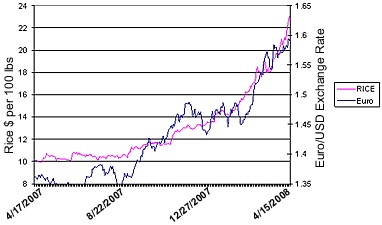
The chart below shows the price of 100 pounds of rice against the euro's
parity against the US dollar during the past 12 months. The regression fit
is 90%. There is an even tighter relationship between the price of rice and
the price of oil, another store of value against dollar depreciation.
Rice price vs Euro/US$ rate, April 15, 2007 to April 15, 2008
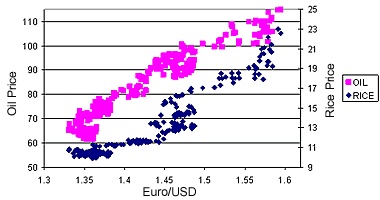
As the chart makes clear, the ascent of the cost of rice to $24 from $10 per
hundredweight over the past year tracks the declining value of the American
dollar. The link between the declining parity of the US unit and the rising
price of commodities, including oil as well as rice and other wares, is
indisputable. China has bid aggressively for rice all year, and last week
banned rice exports, along with Vietnam and several other producers.
Euro/US$ rate vs rice and oil, April 16, 2007 to April 16, 2008
For developing countries whose currencies track the American dollar and
whose purchasing power declines along with the American unit, this is a
catastrophe, as World Bank president Robert Zoellick warned the Group of
Seven industrial nations in Washington last week. Food security suddenly has
become the top item on the strategic agenda.
Never before in history has hunger become a global threat in a period of
plentiful harvests. Global rice production will hit a record of 423 million
tons in the 2007-2008 crop year, enough to satisfy global demand. The
trouble is that only 7% of the world's rice supply is exported, because
local demand is met by local production. Any significant increase in rice
stockpiles cuts deeply into available supply for export, leading to a spike
in prices. Because such a small proportion of the global rice supply trades,
the monetary shock from the weak dollar was sufficient to more than double
its price.
It is not only rice, of course, that the cash-rich countries of the world
are buying as a store of value; the price of wheat, soy and other grains has
risen almost as fast. This might deal the death-blow to America's hapless
efforts to stabilize the Middle East, where a higher proportion of
impoverished people eat off state subsidies than in any other part of the
world. Egypt has been the anchor for American diplomacy in the Arab world
since the Jimmy Carter administration (1977 to 1981), and is most
susceptible to hunger. Food prices have risen by 145% in Lebanon and by 20%
in Syria this year. Iraqis depend on food subsidies financed by American
aid.
Reduced to essentials, America's foreign policy sought two unattainable
objectives: to stabilize the Middle East and destabilize China. That is an
exaggeration, of course, for Washington hoped not to sow instability, but
only to put China in its place over the Tibetan affair.
The George W. Bush administration might as well have used the State
Department as a set for the Jackass reality show. American arrogance has
eroded the ground under many of the governments on which its foreign policy
depends. It is hard to characterize what will come next, except, like the
stunts on Jackass, that it is going to hurt."
Copyright 2008 Asia Times Online Ltd.
AlterNet is making this material available in accordance with Title 17 U.S.C.
Section 107: This article is distributed without profit to those who have
expressed a prior interest in receiving the included information for
research and educational purposes.
Thai
AirAsia drops Xiamen
24
April 2008
The no-frills
carrier Thai AirAsia (TAA) has dropped Xiamen in southeastern China from its
network as it shifts aircraft capacity to two new routes that potentially
offer greater economic returns.
TAA said it will
stop Xiamen from March 31 due to higher operating costs, a limited load
factor and a price war with Thai Airways International.
The no-frills
carrier believes it will be more profitable to use the planes on two new
routes, Bangkok-Jakarta and Bangkok-Ho Chi Minh City (HCM).
TAA started flying
daily to Jakarta on April 1 and to HCM on April 4, starting with two flights
a week. It doubles those to four flights a week on April 27.
With Xiamen
removed from its network, the only point in mainland China that TAA is still
serving is Shenzhen. TAA inaugurated Bangkok-Shenzhen service in July last
year.
TAA's earlier plan
to start flying from Bangkok to Guangzhou this year has yet to take off as
the airline grows more cautiously.
TAA is advancing
the retirement of its Boeing B737-300 fleet and replacing them with
brand-new Airbus A320 jetliners. By the end of next year, its fleet will
consist entirely of A320s.
TAA has ordered 40
A320s, three of which were delivered last year. Five are due this year and
five more next year.
Dubai
announces tram system for Burj
24 April 2008
In another excuse
for more noisy construction close to where we live Emaar Properties unveiled
plans on Wednesday for a $136 million advanced tram system for its Downtown
Burj Dubai flagship project.
The 4.6km Downtown Burj Dubai Tram System tramway has been designed to meet
the commuting needs of residents and visitors to the $20 billion mixed-use
neighbourhood, comprising more than 30,000 homes, and over 3.77 million
square feet of retail space, Emaar said in a statement.
The first phase, scheduled to be up and running by the end of 2009, will
feature a 1.1km twin track express link shuttle service between the Burj
Palace interchange station with Dubai Metro and The Dubai Mall.
The driverless service will have a one-way journey time of 2-3 minutes with
1-2 minutes between trams, and include an intermediate stop at a new hotel
development, currently being planned.
Phase two will consist of a 4.6km, single track, clockwise commuter service
operating from and to the Burj Palace interchange station with Dubai Metro.
It will service all ten stations that network the 500-acre development
featuring architectural milestones such as Burj Dubai, the world’s tallest
building, and the Dubai Mall, one of the world’s largest shopping and
entertainment destinations.
The complete one-way journey time will be approximately eight minutes. This
phase is planned to be fully operational in 2010.
Automatic fare collection will be compatible with the RTA’s Unified
Automatic Card system, enabling integrated travel across Dubai’s public
transport system.
EK new
routes before end 2008
23 April 2008
EK's Chairman
announced yesterday that there are another three new routes to be opened in
2008. One in Europe. One in the Far East and one in Algeria,
Well, Algeria can
only be Algiers. Is there really enough demand for flights from Dubai to
Algiers?
But Europe - time
to speculate - either Madrid or Copenhagen.
And one more route
in the Far East. That is tough - they have covered the major cities well.
Unless at last they can get into Tokyo. Failing Tokyo then where? Two
guesses: Fukuoka in Japan or Ho Chi Minh City in Vietnam. Both would be
something of a surprise. Watch this space.
EK double
daily to Moscow
21 April 2008
Next additions for
Emirates is to take its busy Moscow route double daily from 1 March 2009.
The daily flights
will now be:
EK133 DXB 0930 -
1355 DME 773 D
EK131 DXB 1740 - 2205 DME 332 D
EK134 DME 1700 - 2315 DXB 773 D
EK132 DME 2340 - 0555+1 DXB 332 D
A Quest
too far
20 April 2008
You have to love
those kinky Brits. The latest to get into trouble is also the most annoying
reporter on television. But hemay not be around for too much longer in order
to save his employer CNN from further embarrassment.
Richard Quest used
to be more famous for shouting his news reports and irritating everyone that
he interviewed. He was arrested early last Friday morning for drug
possession when police found him in Central Park well after the park's 1
a.m. curfew. The initial reports said Quest told police he was carrying
methamphetamime in his pocket, but leave it to the New York Post to add the
really interestingt details.
Quest, 46, was
arrested at around 3:40 a.m. after a cop spotted him and another man inside
the park near 64th Street, a police source said.
Not only did Quest have drugs, he also had a "rope around his neck that was
tied to his genitals, and a sex toy in his boot." The Post also reported,
"It wasn't immediately clear what the rope was for."
Quest, who was in jail most of Saturday, was charged with loitering and drug
possession (but not lewdness because he wasn't exposed). His lawyer claimed
Quest was "returning to his hotel with friends" and had no idea there was a
curfew for the park. Quest will attend six months of drug counseling and if
he stays out of trouble, the charges will be dismissed and his case sealed.
A law unto
themselves
19 April
2008 - From The Economist
Reforming a
corrupt and politicised police force will be tough
IN THAILAND'S most sensational crimes, the prime suspects are often the
police. Among current cases are a group of border police accused of
abducting innocent people and extorting money from them, and a huge
car-theft ring thought to have been run by bent coppers. The prime minister,
Samak Sundaravej, this month sacked the national police chief, Sereepisut
Taemeeyaves, for alleged corruption. Mr Sereepisut insists he is the victim
of a conspiracy by crooked subordinates.
Earlier this month the justice minister visited Chalor Kerdthes, a former
police general serving life in jail, belatedly seeking progress on the “blue
diamond” affair of the early 1990s, which wrecked Thailand's relations with
Saudi Arabia. After the priceless gem and other jewels were stolen from a
Saudi royal palace by a Thai worker, three Saudi diplomats seeking their
return were murdered in Bangkok. The Thai police supposedly solved the case
but the jewels they sent back to Riyadh were fake. Mr Chalor arranged the
murders of the family of a gem dealer involved in the case. It is suspected
he can dish the dirt on other former police chiefs.
Cases of police graft and abuse of power are legion. In 2003 Thailand's then
prime minister, Thaksin Shinawatra—a former mid-ranking policeman and
businessman—told police to wage “war on drugs”, resulting in at least 1,300
extra-judicial killings. The army removed Mr Thaksin in a coup in 2006,
promising a thorough investigation of the deaths. It had made little
progress by last December's election, won by allies of Mr Thaksin.
In March the American government's annual human-rights report on Thailand
criticised the widespread torture of suspects. Last year 751 people died in
prison or police custody. Abuses by police (and soldiers) have worsened an
insurgency in Thailand's mainly Muslim southern provinces, in which 3,000
people have died since 2004. Predictably, opinion polls show the police are
widely mistrusted.
Experts say Thailand's force is not the world's worst: it does have some
honest, capable investigators. However, for a country of a fairly high state
of development, its record is abysmal. After decades of failed attempts at
police reform, a panel set up after the 2006 coup proposed sweeping changes,
including creating an independent police-complaints body. Some of the
panel's reformists may be sincere. But this looked suspiciously like an
attempt to curb Mr Thaksin's power base in the police. Now Mr Samak,
although a supposed ally of Mr Thaksin, seems to be building bridges with
army chiefs to bolster his own power. So his motives in sacking the police
chief and talking of continuing the military government's reforms are also
bound to be questioned.
Thai governments tend to rely on the army or the police (or both) to remain
in power. So their commands have always been deeply politicised. Like other
public institutions they are dominated by a narrow elite of families with
tentacles everywhere. “You find the same few surnames wherever you look,”
notes Michael Nelson, a political scientist in Bangkok. Indeed, Mr
Sereepisut's replacement as police chief has the same surname as a former
army chief—his brother.
Thai public servants are less loyal to the institutions that employ them
than to their loose network of connections—relatives, ex-classmates from
military training or old university chums. The 2006 coup pitted Mr Thaksin's
schoolmates against those of General Sonthi Boonyaratglin, the then army
chief. Police reforms elsewhere have generally succeeded only where a
public-spirited and untainted political leadership forced them through. When
will Thailand get that sort of leadership?
Dubai -
another UK visitor guide
Head for
heights in Dubai - The Independent - Saturday, 19 April 2008 - always
interesting to read how others view our building site!
For his 1979 travel book Arabia: Through the Looking Glass, Jonathan Raban
stopped off in Dubai as the petro-dollar boom kicked in. Thirty years ago,
no-one in Dubai could have foreseen the seven-star hotels, the extravagant
shopping trips of Colleen McLoughlin and her fellow Wags, or George Clooney
dropping into town. But its arrogance and aspiration was already evident to
Raban.
"We passed the Dubai Hilton," he wrote. "It looked to me like a Hilton but
it was marked by one of those singular honours which count for so much and
seem – to an outsider – so numbingly unimportant. At that particular moment
it was The Tallest Building In The Gulf and Sheikh Rashid of Dubai was
apparently doting on it like a favourite child. Looking at its smug,
slab-sides cliffs of glass and concrete, I hoped that it would not be
allowed to enjoy its pre-eminence for too long."
It certainly didn't. That title has passed through many hands and rests now
with the Burj Dubai, a massive steeple rising through the clouds. Still
under construction, it hit 629m at the beginning of April, breaking the
record for the tallest man-made structure not just in the Gulf, but in the
world.
It surpassed North Dakota's KVLY-TV mast, which held the title since 1963,
and that certainly hasn't got luxury apartments at the top.
I caught my first glimpse of the Burj Dubai as my flight swept past on its
descent into Dubai's airport. From the sky, you can the see an eruption of
towers in this thin strip of a city lying between the Arabian sea and vast
plains of sand. Dubai is undoubtedly brash – and built on vaunting ambition.
So I decided my mission would be to get as high in Dubai as possible: during
my five-day holiday I would climb any skyscraper I could talk or drink my
way into.
My hotel was the Grosvenor House, in the new development of West Marina
Beach, to the west of Dubai. Standing at 210m, the hotel briefly made the
top 100 tallest buildings in the world when it opened in 2005. Just three
years later it languishes closer to the 300 mark. Constructed from what
appeared to be massive peach and black Lego blocks, it does still tower,
just, over the neighbouring construction sites.
Passing tourists were welcomed in the evening at the hotel's Bar 44, a
showy, if soulless, cocktail lounge. However the real treat was reserved for
the hotel guests who, for a supplement, could take breakfast and afternoon
tea in the adjacent lounge on the 44th floor overlooking the Arabian Sea.
Sitting on the balcony outside, with a perfect afternoon tea of jam and
scones, I got my first, giddying, view of Dubai. Out in the water was the
Burj Al Arab, the sail-shaped "seven-star" hotel; facing it lay its sister
hotel, the wave-shaped Jumeirah Beach. Beneath me, just beyond the coast,
was the "World" development, for which sand has been lovingly dredged into
the shapes of the continent for property tycoons and A-listers to purchase
in their own acts of mini-colonialism.
Tommy Lee Jones has apparently bought "Greece" for his ex-wife Pamela
Anderson, though rumours that Brad Pitt and Angelina Jolie had joined the
scramble for Africa and snapped up Ethiopia have been denied by the couple.
It occurred to me that residents of "The World" will never fully appreciate
what they eventually live on because it takes being at the top of a tall
building such as the Grosvenor to see the full glory (and the full folly) of
this particular project.
I turned my eyes towards the heart of the city. The main thoroughfare
dissecting Dubai is the Sheikh Zayed Road, the eight-lane highway which runs
from the heart of old Dubai out to West Marina Beach. It is along this
street that the forest of skyscrapers grows strongest and thickest. Here
lies the Chelsea Tower, the two Emirates Towers and the Burj Dubai, with
many more still gestating in their scaffolding wombs.
My first stop was the Chelsea Tower. The taxi driver needed no further
instructions; it is his trade to transport legions of businessmen and
tourists from one high-class destination to the next.
His English, and his Arabic, was broken – he came from India – but he knew
the name of every skyscraper I asked him about. We glided down the spanking
new highways that dissect the city, past the hoardings over the developments
(with their taglines such as "Be Unlimited" and "Limitless").
The Chelsea Tower is the 14th-tallest residential skyscraper in the world
and 123rd-tallest building in the world. With most of Dubai's population
being foreigners, there is a steady stream of businessmen and their
holidaying families who avail themselves of their short- and long-term hotel
apartments.
I asked whether I could see one as high as possible and was shown around a
crisp, clean, set of rooms up on the 40th floor. Few pictures hung on the
walls but, given the massive windows and the vast views they captured, u o
there was little need of them. I persuaded the management to allow me up
onto the roof of the building, somewhere not normally accessible to guests.
A security guard called Mohammed accompanied me. It seemed a little
difficult to breathe at 250m high, but that wasn't to do with the altitude;
Mohammed pointed out the thin layer of yellow that hung across the city, a
shroud of dust thrown up by all the building works going on. The spiked top
of the Burj Dubai was almost invisible.
Over the road was my next target, the twin Emirates Towers. This office
tower, at 355m high, is the 15th-tallest building in the world, followed
closely by its sister building, the Emirates Hotel at 305m. The apexes of
the Emirates Towers are equilateral triangles sloping at 45 degrees. Beneath
the precipitous glass and steel roof of the Emirates Hotel is the Vu bar. Up
on the 51st floor, it is open to the public in the evening (at least, those
members of the public who have a dinner reservation). With its heavy wood
decor and odour of tobacco, it had the feel of a gentleman's club. A floor
below is the well-appointed Vu restaurant, serving scallops and foie gras.
Dinner there for two cost around 940 dirhams (£130) – and a decent dose of
vertigo.
Looking down from this glass enclave at the top of the Emirates Tower, I
found myself contemplating the other Dubai. So far, I'd been in a city
manufactured for moneyed foreigners. Like a suction pump, each
air-conditioned building I'd entered was designed to pull me upwards.
Super-speed elevators had shuttled me away from the realities of the hustle
and heat and traffic of the city, into a far more rarefied world: the
highest of pedestals. The streets looked up at us in our glazed towers, and
we in turn were obliged to look down upon them. I peered downwards too, and
decided to explore this alternative Dubai.
Low-rise areas carpet the inner city. Al Karama is a little series of boxy
concrete residential blocks containing shops selling old furniture. It also
boasts a thriving counterfeits market. It was the first place I heard the
mantra that then followed me through the old town: "Rolex! Tag Heuer!
Cartier! Omega!".
An Iranian spotted me as a potential buyer and led me up some back stairs to
a room stacked high with handbags, shoes and trays of watches.
He gave me a Coca-Cola while he displayed his wares. "You like Gucci?" he
asked. "Juicy Couture? Everything's very good quality." I declined his
offers and moved onto a store where the Keralan shopkeeper let me try on a
burka and a belly-dancing outfit. I left with a camel puppet as a souvenir.
Next, I got a little lost on a city stroll between the Al Karama market and
an area called Deira, which lies on the other side of Dubai's river, the
Creek, and is home to the Gold Souk. But during the process of regaining my
bearings, I kept meeting people with tales to tell of how they had arrived
on these shores.
There was the South African estate agent who walked with me a while, and
informed me this was the only place to do business in his industry, but that
he missed home. There was the Pakistani ship's captain who, over a beer in
the slightly seedy Sun Hotel, described a complicated personal life
involving his wife, nine daughters, and a nubile Korean lover. He had been
naturalised in Dubai but wanted to move to Manchester. A suited woman from
Mumbai told me she had come to Dubai to escape a broken heart.
The backdrop to these conversations were streets filled with African women
in flowery headdresses; Chinese labourers; Indian stall-holders and
mechanics; all following the pulse of money. I eventually yielded to the
watch-buying mantra and purchased a "Cartier" watch from a vendor in Deira.
He assured me it was the finest timepiece that Singaporean counterfeiters
had ever produced.
At street level it becomes abundantly evident that the culture of this city
is trade. Only one in five of Dubai's inhabitants is Arabic; it is the
international traders who make it tick. Everyone from the street hawker to
the high-flying businessman is integral to the city. Its culture has been
fostered by the ruling Al Maktoum royal family – and the skyscrapers are
monuments to their success. But down on the ground the fuel for it all is
the constant stream of newcomers with a hunger to do well.
My last vertical trip was to the Burj Al Arab, as heavy on the wallet as it
is on the skyline. This 321m sail-shaped hotel, built on a man-made island
out at sea, epitomises Dubai's gaudy excesses. To get past the tight
security on the front gates, one needs either a reservation at the hotel or
in one of its extraordinarily expensive restaurants.
It's worth the effort. The Burj-al-Arab has the highest atrium in the world,
at 180m, a butler dedicated to each of the 27 floors of the hotel, and a
fleet of Rolls-Royces for its guests. It feels like it had been built for
another age, awash with gold trim and architectural flourishes. I ascended
in the panoramic lift at six metres a second into the crow's nest of the
hotel, the 27th floor, which houses the Al Muntaha Restaurant.
On offer was a good European menu and classy, if somewhat bright, cocktail
bar. At 200m high, the view over the Arabian Gulf and the city was the best
I had seen. The biggest thrill, though, was plummeting down to earth again
in the elevator. For a moment I thought we were being bulleted down deep
into the sea.
It didn't take me long to feel seduced again by the old city. The Creek,
which cuts through old Dubai, is about as wide as the Thames and is
chock-full of old wooden cargo ships. These vie for space with little
passenger ferries that run between Bur Dubai and the souk on the Deira bank
opposite. As we traversed the Creek on one of these makeshift ferries,
sitting jammed up against dockers, businessmen and tourists, I caught the
sticky smell of the "put-put" engine's petrol fumes. For all the heights of
a city that had risen on the petro-dollar, this was the first real whiff I'd
had off the stuff.
The ferryman asked if I would like a private, hour-long, tour of the Creek
for 100 dirhams (£14). I accepted, and we set off down the river past more
gleaming edifices. Soon our boat was chugging along beside the Dubai Hilton.
Surely this squat little thing was not the Hilton of Raban's Dubai? No: his
Hilton was torn down many years ago, its dubious glories lost forever in the
rubble of this ever-changing city. It may all be built of concrete and steel
round here, but there is still something ephemeral about it. Will it stand
the test of time? My "Cartier" watch certainly didn't. It broke shortly
after my return home.
In praise
of Bournville
18 March 2008
Tai is leaving for
Birmingham on Sunday. Her first visit to the city I was born in. I grew up
in the Cadbury village of Bournville. It is an unusual village; built by a
Quaker family with strict social values it still retains a real sense of
community despite how close it is to the city of Birmingham. It sounds a bit
mean but I was always a bit upset with my Dad for taking us away from the
village and my school when I was 10 years old.
This BBC article
from 2007 describes the village well.
Is this the
nicest place to live in Britain?
By Dominic Casciani
BBC News Online community affairs reporter
 Bournville.
Just the way it rolls off your tongue makes it sound a nice place to live.
And yet at first glance it's just another red-brick estate in the suburbs of
Britain's second city. But academics say the Birmingham estate built by
chocolate baron George Cadbury is much more than that. It is quite simply
one of the nicest places to live in Britain. Bournville.
Just the way it rolls off your tongue makes it sound a nice place to live.
And yet at first glance it's just another red-brick estate in the suburbs of
Britain's second city. But academics say the Birmingham estate built by
chocolate baron George Cadbury is much more than that. It is quite simply
one of the nicest places to live in Britain.
There's no end of research on what makes a bad neighbourhood. But what about
what makes a good place to live? The Joseph Rowntree Foundation has tried to
answer this question by funding research into Bournville, long reputed to be
neighbourly, peaceful and, well, nice.
Bournville was born in the last years of the 19th Century when George
Cadbury, a classic Victorian philanthropist, decided he wanted homes next to
his factory south-west of Birmingham city centre. He said the estate should
"ameliorate the condition of the working-class and labouring population...
by the provision of improved dwellings, with gardens and open space to be
enjoyed therewith".
A century on, the model village is a large garden suburb of 1,000 acres,
7,800 homes and 120 acres of open space. At the heart of the area is
Bournville Village itself - to all intents and purposes a slice of rural
Britain in the heart of a city, complete with village green, shops and a war
memorial.
All the homes have big gardens on wide roads, though the houses themselves
are neither too grand nor too small. Some 40% of residents rent from the
charitable trust, but they are intermingled with owner-occupiers creating a
social mix you don't often find. What the researchers found was that
Bournville's success comes down to a seamless mix including quality homes,
neighbours from different backgrounds, services and open space.
Factors like these (and perhaps the sweet smells of a chocolate factory)
encourage residents to more actively commit to an area's prosperity,
creating a virtuous circle of neighbourliness - also known as social
cohesion. On top of this, the Bournville Village Trust exercises an
unusually high level of control. Residents can't just put up a satellite
dish without permission.
Furthermore, they cannot buy alcohol within its boundaries. Not that it
seems to bother anyone that pubs were not part of the Cadbury vision. The
Rowntree research found that across a range of national indicators
Bournville residents were simply happier.
Tenants were twice as likely to describe the area as "pleasant" than those
elsewhere. They even make fewer complaints about the thing we all fear most
- neighbours from hell.
So is this the epitome of Arcadia transplanted into suburbia?
"This was the first purpose-built community in Britain," says Alan Shrimpton,
director of estates for the Bournville Village Trust. "George Cadbury wanted
to build good housing for all people. He sat down and asked himself how
people wanted to live. "I don't think anyone got it as right as Cadbury
did."
The trust rejects suggestions that Cadbury's vision has come at a price,
such as the right to buy a bottle of wine. Instead, says Mr Shrimpton,
people willingly enter a social contract with their neighbours, the trust
and wider community. "These kinds of rules are supported by the residents
themselves," says Mr Shrimpton. "The last time this was discussed the
consensus was the drawbacks of allowing the sale of alcohol would outweigh
the advantages. "If you want to live in harmony with your neighbour, there
is sometimes a price to pay. It seems at Bournville people want to pay it."
David Smith, his wife and two young sons, are among the new-comers who are
happy with that social contract. He loves it so much he says he will
probably stay forever.
"We only used to live a few miles away in Selly Oak," he says. "But we've
now found a real community spirit." Mr Smith runs a community website to
link up all the residents' groups, friends, neighbours and societies,
something he was encouraged to do by the atmosphere of the area. "People
just tend to be generally friendly in Bournville," he says. "There are
newsletters and notice boards of what's going on. I hadn't seen that
anywhere before."
The Trust concedes its one major mistake was Shenley, a multi-storey
post-war project which abandoned the Cadbury principles and has been beset
by problems. It also accepts that it needs to do more for the young and
tackle a social mix that could worsen as the stable population ages and the
highly desirable private homes soar in value.
But others are trying to learn from Bournville, the most recent being the
Prince of Wales' own Poundbury community in Dorset. Meanwhile, Joseph
Rowntree's own model village just north of York, New Earswick, continues to
thrive a century after it was founded.
Rosemary Shutt of the local Bournville Historical Society says the most
important thing others can take away is the essence of what makes a
community work - collective experience. "A lot of the old people who live in
Bournville went to the school in the village centre, worked for Cadbury's
and still live here," says Mrs Shutt. That means there is a real sense of
shared memories. "I think if George Cadbury came back today, he's still be
happy with Bournville. There's probably more litter, but the spirit of
Cadbury is still here."
Thomson
Reuters is launched today
17 April 2008
NEW YORK (Reuters)
- The new Thomson Reuters Corp may compete most directly with Bloomberg LP
and Reed Elsevier, but Chief Executive Tom Glocer thinks the company also
may jostle with Google Inc and Microsoft Corp.
"There are going to be a handful of 'information majors,'" Glocer, 48, said
in an interview in his office at the Reuters building in Times Square on the
eve of Canadian publisher Thomson Corp's completion of its more than $16
billion purchase of Reuters Group Plc.
"We're all going to keep an eye on each other," Glocer said. "We're all
going to compete in some areas, cooperate in some others."
Thomson Reuters, which begins trading in London, Toronto and New York on
Thursday, will be known primarily for its worldwide news service, data
products and technology for financial professionals and its portfolio of
products serving the legal, scientific, accounting and health-care sectors.
Behind that is Glocer's idea of what he calls "intelligent information" --
his longer-term goal of lacing data sources from both companies together. He
wants to offer people easy access to the information they need to do their
jobs -- and wants them to pay for the convenience.
Most of these tools have a low profile in the eyes of the public, but Glocer
prefers to focus most on that field rather than competing directly against
the Googles and Microsofts of the world in the wider consumer space.
"We are not going to own a film studio. We are not going to launch a teenage
social networking service," he said, referring to News Corp properties 20th
Century Fox and the MySpace social networking site.
"We're really focused only on professionals, people who will pay us for our
content and services," he said. "What would you pay me for tomorrow's New
York weather forecast? Probably nothing."
On the other hand, he said, an insurance company might pay dearly for
getting "bespoke, proprietary meteorological content on the long-range
hurricane forecast for Florida in the 2008 hurricane season."
"You'll pay me for that if I can improve the profitability of your
underwriting book as a result," Glocer said.
Still, information and communications conglomerates have a way of growing
into new territory over time, Glocer noted.
"I think Google is clearly there as the monetization device for lots of
consumer content. The question mark is if they want to get into anything
other than the low end of professional," he said. "I think News Corp-Dow
Jones has a potential seat at the table. I think Microsoft-Yahoo does if
they pull it off (merge) and if Microsoft embraces content more than it has
before."
While Glocer is largely sticking to professional services, he does embrace
free, new ways to communicate to the world. He maintains a profile on the
Facebook social network and is the proprietor of a blog at tomglocer.com. He
also gave the green light to Reuters to set up a news bureau in Second Life,
a virtual world on the Internet.
Glocer was a mergers and acquisitions lawyer with New York's Davis Polk &
Wardwell before joining Reuters in 1993 as a vice president and deputy
counsel, and went on to hold positions as general counsel and chief of Latin
America.
In July 2001, he became CEO, eight years after joining the company -- and
just before a global market slump that led to falling revenue and the
company's first loss since 1984.
In the near future, Thomson Reuters will have to negotiate another perilous
financial landscape.
"We're not immune to the financial cycle," Glocer said. "There's clearly
been an enormous dislocation in the credit markets, which have pulled down a
whole bunch of funds and obviously Bear Stearns as well."
But he said that Reuters' foreign exchange business is producing record
volumes and revenue, as are its commodities and energy information
businesses.
"I'm more concerned about the effects of the financial crisis on the real
economy and what are the implications of a real recession than the doom and
gloom stories specifically about finance," he said.
And while Thomson Reuters builds up its position in financial news and data,
Glocer said he cannot imagine the company without a general and political
news division, including entertainment coverage, because it is all "so
incredibly intertwined into the economy."
Hanoi - a
city to avoid
16 April 2008
It is time for a
little honestly in my travel commentaries. Hanoi is a dump; dirty,
ill-mannered and polluted.
Which begs the
question of why are we here. Many Thais do come to Hanoi and Tai had always
wanted to visit.. It is six years since I was last here and that was not the
best weekend I can ever recall so I thought it might be good to be back here
with Tai and for us to be able to enjoy some quiet time together.
Quiet time does
not exist in Hanoi. The city has gone from bicycle to motor cycle. Forget
the image of straight backed girls in ao dais pedaling serenely along the
streets.
Everyone is on a
bike; except the elite few who have a car. And everyone is on the horn. My
head has hurt since we arrived.
Try to cross the
road - just go and don't stop. Pedestrian crossing and traffic lights exist
solely for decorative purposes.
The saddest part
of communism is that it makes the elite wealthier and the poor poorer. And
Hanoi is a poor city. The so called highway from the airport is decrepid.
There is hardly a new building to be seen except for some Japanese invested
sweat shops to take advantage of Hanoi's young cheap labour. The city in run
down. It feels more like Rangoon.
The idea that
Vietnam is the new economic tiger of Asia is almost laughable. This is not
an economic tiger. This is a moth-eared dog.
And the people -
there is none of that Thai charm and smile. This is a gruff, and sour faced
people that will make money out of you however they can. I may generalise a
little. Our hotel was welcoming. But that is about it.
We had one nice
dinner. At Club 51. Allegedly one of the best restaurants in town. But the
service was a shambles.
Mind your
possessions. It is that kind of place.
And it feels
dirty. The street food is doubtful; the streets appear to have open sewers
at the side. My stomach, which is usually cast iron, is unhappy. An the
street pollution has got to my throat.
Wish we could fly
back tonight. One night in Hanoi feels like more than enough.
There are some
lovely places in Vietnam. I thoroughly enjoyed Hoi An last year. But I will
be quite content not to come back to Hanoi.
Emirates
profit record
13 April 2008
While other
airlines are heading into bankruptcy and Chapter 11 protection in the USA
Dubai-based Emirates airline posted a rise of at least 40 percent in profit
in the last fiscal year to more than 5 billion dirhams ($1.36 billion), al-Khaleej
newspaper reported on Monday.
Profit rose in the year to March 31 after the airline carried more
passengers and cargo, the newspaper reported, citing unidentified sources. A
spokeswoman for Emirates could not immediately comment on the report.
Emirates Vice Chairman Maurice Flanagan said the state-owned carrier would
probably post a profit of at least $1 billion in the fiscal year, Emirates
Business reported in February.
What does this
mean for the long awaited announcement of the EK 2007/8 profit share?
The
Burmese refugee tragedy
11 April
2008
The Burmese government has a lot to answer for. Driving its
own people out of the country is one additional crime. That there are Thais
who are complicit in this tragedy is saddening.
Fifty-four Burmese migrants were been found dead after
suffocating in a lorry smuggling them into southern Thailand.
More than 100 people were packed into a container measuring 6m by 2m. Many
of the survivors are seriously ill from dehydration and lack of oxygen.
The driver opened the doors of the vehicle after the migrants banged on the
walls - but he fled on foot when he saw what had happened.
Thousands of Burmese risk the trip to Thailand in the hope of better wages.
Police said the Burmese had crossed by boat to the Thai town of Ranong from
Burma's southern tip at Victoria Point - a route often used by illegal
migrants.
They had then been packed into an airtight container on a lorry for the
journey to the resort island of Phuket.
Survivors have reported that they tried to bang on the walls of the
container to tell the driver they were dying, but he told them to shut up as
police would hear them when they crossed through checkpoints inside
Thailand.
Their horrific deaths have sparked outrage from rights groups
and renewed calls for tough action against human trafficking networks in the
region.
Some 2 million migrants from across the region are working in Thailand, most
of them fleeing the former Burma where 46 years of army misrule have
crippled a once-promising economy.
Only 500,000 migrants are in the country legally, a Labour Ministry official
told Channel 9 television.
Under Thai law, registered migrants have the same rights as Thais, but in
practice this is far from the case. Migrants are routinely denied access to
such basic rights as education, medical care and freedom of movement.
However, the vast majority are unregistered and work illegally in factories,
restaurants, at petrol pumps and as domestic helpers or crew on fishing
trawlers.
The Asian Human Rights Commission said the perpetrators of the truck tragedy
must be brought to justice, but authorities should not use it as a pretext
for a crackdown on migrant labourers.
"Millions risk everything to leave Burma because life there is appallingly
bad," the Commission said, noting that they often do jobs that Thais will
not.
The survivors were due to appear in court in the southern province of Ranong
on Friday to face charges of illegal entry. Police said some could be
deported immediately after the hearing.
Aye, whose 8-year-old daughter died in the truck, said she could not provide
for her other two children in Myanmar -- a 10-year-old daughter and
6-year-old son -- if she was unable to work in Thailand.
Why does this happen; because the nations of South East Asia and the West
tolerate Burma and allow the Chinese to wield undue influence there. It is
time for change in Burma. Tragedies like this should shame us all.
Dubai Mall
sets opening date
10 April 2008
Emaar Malls Group will open its flagship shopping mall
development The Dubai Mall on August 28. In
the very first year, EMAAR are expecting 30 million visitors to the mall, he
added.
One of the world's largest shopping and entertainment destinations, The
Dubai Mall has a total internal floor area of 5.9 million ft² and gross
leasable space of 3.77 million ft², which is equivalent to the size of 50
football fields put together. The mall will feature more than 1,200 stores,
including two anchor department stores and 120 food and beverage outlets.
The key components of the mall include one of the world's largest indoor
Aquariums featuring 33,000 living animals; the world's largest indoor Gold
Souk with 220 retailers; the Middle East's first Galeries Lafayette
department store; an Olympic-size ice rink; and The Grove, an indoor-outdoor
streetscape with fully retractable roof, will open on August 28, along with
the 14,000-car parking facility.
The entertainment section comprising the region's first SEGA indoor theme
park; KidZania, an 80,000 ft² children's ‘edu-tainment' centre and a
22-screen cineplex, will open later this year as completion requires a
dust-free environment.
China's torch
thugs
10 April 2008
They look
forbidding. They are running as a group surrounding the Olympic torch
bearers. Beijing calls them torch "escorts" or "flame attendants" but the
Chinese guards in blue tracksuits surrounding the Olympic torch in London, Paris
and San Francisco are elite members of the paramilitary units used to crush dissent
in Tibet.
The International Olympic committee
said China had a right to supply escorts for the Beijing Games torch on its
journey around the world, saying this was "normal".
Beijing's Olympic organising committee insisted the group of 20 to 30 flame
attendants from Beijing were there merely to help with practicalities such
as relighting the torch if necessary, and were trained in "torch etiquette"
only.
But the Shanghai-based Labour Daily newspaper, quoting Zhao Si, head of the
elite unit, said its members were picked in 2007 from the People's Armed
Police, China's 660,000-strong paramilitary force that mostly deals with
internal security. Thousands of PAP forces are still deployed throughout
Tibet and Tibetan regions of western China since monk-led protests on March
10 degenerated into a violent riot in Lhasa on March 14.
Pictures of the guards at a swearing-in ceremony, after undergoing special
physical, etiquette and language training at the PAP training academy in
Beijing, show their official name as "The Protection Team for the Holy Flame
of the 29th Olympic Games".
The guards are flying on a chartered Air China jet that carries the back-up
"Olympic lanterns" that each contain a flame from which the torch is lit or
relit.
British television presenter Konnie Huq, a torch-bearer caught up in a clash
between protesters and the flame attendants in London, said the Chinese
guards shouted orders at her and pushed her arm to make her lift the torch
higher.
A leading London Olympics chief was overheard describing the escorts as
"thugs".
Lord Sebastian Coe, a two-time Olympic gold medallist and chairman of
London's Olympic organising committee, who called them thugs, said their
behaviour was "horrible". Later he said his remarks, heard by British
television, were meant to be private.
"They tried to push me out of the way three times. They are horrible," Lord
Coe was overhead by Channel Four as saying in London. "They did not speak
English … I think they were thugs."
Emirates to the Golden Gate
9 April 2008
Emirates today
announced daily nonstop Dubai-San Francisco flights effective Oct 26th 2008
using a Boeing 777-200LR seating 266 pax in a 3 class configuration.
The new route will be very popular with San Francisco's large non resident
Indian population. This brings San Francisco onto the EK network far earlier
than most observers expected.
Flight timings are as follows :
EK 225 Dep DXB 08:45 Arr SFO 13:45
EK 226 Dep SFO 16:45 Arr DXB 1925+1
DXB-SFO flight will be 16 hours
SFO-DXB flight will be 15 hours 40 minutes
This is Ek's fifth new destination this year. San Francisco augments the
airline's American expansion which now includes two gateways in California,
the U.S. southwest with Houston, and the eastern seaboard with two daily
services to New York's JFK International Airport.
Where next in the
USA; my guess: Chicago.
Oasis runs dry
9 April 2008
In a sad day for
the Hong Kong airline industry Hong Kong-based bargain airline Oasis Hong
Kong Airlines shut down and applied for liquidation today, a year and a half
after it launched as a specialist in long-haul budget travel.
Chief Executive
Stephen Miller told a press conference that Oasis has suspended its flights
and that liquidators will seek new investors.
The fate of its
700 employees wasn't immediately clear. It also wasn't immediately clear how
many passengers were affected.
It is estimated
that Oasis has accumulated losses of about HK$1.0 billion since its launch
in 2006 as it offered cheap prices for long-haul flights to London and
Canada while underestimating its costs. The airline was always going to
struggle to compete on the long haul market against very established
carriers in CX, BA, VS and AC. The larger airlines could match Oasis on
prices and then offer hub arrangements at their home base to bring
passengers to or from their long haul flights. Oasis never had this
advantage.
Oasis started offering its services on October 2006 with the principal
objective of "making frequent long-haul travel accessible to all."
The airline was
set up by Chairman Raymond Lee, a minister and property investor. He and his
wife were among backers who committed $100 million in funds to the airline
before it began flying. Unlike low-cost short-haul carriers, Oasis offered
passengers free meals and in-flight entertainment, as well as business-class
seats.
It was offering daily non-stop flights between Hong Kong and London and six
flights every week between Hong Kong and Vancouver.
ATA Airlines Inc., Aloha Airgroup Inc. and Skybus Airlines Inc. have also
ceased operations since March 31 amid surging fuel prices - which yesterday
hit US$135 for a barrel of aviation fuel.
The only question
is - who will be next?
Dubai's Prince
Buys $2.7 Million Camel
9 April 2008
On Tuesday this week Dubai's crown prince paid
$2.7 million for a camel during a desert festival celebrating Bedouin
traditions in the emirate of Abu Dhabi.
The festival also included a camel beauty contest, where thousands of owners
strutted their animals in a bid for the top prize of finest overall camel
and separate categories related to the age and color of the camels, in which
features such as best neck, head, lips, nose, hump, legs or feet, are
judged.
Sheik Hamdan bin Mohammed bin Rashid al-Maktoum, the son of Dubai's ruler,
Sheik Mohammed, bought 16 camels for $4.5 million, including one female
camel for $2.7 million, the state news agency WAM reported.
There was no indication what Hamdan, Dubai's heir apparent, planned to do
with the animal though female camels are often used for racing. Owning fine
camels is also a mark of prestige for the ruling elite in the Persian Gulf.
Abu Dhabi's ruling family organized the nine-day festival in a bid to
preserve the nomadic way of life in the desert that predates the discovery
of oil in the region in the 1960s.
More than 17,000 camels from the oil-rich Gulf countries — the Emirates,
Saudi Arabia, Oman, Qatar and Bahrain — were registered for the beauty
contest, which gave out millions of dollars in prize money and more than 100
four-wheel-drive vehicles and pickup trucks, the festival's managers said.
Putting out the
Beijing Olympic Torch
8 April 2008
The Olympic torch
campaigns are doing their job; they are highlighting the Tibet issue,
China's poor human rights record and just how much of a media circus the
Olympic Games has become.
This was always to
be a political games; perhaps the most political since Berlin in 1936. And
just as Beijing is seeking to manage its image as positively as possible
there are plenty of groups seeking to show the other side of China and use
the unprecedented media attention generated by the Games as an opportunity
to push for change.
As China gets
increasingly concerned at the potential for adverse media coverage or for
disruption of Olympic events the country has now imposed a series of entry
restrictions on foreign passport holders which is likely to impact on
tourists visiting the country.
Slower visa processing times, no multiple-entry visas and no one-day travel
visas from Hong Kong have all been reported by Hong Kong-based travel
agents.
Multiple-entry visas have been suspended until October 17th and travelers
applying for visas can now expect next-day rather than same-day turnaround
for visa processing, it has been reported.
The Beijing Olympics are set to run from August 8th to 24th. Should nations
boycott the Beijing Olympic Games? The answer is yes and no! Over the next
few months there will be increasing calls for the boycott of the Olympic
Games will follow.
With its booming economic and political presence on the world stage, hosting
the Olympic Games was originally supposed to be China’s
coming-out-of-its-shell party; instead, it has become a problematic
political issue accentuating its ongoing violations of human rights, with
Tibet as the centre of attention.
There is an issue
to be addressed but western governments will not take any meaningful and
significant action.
In 1980, 62 countries, including Canada, declined to participate at the
Moscow Olympic Games following the invasion of Afghanistan by Soviet forces.
The difference, however, was that countries had only limited economic ties
with the former Soviet Union, making a boycott easily feasible and
relatively harmless from a political perspective on the home front.
Today China is the largest trading partner of most western nations. This
economic interdependence between nations ends all talk of a boycott. Further
the UK as the 2012 host cannot afford to boycott the games weakening any
concerted action by the western nations.
There is little to be gained by using the Olympic Games as a political
weapon. If the Olympics Games were not being hosted by China, would there
even be any discussion of a boycott due to China’s encroachments of human
rights? The answer is obvious: no. The truth is that at the end of the day
economic interests are paramount and China is too big to upset.
If western nations truly wish to pressure China into change, it will require
a further-reaching strategy, which inevitably would include introducing
economic sanctions — or, at the very least, threats to do so.
The International Olympic Committee charter insists “universal and
fundamental ethical principles” as part of the spirit of the Olympic Games.
As soon as the IOC awarded the Games to China they were putting this
principle at risk.
There could be a boycott of the Beijing 2008 Summer Olympic Games but
only if governments and citizens are willing to follow their Olympic protest
with further sanctions and maintain their principle-based position even in
the wake of potential negative repercussions.
But this is not
going to happen. Instead we will watch our athletes compete in Beijing and
grimace as the Chinese government continues to ignore basic human rights and
freedoms.
China
reinvents the propaganda machine
5 April 2008
As China gears up
for the August Olympics the old guard who operate this monolithic state's
propaganda machine are back in action.
And the Chinese
public relations machine is going to have a hard year. The world is looking
at China; and it is a great opportunity for those in and out side of China
who want change to air their grievances.
The current
problem is what to do with Tibet and the Dalai Lama, the exiled Tibetan
spiritual leader. Outside China this alleged villain is one of the world's
most admired people. The Chinese (never subtle in their terms of abuse have
called him a "wolf in monk's robes," "a wolf with a human face and heart of
a beast" and the "scum of Buddhism." In case anyone missed the message, the
government has also called the struggle against the Dalai Lama "a
life-and-death battle."
The propaganda means of the Chinese state are overwhelming; it controls
television, radio and news media. It controls the messages given out in
schools and on the streets. It is not just about shaping opinion, but about
nationalism at its worst.
Chinese television coverage is almost exclusively images of lawless Tibetan
rioters smashing shops in Lhasa, along with the images of ethnic Han victims
of the violence, typically recovering in the hospital.
In the meantime Western media are now barred access to Tibet. So much for
China lifting restrictions on the movements of international journalists.
And there will be thousands of reporters in China for the Olympics.
As China cranks up the propaganda it creates an image ever further from that
which it so eagerly wishes to promote of itself to the world.
China has invested hugely in its hosting of the Olympic Games in August with
the idea of introducing itself as an overwhelming success story:
increasingly prosperous, harmonious and forward-looking. The first statement
is certainly true, but one needn't be an enemy of China, as the
propagandists would have it, to question the other two.
The biggest challenge for China and for many of its people is learning to
deal with criticism without turning it into a matter of ethnic pride or
betrayal. They had better get used to it. There is plenty more to come.
Dubai planning 2016 Olympic bid
2 April 2008
Dubai is
considering to bid for the Olympic Games, a report quoting Sheikh Mohammed
bin Rashid Al Maktoum, Vice President and Prime Minister of the UAE and
Ruler of Dubai, said.
The city will host the event, if it wins the bid, at Dubai Sports City,
ArabianBusiness.com said.
Sheikh Mohammed was talking to journalists on a flight from Beijing to
Shanghai as part of his state visit to China.
He declined to give further details and did not name a target year to host
the games, said the report.
Dubai Sport City, currently under construction, is one of the largest sports
complexes in the world.
Next mega mall
by year end
2 April 2008
One of the world's
largest shopping malls is set to open towards the end of the year in the
booming Gulf retail paradise of Dubai, developers said on Tuesday.
The Dubai Mall -- covering an area of around 12 million square feet (1.1
million square meters) -- will feature 1,200 stores, an indoor aquarium and
an Olympic-sized ice rink, the emirate's real estate developer Emaar said in
a statement.
The development will dwarf the Mall of the Emirates, currently Dubai's
largest retail center that also boasts an indoor ski slope and a luxury
hotel.
"It will be the region's premier shopping and entertainment destination for
residents and a major attraction for Dubai's tourists," said Jim Badour,
head of Emaar's shopping malls division.
The mall will be part of a wider multi-billion dollar development that
includes the world's tallest tower.
The World Cup
queue fiasco
2 April 2008
While most racing
enthusiasts had a great time at Nad Al Sheba, many others complained at the
long delays suffered. Following is a selection of readers' response on the
Gulf News website:
How sad that the bulk of spectators were left queuing in the sun for hours
before they could enter International Village? It was so bad - and no water
was available - that before I keeled over from heat stroke we decided to go
home! The tickets ordered online, we later found out, were to be collected
from the parking spot we had just left on a shuttle bus, which happened to
be the fifth one we waited for as they were always full up! And then to find
that we had to go back to the kilometre-long queue - no thank you!
Christine Curtis, UAE
The horses were awesome and the show was fantastic. But the shuttle system
that was totally chaotic. It was a stampede when the spectators were
leaving. There were only two policemen and a few 'traffic marshals' who were
doing anything but controlling the crowd. There were children, women, senior
citizens, and a man on a wheelchair and then there were others who would
just push and do anything to get on the bus. The marshals were unable to
control them. It took about one hour for the people who were actually
patiently waiting in a queue to get a ride in the bus, to reach the parking
area. Hope it is better next year.
Sheetal Mantri, UAE
We arrived at 4.30pm, having queued for one hour to get into the car park.
We went straight to the information desk where we were told that we would
have to go to the 'remote car park' to collect our tickets. Why the
collection point was not next to the entrance is beyond me. We then queued
for over an hour in the baking sun with no refreshments to collect our
tickets, as there were only two people handing them out to the thousands
that had come to collect them. We then had to queue to get a bus back to the
stadium. The driver did not know the way back to the stadium and had to wait
for an escort. We finally arrived outside the venue at 7pm. The queue to get
in was huge. Officials told us that the waiting time was approximately two
hours. At that point we decided to head home, as we wouldn't have made it
inside till 9pm despite having arrived at 4.30pm. It was a total waste of
time and money.
Jenny, UAE
After three years of happily attending the Dubai World Cup and experiencing
smooth and enjoyable evenings, I am saddened to say that our purchased
e-tickets were not used. It was due to the lack of organisation at the
venue. Having purchased our tickets online, nobody at the venue could
accurately tell us where we had to go to pick up our actual tickets - the
instructions were not written on the e-receipt. We arrived at gate three,
and the people at the door had no idea where we had to go. The organisation
was a disaster, and we left three hours into our ordeal without having even
entered.
Walid Zabaneh, UAE
It was excruciatingly embarrassing to have to put my overseas guests through
the shambles. We gave up after a two-hour traffic queue followed by a
further two hours in a non-moving pedestrian queue. Organisation that poor
is totally unforgivable.
John Hoyle, UAE
We arrived in the car park at around 3.30pm after fighting our way there in
traffic. We then had to fight to get on to the shuttle buses, as the taxis
couldn't drop off people at the gates. Once you got to the gates, you had to
queue once again to get in. The line must have snaked for at least a
kilometre.
Adam Loosely, UAE
No racing
refunds
2 April 2008
The hundreds of
racegoers who abandoned their plans to enjoy this year’s Dubai World Cup due
to the huge queues outside the venue will not be refunded their ticket money
it was confirmed yesterday. Racegoers were forced to stand in line for hours
to first collect their dhs180 entry tickets and then had to wait again to
gain entry into Saturday’s showpiece event of the racing season at Nad Al
Sheba.
Many simply gave up after seeing the mammoth queue stretching outside the
International Village and returned home instead. A spokesman for Dubai
Racing Club apologised for the delays but said that no refunds would be
issued to those left bitterly disappointed by the poor organisation. “We are
very sorry for anyone who experienced delays and we will be reviewing our
procedures to make sure the same does not happen next year but we don’t see
why we should issue any refunds,” a spokesman said.
|