Dubai360 - opens the door but where are the people?
28
January 2015 www.dubai360.com
Last
week while I was away in Thailand Dubai launched another of its big
promotional projects - Dubai360 - an online interactive city tour. Maybe the
first of its kind.
The
website uses a combination of super high-resolution 360 degree panoramic
photos, videos, maps and timelapses to give visitors a feel of what it’s
like to stand on top of the tallest building in the world, float over The
Palm Islands, take a ride on the Metro and sneak a peek inside some of the
most luxurious hotels in the world.
Over 500,000 individual photographs were used for the project and it took a
team of 30 designers, photographers and coders more than 18 months to
complete with unprecedented access to the city’s landmarks.
It is
good - but does it do enough?
Where
are all the people? Where is the energy, life, work, play of the over 2
million people that live here?
Where
are the thousands of workers that get their one day off a week and are
playing cricket on makeshift pitches across the Emirate?
Where
is the tour of the coffee shops of old Satwa?
Where
are the folks that still build the old dhows?
Where
are the mass of tour boats and their guests floating around the creek every
night?
Where
are the punters in the public areas at Meydan races?
Where
are the often endless immigration queues at DXB airport?
It is
soul-less. Another fine tribute to Dubai's bling; another fine tribute to
modern architecture; another fine tribute to the remarkable pace of growth.
But it is as though no one lives here.
So
exactly who is the target audience? There are English and Arabic
descriptions. But maybe there should also be Chinese and Russian as the
source of signficant numbers to come to Dubai. and there are typos which
always seems unforgivable in a high profile project.
The
other catch is that with the pace of development in Dubai scenes can quickly
become obsolete. The view off the roof of my tower in Business Bay is
probably over a year old. The opear house is beginning to take shape as is
the Dubai Mall extension.
It
deserves a good look. And it needs a more detailed look from me. Part of my
problem is that despite the fistfuls of dollars I pay to Du each month the
timelapses still load very slowly.
Flights to Baghdad suspended after shooting
28
January 2015
Flights from the UAE to Baghdad have been suspended with immediate effect
after a Flydubai aircraft was hit by small arms fire as it landed in the
Iraqi capital.
The incident took place on Monday when the Dubai to Baghdad flight came in
to land, Flydubai confirmed.
Emirates and Etihad said on Tuesday morning that all flights have been
suspended due to “safety concerns”.
Local media reported that a sniper had fired on the aircraft on Monday night
and that Baghdad Airport was shut down following the incident.
Local media reported that a child passenger had been injured but Flydubai
said no passengers required medical attention.
Flydubai said bullet holes were discovered in the fuselage.
The statement said: “After landing at Baghdad International Airport (BGW) on
26 January 2015, damage to the aircraft fuselage consistent with small arms
fire was discovered on Flydubai flight FZ 215.
“All the passengers disembarked normally through the jet bridge. No medical
attention was required at the airport. Passengers from Baghdad to Dubai were
accommodated on a replacement aircraft. An investigation is underway to
establish what happened.”
An Emirates spokeswoman said: “Emirates can confirm that we are suspending
our flights to and from Baghdad due to operational and safety concerns. This
took effect from 26 January until further notice.
“Our services to other points in Iraq – Erbil and Basra continue to operate
as scheduled. We remain committed to our customers in Iraq and hope to
resume services to Baghdad as soon as operational conditions allow us to do
so.
“Our customer service team is contacting affected customers to assist them
with making alternative travel arrangements. We apologise for any
inconvenience caused. Customers can also check emirates.com for the latest
flight status.”
Etihad said the decision had been taken following a ban by the UAE General
Civil Aviation Authority on Monday.
A statement on Etihad’s website said: “To comply with the UAE General Civil
Aviation Authority ban on operation to and from Baghdad on security grounds,
Etihad Airways has suspended all flights to the Iraqi city with immediate
effect and until further notice.
“The safety of our customers and employees is always our first priority. We
will continue to work closely with the authorities and monitor the security
situation before recommencing scheduled services to Baghdad.”
Etihad said that cancellations and refunds are being offered.
Emirates continues to fly into Erbil and Basra.
Why the Greek result matters
27
January 2015 - The Economist
As
one country after another on the periphery of the euro zone had to swallow
painful reforms and fiscal austerity as the price for their bail-outs
between 2010 and 2013, the surprise was that by and large they accepted the
medicine without a large-scale populist revolt. But Sunday’s result in the
Greek election marks a turning-point because Syriza, the radical-left party
that has prevailed at the polls, campaigned on casting aside austerity,
backtracking on the reforms and renegotiating the vast debt that Greece owes
its European creditors. These policies are unacceptable to the euro-zone
countries, especially Germany, that have lent Greece so much money. The
outcome of the election could also have wider implications. Why does the
Greek result matter?
A clash is impending because the Greeks see their recent history in a very
different light from that of the Germans and other Europeans who have bailed
them out. From the perspective of Northern creditor nations, Greece was the
architect of its own misfortune by mismanaging its public finances on a
staggering scale. It has been lent an astonishing amount of money in not
just one but two bail-outs, amounting to €246 billion ($275 billion), worth
more than the country’s entire economic output. From a Greek perspective,
however, the country has suffered a calamitous decline in GDP, which at its
low in late 2013 was 27% down on its pre-crisis peak. Harsh spending cuts
and tax rises have been imposed again and again as conditions for further
economic support. Greeks feel that they have lost control of their country,
which is now instead being directed by the hated troika: the European
Commission, the IMF and the European Central Bank.
Syriza won on Sunday because Alexis Tsipras, the party's leader, offered a
message of hope to a country still in despair, even though the economy is
now recovering. But the difficulty with his plan for Greece is that it
requires other Europeans to finance it—or to countenance a reversal of
reforms they regard as vital for Greece to cope with euro-zone membership.
If Mr Tsipras makes good on promises of higher spending and lower taxes then
Greece will fail to meet its objective of running a big primary budget
surplus (ie, before interest payments), which would make it far harder to
get its debt down from 175% of GDP. And if he reverses reforms such as the
ones that have brought down wages, then Greece will head back towards the
uncompetitive economic mess that, along with budgetary mismanagement, got it
into trouble in the first place.
In the negotiations that will now occur between Mr Tsipras and Greece’s
creditors, Germany will give little ground. Angela Merkel, too, must pay
attention to domestic opinion, which would be hostile to any concessions.
The German chancellor also has to reckon with the wider impact of any deal
that appeared to reward Syriza in emboldening populist revolts in other
countries in the euro area, notably in Spain. For any country to leave the
euro will be destabilising because it would break the supposed
irrevocability of membership. But if Mr Tsipras were to get his way then the
euro area would become a club where borrowers rather than lenders called the
shots, which would be unsustainable. That is why Mr Tsipras will, before
long, face a difficult choice between backing down on his demands—or
presiding over a ruinous Greek exit.
The Royal Road to Ruin
26
January 2015
The Economist
In Thailand, strict lèse-majesté laws pose the gravest threat to free
expression
Although lèse-majesté laws remain on the books in many constitutional
monarchies, prosecutions are rare. Thailand is an exception: it enforces
them far more assiduously than any other country since Japan canned rules
protecting its emperor after the second world war. Anyone who "defames,
insults or threatens" the King, his heir, the Queen or a regent risks
between three and 15 years in jail. For decades, the number of cases
averaged around ten a year, but since 2004, they have soared to several
hundred each year, as friction between Thailand's populist governments and
its traditional ruling establishment has erupted into conflict.
Lèse-majesté complaints are a common way of harassing political rivals. A
surge of new cases followed last May's military coup. Anyone can report an
offence, and it is not only speech that breaks the rules. In 2011 a
61-year-old received a 20-year sentence for sending four offensive text
messages; he denied the charges and died in prison the following year.
People who fail to stand for the royal anthem, still played before most film
screenings, or deface banknotes, which bear the King's image, have fallen
foul of the law. In December complaints of lèse-majesté were made against a
woman who wore black clothes on the eve of the King's birthday. In 2008 a
series of charges against the BBC included the complaint that its website
had allowed the King's image to appear below that of a politician.
Foreigners who break the lèse-majesté law are often swiftly deported, but in
recent years more of them have served jail terms. In 2007 Oliver Jufer, a
Swiss national, received a ten-year sentence for defacing pictures of the
King while drunk (he was pardoned after a month). Shortly afterwards an
Australian, Harry Nicolaides, spent more than a year behind bars because one
paragraph in a self-published novel contained an unflattering description of
the crown prince. In 2012 Joe Gordon, a Thai American, spent seven months in
prison for translating excerpts of "The King Never Smiles", an
English-language biography of the King that is banned in Thailand.
In 2005 King Bhumibol warned supporters that over-zealous implementation of
lèse-majesté laws could create problems for the monarchy. The palace
regularly issues pardons, particularly if cases are well-publicised and
miscreants apologetic, but the volume of prosecutions is moving upwards, all
the same. Hard-liners argue that criticism of lèse-majesté laws is itself a
crime, which is one reason the plague is so difficult to stop. And cases are
poorly covered in the media, for fear of repeating the offence.
In theory the death of King Bhumibol, who is 87 years old, could provide a
window for reform. It is more likely that fears about the monarchy's future
will prompt the courts to crack down even harder.
Yingluck's farcical impeachment; and now, criminal charges
24
January 2015
Thai
authorities have banned former Prime Minister Yingluck Shinawatra from
office for five years and launched a legal case that could see her jailed
for up to ten years. The impeachment sends a strong signal that there
will be no compromise and her family will be removed from politics.
An army-appointed - national legislative assembly - impeached her over
corruption in a scheme she oversaw to subsidise rice farmers.
The
impeachment process was more show trial than legal proceeding: All the
members of the assembly were handpicked by the junta, and the military
cannot explain how someone who is no longer in power could be impeached. So
they applied the penalty retroactively.
For
the NCPO this is something of a public relations disaster. They have
promised national reconciliation. But Yingluck had to be found guilty to
appease the Democrats and the Suthep led PRDC. The last thing the junta
leader needed was a coup to remove a coup. How he must wish that Yingluck
had simply taken flight and left Thailand.
In
this analysis it suggests that the biggest loser from this impeachment
process is in fact General Prauth - he simply looks like a pawn of the elite
- like General Sonthi back in 2006. The decision may also discredit General
Prawit who appears to have been seeking a deal with Thaksin Shinawatra. No
deal is possible now.
For
the members of the Bangkok establishment who last year led the takeover of
government buildings and called for a hiatus of democracy, Friday presented
them with a moment of jubilation.
Akanat Promphan, a leader of last year’s protests, hailed the “bravery” of
the junta’s assembly and said the vote would “set the standard of morality
of Thai politicians in the future.”
Bravery? What else were they to do.
But for Ms. Yingluck’s supporters, a political movement that has won every
election since 2001, this was confirmation that the military was out to
destroy their movement and side with the Bangkok establishment accustomed to
calling the shots.
“We are fighting on a battlefield owned by dictators,” said Reungkrai
Leekitwattana, a member of Ms. Yingluck’s party, on a satellite television
channel sympathetic to the movement.
The members of the assembly who impeached Ms. Yingluck “are not the
representatives of the people,” he said.
The power struggle in Thailand has always been more complicated than rich
versus poor or democrats versus autocrats. But the threat of imprisonment
could turn Yingluck into the most unlikely martyr and a symbol of democratic
struggle rather than simply another elite caught up in Thailand's power
struggle.
Economists considered the rice program wasteful, and the program infuriated
members of the Bangkok establishment, who resented that their taxes were
being transferred to farmers.
The anger over the policy exemplified the difference in priorities between
the urban establishment and Ms. Yingluck’s iconoclastic, rural-based
political movement.
Ms. Yingluck has defended the rice subsidy program as assistance for the
poor. “Many governments have public policies to help farmers,” she said in
testimony at the impeachment hearings. “It’s the government’s duty to look
after them.”
The point of the program, she said, was “reducing the gap between the rich
and the poor, reducing social disparity.” The rice subsidies, which caused
the government to borrow heavily, benefited the rural constituencies that
form the core support of Ms. Yingluck’s party.
Shortly after her impeachment, Ms Yingluck was due to hold a news conference
at a Bangkok hotel. But troops arrived and prevented her from speaking.
Thailand is still under martial law and unauthorised political meetings are
banned.
Ms Yingluck has since posted a statement (in Thai) on her Facebook page
accusing the authorities of trying to destroy her.
"Democracy has died in Thailand today, along with the rule of law," she
said.
Those advocating impeachment argued that it had nothing to do with politics
or reconciliation. They argue that it should be understood purely as a
response to corruption in the Yingluck government's rice support scheme.
But no-one has yet been tried or convicted of corruption in relation to the
scheme. It was expensive, it was mismanaged, some people no doubt took
advantage. But what exactly was Yingluck guilty of beyond trusting her
ministers to do their job. History is riddled with governments using
financial schemes and differential taxation to gain the support of an
electorate.
The
best summary is from Jonathan Head at the BBC who simply noted that: "this
was not about corruption, or the rule of law. It was the culmination of
eight months of lobbying by hard-line opponents of the Shinawatra family,
who want them purged from politics, and eight months of hesitation by
military rulers who had some hopes of being seen as saviours, delivering the
nation from political turmoil."
Ms Yingluck faces the same fate as her brother - jail or exile. To her
credit and to the Junta's dismay it looks like she will stay in Thailand and
fight. That can only galvanise her supporters.
The Guardian view on Saudi Arabia after King Abdullah’s death
24
January 2015
The Guardian
The
House of Saud is one of the biggest and most successful family businesses in
the world and, as in any business, much depends on the CEO. King Abdullah
bin Abdulaziz was a skilful manager of his awkward country after he took
over as effective regent in 1995, when King Fahd was disabled by a stroke.
He was adept at steering the contentious princely clan at the top of the
Saudi system, many of whose members have less access to privilege and power
than the stereotypes suggest. He was good, if slow, at accommodating the
growing class of educated commoners whose allegiance, and satisfaction, are
vital if Saudi Arabia is to become a modern industrial economy. He was
successful in defeating a major internal Islamist threat in the shape of al-Qaida.
He also took action, belatedly and still far from completely, on the export
of Wahhabi extremism and the funding of Islamist movements abroad by Saudi
individuals and groups, the worst aspect of the dangerous double life long
led by the Saudi state. He moved just a little, but still perceptibly, on
political matters, widening consultation slightly and introducing elections
to municipal councils. He was, in other words, not a bad man, and his reign
illustrates the argument that parts of the princely elite are more liberal,
in a very broad sense of that word, than much of the rest of Saudi society
and than its religious establishment.
The proof of this good management came with the Arab spring, when many saw
Saudi Arabia as ripe for the kind of change that at that time seemed to
presage a new democratic future for many countries in the region. But the
country weathered the storm with surprising ease, indeed emerging to become
an arbiter in the internal conflicts that followed in the nations where
regime change had taken place. The wisdom of that foreign policy, whether in
Syria, Egypt, or Libya, is very debatable, but it is nevertheless the
expression of a relatively strong state.
Yet at the end of Abdullah’s reign Saudi Arabia is still a country where
terrible and deplorable things happen. It is a country where a young man can
be sentenced to repeated floggings because he put forward moderately worded
arguments on freedom of thought. It is a country where women cannot drive a
car, a country without a single non-Muslim place of worship, even though
many who work there are Christians or Hindus, and a country where
corruption, grand and petty, remains a serious problem. It is, finally,
still a country a long way from dealing with the contradictions that will
undoubtedly undermine its ambitions if they are not at least partly
resolved. Saudi Arabia cannot be the economic powerhouse it wants to be
without enfranchising its educated professionals, on the way to fuller
political participation for all. It cannot flourish, given its demographics,
without meeting the aspirations of its youth and without allowing the half
of the population that is female the right to work, among other rights, if
they wish to do so. And it cannot be a state open to the world, which its
large expatriate community at home and the large number of its students and
businessmen abroad dictate it should be, if it continues to act as if
everything foreign is in some way toxic.
The new ruler, King Salman bin Abdulaziz, is thought to be in bad health.
Both he and his crown prince, Muqrin bin Abdulaziz, are old. Although age
has never been a disqualification in this long-lived family, the name that
may turn out to matter more is that of Deputy Crown Prince Muhammad bin
Nayef. Young by Saudi standards, he is a nephew of Abdullah and the first of
the grandsons and great-nephews of Ibn Saud to have an opportunity to rule.
Whatever the exact dynastic sequence turns out to be, the Saudi royal family
has work to do. Their nation was founded on two enormous pieces of luck. The
first was that the British chose to look the other way as Ibn Saud rounded
out his kingdom in the 1920s. The second was oil, swiftly parlayed into an
alliance with the United States that has endured ever since. But the oil
revenues are no longer enough to sustain a state that has historically
contained its problems by throwing money at them. Saudi Arabia needs to move
down the new path that King Abdullah very tentatively explored both more
swiftly and more surely than in the past.
Too sick to work?
16
January 2015
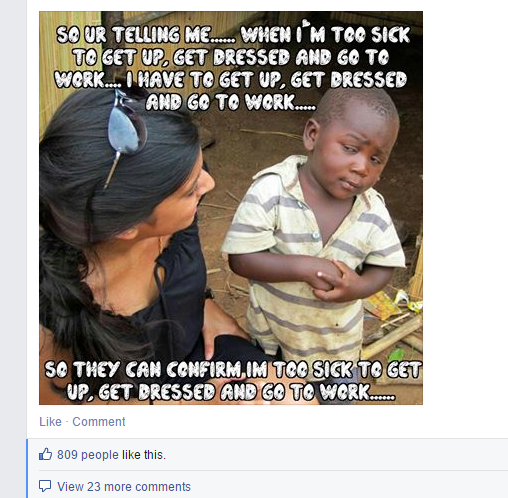
I am
too sick to work...so come in and prove it. And then you will get a sick
certificate. That is the new rule for cabin crew at my wife's employer.
An organisation that does not trust its staff to behave like adults is on a
slippery downward path...the trouble is that there have always been a few
crew at Emirates who will call sick because they want an extra day off or
dot feel like a 3am turn to Hyderabad. They know that there are reserve crew
who can fly in their place so they abuse the system. And then everyone
suffers.
A
note on PPRUNE said that "Over 400 cc called in sick today. Cc were called
out on days off to cover. Pandamonium!" (sic)
A
Swiss forex shocker
15
January 2015
The
Swiss National Bank lobbed a bombshell into the global currency markets as
it gave up defending the Swiss franc against investors desperate for a safe
haven against the eurozone debt crisis.
It ditched its three-year-old cap of Swfr1.20 against the euro, imposed to
stave off the invasion of cash-seeking protection from turbulent markets.
Within seconds, the "Swissie" soared nearly 30 per cent against the single
currency with one investor describing the move as "like detonating a stick
of dynamite in a dam".
The pound also plunged, along with all other major currencies.
Steve Woodcock, head of trading at TradeNext, said: "It’s the biggest move
I’ve seen in a 30-year career as a trader."
Some analysts speculated that the sudden U-turn in Switzerland’s previous
policy meant the SNB had got wind of an even bigger blast of quantitative
easing money printing from the European Central Bank than was expected next
week.
Only on Monday, the SNB’s vice chairman, Jean-Pierre Danthine, said the cap
would remain the cornerstone of Swiss monetary policy.
But the growing crisis in the eurozone meant the flood of cash kept on
coming, making it evermore difficult to sustain the cap.
Last month, the SNB was forced to take further measures to defend itself by
imposing negative interest rates, effectively meaning investors had to pay
to lodge cash in the country.
In an effort to soften the impact of removing the currency cap today, the
SNB slashed interest rates even further, by half a percentage point to minus
0.75 per cent.
The SNB said that linking the Swiss franc to the euro meant the currency had
fallen dangerously far against the dollar.
"In these circumstances the SNB concluded that enforcing and maintaining the
minimum exchange rate for the Swiss franc against the euro is no longer
justified," it explained.
Simon Smith, chief economist at currency dealer FxPro, said: "The Swiss
central bank has decided this is a battle it can’t win given the ECB is
likely to do QE next week or at least in March."
He added that “pressure had been building” on the currency cap due to the
swissie’s traditional status as a safe haven.
"But at this point in time, the SNB has broken a dam wall and the waters
have flooded out."
Foreign exchange expert Gain Capital’s research director, Kathleen Brooks,
added: "If the SNB is so spooked it is disbanding with a policy that it has
held dear since 2011, then the rest of the market may want to reconsider
their expectations for next week’s ECB meeting."
The
Euro is now under serious pressure.
How
bad was it - well this is the 16 January announcement from
UK forex broker Alpari:
"The recent move on the Swiss franc caused by the Swiss National Bank’s
unexpected policy reversal of capping the Swiss franc against the euro has
resulted in exceptional volatility and extreme lack of liquidity. This has
resulted in the majority of clients sustaining losses which has exceeded
their account equity. Where a client cannot cover this loss, it is passed on
to us. This has forced Alpari (UK) Limited to confirm today, 16/01/15, that
it has entered into insolvency. Retail client funds continue to be
segregated in accordance with FCA rules. - See more at: http://www.alpari.co.uk/client-updates/notifications/posts/2015/january/important-announcement#sthash.u9m1x4Iv.dpuf"
Presence at Paris rally of leaders with poor free press records is condemned
12
January 2015
Reporters Without Borders singles out the leaders of Egypt, Russia, Turkey,
Algeria and the United Arab Emirates - The Guardian
Press
freedom campaigners condemned the presence of world leaders attending the
unity rally in Paris on Sunday who have poor records on human rights and the
free press in their home countries.
Reporters Without Borders singled out leaders from Egypt, Turkey, Russia,
Algeria and the United Arab Emirates (UAE), as being responsible for
particularly harsh environments for journalists. These countries rank
respectively 159th, 154th, 148th, 121st and 118th out of 180 countries in
terms of press freedom in a league table compiled by the group.
“We should show solidarity with Charlie Hebdo without forgetting the world’s
other ‘Charlies’,” said Christophe Deloire, secretary general of the
campaign group. “It would be intolerable [if] representatives from countries
that reduce their journalists to silence profit from this emotional
outpouring to … improve their international image … We should not allow the
predators of the press to spit on the graves of Charlie Hebdo.”
About 40 world leaders gathered in Paris to take part in the massive rally.
France’s president, François Hollande, the British prime minister, David
Cameron and the German chancellor, Angela Merkel, walked arm in arm with
other leaders at the start of the march.
Also invited were the Turkish prime minister, Ahmet Davutoğlu, Sheikh
Abdallah ben Zayed al-Nahyan of the UAE and the foreign ministers of Egypt,
Russia and Algeria: Sameh Choukry, Sergei Lavrov, and Ramtane Lamamra.
Nearly 70 journalists are being prosecuted in Turkey for referring to
corruption allegations against close associates of the former prime
minister, Recep Tayyip Erdoğan, who is now the president.
In Egypt 16 journalists, including three from al-Jazeera, are in jail. The
al-Jazeera journalists have been held since December 2013 for “spreading
false news” and “membership of a terrorist organisation”.
The al-Jazeera journalists include Peter Greste, formerly of the BBC, who
has lodged paperwork with the Egyptian government seeking his own
deportation. But his release from prison could be weeks or months away, as
the new presidential power to deport foreign prisoners is tested for the
first time.
A member of Greste’s Australian legal team said the jailed journalist’s
application was “among the first” to petition the Egyptian president, Abdel
Fatah al-Sisi, for deportation.
Several Russian journalists have been imprisoned, often in Siberia, and two
NGOs that support the media have been added to an official list of “foreign
agents”, a term used to stigmatise bodies that receive foreign funding and
are suspected of “political activity”. In December, 20 activists including
Masha Alyokhina from Pussy Riot were arrested in Moscow, after staging an
all-night protest against the conviction of Alexei Navalny, a critic of the
Kremlin, and his brother Oleg.
Algeria bans marches and public protests, prompting the Algérie-Focus
website to say: “Marches and public protests are banned in Algeria, but
Algerian ministers have the right to march in the streets of … Paris!”
*************************
As an addendum the world leaders did not so much lead the parade as conduct
their own photo-op at some distance from the parade - pseudo-solidarity said
one smart commentator. See more details in this
Independent article.
Beaucoup de chefs de gouvernement mondiaux ne sont pas Charlie
9
January 2015
It is the first time since the Libération of Paris in 1944 that so many
people have taken to the streets of Paris, and the first time so many world
leaders have congregated in one place in what is essentially a show of
solidarity and condolence with France. The massed crowds were wonderful. The
leaders less so.
On a political and diplomatic level, is was certainly unusual: there were
around 60 presidents, prime ministers, world leaders, statesmen and women
travelling by bus from the Elysée palace to the 11th arrondissement of
Paris.
To put this into perspective, last year, to mark the 70th anniversary of the
D-Day landings, a total of 19 world leaders went to Normandy.
On a human level, it was a massive outpouring of national grief, solidarity
and defiance. People turned out en masse not only to show their respect for
the 17 victims of the three terrorist attacks last week, but their support
for the values of the Republique “liberté, égalité, fraternité”, freedom of
speech and freedom of the press.
A huge area of Paris was in lock down with possibly a million people
gathered in Place de la Republique and Place de la Nation and along the 3 km
march route.
There were marches and vigils in most French cities and also across Europe.
Yet
these 60 world leaders hijacked today's unity march. There message of unity
reeked of hypocricy.
There
was one nation notably absent - the USA: President Obama, Vice President Joe
Biden and Sec. of State John Kerry. Actually that is no bad thing. The USA
tends to take over these events; their security requirements are simply
massive - too much for this rally at such short notice and actually, not
everything resolves around the USA.
But
just why were so many leaders where there other than for their own political
capital - this was an event for the people, Not an event for certain leaders
to be seen to be attending. And the very idea that some of these leaders
have any belief in or acceptance of press and personal freedoms as defined
in three wonderful words by the French is basically risible.
So
who was there:
EUROPE
French president François Hollande
German chancellor Angela Merkel
British prime minister David Cameron
Italian prime minister Matteo Renzi
Spanish prime minister Mariano Rajoy
Romanian president Klaus Iohannis
European commission president Jean-Claude Juncker
European parliament president Martin Schulz
EU president Donald Tusk
Nato secretary general Jens Stoltenberg
Polish prime minister Ewa Kopacz
Danish prime minister Helle Thorning-Schmidt
Belgian prime minister Charles Michel
Dutch prime minister Mark Rutte
Greek prime minister Antonis Samaras
Irish prime minister Enda Kenny
Portuguese prime minister Pedro Passos Coelho
Czech prime minister Bohuslav Sobotka
Slovakian prime minister Robert Fico
Latvian prime minister Laimdota Straujuma
Bulgarian prime minister Boyko Borisov
Hungarian prime minister Viktor Orbán
Croatian prime minister Zoran Milanović
Luxembourg prime minister Xavier Bettel
Maltese prime minister Joseph Muscat
Slovenian prime minister Miro Cerar
Swedish prime minister Stefan Löfven
Finnish prime minister Alexander Stubb
Ukrainian president Petro Poroshenko
Swiss president Simonetta Sommaruga
Kosovo president Atifete Jahjaga
Albanian prime minister Edi Rama
Turkish prime minister Ahmet Davutoğlu
Norwegian prime minister Erna Solberg
Georgian prime minister Irakli Garibashvili
Russian foreign minister Sergei Lavrov
Austrian foreign minister Sebastian Kurz
NORTH AMERICA
USA's Ambassador to France
Canadian public safety minister Steven Blaney
MIDDLE EAST
Israeli prime minister Binyamin Netanyahu and foreign minister Avigdor
Lieberman
Jordanian King Abdullah II and Queen Rania
Palestinian Authority president Mahmoud Abbas
United Arab Emirates foreign minister Sheikh Abdullah bin Zayed al-Nahyan
Qatari Sheikh Mohammed Ben Hamad Bin Khalifa Al Thani
Bahrain foreign minister Sheikh Khaled bin Ahmed Al Khalifa and prince
Abdullah Bin Hamad al-Khalifa
AFRICA
Malian president Ibrahim Boubacar Keïta
Gabonese president Ali Bongo
Niger president Mahamadou Issoufou
Benin president Thomas Boni Yayi
Tunisian prime minister Mehdi Jomaa
Algerian foreign minister Ramtane Lamamra
You
cannot count the number but it was estimated that one million Parisiens took
to the streets to claim their right to liberty, fraternity and equality.
But
let's talk about press freedoms in some of the countries whose leaders
attended the Paris rally today...
The
notes are from the
US
State Department's Country Reports on Human Rights Practices for 2013
Apparently the Saudi Arabian ambassador to France was in attendance
representing a state that is giving blogger Raif Badawi 1000 lashes?
Marching right next to Francois Hollande: Ali Bongo of Gabon, who recently
"suspended" 3 newspapers. 1 for satire.
In
the United Arab Emirates "the law prohibits criticism of rulers and speech
that may create or encourage social unrest..."
In Turkey "the penal code and antiterror law contain multiple articles that
restrict freedom of the press."
In
Tunisia "speech considered offensive to local sensibilities continued to be
treated as criminal."
In
Russia In 2013 "the government instituted several laws that restrict freedom
of speech."
In
Niger in February 2013 "police beat journalists covering protests by a
teachers’ trade union...Authorities took no...action."
In Mali "the constitution provides for freedom of speech and press,
but the government restricted press freedom."
In
Jordan "the law permits punishment of up to three years’ imprisonment for
insulting the king, slandering the gov..."
In Israel "news printed or broadcast abroad is subject to security
censorship."
In
Georgia in 2013 "there were credible reports that the government at times
did not adequately protect freedom of speech."
In
Gabon the "government suspended several newspapers & TV stations during the
year for disrupting public order or libel."
In
the Ukraine the "government did not uniformly respect the rights of freedom
of speech & press provided by the constitution and law."
In
Croatia "the law provides for no less than six months’ and no more than five
years’ imprisonment for hate speech."
In
Bulgaria "the penal code provides for one to four years’ imprisonment for
incitement to 'hate speech.'
In
Benin "the government occasionally inhibited freedom of the press."
In
Algeria "Individuals were not able to criticize the government publicly."
And
even in France there are restrictions on "offending the dignity of the
republic”... include "insulting" anyone who serves the public. In addition
it is an offense to insult the national flag or anthem, with a penalty of a
maximum 9,000 euro or up to 6 months' imprisonment.
Beaucoup de chefs de gouvernement mondiaux ne sont pas Charlie
Charlie Hebdo: Don’t blame this bloodshed on France’s Muslims
8 January 2015
Nabila Ramdani in The Guardian
Those of us trying to make sense of the Charlie Hebdo massacre need to
understand the bloody history of my home city, Paris. That four hugely
popular cartoonists were considered legitimate targets by murderers said to
have been living within a few miles of the Louvre and other global symbols
of liberal Gallic civilisation doesn’t seem possible: donnish satirists are
not meant to be gunned down in quaint Paris arrondissements any more than
municipal policemen used to dealing with traffic and tourists.
Sadly, the French capital has been associated with some of the worst
barbarism in human history.
The Terror started by the 1789 Revolution led to tens of thousands of
deaths, with many of its victims guillotined in front of vengeful crowds.
Savage mass murders continued on squares and boulevards throughout the 19th
and 20th centuries, through the Commune and two world wars, the second of
which saw tens of thousands of Jews persecuted before being sent to their
deaths in concentration camps. Postwar, many of the Gestapo-trained
gendarmes involved in the those atrocities showed a fresh brutality to
Algerians displaced by their own nation’s fight for independence from
France.
The three French-Algerian men believed responsible for the 12 deaths in
Paris on Wednesday would have been steeped in a recent history of this
conflict which, in the 1960s, was exported from the battlefields of Algeria
to Paris itself. During one notorious atrocity in 1961, up to 200 Algerians
were slaughtered around national monuments, including the Eiffel Tower and
Notre Dame cathedral. Many were tossed into the Seine from some of the most
beautiful bridges in the world and left to drown.
Half a century on, the violence has subsided but there is still a strong
sense of resentment among alienated communities living in housing estates on
the outskirts of the capital. Many are Muslims of north African origin who
complain that discrimination against them extends to every field of life,
from housing and employment to the right to religious expression. This is
particularly so as politicians of the left and right regularly blame Islam
for these social problems, which in fact have nothing to do with spiritual
faith.
Anti-religious hate speech has thus become all too prevalent in modern
France, as it is manipulated for political purposes. Jean-Marie Le Pen, the
founder of the National Front, is a convicted racist and antisemite, and his
daughter, Marine Le Pen, the party’s current leader, regularly stigmatises
Muslims and other minority groups.
Immigration policy underpins all of this discourse. Manuel Valls, the
reactionary Socialist prime minister, infamously portrayed Roma gypsies as a
group who cannot integrate and who should be deported back to Romania and
Bulgaria, despite being EU citizens. This was followed by a number of
violent attacks on Roma, while a right-wing mayor blocked the burial of a
Roma baby in a municipal cemetery last week.
There is no doubt that Charlie Hebdo’s notorious cartoons satirising the
prophet Muhammad saddened and angered Muslims in equal measure. When the
magazine published a cover with a bearded and turbaned cartoon figure of the
prophet saying “100 lashes if you’re not dying of laughter” in 2011, their
offices were firebombed.
Other images and articles were also vindictive, including some about the
other major monotheistic religions, Christianity and Judaism, but it was
Islam that the Hebdo team always really had in its sights. Its murdered
editor, Stéphane Charbonnier, regularly expressed his disdain for this
religion. Such prejudice was in fact condemned by the White House in
September 2012, when a spokesman for President Obama questioned the judgment
of Charlie Hebdo for publishing “images that will be deeply offensive to
many and have the potential to be inflammatory”. Richard Prasquier, head of
France’s Jewish council, also said he disapproved of the caricatures because
they constituted a “form of irresponsible panache”.
The climate of intolerance across France may well have been something
Charlie Hebdo was reflecting, rather than creating, but strict laws banning
hate literature would certainly have made many of its past issues
unpublishable in countries including the UK. Comparisons between Private
Eye, the British satirical weekly, and Charlie Hebdo have been made
recently, but actually they are wrong: the self-styled “nasty” French
magazine produces a far darker form of satire.
The sacred point, however, is that none of this in any way justifies
violence, let alone the horrific slaughter this week. The vast majority of
French Algerians and, indeed, Muslims across the world, were shocked and
appalled by the murders, with a spokesman for the French Council of the
Muslim Faith speaking of a “barbaric act against humanity, democracy and
freedom of the press”.
Hassen Chalghoumi, imam of the mosque in Drancy – scene of those Holocaust
deportations during the Nazi occupation – spoke up for many when he said of
the killers: “They have sold their souls to hell. This is not freedom. This
is not Islam and I hope the French will come out united at the end of this.”
Two of the dead – Ahmed Merabet, a police officer, and Mustapha Ourad, who
was working in the Charlie Hebdo office – were themselves Muslim. Many
fellow Muslims were among the crowds that poured on to the streets on
Wednesday night in a show of solidarity for the Charlie Hebdo victims,
rallying behind President Hollande’s call for national unity.
Despite all this, the seemingly inevitable backlash has begun, with mosques
being targeted. Blank grenades were thrown at one in Le Mans on Wednesday
night, with bullet holes also found in its windows. Shots were fired at a
Muslim prayer hall near Narbonne, in the south of France, while an explosion
close to a mosque in Villefranche-sur-Saône was described by a local
prosecutor as a “criminal act”.
As the history of Paris shows, extreme violence often inspires further
violence. The bloody cycle continues, just as it has always done. But
attributing its causes to millions of law-abiding French Muslims is as
cynical as trying to blame it on a small group of artists and writers.
French Humor, Turned Into Tragedy
The Attack on Charlie Hebdo and the Tradition of Parisian Wit
8 January 2015 from the
New York Times
In
September 2012, the satirical newspaper Charlie Hebdo, defying the advice of
the French government, published several lewd caricatures of the Prophet
Muhammad.
I was in Tunis that week. There were tanks and soldiers outside the mosques,
and graffiti in English, French and Spanish calling for revolution,
declaring war on the West and all those who hated Islam. A few days earlier
the United States Embassy in Tunis had been attacked, and the American
School burned down. And shortly before that, the American ambassador to
Libya had been murdered by a jihadist militia.
I spent a tense half-hour on the Avenue Habib Bourguiba, trying in vain, as
a lone and very visible European, to hail a taxi before the curfew took
effect. I cursed Charlie Hebdo for its willful and unnecessary provocations
over the years: In 2006, the newspaper reprinted cartoons mocking Muhammad
that had first appeared in a Danish newspaper, and in 2011, its offices were
firebombed after it published a spoof issue, “Charia Hebdo,” a play on the
word for Shariah law.
But, like everyone else in Paris, where I live, I was shocked to the core
when I heard about the killings of 12 people at the offices of Charlie Hebdo,
a 20-minute walk from my own office, on Wednesday morning.
I first became aware that something was wrong when I noticed heavily armed
police officers and soldiers at every corner and cars being towed by
military vehicles. I stopped for coffee on the Rue de Grenelle and everybody
was talking at once and staring at the TV as it showed footage of the
massacre, in which two police officers were killed, as well as the
magazine’s editorial director, Stéphane Charbonnier, and several
cartoonists.
“This is just another stage,” the guy next to me said.
“Another stage in what?” I said.
“The war against the Arabs,” he replied.
It has to be said that Charlie Hebdo is an unlikely victim of such
unjustified violence. For most Parisians these days, the magazine is a
quaint relic of the ’60s and ’70s that has long since lost its power to
shock. Only the day before the killings, I had noticed on a newsstand a
recent front cover of the magazine that showed a goofy-looking Virgin Mary
giving birth to an even goofier-looking Christ. I shrugged and walked on,
reflecting on how few people read the magazine these days, how it had only
just begun to overcome its money troubles, and what a museum piece it had
become.
To some extent, this was reflected in the ages of two prominent figures who
were killed: the brilliant and much-loved cartoonists Jean Cabut (or Cabu)
and Georges Wolinski were, respectively, 76 and 80. Most important, they
belonged to the generation of May 1968 — the generation that had revolted
against the heavy hand of Charles de Gaulle’s paternalism with a belief in
unlimited liberty, unrestrained sexual behavior, drug taking and, above all,
the freedom to mock all forms of moral and religious authority.
Charlie Hebdo’s relentless pursuit of provocation — or “la provoc” in slangy
French — belongs to a very Parisian tradition. It dates to before the French
Revolution, when it was termed “L’esprit frondeur,” or “slingshot wit.” (A
“fronde” was a catapult used to hurl stones at the king in times of
insurrection.)
What also made Charlie Hebdo, founded in 1970, so French was a militant,
aggressive secularism. This again is an old tradition in French culture —
historically, a way of policing the power of the Catholic Church. May ’68
was also the revolt of the young against the old, and anti-religious satire
a key part of that revolt.
But in contemporary France, the young rebels of ’68 have long since become
the cultural establishment, even if they still espouse the leftist and
libertarian ideals of their younger days. Charlie Hebdo, for all its vaunted
anarchism, has been a member of the establishment for a very long time.
Or at least this is how the magazine is viewed out in the banlieues — the
enormous and often wretched suburbs that surround all major French cities
and that are home to a huge immigrant population, mainly from former French
colonies in the Middle East, Africa and Asia. What is seen in the center of
Paris as tweaking the nose of authority — religious or political — is seen
out in the banlieues as the arrogance of those in power who can mock what
they like, including deeply held religious beliefs, perhaps the only part of
personal identity that has not been crushed or assimilated into mainstream
French society.
What was gunned down on Wednesday in Paris was a generation that believed
foremost in the freedom to say what you like to whomever you like. Parisians
pride themselves on what they call “gouaille,” a kind of cheeky wit, based
on free thinking and a love of provocation, that always stands in opposition
to authority.
The awful killings are the direct opposite of all that: the merciless
massacre of the Parisian mind.
Andrew Hussey is a professor of cultural history and dean of the
University of London’s Institute in Paris. He is the author, most recently,
of “The French Intifada: The Long War Between France and Its Arabs.”
Trying to make sense of the Paris murders
8
July 2015
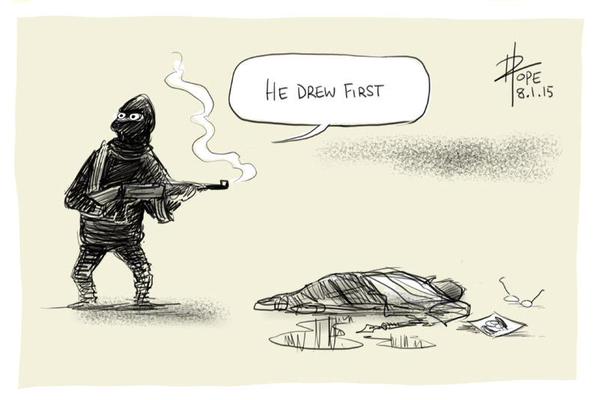
Dave Pope's pointed cartoon sent with the following twitter
message: "Can't sleep tonight, thoughts with my French cartooning
colleagues, their families and loved ones
#CharlieHebdo"
Charlie Hebdo, a French satirical magazine, was attacked by gunmen
yesterday, with 12 people killed. Editor Stephane “Charb” Charbonnier and
prominent cartoonists Jean “Cabu” Cabut, Georges Wolinski and Bernard
“Tignous” Verlhac were among those confirmed dead.
These
were well known cartoonists; household names in France; celebrated for their
art in a country that embraces anarchy and that celebrates their liberty,
democracy and equality with a very active, diverse and politically engaged
media.
Mustapha Ourrad, a Charlie Hebdo copy editor of Algerian descent who was
among the victims. He is a Muslim.
Attending a weekly editorial meeting they were shot at point blank range by
two heavily-armed, trained attackers working to a clear plan. The killers
carried out their lethal mission with military precision. They sought out
the cartoonists by name before executing them and turning their guns on the
others.
Then
as the attackers left they shot and wounded a policeman who raising his
hands and pleading not to be shot they then executed with a close range
shot. All captured on security cameras.
It
was a sophisticated attack by well trained killers suggesting that they had
powerful backers. The killers are still at large.
Charlie Hebdo was first established in 1970 following the state censorship
of its staunchly anti-establishment predecessor Hara-Kiri magazine, which
was banned after appearing to mock the death of former president Charles de
Gaulle.
The left-wing magazine publishes weekly and came to international prominence
in 2011 after its offices were fire-bombed and it had its website hacked.
It
frequently pokes fun at the extreme right-wing and at all religions. Its
depiction of the prophet Mohamed was the reason behind the 2011 attack.
The following year, its publication of another series of lewd cartoons
depicting Mohamed prompted the French government to close embassies and
schools in 20 countries.
Following that controversy, late editor Charbonnier told the news channel
iTELE: “We do caricatures of everyone, and above all every week, and when we
do it with the Prophet, it’s called provocation.”
All
satire is intended to be provocative. Charlie Hebdo's cartoons regularly
targeted Islam. Depicting the prophet Muhammed is But that is no excuse for
yesterday's murders. But it does explain why Charlie Hedbo was targeted.
For
all the tub-thumping the reality us that this was death delivered by an
ideology that has sought to achieve power through terror for decades.
It
would be easy to suggest that the murders are the result of France’s failure
to assimilate two generations of Muslim immigrants from its former colonies.
Or they are due to French military action against the Islamic State in the
Middle East, or the American invasion of Iraq before that. T
And
nor can they be understood and accepted as a reaction to disrespect of Islam
by irresponsible cartoonists.
The
same extremism, the same shock tactics, the same rule by fear murdered three
thousand people in the U.S. on September 11, 2001, has brought mass rape and
slaughter to the cities and deserts of Syria and Iraq; has massacred a
hundred and thirty-two children and thirteen adults in a school in Peshawar
last month and regularly kills so many Nigerians, especially young ones,
that hardly anyone pays attention.
There has been a significant surge in Islamist killing around the world.
These deaths no not avenge perceived insults to Islam. And we should not
alienate the millions of Muslims who dislike what’s being done in the name
of their religion. Many of them immediately condemned the attack on Charlie
Hebdo, in tones of anguish particular to those whose deepest beliefs have
been tainted.
The
killers yesterday waged war against freedom of thought and speech, against
tolerance and pluralism. A war against the values that are part of a
democratic society.
Jihadists kill because that is what they do. It does not matter if you are a
French cartoonist or a Yezidi child, or an aid worker or journalist.
Provocation is merely an excuse used by bullies to justify their actions,
while seeking to force the world to bow to their will.
In October last year, imprisoned Syrian journalist Mazen Darwish managed to
smuggle a note from his Damascus cell to the free speech charity English
PEN. Darwish had been singled out for an award by PEN and Salman Rushdie,
and he took the opportunity to address Rushdie directly, writing:
“[W]e committed an unforgivable sin in the Arab world when we responded with
indifference to the fatwas and calls for your death. So indifferent were we
that we colluded – even if just by our silent complicity – in excluding and
eliminating difference, while acting as if the whole thing had nothing to do
with us. And so here we are today, paying the high, bloodsoaked price of
that collusion, and finding ourselves the main victims of the obscurantist
ideology now infiltrating our homes and our cities.
What a great shame that it has taken us all of this bloodshed to arrive at
the belief that we are the ones who will pay the price for preventing those
with whom we disagree from expressing their views – and that we will pay
with our lives and our futures. What a shame this much blood has had to be
spilled for us to realise, finally, that we are digging our own graves when
we allow thought to be crushed by accusations of unbelief, calling people
infidels, and when we allow opinion to be countered with violence.”
With
all of that said; deliberate provocation seeks out a reaction. And that is
the risk. That in justifying our own freedoms we may simply be contributing
to greater polarisation and alienation.
At
what point does free press become hate press? At what point does humour turn
into vitriol?
All I
know is that we live in a more dangerous world. We live in a world where
extremists have created a security paranoia and have allowed governments to
remove so many of the freedoms that have been fought for for centuries. And
the trouble with extremists is that they desire and they create more
extremists and breed instability and fear.
We
are not afraid was a strong and welcome message overnight in Paris. So for
today show solidarity with the victims of this terror by demanding justice.
That is defiance. I am not convinced that the reactionary re-publication of
Charlie Hebdo's cartoons is either defiant or useful.
Mehdi Hasan on Islam and blasphemy: Muhammad survived Dante’s Inferno. He’ll
survive a YouTube clip
Like freedom, tolerance is not a western invention or
innovation; it is an Islamic virtue.
7 January 2015 -
Originally published in the New Statesman on 27
September 2012 -
Dear Muslim protester,
Where do I begin? Having watched you shout and scream in front of the
world’s television cameras, throw petrol bombs and smash windows, I
reluctantly decided to write this open letter to you.
Let me be blunt: you and I have little in common other than our shared
Islamic faith, our common belief that there is no God but God and Muhammad
is His Messenger. You live in a Muslim-majority country, where religion (or
should that be religious extremism?) defines the boundaries of political
debate and the limits of free speech; I was born and brought up in the
liberal, secular west as a member of a minority Muslim community.
If I’m honest, I have to say that, listening to your belligerent rhetoric
and watching your violent behaviour, I struggle to recognise the Islam in
which you profess to believe. My Islamic faith is based on the principles of
peace, moderation and mercy; it revolves around the Quranic verses “There is
no compulsion in religion” (2:256) and “Unto you your religion, and unto me
my religion” (109:6). Yours is a faith disfigured by anger, hate and
paranoia.
Please do not misunderstand me: yes, you have every right to be angry. I
have no time for those neoconservatives here in the west who airily dismiss
“false grievances” in the Middle East and beyond. Muslims have much to be
aggrieved over – from Bagram to Guantanamo Bay, from Abu Ghraib to Haditha,
from US soldiers urinating on the Quran to the spate of racist films and
cartoons depicting our beloved prophet as a terrorist/murderer/paedophile/rapist/
delete-as-applicable.
Anger, however, is not an excuse for extremism. Have you not read this
saying by the Prophet? “The strong is not the one who overcomes the people
by his strength, but the strong is the one who controls himself while in
anger.”
Today, 14 centuries later, too many of us seem to have lost all
self-control. Your fanatical counterparts on the Christian evangelical right
have a phrase they often deploy: “WWJD”, or “What would Jesus do?”. Perhaps
you and your fellow protesters should ask “WWMD”: what would Muhammad do?
Would the Prophet endorse your violent attacks on foreign embassies and
schools, on police stations and shops?
We both know the answer. As a child, you will have been taught, like me,
about how Muhammad was verbally and physically abused by the pagan
worshippers of Mecca – but never responded in kind. The Quran calls him a
“mercy for all of creation”.
But your anger has blinded you. You tell foreign reporters you are
protesting against injustice – but the fight for justice begins at home.
Where were you and your fellow flag-burners when a poor, 14-year-old
Christian girl in Pakistan was arrested on trumped-up charges of “blasphemy”
in August and threatened with the death penalty? Where are you today when
the Syrian regime continues to wage war against its own (Muslim) people? Why
do you not protest outside the embassies of the Bahraini regime, which
tortures and tear-gasses its (Muslim) citizens?
You say you love the Prophet and cannot bear to see him abused, yet in Saudi
Arabia the house of the Prophet’s first wife, Khadija, was flattened to make
way for a public toilet, while the house where Muhammad was born is now
overshadowed by a royal palace. Where is your rage against the Saudi regime?
Or is your selfprofessed love for the Prophet just a cynical expression of
crude anti-Americanism?
You and I have long complained of the west’s double standards in the Middle
East; it is time for us to recognise that Muslims are guilty of equally
egregious double standards. Egyptian state television has broadcast a series
based on the infamous anti-Semitic forgery The Protocols of the Elders of
Zion. Pakistani television channels regularly air programmes demonizing the
country’s Ahmadiyya community. Islamic scholars appear in online videos
ridiculing the core beliefs of Judaism and Christianity. Yet you and your
allies demand special protection for your religion and your prophet. Why? Is
your faith so weak, so brittle? Muhammad, lest we forget, survived Dante’s
Inferno. Trust me, he’ll survive a 14-minute clip on YouTube.
Perhaps the greatest irony, and tragedy, is that by publicising the online
insults directed at the Prophet, you have given the wretched “Sam Bacile”,
the maker of the offensive movie, and his Islamophobic, evangelical
Christian ally, Steve Klein, a victory they could never have achieved on
their own. Need I remind you that when the full-length film, Innocence of
Muslims, was released earlier this year, it was shown only once, to an
audience of fewer than ten people, at a run-down cinema in California?
Meanwhile, the reputational damage done to our faith – exacerbated, I hasten
to add, by lazy journalists in the west who cannot seem to distinguish
between Islam and its adherents – has been immense. Have you not seen the
cover of Newsweek magazine? “Muslim rage”, screams the headline.
But I have some (bad) news for you (and, for that matter, Newsweek). You
represent no one but yourself. You do not speak for Islam or for the
Prophet. Nor are you representative of the world’s 1.6 billion Muslims. In a
recent Gallup survey conducted in ten Muslim-majority countries,
representing more than 80 per cent of the global Muslim population,
believers, when asked what they admired most about the west, cited political
freedoms, fair trials and . . . wait for it . . . freedom of speech.
Your actions undermine not just the great religion of Islam but a worldwide
Muslim community, or umma, whose members want to live in peace and freedom
despite the provocations from the bigots, phobes and haters.
Like freedom, tolerance is not a western invention or innovation; it is an
Islamic virtue. As the great Muslim caliph Ali ibn Abu Talib once wrote:
“Remember that people are of two kinds: they are either your brothers in
religion or your brothers in mankind.”
Yours faithfully, Mehdi.
Mehdi Hasan is an NS contributing writer and the political director of
Huffington Post UK.
Understanding the Brits
2
January 2015
Tai
might find this helpful :)

Goodbye 2014 - you will not be missed
31
December 2014
So
another year comes to an end and more than any other in recent times I will
be glad to see the back of this one.
Of
course that does not mean that 2015 will be any better - or that some things
simply go away because it is the end of the year - but there will always be
the sense that 1 January marks the start of a new year and the hope of
change.
2014
will be remembered for the loss of Tai's father in the sort of accident that
is just the waste of a life and for her sister's stroke. That her sister has
made a partial recovery contrary to the surgeon's expectations is one of the
reasons for hope.
Both
events highlighted the importance of family and community in Thailand. It is
such a tragedy that a country with so much potential is being held back in
the dark ages by powerful vested interests and a compliant army. Andrew
MacGregor Marshall's late 2014 book "A Kingdom in Crisis" should be required
reading for anyone who loves Thailand but who believes in the future rather
than a servile past and present. The May coup was just another setback on
the road to building a proud future and an educated democratic nation.
Meanwhile an industry that I love had one of its worst years in recent
history. The disappearance of MH370 remains one of the great aviation
mysteries. I still believe that the wreckage will be found and her secrets
revealed but the uncertainty and the wait for the families must be
heart-breaking.
No
one has yet been found responsible for shooting down MH17. Though most
rational people are certain that it was Russian supported Ukraine
separatists. Political pragmatism must ot be allowed to hide the truth and
bring those responsible to justice.
And
just three days ago Air Asia had its first fatal accident with the loss of
flight 8501 from Surabaya to Singapore. Air Asia will survive. Its CEO has
been strong. But the airline's innocence has gone.
The
world seemed a less certain place in 2014. The rise of ISIS in the middle
east should concern anyone who values peace in the region. Calm appears to
have come to the Ukraine but there remains uncertainty over Russian
intentions which have been somewhat short circuited by the dramatic fall in
oil prices. Disputes over island ownership and passage through the South
China Sea could be the next hot spot. Calm heads should prevail. But the
rise of sabre-rattling patriotism could cause escalation. Maybe there is the
issue - the rise of extremism is all its different hues. The rest of us -
the big silent majority - may just get caught up in the crossfire.
The
Gaza conflict in July shocked the world. Israel launched a devastating
operation on Gaza after three teenagers were kidnapped by Palestinians. In
seven weeks of bombardment, 2,200 people were killed - the vast majority of
them Palestinians. There appears to be no acceptable (to all parties)
resolution. And war and murder are hiddne behind ever more effective
propaganda machines.
Myanmar's refugee problem and the oppression of the Rohinya people
continues. The greatest disappointment - the silence of Aung San Suu Chi.
After years of persecution she should be standing up for the oppressed not
playing for political expediency.
Oscar
Pistorius got away with it - which shows what can be done when you can
afford the best legal representation. The trial should never have been
televised. It simply led to media excess.
Ebola
is a reminder that nature can still terrify us and that there are some
remarkably brave doctors, nurses and relief agency staff working with little
fuss and only with the well-being of their patients in mind.
In a
troubled world the US looks impotent; Russia looks weakened; the rise of
China is inexorable. How China uses that influence and its economic
domination will be a great test for all.
It
was a good year for travel - even if it was not always for the happiest of
reasons: on the map this year were London, Newcastle, Vienna, Thailand
(Bangkok, Phuket, Hua Hin and Chiang Mai), Tokyo, Rome, Vientiane,
Switzerland, Devon, Ireland, Stockholm, Norway, Seattle, Portland, Sicily,
Hong Kong, Athens, Sydney. Norway and Ireland were highlights; Norway for
its scenery and just simple decent friendliness; Ireland for the landing
place of Alcock and Brown and for that connection to one of the great feats
of aviation.
Lunch
in Stockholm was a wonderful way to reconnect. Long lunches and long
conversations should happen more often.
Dubai
meanders along. As it has rebounded from the 2008-2010 financial crisis the
hubris has ratcheted up as well. Dubai was granted the 2020 World Expo. The
truble is most people do not know what this is or indeed where the 2015
event will be held. But they have been told it is important so it is.
There
are still too many vanity construction projects - hello Dubai canal - and
not enough projects that make a difference to the lives of all the UAE's
residents. The trouble is when Dubi booms there are people taking advantage
- and when it crashes there have been too many people taking advantage.
Meanwhile human rights and concerns over legal transparency remain a concern
here as they do throughout much of the region.
So
that's about it - a troubled year ends. And a new year begins. I wonder
where I will be writing this from in 12 months time.
Take
care, gentle reader. Thank you. Have a safe and happy new year and an
optimistic 2015.
In
praise of.....London
31
December 2014
It is
time to give London its due - it is one of the world's great cities - maybe
it eve tops the list.
I
left London in 1988. Thatcher was Prime Minister. Eddie the Eagle was the
best the British could offer at the Calgary WInter Olympics. London felt
old, tired.
The
new London is far from perfect - that is part of its appeal. But it is a
vibrant, international city, that has benefited hugely from an influx of
nationalities who have arrived to study, work or just to explore.
That
to me is the biggest and most welcome difference. The new London is an
international city. The old 1980s London was a British city.
House
prices are prohibitive. The best properties are now foreign owned. Commutes
have become longer and more expensive. The infrastructure creaks....but that
at least gives the British something to complain about.
Over
Christmas engineering work on the railways predictably did not finish in
time. Finsbury Park - a remote NE London commuter station replaced Kings
Cross as London's main terminal for two days. Perhaps the daftest piece of
contingency planning since Canute tried t stop the incoming tide. Misery for
those caught up in the mess. Mirth for the rest of us.
But
what a fun place to visit. The investment in the city over the last thirty
years has transformed derelict suburbs into new destinations; Canary Wharf;
the city around Liverpool Street; Paddington Basin; the transformation of
the South Bank, including Borough and Southwark.
On a
sunny, cold December Sunday evening crowds on the south bank were enjoying a
European style winter fair. The churros and hot chocolate stand was next to
the duck confit burger stand and the chorizo roll and hot sangria stand.
There was music. There was the buzz of a happy crowd.
The
river is so much busier than it used to be. Tour boats continue through the
winter months. The redevelopment of the South Bank, allows an uninterrupted
walk along the river and takes in the Globe Theatre; the Tate Modern, the
National Theatre - and some fine restaurants, bars, and markets. London is a
city where you should explore as much as you can on foot. There is always
something to see.
Over
in Covent Garden, whose transformation in the 1980s arguably started the
rebuilding of London as a destination, performers entertained a big crowd.
The market was busy. The festive decorations were classy. The subway station
as over-crowded as it always is.
Chinatown and Soho were busy. This is a very different Soho from 30 years
ago. Restaurants of just about every nationality line the streets. Few of
the staff are British - maybe that is why they are welcoming and
enthusiastic. There is a warm energy. Explore and you will be rewarded.
The
media remains vibrant - both traditional and new media. Fleet Street's media
giants have long gone, to be replaced by solicitors and accountants and even
a Premier Inn in one of the old Reuters buildings. But reading newspapers
like the Independent and Guardian is a good reminder of what quality,
questioning, informative and sometimes humourous journalism can do....and is
such a refreshing change after too many years of the SCMP, Bangkok Post and
Gulf News.
Maybe
that is part of the charm - London does not take itself too seriously. None
of the pompous overblown self promotion of Dubai. London has it all and does
not need to make a loud noise about it. Take Paddington station where a
statue of the great engineer, Isambard Kingdom Brunel sits next to a tribute
to Paddington Bear. London has this ability to make people smile.
I am
sure living in London has many frustrations. The cost of living is among the
highest in the world. But for a visitor it is hard to beat.