|
Welcome to rascott.com
This is a
personal site that reflects my interests in news,
current affairs, aviation and travel.
email me:
robert@rascott.com
Home
Up
Now In Dubai:
Scott
Consulting
Photo Albums
My photographs have been moved off this site and are now stored on Picasa. They
were simply taking up too much space on my web host.
Please use
this link to see my list of photo albums.
Some
Useful links:
Information:
World Time
Clock
Exchange Rates
Journalism:
ForeignPolicy
Nationsonline.org
Project Syndicate
Amnesty International
Reporters w/o borders
The Guardian
BBC World News
CNN Asia
Bangkok Post
Daylife.com - news
Gulf News
Arabian Business
World News
WSJ - Asia
SCMP
Good causes:
Sister
Joan - Bangkok
Regional Info:
BKK Magazine
HK Magazine
In
Singapore Magazine
TimeOut Dubai
Back in the UK:
Newton Ferrers
And for fun:
Lin Ping live panda tv
EarthCam
History
BBC Archive
National Media
Museum
The British Library
Imperial War Museum
There are many other links on my
AOB blog page.
| |
|
2020 Expo - the candidates
27 November
2013
The winner of the
bidding to host the 2020 World Expo will be announced today.
This is the
timetable for today's events at the BIE General Assembly in Paris (based
upon UAE time - GMT +4)
1.30pm: Final 20-minute presentations begin with five-minute breaks for
setting up. First up is Dubai, followed by Sao Paulo, Yekaterinburg, then
Izmir.
3.30pm: Break for lunch
5.30pm: Voting begins with three rounds anticipated. The lowest scoring bid
drops out of each round.
8.30pm: Announcement on which city will host World Expo 2020
The results of each round and final result will be announced by the
president of the BIE general assembly, Ferdinand Nagy.
If Dubai is successful it will be the first world fair in the Middle East.
The same holds true for Izmir.
It would also be the first world fair for Russia if Yekaterinburg is
selected, and the first in South America if Sao Paulo is chosen.
Dubai – whose theme is Connecting Minds, Creating the Future – is competing
against Turkey’s universal health campaign, Brazil’s diversity and harmony
projects, and Russia’s globalisation pitch.
Since its inception in London in 1851, more than a billion people have
visited a world fair. The last one, Expo 2010, was held in Shanghai, China.
The 2015 event will be in Milan.
Here are the competing candidates and their themes:
Dubai, UAE
Theme: Connecting Minds, Creating the Future
Dubai’s project is aiming to find solutions to three global issues –
mobility, sustainability and opportunity.
The Expo Live programme is an important part of the bid. The initiative aims
to find and fund innovative projects, such as clean drinking water and
solar-powered lights, in needy communities worldwide.
The initiative will connect innovators with experts and the projects will be
presented during the expo in pavilions dedicated to innovation.
Expo 2020 would also coincide with the 50th anniversary of the formation of
the UAE.
The bid has a target of 25 million visitors and will build Dubai and the
UAE’s status as a world hub.
The expo site would be converted into the Dubai Trade Centre Jebel Ali. The
main site would be across 438 hectares, next to the new Al Maktoum
International Airport; which will still be a building site in 2020!
The site would be divided into three areas dedicated to each sub theme and
these zones would lead to Al Wasl, the main plaza.
Countries can set up their pavilion in areas that correspond to their
development strategy. Sustainability is at the heart of the project, so the
site will include solar panels to generate electricity in the building
facade and for street lighting, and to recycle waste water. There will be
extensive use of public transport.
Local plants will be part of the landscape design and treated sewage
effluent will be used for district cooling and irrigation. The site will be
largely car-free with bus and Metro connectivity along with a cable car to
transport visitors within the site. After the fair, the expo site will be
reused for research centres and a university.
Sao Paulo, Brazil
Theme: Power of Diversity, Harmony for Growth
Brazil is already hosting the World Cup next year and the Summer Olympics in
Rio de Janeiro in 2016 .
The city’s economic and cultural strength prompted the idea for its theme,
which aims to show how diversity can be used to foster development. It will
focus on diversity of thought, culture, skill and enable innovation.
The project notes that since diversity could also lead to conflict and
discrimination, the bid will also address these issues by examining public
policies, the importance of cross-cultural dialogue and the idea of
prosperity.
A 500-hectare site chosen for Expo 2020 is in the region of Pirituba, in the
north-east of Sao Paulo.
The area – covered by rainforest, lakes and rivers – aims to welcome 30
million visitors. The open areas are designed as public parks so visitors
can walk from pavilions into nature. Sustainability is part of the project,
which will include waste-limitation initiatives.
The highly populated region of Pirituba is not well connected to the centre
of Sao Paulo and lacks job opportunities. The expo would boost plans to
create a hub for business, tourism and education with research and learning
centres and new housing areas. It would also help projects such as the
creation of a new metro line connecting Pirituba to the city centre and the
building of Sao Paulo’s biggest conference centre.
Yekaterinburg, Russia
Theme: The Global Mind
Yekaterinburg is aiming to connect ideas and projects from across the world
to achieve sustainable globalisation. The city is attempting to answer a
worldwide question – what can we do to make sure globalisation benefits
everyone?
A world fair focused on this subject will allow all countries to showcase
their best practices in varied fields. As part of Yekaterinburg’s bid, a
group of students from the city are travelling around the world to bring
connectivity to remote areas.
The team has introduced children in Mongolia, Indonesia, Panama, Namibia,
Kenya and Sri Lanka to advanced technologies and helped equip their schools
with internet access.
Yekaterinburg’s proposed 500-hectare site, 5km from the city centre, aims to
cater to 12 million visitors.
Part of the site will be dedicated to the expo, while the remaining area
will include housing, commercial centres and leisure space along with parks
and car parks.
A world fair would help improve the city’s transportation, infrastructure
and logistical resources.
Since the economic and tourist focus is on Russia’s western regions and in
cities such as Moscow and Saint Petersburg, the Expo 2020 bid aims to
develop the Ural region and transform it into an international hub for
innovation and technology.
Izmir, Turkey
Theme: New Routes to a Better World/Health for All
At the heart of Turkey’s bid is the belief that health is at the centre of
development and human progress because a healthy population can work, think
and communicate better than a population weakened by illness.
Izmir’s bid conceives health as a basic human right that must be promoted
through international cooperation and public policies.
The city has identified four challenges to be tackled during the expo,
including education and public health, innovation, care and collaboration,
and healthy living.
The bid committee has partnered with a rural health project developed by
Elon University in North Carolina to create a new health training facility
in Jamkhed, one of India’s poorest regions.
The site is planning to focus on universal health since Izmir portrays
itself as the birthplace of western medicine.
Turkey hopes to boost its international role in the health sector by
creating a global health hub in Izmir. The expo aims to welcome 39 million
visitors to a 600-hectare site. After the expo, a large part of this would
be dedicated to health campuses, universities, research centres, hospitals
and rehabilitation facilities.
The site would be around a natural lagoon that is home to birds, including
flamingos. At the centre would be a road to be used as a main boulevard
connecting all areas. The project aims to improve quality of life by
focusing on sustainability and ecology through the production of solar and
geothermal energy to handle requirements on site.
Izmir lost to
Milan in the bidding for the 2015 Expo.
Dubai has some
high profile support including the British and Canadians. My guess is that
Brazil has enough to manage with the 2014 World Cup and 2016 Olympics so
that rules out Sao Paulo. The Russians are ruled out by the mess that is
Sochi 2014. That leaves Izmir and Dubai to battle it out in the final vote.
The Man Who Leads Bangkok’s Mobs
27 November 2013 Written by Pavin Chachavalpongpun
Asia Sentinel
Suthep Thaugsuban, Thailand’s current mob leader, has reinvented himself
from villain to national hero, at least in the eyes of his supporters,
because he has dared to challenge what is characterized as the evil regime
of the Yingluck government, backed by the long-ousted former premier Thaksin
Shinawatra.
The entire planet must know who Thaksin is: Thailand’s most popular prime
minister since the abolition of absolute monarchy in 1932. But for Suthep,
he has earned the title of villain. Suthep was serving as deputy prime
minister in the Abhisit Vejjajiva administration in charge of launching
deadly crackdowns on red-shirt demonstrators in 2010, leading to more than
90 people being killed, most of them protesters, and more than 2,000
injured.
Today Suthep is leading anti-government forces to bring down the elected
Pheu Thai government, just as his party—the Democrats—helped the
yellow-shirted People’s Alliance for Democracy (PAD) remove the Thaksin
government from power in 2006. Starting off with a protest against the
government-initiated amnesty bill which could potentially free Thaksin from
his corruption charges and more importantly and ironically pardon those
behind the May 10, 2010 killings of the Red Shirts at the Rachaprasong area
of Bangkok, Suthep’s determination to topple the Yingluck regime is
unwavering.
But the legitimacy behind Suthep’s street mobs evaporated following the
government’s forced willingness to put the controversial bill back on the
shelf. Suddenly, Suthep lacked valid reasons that could be used against the
government. The reinterpretation of the 1962 International Court of Justice
verdict on the Preah Vihear Temple dispute failed to ignite nationalist
sentiment. Without any credible motivation, Suthep returned to the old
tricks, exploiting the ghosts of Thai politics in defying the government.
One is to continue to condemn the “Thaksin regime” as the sole source of
today’s political crisis. In painting a picture of Thaksin as the enemy of
the state, it provides Suthep with justification for his street protests
which can now be perceived as necessary and moral.
The other is to drag the monarchy into the political mess once again.
Fighting against the Yingluck government and Thaksin together is now equated
with the protection of the royal institution. This kind of political game,
which draws the political fault line at the monarchy, is dangerous. The
massacre at Thammasat University in the 1970s, in which as many as 100
students were murdered and others were beaten and brutalized, demonstrated
how the manipulation of the monarchy ended up in political violence.
Now, let’s analyze why Suthep has been so desperate to topple the
government. Certainly the Democrat Party has been unable to compete with
Thaksin in the game of electoral politics as shown in its failure to win a
majority since 1992. Thus extra-parliamentary tactics are preferred. Also,
Suthep’s desperate action unveils his personal problem. Suthep has
successfully highlighted the issue of amnesty in order to obscure his own
alleged crime behind the deaths of the Red Shirts, downplaying the charges
brought against him while re-injecting what is known as “Thaksinophobia”
among the Thai middle and upper classes in Bangkok. The transformation from
killer into a national hero has begun; and in this process, Suthep has risen
to become the new face of “moral protector” in Thai politics. Again and
again, Thais are witnessing the deep irony within the domain of Thai
politics when immoral politicians themselves enjoy preaching about morality.
With no sign that the government has been weakened by the protests, Suthep
has intensified the pressure and at the same time worked closely with his
Democrat Party. With Democrat leader Abhisit Vejjajiva filing a
no-confidence motion against Yingluck in the parliament, Suthep has upgraded
his protests, in the past few days ordering his anti-Thaksin supporters to
occupy a number of key government offices including the Ministry of Finance,
the Minister of Foreign Affairs and the National Budget Bureau in order to
disrupt the functionality of the government and surely to create the
situation of ungovernability so as to invite intervention by the military
and possibly the Thai court.
Yingluck declared a state of emergency and handed greater authority to the
police to control the situation. She also vowed not to use force against
demonstrators, acknowledging that such use could destroy her party’s
standing, given the condemnation of political violence in 2010 at the hands
of the Democrat government.
Also, use of force would inevitably bring in the military into the
conflict—something that the government will be reluctant to do so.
So far, the military has remained silent regarding the current round of
political provocations. This could be explained in two contexts. First, the
military must fully realize that intervention this time is not tenable. The
2006 coup produced a series of unfavorable effects on the part of the
military and its position in politics. It also gave birth to the Red Shirts
whose key agenda has been to reject a coup.
The fact that a large number of Red Shirts are now gathering inside a
Bangkok stadium seems to send out a strong signal that they are willing to
protect the government from any intervention from the army.
Second and crucially, the military has never worked alone in the maintenance
of its interests in politics. It has worked intimately through the so-called
network monarchy, in creating a particular kind of politics whereby civilian
governments must be kept vulnerable or otherwise they could be toppled. But
since the monarchy has been weakened by its long years of self-politicisation
and the ill health of the King, the military may find that making no move to
be the best option for its survival.
Lastly, it is all about the monarchy too. The Thai crisis has partly echoed
the anxiety of the Bangkok elite as Thais are approaching the sunset of the
Bhumibol reign. This shift of political landscape will cause an impact on
their wealth and social status. The anxiety has served as a driving force
behind the hatred campaign against Thaksin, seen as an adversary of the
monarchy.
Many in Thailand wonder why the King, often intervening in the crises in the
past, has also remained silent. This might be because the monarchy has never
been above politics or neutral, and has actively engaged in conflict.
Whatever the King will say now may not be taken seriously by many in the
Thaksin camp.
Recently, Crown Prince Vajiralongkorn, heir to the throne, conveyed a
message through a Thaksin proxy, Metropolitan Police Commissioner Pol Lt-Gen
Kamronvit Thoopkracharng, about his concern over the escalating political
situation and urged all sides to talk to each other.
Vajiralonglorn’s choice of messenger is interesting—someone so close to
Thaksin thus confirms the rumor of a sort of relationship between the Crown
Prince and the former prime minister. It remains to be seen if his concern
will be responded positively by Suthep’s side whose members also identify
themselves as another kind of royalist—loyal to the King but ambivalent
about his son.
Another important point is that the Crown Prince has become increasingly
vocal in politics. This also signifies that the process of royal transition
within the walls of the palace has already begun. His active role will
answer a question of whether he will be enthroned after the King passes from
the scene. Surely, the faction identified with the more popular Princess
Maha Chakri Sirindhorn would rather not want to hear such an answer.
(Pavin Chachavalpongpun is an associate professor at Kyoto University’s
Centre for Southeast Asian Studies and regular contributor to Asia
Sentinel.)
Bubbling over
26 November
2013 -
The Economist
Thailand's
political battles, slow-burning for years, are raging again. On November
25th tens of thousands of demonstrators linked to the main opposition
Democrat Party marched on key government institutions, including army
headquarters and television stations. They stormed ministries. Pictures of
protesters armed with whistles and brandishing the Thai flag, gathered
around a conference table in the finance ministry, were splashed over the
front pages of the morning papers. By the afternoon of November 26th, they
had moved on to protest outside the ministry of interior (now firmly guarded
against intrusions). That afternoon, the country's criminal court approved a
warrant for the arrest of the protest leader, Suthep Thaugsuban, a former
deputy prime minister, for storming the finance ministry.
It leaves some pondering whether Thailand is in essence ungovernable. The
government of Yingluck Shinawatra, the prime minister, has been watching
silently, but has extended the use of internal securities laws to the entire
capital and a neighbouring province. As night fell, a portable diesel-run
floodlight was brought in to illuminate the protesters’ trophy. Hundreds
entered the building to inspect a government institution from the inside.
Two hundred yards down the road mobile toilets were brought into position,
as though to make the point that if efforts to topple the government failed,
it would not be due to logistical details. Outside the budget bureau of the
finance ministry, protesters chanted “Yingluck, get out, Yingluck, get out”.
The mass protests, the biggest since 2010, are the latest round in an
escalating battle between the Bangko The
Economistk-centred
establishment and the family clan of Thaksin Shinawatra, a billionaire
former prime minister, and his sister Yingluck, the current prime minister.
A no-confidence debate began in parliament on November 26th—an almost
certainly futile bid by the opposition to oust Ms Yingluck’s Pheu Thai
government, which has a thumping majority in parliament. To opposition
Democrats and their royalist supporters, Mr Thaksin is a totally
unacceptable figure. Among the paraphernalia on sale at the Democracy
Monument, where anti-Thaksin supporters have been gathering for weeks, are
red foot mats with pictures of the Shinawatra siblings. Mr Suthep resigned
his seat, along with a bunch of Democrat MPs, to lead a campaign of “civil
disobedience”. The Democrat Party itself, stuffed with politicians prone to
lecture about the rule of law, is unsure to what extent it wants to be
associated with an uprising that appears almost designed to provoke
casualties.
The opposition has dealt two damaging blows to Ms Yingluck’s efforts to
reset the country’s democracy to its state prior to 2006, when a coup
removed Ms Yingluck’s brother from power. A fortnight ago the opposition
effectively killed a controversial amnesty bill that would have paved the
return of Mr Thaksin from self-imposed exile in Dubai. It would also have
granted amnesty to everybody else caught up in the political conflicts since
2004, including politicians and security forces. The bill infuriated Mr
Thaksin’s red-shirted supporters because it would have absolved those who
ordered an army crackdown in 2010 that killed 90 of them.
Then, on November 20th, Thailand’s constitutional court declared unlawful Ms
Yingluck’s plans to make the Senate (the upper house of parliament) a fully
elected body instead of partially appointed, as decreed by the military
following the coup. The ruling was a major victory for the opposition—a
fully elected Senate would have given her party sweeping powers through
control of both houses of parliament. The court's decision to veto the will
of a democratically elected parliament infuriated the government, which sees
the verdict as further evidence that the court is acting on behalf of a
conservative elite that believes it is entitled to rule the country.
The king’s 86th birthday is on December 5th, and both sides of the political
divide claim legitimacy bestowed by loyalty to the monarchy. The opposition
has threatened to use lèse-majesté laws to bring down Yingluck and her
government—the idea being that by submitting an unlawful bill to the king
she violated the (unwritten) principle that the king must never be put in a
compromising position. Ms Yingluck’s courtiers have retorted that the judges
of the constitutional court violated lèse-majesté laws by ruling on the
legality of a bill that was awaiting signature by the palace.
Moving between the protest sites of the anti-Thaksin protesters, in the west
of the city, and the base of red-shirted supporters of the Shinawatras at
Rajamangala stadium 15 kilometres to the east, an observer may not even have
noticed the ongoing battle for control of Thailand’s democratic
institutions.
The red-shirt leaders say they will push for a new constitutional amendment,
which would allow the formation of a drafting committee to rewrite the
entire constitution. The move to amend the constitution is a test of the
judiciary’s power. After the 2006 coup, the court ruled against two pro-Thaksin
administrations, effectively toppling them from power. The Democrat Party
has moved to have 300-odd MPs who voted for the amnesty bill impeached by
the National Anti-Corruption Commission. At this point, impeachment of
enough MPs to trigger dissolution of the house appears improbable. In any
event, that would probably enable another pro-Thaksin party to come to
power, and begin the process all over again.
The Rajamangla Sports Stadium is a fitting setting for the red-shirts who
have come from the provinces to Bangkok. So far, they have largely remained
spectators in the “People’s Revolution” called for by the establishment. The
sale of red paraphernalia is swift—wall clocks with smiling faces of Mr
Thaksin and Ms Yingluck are a favourite. The mood is upbeat. Some supporters
are sporting shirts saying “We love the crown prince”. They confirm the
worst inner fears of politicians and protesters at the other end of the
city: that the palace—the institution that remains such an important part of
the ongoing political manoeuvring but which cannot even be mentioned—may not
share their utter distaste for Mr Thaksin forever.
Another doomed Thai start-up
25 November
2013
Here we go with
another presumable doomed Thai aviation start-up.
The latest is
New Gen Airways which is the
trade name of Sabaidee Airways Co., Ltd.
I have bleated
about this before but the lack of effective regulation in Thailand has
allowed so many under-capitalised airlines to start and fail over the last
decade.
The focus is on
tourists from China who it appears to assume would prefer to fly on an
unknown airline with a single 737-400 (ex US Airways) rather than a known
scheduled Chinese or Thai airline.
Thailand's
political farce
24 November
2013
Well it would be a
farce if it did not matter so much to this proud South East Asian Nation.
What a mess.
Regular readers
will see that I have largely given up writing about or commenting on what is
happening in Thailand.
But the summary is
something like this:
Thaksin and his
various political parties have won every election since 2001.
The Democrats
cannot win an election. And if an election was called today they would not
win.
But the Democrats
have previously succeeded in using the judicial sytem to overthrow the
government. They have also supported and taken advantage of the 2007
constitution written by the post coup military government that ensured non
elected appointees to the Senate and limited the authority of the elected
government.
The Peau Thai
government through its ham-fisted attempts to use an amnesty bill to bring
Thaksin back to Thailand managed to alienate both yellow and red shirts.
Their are many red shirts that believe there are Democrats and Army officers
that need to be brought to justice after the killings at the red camp in
2010. Meanwhile the yellows simply want to remove Thaksin and all around
him, at any cost.
The amnesty bill
has seen a coming together of the forces opposed to Thaksin and they are
gathered this weekend around Democracy monument. With no sense of irony
Suthep, the protest leader and ex Democrat deputy PM called for return of
absolute monarchy from the monument that was built precisely to celebrate
the passage to a constitutional one. With an uncertain succession likely any
time in the next few years this is either madness or part of a much larger
scheme.
Last week the
Constitutional Court ruled 5-4 that the elected government could not change
the constitution (as it sought to move to an all elected senate). The court
essentially ruled that changing a basic law that came from an illegal act
(the 2006 coup) is out of the question. Bizarre.
By way of background, the 2007 constitution resulted from an illegal action
by a military junta that overthrew an elected government and a
widely-accepted constitution. It replaced it with a constitution drawn up by
the junta’s hand-picked committee that was tutored by the junta and its
unelected government. One of the reversions to type in that junta
constitution was creating a Senate that could be controlled by
palace-associated conservatives. That control came through appointed members
and meant that opposition plus senators were likely to prevent popular
change to law and the elite’s state.
To add to the
chaos Sondhi Limthongkul, former leader of the ultra-nationalist yellow
shirts, aka the PAD, called on his followers to join the protests after the
anti-government protest groups have joined their forces together during the
weekend.
"Democracy" for
these Thai protesters boils down to this: Isaan peasants don't deserve a
vote per head and should learn their place in society. If you are not with
us you are against us. The irony is that the "elite" are using southern mobs
for their mass protests. The mobs are not Bangkok's white collar elite. They
are rented thugs.
So what does the
government do now. Sit it out and wait for the storm to pass over.
The storm seems to
involve lots of whistle blowing - literally. As always the question in
Thailand is - and then what? Forward-thinking was never a Thai strength.
It is also worth
remembering that although the protests are large - they are still a
minority. Who are dictating to the majority that they do not deserve the
vote or any say in how they are governed.
The irony is that
if Thailand held an election next week/month/year the Democrats would not
win - once again the Dems only route to power is through the courts.
Tuesday will see a
censure debate in parliament. The Democrats will accuse the government of
corruption. It is a smokescreen. This is all about removing Thaksin and his
sister. This government is no worse than past administrations, including
Abhisit's, and is more competent than most.
What we have is a
2008-style bid to create chaos and the illusion that the government has lost
legitimacy. Then there will be a judicial coup. 2008 revisited.
You can follow
today's protests here.
If you look at
pictures of the protestors we have long moved on from office workers popping
out in their lunch break to blow whistles on Silom. We have the same
rent-a-crowd that was brought in to occupy the airports in 2008. Mainly
southern, male, poor and spoiling for a fight.
I am glad I do not
read Thai but what has been translated for me is crude, offensive and
threatening. Some of the nastiest slogans are aimed at Priminister Yingluk,
who deserves better.
That the Democrats
should support and condone such abuse is shameful.
Thailand's war of attrition
24 November
2013
Foreign Policy
With his sister in
office, a majority in the lower house, and billions in the bank, Thailand's
self-exiled former Prime Minister Thaksin Shinawatra had every reason to
feel confident he might soon return home. But an attempt by the ruling Pheu
Thai party to ram a sweeping political amnesty through parliament has
backfired. As the government he influences from overseas fights for
survival, Thailand's latest political crisis threatens longer-term damage to
Thaksin's support base. And it leaves him a long way from home.
Portrayed by the Shinawatras as an attempt to draw a line under nearly a
decade of bruising political encounters, the amnesty bill would have cleared
Thaksin of a two-year prison term for graft in absentia after his ouster by
coup in 2006. Murder charges against Abhisit Vejjajiva, leader of the
opposition Democrat Party, over his role in crushing Bangkok street protests
by Thaksin supporters, known as "Red Shirts," when he was prime minister in
2010 would also have been quashed.
"Should we reset and move on or should we continue to fight?" Thaksin said
in a last-ditch attempt at convincing his opponents that the bill could lead
to political reconciliation during an interview published in Thai and
English on Oct. 24.
Eight days later, the Pheu Thai-dominated lower house unanimously passed the
bill amid an opposition walkout. By the time it reached the upper house on
Nov. 12, however, the bill had become so toxic that senators had little
choice but to reject it 141-0.
As it reached the Senate, almost every corner of Thai society was livid.
Office workers in the central Silom district of Bangkok left their desks and
poured into the street blowing whistles; university staff and students
marched together on campuses, and opposition supporters set up tents around
the capital's Democracy Monument near the seat of government.
A bill that was designed to "reset" the country's long-running political
feud by clearing everyone's name thereby -- in theory, keeping everyone
happy -- had achieved the opposite. For Thaksin supporters, many of whom
were killed and injured at the hands of the military in 2010, the amnesty
would clear main opposition Democrat Party leader Abhisit, a man they
commonly refer to as "the murderer." For his opponents, the bill is seen as
a cynical attempt by the government to sweep graft under the carpet and
smooth the return of a hated and divisive figure. There are also fears that
Thaksin's assets worth $1.47 billion could be unfrozen.
Following a coup in September 2006, Thailand's political divide has widened
in a cyclical series of political crises typified by protests and clashes
involving the "Yellow Shirts," self-proclaimed defenders of the monarchy,
and the Red Shirts, opponents of the coup. As a result, chaos has become a
regular feature of life in the Thai capital: In November 2008, Yellow Shirts
seized both Bangkok airports to protest a new government deemed a proxy of
Thaksin; less than two years later, parts of Bangkok were turned into
free-fire zones as the army clashed with encamped Red Shirts. Amid the
battles, the Reds have aimed to overturn the constitutional legacy of the
coup in the name of greater democratic reform. For the Yellows, the goal
remains the end of Thaksin's influence, a man deemed a threat to the
monarchy, an enduring symbol of graft and greed.
"Corruption is the No. 1 problem with the government," says Chao Chaonarich,
a real-estate agent from Bangkok. One of the thousands of Yellow Shirt
protesters who continue to rally in Bangkok as the opposition aims to topple
Yingluck, Chao complained the government's record was far from stellar even
before the amnesty bill.
Government critics argue that a populist rice-pledging scheme which
guarantees farmers a fixed price per kilo is costing the country dear,
guaranteeing prices above market rates while sapping overseas demand. The
Shinawatras have pursued an election-winning strategy of "Thaksinomics,"
playing to the rural poor -- the majority -- by providing subsidies on
everything from health insurance to energy in recent years, with mixed
results. The rice-pledging scheme left taxpayers with a bill for 136 billion
baht ($4.3 billion) during Yingluck's first year in office and an estimated
$9.6 billion in the 18 months since. The government has refused to disclose
recent losses but the state budget is hemorrhaging funds by most accounts:
In recent weeks, some farmers have been told they must wait months before
they will receive payment with debt as percentage of GDP climbing to 44.3
percent.
To add further damage to the Pheu Thai government, the International
Monetary Fund called for the rice policy to be scrapped on Nov. 11. That was
the same day the Senate shot down the amnesty bill and the International
Court of Justice in The Hague mostly sided with Cambodia in a ruling on a
territorial dispute over land around Preah Vihear, a 1,000-year-old Hindu
temple.
If policies like the rice scheme were supposed to lock-in voters for
Yingluck and Thaksin in Thailand's agricultural heartland in the north, the
amnesty debacle has mobilized opponents, particularly in Bangkok, while
turning off rural supporters.
A Bangkok University poll conducted a few days before the Senate killed the
bill put opposition leader Abhisit ahead of Yingluck for the first time
since she easily defeated him in June 2011 elections. Her approval rating
has slumped to 26.7 percent against 37.2 percent for Abhisit -- in June of
this year, Yingluck was nearly nine percentage points clear according to the
same pollsters.
Her policies have remained strictly Thaksin-centric: Economically with the
rice policy and a first-time car-buyers financing scheme, and politically in
attempting to nullify constitutional changes made following the coup against
her exiled brother.
Thida Thavornseth, chairman of the United Front for Democracy Against
Dictatorship (UDD), a core Red Shirt group, estimated the government had
lost "at least 10 percent" of its support in the past few weeks. Key
supporters who want to see rule of law, democratic reform, and Abhisit on
trial for murder are "angry" she says.
Thida was among four key Red Shirt leaders were removed from a scheduled
appearance on Asia Update, a television channel financially backed by
Thaksin's son Panthongtae, a week before the crucial Senate vote. Their
message wasn't what Thaksin wanted people to hear, she said: All were
against the bill. In response, the UDD is set to launch its own TV channel
next month.
Other former Thaksin supporters have spoken of more drastic moves away from
him, and his sister. Among the Red Shirt protests against the amnesty bill,
some leaders of the movement spoke of setting up a political party to rival
the Shinawatras.
"Many people don't feel the same about Yingluck and Thaksin anymore," says
Thida.
An increasingly fractured group, the Red Shirts represent a number of
factions who all share one thing in common: Since his first election victory
in 2001, most have jumped on the Thaksin bandwagon. In a country where King
Bhumibol Adulyadej has reigned from behind closely guarded palace gates
since 1946 (the longest-serving monarch in the world), the Red Shirts have
considered Thaksin a breath of fresh, democratic air to mix up the old
elite. To his detractors, the telecoms billionaire-cum-politician has
instead been viewed as nouveau-riche, a young upstart prepared to upset the
regal status quo to his own end.
He hinted at reforming what is known as Article 112, Thailand's draconian
lese majeste law; so too did his sister when she took office. But with an
escalating number of Red Shirts behind bars in recent years, "Pheu Thai has
been singularly unresponsive in the effort to bring up this issue," says
David Streckfuss, a leading academic on lese majeste. The controversial
amnesty bill was described as a "blanket amnesty" by most news media for
everyone from Thaksin down to the lowest-ranking Red Shirt behind bars. But
the only Thais who wouldn't get a clean slate under the proposed law were
those behind bars on lese majeste convictions, says Streckfuss.
With antagonism running high and the number of cases rising to about 150
every year, Article 112 is for the time being too politically explosive for
the government to handle in the current political climate, adds Streckfuss.
In a country where this draconian law makes free political discussion
impossible, Thailand's latest political quagmire has raised even more
questions than usual as the impasse rumbles on. Why did Thaksin risk such a
disastrous political move? And where does it leave supporters who have for
the first time openly protested in the streets against him?
Mutterings of a back-room deal between Thaksin, the military, and even the
"network monarchy" (the royals and their associated offices including the
Privy Council) provide a plausible explanation as to why Thaksin felt
confident enough to push the amnesty bill so hard from exile through his
supporters. But we don't know what's happening behind the scenes, says
Duncan McCargo, author of The Thaksinization of Thailand.
"The amnesty issue relates to what the state of play is over a deal between
the two sides," he says. "It's not simply about what Thaksin is doing."
Audio tapes of a supposed conversation appeared on YouTube in which Thaksin
discussed a military reshuffle and his possible return to Thailand with
Deputy Defense Minister Yuthasak Sasiprapha emerged in July fueling
conspiracy theories over a backroom deal. Yuthasak's roles in previous
Thaksin administrations added an appearance of authenticity.
But those close to the billionaire tycoon in recent years -- including
exiled UDD founding member Jakrapob Penkair -- remain adamant that he was
not party to any discussions with the military, opposition or any other
senior establishment figure in the lead up to the amnesty bill.
"There's no such deal. But I admit that there might be some deal among those
in high places in Thailand that our side is not involved in," says Jarapob,
alluding to a deal among other power factions.
As leaders of the opposition Democrat party appeared on stage in front of
thousands of supporters in Bangkok during a final push to topple the
government this week, Yingluck has called for talks with the opposition.
It's the first public mention of dialogue since Thailand's latest political
battle began.
The "unpalatable" opposition is resurgent but cannot expect to win an
election anytime soon, says McCargo. With Thaksin recoiled and no closer to
a return, his position has weakened. And although Yingluck remains
vulnerable in the short term and far from in full control, she is likely to
emerge further distanced from her divisive older brother and therefore
stronger, adds McCargo.
Thailand, though, remains no closer to a settlement, much less in possession
of a leader to help end the cycle of mutually assured political destruction.
"For Thai people, you don't have any other choice," says Thida of the UDD.
"If you don't choose Pheu Thai, but you support democracy, who do you choose
now?"
Launching Etihad regional
18 November
2013
In maybe the the
most interesting announcement of the first day of the Dubai airshow Abu
Dhabi airline Etihad announced it will launch a new subsidiary, Etihad
Regional, with the acquisition of a one-third stake in Swiss regional
airline Darwin Airline.
The groundbreaking model will see Darwin's fleet rebranded as Etihad
Regional, but they will continue to be operated by Darwin airline and carry
the Swiss flag.
Twenty new routes will be added, with 16 new destinations to be launched by
mid-2014, the Abu Dhabi carrier confirmed.
Darwin Airline, which began services in 2003 and now has 10 50-seated Saab
aircraft and flies to 21 regional European destinations, will be Etihad's
seventh equity partner
Etihad CEO James Hogan said the new model was a game-changer in global
aviation.
"It will add to the Etihad airline alliances in a smarter way, bringing
secondary European cities into our world network," he said.
"The object is all about network. How do we take our brand into markets that
we don't reach in our own right? We're talking about second and third tier
markets where we will not see Etihad Airways wide bodies. (Etihad Regional)
gives us the ability to target those cities and help position and build a
regional business."
Hogan said there were no plans as yet to invest in new aircraft for Etihad
Regional.
The UAE national carrier will look to expand Etihad Regional by tying up
with other regional airlines operating from Etihad's hubs in Zurich and
Berlin.
The airlines would not disclose the value of the deal.
Thailand’s Latest Troubles
18 November
2013 By The New York Times Editorial Board
Thailand is again on the verge of political turmoil. An ill-conceived
amnesty bill pushed through the lower house of Parliament by Prime Minister
Yingluck Shinawatra earlier this month brought many thousands of
demonstrators for and against the government into the streets of Bangkok,
putting tthe country’s fragile democracy in peril.
The amnesty bill proposes to pardon almost anyone facing almost any charge
arising from the period of political crisis from 2004 to 2010 — ranging from
those charged with ordering the killings of demonstrators by the army and
police in 2010 to some 25,000 people charged with graft and tax evasion. The
bill would allow former Prime Minister Thaksin Shinawatra, Ms. Yingluck’s
brother, to return to Thailand from self-exile, grant him amnesty from a
corruption verdict and restore part of his confiscated fortune.
Mr. Thaksin, ousted in 2006 by a military coup, continues to control the
ruling Pheu Thai Party. Ms. Yingluck proved herself to be a mere proxy of
her exiled brother by pushing the amnesty bill. The Bangkok establishment —
the military, the business community and those around the royal court —
fears and loathes Mr. Thaksin, who has support in the rural areas and among
the poor. Soon after the demonstrations broke out, Ms. Yingluck backed down
and all parties of the coalition government have vowed not to revive the
bill. But the opposition led by the Democrat Party still wants to topple the
government and continues to fan the street demonstrations.
This episode falls into a pattern in Thailand, with government transitions
too often a result of mass demonstrations escalating into violence, then
leading to a military coup. Since the founding of the Thai constitutional
monarchy in 1932, there have been nearly 20 military coups and attempted
coups; as many constitutions, charters and interim charters; and 25
amnesties, establishing a culture of political impunity where recklessness,
corruption and even murder become the norm. In more recent years, the
politically motivated Constitutional Court has at times moved to disband the
ruling political party. The court is scheduled to make a ruling on Nov. 20,
which could disband the Pheu Thai Party. Since 2006, the court has twice
disbanded political parties under Mr. Thaksin’s control.
The Thai people deserve justice under law, not by amnesty. The Yingluck
government, by pushing for the amnesty bill, has lost the confidence even of
some supporters. The antidote to Thailand’s history of politics by coups and
dubious court rulings is trust in democratic elections and reforms to
strengthen the independence of the judiciary.
Gulf airlines
buy big
17 November
2013
Boeing and Airbus
are celebrating a raft of new orders from Gulf based airlines on the opening
day of the Dubai airshow.
|
Emirates |
Etihad |
Qatar
Airways |
flydubai |
| Boeing 777X |
150 (plus 50
options) |
25 |
50 |
|
| Boeing 787-10 |
|
30 |
|
|
| Boeing 777 freighter |
|
1 |
|
|
| Boeing 737-800 max |
|
|
|
110 |
| Boeing 737-800 |
|
|
|
8 |
| AirbusA380 |
50 |
|
|
|
| Airbus A350XWB |
|
50 |
|
|
| AirbusA321 |
|
26 |
|
|
| Airbus A320 |
|
10 |
|
|
| Airbus A330 freighter |
|
1 |
|
|
A few airshow
notes:
The Boeing 777X
does not exist yet other than as a model and a design. And Boeing do not yet
know where it will be built.
The new site at
DWC is a good 60 kilometres from downtown Dubai - it is a long haul.
It is also in the
middle of the desert and yesterday as the wind blew the airfield and show
were hit by a big sandstorm which ended the flying show after Al Fursan had
given a shortened display.
Emirates will
launch some two-class A380s in October 2014 with 617 seats. That was
inevitable.
The site is
nowhere near as much fun as the old DXB site - the DXB venue was in the
middle of a working airfield so there was a rare opportunity to be close to
arrivals/departures.
Public catering is
a shambles. Best to take your own or get an invitation to one of the
chalets.
The sandstorm was
awful. Grit and sand. The flying display was cancelled after Al Fursan gave
a shortened display.
There were no
where near as many people there as in previous years. I am sure the media
will tell you otherwise but the opening day was not well attended.
Links:
Dubai Airshow: 'Gulf Three' deals will strike fear into rival airlines
Dubai Air
Show: the sky's the limit
Gulf carriers' 15 minutes of jet order hysteria
flydubai's 2014
service cuts
15 November
2013
flydubai has
outlined its planned service reduction during Dubai International Airport
Runway maintenance project, from 01MAY14 to 20JUL14.
And the service
cuts are huge. It is fairly clear that flyDubai operations are being much
harder hit than at Emirates. Which makes sense. Keep the money-making
flagship operating as much as possile. What I dont understand about flydubai
is why they simply do not uproot to Al Maktoum International and operate a
fleet of fast buses to and from Dubai International.
The airline is to cut operations from 587 weekly flights (April 2014) to 310
flights (May – July 2014 schedule), while overall destinations reduced from
67 to 51. This represents roughly 47% frequency reductions based on current
plan.
While some routes see service reductions there will be no service of the
following routes during the runway work: Dubai to Addis Ababa, Ahmedabad,
Chisinau, Chittagong, Colombo, Hambantota, Dhaka, Donetsk, Kazan, Kiev
Borispol, Kiev Zhulyany, Male, Odessa, Samara, Ufa and Yekaterinburg.
During the runway maintenance project, the airline will also shift planned
operational schedule as well. It is possible that the carrier may further
revise planned service reductions.
The red arrows are in town
14 November
2013
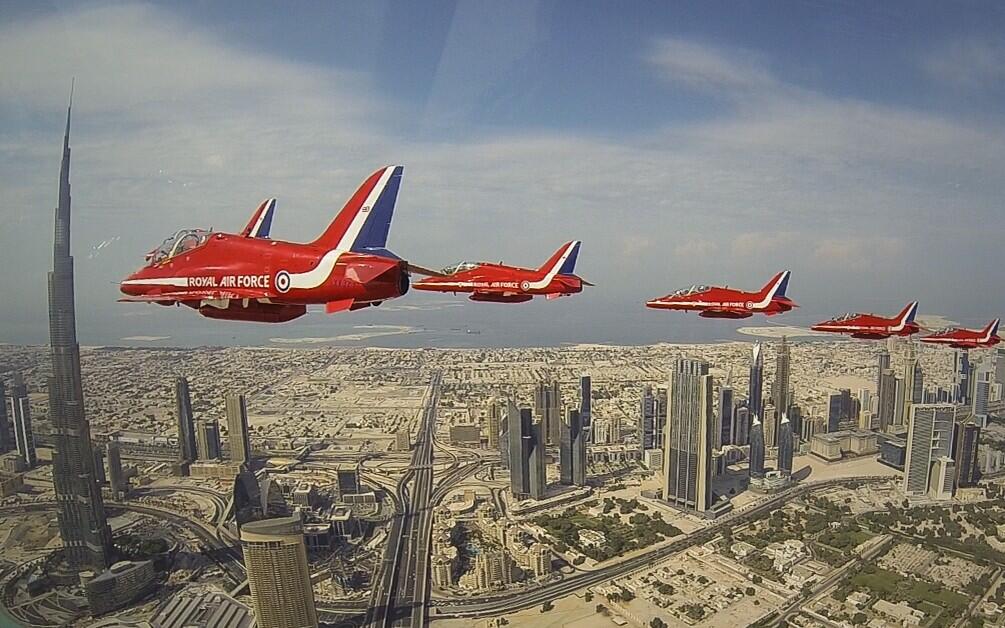
Picture posted on
twitter by Red4. And the Red Arrows will be at the Dubai Air Show all week.
Around the
world in twelve days
13 November
2013
There is a right
way to go around the world and by implication a wrong way. The right way,
Fineas Fogg and Michael Palin both did this, is to head east - and better
still to take 80 days.
The wrong way is
to head west and to take just 12 days.
But that was our
choice - partly determined by where we wanted to go and also by available
flights.
Our itinerary
looked something like this:
1 November -
Emirates - Dubai to Seattle - Fourteen hours
3 November - Delta - Seattle to Los Angeles and Los Angeles to Kahului on
Maui in Hawaii. Two hours; three hour layover and another six hour flight
6 November - Hawaiian - Kahului to Honolulu on Oahu, Hawaii - 25 minutes
9 November/10 November - Japan Airlines Honolulu to Tokyo Narita - 8 hours
13 November Emirates - Tokyo Haneda to Dubai - Eleven and a half hours.
In reality it has been a bit much. We woke too early every morning and by
nighttime we were often too tired too early.
As for the trip;
we arrived in Seattle early afternoon which allowed us time to check in to
our hotel and then head downtown to Pike Place market and for a sunset ride
on the Seattle Wheel - every city should or does have one! And we even had
the energy for seafood dinner and a bottle of wine.
Saturday 2 November was our visit to the Everett factory of Boeing Inc.
Disappointing; in part I suspect because only minimum work takes place at
the weekends; but also because the guided tour is a lecture and not an
interaction and there is an excess of USA flag waving. Other people do make
airplanes.
Flying Delta -
torture. Even the Delta captain ("call me Chuck, everyone does") on standby
sitting with us was embarrassed. Nice guy. But six hours with a small packet
of pretzels?
Maui - sun, sand and stunning blue seas. What a nice way to wake up. The
people are friendly. By our second visit to the supermarket we were
regulars. But it is a place that needs a longer stay to make the best of it;
and to have the time to play some golf and take to the water. We did explore
the west coast and Lahaina, perhaps the ultimate tourist town. But dinner at
Fleetwoods was very average. The chef had gone his or her own way.
I can see why
people like Maui. The climate is good. The sea is blue. But the beaches are
often very average. A narrow strip of sand backing onto a busy road. There
is good public access to the beaches though the best will also be backed by
an ugly hotel or condo development.
And many of the
buildings are showing their age. There is plenty of 1960s/1970s
construction.
Also worth noting.
It is expensive. There has also been a long drought - officially since 2008
and much of the interior of the island is very dry.
Waikiki could be fun. But it feels run down. There is little that is new
other than brand name shops. And people do shop there. But it is a city that
reminds you that the American Dream does not work out for everyone; the
beach road becomes the home for many homeless every night; especially near
where we were staying at the south end of the beach. They are not
threatening; though someone walking alone might be concerned. Some of the
language is not fit for family ears. And their bathroom appears to be the
grassy area between the beach and the road. Best not to walk barefoot there.
Great sunsets.
Daily rainbows. Nice lifestyle if you can afford to live well. A genuine
east meets west place. Except that east largely ignores west. The Japanese
and Koreans have their own tour groups, guides, eating places, lifestyle.
Although there are plenty of Japanese and Korean visitors I suspect the
city's future is tied into attracting large numbers of Chinese visitors.
That will need a change to the US visa rules; or at least a simplification
of the application process.
Australia realised
the spending power of Chinese visitors some years ago The USA will need to
do the same.
And onto Tokyo. I
am a fan. What more can I add? The Japanese are already celebrating
Christmas. Lights are up. Shops are full of Christmas items. Recession. What
recession? The shops are packed and people are buying. Skirts are still
short. Food is still good....though no more ramen please. And around each
corner there is something new to see. Foreigners are tolerated rather than
engaged. The subway is a thing of wonder. Trains will take you everywhere
and the signage is simple and in English.
I want to go back
soon!
Emirates half
year - steady as she goes
12 November
2013
Emirates Group
today announced its half-year results which show a steady performance.
Here is what I
predicted on 31 October:
"EK
will announce its half years results in the next couple of weeks - almost
certainly before the Dubai Air Show.
Anyone want to guess the
number - the trend is not exactly your friend. There is no trend.
The 2012 half year net
profit was Dhs1.7 billion ($464 million) up 104 per cent from Dhs836 million
($228 million) for the 30 September 2011 half year.
For the six months to 30 September 2012 the airline’s revenue, including
other operating income, of Dhs35.4 billion ($9.7 billion) was higher by 17
per cent compared with Dhs30.2 billion ($8.2 billion) in 2011.
We will not see profit
back at 2010 levels of AED3.4 billion, though there will be an increase in
revenues simply due to more aircraft flying more routes.
Assume a 15% increase in
revenue to AED40.7billion. As for net profit - my guess - about the same as
last year - say AED 1.6billion - a fall in the net profit margin from 4.8%
to 3.9%."
How did I do?
Emirates Group
revenues reached Dh42.3 billion ($11.5 billion) for the first six months of
its current fiscal year ending 30 September 2013, up 13 per cent from Dh37.5
billion ($10.2 billion) at September 30, 2012.
Net profit for the group rose to Dh2.2 billion ($600 million), an increase
of 4 per cent over the last year’s results.
The group’s cash position on September 30, 2013, was at Dh18.2 billion ($4.9
billion), compared to Dh27 billion ($7.3 billion) as at March 31, 2013.
Overall staff
numbers increased by 11.7 per to over 75,800 compared with March 31, 2013.
During the first six months of the fiscal year, Emirates received 10
wide-body aircraft – six A380s, three 777s and one 777 freighter, with 15
more new aircraft scheduled to be delivered before the end of the financial
year (March 31, 2014).
The airline is the
major part of the Emirates Group and for the first half of the 2013-14
fiscal year Emirates net profit was Dh1.7 billion ($475 million), up 2 per
cent from the same period last year....slightly ahead of my forecast.
Emirates revenue,
including other operating income, of Dh39.8 billion ($10.8 billion) was
higher by 12 per cent compared with Dh35.4 billion ($9.6 billion) recorded
last year, reflecting passenger demand and strong yield. This is slightly
slower growth than I forecast and is a slower rate of growth than the growth
in capacity and passenger numbers implying some pressure on yields.
In the first-half of its financial year 2013-14 capacity measured in
Available Seat Kilometres (ASKM), grew by 16.9 per cent, whilst passenger
traffic carried measured in Revenue Passenger Kilometres (RPKM) was up 16.1
per cent with Passenger Seat Factor sustained at a high level, averaging
79.2 per cent, slightly below last year’s 79.7 per cent.
Emirates carried 21.5 million passengers since April 1, 2013, up 15 per cent
from the same period last year.
So the results are much in line with expectations - and for once EK has
performed consistently with the prior year. Given there has been no
significant change in the major cost bases of fuel and staff, and given no
business impacting global events the results were for once fairly
predictable.
But no one should
be expecting a bonus come April next year.
Fleetwoods -
Don't stop here
6 November 2013
I do not often
write restaurant reviews but Fleetwoods on Front Street in Maui was so
average that the story needs to be told.
Opened a year ago
the restaurant is owned by Mick Fleetwood, a Maui resident and one of the
biggest names in the music industry - he is the Fleetwood in Fleetwood Mac.
We arrived at 8pm
with a reserved table. And while they found a table for us we sat at the bar
where the rather harried bar staff eventually poured us two prosecco.
Now it would be
sensible to simply add the bar drinks to the final bill for the night. But
no. You have to settle up at the bar first and then go back to the entrance
to see the lady that takes you to your table. Even though your table is just
5 yards from the bar!
A simple order of
a shared appetizer, two entrees and two glasses of wine.
The calamari
appetizer appeared. Very average.
And then nothing
for some time.
Our two glasses of
wine appeared long after we had finished our appetizer; our waitress
explaining that she was having to work extra tables. The restaurant was not
that busy.
Then we were asked
if we had received our appetizer.
Then we were
brought some bread,
Then the main
courses arrived. This was 90 minutes after we had arrived at the restaurant.
The North Beach
Cioppino offers a half lobster tail, mussels, clams, shrimp, and fish in a
spicy tomato Sauce. The tomato sauce appears to be a tin of thick non spicy
passata. It is not spicy and it overwhelms the fish.
The Asian style
Monchong was more successful - it is a
white, sweet, moderately dense
fish and is Hawaii's most popular fish. Elsewhere it is known as a
pomfret. Served with Bak Choy and Green Beans.
We did not stay for dessert of coffee.
Including the two glasses of prosecco at the
bar and service dinner cost US$183. Genuinely poor value. Average food,
carelessly served.
Mr. Fleetwood's report
card should read - can and should do much better.
'Racist abuse
of Yaya Touré is a smokescreen, real problem is at home'
5 November 2013 John Barnes in The Guardian
I'm not interested in what happened to Yaya Touré at CSKA Moscow – as far as
I'm concerned their supporters can abuse who they want because, for me, what
happened in Russia is the tip of a wider issue and, quite frankly, something
of a smokescreen. For instance, how many black coaches are there in this
country? Very few, yet all we're focusing on is CSKA Moscow, and the more we
push for clubs like them to get banned or have their stadiums shut down the
more we don't need to look at what is going on here.
The truth is that those at the top of British football do not care about
getting rid of racism, they just don't want to hear it or see it. As soon as
someone like Touré or Danny Rose gets abused in Eastern Europe there is
shock and outrage from players, clubs and the authorities, yet no one is
speaking about the people living in inner cities like Brixton who, because
of their appearance and their background, have become completely
disenfranchised from society. Why don't they care? Because the
powers-that-be have enough wealth to not worry about these people.
Black players, in particular, should be tackling these issues because
ultimately it will affect them when they retire. There are so many
intelligent former black players, guys like Luther Blissett and Cyrille
Regis, who never got a chance to become a top manager or a top coach because
of the perception that surrounds people who look like them. They are black –
which, for many, means they are good athletes but incapable of being
anything above and beyond that.
To a large extent this is down to unconscious racism and probably 99% of us
are guilty of that – I know I am. We all have preconceptions of people based
on what we have been told about them and their race and ethnicity.
I still come across managers of a certain generation, those in their fifties
and older, who say to me: "I don't see you as black", and think that is a
compliment. So what, I don't walk around with my jeans down by my arse,
smoking a spliff, so that means I'm not black? These are the attitudes we
need to change if black people as a whole are going to progress, and the
only way we can achieve that is through education.
This is what footballers have to do – they cannot directly affect society
but what they can do is use their standing in this country to make a wider
audience aware of the wider issues surrounding race and stress the
importance of understanding that what they have been told about a certain
group of people is, in the main, wrong.
That, for instance, the best occupations black people can aspire to is being
a footballer, or a runner, or a singer. People look at Barack Obama and say:
"See, black people can be President" – no they can't. Any black person who
has been successful, particularly Obama, has been lifted out of blackness
and stands as the exception.
We need to talk openly about perceptions and not be afraid of the fact that
we all have different views about different people based on how they look.
There is nothing racist about an open, honest dialogue and it is certainly
more productive then pointing the finger at the CSKA Moscow fans, or at Luis
Suárez or John Terry, and demanding they are punished.
Personally, I don't blame Suárez or Terry for what they did – they are
simply products of a society and environment that allows them to think it is
OK to speak about certain people in a certain way. It would be far better if
instead of banning them and demonising them, the Football Association aimed
to educate them and make them see that black people are undeserving of
racial abuse.
The truth is that Anton Ferdinand has more in common with Terry than he does
with someone from Africa. They're wealthy guys from western culture who both
drive Bentleys, both drink champagne and both listen to Tinie Tempah, yet
Ferdinand is told he is different, that he is part of a race open to
insults? That is ridiculous and, again, is the product of historically
incorrect preconceptions.
Racism is never personal – it's about someone saying the group I am part of
is superior to the group you are part of. How, for instance, can a handsome,
talented, beautiful black footballer be personally affected by a fat, ugly,
unemployed fan calling them a black this or a black that? I used to get that
when I was playing and I used to just look at the people doing it and think:
'You're abusing me? Look at you, how can you even dare abuse me?!'
That is why it is pointless, and pretty ridiculous, to be worrying about a
footballer getting racially abused – in no way are they the biggest
sufferers, and, quite frankly, if I was someone like Touré or Rose I'd feel
embarrassed if I had to look at someone who was suffering genuine racism and
take their sympathy. A millionaire getting booed in Russia is nothing
compared with generations of people never getting the chance to better their
lives and those of their children.
Physically we are different – east Africans, for instance, are genetically
inclined to run long distances in shorter spaces of time – but
intellectually and morally we all have the potential to be the same. That is
the type of equality I am interested in and is the message I give when
speaking at universities and other public forums. And that is what more
people involved in football, black players in particular should be doing.
Because unless you get rid of racism in society, you can never get rid of it
in football and as things stand there will always be these one-off moments
when a player is abused or booed purely because of the colour of their skin.
Everyone goes into shock because they thought racism had disappeared from
the game but how can it have done when it continues to exist in every other
part of society at a more deep-seated, depressing level? Just because
someone keeps their mouth shut for 90 minutes doesn't mean that for the rest
of the week he isn't a racist, or hold unconsciously racist views, and until
that is addressed, there will always be a problem.
Tackling racism is a long and complicated process but one thing's for sure;
it cannot be solved by banning a player or closing part of a stadium. The
problem is wider than that and if football really cared those involved in
the game, players in particular, would worry less about one-off incidents
like what happened to Touré when he played for Manchester City in Moscow and
more about what is going on around them. Perceptions need to change and for
that to happen, education needs to be pushed as the only way forward.
John Barnes has donated his fee for this column to charity
At the 1984 FA Cup Final an Everton fan two
rows behind me jumped from his seat; his face raging with anger and yelled
at Watford's John Barnes - "Kill that f***ing black bastard." That was
almost thirty years ago and reading John's article above makes it pretty
clear that nothing has changed. He is right; the FA have never dealt
effectively with racism in football because they have never tried to address
it as part of racism institutionalized in society. For the FA this is simply
a problem that they would like to suggest exists elsewhere; deaf to any
problems under their own watch. Useless.
Amnesty of
betrayal can't rewrite history
5 November 2013
The Bangkok Post - Songkran Grachangnetara
There is nothing that unites the "We Hate Thaksin" brigade
more than the possibility of an amnesty for the exiled former prime
minister.
All of a sudden,
the usual suspects, such as retired generals with empty nest syndrome,
senile political has-beens and of course, the perennial "one-trick pony"
party, start coming out of the woodwork for another day in the sun.
The possibility of
Thaksin's return has a phenomenal effect on Thaksin haters, because it
transforms them into some sort of heroic alter ego. Just look at the way the
leaders of the three anti-amnesty protest groups have reinvented themselves.
Maj Gen Chamlong Srimuang _ lest it be forgotten, Thaksin's one and only
political mentor (bringing the billionaire into the Palang Dharma Party) _
suddenly warps himself into David, courageously opposing the Goliath that is
Thaksin.
Sondhi Limthongkul,
a person who had business dealings with Thaksin but switched sides so many
times, now wants us to believe he's a male version of Corazon Aquino,
leading the people in protest against tyranny and oppression.
But the most
drastic transformation comes from the leaders of "the one-trick pony" party
itself, namely Suthep Thaugsuban and Abhisit Vejjajiva.
These two leaders
of the Democrat Party that colluded with undemocratic forces to bring us the
2006 coup, which led to an illegitimate Abhisit administration, ended up
mimicking all of Thaksin's populist policies, and now want us to believe
they're Aung San Suu Kyi fighting for liberal democratic values!
So let me sum this
up correctly if I may. We're being asked to support this great revolt
against the Thaksinisation of Thailand by placing our faith in protest
leaders who:
a) were
responsible for mentoring and introducing Thaksin to Thai politics.
b) had an intimate
business relationship with Thaksin, before turning into a serial
side-switcher.
c) copied all of
Thaksin's political tactics and policies while they were last in government.
Let me be clear.
I'm profoundly against the Thaksinisation of Thailand, and can think of
nothing more repugnant. But honestly, I simply refuse to follow this bunch
of invertebrates into protest, because you'll end up being used and tossed
aside like a dirty handkerchief once they get what they want.
I've seen some
pretty ridiculous things in Thai politics but believing Maj Gen Chamlong, Mr
Sondhi or Mr Abhisit have the solution Thailand really requires is as
idiotic as the guy who fixed the problem of his low ceiling by chopping off
his legs!
Over the past few
days I've heard and read the opinions of many of the political cognoscenti
that urge all people of good moral standing to unite in protest against
Thaksin.
"My enemy's enemy
is my friend", is essentially their logic and it is indeed persuasive. But
in my view, it is also shortsighted and flawed.
My question is
this. What if we do somehow manage to permanently exorcise Thailand from
Thaksin's political brand of demonic possession? Then what?
Do we just hope
for the best and pray that someone less evil takes his place? That doesn't
seem like a viable long-term strategy at all, because we know that under
present circumstances it will be another Abhisit-led administration
achieving office through undemocratic means that will do a rerun and we all
know how that movie ended.
However, I'd like
to end by making some observations regarding what academics and columnists
are calling a "blanket amnesty" for all those involved in the political
battle that has been raging since the coup.
Firstly, it is not
and should never be called a blanket amnesty, because none of the versions
of the amnesty bill give an amnesty to those who were slapped with criminal
charges under the Criminal Code's Section 112, otherwise known as the lese
majeste law. Make no mistake, those charged under Section 112 are mostly
political prisoners, because they have been used unconscionably as pawns by
leaders in the Pheu Thai Party, who have now struck a deal that keeps the
military in their barracks in return for Prime Minister Yingluck
Shinawatra's acquiescence in military affairs.
This deal is
tantamount to nothing less than a betrayal by Thaksin and the Pheu Thai
Party of the electoral promise that this abortion of a law, namely Section
112, will be once and for all eliminated from the arsenal of all Thai
political operatives.
The Democrat
Party, needless to say, has been the greatest beneficiary of Section 112,
because it is their most potent weapon of mass destruction.
That is why, under
the guise of protecting the monarchy, the Democrat Party, in my opinion,
will instead go down in history as the Rasputin that has done our beloved
institution the most harm.
Secondly, it is
all too obvious that all roads in Thailand don't lead to Rome. All political
roads in Thailand will lead to our courts.
It will be these
men in dark robes that will decide what shall become law and whether
changing the constitution is indeed constitutional.
It is a bizarre
situation that the courts will face. If this amnesty bill is
unconstitutional then what of the previous amnesty clause that the military
junta granted itself in 2006? And what of the many other amnesty clauses
after each previous military coup?
So potentially we
could see an amnesty bill that has been passed by parliament deemed
unconstitutional by our Constitution Court, while a military junta seizing
power through the barrel of a gun that subsequently writes its own amnesty
clause into our constitution is deemed totally legitimate.
Constitution Court
judges should be swatting up on their answers to these questions because
clever answers will be required.
So for the record.
I am vehemently against this amnesty bill, but for different reasons from
the current protests. I will only support an amnesty that brings Thailand
together, and returns justice to those who have been forgotten. This is an
amnesty bill that is not about the people. It is about power and politics
and should be rejected, but for the right reasons.
|
| |
|