Welcome to rascott.com
This is a
personal site that reflects my interests in news,
current affairs, aviation and travel.
email me: robert@rascott.com
Now In Dubai:
Scott
Consulting
Photo Albums
My photographs have been moved off this site and are now stored on Picasa. They
were simply taking up too much space on my web host.
Please use
this link to see my list of photo albums.
Some
Useful links:
Information:
World Time
Clock
Exchange Rates
Journalism:
ForeignPolicy
Nationsonline.org
Project Syndicate
Amnesty International
Reporters w/o borders
The Guardian
BBC World News
CNN Asia
Bangkok Post
Daylife.com - news
Gulf News
Arabian Business
World News
WSJ - Asia
SCMP
Good causes:
Sister
Joan - Bangkok
Regional Info:
BKK Magazine
HK Magazine
In
Singapore Magazine
TimeOut Dubai
Back in the UK:
Newton Ferrers
And for fun:
Lin Ping live panda tv
EarthCam
History
BBC Archive
National Media
Museum
The British Library
Imperial War Museum
There are many other links on my AOB blog page.
|
Why the Auckland airport bid? 26 July 2007 Some or the rationale behind Dubai Aerospace Enterprise's (DAE) bid for Auckland International Airport (AIA) involves the opportunity to establish a secondary hub for airline Emirates. Merger documents show DAE has pledged to use "reasonable endeavours" to create new routes and services to Auckland for Emirates. DAE doesn't have a shareholding in Dubai-based Emirates but it is chaired by Sheikh Ahmed bin Saeed al Maktoum, who is also the chairman of Emirates. The long term plan likely involves Emirates establishing Auckland as a secondary hub, from where it can fly to the west coast of North America and possibly Central and South America. It might also look to complete a round-the-world link between Dubai, South Africa and Auckland. Emirates could also compete on non stop flights from the far east to New Zealand, instead of flying to New Zealand via the USA. DAE sees Auckland as the first in a portfolio of airports the company plans to own and build up around the world, but particular in emerging markets in China, India and the Middle East. Auckland will be the South Pacific hub because of Australian laws forbidding foreign control of major airports. Our new road to nowhere 24 July 2007 Emaar properties, a leading real estate developer in Dubai has announced the opening of a new access road to its Downtown Burj Dubai development.
The new road will add to the convenience of residents and guests visiting the newly opened retail outlets (there are none yet) and the two hotels within the 500 acre mega project. Unfortunately the new exit does not give access to either Falcon Tower or Millennium Tower. The Burj Dubai Development will eventually comprise The Dubai Mall, the world's largest shopping and entertainment complex; The Residences, an exclusive upscale series of high-rise apartment towers; an Office Park; Burj Dubai Lake Hotel, Burj Views, The Old Town, a low-rise traditional residences community inspired by the stylist antiquity of Arabian architecture; and The Burj Dubai Boulevard, a 3.5 km stretch that binds the entire district besides man-made lakes and landscaped parks. Dubai seeks control of Auckland Airport 23 July 2007 Dubai's government is proposing to buy a controlling stake in Auckland International Airport Ltd., New Zealand's busiest airport, for as much as US$2.1 billion. Auckland Airport directors recommended the offer from state- controlled Dubai Aerospace Enterprises, worth up to NZ$3.80 a share, 15 percent more than before the offer was announced. The offer values Auckland Airport at NZ$5.6 billion including stock, cash and debt, the company said in a statement. The airport handles 70 percent of arrivals to New Zealand. It is not clear what real new value the Dubai bid can bring to remote Auckland unless the airport can serve as a regional hub for Emirates Airline. Perhaps it may be a gateway for Emirates to the West Coast of the USA. There is no doubt that EK has the ambition. Existing management will remain in place, according to the airport's statement. Shareholders will be asked to vote on the proposal in November and the deal is also subject to approval by New Zealand's Overseas Investment Office, which may take until March next year to make a ruling. In the meantime if you have cash to spare then Auckland Airport is not restricted from considering competing proposals and making a recommendation to shareholders if another proposal is better, it said. The Auckland deal may face some political opposition in New Zealand. Lawmaker Winston Peters, who is foreign minister and head of the New Zealand First Party, today said the company's shareholders should oppose ``the unnecessary sell out and sell off of yet another New Zealand plum to a foreign-owned company.'' Dubai Aerospace's shareholders include Emaar Properties PJSC, Istithmar PJSC, Dubai Airport Free Zone Authority, Dubai International Capital LLC, DIFC Investments LLC, the government of Dubai and Amlak Finance PJSC. Dubai - 800 new residents every day! 20 July 2007 The local newspapers report that house rents in Dubai, the single largest worry among the majority of the emirate's 1.3 million residents, will continue to appreciate in the coming years due to the influx of a staggering 292,000 new entrants - employees and residents every year. More than 800 work and residence visas are issued every day. At this rate, the population of Dubai is to grow at 22.46 per cent, doubling in about four years. The 44,000 new housing supplies in the UAE this year would be inadequate compared to the requirements. While this might be a good news for investors, developers and landlords, it may not go down well with tenants who are struggling to make both ends meet, making life in Dubai dearer. Buying our apartment still looks like a good decision. There is increasing interest in Dubai as a business location. Inflation remains high and interests rates remain low for the foreseeable future. All this indicates a solid outlook for postive growth in rent costs in the medium and long-term. Conversely this will also put pressures on companies' bottomlines as demand for salary hike is going to intensify in the coming months. Time to rethink airplane safety 19 July 2007 After today's accident at Sao Paulo this is not the best day to write about airline safety but with over 70% of accidents considered to be survivable it is right to consider what else needs to be done to improve safety. The airline industry makes a big issue of selling airplanes that offer enhanced comfort, a wider cabin, better air filtering, quieter engine noise. Crew training is focused equally upon safety factors and upon service. But few passengers really know what to do in an emergency. Are the people sitting by the emergency exit really capable of opening the doors, assessing the situation and aiding an evacuation? Are all the passengers sober enough to ensure a safe and rapid evacuation of an airplane? There are
unfortunately many instances of flights being disrupted by passengers who
have consumed to much alcohol, either before the flight at the airport or on
board. There should be a serious industry wide push to reduce occurrences of
inflight disruption and violence toward crewmembers and passengers. Safety
is the key issue. All charges leveled against a suspected disruptive passenger should be taken seriously, and investigated thoroughly. And whistleblower protection should be granted for crewmembers that report such occurrences. Many cases likely go unreported due to a perceived employee fear of retribution from employers. One big concern is whether there should be a total ban of alcohol aboard aircraft is necessary. The answer is probably and sadly yes. But it would need to be done on the same day and on a global basis by all airlines. It is not so many years ago that smoking was banned on all flights. It was both a fire hazard and dangerous to the health of non smoking passengers. The ban did not reduce the number of flights being taken. A similar ban on alcohol would be easy to implement - and with global standards now on the liquids that can be brought onto a plane it should be easy to stop anyone taking their own supplies onboard. Duty free purchases could be stored for collection at the end of the flight. The good news for the airlines is a significant reduction in weight through not carrying alcohol and the fuel savings that come with that. Airports are encouraging earlier check in times; which also means more drinking time for many. It may be a great source of revenue for the airports but the time has come to close airport bars; and yes also to take alcohol out of the airport lounges. Cabin crewmembers and boarding agents should be granted the authority to deny boarding of any passenger who exhibits intoxicated or unruly behavior, without fear of repercussions from their employer. Gate personnel should be trained to recognize this type behavior and should be instructed to inform law enforcement personnel so that they may ascertain the passenger's state of sobriety, before the boarding process has begun. Intoxicated
passengers who are denied boarding must be held responsible for their own
behavior. The airline, it's employees, airport, and airport personnel must
be held blameless in such instances. But we need to go further than simply dealing with unruly or drunk passengers and the availability of alcohol. Why are the emergency exits painted the same colour as the rest of the cabin. Sure they have a nearby sign saying exit but why aren't they painted in a bright flourescent orange? Why do the airlines serve hot coffee and tea? The potential for accidents as these heavy pots of hot drinks are carried down the aisles is huge, both to the crew member and the passenger. Why are the meal carts made of heavy duty metal. Have you ever tried to push one of those? Planes are made out of lightweight composite materials. Why not the meal carts as well. Indeed, maybe we should go further; the idea that there should be heating ovens at 35,000 feet makes little sense? Take out anything that could be a potential cause of fire. Serve cold meals only. A few of today's modern passengers look like they would benefit from a good salad. Handing out drinks or hot towels while the airplane is taxi-ing should be discontinued. Crew should be at their stations at the taxi phase and all critical times of the flight. The possibility of an accident on the ground is significantly higher than of an accident while in the air. For all airlines safety is a priority but sometimes they endanger passengers and crew by putting creature comforts first. Firefighting equipment should be clearly identified on board the plane and able bodied passengers should be seated near to such equipment and briefed on its use. Similarly the emergency exit rows should only be occupied by able bodies frequent flyers. Maybe they should only be given to frequent flyers who have taken a one day training program in airline safety and are certified for those seats. Some of these suggestions may appear a little over the top. Since compromise is inevitable and legislation unlikely it is better to keep proposing too much rather than too little. 18 July 2007 The following letter was printed in Dubai's 7 Days newspaper and sums up the joys of summer here rather well: it was not written by me! "This is my first
summer here and someone please, please help me. What is there to do between
7am and 7pm at the weekends which doesn't involve being fried alive. That is summer in Dubai. It is not that bad. No rain; the humidity is not as high as in Bangkok. But it is hot. The construction sites all close down by law in the middle of the day; an excuse for them to work through the night instead. A visit to the beach is not really an option. Even a walk out of the office to the local sandwich shop is an endurance test. You can feel the heat burning off the pavement. Strangely the official temperatures miraculously never rise beyond 49C, but I am sure it gets hotter than that. The malls do great
business with the six week long Dubai Summer Surprises (effectively one
large summer sale) and being one place where families can eat, shop and
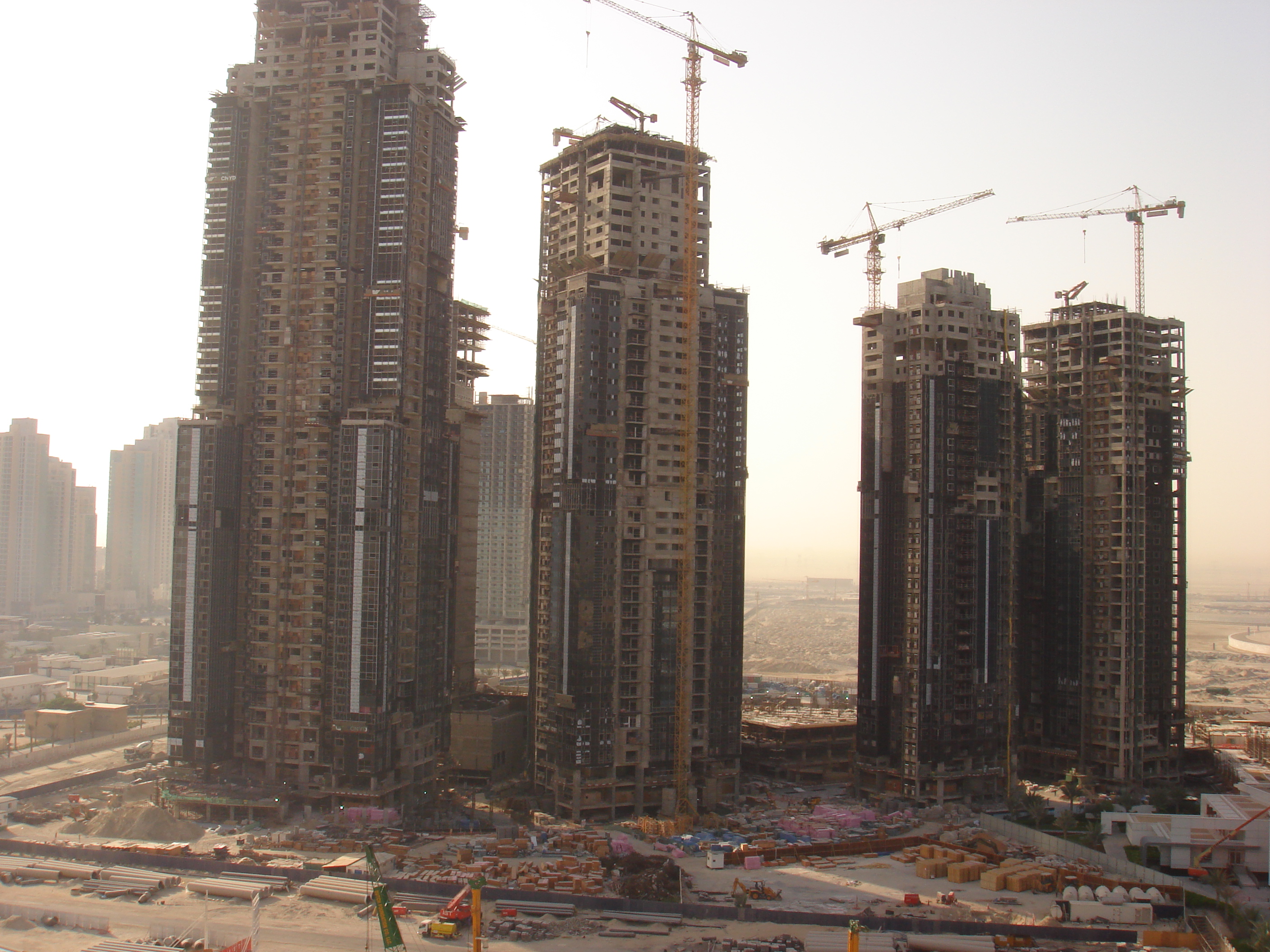
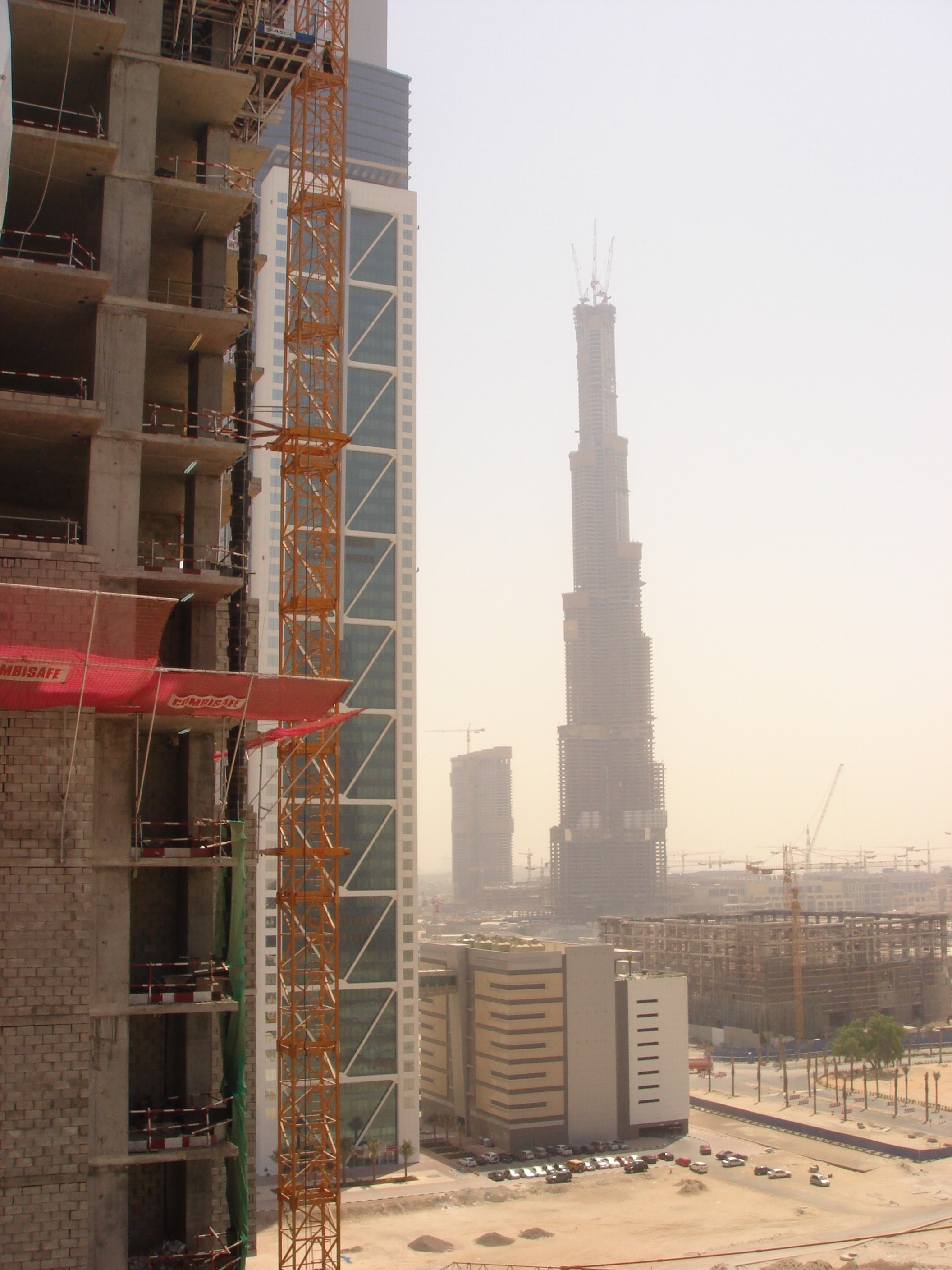
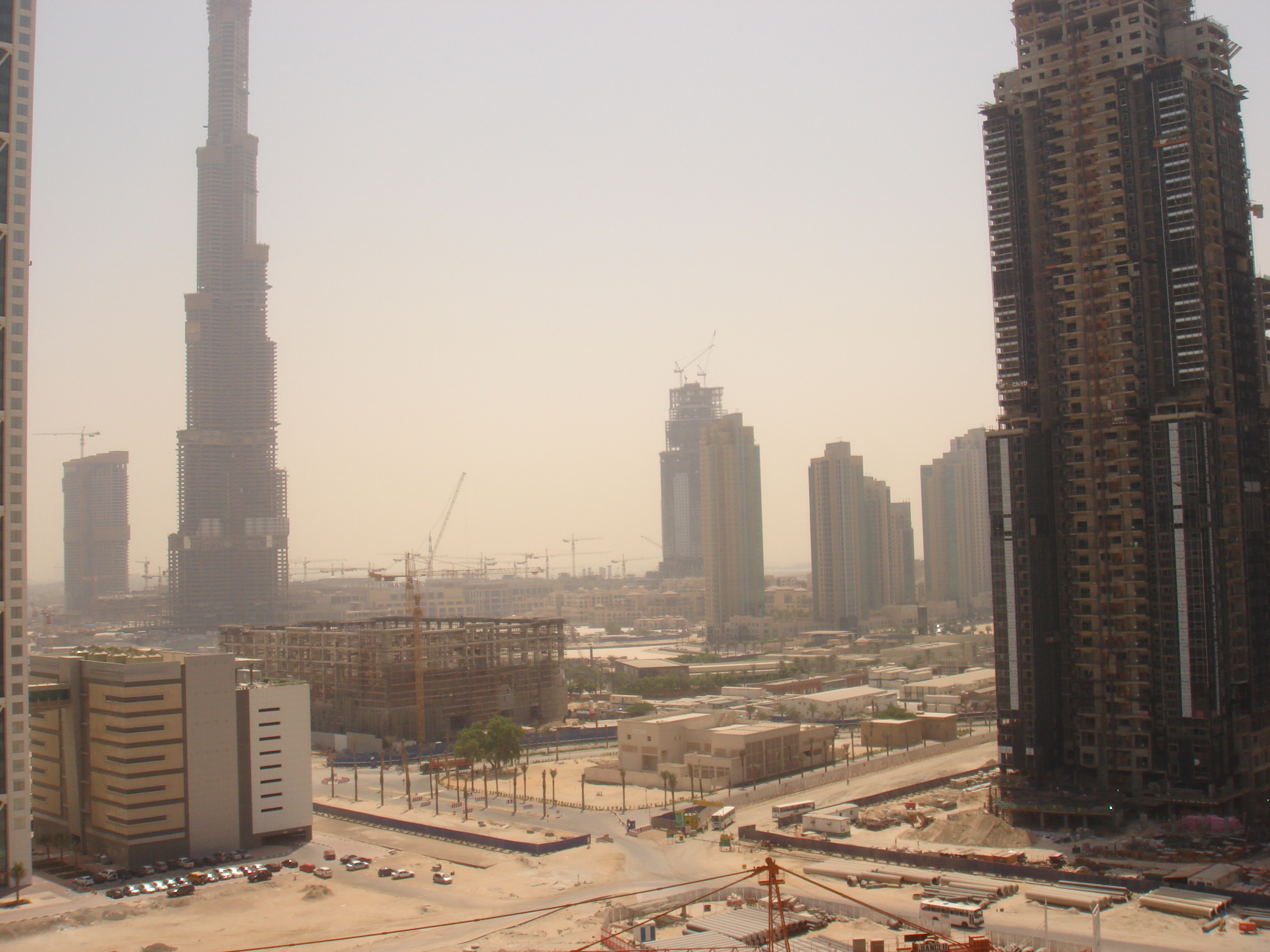
entertain themselves out of the heat. 13 July 2007 It is Friday - the weekend - and yes they are still building on the three sites at the back of my apartment. One day of rest would be nice; one morning when I can lie in after 7am without having to listen to the hammering or drilling! There is a new tower and car park being built on either side of falcon tower and some sort of generating station at the back of the building between Falcon and the Executive Towers complex that you can see in the pictures. Tower B, where Tai and I have bought at apartment is at the very left of the first picture.
It will all be quite exciting when it gets finished. In the meantime sleep is a luxury. The building rules allow 24.7 construction. There are no roads; a few dirt tracks overrun by construction buses and cement mixers! Life on Mars - in the dust and sand it really does look like another world! I want to see a green field and to feel the rain !
Flushed with success in China 12 July 2007 Not content with building the great wall the Chinese now have the great urinal! Officials in Chongqing, that huge city in southwest China are flushed with success after the recent opening of a porcelain palace that features an Egyptian facade, soothing music and more than 1,000 toilets spread out over 32,290 square feet. Officials in Chongqing are preparing to submit an application to Guinness World Records to have the free four-story public bathroom listed as the world's largest public loo. Apparently "guests" may listen to gentle music and watch TV while having a good dump with 999 other users. If you need to go, the washroom is at Yangrenjie, or "Foreigners Street," a tourist area. Quite why anyone would think that tourists will be attracted to a giant loo is a mystery. On a hot day there are is also a cluster of stalls without a roof. For a little Disney-esque pee there are some uniquely shaped urinals, including ones inside open crocodile mouths and several that are topped by the bust of a woman resembling the Virgin Mary. There are also plans to build a supermarket nearby, which will sell toilet-related items according to CCTV. Bangkok commuters to take to their bikes 10 July 2007 The Bangkok
Metropolitan Administration is proposing to build more bicycle trails to
promote riding bikes and other environment-friendly vehicles as part of a
campaign to help fight global warming, Bangkok governor Apirak Kosayodhin
has said. Now all he needs
to do is reduce the temperature to miid 20s celcius and stop the rain. Iran and China - opportunistic bedmates 9 July 2007 I was struck by a comment that Tai made after her flight to Tehran today - that the flight had many Chinese passengers traveling for business. The West has largely withdrawn from Iran with sanctions imposed to encourage Iran to halt its nuclear programme. But that wont stop the Chinese from building closer ties to Iran; does that include nuclear know-how? Conveniently China's UN envoy has recently urged the international community to boost diplomatic efforts to end the nuclear standoff with Iran, saying the time was not yet right for new sanctions. China is one of
the five permanent, veto-wielding members of the 15-nation UN Security
Council alongside Russia, Britain, France and the United States. What drives Chinese interests - natural resources, mainly oil. Same as the US really; it was interesting to note the Australian foreign minister saying that oil supply was one of the key justifications of the Iraq invasion. We all knew that. No elected official had ever said it quite so openly. Why the need. China's own oil and gas resources are scarce. Overall, the typical Chinese citizen still only consumes a fraction of the energy an American consumes. But they will catching up quickly. The number of privately owned automobiles in China is some 25 million, more than double the figure three years ago, and is expected to jump to 130 million by 2030. The Chinese are willing to make friends where the West is not - and indeed where the West is not welcome. No oil-rich country is too dangerous or remote for exploration, and no regime too corrupt or unsavory for a contract. Iran is now China's leading supplier of crude oil. One of its most ambitious investment proposals targets Iran, which has the third largest proven oil reserves in the world. In 2005, China bought about 11 percent of its crude oil imports from Iran. But what China really seeks is to tap into Iran's vast reserves directly, through investments in exploration and production. China has also made goodwill investments in other projects, such as Tehran's subway system. What is clear is that Beijing's will take advantage of opportunities in countries where its would-be competitors are barred from doing business, as U.S. companies are in Iran under sanctions imposed by Washington. It also has demonstrated that it will use its permanent position in the U.N. Security Council to oppose multilateral sanctions that would prevent its own companies from doing the same. Although Beijing has joined the chorus calling for Iran to fully account for its nuclear program, amid suspicions that Tehran is developing nuclear weapons, China has also indicated that it would veto sanctions to force Iran's full disclosure. Interesting bedmates. Save the earth -have a concert! 7 July 2007 It is easy to be a little cynical about Al Gore's save the earth concerts taking place around the world today. There was not much evidence of environmental action in Dubai this morning. The empty Emirates minibuses still had their engines and AC running. Old 727s were taking off from the airport. There is no evidence of public transport. The Hummers and SUVs were already out on the road. Why anyone other than a frustrated tank driver would want a Hummer is one of life's great mysteries. The building sites are already working flat out. And the aircon was on full in teh car; maybe something to do with the fact that it was close to 40C at 8.00am. The trouble with these concerts is that it is so easy to be sceptical or the motives of pop stars promising to change the world. LIve television to over 2 million viewers is a great incentive to get you name and music to people's attention. Yet there is no denying the sheer scale and intensity of Live Earth, even if none of the Dubai TV networks appear to be broadcasting the show. Live Earth runs for 24-hours across seven-continents. The organisers, led by Al Gore, hope it will reach 2 billion people via 120 television networks, internet and radio, making it the biggest media event in history. At Wembley later today, 80,000 people are expected to watch Madonna, Genesis, the Red Hot Chili Peppers, Snow Patrol, the Beastie Boys, Duran Duran, and Blunt, although last night rumours of an appearance by Paul McCartney remained just rumours The shows themselves create a huge carbon footprint. Some performers will arrive and leave by private jet. Anestimate calculated for the Guardian suggests that spectators traveling to the London and New Jersey concerts alone will generate approximately 5,600 tonnes of greenhouse gases between them - the equivalent of 7,270 people crossing the Atlantic by plane. Even those watching online will find Live Earth's website is sponsored by the Chevrolet company, which manufactures SUVs. But the objectives of the shows are real. To pressure politicians to sign an international treaty pledging massively reduced emissions within two years and to persuade individuals to make lifestyle changes, such as installing energy-efficient light bulbs, or taking public transport to work. Oops - yes I drive to work. But it is not far and there is no other way to get there. Is it necessary to raise awareness of an issue that is in the newspapers and news broadcasts almost daily. Probably. Newspapers are for my generation. Internet, television, music is the means of accessing the generation that may have to save the planet. One more moment of cynicism. Is this really a platform for Al Gore to announce a presidential bid. Live Earth's message is that we each should do whatever we can for the climate. Would Mr. Gore continue his environmental campaign into the White House and would he truly make a difference? Emirates aims to redraw world aviation map 6 July 2007 - International Herald Tribune PARIS: The chairman of Emirates Airlines - Sheikh Ahmed Bin Saeed Al-Maktoum of the ruling family of Dubai - has grand ambitions, and a bankroll to match. He has a huge pot of money to spend, $82 billion from his government, the airline and other financiers. He loves large planes and has ordered 55 super-jumbo A380s to create the biggest fleet of these double-decker planes in the world. And he wants to make Dubai, a sheikhdom by the sea, the busiest airline hub in the world, overtaking London, New York and Singapore. Some may consider Maktoum's goals overreaching, but he has delivered so far on all his promises. He built Emirates Airlines from a two-plane operation, started with $10 million in 1985, into one of the world's largest international carriers, with 105 planes. Emirates is the world's fastest-growing airline - it will take delivery of one new Boeing or Airbus plane a month for the next five years - and Maktoum said he would like to see it become, some day, the world's biggest. "We've never seen anything like it before," said Robert Cullemore, a consultant at Aviation Economics, a London-based aerospace advisory firm. "We've never seen growth at this rate." Of course, success for Maktoum is not just a simple matter of buying airplanes. He must still compete with well-established carriers plying many of the same routes as Emirates, attract enough passengers to fill his vast fleet profitably and hope that the economies of the Middle East, including Dubai, and emerging markets in Asia and the Indian subcontinent continue to grow at their current pace to justify the Emirates' massive investment. But at the recent Paris Air Show, Maktoum seemed unfazed by those concerns. He met with the Louis Gallois, the Airbus chief executive, to sign a deal that added eight more A380s, with a list price of $2.6 billion, to his fleet. He held a news conference to tout Dubai's plan to spend $82 billion over the next decade on aviation, including building a new $33 billion Dubai World Central International Airport, which is to have six runways and to become the world's largest airport. "What we are witnessing today," Maktoum said at the time, "is the rewriting of the world's aviation history and the beginning of a new era of global aviation." Being oil-rich helps. Emirates Airlines, said Howard Rubel, an aerospace analyst with Jefferies and Company, "has got cash, clout and cache." "What's surprising is the rapid emergence of the Emirates as a player," Rubel added. "The economies of the Middle East are the fastest growing in the world. So what do they do? They buy planes. But five years ago it was like, 'Who are these guys?' " Aviation has helped transform Dubai, which was a desert trading post with hardly a paved road just 50 years ago, from being fly-over country to a place where people are flying in. About 25.6 million passengers landed there last year. The plan to develop Dubai was created by Maktoum's late older brother and is now overseen by the current ruler, Maktoum's nephew, Sheikh Mohammed bin Rashid Al-Maktoum. Once a pearl-diving outpost that grew rich with oil revenues in the 1970s and 1980s, modern Dubai seems built on hyperbole. Oil revenues have been declining as a percentage of Dubai's economy prepares for the day that its reserves dwindle. Today, oil represents only 5 percent of Dubai's economy, which increasingly relies on revenue from superluxurious hotels, a growing financial center and on serving as the regional headquarters for global brands. For instance, Halliburton, the oil services company, is moving its headquarters from Houston to Dubai, and such American companies as Universal Studios, Nickelodeon, Microsoft and Cisco are also setting up offices. Dubai is on a $365 billion building spree, and more development means more flights for the carrier. Construction projects include the Burj Dubai, the world's tallest building, and the Mall of Arabia, the world's largest shopping mall. The 1,500-square-mile, or almost 4000-square-kilometer, emirate is also building "Dubailand" - a leisure park bigger than Monaco - and the Dubai Waterfront, a development of condos and stores that will be the size of Barbados. At the center of this development spree is the Maktoum family and Maktoum, 49, who exudes a quiet confidence. In an interview at the luxurious Bristol Hotel here, where he was about to host a reception, Maktoum said that "when we started talking about expanding our airline, people thought we were bluffing or that it would take twenty to thirty years." "But we've proven them wrong," he added, while puffing on an ever-present cigarette. "I do believe we are rewriting history and we believe that we can do it in a short time." Emirates currently accounts for about one-third of all the orders for Airbus A380s. The next closest customer is Qantas, with 20 A380s on order. Moreover, since the ruling family is also the government, there is a minimum of red tape and an ease of decision-making. Maktoum, for instance, pointed out that if there are insufficient customs agents to process incoming passengers, he can just get more. The airline also benefits from an enviable location - Emirates bases its strategy on the fact that its planes can reach any point on the globe nonstop from Dubai and can connect any two city pairs with just one stop in the Middle East. It also is further along developing a hub than other airlines in the region. "Sheikh Ahmed is making a huge bet and we'll see how it works out," said Edmund Greenslet, publisher of the Airline Monitor, a trade publication. "We won't know for another decade. His concept is to make Dubai the hub for travel between Asia and the West. But new planes are being designed to go from city-to-city nonstop and to make that paradigm obsolete. He may be making a huge bet on a system that may not be as valid in the future as it has been in the past." Cullemore of Aviation Economics disagrees. While planes might fly nonstop from London to Beijing or Tokyo, there are a lot of other European, Asian and African cities that cannot offer nonstop flights. The Emirates is one of the prime customers for both Boeing and Airbus, not only for the size of its orders, but also because it buys the high-margin interiors that please passengers and are extremely profitable for the aircraft makers. Its first-class seats feature flat-beds with in-seat massage and personal mini-bars, while its in-flight entertainment includes 600 channels, e-mail connections and seat-to-seat telephones for in-flight chats. "One of the issues becoming obvious in the aviation industry is that it is not about the United States anymore," said Jon Kutler, head of Admiralty Partners, a Los Angeles aerospace private equity firm. "It's an extraordinary shift in power. Airlines like the Emirates are pushing for the latest and greatest. They are making an obvious distinction with American carriers that are nickel-and-diming the passengers." It is not only big planes and a new airport that Maktoum is spending his $82 billion on. The rest is going to Dubai Aerospace Enterprises, which includes aircraft leasing, an aircraft maintenance program, aviation information technology and a new aviation university. In addition, $4.5 billion is going to expand the existing Dubai airport to accommodate A380s. One remaining market - still somewhat untapped - is the United States. Emirates has daily flights from New York and just recently added Houston. It would like to start flights to San Francisco, Chicago and Los Angeles. Maktoum doubts that many American tourists would fly all the way to Dubai for vacation, but he sees a growing business market, led by Halliburton's relocation to Dubai. "Once you have one, others will follow," Maktoum said. "It's like getting an anchor tenant. It's the pull and the others will come." Trying to make sense of the Thai economy 5 July 2007 Thailand remains under military rule. An elected Prime Minister was removed in a coup. There have been bombs in Bangkok. The planned 2007 election now looks like 2008. The sectarian murders and bombings continue in Thailand's south. Yet the Baht is trading at a 10 year high and the SET is at a 10 year peak. Does this make any sense. Thailand's economic outlook is mixed. Thailand's exports of cars, electronics and agricultural products continue to surge. This helps the continued appreciation of the baht. But the banking system now has one of the highest levels of non-performing loans in Asia, 8.7 percent, according to Neruda at UBS. By contrast, bad loans account for 2.9 percent of lending in Singapore and 0.6 percent in Hong Kong. Sounds like 1997 re-visited. With domestic consumption low, the government hopes to prime the pump with a larger budget deficit planned for next year. Yet much of the increase is in military spending, which may not trickle down into the general economy. Despite these doubts, foreigners continue to show considerable confidence in Thailand. From January to May this year, Thailand's Board of Investment received applications for 123 billion baht, or $3.9 billion, worth of foreign investment, up 35 percent from the same period last year. Thailand's main stock market index, largely driven by foreign buying, has risen about 21 percent since the beginning of the year. Foreign investors have bought $3 billion more than they have sold on the Thai stock exchange since January. Thai investors have been net sellers of the same amount. Foreign tourists continue to arrive in record numbers despite the New Year bombings in Bangkok that killed three bystanders and the Muslim insurgency in southern Thailand. From January to April, 5 percent more foreign tourists arrived at Bangkok's international airport than in the same period last year. In Phuket, the increase was 21 percent and in Chiang Mai, 9 percent. Overall, about 14 million tourists visited Thailand in 2006. Foreigners continue to buy property in Thailand, despite the prospect that the government will tighten foreign ownership laws. Prices remained relatively stable after the coup, but some developers have added better furnishings to keep sales going. And interest seems to have heightened in recent weeks. It is foreign money that is driving Thailand; domestically, as a friend has reported there is a fair share of doom and gloom. Foreign money is not very loyal. A change in the market; new restrictions on foreign ownership, enhanced political risk can all send that money to a new home. Gulf expats feel the financial pinch! 4 July 2007 Expatriates
working in the Gulf are feeling the pinch as the euro and UK pound reach
near all-time highs against the depreciating US dollar.
Standard Chartered Bank suggest that the dollar will continue
to weaken in the near term applying further pressure on the regional
currencies. EK confirms India expansion 4 July 2007 In a major
strengthening of its India operations, Emirates will introduce a third-daily
service to Mumbai and a double-daily operation to Chennai starting 28th
October 2007. The airline will also add three additional flights each to
Cochin and Hyderabad over the summer and winter seasons. NAS Air - covering all the Saudi markets 3 July 2007 By way of a follow
up to my private jet outing to Jeddah this is a press briefing from Saudi
Arabia-based National Air Services (NAS) who have invested more than SAR
15.5 billion ($4.13 billion) in the purchase of 98 additional aircraft. The LCC booking site is at www.flynas.com The company is
also the regional representative of NetJets, offering fractional ownership
and leasing options, as well as a full portfolio of aircraft management
services solutions. The Airbus order
will constitute the core fleet of NASair and allow the new budget carrier to
operate new domestic and international destinations in the near future. This
may well include Dubai. The dangers of cheap Chinese exports 3 July 2007 Beware the hotel toothpaste or the cheap tubes of toothpaste used by the airlines. The Chinese have just added to the list of problems faced by today's travelers. In Canada 21
Chinese toothpaste products to date have been found to contain unacceptable
levels of diethylene glycol (DEG). DEG is a poisonous chemical used in
antifreeze and as a solvent that may cause nausea, abdominal pain,
dizziness, urinary problems, kidney failure, breathing problems, lethargy,
convulsions, coma and even death when ingested. While toothpaste is not
meant to be swallowed, it is often swallowed by young children. There is a bigger issue. The world's largest exporter of consumer goods does not have first world standards of safety and the risk of contaminated goods is clearly higher in Chinese goods. There have been a series of recent concerns including poisonous toothpaste, contaminated food, and unsafe toys, including contaminated Thomas the Tank Engine toys. There have even been press reports of fake bottled water. All this is bad news for China. Consumers are increasingly concerned that items they buy on the cheap may be of questionable quality. In recent months, the number of unsafe products imported to the United States from China, ranging from seafood and pet food to toys and toothpaste, has grown steadily. Chinese-made products have accounted for 60 percent of recalls this year, according to the U.S. Consumer Product Safety Commission. For the most part, the businesses responsible for the faulty products and bad food have denied the problems, saying their products are safe. Chinese officials hope to downplay the safety and health problems before the 2008 summer Olympics, to be held in Beijing. Earlier this week, inspectors announced they had closed 180 food factories in China in the first half of this year, and that they seized tons of candy, pickles, crackers and seafood tainted with formaldehyde, illegal dyes and industrial wax. That merely scratches the surface of a deeper problem. Salik is here to stay 1 July 2007 Dubai's Salik road toll system started today. The experiment, introduced by the Roads and Transport Authority (RTA), is designed to reduce the number of vehicles using the busiest highway into Dubai, the Shaikh Zayed Road. The RTA believes the traffic will reduce by as much as 20 per cent, thereby reducing congestion and traffic jams on that road. But the figures are speculation. The road was quieter today but that may have nothing to do with Salik. All the Dubai schools are now on vacation. No school buses and cars are on the road; and many families have already left Dubai for extended annual leave and to escape the heat. The radio reports did indicate greater congestion on Emirates Road, Al Wasl Road and Jumairah Beach Road. Already these so-called alternative roads suffer daily from over-crowding, causing frustration in the extreme to commuters. The prospect of having 20 per cent or more of the Shaikh Zayed traffic diverted to these alternative roads looks very bleak indeed. I still dont have a Salik tag for my Thrifty rent a car. Thrifty will be picking up the fines until they get their act together.
|
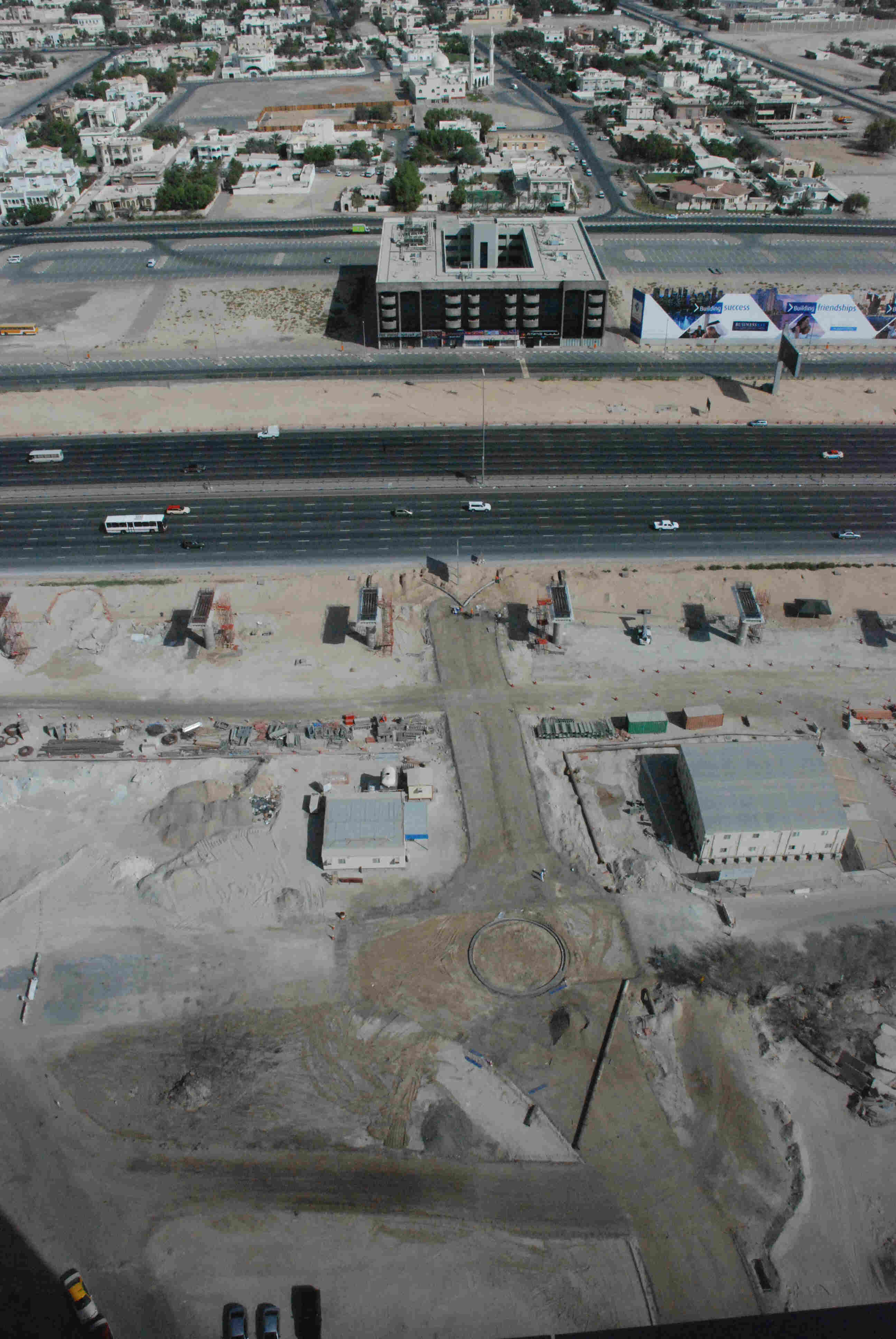 The
new access road from Shaikh Zayed Road, near the Millennium Tower,
complements the existing access road to Downtown Burj Dubai via Doha Road.
The
new access road from Shaikh Zayed Road, near the Millennium Tower,
complements the existing access road to Downtown Burj Dubai via Doha Road.