Welcome to rascott.com
This is a
personal site that reflects my interests in news,
current affairs, aviation and travel.
email me: robert@rascott.com
Now In Dubai:
Scott
Consulting
Photo Albums
My photographs have been moved off this site and are now stored on Picasa. They
were simply taking up too much space on my web host.
Please use
this link to see my list of photo albums.
Some
Useful links:
Information:
World Time
Clock
Exchange Rates
Journalism:
ForeignPolicy
Nationsonline.org
Project Syndicate
Amnesty International
Reporters w/o borders
The Guardian
BBC World News
CNN Asia
Bangkok Post
Daylife.com - news
Gulf News
Arabian Business
World News
WSJ - Asia
SCMP
Good causes:
Sister
Joan - Bangkok
Regional Info:
BKK Magazine
HK Magazine
In
Singapore Magazine
TimeOut Dubai
Back in the UK:
Newton Ferrers
And for fun:
Lin Ping live panda tv
EarthCam
History
BBC Archive
National Media
Museum
The British Library
Imperial War Museum
There are many other links on my AOB blog page.
UK election - Howards' End?
28 April 2005
There is a general election in the UK next Thursday. I should care. I don't; well, not that much. It almost worries me that I cared more about the US election than I do about the UK election. Which only goes to show what a marginal country the UK has become. Indeed I would care much more about a Chinese election, if there ever was one, than I do about an election in my country of birth.
Tony Blair is seeking a third term as Prime Minister and leader of the Labour Party; New Labour, which is basically what the Social Democrats sought to be. He is under attack from the opposition as being slippery, dishonest, a liar even. The trouble is that the man making this noise, Michael Howard, is seen as being equally slippery and equally likely to lie. Howard's disadvantage is his abject lack of leadership quality. He has no noticeable charisma and the personality of a smelly ferret. Howard's bleating about excessive immigration has looked like unpleasant racism and has hurt the Tories.
Iraq was a bit of a personal disaster for Blair; there were no weapons of mass destruction. Did he do what he believed was right? Yes. And was the UK's role in the Iraq war important? Yes, and in a way that people have not fully thought through. The UK saved the world from unilateral action by the USA. The hawks have been somewhat held in check by the need to be a part of a coalition. In years to come that will probably be seen as having been a important counter-balance to potential US imperialism.
The there is Charles Kennedy. He looks like a fun guy to hang out down at the pub with; except that the Liberals have apparently told all their candidates to stop drinking while they campaign. It is not beyond possibility that there could be a huge swing to the Liberals from disaffected Labour and Tory voters. But the Liberal manifesto looks like the Labour manifesto - and the Liberals latest recruit is a disaffected old style Labour left winger.
Blair will be re-elected; with a strong but reduced majority. People have jobs; the economy is strong; Gordon Brown is seen as safe; and elections are more about domestic than foreign issues. This will be Howard's End.
The blame game
28 April 2005
The truth is out there somewhere but since this is Thailand we are unlikely to find it !
In an unlikely compromise Thailand and Singapore have agreed to suspend the
pilots of the two airliners involved in the ground accident at Bangkok airport
on April 19. The Singapore Air pilot is presumably taking a week's vacation; the
Thai pilot is probably taking driving lessons.
Deputy Transport Minister Phumtham Vejjayachai said the initial investigation
found that the Boeing 777 of Singapore Airlines (SIA) was parked 194.4 metres
beyond the holding line at its parking bay while waiting for the Hong Kong-bound
Airbus 330 of Thai Airways International (THAI) to taxi prior to takeoff.
Since the SQ plane was at its parking bay it simply cannot have been 194.4
metres (that is 600 feet) past its holding line. When an aircraft parks at BKK
it is directed by ground controllers and hand signals from the airport
equivalent or a whistle blowing car park attendant.
But the THAI pilot also miscalculated the distance between the two aircraft,
causing his plane to scratch the Boeing, he said. The THAI plane lost its right
wingtip (note that this is the co-pilot's side of the plane) while the SIA
aircraft suffered a damaged aileron. It sounds as though Thai was in a hurry to
leave and misjudged distances.
Xinhua changes the focus
22 April 2005
 State
owned Chinese news agency, Xinhua, has realised that the best way to distract
attention from the anti Japanese protests is to divert attention to other
important issues.
State
owned Chinese news agency, Xinhua, has realised that the best way to distract
attention from the anti Japanese protests is to divert attention to other
important issues.
As a state owned enterprise it clearly has a duty to report all the big domestic news stories and it does not disappoint with its substantial photograph collection from the 2005 Miss Universe China qualifying competition.
Given Xinhua's ability to borrow news stories I do not feel too guilty about using one of their pictures here. And if you want to see more (and there are many more) then you should follow this link!
With thanks to www.danwei.org.
Pointing fingers in taxi accident at Bangkok airport
21 April 2005
Inevitably the Thais and Singaporeans are pointing fingers at eachother after a taxiing Thai A330 and a Singapore Air 777 clipped wings while taxi-ing at Bangkok airport last night.
Singapore flight 68 had landed and was moving to its assigned gate. It was stationary at the time of the collision. The Thai 777 was moving to the runway for its departure.
The fact that it was stationary is unlikely to deter Thai investigators. As usual with a traffic accident in Thailand it must surely be the fault of the farang; whatever the circumstances.
Meanwhile both airlines indicate that fault lies with the other party.
Singapore takes a gamble
19 April 2005
Quote of the week comes from Singapore Prime Minister Lee Hsien Loong who said that "we want Singapore to have the X-factor, that buzz that you get in London, Paris or New York."
It will take more than a couple of glitzy casinos to give Singapore its "x-factor" but it was an inevitable decision aimed at keeping dollars in Singapore rather than offshore as well as attracting the tousists who might otherwise go to other Asian gambling and party towns such as Macau and Perth. One resort will be built on Sentosa and the other at Marina Bay, the undeveloped reclamation in front of the city centre.
As well as boosting Singapore's substantial tourist industry both projects should create thousands of jobs. For a while Singapore Airlines was flying to Las Vegas. Now Las Vegas is coming to Singapore.
Hong Kong's obscene property speculators
19 April 2005
The property speculators are back in a China driven Hong Kong housing frenzy. It really is one thing or another in Hong Kong; boom or bust; and with the government controlling the flow of new housing starts the people who profit most are the property companies (who effectively run Hong Kong) and the speculators.
800 new apartments called The Arch in West Kowloon went on the market last week; a 15% deposit was required; one week later 100 of these apartments are available on the secondary market. It is estimated that one third of the buyers at The Arch were investors not occupiers. One speculator made HK$1 million by flipping the apartment in a matter of days.
Textbook Hypocrisy
19 April 2005
Today's South China Morning Post reminds its readers that the Japanese textbook being used as a propaganda weapon by the Chinese authorities is used in just 18 of Japan's 11,102 junior high schools. It is not exactly a best seller. 0.1 per cent of 1.2million seventh grade children have a copy of the offending book.
Meanwhile there is a glorious opportunity to rewrite Chinese history books with new chapters on the Tiananmen Square killings, the Cultural Revolution (never has any event been so misnamed, China's involvement in the Korean and Vietnam wars, and the occupation of Tibet.
Patriotism, wrote Samuel Johnson, is the last refuge of the scroundrel.
"victory definitely belongs to us Chinese"
18 April 2005
Anti-Japanese demonstrations continued in China at the weekend; with the largest turnout in Shangai.
Running Dog's (Online reporting from China) vivid commentary on the riot is here. In his words "It was politics at its most terrifying - politics as mass mobilization, and politics reduced to the undifferentiated prejudices of the crowd."
The Chinese government continues to refuse to apologise for the damage caused to Japanese property. That said, through history a Chinese apology is as rare as a snowball in the Sahara. The Chinese argue that the demonstrations are spontaneous; the following instructions suggest otherwise: they are also quite entertaining. I guess all the hallo kitty bags and sony mobiles are all being hidden away.
“《上海地区抗议日本右翼活动的详细说明书》
A detailed instruction on the Protest Against Right Wing Japanese
时间:2005年4月16日9点整(本周六)
Time: 2005-4-16 9:00am (Sat.)
地点:1路-外滩人民英雄纪念碑集中、2路-人民广场集中
Venue: Route 1:Monument of People’s Heroes; Route 2: the People’s Square
路线:外滩人民英雄纪念碑—> 南京路—> 人民广场—> 日本大使馆
Route: Monument of People’s Heroes→Nanjing Rd. → the People’s Square → Japanese
Consulate
(考虑到有行动不便的爱国者,我们建议在人民广场坐925B到虹桥开发区。)
(In consideration of those physically challenged, we suggest you to take bus
925B from the People’s Square to Hong Qiao)
人物:有消息上海各大高校学生都会自发参与,目前各校都进入了紧张状态,领导普遍
取消了一切出差会议活动,以防局面发生不可控制。不要试图去各个论坛查证,相关该
天活动的帖子都被要求立即删除。如果有兴趣请自行转发周围的人获知此事并邀请参加
,如果不愿直接参与届时去看看热闹也好的,会是难得的景观!^_^
Participants: Some sources say that college students in Shanghai will
participate voluntarily. All schools in Shanghai are in a state of tension.
School leaders canceled all their activities to see to it that nothing goes out
of control. Don’t try to find proof from school bbs, all related posts are
deleted right away. If you are interested, forward this message to people around
you and invited them to join. If you dont want to get directly involved, just go
and take a look. It will be quite a view!
活动注意事项:
Instructions:
1、记得自带干粮和饮水,不要选择日本的品牌;
1. Bring food and drinking water, don’t choose Japanese brands;
2、尽量不要带贵重物品,尽量穿运动鞋,便于跑动;
2. Don’t bring valuables, wear sports shoes in case you need move fast
3、不要携带日产相机、摄像机、手机、录音机等电子产品,以防不测;
3. Don’t bring Japanese made cameras, video cameras, cell phones, recorders,
etc, just in case
4、带好记号笔,届时签名用;
4. Bring markers for signature
5、到了使馆门口不要投掷石块、金属等硬物,建议携带番茄和鸡蛋、小泉头像、打火
机、日本国旗等;
5. Don’t throw stones, metal or any hard stuff to the Japanese consulate. We
suggest you to bring tomatoes and eggs, lighters, Japanese national flags, and
portrait of the Japanese Prime Minister.
6、参考口号和标语:“抵制日货、抗议日本篡改历史教科书!”、“抵制日货、支持
国货”、“反对日本进入常任理事国”、“反对日本进入联合国常任理事国!拒绝日货
!还我钓鱼岛!抗议日本篡改历史教科书!”等。
Reference slogans and banners: “Boycotting Japanese products! No whitewashing
the school history textbook!”; “Boycotting Japanese products! Support domestic
products!”; “No permanent UN Security Council seat for Japan! No Japanese
products! Give us back Diaoyu Island! No glossing over school history text
books!”
活动目的:
Purpose:
对日本政府长期拒不承认二战期间所犯下的滔天罪行、篡改历史教科书、强占钓鱼岛、
妄想加入常任理事国的卑鄙行径表示最最强烈的抗议!!!
To protest against the Japanese government for not admitting the war crimes they
committed in the 2nd World War, whitewashing school history textbooks, illegal
occupation of Diaoyu Island, and attempts to obtain permanent seat in the UN
Security Council!
最重要提示:
Important:
1、此次活动不针对任何在华日本友人、仅仅针对日本右翼势力和其支持者,所以在活
动中请不要过激地针对友人;
1.The protest is not aimed at friendly Japanese, but again Japanese right wings.
2、警察是人民的公仆,在游行过程中,他们和我们一样也是爱国的,只是因为他们有
他们的任务——保证活动的安全性,所以大家配合警察叔叔,特别是在使馆门口,如果
警察叔叔看着你,就不要乱丢东西,如果没有人看着你,就丢一个鸡蛋或者一个番茄,
万一丢完了被警察叔叔发现,就朝他笑笑;
2. The police are public servants, they are just as patriotic as us, but they
have their duties — to ensure security during the protest. Therefore, please
cooperate with them, especially in front of the Japanese consulate. If a
policeman looks at you, don’t throw anything, if not, throw an egg or a tomato.
If you are spotted throwing stuff at the consulate, smile at the policeman.
3、沿途经过日本人投资的商店、公司等,不要给予破坏性打击,因为破坏了以后,日
本人会向中国政府索要赔偿的,所以大家届时理智一点;
3. Don’t attack Japanese shops, companies en route the protest, for the Japanese
government will claim losses with the Chinese government. Please stay calm!
4、在焚烧日本国旗和小泉头像的时候,请注意安全,不要烧到衣服变成自焚了!
4. Be careful when burning the Japanese flag and the Prime Minister’s portrait!
Don’t end up burning yourself!
5、控制好整个活动的度是最关键的,所以请各部分(学校、公司、社会团体)负责人掌控好,上海是国际性大都市,是国家的经济命脉,请大家在整个活动中理性参与!!!
5. It’s very important to control the degree of the protest. People in charge of
the protest from all companies schools and social groups need to control your
own group. Shanghai is an international city, and the economic heart of China,
so, please participate with caution!!!
6、以上几点是我们能想到的,也希望大家补充,并提醒到时候参加活动的朋友们。
6. The above mentioned are things we can think of, you can add to it and bring
it up to friends who join our protest.
如果你爱国,如果你周六有空,那就请参与到这个活动中来!
If you are patriotic and you are free on Saturday, please join the protest!
也许你的力量是渺小的,但是千万个我们就能汇聚成强大的力量!!!希望上海的活动
能象广州和北京一样成功!也希望我们简单的活动能让日本政府认清目前的形势!
Perhaps you think you are nothing, but thousands of us can be a tremendous
force!!! We hope the protest in Shanghai will be as successful as the ones in
Beijing and Guangzhou! We also hope that the Japanese government will recognize
the situation because of our protest!
抗日的道路很漫长,但是只要我们齐心协力,胜利一定属于我们中国人!!!
The road of fighting the Japanese right wing is long. But if we bear ourselves
to our duties, victory definitely belongs to us Chinese!”
Try this for double standards
12 April 2005
Blistering irony from China as they keep the pressure up on Japan; the executive vice-mayor of Shenzen (there is plenty of vice in Shenzen!) gave his support to the anti-Japanese protests saying that they were a reflection of people's emotions. Asked if the city government would approve any future anti-Japan demonstrations Mr Xu said that the constitution gave people the right to protest adding that "our government cannot deprive people of that right"
Meanwhile in Dongyang, Zheijiang province two protesters were reported dead as police used batons and shields to break up a demonstration by elderly women against heavy chemical pollution.
From SCMP to China Daily
12 April 2005
The SCMP was once a strong independent opinionated and critical newspaper. It is now a poor imitation of its former self and reads more like China Daily.
This has a lot to do with its pro China ownership and its China editor. Hilariously, Wang Xiangwei (China Editor, SCMP) in yesterday's opinion peace on the anti-Japanese demonstrations wrote yesterday that:
"The anti-Japanese protests have been largely peaceful and controlled, compared to demonstrations of a similar scale in western countries".
Preposterous. Up to 500,00 marched in Hong Kong on a pro-democracy protest two years ago; not one brick was thrown. One million people march in London to protest the Iraq war; beyond a few scuffles, there are no problems.
Meanwhile a few thousand people protest in Chinese cities and sovereign property (the Japanese embassy) is attacked.
And the SCMP allows this stuff to be printed ??
No one was hurt or arrested reports Mr. Wang. Well of course no one was arrested; the authorities were conveniently looking the other way !
Mr. Wang describes these as "popular protests". Maybe encouraged or supported would be better choices of wording !
From dot com baby to coffee shop
12 April 2005
The demise of Hong Kong's dot com boom was never more apparent than with the bizarre acquisition by Chevalier iTech Holdings of the Pacific Coffee chain.
The acquisition is effectively a backdoor listing for the coffee chain allowing them to tap public funds to expand into the Chinese mainland market.
Chevalier, whose earnings from system integration and maintenance services has been declining, announced with a poker face that the purchase would widen its revenue stream. Yep, and the synergies are obvious ??
Going too far in China
11 April 2005
The Chinese authorities may find that once the tap has been turned on it is hard to turn off...the sheer venom of the anti-Japanese demonstrations in Beijing and southern China over the weekend have surprised many observors.
But now that the anti-Japanese protests have started they may prove hard to stop. Once you give people a voice it is hard to take it away from them.
In Beijing it was clear that the march and demonstration at the Japanese embassy had official sanction. Roads had been cleared for the march; barriers erected and an areas set aside from where the demonstrators could launch eggs, stones and bottles at the embassy. But popular anger against Japan is so raw that it takes little effort to spark.
Some of the posters were vitriolic: in one, a Chinese swordsman was slicing through a Japanese rising sun symbol. Another read, "Take a big knife and chop off head of Japanese devil."
People are being urged to boycott Japanese products; Japanese cars have been attacked. All this is bad economic news to Japanese companies who have been massive investors into China.
So what is happening; at a base level the Chinese are protesting Tokyo's whitewashing of World War II atrocities and its bid for a permanent seat on the U.N. Security Council (where China does have a seat). Additionally the Communist Party is playing a nationalist card to win backing at home. The economic advantage to Chinese companies is that in this hostile atmosphere they may blunt Japanese competition. But reaction from Japan could be strong. The demonstrations were also timed to coincide with discussions on the ongoing territorial dispute over gas fields to the south of Japan or to the East of China depending on your point of view.
How far can this go and what will the Japanese reaction be. The Japanese themselves are speaking with a stronger voice. Aid to China has ended, Prime Minister Koizumi under pressure from the political right is in no hurry to visit Beijing. But to avoid further turmoil and significant economic problems Mr Koizumi must finding less inflammatory ways to honour the nation’s war dead and do something to balance the historical textbooks.
China has exploited and exacerbated historic bitterness for political purposes: first, to divert attention from domestic tensions over economic disparities, unemployment, corruption and political restrictions; and secondly, to limit Japan’s influence in Asia at a time of growing political and economic competition with China.
Anyone over 40 will know what a mob can do in China. There are well over 10,000 Japanese companies operating factories and trading operations in China; even if just a few of them were to be targeted in a spontaneous wave of violence, memories of the cultural revolution are still fresh enough that fear alone would stop the other businesses from operating.China will be the ultimate loser if the government encourages a marauding mob mentality.
Pattaya - the costa del crime!
11 April 2005
It is always interesting to read how Thailand is portrayed in the foreign press. The following piece from today's Guardian newspaper describes how British criminals have made Thailand's Pattaya Beach their new home of choice.
Pattaya is not an attractive town. But there are other sides to it that are not covered here. Some fine resorts, and new resorts like the Sheraton opening soon; great golf nearby; and a world class sailing club.
Great escape
In the 1980s, the Costa del Sol was the destination of choice for many British criminals. Today they head to Thailand, where the beaches are stunning, the women cheap and the police bribable. Duncan Campbell travels to Pattaya, paradise for sunseekers - and Brits on the run
Monday April 11, 2005
The Guardian
Outside the Dog's Bollocks pub, a blackboard is pointing out that "Charlton v Yids" will be screened on the bar's television later this evening. Down the narrow street that leads to the Pattaya beachfront, past the cafes offering a full English breakfast and the masseuses offering full everything else, every middle-aged British male seems to be accompanied by a Thai woman half his age, half his size and seven times as attractive. On the crowded beachfront, as jet skis skid across the bay, every counterfeit imaginable is available, from Ray Bans to Rod Stewart CDs. Newly arrived Brits, identifiable by their fake Premiership football shirts, shorts and hairless alabaster legs, are handed flyers offering trips across the border to Cambodia on "visa runs" and assistance in "getting positive results for any length 'overstay'". One stall is selling women's T-shirts reading "No Money, No Honey" and, for men, sleeveless black T-shirts pronouncing "Good guys go to Heaven, bad guys go to Pattaya."
Detective Superintendent John Sweeney from the Metropolitan police has made five visits over the past two years - all on extradition business. "It's the new Costa del Crime," he says, thanks to the numbers of Brits fleeing the law at home for lives of lucrative, beachfront liberty in Thailand. "You see them all there in their singlets and tattoos. It's a perfect place for them. What the Thais must think of British people I have no idea."
Pattaya gained its reputation as a place where sex was for sale during the Vietnam war when US servicemen would come to Thailand for "rest and rehabilitation". The trade continued after the war, with western tourists filling the vacuum. Now everything sexual is available. Young women dressed as schoolgirls beckon customers into Classroom-A-Go-Go (motto: "study hard") and young men in white T-shirts and shorts follow suit at Narcissus. There are women dressed as secretaries at a bar called the Office Girls and encased in silver dresses at another, Crystal Girls. "What makes it attractive for someone on the run is that it is very easy to pick up bogus ID, it's very cheap to live and you can get yourself fixed up with a Thai woman very easily," says Sweeney.
The lid was lifted on the British expat underworld in Pattaya during a murder trial at the Old Bailey in December. Matthew O'Connor, a London taxi driver and martial-arts expert who co-managed the Camden club Barzaar, was charged with the 1997 killing of Ronald Hinkson outside his club. O'Connor, who fled the country with a false passport immediately after the killing, was tracked down to Thailand four years later and spent two years in jail there fighting extradition. He was acquitted of the murder after he told the jury that he had not been involved and had only disappeared because he believed the dead man's friends were after him.
O'Connor, like many on the run, had managed to create a new world for himself in Pattaya, complete with a Thai partner with whom he had a son. He might have spent the rest of his life there, untroubled by the British police, had it not been for another Pattaya expat, Ian Muirhead. A small, nervy man, Muirhead had been in jail for various offences in Britain and the US before he ended up enjoying the benefits of Thailand. There he set himself up as a cigarette smuggler and importer of fake Gucci and Louis Vuitton accessories. He also made a speciality of supplying fake visas and travel documents, thus facilitating illegal immigration scams.
Muirhead's modus operandi, typical of the counterfeit trade from Thailand, was to purchase fake fancy goods at a fraction of the price of the genuine article, ship them back to London and have them sold off by associates working in the London markets. He was not making a fortune - he reckoned between £2,000 and £4,000 per monthly trip - but combined with the phoney visa business, it provided a comfortable life. He was arrested in England in 2002 after trying to pull off one trip too many. In exchange for a £21,000 reward, he divulged the new identity and whereabouts of O'Connor, then operating under the name of Roy Cann. He is now living at a secret location.
O'Connor, who had used Muirhead to collect money for him from London, had also found the counterfeit goods trade allowed him a comfortable life in Thailand. Like Muirhead, he traded in replica football shirts, buying them for £3 and selling them for £15. The fact that Thailand is one of the world centres of counterfeit production provides expat criminals with a wonderful way of making money relatively free from risks. If they have legal problems, the police are very bribable.
The old Costa del Crime in the south of Spain was where villains took advantage of the collapse in 1978 of the extradition agreement between Spain and the UK. For a while in the 1980s, up to 100 major British criminals enjoyed their San Miguels without fear of a hand on the collar of their Hawaiian shirts (the door to Spain was closed in 1985 with a new extradition accord, although it didn't apply to those who were there already). The old Costa del Crime provided a haven with full access to the staples of the expat Brit: televised football, beer and breakfast. Pattaya can offer all of these - along with a young female population who show an unfailing attraction to well-off, middle-aged Brits in shorts and sandals.
So is Pattaya really the new Costa del Crime? "Not at all; it's more like Blackpool," says one expat Londoner who now owns a bar just up the road from the Dog's Bollocks, where Muirhead and his pals hung out. The staff and customers there were more reticent: a journalist exploring this theme around the time of the last World Cup got, I was told, "a smack in the mouth".
"It's really very relaxed," says the Londoner. "There are a few ex-cons here but I don't know of anyone on the run - apart from one guy who's now gone to the Philippines [which has no extradition treaty with Britain]. You get all kinds here: your golfing fraternity and just normal people." Oddly, no one in this supposedly family-friendly golfing idyll wants to talk on the record. To an observer, indeed, Pattaya is much more identifiable as the home of "beer bars" where a "bar fine" is paid to take a woman off for sex, or go-go bars where "lady drinks" are bought for the dancers, who are also available for sex for as little as £10. A Brit on the run can, for very little investment, find himself a woman, a place to stay, a new identity and, with the right connections, a way of scamming enough money to stay for ever.
Of course, there are plenty of expats who have nothing to do with crime and who are attracted by the sun and cheap property. Around £30,000 will buy a very comfortable apartment near the beach, and rents are minimal - 650,000 British tourists visit Pattaya every year. One legitimate English businessman who has been in Pattaya for a decade says he has seen the town grow by 10% a year since then. There were some problems on the criminal front, he says, but mainly with people who overstayed their visas.
There have, however, certainly been no shortage of crime stories involving Britons in the town. Last month, Bernard Le Court, a 52-year-old chef from Liverpool who moved to Thailand six years ago to open a restaurant, had his throat cut in Pattaya. A local taxi driver was arrested after the body was found in bushes near Pluta Luang, 22 miles south of the town. He was said to have heavy gambling debts and to have robbed Le Court of his camera equipment and money. He could face the death penalty if convicted.
The lively local paper Pattaya Today, one of three local English-language publications, provides a round-up of the criminal happenings complete with graphic photos: Thai police make a speciality of posing beside the bodies of murder victims. In one week last month it was carrying reports of a Briton, Alexander Downey, caught with three packs of "ice" (pure amphetamines), and a report that noted that "the Brit's landlady said she believed he had made some enemies in Pattaya and they had decided to put an end to his nefarious activities". Another report told of a "Swiss guy found expired in condo - possibly hit with hard object".
It is not only British criminals who are attracted to Thailand; while the British and Australians are the most involved in the counterfeit business, some sex trade and drugs, Russians are involved in prostitution and West Africans in drugs and diamonds. Down on the front, one 20-year-old Thai businessman offering fake YSL suits says that Englishmen have a bad reputation locally: "They get very drunk and sometimes you get a group of them and they take a woman and they don't want to pay her and they rape her. There are Germans, too, but the English are the worst." Pat, a 27-year-old Thai bar-girl, says the English are the best and the worst customers. What does she mean? "They do like to get very drunk."
Unlike Patong, Thailand's other main hangout for British expats and tourists, Pattaya was not affected by the Boxing Day tsunami. There is little doubt, however, that the catastrophe in the region may have provided some people with a perfect way of disappearing. There are many apocryphal tales in Pattaya about British criminals who got new identities after claiming that their passports had been washed away in the waves. Even if they can't secure a phoney identity in Thailand, a taxi ride from Pattaya takes you over the border into Cambodia where it is even easier to disappear. Last summer, a bogus passport ring was busted in Bangkok with false ID from New Zealand, France, Belgium and Spain being sold for as little as €1,500 (£1,000 each). There are services available, too, for criminals who want to stay in Thailand but who do not want the risk and bother of travelling abroad to get their visa renewed. For 3,200 baht (£42) for a tourist visa or 7,500 baht (£100) for a three month non-immigrant visa, someone will leave the country on your behalf and return with the necessary renewal stamp.
There are currently 41 Britons in jail in Thailand, according to Prisoners Abroad, mostly on drugs charges; some are serving sentences of 49 or even 99 years, their only faint hope a royal pardon. The jail where they are housed, the Bang Kwang or "Bangkok Hilton", has now become so notorious that visiting a detained Brit has been added to the list of things to do for backpackers in the area. In a recent book called Guns, Girls, Gambling, Ganja, three Thai academics from Chulalongkorn University in Bangkok wrote that "Thailand has acquired an international reputation as a country where illegal businesses can flourish because of poor law enforcement. This is bad for Thailand's international reputation." It is, however, good for a Brit on the run.
Thai Airways new colour scheme
10 April 2005
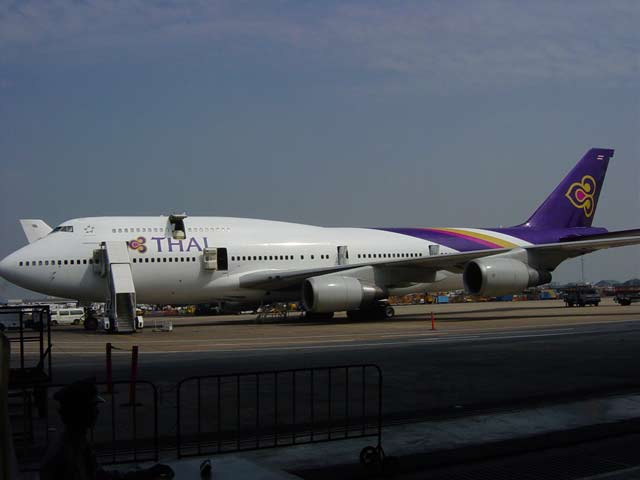
Thai's first 747-400 in the new (far too white) corporate colour scheme. It is not just painting the planes that Thai needs to do. Its first and business class products are woeful compared to other Asian carriers. Its cabin crews are getting a little long in the tooth and less than efficient and the whole thing looks like a badly run state owned enterprise that has relies on state support and protection to manage the bottom line.
A most practical wedding
10 April 2005
The highlight of the royal wedding had to be seeing the royal family piling into large "Windsorian" buses to leave St George's chapel after Charles and Camilla's service of blessing, and head up the hill to WIndsor castle for the post wedding finger buffet!
No carriages, no pomp, no circumstance. Not even a church wedding. Both previously divorced, Charles and Camilla had a registry office wedding.
It was a bit cheesy for a global tv audience. The Queen galloped off after the blessing to go and watch the Grand National horse race. The celebrities who did attend were largely the "B" team. This was not the shining lights that attended Diana's funeral.
There were no family pictures on the steps of the chapel. No words between the Queen and her new daughter-in -law. The "News of the World" described the Queen as the Ice Queen giving Camilla an extraordinary snub. There was certainly no sign of affection between the two. Ah, happy families.
Anyway, good for them. He is 56; she is 57. They are clearly very happy together. Much has been written about Camilla and many comparisons have been drawn to Diana. This time Charles has made the right choice. They will be good for eachother. And she will be a good Queen and a good ambassador alongside Charles. It does not alter my view that I would abolish the monarchy and be done with them; what would the tabloid press find to talk about then?
People make mistakes; they pay the price; but they deserve a second chance.
Dripping in irony
6 April 2005
The big news in China is the same as the big news most days here. It is the continuing battle for influence with Japan. The diplomatic war of words is not abating.
the latest war of words is over re-written Japanese textbooks that are less than truthful in their depiction of the Japanese actions in the second world war. One history book submitted by the right-wing History Textbook Reform Society re-asserts the wartime ideology that Japan's invasions of China, the Korean Peninsula and Southeast Asia were justified acts of self-defence. Apparently, it assisted Asia's liberation from European and American domination.
There is no overt mention of the appalling Japanese atrocities committed in China and elsewhere.
The trouble is that Xinhua, through its editorial comment in China Daily then observes that "a country's prestige is not built on subterfuge, but its acknowledgment of the past". Well I have news for the Chinese, Mao Tse-Tung's cultural revolution was abhorrent and brutal and is there a Chinese text book that acknowledges the massacre in Tianenmen Square in June 1989.
The failure of the Japanese to acknowledge past atrocities is shameful; but China could try leading by example.
Interpreting the incredibly obvious
6 April 2005
Here is the Basic Law and its Article 46:
The term of office of the Chief Executive of the Hong Kong Special Administrative Region shall be five years. He or she may serve for not more than two consecutive terms.
What needs to be interpreted? In July there will be an election for a new chief executive. The Chief Executive when elected should serve for five years. If he resigns before the end of the 5 years a new election is held and a new five year term starts.
The trouble is Beijing does not trust anyone form Hong Kong to run for five years - and the still see Tsang as being connected to the old British regime; so they want to keep their options open and replace him after 2 years (when Tung's term would have ended) if they need to.
Sadly it is not the rule of law that governs "one country two systems."
Meanwhile in China the Basic Law is a massive hit
This Xinhua (that bastion of all that is good in journalism !!) masterpiece is worth reading for its audacious spin ! It would be very funny read if it was not so disturbing !
| Basic Law guarantees prosperity, stability |
| www.chinaview.cn 2005-04-05 08:14:07 |
| BEIJING, April 5 -- The Basic Law of the Hong Kong SAR
was promulgated 15 years ago and has been implemented for almost eight years
since July 1, 1997. The 15 years' history of the SAR's mini constitution has
been a convincing proof that it is indeed a ground-breaking masterpiece and
a piece of legislation that has far-reaching historical and international
implications.
Since its creation and implementation, the Basic Law has brought about the successful return of the SAR to its motherland, and proven itself to be the "guardian angel" of Hong Kong's long-term prosperity and stability. Since Hong Kong's return to the motherland, the SAR government and the local community, with the central government's support, have spared no effort in putting the Basic Law into practice and working together to tackle a series of major political, economic and social problems, thereby sustaining the city's prosperity and stability. As a result, Hong Kong has been able to preserve its capitalistic society, economy, legal system and lifestyle, and its people have been able to enjoy an extent of rights and freedom that is greater than before 1997, as well as democratic rights that were never granted before. During this period, more than 100,000 Hongkongers who had emigrated have returned to the territory and thousands of multi-national corporations have chosen the SAR as the base of their regional operation. Hong Kong has further strengthened its role as the bridge for foreign investors to tap into the mainland market and entrenched its status as the freest economy and the best business location in the world. Certainly, the implementation of the "one country, two systems" blueprint, an unprecedented undertaking, has inevitably been an arduous process of exploration. Over the past eight years, its implementation has undergone obvious shifts of emphasis: from "two systems" to "one country"; from "rights" to "obligations"; and from "separation" to "integration." These three major changes indicate that Hong Kong people's understanding of the Basic Law has improved in terms of both depth and breadth. In implementing the Basic Law, the local society has gradually changed from emphasizing "two systems" to stressing "one country." According to the mini constitution, the Hong Kong SAR is a local administrative region directly under the jurisdiction of the central government, and its high degree of autonomy derives from Beijing. It is, therefore, not conducive to the maintenance of the SAR's prosperity and stability in the long-run if Hongkongers tend to refer to "two systems" and not "one country." This paradigm shift is evident in Hong Kong society's familiarization process with the power of the National People's Congress Standing Committee to interpret the Basic Law. In the present row over the new chief executive's tenure, for instance, there is a growing voice in society calling for the NPCSC to step in and give its interpretation to provisions central to the argument. There is an increasing realization among the local populace that the NPCSC's power to interpret the Basic Law, which is a key component of the constitutional regime prescribed by the mini constitution, will do Hong Kong only good and no harm. The second change in emphasis refers to the local community's tendency in the past to talk about "rights" and not "obligations." The most glaring example is the obsession with the freedom of demonstration and assembly. With instigation by certain politicians, this obsession has led to numerous marches and protests in the city, which has come to be called "the capital of demonstrations" by foreign media. Fortunately, with deepening understanding of the Basic Law, Hong Kong people have come to realize the importance of social responsibility in preserving stability. They are tired of incessant turmoil, quibbling and dissension. Their consensus now is to seek development, stability and harmony. This development has everything to do with a growing sense of responsibility and obligations in the community. Finally, we have seen the shift from stressing "isolation" to underlining "integration." Hong Kong used to adopt an attitude of isolation in the face of economic integration with the mainland. Underscoring the "border" concept, it worried that integration might have a negative impact on the local economy and blur the boundary and hence the differences between the two systems. Yet, with the Individual Travel Scheme, CEPA and the Pan-Pearl River Delta co-operation falling respectively into place, Hong Kong people have soon recognized that the quickened pace of economic amalgamation across the border is a guarantee for Hong Kong's economic prosperity and the trend for future development. Cross-border economic integration will not erase Hong Kong's characteristics. On the contrary, it will give fuller play to the SAR's advantages and uniqueness and sharpen its economic competitiveness. The above three transformations in Hong Kong society during the Basic Law's implementation have attested to the fact that the mini constitution has gradually sunken in, and is being implemented with a fuller and deeper understanding. |
The great firewall at work
6 April 2005
The BBC news on my home page carries the following headline:
China to settle new HK chief row
Guess what; I cannot access that story in Beijing !
Other pages that cannot be accessed through the great firewall include any pages hosted on geocities or blogspot. I cannot even access the Bangkok Wanderers Golf Page !
China's anti-secession own goal
6 April 2005
On March 14, 2005 China's so called Parliamentarians enacted China's anti-secession law; an ill-advised, ill-timed piece of poor legislation.
By announcing that China has the legal right (under its law) to take military measures to invade Taiwan should Taiwan move any further towards independence China has pushed Taiwan a major step forward in that direction and given Taiwan international sympathy through its heavy handed approach.
Hundreds of thousands have protested in Taiwan, just when President Chen appeared to be losing some of his popular mandate.
At the same time the EU appears to be backing away from lifting their arms embargo that was established after the Tianenmen massacre of 1989. The French (who have lost so much political capital in the Middle East) are desperate to legitimately sell arms to China; a move opposed by the Americans.
A PR own goal that will be long remembered and was not necessary.
Beware the inflight meal
6 April 2005
Munir Said Thalib, the leader of the Indonesian human rights group, Impartial, boarded his Amsterdam bound Garuda flight in Jakarta on September 7, 2004.
Upgraded to Business Class he was probably expecting a pleasant 13 hour overnight flight.
Unfortunately he was given a very special meal - laced with nearly 500 grams of arsenic; four times the lethal dose. A Garuda pilot who was assigned as the security officer for the flight was arrested last month, and now two of the flight attendants from that flight are being questioned but have not yet been formally charged.
One of the advantages of the new breed of no frills airlines - no meals !
The passing of a Pope and the meaning of life
2 April 2005
Front page banner headline on the front page of Bangkok's The Nation newspaper today; Pope seems close to death.
Meanwhile in the Bangkok Post; front page banner headline: Fishermen threaten to strike.
I may not be a great fan of the Roman Catholic Church but the death of the Pope is clearly a major global event that is or greater import than the possibility of a strike by Thailand's trawler fishermen demanding lower diesel prices.
Which brings us neatly to the subject of death Which has been a big topic recently as poor Terri Schiavo was artificially kept alive for no apparent reason other than a 15 year family feud. Rather bizarrely woman whose bulimia may have been the cause of the heart failure that left her brain dead was kept alive by a feeding tube. She became a pro-life poster child. Pro what sort of life? She had no life. Let her go loved and peacefully. Remembered for being alive.
Let it be said here and now that should I be incapacitated, brain and/or clinically dead then there are under no circumstances nay anyone try to prolong my life, no force feeding, no clinging onto life through some sort of resuscitator. It is not my intention or desire to cling to earthly life; it is not my intention or desire to be remembered in any bed-ridden vegetative state. I would like to be remembered for being alive; not for being dead while alive.
For any true Christian of course this decision should be easy; they have the quiet promise of an eternal life. Maybe. If that is the case why do I have this sense of science and medicine trying to prolong the Pope's life; does he doubt the afterlife?
There is one area where both the Pope and his supporters have missed an opportunity to benefit many. The Pope is in the final severe stages of Parkinson's disease. He has hardly spoken about it. He could have been a spokesperson for this unpleasant ill-understood disease. Research is often the result of high profile individuals demanding action.