Welcome to rascott.com
This is a
personal site that reflects my interests in news,
current affairs, aviation and travel.
email me: robert@rascott.com
Now In Dubai:
Scott
Consulting
Photo Albums
My photographs have been moved off this site and are now stored on Picasa. They
were simply taking up too much space on my web host.
Please use
this link to see my list of photo albums.
Some
Useful links:
Information:
World Time
Clock
Exchange Rates
Journalism:
ForeignPolicy
Nationsonline.org
Project Syndicate
Amnesty International
Reporters w/o borders
The Guardian
BBC World News
CNN Asia
Bangkok Post
Daylife.com - news
Gulf News
Arabian Business
World News
WSJ - Asia
SCMP
Good causes:
Sister
Joan - Bangkok
Regional Info:
BKK Magazine
HK Magazine
In
Singapore Magazine
TimeOut Dubai
Back in the UK:
Newton Ferrers
And for fun:
Lin Ping live panda tv
EarthCam
History
BBC Archive
National Media
Museum
The British Library
Imperial War Museum
There are many other links on my AOB blog page.
Gig or Gik?
January 31, 2006
A recent phenomenon in Thai society is that gigs (sometimes known as giks) have become more acceptable. A gig or gik is local slang for a fun partner on the side of a steady relationship, but one who is short of being a boyfriend or girlfriend. The idea is that their is no commitment. It is not clear whether or not sex is involved; but if it is not involved then the gig/gik has not really progressed past the friendship stage.
What is unusual is that it is usually women who seek, find and maintain their gig. Men don't have gigs – they have affairs. This means that gigs are mostly men. The girl will go on secret dates with her gig, but the interaction is often limited to romancing, perhaps a kiss, and for the really modern types, maybe sex. Most of the time, the girl only needs someone else to talk to since she’s already bored with the conversations she has with her real boyfriend or she just needs someone else to wine and dine and amuse her.
It will never evolve into a long-term relationship and could end at any time. The gig must understand this or the gig-ship is immediately over.
For a modern Thai woman this reverses tradition. In conservative Thailand it has been perfectly acceptable for men to have "mia nois", to visit massage parlours and karaoke clubs. Many modern women now want to experience a range of choices, like the guys. But they want the security net of a steady boyfriend as well. The steady boyfriend lets the woman continue to look conservative to her family and partner but in her own secret world, known only to her closest friends, she can enjoy romance and adventure with someone who has other qualities.
Because of the lack of any emotional commitment the girl will argue (should she need to explain her actions) that "it was only a gig.” A gig’s status is even lower than a "mia noi" (mistress), since they give everything and gain nothing, apart from the girl’s temporary company. In a gig relationship the argument will be made that it is not an affair; their is no attachment or commitment. Where then are the feelings; the sense of risk, the shared stolen secret moment; all the things that make an affair so full or risk and therefore for many so appealing.
In the end a gig-ship is an affair, but with no emotional reward. This is the lowliest form of modern relationship, and despite the excuses that semantics might provide, we should all be wary about getting into such a mess.
Pretty Woman meets Geisha Girl
31 January 2006
Memoirs of A Geisha is another fine example of Hollywood spoiling one of my favourite books. Everything that I imagine when I read the books is wiped out by Hollywood's insensitive box office appeal. Another such novel was "Snow Falling On Cedars." Wonderful book. Sleepy film. Memoirs is more like Pretty Woman meets Geisha Girl. In this case the tart with a heart is Japanese. Otherwise it is the same romance makes it all worthwhile story. And the hardships, failures and cruelty of the time are glossed over by gorgeous costumes, an amazing set (Kyoto comes to California) and Yo-Yo Ma on the cello.
No expense was spared in making the film. It is just that in the end it lacks intensity and passion. It is embers without fire.
I have no problem with the use of Chinese actresses in the three lead roles. Zhang Zhi-yi, the incomparable Gong Li and Michelle Yeoh are all very fine actresses and are known to western and Asian audiences. They are also bigger box office stars in Japan than any Japanese actress.
Maybe we expect too much. Arthur Golden's novel is a terrific read that presumes to give an insider's view of World War II-era geisha culture. But Golden is an American man from Brookline who combined expert researched with an old-fashioned Gothic romance. The book seems more real than it probably should. The film ends up less real than maybe it could be.
There are some untidy loose ends. The tart with a heart forgets her sister all to quickly. Hatsumomo (Gong Li) is cast out of the geisha house but we do not know her fate. Gong Li is terrific in a now rare film role and plays the bitch with consummate (worrying !) ease.
The problems lie with a wooden script delivered in English which neither Zhang or Li are comfortable with. The Japanese male lead, Ken Watanabe, also struggles with the language. Watanabe remember was wonderful in "The Last Samurai." Instead of the actors using their native languages Zhang, Li and Watanabe have to use pidgin dialogue delivered in often-incomprehensible accents.
Rotiboy; is the taste worth the wait?
30 January 2006
All day and every day the queue lines up along Silom Road from the tiny bakery known as Rotiboy. They sell one single type of coffee flavoured bun for Bt 25 a time. The minimal job satisfaction from baking the same bun all day long is presumably offset by the fact that people are queuing for up to 30 minutes to buy a bun!
I carried out a quick poll around the office. Rotiboy was described as either OK or too oily. Apparently they smell nice; which suggests that standing outside the store for five minutes is better than buying one to eat.
The other, and most popular solution, was to eat a Rotiboy that one of your colleagues has bought. This saves queuing in the heat as well as Bt25 ! If you like a queue check out the picture below.
Field research was completed this afternoon when the maid was dispatched on a Rotiboy run. In summary; they are oily, buttery and leave a quite unpleasant aftertaste somewhat like paint stripper mixed with garlic!
I am not sure about the moniker - buns to die for. Other than the obvious double meaning they really are not that special.
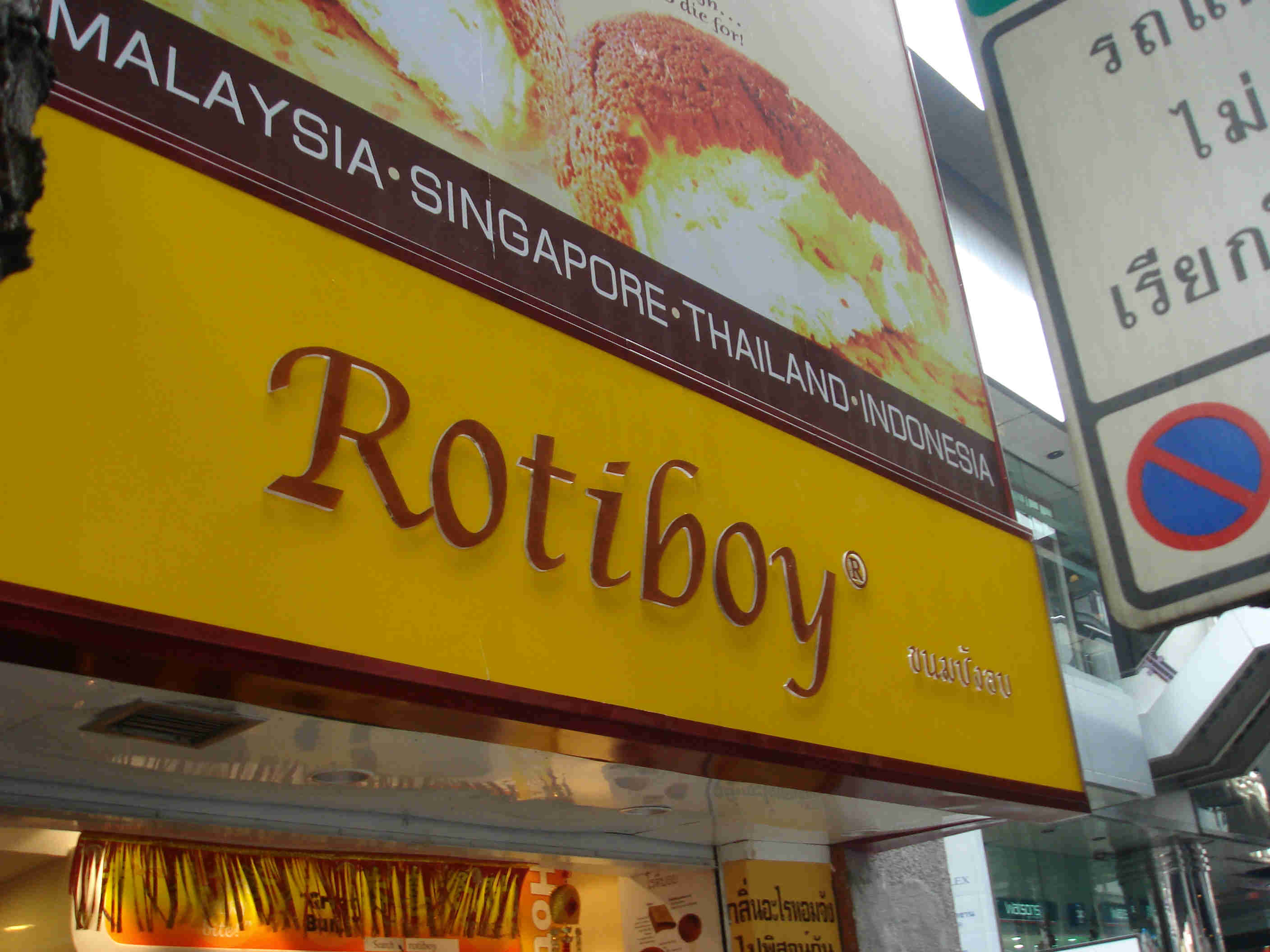
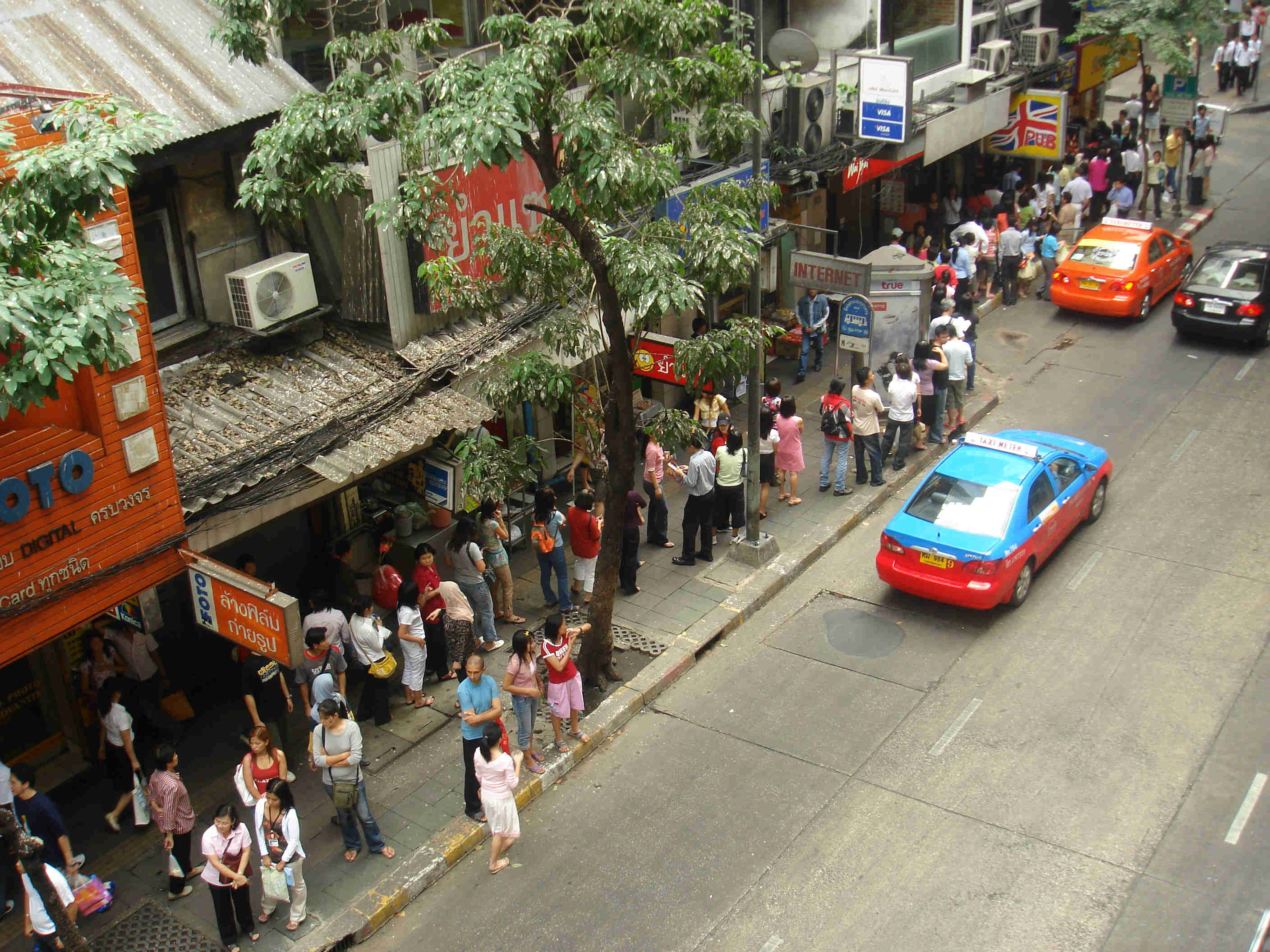


Happy Chinese New Year
29 January 2006

Ample rich indeed
29 January 2006
Ample Rich is a wonderfully named company for the Prime Minister of Thailand. He is that and more. And this Virgin Islands company is now at the heart of the debate over the sale of the Shinawatra family's stake in Shin Corporation to Temasek Holdings of Singapore.
The deal was worth Bt73.2 billion at Bt 49.25 a share for the full 49.6 per cent (1.4 billion shares) held by the Shinawatra/Damapong families. This was their entire stake in Shin Corp.
Temasek paid the full mount to the Shinawatra/Damapong group on 23rd January in exchange for the 49.6 per cent stake in Shin.
The group’s responsibility was to gather all of the 1.4 billion shares of Shin Corp for delivery on the day of the transaction on the Thai stock exchange. But before January 20, the group had only 38-39 per cent of Shin Corp’s stocks under its name. The remaining 10.7 per cent, or 329,200,000 shares, were held by Ample Rich, which has its headquarters in Singapore and s registered in the British Virgin Islands, a widely used tax shelter.
To have a 49.6 beneficial interest in Shin Corp somebody in the Shinawatra/Damapong families had to own the nominee company. Prime Minister Thaksin set up Ample Rich in June 1999 and transferred 329,200,000 shares of Shin Corp to this company in a big-lot transaction through the Thai stock exchange. This resulted in a reduction of his holding from 23.75 per cent to 11.88 per cent. On that same day, Boonklee Plangsiri, Shin’s chief executive, clarified that the transaction would not have any significant bearing on the ownership or management structure of the conglomerate, since Thaksin was the 100 per cent owner of Ample Rich.
On January 20th 2006 Ample Rich sold 164,600,000 shares of Shin Corp each to the two children of Thaksin – Pinthongta and Panthongthae – for Bt1 a share. It is clear that the Shin stake held by Ample Rich had not changed hands throughout the years. This was three days before the takeover deal was to be publicly announced.
Why would Ample Rich sell Shin stocks for Bt1 apiece when the stocks were trading at Bt47-Bt49 on the stock exchange. On Monday 23rd January the two children made a profit of Bt15.88 billion. Remember Prime Minister Thaksin has even said that the decision to sell was made by the children so that their father could concentrate on politics. Has their been a breech of the securities law involving insider information. You decide.
For the Prime Minister the answer is clear: “The hue and cry about the deal boils down to this: envy for my money,” he said. To get ample rich is indeed glorious to misquote a great Chinese leader!
The demise of Google
26 January 2006
Google used to be fun. It was clever; very clever.
All too quickly it has become a big corporate beast that seeks profit at the expense of its founding value. The company motto was "Don't be evil." It set high ethical standards. But those standards were wiped out yesterday when a heavily censored google.cn was launched to help the company become a big player in the second-biggest internet market.
With the launch of google.cn the company can operate within the so-called Great Firewall of China instead of being outside it. Google says it has to do this to compete with domestic search engines such as Baidu, the market leader. The new system, it concedes, has forced it into self-censorship, including removing politically sensitive results from searches. Worse still it leaves only the politically correct results of searches. That said it dies not quite work yet. A search on google.cn for "taiwan independence" gives 2.3million responses, many of which would make Beijing feel highly uncomfortable. Search on pictures and not the web on google.cn and the first picture is the taiwan independence flag. Self censorship is not easy !
Google will note launch email or blogging services in China; such services have previously landed rivals such as Yahoo! and Microsoft into trouble. It admits this is inconsistent with the mission to provide information to everyone but claims it is better than providing no information or a heavily degraded user experience that could lead to a falling market share.
In the end Google has chosen to abandon the principles of free speech and universally available information in order to gain access to a large market in a repressive state. The Guardian newspaper summed up Google's predicament: " It is easy to see why Google is doing this. This does not alter the fact that, sadly and in a significant way, it is not the same company today as it was yesterday."
While this may be a setback for free speech it is the equivalent of trying to stick a finger in an already breached dike. Chinese internet users are armed with mobile telephones and are increasingly well traveled and well informed. They will eventually find out whatever it is that the Chinese government, with the complicity of western internet companies, is trying to hide.
Happy families
24 January 206
The worst kept secret (not that that is saying much) in Thailand was reveled yesterday when Thailand's Prime Minister, Thaksin Shinawatra, sold his company, Shin Corporation, to a consortium led by Singapore's Temasek Holdings for a very attractive, and tax free, US$1.85 billion.
Mr. Thaksin told the press that his children made the decision. He presumably said this with the same straight face that he used when he told the gathered media that he spent the new year in Singapore shopping and eating MacDonalds.
This is the biggest corporate deal ever in Thailand; and the deal cements the relationship between two of Asia's most influential families; the Shinawatras of Thailand and the Lees of Singapore. The Chief Executive of Temasek, Mdm Ho Ching, is the wife of Singapore's Prime Minister, Lee Hsien Loong.
Various members of the Shinawatra family had owned personal stakes in Shin Corp since Thaksin became Prime Minister of Thailand and therefore could not be the nominal owner of the shareholding. Mr. Thaksin's 23 year old daughter Pintongtha was the largest single shareholder and she will net a cool US$500 million from this deal which must make her a very attractive catch. The Shinawatra family and Mr. Thaksin's inlaws, the Damapong family, have sold their entire 49.6% stake in Shin Corporation and no longer hold stock in the company.
Thaksin's own explanation of the transaction was almost "folksy" and designed to appeal to his strong rural Thai support base, He explained that "the stock transaction was not decided by Shin Corp but by my children who want their father to devote his full attention to serving the country", he said. "They want their father to focus on politics and to avoid public criticism about conflicts of interest."
He could have used realistic business reasons to justify the sale; including the one week-old legislation that allows foreigners to own 49% of Thai telecoms firms or an increasingly competitive market that is likely to make it harder to generate huge profits. He could also have explained that with the stock trading near an all time high this was a good time to exit.
Realistically it is the best of all worlds; it is a good time to sell; it creates a massive war chest for future spending and it helps his own brand image. For those people who have accused him of conflicts of interest these are now past and not future and give his opponents one less stick to use.
Thaksin. the first Prime Minister ever in Thailand to be re-elected for a second term, is here to stay. An election is still three years away but already a third term beckons.
A vote for Sven but not from the FA
24 January 2006
The English FA has confirmed that Sven-Goran Eriksson will be leaving their employ after the 2006 World Cup. It is hard to tell who will be the more relieved! So the talk is less about how will England perform at the 2006 World Cup but who will be managing the team by year end.
This is a monumental shambles. The FA have caved into mass media hype; a witch hunt that the zealots would be proud of. The only surprise is that they did not use a ducking chair. If Sven dies from drowning then it proves he is proudly English; if he lives then he is a trecherous swede. What motivation does he have to see England do well at the World Cup. None. What motivation do his players have. Less than before. There will be a new man to please by year end.
Eriksson has enjoyed the loyalty of his players. The squad was stable and just possibly had the best chance of a World Cup success since 1966. Strange how much more loyal the players are than the clowns that run the game.
What the FA have forgotten is that there is no experienced English coach who can take on this poisoned chalice.
Who would want the job. The English media have hounded every previous manager out of the job. The FA will probably bow to pressure and try to find an English manager; McLaren (who is managing a poor Middlesborough team just beaten 0-7 by Arsenal; Curbishley, who has no European experience; Allardyce, manages an ugly team and again lacks experience of managing in international competitions. The cupboard is bare.
My choice - Arsene Venger. But he is way to smart for the FA.
Meanwhile, the Guardian newspaper nicely puts things into perspective in their leader from earlier today:
Leader
Tuesday January 24, 2006
The Guardian
Sven-Goran Eriksson, the England manager, is to leave his post after the World Cup in Germany in the summer. There are pertinent criticisms one can level at him: that his tactics as England's manager have been poor in key games, that his private life has not always been well judged and, most recently, that he (and his agent) should not have fallen for a News of the World sting.
But they pale into insignificance alongside the abuse to which Mr Eriksson has been subjected. It is unfortunately a given of football that the tabloids feel entitled to abuse any England manager - and that some do so with special relish because Mr Eriksson is not English. But, even by these standards, the latest outbursts are clueless.
Mr Eriksson's supposed crime is to have said unguarded things about football that most sane people have long assumed: among them that there is a corruption issue, an agent problem and a bung culture; that some managers are much worse in this regard than others; that Sir Alex Ferguson treats players like children and that Rio Ferdinand is not God's gift to the world. He is denounced by the Daily Mail for "besmirching the reputation of the national game".
In fact, with all his failings, Mr Eriksson is a good manager who should be judged by his record on the pitch. He is also, most of the time, a grown-up in a game collectively in thrall to emotional and moral adolescents. It is the system and the critics, not the manager, who do more to bring English football into disrepute.
Conservatives win in Canada (sort of - eh!)
24 January 2006
Steven Harper will be Canada's new Prime Minister leading a minority Conservative government. People may not have warmed to him but they have decided that he is competent and worthy of some respect.
It is also clear that Canadians wanted change; but that change should be held in check. Harper hit home on what people most want to hear - with pledges to cut taxes and to tackle corruption and violent crime.
The NDP did better than expected; left wing votes shifting from the Liberals to the NDP rather than moving to the centre and to the Conservative. In the collective wisdom the Canadians have said yes to change but only a little please!
In reality this is a disaster for everyone. The Liberal Party has lost the election and needs to find a new leader and a new direction. The Conservatives are back in power but with their hands firmly tied behind their backs. The NDP still remains on the political fringe and the Bloc Quebecois remains the most useless party of all; holding the government at ransom to protect the interests of their economically moribund province.
The actual results were:
| Prediction | Actual 2006 Result | |
| Conservatives | 135 | 124 |
| Liberals | 101 | 103 |
| Bloc Quebecios | 55 | 51 |
| NDP | 17 | 29 |
The lifespan of a minority government has traditionally been less than 2 years. To remain in office Harper will have to rely upon the compliance of opposition parties for his support and on the reluctance of Canadians to have another drawn out expensive election campaign.
Harper can be nothing other than consensual; no extremism here. It is change without risk. At least it does give the country a different focus. It de-emphasises Ottawa; so long the center of political influence. Harper is from the Conservative west. His support will need to come from the Quebec contingent. It will be interesting to see how that impacts the sense of Canadian federalism, if at all.
Canada votes - eh !
23 January 2006
It is election day in Canada today - eh ! The forecast is relatively mild so that should help people get out and vote. This may work in favour of the beleagured Liberals whose voters would have otherwise stayed at home out of sheer apathy.
I have in an earlier article predicted a minority Conservative government. I still think that is likely. I am not sure that the Canadian people are ready to trust Harper and the Conservatives enough to give them a working majority. This will make governing Canada extremely hard work.
At their best the Liberals are still stirred by the idea that Canada must strive to be not only a richer society, but also a more just and compassionate one. But they have lost that plot in a swathe of corruption scandals and hefty expense accounts. They need to rebuild and honestly that is best done in opposition under new leadership.
There are some interesting side notes to the election; there are 45 Indo-Canadians running for Parliament. There will also be a significant number of Chinese Canadians; evidence that the Chinese can indeed be political. The Australian newspaper reported last Friday on a rush on gay marriages here ahead of a possible Conservative victory.
Voting starts in the Eastern provinces at 7.00am and finishes in the West at 10.00pm.
The 2004 election result is shown here together with my forecast for today:
| Party | 2006 rascott.com prediction | June 2004Election result |
| Liberals | 101 | 135 |
| Conservatives | 135 | 99 |
| Bloc Quebecois | 55 | 54 |
| NDP | 17 | 19 |
| Other | 0 | 1 |
The Conservatives need 155 votes for a working majoirty. More as the results come in tomorrow.
A room with a view
23 January 2006
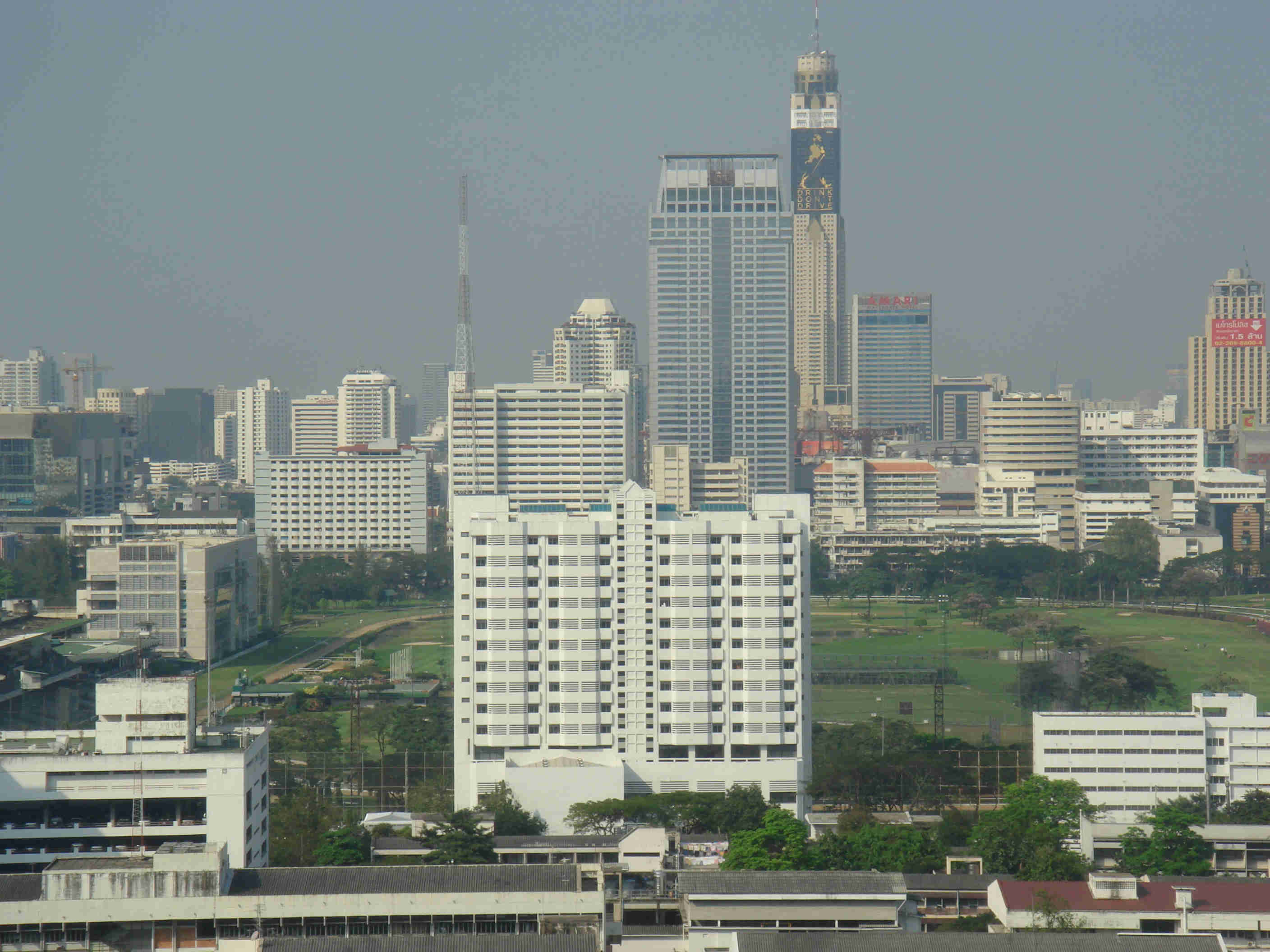
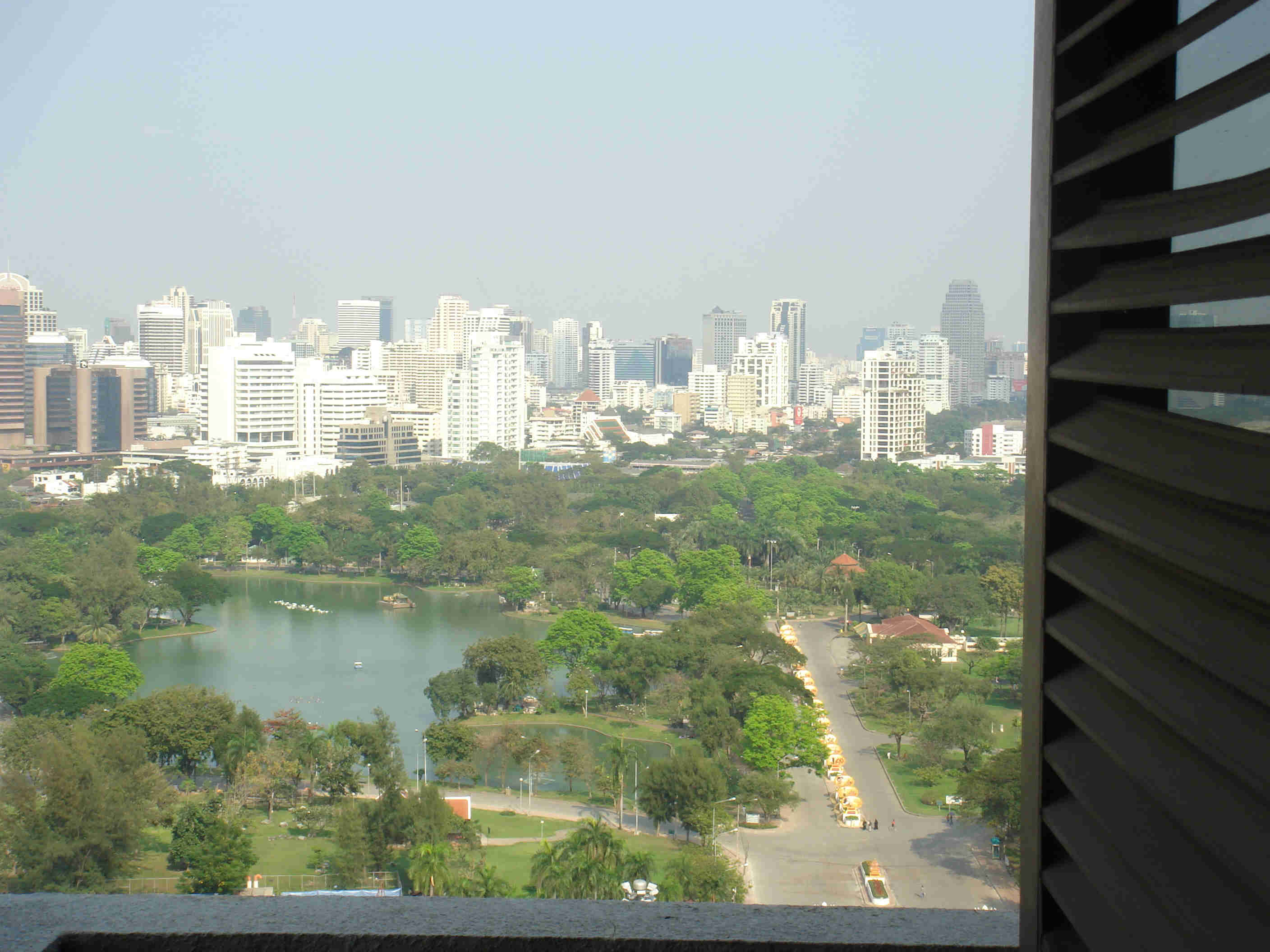
The office view - overlooking the race course of the Bangkok Sports Club and from the mens room (always take your camera) overlooking Lumpini Park !
The large black poster on the Baiyoke Tower (Bangkok's tallest building in the left hand picture) is a Johnny Walker ad that reads "Drink, Don't Drive." Don't drink and drive I understand but this encouragement to drink more seems quite wrong!
West Wing ending May 14
23 January 2006
Just as Presidents have term limits so do TV shows. And as fictional President Jeb Bartlett ends his two terms in office so the highly rated TV series West Wing will come to and end on May 14th at the end of its seven year run.
The show has sufffered a hit in the ratings since its move to Sunday nights although the battle for the Presidency has been critically acclaimed as stand out actors Jimmy Smits and Alan Arkin have taken to their roles as competing candidates.
Writers have also had to deal with the recent death of John Spencer, the Emmy-winning actor who played Vice-Presidential candidate Leo McGarry.
On May 14NBC announced Sunday that the show would end its seven-year run on May 14, when the victor of the current Presidential campaign between Arnold Vinick (Alan Alda) and Matt Santos (Jimmy Smits) is sworn into office.
The April 2 and 9 episodes will cover an eventful Election Day. Episodes in between will strive to achieve closure for the show's many characters.
Spencer died on December 16 of a heart attack (ironically, his character on the show suffered from heart problems, as well) and the storyline has reached a logical end with the end of the second term of the Administration of Josiah Bartlett (Martin Sheen). He will appear in one final episode. The Feb. 12 episode will deal with his character's death. Most of the scenes were shot before the actor's death.
McGarry's death in the series will come five days before Election Day. Since there's no real Constitutional provision as to how to deal with the death of a Vice Presidential candidate that soon before an election, Santos will have the option of announcing a new candidate or keeping quiet and trying to get one nominated through Congress.
The show was of course based upon a Democratic presidency with a very human face. Maybe this is not in tune with a harder Republican America. But the West Wings' public servants were not Cheney and Rove; they were mainly decent, bright and articulate people who believed that what they were doing mattered.
Survivor Thaksin
20 January 2006
Thai Prime Minister Thaksin is the star this week of his own reality show called Backstage Show: with 100 hours of non-stop live TV, and 100 camera crews and four mobile vans following hid every move the Prime Minister is the undisputed star of this 24-hour-a-day live cable television show as he spends a five-day stay with farmers in the poor north-eastern of Thailand.
Political analysts accuse Thaksin of trying to shore up popular support for his government. He spent his first night sleeping in a tent in the yard of the family, whose absent father drives a taxi in Bangkok.
He is due to spend the week listening to grievances from the villagers in the poorest part of Thailand, known as Isaan, and publicising his plans to tackle poverty.
This is a political master stroke. He will now be the first of a new global trend of political reality shows. There is one small issue - you cannot vote Thaksin off the show; but why should you when you elected him as PM in the first place.
Imagine the opportunity; Putin live; a week with George in the bush; on holiday with Tony and Cherie; a week with the Burmese Junta...that would be fun !My Australian friends think that a week with John Howard would be rivetting viewing; a new versions of Neighbours!
Thaksin's stunts may not be appreciated in the smog-filled, traffic blighted city of Bangkok but they are popular with the rural masses where the heart of Thaksin's TRT party support lives. It also helps if the Prime Minister controls the TV broadcast media, as Thaksin largely does.
To add to the fun on the last day nineteen foreign diplomats are expected to join Prime Minister Thaksin Shinawatra in Roi Et. The government invited 53 ambassadors to attend the highly-publicised trip, but only 19 conveniently could make it. Thirteen countries including Indonesia, Russia and South Korea have sent deputies.
Apart from the Nigerian ambassador, there are no representatives from Africa. Ambassadors from Laos and Cambodia, the US and China will be absent.
TV viewers have been rivetted (maybe not) this week with images of the
benevolent Prime Minister doing his bit to alleviate poverty in the North East.
As one of Thailand's richest men, heading one of the the richest families, in
Thailand, this is well within his capabilities. One critic describes him as
"resembling a department store Santa Claus (sitting) on a chair as villagers
lined up to tell him what they wanted."
Thaksin ordered government architects to build a house for one old woman and a
promised another that the government would provide medical care for an ailing
relative.
Bearing a photograph of his missing daughter, one tearful father asked the prime
minister to help him find the girl, whom he feared had been lured into
prostitution.
“Please help me. I have come to the best person who can help me,” the man told
Prime Minister Thaksin. “I will not sleep until I find her.”
For each grievance raised by villagers, Thaksin provided advice or assigned
state officials to take care of them. While visiting one local farm, Thaksin
advised the farmer to build a rice silo.
Throughout the day, the prime minister distributed gifts of cash to villagers.
He also approved a 25-million-baht bridge projectare from Europe and parts of
Asia.
Viewers can watch the show on two channels. The country's dominant pay TV operator, United Broadcasting Corp., is beaming the show live through iPSTAR satellites, owned by a unit of Shin Corp., which the prime minister's family controls. Excerpts of the show are also being carried on iTV, which is a unit of Shin.
Thaksin is the star; he is the director and producer; the overseer of all content. You see what he and his advisors want you to see. It is manipulative. It is an outstanding way to bolster his support in Thailand's provinces.
And it will be a hard act to follow !
Hasty Justice
18 January 2006
The trial of two fishermen accused of raping and murdering British tourist, Katherine Horton, has been concluded only 18 days after her murder.
Wichai Somkhaoyai, 24 and Bualoi Posit, 23, both admitted the charges and have been sentenced to execution by lethal injection.
Thailand's prime minister Thaksin Shinawatra earlier had declared the men should face the maximum penalty because of damage done to the country's image.
The attack took place at 2100 local time on New Year's Day, close to where Miss Horton was staying on Lamai Beach, on the island of Koh Samui.
Her body was washed up the next morning on a remote beach a few kilometres away where it was found by a water biker.
The court heard last Friday how Miss Horton was beaten with a parasol pole and later dragged out to sea off Koh Samui where she drowned. The two men have apparently confessed. The DNA evidence (semen) is according to the court completely convincing.
The accused were swamped yesterday by dozens of reporters and photographers from across the world as they stepped out of the prison van that had brought them in to the provincial court of Surat Thani. They were clearly over whelmed.
It just seems as though it is all too quick and too convenient. There appears to have been little or no case for the defence. No witnesses were called for the defensc. Indeed from the reports of the trial there does not even appear to have been a case presented for the defence. The trial was expedited because it was about the nation's reputation. But the reputation would be more damaged if there is any evidence to subsequently suggest that the wrong men were accused and tried.
There is an appeal period of 30 days. And at a minimum I would be more comfortable with this process if their death sentence is commuted to a life sentence. I am against the death penalty anyway; but in this instance it looks too hasty, too contrived and too influenced by external forces.
Am Amnesty International spokesperson, Sarah Green, said: "Amnesty International opposes the death penalty for all crimes everywhere, because it is an extremely brutal punishment which has never been proven to provide a deterrent to committing crime. In this case, there are serious fair trial questions. The speedy nature of the trial meant the defence may not have had time to prepare an adequate defence, and the prime minister's intervention may have influenced the court."
Something you wont read in the Thai press
15 January 2005
Paradise lost
Katherine Horton travelled to Thailand lured by the promise of a
palm-fringed idyll. Instead she met her death at the hands of two local
fishermen. As they await sentence Lorna Martin uncovers the harsh truth behind
the postcard images
Sunday January 15, 2006
The Observer
When Katie Gill decided to visit Koh Samui during her
round-the-world trip she had an image in her mind of the most pleasurable place
on the planet. Miles of white sandy beaches, clear azure water sparkling in the
sunlight, cheap beachfront accommodation, serenity, solitude and, above it all,
a crown of coconut palms blowing in the breeze. Like many things in life, it
didn't quite live up to the fantasy. She didn't, for instance, expect to see a
giant Tesco superstore or a Starbucks or McDonald's. And it was much busier and
noisier than she'd expected. But she wasn't too disappointed. When she sat on
the sand listening to the waves splashing gently on the shore, it felt as close
as she would ever get to that funny old concept called paradise.
Katie had planned on staying a few days, but after a week decided to abandon the rest of her adventure around the globe and stay for a month - for two months - forever on the small island on the Gulf of Thailand.
On a hot and sticky evening last week, some two years after she arrived, the 25-year-old from Derbyshire, sat outside one of the few remaining bars in the town of Lamai that she still feels safe in, sipping an ice-cold Singha beer.
The pot-holed and flood-damaged road through the town was teeming with traffic, the air thick with dust and petrol fumes. Stalls offering lethal local whisky and fake designer goods competed for pavement space with stray dogs and people selling chickens and ducks. On the narrow road, hundreds of motorcycles tried to out-do each other by constantly blasting their horns, while dilapidated jeeps crawled along, their Tannoys blaring adverts for the best foam parties and Thai lady boxing.
In the glut of neon-lit 'lady bars', drunken, lonely Western men were propped up by groups of beautiful Thai women, giggling and whispering and wondering whether tonight was going to be the night that they would get lucky and hit on a man with a bulging wallet and an urge to get married. Were they shocked by the news, two weeks ago now with the men already caught, of the rape and murder of the Welsh student Katherine Horton? Yes, it seems. But they may well be the only ones.
'It's not paradise any more and I guess it never will be,' said Katie, surveying the scene around her and wondering whether, at 25, it's time to move on. 'For the first time since I came here I don't feel safe. I used to live on the beach and would often walk alone to bars or wander home a little bit drunk on my own. I never felt scared. I used to think in a place like Koh Samui, as a single female, nothing could go wrong. I actually thought it was more dangerous for single foreign guys because they are always getting ripped off by bar girls and lady boys. Now I would be afraid to walk along the beach on my own and I rarely socialise. For the first time in two years I have actually been longing for home.'
She is not the only one. Since the murder on New Year's Day, many British tourists have abandoned the tropical resort, unable or unwilling to accept that the worst horrors of the modern world can also reside in a place they thought was the nearest thing to heaven on earth.
On Wednesday two illiterate and impoverished fishermen, who have pleaded guilty to rape and murder, will be sentenced for the crime. Bualoi Posit, 23, and Wichai Somkhaoyai, 24, could face execution. As they await the judge's ruling, a new picture of Thailand is emerging, a sharp contrast to the palm trees of the brochures. Spiralling violence and corruption on the island is growing amid increasing resentment among some Thais about its unregulated over-development. The Observer has also spoken to British women who claim Thai police do not treat rape seriously. In addition, there are also concerns in some quarters about the quality of the investigation into Katherine's murder.
In Britain, her murder has sparked fears about the safety of backpackers and the dilemma faced by an increasing number of parents in an ever-shrinking and more accessible world. Any parent with an adventurous child must have wondered what they would have done in a similar situation as they listened to the words of Ian Horton. He was nervous about his 21-year-old daughter travelling to another continent. But she had tried to reassure him that she could just as easily be knocked down by a bus at home. 'She was full of confidence,' he said. 'She felt immune to the dangers of the world, as we have all felt when we were young adults. She came to Thailand to dance on a beach, to ride an elephant. Tragically her faith in her fellow man let her down.'
In Koh Samui, Thailand's fastest growing tourist destination, the case has provoked strong emotion. Last week, a planned re-enactment of the murder had to be abandoned after an angry mob surrounded the culprits with wooden clubs. On Thursday, hundreds of local people ventured down to a previously undiscovered stretch of beach to take part in a special Buddhist service where Katherine's body was found. They raised two large white banners in the sand which read: 'The people of Koh Samui would like to offer our most heartfelt condolences to the bereaved family of Katherine Elizabeth Horton.' After prayers and the reading of a specially written poem, each person was handed a single white rose which was thrown into the waves, as orange-robbed monks placed a giant wreath of roses in the sea in the student's memory.
Later that evening, in the beach-huts and resorts along Lamai beach, it remained the sole topic of conversation.
'I am very angry about what happened,' said Piya Chanthong, a well-known local businessman who owns a complex of beachside apartments near where Katherine had been staying and is campaigning for more control over development and extra police officers for the area. 'The people who did this have nothing in their heads. They just drink and watch porn and decide they have to find a lady to rape. In Samui foreign girls have been raped before, but not killed. To rape and kill is very unusual here. That is why everyone is so angry. They are afraid that it is going to make people hate Thailand.'
As he talked, two Thai men wandered along the beach. The looked like walking zombies - stumbling through the sand and clawing at the thin air in front of them. Their eyes were glazed and they seemed oblivious to anything but their own hallucinations, which they appeared to be following and trying to grasp. 'Ton Lamphong,' Mr Chanthong explained, adding that many Thai men chew the highly toxic plant constantly. It is legal but can leave some people who are not used to it completely whacked out for days. It is a small part of a big drug problem on the island.
Fifteen years ago, Koh Samui was a backpacker's secret - a sleepy and unspoilt coconut and fishing island. Then came the dream of The Beach - the film based on Alex Garland's novel starring Leonardo DiCaprio. The island from which tourists visit the film's location was, before the tsunami hit it, so overbuilt that the water supply had been irretrievably poisoned by tourists' waste. These days Koh Samui is bursting at the edges and now rivals Phuket as one of the country's most popular destinations. It has recently experienced a triple boom, benefiting from a financial crisis which suddenly made Thailand very cheap for visitors, the 2002 Bali bombing which discouraged people from going to the Indonesian island, and the 2004 tsunami which devastated the west coast of Thailand but left Koh Samui unscathed.
Last year, during high season, it was so busy that some tourists were found sleeping in temples. For some it is all good news - property developers, the sex trade, wealthy expats and ex-cons are reaping the benefits. Others, mainly backpackers and poor uneducated Thai people, many of whom do not have running water and live in shacks are paying a heavy price. Although still unarguably beautiful in parts, many of Thailand's main beaches and towns have been ruined by the trappings of western tourism. Lamai has been spoken about as the new Ibiza or Faliraki. Premiership football matches are shown in many bars, the Daily Mail is widely available. In addition to such western influences, it has also emerged as one of the largest and least regulated red-light areas in the country. It is not easy to find a bar in Lamai which is not a front for prostitution and many Thais say the scene is now far worse than the once notorious Patpong district of Bangkok. God's joke is that the poor got all the things that the rich so desperately want to buy. In Lamai, it's easy to see his point. The bars are littered with beautiful, svelte erotically confident women. The wobbly, pale, plump tourists, with their money and their leisure wear, holiday socks and sandals look like another species.
There is no doubt that it is now commercial tourism, sex tourism, which draws most tourists to Koh Samui and brings in the big bucks.
Although official figures are not kept, it is estimated that there are around 10,000 prostitutes in Samui alone. Thai officials have an uncomfortable relationship with this side of their country. At least 10 per cent of the total tourist spending is on the sex trade which, although illegal, is tacitly tolerated by the government because of the enormous sums earned from it.
Many Thais hate it. 'There are two types of Thai men,' volunteered Chanthong later as we watched these enthusiastic women at work. He paused while he took a mouthful of his scallop and coconut soup. We were surrounded by pink neon light and screams from the foam party across the road intermittantly pierced the air. 'There are those who work with tourists and those who have come down from the mountains and never come into contact with them. Most Thai men have the same respect for Western women as they do for Thais, but there are some men who see European women topless on the beach and think it is easy to have sex with them. I even have some friends who came down from Bangkok and ask if I can find them a European woman to have sex with. I say it is not like a piece of cake. They don't understand that. I suppose it's the same as the European men who come here thinking Thai women are easy.'
The following day I met other Thais and some ex-pats for breakfast in a tiny fishing village two miles north of Lamai. The village was swathed in an eerie silence. 'Fishermen work at night,' his friend explained. What do they do during the day? 'They sit and look.' Under the palms in the close morning heat, groups of men were squatting perfectly still, gazing out to the blue and placid sea. Here and there a half-hearted game of draughts was in progress. 'These men have come down from the mountains. They earn around 1000 Baht (around £14) a month. They have no running water and live in dilapidated huts with children running around in rags and bare feet.' This is the side of paradise hidden from tourists.
Koh Samui is increasingly becoming a tale of two cities. While it is still possible to rent a beach hut for £10 a night, like the one Katherine had stayed in, they are becoming a rarity. In their place are multi-million-dollar homes and five-star spa resorts. In the next six months, around 20 upmarket health spas are due to open. In these resorts, foreigners are only too happy to pay hundreds, or even thousands of pounds, to starve themselves, undergo colonic irrigation and have daily yoga sessions, but they tend rarely to leave their complexes. Local workers will see little benefit from the continued development of the island, while expats, property developers and corrupt government officials will continue to rake money in.
Although the permanent population of the island is just 40,000, it now draws nearly a million tourists every year. Thailand as a whole hopes to increase its tourist numbers from 14 million to 20 million by the end of 2008.
Unless there are some controls, however, on the relentless overdevelopment of islands such as Koh Samui, many locals fear it will not only spoil the area and the environment, but also lead to an increase in crime.
There is already endemic corruption among police and government officials in Thailand. And, despite Samui's increasing levels of crime, it has only 15 tourist police and a regular force of 200.
'We urgently need more police,' said Chanthong. 'It is not the same island as it was 10 years ago. We need police now to walk along the beaches at night. At the moment you rarely see a policeman in Samui, but there is a lot of violence. As more money pours into the island, people no longer care about their friends.'
He recalled an incident, which happened the same night as the murder of Katherine, in which a 15-year-old Thai boy was stabbed through the heart by another Thai man in a petty argument over money. In another widely talked about incident, three men walked into a bar in early December and shot an off-duty policeman who had been trying to clamp down on the drugs trade. 'Nowadays in Samui people will get shot over a queue for a motorbike taxi,' he said. 'There are more guns in Samui than permanent residents. Gangs of people are trying to control territory and they are prepared to kill to control it.'
Katherine was the seventh British tourist to have been killed in Thailand in the past 16 months, a statistic which has alarmed Thai ministers and British officials. Despite the myth peddled in holiday brochures and assurances from police and politicians that Koh Samui is safe, in the past eight weeks, there have been at least five murders, more than 20 robberies, the same number of violent assaults and around 15 gun-related incidents.
The Observer also understands that there have been at least two more reported rapes on the island since the beginning of December. One involved a 26-year-old British woman who was allegedly raped by two men in the island's busiest resort of Chuweng. The two fishermen charged with Katherine's murder have been linked to this attack. Photographs of them have been sent to the victim but sources in Thailand have said the men vehemently denied any involvement. In the other case, a 12-year-old Swedish girl was allegedly raped by a man who worked in the resort where her family was staying.
Although these are the only known reported rapes, the true level is thought to be much higher. Police in Thailand tend to turn a blind eye to violence in relationships, even if that relationship is little more than a one-night liaison on the beach.
Later that day, I met a group of ex-pat British women, who had lived in Samui for between three and 10 years after first visiting the island as a backpacker. It was hot and humid and bright, with just enough breeze to shake the frangipani. We sat surrounded by lush greenery, sipping fresh coconut juice and discussing island life.
One English woman who asked for her name not to be published said police were dismissive when she asked for help in dealing with a violent ex-boyfriend. 'They asked if the man, who was a Thai, was my boyfriend and when I told him he was my ex they said they couldn't do anything,' she said. 'If there is a violent fight in the street between a man and a woman no one will bat an eyelid. In the case of Katherine Horton, the sad truth is that if she had been raped and not murdered people here wouldn't have been that bothered. There is a view here that if a foreign girl goes for a walk on the beach with a Thai man then she is basically giving him the go-ahead for sex.'
Another woman, Dee Walker, who has lived here for three years with her Thai boyfriend, said she had fallen out of love with the island. 'It is getting more and more like Ibiza,' she said.
The hope among many Thais is that Katherine's murder may focus minds. It may just bring a little more control over the rapid development of the island and its crumbling infrastructure.
Paiant Pangha, a driver in the area, said many ordinary Thais felt their island was being taken away from them and destroyed forever. 'This was once a beautiful island, but it has lost so much of its charm. It resembles a massive construction site, as every inch of land is sold off to developers to build more luxury resorts, with no regard whatsoever for the environment or the natural ecology. There are mafia gangs operating here and lots of ex-cons. Life here used to be plain and simple and easy. But that has all been spoilt.'
As well as government action, he would like to see tourists taking more responsibility when they travel to foreign shores.
'It's terribly sad what happened to Katherine. Every Thai person is deeply saddened by it and hate the men who did that to her. But I also think it is important that as more and more tourists come here, they respect our different culture. I'm not talking about Katherine here but there are many European women who ignore our culture and, for example, run around topless on the beach. I know many Thai men who boast about the number of farangs [foreigners] that they have slept with.
'I just think it would be better for everyone if people respected other peoples' cultures and environments.'
With the eyes of the world's press on them, and because of their fear of inflicting damage on their vital tourist industry, the Thai authorities have acted with unprecedented haste in solving the murder of Katherine. Hundreds of officers were dispatched to the province and in an unusual public appeal, the country's prime minister Thaksin Shinawatra said the killers should receive the 'hardest punishment possible'.
While the efficiency of the authorities is likely to be welcomed by Katherine's relatives and those working in the tourist industry, there are some concerns about the handling of the case. Local reporters have revealed that they were initially told by Thai police to play down the death in order not to damage the tourist trade. The fast-tracking of the court case has also raised some eyebrows. Shinawatra admitted that it would normally take two to three months to prepare the prosecution case then a further few months before the case came to trial. Instead, the entire process, from arrest to conviction, will have been completed in little more than a week.
There have also been some worrying questions raised about the quality of the forensic evidence. Not long after Katherine's body was found, local television reports showed scores of ordinary Thai police officers walking around her. It is also not uncommon for forensic reports in Thailand to be wildly inaccurate.
Despite this, in an interview with The Observer, Voravate Vinitnatayanon, the chief of police for the Surat Thani province, insisted the investigation had been conducted thoroughly. Both men confessed quickly, he said. 'You must trust us. We have good forensic evidence and DNA.' He said initial criticism of the case was unfair. 'We did as much as we could. The case was very unusual. Things like this never happen here. That's why we put 100 officers on the case. We had a jigsaw puzzle to solve. This isn't Scotland Yard. In Thailand, we may do things differently, but it was still a very thorough investigation.'
As dusk crept around the edges of the island, the tourists on Lamai beach packed up their belongings and returned to their apartments. Two young British women remained. As the sun set, they stared out across the sea. Geckos sang and crickets chirped. It could have happened to one of them, or indeed to any young adventurous traveller. Katherine Horton did nothing wrong. As her father said, she felt immune to the dangers of the world, as we have all felt when we were young adults. Katherine Horton came to Thailand to dance on a beach, to ride an elephant. Tragically her faith in her fellow man let her down. Rachel Harrison and her friend Erin Sander, both 26, thought long and hard about coming to Koh Samui. The two friends from Derby had taken three months off work and already spent four weeks on the nearby island of Ko Pha-Ngan. They arrived at their beachside apartment on Thursday. 'It did feel a little eerie walking along the beach,' said Rachel. 'But these things can happen anywhere. We have had a wonderful time in Thailand. People have welcomed us into their homes and looked after us. This is awful for Katherine's family, and it is a tragic reminder of how careful travellers have to be and of how random and fragile life is.'
Erin agreed that it would not put her off travelling. 'I would never devalue what has happened. It's awful. But parents can't keep their children in a cocoon. They have to let them fly. You can't stay in the basement and be afraid to travel the world. There is too much in this world to see and explore and experience.'
"Budget Terminal" - Singaporean originality!
14 January 2005
Singapore's newest airport terminal will be operational in March of this year. Especially built to meet the needs of passengers flying point to point on the low cost carriers the terminal has been graced with the outstandingly original name of "Budget Terminal"!
Remarkably a contest was needed to come up with this name ! And there were 12,000 entries.
The new terminal covers 25,000 square metres and can handle 2.7 million passengers a year. The terminal could be expanded to manage 5 million.
This is a first for Asia; the first dedicated low cost air terminal in the region.
There will be retail and food outlets as well as free internet and free local calls for passengers. There will be no air-bridges and passengers will either walk or be bussed to and from their airplane.
Twelve years is enough; where Canada goes the UK will follow.
11 January 2006
I bet you have all been wondering what is happening in the Canadian election campaign which ends with a vote on January 23rd.
There is no doubt that Canadians are bored with twelve years of Liberal government. They see 67 year old Paul Martin as tired and listless. They see his party as the beneficiary of corrupt actions and they see complacency. Martin is a decent man. He was a good finance minister. He has not been able to successfully assume the role of Prime Minister. He simply lacks the pr talent that is so necessary for a modern leader. And frankly his age does count against him.
Meanwhile during the 5 week campaign Stephen Harper, as leader of the Conservatives, has shown that he is not quite such an aloof extremist as the Liberals would portray him. "He will never be warm and fuzzy, but has managed to come across as reasonable, solid and not the least bit scary. For many voters he now represents safe change," said the lead editorial in the Globe and Mail newspaper on Tuesday.
It is indeed sad that the Liberals are portraying Harper's closeness to the US as a bad thing for Canada. The US is Canada's largest trading partner by a country mile. It is also Canada's best, biggest and closest ally. They even watch the same bad TV programs and play the same advertisement interrupted sports.
The Liberals argue that Harper has views and values out of step with most Canadians. The trouble with the Liberals is that they themselves have failed to display the values of decency, honesty and accountability associated with being Canadian.
After 12 years of Liberal government it is time for a change.
If there were an election in the UK exactly the same arguments would apply to Blair's tired government. Gordon Brown is a solid and effective Chancellor. He will, like Mr. Martin, struggle as Prime Minister; inheriting a party built be someone else (Chretien in Canada; Blair in the UK) and that needs to find its values and personalities in opposition rather than in government.
Mr. Harper will likely be the next Canadian Prime Minister; albeit with a minority government supported by the Bloc Quebecois. Mr. Martin will do the decent thing and retire gracefully from politics to write a vitriolic memoir!
The freedom to Blog
11 January 2006
Microsoft has deservedly run into a barrage of abuse for removing Michael Anti's blog on MSN spaces. Microsoft argued that they did so "after Chinese authorities made a request through a Shanghai-based affiliate of the company."
They claim they had to do so in compliance with Chinese law.
What law was being broken? Microsoft received an indirect, verbal request and
the they removed information from a US based server.
US companies overseas are restrained from claiming advantage through financial acts by the Foreign Corrupt Practices Act. But if these values are meaningless if companies fail to respect freedom of speech and human rights There is a strong case now for something similar to the FCPA, forbidding US companies from assisting foreign governments to curb any democratic initiative. The Los Angeles Times editorial gets to the point succinctly.
(Picture from http://sheep-dog.blogspot.com - isn't photoshop wonderful) This is the sort of corporate publicity that really deserves to hurt Microsoft).
Editorial in the Los Angeles Times 10 January 2006.
"AFTER MICROSOFT SHUT down a popular Chinese-language blog
recently, a barrage of anti-Microsoft messages began zinging around the
blogosphere in China. One of them took that famous photo of a lone student
blocking a line of tanks near Tiananmen Square and superimposed the Microsoft
logo on each tank.
Such an image is unlikely to improve Microsoft's reputation in China. It may
even be more damaging to its prospects than irritating China's propaganda
ministry, gatekeeper of all information-based business and the minder that
Microsoft and other Western media companies are constantly trying to please.
Doing business in China requires flexibility. The law, where it exists, is often
irrelevant; it is the decision-making of individual officials that matters.
Western businesses sometimes have to bend over backward to please officials in
order to secure access to China's enormous market. Sometimes they go too far —
and this appears to be one of those times.
Late last month, Microsoft deleted a blog from the MSN online service after the
author, a Chinese journalist using the name "Anti," applauded striking
journalists at the Beijing News who were protesting the firing of their
independent-minded editor. A strike at a Beijing newspaper is not a common
event. But it is not a politically incendiary one, nor was it secret, having
been widely reported on the Internet.
China's Communist Party believes in the control of information. Yet it has
steadily undercut that control by pushing economic change, effectively deciding
that more information is OK if it means a broad rise in living standards. As a
result, young people in China today have access to almost the same Internet as
young people in any other country.
That has not stopped China's authorities from trying to limit access to
information that doesn't serve their goals. They still deploy more than 30,000
tech-savvy police to monitor e-mail and block selected websites, often the ones
with words such as "democracy" in their title. In a few cases, they have jailed
Internet users who spread items considered anti-government. More than anything,
China's Internet police provide their leaders with the impression that they have
some modicum of control over an unwieldy landscape. That is their prerogative.
However, U.S. companies such as Microsoft, Yahoo and Google have a
responsibility to their shareholders to stand up for the profitable operation of
their businesses in China. Trying to anticipate every concern of the propaganda
ministry is no way to win long-term customers. Fighting for the right to conduct
business fairly and reasonably is the mark of every Western company that has
succeeded in China.
U.S. companies also have an obligation, as leaders in a global medium defined by
open information, to protect basic rights of individuals to express themselves
without censorship — within reason.
"Within reason" are the key words here. It is within reason for China to demand
that U.S. companies comply with Chinese laws and regulations. What is not within
reason is a Chinese demand for compliance with unwritten whims."
The quiet death of freedom
10 January 2006
In a cover piece for the "New Statesman", John Pilger describes how, in Britain and the United States, the touchstones of justice and freedom, such as habeas corpus, are being discarded. Pilger is an important writer. He is the balance to the faithful Blair and Bush speechwriters who try to convince us each and every day that the post Saddam world is a better place; that the Iraq invasion was justified.
A friend of mine from China wrote of George Bush as being stupid. No he is not stupid; but he is dangerous. You don not become President of the USA by being stupid. You do it by surrounding yourself with very able people. In Bush's case with ambitious people with a clear and threatening agenda.
Harold Pinter in his Nobel Prize acceptance speech in December said "we have brought torture, cluster bombs, depleted uranium, innumerable acts of random murder, misery, degradation and death to the Iraqi people and call it 'bringing freedom and democracy to the Middle East'.
It should be no surprise that some of the most articulate critics of the policies of Bush and Blair come from Britain. Bush has conjured a society that lives in anxiety, uncertainty and fear. His administration feeds off that to justify their actions.
Yes the US does much that is good through its humanitarian expenditure but that is best done through charity and not through government. The US is in the classic offense is the best form of defense gambit.
There are signs of disquiet in the US. In the same way as public pressure eventually led to the US withdrawal from Vietnam. But this administration will not give up on its goal of controlling Iraq and using Iraq as a beachhead in the Middle East. And the still scared people of the USA will give Bush the benefit of the doubt - for now.
You may not agree with all Pilger writes but we need him and people like him to force the debate and to make us think how much of our freedoms are we willing to sacrifice.
And most important of all be grateful that such debate can still take place. John Pilger would struggle to make a living as a journalist in China for instance!
THE QUIET DEATH OF FREEDOM
On Christmas Eve, I dropped in on Brian Haw, whose hunched, pacing figure was just visible through the freezing fog. For four and a half years, Brian has camped in Parliament Square with a graphic display of photographs that show the terror and suffering imposed on Iraqi children by British policies. The effectiveness of his action was demonstrated last April when the Blair government banned any expression of opposition within a kilometre of Parliament. The High Court subsequently ruled that, because his presence preceded the ban, Brian was an exception.
Day after day, night after night, season upon season, he remains a beacon, illuminating the great crime of Iraq and the cowardice of the House of Commons. As we talked, two women brought him a Christmas meal and mulled wine. They thanked him, shook his hand and hurried on. He had never seen them before. "That's typical of the public," he said. A man in a pin-striped suit and tie emerged from the fog, carrying a small wreath. ""I intend to place this at the Cenotaph and read out the names of the dead in Iraq," he said to Brian, who cautioned him: "You'll spend the night in cells, mate." We watched him stride off and lay his wreath. His head bowed, he appeared to be whispering. Thirty years ago, I watched dissidents do something similar outside the walls of the Kremlin.
As night had covered him, he was lucky. On 7 December, Maya Evans, a vegan chef aged 25, was convicted of breaching the new Serious Organised Crime and Police Act by reading aloud at the Cenotaph the names of 97 British soldiers killed in Iraq. So serious was her crime that it required 14 policemen in two vans to arrest her. She was fined and given a criminal record for the rest of her life.
Freedom is dying.
Eighty-year-old John Catt served with the RAF in the Second World War. Last September, he was stopped by police in Brighton for wearing an "offensive" T-shirt, which suggested that Bush and Blair be tried for war crimes. He was arrested under the Terrorism Act and handcuffed, with his arms held behind his back. The official record of the arrest says the "purpose" of searching him was "terrorism" and the "grounds for intervention" were "carrying placard and T-shirt with anti-Blair info" (sic).
He is awaiting trial.
Such cases compare with others that remain secret and beyond any form of justice: those of the foreign nationals held at Belmarsh prison, who have never been charged, let alone put on trial. They are held "on suspicion". Some of the "evidence" against them, whatever it is, the Blair government has now admitted, could have been extracted under torture at Guantanamo and Abu Ghraib. They are political prisoners in all but name. They face the prospect of being spirited out of the country into the arms of a regime which may torture them to death. Their isolated families, including children, are quietly going mad.
And for what? From 11 September 2001 to 30 September 2005, a total of 895 people were arrested in Britain under the Terrorism Act. Only 23 have been convicted of offences covered by the Act. As for real terrorists, the identity of two of the 7 July bombers, including the suspected mastermind, was known to MI5, and nothing was done. And Blair wants to give them more power. Having helped to devastate Iraq, he is now killing freedom in his own country.
Consider parallel events in the United States. Last October, an American surgeon, loved by his patients, was punished with 22 years in prison for founding a charity, Help the Needy, which helped children in Iraq stricken by an economic and humanitarian blockade imposed by America and Britain. In raising money for infants dying from diarrhoea, Dr Rafil Dhafir broke a siege which, according to Unicef, had caused the deaths of half a million under the age of five. The then Attorney-General of the United States, John Ashcroft, called Dr Dhafir, a Muslim, a "terrorist", a description mocked by even the judge in his politically-motivated, travesty of a trial.
The Dhafir case is not extraordinary. In the same month, three US Circuit Court judges ruled in favour of the Bush regime's "right" to imprison an American citizen "indefinitely" without charging him with a crime. This was the case of Joseph Padilla, a petty criminal who allegedly visited Pakistan before he was arrested at Chicago airport three and a half years ago. He was never charged and no evidence has ever been presented against him. Now mired in legal complexity, the case puts George W Bush above the law and outlaws the Bill of Rights. Indeed, on 14 November, the US Senate effectively voted to ban habeas corpus by passing an amendment that overturned a Supreme Court ruling allowing Guantanamo prisoners access to a federal court. Thus, the touchstone of America's most celebrated freedom was scrapped. Without habeas corpus, a government can simply lock away its opponents and implement a dictatorship.
A related, insidious tyranny is being imposed across the world. For all his troubles in Iraq, Bush has carried out the recommendations of a Messianic conspiracy theory called the "Project for a New American Century". Written by his ideological sponsors shortly before he came to power, it foresaw his administration as a military dictatorship behind a democratic facade: "the cavalry on a new American frontier" guided by a blend of paranoia and megalomania. More than 700 American bases are now placed strategically in compliant countries, notably at the gateways to the sources of fossil fuels and encircling the Middle East and Central Asia. "Pre-emptive" aggression is policy, including the use of nuclear weapons. The chemical warfare industry has been reinvigorated. Missile treaties have been torn up. Space has been militarised. Global warming has been embraced. The powers of the president have never been greater. The judicial system has been subverted, along with civil liberties. The former senior CIA analyst Ray McGovern, who once prepared the White House daily briefing, told me that the authors of the PNAC and those now occupying positions of executive power used to be known in Washington as "the crazies". He said, "We should now be very worried about fascism".
In his epic acceptance of the Nobel Prize in Literature on 7 December, Harold Pinter spoke of "a vast tapestry of lies, upon which we feed". He asked why "the systematic brutality, the widespread atrocities, the ruthless suppression of independent thought" of Stalinist Russia was well known in the west while American state crimes were merely "superficially recorded, let alone documented, let alone acknowledged".
A silence has reigned. Across the world, the extinction and suffering of countless human beings can be attributed to rampant American power, "but you wouldn't know it," said Pinter. "It never happened. Nothing ever happened. Even while it was happening it wasn't happening. It didn't matter. It was of no interest."
To its credit, the Guardian in London published every word of Pinter's warning. To its shame, though unsurprising, the state television broadcaster ignored it. All that Newsnight flatulence about the arts, all that recycled preening for the cameras at Booker prize-giving events, yet the BBC could not make room for Britain's greatest living dramatist, so honoured, to tell the truth.
For the BBC, it simply never happened, just as the killing of half a million children by America's medieval siege of Iraq during the 1990s never happened, just as the Dhafir and Padilla trials and the Senate vote, banning freedom, never happened. The political prisoners of Belmarsh barely exist; and a big, brave posse of Metropolitan police never swept away Maya Evans as she publicly grieved for British soldiers killed in the cause of nothing, except rotten power.
Bereft of irony, but with a snigger, the BBC newsreader Fiona Bruce introduced, as news, a Christmas propaganda film about Bush's dogs. That happened. Now imagine Bruce reading the following: "Here is delayed news, just in. From 1945 to 2005, the United States attempted to overthrow 50 governments, many of them democracies, and to crush 30 popular movements fighting tyrannical regimes. In the process, 25 countries were bombed, causing the loss of several million lives and the despair of millions more." (Thanks to William Blum's Rogue State, Common Courage Press, 2005).
The icon of horror of Saddam Hussein's rule is a 1988 film of petrified bodies in the Kurdish town of Halabja, killed in a chemical weapons attack. The attack has been referred to a great deal by Bush and Blair and the film shown a great deal by the BBC. At the time, as I know from personal experience, the Foreign Office tried to cover up the crime at Halabja. The Americans tried to blame it on Iran. Today, in an age of images, there are no images of the chemical weapons attack on Fallujah in November 2004. This allowed the Americans to deny it until they were caught out recently by investigators using the internet. For the BBC, American atrocities simply do not happen.
In 1999, while filming in Washington and Iraq, I learned the true scale of bombing in what the Americans and British then called Iraq's "no fly zones". During the 18 months to 14 January, 1999, US aircraft flew 24,000 combat missions over Iraq; almost every mission was bombing or strafing. "We're down to the last outhouse," a US official protested. "There are still some things left [to bomb], but not many." That was six years ago. In recent months, the air assault on Iraq has multiplied; the effect on the ground cannot be imagined. For the BBC it has not happened.
The black farce extends to those pseudo-humanitarians in the media and elsewhere, who themselves have never seen the effects of cluster bombs and air-burst shells, yet continue to invoke the crimes of Saddam to justify the the nightmare in Iraq and to protect a quisling prime minister who has sold out his country and made the world more dangerous. Curiously, some of them insist on describing themselves as "liberals" and "left of centre", even "anti-fascists". They want some respectability, I suppose. This is understandable, given that the league table of carnage of Saddam Hussein was overtaken long ago by that of their hero in Downing Street, who will next support an attack on Iran.
This cannot change until we, in the west, look in the mirror and confront the true aims and narcissism of the power applied in our name: its extremes and terrorism. The traditional double-standard no longer works; there are now millions like Brian Haw, Maya Evans, John Catt and the man in the pin-striped suit, with his wreath. Looking in the mirror means understanding that a violent and undemocratic order is being imposed by those whose actions are little different from the actions of fascists. The difference used to be distance. Now they are bringing it home.
John Pilger's new book, Freedom Next Time, will be published in June by Bantam Press.
First published in the New Statesman - www.newstatesman.co.uk
Thaksin's misplaced praise of Singapore's media
10 January 2006
Thai Prime Minister Thaksin Shinawatra on his return from a family new year holiday in Singapore has described how “thrilled” he had been to read the city state's newspapers.
Thaksin believes that the Thai media should follow the Singaporean example and keep their political news coverage to a minimum while focusing on new innovations and economic opportunities.
He is right about one thing; he will have found nothing critical of the Singaporean government in the newspapers there.
Thaksin's argument is that journalists would do a better service for the country by concentrating on “more constructive stories”. But using the Singapore media as an example for Thai (or any other) journalists to follow is an insult to the intelligence of the Thai public.
The reason the Singaporean media are so devoid of political news is that there is no politics to cover in the first place. The island nation is essentially under a one-party rule that tolerates no criticism or dissenting views. There is no meaningful opposition. The media is state controlled. And those in power are safe from scrutiny.
No wonder Thaksin sees this as such a great example. Being able to rule free of criticism and scrutiny. But that is not the democratic way and the values that this country has embraced mean that he has to govern for the good of the people. Democracy means accountability; debate; censure; bouquets and brickbats!
Thailand is fortunate to have civic groups, NGOs and an active written media that examine and report upon the corruption, incompetence, cronyism and conflicts of interest that plague the current administration. It is not all one sided. The media is not slow to show support or to praise either.
Political news will continue to make headlines while Sondhi continues his weekly critique of the administration and with infighting among the factions that make up the governing TRT.
This is not the time to rid Thailand of political news; this is time to engage and discuss how the country can embrace economic and personal liberty. Every CEO is accountable to his or her shareholders.
Thailand's Grand Invitation in 2006
6 January 2006
The Tourism Authority of Thailand's 2006 campaign is known as the Grand Invitation and various events have been proposed throughout the year.
This starts with the Royal Trophy: Europe VS Asia Golf
Championship in Chon Buri from January 7 to 8. Celebrations for Chinese New Year
will follow on January 29-February 3.
TAT will hold the Grand Bangkok International Film Festival from February 17 to
27. In March, the agency will run the Grand Music and Dance Festival on Pattaya
Beach from March 17 to 19. If last year is anything to go by Pattaya is just
packed that weekend.
The Grand International Kites Festival will be held in Hua Hin from March 11 to
15, and the Grand Songkran Festival will be held between April 13 and 15. On May
11, the Royal Ploughing Ceremony will be held in Bangkok.
In June, the spectacular royal barge procession will be held for Bangkok's 60th
anniversary celebrations of His Majesty the King's accession to the throne. Many
countries will be sending visiting royals and other officials to celebrate this
rare royal anniversary. And on July 5 through 11, the Grand Candle Festival and
International Candle Carving Competition will be held in Bangkok and Ubon
Ratchathani.
August has the celebration of Her Majesty the Queen's birthday on the 12th. Bars
are usually closed ! You are warned.
The Grand International Boat Races are scheduled for September 9 and 10 in Muang
Phra Nakhon Si Ayutthaya.
Come October and there will be a another royal barge procession during the Royal
Kathin ceremony on the Chao Praya River in Bangkok.
In November tourists and locals can also look forward to Andrea Bocelli's royal
concert at the world heritage site in Muang Phra Nakhon Si Ayutthaya and the
Grand Loi Krathong Festival.
The grand opening of Royal Ratchaphruek 2006 will be held in Chiang Mai from
November 1 to 12.
On December 5 is the celebration of HM the King's birthday. The Grand Jazz
Festival in Bangkok will be held on December 19 and 20. And finally, the year
will end with the New Year's celebrations around the country.
Some Predictions for 2006
3 January 2006 (I may add to this list if enlightenment strikes)
Thailand
Sondhi will limp quietly away,
The airport will open - September 2006.
Bar opening times will slowly move back to 2am.
Asia
There will be increasing controversy over China's economic power translating into increased military force. The reality on this issue is somewhat different. China's military budget, according to American estimates, is about $90 billion: still only a fraction of the more than $400 billion the U.S. spends annually.
Energy supplies will dominate political tensions as India and China increasingly compete for access to the energy supplies of Central Europe. Russia, by cutting off gas supplies to the Ukraine, has already shown how a major producer can use energy supplies as an effective political weapon.
Singapore will allow a limited distribution of Playboy magazine. No one will buy it.
Qantas and Singapore Airlines will start major merger discussions. So will Cathay Pacific and Air China.
Anson Chan will announce her intention of standing as Chief Executive of the Hong Kong SAR at the end of Donald Tsang's short term.
Politics
The USA will begin its withdrawal from Iraq with a troop reduction of at least one half by the end of teh year.
Tony Blair will quit sometime in the year, after his 10th anniversary as PM in May. Chancellor Gordon Brown will take over the Labour Party presiding over a weakening economy, a widening budget deficit, and with none of the international goodwill Blair enjoys.
Expect the Germany economy to be the fastest growing in Europe this year. There is a new credible government. Costs have been cut. Productivity improved. The World Cup boosts tourism. All good news for what was an ailing country.
The US will increase pressure on Iran; this is the new crisis point in the Middle East. Bush will seek UN consensus to attack alleged Iranian nuclear facilities. He wont get UN support. He wont be able to go it alone; not this time. And Iran is counting on that.
Saddam Hussein will be found guilty; will lose his appeal and will be executed. Finding him guilty is fine. Executing him is petty and wrong.
Immigration will be a big issue in European politics and may derail Turkey's entry into the EU. There will be race riots in Europe from both sides. Disenfranchised immigrants as in Paris in 2005 and nationalist protests against immigration levels to western european countries.
Sport
The World Cup winners will be........Brazil....nothing original there.
Tiger Woods will become a father; the only question is whether they have a cub or a baby!
Michael Vaughan will not be England's cricket captain for the 2006/7 Ashes Tour. Form and injury will hurt him in 2006. There are a number of potential successors. Andrew Strauss is a strong candidate.
England will see the error of their ways and make Frank Lampard captain before the 2006 World Cup instead of David Beckham.
Technology
Wi-fi will be free to all. At least in some major US and Canadian cities....and this will start a global trend of free wi-fi access. This will lead to a de-emphasising of desktop computing and a faster move to the mobility of laptops.
Following the success of Skype for home consumers suppliers will announce low-cost, integrated voice, data and video conferencing solutions at work.
Me
The big question is where will I be living be the end of the year? I simply do not know!
10 Handicap by year end.
At least one trip to England in the year and at least one long trip to somewhere I have never been to before.
Still single....and well past my mid life crisis !
Sex Toys 'R' Us
1 January 2006
Some 70% of the world's sex toys are made in China. Strange but true. Yet this massive industry has hardly made any in roads into the Asian retail industry or home; with the remarkable exception of Japan, where the sex industry continues to boldly go where no fetish has gone before.
One simple explanation is that the sex toy industry is a product or modern, industrial, consumer-driven, urban societies only. It is also far more visible in open cultures with limited censorship of the media and with fewer state regulations over the actions of consenting adults.
I was thinking about this article as I walked along Oxford Street and Tottenham Court Road in London's West End. Oxford Street is the heart of London's shopping. Yet as you walk along the street you will see a number of "adult stores" where people walk in and out as though they were shopping at a virgin (no pun intended!) mega store. These places are no longer taboo; they have become mainstream. They are visited by couples not just rain-coated guys!
Indeed supermarket giant Asda and high street drug store, Superdrug, have both started selling vibrators....I think I'll run out and get the Cornflakes and a vibrator, dear !Sex toys have been available for hundreds of years.
The first documented use of a dildo comes from 3rd century Greece, where merchants sold something called an olisbos. In Renaissance Italy, the olisbo morphed into the dildo probably from the Italian diletto, which means ‘to delight’. Modern rubber dildos, resembling the ones we see today, came into being in the mid-19th century.
But if you want to play with toys in Asia, best to bring your own! Take Thailand as an example. A country with a quite relaxed view on sex between consenting adults; where it is common for Thai men to invest in mia noi (minor wives), where massage parlours and karaoke are open about providing sexual services for Thais and for visitors, a country that is open to adult visitors who come to meet available Thai women. But is there an Ann Summers store (http://www.annsummers.com) to be found anywhere. Not at all. Sex is left for the privacy of the home or hotel room. What girl could resist a rampant rabbit thruster!
In China there appears to be something of a sexual revolution; fuelled by a young and educated population who write about their exploits online. Indeed the bedroom is the one place the Chinese government cannot monitor and young people are taking advantage. Not only are they having more sex than their parents ever did, they are doing it far earlier.
Last year Yahoo Inc acquired a major stake in the Chinese online market place company - Alibaba. This site is a great source of information about the availability of a wide range of sex industry products that are made in China.
Try Ningbo Sowona Fashion Industrial Manufactory or IREX Industry (HK) Co., Ltd. Search for adult toys at Alibaba and you get 295 Selling Leads, 249 Products, 161 Companies.
But can you buy these products in China. They certainly do not appear to be on your local high street. It also begs the question what the average factory worker thinks about such products and the apparent decadence, or liberal values, of the west. Chinese manufactures and sales outlets justify their business by arguing that they help promote marital harmony and keep the population growth in check by allowing people to indulge in sexual activity without engaging in real sex. They could of course just use a condom!
In India, a country which claims responsibility for the Kama
Sutra it is in fact illegal to even use a sex toy. There is no Indian
manufactures of sex toys. Most of the apparatus available in India are either
manufactured in China or personally imported.
"Though we recommend the usage of sex toys to couples or single person for
sexual gratification, we cannot advice it legally. Besides we cannot suggest
them a place to buy. It's sad for a country where the first treatise on sex was
written," wrote Dr. Mahesh Nawal, Indore based sexologist.
As a service to my reader enthusiasts can apparently purchase the toy of their
choice in Delhi, at the Lajpat Rai Market in Chandni Chowk and at Gaffar Market
in Karol Bagh. In Mumbai you can shop in the Fort area.
Singapore is repressed. In so many ways Singapore represents a vibrant modern society with significant disposable incomes and very consumer driven. Oral sex is still taboo. But the city state did host its first ever sex exhibition - Sexpo 2005. Part of the pitch to the government by the organisers was that such a show could boost the sex drives of young Chinese professionals encouraging family growth! There were three popular "health boutiques" that sold sexy lingerie and colorful dildos. The stampede at the checkouts reflecting the major shortage of such items on offer in Singapore and the surrounding region.
There is some interesting writing from Singapore - from the girls not the guys; what is it about Singaporean girls that makes them more open and more creative...try http://singleserves.blogspot.com/
As for Japan; the Shukan Post reported in December that just about every young woman is carrying around her own vibrator. In Japan the sleazy image has been replaced by "adult goods."
Eiko Yamada,
proprietor of Shesta, an adult good shop targeting women, says the number
of adult aid users is skyrocketing, particularly among women in their late 20s
to early 30s. "Our sales are almost 200 percent what they were last year,"
Yamada told Shukan Post.
Japan's adult aid market for women has evolved quickly. Instead of expensive
toys that were either egg-shaped or made to look like a male organ suppliers are
now catering to female buyers and selling toys in all sorts of shapes so complex
it's hard to even tell they're vibrators. You can get some that warm human skin,
others that emit a sweet smell when they're turned on. Prices vary, too, with
the range starting at about 3,000 yen (US$30) nd going through to really classy
models in the vicinity of 10,000 yen.
In Japan this is known as the "My Vibrator" phenomenon. Stores cater to single
women and couples and store employees are women. Online sales offering
anonymity have also become the norm and sparked explosive sales growth.
Is this the future for the rest of
Asia. Imagine the retail potential in China or India when (not if) they go the
way of the Japanese and so many western countries.