Welcome to rascott.com
This is a
personal site that reflects my interests in news,
current affairs, aviation and travel.
email me: robert@rascott.com
Now In Dubai:
Scott
Consulting
Photo Albums
My photographs have been moved off this site and are now stored on Picasa. They
were simply taking up too much space on my web host.
Please use
this link to see my list of photo albums.
Some
Useful links:
Information:
World Time
Clock
Exchange Rates
Journalism:
ForeignPolicy
Nationsonline.org
Project Syndicate
Amnesty International
Reporters w/o borders
The Guardian
BBC World News
CNN Asia
Bangkok Post
Daylife.com - news
Gulf News
Arabian Business
World News
WSJ - Asia
SCMP
Good causes:
Sister
Joan - Bangkok
Regional Info:
BKK Magazine
HK Magazine
In
Singapore Magazine
TimeOut Dubai
Back in the UK:
Newton Ferrers
And for fun:
Lin Ping live panda tv
EarthCam
History
BBC Archive
National Media
Museum
The British Library
Imperial War Museum
There are many other links on my AOB blog page.
A bleak campaign in the frozen north
30 November 2005
Canada's January 23rd federal election is going to be a cold, dark and bleak campaign.
Most of the campaigning will be done during the coldest time of year. In the far north, candidates will have to drum up voter enthusiasm in 24-hour darkness and subzero temperatures.
The election campaign will take place over the Christmas and New Year holidays, which is why the campaign has been lengthened from five weeks to eight.
This will be a nasty campaign. The two largest parties (the Liberals who dominate in the East) and the Conservatives (in Central Canada) will slug it out in a mean spirited campaign. The beneficiaries may be the smaller parties such as the NDP and the Parti Quebecois, who will probably hold the balance of power in what will probably again be a minority government.
Despite a healthy economy and bright national prospects, voter cynicism is at an unprecedented high. Federalism means less than ever to most Canadians.
Polls show a widespread desire for change. But neither the Liberals or the Conservatives can deliver this. The Liberal party has been in power for 12 years and is now asking for a rare fifth consecutive mandate. But the Liberals have taken a credibility hammering from a sponsorship scandal, in which a federal program was misused to funnel tax dollars to Liberal-friendly advertising firms—some of whom redirected cash into Liberal coffers in Quebec. Paul Martin, now Liberal party leader, was the Finance Minister at the time.
The Liberals will argue that the Conservative leader, Harper will undo many of Canada's social programs. Portraying Harper as a demon will further disenchant voters.
Beware therefore of the secessionist Parti Quebecois who last month elected a young and vibrant leader in Andre Boisclair. Boisclair has vowed to call a new referendum on Quebec sovereignty at his first opportunity. That could come within two years if his party can defeat the moribund ruling provincial Liberal party in the next provincial election.
This looks likely to be an acrimonious federal campaign that will result in another weak and divided government in Ottawa. Federalism in Canada suffers. The nation divides. And Quebec becomes an issue again.
Thaksin and Sondhi - now the good news
28 November 2005
There is much to cheer in the massive political feud between Thai Prime Minister Thaksin and his ex-ally, turned arch-critic, Sondhi Limthongkul.
What should we celebrate? Let's start with celebrating the fact that Thailand's young democracy allows political rallies such as the weekly rally led by Sondhi in Lumpini Park where some 50,000 people are now gathering each week to listen to Sondhi's allegations.
Imagine something similar in the alleged democracy of Singapore? A rally of more than four people needs a permit in Singapore. It simply would not happen. There is no opposition to speak of, and people are generally too comfortable too be bothered with political issues.
Cheer also for the Thai judiciary which has shown reasonable independence and even handedness. Last week the Civil Court partially lifted an order restraining Sondhi, his media firms and executives from criticising the Prime Minister. Meanwhile a court in Yasothon province turned down a police request for a warrant to arrest publisher Sondhi and TV journalist Sarocha Phon-udomsu on charges of lese-majeste.
Cheer also for the Army which appears to have distanced itself from these two heavyweights and is happy to watch them slug it out.
Cheer also for the Thai police whose presence at Lumpini park appears to have been significant but not intimidatory.
In a young democracy debate and discussion is key to progress.
Appalling attack brings no justice
27 November 2005.
On 28 March I asked Hong Kong's Chief Executive to condemning the shocking triad attack on Mr. Ben Ford, to commit the police force to bringing Ford's attackers to justice and clamping down on triad activity. He and Hong Kong's courts have failed miserably on all three counts. They should be ashamed.
The Chinese girl who allegedly ordered the attack was in court last week. The judge said she had made some "extremely suspicious" threats and that she was connected to the attack through the calls made on her mobile phone, yet he let her off because the evidence was not strong enough to prove beyond reasonable doubt that she had ordered the attack. She was simply found guilty of criminal intimidation of the bouncer (who had evicted her drunk boyfriend) and who Mr. Ford was mistaken for and attacked. She will be given a trivial community service sentence.
Hong Kong is way too soft on triads. There was an opportunity here to send a real message and to better protect society.
It is utterly shameful and massively depressing that no one has been brought to justice for this brutal and senseless attack.
One night in Bangkok
26 November 2005. A very warm commentary on Bangkok by night by one of my favourite travel writers.
From the Financial Times. By Pico Iyer
The night in Bangkok is like nowhere else. The smell of mint, of jasmine and perfume as I step outside the airport a little before midnight. Stalls still lining the streets, fragrant with lemongrass and tangerines. Long-legged ladies stepping over streets turned into rivers by the night’s downpour, as dainty as duchesses about to be presented to the Queen. On the Chao Phraya River, the day’s last rice-barges drifting between temples and trails of water hyacinths while river-cruisers whoosh past, leaving disco tunes and flashes of light in their wake.
As I negotiate my way into town, through an Escher-like labyrinth of overpasses and freeways, I see three 7-Elevens open on a single block even now, next to them wonky, lamp-lit family places that might have been here when Somerset Maugham was staying at the Oriental Hotel. The beauty of Bangkok is that the new does not so much obliterate the old as know how to turn it to dazzling advantage. Everywhere the city is buzzing with fun and commerce and, most of all, with an inimitably stylish gift for turning fun into commerce.
I sometimes think that you could make up a global clock, with each of its hours given over to one of the world’s great cities. To New York I would assign noon, its great avenues choked with streams of yellow taxis, from out of which pour the dance-tunes of Port-au-Prince, Addis Ababa, Lahore. London these days has claimed 10pm on the far, long-forgotten side of the Thames, from which you can see the great bridges and Houses of Parliament lit up across the water. Paris is its pristine self in the hour after dawn, when the bakeries are just beginning to tickle the corners of the streets, and not a footstep can be heard on the cobbled lanes. Kyoto I tell my friends to visit in the hour after nightfall, when white-faced figures in kimonos step out of their wooden houses and into smoothly purring black taxis.
Bangkok, by contrast, is the queen of 3am, the spiritual home of those hours that are dead in most places in the world but lit up with a gaiety, a brightness, a devil-may-care intensity in a city of professional charmers that has long known that it can best get what it wants by giving visitors everything that they want. Not long ago, I read, the city had made an attempt to reform its image by declaring that all bars (or visible foreigners’ bars at least) close their doors at 1am, and not the 2am or even 4am of before. The rulers of the land of the free (as “Thailand” literally means) have always been of two minds about the fact that their country’s great source of tourist revenue (the “one night in Bangkok” mystique) is also its great source of shame. So as I flew into the eastern city of angels, on roughly my 50th trip in the past 22 years, I decided to explore it in its native habitat, the temporal microclimate known as 3am.
I dropped off my bags at the Oriental Hotel, which still sits beside the Chao Phraya (the River of Kings) as majestically as a grand dame undisturbed by the hurly-burly not many minutes away. The Oriental has in the three years since my last visit introduced a haunting new black-tiled swimming-pool and a renovated, elegant restaurant along the river. The words “hospitality industry” might almost have been invented for Thailand, so seamlessly does it blend an unobtrusive hard work with a gift for making every foreigner feel at home.
The minute I stepped out of the hotel, panels of light winking above me, snatches of music (and solicitation) from the brightly-lit shadows, I could see that the new laws of the “Social Order Policy”, like the old laws of the “Social Order Policy”, were mostly being honoured in the breach. The most visible bars were indeed, somewhat lackadaisically, closing their doors somewhere around 1am but that only meant that clusters of open-air bars were coming to life all around, some of them no more than five seats set down on the pavement behind a vendor’s stand. At 1.45am, I counted more than 50 lit-up taxis jamming the little one-lane length of Convent Road.
Bangkok is alive with night markets in every corner of the city and in the one beloved of tourists, near the Patpong alleyways, demure young women were still nonchalantly peddling almost-designer sunglasses, Osama bin Laden T-shirts, DVDs of movies not even showing yet in California and fake Rolexes in three different categories (cheap, moderate and actually quite expensive). “Free Pool All Night Long” a sign announced and just around the corner from a tapas-café jazz bar, a tattoo removal joint seemed to be doing roaring business. In the nearest all-night pharmacy, long lines of customers were buying soft drinks, snacks and over-the-counter Prozac in both branded and generic form.
Night is obviously the best time for examining the city’s subconscious, as it were, charting the mechanisms that have helped it to become the world’s supplier of dreams, fantasies and the sensation of not quite being awake. But the night is also the ideal time for navigating a city notorious for its traffic jams and sullen daytime monsoonal skies. Bangkok is a city of transformations (those outrageously feminine characters flouncing down Patpong 2 on high heels are only males with a “fee” attached) and at night every other rain-worn little building is reborn as a gaudy playground.
The natural place to observe one side of this often pious Buddhist city at 3am is the underground landmark that has stood at the centre of the Bangkok night for decades, the Grace Hotel. Around it, in Soi Nana, as the little street is called, an elephant was standing bleary-eyed, awaiting tourist cameras and another Night Market was selling laser-pointed mini-keychain lighters and “magic” two-sided wallets. Inside, at 3.05 on a rainy Wednesday morning, more than 100 people were milling around a lobby worthy of Dubai. Indians just flown in from the Gulf, sheikhs (as they seemed), their black-veiled ladies by their sides (shy glances from huge, kohl-rimmed eyes), two eastern European women I took at first to be back-packers, what might have been one of the local Nigerian druglords who moonlight by selling false passports and send mules around the world with heroin in their stomachs.
Those who take Bangkok to be a cutting-edge Gomorrah, the most evilly red-lit paradise in Dante’s hell, could easily do their field work at the Grace. And yet the confounding thing about Bangkok, what sets it apart from anywhere else, is that it bends every rule with a sweetness, a charm and a natural sense of flair that disarms one’s every preconception. Nine of the 10 pool tables in the Grace’s lobby were being put to cheerful use at 3.30am, and all four bowling alleys were clattering with laughter and falling pins. Furious games of ping-pong were taking place next to signs that said, “No Sit or Sleep on a Table Tennis” and in the Arabian Nights club down the hallway, Arab men in desert robes were twirling their arms around on the dance floor like intoxicated dervishes.
Part of the special allure of Bangkok is that it marries exoticism to efficiency, serves up the faraway in a form that every visitor can claim as his own. Here are all the conveniences of Japan, say (iris-reading machines at the airport, more than 1,300 7-Elevens across the city, tickets on the Sky Train mass transportation system as glossy as corporate credit cards), yet served up with a panache that Japan seldom musters. At the latest place of the moment, the Bed Supperclub, waiters in spotless “I AM NOT TRYING TO SEDUCE YOU” t-shirts (the eastern equivalent of the Cretan liar) offer up crab meat in chilled guava/melon soup with walnut oil and green-tea pindan cake with strawberries and basil in a drop-dead white-on-white interior that would make Tokyo blush.
The second grace of Bangkok, especially visible at the dead of night, is that it is supple and accommodating enough to make itself over in the image of every foreign need. Even as the Grace had turned into a giant bazaar of the illicit (the Thai ladies there sporting hennaed hair and billowing harem pants), across town, in Soi Thaniya, young women in Singapore Airlines costumes were bowing sweetly and in perfect Japanese ushering salarymen out of buildings filled with the Excite Club, Charmy Nights and U-Smile. Around the corner one Dr Smile could give you clean white teeth in one hour in his Smile Zone.
This natural, evergreen complaisance is the side that Bangkok shows the world. But even in those parts where foreigners seldom stray, the sense of enterprise is sleepless. I get into a taxi just before 4am – Tammy Wynette huskily enjoins me to “Stand By Your Man” on the radio – and, driving across town to the Khao San Road, the back-packers’ Mecca, I see block after long block in an otherwise deserted area full of stalls that sell Che Guevara t-shirts to local students and orchids to shopkeepers (or to Russians who send them on the next plane back to Moscow). On Sukhumvit Road, a row of figures is seated next to tiny candles under the awnings of closed shops with cards beside them that read, “FORTUNE TELLER. WORK MONEY LOVE LIFE.” Outside an all-night department-store, 10 Thais are huddled around an elaborate sheet pushing down banknotes in a furious version of Thai roulette.
The city remains, of course, the centre for a country that is often impoverished and still developing: a rat is scuttling along busy Sukhumvit at 4.15am and a blind woman taps her way among the all-night food-stalls singing a tuneless melody and holding up a sign that asks for money, in English. Need is one factor in the city’s eager seductions. But still there is a sense that more and more Thais can also enjoy the fruits of global production in their wildly eclectic city (a small hotel I look in on at 4.25 is putting out trays for its buffet breakfast: baked beans, tropical fruit, French pastries, stir-fried vegetables and Thai curry.
Since it is time for lunch, according to my stomach (4.30am in Bangkok is 2.30pm in California, where I woke up), I stop off at the nearest restaurant I can find and enjoy a celestial ravioli (dished up from a central kitchen down the street that is also serving up steak frites, tacos and teriyaki). Next to me, what seems to be a Vietnam veteran is dispensing what sounds like Buddhist advice on his cell phone. “Your vessel just grows lighter. Don’t think about it. Just look at it. Neutralise it. Just stay with it and – you know what? – it dissolves.” Dissolutions are very much the order of the night.
I stop off at the nearest internet café to check in with my bosses on the far side of the world. Tucked into an alleyway next to a massage parlour, the seven-seat place greets me with a sign that (wonderfully mistransliterating the Thai unit of currency, the baht), announces, “1 MINS – 1 BATH. MINIMUM CHARGE – 20 BATHS”. Every other terminal in the place is taken up by falling angels from the nearby bars gleefully video-conferencing their faraway foreign amours. As I take the last remaining seat and thrash out fine points of the Gelugpa tradition in Tibetan Buddhism with an editor in New York, all six screens around me light up with shirtless men in Edinburgh, Vienna, Paris, while my fellow customers loudly confer on whether they should type, “You take my heart away” or “I want your body now.”
As the sky begins to pale, I go out again and take a taxi to the river and then a ferry across to the Temple of the Dawn, Wat Arun. Around me, in the back-canals, monks in spotless orange robes are paddling from water-house to water-house, women at each stop bending down to hand them bowls of vegetables and rice. Secretaries are stepping out of broken shacks in immaculate skirts, off to their jobs in the high-rises and schoolchildren in crisp white-shirted uniforms with crests on them are sashaying off to class.
The final grace of Bangkok is that every night is washed clean by the regular ablutions of the dawn. The sun is glinting off the gold-leaf in the temples now and birds are singing from the eaves. A cock is crowing across the water and stalls are already set up next to the landing where I exit from a water-taxi, serving up pork with chillies, beef and jackfruit and spicy noodles. Fresh loaves of bread are set up along the windowsills of shuttered shops. And when I look in on the internet café I had visited before – a final question from New York – I see that all six customers are still there as the light fills the heavens, exporting Bangkok at the dead of night around the world.
Pico Iyer was a guest of the Oriental Hotel, Bangkok, tel: +66 2-2659 9000; www.mandarinoriental.com. His books include “The Global Soul” (Bloomsbury, £8.99) and “Sun After Dark” (Bloomsbury, £7.99) and he is the editor of “The Best American Travel Writing” (Houghton Mifflin, $14
Why Singapore needs to show its humanity
24 November 2005 from the Daily Telegraph, Sydney Australia
Flawed case for the execution
THE plight of Nguyen Tuong Van, scheduled to be executed in Singapore on December 2, is – above all things – a potent reminder of the lunatic risk taken by anyone foolish enough to try to smuggle drugs in Asian countries.
As if any such reminder were necessary. Tough Asian drug laws are not secret and no Australian could seriously argue they were unaware of the severe punishments meted out to those convicted of drug offences in countries such as Indonesia, Malaysia and Singapore.
Under international law, it is the right of every sovereign nation to enact its own penal code – to determine punishment as it sees fit.
But that does not mean we have to agree with such decisions. In this country, we have long abandoned capital punishment because it is inhumane – and ineffective in most cases.
We take the historical view that the death penalty has not been shown to be an effective deterrent to criminality, we recognise the undeniable possibility of wrongful convictions and we conclude that judicial killings are unacceptable.
In the case of Nguyen Tuong Van, the Singaporean Government is also relying on a flawed rationale to justify its decision to reject our official pleas for clemency.
In a letter to Federal Parliamentary Speaker David Hawker, his Singaporean counterpart Abdullah Tarmugi argues that the 396g of heroin Nguyen was carrying posed a danger in that it was "enough for more than 26,000 doses of heroin for drug addicts".
Without quibbling about Mr Tarmugi's maths, the fact is, Nguyen was caught in a transit lounge at Changi airport. He was on his way to Australia, so his cargo posed no danger to Singaporeans.
There is also the matter of Singapore's support for the obnoxious military junta in Burma, where most of the region's illicitly traded heroin is cultivated. Some may see that as hypocritical.
Nguyen was a fool. And he's a serious criminal. Had he been convicted in this country of trafficking in such a quantity of heroin, he would have been liable for a lengthy jail term.
But he should not be executed.
Low-cost; long haul
24 November 2005
The world of low cost carriers has in recent years been confined to short haul routes with quick turnarounds, regular flights, no or limited freight and simplicity of operations.
Low costs long haul was tried by Laker and People Express in the 1970s and 1980s; both failed; in large part because the existing carriers could fill up the back of their airplanes at discounted fares. This approach works even now in Asia where Singapore Air and Cathay Pacific offer very cheap fares in the back of their 747s and 77s on routes where JetstarAsia and Tiger Airways have joined the competition.
So what of the future. There has to be a market for cheap seats on giant aircraft. Emirates President, Tim Clark, thinks the future may in fact be the Airbus A380. He envisages this as the perfect long-haul low-cost aircraft. Possibly hinting at how Emirates might use some of the 45 it has on order, he pointed out that in an all-economy, 780-seat configuration, an airline could operate the A380 from London's low-cost hub at Stansted to Adelaide in Australia via Colombo in Sri Lanka at a fare of US$$516 return and break even at an 80% load factor. Stansted-Burbank, California would cost $387.
Clearly some of these low-cost airports may need modifications to handle the aircraft. The seat-mile costs for a stretched A380 appear to be very attractive. Clark thinks that the A380 would only have beverage stations and passengers would bring their own food. Although in reality the airlines might sell food as many of the LCCs do now. Video-on-demand and all drinks would be charged for and passengers limited to one piece of baggage at 25 kg.
Boeing predictable argue that their new 787 is suited for a long-haul operation, offering similar seat-mile costs to the A380 with much lower trip costs.
At last airline plans for the A380 and other very big planes are becoming clearer. Forget the talk of on board spas and shopping malls. Get as many bums on seats as possible and get them to where they want to go at a fare they can afford.
The mother of all airport hubs
24 November 2005
This news should reverberate around the global aviation industry and puts Bangkok's efforts to build a new airport to shame.
Dubai has announced plans for its new Jebel Ali Airport. Their existing airport is modern but restricted in growth due to proximity to the fast expanding city of Dubai. The new airport will be huge measuring 140 sq. km., 10 times the area of Dubai International and as big as London Heathrow and Chicago O'Hare combined.
Airport City ultimately will have six runways and move 120 million passengers and 12 million tons of cargo a year. The first aircraft will touch down in 2007 and the 2009 Dubai Air Show will be held at the airport's 500,000-sq.-m. Dubai Exhibition City site.
In the meantime Bangkok struggles to complete its new airport which may not be operational until 2007 with a capacity of approximately 45 million passengers.
At this rate the world will be flying anywhere via Dubai.
Singapore's struggling LCCs
24 November 2005
After over a year of operation it is time for a report card on the Singapore based low cost carriers. And in terms of executing their original business plans the report would show a resounding F.
Valuair has effectively died to be swallowed up by Qantas backed JetstarAsia. There have been lay-offs. Valuiar flights to BKK and HKG have been terminated allowing JetstarAsia to operate those routes. Valuair does have landing rights in Indonesia. JetstarAsia does not. So Valuair is restricted to twice daily flights to Jakarta and a daily return to Surabaya.
JetstarAsia has itself been forced to cut back its expansion plans - not taking delivery of new planes and forced to find new routes to dubious destinations such as Yangon. Given the Australian government's position of the Burmese dictatorship this appears to be a very questionable piece of business.
The main issue for Tiger and JetstarAsia is that they have not been able to obtain rights to fly into Singapore's nearest neighbours, Malaysia and Indonesia. This is a real issue given the obvious problem that Singapore has no domestic market!
Tiger has a mere three flights a week to the secondary Indonesian destination of Padang. It has no other Indonesian and no Malaysian flights.
There is no open skies policy between Singapore and either Malaysia and Indonesia. The existing (and government owned) carriers are well protected. Who loses; the consumer. Currently, the KUL-SIN sector is a virtual monopoly where the traffic is only for the two flag carriers, Malaysia Airlines (MAS) and SIA.
A traveler on that 45 minute route pays RM257.60 one way for a 300km flight plus a further RM136 in taxes, insurance and fuel surcharge, for a total of RM400; over US$100 one way.
This sector attracts over two million passengers a year and flights are virtually full every day with the two incumbents operate 13 return flights daily between the two points often using large planes such as the Boeing 777 and Airbus A330.
Air Asia, of course, has domestic markets in Malaysia, Thailand and Indonesia, so its growth is not held back in the same way as the Singapore based carriers. But Air Asia is unable to even get bus rights to ply the Johor Baru-Singapore route. Further the Singaporean authorities have not granted landing rights to our Air Asia's Indonesian unit, PTAwair.
Investors in Singapore's LCCs will need deep pockets and a lot of patience; or they will be consolidated into the operations of their wealthier parents.
Where next for Sondi?
23 November 2005
With Thaksin and his ruling TRT party at last doing what they should have done weeks ago - stay quiet and let the Sondhi storm blow over - people are questioning what will happen next.
The following analysis from the Nation Post may seem a little light hearted but it is an astute summary of where we are now in this dispute and what will likely happen next.
My vote is for Scenario A in the list below. Although during the course of the day a Scenario D has emerged with the threat of an arrest warrant for Sondhi. This would seem like the biggest mistake the government could make. Every time that he has been threatened his appeal has grown.
from The Nation - 23 November 2005:
"Is Sondhi for real?
It depends on what you mean by “real”. For sure, he’s now Thaksin Shinawatra’s number one sworn enemy and hell-bent on sending the PM into political exile for good. But on whether Sondhi has also become a true crusader for civil liberty and media freedom, you will have to pass your own judgement.
Real or not, Sondhi has been propelled by circumstances to hero status. Thaksin must be kicking himself for pulling the media tycoon’s talk show off the air. This is the type of mistake by an autocratic leader who’s “losing it”. Instead of allowing society such channels for letting off steam, Thaksin tried to plug them, and on Friday was yielded glimpses of a very frustrated middle class on the verge of exploding. He made people curious and angry. What is it that this guy knows that makes the prime minister hate him so much? Let’s go to Lumpini.
Thaksin’s helping hand in Sondhi’s rise to superstardom knew no bounds. Billion-baht lawsuits. A court’s gag order. Intimidation from the military. You name it.
Sondhi must have been amazed himself, and only he knows whether he’s really happy with the mounting weight of expectations. Yes, the crowds for now are satisfied just to hear him mock Thaksin, but what if they start shouting, with fists in the air, “Let’s go to Rajdamnoen”?
What about the crowds?
From what we have observed, many of them are just like us – curious, or thirsty for “the other side” of the news, or simply fed up. Thaksin should not assume that this is a politically organised gathering. At any rate, the number of attendees coming to Lumpini Park should not worry him as much as the numbers of hits on the manager.co.th website on Friday, which reportedly rose from an average of 70,000 to 140,000. Organised mobs do not visit websites to send a political message.
And NGOs and political action groups haven’t even come into play yet. Sondhi’s controversial background is causing a lot of people to hold off on supporting him for now. But when a bandwagon is growing this fast, who can say what’s next?
Where do they go from here?
If we are not mistaken, the government may have come to its senses. The decision to make a strategic retreat and let Sondhi bark like a fool till he drops may work. The Lumpini crowds – loud but not that vociferous – have enjoyed Sondhi’s provocation and Thaksin’s reaction. When the latter element is missing, half the fun is gone.
Now, let’s assume Sondhi’s still packing more ammunition, with new help from those who want to turn the polite, meatball-eating audience into a yelling mob with Rambo headbands. Can this happen? Big clues will come this Friday. Keep your eyes on new faces in the crowds, high-profile guests and topics to be raised by our man of the moment. The big question is whether Sondhi is equipped or prepared to lead a large-scale anti-government protest. Will he have to pass the torch to somebody else?
Scenario A: He runs out of topics, the public loses interest and reluctant and sceptical allies are alienated. The auspicious occasion of December 5 helps cool down tension and a festive mood sets in. The volcano becomes dormant.
Scenario B: Lumpini continues to be the site of a protracted anti-government rally taking place once a week, attracting crowds through new exposure of corruption or other scandals. The volcano keeps smoking, ready to explode at any moment.
Scenario C: A big bang. If this is in fact an anti-Thaksin conspiracy, those involved may have thought the moment is ripe, that the Lumpini phenomenon must not go to waste. Sondhi will get help, or be used, or get carried away by circumstances. Confrontation will escalate, with groups that have stood on the sidelines forced to join the fray. Consequences could be unpredictable.
How’s Thaksin really feeling right now?
Like the loneliest man on Planet Earth perhaps. He has no allies outside of Thai Rak Thai, and his party members, long in the comfort zone of parliamentary domination, are rabbits in headlights when it comes to street fights.
Does he really believe in the Mercury stuff?
Sure he does. This is the one thing we are most certain about. He can sue us if he likes."
Bangkok goes potty
23 November 2005
Some countries get the Olympics, some get the World Expo; others get the WTO; from November 16-18, 2006, Bangkok will host
the World Toilet Expo and Forum 2006 organised by the World Toilet Organisation, which is based in Singapore, and the Thai Public Health Ministry. The 2006 event is expected to flush out experts from 35 countries.The Bangkok event ahs the splendid theme of
"Happy Toilet,
Healthy Life." Ideally the organisers will produce best
selling souvenirs; a Thaksin potty perhaps.
The event includes a trade and educational exhibition for manufacturers to
display the latest range of products and technology relating to toilet hygiene,
ventilation, cleaning and water circulation systems. I cant imagine this is a
show that Bangkok's famous pretties will be too enthusiastic to work at !
The 2006 expo is the second after the first World Toilet Expo in China last
April. The organisers believe that public toilets are a crucial indicator for
the quality of life and the level of environmental hygiene of a country. Happy
toilets mean happy people!
The first World Toilet Expo was held in China because the Chinese government
wanted to send a message to the world that the country is concerned about
hygiene and public health. Concern about public health may seem a little ironic
in Harbin this week.
World Toilet Day was on November 19 in case you missed it or did not need to go that day !
The WTO has started this annual event to increase awareness of toilet user's right to a better toilet environment. A couple of dodgy curries and some tap water and the delegates should be well positioned to test the products on offer!
Harbin water crisis
22 November 2005
A major and prosperous north eastern Chinese city will be without water for the next four days.
A chemical plant explosion on the Songhua river in northeastern China appears to have contaminated the water supply of Heilongjiang's provincial capital city, Harbin. The Harbin municipality comprises 9.4 million people with an estimated 3.3 million people live in the city proper.
The blast which killed five people was on Nov 13 in neighboring Jilin province yards and happened yards away from the riverbank, causing toxins to be released into the Songhua, which supplies water to Harbin, flows through a heavily populated part of the province until it merges with the Heilong (Black Dragon) river, known in bordering Russia's Far East as the Amur.
The problem is that 9 days have passed since the accident which suggests that the water consumed before today may already have been contaminated.
Years ago news of a problem such as this would probably have emerged only slowly from China through visitors and news agencies. The internet makes such news hard to contain. However, it is still hard to determine among the public pronouncements what actually happened and how great the risk is.
To add to the city's problems is a rumor sweeping through the city since Sunday that an earthquake is immanent in Harbin. Fears were sparked by a July temblor in Daqing (100 miles northwest of Harbin) and the local seismological bureau offering information on preparedness in case of such an event.
Stores have sold out of bottled water and anything else that is drinkable. People are sleeping outdoors in sub zero temperatures. Profiteering is inevitable.
Gagged by the Stars
21 November 2005
Imagine if you will George W Bush, the elected President of the world's most powerful democracy suddenly announcing that he could not talk to the national or international media because he had read his horoscope in National Enquirer and it had told him to remain silent form now until next year.
Bush would be impeached. They would send him to the funny farm.
But that appears to be where we are in Thailand right now as the elected Prime Minister has announced that he will not speak to the media until 2006. "The lunar cycle and the astrological signs are not on my side at the moment," Mr Thaksin said last week. He now says he is going to "zip his mouth" on the advice of his astrologer until his "lucky stars" return.
Confronted by a weekly public onslaught over corruption charges and malfeasance from his ex-ally, Sondhi Limthongkul, Thaksin has taken silence as his best defence leaving his allies to confront and try to gag Sondhi. Three defamation lawsuits demanding three billion baht in compensation have been filed against Mr Sondhi by the prime minister. Silence is a dangerous strategy.
Meanwhile The Nation newspaper reported today that civic and democracy groups have urged the Thaksin government to stop interfering in the media and to end the political confrontation with Sondhi Limthongkul before the conflict snowballs into a crisis and a bloodbath. The current intense political climate is being likened to the events of October 1973 and May 1992.
Sondhi has called for a crowd of 200,000 at Friday's rally in Lumphini Park, four times the crowd that attended last week. A rally of that size could be hard to contain peacefully.
This very personal dispute is being played out on a very public stage and it is unlikely that both protagonists can be left standing at the end.
There is still time to make your appeal for Nguyen's life
20 November 2005
You can add your voice here: http://www.amnesty.org.au/Act_now/action_centre/singapore_urge_authorities_to_stop_the_execution_of_van_tuong_nguyen
Nguyen Tuong Van is expected to hang in Singapore on December 2nd. This immoral act will be carried out by the Government of Singapore irrespective of the views of the rest of the civilised world.
Labor foreign affairs shadow minister Kevin Rudd interviewed by Australian Broadcasting earlier today had the following to say:
"I think it will have an impact on Australia's bilateral relations with Singapore. The reason I say that is that the Singaporean Government has treated Australia with contempt on this question. We've had representations from the Pope, from the Prime Minister, the Governor-General, the Opposition, a resolution of the Australian Parliament and representations from a huge cross-section of the Australian people. The Singaporean Government's response to that has been to tell us all to go jump in the lake. I think because the Singaporean Government has treated us with contempt and because they've treated the Australian Prime Minister with contempt as well, it's time the Australian Government raised a formal diplomatic protest with the Singaporeans to explain the fact that this country thinks that Singapore's handling of this has simply been appalling.
I can't understand how a country in the 21st century could be making recourse to hanging as - capital punishment is something I'm deeply opposed to as a matter of principle, as is Mr Downer. Execution by hanging is repugnant. I spoke to Lex Lasry, the lawyer dealing with the Nguyen case, just this morning. He's just come back from Singapore. He tells me also that in the week or so ahead when young Mr Nguyen's mother will be visiting him, and visiting him in these extraordinarily ugly circumstances, that the Singaporean processes don't even allow his mum to give him a farewell cuddle. They don't allow physical contact. It's behind the glass wall. I mean, what sort of government are we dealing with here? As I said before, they've treated the Australian Government and public opinion with contempt. This deserves and demands a formal diplomatic protest by the Australian Government to try and get some sense and some compassion out of the Singaporean Government."
The steamy side of Loy Kratong
16 November 2005
Today is Loy Krathong; perhaps the most enjoyable festival of the Thai year; but in more recent times it is also the time of year when the nation's thoughts turn to sex, relationships and sex again. Some of this year's media frenzy has been started by some truly daft pronouncements from the Social Development and Human Security Minister Watana Muangsook. Last weekend he was urging wives to bow to their husbands before bed. Great idea; lets get the wife to bow to the husband who has just come home from the brothel, massage parlour or a night out with the mia noi !
Then he announced a plan to set up checkpoints in front of all short-time hotels to prevent youths from indulging in sex during the upcoming Loy Krathong Day. Watana's wit and wisdom is highlighted in a couple of news articles below.
Tonight looks like being a busy night for Bangkok's hotels; consider a couple of findings from last week's Durex sponsored world sex survey: Thais topped this global poll for using pornography during sex, proving that the copy DVDs and VCDs that are sold along Silom every night are put to good use; some 67 per cent of Thai men surveyed said they use it, while 44.5 per cent of women surveyed said they also subscribe to it. The practice is most popular among respondents who were between 21 and 24 years old. On average, Thais surveyed lost their virginity at the age of 16.2 years, just over the global average of 15.9 years. They tend to have sex for the first time on Valentine’s Day, followed by Loy Krathong and on their birthdays.
I must have been a late developer; I was 19 when I had sex for the first time; but that is a story for another day; suffice it to say it was not that comfortable and I had little control over proceedings ! I do, however, remember her name.
But I digress; as an additional precaution Bangkok city officials will patrol 18 public parks during the Loy Krathong festival in an attempt to thwart teenagers trying to have under-age sex.
Some options on where to go and what to do tonight; one of the
staff at ABP recommended Suan Lum night bazaar. For the surreal, head to the
bars where the girls will be dressed in their finest and inflatable plastic
ponds will be set up to float your kratong. The lake in Lumpini Park could be
fun and suitably sober. For the extravagant host then anywhere on the river. All
of the restaurants have special themed dinner, shows and a view of the
fireworks. You can float your krathong on the river and see it washed away five
seconds later by a huge passing cruise boat.
"Watana urges wives to prostrate before men
Angry women's groups say his wife should set example, do it first
By Manop Thip-osod - Bangkok Post Sunday 13 November
An ancient Thai marriage rite in which wives prostrate before
their husbands should be revived to bring back the disappearing happy family,
Social Development and Human Security Minister Watana Muangsook said yesterday.
The minister's latest unusual idea to build a healthy society, was quickly
criticised by women's rights activists. They asked why a husband could not pay
such respect to his wife."
"End the media circus on teen sex
from the Nation on 13 November 2005
Watana’s puerile threat to station police outside motels only highlights the blind hypocrisy in Thai society. Thai society’s almost voyeuristic obsession with teenagers’ sexual activity and the inane public debate that accompanies it is both unhealthy and counterproductive.
Hardly a day goes by without a new, sensational study or opinion poll informing us about how youths are beginning to have sexual intercourse at an ever-younger age. Publicity-seeking academics and pollsters seem to be vying with one another to present the most hysterical headline-grabbing revelations on the subject that they can think of. Uncritical media tend to lap it all up and make sensational reports out of these supposedly scientific opinion surveys."
Next, agonising parents, teachers and social workers express outrage, lamenting Thailand’s cultural degradation and start blaming permissive Western influences for young people’s “loose sexual behaviour”. Such moral indignation does nothing to reduce the widespread hypocrisy toward sex that has always existed in this society.
These sermonising adults are inclined to paint an idyllic picture of a puritanical Thai society, which probably has never existed, where dutiful sons and daughters grow up under the watchful eyes of their role-model parents, keeping vows of celibacy until their marriage. So how can one explain Thailand’s oversized sex industry that has won for the country the notoriety of being one of the world’s major sex capitals, or the widespread practice of male polygamy?
It is not too difficult to figure out from whom many of today’s youths are learning their decadent lifestyle.
One of the ways to start to raise the quality of public debate is to get rid of the kind of politicians as exemplified by Social Development and Human Security Minister Watana Muangsook, who came up with the fantastically stupid idea of setting up checkpoints in front of all short-time hotels to prevent youths from indulging in sex during the upcoming Loy Krathong Day, and to do away with all this media circus about teen sex."
Asia's toilet seat hub
15 November 2005
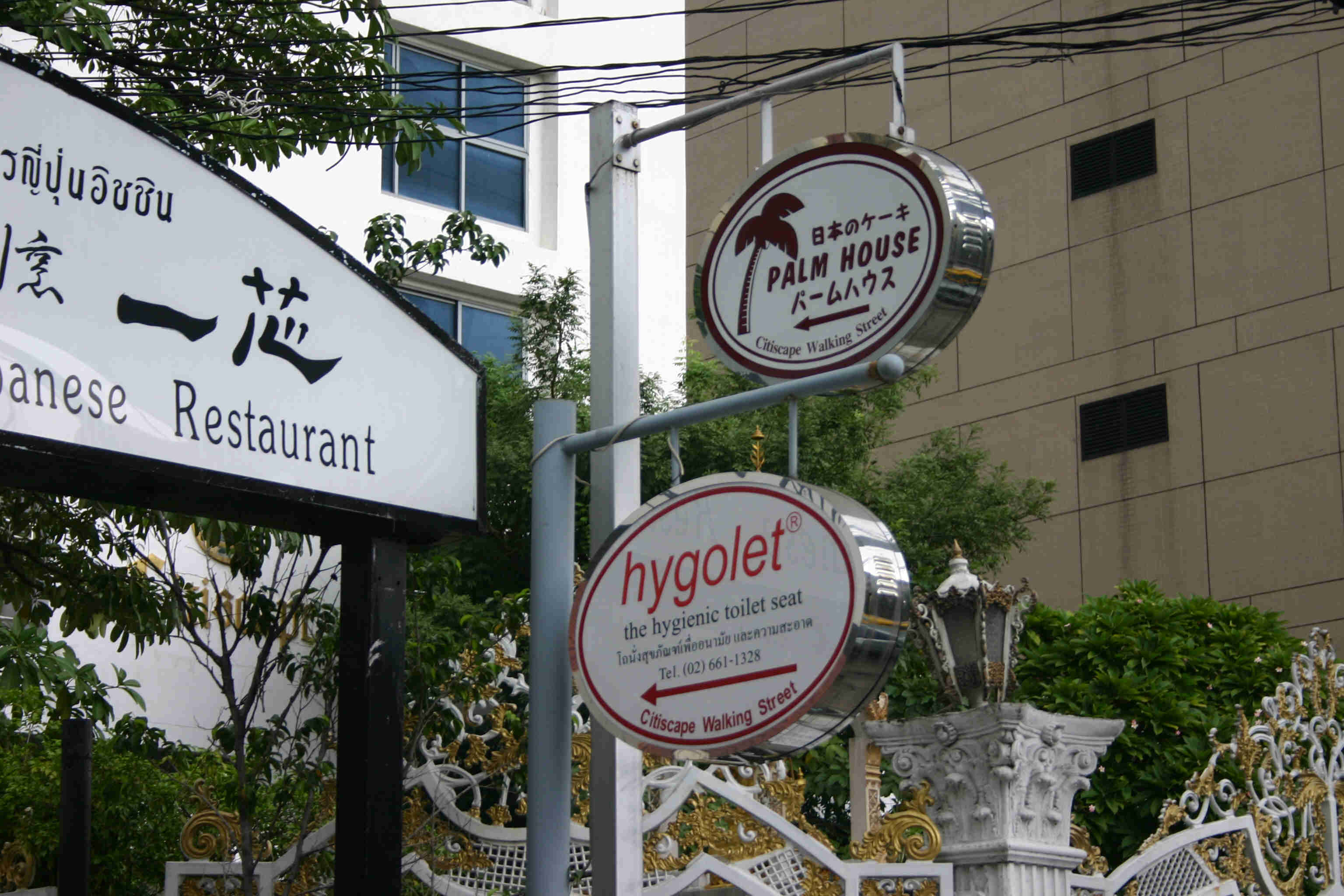
One of my first ever stock takes as a baby auditor hundreds of years ago was a new year's day count at a toilet seat warehouse. It was a crappy job but someone had to do it. With Thailand setting itself up to be the hub of everything toilet seats should be no exception.
So here from Amazing Thailand is the "hygolet."
Lost in translation
15 November 2005
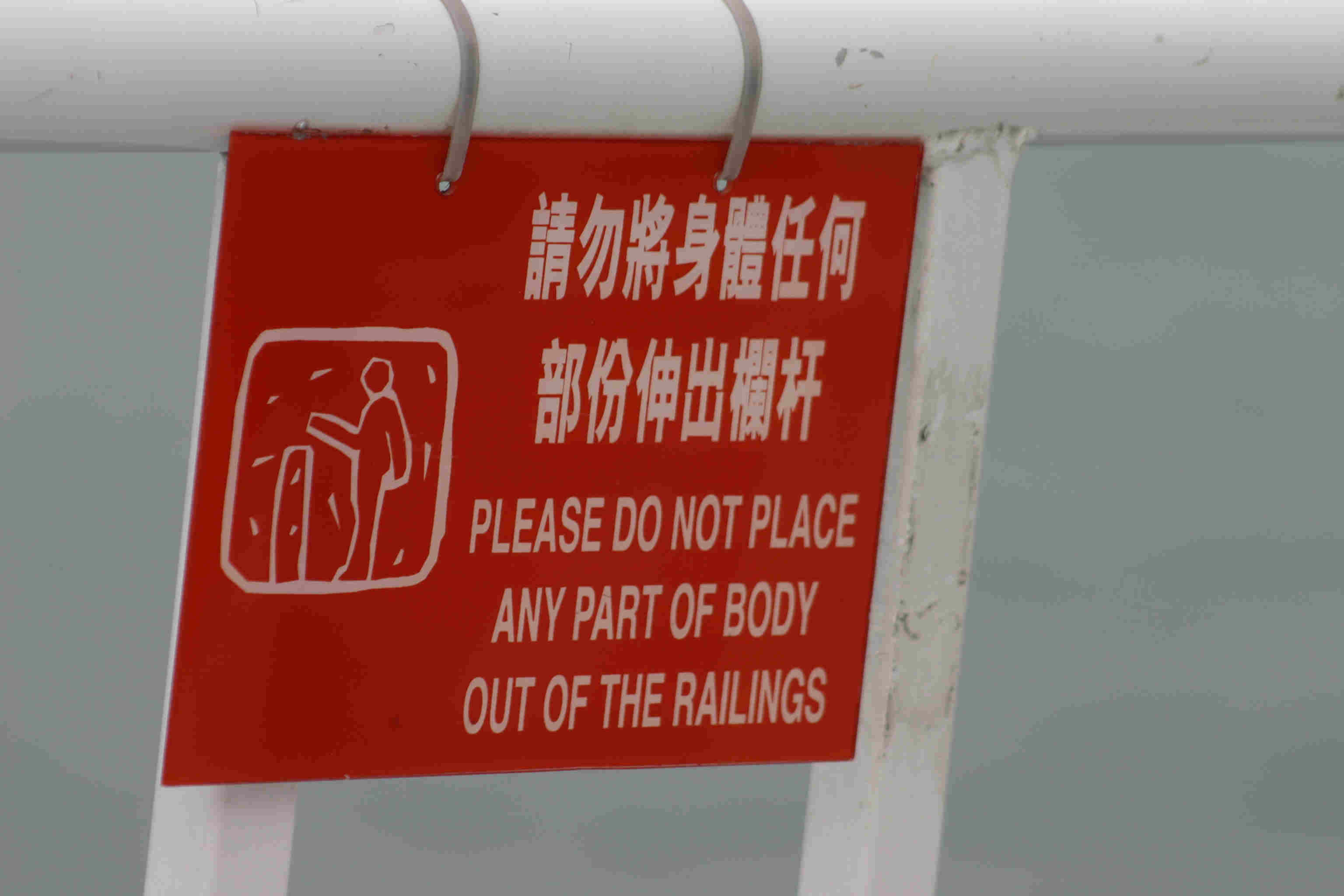
Helpful advice from Hong Kong ferries; and a very strange drawing !
Startling Revelation - FDI and corruption indices may be related?
14 November 2005
"It's now or never" for Europe to play a larger role in the rise of Asian economies, Thai Deputy Prime Minister Somkid Jatusripitak warned a European investment forum in Bangkok today.
While acknowledging that Asia's tremendous growth of late has
been led by China, Somkid argued that European investors should also look to
Southeast Asia as a major trade gateway to China and the region.
EU investments in Asean amounted to only 2.8 per cent of
Europe's total foreign direct investment (FDI) worldwide in 2002, and less in
2003 and 2004 when many European companies shifted their attention to the
rapidly growing markets of China and India.
Asean groups Brunei, Cambodia, Indonesia, Laos, Malaysia, Myanmar (Burma), the
Philippines, Singapore, Thailand and Vietnam.
The EU is hosting its 4th Asia Invest Forum 2005 in Bangkok, attracting more
than 200 participants, on Monday and Tuesday in an effort to stimulate flagging
European investment interest in the region.
Meanwhile Transparency International's Corruption Perception Index for 2005 lists 159 countries and show the following stellar performance in SEA (Singapore 5th, Malaysia 39th, Thailand joint 59th, Philippines joint 117th, Indonesia joint 137th and Myanmar joint 155th).
China is in 77th place; but the market is so very large that investors will live with the risks. Why use SEA as a gateway to China, Hong Kong (in 15th place will do very nicely thank you; or maybe Singapore albeit from a distance. It really is now or never for SEA to improve its corruption image. Do that and investment will flow. Otherwise there are other markets and other entry points.
The five copies?
14 November 2005
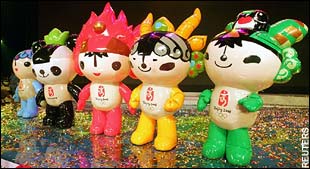
Let the marketing begin. Buy one mascot; and then you have to buy another four. China has chosen five mascots for the 2008 Olympic Games and while it is so unfashionable to criticize China what a dopey collection they are: like cheap powerpuff girls they look cheap, plastic and made in a Shenzhen sweat shop.
Describing the mascots as looking like bad Japanese cartoon characters is probably not what the Beijing organisers want to hear.
This is the official version of their meaning:
Like the Five Olympic Rings from which they draw their color and inspiration, the Five Friendlies will serve as the Official Mascots of Beijing 2008 Olympic Games, carrying a message of friendship and peace--and blessings from China--to children all over the world.
Designed to express the playful qualities of five little children who form an intimate circle of friends, the Five Friendlies also embody the natural characteristics of four of China's most popular animals--the Fish, the Panda, the Tibetan Antelope, the Swallow--and the Olympic Flame.
Patten fever in Hong Kong
14 November 2005
My weekend visit to Hong Kong coincided with Chris Patten's first visit to Hong Kong since 2000. Patten was governor of Hong Kong for the five year's up to the handover of Hong Kong back to China.
After almost eight year's of shocking misgovernment Patten was feted wherever he went. In Hong Kong to promote his new book, which really does not say that much about either Hong Kong or China, his book signings (and there were many) were sieges. He was sold out at the FCC; he gave interviews in cars between appointments. He had tea with Li Ka-shing (who really runs Hong Kong) and with dinner with his ex staffer, Donald Tsang (who nominally runs Hong Kong as a mainland appointee.)
Patten, was described by the Beijing authorities pre 1997 as a “strutting prostitute” and “the criminal of all time.” But all seems largely forgiven by the Chinese and his book is to be published in China; probably after a few edits have been made. Patten's praise of Jung Chang's new biography of Mao may have to go!
Patten is probably the best Prime Minister that Britain never had. Articulate; sensible in his judgments; as decisive as politics will let someone be; and widely respected across all political boundaries. Even I would have voted for him and I never voted Conservative in my life! He is always worth listening to; yet he does not expect agreement with all he believes him; he simply shows that a democracy is about the right to air and discuss opinions. Some of his are made very clear in his interview with Time Magazine below.
Patten is the nearest Kong Kong has to a celebrity! Everywhere that he went over the weekend he was mobbed; the crowds were pushing and shoving to get close to their hero, hoping for a smile, a handshake, an autograph. He is no rock star. At 61 he has become chubbier and the panda eyes that are beginning to show signs of age. Maybe that is part of the appeal.
Patten describes his five years in Hong Kong as the best time he has his family have had. "I love coming back," he says, lamenting the five years since he last visited. "It is extraordinary how much the urban landscape has changed. This is still an exciting place." If you want to see the virtues of free trade, Patten says, "you can either read Adam Smith or buy an air ticket to Hong Kong." There is no doubt that Patten genuinely loved Hong Kong and its people. Events since 1997 have shown how important real leadership can be. It was not a few old leftover expat Brits who were queuing for hours to see Patten. It was the people of the city of Hong Kong. Patten gave them a sense of identity. A friend told me she always says that she is Hong Kong Chinese.
Patten's views on democracy are unshakeable: "One, do I believe in democracy? Yes, I do. Two, do I think that sooner or later Hong Kong will be a democracy? Yes, I do, and the sooner the better. Three, do I think democracy is destabilizing? No, I don't." His views on democracy in Hong Kong are long held: "This is an extraordinarily mature society (where) people are asked to make very difficult choices everyday of the week. They are capable of making more." The hint here is that any reunification of Taiwan will only come after there has been political change in China.
Time Magazine - Questions for Chris Patten.
Chris Patten's always been a busy man: former chairman
of Britain's Conservative Party, Governor of Hong Kong, Europe's External
Relations Commissioner. At 61, he's in the House of Lords and chancellor of
Oxford University. Now he's published Not Quite the Diplomat, a learned
romp through the lessons of a life in politics. He spoke with
Time's J.F.O.
McAllister.
you're very critical of tony blair.
He's an extremely talented politician, articulate and intelligent, and brilliant
at the more vulgar end of empathizing. But I think he's deeply superficial. He
skids across the surface of issues. In foreign policy, that's accompanied by an
excessive regard for his own ability to charm people into his point of view.
doesn't a politician who wins
three elections rate a little more respect? Blair's
greatness was reforming a Labour Party that knew it had to be reformed. His
reforms of public services were Conservative ideas he cottoned onto rather late
and rather incoherently. But what is he going to be remembered for? Principally
for Iraq.
your affection for the u.s. seems
to have declined, too. I still get a huge buzz from
just being in America. Do I get a buzz from President Bush's Administration? No.
you've issued your share of bland
communiques, but your book calls for more open international disagreement.
It often ends up in self-delusion if, with a great power, you don't take
arguments head-on. I don't think Britain ended up influencing the Bush
Administration on Iraq one jot. We were simply a sort of multilateral pin to
stick in the Administration's lapel. Europe's relationship with the U.S. is
fundamentally strong enough for us to disagree. Had we set out where we thought
things were mistaken, it might have emboldened American critics of the policy.
And why do we always feel obliged to leave a warm feeling in the air whenever we
see President Putin, who to a considerable extent doesn't share our values?
because europe needs russia's gas.
Yes, but he has to sell his gas to us just as we
need to buy it. He has nothing else to sell us.
even after iraq, aren't european
leaders still notably reticent about criticizing the U.S.?
There's a profound awareness that unless we're careful, we're going to look like
grandstand critics rather than players. In order to make ourselves a more
effective partner, able occasionally to criticize, we in Europe have to be able
to do more on the ground ourselves. But Europe's most effective contribution to
global security has been the enlargement process in the E.U., a tremendous
example of soft power. That's why to turn our back on admitting Turkey would be
to reject the most important contribution Europe has made to geopolitics.
you say europeans are "more
inclined to take holidays than risks." you mean they can't compete?
Our population is falling and aging. Defending our social
model doesn't necessarily mean working harder or taking fewer holidays, but it
does mean working later in life, providing more opportunities for women and,
especially, much better education and training. The real threat to European
well-being isn't Polish plumbers, it's Asian software engineers and scientists.
On the whole, European universities are underfunded and not well managed. We're
so snooty about the U.S. and its alleged meretricious consumerism. But they're
investing twice as much in knowledge as we do, which is really their investment
in the next generation.
How does this gap get fixed?
Governments have to put their money where their
mouth is.
AND HOW SHOULD THE WEST APPROACH
CHINA? China would be much more worrying if it were
to fail. We should draw China, and India as well, into global leadership on
economic and political issues.
ISN'T THAT ALREADY HAPPENING? Too often we've given
the impression we're in favor of rules-based global governance, provided the
rules suit us. I'm seriously worried about growing protectionism in the West.
Hotels go on and off Alert in Beijing
9 November 2005 and 10 November 2005
The U.S. Embassy in Beijing has now withdrawn an advisory warning of a possible terror threat involving hotels in China. This seems strange given the overnight bombings of US hotels in Amman, Jordan. If anything US hotels worldwide are likely to be increasing security.
The Beijing authorities have suggested that the warning issued on Thursday (see below) was "a sham fabricated by some foreign citizen."
It should also be noted that in just over a week USA President George W. Bush is scheduled to meet with Chinese President Hu Jintao in Beijing.
Refuting the U.S. advisory, China said in a statement faxed to new agencies that "the recent mentioning of a so-called 'future attack on four and five-star hotels in China' is a sham fabricated by some foreign citizen."
China has provided no additional details and did not identify the "foreign citizen."
All very strange.
Possible Terror Threat to Hotels in
China
----------------------------------------------------------------------
The American Embassy in Beijing sent the following message to American
Citizens on November 9, 2005:
The Embassy has learned that Chinese police advised hotels that Islamic
extremist elements could be planning to attack four and five star
hotels in China sometime over the course of the next week. Chinese
authorities have assured the Embassy that they are taking appropriate security
measures and investigating the possible threat thoroughly. American
citizens visiting Chinese four and five star hotels should review their
plans carefully, remain vigilant with regard to their personal security,
and exercise caution. Reports should be made to local police if one
notices unusual activities in or around these areas.
The road to Pyinmana
9 November 2005
Last Sunday most of Burma's middle ranked military and civil servant personnel would have been enjoying a quiet Sunday with their families in Rangoon. It came as something of a surprise to most of them that they would be uprooting on Monday afternoon, leaving their families behind and joining convoys moving about 320km north to Pyinmana.
A year ago, Pyinmana was little more than a collection of straw huts and rice paddies. But in the last two years it has apparently been transformed. The new capital reportedly consists of a 10sqkm compound, on which it is planned to have mansion homes for generals, diplomatic quarters, a parliamentary building, an airport and a golf course. At the moment it is in a secure military zone that foreigners cannot enter, protected by anti-aircraft missiles. Underground bunkers and office blocks are believed to have been constructed but it is not clear how much of the city has been built so far.
The timing of the move was believed to have been chosen as auspicious by astrologers.
The British embassy learnt of the move in a brief note sent on Monday informing of a relocation to a "command and control centre" and instructing UN and diplomatic staff to stay in Rangoon for the time being. Meanwhile the security staff around the foreign embassies were withdrawn and protective barriers erected since 9 September 2001 were dismantled. At least one embassy was making alternative security arrangements.
Foreign journalists meanwhile were called to the government on Monday afternoon; given a five line note advising of the move and were not allowed to ask questions.
China is reported to be partly funding the move, and it could be that the pro-Beijing Burmese regime is more comfortable with a seat nearer its powerful giant neighbour and trading partner. Chinese influence in, and financing of, Burma is huge. Burma gives China access to Indian ocean ports and proximity to Asia's other great super power, India. In return Burma provides massive raw material to China.
Foreign diplomats said they had received official briefings that all ministries would eventually be relocated but were told there was no need for foreign embassies or organisations to move to the new location soon. The basic message to the foreigners is that you really do not matter very much.
Ironically, Pyinmana, where steam locomotives still arrive pulling freight cars of sugar cane, was the stronghold of the Japanese army during the Second World War, and is guarded by jungle-clad hills. It was from here that Ms Suu Kyi's heroic father, General Aung San, launched the Burmese independence movement.
A 20th century history quiz.
5 November 2005
From the Guardian and a new book by Craig Brown - 1966 and All That; here is a history quiz for anyone who grew up in 20th Century Britain. Almost treasonable which is appropriate for Bonfire Night!
Twenties
- Imagine you are a member of the Bloomsbury Grope. Give reasons.
Thirties
- Whose side was Franco on in the Franco-Prussian war?
- Why was the Spanish War considered civil?
Forties
- How did de General have de Gaulle? Give reasons.
- Compare and contrast (a) the Desert Rat with (b) the Desert Fox. Provide recipes for both.
Fifties
- Compare and contrast any two of the following: (a) Lady Chatterley's Lover (b) Lady Chatterley's Liver (c) Lady Chatterley's Loafer (d) Lady Chatterley's Loofah. Keep your reasons to yourself.
- How much is that doggie in the window? Answer to within one decimal point.
Sixties
- Is this the Northern Ireland question: If not, what is?
- What would have happened to Mick Jigger if he had been able to get satisfaction? Answer on both sides of the sheets.
- 'This is the darning of the Age of Aquarius.' Why did it need mending? Where is the Global Village? Who lived Chez Guevara?
- Answer any of the following:
- (i) Who's afraid of Virginia Woolf?
- (ii) Voulez-vous coucher avec moi?
- (iii) He would, wouldn't he?
Seventies
- If the Bhagwam Sree Rajneesh was leader of the Orange people, who was leader of the Republicans?
- Draw a scale-map of Barbara Castle, with ramparts.
Eighties
- Was the International Monetary Fun? If not, why not
- Attempt to forget each of the following: Teresa Gorman; Andrew Neil; Cabbage Patch Dolls; TVam; Amadeus; the Rubik's Cube; Noel's House Party; Bros.
Up to the end of history
- Is Dessert Storm better served in a dish or a cocktail glass?
- Why was Clare Short? What did Robin Cook? Why did David Blunkett? Which was Jack's Straw? What made Gordon Brown?
Don Muang's unknown future
5 November 2005
It is probable that Bangkok's new Suvarnabhumi airport will open some time in 2006. It is less likely that it will open according to the government's schedule of June 2006.
Tellingly, in terms of the overall lack of clear planning and management of the new airport project, the future of the current international airport at Don Muang is unknown.
So, no surprise here, a committee has been set up reporting to
Vice Transport Minister Mahidol Chantrangkurn; the committee will among other
tasks consider the option of maintaining Don Muang as a secondary airport.
One option Mahidol suggested is the possibility that it could be used as a
special airport for low-cost airlines.
The committee would take into account the experiences of other
countries where new airports have recently been opened. Surely they have found
that out by now. It really is not that hard to do.
Even more bizarrely the Vice Transport Minister is reported as asking whether
"Suvarnabhumi will be able to accommodate low-cost airlines, with their
estimated 10-per-cent increase in passengers each year, and we also need to
assess whether offering services to low-cost airlines will affect Suvarnabhumi’s
aim of becoming a regional aviation hub.
“Low-cost airlines have recorded sharp growth, with nearly 5 million passengers
so far this year. This could crowd Suvarnabhumi more quickly than estimated,”
Mahidol said.
So a new airport is to be opened in mid 2006 but it may not have the capacity to meet Bangkok's aviation needs. A little capacity planning would have helped. A visit to Singapore's Changi Airport would provide a very good lesson in capacity planning as the airport builds both Terminal 3 and an LCC terminal in expectation of future traffic.
The minister then asked a question that really should have
been addressed years ago: what future purposes will Don Muang serve; and he has
left open every possibility including using it for chartered flights, personal
jets, special jets, small cargo planes or low-cost airlines.
The implications are that the new airport is going to be operating at capacity
immediately.
In terms of airport codes it is expected that BKK will transfer to the new airport when it opens. Don Muang if it stays open should become TIT (This is Thailand!).
Plea for clemency
3 November 2005
My faithful reader may want to send a similar letter: but you had better do so quickly.
Prime Minister LEE Hsien Loong
Prime Minister's Office
Istana,
Orchard Rd
Singapore 238823
Email: lee_hsien_loong@pmo.gov.sg
Dear Prime Minister,
I am appealing to you and your Cabinet to urgently reconsider granting clemency
to Australian man Van Tuong Nguyen who will otherwise be executed for drug
trafficking.
The opportunity to show compassion is a great privilege of civilised, democratic
society. As a sovereign nation Singapore has its rules and responsibilities to
its people. But you also have the opportunity to say that in rare cases there
are circumstances under which compassion may be shown. Such an action in this
case would gain Singapore great respect.
The death penalty takes away the greatest
right that we all have; the right to live. Van Tuong Nguyen is a young man with
no prior criminal conviction who does not deserve to pay the ultimate price for
his mistake.
I understand under Singapore's Constitution, clemency can be granted in rare
circumstances and that Van Tuong Nguyen's case fits the criteria. He has shown
remorse, confessed at the earliest opportunity and cooperated fully with the
Singaporean authorities and the Australian Federal Police.
I urge your government to show compassion
and grant clemency to this young man.
Yours faithfully,
Robert Scott
Bangkok
Asian golfers hit for six
3 November 2005
Asia's golfers will play the first ever professional championship par 6 in the Double A International Open starting today at St. Andrews Hill 2000 in Rayong. near Bangkok. The monstrous 878-yard, par six fourth hole has set off a debate about the games traditions and about how technology has changed the modern game.
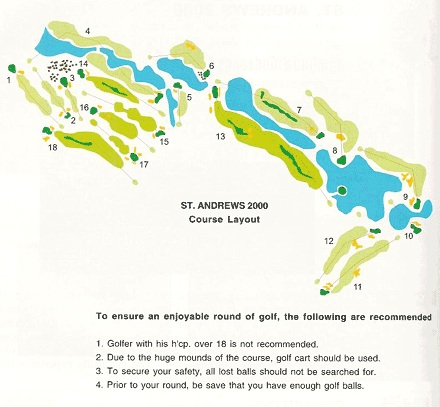
In practice the pros have been playing driver, medium iron, fairway wood and wedge to the green.I have played this hole; albeit of a slightly shorter 838 yard tee. It is very, very long!
St. Andrews Hills, designed by Desmond Muirhead, opened for play in 2000 and in its original design, the 13th hole was also designed as a par six. However for the Double A International Open, the 13th was reduced to a conventional par five, making this week's total yardage at 7,483 yards and playing to a par 73.
Traditionally golf has been played only on holes that are par 3, 4 and 5. But other than the possible boredom factor why not a par 6. The only question being how to make the hole challenging - and not just inordinately long.
This is a very difficult and long course. If it is presented in good condition this week it will be a terrific tournament. Even par may be a very good score.
A senseless hanging
2 November 2005
Senior Minister Goh Chok Tong recently defended Singapore's lack of press freedoms citing economic well being and government transparency as being paramount. "My simple point is this," he said, "it has not been proven that having more press freedom would result in a clean and efficient government or economic freedom and prosperity" He proudly trumpeted Singapore's rush from third to first world society.
Yet this first world society still uses the death penalty for both foreign and its own citizens. There will be little discussion of Nguyen Tuong Van in the Singaporean newspapers. Editors and journalists in Singapore have been told to work for the public good in a practical rather than idealistic way....not to pursue a personal or political agenda.
But this young Australian man facing imminent execution in Singapore on drug charges appears to be neither a hardened criminal nor a desperate addict. He did not stand to profit personally from the two small packages of heroin he picked up in Cambodia and which were intercepted during a transit stop in Singapore. It was a one-off drug run in exchange for clearing about $20,000 in gambling debts racked up by his twin brother. Foolish indeed. It was also his first overseas trip. Under Singaporean law a sentence of death is mandatory for the possession of 15 grams or more of heroin, leaving courts to deal with only one issue: was the accused in possession of the drugs? By Nguyen Tuong Van's own admission he was. The Australian Government believes Nguyen's is an exceptional case, but has failed in its formal appeal for clemency to the Singaporean Government. Singaporean law is clear: there are no mitigating circumstances.
 The
mandatory death penalty reflects an uncompromising official attitude aimed at
quarantining the country from drugs. Yet this does not appear to be a deterrent.
If that view were correct, it would be shown by the fact that there are fewer
offenders, which has not been demonstrated. Despite the death penalty, the drug
trade still flourishes.
The
mandatory death penalty reflects an uncompromising official attitude aimed at
quarantining the country from drugs. Yet this does not appear to be a deterrent.
If that view were correct, it would be shown by the fact that there are fewer
offenders, which has not been demonstrated. Despite the death penalty, the drug
trade still flourishes.
What the Singapore system fails to do is to make any distinction in the criminal justice system between career criminals and those one-off offenders driven by other circumstances.
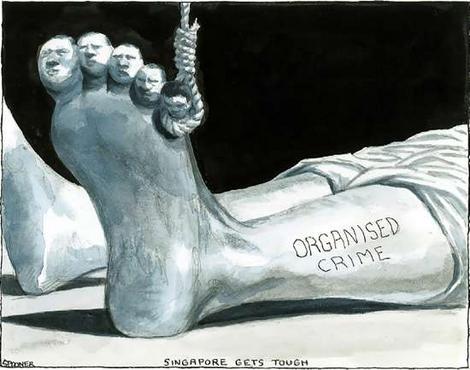
The system gets the smugglers, the runners and carriers. In this case it so many others it does not target the drug syndicates for whom a life is so easily expendible.
The profile of smugglers, more often than not, are of people with poor education who have neither the reasoning skills nor the understanding of the legal complexities and the dangers they court. Often, as in the case of Nguyen, they are hoodwinked by the real traffickers into transporting the contraband.
An extended prison sentence should be sufficient penalty; possibly alleviated through co-operation in finding out more about the syndicates that sent him to Cambodia. Nguyen is not the problem; as the cartoon above from "The Age" so graphically portrays.
As a small aside Nguyen was technically not even in Singapore when arrested. He was transiting flights from Cambodia to Australia and had not and would not pass through immigration. Arguably he could have been tried in Australia; his destination. Since his arrest he has co-operated fully.
The mandatory death penalty is not a solution in the ongoing battle against drugs, be it in Singapore or any other country faced with this problem. My views on this have been aired before; the death penalty is wrong; no one has the right to end another person's life. The death penalty is barbaric; it is as simple as that.
Unlike Schapelle Corby or even the Bali nine, Nguyen's case has not rallied the support of the Australian public. That may be because Nguyen is of Vietnamese background, or it may be that his own defence team has deliberately kept a low profile.
Nguyen is likely to hang on November 11th; The Australian government, Amnesty International and all fair minded people society should do all they can to ask for clemency from the Singaporean government. The greatest trait of any civilised society is that of compassion. Sadly Singapore may not yet be ready to make that leap.