Bad laws
sprouting in Brussels
30 April 2010
Belgian lawmakers
in the lower house of the federal parliament have voted overwhelmingly to
ban the wearing of the Islamic burqa in public.136 deputies voted for a
nationwide ban on clothes or veils that do not allow the wearer to be fully
identified, including the full-face niqab and burqa.
There were just two abstentions. No one voted against.
The ban will be imposed in streets, public gardens and sports grounds or
buildings “meant for public use or to provide services” to the public,
according to the text of the bill.
People who ignore the new law could face a fine of 15-25 euros ($20-$34)
and/or a jail sentence of up to seven days.
The government's argument is that people cannot be recognised while wearing
the clothing.
But who can be
recognised while they where a motorcycle helmet? Who can be recognised
wrapped up in hoodies on a cold day? So let's ban helmets and hoodies. Let's
ban facial hair as well.
The upper house of parliament has two weeks to raise any objections to the
decision.
Amnesty International has condemned the move in a statement issued on
Thursday. “A complete ban on the covering of the face would violate the
rights to freedom of expression and religion of those women who wear the
burqa or the niqab,” said John Dalhuisen, Amnesty’s expert on discrimination
in Europe.
“The Belgian move to ban full face veils, the first in Europe, sets a
dangerous precedent,” he warned. Amnesty called on the upper house to review
the legislation, adding it believed the move was in breach of Belgium’s
obligations under international human rights law. There was no “demonstrable
link between the wearing of full face veils in Belgium and genuine threats
to public safety,” Mr Dalhuisen argued.
This is bad
legislation that will reinforce prejudice and violate freedoms of expression
and religion. It should not be allowed to proceed.
Don't give up
on Thailand
30 April 2010
Canada is the
latest country to issue a travel warning against visiting Thailand. But it
really does not make sense.
The Canadian
federal government upgraded its travel warning for Thailand Wednesday,
telling Canadians to avoid the kingdom marred by political violence.
In a statement, Canada's Foreign Affairs Department advised against
non-essential travel to Thailand because of ongoing large-scale political
demonstrations marked by violence, injuries and deaths.
"The security situation is very volatile with significant potential for
further civil unrest, violent clashes and attacks," the department said.
Don't give up on
Thailand. SImply fly there and avoid central Bangkok.
The airport is
modern and safe. The domestic airlines will fly you to the North or to Koh
Samui or Phuket. Taxis and buses will take you to the southern resorts or to
Rayong (go to Koh Samet) and Pattaya.
Travel to the
North. Go south to lovely Hua Hin. Go to Pattaya if you have to. Head west
for Kanchanaburi and the River Kwai.
You do not see
Thailand by going to Bangkok. Bangkok is basically another big asian
metropolis. Sure it has palaces and temples. But it also has malls and
designer stores and you could be anywhere in the world. This is the time not
to go to Siam's hi-so malls. This is the time to take the path less
traveled. You will have a much better holiday.
Big US aviation
merger ahead
30 April 2010
Following rapidly
on the merger of Delta and NorthWest comes the expected merger of United and
Continental
Continental
Airlines Inc. and UAL Corp.'s United Airlines are expected to announce next
Monday that they are merging to form the world's largest airline by
passengers carrie.
The merged airline
will be run under the UA name and led by CO's senior management.
Continental has apparently agreed to allow the combined airline to be based
in Chicago, United's home base. Jeff Smisek, Continental's chief executive
officer, will become CEO of the merged carrier; Glenn Tilton, UAL's CEO,
would become non-executive chairman for two years, after which Mr. Smisek
would take over that role.
This leaves
American Airlines looking a little vulnerable as the one major US airline
that has avoided domestic consolidation. American has been courting an
international alliance with British Airways and Iberia.
When Delta and
Northwest merged the Northwest name dies.
When US Air and
American West died the America West name died.
Now the
Continental name will go; following the long list of great American Airlines
that have gone - TWA, Pan American, Eastern, Northwest
This will leave
United, American and Delta as the three major US carriers US Airways
struggling as the perpetual ugly bridesmaid that the other airlines would
happily screw but never marry. And Southwest, JetBlue and AirTran as the
major LCC operators.
CRES must show
proof
30 April 2010 -
Bangkok Post editorial of 29 April
"Some things
should never be forgotten. Especially now, when conflicting groups appear so
intent on toppling each other that they have thrown all caution to the
winds, we should not forget the lessons of pain and anguish experienced in
our past.
The allegation of conspiracy to overthrow the monarchy is a serious one,
because it can stimulate extreme emotion and reaction among the public. For
the Centre for the Resolution of Emergency Situation (CRES) to bandy this
allegation about rather casually - backing its claim with only a chart
cluttered with names supposedly linking them to the alleged plot - is at
best a reckless move.
This is especially so in light of the present situation. The confrontation
between protesters led by the United Front for Democracy against
Dictatorship (UDD) and the government of Prime Minister Abhisit Vejjajiva
has intensified to the point where things could boil over at any minute. To
lay such an inflammatory charge against a group of people (most of whom, if
not all, stand in opposition to the government) without solid proof risks
fuelling the volatile situation even further.
Truth be told, the CRES' chart does not offer any depth of new information
to the public. Any citizen who has been following the news will already be
familiar with the materials produced by people the centre alleges to be
harbouring malicious intent towards the monarchy. That the CRES has drawn
some lines on a chart linking these people into a network is not proof
enough that such a network really exists. To convince the public of the
truth of such a conspiracy and to be fair to all the people implicated by
the chart, the CRES must come up with much clearer evidence; in other words,
implications are not enough.
PM Abhisit says people involved in this "network" could face legal action.
Such a statement is easy to make. The point is, he should be making such a
claim only with strong and solid proof in hand - before revealing people's
names and claiming they are connected in one way or another to such a
sensitive issue.
Some politicians and academics have already come out to deny the accusation,
namely, Gen Chavalit Yongchaiyudh, Puea Thai party's advisory chairman.
Deputy Prime Minister Suthep Thaugsuban, however, insists a summons will be
issued and if Gen Chavalit refuses to report to the CRES after two
summonses, he will face an arrest warrant. It is hoped Deputy PM Suthep and
the CRES have a strong enough case against this veteran soldier and former
prime minister. The government must proceed in a transparent and lawful
manner.
The Thai people have witnessed how the use of extreme nationalism and hate
campaigns can poison the minds of the people and turn fellow citizens
against one another, usually with violent and regrettable results. We have
also seen similar cases of civil unrest, even war, that broke out in other
countries because of the same reasons. Certain dates in our political
calendar are marked with losses and remembered with sorrow because an
instigation was allowed to get out of control.
We cannot emphasise enough how vulnerable and volatile the situation at this
moment is. Recklessness and extremism have never helped us solve a crisis -
they have only made matters get way out of hand, to everybody's regret. That
much we should have learned."
Election is
Cameron's to lose
30 April 2010
In one week the
British people will elect David Cameron as the new Prime Minister.
After tonight's
final debate we are back where we were when the campaign started. Is Britain
ready for the return of the Conservatives from the political wilderness
under David Cameron.
Overall I thought
it was a disappointing, cautious debate No one was willing to be honest
about how bad the economy is and the pain that is ahead.
It did feel like
Nick Clegg's weakest debate. You simply cannot keep attacking political
point scoring in a political debate. Not good enough. You cannot have just
one economic policy - no tax to be paid on the first gbp 10,000 of income.
Maybe there are other policies - this one just got mentioned as an answer to
almost every question.
Today was the day
when I decided that maybe Nick Clegg and the LibDems offer little more than
muddied confusion.
Beating up bankers
gets dull after a while. It wins votes. But the bankers, the brightest and
best of them will simply lead a brain drain out of the country.
Clegg got rather
ignored/marginalised tonight. Stuck in the middle but by-passed.
Gordon Brown was
strong on the economy (as he should be). And I liked his final line; "things
are too important to be left to risky policies under these two people." It
was dangerous but he really had nothing to lose.
So where are we. I
don't think Clegg has done enough to be a game changer. People will vote for
the system they know; the British do not and will not trust a hung
parliament to be effective.
So David Cameron
looks like your new Prime Minister. Get used to it. He probably wont have
enough votes to have a working majority but he may be very close I just feel
that the Liberal euphoria may be about to burst. This would be a shock for
the Liberals who are polling at around 30% currently.
So how about:
Conservatives
310 38%
Labour
252 30%
Liberal
60 23%
Others
28
9%
Total
650
Hospital farce
30 April 2010
It was a quieter
day in Bangkok today but the red shirts surely made a tactical error when
more than 200 red-shirt guards stormed into Chulalongkorn Hospital last
night to check if there were soldiers inside the hospital buildings.
The hospital is
located right next to the red-shirt rally site.
Hospital director Dr Adisorn Patradul initially refused to let the red shirt
members into the hospital complex. Adisorn gave in after red shirt co-leader
Payap Panket, who has an outstanding arrest warrant, insisted that he be
allowed to inspect the area.
Aisorn only allowed Payap, five red-shirt guards and a gaggle of reporters
to enter. However many other red-shirt guards poured into the hospital
buildings as soon as the door was opened.
The search went on in front of bewildered nurses and doctors and lasted
about one hour until police arrived to negotiate - and found themselves
negotiating with Payap, despite the arrest warrant. The talks ended with an
agreement for the red-shirt guards to be allowed to check the hospital again
today.
Chulalongkorn Hospital had already stopped receiving new patients while
nearby Police General Hospital had transferred patients to buildings that
were farther away from the demonstration.
This is not right
- the hospital suspended all surgery. The hospital has to look after its
patients. And it just looks hopeless when the police are standing next to a
wanted red shirt leader and take no action.
This is Thailand
without leadership.
Britain's voteless immigrants
30 April 2010
"Bigot gate" made
immigrants a central election issue. Why? Ignorance mainly. "Flocking
eastern Europeans" was the term used by supposedly Labour supporting Gillian
Duffy in her meeting with Gordon Brown. Very tolerant of her.
Who are these
people? They are workers who contribute to the UK economy and to UK society.
They probably pay into the tax system more than they get back out of it.
they are or working age not retirement age; are less likely to draw on the
NHS and are unlikely to stay long enough in Britain for a pension. And to be
honest parts of the UK economy probably would collapse without immigrant
labour;
And while they
work very hard they dont have a vote. They can therefore be used as a cheap
target for political point scoring. Gordon Brown had to apologise to Ms.
Duffy. But no one has apologised to the people that she dismissed as
flocking eastern europeans.
I am sure she does
not think of herself as bigoted. But there was prejudice and ignorance -
fuelled by the mass market tabloid journalism and television.
80% of so called
British immigration is not immigration - it is integration. It is part of
being in Europe and the acceptance of the free flow of labour around the
European community.
Whether is is
eastern europeans in the UK, the british across europe or asia, the
philippinos around the world; the chinese in america or the indians and
other nationalities in the UAE, immigrants make a massive contribution to
the economy.
I have now lived
for 22 years away from the country of my birth and as a guest in foreign
lands. Yes, as an immigrant. Two of those countries have accepted me as a
citizen or permanent resident. Because of what I have contributed to those
countries; and what they have given to me.
Instead of the
instant trepidation of immigration how about asking what is it like to be an
immigrant in a foreign land? How does it feel to be so far away from home?
To leave your life behind and start again from scratch? What is it like to
live in a country where you have no voice? Why did they come here? What do
and don't they like about the country they live in? What's it like where
they come from?
Listen. Don't
judge.
Thai chaos
leave power vacuum
29 April 2010 -
Ravi Nessman, Associated Press Writer
"Renegade Maj. Gen. Khattiya Sawasdipol helped construct the barricades
paralyzing downtown Bangkok, has been accused of creating a paramilitary
force among anti-government protesters and has vowed to battle his own army
if it should launch a crackdown.
His actions have made him a fugitive from justice, yet he wanders freely in
the streets of the Thai capital, signing autographs just yards (meters) from
security forces keeping watch over the protesters.
Seven weeks into a stalemate that has turned parts of the city into a
lawless protest camp, many are wondering why the government seems unable or
unwilling to restore order.
"Red Shirt" protest leaders with arrest warrants on their heads lead
demonstrations through the streets, sympathizers have set up roadblocks
outside the city to stop police reinforcements from entering and no one in
the government, police or military has publicly articulated a plan as to how
to resolve the crisis.
"It's out of control. It's beyond imagination," said Siripan Nogsuan
Sawasdee, a political scientist at Bangkok's Chulalongkorn University.
Prime Minister Abhisit Vejjajiva says he wants a political solution but has
called off negotiations until the protesters leave downtown.
That has left many here expecting a crackdown. But Siripan and other
analysts question whether Gen. Anupong Paochinda, the army chief set for
retirement in September, has the stomach for more bloodshed after earlier
clashes claimed 27 lives in the worst political violence here in 18 years.
The loyalty of some soldiers, drawn from the same impoverished rural stock
as many protesters, is in question as well. Authorities have also drawn
criticism by bungling high-profile efforts to arrest Red Shirt leaders,
including once instance in which a wanted leader escaped by rope from a
hotel window as police raided the building.
Now, thousands of Red Shirts hide from the midday sun under rows of tents
erected inside Bangkok's high-priced shopping district.
In an atmosphere reminiscent of a music festival, vendors selling red
shirts, protest scarves and slingshots share street space with those selling
Bob Marley T-shirts and Hello Kitty cell phone covers. Some came with
pushcarts, plastic chairs and folding tables and opened street cafes, while
others brought in mattresses and offered Thai massage.
There are rows of portable toilets and regular food deliveries from protest
coordinators, who dish out curry and ice cream to supporters from metal vats
on the back of pickup trucks.
The camp is protected by Khattiya's barricades of fencing, bamboo, tires and
razor wire. Though he has been working with the protesters since at least
last year, the military suspended him three months ago, and the courts
issued an arrest warrant for him last month on weapons charges, the
government only took its first major action against him on Thursday _ by
shutting down his website.
Khattiya said he is not concerned that he might be arrested.
"What would they arrest me for? For walking around here among the
protesters? Nonsense," he said.
It was the security forces who were afraid, he said.
"They couldn't believe civilians would dare to fight back," he said.
Government spokesman Panitan Wattanayagorn said it was government policy to
arrest the protest leaders, but it was up to the police to determine how to
carry it out.
Such a lengthy disruptive protest would be unthinkable in more authoritarian
countries such as Myanmar or China. Even in democratic countries, it would
be hard to imagine police allowing demonstrators to take over a premier
shopping district _ akin to New York's 5th Avenue _ and set up a protest
camp.
The demonstration calling for the dissolution of Parliament and new
elections is costing businesses millions of dollars a day and wearing on
many Thais.
A group of counter-demonstrators known as the Yellow Shirts demanded
Thursday the government present a plan for ending the current stalemate and
said they would support a declaration of martial law.
"The crisis has reached a critical point and has damaged the economy and
society," they said in a petition to the government. "We would like to see
the brave soldiers help us get rid of this illegal activity and bring peace
to Thai society as soon as possible."
But the Yellow Shirts themselves proved that paralyzing the nation is a
winning strategy when they took over the prime minister's office and then
Bangkok's airports in 2008 to help force a change in government.
Leigh Dixon, a former Australian police official who is now a security
consultant based in Indonesia, said it would have been far easier to clear
out the Red Shirts earlier in their nearly two-month protest, before they
had erected barricades and other defensive measures.
The Thai authorities are now left with four difficult options: negotiate,
lay siege to the protesters by cutting off their food and other essential
services, raid the area with tear gas, water cannons and other nonlethal
force, or seal them into their camp and ignore them, he said.
"You need to find a solution without using force," former Israeli police
commissioner Assaf Hefetz said, "because people will be killed and that
could flare into more violence."
Panitan, the government spokesman, said that while the prime minister is not
negotiating with the protesters, he is meeting with community leaders and
other political parties to find a compromise.
"He's looking for a political solution, at the same time we are also moving
to make sure security issues are handled," he said, adding that the details
and timing of any crackdown would be decided by the security forces.
Siripan, the political scientist, said she favors negotiations, but since
the government has called them off, she could not understand why they
weren't ordering a crackdown.
A confrontation between security forces and protesters Wednesday on the
outskirts of the city offered a perfect opportunity for a raid on the
encampment downtown, she said. A soldier was killed, providing a pretext for
action, many protest leaders were outside their stronghold and Red Shirts
were seeking shelter from a driving rain.
"It's confusing," she said."
South Korea's northern problem
29 April 2010
On 26 March 2010
the South Korean navy corvette Cheonan sank with the loss of 46 lives. The
funeral of the crew was held today.Flags flew at half-mast, a siren wailed
and families wept.
There is growing
suspicion that North Korea was to blame.
"We'll never forgive whoever inflicted this great pain on us," navy chief
Kim Sung-Chan told the mass funeral. We will track them down to the end and
we will, by all means, make them pay for this."
But after a month
little has been done. And the reality is that South Korea can do little. Any
conflict with the north would irreparably impact the prosperity that the
South has built in the last 20 years.
Investigators studying the two salvaged halves of the Cheonan say an
external blast hit the ship underwater. The defence minister has said a
heavy torpedo was among the likeliest causes, although Seoul has not openly
blamed Pyongyang pending the outcome of a multinational probe by more than
100 investigators.
The communist North has denied involvement.
South Korean President Lee Myung-bak has set out a very deliberate
investigation. From the beginning, an attack by North Korea was suspected.
But only this week did South Korea's defense minister say publicly that a
torpedo was the likely cause of the explosion, although he did not say where
the torpedo came from.
The problem of
concluding that North Korea did what it almost certainly did is that neither
Mr. Lee, nor his US allies knows how to respond.
There will be no
military reprisal. And asking the U.N. Security Council for more sanctions
against the regime of Kim Jong Il would require the consent of China, which
remains North Korea's strongest ally. In part because the last thing China
needs is a flood of North Korean refugees.
Was the attack
sanctioned by Kim? Was it the act of a rogue group in the North Korean
army/navy? If the latter, does it mean greater instability in North Korea?
The real issue is that North Korea appears to have taken a very well
calculated gamble - that it can escalate tensions and get away with it.
Waking up to
the fact that we have sunk so low
28 April 2010 by Tulsathit Taptim - The Nation
This is the voice
of common sense from the Nation - and makes for sad, but honest, reading
from a writer who clearly cares deeply for his country. You can follow him
on twitter at
http://twitter.com/tulsathit
"It's almost
5.30pm now, and the deadline's approaching, so I have decided to go wherever
the keyboard and a lot of unsettled thoughts take me. This article probably
has no theme, but, to me at least, this one is historic. This is my first
op-ed piece that I write with the term "civil war", something we have talked
so many times about over the past few years, being no longer just a cliche
in my view.
 Many
people say they have seen it coming. But not me. I want to be truthful about
that. I once wrote a sarcastic article about the People's Alliance for
Democracy becoming an independent armed militia camped outside Government
House, but that was to elicit some laughs. The joke, it now seems, is on
another article entitled "The nation's head and heart spoke at once", which
was meant to shed positive light on the 2008 election results that confirmed
Thailand as being divided down the middle.
Many
people say they have seen it coming. But not me. I want to be truthful about
that. I once wrote a sarcastic article about the People's Alliance for
Democracy becoming an independent armed militia camped outside Government
House, but that was to elicit some laughs. The joke, it now seems, is on
another article entitled "The nation's head and heart spoke at once", which
was meant to shed positive light on the 2008 election results that confirmed
Thailand as being divided down the middle.
We never know, do we? And even though we might have sensed it, it was hard
to imagine Thailand as it has become today. The "Land of Smiles" nametag
wasn't acquired cheaply, but we are throwing it all away. We had been a
nation of easy-come, easy-go people. It wasn't an entirely complimentary
label but we were happy about it. We used to laugh away problems, never
amplify them into senseless hatred.
Even after the red shirts declared their "phrai versus ammat" war, I still
refused to admit it was coming. All the extreme vulgarity on the Web boards
failed to convice me that Thais could hate each other so much. It's
politics, I told myself. And it wasn't like we were a country where half the
population had come from Mars and the other half from Venus. We were a
family.
Last week my naive optimism was blown away: Of course we are capable of
hating each other to death over something as absurd as political ideology. I
had presumed that for a civil war to break out, it would take obscene taxes
imposed on the poor, or land evictions on a grand scale, or Gestapo-type
operations to keep tabs on whom everyone was worshipping. Now I think I
could be wrong.
Reuters today said we were in serious danger of that nightmare coming true.
Having seen clips of street showdowns between rival political demonstrators,
having heard and read remarks from both sides, sadly I have to agree. Civil
war or not, our country most likely will never be the same. The process of
freefalling into an unknown destiny may have just begun.
It's up to each us whether to love or hate Thaksin Shinawatra. People see
things differently. The real travesty is allowing whatever that feeling is
to be manipulated and turned into hatred toward those who disagree. When we
like something strongly, we are idealists; when we start hating something so
strongly that we also hate those who like it, we become zealots.
Which is probably what many of us have become. The "colours" mean we can't
change. They tell us who to love, hate and die for. There is no way but to
go with the flow. If wars begin with stereotyping the other side, the enemy,
we may already have crossed the threshold.
When the House of Representatives should be dissolved is the least of my
concerns. Whether Prime Minister Abhisit Vejjajiva survives the crisis is a
trivial matter, and so is, dare I say it, a coup. Politics will sort itself
out. It will sooner or later present us with an illusion that things will
get back to normal, whether through a caretaker national government or a new
constitution. One way or another, those who put us here in the first place
will come up with a purportedly new formula and tell us everything is going
to be just fine.
The pessimist in me - it arrived late but is coming on strong - says this is
no longer a political problem and that's why it will be much more difficult
to solve. The manipulators or instigators - whatever we want to call them -
have won. The UK government is tracing its citizens who have booked flights
to Thailand and telling them not to come to Bangkok. East Timor's
independence fighter Ramos-Horta has said he has no clue how Thais went from
political rivals to real-life enemies. Singapore is lecturing us about the
values of democracy.
That's what we are talking about here, right? Democracy? The term is being
used everywhere, by everyone, and in practically every rival organisation's
name.
In tandem with "civil war", democracy has become a cliche now. And at this
rate, it may remain so for a long, long time."
Thai Democrats to face Court
28 April 2010
Thailand's
Constitution Court agreed on Wednesday to consider a case against the ruling
Democrat Party for alleged misuse of funds granted by the Election
Commission (EC), the court’s secretary-general Chaona Trimas said.
The case submitted by the EC was forwarded to the court by the
attorney-general after the EC ruled to disband the Democrat Party led by
Prime Minister Abhisit Vejjajiva for two charges of misuse of a commission
grant and unlawful donation money to the party in 2005.
The case regarding alleged misuse of the campaign donation is expected to be
submitted to the attorney general next month.
The Democrat Party will be permitted to give its statement within 15 days or
more, at the court’s discretion, and the EC may be asked to give additional
information if needed.
If the Democrat Party, the country’s oldest political party is dissolved,
some party executives, including Prime Minister Abhisit Vejjajiva, will be
banned from political activities for five years, according to the
Constitution.
The EC ruled the Democrat Party should be dissolved for misusing its Bt29
million allocation from the EC's political party development fund and
accepting a Bt258 million donation alleged to have been made by the
petrochemical firm TPI Polene Plc for the 2005 general election.
The EC ruled that the two actions of the Democrat Party could be considered
as concealed acts and violated the Political Party Act. (TNA)
Hardtime on
hardtalk for Thai PM
28 April 2010
This is my
twitter summary (from last to first) of the Thai Prime Minster's grilling
today on BBC's Hard Talk. Sometimes I feel sorry for PM Abhisit. Does he
really belive what he is saying or is he saying what he knows he has to say.
I dont think he
will survive as PM; he is going to be the PM that oversees a bloody
crackdown or that refused to do anything - he cannot win either way.
BBC saying that
soldier was killed by police fire
BBC needed to ask AV about the electoral commision charges against the
Democrats....
No question of the Electoral Commission Charges - think the BBC missed that
one - which is a shame
all sides need to take into account the views of the other side
AV - I have never put my interest above the country
AV - we are trying as best we can to restore order
AV - we are aiming for some kind of political solution - based on the rule
of law
AV - party that had the biggest number of votes were charged in election
fraud
BBC - you yourself have never won an election
AV - Thaksin was an acting prime minister because elections were going to be
held ?????
BBC - you are a direct beneficiary of the coup
BBC - you came to g'ment assisted by a military coup
BBC - you never won an election
AV - a number of tasks that need to be completed - take no longer than nine
months - open to discussions - blah blah blah !
AV - the publis feels that the g'ment should not give in to intimidation and
terrorist tactics
Will BBC ask Abhisit about Democrat party corruption charges ??
AV - we should have discussions about when the elections are best held
AV - we had 2 rounds of open negotiations ! Err !! 30 minutes for TV !! He
is creative in his answers !
AV - April 10 we have evidence of the men in black operating in the area of
the red shirts
AV - it is not in my power to declare martial law - that is up to the armed
forces
Brilliant @klustout RT @Anasuya: Abhisit Drinking Game: Everytime he says
"rule of law", drink
AV - Try to separate hard line violent elements from peaceful protestors
What do you mean by minimum he was asked ! AV - we will have to be careful
AV - we are aiming to restore order as soon as possible - with minimum
losses
AV - Protestors trying to escalate level of violence and tension
AV - The situation is becoming more controllable !!
AV - we underestimated the length to which some of the demonstrators would
go to use weapons against ordinary people
AV - "situation has improved markedly" Really !!
AV - trying to avoid possible confrontations - AV was interviewed in army
barracks
PM Abhisit on BBC Hardtalk now - remember this is taped (yesterday?) not
live.
Changing
the financial centre of the UAE?
28 April 2010
Reuters is
reporting that a merger of the United Arab Emirates' two main bourses is
imminent, two people familiar with the matter said on Tuesday, with the
exchanges seeking to create a single market as trading revenue slumps.
The Abu Dhabi Securities Exchange (ADX) is seen as the driver of a merger
with its domestic rival, the Dubai Financial Market (DFM), the sources said.
"The merger is being discussed at the highest level and the outcome is
awaited imminently," an ADX official told Reuters, "It would be good for
both markets, instead of them competing against each other. This is a sign
of consolidation in the UAE." But it does appear to be consolidation driven
by and in favour of Abu Dhabi.
The ADX is owned by Abu Dhabi, home to 90 percent of the UAE's oil reserves
and one of the world's largest sovereign wealth funds, while Dubai, which
holds an 80 percent stake in DFM through Borse Dubai, last month unveiled a
$9.5 billion rescue plan for indebted government conglomerate Dubai World [DBWLD.UL].
DFM's profit fell by almost half in 2009 as market turnover slumped 43
percent to a five-year low of $47.2 billion. ADX turnover slid 70 percent
last year to $19.1 billion.
This collapse in trading is spurring the UAE bourses to consolidate,
analysts have said, with many questioning the wisdom of having three stock
exchanges -- DFM, ADX and Nasdaq Dubai - in a country of 5 million people,
while consolidation would likely boost liquidity and with it valuations.
Chitchob the
changeling
27 April 2010
When reading this
do remember that Newin Chidchob was banned from politics for 5 years - but
it was his divorce of Thaksin and remarriage with Abhisit's Democrats that
has allowed the Democrats to consitute their army backed government. Newin
is also thought to be the blue shirt leader.
On Monday Newin
Chidchob leader of the Bhum Jai Thai Party voiced his readiness to spearhead
a campaign to protect the monarchy and fight the red-shirt menace.
"Law-enforcement
officials must speedily tackle any offences against the monarchy, and if
this fails I am ready to stand side by side with the people to protect His
Majesty the King, the country's most revered figure," he said.
Newin said it was
every Thai citizen's sacred duty to safeguard the monarchy and repel any
attacks on the revered institution. .
The Nation notes that Newin was “once the right-hand man of ousted prime
minister Thaksin Shinawatra, (he) became a royalist after he was acquitted
in a corruption case involving a rubber plantation last year.” Payback?
Newin has continued to chair many committees to organise events and
ceremonies in praise of the monarchy. The blue-shirt movement aims to
protect the Royal Family.
Until now he has
been very quiet throughout the six weeks of protests. Biding his time maybe.
And his time may well come soon.
Network of
conspirators
27 April 2010
Thanong in the
Nation talks up the evil plot in his op-ed piece today. This is the
government chart of the alleged plot It was published by ASTV, Manager and
Matichon yesterday.
 Suthep
Thuagsuban, the deputy prime minister, has announced that the Emergency
Command Operation would summon all the suspects who are believed to be
involved in a plot to overthrow the Monarchy for interrogation.
Suthep
Thuagsuban, the deputy prime minister, has announced that the Emergency
Command Operation would summon all the suspects who are believed to be
involved in a plot to overthrow the Monarchy for interrogation.
"Whether they are related to Thaksin Shinawatra or not, we don't care. We'll
proceed with the legal process. We'll never allow anybody to offend the
Monarchy," he said.
Suthep said the suspects will receive a summon to appear before the
Emergency Command Operation. If they fail to show up, a second summon will
be issued. If they still try to avoid the summon, an arrest warrant will
follow.
Asked whether Gen
Chavalit Yongchaiyudh would face a summon, Suthep said: "We are taking a
look at it."
The big question
is what kind of evidence will Suthep deem sufficient for a warrant? What
evidence does he already have? Will the evidence be made public? And if it
is not public why not. Claiming national security is a likely but feeble
reasoning.
Col Sansern
Kaewkamnerd, the spokesman of the Emergency Command Operation, yesterday
released the names of the key personalities, whom he said have allegedly
been involved in an attempt to overthrow the Monarchy. He said the Red
Shirts have created all the turmoil to apply pressure on the authorities and
raised the level of their protests to a terrorist rally.
"They have in their possession massive weapons and they have also been
creating stories with fabricated information to attack the institution of
high reverence," he said. "This scheme has been systematically executed by
core leaders, sub-core leaders and many others who have faced arrest
warrants or have escapted from the hands of the authorities."
Nutthawat Saikua, one of the leaders of the Red Shirts, said the list of
conspirators to overthrow the Monarchy is a work of "imagination" and a
"joke". He plans to assign the Red Shirts' lawyers to sue the government and
the Emergency Command Operation for having produced this mud-slinging work.
Prime Minister Abhisit Vejjajiva has also confirmed the existence of this
network of conspirators, whose aim is to overthrow the Monarchy. "They have
been actively doing their work all the time," he said. Abhisit added that
the government would have to educate the general public about this movement
to overthrow the Monarchy and at the same time it would also have to resort
to the legal means to go after the conspirators.
"We are beginning to see a clearer picture. The Emergency Operation Command
will have to pursue this matter further," said Abhisit.
Allegedly central to this network of conspirators, according to the
Emergency Operation Command, are Thaksin Shinawatra, Gen Chavalit
Yongchaiyudh, Somchai Wongsawat, who are linked to the Pheu Thai Party and
the United Front for Democracy Against Dictatorship. Apart from the
community radios in the North and Northeast, the major media outlets of the
Red Shirts are People Channel TV, Voice of Thaksin, Thai Red News and Truth
Today.
Also included are Suriya Jungrungreangkit (ex Industry and Transport
minister in the TRT government), Dr Weng Tojirakarn, Jakrapob Penkhair, Ji
Ungphakorn, Adisorn Phiangket, Sutham Saengprathum; basically if you are not
with us you are against us.
It is worth noting
that the current Foreign Minister, Kasit Phirom, recently spoke in
Washington DC and called for reform of the Thai monarchy in a changing
world.
But he is not in
the list of conspirators.
There is no
evidence presented to support any of these conspiracy allegations. But the
government does know that the King is revered by the Thai population. Any
any possible conspiracy against the monarchy will ensure public support of a
crack down.
Is ECO and the
CRES the same thing I assume so.
Emirates summer
flights to Medinah
27 April 2010
Emirates will
launch a new service to Al Medinah al Munawarrah throughout summer, catering
for increased demand during this peak travel period.
The twice weekly flights will be in place from 2nd July to 24th September
2010 and will be operated by an Airbus A330-200. The service will be
available in a three-class configuration including; 12 First Class seats, 42
Business Class seats and 183 Economy Class seats.
The Emirates flight will depart Dubai each Friday and Sunday at 0115 hours
and will arrive in Al Medinah al Munawarrah at 0300 hours. On the return
journey the flight will depart Al Medinah al Munawarrah at 0435 hours,
arriving in Dubai at 0815 hours.
This new, limited time, service means that Emirates will have four gateways
into the Kingdom of Saudi Arabia across the peak summer holiday.
Emirates currently operates 21 weekly flights to Saudi Arabia from three
gateways including; Riyadh, Jeddah and Dammam.
How to justify
a crackdown
27 April 2010
The groundwork has
been laid If there is to be a crackdown on the red shirts - using force and
with casulaties and multiple arrests - the giovernment has now set out the
justification for doing so.
The Bangkok Post
reports, without any questioning, that the Centre for the Resolution to
Emergency Situations claims to have uncovered a plot to overthrow the
monarchy.
The CRES said the network behind the plot included key leaders of the United
Front for Democracy against Dictatorship, members of the Puea Thai Party and
former banned politicians, academics and hosts of community radio programmes.
There is
absolutely no evidence produced to support any of these claims.
Prime Minister Abhisit Vejjajiva said yesterday the CRES had put together
the pieces of the “political jigsaw”. He said people involved in the network
could face legal action.
The prime minister and the armed forces have long suspected the UDD rally
had a higher purpose than just forcing a dissolution of the House of
Representatives.
CRES spokesman Sansern Kaewkamnerd said the demonstration, which started in
mid-March, had attacked the higher institution through UDD leaders and the
red shirts’ media.
The CRES yesterday ordered red shirt protesters to walk away from road
blockades or face a crackdown by a joint police-military operation.
UDD leaders are concerned more police and soldiers are part of the
government’s plan to launch another effort to clamp down on the
demonstrators at Ratchaprasong intersection.
The capital was rocked by grenade attacks in front of the house of Chart
Thai Pattana Party chief adviser Banharn Silpa-archa on Sunday night and a
bomb threats in front of Chulalongkorn Hospital and a car showroom.
UDD protesters yesterday also gathered in Pathum Thani, Saraburi,
Chachoengsao, Phitsanulok and Ayutthaya.
Will Thailand's
Democrats survive?
26 April 2010
Thailand's
democrats are under threat from all sides. The red shirts have taken over
the heart of commercial Bangkok and are calling for the dissolution of the
current government.
In the meantime
Thailand's Election Commission today submitted a petition to the
Constitution Court seeking to dissolve the Democrat Party in connection with
the alleged misuse of the 29 million baht political development fund, said
EC deputy secretary-general Thanis Sriprathes.
The 8,000-page petition (this was the Bangkok Post figure - 8,000 pages !)
was accompanied by the individual judgment on the case from each of the five
election commissioners.
The Democrat Party's proposed dissolution is based on two allegations.
The first involves the 29 million baht political development fund allocated
by the EC. The party is alleged to have misused it.
The second case concerns an allegation that the party has unlawfully
received a donation of 258 million baht from TPI Polene, a listed company,
in violation of the Political Party Act.
Mr Thanis said the petition on the 258 million baht donation case, which
also recommends dissolution of the Democrat Party, was being drafted and
expected to be forwarded to the Office of the Attorney General in early May.
History indicates
that some politicians may get a five year ban - and the party will be
disbanded - only to re-unite under another banner - the Thai People's
Democratic Party or something similar !
Stand-off in
Bangkok
26 April 2010
From The Economist online
"It took several anxious days, and a lethal grenade attack, for Thailand’s
warring sides to reach a tentative peace deal. Its unravelling was swift and
disheartening, and brings Thailand back to the brink of further unrest. On
April 23rd, red-shirt protesters, who are camped out on mass in Bangkok’s
shopping hub, revised their demand for snap elections, saying a three-month
timetable was acceptable. Peace seemed to have broken out, to the relief of
residents braced for another violent showdown between security forces and
the red shirts, whose rallies attract tens of thousands.
But the next day the prime minister, Abhisit Vejjajiva, shot down the peace
plan. He said he would not be forced into dissolving parliament, which is
the rallying cry of the red shirts’ six-week-long protest in the capital. In
a taped interview broadcast on April 25th, Mr. Abhisit, held out little hope
of a compromise. He said his government was working to retake the streets
from the demonstrators, without giving details, and said his solution “may
not please everyone”. By his side, in a show of unity, was the head of the
army, General Anupong Paochinda, who has been resisting pressure from
government and military hawks to crack down hard. He wants a political
compromise to end the crisis. He may not get one.
The seizure of Bangkok’s tourist and shopping hub is choking its economic
recovery. Several luxury hotels and malls have been closed for weeks.
Companies are pulling out expatriate staff. A grenade attack on April 22nd
against a crowd of pro-government protesters that killed one person and
injured dozens more has alarmed business people. Many foreign governments
promptly warned their citizens against non-essential travel to Bangkok.
But a bloody attack on a sprawling fortified encampment could deal an even
worst blow to Thailand’s reputation for stability. Few believe that a
crackdown would silence the calls for political change. Indeed, it may
inflame a movement that has the support of working-class and rural Thais who
already feel cheated by Bangkok’s royalist elite and its political wing.
Inside the red-shirts’ squalid bamboo-fenced encampment, televisions screen
bloody footage of the Apr 10th clashes with security forces that left 25
dead and over 800 injured.
Protests in the northeast, a stronghold of the ousted former prime minister,
Thaksin Shinawatra, a hero to many red shirts, are starting to spread. Over
the past week, protesters have blocked a train carrying military troops and
equipment, and obstructed police units on their way to the capital. Power
lines and a fuel storage tank have also been targeted by unknown bombers,
whose sabotage thankfully failed. After four years of political upheaval,
Thai newspapers fret over the risk of all-out civil strife.
The military could still be used to disperse protesters. By offering no
clear alternatives to the scotched peace deal, Mr. Abhisit may be leaning
that way, urged on by royalist backers who see no need for a truce. He is
right to argue that holding another election will not solve Thailand’s
protracted crisis. There is also risk that raising a mob to force an
election becomes an accepted part of the political process. In 2008, Mr.
Abhisit was the beneficiary of a yellow-shirted revolt that closed Bangkok’s
international airports. Now he findshimself isolated in his own party and
increasingly out of his depth. “I don’t know what is keeping him there,”
muses a Western diplomat.
The danger for Thailand is that there are people on both sides who want to
escalate the crisis. Armed gunmen with military weapons showed up on April
10th to aid the red shirts, who profess nonviolence. One reason why the
military is hesitating is that it knows resistance would greet any move into
the red-shirt camp. In his joint appearance with Mr. Abhisit, Geneneral
Anupong admitted that some of his troops are conspiring with the red shirts.
Some active officers, and other retired soldiers, may have fought alongside
the protesters, he said. Still, he added, the military is unified and
supporting the government. This was not very comforting. Meanwhile, the
country waits to see who makes the first move."
flydubai adds
Latakia
26 April 2010
flydubai, Dubai’s
first low cost airline will begin flights to the Syrian city, Latakia, in
June. This is an interesting new destination for regional tourism and trade.
Latakia will be flydubai’s third Syrian destination, after Damascus and
Aleppo, and is the fifth new route to be announced by the airline this
month.
The four weekly service will begin on Sunday, June 20 and will take the
airline’s network to 18 destinations. Prices for Latakia will start from AED
350 for one way fare including all taxes and charges and one piece of hand
luggage.
Ghaith Al Ghaith, flydubai’s CEO said: “Adding Latakia to our existing
routes of Damascus and Aleppo, demonstrates the importance of Syria as a key
destination to flydubai. Thanks to flydubai, Dubai’s growing Syrian
expatriate population and the 500,000-strong community in Latakia now have
even better access to quality, safe and low-cost air travel.”
Latakia is Syria’s busiest and most modern seaport located to the south west
of the urban centre of Aleppo and has been an important trading and
agricultural hub since ancient times, known for its tobacco, cotton and
fruit exports.
The city is also increasingly gaining a reputation as a first-class tourism
destination, thanks to its pristine beaches, picturesque mountains and rich
archaeological heritage.
FZ233 to Latakia will depart from Dubai at 1130hrs and land at 1400hrs local
time. FZ234 returns at 1510hrs local time and reaches Dubai at 1930hrs.
It is worth noting
that flydubai still does not have flying rights to India - where the second
and third level cities must have been a key part of its original business
plan. The airline has been creative in finding new destinations in the Gulf
region.
Its just not
cricket !
26 April 2010
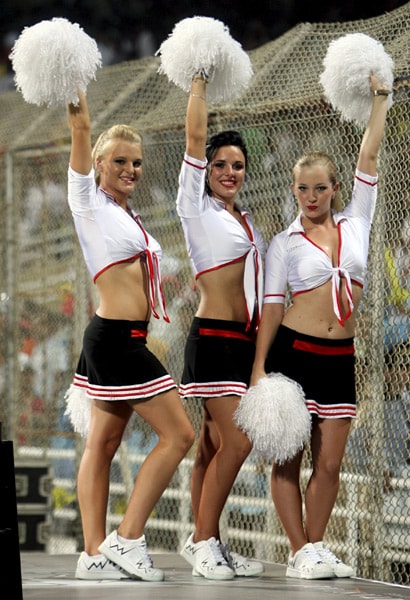
What would Douglas
Jardine have made of this - 20/20 IPL cricket with cheerleader squads - who
incidentally don't look very Indian!
"Will you join
in our crusade? who will be strong and stand with me? somewhere beyond the
barricade is there a world you long to see?
Do you hear the people sing? say, do you hear the distant drums? it is the
future that they bring when tomorrow comes!"
Flashpoint Silom
22 April 2010
Nirmal Ghosh - Straits Times
1am, Thursday : I got to Sala Daeng yesterday (Wed) afternoon, and made my
way to the Au Bon Pain cafe right next to the Dusit Thani hotel, at the
corner of the intersection across from the Red Shirt barricades next to
Lumpini Park.
A couple of hundred pro-government demonstrators were gathered on the
sidewalk outside waving Thai flags and yelling at the Red Shirts. There were
police making sure they stayed clear of the road to let traffic through.
More police were lined up at the side gate to the Dusit. But passions seemed
high on the part of the flag-waving pro-government crowd, and their numbers
were steadily growing. Sensing the mood, I tweeted that Sala Daeng was an
accident waiting to happen.
Later, I watched it unfold. There was little satisfaction in having been
right.
I had made a round of the Red Shirt barricades by then. Behind the bristling
bamboo and car tyre barricade some four to five metres high, the Red Shirts
were roaming around with bamboo staves, some of them sharpened. One seemed
to have arrows. Others seemed to be making slingshots.
I was told by journalist friends that they had chilli powder mixtures as
well though I didn’t see any. I didn’t see any firearms. At one point a big
BMW pulled up and reversed behind the barricade and a uniformed chauffeur
got out, opened the boot and started unloading food. Another time, a pickup
truck came by and Red Shirts on the truck hurled big plastic bags full of
styrofoam-packed food high into the barricade where they were grabbed by
eager hands and distributed. Many motorists wound down windows as they
passed and cheered the Red Shirts.
I made my way back to the other side of the street and hunkered down in the
Au Bon Pain and wrote my first report while the yelling outside grew more
and more hysterical. Then the cafe finally decided to close early, and I
shifted to the business centre at the Dusit and wrote my second report. When
I was done, around 8.30pm, I went back out and joined other journalists
watching the drama unfold.
The mood among the pro-government crowd became more and more ragged, with a
couple of passing red-shirted taxi drivers having their cabs bashed. But
around 10pm, the mood appeared to settle as many people left. I was on the
point of heading home when some rowdy men began to get out of hand, running
out into the intersection threateningly.
I saw the precise moment when the riot started. At around 11pm, some of the
pro-government demonstrators were running out into the intersection taunting
the Reds, and then one finally let fly with a large stone. That of course
was the signal for a barrage of stones and bottles from the pro-government
mob.
Only about 20 or so were involved, but it was enough to create tremendous
chaos. Glass shattered on the street and rocks cracked and bounced as they
went for the Reds – who retaliated with rocks and slingshots of their own
but held their line and did not come charging out.
Meanwhile cross-traffic was still flowing, crunching over the rocks and
broken glass. I wonder if some of the cars were hit as they crossed between
the battling sides.
The Reds vastly outnumbered the pro-government protestors, but held their
ground. The pro-government men periodically surged out into the intersection
to throw missiles at the barricades. Some hung back, crouching in the
shrubbery on the verge, aiming carefully and letting loose with slingshots –
deadly when fired with small ball bearings or marbles.
All the while, police deployed on the ground, and soldiers on the pedestrian
overpass above, did absolutely nothing to stop or separate the two sides. In
fact the police even moved one of their trucks out of the way of the
rampaging pro-government men.
A Thai man dressed in a white shirt spoke to me as we took cover behind a
wall, with rocks flying around us. "What do you think Thais should do?" he
asked me. It was a difficult question. I thought for a moment and said "Sit
down and talk about the issues".
He looked sad and then told me that "Thais only learn when many people are
killed".
Seconds later, a large Thai man in ordinary clothing translated a sign lying
on the sidewalk which proclaimed that Red Shirts were goons in the pay of
ex-premier Thaksin Shinawatra. Then he put his arm around me and led me away
and whispered in my ear "I am Red Shirt".
He said he was a taxi drover, and the pro-government men were from the
People's Alliance for Democracy (PAD), the formerly yellow-clad right-wing
group that closed down three airports in 2008 to paralyse the pro-Thaksin
government of the time, paving the way for its fall which eventually came
through a court decision to disband it because one of its executives had
cheated in the last election. That paved the way for the Democrat Party to
take power.
It is obvious to independent observers that the so-called "no colour" or
"multi-colour" crowds that have emerged lately, are largely the PAD in a
different form. They have been urging the government to crack down on the
Red Shirts of the United Front for Democracy against Dictatorship (UDD), and
have even threatened to do it themselves if the government and army did not.
They certainly tried at Sala Daeng, though not in force. But the Reds were
fairly disciplined and thankfully the riot did not escalate into a
full-blown fight. At least twice, the Red Shirts fired firecrackers at the
pro-government men who ran helter skelter, but returned to pelt them with
stones. The men were banging paving stones on the hard concrete to break
them into smaller pieces. One young man ran past me with a sack full of
empty bottles, heading for the fight.
At one point a foreigner who appeared to be a tourist, wearing black clothes
but with a red armband, was roughed up by the pro-government men, but some
among them got him away. That was at around 1145pm and seemed to trigger the
police into action.
They formed a double line at the top of the road facing the pro-government
crowd, which included some women who were hurling rocks and bottles as much
as the men. The arrival of the police seemed to embolden them and they
started screaming abuses at the Reds – insulting Thai terms like "hia" –
monitor lizard – and "khwai" – buffalo, a common insult used by a certain
section of the Bangkokian middle classes against rural people from the
north-east, where most of the Reds are from.
The police then turned around and faced towards the Reds, which came as a
bit of a surprise. But two big police trucks finally showed up then and
parked right in front of the police lines, and then the violence seemed to
peter out a bit.
The interesting part of the evening was that the police and soldiers did
nothing to stop the pro-government crowd, which incidentally was also, like
the Reds, in violation of the Emergency Decree which prohibits assembly of
more than five people. Yet they were allowed to assemble and yell at the
Reds in a gradual escalation all afternoon, which finally exploded at night
with the police and soldiers simply looking on.
Sala Daeng was and could be the flashpoint, which will see Thais battling
Thais in this divided country that appears to many, to be sliding into a
civil war. The right-wingers say they are fighting for the nation and the
King. The Red Shirts – from the same nation – say they are fighting for
their democratic right to have an election and have the results accepted and
respected. The right-wingers despise and denigrate them as ignorant rabble
seduced by Thaksin's money.
Someone tweeted me in the middle of all this, to say that "This is straight
out of the 1976 playbook. Get goons to do the dirty work and wash your hands
of it".
The year 1976 was a dreadful one in which mobs egged on by right-wing
rabble-rousers launched into a horrible massacre at Thammasat University, in
which leftist students were hanged and beaten and shot to death.
Thais say their nation has never been so divided as it today. The rage on
either side is palpable. Families and friends and couples have been torn by
it. Red Shirts kick and stamp on pictures of Privy Council president general
Prem Tinsulanonda, Prime Minister Abhisit Vejjajiva, and army chief general
Anupong Paochinda, and scrawl obscene and insulting graffiti against them.
Pro-government right-wing elements heckle and attack Red Shirts and kick and
smash their cars and shout "Ai! Khwai!" as they pass.
A people versus people bloodbath may be part of the playbook, forcing the
army to wade in. But times are different now from 1976, and there is no
telling what the consequences may be.
April 10 was a signal of just how bad things can become. And they could get
a lot worse unless there is some political compromise at the top. The window
for such a compromise, however, is closing fast.
In today’s The Nation, Supalak Ganjanakhundee wrote: "Thais appear to be
keen on expanding the ongoing conflict instead of containing it, with many
different colour-coded groups emerging to confront the Red-Shirt protesters.
Such confrontation would only orchestrate violence, if not a civil war."
It is worth quoting Supalak further, because he explains the echo of 1976.
"On Tuesday" he wrote, "an unknown group of people put up stickers on Silom
Road saying that the Red-Shirt group wanted a new Thailand with Thaksin as
president. A move like this suggests that the right wing and elitist forces
are employing old tactics to label the opponents as anti-monarchists."
‘’On October 6, 1976, student activists in Thammasat University were
massacred just because they were accused of being anti-monarchists.
"The stickers on Silom Road prompted an immediate denial from Thaksin, with
the Red-Shirt leaders declaring on Tuesday that it was a dirty political
game. They know the power of anti-monarchy accusations.
"If Abhisit and his government are gentle and fair enough, they should be
able to limit the conflict and stop a third hand from using this sensitive
issue to make things worse.
"Calling the protesters terrorists and turning a normal political protest
into a national security issue and a threat to the revered institution, is
uncivilised and unfair. Besides, such tactics will only make the problem
more complicated and difficult to resolve," concluded Supalak.
Thai elite in
denial over new Thailand
21 April 2010 - The New Straits Times - Sin-Ming Shaw
"Thailand’s poor have decided that docility is a thing of the past. They are
angry and frustrated by the status quo and are clamouring for change
In other prosperous democracies, the middle class provides the glue that
holds society together. In Thailand, by contrast, the bourgeoisie, centred
in Bangkok, is barely emerging as a social and political force.
Instead, for a half-century, an unspoken social contract among four broad
groups has held Thailand together: the “Palace” (a euphemism used here to
avoid violating draconian lèse majesté laws); big business, the custodian of
economic growth; the military, which ensures, first and foremost, the
sanctity of the Palace and the moral values it represents; and the common
people, mostly rural and urban poor, who accept the rule of the other three
estates.
Thailand’s national mythology is that it is a happy Buddhist country; a
“land of smiles” bound together by compassion and harmony under the
benevolent grace and blessings of the Palace and the generosity of big
business. The less fortunate classes are docile, content to accept their
subservient roles and satisfied with the social welfare, no matter how
skimpy, provided by their betters.
The poor and the military hold the Palace in genuine reverence. Palace staff
and people in the countryside kneel before the monarchy not merely as a
matter of protocol, but out of genuine love and respect. Forbes magazine
ranked the Thai monarchy last yearas the richest of all the world’s royals,
putting its net worth at US$30 billion (RM100 billion) — a figure that
locals consider too low. That royal wealth necessarily entails substantial
investments in and with Thai big business in all sectors of the economy.
Thailand’s blue-chip firms gain much from direct involvement with the Palace
and from social proximity to it. One Hong Kong scion, whose wife is from an
elite Thai family, estimates that perhaps 20 families control most of Thai
business.
The Thai military is constitutionally subordinate to civilian leadership,
but in reality it owes its allegiance to the Palace. In the current crisis,
army generals have told the public that they are reluctant to use force, a
position that was not theirs to take.
How long this inactivity will last is anyone’s guess. Mobs wearing red
shirts to symbolise their loyalty to former prime minister Thaksin
Shinawatra are now camped out in two major commercial areas, paralysing a
large part of the local economy. They demand that the government dissolve
the current legislature immediately, and that Prime Minister Abhisit
Vejjajiva resign because he was never elected and is viewed as a front man
for the traditional anti-Thaksin monied groups.
Many believe that the current crisis will pass, and that Thailand will
revert to its historical harmony among the four groups. But this view
ignores the country’s new political dynamics.
First and foremost, Thailand’s lower classes have decided that docility is a
thing of the past. They are angry and frustrated by the status quo. Save for
the handouts they got under Thaksin, they benefited little from the economic
growth of the past three decades. The vast gap between the urban rich and
the rest has grown worse over the years, with no discernible “trickle-down”
effect. Even in the prime commercial districts and chic neighbourhoods of
Bangkok, the nation’s richest city, a short walk reveals miles of cracked
pavements, piles of uncollected garbage, and rats scurrying freely. Such
wrenching sights are typically accompanied by the pungent odour of a sewage
system that is more a problem than a solution, especially during the rainy
season.
The sight of run-down physical infrastructure, punctuated by super-modern
shopping malls with global consumer brand names well beyond the purchasing
power of most citizens, is not what you would expect in an economy once
described as a potential Asian Dragon.
The wealthy dwell in air-conditioned houses, travel in chauffeur-driven cars
and shop in luxury malls, apparently oblivious to how the rest of the
country lives. Poor rural families see too many of their children become
prostitutes in order to survive.
The poor view the coup against Thaksin in 2006, and the later disbanding of
his party, as revenge by the traditional elites who wanted the old ways
back, and who would get what they wanted by force as they could no longer
get it through the ballot box. It is a view that is not entirely wrong.
In late 2008, anti-Thaksin mobs wearing yellow shirts and led by prominent
business figures occupied Bangkok’s Suvarnabhumi International Airport with
impunity, seeking to annul the result of a general election in which pro-Thaksin
forces gained power, despite Thaksin’s exile overseas. Yellow is the colour
of Thai royalty, and the Palace was believed to be sympathetic to the mobs.
Now Thaksin loyalists — the “Red Shirts” — are doing much the same,
demanding change through mob behaviour. They believe that they, too, are
entitled to act with impunity. The Red Shirts are not blind to Thaksin’s
excessive corruption. But they see him as a rare Thai politician who
actually bothered to connect with them. Moreover, as prime minister, Thaksin
made a point of delivering much-needed services to the underclasses:
subsidised medical care and micro-loans, to name just two.
But the unspoken issue behind Thailand’s unrest is that, with the country’s
82-year-old king ailing, the Palace’s moral force has come into question.
Indeed, Thai Foreign Minister Kasit Pirmoya, breaking taboos that have
governed the country for years, recently spoke about the need to re-examine
the country’s lèse majesté laws so that public discourse could intelligently
address the role of the Palace in Thailand’s future.
What Thaksin did for the poor required only political self-interest. Yet
even that elementary wisdom has never occurred to traditional ruling elites
too set in their ways. Until it does, Thailand’s otherwise promising future
will be increasingly remote.
The writer, a former fellow at Oxford University, is an investor based in
Thailand and Argentina
5 scenarios for
Thai crisis
20 April 2010
Martin Petty for Reuters
"Thailand's
military has vowed to get tough on anti-government protesters who say they
will occupy a luxury hotel and shopping district "indefinitely", raising the
risk of another violent confrontation.
Attitudes have hardened on both sides since troops and protesters clashed in
Bangkok on April 10, killing 25 people and wounding more than 800 during a
chaotic army crackdown that has intensified a five-year political crisis.
Following are scenarios about what could happen next.
TROOPS TRY TO BREAK UP PROTEST TRIGGERING VIOLENT CLASHES
The army says it will use force if necessary to take back the main protest
site at the Rachaprasong intersection and has warned that could cause
casualties.
Troops would likely move in at night, encountering red shirt guards blocking
the main entrances to the site, while swarms of protesters join in.
Soldiers, unable to drive through streets blocked by cars and trucks, throw
tear gas and fire rubber bullets at demonstrators, who stand firm.
As in the April 10 crackdown, shadowy gunmen may appear and open fire with
assault rifles and grenade launchers. Panicky troops open fire on the crowd,
with significant casualties.
The military is unable to secure the sprawling protest base, surrounded by
concrete pillars, bridges, shops, tents and an elevated rail track. Troops
withdraw. The protest continues.
PROBABILITY: This is a likely scenario given the huge political stakes,
the commercial significance of the location and the military's tough new
stance.
MARKET REACTION: Stocks .SETI and the baht THB= would slide. Ratings
agencies would consider another downgrade for Thailand. Long term
investments would go on hold.
ARMY SECURES PROTEST SITE, RED SHIRTS REGROUP ELSEWHERE
The military moves in unannounced during the early hours of the morning when
the number of demonstrators is considerably lower than in the evening and
daytime. Clashes ensue, causing some casualties. But the crowd is small, and
the soldiers are able to overcome "red shirt" guards.
The military surrounds the site in huge numbers. Many protesters agree to
leave, others are chased away by troops, who secure the site and establish a
perimeter. The government swiftly announces it has taken control.
Protest leaders vow to regroup. After a flurry of phone calls and text
messages, and "red shirt" radio issuing a call to mass at another site,
thousands begin a new demonstration elsewhere.
PROBABILITY: This is the second-most likely scenario.
MARKET IMPACT: The resilient bourse falls, but there is no mass selling.
However, investors are aware this is a quick-fix and not a long term
solution and many remain on the sidelines.
GOVERNMENT, PROTESTERS AGREE TO RESUME TALKS
Prime Minister Abhisit Vejjajiva is eager to avoid bloodshed and offers to
restart talks with no preconditions. The protesters accept. This takes the
heat off a tense situation and allows all parties some breathing space.
However, neither side has anything to bring to the table. Abhisit and his
backers refuse to agree to a shorter timeframe for holding an election and
the talks collapse.
The protesters remain defiant and their rally continues.
PROBABILITY: The two sides are unlikely to even hold talks, let alone come
to any agreement. The government has accused the "red shirts" of harbouring
"terrorists", and they in turn have branded the government "murderous" over
the April 10 clashes.
MARKET IMPACT: Thai stocks would rally briefly, if the two sides agreed to
talks, and the market, one of Asia's cheapest, might see several days of
gains during the cooling-off period, before falling again when the talks
inevitably collapse.
CLASHES OCCUR, ABHISIT DISSOLVES HOUSE, ARMY STAGES COUP
The army's attempt to break up the protests results in heavy bloodshed.
Abhisit's position becomes untenable. He defies his military and
establishment allies and dissolves parliament.
Aware polls would almost certainly return a government allied with ousted
former premier Thaksin Shinawatra -- the de facto "red shirt" leader
despised by the establishment elites -- the military stages a coup saying it
is upholding national security and protecting the revered king.
PROBABILITY: Highly unlikely. Abhisit is showing no signs of wavering. He
needs the military as much as they need him and both are determined to keep
Thaksin at bay and prevent early polls.
MARKET IMPACT: Stocks would plunge after massive foreign selling, and the
baht would weaken. Concerns about fiscal mismanagement, poor governance, and
a public backlash -- even civil war -- would curtail long-term investment.
Thailand's credit ratings would be downgraded."
Did authorities
overreact to the volcanic ash?
20 April 2010
- By Patrick Smith - Salon.com
There was no choice but to err on the safe side, but that won't stop the
questions.
"The airlines, along with their advocacy groups, have grown increasingly
vocal over the past few days, urging that restrictions be lifted and, in
some cases, accusing European authorities of having mucked up the whole
affair through overreaction and bureaucratic bungle.
Taking that second point first, I'm not sure what we were supposed to expect
when a sudden natural calamity affects more than 20 sovereign nations
simultaneously. Such events lend themselves to a certain, let's just say,
logistical disorientation.
The airlines' comments have, not unpredictably, brought out the cynics. With
carriers losing an estimated $200 million daily, it's easy to understand the
eagerness to get flying again, but are they being reckless about it?
There are millions of people out there who see airlines as the embodiment of
evil on earth, but let me remind you of the immense liability issues at
hand. Contrary to prevailing wisdom, airlines are not looking to play fast
and loose with the lives of their customers. They have too much to lose.
Call me a shill if you want, but remember that I'm a crew member too.
Speaking as a pilot, rest assured that I am not particularly eager to put
myself, never mind those people on my plane, in harm's way.
Meanwhile, the next chapter in this saga (to borrow an Icelandic word) will
be controversies over passenger reimbursements and air carrier bailouts.
European carriers are already asking for support, while passengers who paid
a few hundred dollars for an airline ticket are, in some cases, expecting
thousands in compensation. Is this fair? Who owes whom, and for what? It's a
topic that will stoke emotions and fire up anti-airline sentiment. What fun.
Was there an overreaction to the ash? It's impossible to say, but we had no
choice really but to err on the safe side. There was too much at stake. The
airlines, believe me, realize this in full. They are pushing for resolution;
they are not being daredevils.
Indeed things are slowly returning to normal. And that's how we should
expect it to happen -- slowly, methodically. This ash cloud is not a
localized or uniform thing. It's nebulous and changing, hour by hour, more
hazardous in some areas than in others. The skies will reopen sector by
sector, not in one wallop.
Nobody is saying the crisis has been handled ideally, but there are plenty
of smart, dedicated professionals who have been focused on this problem from
the start. All in all, I'd say we've handled it pretty well.
But don't close the book just yet. Eyjafjallajokull continues its angry
fuming, and now winds have turned portions of the ash cloud westbound. And
scientists are turning their attention toward a second Icelandic volcano,
Katla, which has begun to rumble ominously.
The overarching moral here, of course, is that we as humans remain at the
mercy of nature. There are those things in the world over which he have
little or no control. It's almost funny watching and listening to the
frustrations of certain people, who see this crisis as one of human failure
rather than simple human frailty."
Happy birthday Alex !
20 April 1997
to 20 April 2010 - 13 today !
The Ashes
become an election issue
20 April 2010
Why on earth
should the government be responsible for flying Brits back to their drab
little island?
There are many
Brits abroad who are now complaining that the government is not doing enough
to get people back home. Yet these people could afford to go on vacation.
They had the time and money. They are not exactly your poor and needy.
Sure people are
inconvenienced. But its like owning a car If you cant afford the insurance
then don't buy a car. If you can afford a holiday you can afford a little
extra cost and work to manage the inconvenience.
If your airline
does not look after you don't fly with them again.
If the tour groups
do not look after you then do not book with them again.
But with an
election just over two weeks away there is huge pressure on the UK's Labour
government to be seen to be doing something akin to the Dunkirk evacuation.
Funny isn't it -
people say they want less government and less bureaucracy. But as soon as
something goes wrong then the government has to step in and fix it.
And if the Labour Party does nothing then the opposition parties will make
political hay.
The Labour Party
did not blow up the Icelandic volcano. They did not send people overseas on
vacation. If you are concerned about acts of God - then stay and holiday in
the UK.
Many people have
shown great ingenuity to get home. Many companies have made huge efforts to
help people. The ferry, coach and rail companies have laid on numerous extra
services. Yet still people moan. They complain about a lack of care or
information. Show the initiative to find out what your options are. or just
stay where you are until it blows over and stop complaining !
No one died. No
one was hurt. No one was robbed (except for people being put on hold by Aer
Lingus at 10p per minute - disgraceful).
One friend is on
his way back to Dubai from the UK via train to Paris - 6 hour wait - train
to Lyon and train to Nice and then fly to Dubai arriving on Thurs morning
and straight to work. Hope he showers first.
Judgements on
safety clouded by profit losses
20 April 2010
Editorial - The National
Key quote:
"the thought that the eyes of some airline executives and airport managers
may be more focused on the bottom line than on passenger safety discomforts
us."
"Try finding a person who can pronounce its name or pinpoint
its location on a map and you’d probably be out of luck. By now, though,
it’s nearly impossible to find a person who doesn’t know that
Eyjafjallajokull – don’t even try it – spells inconvenience, hardship and
even heartache on a global scale.
The fine grey ash spewed into the atmosphere from the volcano in Iceland has
dashed holidays, thwarted work and slowed economies. Nearly a whole
continent – Europe – has been closed to air traffic altogether. The figures
are staggering. More than 6.8 million airline passengers and 313 airports
have been affected, and 63,000 flights have been cancelled worldwide at a
cost to airlines of $200 million a day.
As shown by the sharp slowdown at airports, even 6,900km away the UAE is by
no means immune. Most who work here come from somewhere else – just ask any
number of residents who were expecting visits by family members this week.
Then there’s our food. Shipments of dairy products from the US and fruit and
vegetables from the Netherlands have halted, with local wholesalers turning
to nations as far-flung as Australia and South Africa to make up the
shortfall.
Everyone is waiting for the all clear. The disagreement that is emerging is
just who should make that call and when to do it.
Suffering from an economic squeeze compared to the aftermath of September
11, the airlines are perhaps understandably chafing to get back to business.
The international aviation authority has called the continued closure of
airspace as “a European embarassment”. British Airways wants authorities to
allow airlines to decide when it’s safe to fly.
There is a valid argument to be made about how much expense should be
incurred as a precaution against an unlikely disaster, even if its
consequences are grim. And the airlines are arguing that a crash truly is
unlikely. Several international carriers have conducted test flights, minus
passengers, and reported no damage to the aircraft. Besides, the argument
goes, airlines, not to mention passengers, wouldn’t fly if they really
thought there was a risk, regardless of the profit motive.
Of course, flying has never been risk-free, no matter how much the airline
industry tries to persuade us otherwise. But the thought that the eyes of
some airline executives and airport managers may be more focused on the
bottom line than on passenger safety discomforts us. For the time being, the
possibility of silicon-laden ash turning to glass inside aircraft engines,
causing them to stall thousands of feet above the earth, is convincing
enough.
The airlines, and those that depend on them, should be digging in to weather
this storm. In all likelihood, governments will come to the rescue before
their flagships fail, not an ideal situation but perhaps a necessary one.
The natural movements of earth and wind will decide when Europe’s air
traffic returns to normal. Political pressure or economic emergency should
have no sway in the matter – only when regulators judge that it is safe
based on the best available science should the planes fly again."
Earthquakes
explained in Iran
20 April 2010
An Iranian cleric
has an unusual and unscientific explanation for earthquakes I wonder how
would explain a volcano.
Iran is one of the world's most earthquake-prone countries, and the cleric's
unusual explanation for why the earth shakes follows a prediction by
President Mahmoud Ahmadinejad that a quake is certain to hit Tehran and that
many of its 12 million inhabitants should relocate.
"Many women who do not dress modestly ... lead young men astray, corrupt
their chastity and spread adultery in society, which (consequently)
increases earthquakes," Hojatoleslam Kazem Sedighi was quoted as saying by
Iranian media.
Some experts have even suggested Iran should move its capital to a less
seismically active location. Tehran straddles scores of fault lines,
including one more than 50 miles (80 kilometers) long, though it has not
suffered a major quake since 1830.
In 2003, a powerful earthquake hit the southern city of Bam, killing 31,000
people — about a quarter of that city's population — and destroying its
ancient mud-built citadel.
Ahmadinejad made his quake prediction two weeks ago but said he could not
give an exact date. He acknowledged that he could not order all of Tehran's
12 million people to evacuate. "But provisions have to be made. ... At least
5 million should leave Tehran so it is less crowded," the president said.
Minister of Welfare and Social Security Sadeq Mahsooli said prayers and
pleas for forgiveness were the best "formulas to repel earthquakes."
"We cannot invent a system that prevents earthquakes, but God has created
this system and that is to avoid sins, to pray, to seek forgiveness, pay
alms and self-sacrifice," Mahsooli said.
The tragedy of Shashi Tharoor
BBC - Soutik Biswas - 19 April 2010
This is best
read together with the author's article on
Time to Clean Up Indian Cricket. The comments that follow indicate how
strong feelings are on all sides.
"When Shashi
Tharoor joined the Congress-led government as a junior foreign affairs
minister after a rousing electoral debut last year, he was hailed as a
great, young hope for a new emerging politics. At 54, he is still a toddler
by Indian political standards.
Mr Tharoor's credentials were impeccable. He had been a top UN diplomat who
had even taken a shot at the secretary general's job, albeit unsuccessfully.
He was erudite (a prolific writer of novels, non-fiction and columns),
articulate (a delight for English TV networks) and adept at using social
networking tools to reach out to his supporters (more than 700,000 followers
on Twitter). He appeared to be a far cry from the stereotypical
subcontinental politician.
Once in government, Mr Tharoor led a charmed life. First he was ticked off
by the government for staying in a luxury hotel at a time when his
recession-hit government was preaching austerity. (Mr Tharoor argued that he
was paying his own bills, but moved out of the hotel anyway). Then his
frenzied Twittering got him into trouble - on at least two occasions he
appeared to have irked his party with his messages. He finally ran out of
luck on Sunday night after the government could not countenance his
involvement with a cricket team in a tournament neck deep in allegations of
corruption and sleaze.
In many ways, Mr Tharoor's inglorious departure is a big blow to urban,
English-speaking Indians who believe that the country's politics needs
people like him to change the rules of the game. "Tharoor's predicament
should give no joy to those who have yearned for freshness in politics. He
had his chance but let human frailties and the air of India cloud his
judgement," writes analyst Swapan Dasgupta. "His unavoidable fall will be
celebrated by those who want politics to remain a closed shop."
Was Mr Tharoor's fall a result of blithe insouciance - or what Mr Dasgupta
calls "smug superciliousness" - that made him think that he could never do
any wrong? Or was he naïve enough to get involved in the auction of a team
in a controversial cricket event, as alleged? It is difficult to say. Mr
Tharoor has maintained his innocence and said that nobody ever raised any
questions about his integrity in his career as a UN diplomat.
But most analysts say it was a bit reckless of him to allow a close aide to
turn up for the auction of a cricket team in which a woman friend of his
[with Dubai connections as has Mr. Tharoor] was picking up equity,
allegedly free. They say it was improper for him to even call up the chief
of the Indian Premier League to discuss matters relating to the team. All
this, they say, doesn't ring quite true with a telling Twitter message from
Mr Tharoor last week, before he handed in his resignation: "Thanks for all
the support and good wishes. You folks are the new India. We will 'be the
change' we wish to see in our country. But not without pain!" Social
networking will never win votes in India. In the end, writes Swapan Dasgupta,
"a man who sought 'new politics' was brought down because he couldn't rise
above old politics". That perhaps really sums up the tragedy of Shashi
Tharoor."
Airlines versus the regulators
19 April 2010
UK and European
airlines are pressing the Government and European Union regulators to be
allowed back to fly; even if under strict regulations; such as daytime
flights only.
The airlines are
losing money. They want to fly. Above all else they want to clarity on the
criteria for restoring operations. And now they are angry with the
regulators. I am not sure how you can be angry about people who put safety
first.
Had a plane fallen
out of the sky in the last few days then a tragedy would have happened which
with our technology would be wholly unnecessary.
And why is this
such a big deal. Some people are inconvenienced. Some people are out of
pocket. The airlines that are financially sound will quikcly pick up
momentum and overfill their planes over the next two weeks.
But no one had
died or lost everything from this volcano. It is not on the same scale as
the Qiinghai earthquake.
There can be no
doubt that closing airspace was the correct initial reaction given the cost
and danger of damage of accident from the debris in the ash clouds. Now it
looks as though air space will partially re-open over Europe on Tuesday.
The airlines want
to fly. But better safe than sorry in this case. One airplane losing engine
power after flights restart and the whole network will be closed down again.
And don't be
surprised if the Iceland Volcano decides that it has not finished; another
serious eruption and disruption of traffic is quite possible.
Financially this
will have hurt some airlines. But those that already have their hands out
for bail-out money should be ashamed.
flydubai
adds Kabul and Luxor
18 April 2010
Dubai’s low cost
carrier flydubai announced today that it will be introducing two new routes
to Afghanistan and Egypt in May.
Starting on May 17, the budget airline will fly to Kabul in Afghanistan,
followed two days later with flights to the ancient Egyptian city of Luxor.
Flights to the Afghan capital will start from AED725 (expensive for
flydubai's routes) and will be five times per week, whereas flights to Luxor
will be priced at AED350 and will be three times a week, a statement by the
airline said.
Ghaith al Ghaith, CEO of flydubai, said: “This brings our network to 17
destinations and continues our commitment to make travel a little less
complex, a little less stressful and a little less expensive.
“Kabul is going through a very turbulent time, but providing air links on a
quality airline flying the newest, safest aircraft in the industry will
ensure the brave people working to secure and develop the country will have
a safe, comfortable and affordable travel option.”
flydubai was founded in 2008 and now operates from Dubai International
Airport Terminal 2.
Airline
finances up in ashes?
18 April 2010
Emirates Airline
said today that the disruption caused by the Icelandic volcano eruption was
"unprecedented in aviation history". I guess EK was not around in the USA
for the impact of 9/11 - but the disruption is significant.
The Dubai carrier
said it was currently providing hotel accommodation and three meals per day
for more than 5,000 transit passengers at a cost of more than $1 million per
day.
In total the
disruption caused by the Icelandic volcano eruption has cost Emirates
Airline in excess of $50m. The airline said it is losing revenue from 18,000
passengers a day as airspace across the UK and much of Europe remains
closed. Around 30 Emirates aircraft are grounded, equivalent to one fifth of
the fleet, the statement said.
The problem is that the airlines were only just beginning to emerges from
the latest financial crisis. The fear must be that the effects could last
for days or even weeks.
In 2001 the suspension of all flights in American airspace for several days
in the wake of the terror attacks forced a $15 billion government bail-out
for domestic carriers. Even with this help US Airways and United Airlines
were forced to file for bankruptcy in 2002. A prolonged disruption of
flights in and out of northern Europe could threaten the tentative economic
recovery in the region if business travellers and tourists stop arriving.
As many as 15 000 flights a day are now being cancelled across Europe. It is
far from clear when flights will start operating again and "once they start
operations again, obviously we will have aircraft in places they are not
supposed to be," said Jonathan Nicholson, a spokesman for the UK Civil
Aviation Authority. "It takes time before normal operations resume."
In Dubai Richard
Vaughan, divisional senior vice president, Commercial Operations Worldwide
said today: “Disruption of this magnitude is unprecedented in aviation
history. The longer that it continues, the more complex the recovery process
becomes.
“Emirates understands how difficult the ongoing disruption is for everyone
affected. We continue to work on a contingency plan to get our flights and
passengers moving as quickly as possible once airspace reopens.
“We estimate that, once approval has been granted to fly, it will take
around 24 hours to get our flight schedules back to normal. However, with
each day that passes, so the backlog grows.
“Currently, over 73,000 of our passengers have been affected by the
cancellations. We plan to operate extra flights to help ease the situation
but we will not be able to confirm any further details until clearance is
received from European Air Traffic Control authorities.”
The airline has cancelled all its flights to the UK and most to mainland
Europe on Sunday and has already grounded all early morning flights to the
UK, scheduled to leave Dubai on Monday.
Airlines have weathered the effects of recessions, terror attacks, wars and
diseases such as SARS in the past and most will eventually get over a few
days lost to volcanic activity. But a prolonged eruption could have more
unpleasant effects not just for air travellers but for everyone in and
traveling to Europe.
Angels with
bloody hands
17 April 2010 -
The Economist
"Known in Thai as
the “City of Angels”, Bangkok on April 10th briefly resembled an
approximation of hell. Street fighting left at least 23 dead, hundreds
injured and a dark cloud over the country’s huge tourism industry and its
economic health in general. Yet hope that the shocking eruption of violence
might jolt the two sides into mutual climbdowns has so far proved illusory.
The government of Abhisit Vejjajiva, the prime minister (pictured), is still
unwilling to meet the protesters’ demand for an early election. The
red-shirted protesters occupying parts of Bangkok for over a month now
refuse even to talk to the government. They are both wrong.
The origins of the bloodshed can be disputed. But the underlying causes of
political deadlock are not: they lie in the persistent refusal of Thailand’s
elites to accept electoral defeat at the hands of Thaksin Shinawatra, a
deeply flawed but nonetheless popular prime minister. He was turfed out in a
coup in 2006 and went into exile. Against the odds, a party loyal to him did
better than any other in an election in 2007. A year later, it was forced
out of office by yellow-shirted mobs and convenient court rulings.
Mr Abhisit can hardly be surprised that he now faces the same tactics. He is
also guilty of hypocrisy. In 2008 he called on the then prime minister to
resign after two yellow-shirt protesters had died. In general the pro-Thaksin
red shirts have shown greater discipline recently than the yellow shirts did
then. The red shirts also have a stronger case: that the prime minister and
his cobbled-together ruling coalition lack a popular mandate. It would be
humiliating, but Mr Abhisit should offer an early election. Better to cede
power that way than in a coup or bloody insurrection.
He has a point, though, that an election in itself would not end the cycle
of confrontation. He knows that a red shirt, pro-Thaksin party, with its
roots in the poor and populous north-east, might well win again. And again,
the urban middle-classes and the business, military and aristocratic elites
used to running Thailand as their private show might balk. It is not enough
that the people be given the chance to vote again. There has to be consensus
on the need to honour the results, and, thereafter, to replace the
army-imposed constitution with its predecessor, adopted in 1997 after much
public debate.
Sadly, many red shirts, too, seem to find constitutionality boring and
unproductive. Mr Thaksin himself a year ago unhelpfully called for a
“revolution”. Portraying themselves, falsely, as blameless, unarmed victims,
his followers are holding out for complete victory. That is a foolish
tactic. Many policemen and soldiers for a long time showed restraint—partly
because some probably sympathise with the red shirts’ grievances. The red
shirts should be looking for common ground, not the final, bloody showdown a
few seem to crave.
In 1992, after a massacre in Bangkok, the army chief and protest leader were
seen on television, on their knees before Bhumibol Adulyadej, Thailand’s
king, being carpeted—like naughty children scolded by a tolerant parent. His
prestige brought a settlement. Red shirts, though accused of being closet
republicans, have asked for a royal repeat performance. That looks unlikely.
The king, now 82, is in poor health, his court has taken the government’s
side in the conflict, and his likely successor is deeply unpopular. A
political system that relies on the crown’s “stabilising” role has broken
down, leaving what is close to an undeclared civil war. In the past the
mechanism for preventing such a disaster has been a coup. Better for the
politicians, no matter what colour their shirt, to grow up, and talk."
Thailand update - 17 April 2010
Bangkok Post - Read the following - this is a good indication of
hoe heavily armed the militray was in last Saturday#s crackdown. And why did
they have anti-aircraft guns and ammunition at a public rally ? Bizarre.
"The government
believes the red shirts are working with the armed men or they may have been
infiltrated.
Among the firearms and other equipment claimed to have been lost during the
clash were nine M16 rifles, 25 Tavor rifles, six anti-aircraft guns, 116
shields, 105 batons and 80 body armour suits.
The army also lost control of six personnel carriers and three high-mobility
multi-purpose vehicles when troops abandoned them in the face of angry red
shirts.
Ammunition also went missing, including 580 rubber bullet rounds, 600
anti-aircraft rounds and 8,182 M16 rifle rounds."
************************************
Meanwhile the ABC documentary has caused a predictable fuss:
AFP reports that
Thailand has protested to the Australian government over the airing of a
documentary critical of the Thai royal family and warned that the broadcast
could affect ties between the nations.
A senior representative from the Thai embassy met with officials from
Australia's Department of Foreign Affairs on Thursday to express his concern
at the programme aired by the Australian Broadcasting Corporation (ABC).
Saksee Phromyothi, minister-counsellor at the Royal Thai Embassy, told AFP
that "We consider this an issue matter of national security... because the
royal family, the monarchy, in our constitution is above politics."
Thailand's ambassador designate Kriangsak Kittichaisaree has also written to
ABC managing director Mark Scott to complain about the programme which could
breach Thailand's lese-majeste laws which prohibit criticism of the royals.
"I regret that an organisation of the ABC's stature has lowered its own
standard by airing the said documentary which is presented in a manner no
different from tabloid journalism," he wrote.
The programme was shown last Tuesday in Australia but it cannot be seen on
the Internet outside the country.
Thailand mulls
a 'half coup'
16 April 2010 By Shawn W Crispin Asia Times
This is
worth a read in full. It is worthy of a movie Full of intrigue and back
stabbing that makes ancient Rome look like a tea party. Assuming Crispin's
sources are good - this is remarkable.
"When assassins dressed in black killed one top military commander and
maimed two others in the early stages of the April 10 clashes between Thai
security forces and red-shirted anti-government protesters, the precision
hits were likely as political as they were tactical.
Analysts and diplomats believe that the pre-emptive strikes effectively
broke the military's chain of command and contributed significantly to the
subsequent random violence that resulted in at least 24 deaths - including
five soldiers - and over 800 injuries, many from bullet and grenade shrapnel
wounds.
Significantly, the three targeted officers were all primed for promotion to
top-ranking positions in this year's military reshuffle and all were known
loyalists to the deputy army commander, General Prayuth Chan-ocha, who is
poised to replace the army commander, General Anupong Paochinda, on his
mandatory retirement later this year.
The sophisticated nature of the targeted attacks, including the use of
laser-guided spot and shoot teams, and the apparent leak of confidential
information concerning troops' plans and formations, has suggested to
analysts possible military involvement in the assaults. Officials have
claimed that "terrorists" rather than rogue soldiers orchestrated the
violence. But the uncertainty has raised critical new questions about army
unity at a pivotal juncture in the country's violently escalating
five-year-old political conflict.
Prime Minister Abhisit Vejjajiva's government has said that deployed
soldiers used live ammunition only in self-defense after they unexpectedly
came under fire; the United Front for Democracy Against Dictatorship (UDD)
protest group has claimed that none of its supporters were under arms.
International reaction to the killings has been guarded due to the still
unclear circumstances surrounding the violence.
The UDD launched its protests in mid-March two weeks after a Thai court
ruled to confiscate US$1.4 billion worth of exiled former premier Thaksin
Shinawatra's assets on charges of abuse of power. His elected government was
toppled in a bloodless 2006 military coup and the UDD has mobilized around
his still strong grass-roots popularity, particularly in the northern and
northeastern regions but also among Bangkok's lower classes, and his
presumed funds.
In April 2009, Thaksin urged his UDD supporters in a video-linked address to
launch a "social revolution" against the government, a battle cry that
sparked riots in the national capital that the military suppressed
professionally. Thaksin told international media at the time that soldiers
had killed scores of his supporters and secretly spirited away their bodies
- claims that were never substantiated with evidence.
In advance of the April 10 violence, coinciding with the start of the UDD's
protests, government offices, military installations and private businesses
were targeted in a mysterious bombing campaign that UDD leaders have claimed
the military orchestrated to discredit their self-proclaimed peaceful
protests.
Yet some diplomats monitoring the situation felt that certain bombings were
coordinated with protest activities and seemingly aimed to provoke a
security force crackdown against unarmed UDD demonstrators.
An armed response, diplomats then suggested, would have provided Thaksin
with potent ammunition to call for a mass royal amnesty that would protect
security forces from legal prosecution for killing protesters and absolve
him of his court convictions, including a 2008 criminal corruption verdict
that included a two-year prison sentence and drove him - before the ruling
was made - into exile.
Royal silence
The palace, however, has maintained a steely silence in the wake of the
April 10 violence with no hint of a royally endorsed amnesty forthcoming.
This despite calls from UDD co-leaders to King Bhumibol Adulyadej to
intervene in the crisis. Queen Sirikit, meanwhile, made a symbolic
appearance at the funeral of Colonel Romklao Thuwatham, the commander killed
on April 10 who was also her former bodyguard, and has paid hospital visits
to injured soldiers.
As Abhisit's government and UDD leaders fire accusations and
counter-accusations over who should be held chiefly accountable for the
April 10 death and destruction, it is the military's next moves that will
determine the country's political trajectory. One palace insider told Asia
Times Online that top soldiers had in recent days weighed the possibility of
launching a "half coup" that would maintain Abhisit's Democrat party in
political power while relieving certain soldiers of their command posts.
For his part, Anupong has maintained that politicians must find a political
solution to the crisis and this week lent his tacit support to the
dissolution of parliament and holding new elections, without mentioning a
timetable. But an internal military putsch that replaces Anupong with
Prayuth, purges military officers perceived to be under Thaksin's and the
UDD's sway, and invokes martial law to clamp down on the UDD, is also a
strong possibility.
Anupong is believed to have lost significant support among the top brass and
sections of the palace after Saturday's botched security operation. In
particular, he has been criticized for not moving earlier and more
decisively against the UDD, including on occasions when demonstrators left
lightly guarded their main protest sites to participate in roving rallies
around Bangkok.
"How much longer can Anupong last?" asks one Bangkok-based diplomat. "He has
become something of a do-nothing army commander who is not willing to do get
involved in crucial operations ... His earlier restraint is now seen in the
eyes of some as a liability." People who attended the funeral ceremony this
week of one of the fallen commanders said that Anupong was isolated and
ignored by other top soldiers.
Any Prayuth-led purge of the military would aim to remove senior officers
believed to be in league with and providing confidential information to
Thaksin and the UDD. In particular, questions are being raised about the
possible role of the paramilitary tahahn prahn, or Rangers, in last
Saturday's commando-style decapitation of the military's on-the-ground
command.
Unaccountable force
Analysts and diplomats say that the Rangers are one of the few Thai military
units with the capability and training to have accomplished such a
sophisticated military-style operation. Certain Rangers have openly
demonstrated their support for the UDD and in recent weeks appeared in full
uniform to sing songs on the UDD's protest stage.
General Chavalit Yongchaiyudh, who first formed the Rangers as a
counter-communist force in 1978, has according to at least one academic
study [1] maintained influence over the elite unit in his civilian capacity
and has deployed its soldiers for political purposes in the past. The
Rangers are perhaps the least accountable of the Thai military's units,
embodied in a culture that allows soldiers to come and go without question
from their main camp in Korat province.
One government official says they are now quietly probing the current status
of Chavalit's connections with the Rangers. Chavalit is now chairman of the
Thaksin-aligned opposition Puea Thai party and is tipped to run as the
party's prime ministerial candidate at the next polls. He has said publicly
that Abhisit should take full responsibility for the April 10 deaths.
Other insiders believe that the Supreme Command has played a role in leaking
information to the UDD from the government's security command center,
including confidential details of the military's plans and formations for
dispersing the UDD. They note that Supreme Commander General Songkitti
Jaggabatra has been a dissenting voice in top-level meetings held to devise
strategies for dealing with the UDD.
A government official says the matter is under "internal investigation";
Songkitti could not be reached for this article.
It's unclear, however, just how deep intra-military distrust runs. The
earlier consensus among military analysts and observers was that Anupong had
since the 2006 coup consolidated his power through a series of reshuffles
and demotions that aimed specifically at purging remnant support for Thaksin
from leadership positions in the armed forces.
Some military insiders, including former spy chief and behind-the-scenes
2006 coup leader, Squadron Leader Prasong Soonsiri, had in recent months
made presentations to diplomats that there was still strong pro-Thaksin
sentiment at certain top levels of the armed forces. Some now believe
Thaksin has capitalized on mounting resentment to the disproportionate
promotion of former Queen's Guards, including Anupong and Prayuth, at recent
reshuffles.
That may partially explain why Anupong and Prayuth relied on known loyalists
outside of Bangkok, including the Prachinburi province-based 2nd Infantry
Division, to play the lead role in last Saturday's crowd control operation.
One military insider said that "trust issues" were a factor in the decision
to deploy the Bangkok-based 1st Infantry Division only on the operation's
perimeter and to keep the Bangkok-based 2nd and 4th Cavalry units in the
barracks. Nor were the special forces deployed, a unit known peeved since
2007 for having its leaders sidelined by Anupong after playing a pivotal
role in the coup that ousted Thaksin.
It's uncertain how senior soldiers would react to any order from Prayuth to
quit their commands, though one military insider suggests any aggressive
action to lockdown top officers perceived to be compromised could spark a
"civil war". Some believe that this week's mysterious botched attack on an
electricity generating plant providing power to Bangkok was meant to send a
signal to Prayuth that any internal coup would be met with strong and
potentially debilitating resistance.
One diplomat suggests that the top brass should instead aim to publicly
"name and shame" officers with hard evidence proving they leaked information
or participated in operations that endangered and took other soldiers' lives
rather than launch another coup. The envoy expressed concerns that the
military could be emboldened to act more forcefully by the tepid domestic
and international response to last Saturday's bloodbath.
Yet passions are known to be running high in Prayuth's camp after the
Queen's Guard soldiers who were expected to make up the core of his power
base upon becoming army commander were targeted, killed and maimed in a
military-style assault.
It's thus unclear whether the military under Prayuth's leadership would
countenance the prospect of elections that could hand Chavalit the
premiership and by proxy give Thaksin sway over future military policies and
reshuffles. But even a "half coup" would be highly unpopular and could well
push Thailand to a tipping point."
Note
1. See Desmond Ball's The Boys in Black: The Thahan Prahn (Rangers),
Thailand's Paramilitary Border Guards, White Lotus Press, Bangkok, 2004.
Shawn W Crispin is Asia Times Online's Southeast Asia Editor.
All on Anupong
16 March 2010
Thai Prime
Minister Abhisit Vejjajiva tonight made his army chief the head of national
security in a bid to streamline operations as anti-government protesters
massed in the streets calling for his downfall.
Army chief General Anupong Paochinda will replace Deputy Prime Minister
Suthep Thaugsuban, Abhisit said, admitting that efforts to rein in the
protests had failed six days after violent clashes killed 24 people.
“We have reached a consensus today to treat all terrorist acts as special
cases, which will facilitate in speeding up legal proceedings that we need
to take,” he said in a televised address.
“The unsuccessful efforts taken so far in enforcing law have prompted us to
review structural issues.”
The government has promised to crack down on what it terms “terrorists” whom
it blames for Saturday’s killings. Abhisit also admitted efforts to arrest
some red shirt leaders on Friday had failed.
In his 12-minute
national address last night to make the crucial announcement, Abhisit used
the word "terrorist" or "terrorism" five times.
Thailand's
Broken Democracy
16 April 2010 - Time magazine - Hannah Beech
"When I was a kid growing up in Bangkok, we used to have "coup days" —
school would be canceled because of the threat of tanks rolling down the
street. I loved the bonus vacation time, but the fact that putsches, or
rumors of them, happened so often as to merit a specific type of holiday
proved just how unstable Thailand's political landscape was. Thirty years
later, not much has changed in one of the world's favorite vacation
destinations. As red-shirted antigovernment protesters have besieged Bangkok
for a month now, my son's school has been intermittently shuttered. And the
favorite parlor game in the Thai capital remains the same: guessing when the
men in green might move.
In the facile political taxonomy we use to categorize nations, Thailand is
considered a democracy. Yet the country remains, if not a banana republic, a
juicy, messy mango republic. Over the past four years, two political blocs,
loosely divided in terms of class and geography, have swapped control of
government with whirlwind velocity, using ever more creative protest tactics
and distortions of democratic institutions to vanquish their opponents. (See
pictures from Thailand's April 2009 protests.)
The recent twists and turns of Thai politics make even a Tolstoy epic feel
streamlined. Here are the highlights: In 2006, after months of protests by
his opponents (clad in their trademark yellow shirts), populist Prime
Minister Thaksin Shinawatra was overthrown in a military putsch and later
sentenced in absentia for abuse of power. After a bungled attempt to guide
the country, the generals allowed elections, which a Thaksin-supported party
promptly won. But that Prime Minister was forced out of office by a court
decree because he had accepted a token fee for hosting a cooking show.
Later, with Thaksin's brother-in-law helming the government, the Yellow
Shirts, who had besieged the prime ministerial offices for months, resorted
to hijacking Bangkok's two airports for a week.
The political deadlock eased only in December 2008 when the constitutional
court ordered the Thaksin proxy party dissolved for electoral fraud, paving
the way for current Prime Minister Abhisit Vejjajiva's ascension through
parliamentary backroom deals. Ever since, red-shirted Thaksin supporters
have periodically descended on Bangkok streets, demanding fresh elections
that they hope will usher in a leader who will address the needs of the
nation's lower classes. Their latest rally on April 10 turned violent, with
protesters and troops trading gunfire in the shadow of the capital's
Democracy Monument; 23 people, both military and civilian, died in
Thailand's worst political unrest in nearly two decades. Then, on April 12,
a curiously timed Election Commission decision was handed down, recommending
that Abhisit's Democrat Party be disbanded for accepting illegal campaign
donations. (Read "Does Thailand's Military Answer to the Government?")
Even as this political farce has unfolded, Bangkok has, for the most part,
felt strangely normal. Earlier this month, Abhisit declared a state of
emergency in the capital after the red rallies swelled and mysterious
grenades were lobbed across town. But restaurants were still packed, bars
still buzzing. The only real outcry seemed to come when protesters had the
audacity to converge near six shopping malls, forcing a halt to retail
therapy.
Yet the growing political lawlessness is devastating for Thailand's economy
— and the bloodshed of April 10 is impossible to ignore. Already, foreign
investors are looking at regional alternatives like Indonesia or Vietnam as
safer places to park their money. On April 12 Thailand's Finance Ministry
trimmed half a percentage point off this year's growth estimate of 4.5%
because of the continuing crisis. The same day, army chief General Anupong
Paochinda, whose support is key to Abhisit's coalition, opined that a
parliamentary dissolution followed by elections was a wise course of action.
The Reds were elated. They believe their side will prevail at the ballot
box. But the Yellow Shirts quickly came out of hiding and announced plans to
stage their own counterdemonstrations.
As ever, Bangkok buzzes with speculation that the army might again extend
its iron fist, if only to stop the revolving door of street protests. My
son, I suspect, will enjoy plenty more coup days off from school."
Crisis meeting after a weekend of golf
16 April 2010
There is no crisis
in Bangkok. The army will have a meeting of commanders. But not until
Monday. After all a weekend on the golf course is clearly a military
priority.
Thailand - where
the army - or at least its leaders - only work from Monday to Friday.
The Bangkok Post
is reporting that Army commander-in-chief Anupong Paojinda on Friday
afternoon issued an urgent order instructing troop commanders of the rank
Maj Gen and higher to attend an extraordinary meeting at 1pm on Monday at
Army Headquarters, reports said.
It was reported that Gen Anupong, deputy army chief Gen Prayuth Chan-ocha,
army chief assistants Gen Theerawat Boonyapradab and Gen Wit Thephassadin na
Ayutthaya, army chief of staff Gen Phirun Phaewpolsong, commanders of Army
Region 1-4, and commander of the Special Warfare Unit would all attend this
important gathering.
Botched in Bangkok !
16 April 2010
This is too funny.
The simple version is that three red shirt leaders were sleeping in the
decidedly average SC hotel last night. The authorities knew this. They
raided the hotel. The three leaders escaped. And red shirts took captive at
least two of the police officers.
But there is so
much more to this !
The Nation says
the raid was carried out by "dozens of commandos".
Red shirt leader
Arisamun Pongruengrong scaled down a rope from the balcony of his room on
the third floor and was rescued by some 500 red shirts protesters. See this
picture from TNA. But why is there a policeman in the background taking
pictures of the rescuers. Why is he not arresting Arisman?
 Deputy
Prime Minister Suthep Thaugsuban has earlier announced the raid on national
television. "As I am speaking, special forces are surrounding the SC Park
Hotel where we believe the terrorists and their leaders are staying," he
said about 10am. "We will arrest and suppress the terrorists. We have set up
special task forces to hunt down the terrorists," he said.
Deputy
Prime Minister Suthep Thaugsuban has earlier announced the raid on national
television. "As I am speaking, special forces are surrounding the SC Park
Hotel where we believe the terrorists and their leaders are staying," he
said about 10am. "We will arrest and suppress the terrorists. We have set up
special task forces to hunt down the terrorists," he said.
Why announce the
raid on TV before it has been completed. Did this alert the red shirts.
Why - and this is
always the case - was there photographers and a TV station at the hotel to
take pictures of Mr Arisman. WHo alerted the media to be there at that time?
At 11.30am, government spokesman Panitan Wattanayakorn told reporters that
the operation to arrest the red-shirt leaders was "unsuccessful".
"They planned to kill me. They planned to kill me," Arisman has told foreign
press. "There were two (unexploded) bombs in my room"
Not only did
commandos fail to arrest red leaders, some senior officers were also "taken"
hostage by reds.
Meanwhile more
than ten members of the People ‘s Network for Protecting the Nation, led by
Chaiwat Sinsuwong, submit a letter to Gen Kanit Saphithak, Army Region 1
commander, calling for the use of martial law or any other stringent
measures to settle the continuing political problem, reports said.
“The situation has been escalating and the imposition of the martial law
will give the military absolute power in dealing with the protesters and
maintaining peace and order”, Mr Chaiwat said on Friday afternoon.
But this botched
raid can only add to the pressure on Abhisit. The police and army have
failed him again. Heads should roll. But whose head?
Tulsathit from the
Nation has been running a twitter contest for the best caption to this
picture. My offering: Dope on a Rope. Others include Die Another Day. Dangle
Berry. Bangkok Dangerous.
In case we
forget what matters
16 April 2010
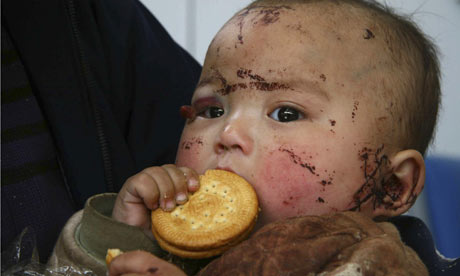
A
nine-month-old child injured in the earthquake in Yushu, Qinghai.Reuters
Sadly the volcano
story has taken over any news of the 48 hours old news of China earthquake
in Yushu, Qinghai. There the death told is at least 760 and over 8,000 are
injured and many more homeless, perhaps 100,000.
We seem to have
got our priorities very wrong.
The quake was
centered in a largely Tibetan area of China. It is remote. Almost
inaccessible. 800 km away from the provincial capital Xining.
Chine is
restricting access by local and foreign reporters to this sensitive region.
We are getting less coverage and news than in the 2008 Sichuan earthquake.
But that does not mean that we should ignore the story and the suffering.
What matters more
- pictures of a hen party that could not get to Spain for a pissed - up
weekend - or coverage of the rescue efforts in China.
Martyrs on both
sides
Blood on the streets does not seem to bring compromise any closer
15 April 2010 -
The Economist
"When protesters
hurled their own blood last month against the walls of the prime minister’s
house in Bangkok, it was an act of macabre political theatre. Photographers
crouched to snap the sticky pavement. On April 10th there was more blood on
the streets, spilled in earnest, during the worst political violence in
Bangkok since May 1992. As then, armed soldiers clashed with anti-government
demonstrators. This time at least 23 people died. Several hundred were
injured, some seriously.
The government and the red-shirted protesters each accuse the other of
starting the firefight. There is confusion over how the violence escalated
after dark. Rogue soldiers may have had a hand in it. The prime minister,
Abhisit Vejjajiva, has blamed “terrorists” for the bloodshed. Red-shirt
leaders say the army massacred innocents. On April 12th they paraded several
empty coffins around the city.
For the past month, the demonstrators have occupied a symbolic swathe of
Bangkok’s old city, in a campaign to force an early election against the
wishes of Mr Abhisit, whose term ends next year. The protests have been
peaceful, but the capital has been shaken by a string of unsolved bombings.
Protesters also seized a second site in a posh shopping area and on April
7th briefly invaded parliament, giving Mr Abhisit a pretext to declare a
state of emergency in and around Bangkok.
At first it was an emergency in name only. Red shirts were emboldened by
signs of divided loyalties among rank-and-file troops, many of whom hail
from the same working-class or rural backgrounds as do the reds. On April
9th protesters overran a satellite relay station that had blocked their
television channel. For hawks, that seems to have been the final straw.
In the afternoon of the next day the army advanced along the tree-lined
streets leading to the red shirts’ encampment on a canal bridge. In initial
skirmishes, troops used rubber bullets and tear gas on protesters, whose
numbers swelled as reinforcements arrived by car and motorbike. As the sun
sank low in the sky, a queasy calm prevailed. Riot troops slumped by their
shields. An army negotiator used a loudspeaker to play “Imagine” by John
Lennon.
What happened next is disputed. The government and army say troops
retreating along narrow streets came under fire and shot back, provoking a
furious response from protesters on the other side of the barricades. The
battle lasted an hour or so. But the casualties came in thick and fast. Most
protesters were armed, if at all, with sharpened sticks and rocks. Soldiers
fired live rounds into the air and towards the crowds in the darkened
streets.
The rogue firepower appeared to come from black-clad men armed with assault
rifles and explosives. Similar agents provocateurs have played walk-on roles
in previous political showdowns in Bangkok. Your correspondent watched a
gunman step into the street where red shirts had taken cover and calmly
direct a burst of fire towards the army lines. On a parallel street,
protesters overran a column of armoured personnel carriers, whose captured
crewmen were later paraded on the rally stage, along with the corpses of two
protesters.
After the shocking explosion of hatred and violence, tensions eased a bit
this week as Bangkokians celebrated the Thai new year holiday. Last year’s
festivities were similarly blighted by violent clashes that left two people
dead. On that occasion, the army soon restored order. Mr Abhisit gained
kudos for quelling an unruly mob. The latest protests, however, have been
both more orderly and bigger. They have attracted huge crowds, testimony to
the pulling power of the red shirts. This alarms Bangkok’s blinkered elites,
who dismiss them as puppets in the pay of Thaksin Shinawatra, an exiled
former prime minister, ousted in a coup in 2006.
No surrender
Still neither side seems in the mood to compromise. Red-shirt leaders said
on April 14th that they would move all their supporters to their second
site, in the shopping district, to prepare for a showdown. Yet a negotiated
settlement that includes a prompt timetable for a fresh election—in exchange
for some withdrawal by the protesters—seems the only way out. Mr Abhisit,
who ordered the crackdown, may have to go. His hand could also be forced by
the alleged campaign-finance abuses by his Democrat Party. The Election
Commission said on April 12th it will seek the dissolution of the party. The
ruling may have been intended as a sop to red shirts who see the commission
as biased. It will take several months to reach the courts. Democrats have
denied any irregularities.
A firmer nudge towards elections may come from either the Democrats’
skittish coalition partners or the army, whose support remains crucial for
Mr Abhisit’s survival. The army chief, General Anupong Paochinda, has said
that a parliamentary dissolution may be the way forward and appeared to
distance himself from the botched crackdown, which he reportedly delegated
to his hawkish deputy. The troops are back in their barracks.
But there is also pressure on Mr Abhisit from right-wingers. A newspaper
columnist described the rallies as “full-blown treason with terrorism”.
Chillingly, recalling the pretexts used for previous massacres by the army,
the revered monarchy is being invoked. Ultra-royalists are claiming it is
under attack, and calling for martial law so that troops can finish the job.
This is not all paranoid fantasy: republican anger is indeed bubbling to the
surface.
The army also has its martyrs. Five soldiers have died. Ground commanders
were apparently the targets of the rogue gunmen, suggesting an inside job.
Red-shirt leaders have boasted of leaks from allies inside military
headquarters. There is even a name for disgruntled, red-leaning soldiers:
“watermelons”, ie, green outside, red inside. Four years of political
upheaval have left Thailand divided and disoriented. A split in the army
should not come as a surprise. It is still, however, frightening."
Ash clouds keep
falling on my head
15 April 2010
UK and to a lesser
extent European air travel has come to a grinding halt as the skies are
filled with ash spewed out by last night's eruption of an Icelandic volcano which has spewed a plume of volcanic ash that is moving southwards over the
UK.
which has spewed a plume of volcanic ash that is moving southwards over the
UK.
The offending
volcano is called Eyjafjallajokull - no wonder none of the news networks
call it by name !
The first closures
were in Scotland and the north and the entirety of UK airspace was closed
from noon on Thursday.
The radar scan
shows mid afternoon air traffic and hardly a flight operating over the UK.
National Air Traffic Services said: "No flights will be permitted in UK
controlled airspace other than emergency situations" until 0700 BST on
Friday at the earliest.
The eruption ejected the plume, which is made up of fine rock particles, up
to 11km into the atmosphere.
The main mass of ash i over Scandinavia where airports have also been
closed.
The ash cloud is so high that it is not visible from the ground and poses no
threat to public health.
So why close the
airports; the major concern is that the ash could pose a very serious hazard
to aircraft engines.
The explosive eruptions send fine ash up into the atmosphere. But the ash
blows on high winds exactly where the aeroplanes cruise." In 1982, British
Airways and Singapore Airways jumbo jets lost all their engines when they
flew into an ash cloud over Indonesia. Eric Moody was the captain of the BA
jet in June 1982 flying BA009.
Reports said that the ash sandblasted the windscreen and clogged the
engines, which only restarted when enough of the molten ash solidified and
broke off.
You can see this
dramatised in Air Crash Investigation - All Engines Failed - BA 009 in June
1982 http://bit.ly/dp0ABU
A KLM flight had a
similar experience in 1989 over Alaska. Once the ash gets sucked into a jet
engine the airliner is in peril. So the safety measures are entirely
sensible. But what happens if there are further eruptions?
Of course you are
flying from Iceland you wont have a problem - there an air traffic
controller said "the ash is going out to ocean so our airports aren't
affected."
For Emirates it is
bad news - so much of their business is transit business taking passengers
through Dubai from Europe to Asia and vice versa. Now there are going to be
many many passengers marooned in Dubai and it is far from clear whether
flights will be able to leave tomorrow morning.
Thailand Runs
Out of Room for Compromise
15 April 2010 -
The Wall Street Journal
The violence that
left 23 dead and over 800 injured in Bangkok last Saturday hardened the
divisions within society. The possibility of far worse bloodletting has only
increased.
The deaths and injuries came in street fighting between security forces and
red shirt protesters that lasted around an hour. Many photos and videos show
black-camouflaged figures using grenades and assault rifles at close range.
Autopsies found that nine of the 18 dead protesters were killed by
high-velocity fire at long range—probably snipers. Clearly somebody wanted a
serious death toll, but was it the security forces, the protesters, or both?
Security units and right-wing vigilante groups have played a role in past
incidents. The red shirts also have an extremist wing which has explicitly
threatened such violence. Each side is blaming the other, and displaying
photographic evidence. The only certainty now is that the bloodshed has
totally changed the confrontation.
Both sides have martyrs and grounds for revenge. The red shirts are unbowed
and defiant. They have fortified their occupied positions in central Bangkok
and upped their demands for an immediate dissolution of parliament and exile
of the prime minister, Abhisit Vejjajiva. Opponents of the red shirts are
calling for a more severe crackdown.
Mr. Abhisit's
government is sometimes pictured as a creature of the military, but its true
position is more complex. Much of the business community, the professionals
and the white-collar middle class in the capital are still fervent
supporters. Among the die-hards, Saturday's violence offers proof that the
red shirt movement is dangerous to the country. Opinion leaders have quickly
resurrected the claim that the red shirts aim to overthrow the monarchy. Mr.
Abhisit reflected these views by labeling the protesters as "terrorists" and
accusing them of maneuvering for a "major change." These claims may be used
to justify more decisive repression.
The true reason for the die-hards' fear is the depth and intensity of
support for the red movement revealed over the past month. The size and
stamina of the protest belied predictions. A wide spectrum of people joined
the demonstrations, not just the rural poor. Many Bangkokians took part, to
the surprise of those who saw this contest as village against city.
Moreover, the evident intensity of the protesters' commitment exploded any
illusion that this was merely a paid mob. The organization was tight. Until
last Saturday, the protest had a festival feel and was spectacularly
nonviolent. Clearly this is a mass movement expressing a deeply felt demand
for change. The government and military now face the prospect that any
attempted coup or renewed violent oppression could trigger a far larger show
of popular support for the protests.
Most worrying for the government and army has been the effect on monks and
rank-and-file security personnel. Many monks joined the protests. Police
stood aside. Late last week, more and more soldiers were showing signs of
fraternization.
This is not surprising. Monks and privates are mostly drawn from the same
social milieu as the core protesters—the lower rungs of rural and urban
society. They are cousins and schoolfellows. The signs of defection among
these agents of moral and physical authority seem to have panicked the
government into the clumsy, failed operation last weekend.
What then are the prospects for negotiation? From the start the red shirts
have been demanding a quick dissolution of parliament. The army chief seems
to have accepted this as inevitable. The government has offered October. The
red shirts demand tomorrow. The gap would seem to be bridgeable in a
negotiated settlement.
But complexities lurk. Until this recent incident, the ruling Democrat Party
and its coalition allies harbored some hope that they could survive an
election if they had enough time and enough funds to spend in advance. This
hope now seems forlorn. The demonstrations have shown the breadth and
enthusiasm of support for the reds. Martyrdom will enhance this enthusiasm.
Electoral politicians are scrambling to shift ground in line with the voters
on whom they depend. With a big election victory, the reds could reinstate
the 1997 constitution scrapped by the 2006 coup, void the actions of the
coup government, put the coup generals on trial, and bring back former
premier Thaksin Shinawatra. In fear of these prospects, die-hard groups are
howling for repression rather than negotiation. The conservative and
royalist "yellow shirts" have called for martial law. Yet with every day of
delay in restarting negotiations, the Democrats' electoral prospects slip
still lower.
Since the 2006 coup, parliament has been battered and belittled. Two elected
governments have been overthrown. More than 200 elected legislators have
been banned from politics. A new constitution deliberately sets out to
diminish parliament's role. The consequences are now clear. The country
desperately needs to reinstate parliament as a national forum.
Thailand is running out of mechanisms for compromise. Various academic
groups, business groups, peace advocates and elder statesmen have failed to
gain any traction as potential conciliators. By loudly and repeatedly
claiming to be defending the monarchy, the die-hard groups have eroded the
institution's old role as mediator. There remains only a slim chance for Mr.
Abhisit to play a positive role in the emergence of the new political
Thailand, rather than being a casualty in the collapse of the old order.
Bored of BKK
15 April 2010
OK - I am getting
bored with following the news from Thailand and trying to sort out real news
from make believe. But every day I have to check the news from Thailand in
case something significant has happened. Although it is sensibly quiet
through the new year holiday.
I am also a little
bored by how little many intelligent Thais know about what is happening at
home and how accepting they are of the news that is fed to them - rather
than searching for balance. They seem to want this crisis to simply go away
and evaporate into thin air For many in Bangkok a crackdown on the reds
would be perfectly acceptable. But it would solve nothing.
But a few notes
from today:
The Bangkok Post
says that Thai citizens possessing army weapons taken from troops or
abandoned during last weekend’s clashes between government security forces
and anti-government protesters are urged to return them to the authorities
or police, an army spokesman said Wednesday. Presumably so they can be
re-used to shoot a few more red shirts !
******************************
The scare mongers are still out there clamouring for a coup of the elite.
The Post Today newspaper, a sister publication of the Bangkok Post and
popular among the Bangkok middle class, yesterday stated in its front-page
headline, "Turning the Country Upside Down: Suthep reveals a plan to change
the country.
******************************
House Speaker Chai Chidchob yesterday revealed a desire to seeing his son
Newin Chidchob become prime minister before he dies. Speaking on his 83rd
birthday, the Parliament President said if Newin was blessed, he could
become PM.
"We cannot block those who are destined to rise to their glory. I had said
earlier that Abhisit Vejjajiva would one day become PM. If Newin is blessed,
he could also become (PM),'' he said.
One problem: Newin
is serving a five-year ban from politics which is due to expire in two
years.
********************************
The Nation - speaking sense at last: The government's clampdown on the
red-shirt media and media sympathetic to the red shirts since last week has
so far generated more hatred and anger among the movement.
Again, this immature way of handling the conflict by the government can
never bring about democracy. It will bring about more social division,
however.
And yesterday, the government even went further by trying to block all
politically "divisive" comments and pictures online related to the bloody
clashes of April 10.
*********************************
Red shirts abandoned protest sites on Phan Fa bridge and along Rajdamnoen
Avenue late yesterday after their leaders decided to have them join the
Rajprasong intersection site for strategic reasons.
Leaders said it
would be easier to guard one site rather than two - but Rajprasong is
definitely more strategic in terms of its effect on the economy.
Thai Foreign
Minister breaks taboo on role of monarchy
14 April 2010 -
The Times
"The Foreign
Minister of Thailand has called for an open debate on reform of the
country’s monarchy; an unprecedented proposal in a land where discussion of
the role of the Royal Family is taboo.
Speaking in Washington, Kasit Piromya drew comparisons with the monarchies
of Britain and the Netherlands. Both countries tolerate criticism of their
Royal families, which would be regarded as a serious crime in Thailand,
where lèse-majesté, or insulting the king, is punishable with 15 years in
prison.
Mr Kasit’s words will provoke further nervousness among a population already
anxious about an ongoing political crisis and the continuing ill health of
the 82-year-old king, Bhumibol Adulyadej. Abhisit Vejjajiva, the Prime
Minister, is under intense pressure to dissolve parliament after battles
between police and anti-government protesters in which 21 people died last
Saturday.
“It is a process that we have to go through and I think we should be brave
enough to go through all of this and to talk about even the taboo subject of
the institution of the monarchy,” Mr Kasit said at a seminar in Washington,
where he is attending the nuclear security conference.
“I think we have to talk about the institution of the monarchy, how it would
have to reform itself to the modern globalised world. Everything is now
becoming in the open. Let’s have a discussion: what type of democratic
society would we like to be?”
Thailand’s lèse-majesté law has made any meaningful discussion of the role
and future of the monarchy impossibly dangerous. Indeed, there sometimes
seems to be little limit on what can be regarded as insulting the monarchy.
Recently, however, there have been signs that the taboo is being eroded.
Last night the Australian television channel ABC broadcast a documentary on
the Thai Royal Family which included scenes from an extraordinary video
showing King Bhumibol’s daughter-in-law, Crown Princess Srirasmi, dining
privately with Crown Prince Maha Vajiralongkorn at a birthday party for her
husband’s dog. In the video, which has been posted on the internet, the
princess is topless and, at one point, she eats off a plate placed on the
ground by the Crown Prince.
Mr Kasit is the most senior Thai politician to speak openly about reform of
the monarchy. In remarks that will further stir Thailand’s political
turmoil, he also accused the former prime minister, Thaksin Shinawatra, of
being “a bloody terrorist” and compared him with Stalin, Mussolini and
Hitler. He denounced foreign governments, including Russia and Germany, as
well as Interpol, for not co-operating in returning Mr Thaksin to Thailand,
where he has been convicted in absentia on corruption charges."
What is the
link between Arabian Business and Thaksin?
14 April 2010
Arabian Business
is up to its pro-Thaksin tricks again.
What governments can learn
from CEOs
by Thaksin Shinawatra on Wednesday, 14 April 2010
Because the same
article was posted under a different heading on 15 March.
Politicians can learn from CEOs
by Thaksin Shinawatra on Monday, 15 March 2010
And Arabian
Business continues to reject any comments made under these articles.
I wrote the
following comment: "What is it between Arabain Business and Thaksin? Why do
you keep republishing this same article as though it is today's news. 21
people died on Saturday in violence funded by Mr. Thaksin. He is a convicted
criminal living in exile."
This is their
standard rejection: I do not regard my comments as either a personal insult
or as using inappropriate language.
"Thank you for
your recent comment posted on ArabianBusiness.com. We regret to inform you
that your post did not meet the terms and conditions for comments and
therefore will not be published. All posts are sent to the administrator for
review and are published only after approval. ArabianBusiness.com reserves
the right to remove any comment at any time for any reason. Please keep your
responses appropriate and on topic. Arabian Business would like to point out
that only comments relevant to the story will be published. Any containing
personal insults or inappropriate language will not be approved".
The article is not
news. It has been published before. But Anil Bhoyrul is an editor at
Arabian Business and also was the Editor of Thaksin's Dubai published
revisionist novel - Tackling Poverty.
But this is
shameless promotion of Thaksin on an allegedly news site. And it should be
stopped.
When a crew excels
13 April 2010
Lots of praise for
the CX crew at HKG today. Medals, the freedom of HKG and a good night's
sleep should all be recommended.
I remember reading
an article in Airliners where the author (a Northwest/Delta A330) captain
simply said that when something goes wrong on the A330 you get a lot of
information very quickly and things can go wrong very quickly.
Flight CX780 made
a high-speed landing at 1:43 pm (0543 GMT) at HKG today with fire engines on
standby. Passengers left the plane using three chutes, and eight passengers
were injured on the slides; mainly slide burns!
It could have been
much worse.
The Airbus A330
carrying 309 passengers and 13 crew members from Surabaya, Indonesia, made
the emergency landing after one of its two engines was shut down and the
other developed a fault during its approach.
The A330 under question is B-HLL, with Rolls Royce engines. Apparently there
was an engine failure 10 minutes before landing in HKG. One engine failed
and the other engine "stuck" at 70% or normal power with no response from
the thrust levers; so the engine had to be shut down on final approach.
No engines means no hydraulics. No hydraulics means no flaps.
So the plane landed as a glider with a high landing speed and had to use the
parking brakes to slow the plane resulting in the brakes overheating, and 6
tyres bursting with minor flames.
Reminiscent of Air
Transat in the Azores years ago.
This could have been a very major incident. A double engine failure on
approach and adds to the list of strange Airbus incidents.
It should be front
page news in Hong Kong. For a successful landing and evacuation by a very
capable crew.
Pictures from
Thailand
13 April 2010
Some links to
pictures from the violence in Bangkok at the weekend:
Prachatai - ireport
Pantip - warning - some of the pictures are graphic
And a worthy
report in the New York Times
Aussie TV takes
on the unspoken
13 April 2010
The Australian Broadcasting Corp has screened a report critical of the Thai
royal family that could expose its correspondent, Eric Campbell, to
Thailand's controversial lese majeste law
''It's basically a story that can only be done by people who don't live and
work in Thailand,'' Campbell said of the piece shown on Foreign
Correspondent last night. ''The downside is unfortunately I can never go
back to Thailand.''
The Sydney Morning Herald added that ABC's Bangkok bureau has been closed
for up to two weeks for security reasons, as a result of the report.
The report, which comes after more than a month of violent anti-government
protests, focused on problems inside the royal family - namely the
succession from a revered king to his son. ''The succession has been in the
background of all the recent conflicts,'' Campbell said. ''In the last four
years there's been extreme efforts to stifle any dissent.''
The program played infamous YouTube footage of Crown Prince Vajiralongkorn
which I will not describe here.
The program also spoke to three people impacted by lese majeste charges or
with family members sentenced to jail.
The Aussie reported has previously been arrested in Serbia and threatened
with expulsion from China, but said he does not seek out this kind of legal
conflict.
''I've always taken the view that your first duty is to the story. You live
with the consequences or you go and work for Getaway.''
The president of the Foreign Correspondents' Club of Thailand, Marwaan
Macan-Markar, said Mr Campbell was unlikely to receive a working visa in
Thailand. But he doubted the country would pursue a prosecution or that the
ABC would he harassed by the government in Bangkok.
Don't be too
surprised if the Foreign Ministry does not at least summons the Australian
Ambassador to Thailand to remind him of the importance of their bilateral
ties.
The Propaganda
War
13 April 2010
At lunch today I
was told that the reds started it. No evidence was presented to support this
claim.
The reds were
heavily armed I was told. No evidence. I read it in an email I was told.
These are very
smart Thais, living overseas. But their choice of sources for balanced news
reporting is bizarre.
The government
media and anti-red shirt blogs are desperately seeking for armed red shirts.
It seems that finding a few red shirt shooters somehow outweighs the fire
power of a huge, well-armed and well protected army.
Many of the
yellow-shirt related blogs have been full of conspiracies, stories about a
third hand and calls for a tough government crack down against the hated red
shirts. The op-ed below from the Nation is a blood thirsty, sometime bizarre
indication of how extreme people think.
The propaganda battle continues.
The government is
offering a particular conspiracy theory of “terrorists” bent on bringing
down the monarchy. Under the headline “Thaksin’s red shirts upgrade campaign
to terrorism,” Sopon (in the Nation) has immediately supported Prime
Minister Abhisit Vejjajiva’s position. He then states: “Among the crazed red
shirts were men armed with weapons such as M16 and AK47 assault rifles, M79
grenade launchers and hand grenades. Their targets were the soldiers.”
The evidence for
these claims is still very thin. There must have been armed people amongst
the red shirts, but most international media images show a heavily armed
army facing people using sticks and rocks.
The authorities were heavily armed but Sopon makes it sound like they
weren’t: “It was a lop-sided battle from the start.” His own story is
illogical: he says the “soldiers were instructed by their commanding
officers not to use firearms except to defend themselves.” But when they are
attacked with weapons that appear to be war weapons, he says they don’t
fight back, because there are no “secure positions.” He ignores the facts:
the majority of casualties were sustained by the red shirts; including 16
deaths.
Does Sopon represent the Nation. Does he represent many in the military and
in control in Bangkok. If so he seems to want a frenzy of hatred.
He says that the
“red-shirt leaders have lived up to their vow. They intend to upgrade their
fight into a free-for-all against government forces. Terrorism has become
their means to achieve victory. But all of the autopsies done so far
are suggesting that the red shirts killed were shot with high-powered
weapons that the military uses.
Sopon blames the government for not being tough enough. He wants the
red shirts leaders imprisoned and the keys thrown away; for him they are
traitors. His view may indeed be widely held. But it will do nothing for
peace in Thailand.
Sopon continues to describe the reds as menacing, spoiling for blood, and
will react with senseless brutality if provoked. Yet even Abhisit yesterday
commented that the red shirt rallies have been, until the past few days,
wholly good-natured.
The red shirts says Sopon "remind many people of thugs in Sierra Leone,
Rwanda and Somalia". Most Thais would not know where these countries are of
the conflicts they have suffered. Expecting more attacks on “government
premises,” Sopon says this amounts to “full-blown treason with terrorism.”
Sopon essentially calls for blood: “Prime Minister Abhisit has a few choices
left. If he wants to survive this snowballing terror, he must delegate
authority to the military to take action and deal with the red shirts by
whatever means to restore law and order, with martial law as the last
resort.” Whatever means necessary because the whole establishment is
threatened: “The national institutions, especially the monarchy, face real
peril.” This is a call for the yellow shirts, the right-wing, the military
and the establishment to unite and defeat the evil red shirts and their
gullible, paid supporters. It is a call for war, for class war. Very scary
indeed.
But read this
alongside Kasit's nutty comments in Washington and you realise how the
rhetoric is being stepped up and that there is significant pressure for a
bloody crack down on the reds and its leaders. Despite the calm of Sonkran
it remains a dangerous time.
The yellow side of the propaganda war
13 April 2010
-
Sopon Onkgara in The Nation
This is the latest rabid offering from Sopon in The Nation refered to above.
It is a shocking read. Not for its content. But for its total lack of
balance in what is supposed to be an objective English language newspaper.
If this is what is in the Nation I hate to think what is in some of the Thai
papers. Scary. hate mongering. Nothing to do with news reporting and without
supporting evidence; for instance ref Thaksin's sickness. If he has anything
it is probably the flu bug that almost everyone has in Dubai now.
"It was a bitter
night for all Thais on Saturday night. On Rajdamnoen Avenue and in nearby
areas troops in anti-riot gear tried to disperse the red shirts who were
armed with sticks, stones and bottles. When the clashes started, they became
ugly urban warfare bordering on full-blown rebellion. Or was it?
As skirmishes continued, horror ensued. Among the crazed red shirts were men
armed with weapons such as M16 and AK47 assault rifles, M79 grenade
launchers and hand grenades. Their targets were the soldiers.
It was a lop-sided battle from the start. The soldiers were instructed by
their commanding officers not to use firearms except to defend themselves.
They got no chance as live bullets and grenades flew towards them, and they
started to fall like ten-pins. Blood flowed in the streets as soldiers tried
to drag their comrades to secure positions. There were none.
The red-shirt leaders have lived up to their vow. They intend to upgrade
their fight into a free-for-all against government forces. Terrorism has
become their means to achieve victory. No more attempts to hide the hidden
agenda under false claims of peace and "ahimsa".
The urban terrorists who attacked with lethal weapons had long been expected
to show their menace once confrontation with government troops occurred.
They chose the time well, right after dusk, when they covered their heads
with hoods and selected their targets with minimal discrimination.
It was a miscalculation on the part of the soldiers, who got direct orders
from politicians with no battle experience. It was wrong from the beginning
when Deputy Prime Minister Suthep Thaugsuban, in charge of security affairs,
took command of operations instead of delegating the task to a commanding
general.
This was not the first failure by Suthep. His errors in judgement are
numerous and his overconfidence knows no bounds. Worse, he refused to learn
the costly lesson of the red-shirt riot last April when Bangkok was turned
into a battle zone.
After peace was restored, instead of taking tough legal action against the
ringleaders and preventive measures such as an active media campaign to
educate the gullible victims of propaganda (and money distributed by the
cronies of Thaksin Shinawatra) the government did virtually nothing until
the revival of the red shirts.
Ironically, the ringleaders in their current acts of high treason are the
same ones who incited the previous riot following many days of tirades in
front of Government House. They have become bolder, more prepared, as we
witnessed on Saturday.
The red shirts have become a real force of terror in the city this year.
They roam the streets on motorcycles, in pickup trucks and other vehicles
including taxis and tuk-tuks. They are menacing, spoiling for blood, and
will react with senseless brutality if provoked. As of Sunday, there were 20
dead, including four soldiers, while the number of injured was in the
hundreds. Among those killed was a military colonel.
The red shirts remind many people of thugs in Sierra Leone, Rwanda and
Somalia. They are a brute force. TV viewers saw groups of red shirts running
after a pickup truck carrying wounded soldiers. When they caught up, they
beat the victims without mercy, then went on to search hospital wards for
more victims to exact senseless revenge. Such inhumane and cruel acts were
once so un-Thai. Not anymore. They are bloodthirsty political thugs, paid
well to serve masters who are crooks seeking political power.
During the entire crisis, the chiefs of the armed forces and the defence
minister appeared on TV only once, with Prime Minister Abhisit. None of them
made public comments about their plans. It was total indifference, if not
ignorance, towards a crisis which is threatening to lead the country into
anarchy. None offered to take responsibility for the failure and fatalities.
The fate of the country hangs in the balance, with more rallies and attacks
on government premises likely. This is full-blown treason with terrorism.
The damage so far has yet to be calculated, but is certainly in the billions
of baht.
Prime Minister Abhisit has a few choices left. If he wants to survive this
snowballing terror, he must delegate authority to the military to take
action and deal with the red shirts by whatever means to restore law and
order, with martial law as the last resort. Already the red-shirt leaders
are wanted under arrest warrants issued by the court.
Like it or not, Abhisit should know that time is running out for him in this
critical challenge. The national institutions, especially the monarchy, face
real peril. Thaksin, bed-ridden with serious illness, shed crocodile tears
in Dubai over the dead in the street battles, but failed to hide his
euphoric mood.
It is the ultimate duty of all Thais to keep this fugitive criminal living
with more delusions of grandeur in the desert."
Thai
Expectations
13 April 2010 -
International Heroald Tribune Op-ed.
"The chaos and bloodshed that erupted on Bangkok streets is a brutal
reminder of the law of unintended consequences. The 2006 military coup that
deposed the elected prime minister, Thaksin Shinawatra, and subsequent use
of the courts to keep his allies out of power, have raised a specter more
dangerous to entrenched interests than Thaksin ever was.
The longer this confrontation between red shirts and the military-backed
government continues, the less important will be Thaksin’s own role as
opposition leader-in-exile and the more powerful genuinely radical forces
will become. Prime Minister Abhisit Vejjajiva’s departure is now likely,
which should calm the situation in the short term, but some of the
conditions for the rise of leftist demagoguery or Peronist-style rightist
populism clearly exist. Thailand is in uncharted territory and analysis of
the many past coups and confrontations provide little guide to the future.
Thaksin was an astute billionaire who abused the power that his party’s
dominance in Parliament gave him. But his pro-poor spending won him popular
support without being fiscally irresponsible or undermining Thailand’s
tradition of open markets and private capital. Many of today’s class-warrior
red shirts have scant regard for Thaksin but are riding on his supporters’
backs toward what they hope is more radical change than he espouses.
Once the red shirts were viewed by their opponents as a Thaksin-financed
rabble of rural poor. But the evidence in recent days is that they enjoy the
sympathy of large numbers of Bangkok’s own lower-income groups —
taxi-drivers, street vendors, security guards and construction workers. Even
those most inconvenienced by the demonstrations, the tens of thousands
dependent on tourism and other disrupted businesses, are not all on the side
of law and order.
The legacy of the demonstrations will be lasting. Even the military top
brass is not sure of where it now stands, with some urging compromise on all
sides to avoid more bloodshed, which would test the loyalty of the rank and
file, many of whom are considered sympathetic to the red shirts. Other state
institutions, notably the courts, have also come to be widely seen as
politically motivated.
Enough Thais have been shocked by the score of recent deaths that compromise
will most likely win out in a society where politics is more opportunistic
than ideological. The Thai economy is built more on small farms and
businesses rather than great estates or industrial combines. But compromise
will have to recognize the rising expectations of low-income groups, not
only for more equitable income distribution, but also for greater political
representation.
Expectations have been fed by Thaksin’s rhetoric and by Thailand’s lively
media. Economic fundamentals too now favor the poor. After three decades of
low birth rates, Thailand has little growth in its workforce, so the
bargaining power of lower-income groups is increasing. Bangkok’s middle
class now has to rely on maids from Myanmar to cook and clean. Income
distribution is actually no worse than the average in developing Asia — and
better than in neighboring countries like Malaysia and China. Moreover, the
Thai economy has been growing steadily. But in Thailand’s open and
homogenous society expectations have been growing faster. They must now be
satisfied."
Threats from MICT
13 April 2010
National News Bureau of Thailand - Public Relations Department
Most Public
Relations Departments seek to win friends - not alienate them. Not the Thai
National News Bureau.
"The Ministry of
Information and Communication Technology has now been strictly curbing all
defamatory internet contents that likely pose serious threat to national
security with an aim of preventing further division in the society.
Permanent Secretary for Information and Communication Technology Sue
Loruthai said that the Ministry had been instructed to take a close watch
and curb all allegedly defamatory internet contents which possibly instigate
the hatred of the people and might cause further conflict in society.
Meanwhile, the internet users have been warned to use the internet in the
right way or with appropriate purpose and avoid disseminating information
that could create misunderstanding or instigate violent actions among the
public. Also, all popular websites and social networks such as facebook,
twitter, hi5 and my space will be under thorough watch.
Violators will be prosecuted by law with no compromise."
Kasit's inflammatory nonsense
13 April 2010
In 2008 the
current Thai Foreign Minister Kasit Piromya was on the stage at the PAD
occupation of Bangkok's international airport. He subsequently described the
airport closures as a lot of fun.
He is now accusing
ex PM Thaksin of being a bloody terrorist and drawing comparisons to Hitler.
Kasit must be the worst person from the current government to be commenting
on the morality of civil disobedience?
And then he
wonders why international governments do not take the Thai government
seriously.
Maybe because no
government recognizes the charges from the current Thai government as being
legitimate. Few governments are willing to allow military generals to
convict politicians so easily without raising very large question marks over
"supporting evidence."
The coup was wrong. The Yellows then went too far in their anti-Thaksin
campaign. Instead of killing all his support they turn him into some sort of
hero for democracy. Crazy. Thaksin is no hero. He is bad news and whatever
does happen we should all hope that he does not return to Thailand in any
political role. The country has to move forward and not back.
Arresting Thaksin
and bringing him back to Thailand is not the answer. All of the deep
divisions, political and socio-economic between the Thai people will not
just go away. The red shirts are politically awakened and they want change
not the status quo. Thailand is never going to be the same.
The risk is now or yellow backed coup and the implementation of "New
Politics" where the Thai people cannot vote for the majority control of the
government which will be run by an appointed elite. The argument will be
that politics has failed.
Did politics fail
or was in never allowed to succeed?
Thai
FM slams international community over crisis
12 April 2010
- AFP
"Thailand's
foreign minister lashed out at the global community Monday for failing to
take action against fugitive ousted premier Thaksin Shinawatra, whom he
blamed for the country's deadly political violence.
"Everyone is washing their hands but he is a bloody terrorist," said Foreign
Minister Kasit Piromya in unusually blunt language, citing nations such as
Russia and Germany for turning a blind eye over Thaksin's graft conviction
and allowing him in.
He also cited Dubai, which the billionaire Thaksin had reportedly used as a
longtime base after being overthrown in a military coup in 2006, as well as
Nicaragua and Montenegro, both of which he recently visited.
"There is this act of interference by third countries -- how can the
Russians allow him there for two days or the Germans before that?"
"Everyone is playing naive, closing their eyes and so on, simply because he
was once an elected leader," Kasit said.
He likened Thaksin to an Al-Qaeda terrorist and past "elected" leaders such
as Adolf Hitler, Joseph Stalin and Benito Mussolini.
"Hitler was elected, Mussolini was elected, even Stalin could say that he
was elected also but what did they do to their very society? This is the
question," the top Thai diplomat said at a meeting with a small group of
reporters and think-tank heads.
Kasit, in Washington attending a landmark nuclear summit called by President
Barack Obama, accused Thaksin of orchestrating demonstrations by his
so-called Red Shirt supporters last week that led to 21 deaths in the
bloodiest political unrest in 18 years.
Thaksin, 60, exiled himself to avoid imprisonment on a 2008 corruption
conviction and occasionally addressed the Red Shirts through Internet video
links.
In a second US statement of concern on the Thai crisis in two days, Obama
and US Secretary of State Hillary Clinton said Monday they were "deeply
saddened" by the deadly violence grappling the Southeast Asian nation.
The United States and Thailand are treaty allies.
Washington renewed its "call for both the opposition and the government to
return to the negotiating table and to seek agreement on a way forward that
strengthens your democracy and the rule of law," Clinton said.
"The challenges you are facing cannot be resolved by force, but only by
dialogue. We believe firmly that a negotiated solution is possible."
Kasit lamented that Thailand was "not getting any international cooperation
at all" over Thaksin's case, saying even Interpol "just simply refused to
work with us."
He blamed the ousted premier for using extralegal means to topple Thailand's
current democratically elected administration.
The Red Shirts charge that Prime Minister Abhisit Vejjajiva's current
government is illegitimate because it came to power in 2008 after a court
ousted Thaksin allies from their positions.
Thailand deputy premier Trirong Suwannakiri, who was also at the Washington
forum, warned that if the current crisis raged out of control, the military
could stage a coup to restore order.
Kasit said any negotiated resolution to the turmoil might see the role of
the revered monarchy revamped with greater involvement in the political
process of the impoverished rural poor, who are up in arms against the
nation's military-backed government.
"It is a process we have to go through and we should be brave enough to talk
about even the taboo subject of the institution of monarchy."
The monarchy's role in Thailand's recent political upheaval remains one of
the most sensitive subjects in the kingdom.
The Thai crisis took a new twist Monday as Thailand's election body called
for the dissolution of the ruling party, piling pressure on embattled Prime
Minister Abhisit.
The move centers on allegations of an illegal multimillion-dollar donation
to the Democrat Party during 2005 elections."
Red with
bloodshed
The army has further weakened the Thai government by shooting protesters
12 April 2010 -
The Economist
It was the bloody
showdown that many Thais had feared was coming. On the night of April 10th,
the war of attrition between a shaky government and its red-shirted
protesters became an all-out shooting war, briefly but with lethal
consequences. At least 21 people died in the worst political violence
Bangkok has seen since May 1992, when combat troops fired on demonstrators
on the exact same streets. This time several hundred were injured, some
seriously.
The government and the protesters each accuse the other of starting the
firefight and neither is minded to compromise. But a negotiated settlement
that includes the promise of fresh elections—in exchange for some withdrawal
by the protesters—seems the only way the cycle of violence might be stopped.
For the past month, demonstrators dressed in red and waving red banners have
occupied a symbolic swath of Bangkok’s old city. The “red shirts” have
succeeded in whipping up public support for their drive to force an early
election. But the prime minister, Abhisit Vejjajiva, who will face elections
next year, has not buckled. While the protests themselves had been peaceful,
the capital was shaken by a string of unsolved bombings: small explosions
that did not kill anyone.
On April 7th, when protesters seized a second site, in a posh shopping area,
and then briefly invaded Parliament, Mr Abhisit found a pretext to declare a
state of emergency in Bangkok and the surrounding provinces. For two days,
the emergency was in name only. Red shirts were encouraged by signs of
divided loyalties among rank-and-file security forces on the streets, whose
working-class and rural backgrounds mirror those of the protesters.
Finally, on the afternoon of April 10th, the army began to advance along the
tree-lined streets that lead to the red shirts’ main encampment, on one of
the city’s canal bridges, below a watchtower. In their initial skirmishes,
troops used rubber bullets and tear gas against the protesters, whose
numbers swelled later in the day as reinforcements arrived by car and
motorbike. As the sun sank low, a queasy calm prevailed. Riot troops slumped
by their shields. In a surreal turn, an army negotiator used a loudspeaker
to play soothing disco classics—and even John Lennon’s “Imagine”—to the
becalmed protesters.
What happened next is unclear, and hotly disputed. Government and military
officers say that troops came under fire as they were retreating along
narrow streets near Bangkok’s backpacker hub. When they returned fire they
provoked a furious response from protesters on the other side of the
barricades. The battle lasted only an hour or so. But the casualties came in
thick and fast, as did the ambulances that carried them away. Some soldiers
fired live rounds into the air and, it seems, towards the crowds in the
darkened streets.
Red-shirt leaders say the army committed a massacre. Those red shirts that
were armed bore only rocks and sharpened sticks. One confusing element is
that the rogue firepower appeared to consist of a number of black-clad men
who emerged from the shadows bearing assault rifles and explosives. Similar
agents provocateurs played walk-on roles in May 1992 and in other eruptions
of violence in Bangkok. Your correspondent watched a gunman step into a
street where red shirts had taken cover and calmly aim a burst of automatic
fire towards the army lines. On a parallel street, protesters overran a
column of armoured personnel carriers; the crewmen were captured and later
paraded on a rally stage. So were the corpses of two protesters, martyrs to
a cause that has shaken Thailand to its conservative core.
That the military operation was botched seems beyond dispute. The army lost
four of its men and an alarming amount of equipment while failing to
disperse the protest. Instead it exacerbated an intractable social and
ideological conflict.
Mr Abhisit’s political career may be over, but it would be better for
Thailand for him to stay on, for now, and drag protest leaders back to the
negotiating table. The provision of a timetable for new elections, of three
months or so, is essential. The red-shirt protests must be brought to a halt
and some kind of peace must be brought to the streets of Bangkok. Mr
Abhisit’s coalition has so far resisted. The alternative—an even more bloody
military assault—would tip Thailand further towards chaos.
Is this a very Thai solution?
12 April 2010
The Election
Commission told a press conference today that it voted 4:1 to request the
Constitution Court's order to dissolve the Democrat Party.
The rules say
party executives, like Abhisit and all, will be banned from politics for 5
yrs if their party is dissolved "for corruption".
The party was accused of having unlawfully obtained donations from TPI
Polene.
In the next step, the EC will pass on the case to the Office of the
Attorney-General to consider before sending the case to the Constitution
Court.
Now will the court uphold the dissolution of the Democrats? If they do will
they ban all executives for 5 years? They did this to Thaksin's TRT and
Samak's PPP parties
How will the PAD
react then?
Democrat spokesman Buranachai expressed his confidence that the party could
prove its innocence during trial by Constitution Court.
This might force
an election; but it is probably a slow process.
In the interim
there are rumours that previous PM Chuan Leekpai may once again become PM?
"Why Chuan?" He is not a Democrat Party executive; so the theory is he would
not be banned even if the court dissolves the Democrat party.
The Election
Commission's decision dealt a severe blow on the Democrat Party. The red
shirts at the Ratchaprasong intersection, roared with joy on hearing the
news from their leader Veera Musikhapong, who said he hoped the case would
be proceeded quickly.
Thousands of UDD's red shirts on April 5 converged on the EC headquarters on
Chaeng Wattana road and accused the commission of the dragging the case
against the Democrat Party. Bowing to the UDD's demand, the EC said it would
come up with a decision by April 20.
After today's decision, the EC will forward its decision to the Office of
the Attorney General. The OAG will then has 30 days to decide the case. If
the OAG's decision contradicts that of the EC, a joint committee would be
set up to consider the case. If the OAG agrees with the EC, it will refer
the case to the Constitution Court for a final decision.
The Democrat Party has been accused of receiving more than 258 million baht
in illegal donations from TPI Polene for use in the 2005 general election
without declaring it. The party was also accused of misusing the Politics
Development Fund worth 29 million baht.
TPI Polene, a cement firm, was alleged to have made donations totalling 258
million baht to the Democrats through Messiah Business and Creation Co, an
advertising company.
The party faces dissolution and its executives could be banned from politics
for five years if it is found guilty by the Constitution Court of illegally
receiving the donation.
Dubai’s $330 Billion of Deferred Building Imposes
Investor Fees
April 11, 2010,
Businessweek/Bloomberg
"Silvia Turrin paid two-thirds of the $520,000 purchase price of her Dubai
apartment, only to learn that it won’t be finished until 2012, two years
late. When she stopped payments to Emaar Properties PJSC, the developer hit
her with late fees.
“We feel hopeless and we’re running out of options,” said Turrin, one of
about 400 buyers in two nonexistent towers called 29 Boulevard. “It’s almost
like we don’t have any rights.”
Developers in Dubai are demanding that buyers like Turrin keep paying for
homes that in some cases haven’t even been started. Builders in the emirate
have delayed or canceled projects worth about $331 billion, Dubai-based
market researcher Proleads estimates. The best performing real estate market
in the world collapsed in 2008 after credit dried up, sparking defaults and
forcing writedowns of land and property values.
Emaar, the United Arab Emirates’ biggest developer, isn’t the only one
dealing with disgruntled buyers. About 30 filed a claim against Union
Properties PJSC at the Judicial Authority at Dubai International Financial
Center, saying it breached contracts by failing to deliver apartments on
time. Nakheel PJSC, the creator of palm tree-shaped islands off Dubai’s
coast, said it’s assessing which projects will be halted.
“There is a growing distrust between developers and customers,” said Chet
Riley, a Dubai-based analyst at Nomura Holdings Inc. “Customers don’t want
to pay because they can’t see the development being completed and developers
can’t continue building because customers are not paying.”
Confidence Blow
Disputes between buyers and builders are eroding confidence and discouraging
new investors needed to spark a recovery, Riley said. Dubai and its
state-controlled companies amassed $109 billion in debt to turn the Persian
Gulf city state into a financial center and tourist destination as oil
reserves dwindled. Neighboring emirate Abu Dhabi provided about $25 billion
in financial lifelines last year.
Buyers in Emaar’s 29 Boulevard were notified of the two- year construction
delay in February, just before the original completion date for the two
45-story towers. Most have paid 30 percent to 65 percent of the purchase
price, according to Mehdi Nosratlu, who heads a group of investors
negotiating with Emaar. The site remains a walled-off hole in the ground
with idle cranes hovering above.
Emaar, among the first companies to allow buyers to swap for different
units, said in a March 18 statement that it’s offering customers flexible
payments on an individual basis and has informed buyers about negotiations
with contractors to lower construction costs. It didn’t respond to a further
request for comment. Nakheel said it’s offering alternative properties and
new financing terms to investors in stalled projects. Union Properties said
in a March 29 statement that it isn’t in breach of any contracts.
The Peak
Dubai real estate prices were rising at the fastest rate in the world in
2008, allowing investors to profit by buying and re-selling properties --
often before a single brick was laid. Customers stood in long lines to sign
contracts for the yet-to- be-built houses and apartments that accounted for
about 90 percent of the market, according to Elaine Jones, chief executive
officer of Dubai-based property manager Asteco.
At the time, real estate, business services and construction accounted for
24 percent of the Dubai’s nominal gross domestic product, according to
government statistics. If building materials and financing are included, the
figure was about 40 percent, said Nabil Ahmed, an analyst at Deutsche Bank.
The credit crisis put an end to all that. Emaar’s profit fell to 327 million
dirhams ($89 million) last year from 6.58 billion dirhams in 2007, as
revenue declined by more than half and the value of its properties fell.
Nakheel, owned by state holding company Dubai world, has struggled with 73.3
billion dirhams of liabilities, including term loans of 16.3 billion dirhams,
according to its first-half earnings report.
Little Power
Buyers soon found they had little power to recover their investments when
work stalled or force developers to finish projects or offer alternatives of
equal value. While negotiations have resolved some of the disputes,
customers who aren’t satisfied with the developer’s offer face a long battle
through an untested arbitration process and the courts.
“There have only been a few actual decisions made,” said Ashley Painter, a
partner at Dubai-based law firm Clyde & Co. “The property court won’t take
on a case unless it’s been through mediation and then the whole thing grinds
to a halt.”
Most of the laws and regulatory bodies dealing with real estate contracts
have only been created in the past two or three years and haven’t been able
to cope with the sudden flood of disputes, lawyers and property buyers say.
Regulations Emerge
The Real Estate Regulatory Agency, or RERA, was set up in 2007 to license
and govern the market. A real estate court was also created to rule on
disputes that aren’t resolved by the Dubai Land Department’s mediation
center. RERA put in place laws that tie customers’ payments to the progress
in construction.
“Gradually, Dubai has been passing its real estate laws and regulations,”
said Lisa Dale, a partner in the Dubai-based law firm Al Tamimi & Co.
“However, further resources need to be dedicated to implementing these laws
fully and evenly everywhere.”
Turrin, a 32-year-old property consultant, has been paying for a two-bedroom
apartment on the fourth floor of Tower 1 at 29 Boulevard since 2007. She
said Emaar offered her a 5 percent discount in return for signing a new
contract with a later completion date or an alternative apartment in the
Loft or Burj Khalifa, the world’s tallest skyscraper, at double the price.
Obtaining a document from RERA supporting her right to withhold additional
payments to Emaar didn’t stop the company from charging her 14,623 dirhams
in late fees, Turrin said.
Enforcement
“We can enforce linking payment to the progress of construction, but only
the Real Estate court can cancel contracts,” RERA Chief Executive Marwan Bin
Ghalita said. “Why did investors pay up to 65 percent before any
construction was done? The law has been out there for two years.”
Investors hurt themselves by signing contracts that were ambiguous and
usually favored the developer, Clyde & Co.’s Painter said. Some didn’t even
include completion dates and others failed to define the buyer’s rights if a
project should stall.
“Two years ago, many of those same customers were throwing checks over the
rails at developers,” said Nomura’s Riley. “In effect, there was no
paperwork or anything. A lot of buyers who decided to enter the market had
no intention, capacity or capability to complete on the purchase.”
Wherever the fault lies, Dubai’s government can’t afford to leave the
conflicts unresolved if it wants to restore confidence and bring investors
back into the real estate market, he said.
Government Pressure
Dubai pledged to take direct control of Nakheel last month, providing $8
billion in cash and saying it will help buyers of stalled projects to swap
their properties for units in developments nearing completion or receive
credit for money already paid. It may also offer revised payment plans.
“There is pressure from the government to improve service and treat
investors fairly because Dubai needs them for the long term,” said Majed
Azzam, an analyst at Al-Futtaim HC Securities in Dubai.
Nakheel had to make a deal with buyers or face “massive defaults,” said Saud
Masud, head of Middle Eastern research at UBS AG in Dubai. Buyers may not
get units without additional cost and will still have to deal with negative
equity, falling prices and maintenance expenses, he said.
“Nakheel will continue to assist customers in longer-term projects in their
consolidation or swapping process to find an alternative investment in an
active development if they so choose,” the company said in a statement on
April 8.
Off-Plan Dead
New buyers in Dubai won’t be forced to choose between unfinished
developments because companies built more properties than they could sell in
the last several years. Off-plan sales accounted for the majority of
transactions after the property market was opened to foreigners in 2002,
Asteco CEO Jones said.
Today, off-plan buying is “effectively dead” and isn’t likely to be revived
anytime soon, Riley said.
After finding that they own unfinished properties that are worth less than
they owe on mortgages, many buyers just want to get out, RERA’s Bin Ghalita
said. While the regulator can protect buyers’ rights, “people have to take
responsibility for their investment decisions,” he said."
Is this the end
for Thailand's Abhisit?
12 April 2010 -
Asia Sentinel
"The government
loses its legitimacy in the midst of flying bullets
The full scale of Thailand’s slow implosion from its deep and protracted
political conflict is revealed in Bangkok’s current collapse. That it again
happened at a time when Thais traditionally come together to celebrate the
Songkrang New Year festival underscores the futility of compromise.
At the Klang General Hospital where I was soon after the violence erupted on
Saturday evening, body after body was brought in, a few draped in the Thai
flag. One victim had his head blown off. A medic held his mushy brains in a
plastic bag followed the body as it was wheeled into the emergency room.
Dr. Pijaya Nagavajara, the director of the hospital, told, “The first dead
case was around 7 pm. Severe head injury. Fractured skull that exposed the
brains. And the patient was dead before arrival. After that we saw many
gunshot wounds. Rubber bullets and real bullets. The severe head injury
cases could be due to being hit by a hard object or high velocity.
“I expected (to see) rubber bullets but I don’t know why there were real
bullets,” Nagavaraja said.
The Thai government and the Red Shirts who represent Thailand’s
disenfranchised rural grassroots (and deposed former Prime Minister Thaksin
Shinawatra) have both been insincere and unable to break the country’s
stalemate over whether new elections should be held to return the mandate to
the people. Thailand now has little choice but to take that step.
The alternatives are not attractive: further bloodshed, another military
coup (Thailand has had 18) though the security forces are in disarray or
royal intervention. King Bhumibol Adulyadej, the world’s longest reigning
monarch, however, is frail and has been hospitalized since September.
New elections will not solve Thailand’s complex problems but they would go a
long way to cool temperatures in a country that has also been burning under
an unusual spell of drought. Prime Minister Abhisit Vejajjiva, has got to
go, and the sooner the better for the mess that he has wrought. Moreover, a
caretaker leader to manage the nation’s affairs in the interim is not
without precedent in Thai history. In times of crisis, leaders emerge and
Thailand is not short of moderate, respected and competent figures.
Abhisit’s establishment defenders argue he should be given credit for
allowing the Red Shirts to exercise their basic right of assembly even
though militants within their ranks tried during last year’s melee in
Pattaya to lynch him. They say he did not use force until he absolutely had
to enforce the law and prevent Thailand’s rapid slide into a failed state.
They say the question of Abhisit’s legitimacy – a sore point with the Red
Shirts who view him as a military appointee – is overblown. Under Thailand
’s parliamentary democracy, Abhisit’s defenders say he is as legitimate as
George W. Bush was following his disputed 2000 victory in the US because the
rules of the game have to be respected (as if Thailand had rules).
They note that even though Britain’s Gordon Brown has also faced similar
pressures to quit, Brown called for elections when it was appropriate as was
his prerogative. Abhisit, they add, is a professional politician who has
been elected to parliament many times in previous elections. Abhisit, now
46, has been in politics since he was 27.
And yet Abhisit has to take responsibility for the bloodbath, the worst
violence in two decades. Anyone who has lived here and knows Thailand and
its famed hospitality will tell you the country has been abnormal even since
the Yellow Shirt People’s Alliance for Democracy or PAD seized the
international airport in 2008, propelling Abhisit into power. Thaksin, who
was ousted in a coup in 2006, was no role model either when he was in power
but the Thai elite has been in a dogged state of denial about the new
Thailand, that is until the takeover of their favorite shopping belt last
week opened their eyes to the masses who want their voices heard and their
votes to count.
For example, two days before a top court in Bangkok was scheduled to hand
down a controversial verdict on the fugitive Thaksin and his assets that the
state has now seized, a Thai state television channel beamed prime-time
pictures of Abhisit displaying his Government House office at a time when
most Thais hunkered down in their homes fearing anarchy. Abhisit gamely
posed for the camera.
Government Spokesman Panitan Wattanayagorn claimed many Thais want to see
the prime minister’s office, which they’ve never had a chance to see before.
The disconnect between the official perception of a looming threat by the
Red Shirts and reality was telling.
Apirak Wanasathop, an independent consultant who witnessed the Oct. 14, 1973
riots led by students and the urban middle class, insists the Thai political
environment is now much more developed. “The base is different and the
masses are more mature. (These protestors) are not just from the rural areas
but they are also workers and Internet users in the city,” he said. Apirak
reckons if the Red Shirts are forced to go underground, the situation will
get worse. Only international pressure, he says, will make Abhisit resign.
Suranand Vejajjiva, Abhisit’s cousin who served in the Thaksin
administration, says politics in Thailand will never be the same again,
something he says his cousin fails to grasp. Many analysts discuss Thai
politics in terms of before and after the current king. And the first major
salvo has been fired in Thailand ’s anguished struggle with succession
issues that ultimately underpin the conflict.
Most of all, Abhisit has to go. It was his Democrat Party that boycotted the
2006 snap polls called by Thaksin, paving the way for the coup. Draconian
lese majeste laws in the country have been applied arbitrarily under
Abhisit’s reign just as emergency powers allow the military too much
discretionary power. The result is clear to see."
Haseenah Koyakutty is a freelance Southeast Asia correspondent based in
Bangkok.
Thailand update
12 April 2010
Reuters TV cameraman's chilling last picture show - no pictures but a
graphic description of the chaos filmed by Reuters cameraman Hiro Muramoto
just before he was shot to death.
Reuters TV - remembering Hiro Muaramoto. Tribute and content from his
last reporting.
***********************
Front page of nationmultimedia.com today - guess the spell check was not
working!

*********************************
Abhisit and Suthep both spoke to the press and public this morning - both
had no intention of quitting and were pointing blame at an unknown third
party. There is a plan here I think: Govt thinks red numbers will fall
during Songkran (Water Festival) & then perhaps the army can force out
what's left.
Pointing the
finger: Deputy PM Suthep, Defence Minister Prawit, Army Chief Gen Anupong
said in press conference terrorists fired at red-shirt protesters on
Saturday.
DPM Suthep: CRES crisis centre unprepared for unidentified group mingling
with protesters and soldiers to attack both sides
PM Abhisit said:
"There has been a group of terrorists who exploited the rally, leading to
the tragic situation." He said the government would further
investigate to get a clearer picture of what happens and let the public know
the results. He blamed terrorist infiltration that turned the situation
bloody and said "a committee will be set up to investigate the incident."
***********************************
Meanwhile the army position appeared rather different. Anupong started the
day saying he will not disperse the protesters. Says it is a political
problem. Later in the day Anupong has been calling for the dissolution of
Parliament. I dont see how the government can survive without the army's
support.
***********************************
Lets go back in history - The Nation's two people of the year in 2008
remain the root cause of many of today's problems:
"No matter who
they really are - saviours, destroyers or mere betrayers - Newin Chidchob
and Army chief Anupong Paochinda had two things in common in 2008. They kept
everyone on edge nearly throughout the year as to where their loyalties lay,
and in the end took the decisions that drastically altered the course of
Thai politics, for better or worse.
It has been a year that the People's Alliance for Democracy dominated the
news and very much dictated political events, and there were times we felt
like the nation was rolling down a slippery slope. We had no idea where we
would end up but Newin's dramatic revolt against Thaksin Shinawatra and
Anupong's enigmatic combination of aloofness and secret influences have
given Thailand a crucial breathing space. The semblance of normalcy that
returned to the Kingdom only a few days ago, following one of the biggest
roller-coasters in Thai political history, had much to do with the duo's
rather unusual ways of handling and manipulating things. After Thaksin,
these two men have come to the fore to represent the multiple faces of Thai
politics, its good and evil and its relentless internal struggle. And for
these reasons, Newin and Anupong are The Nation's Persons of the Year."
***************************************
About 100 charter flights from China to Thailand for this week's Songkran
festival, the Thai traditional New Year, have been cancelled as a result of
the State of Emergency in Bangkok and nearby provinces and the bloody
clashes of Saturday April 10.
Only 10 charter flights remain scheduled during April 10-13, as Chinese
travellers are not confident regarding Thailand’s security under the current
political circumstances.
***************************************
Red-shirted protesters paraded coffins through Thailand's capital earlier
today.
The red-shirted protesters and security forces clashed Saturday on the
streets of Bangkok for several hours, until soldiers and police backed down,
initiating an informal truce that has held since. But no broader solution is
in sight.
A line of pickup trucks, motorcycles and other vehicles wound its way
through the main roads of Bangkok. They carried several coffins with bodies
of those killed in Saturday's violence.
The procession
started at Phan Fa Bridge, near the protester base in the historic section
of Bangkok. It then drove through the modern commercial heart of the city.
UFC adds to UAE contradictions
11 April 2010
I am trying to
make sense of this but not making much progress
You cannot kiss in
a public place such as a Dubai restaurant. You have to dress respectfully in
the malls. Raising a finger is foolish in the extreme.
But beating the
crap out of someone; blood splattering everywhere; with bikini clad girls
wandering around the ring holding up number boards is perfectly acceptable.
Last night the
Ultimate Fight Club brought UFC 112 to Abu Dhabi.
The government
owned National newspaper was exstatic; under the headline : "Unamimous
Verdict - UFC a winner" the paper reported that "The action started slowly
with a rather subdued boxing contest. But by night’s end, after several
bloody, bruising battles, the crowd was roaring its approval as the Ultimate
Fighting Championship proved a smash hit in its Middle East debut."
 Breathlessly
the paper says that "three Octagon girls, including crowd favourite Arianny
Celeste, raised cheers from a crowd that failed to wilt as the hours
passed." That is her picture on the left. In suitably appropriate dress for
the UAE.
Breathlessly
the paper says that "three Octagon girls, including crowd favourite Arianny
Celeste, raised cheers from a crowd that failed to wilt as the hours
passed." That is her picture on the left. In suitably appropriate dress for
the UAE.
And finally The National hyperventilated that "Two rounds later, with
Veach’s blood smeared over Kelly’s head and shoulders, a guillotine choke
sealed victory for the Briton. Veach remained on the mat, attended to by
clean-up men and doctors."
The blood
splattered rise of mixed martial arts packaged and sold as entertainment is
back to the days of the gladiators. Ontario, Canada, has the good sense to
ban the sport.
Abu Dhabi
meanwhile is helping to take UFC international through Flash Entertainment,
which is owned by the Abu Dhabi government Flash bought ten percent of Zuffa
LLC, the parent entity of the UFC, four months ago.
There was a live
crowd of over 11,000 in Abu Dhabi The show is also sent out on pay per view
globally.
But I am still
mystified how conservative Abu Dhabi and the wider UAE reconciles itself to
accepting the UFC package or is it all about making money.
flyDubai to
Istanbul and Assiut
11 April 2010
flydubai, Dubai’s
low cost airline, announced today that it would launch flights to Assiut in
Egypt and Istanbul, Turkey to bring its total network to 15 destinations.
Priced from AED350, flights to Assiut, the largest town in upper Egypt, will
be three times per week and will start on Monday May 24.
Travellers will be able to visit Istanbul, European Capital of Culture 2010,
for AED450 from Thursday June 17. Flights to Istanbul will be five times per
week, the airline said in a statement.
Ghaith Al Ghaith,
CEO of flydubai said: “The addition of these new routes is in line with our
commitment to make travel to key destinations in this region more accessible
and more affordable.
“These two routes are excellent examples of the type of destinations
flydubai is committed to serving. Assiut currently has very few direct links
to the UAE, so by offering this destination we are fulfilling our promise to
make travel a little less complex, a little less stressful and a little less
expensive.
“Although Istanbul is well known to many there is such a demand for short
breaks to the city and to the country in general that we anticipate strong
demand for our quality, low cost service.”
The largest town in southern Egypt, Assiut is known for its agriculture,
especially grain and cotton. It is also home to one of the country’s largest
universities.
I suspect that the
Istanbul flights may launch to Istanbul's second airport at Sabiha Gokcen;
this is used by other LCCs such as Air Arabia. It is on the Asian side and
about 50kms from central Istanbul. There is an airport bus to the city.
Thailand
updates - 11 April 2010
International
Press Service: Bloody
Crackdown Exposes Battle Lines in Class War by
Marwaan Macan-Markar, who is also the
current President of the FCCT. Worth a read.
The Nation: Junior
coalition parties have told Prime Minister Abhisit Vejjajiva to amend the
charter and dissolve the House much sooner than nine months - or they would
pull out of the government, sources from the parties said yesterday.
*********************
Web comments: "Abhisit is finished. The questions now are: 1) How long it
will take for him to realize it; and 2) How long it will take for the people
who put him in this position to find an alternative solution. To be sure,
Abhisit's payment on the deal he struck with the devil 14 months ago is now
due. And, predictably, he will have to pay for it with his political
career."
Alternatively: "If
Abhisit gives into the request of the 'red' this opens the door for anarchy
in Thailnd. It would mean, that any major group in Thailand could force a
government out by protest on the street.
To avoid, the government, and that includes the army, must restore control
at any price. Only after that Abhisit can be replaced, either via new
elections or by stepping back and allow a new PM to be elected."
**********************
Late night comment on Bangkok Pundit sums up the red shirts well:
"Conventional
wisdom seems to be that the reds are primarily composed of the poor and
downtrodden, and that the protesters are only doing this because they are
being paid. This articles quotes several supporters who are running
businesses, and in my personal observations gathered from where I live some
100 meters from Bangkok, many of the reds here are not poor and are not from
Isaan or the North. I also have a close Chinese-Thai friend (small business
owner) who lives in the Worachak area, and he told me that he is the only
one among his group of close friends (he is lates 60s) that is opposed to
the reds. That really surprised me. This leads me to the conclusion that
support for the reds may be much broader than many suspect. As for the
payment issue, I know a number of people who are very pro red, and believe
me, they would probably pay to participate if it came to that. The idea that
these people are simply a rent-a-crowd is wishful thinking. Disagree with
their goals or their behavior, but don't delude yourself as to who and what
you are dealing with. This is no longer just about Thaksin, if it ever was,
it is about people who are very tired of business as usual."
***********************
There are some good foreign journalists on twitter from Bangkok - one,
Andrew Marshall noted that 6 armored personnel carriers, a truck, three
Humvees destroyed & dismembered, covered in red shirt graffiti. Fighting
here was ferocious.
************************
Deputy PM Suthep: I am sorry that I sent defenseless soldiers to fight
against armed protesters. This man is delusional Someone needs to show him
the footage on Jazeera/BBC/CNN etc.
************************
General Chaowalit Yongjaiyut plans to held a press conference tomorrow at
1pm to announce the solution to the political unrest in the country. Well
that will fix everything then !!
************************
Thai government: Men armed with machine guns mingled with crowd during
Saturday clash
*************************
The government said 9 months. the red shirts said 15 days. To dissolve the
current parliament.
They could not
reach a compromise. Maybe neither wanted to. And the killings started. Has
Thai society deteriorated into a "hate culture?"
************************
Al Jazeera -
Thai political crisis turns deadly
************************
The
Nation - on a fatal blunder. And a red victory.
************************
Four military officers taken by red protesters have been released, JS100
radio reports.
************************
The propaganda war continued this morning:
Govt spokesman
Panitan on Thai TV detailed the deaths of 4 soldiers, including 1 colonel.
Says 90 soldiers in "serious or critical condition."
Panitan: Thai
government hopes to restore normality "in the next few days." No offered no
explanation of how this might be achieved.
Panitan: "no live
bullets were shot at protestors." Given the death toll and all the foreign
media first hand accounts this sounds like an unlikely claim?
Panitan: We're
committed that justice will be served and asked autopsy unit to investigate
and examine the cause of the death last night.
Panitan:
Government will bring forth facts of what happened during the clashes last
night which led to violence and death in the country.
Panitan:
Government is ready to prove in the court that no fatal weapon used by
military side.
UDD leader Weng
Tojirakarn insisted that Prime Minister Vejjajiva must dissolve the House of
Representatives immediately and resign.
If these two conditions are met, the red shirts would immediately disperse.
Mr Weng added that he was glad that the army was clearly divided. He
speculated that the daily violence, especially the use of M79 grenades, was
carried out by a dissenting military faction opposed to the rapid rise of
the Burapha Task Force faction, formerly headed by Army Chief Anupong
Paojinda.
Spiral of
violence
11 April 2010
Nirmal
Ghosh recounts Bangkok’s descent into chaos for the Straits Times
"IN BANGKOK 23:30 hrs, Saturday April 10 - Working today with some other
journalists, I reached the Pan Fah bridge around 2.30pm and walked up
Rajadamnoen to the Makkawan bridge. Pan Fah is where the original red shirt
camp is; they have been there since early March.
All was quiet at Pan Fah. Reports of troops "moving in" and using water
cannons there were all apparently bogus or deliberate disinformation. But at
Makkawan in front of the UN building, soldiers were closing in from three
sides and the acrid tear gas blew across milling red shirt crowds and
soldiers alike under the baking sun. Vendors selling red shirt merchandise
were beginning to pack their wares and began leaving as gunfire rattled down
the leafy avenue.
Troops, the frontline armed only with shields and batons but others with
shotguns, M16s and teargas, were advancing to clear the avenue. As they
formed up and advanced a brief skirmish ensued with some gunshots and small
explosions. Later I saw a 12 gauge shotgun shell on the road, probably used
for rubber bullets. But red shirts also held up spent M16 shells. One red
shirt, a Bangkok-resident engineer, held up the shells and screamed "all we
want is an election, we have come with bare hands." There were no casualties
from that clash though.
Military helicopters circled overhead. Red shirts released bunches of
helium-filled red balloons to hinder them. Later a contraption firing
rockets of the kind used in firework festivals, was rigged up on a truck and
volleys were fired but of course were hopelessly short in range. Later there
were reports of tear gas being dropped out of helicopters though I did not
see any myself.
All day the situation hung in balance with even some friendly local truces.
At Makkawan red shirts even formed a line at one point to protect retreating
soldiers. The red shirts cheered and danced as the soldiers left. Even later
in the evening near Royal Plaza, there was no real animosity between the
troops and the reds of the United Front for Democracy against Dictatorship (UDD).
The army had bizarrely set up a sound truck which was blasting out '70s
disco hits in an attempt to keep the mood light. When I got there they were
playing Boney M's "Rasputin." A local truce was negotiated between a red
shirt and the army unit commander.
But red shirts reinforced their fellow protestors in large numbers both at
Ratchaprasong and at Rajadamnoen, and by nightfall it seemed inevitable that
the army’s push to clear Rajadamnoen and Pan Fah, would go wrong.
The mood at Ratchaprasong where the main red shirt protest is camped was
stable and even upbeat. But at Rajadamnoen in the Democracy Monument-Kao San
road area, hours of standoffs and some skirmishes erupted into nasty full
scale pitched battles with troops shooting directly at red shirts with both
rubber and live bullets.
Red shirts fought back and after a long clash which saw petrol bombs and
grenade explosions and troops firing directly at red shirts, the street near
the tourist enclave of Kao San road was littered with broken glass and
rubble, shoes and socks and fresh blood. Colleagues Willi Germund and
Marwaan Macan-Markar saw two civilians – one of them definitely a red shirt
– hit by bullets just 10 metres in front of them.
I was around the corner in Kao San road trying to file my stories in a
restaurant which had been all but closed. Curious tourists filled the street
as the rattle of gunfire and the occasional big explosion was heard at the
bottom of the road where it turns to meet Democracy Monument.
While this battle raged with people running up and down the street outside,
I tried to compose my thoughts, and had most of one story done when suddenly
a squad of soldiers came charging in apparently running from the battle, and
one collapsed right next to me and passed out. Two tourists and staff of the
restaurant washed his face with water and carried him out. I was then told I
had to leave, so I logged out and gathered my things and ran out to see two
soldiers being loaded into ambulances.
I joined Willi and Marwaan after some time then, and saw fresh blood where
one of the bodies had lain. The tenuously controlled situation that had
prevailed through the day had disintegrated into a spiral of violence and
roving riots. Red shirts and soldiers fought skirmishes virtually around
every other street corner.
By evening it was also evident from that hard core elements in the reds had
also armed themselves, though most remained primitively armed. One
journalist said he saw an AK47 and M16 in the hands of two red shirts. There
was hand to hand combat between soldiers and red shirts.
As I beat a retreat from my Internet café on Kao San and went in search of
my friends, I called professor Federico Ferrara, professor at National
University of Singapore and author of the recent book "Thailand Unhinged."
He said "Under any circumstances a crackdown of this kind is a huge gamble.
The possibility that it will end well is off the table. My advice to Abhisit
would be to pack his bags."
Earlier in the day I had met Jaran Ditta-apichai, UDD co-leader, at
Ratchaprasong and he told me "If the government wins this the country will
be at war. This is just a battle. And if army fails to clear Rajadamnoen
then Abhisit will have to go tomorrow."
But prime minister Abhisit Vejjajiva showed no sign of budging even though
army chief Anupong Paochinda called a truce after the bloody clashes at
Rajadamnoen Road and Kao San Raod in the Democracy Monument area. Late at
night he went on TV expressing regret for the deaths but saying red shirts
had started the violence.
A lot of people tonight are keeping their fingers crossed that the truce
will hold.
It was a bad day for journalists. In just one afternoon at least three were
injured, and one was killed – Reuters cameraman Hiroyuki Muramoto. After the
truce was called we made our way to Pan Fah and met with other colleagues,
many of us stunned and exhausted from being out all day and often in the
line of fire. Colleagues spoke of a firefight in which it seemed as if
soldiers may have even been shooting at each other. Snipers were shooting
from roofs. There had been so much chaos and confusion that the details and
facts quickly became hazy.
While we talked and checked whether other friends were safe, a man was led
by stripped to the waist, whimpering in fear, being bashed around by red
shirt guards. He seemed to have been some kind of infiltrator. Some of us
ran after them to ensure that he was not lynched. He was kicked in the back
and made to sit and was interrogated by one of the red shirts who seemed to
be in charge of security. Meanwhile up on the stage, five soldiers who had
been "arrested" were on display for the big crowd at Pan Fah.
I decided to leave then. On the way back home a short while ago I passed
Lumpini Park at the top of Silom road, and saw that red shirts had put up
tents there and hundreds were standing about. This was on top of the few
thousand at Pan Fah and the many thousands at Ratchaprasong. The fact that
the movement has only grown since April 2009, is better organised, and has
been able to consistently muster tens of thousands of supporters in Bangkok
– and several thousand from Bangkok itself – came as little surprise to many
foreign journalists who have been closely tracking Thailand’s political
conflict."
No end in sight
11 April 2010
The death toll in
Bangkok is up to 19. The number injured around 800. There is no obvious end
in site Maybe there will be a truce over the Songkran new year holiday
But the streets of
Bangkok now resemble a war zone. The fighting has spread from to tourist
areas such as Khao San Road.
Using force to
clear the demonstrations was always going to be a risk. The military vowed
to clear one of the protesters' main encampments by nightfall, but by last
night they had failed.
Details are
difficult to confirm, but videos showed chaotic scenes of fighting in
streets enveloped in tear gas before the army pulled back after several
hours of fighting.
The local pro
government media are quick to blame the red shirts for the violence though
for the most part the protesters are wielding sticks and rocks against well
armed and protected riot police. Tear gas was used frequently by the
soldiers, who, as well as using rubber bullets, also fired M16 assault
rifles. These were meant to be fired into the air but the death toll
suggests that many were fired at protestors and civilians.
Demonstrators, who had prepared for the clashes by carrying wet towels to
cover their faces against the tear gas, said last night that they now wanted
the parliament dissolved at once. "We are changing our demand from
dissolving parliament in 15 days to dissolving it immediately," declared the
protest leader, Veera Musikapong. "And we call for Abhisit to leave the
country immediately."
Neither the Red
Shirts nor the government appear ready to back down. Indeed escalation by
either side may be the only way to reach an unpleasant and bloody
resolution. The demonstrators appear increasingly desperate to find a way of
forcing the government to dissolve parliament. The authorities are even more
desperate to see the protesters dispersed.
Abhisit says the
crackdown was necessary after the two days of negotiation failed. Those were
not negotiations. They were made for TV pposturing with no attempt at
compromise. There seem to be no neutral figures left who can mediate.
It does appear
that the army is in part reluctant to use massive force against the
protesters. There are red shirt sympathisers in the army ranks.
Yesterday's demonstrations in Bangkok coincided with the first protests
outside of the capital. In the northern city of Chiang Mai, the hometown of
Mr Thaksin, hundreds of protesters forced their way into the governor's
office compound. Protest leaders made fiery speeches on a makeshift stage,
calling on the government to dissolve parliament and stop the crackdown.
Meanwhile, in the north-eastern town of Udon Thani, hundreds of people broke
through the gates into the compound of the town hall.
Meanwhile the Nation newspaper hints that a third, dark element was at play
last night without saying who that might be and what motives they might
have. There remains talk of a split in the army and a possible coup; an M79
attack that killed a colonel/wounded a maj general overseeing the operations
is prime cause of this rumour.
Reuters photographer dies in Bangkok
riots
10 April 2010
Hiro Muramoto, a
Japanese national who worked for Thomson Reuters in Tokyo, was shot in the
chest and arrived at Klang Hospital without a pulse, said the hospital's
director, Dr. Pichaya Nakwatchara.
"I am dreadfully saddened to have lost our colleague Hiro Muramoto in the
Bangkok clashes," said David Schlesinger, Reuters Editor-in-Chief.
"Journalism can be a terribly dangerous profession as those who try to tell
the world the story thrust themselves in the center of the action. The
entire Reuters family will mourn this tragedy."
Muramoto had been covering fighting between troops and protesters in the
Rajdumnoen Road area where soldiers opened fire with rubber bullets and tear
gas, as well as live rounds into the air, in Bangkok's worst political
violence in 18 years.
The hospital director said the bullet had exited his back. He did not know
what kind of bullet it was.
An army spokesman said protesters were armed with guns and had been throwing
petrol bombs and grenades at troops.
At least 521 people, including 64 soldiers and police, were wounded in the
fighting near the Phan Fah bridge and Rajdumnoen Road in Bangkok's old
quarter, a protest base near government buildings and the regional U.N.
headquarters.
Four civilians and four soldiers were killed, Deputy Governor of Bangkok
Malinee Sukavrejworakit said. She did not give details. Hundreds of
protesters went to Klang Hospital near the last and most violent clash to
seek details on casualties.
Another letter
to Salwan (Mis)management
10 April 2010
Saeed Bushalat
Chief Executive Officer – Salwan LLC
10 April 2010
Dear Mr. Bushalat,
Another example of the appalling lack of management at Executive Towers is
the daily Fire Alarms.
The fire alarms in Tower B usually go off between 4 and 6 times a day.
Usually the alarm is cancelled in the first couple of minutes
This morning (10 April) we had a continuous fire alarm; that rang for well
over 5 minutes; enough for people to move onto the fire exit stairs and
start walking down the building.
The trouble with walking down the fire exit stairs is that on almost every
floor below 34, there were contractors either standing around or painting
the fire escape walls; so to walk down stairs you had to navigate over
polythene, past paint pots and brushes and around the working team; who
seemed to have no interest at all in whether the alarm was for real or not.
“Take the elevator” said one of the Al Habtoor foremen, forgetting that
taking the elevator in a fire is suicidal.
As always there is no response, message or action from Idama or Salwan.
The problem you have is that one day the fire will be for real; and no one
in the building will know whether this is yet another false alarm or a real
incident.
There does not appear to be any sort of incident training for your staff in
the building; there is no public address system to alert people to a false
alarm or otherwise; there are no fire marshals; there are no fire
instructions posted on any of the floors.
On a second subject it appears that Idama have now given up cleaning any of
the public areas in Tower B. The elevator lobbies and corridors are dusty,
dirty and littered. There are hand and footprints on the doors from the
contractors. Just what are our management fees being used for ?
You have not responded to either of my two previous emails. If you are not
responsible for Salwan Management then perhaps you could tell me who I
should be contacting to ensure that there is effective management of this
building.
Yours sincerely,
Airline merger mania in
Europe and the USA
9 April 2010
In the USA United and US AIr are in
merger talks that, if successful, would create the nation’s second-biggest
airline. It is the third time in a decade that they have tried to make a
deal.
In Europe British Airways and
Iberia have signed a deal that will establish a merged airline albeit with
two brands.
There is now a name for the new holding
company being set up for the merged body: International Airlines Group or,
as it will inevitably become known, IAG.
Authorities and regulators in the UK and Spain have signed off on the basic
structure of IAG, which will be headquartered in London; registered in
Madrid; listed in both cities; and run by BA’s current chief, Willie Walsh,
who will become its chief executive
BA shareholders are to receive 55 per
cent of the new company and Iberia shareholders 45 per cent, or 56 per cent
to 44 per cent once the tie-up is finalised and cross-shareholdings are
cancelled. BA and Iberia will still exist as brands and operating companies,
with their own boards, chief executives and finance directors.
It is worth noting that Ryanair has
66m passengers a year already exceeding the 58m BA and Iberia expect to
carry each year if their tie-up succeeds.
Mergers in the airline industry have been difficult to pull off, in part
because complex labor contracts can offset the promised cost savings. The
latest combination, involving Delta Air Lines and Northwest Airlines,
creating the USA’s largest carrier, took nearly two years to complete. One
reason that merger succeeded was that Delta and Northwest negotiated a
seniority plan and a new collective bargaining agreement with the pilots,
enabling the two companies to integrate their operations faster and more
smoothly.
Disclosure of the talks could spur other airlines, like Continental and
American Airlines, to consider bidding for United or US Airways, analysts
said.
The labor issue could turn out to be the biggest hurdle to overcome in any
merger with United.
A combination of US Airways and United is not a natural fit. The two
carriers would end up with a large number of hubs, including United’s
operations in Chicago and Denver and at Washington Dulles International
Airport. US Airways has hubs in Philadelphia, Phoenix and Charlotte, N.C.,
and has extensive operations in the Washington area, giving it a strong
presence on the East Coast. It has about 34,000 employees and operates about
3,100 flights a day.
US Airways is widely viewed as the weakest of the major airlines, with few
international routes. At its domestic hub in Phoenix, it competes directly
with Southwest.
United, which has hubs in Los Angeles, San Francisco, Denver, Chicago and
Washington, operates about 3,300 flights a day on United and United Express.
It has 46,000 employees.
Both airlines are part of the Star Alliance, the largest global airline
alliance. But analysts said Continental would be a much better match for
United, providing a strong management team and valuable routes to South
America, as well as access to New York, where United is weak.
In Europe KLM and Air France have
already merged, again with separate brands. Lufthansa owns UK based BMI.
The big prize will be the first
genuine merger of a European and US carrier. Not an alliance but a single
airline under common management. Forget the alliances; carriers jump from
alliance to alliance as they see fit.
Thailand's new normal
9 April 2010 -
Asian Wall Street Journal
"Thai Prime
Minister Abhisit Vejjajiva put in place tools to use force if necessary
against protestors in Bangkok this week, in the name of restoring normality
to a city that has come to a standstill. He may succeed in returning
Thailand to rule by elites—but that's not a lasting solution.
The protesters, known as the "red shirts," are comprised mostly of the rural
poor who want a democratic voice. Former Prime Minister Thaksin Shinawatra
showered them with attention and populist handouts during his time in
office, and when he was ousted in a military coup in 2006 these voters felt
disenfranchised. The red shirts want Mr. Abhisit to dissolve parliament and
hold new elections as soon as possible. Many have told journalists they are
willing to die for their cause.
Mr. Abhisit has tried to walk a fine line between rightly asking the red
shirts to refrain from disrupting the city, and offering political
compromise that will satisfy both the protestors and the elites who have
supported him in office. He seems genuinely interested in a peaceful
solution. As evidence, the police have refrained from violence in every
confrontation so far with protestors.
The trouble is that the longer Mr. Abhisit puts off addressing the
protestors' real concerns, the angrier they will become. Since he became
prime minister in 2008, Mr. Abhisit has mainly focused on maintaining
political stability and reviving the economy. Those are worthy goals, but he
has failed so far in his efforts to reform the current constitution, which
was written by the military government and limits the power of elected
officials. Nor did he present a timetable to call fresh elections until he
was pressed to do so by the red-shirt leaders.
Now the red shirts see making trouble as their only solution. They broke
into parliament Wednesday, forcing a deputy prime minister to flee by
helicopter. Bangkok this week saw several grenade and homemade bomb attacks
against random targets, including some military bases, though no one has yet
claimed responsibility. The central shopping district has been shuttered for
nearly a week because the red shirts have chosen it as a rallying point.
Mr. Abhisit, left with little choice, declared a state of emergency
Wednesday. Yesterday, the government started censoring opposition media.
This is important because pro-Thaksin TV and radio channels are a key tool
for rallying the red shirts. It is unclear whether Mr. Thaksin's nightly
videocasts to the protestors will be allowed to continue.
In the short term, Bangkok's impasse could be eased if both sides would meet
in the middle. The red shirt leaders have demanded that Mr. Abhisit call
elections within 15 days, and their party, Puea Thai, might do well in snap
elections. Mr. Abhisit has compromised by promising to call elections by the
end of this year, even though his term lasts until the end of 2011.
In the long run however Thailand will remain politically unsettled until its
elites and military give the Thai people full democracy. That means Mr.
Abhisit must embrace the idea that his party could lose in a popular vote.
While that might not be an appealing prospect for Mr. Abhisit, that's how
democracy works.
Even if Mr. Thaksin never returns to Thailand, he has set off a democracy
movement that isn't going away. The sooner Bangkok realizes that, the
better."
Thailand update - 9 April 2010
After a few days away it is hard to know
where to start:
There is now a
state of emergency in Bangkok. This gives far greater powers to the army; it
also bans gatherings of more than five people.
Lets start with a
reminder from the
New York Times in August 2005: "Prime
Minister Thaksin Shinawatra said Thursday that an executive decree giving
his government sweeping powers was not "a license to kill" but a tool needed
to root out violent Muslim separatists in southern Thailand.
The emergency decree, which went into effect last month, was formally
approved by the upper house of Parliament Thursday amid opposition charges
that it would only fuel the violence and violated basic human rights
guaranteed by the country's Constitution.
The opposition assailed the decree on Wednesday as ineffective and
provocative.
The opposition leader, Abhisit Vejjajiva, said the emergency decree, passed
by the cabinet in mid-July, opened the way for state abuses of civil
liberties in its wide discretion to detain suspects and censor media.
"Press censorship made possible by the laws is against the Constitution,
which says clearly that it can only be invoked under the state of war. We
are definitely not in the state of war," Abhisit, of the Democrat Party,
said during a debate on the decree in Parliament."
So let's see; in 2005 the current PM said
press censorship can only be invoked in a state of war.
But as of today his government has banned
36 news websites. Is Thailand in a state of war? Or is it just a matter of
different standards.
*************************************
Abhisit said on Thursday night that "Now that we have managed to stop
disinformation and will be able to arrest the leaders, we will be in better
position to persuade the protesters to end the rally"
Strange how disinformation comes from one
side only. ASTV still operates. And government officials still make up their
own stories.
The government has imposed a black out on
the red-shirt People Channel TV station accusing the channel of spreading
lies and misinformation and of inciting public hatred against the government
and the elite amataya ruling clique.
And what is ASTV doing ?? Still
broadcasting their anti-red venom.
Controlling the media and censoring information is one of the several
actions authorised under the state of emergency rule. Other possible actions
include a ban on public gatherings of more than five people, curfews and
preventing people joining the red-shirt rallies - and detaining people for
up to 30 days without a court warrant.
*****************************************
The grenade attacks continue - but no one knows who is beside them - and
despite their best efforts the government and its controlled media have been
unable to implicate the red shirt except by innuendo. Today a grenade was
fired into the grounds of the Army HQ from an M79 grenade launcher landing
near General Anupong Paojinda's office suite. A junior officer was slightly
injured. There was a similar attack on March 14.
Police say there have been about 40 bombing incidents in Bangkok and some
provinces since Feb 27. The targets include Bangkok Bank branches and a
school linked to Gen Prem Tinsulanonda, president of the Privy Council.
Red-shirt protesters remain unperturbed, even defiant, despite the
imposition of emergency rule. They are hoping for reinforcements from the
countryside to carry on with their occupation of Ratchaprasong commercial
district and Phan Fa bridge. But any groups trying to join the rally from
upcountry are likely to find their way blocked by military and police forces
acting under emergency rule.
*******************************************
The Bangkok Metropolitan Administration (BMA) has cancelled all of its
Songkran activities in the wake of intensifying red shirt rallies and the
state of emergency.
*******************************************
The Nation says that the government has sought court orders to close more
than 9,000 different URLs.
*******************************************
The Nation this morning: " Just as he was about to be dumped by the military
and coalition partners, Prime Minister Abhisit Vejjajiva staged a comeback.
He invoked the emergency decree, equivalent to martial law, to deal with the
red shirts. Earlier, the military and coalition partners signalled that he
must dissolve Parliament in 48 hours, otherwise they would withdraw
support."
This appears to have been the result of
Tuesday's storming of the Parliament building by a red shirt group: The
nation reports that "the parliamentarians and staff had to escape over the
fence of the rear exit. Suthep and other ministers had climbed ladders
before being taken away via helicopter. The script could not have been
written better. The TV footage spoke a thousand words. It showed the whole
world that Abhisit had lost control of the country. This was reminiscent of
the yellow-shirt rallies."
***********************************************
ASTV stirring up lots of speculation about Thaksin's health. He has been
quiet on twitter until today which make people wonder where he is and if he
is well Suggestions are that he was having chemotherapy in a Dubai hospital.
He says he is off to Saudi Arabia tomorrow.
***********************************************
MCOT is reporting that the Thai Criminal Court has issued arrest warrants
for 17 Red Shirt core leaders including Veera, Jatuporn, Natthawut for
defying Emergency Decree, blocking Ratchaprasong
**********************************************
Col Sansern Kaewkamnerd, the spokesman of the Emergency Operations Command,
said the EOC would summon the owners of taxis and taxi motorcyclists to be
warned of possible legal actions if their vehicles are used to commit
crimes.
He said the owners of the vehicles will be warned against allowing their
vehicles to be used in anyway that violates the laws.
Qatar sets new visa rules
8 April 2010
British and
American citizens will be among the nationals of 33 countries that will have
to apply for a visa prior to arrival in Qatar, according to new rules being
enacted by the emirate from May 1.
The regulations also mean that all passengers wishing to travel to Qatar for
business purposes will need to have their visas arranged by a local sponsor,
via the Ministry of Interior.
British nationals wishing to apply for a Qatari visa will need to provide
their last three months’ bank statements, which must show the name and
address of the applicant, and prove that there is at least $1,300 in the
applicant’s account.
Fighters escort
US jet with smoking diplomat
8 April 2010
Federal air
marshals confronted a passenger who had apparently lit a cigarette in an
airline lavatory on Wednesday night, leading Norad to scramble two fighter
jets and a mass of law enforcement officials to meet the plane, United
Flight 663, when it landed at Denver International Airport.
When Qatari
diplomat Mohammed al Modadi decided to light up a cigarette toward the end
of the flight from Washington, D.C., to Denver, Colorado, he probably did
not anticipate that he would terrify the U.S. for thirty brief but harrowing
minutes. The incident, falsely reported as an attempted terrorist attack,
overtook the networks before being declared a "misunderstanding."
A federal official speaking on condition that he not be identified by name
said that the passenger had gone to the bathroom to smoke a cigarette,
claimed he had diplomatic immunity and made sarcastic comments that the
marshals took as a threat.
“The situation here is not like the shoe bomber on Christmas,” the official
said, referring to the passenger on an Amsterdam-to-Detroit flight who is
charged with trying to set off a bomb in his underwear, not his shoe.
Various news reports identified the man in Wednesday’s incident as a Qatari
diplomat.
The plane, which left Washington at 5:33 p.m. Eastern Time, landed in Denver
about 6:50 p.m. Mountain Time.
After the cockpit crew requested that the plane be met by law enforcement,
The North American Aerospace Defense Command scrambled two F-16 fighters
from Buckley Air Force Base, in Colorado, to intercept the plane. They
escorted it for the last five minutes of its flight.
Initial reports said the passenger might have been trying to set something
on fire. But several law enforcement officials said no explosive had been
found on the plane. Still, the man was being questioned by the F.B.I., as
were fellow passengers.A Department of Homeland Security official, speaking
on background, said it appeared the man had been smoking a cigarette in the
bathroom, had tried to cover it up, and then had made an “unfortunate
comment.”
It would be nice
to think that diplomats set the standards of behaviour. But not in this
case.
NBC News reported that a half-hour before landing, the air marshal smelled
smoke and confronted the man as he emerged from a bathroom. The man claimed
he had been trying to set his shoes on fire, the report said.
Once the plane landed, a passenger commented that the flight attendants and
pilot didn’t make any welcoming announcements. He said the aircraft sat
there for about an hour. A pilot said over the intercom that " we have a
situation on the plane. we need to stay here."
While new facts could yet emerge, most reports now state fairly
unequivocally that the incident was a misunderstanding resulting from
Modadi's smoking and the way he reacted when confronted by air marshals.
Still, it's worth considering what made the initial reports so scary. Any
failed terrorist attack, especially one involving U.S. airplanes, is
terrifying. But the incident on flight 663 was especially so because of
Modadi's status as a foreign diplomat based in Washington, D.C. Fortunately,
Modadi's only crimes appear to be impatience, addiction to cigarettes, and
possibly a poor sense of humor.
Modadi was escorted off the plane by the authorities.
The Qatar Embassy in Washington issued the following statement (aka denial)
all in CAPS - see below. Wouldn't it be so much more credible if they said
that they regretted the incident and would take appropriate action.
Instead with a
claim of diplomatic immunity no action will be taken. Interesting since
"foreigners" in the Middle East keep getting reminded by the locals to
behave ourselves and to respect the local culture and laws. And a couple in
the UAE faces jail for a late night kiss in a restaurant.
If this were an
ordinary citizen he or she would be charged and in court
In all honestly I
don't know which annoys me more, the elevated state of paranoia that passes
for normality these days or the stupidity of anyone who provokes it.
FOR
IMMEDIATE RELEASE APRIL 7, 2010
FROM THE AMBASSADOR OF THE STATE OF
QATAR TO THE UNITED STATES, H.E. ALI BIN FAHAD AL-HAJRI
PRESS REPORTS TODAY REGARDING AN INCIDENT ABOARD A COMMERCIAL FLIGHT FROM
WASHINGTON, DC TO DENVER, CO INDICATE THAT A QATARI DIPLOMAT WAS DETAINED
FOR SUSPICIOUS BEHAVIOR. WE RESPECT THE NECESSITY OF SPECIAL SECURITY
PRECAUTIONS INVOLVING AIR TRAVEL, BUT THIS DIPLOMAT WAS TRAVELING TO DENVER
ON OFFICIAL EMBASSY BUSINESS ON MY INSTRUCTIONS, AND HE WAS CERTAINLY NOT
ENGAGED IN ANY THREATENING ACTIVITY. THE FACTS WILL REVEAL THAT THIS
WAS A MISTAKE, AND WE URGE ALL CONCERNED PARTIES TO AVOID RECKLESS JUDGMENTS
OR SPECULATION.
Pay to Pee on
Ryanair
6 April 2010
Ryanair has
confirmed that it is pushing ahead with its controversial scheme to charge
passengers for use of toilets on its aircraft, meaning spending a penny on a
flight will soon cost as much as a pound.
The no-frills airline is working with Boeing to redesign the cabin and
develop coin-operated toilets on 168 of its planes.
Not content with
charging passengers for use of the facilities, the airline is also looking
at reducing the number of toilets on board, leaving just one available
cubicle for up to 189 passengers.
To use the
remaining toilet on board, passengers would be forced to part with either £1
or €1 for each visit.
Stephen McNamara,
a spokesperson for the airline said that 'by charging for the toilets we are
hoping to change passenger behaviour so that they use the bathroom before or
after the flight.
'That will enable
us to remove two out of three of the toilets and make way for at least six
extra seats on board.'
The airline
already charges for food and drink on board as well as leveraging a charge
for credit card payments, hold luggage, online and airport check-in and high
fees for luggage weighing more than 15kg.
Ryanair boss Michael O'Leary first suggested the toilet charges last year
but the budget carrier appeared to backtrack on the idea.
However, the airline has confirmed its plans in its latest in-flight
magazine, although Mr McNamara said the charges would not be coming in this
summer.
The confirmation
of further charges on board comes just as a new survey has shown that
low-cost carriers are charging sky-high prices for food and drink.
Passengers pay 374 per cent more for snacks on flights than they would at
the supermarket, according to statistics from price comparison site
travelsupermarket.com.
Mr McNamara said on behalf of Ryanair: 'I would like to know how much Tesco
are charging for flights from Barcelona to London.'
Fair enough. Most
people dislike Ryanair; but people fly with them because for the most part
they are cheap and get you there safely and on time.
And do you really
need to use the washroom on a two hour flight?
A Greek Tragedy
6 April 2010
Athens feels more
like a Middle Eastern city than a part of modern cosmopolitan Europe. And
its economy, which is for instance 1/10 the size of the German economy, is
an ill fit with modern industrialised Europe.
Greece and the
other Club Med countries cleaned up their act just long enough to satisfy
the EMU entrance criteria, but they have backslid since being admitted. And
now the Euro zone is under pressure.
The Euro was
adopted too quickly for many countries such as Greece and Spain (which had
lower living costs than the other Euro countries). Devaluation is now
impossible as that is not in German interests. Yet for Greece and Spain pre
Euro it would have been the ideal solution to their current problems.
The expensive Euro
is now creating large pockets of hardship for lower paid Europeans which is
leading to increasing worker unrest with the potential to cause social
upheaval (Europe has a history of this). A summer of strikes is likely.
Greece has a
budget deficit before interest payments of 7.9% right now. And her economy
is actually contracting right now. If it continues to contract, then a
budget surplus well above 7.44% will be required just to keep total debt
from increasing let alone bringing debt down.
The Greek economy is not going to magically turnaround. It is hard to
imagine anything other than an ultimate debt default.
The Euro zone has
been trying to support the Greek economy; but honestly does it even deserve
to be supported? Should Greece be a Euro country or an EC member?
Everyone looks to
Germany to prop up the European economies. But the Germans are less than
enthused at propping up Greece; at last the country is less worried by
historical guilt than its own national self-interest just like France or
Britain.
In the meantime,
in the same way that, in spite of decades of brave talk from Brussels,
Europe still depends on NATO for its defence, it will now have to rely on
the International Monetary Fund for its economic security, Economic and
Monetary Union notwithstanding.
The EU has never really stood alone; From its beginning in 1958 it was the
triumph of top-down government, the result of a series of key decisions
taken in smoke-filled rooms by several generations of mostly French and
German “statesmen”.
Reluctant
electorates had to be persuaded across Europe that European membership was a
good thing.
A Greek default
could be the first of others in Europe; Portugal's economy is smaller than
Greece so less of a concern. But what of Spain and Italy?
Greek politicians are committed to delivering painful budget cuts. But can
they deliver. Can the Greek government stand up to the protests and strikes
it is already facing on all sides as it announces where the axe will fall.
The government may not even to survive.
A senior Greek politician has already given a foretaste of the possible
reaction, with an attack on Germany harking back to the wartime occupation.
The underlying
issues of race, history and superiority all come to the fore. The EU is
based in a single central conceit that somehow the people of Europe feel the
urge to unite in one nation, and that therefore Berliners feel the same
responsibility and warmth towards Greeks, Italians or Britons as they do
towards Bavarians or Rhinelanders, and vice versa. It does not work.
Talk to anyone
outside the political class and you find this is as much wishful thinking
today as it was when the Treaty of Rome was signed. The only common interest
in Europe is to get out of Brussels in subsidies at least as much as they
contribute in taxes.
All the rest is
simply politicians’ hot air. So far, they have always been able to paper
over the cracks, or more often stuff the cracks with money. As soon as the
money runs out, so does the Euroenthusiasm.
And what then?
Thoughts on
Athens
6 April 2010
OK; call me a
heathen; Athens is over-rated. Unless you are riveted by Greek history there
really is not a lot here that is interesting.
Give me Paris or
London or Rome or Washington any day.
Sure the Parthenon
looks grand. But it has been under renovation for 2,000 years and it is
still dominated by cranes and building materials. But it is the general
state of disrepair thst is sad. the temple of Zeus. A few old columns
surrounded by a cow field.
Lycebatticus Hill.
This has an old funicular railway that runs when the operator feel like it
to a graffiti covered hill top.
Graffiti
everywhere. Much of it is not even very artistic or colourful.
And of course we
were there for Easter. It is hard to imagine any other cash strapped tourist
driven economy completely closing down for the Easter weekend but that is
what Athens does.
The Parthenon was
closed on Easter Sunday. The new Acropolis Museum was closed on Sunday and
Monday. The markets were closed all weekend as were the stores throughout
the city; except for a few gift shops in the Plaka. Restaurants were often
closed for all or part of the weekend.
Yet the city's
hotels were fully booked with weekend visitors. It was just that there was
not a lot for them to do.
The Euro hurts
Greece. It has made Athens an expensive place to visit. Yet the city is not
prosperous. Salaries are among the lowest in the European Union.
Bizarrely the only
people selling in Athens at the weekend were the African hawkers. And they
are everywhere; even wandering around the port at Piraeus. They all sell the
same things; fake bags; fake watches; over-sized lighters and cheap toys.
From morning to late night they are parked on the main pedestrian shopping
street of Ermou. They wander around the restaurants of the plaka and take
over the square at Monastikiri. They are totally harmless; but there is
little evidence that you are in Athens!
PM cannot use
courts
5 April 2010
Thailand's Civil
Court on Monday refused to issue an injunction to force red-shirt protesters
to leave Ratchaprasong intersection as requested by the government.
The court reasoned that the director of the Internal Security Operations
Command (Isoc) already has the authority under the Internal Security Act,
which has been imposed in the capital, to order red-shirts out of the area
without having to seek the court injunction.
The court explained that the ISA empowers the Isoc director to prevent
activities that affect national stability and the director has the right to
carry out actions that would bring the country back to normalcy.
Prime Minister Abhisit Vejjajiva is the director of Isoc.
Protesters who were still occupying the intersection cheered loudly upon
hearing the court’s decision.
Red-shirt leader Jatuporn Prompan said this is the victory of the red-shirts
and justice has been served.
I am not sure why Abhisit would use the courts other than as something to
hide behind and say he was only doing their will. His government imposed the
ISA, a special law that allows the security apparatus wide powers close to
those of a state of emergency.
But the government
does not want to sanction army units to march on thousands of protesters,
sitting peacefully on the streets. So, the givernment went to the Court -
and the Courts said you have the pwer to do it if you wish; not court
sanction is needed.
PAD nonsense
5 April 2010
New Politics Party Secretary-General and People’s Alliance
for Democracy spokesperson Suriyasai Katasila quoted in ASTV Manager says
that the red shirts’ closure of the Rajprasong intersection was meant to
pressure society rather than the government, because it damaged the economy
and society. But this cannot be compared with the PAD protests, which were
in a different context. The PAD’s actions were justified, as Thaksin’s
nominee governments were illegitimate and unacceptable.
“Facts about the PAD’s protests, especially the seizures of Government House
and the airports, have been distorted. The PAD, in fact, did not close down
Suvarnabhumi Airport; it was ordered closed by Serirat Prasutanont, Director
of the Suvarnabhumi Airport Authority, an action suspected to be
malfeasance. Serirat is a relative of UDD leader Veera Musigapong…”.
Some people have
very short, creative and selective memories,
Smoked BBQ lamb!
Easter Sunday -
Athens

We had dinner here
on Easter Sunday - a plate of greek salad and some bbq lamb. Small plates of
fatty lamb. far too expensive for what was offered.
Army calls shots
on House dissolution
Bangkok Post - 4
April 2010 - The Bangkok Post reports that signals from the military (and
Si Sao Thewes) are that the PM shouldn't cave in to UDD demands and he must
bide his time. Really it is just another reminder of who is in charge. But
go back to the negotiation the reds said dissolution in 15 days and Abhisit
said 9 months. The reds need to be seen to compromise - say dissolution by
31 July. 4 months away. Then see if Abhisit can move. Based on this analysis
he cannot move. And that will weaken him and the Democrats.
"The army is playing a key role in Prime Minister Abhisit Vejjajiva's
decision to rule out a quick dissolution of parliament as favoured by the
United Front for Democracy against Dictatorship.
During negotiations with the red shirt leaders on Sunday and Monday, Mr
Abhisit cited the need to tackle economic problems, budget disbursement, a
solution to charter amendments and a calmer political atmosphere as factors
which make it inadvisable to rush to the polls. At least nine months are
needed to be fully prepared.
One issue that is preventing the prime minister from launching an election
campaign any time soon is the military reshuffle to find a successor to army
chief Anupong Paojinda.
The Democrat Party-led coalition government is receiving full backing from
the army which has sent 70,000 troops to control the situation in Bangkok
since the latest round of street rallies by red shirt demonstrators began.
The signals being sent to Mr Abhisit from the army and even Si Sao Thewes
(the residence of Privy Council president Prem Tinsulanonda) are that the
prime minister must be patient in countering protests by the UDD and refuse
to dissolve the parliament at least until the end of the year.
Present and former top brass believe the Democrats and the coalition
partners will have an edge over Puea Thai if Mr Abhisit holds on to
administrative power for some time before announcing the end of the
legislative assembly.
The government can use all available mechanisms and budget to counter the
financial ammunition supplied by ousted prime minister Thaksin Shinawatra to
the opposition party.
Two important issues which the army also cares about are budget approval for
the next fiscal year which also involves arms procurement projects proposed
by the armed forces and the reshuffle of top military leaders.
Gen Anupong will retire at the end of September and deputy army chief
Prayuth Chan-ocha has been selected as his successor from Oct 1. The army
wants the government to approve the list before dissolving parliament. Any
change in administrative power now could affect Gen Anupong's succession
plan and end the chance for Gen Prayuth to be promoted to the most powerful
position in the army.
Gen Prayuth is the youngest among the so called "3Ps" group in the top
military circle. The eldest P is "Pom", the nickname of Defence Minister
Prawit Wongsuwon. The second P is "Pok", the nickname of Gen Anupong and the
last is his deputy, Gen Prayuth. They are brothers, rising to power from the
same unit at the Royal Guard's 2nd Infantry Division in Prachin Buri.
Gen Prayuth has four more years to serve and will retire in 2014. His
military career has been set to follow in the footsteps of Gen Anupong.
Normally, the military reshuffle list is completed no later than
mid-September but it can be done by August. That is the reason why the
government cannot accept the demand by the red shirts to dissolve the House
as soon as possible, not to mention the UDD's specific demand of 15 days.
The Democrats expect reciprocal benefits from the appointment of Gen Prayuth.
The army, with the full support of the 3Ps, can help them in the next
political battle with Puea Thai at least because they can order all soldiers
to vote for the party when the troops go to cast their ballots.
The Internal Security Operations Command, with an annual budget of more than
8 billion baht and 700,000 staff members, can be a key instrument to canvass
for the Democrats during election campaigns especially in the northern and
eastern areas where Puea Thai's influence is still strong.
In case the Democrats do not emerge the winner in the next elections, the
army can play a role in influencing the coalition parties now with Mr
Abhisit not to defect to Puea Thai.
That power was proven when Gen Prawit, Gen Anupong and Gen Prayuth lobbied
other parties to abandon Puea Thai to form the coalition government with the
Democrats."
Kissing couple
lose appeal
4 April 2010
A British couple
jailed in Dubai for kissing in public have lost their appeal against their
conviction.
Ayman Najafi, 24, and Charlotte Adams, 25, were sentenced to a month in
prison with subsequent deportation and fined about £200 for drinking
alcohol.
The couple were arrested in November after a woman accused them of breaking
the country's strict decency laws by kissing on the mouth in a restaurant.
At 2am in the morning. The woman has not been required to attend court to
give evidence.
The pair said they would make a second appeal against the judge's decision.
Another historic
day for democracy
3 April 2010
Rather than
writing my own summary of red shirts 2010 March compared to the yellow
shirts in 2006 I am reprinting BangkokPundit's critique published today.
BangkokPundit
Protesters in the
streets wanting democracy, marching past shopping centres, closing the road
to all. In 2010, The Nation is in hysterics about the reds, but
back in 2006, you can see how they
reported the PAD rally. The title was "Another historic march for
democracy":
The People's
Alliance for Democracy holds another historic march from the National
Stadium to Sukhumvit Road to urge more people to come out to support the
calls for a royal intervention in the political crisis.
The PAD declared victory Saturday night after over 150,000 people come out
to show support for its appeal to His Majesty to grant an interim
government to carry out political reform.
The PAD
plans to march protesters from the stadium past Siam Square and Siam
Paragon shopping areas to Sukhumvit Road to highlight its cause.
...
Sondhi says the demonstration at Siam Paragon may continue until
April 1.
2:16 pm: Sondhi asks the crowd to gather at Siam Paragon on
Wednesday (March 29). Sondhi also criticizes Emporium for putting up
barricades to prevent protesters to go inside to use toilets. He urges
protesters to boycott Emporium.
...
1:37 pm: Announcer tells the crowd that the road in front of
Emporium is under occupation of protesters. Demonstrators who fully occupy
the road on the opposite side from the shopping mall start crossing the
road to the side of Emporium.
1:35 pm: The amplifier truck of Sondhi reaches under the fly-over
in front of Emporium. Sondhi waves to the crowd. A lot of people watch the
demonstration on the Sky Train station and from the area in front of the
shopping mall.
1:32 pm: Demonstrators are asked to make way for amplifier truck so that
Sondhi and other PAD leaders can open a Hyde Park in front of the shopping
mall.
...
11:30 am: When the procession reaches the Rajprasong Intersection,
protesters see a campaign vehicle of Paendin Thai Party driving past them
from the opposite lane. Confusion break out when some protesters boo and
throw objects to the vehicles. Some run after it and tearing down picture
of Thaksin from the vehicle.
...
10:52 am: ASTV reports that the front of the procession is still at Siam
Paragon while the tail is still in front of the National Stadium. It says
the number of protesters is expected at about 100,000 as the line is
longer than one kilometre [BP: If this how they calculate
the numbers, how many red shirts are there then?.
BP:
Different political agenda and so unsurprisingly a different response from
The Nation. After this protest, the PAD then started to occupy the
reds outisde of Paragon - around 200 metres from where the red shirts are
now.
Despite the
unabashed support for the PAD back then by those at The Nation with
it being Thaksin's fault that he didn't resign which was
stirring up the anger. However, the same problems that PAD faced back
then will also apply to the red shirts this time.
From The
Nation on
March 29, 2006:
In spite of
quiet objections from the management of Siam Paragon, PAD
succeeded in establishing its foothold at the mall and forced businesses
to shut for two days - dashing hopes for an end of the month
sale.
From The Nation on
March 28, 2006:
But in
reality a three-day presence in front of Siam Paragon might cause real
havoc for businesses in the area.
Even during Sunday's march past Siam Paragon traffic was paralysed for
more than four hours.
Imagine what it will be like for three days and three nights.
Shoppers are likely to avoid the place, worried about traffic, general
chaos, or even violence.
And if the business owners don't want business damaged, they might just
join the anti-Thaksin rally.
While it seems a smart move, the PAD must be prepared for an eventual
backlash.
If the rally makes trouble for business owners they may become annoyed
with the protesters
From The
Nation on
March 28, 2006:
Protest leader
Sondhi Limthongkul has described Siam Paragon as the "perfect location
presented by heaven" for the demonstration.
...
For the PAD, although the strategy carries risk, it represents the lengths
they will have to go to if they are to win this battle.
The Nation
on
March 29, 2006:
A clear
majority, 71 per cent, of Bangkok residents are opposed to the People's
Alliance for Democracy (PAD)'s decision to move its anti-Thaksin rally to
Siam Paragon shopping mall, Abac Poll said
yesterday.
BP:
This is the same problem that the red shirts face this time. BP does not see
any justification for a long stay in the centre of Bangkok. Staying
overnight and returning would see increased anger - the red shirts don't
have the media support that the PAD had in March 2006. The impact of
protesting at the Rajprasong intersection is completely different from their
normal location at the Phan Fa bridge.
Then, of course,
Thaksin had the same position that Abhisit has today as The Nation
on March 29, 2006
reports:
Meanwhile, Prime
Minister Thaksin Shinawatra instructed police and government agencies to
collect evidence against members of the anti-government movement to use in
criminal or civil lawsuits for any violation of law and personal rights of
any individuals.
Thaksin, speaking through a video conference link from his home in Chiang
Mai, said he thought the gathering in front of Siam Paragon was intended
to provoke the government to disperse them by force in order to stop the
April 2 election from materialising.
Reds shut down
malls
3 April 2010
It was something
of a Saturday afternoon crisis in Bangkok as the city's middle classes could
not shop in Siam. The red shirts took to the streets again. And in big
numbers.

In one symbolic
incident reported by the Associated Press an 18-year old boy ran his Porsche
into a line a few parked red shirt motorcycles. AP repoted that police, who
also found a handgun in the car, later identified the driver as Thanat
Thanakitamnuay, grandson of prominent businessman and former Deputy Prime
Minister Amnuay Viravan.
“This is just what’s wrong with this country. A rich man can drive into
protesters and get away,” said Sakda, a factory worker from suburban Bangkok
told AP. He declined to give his full name.
The quote is hardly surprising and the symbolism of this incident is also
very obvious. As for the boy with the Porsche, as always daddy will sort
that out.
Yellow turns to
Pink
2 April 2010
The Nation reports
today how a doctor and lecturer of Chulalongkorn University led a
group of government's supporters to visit Prime Minister Abhisit Vejjajiva
at the Government House to show their moral support. The group was led by
Doctor Tul Sitthisomwong, a lecturer of Chulalongkorn's Faculty of Medicine.
About 10 academics and medical personnel from Ramathibodi Hospital and
Chulalongkorn University also accompanied Tul to meet the prime minister at
8 am.
Ramathibodi being
the Hospital that allegedly tested the red shirts blood and reported that it
was infected. Coincidence. I think not!
This is the best part - "speaking to reporters after meeting the prime
minister, Tul denied that his group was linked to the People's Alliance for
Democracy and the military. Tul said his group saw that the prime minister
should remain running the country instead of dissolving the House as
demanded by the red-shirt movement."
This of course is
the same Doctir Tul who is in teh Bangkok Post on 6th Febraury reported as
follows:
"Yellow-clad PAD
representatives yesterday submitted a letter to Senate Speaker Prasobsuk
Boondej informing him they would gather signatures to demand the impeachment
of the 102 MPs who proposed the charter amendment motion to parliament.
PAD member Tul Shitthisomwong said the MPs had proposed the amendment to
further their own interests and that violated the constitution as Section
122 of the 2007 charter prohibited them from having a conflict of interest."
A quick google
search for Dr Tul reveals a politically active doctor.
PAD member; new
name; new colour. Now where are the blue shirts.
Burj Khalifa
1 April 2010
Three months after
its official opening it is still not open and the viewing gallery remains
closed - but it is the most photographed building in Dubai - and here is a
composite of some of my pictures:

Thailand update -
1 April 2010
I was hoping to avoid a Thailand update today but there is so
much nonsense and propaganda that comment is needed.
"Health staff: HIV
detected in splattered blood" blazed the Bangkok Post.
This sounds
unethical. It also read like propaganda of the worst sensationalist kind.
MCOT and TNA both carried the story. So did the Nation. As always with the
Thai press they gleefully reported the story without any investigation or
checking of facts.
The article
reported that "samples of the blood that was splattered by the red-shirts at
the gates of Government House and Prime Minister Abhisit Vejjajiva's house
on March 15 and 16 were found to have three kinds of highly contagious
viruses - hepatitis B, hepatitis C and HiV.
The blood, which United Front for Democracy against Dictatorship (UDD)
leaders claimed was all donated by red-shirt supporters, was also found to
be mixed with the blood of pigs.
The results of the tests were released on Thursday by the Mahidol Brothers
Group, led by Dr Kusol Prawichpaiboon....they submitted a report on their
findings to Prime Minister Abhisit Vejjajiva through his deputy
secretary-general Issara Sunthornwat.
The report
strongly condemned the red-shirts for using blood to attack their political
opponents, even though the UDD claimed their actions were non-violent and
constitutional.
The report said the leaders of the red-shirts showed no sense of
responsibility for the hygiene and physical welfare of their fellow Thais.
The TNA version reported that: " The Mahidol University medical group
disclosed that test results of blood collected from sites targetted by the
Red Shirt blood-pouring protest were tainted with severe communicable
diseases, including HIV/AIDS.
The test results of blood samples collected from several sites where the
blood-splattering protest took place were tainted with severe diseases,
including Hepatitis B and C as well as HIV/AIDS.
Dr Kusol Prawitpaiboon, representative of the Mahidol University medical
group, said Thursday while submitting the blood test results to the prime
minister's representative Issara Sunthornwat."
But now The Nation is reporting that the Mahidol Brothers Group's comment
that the blood the redshirt protesters splashed Government House and the
PM's residence with on March 1516 carried hepatitis B, hepatitis C and HIV
viruses was mixed in with pig's blood as well could be considered unethical,
the Medical Council of Thailand warned yesterday.
The council's
subcommittee for professional ethics is set to discuss this issue in its
meeting on April 8.
Better still, Mahidol University's Ramathibodi Hospital denied doing any
blood tests for the group, while the red shirts are threatening to take it
to court for "human rights" violations.
Meanwhile, Ramathibodi Hospital's director, Dr Than Supatarapan, said he did
not know Dr Kusol, the Mahidol Brothers Group leader, because he did not
work at the hospital. In addition, he said, he had inquired with the
hospital's Pathology Department and was told that no blood samples had been
submitted for tests recently.
**************************************
Meanwhile the
Nations is almost wetting itself in excitement as "a rapidly expanding
network of academics, businessmen and civic-society organisations has urged
peace-loving citizens to join forces tomorrow in a bid to counter the
red-shirt protesters.
Their venue is Chulalongkorn University's lawns in front of the twin statue
of King Rama V and King Rama VI.
The Nation reports Vichian Nak-indaranont, a businessman, saying that
several hundred businessmen are expected to join tomorrow's gathering at
Chulalongkorn University.
The Bangkok Post
also writes of another group called “People Who Love Peace” who have “issued
a statement voicing their disagreement with the red shirts’ demand for a
dissolution of the House and what it said was an attempt to amend the
constitution to whitewash wrongdoers.”
We are colour
blind say the organisers - but we happen to hate red! Color blind means
wearing pink: “Please wear pink. (If that is inconvenient, please wear any
colour except red),” said the organizers. Pink is the Chulalongkorn
University’s color and it is also the currently most popular color for
royalists.
What is false is to claim that this “movement” is somehow unbiased, neutral
or representative of the “silent majority.”
Where were all
these people when the airport was occupied in 2008. Or when government house
was blockaded for 190 days. Or when there was a coup and the army took over
government for a year?
Pink is the New
Yellow : the return of the PAD masquerading behind a network of academics,
businessmen and civic groups all determined to counter the red-shirt
protesters.
****************************************
Finally the Nation
reports that the Office of the Attorney-General has approved the Finance
Ministry's order for commercial banks to transfer funds in various bank
accounts belonging to ousted premier Thaksin Shinawatra and his family to
the state coffers. Commercial banks in which Thaksin and his family have
accounts have been asked to transfer funds totalling Bt46 billion to the
Finance Ministry.
However, lawyers representing Thaksin and his family have sought a court
injunction on the transfer of the funds to the state treasury.
Presumably no
transfer my happen until the injunction is heard.
Meanwhile, the Department of Special Investigation has asked five commercial
banks to report the detailed transactions of deposit accounts from which
money was withdrawn by two of Thaksin's children since the Revenue
Department issued an asset-freeze order.
DSI director-general Tarit Pengdit said letters had been sent yesterday to
Bangkok Bank, Siam Commercial Bank, Bank of Ayudhya, Thanachart Bank and the
Government Housing Bank.
The financial institutions have been instructed to submit the reports as
soon as possible.
Tarit said the DSI had acted upon a Revenue Department request. It does not
necessarily indicate any wrongdoing in Panthongtae and Pinthongta
Shinawatra's withdrawals from the deposit accounts.
The DSI's investigation will establish whether such withdrawals are damaging
the companies that own the accounts.
Tarit added that the DSI was not taking the side of any party. The
investigation has been launched to prevent damage to government agencies. Of
course.
Just a thought
here - for public transparency - how about a complete and public accounting
of where the money is transferred from, where it is transferred to;
who is entitled to withdraw the transferred funds and how and when are those
funds used.
Smiling for the
cameras
1 April 2010 -
The Economist
"The glare of
public debate was a departure from Thailand’s usual brand of political
dealmaking. And it hardly made prime-time entertainment. But the three-hour
televised peace talks on the evening of March 27th between Thailand’s prime
minister, Abhisit Vejjajiva, and his red-shirted opponents did at least
suggest that a tense political stand-off on the streets of Bangkok might yet
be resolved peacefully. Neither side, however, was ready to budge much; a
second meeting on March 28th likewise failed to yield a compromise; and it
is unclear if there will be more talks to break the impasse.
The red shirts, who have been camped out in the Thai capital for three weeks
in a huge show of strength, want Mr Abhisit to call new elections at once.
They were not impressed by his offer of a nine-month timetable to wind down
parliament, in which Mr Abhisit’s Democrat Party heads a six-party ruling
coalition. The two sides might yet close the gap on a timetable.
Mr Abhisit had pooh-poohed the popularity and legitimacy of the red shirts,
so sitting down with their leaders was a concession. It came amid friction
between the army, squarely behind Mr Abhisit, and the protesters, who accuse
the top brass of dictating government policy. A spate of unsolved bombings
of government and military facilities has added to the tensions. The talks
on March 27th followed sabre-rattling by both sides, including a threat by
demonstrators to storm an army base where Mr Abhisit has been holed up.
Bangkok’s royalist elite has been chastened by the red shirts’ pulling
power. Far from being a rural army-for-hire, as critics claim, it clearly
has plenty of urban supporters. Not all red shirts are fans of Thaksin
Shinawatra, the fugitive former prime minister, who backs the movement. But
they are ready to join forces to evict a government that, in their eyes,
lacks a democratic mandate. To imagine, as some do, that the red shirts will
all go home to tend their fields is wishful thinking, argues Chris Baker, a
historian and biographer of Mr Thaksin. The movement has staying power and
Bangkok’s snooty elites “have been kidding themselves,” he says.
A commitment to hold elections soon should end the protest. But Mr Abhisit’s
coalition partners, mostly cast-offs from Mr Thaksin’s former party, want to
stay in power—and build up campaign funds—for as long as possible. The
generals have their eyes fixed mainly on their annual promotions in October,
when the army chief must retire. Mr Abhisit told the red-shirt leaders that
an election should be held after constitutional amendments were completed
and a budget was passed in the autumn. That sounds like flim-flam. And an
excuse might yet be found for further delay, beyond the end of parliament’s
term in December 2011.
Behind the sparring over election dates are calculations over who stands to
gain. Many believe that the Puea Thai party, the heir to Mr Thaksin’s
electoral machine, would win a plurality in an election, as its predecessor
did in December 2007. Red shirts reckon they have a clear majority. But
there is a counter-argument. The share of the vote for Mr Thaksin and his
proxies has been in steady decline since a 2005 landslide victory.
Court-ordered break-ups of two ruling political parties have depleted his
stock of credible allies. To this way of thinking, the red-shirt protests
represent the flailing of a desperate man. It is a fine theory that would
seem worth putting to the electoral test. But Mr Abhisit and his backers do
not seem convinced."
Prachatai
webmaster charged
1 April 2010
Prachatai editor
Chiranuch Premchaiporn was yesterday charged under the Computer Crimes Act
as she did not delete comments posted by readers that were alleged to
constitute lese majeste. In theory, Chiranuch she faces up to 50 years in
prison because there are 10 counts - five years per count.
Chiranuch was
granted bail after the prosecutors eventually filed a lawsuit against her
under Thailand’s Computer Crimes Act.
Her alleged crime - failing to self-censor web-board posts fast enough for
government censors.
The criminal court set 31 May for the first meeting to check witness lists
of both defendants and prosecutors.
She was first arrested in March last year. The cyber law was introduced
during the post coup army administration of Gen Surayud Chulanont. It was
first successfully applied to a blogger Suvicha Thakor, who later got
20-year sentence in April last year and is now waiting for the royal
amnesty.
More than six people have also been arrested with this law and the
prosecutors have yet to file the charges to the court.
Thailand has already curbed speeches and discussions that deemed lese
majeste through the criminal law with maximum punishment of 15 year sentence
but the information and communication technology has become a convenient
tool for authorities upon internet users.
PM Abhisit has had
his say on this case; but to little effect. In March 2009, he told a meeting
at St John’s College, Oxford that he had “sorted out Chiranuch’s case and it
was a misunderstanding by the police”.
Earlier this year,
at the annual Foreign Correspondents Club of Thailand (FCCT) dinner, with Ms
Chiranuch present in the audience, Abhisit said this was one case that he
viewed with "regret."
Whatever the prime minister may say, the case is clearly grinding through
the system, and will be a test case for Thailand’s relatively new Computer
Crimes Act which arms authorities with wide powers. It will thus be very
closely watched.
Thaksin back in Dubai
1 April 2010
Why should the red
shirts or any observer believe anything that the Thai government says about
Thaksin, the red shirts or dissolution of the government:
Thaksin is back in
Dubai. And it seems that the Thai government now accepts that he can stay
and live here.
31 March 2010 -
"We are told that Dubai will not let him conduct political activities
there," said Chavanont Intarakomalyasut, a Foreign Ministry spokesman,
adding that Thaksin has not been kicked out of the United Arab Emirates. "To
stay there — to live there — is another story."
Yet it is only two
weeks since the Thai government was stating categorically that Thaksin had
been asked to leave the UAE.
16 March 2101 -
"The UAE will lose face if they allow Thaksin to return. They may arrest
him, as has been requested by us," Vice Foreign Minister Panich Vikitsreth
said. "I don't think Thaksin will be allowed to enter the UAE."
13 March 2010 - Bangkok Post headline "UAE asks Thaksin to leave" - “A high
ranking government official of the UAE has confirmed that the fugitive
ex-premier has been asked to leave the UAE for having violated an agreement
that he would not use the country as base for his political activities,”
Panich Vikitsreth, assistant to Foreign Minister Kasit Piromya said.
Meanwhile Thaksin
spent a few days in Sweden - The Swedish Foreign Ministry confirmed that the
Thai Government on Monday did request the Swedish government to ask Thaksin
Shinawatra to leave Sweden. But Sweden did not ask him to leave, says Anders
Joerle, head
of the press department of the Swedish Ministry for Foreign Affairs.
The Thais working Israel's farms
1 April 2010 - Jon Donnison - BBC News, Gaza
The beautiful moshav or communal farm at Netiv Haasara in southern Israel,
right on the border with Gaza, is green, lush and fragrant with jasmine and
orange blossom.
In the moshav's vast greenhouses they grow everything from cucumbers to
coriander, peas to peppers.
The sounds and smells are pretty typical of Israel in springtime - except,
that is, for the murmur of conversation in an unlikely language - Thai.
"Virtually all our workers here are Thai," says Roni Keidar who runs a seed
production business on the moshav.
"We tried to get Israelis to do the work but it's too difficult. It's too
hot for them in the greenhouses," she says.
"Too posh to pick?" I ask. "Maybe," Ms Keidar laughs.
The Israeli government says there are around 28,000 Thais working legally in
Israel.
And with the farms located close to the border with Gaza, there is a risk
from the rockets Palestinian militants fire into Israel.
Last month a Thai farm worker at Netiv Haasara became the first person in
Israel in more than a year to be killed by a rocket fired by Palestinian
militants in Gaza.
But for many it is a risk worth taking.
"I earn about a thousand dollars a month here," says 33-year-old Kai, who
gives only his first name, as he picks coriander. "That's double what I
could earn back home."
Kai has worked here for four and half years. He has six months to go on his
five-year visa.
He is doing work that used to be done by another cheap workforce just down
the road.
Netiv Haasara is right on the border with Gaza. Standing by the greenhouses
you can literally touch the huge concrete wall that separates Israel from
the Palestinian territory.
Less than a kilometre from Netiv Haasara is the Erez Crossing, the main
checkpoint from Gaza into Israel.
These days just a trickle of people are allowed to cross.
But until the start of the second intifada, or Palestinian uprising, in 2000
when Israel tightened the border, thousands of Gazans used to travel daily
through Erez to work on Israeli farms.
I meet one such Gazan next to his small house in Beit Hanoun.
The walls are riddled with bullet holes from Israel's offensive in Gaza just
over a year ago.
Like more than 40% of Gazans, Khalil Zania is unemployed.
But for 17 years he helped keep bees and picked flowers on the moshav where
Roni Keidar now has her farm.
"After the intifada they started using foreign workers and we had to stay
home. It makes me feel sad. Palestinian workers were very good," he says.
Mr Zania says he still talks on the phone to some of the friends he met in
Israel.
And Roni Keidar said her Gazan workers were "part of the family".
"We used to go to their weddings or birthday parties in Gaza. They would
come and eat at our house," she says.
Although she says it's "crazy" to be using workers from halfway around the
world when there is a huge unemployed workforce so close to home, she can
see why the Palestinians are not allowed in.
"It's because of terrorism," she says, adding that when the borders were
open, there were suicide attacks in cities such as Tel Aviv.
"It was much nicer to have Palestinian workers coming across. I wish it
could change."
Dubai Briton faces jail over 'middle finger salute'
1 April 2010
- The Daily Telegraph
I dont really
want to comment on this story - other than you have been warned. Just walk
away from any altercation. It is not worth it.
"A British expatriate in Dubai is facing jail and deportation after being
accused of making a single-finger gesture in an argument.
Simon Andrews, 56, has had his passport confiscated for almost eight months
while waiting for his case to be heard.
He told Dubai Court of Misdemeanours he denies "flipping the finger" at
Mahmoud Rasheed, an Iraqi aviation student, during an argument.
It is the latest in a string of prosecutions of expatriates and visitors in
Dubai for breaching the emirate's public decency laws.
Making insulting gestures is regarded as unacceptable, and carries with it
the possibility of a jail sentence of up to six months and deportation.
An Australian nurse working in a hospital in Dubai was last year jailed for
a month and deported after serving 24 days after admitting raising his
middle finger to a driver who he said was driving erratically while talking
on his mobile phone.
The driver turned out to be an off-duty army officer who followed him home
and reported him to police.
Mr Andrews has said Mr Rasheed, who has not yet appeared in court to give
evidence, is mistaken and no finger was raised.
At a court hearing on Sunday, he asked for the passport put up as bail
surety for him by a friend to be returned as the friend had to go abroad for
work.
He was told to provide another passport in its place. His own passport has
also been confiscated, preventing him leaving Dubai before the case is
heard.
"He appeared very confident," an observer at the court said. "He said it was
"my word against his word" and though the other main claimed he flashed his
middle finger, it never happened.
"He also pointed out he hadn't turned up in court."
Also appearing in court on Sunday will be Ayman Najafi and Charlotte Adams,
two Britons who are appealing against a one-month jail sentence for kissing
in public at a restaurant, another breach of the public decency code.
They also pleaded not guilty, but were convicted even though the main
witness, an Emirati woman who called the police, failed to attend the
hearing.
The Foreign Office says that British citizens are more likely to be arrested
in the United Arab Emirates than anywhere else in the world.
It warns visitors not to misled by the emirate's tolerance of some
non-Muslim practices such as drinking alcohol into thinking that there is a
free-for-all. The emirate still practises a form of Sharia law.
On the other hand, some local newspaper commentators have urged law
enforcement agencies to be more explicit about what is against the law and
what is tolerated."
Canada's dying aviation industry
1 April 2010
The Skyservice
charter airline has cancelled almost all of its scheduled flights out of
Toronto's Pearson International Airport amid rumours that the airline may
have gone out of business.
So Air Canada has
seen off yet another Canadian airline it its bid to be the sole survivor.
Skyservice was
founded in 1986. It had more than 1,200 employees and operated more than 20
commercial aircraft to destinations in Canada, the United States, Caribbean,
Mexico and Europe. Its fleet included the Airbus A330, A320 and the Boeing
B757.
In other news Air Canada said on Monday that it has been
cleared to launch its legal challenge for the right to resume flying at
Toronto City Airport in direct competition with niche carrier Porter
Airlines. Air
Canada also started Toronto Island flights in competition to CityExpress
back in the 1990s; leading to the collapse of the competitor.
Opening an airline in Canada and taking on
the mighty Air Canada is a risky proposition at best. Here are some of the
failed airlines of Canada.
Air BC · Air Canada Tango · Air Nova · Air Ontario · Canada 3000 · Canada
West Airlines · Canadian Airlines · Canadian Airways · Canadian Colonial
Airways · Canadian Pacific Airlines · CityExpress · Harmony Airways · Inter-Canadien
· Jetsgo · Odyssey International · Pacific Western Airlines · Quebecair ·
Roots Air · Royal Aviation · Transair · Trans-Canada Air Lines ·
Trans-Provincial Airlines · Triton Airlines · Wardair · Worldways Canada ·
World-Wide Airways ·Zip and now Skyservice.
Only one Canadian startup,
Westjet, has gained critical mass, largely as a result of being based where
Air Canada is weakest, in the west.
Air Canada also lobbies hard to block out overseas competitors such as
Emirates. In the USA, Emirates competes freely with Delta and United on USA-DXB
flights. Yet Air Canada complains to the regulator at any extension of
Emirates rights into Canada.
Air Canada claims
that it is defending the aviation industry in Canada - yet it is doing so on
its terms and as the sole survivor. The rgeulator needs a good look at the
history of failed airlines in Canada to see that excessive protection of Air
Canada is harmful to the Canadian industry and traveling public.