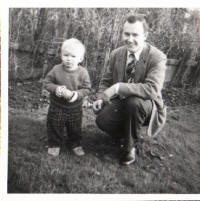
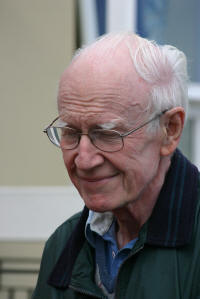
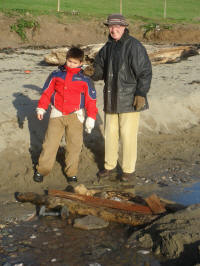
One year on: Brian W Scott.
19 July 1932 to 30 March 2006
30 March 2007
It does not seem a
year ago; but Dad died a year ago today.
He really was a
decent man; wonderfully loyal, honest, sensible, hard working. He gave his
best for his family. He loved us; though he never told us. He never judged
us; he was proud of our successes and tolerant of our mistakes. He had
a great sense of fairness, of right and wrong. And a nice dry humour.
He bore his
illness with great courage and dignity and even a little humour.
When things are
difficult my mother asks herself "What would Brian have done?" So do I. He
still appears in my dreams sometimes. He would never have questioned my move
to Dubai or the reasons for it. He would have given his usual strong quiet
support and always his interest.
If I have any
regret it is that Tai only met him on the one occasion. I wish they had
enjoyed getting to know eachother. They would have enjoyed eachother's
company. My father would have wanted to take her for long walks to
appreciate the English countryside, its wildlife and the changes of scenery.
He would have been explaining the joys of Belleek and Masons' Ironstone to
her. And then there would have been the tour of the local village hall to
appreciate his fund-raising work !
My mother
meanwhile has great support and friends in the village. After living with
someone that you love for 50 years I can only imagine how different life
must suddenly be on your own. But she has managed with great strength and
will continue to do so for a long time to come.
I hope he is still
watching proudly over us.
Put your money to a good cause for my baby brother
22 March 2007 - Sticky - Will leave this as the lead story until month end.
Please scroll down for new items.
My baby brother is
mad. He is also generous to a fault. A gentle guy who has been through a lot
and emerged smiling.
He is also running
the London Marathon for the third year. This is on 22 April 2007. And once again he is running for
charity - for the Leonard Cheshire homes. Leonard Cheshire is the largest
charity provider of disability support services in the UK. It supports over
21,000 disabled people in the UK, offering flexible services to meet a wide
range of needs. The charity also campaigns for the rights of over 8 million
disabled people and raises awareness of the issues affecting them. Outside
of the UK, they support disabled people in 57 countries across the world.
This is on 22 April 2007. And once again he is running for
charity - for the Leonard Cheshire homes. Leonard Cheshire is the largest
charity provider of disability support services in the UK. It supports over
21,000 disabled people in the UK, offering flexible services to meet a wide
range of needs. The charity also campaigns for the rights of over 8 million
disabled people and raises awareness of the issues affecting them. Outside
of the UK, they support disabled people in 57 countries across the world.
You can go to this
website to sponsor Tim -
http://www.justgiving.com/guessmytime - better still, for a minimal
donation you can guess his time for the London Marathon; the previous two
years times are there to give you a clue. Personally I think he will beat 5
hours this year. The three closest guesses win a bottle of champagne.
Why does he run?
What inspired him? Read the following which was published just before last
year's event. Tai and I will be sponsoring him - so can you.....thank
you.....
Nine Lives...One Left
by Timothy
Scott
http://www.inspiredtorun.co.uk/2006/05/06/nine-lives-one-left
When I left the
John Radcliffe hospital in Oxford it was July 2003. I was terrified
of what the future held for me. I had gone to A&E in November 2002,
and had been quickly diagnosed with pancreatitis caused by a gallstone
blocking a bile duct. I was in hospital from November to January 2003
and home in February. I went back at the start of March 2003 to have
my gallbladder removed. This caused the pancreatitis to flare up and
cause many complications, which were life-threatening. For example
enzymes, produced by the pancreas, escaped and started to digest parts they
would not normally get to. When I woke one night vomiting blood I just
thought that a blood drip I was having was coming out again. No!
Enzymes had eaten the wall of the splenic artery. This involved a
transfusion of more than 60 units of blood and I thank everybody who goes to
the trouble of giving blood!
What could I do?
Not very much apart from trust everybody to do their best for me and to use
the skills they had learned, some through years of experience and others
just starting on their own career. All of them superb and unforgetable;
too many to name and probably every department in the hospital - they will
know who I mean!
My wife Caren and
our three boys, Joe, Ellis and Sean watched with the rest of my family,
friends and colleagues. I had started a new job at Windles three weeks
before being taken ill. They gave me their full support and a job when
I was ready to return.
From March 2003 to
July 2003 I was on a Nil By Mouth order! So I had lost a few stone.
I was fed by fluids dripped into my duodenum, below the stomach so that the
stomach could heal itself. My stomach had been cut through to reach
and repair the splenic artery. I lay in bed and was scared that I
would never walk again. Physiotherapists, my wife and family, nurses,
a very special health care assistant, stoma nurses and a friend who used to
put lines into me for blood and drugs all helped me to believe that it was
possible. A tilt-table was brought into my room and I was put upright
for the first time in months. Scared? Yes but also "quietly
determined" - or "stubborn" as my wife prefers to call it.
Gradually I
started to move again. Sitting on the edge of the bed would be a great
achievement, then standing, then walking in a zimmer frame. Nervously
my confidence grew and the distances increased. I dressed in a dinner
jacket and went out with my wife and friends to a charity dinner in Oxford.
I was still Nil By Mouth so it was an odd place to be, but I felt great joy
and relief to be out and about doing something that I had taken for granted.
I had got to the age of 42 with very few health concerns. I was
pleased to get back to the hospital for sleep and security but I knew I was
going to be well.
My first marathon
in 2005 was 5:33:48; I had enjoyed listening to "Don't Fear The
Reaper" on the PA in the Red Start zone.
My second marathon
in 2006 was 5:12:33; if I carry on improving like this I will set a record
when I am 54. What made me very happy was spending some time in the
Leonard Cheshire reception. My consultant chose Leonard Cheshire as
the charity I should run for because of the great work they do for disabled
people in the UK and around the world. At one time in hospital after
I'd had a cardiac arrest, my wife was told that if I lived I may never live
at home again or work again. I have learned not to take anything for
granted.
I had previously
watched the man in the deep sea diving gear. I knew that I could beat
his time and I was pleased this year to be walking back to my car and
noticed a Dalek making his way along the Embankment!
Running has given
me strength and great recovery powers. All my training has been at the
Vale of White Horse Leisure and Tennis Centre on a treadmill. The
trainers think I am a bit nuts! I have enjoyed the comfort of watching
monitors, like in hospital, telling me that I am going a little further,
sometimes a little faster each time. And the staff, like the John
Radcliffe team, superb in their reassurance and belief that I cold achieve
my goal.
And it is easy to
think I had a bad time. I did. But I arrive at the London
Marathon, talk to runners or just read some of the t-shirts and look at the
photos of loved ones. Then I can understand how fortunate I have been.
Caren thinks I am
unusual because I do not worry much. After all that - why should I?
As I trained for the marathon this year I have watched my father die from
cancer after a malignant melanoma was removed in 1990. The cancer only
showed itself again last year, and chemo gave him his last months with a
better quality of life.
This year I also
had a mole removed and this has tested as a malignant melanoma.
The day after the London Marathon I went into hospital to have more cut from
around the removed mole and a lymph node removed. These are being
tested to see if there are further signs of cancer; I am looking forward to
good news next week! [ps - it was good news - no signs of cancer]
It would have
been easy to say "no" to the marathon and hold my place for next year.
But I needed to do it to prove something to myself. I am not sure what
it proves but it helps me to think that I am OK.
In all of this
the most difficult thing has been to understand my mind. I was so
close to being brain damaged, and it has only been over two years' recovery
that I have gradually understood how ill I was. Standing up and
driving a car will fool most people that you are well and able to do your
sales job. Bit by bit I have put my mind back together, like a jigsaw
puzzle. In the puzzle there are bits I do not want to put back in, so
I leave them out. I make the pieces that I do want
back in take up more space and change shape. Many things that connect
now to the past have helped; concerts, films, family and friends, Dr. Who on
the TV and Daleks by the Thames. It all makes wonderful sense and I
hope I can keep on running.
When I left
hospital my consultant (on morphine he was promoted to God) said: "you have
used 8 lives, make the most of your 9th."
The coming crisis with Iran
29 March 2007
I
have written about this before but the current gunboat diplomacy between
Britain and Iran threatens to take Iran's dispute with the west from words
to action.
It
is not without irony that while the British were on duty as as part if the
Iraqi occupation it was in fact Iranian naval vessels that seized 15 British
Royal Navy sailors and marines on the morning of Friday March 23. They were
taken in an area near the mouth of the Shatt al-Arab waterway, which forms
part of the border between Iran and Iraq.
The
captives include 14 men and one woman. The Iranians say that the captured
personnel could face trial for an "illegal entrance" to Iranian waters. The
UK denies Iran's claims and insists that the personnel, who were taken after
carrying out a routine inspection of an Indian-flagged civilian ship, were
in Iraqi waters.
The Ministry of
Defence has released evidence that it says proves the personnel were 1.7
nautical miles inside Iraqi territorial waters. The information was based
partly on a GPS device on one of the two British rigid inflatable
speedboats, operating from HMS Cornwall, intercepted by the Iranians.
The MoD said the
British inflatables were "ambushed" by six heavily armed Iranian vessels
equipped with heavy machine-guns and rocket-propelled grenades. In contrast,
the British, who were disembarking from the cargo vessel having completed
their search, had only SA80 semi-automatic rifles and sidearms. There was no
fight. And the British marines were taken captive.
Iraq and Iran have
disputed navigation rights on the Shatt al-Arab since 1935, when an
international commission gave Iraq control. There is also a general tension
around Iraq and Iran's borders, with British officials having accused Iran
of supplying Iraqi insurgents with weapons and training.
There is one claim
that the British are being held by the Iranian Revolutionary Guard. It
claimed the Iranians want a prisoner swap for senior officers of the al-Quds
brigade of the Iranian Revolutionary Guard captured by US forces in Irbil,
Iraq, earlier this year.
With a hardline
government in power in Tehran following Mahmoud Ahmadinejad's win in the
June 2005 presidential election it is unlikely that the Iranians will back
down. It would be a significant loss of face. The Iranians want an admission
of trespass into Iranian waters from the British. That too is unlikely.
If the captured sailors had been American, the diplomatic fallout could have
been very dangerous.
The gunboat
stand-off escalated last night when Iran TV showed footage of the 15
captives, which prompted fury from the Foreign Office.
Today at the UN in
New York, Britain asked the security council to support a brief press
statement that would "deplore" Iran's detention of 15 British sailors and
marines, and demand their immediate release, according to the Associated
Press. It is unlikely that the British will get the unanimous support
required for such a statement. Since most countries question the legitimacy
of US and British operations in Iraq even if the boat was in Iraqi waters
the British will not get strong support.
Mr Blair told ITV
News that he did not want a confrontation with the Iranians but they must
understand that the "only outcome" to the crisis is to release Britain's
military personnel. Mr Blair added: "What we have to do in a very firm way,
is step up the pressure."
In the meantime
the Iranians appear to have mastered diplomatic poker! The apparent crisis
is pushing oil prices back up. As a major exporter Iran must be pleased.
Meanwhile the US neocons (Dick Cheney and all) are doing the "I told you so
dance" and are probably sharpening their military options.
It may well be
that the authorities do not know what to do with the captives. That this was
as much a surprise to Teheran as it was to the marines. Iran will extract as
much propaganda as possible. It may not be a bad idea for the British to
simply admit fault and get their people home as fast as possible. Behind the
scenes there must be some high level table thumping going on.
There is trouble
ahead.
Stange politics in Bangkok
29
March 2007
Sonthi
Limthongkul, owner of Manager newspaper, was sentenced to two years in
prison after the Criminal Court found him guilty of making libelous
statements against a former Thai Rak Thai executive member.
Sonthi, a strong and highly vocal critic of deposed prime minister Thaksin
Shinawatra, is also ordered to pay compensation of Bt200,000 to Phumtham
Vejjayachai, a former TRT deputy secretary. The Court also dismissed the
same charges on other defendants.
Sonthii was responsible for organizing the mass anti-Thaksin rallies in
Lumpini Park in 2006.
Phumtham told court that Sonthi made the defamation during his television
talk show conducted in Wat Pa Ban Tat Temple in Udon Thani province in
November 25, 2005.
After hearing the sentence, Sonthi's lawyer submitted a bail request to the
court.
The continuing erosion of civil rights in Thailand
29
March 2007
Thailand's military chief and the leader of last September's coup, General
Sonthi Boonyaratglin, said on Wednesday that he has asked the government to
declare emergency rule in Bangkok to crack down on anti-coup protesters.
Anti-coup protesters have been holding weekly rallies against the junta,
attracting a small but growing crowd that reached 2,000 people last Friday.
The protests have so far been peaceful. Sonthi, who perhaps fails to
appreciate the irony of his request, says that he is afraid the protest
movement could gather steam, much like the mass street demonstrations last
year that eventually led to the coup against then-prime minister Thaksin
Shinawatra.
Perhaps the question that he needs to answer is why these protests are
happening and why they are gathering momentum.
Sonthi made the call just two months after martial law was lifted in
Bangkok. He had imposed martial law on Thailand immediately after seizing
power on September 19, but has now lifted it across half the country.
Declaring emergency rule would give authorities many of the same powers they
had under martial law.
The government would be able to detain suspects without charge for 30 days,
and would have the power to seize and destroy anything deemed a threat to
national security or to impede the work of the authorities.
Emergency rule also gives the government tough censorship powers as well as
the right to impose a curfew and to ban public gatherings, while giving
security forces broad immunity from prosecution.
Emirates says no to takeovers
29
March 2007
Emirates airline plans to grow organically and is not in talks on any
acquisitions, Tim Clark, Emirates President, said.
Emirates, the largest Arab airline, has repeatedly knocked down speculation
it was considering buying British Airways, Germany’s Lufthansa, Alitalia or
other airlines. The airline expects to grow organically and not to change
strategy.
The airline said it is working with Airbus to ensure delivery next year of
its A380 superjumbo aircraft for which it is the largest customer, though it
raised concerns about industrial action.
Tim
Clark said he will travel to Airbus’s headquarters in Toulouse, France, to
review progress after delivery of the first of 43 A380s to Emirates was
delayed almost two years to August next year.
Emirates is also mulling the possibility of ordering Airbus’s planned
A350-XWB, or extra wide body, and Boeing Co.’s 787-10X, which the two
aircraft makers are considering offering. The possible Boeing model is a
larger version of its 787 “Dreamliner”.
Emirates’s order for the models could range between 60 and 100 aircraft. “If
we go with one of those airplanes, the belief is that that is the number we
could buy,” Clark said.
Still, the Dubai government-owned carrier was unlikely to make any order
this year, he said.
Emirates, the world’s eighth-largest international air passenger carrier in
2005, operates a fleet of 102 and still has another 106 on order, including
the A380, which will be the world’s largest passenger aircraft when it comes
into service this year.
Emirates plans to grow its fleet to 157 and double the number of
destinations to about 170 during the next five years, adding cities in the
United States, Africa and India. In China, Clark beleives that the airline
has not yet "even scratched the surface."
The expansion is a threat to international long-haul carriers like Qantas
Airways Ltd. and Singapore Airlines as Emirates uses long-range aircraft to
connect any two points in the world through one hub.
The airline will start flying to Sao Paulo this year, its first South
American destination.
Trial by proxy
27
March 2007
We
cant get Thaksin - so how about his Mrs? That appears to have been the
discussion that led to the current prosecution of Mrs. Thaksin for allged
tax evasion in 1997. Yes ten years ago; at the time coincidentally of the
Asian financial markets crisis the memory of which Thaksin did much to
eradicate.
The case involves
a complex web of tax and criminal issues and is expected to go through three
tiers of courts to the Supreme Court. A decision is not likely for three
years by when the only people who will have won are the lawyers.
In the meantime
the public will have lost interest; a new government will have been elected
and Don Muang airport will be back to its old service levels.
The court battle
is not about alleged corruption involving Thakisn or his government. Public
prosecutors have named Thaksin's wife, Khunying Pojaman, her brother
Bhanapot Damapong, and her private secretary Kanchanapa Honghern as
defendants. However it is really the ousted premier who is on trial by
proxy.
The highly
publicised case involves the 1997 share transaction involving Pojaman and
Bhanapot. It is the core of the prosecution's case. Following the coup, the
Assets Examination Committee (AEC) focused on the Pojaman-Bhanapot share
transaction as a lesson to expose Thaksin's flawed leadership.
In the writ, filed
at the Criminal Court on Monday, prosecutors contend that Pojaman, Bhanapot
and Kanchanapa, conspired to evade income tax and also committed perjury to
avoid tax obligations.
Pojaman and
Bhanapot each stand accused of two counts of criminal and tax violations
relating to their 1997 share deals. The two counts comprise one for
conspiracy on tax evasion and one for the conspiracy on perjury. Kanchanapa
faces one count of conspiracy in the alleged tax dodge.
According to the
prosecution's writ, Pojaman issued an instruction on November 7, 1997 for
her stockbroker to sell 4.5 million Shin Corp shares worth Bt738 million to
Bhanapot. The company was then known as Shinawatra Computer and
Communications.
Pojaman's shares
were held by her maid, Duangta Wongpakdee, who acted as nominee. Kanchanapa
organised the transaction on Pojaman's behalf.
Pojaman issued a
cheque dated November 12 to pay for the shares on Bhanapot's behalf. And her
stockbroker paid out Bt734 million on the same day to Duangta for the cost
of shares minus brokerage fees and value added tax. Duangta's sales earnings
were later deposited in Pojaman's bank account.
Prosecutors
contend that the transaction was staged on the stock market in order to help
Bhanapot dodge his income tax obligations that should have amounted to Bt273
million.
In 1997 Bhanapot
filed an income tax return for Bt8.1 million after claiming exemption for
his shares transaction done on the stock market.
In regard to the
charges of perjury, Pojaman and Bhanapot testified in a 2001 tax audit that
they were entitled to tax exemption because the shares were given by Pojaman
to her brother as a family gift.
Pojaman claimed
that she designated her shares as a gift for Bhanapot's first-born son and
that she wanted to raise the social standing of her brother's family to
match her own.
Prosecutors
contend that the transaction was not a gift but an outright payment for
Bhanapot's services rendered to the Shinawatra family. They say the alleged
perjury during the tax audit caused damage to the state amounting to Bt546
million computed from unpaid tax plus a Bt272 million fine.
The court has set
a May 14 date for a hearing on admissible evidence before commencing trial.
The three
defendants were released after posting Bt5 million bail each. As a condition
for bail, they are obliged not to comment publicly on the case. Of course
that does not stop the rest of us from commenting.
The gag order
might have little bearing on the upcoming courtroom drama and the defence
remains a step ahead after putting up a guarantee for liable tax at the
Revenue Department. The guarantee is designed to show a lack of intent to
dodge tax payments.
The defence plans
to play up the role of an innocent, tax-abiding citizen being victimised via
conflicting interpretations of the tax code, while the prosecution has the
burden of proving motive and intent by demonstrating that the three
defendants are not so naive in regard to tax matters.
This has so far to
run that by the time a decision is reached frankly no one will care.
But in the end
what has Thaksin's family done differently to so many other of Thailand's
leading families. As Prime Minister he should be held to a high level of
responsibility and accountability bit with tax rulings and legislation that
appear to be changed on a whim or at least open to man interpretations the
burden of proof in this case will be hard.
Why on earth I am
defending the Thaksin family is a great mystery. Suddenly he is the
underdog. Lets face it - he was elected as Prime Minsister by massive
majorities. Rather more than can be said for the current incumbents.
UAE airlines to compete on Kangaroo route
25 March 2007 - The Melbourne Age
It's a tale of rich Arab governments
and their exotic airlines: one a globally renowned, multi-award winning
business, the other a rising upstart eager to spread its wings.
It's also a tale of two Middle Eastern
cities: one is among the hottest new destinations, its neighbour still as
mysterious and unknown - at least to Australians -as the region in which
it resides.
So when Etihad's Airbus A340-500 heads
down the runway of Sydney Airport on Tuesday to mark the launch its new
thrice-weekly non-stop flights to and from Sydney, it will spark an
intense rivalry not just for the lucrative Kangaroo route but also for the
Aussie tourist dollar. Just as the airlines will slug it out with bigger
seats, better food and more movie channels, so the cities of Dubai and Abu
Dhabi will attempt to seduce Australians to stop over for longer.
Already, there are deals as low as
$US69 a night to lure Australians to sample the extraordinary cities that
billions of dollars of oil wealth is building in both places, invested to
ensure tourism dollars quickly replace black gold. Forget revolving
restaurants. These places have revolving hotels. Golf, anyone? How about
the roof of one of the world's tallest blocks?
As the Kangaroo route booking seasons
cranks up, the deals for Arabian adventures can only get better.
For the past 11 years, Emirates has
been our leading Middle Eastern airline. It currently has daily non-stop
flights from three Australian cities, including Sydney, to its Dubai hub -
then on to an assortment of other international destinations.
Its service has won more than 300
awards. Its marketers have put it at the forefront of sport and culture
throughout the country.
Its home base of Dubai has become a
shopping and holiday attraction and is now ready to challenge the likes of
Bangkok and Singapore as a stop-over favourite.
Enter Etihad. Enter Abu Dhabi.
While it still has a way to go the
emirate's government is spending $250 billion to build enough amazing
attractions to seduce you into having your first Arabian holiday there.
Melburnian James Hogan is leading the charge for the newcomer as Etihad's
chief executive.
As you would expect, he insists Etihad
isn't looking for a scrap with its more established neighbour, playing
down any talk of "a Gulf airline war". Indeed, he is adamant that such is
the growing demand for flights to the Gulf states and beyond that both can
thrive. And he could be on to something.
"We really believe we're going to
develop the market," he says. "We're going to be filling a gap and we
believe we can open up a new world of opportunities for customers, whether
they are corporate people, holidaymakers, students or backpackers.
Since its launch by royal decree in
2003 by the Abu Dhabi government, "the national airline of the United Arab
Emirates" has been an unmitigated success, being named the World Travel
Awards' New Airline of the Year three times in a row in 2004-06. It has
quickly earned a reputation for comfort and quality in its Airbus
A340-500s where its rebranded old-style economy, business and premium
classes with the rather daintily named Coral, Pearl and Diamond zones.
"All our planes are new and well kitted
out," Hogan says. "Our premium [Diamond and Pearl] seats are
state-of-the-art, with a bed and a big TV, while some of our economy
[Coral] ones are as good as business seats on other airlines."
Etihad cannot match Emirates'
destination choice - it has 37 to the Dubai airline's 87 -but it is
spawning new routes all the time, including those not directly serviced by
its rival, such as Geneva and, from this winter, Toronto, Brussels and
Dublin.
Hogan, who aims to link Etihad with 70
cities by 2010, says: "We think it's very appealing to be able to fly from
Sydney to any one of these places with just one change. People don't want
to have to change twice and hang around in airports."
He insists Etihad will not be dragged
into any convoluted price wars, though its Australian launch fares are
eminently attractive.
The cheapest return tickets from Sydney
to several European destinations, via Abu Dhabi, are hovering about $1700,
including taxes, and this may explain why several flights over the next
two months are already 60 per cent full.
Another reason for Hogan's confidence
is the Middle East's growing - booming - status as a centre for trade and
tourism. "Abu Dhabi is perfectly positioned to link East with West, but
also ideal for tapping into the surrounding Gulf states, North Africa,
India and Pakistan," he says.
Hogan, whose knowledge of the region
grew thanks to his stint as boss of Gulf Air between 2002 and 2006, even
suggests that if any airlines could be hit by Etihad's rise it may be the
non-Middle Eastern rivals. He doesn't name names but the likes of
Singapore Airlines, Thai Airways, British Airways and Virgin Atlantic,
which stop over in Asia, could be vulnerable.
This is because Abu Dhabi, the UAE's
oil-rich capital city, is set to grow rapidly.
Picture-perfect artificial islands,
gleaming shopping malls, a formula one circuit and even a Louvre museum -
linked with its famous French counterpart - will co-exist alongside
skyscrapers and five-star hotels.
This will make it an attractive holiday
and stop-over destination and a vital business hub, rivalling Dubai as the
place to be in the region.
Etihad's Sydney operation is the
priority now, though it has spoken to Qantas about a possible codeshare
agreement that would enable the airline to spread its wings to other
Australian cities.
The Qantas discussions, Hogan says,
"haven't been finalised. We are very keen, if we are both in a position to
do so, to work together."
Emirates, meanwhile, is watching
developments with interest and clearly not resting on its laurels. The
Dubai government-owned colossus recently announced that it will add
Venice, Sao Paulo, Houston and Newcastle (UK) to its already bulging list
of destinations.
On top of this, it is seeking
permission to increase flights to Dubai from Sydney, Melbourne, Brisbane
and Perth. Stephen Pearse, Emirates Australia's commercial vice-president,
says: "We believe that there is still much untapped demand along with
significant growth opportunities for Australia."
"Our analysis of the Tourism
Forecasting Committee's published forecasts for inbound visitor arrivals
and outbound international departures through to 2014, together with our
own passenger traffic forecasts, lead us to believe that Emirates can grow
its passenger traffic to 2.7 million round-trip passengers by 2014.
"This passenger volume could see about
$222 million spent on the promotion of Australia internationally by
Emirates."
With Qatar Airways of Doha winning
rights to fly daily into Melbourne - and a second Australian city from
2008 - and Gulf Air flying from Sydney to Europe via Bahrain, the Middle
Eastern airlines are showing an aggressive streak. Industry experts say
this will result in passengers reaping the benefits.
Flight Centre spokesman Haydn Long
says: "Typically, the arrival of a new carrier will lead to great deals
for travellers as the new carrier seeks to fill its planes and the
established carriers seek to continue to grow their presence.
"We have obviously seen this in the
domestic market in relatively recent times with the launch of Virgin Blue
and then Jetstar. Competition is obviously healthy and delivers great
deals to customers."
Let battle commence.
HOW THEY
COMPARE
Emirates
OWNED BY
Government of Dubai.
COUNTRY OF ORIGIN
United Arab Emirates.
* Flights to Europe weekly 14 - a daily direct service as well as seven
flights a week from Sydney via Bangkok.
MAIN STOPOVER
Dubai.
AIRCRAFT
Boeing 777; Airbus A340-500.
TICKET PRICES
$1913 (return to London, March 25-May 27).*
CAPACITY
Boeing 777; 18 first class, 49 business,
385 economy. A340; 12 first class, 42 business, 204 economy.
SPECIAL FEATURES
Business travellers have lie-flat seats,
with in-seat massage function, large privacy dividers, and handheld
controls. Passengers can enjoy more than 600 channels of entertainment.
CUISINE
Anchovy bell peppers and fresh parmesan;
cream of carrot and coriander soup; lobster and rocket salad on noodles
with Thai chilli; scallop ragout and tomato salsa; and oven-roasted lamb
with thyme. Overseen by top international chefs.
Etihad
OWNED BY
Government of Abu Dhabi.
COUNTRY OF ORIGIN
United Arab Emirates.
FLIGHTS TO EUROPE WEEKLY
Three (Tues, Thurs and Sat). Daily from
June 29.
MAIN STOPOVER
Abu Dhabi.
AIRCRAFT
Airbus A340-500.
TICKET PRICES
Start from $1759 inclusive fuel and taxes
(return launch special tickets to London for departures until June 30).*
CAPACITY
12 Diamond (first), 28 Pearl (business),
200 Coral (economy).
SPECIAL FEATURES
Diamond passengers get 58cm TV screens, a
personal mini-bar, seats swivel 180 degrees. Coral Zone, more than 350
hours of "world-class" entertainment.
CUISINE
Etihad's cuisine had been created by a
panel of award-winning chefs. The menus reflect the flavours and styles of
the destinations for each route.
More EK to Australia
24 March 2007
Emirates Airline has been granted rights
to operate additional flights into Australia, after the successful
negotiations between the governments of Australia and the United Arab
Emirates.
Emirates will gradually increase its
frequency to the four cities it currently serves – Sydney, Melbourne,
Brisbane and Perth – and the new agreement will allow Emirates to grow its
services from 49 flights a week to 84 flights a week between now and 2011.
This will mark an increase of 71 per cent in its services to Australia.
Emirates has been asking to grow its Australia service to 112 flights a week
by 2014.
Emirates currently serves Australia with
double dailies to Sydney, Melbourne and Perth and a daily flight to
Brisbane. In the last decade, the airline has welcomed over two and a half
million passengers on its Australian flights.
Emirates has invested over A$1 billion in
Australia in the last decade, including a dedicated Emirates Lounge in each
of its four destinations in the country. The airline sponsors some of the
most high-profile sports events such as the Emirates Melbourne Cup, Emirates
Western Force, Collingwood Football Club, and the Australian Jockey Club;
and the symphony orchestras in Sydney, Melbourne and Western Australia.
Emirates also sponsors Cricket Australia and the prominent Fly Emirates
branding can be seen on the sleeve of the Australian team currently playing
at the World Cup in the West Indies.
So there is an element of payback here on
a substantial promotional investment.
How long before EK has a crew base, at
least for technical crews, in Australia?
Woolmer's suspicious death should end this world cup
21 March 2007
If the allegations
concerning Bob Woolmer's terrible death are true then this cricket world cup
should end immediately, Woolmer was a thoroughly decent man, a good
cricketer and by all accounts an outstanding and widely respected coach.
The
Pakistan Cricket Board has been claiming that the autopsy conducted on
Woolmer was inconclusive however local police in the West Indies have
apparently confirmed that investigators have said the coach was murdered.
The Jamaican Police is said to be determining
the whereabouts of some of the Pakistan players at the time the murder could
have taken place.
The confirmation comes soon after allegations
by former Pakistan pacer Sarfaraz Nawaz that Woolmer was murdered by a
betting syndicate. The outspoken Nawaz has said that almost everybody in
control of the game is involved in betting and Woolmer was perhaps about to
reveal all in a book.
All members of the
Pakistan squad, including superstars Inzamam-ul-Haq and Mohammad Yousuf,
will now face police inquiries.
It was revealed
there were two marks on Woolmer's throat after he was found unconscious and
lying in his hotel room bathroom near pools of blood and vomit two days ago,
less than 24 hours after Pakistan's shock World Cup defeat to debutants
Ireland.
Vomit in unusually
high places on the walls indicated to police that Woolmer may have been
involved in a struggle.
Investigators have
also begun to trawl through security tapes from the Pegasus Hotel in Jamaica
where the team is staying with claims last night the former Pakistan coach
was about to reveal the shady world of match-fixing in a new book.
Deputy
commissioner of police Mark Shields confirmed a murder investigation was
underway.
Woolmer, 58,
ordered room service after returning to the hotel on Saturday night after
the match. He was found by a hotel attendant who called an ambulance, but
was pronounced dead soon after arriving at hospital.
The room in which
he collapsed remains sealed off by police with investigators searching for
clues.
Hotel staff were
last night banned from talking about the incident, which has left players
questioning whether the World Cup should continue.
There were
allegations last night by former Pakistan fast bowler Sarfaraz Nawaz that
Woolmer was murdered by a betting syndicate.
Nawaz feels that
almost everybody in control of the game is involved in betting and Woolmer
was perhaps about to reveal all in a book called Discovering Cricket.
"Has Woolmer carried with him to the grave dark secrets that could have
brought ruin upon Pakistan's players?" Nawaz said. "'Did he pay for being
the unwitting receptacle of information that was never to be shared?"
Nawaz claimed that
at least five bookies from Pakistan had landed in the West Indies when the
World Cup began and had been in touch with Pakistani players.
Given the nature
of the allegations, the Pakistan team and its official cannot be allowed to
leave Jamaica until the investigation is complete. Further the World Cup
itself should be brought to an immediate halt. There is no excuse for
cricket to bring about the death of a thoroughly decent man.
Famed Thai hospitality shows signs of strain
By Thomas Fuller - International Herald Tribune
Tuesday, March 20, 2007
BANGKOK: Long one of the most open and accommodating destinations for
tourists and businesspeople in Asia, the well-advertised "land of smiles" is
showing signs of a subtle frown directed toward foreigners.
Over the past seven months, successive Thai governments have passed measures
scrutinizing land purchases by non-Thais and clamping down on long-stay
retirees and expatriate workers who lack proper visas. In January, the
cabinet passed a sweeping bill that tightens restrictions on foreign
companies, a measure that awaits final approval.
"There's been a trend that suggests rising economic nationalism," said
Thitinan Pongsudhirak, a professor of political science at Chulalongkorn
University. Thailand, he said, has fallen into a "very complex mood
ofambivalence" toward outsiders under the military-led government that
seized
power last September.
That mood is evident in a 12th-floor conference room at the headquarters of
Bangkok Bank, where Vongthip Chumpani, an adviser and former vice
presidentat the bank, expresses her frustrations about certain types of
foreigners who come to Thailand ‹ and tend to stay.
"We are getting a lot of weird retirees here," Vongthip said. "They can't
survive in your country so they come here."
Thailand needs to slow down and catch its breath, she said.
ThaksinShinawatra, the prime minister ousted in September, had entered into
a
flurry of free-trade agreements with Australia, China, Japan, the
UnitedStates and others. To Vongthip's thinking, he tried to pry the country
open
too quickly.
"We bent over backward all the time to accommodate foreign investors," she
said.
That could be changing.
Under proposed new rules for foreign investors, companies such as Federal
Express might have to give up control of their operations in Thailand. Car
and electronics manufacturers could be barred from delivering their cars or
disk drives to ports for export; only Thai-owned companies would be allowed
to transport items within the country.
Retail chains, big ones like Carrefour and hundreds of smaller ones, could
be frozen out of future expansion. Land purchases by thousands of foreigners
could be declared illegal.
These amendments to the Foreign Business Act were approved by the Thai
cabinet in January and are now under review by the Council of State, an
independent government body of legal experts.
Since the very first boatloads of Portuguese and Dutch emissaries arrived
here five centuries ago, Thailand has had a knack for dealing with
foreigners: trade but not domination, hospitality but not subservience.
Thais successfully gleaned technology from Europeans, Americans and
Japanese, and the elite sent their children to study abroad. Unlike all of
its neighbors, Thailand was never colonized.
But this was before millions of tourists poured into the country's spas,
beaches, golf courses and restaurants ‹ not to mention red-light districts
and massage parlors. The number of tourists visiting Thailand, whose
population is 64 million, is expected to reach nearly 15 million this year,
a doubling over the past decade.
On the southern resort island of Phuket, roadside billboards, written in
English, advertise million-dollar condominiums ‹ this in a country where a
schoolteacher is lucky to bring home a few hundred dollars a month. In
northeastern Thailand, men from Germany, Switzerland, Britain and other
Western countries live with their Thai wives on neatly groomed streets that
stand out from ramshackle neighboring villages.
"I've seen so many old farangs with young Thai women," said Nattaya
Rattanamanee, 31, an accountant working at a hotel on the resort island of
Samui, using the Thai word for Westerners. "These old farangs damage the
reputation of Thailand; they turn Thailand into a land of prostitutes."
Feeling the strain of the tourist influx, the Thai government recently
announced a new approach: the country would no longer focus on the quantity
of tourists, but instead target "quality" ‹ read "wealthy" ‹ tourists.
"In years past we've always targeted numbers: trying to achieve the highest
numbers of arrivals possible," said Chattan Kunjara Na Ayudhya, a spokesman
for the Tourism Authority of Thailand. "It's time to change. If we continue
to focus mainly on numbers, some destinations will not be able to handle
that many people."
Any resentment that Thais may harbor toward foreigners is unlikely to be
felt by short-term vacationers. It is hidden behind an often genuine Thai
smile and shielded by a wall of politeness. There is no generalized backlash
against foreigners, Thais say, but rather concerns about specific problems:
criminals who come to Thailand on the lam, the increase in land purchases by
foreigners and foreign companies having too much influence in the economy.
In September, just before the coup, the head of the country's immigration
department announced that foreign tourists would be limited to staying in
Thailand for 90 days within any six- month period. This was primarily aimed
at foreign retirees who take up permanent residence without proper paperwork
and the thousands of people working here without work visas.
One such person was John Mark Karr, the American who falsely confessed to
the 1996 killing of JonBenet Ramsey, a Colorado schoolgirl, and was living
in Bangkok as an English teacher. Karr's apprehension last August in Bangkok
buttressed Thailand's image as a magnet for creeps and perverts.
"I hate them. There are so many of those in Thailand," said Yupa Boontaworn,
a 22-year-old university student, when asked about people like Karr. Tourism
is good for the Thai economy, she said, but the government should move more
aggressively against pedophiles and sex tourists.
As a tourist destination, Thailand shares much in common with the
Netherlands: a hands-off government and the veneer of a tolerant society,
but a surprisingly conservative core. In some ways, anti-foreign feelings in
Thailand arise from the clash between the permissive Thailand of skimpily
clad bar girls twirling around poles and the more traditional side of the
country, where women are too shy even to wear a swimsuit on a beach. Today,
that veneer of tolerance, while still intact, is chipping.
"Foreigners shouldn't be able to do anything they please in Thailand," said
Samree Ardsuan, 68, a retired civil servant. If someone led a demonstration
protesting foreign ownership of companies, Samree said, he would definitely
join in.
With a few exceptions such as condominiums and small plots, foreigners are
barred from owning property in Thailand. But many have skirted these laws by
registering shell companies, a practice that the government now promises
tostop.
The mood toward foreigners today, analysts say, is a corollary to Thailand's
political crisis. Many Thais became defensive when foreign governments
criticized the coup in September as undemocratic, and today there are
occasional nationalist outbursts. In February, the head of the military
junta, Sonthi Boonyaratglin, vowed to retake stakes in a satellite company
that Thaksin's family sold to a Singapore government agency last year.
The Thai government says the proposed amendments to the Foreign Business Act
are long overdue clarifications. But to some Thais, including Vongthip of
Bangkok Bank, the law would also help redress what is seen here as the
injustices that accompanied the financial crisis of the late 1990s, when
indebted Thai companies were forced to sell their assets cheaply to
foreigners. Foreign banks and companies, Vongthip said, "picked up
everything for a song."
Many questions about the amendments remain. Analysts say there could be less
pressure for a new law since one of the more nationalist members of the Thai
cabinet, Pridiyathorn Devakula, stepped down as finance minister in
February.
The legal committee also appears to be casting a skeptical eye on the
proposed new law. "The majority of the committee is not sure that the law
needs to be amended," Pakorn Nilprapan, the committee's secretary, said this
month. "We are seeking explanations from the Ministry of Commerce."
Even if the amendments do become law, many here predict that the law's
harshest provisions will be quietly forgotten.
"I don't think it's going to be enforced ‹ it's just not the Thai way," said
David Lyman, chairman of Tilleke & Gibbons, a prominent Bangkok law firm.
Lyman, who first moved to Thailand in 1949, says he has seen this all
before: the government has threatened to restrict foreign ownership on and
off for nearly four decades.
"Reason usually ends up prevailing in Thailand, after all other options have
been exhausted," Lyman said.
EK - a friend of Australia but not of Qantas!
21 March 2007
Emirate Airline's
plans of becoming the biggest foreign airline to fly into Australia could be
given a major boost today, with the Federal Government expected to decide
whether to allow the Dubai carrier to fly 16 DAILY services into Sydney,
Melbourne, Brisbane and Perth by 2014.
Following talks
between Australian and United Arab Emirates officials in Dubai, Federal
Transport Minister Mark Vaile is expected to announce by the end of this
week whether he will approve Emirates' request to have its 49 a week flight
cap lifted to 112 by 2014
There is
speculation the MoU could allow Emirates to double its flights to 98 by
2012. If all goes Emirates way, it is expected the airline will eclipse
Singapore Airlines as the largest foreign carrier in Australia within five
years. This could be accelerated if the Dubai carrier decides to deploy a
substantial number of the 45 giant A380s it has on order on Australian
routes. So far, Emirates along with Singapore Air has hinted it could deploy
its A380s on its Sydney and Melbourne routes.
Despite Qantas and
Air New Zealand alleging government-backed Middle Eastern airlines will only
seek to dump capacity if granted more access, Emirates has argued it does
not represent a threat to Qantas.
In a submission
made to the Federal Government last April, titled 'Emirates a friend of
Australia', the airline argued it would not only stimulate Middle Eastern
tourist arrivals but also boost visitors from European regions not serviced
by Qantas.
After already
granting Qatar Airways rights to fly double daily services into Australia
from next year, any lifting of Emirates' flight cap is set to temper the
recent protests from Melbourne and Brisbane Airports that the Federal
Government was not doing enough to help boost flights and foreign tourism
arrivals. Melbourne for instance is no longer served by any European
carriers.
Another UAE airline set to fly
20 March 2007
On the principle
that every Emirate should have one RAK
Airways, based in Ras Al Khaimah (hence the name!) is now set to take
off by April. Ras Al Khaimah is just to the north of Dubai and Sharjah.
RAK Airways, the
fourth national carrier of the UAE, (Emirates, Etihad, Air Arabia are the
other three) said it plans to order 15 passenger aircraft from Airbus or
Boeing to meet surging demand for air travel in the Middle East. I am not
sure about the name; Americans will associate it with Iraq and in the event
of an accident it is a headline writer's dream.
The airline, which
has leased two Boeing 757s, will decide in 2010 whether to order twin-engine
A330-200s from Airbus or 787 models from Boeing, the carrier's CEO, Jack
Romero, said.
An A330-200 costs $150 million at list prices, valuing the order at about
$2.25 billion. Part of this money may come from a possible IPO, he said.
Passenger growth is 15 to 16 per cent per year in the GCC region and RAK is
hoping to prosper of this boom in travel.
The airline has received its air operating certificate from the UAE's
General Civil Aviation Authority (GCAA), he said. It will start flights in
April, with two leased Boeing 757- 200 aircraft, and will offer services to
Iran and India in its first year, as soon as traffic rights become
available.
Launch destinations are expected to include Mumbai, Delhi, Trivandrum,
Kochi, Bangalore, Tehran, Esfahan and Bandar Abbas.
The carrier will add destinations in India and Pakistan in its second year,
and flights to Europe in its third said the CEO.
The airline expects to fly 230,000 passengers in its first year of
operations and aims to carry 580, 000 passengers by the third year.
"According to our very conservative estimates, we will be carrying 2.7
million passengers in five years," he said. The airline aims to be a
full-service scheduled airline and will offer generous baggage allowances of
up to 45 kg on selected routes.
Dubai Metro on track for 2009 opening
20 March 2007
Dubai's Dhs15.5 billion ($4.2 billion)
Metro rail system is on target to open in September 2009, according to the
Road Traffic Association (RTA), which is managing the project.
Around 7,000 people are working around the clock on the project at different
sites across the city. Many of them right outside the building wher I am
staying.
Once completed, 87 fully automated, driverless, trains will run on the Red
and Green Lines, which will comprise over 75 kilometres of track.
Almost 2 million people will be able to use the
Metro when it is completed.
Dubai's RTA is planning for the Metro to form the backbone of an integrated
public transport system. Bus routes and stops will be organised around the
railway, making it accessible without the use of private cars for most
communities in Dubai.Taxi stations and Park & Ride facilities will be
included in key Metro stations to further enhance the central role of the
Metro System.
Details released yesterday confirmed that there will be a total of 47
stations.
The 52 kilometre Red Line, which will eventually run from the Airport Free
Zone to Jebel Ali via the International Airport and Sheikh Zayed Road, will
have 29 stations.
The 22.5 kilometre Green Line will begin in Rashidya, loop round Deira City
Centre and Healthcare City, before ending almost back at its starting point
at Festival City. It will have 18 stations.
The lines will cross at Union Square and BurJuman Centre, where passengers
will be able to change trains.
Unlike most urban transport systems in the West, Dubai's Metro will have
segregated carriages for different types of passengers.
The more expensive Golden Class will offer a greater level of comfort than
Silver Class. There will also be a family carriage for women and children on
each train.

The Metro will form the backbone of an integrated public transport
system that will ease congestion on the roads.
Jebel Ali move
expected by 2016
20 March 2007
Emirates could relocate its entire
operation from Dubai International airport to the city's new development at
Jebel Ali in the middle of the next decade, if proposals to accelerate the
huge infrastructure project are agreed.
The initial phase of Dubai World Central
(dubbed "JXB") at Jebel Ali is due to open next year and the airport will
eventually incorporate six parallel runways and additional terminals to give
it an annual capacity of 120 million passengers by 2030.
Emirates Airline president Tim Clark says
that he hopes discussions will start in "a couple of months" about
accelerating the airport's development. "The existing airport will be
reaching maximum capacity by 2013, so by 2016, we should be moving to Jebel
Ali," he says.
Emirates eyes head start for its A380
preparation
20 March 2007
Emirates hopes to gain extra time to
prepare for next year's service entry of its A380 fleet if Airbus can remain
ahead of schedule with the completion of its first aircraft.
The Dubai-based airline's first A380 is
MSN011, which is due for delivery in August next year. The aircraft was
structurally completed at Toulouse by early 2006, but has been undergoing
reworking along with other early-build A380s following wiring problems.
Emirates Airline president Tim Clark says
an audit by Emirates of the rework and completion effort, as well as
information provided by Airbus, indicates the first aircraft could be
completed early next year, slightly sooner than Airbus had previously
forecast.
Clark says the first plane could be ready
by January or February. Emirates could still take delivery in August, but
the earlier availability would allow the airline to undertake extensive
systems checks and be used for crew training in Toulouse.
However, Clark cautions that MSN011 is
still to have its buyer-furnished equipment installed, and with the prospect
of possible industrial action at Airbus, the schedule could still change.
Emirates has a 1 November 2008
service-entry target, by which time it should have received its first three
A380s. Leading launch destination candidates include London, New York and
Sydney.
Latest updates
to Emirates schedule
18 March 2007
A few developments
that are expected in the new summer schedule on Emirates Airline network
Johannesburg will
initially get four extra 77W flights a week from 3 June 2007. Under the new
bilateral agreement with South Africa Emirates have also been granted rights
for a daily Cape Town service. This is unlikely to start until late this
year or early 2008. Expect to see a build up in fights to South Africa
before the 2010 World Cup.
Beijing will go
double daily with a 340-300. Shanghai is also expected to become double
daily. The second China flights each day are likely to be timed to connect
to and from the new Johannesburg flight.
As previously
mentioned new services start to Sao Paulo (six a week), Venice, Houston
(initially three a week) and Newcastle.
Also expect
Jakarta to become double daily; at the moment there are 10 flights a week.
An announcement is
expected on March 20th about additional rights for Emirates operating into
Australia. Expect Brisbane to have a non - stop flight by year end with an
A340-500; Brisbane would then match Sydney and Melbourne with two daily
flights, one non-stop and one operating via Asia.
Emirates A380
woes
17 March 2007
Emirates President
Tim Clark has said that the operating costs of its A380 fleet will be higher
than originally planned due to an extra six tons of weight which will cost
the airline extra money in operation for the next 10 or 15 years.
Emirates' 45
A380s, which constitute a $15 billion investment, each should generate $200
million for the airline annually. The weight issues are compounded by the
money EK is losing because of the program's delay. Emirates will take
delivery of its first A380 in August 2008, 21 months later then scheduled.
Originally by August 2008 the airline would have had 18 A380s already in
service, with each vehicle flying 15 hours a day and transporting 500-600
passengers.
Emirates and
Airbus are nearing a delay compensation agreement. Meanwhile a Boeing sales
team was in Dubai about two weeks ago to discuss the 747-800
Intercontinental, which Emirates apparently like but which would not be able
to fulfill certain missions important to the carrier, like nonstop Dubai-Los
Angeles service with 400 passengers and a full cargo payload.
Airbus are
presenting their final A350 XWB version to EK next month. Airbus received a
big boost with a substantial order from Qatar Airways for eighty
A350s.
Geldof (Sir
Bob) to play in Dubai on Friday
15 March 2007
Sir Bob Geldof and
his band will play a live concert at the Irish Village in Dubai on Friday.
Geldof, now 52, is
a bit of a personal hero. It is easy to put him on a pedestal and hurl abuse
at him. Many do But for twenty years he has done more to fight poverty and
starvation in Africa than any politician, than anyone in the UN and than any
African leader.
Geldof was
originally the frontman of the wonderfully named Boomtown Rats, famed for "I
dont Like Mondays" and "Rattrap." Distressed by Michael Buerk's BBC report
on the Ethiopian famine he put together Band Aid and in a matter of days had
a global best selling record and the beginnings of a major charitable relief
fund.
Live Aid followed
in 1985. Yes I do remember it, though I was working in Chicago at the time.
No previous concert had ever brought together so many famous performers from
the past and present.
Each of the two main portions of the concert (in London
and Philadelphia) ended with their particular continental all-star
anti-hunger anthems, with Band Aid's "Do They Know It's Christmas?" closing
the UK concert, and USA for Africa's "We Are the World" closing the US
concert.
Since the concert, bootleg videos and CDs have circulated
widely. The concert was never supposed to have been released commercially,
but in 2004 Warner Music released a four-disc DVD edition of the concert.
The concert was the most ambitious international satellite
television venture that had ever been attempted at the time. it is estimated
that around £150mn has been raised for famine relief as a direct result of
the concerts. Remember this is in 1985 money.
To Geldof's credit he has continued to fight for Africa.
Live 8 was in 2005 and sought a commitment from the G8 leaders meeting at
Gleneagles to make poverty history. This is the official web site -
http://www.live8live.com/
Why does this all
matter in Dubai; the single largest donation at Live Aid came from the
ruling family of Dubai. They donated £1m in a phone conversation with Geldof.
In the official DVD of the concert you can see Geldof running to personally
take the call.
Update on the
Dubai runway accident
14 March 2007
It is probably
just co-incidence but there must be a chance that the Bangladeshi plane hit
debris on the runway. The investigation is ongoing.
From Bloomberg
A Cathay Pacific Airways Ltd. Boeing Co. 747-300 cargo
freighter burst a tire on landing at Dubai International Airport today
before a Biman Bangladesh Airlines jet lost its nose wheel while attempting
to take off, Cathay Pacific's United Arab Emirates country manager said.
The remains of the tire were on the runway after the Cathay cargo plane from
Frankfurt completed its landing, the Hong Kong-based carrier's Dubai manager
James Evans said in a telephone interview today.
The incident occurred ''prior to'' the Biman Airbus A310 losing its nose
wheel as it attempted to take off, Evans said. That event injured 14 people
and caused an eight-hour closure of the Middle East's busiest airport.
''We had a tire burst this morning, and we informed the authorities,'' Evans
said. Cathay Pacific is working with Dubai aviation authorities in their
investigation of the Biman incident, he said.
Evans said he didn't know who manufactured the tire. The Cathay Pacific
plane is now ''under the custody'' of airport authorities, said Cathay
Pacific Airport Services Manager Midhat Khan, in a separate telephone
interview.
Chang sperm
donors wanted
12 March 2007
A baby elephant
was born in Thailand this week. Nothing unusual. Except that this one was
created by artificial insemination.
The male calf,
weighing about 100 kgs (220 lbs), was born at the Elephant Hospital in the
northern city of Lampang and veterinarians said he was the first of his kind
in Asia.
His mother,
24-year-old Phang Khod was inseminated with sperm from a 15-year-old male
Asian elephant on June 2005. How the sperm was obained and delivered has not
been reported and it may be best not to know.
The elephant was
inseminated using fresh sperm, a task that Thai veterinarians said was
difficult as the male and female did not live near each other. Not just a
problem for elephants!
The hospital is
now working toward breeding elephants using frozen sperm.
The insemination
project, which is similar to others run in other parts of the world, could
help conserve the elephant population which is now less than 4,500 in
Thailand.
Artificial
insemination of elephants with fresh sperm has been used in Europe and the
United States.
Dubai Airport
closed after incident
12 March 2007
An apparent
mechanical failure damaged the nose of a Bangladeshi airliner during takeoff
Monday, leaving 14 passengers injured and closing Dubai International
Airport, airport officials and passengers said Monday.
Biman Bangladesh
Airlines Flight 006 was accelerating down the runway to take off at 6:30
a.m. when a malfunction occurred that caused its nose to drop to the runway,
airport officials said.
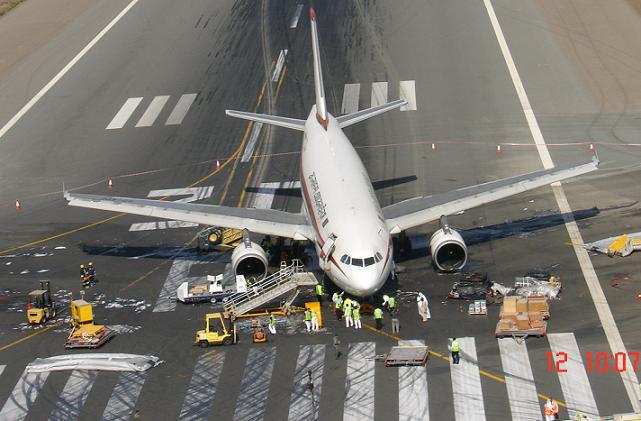
The takeoff was
aborted. The airport has been closed while the condition of the runway is
investigated, the airplane towed from the runway and an investigation
commenced.
The plane's 236
passengers and crew were quickly evacuated and the injured passengers were
taken to a hospital, the officials said. All injuries were said to be minor.
The plane was
traveling to the Bangladeshi capital, Dhaka.
The Dubai
Department of Civil Aviation announced an eight-hour closure for Dubai
International Airport, the busiest in the Middle East, until 2:30 p.m. local
time.
The incident left
thousands of stranded passengers stuck in its two terminals. The accident
occurred shortly before Emirates main morning departure block of flights to
Europe.
The airport's
public address system told travelers that all flights were delayed until
further notice.
A
large number of Emirates flights have been affected. Emirates
announced that the airline is working very hard to manage this challenging
situation and to look after our customers. Many flights have been canceled
and passengers will be transferred to later departures. Incoming planes are
backed up at Abu Dhabi, Al Ain, Fujariah, Sharjah and Kuwait.
However most of the Asian and European arrivals were already
in Dubai before the time of the accident. The biggest impact has been
on European and regional departures.
Surprisingly the EK home page says nothing about the incident
or about the current and likely delays which will impact the airline for the
next couple od days. For crew and passengers that on a long flight back to
Dubai from New York or Australia, being stuck on the ground at another UAE
airfield can be no fun at all. There will be some horror stories.
Dubai Airport does have two runways.
Unfortunately one of them (30L-12R) is closed for a lengthy resurfacing and
extension. The airport must be chaos. Even on a good day terminal 1 can
barely handle the number of passengers. On a good day there are people
sleeping on the floors and two Costa (Lot) coffee shops are over run.
Surprisingly the Emirates Air home page does not give
passengers or those meeting and greeting passengers an alert on today's
problems at DXB.
Just a few examples of the Impact on Passengers and Crews
| |
|
|
EK 387 Flight Route : Bangkok - Abu Dhabi - Dubai |
|
Bangkok - BKK > Abu Dhabi - AUH |
Status: Arrived |
| |
|
|
Airport: Bangkok - BKK |
Airport: Abu Dhabi - AUH |
|
Expected Terminal: 2 |
Actual Time of Arrival: 0724 |
|
Actual Time of Departure: 0253 |
|
| |
Abu Dhabi - AUH Dubai - DXB Dubai - DXB |
Status: In Flight |
| |
|
|
Airport: Abu Dhabi - AUH |
Airport: Dubai - DXB |
|
Actual Time of Departure: 1623 |
Expected Terminal: 1 |
| |
Estimated Time of Arrival: 1658 |
|
|
EK 381 Flight Route : Hong Kong - Al Ain - Dubai |
|
Hong Kong - HKG > Al Ain - AAN |
Status: Arrived |
| |
|
|
Airport: Hong Kong - HKG |
Airport: Al Ain - AAN |
|
Actual Time of Departure: 0732 |
Actual Time of Arrival: 1303 |
| |
|
| |
|
Al Ain - AANDubai - DXB |
Status: In Flight |
| |
|
|
Airport: Al Ain - AAN |
Airport: Dubai - DXB |
|
Actual Time of Departure: 1418 |
Expected Terminal: 1 |
| |
Estimated Time of Arrival: 1500 |
|
| |
|
|
FLIGHT NUMBER : EK 0006 |
|
London Heathrow - LHR > Kuwait - KWI |
Status: Arrived |
| |
|
|
Airport: London Heathrow - LHR |
Airport: Kuwait - KWI |
|
Expected Terminal: 3 |
Expected Terminal: 1 |
|
Actual Time of Departure: 2240 |
Actual Time of Arrival: 0757 Next
Day |
| |
|
Kuwait - KWI > Dubai - DXB |
Status: Not Departed |
| |
|
|
Airport: Kuwait - KWI |
Airport: Dubai - DXB |
|
Expected Terminal: 1 |
Expected Terminal: 1 |
|
Scheduled Time of Departure: 2030 Next
Day |
Estimated Time of Arrival: 2255 Next
Day |
| |
|
FLIGHT NUMBER : EK 0002 |
|
London Heathrow - LHR > Dubai - DXB |
Status: Not Departed |
| |
|
|
Sorry The Flight Has Been Cancelled |
| |
|
FLIGHT NUMBER : EK 0030 |
|
London Heathrow - LHR > Dubai - DXB |
Status: Not Departed |
| |
|
|
Sorry The Flight Has Been Cancelled |
Abe needs to admit the past to have a
future
10 March
2007
Shinzo Abe, the
relatively new Japanese Prime Minister managed to offend most of Asia last
week in a weak defense of the indefensible?
Abe recently said
that there was no evidence that 200,000 or so women from neighbouring
counties such as China and Korea were herded like cattle in a system of
forced brothels where they suffered rape and brutality by the Japanese
Imperial Army. He said
that there was no proof that she and other so-called "comfort women" had
been coerced into prostitution. The evidence is
clearly otherwise.
Japanese Prime Minister Shinzo Abe was
commenting on a proposed resolution before the U.S. House of Representatives
that urges Japan to formally apologize for its wartime brothels.
Japan acknowledged in the 1990s that its
military set up and ran brothels for its troops. But it has rejected most
compensation claims, saying they were settled by postwar treaties. And
though the government issued an apology in 1993, it was never approved by
parliament
In 1997 the
Chinese American historian and journalist Iris Chang had published the ‘Rape
of Nanking’, a history of the 1937-1938 Nanking massacre. It was a
documentation of the infamous war crime committed by the Japanese army when
they occupied the Chinese city of Nanking.
As well as looting and burning the city, they executed prisoners of war as
well as raping and murder women and children. In the West and elsewhere it
is generally agreed that 300,000 non-combatants were killed due to
eyewitnesses, excavations and photographic evidence.
Although the evidence is overwhelming and the Japanese government has
acknowledged it happened, a number of Nationalist protestors and history
books taught in schools have disputed whether the atrocities even happened.
This view has even divided much of the Japanese population.
This history still colours the relationship between China and Japan. The
previous Prime Minister Junichiro Koizumi had stubbornly continued to visit
the Yasukini shrine which honoured Japan’s war dead. In China this caused
much anti-Japanese sentiment.
The new Prime Minister has tried to cultivate a softer relationship with its
neighbours, especially China and South Korea. But that has come to an abrupt
end with statements issued from China, North and South Korea, Taiwan and the
Philippines condemning his remarks.
The surviving women are mostly now in their
70s and 80s. Some tell of soldiers storming villages and rounding them up at
gunpoint. Others say they went willingly because they were promised real
jobs, only to be forced into prostitution. Some Japanese soldiers have
admitted they abducted women under orders from their military commanders.
But the government denied any involvement until documents proving otherwise
were unearthed in 1993. An apology was issued and a reparations fund was
established, but the money came from private sources. Japanese right-wingers
have been retreating from the apology since the day it was uttered.
Denying the past is nothing new for Japan. Six years ago, right-wing
scholars introduced a middle-school textbook designed to give students a
more positive sense of their nation's history. It characterizes Japanese
wartime aggressions as resistance to Western imperialism and shrugs off "The
Rape of Nanking."
Abe is the first Japanese prime minister born after World War II and is more
concerned with charting the nation's future than with redeeming its past. He
is impatient with those who want him to account for an ugly and violent
drama that is so old that most of those involved have died. Japan's
neighbors however, have understandably long memories about wartime
atrocities. Abe is too young to remember. That doesn't mean Japan will be
allowed to forget.
What Mr Abe
effectively did is call the aging victims liars. It may also suggest
something more indicative of Japanese attitudes to rape and their treatment
of women.
Until the Japanese face up to the reality of their history then it will
always have problems in its regional relationships. Of course, Japan is not
alone in failing to acknowledge the truth of its history. China has to face
up to its own history of atrocities, such as Mao’s self inflicted famine
killing 30 million people and its invasion of Tibet.
Recently the UK made a statement declaring a full apology for its shameful
history of slavery. Germany has been apologetic for the crimes of the Nazis
for many years. It is time for Japan to admit the past for the good of its
future.
Where next for
the Thai Baht?
9 March
2007
The Bank of Thailand (BOT) reportedly intervened in the
foreign-exchange market yesterday as the baht jumped to another nine-year
high of 35.13 to the US dollar, following massive sales of dollars by
exporters.
"Exporters are selling dollars on expectation the baht
will strengthen further once the capital-control measure is lifted," said a
dealer at a commercial bank.
The baht opened yesterday at 35.19/35.21 to the dollar
before strengthening to a fresh nine-year high of 35.13 during intra-day
trading. It closed at 35.20/35.21.
The BOT hinted its controversial 30-per-cent unremunerated
reserve-requirement measure could be lifted, following huge pressure from a
business community that has been hurt by a foreign-capital deterrent effect
since the control was implemented last December 19. The exception has been
the export sector, in whose interests the measure was introduced. Newly
appointed Finance Minister Chalongphob Sussang-karn has voiced disagreement
with the 30-per-cent withholding measure and is expected to revoke it. The
likelihood is that, once capital controls are revoked, the baht will further
appreciate.
Expected cancellation of the measure has encouraged Thai
companies to build up their foreign-debt positions, leading the central bank
to monitor the country's foreign-debt position closely out of concern it may
create higher economic risks. The reaction is a reverse of company behaviour
after the 1997 economic crisis, when Thai debtors rushed to repay their
foreign debts as the baht weakened dramatically.
Federation of Thai Industries (FTI) chairman Santi
Vilassakdanont said exporters were selling dollars on the basis of those
fears. While saying the FTI will rush to convince them to stall the dollar
sale, he stressed that if the measure were revoked, the authorities should
make sure the baht does not appreciate beyond the levels of other currencies
in the region.
"We do not mind appreciation as long as the baht moves in
line with other regional currencies. If it irregularly strengthens against
the US dollar, that could diminish the export sector's competitiveness," he
said.
The capital controls have led to two-tier trade in the
baht -- between the onshore and offshore markets. In the onshore market is
at its strongest level in more than nine years. The baht is trading at about
32.7 to the dollar in the offshore market -- about 7% stronger than where it
is trading onshore. The dismantling of the measures would help a convergence
of the onshore and offshore baht spot rates but probably at a rate closer to
the offshore rate.
Overall the stronger performance of the baht against other
regional currencies such as the Won and the Singapore dollar is surprising;
for those of us with US$ assets but expecting a long term future in Thailand
the strengthening of the baht is a weakening or our buying power.
A stronger dollar would help but that looks less than
likely while the Middle East is still troubled and while the US continues to
maintain its low interest rate policy.
Business Bay in
years to come
7 March 2007
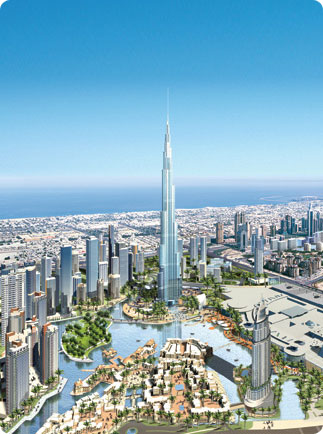
This is business
bay, the Burj Dubai tower and the Dubai mall according to an artist's
impression, at a future date. Not soon.
The Thailand
Coup six months one
6 March 2007
from Chang Noi in the Nation newspaper.
A searing indictment of the coup

Many urban people welcomed the September 19 coup.
As the six-month anniversary approaches, more and more are having second
thoughts. The government is stumbling, news from the charter drafters is
depressing, southern violence gets worse, and Thailand's stock in the world
sinks ever lower. Judging by current trends, it won't be long before Prime
Minister Surayud Chulanont's falling ratings meet Thaksin Shinawatra's
rising ones. Some blame this on Surayud personally. But others are asking
the bigger questions: Why didn't the coup work? Was it a good idea to have a
coup in the first place? And if not, why did it happen?
Last month, the
magazine Fa Dieo Kan put out a special issue on the coup. The editor
apologises upfront for making no pretence of even balance. This publication
is unremittingly and furiously against the coup. The contents include
articles, speeches, interviews and translations by 20 people, so there is no
single argument, and much disagreement. But the book's overall message is
daring, revealing and very challenging.
The cover tells it
all. The graphic lampoons the generals' protests that it was not really a
coup. The title is: "The Coup for Democracy with the King as Head of State."
The book's first main point is that you cannot start to understand this
coup, or current Thai politics at all, without confronting the role of the
monarchical institution.
In these writers'
usage, the monarchical institution is not an individual or family but a much
larger collection of people including Privy councillors and royalist
supporters. This monarchical institution is like a "black box" in economic
or scientific theory. You cannot see inside so you don't know how it works.
But you can see what it does and what the effects are on the outside world.
Several of the writers argue that the major role of the black box in this
coup is undeniable. You need only consider the role of Privy councillors
both before and after. These writers then ask why this happened and what are
the consequences?
Thongchai
Winichakul answers these questions using a long perspective. The history of
modern Thailand has tended to be written as good democrats combating bad
soldiers. But the crucial battle of that war was fought in 1973, and the war
ended by 1992. Instead Thongchai suggests the whole dreary history of coups
from 1947 onwards should be seen as an attempt by self-serving elites to
control the consequences of what happened in 1932. Their goal is not to
return to monarchic rule, but to a form of elite rule that clings to the
monarchy for legitimacy. But over time the politicians and the people have
become pushier. One counter-strategy of the old elites is to go on and on
about corruption and money politics. In itself, this criticism is not bad.
But it can easily become a tool to discredit parliamentary politics as a
whole, and overthrow the fundamental concept of democracy, the sovereignty
of the people. In Thongchai's words, "If a government supported by a popular
majority is only a 'jockey', then in the end the government machinery
belongs to the king".
But how do such
historical forces work in practice, in the present? After the coup, General
Sonthi Boonyaratglin said he moved at "the request of the people". General
Saprang Kalyanamitr let it slip that the planning took seven months, meaning
it started in February 2006, amid the furore over the Shin Corp sale.
Thanapol Eawsakul tracks back to that month to examine the genesis of the
coup in fine detail.
Sondhi Limthongkul
had begun his crusade several months before - wrapping himself in yellow,
splashing "we will fight for the King" across his chest, and claiming to
light a "dhamma candle" to spotlight Thaksin's evil. Sondhi created the idea
that politics had become a contest between the prime minister and His
Majesty the King. But his movement was stumbling. The rallies were dwindling
and Sondhi's allegations of corruption were embarrassingly thin. The Shin
Corp sale gave him a second chance.
A week later one
of his future People's Alliance for Democracy allies, Somkiat Phongpaiboon
wrote, "Please watch the royalist group and the Privy councillors, which
Sondhi has called 'the return of the royal power'."
On February 4 of
last year, Thaksin said he would resign if His Majesty whispered in his ear.
That evening, Sondhi thundered from his rally stage, "Where is the army?
This talk is enough to bring [Thaksin] to the execution post." That night he
took a petition to Privy Council President General Prem Tinsulanonda. As he
told the world the following day, the Bureau of the Royal Household was
surprisingly open at 9pm as if ready to receive him. Sondhi also went to
meet General Sonthi, and related later, "I asked [Sonthi], 'Are you going to
stand by the people?' He nodded, 'I will stand by the people because I am a
soldier of the King'."
From that point,
Sondhi organised more rallies, but they did not build. He called for the use
of Clause 7, but on April 25 His Majesty said that would be inappropriate.
As Thanapol concludes, the coup happened because Sondhi issued an invitation
to the Army to carry out the coup, and Sonthi B accepted the invitation.
Given these
events, how can monarchy and democracy coexist for the long term, without
regular crises? More people have begun to doubt that this coup was ever the
solution to anything. This book argues that the big issue now is not the
military or political corruption or populism, but how to prevent an elite
minority controlling politics and keeping the masses as passive partners, in
part by exploiting the symbolic power of the monarchy.
Why Brummies
like Emirates
4 March 2007
It is a little known fact that I was born at Marston Green
maternity hospital, under the flightpath into what was then known as
Birmingham Elmdon airport.
Now known as Birmingham International the airport hosts
Emirates Airline as its premier carrier. And Emirate is again planning an
increase in capacity after notching up a 71 per cent rise in the number of
passengers using its Birmingham services in just two years.
From 187,000 customers flying with the Dubai-based
international carrier in 2004/2005, the latest figures for the year to March
have hit 320,000 for its twice-daily services from Birmingham.
It means that Emirates will be looking to use larger aircraft
at Birmingham from summer onwards – and increases the chances of the
introduction of a third service in about a year's time.
Emirates says that as well as the growth of Dubai as one of
the world’s leading business and tourism destinations, the popularity of
Australian destinations has soared as Midlands travelers turn their back on
London’s airports to fly direct from Birmingham.
Four of the top seven destinations for Emirates passengers
are now in Australia – compared with two in 2005 – with Perth, Sydney,
Brisbane and Melbourne overtaking Delhi and Dhaka in popularity as travelers
take advantage of connections through the carrier's Dubai hub.
The Birmingham flights save Midlands passengers from
traveling down the M1 or M40 to the London airports. Passengers save
significant time by flying direct with Emirates from Birmingham
International to our destinations in the Middle East, Asia and Australia.
Birmingham is also home for a large number of South Asians who can connect
through Dubai to India, Pakistan, Bangladesh and Sri Lanka.
Dubai's growth
- some statistics
1 March 2007
Statistics
released to day from the Dubai Statistics Department.
2005 Population
1,130 million
2006 Population 1,422 million
75.5% male
24.5% female
212,867 new
vehicles registered in 2006.
2,222 buildings
completed in 2006 at a cost of AED 11.16 billion. 381 are commercial and
1,432 are residential.
2.21 million
mobile phones, up 20.6%.
953,292 visitors.
13,574 tonnes of
waste collected - that is almost 10 tonnes per person !
There were 306
hotels at the end of the year with 31,580 rooms that accommodated 5.4million
guests. There are also 115 apartment hotels.
Jazeera's fast
growing Dubai hub
1 March 2007
Jazeera Airways
has revealed the airline’s multi-hub strategy – a move that will no doubt
grab the attention of its direct competitor, Sharjah-based Air Arabia.
While hardly a
threat to Dubai based Emirates the Jazeera growth does indicate both the
need for a low cost operation out of Dubai and that their is sufficient
capacity at the airport for the new airline to grow a base there.
Jazeera is looking for a third (and maybe more) hub airports. The airline's
chairman has said that “We have to have more hubs. We need to be all over
the region and there are a couple of destinations we are looking at right
now.
In one year the
privately owned Jazeera Airways has extended its reach to 20 destinations
across the Middle East, North Africa and the Indian Subcontinent.
By March 27, the airline will fly direct from Dubai to seven destinations –
Kuwait, Bahrain, Mumbai, Kochi, New Delhi, Muscat and Salalah, operated by
five Airbus A320s.
In comparison, Air Arabia, now in its fourth year, flies to 33 destinations
from Sharjah across the Middle East, North Africa, Indian Subcontinent and
Central Asia and flies nine Airbus A320s.
Both airlines believe there is room in the market for several LCCs.
The economy cabin
market for travel in this region is already a highly competitive one. It
probably is true that supply creates demand for air travel in this region.
Emirates has always been high cost for shirt haul flights and the growth if
Jazeera may put pressure on Emirates fares in the Middle East and to South
Asia.
|

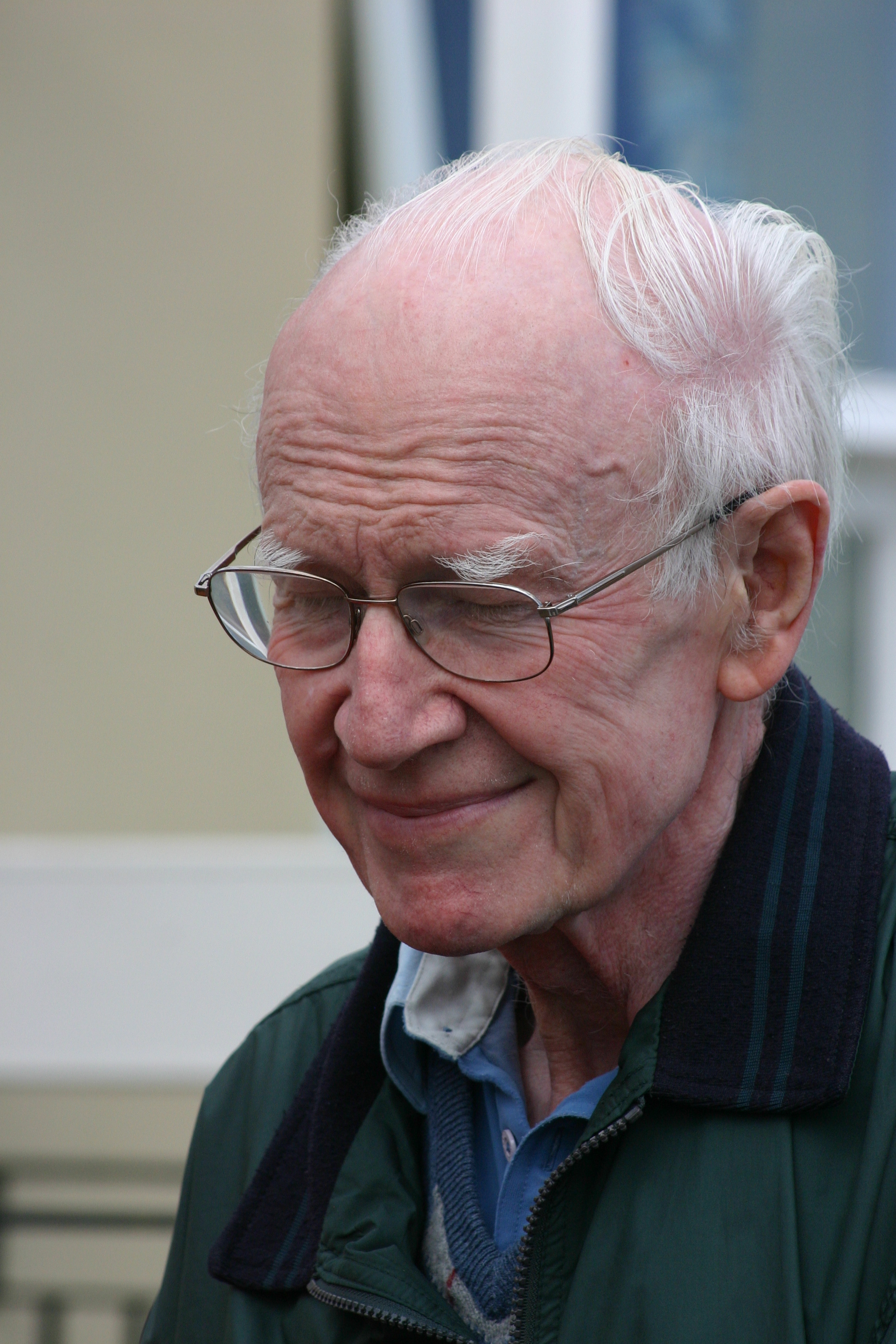
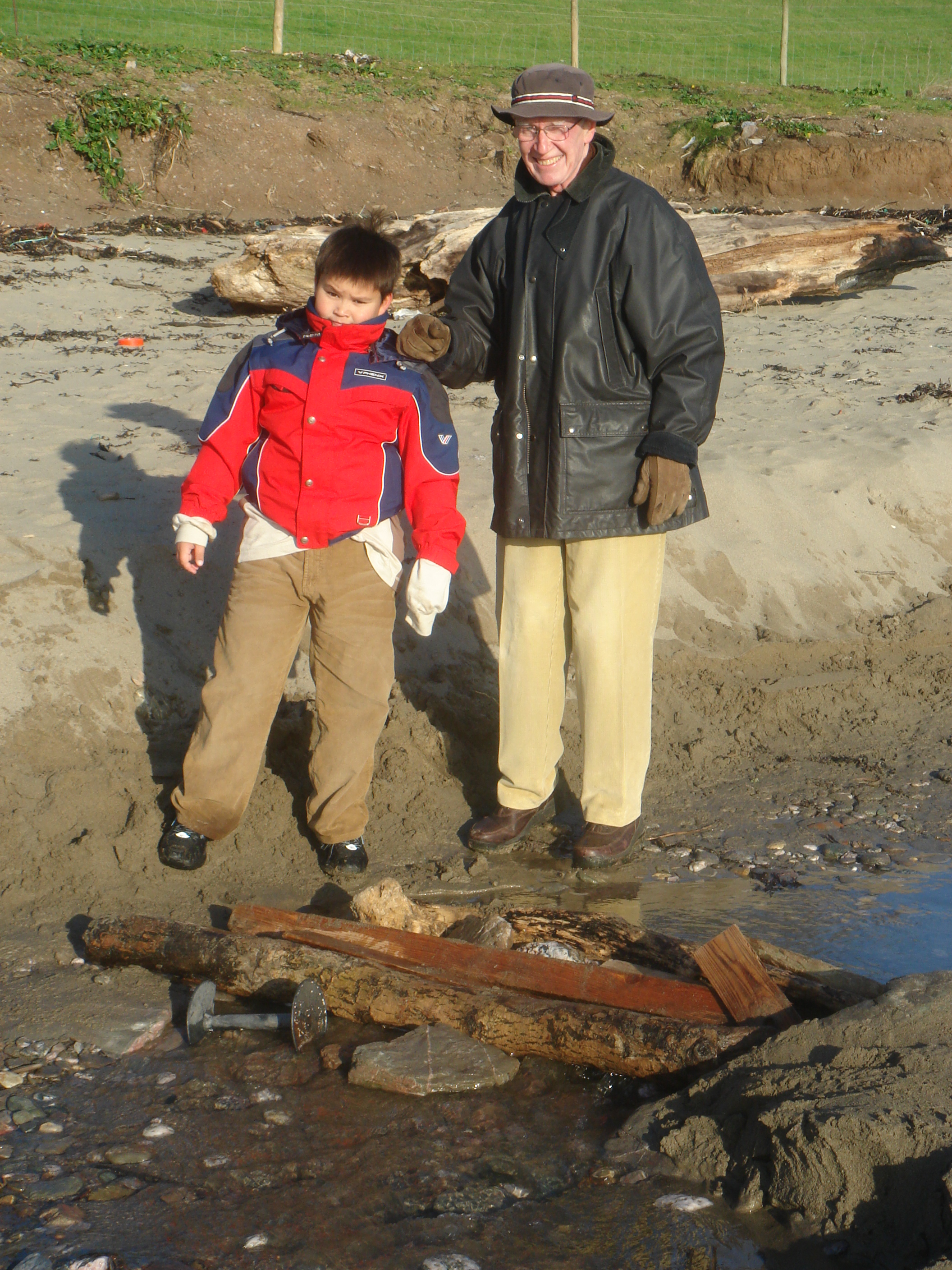
 zoom
zoom