Plutonium and Mickey Mouse
Japan’s nuclear crisis drags on, exposing profound failures both at the
company and in national energy policy
31 March 2011 The Economist
It is daylight, but the darkness inside the headquarters of the world’s
biggest privately owned electricity company is sepulchral. Officials, heads
bowed, apologise in whispers for the trouble Tokyo Electric Power (TEPCO)
has caused. Their 66-year-old boss, Masataka Shimizu, went into hospital on
March 30th, suffering from hypertension; he has been absent for much of the
past three weeks. In the gloom TEPCO’s logo on the walls of the building
resembles a mutant Mickey Mouse.
About 250km away, at the Fukushima Dai-ichi nuclear-power
plant, hundreds of TEPCO employees and some subcontractors are trying to
prevent further leaks of radioactive material from three damaged nuclear
reactors and various sources of spent fuel. Their conditions are close to
intolerable. At times, they have been exposed to more radiation in a few
hours than they are supposed to endure in a year. Their rations are biscuits
and canned food. They have a blanket each, and sleep on the floor. Some have
lost homes and families to the tsunami that left 27,690 dead or missing.
TEPCO sees them as soldiers. “We don’t think they are heroes. They are doing
what they should,” an official says.
TEPCO is getting most of the blame for Japan’s nuclear disaster. For much of
the past three weeks, the authorities have held out hopes that they could
regain control by reconnecting cooling systems damaged by the tsunami. These
are supposed to prevent fuel from melting and rupturing the protective steel
case of the reactor vessels.
This week the discovery of large pools of highly radioactive water and
raised levels of radiation in seawater near the plant has shown how far the
authorities really are from regaining control. Previous releases of
radioactive iodine and caesium had shown that material from the core of at
least one reactor has been released. The new findings suggest that the
systems designed to contain such releases may have been badly compromised.
The tanks into which contaminated water is being pumped will eventually fill
up. And conditions for workers are getting more dangerous, which means that
fixing up the cooling systems and hooking up vital measuring instruments
takes longer.
The plant is so woefully damaged that TEPCO officials cannot say when the
crisis will be over. Levels of radiation have mostly been subsiding, though
unevenly spread. But reports on March 31st revealed that radiation in a
village 40km away exceeded criteria for evacuation and the UN’s nuclear
watchdog suggested the government might widen the 20km evacuation zone. All
this has compounded worries that the area round the plant may remain unsafe
for years.
There is plenty of blame to go around. TEPCO wrongly measured radiated
waters in one of the turbine halls at 10m times normal level, rather than
the still-alarming 100,000 times. Subcontractors working for TEPCO
reportedly complained about the safety of their workers on site. Three
electricians accidentally stepped into a dangerous puddle on March 24th. In
one sign of unpreparedness, the gauge that measured the radioactivity of
water afterwards could not go higher than 1,000 millisieverts an hour, about
the level at which radiation becomes an immediate threat to health.
Tensions between TEPCO and the government of Naoto Kan have
risen since the prime minister installed crisis managers inside the
utility’s head office. Privately, officials have suggested TEPCO may have
been slow to use seawater to cool the reactors because it wanted to save its
plant—though the company denies this. Publicly, Mr Kan has lambasted the
company’s tsunami-preparedness. Koichiro Gemba, a cabinet minister, has left
open the possibility that TEPCO would be nationalised, though this was
perhaps to reassure voters in his Fukushima district that they would be
adequately compensated. Other officials were non-committal about state
intervention, but TEPCO shares have fallen by over 75% since March 11th.
Outside experts say that repeated flaws in the company’s nuclear operations
have denuded its board of specialists in atomic power. Mr Shimizu is the
third successive president to have been hit by a nuclear accident. “This
company is really rotten to the core,” says Kenichi Ohmae, a management
consultant and former nuclear engineer. He blames TEPCO for storing too much
spent fuel on the site; for placing too many reactors in the same place
(there are six in the Fukushima Dai-ichi plant and seven in a nuclear
complex on an earthquake fault-line in Niigata); and for not having enough
varied sources of power.
But the problems run deeper than TEPCO. The Ministry of Economy, Trade and
Industry (METI) oversees the regulator and is responsible for safety issues.
But it also promotes the nuclear industry. Reportedly, Mr Kan is considering
altering this. Nuclear scientists, says Mr Ohmae, are mostly sponsored by
utilities, compromising their independence. He describes them as
“Christmas-tree decorations” on government safety commissions.
The problems compound one another. Taro Kono, of the opposition Liberal
Democratic Party (LDP), says there is an “unholy triangle” between METI, its
affiliated regulator and the nuclear industry. His office notes that Toru
Ishida, a former METI energy official, moved straight into a job as senior
adviser to TEPCO. Mr Kono also accuses the media of being in the nuclear
industry’s pocket, because of lashings of advertising.
Paul Scalise, a TEPCO expert at Temple University’s Institute of
Contemporary Asian Studies in Japan, responds that the demonising happens,
in part, so that politicians, bureaucrats and the electorate can avoid blame
themselves. He points out that Japan’s embrace of nuclear technology was a
national decision, taken after the 1973 oil shock (Japan imports 99% of its
oil). But after accidents at Three-Mile Island and Chernobyl, local people
began to take a not-in-my-back-yard attitude. Utilities and the government
responded by offering tax incentives, subsidies and other blandishments. The
result was some of the highest electricity tariffs in the rich world.
Yet companies like TEPCO have still struggled to build new plants in the
teeth of local opposition, Mr Scalise says. That helps explain why so many
of its reactors are on single sites. The company stores spent fuel rods on
its premises because there is no consensus on where else to put them.
Meanwhile, the shortage of capacity means that its margin of excess power
has been shrinking for 20 years.
Following the earthquake and tsunami, about 28% of TEPCO’s installed
capacity, nuclear and non-nuclear, remains shut down. On March 30th, the
government acknowledged the obvious—that it is likely to decommission the
Fukushima Dai-ichi plant permanently—and possibly have to cover it to stop
radiation leaking out. That would knock out about 1.8% of Japan’s energy
capacity. In a model of bad planning, the country’s power-distribution
systems in the east and west of the country operate on different
frequencies, so it is hard to share electricity between them. Unless damaged
thermal-electric capacity is brought back soon and more small gas-fired
plants are quickly built, months—perhaps years—of energy shortages loom,
with crippling effects on the economy.
All this will be a reason to judge TEPCO severely. But the crisis is
exposing the failure of the nation’s energy policy as a whole. Prices are
exorbitantly high. Power generation produces more greenhouse gases than the
government wants. The country has not achieved its goal of nuclear
self-sufficiency by reprocessing spent fuel. And now it has a nuclear
disaster on its hands. That is not only TEPCO’s fault. It is Japan’s. If the
country wants a more reliable energy strategy, it will have to start by
acknowledging its collective failings.
Maids saving Singapore
31 March 2011
This is just too good: the nanny state is in uproar. It looks
like a brave soldier is playing with his phone. What is clear is that his
maid is carrying his back pack. She is even marching in time with her left
leg forward.

For more on this wonderfully predictable
story read here.
Thailand: A Democratic Failure and Its Lessons for the
Middle East
A Markets and Democracy Brief
Council for Foreign Relations
Author: Joshua Kurlantzick, Fellow for Southeast Asia
31 March 2011
As nations in the Middle East revolt against longtime
autocrats, many reformers in countries like Tunisia or Egypt are celebrating
their first tastes of democratic freedom. In Egypt, high turnout marked a
recent referendum, the first truly free vote in modern history, to decide on
a set of new constitutional amendments.
Yet as the experience of many developing nations in East Asia shows, these
initial, exuberant glimpses of democratic reform can prove a mirage, and
toppling a dictator hardly guarantees a smooth path to consolidated
democracy. In the 1980s and early 1990s, nations from Indonesia to the
Philippines to Mongolia embarked on their own democratic transitions, often
after large-scale street demonstrations similar to the Middle East’s “Days
of Rage.”Among newly democratizing nations, Thailand, where hundreds of
thousands of Thais came out into the streets of Bangkok in 1992 to bring
down a military government, seemed perhaps the best prospect for stable
democracy. Thailand boasted a large, educated middle class, one of the
best-performing economies in the world, and a relatively robust civil
society. By the late 1990s, Thailand had held several free elections and
passed a reformist constitution that enshrined greater protections for civil
liberties and created a wealth of new institutions designed to root out
graft and ensure civil rights. In its 1999 report on freedom in the world,
monitoring organization Freedom House ranked Thailand a “free” nation.
Today, however, Thailand looks less like a success story and more like an
example of how democracy can fail. Since a 2006 military coup, Thailand has
reverted to a kind of soft authoritarianism: the military plays an enormous
role in determining politics; the Thai middle class has become increasingly
antidemocratic; and security forces have used threats, online filtering,
arrests, and killings to intimidate opponents of a government sanctioned by
the armed forces and Thailand’s monarchy. Freedom House recently ranked
Thailand as only “partly free,” and the country has sunk near the bottom of
all developing nations in rankings of press freedom. Thailand’s failures
provide cautionary tales for reformers in the Arab world.
Where It Went Wrong
After forcing out the military and launching a first wave of democratic
reforms, Thailand’s politics took a wrong turn in the past decade, starting
the slide that has led to its soft authoritarianism. In the late 1990s and
early 2000s, many leading Thai reformers, who had organized the protests in
1992, backed off, a major mistake. They believed, falsely, that Thailand had
passed a threshold, allowing them to shut down their NGOs, their media
watchdogs, and their transparency monitors. In the wake of the Asian
financial crisis, many of these idealistic middle-class Thais suddenly found
themselves unemployed, making it harder to spend time volunteering at
nonprofits or leading nighttime discussion sessions about new political
parties.
As Thailand’s reformers eased off the pressure, one of the country’s most
powerful businessmen, telecommunications tycoon Thaksin Shinawatra, used his
fortune to build a political party and, in 2001, to run for prime minister.
Thaksin took advantage of the fact that, contrary to what many reformers
believed, the country’s institutions indeed remained weak. He bought up
politicians to join his party, and when the courts tried to prosecute him
for concealing his assets, he used connections in the judiciary to help win
an acquittal, paving the way for him to take office. But Thaksin also
offered policy proposals—inexpensive health care, loans to villages to start
businesses—that genuinely appealed to Thailand’s poor, who still make up the
majority of the country. No Thai politician had tried to court the poor with
such comprehensive policies. Indeed, in the exuberance of the early
democratic era, Thailand’s middle class seemed to forget that democracy
would empower the poor at the ballot box—and that, if reform-minded parties
did not appeal to this constituency, a less democratic-minded leader could
win them over.
Elected in 2001 with landslide support from the poor, Thaksin soon showed he
had little interest in strengthening Thailand’s democracy. Indeed, like Hugo
Chávez, Vladimir Putin, Evo Morales, and other leaders who have emerged in
many weak democracies today, Thaksin became an elected autocrat. He used his
power to threaten Thailand’s free media, eviscerate its independent civil
service, and launch a bloody campaign against insurgents in the country’s
Muslim-majority south. Like other elected autocrats, Thaksin also rewarded
political allies with large government contracts and punished political
enemies financially.
By 2005, when Thaksin was reelected, again with massive support from the
poor, he dominated the country’s political landscape. And yet Thailand had
not become Equatorial Guinea or Libya; the Thai middle classes, who had led
the democratic revolution before, could have fought back against Thaksin at
the ballot box, through the remaining independent news outlets or in the
courts. But instead, like middle classes in many emerging democracies today,
they had grown disillusioned with democracy, believing that it had delivered
only elected autocracy and that it would empower the poor at their expense.
So, instead of choosing the democratic path, Thailand’s urban middle class
launched street protests in 2006 designed to bring down an elected
government—by triggering a coup if necessary. The protesters encouraged a
return to older forms of Thai “democracy,” in which a small oligarchy
essentially controlled politics through unelected positions in parliament,
the bureaucracy, and the army. They got what they wanted: the military
launched a coup in September 2006, and Thaksin fled into exile. This process
has been repeated in recent years in countries from the Philippines to
Honduras, where middle classes have used similarly dubious means to push out
elected leaders they viewed as excessively populist.
The Thai coup, unfortunately, only triggered a total meltdown. Thaksin might
have damaged the country’s weak democracy, but the military ruined it. It
shredded the reformist constitution and set the stage for today’s Thai
government, which unleashed massive force against demonstrators who gathered
in the streets of Bangkok in spring 2010. In that bloodshed, at least eighty
people were killed, and parts of Bangkok’s central business district were
torched, leaving the prosperous city looking more like Baghdad or Kabul.
The Lessons of Thailand's Meltdown
Later this year, Thailand will go to the polls in a national election touted
by the government as a major step toward reconciliation between classes and
factions following the bloodshed last year. But the election is unlikely to
be free and fair. The military allegedly has been working behind the scenes
to build support for the ruling party, and if the opposition, still aligned
with the exiled Thaksin, does happen to win, it is quite possible the armed
forces will launch a coup. This would only further deepen class divides in
Thailand and possibly spark all-out civil conflict.
Thailand’s fate is not destined to be repeated in the Middle East, but as in
Thailand, the democratic revolts in the Arab-Muslim world could easily get
sidetracked. Fighting for change is not easy, and in countries like Egypt,
where unemployment is high, would-be reformers could want to return to their
businesses and their families rather than investing years or decades
promoting good governance.
But continued investment in reform is critical. In Middle Eastern nations
with little history of democratic politics, and where for decades political
losers fled the country or wound up in jail, it is not hard to imagine that
the first generation of elected leaders will, like Thaksin, use their
electoral victories to crush all opposition. And if a populist leader like
Thaksin wins initial elections in countries like Egypt or Tunisia, or
possibly Morocco or Jordan, where large underclasses or repressed ethnic or
religious groups are gaining freedom, it could easily trigger a backlash
from middle classes and elites, who would turn to their traditional
protectors—the army, the security forces, the palace—to squash real
democratic rule. In Egypt, liberal economic reforms instituted since the
early 2000s have opened up the economy, but they also have led to rising
inequality: new mansions have sprung up in posh areas of Cairo, yet nearly
one-third of Upper Egypt still lives in poverty.
To avoid Thailand’s fate, Middle Eastern reformers should take several
critical steps. For one, they must realize that, even after they topple a
dictator, they cannot abandon the hard work of reforms; it is in these early
days of democratization that the need for independent government watchdogs,
new press outlets, or aggressive unions is most vital. In addition, they
must resist the tendency to personalize reform—to focus all their hopes for
change on one leader, as some Thais put all their hope in Thaksin, or as
many Indonesians have placed their hopes in current president Susilo Bambang
Yudhoyono. When the public puts so much hope in one potential reformer, his
or her failings become magnified, often leading to disillusionment with
democracy itself. Finally, new leaders in the Middle East will have to enact
policies that help reduce economic inequality, which has been fatal to
democracy in Thailand—and could be as well in Egypt or Tunisia—with
populist-elected autocrats winning office on the poor’s new political
empowerment but then using their power to undermine democracy’s very
institutions.
The birth of an Obama doctrine
31 March 2011 - The Economist
Born, as we are, out of a revolution by those who longed to be free, we
welcome the fact that history is on the move in the Middle East and North
Africa, and that young people are leading the way. Because wherever people
long to be free, they will find a friend in the United States. Ultimately,
it is that faith – those ideals – that are the true measure of American
leadership.
THUS President Barack Obama tonight, speaking to the American
people directly for the first time since launching Operation Odyssey Dawn
and unleashing American missiles in Libya. He had received a great deal of
criticism—for “dithering”, for failing to consult Congress, for going too
far and doing too little. Now he has answered back—and provided, at the same
time, the clearest explanation so far of an “Obama doctrine” of humanitarian
military intervention.
Far from “dithering”, goes the White House line, pushed subtly in the speech
and explicitly in briefings by senior officials, Mr Obama’s handling of the
Libyan crisis has been “relatively extraordinary”. He has in a mere 31 days
since the protests started imposed powerful sanctions, frozen Colonel
Qaddafi’s assets, secured a robust Security Council resolution, organised an
international coalition, executed a near-flawless military campaign, rolled
Colonel Qaddafi’s forces back to the west, taken out the colonel’s air
defences and knocked out a good deal of his ground forces. All this has been
done without having to put American boots on the ground, without American
military casualties and with precious few Libyan civilian casualties. Better
still, with all this now done, America’s own contribution can decline, NATO
can assume command (under an American general but with a Canadian deputy)
and the European allies will take on more of the burden. Compare that, say
senior administration officials, to the years it took to intervene in Bosnia
in the 1990s.
To those hyper-realists who ask why it was necessary for America to entangle
itself in Libya at all, the president’s answer appears to run as follows.
First, he will never hesitate to use military power, unilaterally if
necessary, in defence of the nation’s core interests. No such core interests
were at risk in Libya, but some interests were. For example, the unrest in
Libya might have disrupted the far more consequential democratic revolutions
in Tunisia and especially Egypt, where America has a good deal more at
stake. Moreover, it would not have been right to turn a blind eye to the
possibility of Colonel Qaddafi carrying out his blood-curdling threats to
show “no mercy” to the inhabitants of Benghazi. In such cases, however, it
makes powerful sense, when possible, for America to share the burden with
allies under the authority of the United Nations. This is how he put it in
his speech:
It is true that America cannot use our military wherever repression occurs.
And given the costs and risks of intervention, we must always measure our
interests against the need for action. But that cannot be an argument for
never acting on behalf of what’s right. In this particular country – Libya;
at this particular moment, we were faced with the prospect of violence on a
horrific scale. We had a unique ability to stop that violence: an
international mandate for action, a broad coalition prepared to join us, the
support of Arab countries, and a plea for help from the Libyan people
themselves. We also had the ability to stop Qaddafi’s forces in their tracks
without putting American troops on the ground. To brush aside America’s
responsibility as a leader and – more profoundly – our responsibilities to
our fellow human beings under such circumstances would have been a betrayal
of who we are. Some nations may be able to turn a blind eye to atrocities in
other countries. The United States of America is different. And as
President, I refused to wait for the images of slaughter and mass graves
before taking action.
To critics on the opposite side of the argument, who ask why Mr Obama does
not just finish the job by killing the colonel himself, the White House’s
answer is that this would not only exceed the mandate of UN Resolution 1973,
which calls only for protecting the civilian population, but risk
splintering an artfully assembled alliance. That would leave America
“owning” the resulting mess. The administration acknowledges that the
denouement in Libya is likely to be messy anyway, but would prefer an
internationalised mess to one for which America alone is held responsible.
Might this American restraint enable Colonel Qaddafi to hang on for months,
even longer, in spite of all the other efforts to squeeze and isolate him?
Perhaps: but even if he holds out in some bunker in Tripoli, surrounded by
human shields, the White House does not see how he could continue to govern
Libya in any practical sense.
Another criticism of Mr Obama is that his policy is inconsistent. Why batter
Colonel Qaddafi and not intervene on the side of the opposition in Yemen,
Bahrain, perhaps even Syria? Mr Obama is thought to be preparing another
speech, some time in the next month or two, that will set out his broader
thinking on what the Arab awakening means to Arabs and the wider world, and
spell out how America might be able to help nudge it in a favourable
direction. Yet the president plainly believes that there are so many
variables in the present fast-moving circumstances that it is not possible
to adopt a single doctrine that fits each case. Bahrain has cracked down
forcibly on the opposition but not in the manner of a Qaddafi—and both
America, with its naval base, and Saudi Arabia have a powerful strategic
interest in the country. Ditto Yemen, a hodge-podge of tribes and factions
with a dangerous al-Qaeda presence.
Until Mr Obama gives his larger speech on the significance of the Arab
awakening, much of the White House’s focus will continue to be on
developments on the ground in Libya. The next tactical steps are supposedly
to be decided by the wider alliance talks taking place this week in London.
But senior White House officials say that they will continue to push for
military action against the colonel’s military forces whenever they can be
construed to be posing a threat to the civilian population. The United
States is already in direct contact with the opposition forces, who will
also be represented in London. Though not yet ready to recognise them as the
Libyans’ legitimate government (as the French already have), it is edging in
this direction. Crucially, the administration does not think that Resolution
1973 prevents outsiders from arming the opposition. Mr Obama described the
next steps like this:
As the bulk of our military effort ratchets down, what we can do – and will
do – is support the aspirations of the Libyan people. We have intervened to
stop a massacre, and we will work with our allies and partners as they’re in
the lead to maintain the safety of civilians. We will deny the regime arms,
cut off its supply of cash, assist the opposition, and work with other
nations to hasten the day when Qaddafi leaves power. It may not happen
overnight, as a badly weakened Qaddafi tries desperately to hang on to
power. But it should be clear to those around Qaddafi, and to every Libyan,
that history is not on his side. With the time and space that we have
provided for the Libyan people, they will be able to determine their own
destiny, and that is how it should be.
It is a good case—and it was a good speech. If Colonel Qaddafi is swept
quickly from power, or reduced to impotence in some bunker, nobody will care
very much about the manner in which Mr Obama put together his alliance and
campaign. It might indeed be remembered as an extraordinary foreign-policy
success. After the rescue of Kuwait in 1991, however, the first President
George Bush also expected Saddam Hussein's regime to collapse in short
order. Mr Obama's team says the circumstances this time are entirely
different. They had better be right.
ME turmoil is Dubai's gain
31 March 2011
This is a Reuters report; so has a bit more credibility that
the normal cheerleading from the local media.
But - and this is not unexpected - Reuters is reporting that
"regional turmoil is creating an unexpected boom for Dubai as tourists and
businessmen flock once again to the shopping and skyscraper oasis after
fleeing just a few years ago in the wake of its spectacular debt debacle.
Visitor numbers are noticeably higher in Dubai's gleaming malls and
restaurants, and hotels are ecstatic as rooms fill up and deals are done.
"It has been a windfall. There are 65,500 hotel rooms and apartments in
Dubai, and they were all full. There was not a single one available," said
Guy Wilkinson, managing partner at Viability Management Consultants, a
hospitality consultancy.
"Dubai occupancy has been better, unfortunately, since the unrest started.
It lives a charmed life through big events in the region."
Occupancy rates have surged for hotels and hotel apartments in the emirate
since a wave of unrest hit the region. Hotel occupancy in Dubai increased by
7.9 percent in January compared with the same month in 2010, data from STR
Global showed. February data is not yet available.
However, Dubai is still off its peak, when free restaurant tables and taxis
were as rare as water in the desert.
The main driver, however temporary, appeared to be business.
"We're seeing a number of clients, particularly among large multinationals,
that have moved people and operations to Dubai," said Nabil Issa,
Dubai-based partner at law firm King and Spalding. "The common theme is
becoming 'get them out of Bahrain and send them to Dubai for a while'."
Issa said the flow of deals has virtually dried up in Egypt, Bahrain and
Oman, prompting banks and other international businesses to switch their
attention to Dubai.
"It's become the place to meet with one another and negotiate a deal," said
one Bahrain-based public relations executive who had moved operations
temporarily to Dubai.
"You'll see the coffee shops at the (Dubai International Financial Centre)
and boardrooms are full with business executives trying to close deals that
may have been delayed if they had waited it out in Bahrain."
Clubs and restaurants catering to the financial industry are witnessing an
influx of clients from countries affected by unrest.
"There are members from our club in Bahrain who have moved to Dubai
temporarily and they are using the club here frequently," said Russell
Matcham, chief executive of Capital Club Limited, which runs Dubai's Capital
Club.
"We have also seen senior Saudis more in the club recently as Bahrain has
been off limits. Interest in membership has increased dramatically and we
are getting three or four enquiries per day."
Besides businessmen, tourists are staying away from travel hotspots such as
Egypt's Sharm el-Sheikh, now known as the beach town where President Hosni
Mubarak fled at the height of the uprising. Tunisia, seen as ground zero for
regional unrest, is also off the tourist map.
"We changed our plans when we saw TV pictures of the huge rallies and
violence in Egypt. We originally wanted to head to Sharm el-Sheikh," said
Reinhold Fleischhacker from Germany, as he boarded a sightseeing bus at the
Dubai Mall with his family.
Dubai has world's tallest building, Burj Khalifa, the Gulf's only indoor ski
slope and has built an artificial palm-shaped island complete with resorts.
Even more extravagant projects were being dreamt up when the cranes came to
stop and construction sites fell silent when the asset and property bubble
burst as the global financial crisis drew easy money away from Dubai and the
region.
The unexpected influx of business and tourism -- in other words cash -- is a
welcome boost for the emirate, which has struggled with an estimated $115
billion debt thanks to the collapse of the real estate market.
The International Monetary Fund expects the Dubai gross domestic product to
rise by 2.8 percent this year, compared with 0.5 percent in 2010.
Dubai might be one of the few places in the region to see growth increase on
a year-on-year basis amid political turmoil in the Gulf, said Rachel Ziemba,
senior research analyst at Roubini Global Economics.
Ziemba cautioned that the initial boost might not herald a long-term
positive outlook for the emirate.
"Dubai and, more broadly, the UAE is somewhat sheltered and could see some
benefit of tourism flows," she said. "However the scope of the unrest and
particularly its escalation to regions like Bahrain means even Dubai is not
immune."
Oh Canada - here we go again!
30 March 2011
Canadian voters are all voted out. They are tired of
elections. But here we go again. And I suspect the result will be more of
the same.
Prime Minister Stephen Harper has been in charge of the
country since his Conservatives won the January 2006 election with 124 out
of 308 seats, ahead of the Liberals' 103, the Bloc's 51 and the NDP's 29.
In 2008 the Conservatives weathered a mid-campaign global
economic meltdown to strengthen their minority to 143 seats.
The Liberals, under then-leader Stephane Dion, dropped nearly 20 seats to
77, the Bloc Quebecois held firm with about 50, and the NDP upped its total
to 37.
Michael Ignatieff, the author, emerged in May 2009 as the new
Liberal leader. Ignatieff has suffered two years of fairly weak support in
the polls as Harper's Conservatives passed - mostly thanks to votes from the
enfeebled Liberals - various tough-on-crime bills and a major
infrastructure-spending package (the Economic Action Plan) to stimulate
Canada's economy.
And the Canadian economy and its loonie currency are strong.
Canada survived the financial crisis of 2008/9 largely intact due to its
sound banking system and a resource based economy.
Based on economic strength it may just be that the Conservatives are within
reach of a majority government, largely depending on the results in certain
key "swing'' ridings in Toronto and Vancouver.
The other issue to ensure a majority government in Canada
today is to woo the Quebec voters. At the last three federal elections
Quebec has made it quite clear that it prefers to send a majority of MPs to
Ottawa who represent the Bloc Quebecois party, over the other three federal
parties.
If it were not for Quebec with its 75 seats, the Conservative Party would
easily have won a majority in the last two elections.
And once again if there is a minority government it will be because of the
Quebec voters.
Meanwhile the economy storms ahead despite the collapse of
the Conservative minority government. Traders snapped up the loonie this
week on signs of an improving Canadian economy and the hint of a near-term
interest rate hike.
The currency is ahead 70 basis points since Friday’s no-confidence vote
triggered a snap federal election and was the top gainer among all of its 16
key peers Monday. In the face of acute political uncertainty, the Canadian
dollar rose 0.54 of a U.S. cent to settle at 102.40 cents (U.S.).
Makes you wonder?
Gulf News loses the plot
20 March 2011
The Gulf News has really lost the plot with today's opinion
piece on the UAE - Canada dispute. The headline is "Root of Canada's dispute
with UAE" and teh article is written by Abdulkhaleq Abdullah. The Gulf News
summary is that "the Harper government politicised a purely commercial
landing rights issue thanks to its extreme pro-Israeli position and
prejudices."
Landing rights are landing rights. The issue for Canada all
along has been the impact of allowing Emirates additional flights into
Canada on is own carrier, Air Canada, and on her star alliance partners.
Remember that Air Canada has no interest in flying to Dubai.
The EK and EK flights are not full of passengers coming to Abu Dhabi and
Dubai; they are full of passengers transiting the UAE en route to India and
Pakistan. In fact these passengers are of almost zero economic importance to
the UAE other than to filling seats on its state owned airlines.
Yet the Gulf News, truly bizarrely, somehow manages to link
landing rights for UAE airlines to Canada's relationship and policy on
Israeli issues. Now if that is not stereotyping hate it is hard to tell what
is.
The author starts with the questionable allegation that
PM Harper's "minority conservative government in Canada was brought down on
grounds of being tainted by sleaze, managing the economy poorly and being in
contempt of parliament."
Some simple facts - Canada’s Conservative minority government
started in 2006; and has been in minority ever since surviving through a
loose coalition and parliamentary processes. It collapsed on Friday after a
no-confidence vote by opposition groups. The move set the federal election
to be held in May, the 4th in 7 years. The Conservative government was
accused of economy mismanagement and lack of transparency.
The voting in the House of Commons result was 156-145 which came 2 days
after the Liberals, the Bloc Québécois and the New Democrats had combined to
block the Conservative’s budget.
He adds that Canada has harmed "Canada's international standing, recklessly
damaging its relationship with the Arab world at a very crucial moment in
history and being unnecessarily nasty to a friendly country like the UAE."
I only hear the UAE complaining. In fact Qatar are rather
pleased to be starting flights to Montreal.
It gets worse. "The UAE's modest (he calls this modest!!) request for 14
additional landing rights to UAE carriers in Canadian airports could have
been a perfect win-win situation" The trouble is that influential people in
Canada and at Air Canada do not see win-win. They just see Emirates and
Etihad capacity dumping into Canada.
The author alleges that "Harper foolishly politicised the
landing rights issue and turned it into a political feud and an escalating
tit for tat war between Canada and the UAE."
Now remind me - who was it that removed Canadian access to
Camp Mirage (used by the Canadians for humanitarian work with NATO in
Afghanistan, who refused to let Canadian government ministers use the UAE to
refuel, and who has slapped visa fees on all Canadians.
This is the craziest part - the writer is convinced that "the
genesis of the dispute has to do with the extreme pro-Israeli position the
Canadian government has taken over the last five years."
This has nothing at all to do with whether the UAE's big jets
full of South Asian passengers should be allowed to fly to Canada. And, by
the way, how about the disputes that Emirates now has with Austria, Germany,
France and Korea over extending landing rights.
Continues our blinkered writer: "It is not just Harper's
pro-Zionist inclination, but his latent anti-Arab sentiment that is clearly
annoying and politically troubling. Things reached such a point that it
became legitimate to raise the question: Does Canada have a racist prime
minister, one who harbours anti-Arab prejudices and believes that Arabs are
inherently the bad guys even if they are Canadians of Arab origin?"
You have to be kidding. Canada is perhaps the most tolerantly
multiracial country on the planet. And by the way - didn't Qatar, currently
a very influential Arab nation, just get landing slots in Montreal.
And weren't the Canadians among the first to heed the Arab
League's call for help and action in Libya. Long before the UAE offered
anything other than humanitarian support.
Yet our professor thinks that "Canada has to bear the
consequences of these strong pro-Israeli policies, including turning 330
million Arabs into Canada's possible enemies."
Worse if they write any more of this nonsense I might even
have to head for the consulate and register a vote for Haroer and have I
never voted for the Conservatives in my life.
By the way, Dr Abdulkhaleq Abdullah is a professor of
political science at Emirates University. I just hope he encourages his
students to be a little more balanced.
What is the point of a Thai parliament?
20 March 2011
More evidence that the Thai MPs once elected do not take
parliament seriously.
The parliament was adjourned early today for the second day running as there
were not enough MPs to form a quorum.
House Speaker Chai Chidchob ordered the adjournment of the
House of Representatives at noon after a quorum check found only 229 of the
current 474 MPs were present. At least 237 are needed for a quorum.
Yesterday, lack of a quorum also forced the adjournment of the joint sitting
of parliament to consider the minutes of three Thai-Cambodian Joint Boundary
Commission (JBC) meetings to be postponed to April 5.
The House has been frequently forced to adjourn meetings for lack of a
quorum.
If you are elected by the people dont you have a
responsibility to then work for the people?
BKK rail link suspended
20 March 2011
Apparently all services on the express train to Bangkok's
main airport have been suspended for several days while spare parts are
delivered from Europe.
The SRT Electric Train Company did not plan for this? They do
not carry spare parts?
The Airport Rail Link's operators say the non-stop train between the capital
and Suvarnabhumi International Airport stopped running on Sunday and is
expected to remain out of service for at least the remainder of the week.
The SRT Electric Train Company said on Wednesday that the local train to the
airport known as the City Line was still operating but on a scaled back
schedule.
Company official Pakorn Tangjetsakao was quoted in Thai newspapers as saying
the train's maker Siemens AG was sending a new supply of 'power-connecting
carbon brushes'. He said the company hoped to resume full service by April
4.
Very strange.
Could the UAE be next for Middle East political unrest?
29 March 2011 Source -
efinancial careers news
"As bankers flee Bahrain and Egypt in the wake of political upheaval, those
in the plastic oasis of Dubai look blithely on, even anticipating benefits
as more people and companies look to the emirate as a safe haven. But is it
really that sheltered?
The idea that the UAE could see any political upheaval seems, if anything,
more unlikely after the unrest elsewhere in the region.
Hotels in Dubai are rumoured to be seeing increased levels of business as
financial professionals from Bahrain and tourists, who may have otherwise
visited Egypt, divert to the emirate.
What's more, while the Bahrain Financial Harbour resembles a ghost town –
not least because banks like Standard Chartered and HSBC lifted staff out of
the kingdom – the DIFC has a distinctly more bustling feel to it and
headhunters are rubbing their hands as key bankers temporarily relocated to
Dubai ponder a permanent move.
But is trouble in the UAE really beyond the realms of possibility? David
Butter, regional director for Middle East and North Africa at the Economist
Intelligence Unit, tells us that "it's not outlandish that there could be
trouble in the UAE", but that the "idea would of course be laughed out of
court".
“You’ve got the presence of Emirati angst: the feeling that you’re not doing
as well as others and did we really ask for our country to look like this?,”
he says.
The crucial difference, says Butter, is that Emiratis are a small minority.
Although there's simmering resentment at the way their country has turned
out, they lack the numbers and support to take to the streets. And expats,
self-evidently, won't be protesting about falling house prices or the deep
disappointment that is The World.
Dubai has already witnessed some minor protests, but these were focused on
the unrest in Syria rather than issues with the emirate itself.
The UAE government is, of course, taking action to ensure its citizens are
well looked after through its Emiratisation efforts.
Events like Careers UAE last week, where 15,000 students where given access
to key employers across a range of sectors, show how locals get a leg up.
Many students attending the event were offered jobs on the spot, while most
banks used the event as an opportunity to get the interview process underway
for their Emiratisation programmes."
Your life for your child's education
29 March 2011
There have been a few stories out of Thailand the last few
days that make me so cross. And in many ways they are related. The stories
reflect gap between those who have too much and those who struggle by from
day to day.
This morning's Bangkok Post reports that an inexperienced,
middle-aged Thai boxer and father-of-two has died after collapsing in a
fight for which he was set to be paid just 400 baht.
Just 400 baht. And he needed that to pay for his 13 year old
daughter's education.
Songtham Stipa died from brain injuries sustained in a Muay
Thai match in Surin on Saturday. Songtham collapsed in the ring and was
later pronounced dead at a hospital.
The forty-eight-year-old farmer had agreed to the fight as he
struggled to meet the expenses of his daughters' education and care for his
wife's elderly parents and disabled brother. Songtham had boxed just two
times previously.
The Muay Thai match was staged on Saturday as part of village celebrations
marking the opening of a direct route to Ban Suan Na Kaew in Khewa Si Narin
district.
Local media reported that Songtham struck his head violently after being
thrown to the canvas in the third round by his opponent, Boontham Burana.
He continued fighting but was knocked down another five times. You read that
right - five times.
Eventually the two boxers fell to the mat together, but while Mr Boontham
managed to stand up, Songtham lay motionless.
He did not regain consciousness and a doctor at Surin Hospital in Muang
district pronounced him dead late on Saturday night. Severe brain trauma was
given as the cause of death.
Meanwhile the Thai government continues to throw money at the
military who brought the government to power. Compare yesterday's Baht 7.7
billion purchase of 6 basically useless 35 year old submarines to the loss
of this family's husband and father.
A Porsche to Die By
29 March 2011
This story saddened me on so many levels. It was on the front
page of the Bangkok Post on Sunday morning.
Police have identified the owner of a white Porsche which
slammed into a Lao teenager at such a high speed it cut her body in half and
left her torso in the driver's seat.
The distraught mother of Kambai Inthilat, 17, travelled from Laos to try and
retrieve her daughter's remains yesterday.
The Porsche Cayman owner, Suppachai Thaksinthaweesap, 58, has contacted
Pathum Thani police to ask for postponement of the date that he can bring
the driver in, said Pol Lt Col Bancha Meelert who is in charge of the case.
Mr Suppachai told police the driver would surrender to police after he
returns from a trip to pay homage to his ancestors during the Cheng Meng
festival.
Police said they did not know the relationship between Mr Suppachai and the
driver of the Porsche.
(REALLY - 2 days later it is now confirmed that the driver was
Suppachai's son! How hard is that?)
The teenager was hit by the Porsche, which has red number plates (meaning
the car was new), while crossing the Pathum Thani-Bang Bua Thong Road on
Friday afternoon.
The force of the crash sent the girl's body through the windscreen, with her
torso coming to rest on the driver's side. Police said the driver fled 10km
from the crash scene before abandoning the car outside a restaurant with the
torso still inside.
The girl's mother, Urai Inthilat, 35, yesterday sought police permission to
collect her daughter's body which is being kept at Thammasat Chaloem
Phrakiat Hospital.
But police said they could not release the body without an official letter
from the Lao embassy. The mother will have to wait until tomorrow when she
can ask for a letter from the embassy.
Ms Urai said her daughter had recently travelled from Laos to stay with her
aunt in Pathum Thani during the school holidays. Kambai had come to Thailand
to help her aunt, Laddawan Soonthawong, 40, run her grilled-meat outlet.
Ms Urai broke into tears when she inspected the Porsche parked at Pathum
Thani police station after meeting with Pol Lt Col Bancha.
She said she plans to hold a funeral for her daughter at Sai Noi temple in
Nonthaburi's Bang Bua Thong district, before taking her ashes home to Laos.
She is entitled to seek up to 200,000 baht compensation from the owner of
the Porsche.
The incident comes three months after a Honda, driven by a 16-year-old girl,
crashed into a van killing nine people.
So here we have a
spoiled rich teenage kid losing control of a new Porsche - hitting a
pedestrian so hard that her body is cut into two; not stopping but fleeing
from the scene, dumping the car, and then hiding for a couple of days while
he sorted things out with his family and presumably the authorities.
The girl was from a poor
Laos family. And guess what? Thais do not seem to care.
Meanwhile the Bangkok
Post had a motor show supplement in its Monday addition which included this
appallingly tasteless advertisement - which should have been pulled by
either the newspaper editors or Porsche.

The boy driver has now attended the girl's funeral,
apologised to the mother and paid Baht 300,000 in compensation. All part of
a well orchestrated
display in the media to make the "boy" look more sympathetic.
Yellow Submarines
29 March 2011
Thailand has joined the race to purchase expensive, and mainly unnecessary,
military toys.
Submarines are the latest toy. Everyone wants one. China is building a
submarine base on Hainan island. Vietnam is buying six fast attack
submarines from China, Malaysia has controversially bought two French subs,
and Burma has been renewing its naval power.
Now the Thai government has agreed to buy six 35-year-old
submarines from Germany for $250m, just the latest toys for a military that
has seen its budget rise by almost 60 per cent in nominal terms over the
past four years.
A 60 per cent rise in spending since the coup. Thaksin was
starving the army of funds. Now you know why there was a coup.
Submarines in the Gulf of Thailand are even less logical than
an aircraft carrier. The lamented and almost permanently moored aircraft
carrier Chakri Naruebet plays no role in national security. It can, however,
at least take part in certain humanitarian missions if necessary.
There have been years of justification by navy brass about
the need for submarines. It is still difficult, if not impossible, to
imagine a scenario where such boats could usefully serve the country.
Thailand has no major ports on the Andaman Sea; so the subs will be based in
the clear shallow waters of the Gulf of Thailand – which averages less than
45m deep.
There are additional costs - crewing and training, provision
of supply ships, docking and maintenance facilities, and the cost regular
maintenance just to keep them operational.
The Thai navy probably has little idea how much this will cost each year.
The German navy decided to decommission the submarines because the high cost
of keeping these ageing, obsolete war machines operational is just not worth
it. And the Germans know plenty about operating sumbarines.
The Financial Times noted that "a bit of regional rearmament is
unsurprising. Defence budgets were slashed in the wake of the 1997 Asian
financial crisis, and much of the region’s kit is old and battered, but
Thailand’s recent hunger for weapons stands out."
The air force is buying six Gripen fighters from Sweden for $630m; the army
is setting up a new cavalry division in the northeast, presumably in case
Laos decides to invade, which required a special budgetary allocation of
$2.3bn over five years; the army has started taking delivery of $130m worth
of Ukrainian armoured vehicles; and is looking to buy 200 new tanks at a
cost of $230m.
The military are doing it because they can. And they may make a small
personal profit on the way. What would a Thai contract be without something
extra. The army was instrumental in stitching together Thailand’s current
ruling coalition, and the government has repaid the favour by bowing the
generals’ every request.
Thailand has had 18 coup attempts, 11 of them successful, in
the last 79 years. So the army continues to decide who runs the country and
for how long!
In a recent paper published by Singapore’s Institute of South East Asian
Studies, Pavin Chachavalpongpun wrote:
"In the post-coup period, the role of the army has been prominent in the
security policymaking process with little participation from civilian
leaders. The military has taken on new initiatives, reinventing new threats
to national security and reinvigorating its own power through defence budget
augmentation."
Thailand’s military has not always chosen wisely in its appropriations.
People still shudder – or snigger, depending on their political affiliation
– at the embarrassing purchase of 757 GT-200 “bomb detectors” from a British
company at a little under $30,000 each. It took five years for the army to
work out that the GT-200 was a useless plastic box with a cheap radio aerial
attached worth about a dollar.
The submarines - the yellow (shirt) submarines - will not be
much use either. They are obsolete clunkers. I suspect they may never put to
sea.
Sadly the expensive submarine purchase is little more that
another way for the Democrats to ensure the military's continuing political
support.
Nonsense from the Gulf News
29 March 2011
After four years in the UAE it is easy to become immune to
the nonsense that the Gulf News sometimes comes out with; and today#d leader
is little more than embarrassing cheerleading. It is hard to imagine that
someone actually believes what they write.
But here you go:
"Canada's chance to repair UAE ties : Gulf News Editorial:
New government could begin by granting more landing rights to Etihad and
Emirates
Three combined opposition parties in Canada have toppled the minority
administration of Stephen Harper, forcing a general election there for early
May. It's the fourth time in seven years Canadians will be heading to the
polls.
While the Conservatives under Harper have the greater support, they still
appear to remain short of enough parliamentary seats for an overall
majority.
The reality, though, is that as far as the UAE is concerned, its just
grievances with Ottawa need to be addressed, and the relationship which once
thrived before Harper's advent onto the Ottawa stage needs to be repaired.
Whether it will be Liberal Leader Michael Ignatieff or Harper who will
occupy 24 Sussex Drive, Canada needs to make amends for the manner in which
the UAE has been treated by Ottawa. Granting more landing rights for
Emirates and Etihad will be a sign of good intent for any new government."
Snakes almost on an EK plane
26 March 2011
Indonesian airport officials said they had foiled an attempt
by two Kuwaitis to smuggle 40 pythons in their luggage.
Suspects Yaqub Ebrahim and Ali Hasan were caught Friday at Jakarta's
international airport as they tried to carry the sedated serpents onto an
Emirates Airlines flight to Dubai.
"From many foiled cases, people often use the flights to Dubai to smuggle
illegal animals," Salahudin Rafi, operational and technical director at
airport operator Angkasa Pura II, said in an emailed statement to AFP.
He said the suspects usually sedated the animals so officers could not
detect them.
"For the sake of flight safety and security, no animals are allowed to be
brought onto aircraft without permission and special handling. Especially
pythons, which are considered as wild animals," Rafi said.
The two suspects were questioned by airport authorities and the pythons were
taken to the animal quarantine centre at the airport.
Reforms that Thailand cannot put off
26 March 2011
After three consecutive years of deadly street protests,
Thailand has arrived at the point where it will need to hold new elections,
as the current term of its national assembly expires this December.
Indeed, Prime Minister Abhisit Vejjajiva has indicated that
he will call for the dissolution of the lower house by the first week of
May. This follows a parliamentary no-confidence motion, which his government
barely survived. Accordingly, the stage is set for a general election at
mid-year.
But, in view of the political volatility of recent years, this semblance of
stability and constitutional regularity is deceptive. Echoing popular
movements elsewhere, Thailand remains locked in conflict and polarisation
between an entrenched regime propping up Abhisit and burgeoning new voices
clamouring for enfranchisement. Any peaceful outcome to this conflict will
require far-sighted concessions and compromises.
Thailand’s street politics during this political crisis date back to 2005,
when the corrupt and abusive government of Thaksin Shinawatra, which had
been re-elected in a landslide that year, was toppled by a military coup.
Two years later, after the military regime rammed through a new
constitution, Thaksin’s proxy political party won another election, as his
popular base of “Red Shirts” in Thailand’s downtrodden northeast and
northern regions remained loyal to him.
Thaksin’s yellow-clad royalist foes, the People’s Alliance for Democracy
(PAD), took to the streets against him again in 2008, as the judiciary
ordered the dissolution of his party for the second time. In April 2009, and
again in April-May 2010, the disenfranchised Red Shirts camped in the
streets of Bangkok to demand new elections, but were dispersed by the army,
with 91 fatalities.
Despite their setbacks and lost credibility following the torching of
Bangkok’s central business district, the Red Shirts have grown in number and
demonstrate monthly against Abhisit’s government. And, after two years, PAD
yellow shirts have also returned to the streets to show their disillusion
with Abhisit.
PAD ringleaders now denounce all politicians as corrupt and extol the virtue
of the monarchy. Using the weapons of an anti-corruption drive and rising
nationalism (the result of a periodically violent border dispute with
Cambodia), the royalist-conservative movement is implicitly pointing to an
extra-constitutional solution to Thailand’s political standoff. Another
military coup is their unspoken answer.
While these machinations are par for the course for Thailand’s topsy-turvy
democracy, they point to a deeper structural schism. Thailand’s
six-decade-old incumbent regime, which relies on symbiosis between the
monarchy and the military, is unable to tolerate elections that empower the
rural masses unwittingly awakened by Thaksin’s premiership.
These masses, along with the urban poor, make up the bulk of the Red Shirts.
They demand a voice in politics, a stake in the country’s grossly unequal
economy, and the chance for upward mobility that they saw in Thaksin and his
populist programmes. They know that elected politicians are prone to graft,
but now refuse blatant disenfranchisement and the formation of governments
like Abhisit’s, which was brokered in an army barracks.
For Thailand’s military-political axis and its supporting pillars in the
judiciary and bureaucracy, suppressing these voices has become increasingly
unworkable. Moreover, Thailand already attracts unwanted attention for its
draconian security laws.
Bangkok, for example, has been under either a state of emergency or
provisions of the Internal Security Act for more than a year, in violation
of basic civil liberties. There are now unprecedented scores of political
prisoners. Around the country, many Red Shirts are persecuted, and several
have been murdered under mysterious circumstances. More than 100,000 web
pages have been blocked for “subversive” content. More charges of lèse
majesté have been filed, and with more convictions than ever.
But the establishment’s efforts to put a lid on the seething Thai kettle
appear untenable. Cold War exigencies, which benefited and cemented the
military-monarchical alliance in the 1960s and 1970s, have been replaced by
the imperatives of democracy. The electorate is no longer passive in the
face of rampant corruption and vote-buying.
But solutions for the country’s ills must be found within the boundaries of
law and constitutionalism. Another military putsch would nudge Thailand
backwards, from a democratic outlier on the world stage to an authoritarian
outcast. A way forward beckons. The remarkable 64-year reign of 83-year-old
King Bhumibol Adulyadej deserves credit for Thailand’s unity and stability,
which kept communism at bay and enabled steady economic development, warts
and all.
But times have changed. Entrenched regimes everywhere can endure only if
they recognise and accommodate popular aspirations. Of course, Thaksin’s
legacy of corruption and of a pandering populism must be rejected, but the
profound awakening of the Thai electorate that did occur, almost
accidentally, during his premiership needs to be built upon, not suppressed.
Thailand needs elections that are not subverted by judicial decisions. The
coup-era constitution will then require a revamp. And the lèse majesté code,
which literally allows anyone to file charges against anyone else, must be
reformed. Perhaps the Royal Household itself should be tasked with filing
such charges.
The list goes on. The opacity of the Crown Property Bureau, worth an
estimated US$30 billion (RM91 billion), eventually will have to be
addressed. And the question of royal succession also needs clarification as
Thailand’s constitutional monarchy navigates the uncertain path ahead.
These are delicate issues, given Thailand’s raw and rabid polarisation
between those with vested interests in the old order and those intent on
putting an end to what they claim are neo-feudalistic privileges and
entitlements. Unless good-faith efforts at compromise are shown by all
sides, Thailand will not retake its rightful place among the world’s
up-and-coming democracies. — Project Syndicate
Thitinan Pongsudhirak is professor and director of Chulalongkorn
University’s Institute of Security and International Studies in Bangkok. He
is also a visiting professor at the Johns Hopkins School of Advanced
International Studies in Washington DC.
Shaken not stirred
24 March 2011
A strong earthquake struck eastern Myanmar Thursday, the US
Geological Survey said, as Thai police reported at least one death and
shaking was felt in several countries across southeast Asia.
The greater damage has been done in Myanmar where at least 25
people were initially reported as killed and dozens of buildings destroyed.
By Saturday the unofficial earthquake death toll count has reached 104,
according to information compiled on Friday by residents of the quake zone
in northeastern Burma.
A Myanmar official warned that there could be "many more
casualties" in the town of Tarlay, close to the epicentre, as he confirmed
10 men, a boy and 13 women had been killed when the quake struck.
"Five monasteries and 35 buildings collapsed in the town. Those people were
killed when the buildings collapsed," said the official, who declined to be
named.
Twenty people were injured in Tarlay in the district of Tachileik, and the
official said the main road into the area was closed after being damaged in
the quake.
The quake was felt as far away as Bangkok, almost 800 kilometres (500 miles)
south of the epicentre, Hanoi and the Myanmar capital Naypyidaw, and was
initially put at magnitude-7.0, before being revised slightly downwards to
6.8.
The epicentre, in the hills of Myanmar close to the borders with Thailand
and Laos, was 10 kilometres (six miles) deep; deep enough to reduce the
extent of the damage.
It was located 90 kilometres (56 miles) north of Chiang Rai in Thailand and
235 kilometres (146 miles) north-north-east of Chiang Mai, Thailand's second
city and a popular tourist destination.
Police in Thailand's Mae Sai district, the northernmost area on the border
with Myanmar, said a 52-year-old woman was killed after a wall of her house
collapsed during the quake. Colonel Thanomsak Yospan, superintendent of Mae
Sai district police, told AFP that the woman's home was poorly constructed
and said she was the only known casualty so far.
Initial reports say several ancient sites in Chiang Rai were
damaged and a pagoda's tip fell off.
The region was also affected by aftershocks later in the
evening.
I have to confess that I was having dinner in Thonglor and
did not feel a thing; although there are reports of buildings being shaken
in Bangkok.
So who did kill Hiro Muramoto?
24 March 2010 - Reuters
Thai police said on Thursday they had no evidence to indicate
troops killed Reuters cameraman Hiro Muramoto last year, backing a recent
reversal of preliminary findings that a soldier may have fired the fatal
bullet.
After reviewing a report by Thailand's Department of Special Investigation (DSI),
police said they could not determine whether Muramoto, a 43-year-old
Japanese national, was killed by troops while filming anti-government
demonstrations last April.
The DSI had said last November that a soldier may have fired the shot, but
it now says the type of bullet was inconsistent with those used by soldiers
that day.
The latest police investigation has concurred with the DSI.
"Based on what we have received (from the DSI), there is not yet any
conclusive evidence or witness accounts to show that the authorities were
responsible," said Police General Ek Angsananond.
"We have sent the report back to the DSI, which will continue with the
investigation. If they find more and want us to look at it again, we will do
so."
Muramoto was killed by a high-velocity bullet wound to the chest while
covering chaotic clashes between "red shirt" protesters and troops in
Bangkok's old quarter on April 10. He was among 25 people, mostly
protesters, who died that night.
Witness accounts in a preliminary DSI investigation seen by Reuters in
December said the fatal shot came from the direction of troops. A witness
was quoted as saying he saw "a flash from a gun barrel of a soldier," then
watched Muramoto fall after he was shot in the chest while filming the
troops.
DSI Chief Tharit Pengdith has said investigators had not been able to
determine who fired the shot that killed Muramoto. However, he said on
Thursday that the police investigation had showed that soldiers were not
responsible.
"We will continue with the investigation. But at this level, it's clear from
the police investigation that members of the security forces were not
involved," he said.
A report last month by the Bangkok Post newspaper said the DSI chief had
been paid a visit by the army chief of staff "to complain about an initial
department finding" that blamed soldiers for the journalist's death.
The latest comment by the police is likely to reopen the debate over how
exactly Muramoto was killed and the identity of mysterious black-clad gunmen
seen moving among the demonstrators or firing from above on the night he
died.
The government says the shadowy gunmen were "terrorists" allied with the red
shirts and it has blamed them for most of the deaths during the clashes.
The military has denied responsibility for any of the 91 deaths during the
violence in April and May, a claim most independent observers say is
implausible.
"DSI investigators will continue to look for the perpetrators, focussing on
whether it was the red shirts or black-clad men," Tharit he said.
"If, after a year, there is no conclusion on who fired the shot, we will
consider sending the findings to prosecutors to suspend the investigation
until new evidence or witnesses emerge."
UAE clarifies stand on no-fly zone in Libya (or not)
24 March 2011
The Gulf News happily advises us all that the UAE has
clarified its position on the Libyan no-fly zone.
This is not a clarification. It is a confusion.
The no fly zone was called for by the Arab League. Pressure
was put on the western led UN coalition to take the lead. And then the Arab
League sits back and complains. This is tantamount to entrapment.
The UAE says that it had been willing to deploy planes with
24 aircraft ready to help enforce the no-fly zone but the UAE then decided
not to participate in the coalition effort because of US and European
policies towards Bahrain, according to the former commander-in-chief of the
UAE Air Force.
"The UAE was willing, and there were preparations, to deploy a significant
number of aircraft for the no-fly zone, but a reprioritisation -
specifically the European and US positions on Bahrain - did not satisfy the
Gulf states to this end," the Wall Street Journal quoted Major General
Khalid Al Buainain, who retired in 2006, as saying on the sidelines of the
annual conference of the Emirates Centre for Strategic Studies and Research
(ECSSR) in Abu Dhabi.
According to the report, Major General Al Buainain said the UAE was
initially planning to deploy two squadrons of Mirage and F-16 fighter jets
to Libya.
"What's going on in Bahrain is much beyond our Western allies to understand
it," he told the Wall Street Journal.
"The European and US positions are unable to imagine the extent of Iranian
intervention in Bahrain. It's a matter of political disagreement - not a
matter of resources - between the Gulf states and the Europe and US," he
said, adding that the UAE may be willing to reconsider its position if the
West's stance on Bahrain changes.
He also told the newspaper that the US and European governments had misread
the protests in Bahrain as a spillover of calls for democratic change
sweeping through the region.
The US had recently warned against the use of violence during the crackdown
on protesters in Bahrain, and urged both sides to reach a negotiated
solution.
So the UAE refuses to help the coalition forces in Libya because of allies
questioning her role in Bahrain. That is merely sending mixed messages to
the Libyan opposition.
The UAE had taken a leading role in the calls for action in
Libya, hosting a meeting of the Gulf Cooperation Council in Abu Dhabi on
March 7 at which the six-member bloc of Gulf Arab nations urged the
international community to enforce a no-fly zone.
And now the UAE sits on the sidelines. This is a very
confusing war. And people who should be allies in removing Gaddafi as
quickly as possible are not doing so.
Emirates expansion upsets Austrian
24 March 2011
It looks like Austrian citizens should be joining
Canadians in requiring visas to enter the UAE as its national airline is
trying to avoid being further monstered by Emirates.
Austrian Airlines co-chairman Peter Malanik was blunt in his
comments earlier this week. He told the Kurier newspaper today (Tues): "The
hub Dubai is being expanded regardless of the project’s profitability. It’s
just about the location. The owner is also the lawmaker, the regulator, it
owns the airline and the airport and is in charge of air traffic monitoring.
It also provides the kerosene. Money doesn’t matter." That sums it up in a
sentence!
The Austrian Air co-chief criticised that the intensifying battle between
AUA and Emirates "is not a match of airline against airline – it’s a game
between a state and AUA."
Malanik claimed Austrian stopped offering connections to Mauritius and
Australia due to Emirates. "(The airline’s) next target is to kill our link
to Bangkok," he added.
The aviation manager called for a fairness agreement which considers
identical competition rights, labour rights, consumer protection regulations
and environmental aspects. Malanik also said governmental rights must be
clearly separated from airlines’ actions.
But it should be remembered that Austrian is a subsidiary of
Lufthansa which is fighting multiple battles with Emirates over access to
German airports and access to Canada with Lufthansa supporting its Star
Alliance partner Air Canada.
Meanwhile Emirates says that it is confident that from 27th
March 2011, a total of 13 flights per week will be operated from Vienna to
Dubai in response to a high demand for our services.
A spokesman said that “talks continue with the Austrian
authorities to resolve a technical disagreement concerning the air services
agreement between the UAE and Austria and our additional flights, which
passengers have booked on, Emirates has invested in promoting and hired new
staff for.”
A mistaken war
24 March 2011
This website was badly wrong over the invasion of Iraq and
the removal of Saddam Hussein. Misled by the US and UK rhetoric and too
accepting that Iraq was a regional danger and could develop weapons of mass
destruction.
Of course most of the world was delighted to see Saddam
Hussein overthrown.
But what was obvious was that there was no plan of how the
invasion would operate, how it would be led, how it would be accepted by
other middle east countries and worst of all there was no plan for what to
do when the battle was won.
And that lesson has not been learned.
Once again US, British and other Nato forces are bombarding
an Arab country with cruise missiles and bunker-busting bombs. These are the
weapons of mass destruction. Each cruise missile costs US$1 million.
Eight years after they launched their shock-and-awe devastation of Baghdad
and less than a decade since they invaded Afghanistan, the same western
forces are in action against yet another Muslim state, incinerating soldiers
and tanks on the ground and killing civilians in the process.
This time the Arab League asked for help. But there was a
clear misunderstanding of what that help should be. The Arab League seems to
think that a no fly zone just meant a few planes flying around to protect
civilians from Gaddafi's non existant airforce.
The Nato powers have interpreted the wide ranging UN
resolution as allowing them to wage all aspects of war except for a land
invasion.
But despite their calls for help the Arab League are not involved. The
promised Qatari airforce has yet to arrive; and would only give minimal
regional credibility to their intervention in Libya.
What is the end game here.
Humanitarian support?
Is it really normal to routinely invade other people's
countries in the name of human rights?
Regime Change? And if it is regime change do the allies know
what the future regime will be and who will lead it?
After less than a week the campaign is already coming apart. Public opinion
in the West and middle east is turning against the onslaught.
On the ground, the western attacks have failed to halt the fighting and
killing, or force Colonel Gaddafi's forces into submission.
Nato governments cannot even agree on who is in charge.
Last week, Nato governments claimed the support of "the
international community" on the back of the UN resolution with 10 yes votes
and 5 abstentions. There was also the appeal from the Arab League.
India, Russia, China, Brazil and Germany all abstained and
have now criticised or denounced the bombing – as has the African Union and
even the Arab League itself.
Russia's Vladimir Putin, who accused the allies of launching
a new "crusade" against the Arab world.
China's card was interesting here - as one of the five
permanent members China could have used its veto to stop the resolution.
Jacob Zuma, South Africa's president, voted in favour of UN
resolution 1973 after he was personally lobbied by Barack Obama. But he has
quickly changed his tune.
Speaking this week, Zuma called for an immediate ceasefire, expressing
concern about civilian casualties. South Africa, he said, "rejected any
foreign intervention, whatever its form". The air strikes, he suggested,
were more to do with regime change than humanitarian assistance.
And where should the UN/NATO efforts stop. Why just attack
Libya as a so called humanitarian mission. What about the protests in
Bahrain, Syria and Yemen. Don't these people demand the same protection?
Quite simply western intervention in Libya is hypocritical. There is no
credible international system of human rights protection. Because in the end
the intervention comes down to who is a reliable ally and who is not. And
Yemen and Bahrain remain strong US/Western allies.
There is no plan for what and who comes after Gaddafi. A
revolution led by the Libyan people (as in Egypt) would be powerful. But the
Libyan opposition will come to pwoer only because of outside military
intervention and is fatally compromised from the start.
How does this get solved; not through war. Countries such as
Egypt and Turkey, with a far more legitimate interest in what goes on in
Libya and links to all sides, should take the lead in seeking a genuine
ceasefire, an end to outside interference and a negotiated political
settlement.
African nations; long propped up by Libyan oil money have
started to voice their concerns. Uganda's president, Yoweri Museveni, added
hypocrisy to the Anglo-French charge sheet. "In Libya they are very eager to
impose a no-fly zone. In Bahrain and other areas where there are pro-western
regimes, they turn a blind eye to the very same conditions or even worse
conditions," he wrote in the New Vision newspaper.
The seven-country east African security and development organisation,
Intergovernmental Authority on Development (IGAD), warned meanwhile that the
intervention was an open invitation to terrorists. "Our fear is that what is
happening now in Libya may motivate terrorist groups in Somalia, Afghanistan
and Iraq to regroup on African soil," it said.
Zimbabwe's Robert Mugabe said this week that western
countries were "bloody vampires".
As for the battle itself the sides are really not separated by all that
much. They are gangs of young men with guns, each convinced of the other’s
evil.
The rebels are fighting nearly 42 years of dictatorship,
wielded by a man whom the vast majority in opposition-held Libya deemed
insane. Gaddafi's forces believe though that they were fighting Al Qaeda or
homegrown Islamists. Most were born after Colonel Qaddafi seized power as a
young lieutenant in 1969, and few can imagine Libya without him.
This is a bad war; with no obvious end game. The west were in
some respects lured into the fight through the Arab League's support;
without that support then they need to end the fighting immediately and move
from the battlefield to the negotiation table.
Arab League duplicity?
20 March 2011
For at least two weeks the Arab League has been calling for a
no fly zone over Libya to protect Libyan citizens.
Now that the UN Security Council has (at last) voted to
impose a no fly zone and has mobilised airplanes, navy ships and submarines,
the head of the Arab League seems to be having second thoughts:
"What is happening in Libya differs from the aim of imposing
a no-fly zone, and what we want is the protection of civilians and not the
bombardment of more civilians," said Amr Moussa. Moussa says the current
military action has gone beyond the wishes of the League.
Criticism of the military strikes on Libya from the Arab League has raised
fears about the unity of the coalition taking on Colonel Gaddafi.
The League has called for an emergency meeting to discuss UN resolution 1973
and the action against Libya's government, according to Reuters.
The western allies quickly need substantive Arab backing to avoid any
comparison between the current action and the Iraq war.
As things stand, only Qatar is supporting the campaign, with the United Arab
Emirates playing a decidedly behind-the-scenes role.
William Hague, the British Foreign Secretary said he "hoped"
Arab countries would get involved militarily. "We have been led to expect
that Arab nations will take part," he said; not unreasonably.
The demand from the Arab League that a no-fly zone be established was what
helped trigger demands for last Thursday's UN resolution in the first place
and it is highly doubtful that western leaders would have pushed for it so
publicly without their backing.
Russia, who abstained in the UN vote) has also called on the UK, France and
the US to "stop non-selective use of force" in Libya, after Libyan state TV
showed alleged victims of bombings in Tripoli. The propaganda war is already
in full swing. But the Russians main concern is the message that goes out to
its satellite states. There was no UN resolution to support the Russian
invasion of Georgia for instance.
Hopefully Moussa's statements are personal rather than
representative of the Arab League; the international community is risking
the lives of its military on the urging of the Arab League themselves.
Muammar Gaddafi is not going to go without a fight - and he has appealed for
Arab solidarity calling on "citizens of the Arab and Islamic nations" and
other developing countries to "stand by the heroic Libyan people to confront
this aggression".
But support for military action is muted by deep-seated suspicions that the
West is more concerned with securing access to Arab oil supplies than
supporting Arab aspirations.
A spokesman for Bahrain's largest Shi'ite opposition party Wefaq questioned
why the West was intervening against Gaddafi while it allowed oil-producing
allies to support a crackdown on protesters in Bahrain in which 11 people
have been killed.
"We think what is happening in Bahrain is no different to what was happening
in Libya," Ibrahim Mattar said. "Bahrain is very small so the deaths are
significant for a country where Bahrainis are only 600,000."
It is a very fine line that the allies are treading;
criticism of the West has not translated into support for Gaddafi, who has
bemused or infuriated leaders across the Arab world during his four decades
in power.
But a quick resolution is needed; and that resolution must
mean the end of Libya's rule by Gaddafi and his family.
Koh Lanta - less than paradise
20 March 2011
The advertising hoardings piled along the street tell you to
beat the rush to buy property in Koh Lanta. It is advertised as one of
Thailand's few remaining paradise islands.
There is no denying that the west coast of the island has
some attractive beaches - but development is already chaotic in the north of
the island around Saladan and this blight is heading south along the only
road.
Web sites and brochures will tell you to "come to Koh Lanta for snorkeling
'better than the Red Sea', dive sites regularly listed in the world's top
ten, an Old Town where life continues as it did a hundred years ago."
The snorkeling is very average indeed. The boat trip leaves
Saladan at 9am. Our boat - The Lanta Princess - was an old wooden noisy hulk
with some benches masquerading as seats downstairs. The boat has not been
cleaned in years. The floor is dusty wooden boards.
It take almost two hours to reach the first snorkel reef - it
is already busy there with other boats. The water is murky. A fifteen minute
swim and it is time to leave.
The boat continues to the Emerald Cove on Koh Muk. Here you
can swim or cling onto a rope through a narrow tunnel almost 100 metres long
through a pitch dark cave to an emerald coloured pool and a beach surrounded
by high cliffs.
It is pretty - but it is horribly crowded with boats from
Lanta and Krabi. And the swim through the tunnel in the pitch dark is
alarming - not because of the dark but the sheer mass of people kicking and
clinging on to anything in reach.
On to lunch on the beach - very average. One chicken wing
each - except for the Indian lady who needs six pieces because she was
determined to get more than anyone else. She also made sure that she and her
family would be first off the boat when it docked. Very scary. And too
stereotypical !
You can rent bikes/scooters to explore the island which is just 25
kilometers long and six wide. There are coconut palm gardens and rubber tree
plantations. You can go to the original old town where sea gypsy fishermen
build their nets as they have for centuries. But there is little to see.
We hired a car at Krabi Airport and drove to Lanta - there
are two ferry crossings so the trip takes at least 2 hours depending on the
traffic waiting at the ferry pier.
One curiosity - there are more mosques than temples. Most
women cover their heads. But it is a very gentle form of Islam. You will not
hear a call to prayer from the mosques.
As for food. Pricey and very average. One recommended local
restaurant goes by the name of "Same same but different." The beach location
is very nice. Everything else - same, same and indifferent. There is little
nightlife - quiet bars on the beach are pleasant.
The developers will continue to build. I suspect that bridges
will replace the ferries and Lanta will develop without planning or care to
look like another Phuket and that would be a terrible shame.
It is not paradise; but it is a pleasant place for a few
days; just don't expect too much.
Calling in the big guns
20 March 2011 - The
Economist
The small Gulf monarchy of Bahrain has rapidly turned from an oasis of
relative liberalism, where Saudis go to drink at weekends, to a country
under a state of emergency where Saudi and Emirati troops are helping the
government to quell unrest—none too tenderly. Reinforcements rolled across
the border in a televised show of force on March 14th, stiffening the
resolve of Bahrain’s troops.
Together they violently removed protesters demanding political reforms from
public areas in Manama, the capital, and destroyed their encampment in the
city centre. Human-rights groups said that at least six protesters were shot
dead. Three policemen were also reported to have been killed. According to
witnesses, armed forces surrounded the main hospital at Salmaniya, as well
as medical centres in Shia villages, perhaps to prevent the injured from
receiving treatment; some doctors are apparently carrying out their work in
private homes. The financial district, normally a sleepy version of Dubai,
is now moribund as Western expatriates have fled.
In different parts of the small country vigilante groups have set up
roadblocks and taken up makeshift arms, often on a sectarian basis. The
mostly Shia village of Sitra has seen severe clashes between protesters and
police. Facebook and YouTube are filled with photos of bloody corpses and
videos of street fights. Two government ministers have resigned in protest.
The dispatch of some 2,000 Sunni forces from Saudi Arabia and the United
Arab Emirates (UAE) to a majority Shia country has exacerbated sectarian
tensions. The main Shia party has called it an “invasion”, whereas many
Sunnis see it as a “brotherly” intervention to restore order. Regionally,
the move has been fiercely criticised by the Iranian president, Mahmoud
Ahmadinejad, the leader of Hizbullah, Hassan Nasrallah, and the radical
Iraqi cleric, Muqtada al-Sadr. That is probably the last thing the
protesters need. All along they have said they are aiming for democracy and
reform, not a sectarian agenda. The Saudi and Emirati forces have arrived
under the banner of the Gulf Co-operation Council, a club of six Sunni
monarchies, which has a collective-defence pact to fend off external
aggression. It is the first time it has been used to protect a member from
its own people.
Officially the troops are under the command of the Bahraini king while they
are on his territory. But Saudi Arabia and the UAE are bigger, richer and
more powerful, and it is not clear how much choice the Bahraini government
really had in the matter. Its leaders depend on Saudi goodwill for oil
supplies, which come from a shared offshore field administered by the Saudis
and which provides the vast majority of the government’s revenue. Bahrain,
like Oman, has just been promised $1 billion of aid per year over the next
decade from its wealthier Gulf neighbours.
American officials say they had little warning of the troop influx. It came
just after Robert Gates made a visit to Bahrain in which he emphasised the
need for far-reaching political reforms, saying that if the country wanted
to keep its Shia population out of Iran’s orbit, it needed to bring them
into the political process.
For their part, many opposition members are convinced that the Americans
gave the green light, and argue they are therefore complicit in the killing
of protesters. This could encourage attacks on the US Navy’s Fifth Fleet,
which is based in Bahrain. It is possible that Saudi Arabia and the UAE made
the decision to intervene on their own, angered by America’s withdrawal of
support for the former Egyptian president, Hosni Mubarak, a key ally.
Neither country wants to see a wave of democratisation sweeping the Middle
East. But both can probably assume that President Barack Obama will bite his
tongue and continue to support them.
Land of scams
19 March 2011
So PM Abhisit has survived a no confidence vote where he and
members of his government were accused of corruption.
But he presides over a country where corruption is a way of
life - dressed up in scams of every description - and sadly played out by
people in authority who should be helping the victims rather than profiting
from them
As we left Koh Lanta today the police were out in force at
11am booking scooter drivers for not wearing helmets. Mostly farang. Now
there is only one road down the coast of Koh Lanta. And most scooter riders
do not where helmets.
Now of course they should for their own safety. But it safety
was a concern they would be stopped and warned. There would be safety
campaigns. And people hiring bikes would be told to comply with the laws.
But this is just the one day that the police have chosen to
enforce a law that is ignored by all for the rest of the week and probably
the rest of the month.
And it will be enough to persuade many visitors that it is
not worth returning.
Pot, kettle, black
17 March 2011
7 Days newspaper reports that a Dubai lawyer has been accused of trying to
embezzle hundreds of millions of dirhams from the accounts of former Thai
prime minister Thaksin Shinawatra.
The 45-year-old Emirati, who is a partner at a firm in Dubai, appeared at
Dubai Court of Misdemeanors on Thursday, where he denied breach of trust,
attempted fraud and forgery.
The court was told that the defendant took the money from an escrow account
that the firm had been hired to manage in 2008. The crimes are alleged to
have occurred between September and October 2009.
The official records said that the defendant was the legal representative
for Thaksin during a deal to sell his shares in the British football club
Manchester City.
Thaksin sold his stake for £150 million (Dhs890 million) but the lawyer is
accused of taking £60 million (Dhs355 million) for himself.
Dubai Public Prosecution have also accused the defendant of embezzling 15
million Euros (Dhs77 million) from Thaksin after he asked the lawyer to
receive a money transfer on his behalf and deposit it into Thaksin’s bank
account in Montenegro.
The court heard that the defendant convinced Thaksin to keep the money in
the firm’s account instead for political reasons and then later transferred
it to his own account.
He is also accused of taking nearly Dhs40 million from Thaksin’s accounts to
buy a villa in Emirates Hills. The defendant also faces a forgery charge as
he is accused of fabricating documents in a bid to get his hands on a $48
million private aeroplane.
However, the defendant denies any wrongdoing, and told the court: “I kept
the money safe and didn’t breach trust. I’m not guilty. I want the court to
assign an expert from the Financial Department of the Dubai government to
study the case and I will pay any amount of money that the financial expert
asks.”
The trial has been adjourned until April 7 and the defendant will remain
under custody.
Thaksin was toppled in a coup in 2006 after months of protests alleging he
was corrupt and had treated the country's esteemed King Bhumibol Adulyadej
with disrespect. He has been living in exile ever since in a number of
countries, including in the United Arab Emirates.
It does seem more than a little ironic that Thaksin is fighting a court
battle against a corrupt official; the very crime for which he was sentenced
and found guilty in Thailand and which drove him into exile.
The demise of Bahrain
17 March 2011
The US has issued a sharp rebuke to Bahrain after a day of
crackdowns on demonstrators, in which hospitals were blockaded by riot
police, scores of people were wounded and the Shia diaspora condemned the
kingdom's rulers.
The capital, Manama, was under curfew from 4pm to 4am, and the government
was using emergency laws to ban public gatherings. The central square known
as Pearl Roundabout, which had been a base for the protest movement, was
violently cleared by riot police.
Troops and riot police then moved on to locations across the city, including
the Salmaniya medical clinic , which had become a second focal point of
demonstrations. Doctors reported being attacked in wards and claimed power
to part of the hospital had been turned off. The government said it was
pursuing "thugs and outlaws".
"We have been chased, attacked and locked inside the grounds," one doctor
told the Guardian. "But the worst thing is … that we have been stopped from
reaching patients."
On Wednesday night the British government said it would charter planes to
evacuate its citizens who want to flee the deteriorating situation in
Bahrain. The Foreign Office has urged people to leave the country on
commercial flights but those who cannot get a ticket will be evacuated on a
Foreign Office-chartered flight costing £260.
Phone lines to Bahrain appeared blocked for much of the day , making it
difficult to confirm reports of attacks on demonstrators. However, videos
uploaded to YouTube and Facebook showed clear violence against unarmed
protesters – including one man shot in the leg from at least 100 metres
away. In another case, men in riot police uniform vandalised parked cars as
they confronted demonstrators.
The US secretary of state, Hillary Clinton, led diplomatic reaction to the
violence, delivering a stern warning to Bahrain's rulers. Clinton said
Bahrain, and neighbouring Gulf states that have sent troops to help quell
the uprising, were "on the wrong track". She demanded that Bahrain show
restraint with demonstrators and keep hospitals open.
She described the situation in Manama as alarming and condemned the use of
force against demonstrators. She said four Gulf states had sent troops to
Bahrain. Only Saudi Arabia has so far publicly acknowledged doing so.
In the UK, William Hague, the foreign secretary, said Britain would review
arms sales to Bahrain and Libya, including crowd control equipment which has
been used against unarmed protesters.
Iran, meanwhile, ratcheted up its rhetoric, labelling the damage done to
diplomatic relations as "irreparable". In Iraq and Lebanon, the Shia leaders
Muqtada al-Sadr and Hassan Nasrallah criticised the attacks in comments that
underscored sectarian undertones. "They attack us because we are Shia and
our presence threatens them," said Hussein Mehdi, a protester shot in the
leg by birdshot on Tuesday. "The Saudis are the ones who have driven this.
They are taking a hard line and the regime answers to them."
Saudi Arabia's stance has been the subject of much speculation among
demonstrators, who felt they had established trust with Bahrain's crown
prince, Sheikh Salman bin Hamad bin Isa al-Khalifa .
Saudi Arabia has a restive Shia minority near its border with Bahrain, which
accounts for roughly 12% of its population. Saudi's rulers have long viewed
the Shia as a potential threat. Commentators say Riyadh was not prepared to
tolerate demonstrations that would weaken it by proxy and empower its arch
foe, Iran.
Confused justice
16 March 2011
The Bangkok Post reports that the
the Criminal Court yesterday sentenced the webmaster of a United Front for
Democracy against Dictatorship (UDD) website to a total of 13 years
imprisonment for lese majeste and violating the Computer Crimes Act.
The court found Thanthawut
Taweewarodomkul, who was in charge of the website <www.norporchorusa.com>,
guilty of lese majeste for posting articles which were deemed insulting to
the high institution between March 13 and 15 last year.
Thanthawut given a 10 year jail sentence for lese majeste and
three years for violating the Computer Crimes Act.
The newspaper fails to discuss the rights and wrongs of this
case.
Hefty sentences for lese majeste provide ample argumentative
fodder for those countless Thai citizens who resent the post-coup political
landscape and cry foul at their persistent inability to have their voices
heard.
I expect that many who would otherwise find little common cause with radical
Reds will be deeply perplexed, and even angered, by this decision. If there
is a government strategy at play here then, as I have written in the past,
it is “…a strategy for criminalising, and thus alienating and radicalising,
political discussion”.
Do Thai authorities imagine that these years-long sentences go un-noticed?
Of course not. They hope that discussions, both at home and abroad, will be
further contrained once everyone digests this latest attack on political
speech.
Meanwhile not one person has been prosecuted for the occupation and closure
of both Bangkok airports in 2008; including teh arend takeover of the
terminal and air traffic control buildings. Amazing Thailand.
Bahrain calls for state of emergency
16 March 2011
Bahrain has declared a state of emergency following weeks of
unrest on the island kingdom, state television announced on Tuesday, saying
the measure would come into force immediately and last three months.
An order by the king "authorised the commander of Bahrain's defence forces
to take all necessary measures to protect the safety of the country and its
citizens," said a statement read out on television.
The kingdom has been swept in the wave of protests and a Saudi-led military
force has been deployed to prop up the monarchy against growing opposition.
The crisis has also prompted the Philippine government to urge thousands of
its citizens working in Bahrain to leave the country.
Foreign Affairs Undersecretary Rafael Seguis said Tuesday that there are
31,000 Filipinos in Bahrain.
The Philippines has been evacuating thousands of nationals from countries in
the Middle East and North Africa wracked by violent unrest. About 14,000 of
26,000 Filipinos have already fled Libya.
About 9 million Filipinos working abroad send home billions of dollars that
help shore up the local economy.
Qatar's expansion plans could include acquisition
16 March 2011
Qatar Airways has said that it is considering buying a stake in a European
airline under a plan to increase the number of passengers feeding into its
global network.
A purchase could take place this year, although talks are not being held at
present, Akbar al Baker, the chief executive of Qatar Airways, told a German
newspaper.
The airline is considering a 49 per cent stake in a European
carrier equipped with a developed set of routes, he said. He declined to say
which airlines were being considered.
The acquisition plans are part of a strategy that should this year result in
the Doha airline buying new aircraft and expanding into Canada and Germany -
two markets that have recently put restrictions on Gulf airlines.
The airline is one of the biggest purchasers of new aircraft, with orders
for 80 Airbus A350s, 60 Boeing 787s and 32 Boeing 777s. Mr al Baker said the
carrier's commitment for five Airbus A380 superjumbos may expand with an
additional order. It is also considering a purchase of Bombardier CSeries
aircraft during the Paris Air Show this summer, he said.
Last week, the airline celebrated the launch of scheduled flights to
Stuttgart, a German economic powerhouse that has been an expansion target
for Emirates Airline for several years. The car giant Porsche, which
includes Qatar investment firms as major shareholders, is based in
Stuttgart.
The airline is also expanding into Canada, a market that has been at the
heart of intense lobbying from the UAE for more access for its two long-haul
carriers, Emirates Airline and Etihad Airways. The Doha airline will begin
flights to Canada on June 29 with three times weekly services to Montreal.
Emirates and Etihad currently fly to Toronto.
Record profits expected at Emirates
16 March 2011
Emirates Airline is expected to post record results next month. But I expect
an early earning alert for 2011/12 based upon regional political turbulence
and the rising price of oil.
The Dubai Government-owned carrier is expected to achieve a net profit of
about US$2 billion (Dh7.34bn), analysts say.
The airline recorded a first-half result of $925 million in earnings after a
19.4 per cent jump in passenger traffic during the period, running from
April to September, compared with the same period in 2009. Its financial
year closes at the end of this month.
For Emirates the second half of the year has been much stronger than the
first half and their is no reason why this year should be different.
Emirates, the world's largest international carrier by capacity, reported
its best results during the fiscal year ending in March 2008, just prior to
the global financial downturn, when the airline posted earnings of $1.36bn.
During the financial crisis, its 2009 results dropped to $267m but rebounded
to $975m in the fiscal year ending in March last year.
Emirates has almost 200 aircraft on order, including 75 Airbus A380
superjumbos. Annual world passenger traffic is expected to double in the
next decade because of rising populations and globalisation. And Dubai
expects to double its airport capacity by 2018.
In a recent research note, Royal Bank of Scotland (RBS) said it expected
Emirates and other Gulf carriers to leverage their geographic advantage and
focus their growth on traffic flows among India, China, Africa and the
Middle East.
By 2020, Emirates will be operating about 250 aircraft, including some from
additional orders of the A380, and will have added approximately 46
destinations, with a heavier emphasis on south Asia (I think they will be
stifled in India by issues over access rights) and North America, RBS said.
The UAE's very questionable intervention
15 March 2011
Saudi and United Arab Emirates troops crossed into Bahrain
Monday, March 14 to support the Bahraini king against escalating
demonstrations. Kuwaiti soldiers are on the way.
A Saudi official said the units come from a special force
within the six-nation Gulf Cooperation Council. The Saudis also sent tanks.
This cannot be right. Arab nations have been advising western
nations against foreign intervention; but have now done exactly that.
Syria has sent military assistance to Muammar Qaddafi; will
other Arab nations support the Libyan regime?
What is clear is that in Riyadh and Manama, Saudi King Abdullah and
Bahrain's King Hamad bin Isa Al Khalifa have joined forces to put down any
popular uprising against their regimes and are no longer listening to advice
from Washington to offer their opponents more concessions.
The Obama administration has made known to the US media its
concern about the prospect of Saudi and other Gulf nations buttressing the
Bahraini throne – not just with a grant of at least $10 billion, but
military contingents, lest it start a fire across the entire region.
In the UAE Minister of State for Foreign Affairs Dr Anwar
Mohammed Gergash stated that the United Arab Emirates, in response to a
request from the Kingdom of Bahrain for assistance in and contribution to
establishing security and domestic stability, has decided to dispatch a
security force to take part in preserving order and security in Bahrain.
"The United Arab Emirates affirms that this step represents a lively
embodiment of its commitment to brothers in the Gulf Cooperation Council
(GCC). It is also evidently expresses that the regional security and
stability at this time requires us all to unite our ranks to protect
achievements, keep sectarian strife away as well as to lay foundations for
the future," Gergash added.
"The UAE calls on all the Bahraini people to respond positively and without
prior conditions to this invitation to contribute to the reduction of
tension, end the current crisis and find suitable solutions that would
preserve the achievements of the brotherly Bahraini people," Gergash noted.
Would the UAE tolerate foreign armed intervention in its own
affairs? The answer must be "no".
Japan's nuclear risk
13 March 2011
The Japanese government and nuclear power operators are
notoriously economical with the truth about their operations.
I do not understand the technical issues. But I do know that
people are scared.
Pictures like this must scare residents:
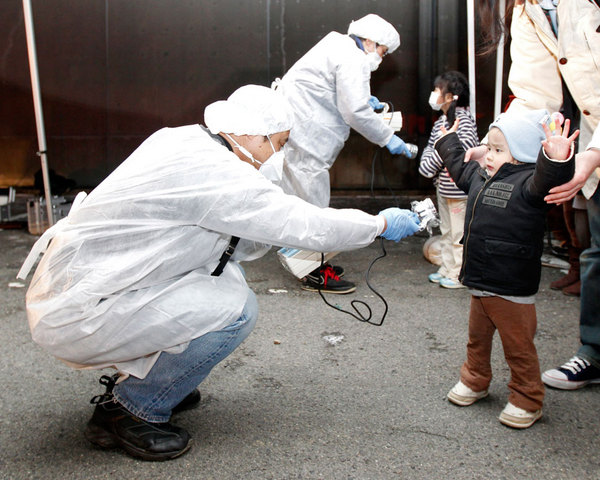
The pictures shows officials in protective gear checking for
signs of radiation on children who are from the evacuation area near the
Fukushima Daini nuclear plant in Koriyama.
Japanese Chief Cabinet Secretary Yukio Edano confirmed on
Saturday there has been an explosion and radiation leakage at Tokyo Electric
Power Co's (TEPCO) Fukushima Daiichi nuclear power plant.
Early reports are that radiation levels receded after the explosion, and
that a worse disaster may have been averted. Still, the incident is being
described as the most significant nuclear disaster since Three Mile Island
or Chernobyl, in global impact.
The biggest earthquake to hit Japan on record struck the
northeast coast on Friday, triggering a 10-meter (33-foot) high tsunami that
swept away everything in its path, including houses, ships, cars and farm
buildings on fire. an explosion blew the roof off of a building and
destroyed the outer walls of a reactor. Officials have expanded the
evacuation radius around the plant to a 12 mile radius, and are distributing
iodine to populations nearby, to help offset possible radiation poisoning.
An
explanation of the
nuclear issue from the BBC.
Japanese PM Naoto
Kan said today: "This earthquake and tsunami and also the situation
concerning the nuclear power stations are perhaps the hardest hardship that
we have experienced after World War Two, within these fifty years. Whether
we as Japanese people can overcome these hardships, that is dependent on
each of us as Japanese citizens."
The true scale of
the disaster remains unclear - it is simply that big and that chaotic.
Japan is a rich,
high-tech nation with much regular experience of both seismic rumblings and
serious earthquakes, such as Kobe. Those factors have led it to plan, and
plan well, for disaster, with billions spent over the years on developing
and deploying technologies to limit the damage from tremors and tsunamis.
Those steps almost certainly kept the death count lower than it might
otherwise be — especially in comparison with the multitudes lost in recent
earthquakes in China and Haiti. Last Friday#s earthquake and tsunami,
however, showed the limits of what even the best preparation can do. The US
west coast, which has anticipated "the big one" for decades will need to
consider whether their preparations are sufficient. The scale of damage and
destruction in Japan is terrifying.
The
BBC has continuing live updates. How quickly we can go from have to have
not.
Missed
opportunity in Chiang Mai
13 March 2011
Last night the
skies over Chiang Mai’s River Ping were lit up by the Asahi Super Dry
Musical Fireworks festival. The show is one of the largest fireworks
displays in Thailand.
For the Asahi Brewery the event is meant to celebrate the long cultural
relationships between Thailand and Japan.
As well as the
fireworks there was music, a street market and food and product stalls.
The event went
ahead as planned despite the Japan earthquake the previous day.
Did the
commentator even mention the quake or offer condolences - no.
This would have
been a great opportunity to put collection boxes at either end of Narawat
bridge to collect for disaster relief. But this was not done.
It always seems so
hard for Thais to think on their feet; to change plans; to react to changing
circumstances.
A missed
opportunity and a sorry failure to express our sadness at events in Japan.
On Monday morning
the Chiang Mai authorities did get back to work;
Chiang Mai's local authorities have also set up a centre to solicit
donations from locals for affected Japanese.
Boonlert Buranupakorn, chairman of Chiang Mai's Provincial Administration
Organisation said that relations between Japan and Chiang Mai date back many
years with the two countries cooperating on many aspects including education
and culture.
There are about 3,000 Japanese living in Chiang Mai.
Update from Dubai Airports
9 March 2011
Paul Griffiths the CEO of Dubai Airports was on Dubai Eye
103.8 this morning explaining why Dubai Airports has delayed passenger
flights to Al Maktoum International Dubai World Central) until 2012.
Current passenger numbers at DXB are 47 million.
Over 4 million passengers a month use DXB at present; a total
of 52 million passengers are expected this year. 55% to 60% is transit
traffic demanding easy connections. And which means (especially for EK)
access to arrival and departure times that fit their hub business model.
Capacity, when the new concourse at T3 is complete by the end
of 2012 will be 75 million. Dubai Airports expects to get capacity to 90m by
2018 by making other changes within the limited capacity of the airport.
But there are other constraints such as airspace. And this is
being addressed at a federal level.
Dubai's two runways are another constraint although Griffiths
did not mention this. Airplanes cannot take off and land at the same time on
the parallel runways as they are too close to eachother. This also limits
the number of possible flight movements.
Griffiths said that it would be very hard to move passenger
airlines incrementally to the new airport. Airlines will only move once the
new airport infrastructure is in place. He did seem certain that Emirates
will move - ending rumours that EK would stay at the old airport and other
airlines be forced to move to DWC.
He added that everyone will move when Emirates moves. And
Emirates will not move until the new airport is big enough and ready to go -
and ready to go all at once. And that will not be until the mid 2020s.
In summary it is more cost effective to generate more
capacity at the existing airport using existing assets said Griffiths.
When the move does eventually happen the old airport could
then be a regional or LCC airport. No decision has yet been taken.
For now the new airport - DWC - is very much a freighter only
business. Dubai Airports has
started negotiations with some passenger airlines to move to
DWC but none have committed yet. The intent is to open for passenger flights
in 2012 but there is no confirmed date yet. "No one really wants to be
first, that is the problem" he said.
There are about 22 cargo airlines operating to DWC at the
moment - with approximately 100 cargo movements a month. So there is lots of
space available.
A few other details from the interview:
The whole airport site at DWC is 148 square kilometres.
Dubai Airports are part of the Dubai Department of Finance
and do not disclose financial and debt numbers.
You can now fly from Dubai to 220 destinations - it was only
110 five years ago.
A
link to the podcast is here.
EK scheduling update
9 March 2011
One thing that Emirates appears to do well is responding
quite quickly to market conditions; which appear to drive the following
changes to the 2011/12 operating plan
The spike in oil prices and unrest in the Middle East has resulted in a
re-allocation in capacity across the network. The focus remains on
maintaining profitability. Additional new destination launches are expected
but one or two could be deferred and capacity used to further bolster
frequencies on existing routes. Details of the latest update to the 2011/12
operating plan below: the second daily to Cape Town will be welcome
addition. Although the operating crew are not going to enjoy the timing.
Effective immediately
EK927/928 DXB-CAI-DXB suspended indefinitely
EK745/746 DXB-TIP-DXB suspended indefinitely
Effective 27 March 2011
2nd Daily introduced to Cape Town (CPT), operated by A340-500 (3-class).
As a result CPT frequency increases to 14x weekly.
EK772 DEP DXB 0350 ARR CPT 1140
EK773 DEP CPT 1340 ARR DXB 0115
EK961/962 DXB-SAH-DXB reduced from Daily to 6x weekly. Flight now operates
Daily ex-Fri using A330-200 (3-class).
EK747/748 DXB-TUN-DXB reduced from 5x weekly to 3x weekly. Flight now
operates Wed, Fri, Sun using A330-200 (3-class).
Effective 28 March 2011
EK125/126 DXB-VIE-DXB will now be introduced with 6x weekly frequency
instead of 4x weekly. Flights operate Daily ex-Thu using A340-500 (3-class).
VIE frequency increases to 13x weekly.
EK705/706 DXB-SEZ-DXB upgrades from from 5x weekly to 6x weekly. Flights
operate Daily ex-Sat.
EK707/708 DXB-SEZ-DXB frequency increases from 2x weekly to 5x weekly.
Flights operate Daily ex-Tue and Sun. SEZ frequency increases to 11x weekly.
Effective 1 April 2011
EK911/913 DXB-DAM-DXB reduced from Daily to 6x weekly. Flight now operates
Daily ex-Thu using various aircraft types. DAM frequency decreases to 13x
weekly.
Effective 1 May 2011
3rd Daily introduced to Manchester (MAN), operated by A330-200 (3-class).
As a result MAN frequency increases to 21x weekly.
EK021 DEP DXB 0300 ARR MAN 0755
EK022 DEP MAN 0940 ARR DXB 2000
Effective 3 September 2011
EK705/706 DXB-SEZ-DXB frequency increases from 6x weekly to Daily. SEZ
increases to 12x weekly.
Effective 28 October 2011
EK797/798 DXB-DKR-DXB will only now increase to 6x weekly from 5x weekly
(instead of planned upgrade to Daily). Flight will operate Daily ex-Thu
using A330-200 (3-class)
Effective 30 October 2011
EK707/708 DXB-SEZ-DXB frequency increases from 5x weekly to Daily. As a
result SEZ increases to 14x weekly. All SEZ flights operated by A340-500
except EK707/708 on Tue which operates with A330-200 (3-class).
The fight for Libya
8 March 2011
Sky News appears to have an exclusive from Zawiyah in the
west of Libya. A reporter - Alex Crawford - and her crew were caught in the
city for three days as pro-Gaddafi forces tried to recapture the city. No
other foreign journalists were there.
Zariyah is being wiped off the face of the earth", one man is
saying.
By modern TV news standards this is fairly graphic reporting
of dead and injured; of heavy gunfire and artillery, of people in pain and
in fear. The rebels tell Alex Crawford that they control the whole of the
city. But they don't control the airforce and Gaddafi has been bombing his
own people.
Residents described a hail of bullets, with women and children being killed
and families trapped within their homes. Today there are reports of up to 50
tanks together with air strikes on residents and protestors.
People may not want to call this a civil war; but that is
what it is rapidly becoming. The attacks on Zariyah imply a disturbing
escalation in the developing civil war in Libya, suggesting that the regime
has now decided to pursue a no-holds barred strategy to crush the rebellion,
despite the growing threats of international action.
The city is littered with war wreckage. The internet has been
cut. The land and mobile phone networks disabled.
The GCC countries called on Monday for a no-fly zone to protect the Libyan
people. Britain and France are stepping up their efforts to put this in
place. A UN resolution is being drafted to be debated by NATO defense
ministers on Thursday. Why does this take so long. As Bob Geldof once said -
people are f***ing dieing.
The GCC was unequivocal; addressing the meeting, Abdul Rahman Al Attiyah,
secretary-general, said the killing of innocent people is a crime against
humanity.
"Massacres committed by the regime against their own citizens are crimes
against humanity that require condemnation, especially the use of
mercenaries and heavy artillery," he said.
The six Gulf Arab states' support for a no-fly zone over Libya on Monday is
an important milestone. It is a call for military intervention in the North
African nation. Delays by Russia and China will only prolong the agony and
the heavy toll on the Libyan population.
"The Gulf Cooperation Council demands that the UN Security Council take all
necessary measures to protect civilians, including enforcing a no-fly zone
over Libya," the six-nation bloc said in a statement. This was the "cover"
or the "frame" that the US, the UK and France needed in order to proceed.
Now, it is time to act.
Note that word - DEMANDS. These are the Middle east allies of
the western nations calling for help.
These are unprecedented statements in unprecedented times.
United Arab Emirates Foreign Minister Sheikh Abdullah bin Zayed al-Nahayan
told a GCC foreign ministers' meeting in Abu Dhabi "We call on the
international community, especially the UN Security Council, to face their
responsibilities in helping the dear people."
But will the UN do the right thing; Russian Foreign Minister
Sergei Lavrov said "The Libyans must resolve their problems themselves,"
signaling Russian opposition. The Chinese are similarly cautious. In part
because they have so heavily censored coverage of events in Libya out of a
paranoia for similar action in China.
The UN may be counting on a Turkish component in the
operation of imposing the no-fly zone. Egypt is mentioned as a potential
lead Arab country in the operation. The GCC countries are encouraged to
provide money and weapons to the anti-government fighters.
One writer put it this way : "The West's refusal to come to the aid of
Libya's lightly-armed freedom fighters as they face planes, tanks, and heavy
weapons may turn the Libyan civil war into the first great betrayal of the
21st century, reminiscent of many that stained the last century...If the
butchers of Tripoli succeed in putting down this popular uprising, they will
establish a model that other of the region's most harsh despots will
emulate."
Hillary Clinton has said tonight that a no-fly zone has to be
enforced by the United Nations and would not be led by the USA. Spineless.
This crisis will not wait. If Qaddafi wins he
will go on killing and torturing for a very long time.
The US has responsibilities that come with super power status. If the world
is helping, the US cannot be exempted or excused.
Message to the UN. People are dieing - you have been asked to
do something about it. So do it.
Emirates Airline to hire another 4,000 cabin crew
8 March 2011
Emirates Airline currently has 12,000 cabin crew and announced yesterday
that it will need several thousand more as it adds aircraft to its fleet.
The airline's record order for the Airbus A380 is prompting it to embark on
an ambitious hiring drive across six continents. Although it is not just
about the A380 - there are a significant number of 777s and A350s on order.
For each A380 that enters its fleet the airline needs 20 pilots and 133
cabin crew, Emirates said yesterday.
With three more A380s expected in 2011as well as deliveries from Boeing for
other large passenger aircraft, Emirates expects to hire about 4,000 cabin
attendants, it said.
The airline currently has 12,000 cabin crew, including 2,000 who operate on
its fleet of 15 A380s. Emirates has another 75 orders for the big bird.
"It took us 25 years to get to 40,000 employees, but in the next 10 years we
will double that to 80,000," an Emirates official said last year. I suspect
it will not be quite that fast; the recession has slowed down deliveries;
the A350 is still a paper plane and oil prices are on the rise again which
may slow down the growth in travel.
Emirates' cabin crew workforce comprises 131 nationalities, speaking more
than 80 different languages. The airline has 152 aircraft in its fleet.
Carrying about 85,000 passengers a day, Emirates now flies to 111
destinations (including freight only destinations) in 66 countries.
China dragon grows in the UAE
8 March 2011 Reuters
A behemoth dragon-shaped shopping mall in the desert near Dubai has become a
symbol of the deepening links between East Asia and the Middle East.
Dragon Mart - 3,950 wholesale and retail shops, stretching 1.2 km, or about
three-quarters of a mile, in a sinuous strip alongside a desert highway - is
China's trade outpost in the Gulf, selling everything from marble tiles and
artificial hair extensions to dried fish and Mickey Mouse telephones.
"I come here with my wife and four children every second week, it's much
cheaper and it is a great shopping experience," Souhail Al Zaabi, a
policeman from Ras Al Khaimah, said recently. "Today, we are buying a
chandelier for our majlis," he added, referring to the traditional Arab
sitting room, "not too big, but like crystals it must look".
Farther along the mall, Chinese massage machines were selling briskly."I
have already bought three tools," said Ali Abdulkader, a 65-year-old
customer, also from Ras Al Khaimah, shopping at a Body Care health and
fitness outlet. "They are good for my body. I have a massage belt, a massage
hammer, and a massage chair installed in my car. It's cheap stuff, cheap."
The Elite Sauna Belt, to reduce fat and decrease joint stiffness, costs
AED50, or about $13.50, including a remote control. A Magic Hand massage
hammer, usually priced at AED150, was on sale for AED45. Similar European
models cost four times as much.
Trolleys loaded with children's bicycles and fluorescent lights were parked
at the cashier desk of the Suntour restaurant, where the smell of stir fried
vegetables and black bean sauce filled the air.
If it weren't for the veiled women and men in Arab garb, this could be a
corridor in any of China's factory cities, crammed with merchandise and the
cacophony of electric toys.
Inaugurated in 2004, Dragon Mart, a retail property division of the Dubai
government's investment vehicle Dubai World, is one of the largest trading
centres for Chinese products in the world outside China. According to the
Federal Customs Authority of the UAE, non-oil trade between the Emirates and
China reached around AED42.6bn in the first ten months of 2010, up 3.4
percent from the same period in 2009.
There are almost 200,000 Chinese residents and more than 3,000 companies in
the emirates, according to the Chinese Consulate. That compares with an
estimated total population in the Emirates of about five million.
"The Chinese economy is resource hungry, and there is a need to access Gulf
markets," said Mark McFarland, emerging markets economist at Emirates NBD in
Dubai, who had previously worked in Hong Kong. "The commerce with China is a
symbol of its rise as an economic power."
"China has been at the forefront of free-trade agreements with the UAE,
which is of great benefit to both countries," he said. "Dubai is becoming a
regional hub for a lot of Chinese operations that are setting up in the
region, but also develop businesses in Africa."
The Dragon is a Chinese symbol of power and strength, and the mall aptly
symbolises the growing strength of China's presence in the emirates, where a
growing number of Chinese businesses have set up operations and store signs
in Chinese intermingle with those in Arabic.
Some Emiratis have chosen to send their children to a Chinese school,
believing that knowledge of both Arabic and Chinese will be a key to success
in the coming decades.
Hamid Kazim, an Emirati business consultant, has sent four of his five
children to a Chinese school in Dubai, where they sit on bright green and
yellow stools - most likely bought at Dragon Mart - alongside Chinese, Malay
and Brazilian children.
"I am an admirer of China. It's quite important for children to be skilled
in different areas," Kazim said.
Chinese residents, meanwhile, are picking up Arabic. "The Chinese ambassador
and the Chinese consul both speak very well Arabic," said Hamdan Mohamed,
president of the Arab Business Club in Dubai.
"We have a big Chinese community in the UAE... To enter this community you
have to speak their language."
A natural global hub for long-distance flights between Asia, Europe and
Africa, "Dubai is a great location which reflects this," McFarland of
Emirates NBD said. "A lot of the companies here are construction and
manufacturing-oriented. You can envision a big increase in trade between the
UAE and China."
Another Dubai property woes story
7 March 2011
The Daily Telegraph
"A few years ago, when foreigners were first allowed to purchase property in
Dubai and developers were falling over themselves to sell residential
communities, it was hard for potential buyers to know which off-plan
developments would make good investments and which would not. On paper, they
all promised a luxurious, enviable lifestyle. Back then, not a single
developer had a track record. Investors were, effectively, buying into the
unknown.
And, for many, the risk was one worth taking. Many developments turned out
well, attracting families and professionals with well-planned facilities,
parks and pretty landscaping. Yet, while others were plagued with irritating
problems, no-one could have predicted what’s happened to Nakheel’s
pioneering concept of International City.
Located in a fairly isolated area a long way from the city, International
City was originally described as: “A cosmopolitan community of over 75
nationalities that provides an affordable and convenient living experience
in a city where neighbours are quick to say hello.” Competitively priced
even at a time when many were finding Dubai unaffordable, it quickly filled
with young families and professionals who couldn’t afford the sky-high rents
of the more central areas.
In the past three years, however, things have changed drastically for
International City. As rents have plummeted across Dubai, the development’s
seen an influx of “bachelors” – men who work in Dubai but who are paid too
little to be able to be able to bring over their wives and children. Often
trying to survive on salaries as little as Dhs 1,500 (£250) a month, they’re
forced into sharing accommodation because they have no other option.
While owners and legitimate tenants complain of up to eight men staying in a
studio or one-bedroom apartment, a quick property search turns up a slew of
ads offering “bed spaces” (a space on the floor) for bachelors (“Indians” or
“Keralites preferred”) costing just Dhs 500 (£84) a month including bills.
Locals have dubbed the area “Slum City” or “Bachelor City”.
Aside from overcrowding, knock-on problems from this huge population of
bachelors include complaints from families of staring, harassment,
whistling, loitering and littering; common areas blocked by lorries;
overflowing sewage; the establishment of a number of brothels; an increase
in associated crime including violence such as stabbings, machete and sword
attacks; and reports of gang wars leading to communal areas smeared with
blood.
It’s an environment that’s not only shocking for a place with such a low
crime rate as Dubai, but one that’s as far from the “harmony” and
“like-mindedness” that the developer claimed would make International City
into “a great place to call home.”
Nakheel says it’s taking the situation seriously, “working with authorities
to preserve the enclave from degenerating into a virtual labour camp.” And,
while this is good news for those who invested in a home in International
City, it doesn’t solve the problem for the bachelors, who’re seen as a
security risk and either banned from living in or priced out of almost every
other area in Dubai."
Obnoxious Brits
7 March 2011
The Brits can be an obnoxious people and they have a bad
habit of taking some of their worst behaviour overseas, including to Dubai.
The Dubai Equestrian and Polo Club is inevitably elitist.
They are hosting an event on 29 April for the Prince William and Kate
Middleton wedding. Now there is no way that I would ever go to that. But
many will - the problem is when they take their helper to look after the
family: read this:
Cost:
AED 450 per person including buffet and unlimited house drinks
AED 300 per person including buffet and unlimited soft drinks
AED 100 per child aged 6-12
Free for children under six years old
Entry for maids is AED 100 (including children’s buffet and non-alcoholic
drinks) when accompanying their sponsor family, or free entry without
refreshments
The guests will be able to watch Wills and Kate get hitched on the big
screen whilst enjoying a lavish all-you-can-eat buffet packed with British
culinary delights. Meanwhile their poor helper can only eat from the
children's buffet and has to amuse the offspring.
You will also be able to buy wedding memorabilia and watch polo, described
on the advert as one of the world’s most elite ("sic") and exciting sports.
Rule Britannia! For me the revolution cannot come soon enough.
So many of the reasons why I left the UK 23 years ago wrapped
up in a single event.
UK and Libya: Fumbling in the desert
7 March 2011
The Guardian
"David Cameron is not having a good Arab revolution. He was
the first world leader to visit Egypt and Tahrir Square after the overthrow
of Hosni Mubarak, which is good. But on the same Middle Eastern tour he took
with him eight defence firms peddling military equipment, which is to
misjudge the nature of events in the region badly. The roles of prime
minister and international sales director for UK plc are different, as Mr
Cameron is fast learning. Then came his comments about a no-fly zone over
Libya, which were initially greeted with less than the customary enthusiasm
by people – such as the US defence secretary, Robert Gates – who know what
the tactic entails: a bombing campaign to knock out Colonel Gaddafi's air
defences. The old foreign affairs hand John Kerry, the chairman of the
senate foreign relations committee, said yesterday that the US and its
allies should prepare for a no-fly zone, but that this could not go into
operation without international backing.
And now there is another fiasco which highlights this government's fumbling
in the desert. Hardly had news come out that Britain was to send experts
into eastern Libya, to give military advice and make contact with opposition
leaders, than it emerged that a British intelligence and special forces unit
had been caught by the opposition with espionage equipment, multiple
passports and weapons. As a senior member of Benghazi's revolutionary
council told this newspaper: "This is no way to conduct yourself during an
uprising." Once again Britain has misjudged the nature of what is unfolding
in Libya. The mission came James Bond-style by helicopter and left more
conventionally by ship.
With battles raging in Zawiyah, Misrata and Bin Jawad yesterday, and with
more columns of armour loyal to Gaddafi heading out from Tripoli, the
military balance is fluid. Some Libyan rebels have called for a no-fly zone,
but until now – and this may change – the mood of the Libyan uprising is
that this is their fight and their fight alone. Quite apart from the
unwarranted legitimacy a bombing campaign would (once again) confer on the
Libyan leader among his rump support in Tripoli and the damage it would do
to attempts to split his camp, a major western military intervention could
have unforeseen political consequences for the very forces it would be
designed to support. A no-fly zone saved lives in Kurdish northern Iraq, but
failed to protect the Shias in the south under Saddam Hussein. The moral
strength of the Libyan rebels and their political claim to represent the
true voice of the people both rest partly on the fact that, like the
Egyptians and the Tunisians, they have come this far alone. The revolt is
theirs, they are no one else's proxy, and the struggle is about ending
tyranny rather than searching for new masters. Even if Gaddafi's forces
succeed in checking the advance of rebel forces, and the civil war becomes
protracted, it is the home-grown nature of this revolt that contains the
ultimate seeds of the destruction of Gaddafi's regime. Thus far, it is
Gaddafi and his sons who have had to import hired guns from abroad.
In Egypt, events are happening which in the long run are just as important
as the battles taking place in Libya. The revolution is deepening. It has
succeeded in ousting first Mubarak, then the prime minister appointed as a
transition figure, and installing one of their own, Ahmed Shafiq, to the
post. The ruling military council yesterday replaced the ministers of the
interior, foreign affairs and justice. The reform of the interior ministry's
hated security services was one of the major demands of the protesters, and
the release of their secret files will be just as important as the Stasi
files were in the dismantling of that organisation. The revolution in Tahrir
Square may now have reached a point of no return, where it can not be
undone. This is a real achievement which will empower a new generation of
Arabs. This, too, requires western recognition and support."
Another delay for Dubai's new airport
6 March 2011
In the biggest none surprise of the year to date the chief
executive of Dubai Airports has confirmed to Reuters that the opening of the
(very limited - low cost and no air bridges) passenger terminal at Dubai’s
new airport will be further delayed until 2012.
Paul Griffiths told Reuters on Sunday that the Al Maktoum
airport will become a scheduled passenger and cargo airport during 2012.
Interesting - he no longer says quarter one or two etc. It is now sometime
in 2012. Which means late 2012 until the date slips again.
The opening of the Al Maktoum airport to passenger flights had been already
delayed to the last quarter of 2011 from March.
Passenger numbers at th existing Dubai International Airport jumped by 10
percent to 4.25 million in January from a year ago. February figures are not
yet available.
The traffic rose 15 percent last year, helped by global economic recovery,
and was seen expanding 11 percent in 2011, Dubai Airports have said.
Asked how much the airport and its associated industries would contribute to
Dubai’s gross domestic product in 2011, Griffiths said: “We believe the
number will be between 20 and 25 percent … 98 percent of all visitor
arrivals to Dubai are by air. The contribution towards GDP is significant.”
TV's surprising and messy grey morality show
4 March 2011 from
Hitfix.com
"There’s a growing schism in the TV business between the kinds of dramas you
find on cable and those that the broadcast networks air. For the most part,
cable is where you go for complicated ongoing narratives, flawed characters
and major creative ambition, while you primarily look to the networks for
admirable heroes in morally black-and-white stories that wrap up neatly by
the end of the hour.
But for more than a season and a half now, CBS’ “The Good Wife” has
admirably found a way to bridge those two worlds: to present elaborate story
arcs and moral ambiguity by the barrelful at the same time it offers at
least one standalone plot per week for the folks who want to turn on the TV
at 10 o’clock and turn it off at 11 feeling like they were just told a
complete story.
Tonight’s episode is a great example of just how many balls “The Good Wife”
is capable of juggling in a single hour, as we get a climax to the ongoing
war for control of the Lockhart/ Gardner & Bond firm, a major development in
the campaign for State’s Attorney, important personal and professional
changes for firm private investigator Kalinda (Archie Panjabi), and another
case spinning out of “Good Wife” co-creator Robert King’s fascination with
social media.
(Despite having an audience predominantly composed of viewers over 50, “The
Good Wife” prides itself on staying abreast of how Twitter, Facebook,
YouTube, etc. are shaping our daily conversations. Occasionally, the show
tries too hard on that score, like a clunky recent ripped-from-the-headlines
episode inspired by controversy over the factuality of “The Social Network,”
but the effort’s there, and the show has a better overall command of
technology than a lot of shows that are more youthful and allegedly cutting
edge.)
That is a lot to deal with in an hour of television (minus commercials), and
yet none of the stories feel rushed or shoehorned in. In the case of the law
firm and election arcs, these are payoffs that have been months in the
making, and the law firm story in particular feels well worth all the time
they’ve put into it so far.
But what’s most compelling isn’t so much the amount of material, but the
depth of it. The show deals smartly and candidly with issues of power, how
business really gets done in our legal and political systems, and the
trade-offs we all make just to get through the day.
In one key scene in tonight’s episode, our titular good wife Alicia Florrick
(Julianna Margulies) confronts boss, mentor and potential love interest(*)
Will Gardner (Josh Charles) when she believes they’re pursuing their new
case for the wrong reason.
(*) The slow-burning attraction between the two of them has been one of the
show's weaker elements - dragged out with some of the usual
will-they-or-won't-they tricks - and it helps this episode that it doesn't
deal with it at all.
“Who do you know is doing something for the right reason?” Will demands. “I
would love to meet them, because my guess is after five minutes of
questioning, we’ll find the wrong reason.”
Will is not the obvious villain in the scene, nor Alicia the obvious hero,
as he also points out that she should understand this sort of situation more
clearly after all they’ve been through over the last year. It’s the kind of
messy, grey morality that most network shows these days are afraid to even
touch, yet “The Good Wife” deals with it constantly.
The series is such a rarity in today’s network landscape, in fact, that
there seems to be a land rush of talented, recognizable, underemployed
character actors to guest on the show early and often rather than play
another suspect or grieving parent on one of the “CSI” or “NCIS” shows.
Every episode is overflowing with Hey, It’s That Guy!s, from recurring
players like Michael J. Fox (an unscrupulous lawyer who uses his medical
condition to win sympathy with judges, juries and potential clients) and
Gary Cole (as a ballistic expert with ties to the Tea Party and the keys to
the heart of Christine Baranski’s otherwise-icy Diane Lockhart) to more
infrequent guests. Tonight’s episode alone features Ken Leung (Miles from
“Lost”) as Alicia’s client, Rita Wilson as opposing counsel, John Benjamin
Hickey from “The Big C” as her client and Jerry Adler (Hesh from “The
Sopranos”) as an elderly partner in the firm, on top of the familiar players
from the firm and the various campaigns.
Though Chris Noth is still around as Alicia’s husband Peter (around whom the
entire election arc revolves), “The Good Wife” has for the most part
transcended its title, which did a good job selling what the pilot episode
was about but not what the series has become. (In that way, it’s the
opposite of “Terriers,” where the title did a horrible job attracting
potential viewers but made sense to those who watched it.) Robert King
recently joked that if he wanted the show to draw more younger viewers, they
would rename it “The Sexy Wife.”
Regardless of what it’s called, though, it’s awfully good, and tonight’s
episode neatly captures all the things that make it so.
Will Dubai weather the storm?
4 March 2011 -
The Financial Times
!The global financial crisis was bad enough for
Dubai, with its real estate exposure and heavy debt burden. The regional
political crisis is proving equally troubling.
Dubai’s stock market fell another 1.6 per cent on Thursday, ending the week
at seven-year lows amid growing turmoil in the Arab world. The index has
fallen 16 per cent since unrest reached the oil-rich Gulf two-and-a-half
weeks ago. But Dubai has a history of coming out of crises relatively
unscathed.
In fact, problems for its neighbours prove to be a boon for the
outward-looking emirate. Certainly, Dubai is unlikely to face protests of
any significance.
Deep unease among western investors about the potential for widespread
political upheaval is leading the sell-off in regional markets. Local
investors are also playing their fair share in volatility, reallocating
portfolios elsewhere, bankers say.
Since Bahrain’s day of rage on February 14 plunged the kingdom into its
ongoing political crisis marked by Sunni-Shia tensions, regional markets
have been in free fall.
Saudi Arabia’s main Saudi Tadawul All-Share Index alone has been down almost
20 per cent since the day of protest. International investors are watching
the oil-rich kingdom closely for any signs of unrest creeping across the
border into the eastern province, home to both large oil reserves and a
significant Shia population.
In Oman, which has also seen violent protests in the port of Sohar, the main
Muscat 30 index has shed 9.3 per cent, while Bahrain’s BB All-Share index
6.3 per cent.
“If we see locals pulling their money out, what on earth are we to think
about the situation” says one international investor.
Yet as markets across the region are suffering, some sectors of Dubai’s
economy are actually beginning to benefit from the regional turmoil.
The city’s financial centre believes that it could receive a boost in the
number of entrants to its tax-free, independently regulated centre. And
tourism that would have once gone to Egypt, Tunisia or Bahrain is diverting
to the emirate’s beach resorts and city hotels.
The city has lured those fleeing conflict elsewhere, from the Iran-Iraq war
to the Afghanistan conflict.
But the Arab spring looks to be a different dynamic from crises of past, and
questions over the future of the region are so profound that investors will
find it difficult to come up with clear views on how the Middle East will
play out.
Dubai will be in a good position to rebound once some clarity emerges.
But we aren’t there yet."
Emirates airline sued over passenger death
4 March 2011
How much is an airline crew expected to be able to do to save
a heart attack victim on a flight. That is the question being raised in a US
court.
It would be a US court. I can see a similar case in a TV show
soon.
Fact: Carol Wilson, aged 70, suffered a heart attack while
flying from Dubai to her home in Houston, US, in April last year with her
son Shawn Carriker.
No in court her family alleges that the flight crew failed to provide
adequate medical assistance in the crucial moments following Ms Wilson's
heart attack.
Wilson's daughter argues that her mother had visited the restroom shortly
before the plane's landing but failed to return. A flight attendant called
Mr Carriker over to knock on the door, but there was no response.
Her son says that he attempted to move his mother out of the bathroom but
struggled as she was "dead weight". Eventually a male flight attendant
helped move her onto the floor in the middle of the aisle and handed Mr
Carriker an oxygen mask, but allegedly did not assist in putting it on.
The family claims that the crew did not perform CPR, did not announce a
medical emergency and that no defibrillators - which the airline states it
has on its planes - were brought out.
Still unconscious, the crew moved Ms Wilson to a jump seat and strapped her
in for landing.
The horror didn't end there for the family - after touching down the crew
allegedly let all the other passenger off the plane first before letting
paramedics on board. Paramedics performed CPR and Ms Wilson was taken to a
local hospital, where she was pronounced dead.
Lawyer Kerry Guidry has filed a lawsuit on behalf of the family at US
District Court in Texas, with a court date set for September 19.
"There's policies and procedures in place when a medical emergency arises
and Emirates failed to follow those policies and procedures and that
contributed to Carol's death," Mr Guidry said.
"She suffered cardiac arrest. The first seven to 10 minutes are critical in
cardiac arrest, and they (Emirates) did nothing, and that's what we believe
led to her death."
He said that all air passengers should be concerned about this case.
"We put our lives in (the crew's) hands when we're in planes and they're
supposed to be professional and know what to do," Guidry says.
Emirates denies the allegations and says that the investigation into the
incident is ongoing.
Now that last comment does no favours to Emirates; the
incident was 11 months ago. You dont need 11 months to investigate an
incident such as this.
Now all crew do have their annual SEP training. But to be
honest how many know how to respond in a real emergency. Did the son allow
the crew to do their job. Were the crew distracted by the work that has to
be done prior to landing? Was the pilot informed. Did he alert ground
services to the passenger emergency so that medical attention would be
immediately available.
Lots of questions; and maybe a need to reinforce some of
these messages in all crew training.
Suvarnabhumi: a bad experience for
travellers
2 March 2011
The Nation Editorial
The Nation has a rant in today's editorial;
but honestly - there are many that are worse - including most large European
and US airports. Anyone been to Heathrow or Gatwick and queued as a
foreigner at immigration; both are disgraceful.
The airside food prices are silly. But there are plenty of shops and places
to eat landside on the mezzanine level between arrivals and departures.
The biggest problem with the airport is
that the official who run it fail to listen to the people that use it. The
meet and greet in arrivals is simply daft. And the taxi problems are
legendary and easily solved. Anyway here is the editorial:
_______________________
"Bangkok's 'showpiece' airport is still beset by ongoing problems, from long
queues to taxi scams to overpriced food. Will it ever change?
It was supposed to be the nation's pride and joy, a grand first impression
for foreign visitors. But ever since Bangkok's Suvarnabhumi International
Airport came into existence, it has been plagued with problems.
First, there weren't enough toilets. Then came reports about cracked
runways. Later it was occupied for weeks by anti-government yellow-shirt
demonstrators - a move that brought regional transportation to its knees.
Today, the airport is still beset by problems. The "Tweeple", in their
"tweets" to Nation Group editor-in-chief Suthichai Yoon, have made their
voices heard, and we at The Nation thank them for speaking out. If anyone
doubts their words, then one should visit the airport and take a look
around.
Take the situation with taxis, for example - a problem which, it seems, will
never go away. Not only has the pick-up point been moved up and down several
times, the drivers still have yet to find any common ground with the airport
authorities, or the passengers for that matter.
Quite simply, wouldn't it be plain common sense to place the pickup point on
the arrival floor - like all other international airports do?
Some meter-taxis continue to refuse passengers who, legally, want to pay by
the meter. For some passengers the only option is to hire a vehicle at an
inflated price or resort to the still inadequate public transport services.
Why put on a meter in the first place if the driver is going to overcharge
passengers with luggage. Besides this, it seems that the only destinations
they know are the five-star hotels in Bangkok or Pattaya. Another option is
to hail a cab that drops off passengers on the departure floor. But then
these drivers only want to pick up foreigners on their way to Pattaya. And
let's not forget the speeding cars that pay no heed to the pedestrian
crossings between the terminals and the car park.
The airport express train was created so that passengers can avoid Bangkok's
notorious traffic, but this lacks convenient access at many stations and is
basically useless for anyone carrying more than one item of luggage.
Once inside the airport, passengers are subjected to slow and outdated
procedures at long immigration lines, where delays of an hour are common.
The security checks are no quicker, unless you are one of the handful of
privileged passengers permitted through the express VIP lane.
Beyond immigration and security, food outlets are outrageously expensive. A
small mineral water costs Bt55 per bottle. How about the authorities putting
a cap on rentals and thus the food price?
Ever since the US got stricter on visas for people from Islamic countries,
many Muslims have chosen Thailand as their choice of destination for
vacations and business. But while there is a prayer room at the airport,
there is no halal food visible in the terminals. There are halal stalls at a
food court in the basement, where fair prices are charged, but how many
people would know about this hideaway place if not for word of mouth.
Many of the "tweets" complain about dirty toilets. Here is a problem that
shouldn't be too hard to solve. If they can charge extortionate prices for
commercial rentals, surely the authorities can hire more cleaners with the
money they are generating. It is doubtful that the cleaning staff get decent
pay. Besides the lack of proper facilities for disabled people, how about
providing diaper-changing facilities for parents travelling with infants?
Luggage handling is another problem. Even with "fragile" signs posted on
them, bags and packages are often damaged. If the baggage-handlers aren't
proficient in simple English, a drawing of a broken glass should be enough.
That should be one of the first things taught in the job orientation.
Security guards are all over the airport but the only thing they seem to be
good at is blocking off certain escalators.
Perhaps it was @Peter_de_Chef who summed up the airport best: "Expensive
food, not enough toilets, long immigration queues, bad-mannered officials,
mafia at the parking lot, crooked taxi-drivers, no free wi-fi, too far to
walk.""
Once again the army shows who runs Thailand
2 March 2011
Get this. The Thai Cabinet has approved more than Bt2 billion
yesterday from a secret budget to establish two new divisions, one of
infantry and one of cavalry, to serve in the North and Northeast regions.
A secret budget. How does a democracy have a secret budget. And if there is
a secret budget cant we use it to educate our people?
Ironically back in the UK the government said Tuesday it
would axe around 11,000 armed forces jobs as part of defence cuts brought in
to help reduce the country's record budget deficit. The size of Britain's
armed forces will be reduced by 17,000 personnel by 2015.
Meanwhile in Thailand lets throw even more money at the Thai
Army; and lets throw even more money at the Thai army in parts of Thailand
where red shirt supporters are dominant and where PM "Mark" Abhisit fears to
go.
The cavalry division of tanks is to be placed in the
Northeastern province of Khon Kaen and will be the unit's third such
division. The infantry division would be placed in Chiang Mai or Chiang Rai
province to support the Third Army Region, the source said.
The ministry will later ask the Cabinet to approve some Bt8 billion to Bt9
billion over the next three years.
It is worth noting how little new spending is targeted at the
south of Thailand where near civil war continues with over 4,000 deaths,
largely among the civilian community which the Thai army appears unable to
protect.
Taxi kills British sailor in Dubai
1 March 2011
A British Royal Navy sailor who helped to combat Somali
piracy in the region was killed in Dubai after being hit by a taxi on
Sunday.
The UK defence ministry said the serviceman had been on duty with HMS
Cornwall, a frigate serving as the command platform for a joint naval
anti-piracy task force.
Dubai Traffic Police said the accident happened at 1am on Sheikh Zayed Road,
close to Mazaya Centre. "The man was hit by a taxi as he was crossing the
road and died at the scene," said an official who declined to be named.
This is a major highway - not a road. By Mazaya Center the
road is some 14 or 15 lanes wide with a barrier in the middle. Trying to run
across this is madness. Part of the problem is that Dubai has so few
pedestrian bridges or underpasses.
Unfortunately the 28 year old Ethiopian driver has been
placed under detention, according to
Emirates 24/7 quoting Dubai's Chief Traffic Prosecutor.
The Prosecutor says that the accident happened at the Defence Roundabout in
the direction of World Trade Centre. Despite the metal fences to prevent
pedestrians fom crossing, the victim crossed over and when he reached the
fast lane the woman ran over him.
No one should be attempting to walk across this road and you
have to feel sorry for any driver in this situation.
Dubai private school fees are frozen again
1 March 2011
This will hurt the private schools in Dubai. They have again
been told they may not raise school fees this year, in the latest of a
series of conflicting decisions by different education authorities.
The Dubai Executive Council yesterday froze fees for the academic year
2011-2012 after a recommendation by the Social Development Committee, one of
the bodies set up in January to streamline decision-making in the emirate.
The freeze contradicts a Ministry of Education ruling last month allowing
some schools to raise fees by 10 per cent a year over three years.
That decision in turn overruled a ban imposed on fee increases last year by
the Knowledge and Human Development Authority (KHDA), which oversees
education in the emirate, on the ground that they were unjustified in a
difficult economic climate. The KHDA has received fee increase requests from
29 schools this year.
Principals trying to improve standards and meet KHDA inspection requirements
said their plans would suffer because of the fee freeze. When the Dubai
Schools Inspection Bureau (DSIB) concluded its first inspections (on behalf
of the KHDA) of the emirate's schools in 2009, it announced that permitted
fee increases would be based on the performance of schools. School that did
well would be entitled to levy a larger increase than those that were just
meeting standards or underperforming.
Last year the KHDA stopped all schools from increasing their
fees, calling it "unjustifiable" given the economic climate.
The messages are confusing; education for Dubai's expatriate
population is of necessity provide by the private sector. Yet the private
sector is highly regulated. And how does a school invest when its fees
are throttled.
Part of the problem that the schools face is that many were
dealing with significant cost increases from 2006 to 2008 but fee increases
were restricted and have never caught up with the higher cost base.
At the same time new schools start with their first three
year fees agreed with the KHDA and with no legacy of rising costs and
throttled fee increases. The incentive is there for new school operators
rather then those that have invested over time.
Relaunching Open Skies
28 February 2011
At last an airline magazine that you should want to take home
with you. Emirates has relaunched its monthly Open Skies magazine and the
relaunch is commendable.
The magazine is also likely to get better as the publishers
gather feedback on this first edition.
There are some teething issues.
Burying the contents page on the 19th page is a problem. Too
much advertising on the first 18 pages.
The Twitter Pitch for cafes in a city is a good idea - but
there must be more than 3 cafes in New York.
At article on shopping for "Booty" in Bangkok is already out
of date - of the seven items two are from Suan Lum which is already closed
down - and two from the airport duty free and no one should ever pay
KingPower prices !
I enjoyed Pico Iyer's artcle and the travel literature
section should be a monthly feature.....
Hanoi photo shoot - great - love the photo feature. More
please !
And sorry - the route maps are different and I dont like
them. I miss thinking about all the other places to fly to not yet on the
network!
But overall it is a great makeover - some real thought has
produced a genuinely interesting, quality airline magazine.