|
A day on the
Yas links
31 January 2012
Yas we can said
Scotland’s Richie Ramsay as he produced an outstanding ten under par 62 over
the Yas Links Golf Cub to win the 2012 Emirates Airline Invitational hosted
by Abdullah Al Naboodah yesterday.
Ramsay topped the field of 50 European Tour players in the pro-am event in
Abu Dhabi, which helps raise money for a number of charities including the
Tour Players Foundation along with Friends of Cancer Patients, the UAE Down
Syndrome Association, the Special Care Centre Abu Dhabi. The Gala dinner
following the Invitational was aiming to raise over$250,000 through a
charity auction.
It was a lovely sunny day for your writer to make his caddying debut on the
European Tour. I was caddying for professional golfer Russell McIntyre who
is based in Portugal. Russell's day did not start well when he cracked his
Taylor Made driver on the first tee. On a long course using the 3 wood off
the tee was great for accuracy but little help for distance. The downside
for Russell yesterday - he really made only one good putt all day; plenty
were close; none would drop.
Ramsay finished
three ahead of Richard Finch and Thorbjorn Olesen (65 was a good score
yesterday) in a field that also included Sergio Garcia and Graeme McDowell,
last year’s champion Retief Goosen – who made a hole-in-one on the eighth –
and Ryder Cup Captains past and present Colin Montgomerie and Jose Maria
Olazabal (who were in the group behind us) in a star line-up.
The other pro in
our group was Tom Lewis, who made such an impact at the 2011 British Open
before turning professional. Tom is still only 21, he is a genuinely nice
guy, was a great partner for his amateur colleague, and is a terrific ball
striker. He eased a 69 yesterday. With a little good fortune, some good
advice, and with a few putts going in, he could become very, very good.
Our two amateurs
were Russell's father - Stewart McIntyre - and Keven LeCocq, a UK based
American, who plays most of his golf at Wentworth. Links for our fourball
are below.
Caddying is tough
- its a long hike with a heavy bag on a warm day. And you do need to pay
attention to the game and to your golfer. Tom Lewis' caddy is the
experienced Irishman, Colin Byrne, very composed and thoughtful; he has won
majors with Retief Goosen and should be a great help to Tom Lewis in his
first full year as a pro.
Colin is my kind
of caddy - asked in 2008 who would be in his dream foursome he replied : the
Dalai Lama, Mahatma Ghandi and Gene Sarazen.
Me - I think my
caddying career may be a once off - though Kevin LeCocq was kind enough to
ask me if I had been a pro caddy before.
It was a very good
day; a top course in lovely condition, and a chance to watch some of the
best golfers from the best vantage point. I even got to chat to Monty and
Jose-Maria Olazabal.
The modern golfers
are very different - they are not necessarily tall; but they are very lean
and have great body turns and swing speed. And their control over ball
distance and flight puts my efforts to shame.
Some links to our
fourball:
Russell McIntyre - Pro golfer at Quinta do Lago. Likes snooker and snakes.
Stewart McIntyre - A Captain of the Super Yacht Industry: Summer 2011
Kevin LeCocq - Head of Global Investment Solutions : Deutsche Bank’s Private
Wealth Management
Tom Lewis
Caddies like Colin Byrne double up as on-course psychologists
Chuck Culpepper The National Jan 25, 2012
Any notion of caddies having cushy jobs is so very last century.
"The more you do it, the longer you spend at the golf course," said Colin
Byrne, the veteran caddie of the 21-year-old English wunderkind Tom Lewis.
"Everyone's looking for an edge, and I think everyone's afraid to leave the
golf course."
One reason: "We're all influenced by what happens around us."
What happens around them nowadays is toil. Twenty years ago, Byrne said,
some players traded on talent; now players trade on moderate talent plus
diligence or considerable talent plus diligence. Even away from the course,
they frequent hotel gyms alongside physios.
Byrne noticed the rigour upgrade with Swedish players in the 1990s (for yet
another case of Swedish excellence).
The caddie's job thus has become "a lot more than the four to five hours on
the course," bloating to more hours of driving ranges and practice rounds,
hunting balance between practice and competition.
The yang might have trumped the yin sometimes, Byrne said, as when Padraig
Harrington, his fellow Irishman, "finally admitted" that in golf's eternal
mystery, he might have won more had he worked less.
Don't picture caddies standing in museums absorbing local culture.
The "old days" - you know, that 20th century - allowed for marginally more
travel glamour and cultural edification, before so many people became so
good that time grew so limited.
"I've come to South Africa," Byrne said from the tournament last week, "and
I've come for work. I'm in a beautiful part of the world. I'm, you know,
close to it, but I'm not really seeing it."
That "sense of being somewhere different" has grown fainter.
Some call them on-course psychologists.
"You know, you kind of get in the back door to a very big arena," said
Byrne, who has written newspaper columns in Ireland.
"You know, because we're not skilled … There's no caddie school, no way to
study it. It's probably something a lot of us have stumbled upon."
Then again, it is a hard to teach -and learn - art.
While discussing the two-time US Open champion Retief Goosen's brutal Sunday
at the 2005 US Open, Byrne said: "Probably the art of caddying is
understanding whom your dealing with, what would motivate him and what
wouldn't motivate him.
"Some people need to be pumped up, and some need quiet words of
encouragement."
"You can say the right thing and the wrong thing, even though it's the same
thing and at the right time," Byrne said, likening it to how saying "Good
morning" can work - or, not.
The job security amounts to …
"There's absolutely no security in the job," Byrne said, "which makes a very
clean case if you're not getting on with the person or you're not doing your
job. There's no contract.
"It keeps people with an eye on the job. It kind of makes you hungry, as
well."
Unlike the slightly raffish days of yore, caddies must be more organised,
more "stable", he said. They outnumber available jobs, so those just hoping
to fill in would be more populous in tournament parking areas had mobile
phones not enabled players in need to locate alternates.
And then, one quirk: "If the economy's doing badly, there are more caddies
out here," Byrne said. "It's not an indicator you'd see in any financial
papers, but it's not a bad one to look at."
But then, that soaring moment …
On a golden Sunday on Long Island, at the 2004 US Open in Shinnecock Hills,
New York, as players bemoaned the barbaric course, Goosen edged Phil
Mickelson even as the American tried to claim the first two majors on offer
that year.
Upshot: Goosen won a road match, with a caddie who has worked for - at least
- Goosen, Greg Turner, Paul Lawrie, Alex Noren, Edoardo Molinari, Lewis.
"Obviously it was a very hostile environment but I think that secretly
helped Retief, because the harder you push him, the better he gets, the more
obnoxious you get, the better he gets," Byrne said.
So: "He holes the final putt to win. Wasn't a fist pump. Was very simple. A
double flip of the cap.
"For him that was probably a big thing, to flip his cap twice as opposed to
doffing it.
"He did a double doff. Just the understatedness of it, that's what I like
about him."
A guy in through the back door stood amid a huge moment that "justified all
the times when you've caddied when you've lost money, or you've got
absolutely no satisfaction out of it." His adjective: "indelible".
Twitter turns evil?
30 January 2012
I was waiting
until I understood Twitter's new censorship policy before commenting on it.
But perhaps the
saddest comment is how quickly both China and Thailand embraced the new
policy. The fact that the new policy has been so rapidly embraced by
countries determined to censor freedom of speech so that the only message
heard is the official message says it all.
Last week, Twitter
announced changes to the way it handles content takedowns. What the company
had announced was that they'd built in the capability to censor content per
country... in response to official requests.
Prior to Twitter’s
announcement, the company had the power to delete tweets, of course, but not
the ability to do so on a country-by-country basis. What’s new, the company
said in a blog post, is “the ability to reactively withhold content from
users in a specific country — while keeping it available in the rest of the
world.” As part of the new policy, Twitter is setting up a new transparency
regime whereby “if and when we are required to withhold a Tweet in a
specific country, we will attempt to let the user know, and we will clearly
mark when the content has been withheld.”
The truth is, Twitter has indeed instituted a method whereby they can - upon
receipt of a "valid and applicable legal request" - take down tweets. The
company also states that they will only respond "reactively"; in other
words, to content that has already been posted. There is a safety feature
built in: Users can change their location if they think the one Twitter has
listed based on their IP address is wrong.
This is censorship, but Twitter isn't above the law. When the company enters
a new jurisdiction, setting up offices and putting employees on the payroll,
it is bound by the laws of that jurisdiction.
It may not be too
much of a change. One day Twitter will be ordered to take something down.
Now they are ready and can do so transparently.
But that has not
stopped the Thai authorities from sensing an opportunity and the Information
and Communication Technology Ministry will work with Twitter to ensure that
tweets disseminated in Thailand are in compliance with local law.
ICT permanent secretary Jeerawan Boonperm said Twitter's move to censor or
block content regarded as offensive in particular countries was a "welcome
development".
The ICT Ministry will contact Twitter shortly to discuss ways in which they
could collaborate, she said. The trouble is that the Thai authorities see
this as am opportunity to clamp down on political views that do not agree
with their own.
Rather bizarrely
Chavarong Limpattamapanee, president of the Thai Journalists Association,
expressed support for the new policy. "Local users must still comply with
local law. Freedom of speech is a human right, but this freedom is not
borderless. One must be responsible," he said.
Thailand has
embraced web censorship. Last year alone the nation asked Facebook to remove
more than 10,000 pages deemed insulting or critical of the Thai royal
family, in violation of Thailand's lese majeste law.
Though there have been no reported arrests relating to Twitter in Thailand,
a number of Thais have been jailed for posting messages on Facebook and the
Internet. There were a number of high profile lese majeste cases last year,
including a 61 year old man who got a 20 year prison sentence for sending
SMS messages and a dual Thai-US citizen who received a two and a half year
prison term for translating a banned book about the king into Thai.
Meanwhile the Chinese have also embraced the new policy. A bit unnecessary
as Twitter is blocked in China anyway. Global Times insisted that "it is
important for it to respect the cultures and ideas of different countries so
as to blend into local environments harmoniously. This is normal practice."
But we should be
concerned. Twitter has been one of a number of tools used to support and
organise the Arab Spring. Of course it was also used in the UK riots last
summer. The risk is that Twitter is depriving cyberdissidents in repressive
countries of a crucial tool for information and organization.
The Twitter view
is that that freedom of expression is interpreted differently from country
to country is unacceptable. Twitter is wrong. Freedom of expression is a
fundamental principle enshrined in the Universal Declaration of Human
Rights.”
Thailand's woes
31 January 2012
The Nation
gleefully reported that Thammasat University Class 01 law graduates
yesterday issued a statement calling for Nitirat academics to suspend their
teaching duties and stop using the university premises to spearhead charter
amendments related to the monarchy.
The graduates include several legal professionals and leading figures like
former prime minister Chuan Leekpai.
"Class 01 graduates deem it inappropriate to use the university's premises
to stage offensive activities against the monarchy," the statement said.
It also lashed out at the academics for setting a bad example for their
students.
This is massively
over-stating the intentions, ambition and message of the Nitirat group.
Manipulating that message for a very different agenda.
The Nation added
that more than nine in 10 people voiced concern about what they saw as
instigation against the monarchy, an Abac Poll said in a national survey
released yesterday.
About two in three people were worried about the persisting political
turmoil. The survey was conducted on 2,572 respondents from 17 selected
provinces across the country having a seven per cent margin of error.
But - and this is the really scary part and the while almost nine in 10
people said cronyism was still plaguing the civil service about three in
five respondents said they would tolerate a corrupt government if benefits
trickled down to them.
Almost two in
three civil servants shared the same view and about half university students
condoned corruption too.
And that is why is
two paragraphs Thailand as a nation continues to be screwed for decades and
why the rich will line their pockets irrespective of political allegiance
and election promises.
Shocking.
Case study:
Kraft’s takeover of Cadbury
28 January 2012
By Scott Moeller
for the Financial Times - published 9 January 2012
The story
In 2009, US food company Kraft Foods launched a hostile bid for Cadbury, the
UK-listed chocolate maker. As became clear almost exactly two years later in
August 2011, Cadbury was the final acquisition necessary to allow Kraft to
be restructured and indeed split into two companies by the end of 2012: a
grocery business worth approximately $16bn; and a $32bn global snacks
business. Kraft needed Cadbury to provide scale for the snacks business,
especially in emerging markets such as India. The challenge for Kraft was
how to buy Cadbury when it was not for sale.
The history
Kraft itself was the product of acquisitions that started in 1916 with the
purchase of a Canadian cheese company. By the time of the offer for Cadbury,
it was the world’s second-largest food conglomerate, with seven brands that
each generated annual revenues of more than $1bn.
Cadbury, founded by John Cadbury in 1824 in Birmingham, England, had also
grown through mergers and demergers. It too had recently embarked on a
strategy that was just beginning to show results. Ownership of the company
was 49 per cent from the US, despite its UK listing and headquarters. Only 5
per cent of its shares were owned by short-term traders at the time of the
Kraft bid.
The challenge
Not only was Cadbury not for sale, but it actively resisted the Kraft
takeover.
Sir Roger Carr, the chairman of Cadbury, was experienced in takeover
defences and immediately put together a strong defensive advisory team. Its
first act was to brand the 745 pence-per-share offer “unattractive”, saying
that it “fundamentally undervalued the company”. The team made clear that
even if the company had to succumb to an unwanted takeover, almost any other
confectionery company (Nestlé, Ferrero and Hershey were all mentioned) would
be preferred as the buyer. In addition, Lord Mandelson, then the UK’s
business secretary, publicly declared that the government would oppose any
buyer who failed to “respect” the historic confectioner.
The response
Cadbury’s own defence documents stated that shareholders should reject
Kraft’s offer because the chocolate company would be “absorbed into Kraft’s
low growth conglomerate business model – an unappealing prospect that
sharply contrasts with the Cadbury strategy of a pure play confectionery
company”.
Little did Cadbury’s management know that Kraft’s plan was to split in two
to eliminate its conglomerate nature and become two more focused businesses,
thereby creating more value for its shareholders.
The result
The Cadbury team determined that a majority of shareholders would sell at a
price of roughly 830 pence a share. A deal was struck between the two
chairmen on January 18 2010 at 840 pence per share plus a special 10 pence
per share dividend. This was approved by 72 per cent of Cadbury shareholders
two weeks later.
The key lessons
In any takeover, especially a cross-border deal in which the acquired
company is as well known as Cadbury was in the UK, the transaction will be
front-page news. In this case, it was the lead business story for at least
four months. Fortunately, this deal had no monopoly or competition issues,
otherwise those regulators could also have been involved.
But aside from any regulators, most other commentators will largely be
distractions. It is important for the acquiring company’s management and
advisers to stay focused on the deal itself and the real decision-makers –
the shareholders of the target company.
As this deal demonstrates, these shareholders may not (and often will not)
be the long-term traditional owners of the target company stock, but rather
very rational hedge funds and other arbitrageurs (in Cadbury’s case, owning
31 per cent of the shares at the end), who are swayed only by the offer
price and how quickly the deal can be completed.
Other stakeholders may have legitimate concerns that need to be addressed
but this can usually be done after the deal is completed, as Kraft did.
The writer is a professor in the practice of finance at Cass Business
School, where he is also the director of the M&A research centre.
Records broken in Dubai Marathon
27 January 2012
21 year old Ayele
Abshero was running his first marathon today in Dubai. And he won in a
sizzling Standard Chartered Dubai Marathon which rewrote the record books.
Abshero ran the fastest winning debut in history, taking the title in an
event record time of 2:04:23 — the fourth fastest in history — while the top
three finishers in the women’s event, won by defending champion Asselefech
Mergia Medessa, all smashed the 2:20:00 barrier.
Abshero, the 2009 Junior Cross Country World Champion, also established
himself as a leading contender for Ethiopia’s Olympic trio — if not victory
at London 2012 — as he headed an Ethiopian 1-2-3, with Dino Sefir second in
2:04:50, and Markos Geneti third in 2:04:54, both personal bests.
In the battle of
African nations the Kenyans who were last year's big winners left out of the
top three. Jonathon Maiyo placed fourth, in 2:04:56, but he was the only
non-Ethiopian in the top 10, most of whom set personal bests. Pre-race
favorite Martin Lel dropped off the lead group before 30k, but soldiered on
to finish 35th in 2:34:57.
It was an Ethiopian red-letter day all round with Medessa defending her
Dubai title, running an Ethiopian and course record, with a personal best of
2:19:31. In a grandstand finish she ended just three seconds ahead of Kenyan
debutante Lucy Kabuu.
Abshero received a trophy and the winner’s check of $250,000 from
Abdulrahman Al Owais, the UAE minister of Health and Culture, Youth and
Community Development.
Abshero’s time is
only headed by Kenyans Patrick Makau — with his world record 2:03:38 — and
Wilson Kipsang (2:03:42) - both set in Berlin, and his illustrious colleague
Haile Gebrselassie (2:03:59).
The three races, a marathon and 10k and 3k races attracted 17,000 runners.
In the women’s 10km event there was a second consecutive victory for UAE
Olympic hopeful Betty Desalyn who warmed up for the Asian Indoor Games with
a time of 34:14, while Eritrean Tekle Sahle took the men’s title in 28:47.
Have a look at
Gerald
Donovan's gigapan picture of the start of the marathon.
Jetstar Japan
hypes its ambitions
27 January 2012
Japan has opened
its doors to foreign low cost carriers with both Air Asia and Jetstar
partnering legacy airlines in Japan to start new carriers.
Jetstar Japan's recently appointed Miyuki Suzuki as the carrier's CEO.She
previously worked as president and CEO at telecommunications company KVH Co.
and as Asia-Pacific head for online information provider LexisNexis. And
twelve years ago Ms Suzuki was working for Reuters as the Marketing Director
for Asia.
In a media
briefing with Bloomberg she said that Jetstar Japan Co. will begin flights
this year and may grow to 100 planes by the end of the decade, helped by
fares about 50 percent cheaper than full-service airlines.
The carrier is
part-owned by Japan Airlines Co. and Qantas Airways Ltd. There is no date
given for the airline's first flight.
Jetstar, one of three Japanese budget carriers preparing to start services
this year, expects lower fares will lure passengers and spur new travel
demand, Suzuki said. Discount carriers could triple their share of Japanese
air travel to 35 percent by 2020, she said.
The competition
could be fierce.
Jetstar is taking
advantage of the fact that Japan Airlines has downsized dramatically and ANA
had a more limited domestic network. Skymark Airlines Inc. is currently
Japan’s largest budget carrier. But a price war is likely on domestic
flights. The airlines also compete in the domestic market with the
extensive, fast and efficient rail network.
Jetstar will need
to operate internationally to grow rapidly. And international flights are
still governed by bilateral rights agreements. Korea is an obvious
destination; as are routes into China. Hong Kong, Macau and Taiwan are also
in easy range of the airline's A320s.
Ms Suzuki said
that Jetstar Japan has received three of the 24 Airbus SAS single-aisle
A320s it plans to operate in the first few years. The airline plans to
expand its fleet by working with the wider Jetstar Group, which has some 170
planes on order.
The Tokyo-based airline will be the third Asian venture for Qantas budget
arm Jetstar, following operations in Singapore and Vietnam. Qantas CEO Alan
Joyce has expanded the unit as competition from Emirates Airline and other
Middle Eastern carriers damp earnings at the Australian company’s
full-service operation.
Suzuki also said that the carrier may also eventually lease larger A330s or
Boeing Co. planes so it can fly long-haul service. Th etarck record of
successful long haul low cost airlines is very poor.
Jetstar Japan will
initially operate from Tokyo’s Narita airport and Osaka’s Kansai airport.
The choice of Narita seems strange. An hour out of Tokyo it is an expensive
airport to access and not well suited to low cost operations. Landing slots
are also limited.
The carrier has 4.8 billion yen ($62 million) in capital from Tokyo-based
JAL, Qantas and Mitsubishi Corp., Japan’s largest trading group. That will
increase to 12 billion yen after the start of operations, Suzuki said.
The new competition will come from All Nippon Airways which is backing two
low-cost carriers that are due to start operations this year. AirAsia Japan
Co., a venture with AirAsia Bhd., will begin flying in August from Narita.
It aims to have about 30 planes and 10 million passengers annually by 2016.
Air Asia will also fly A320s and has a much more substantial footprint and
better brand recognition in Asia.
There is also Peach Aviation Ltd., backed by ANA and Hong Kong-based Far
Eastern Investment Group, which plans to start flights from Kansai in March.
It aims to lease 10 Airbus A320 planes and boost passenger numbers to 6
million annually within five years.
A total of 84 million passengers flew domestically in Japan in 2010,
according to the latest figures available from the nation’s transport
ministry.
Japan’s aviation market is worth $62.5 billion annually, representing about
6.5 percent of worldwide scheduled traffic and 10 percent of industry
revenues, according to the International Air Transport Association.
Thai PM
impresses India
27 January 2012
The Thai Prime
Minister is a big hit in India - not for her politics but for her look and
her fashion. And - lets be honest here - she looks good in this picture.
Read more here.

The meaning of
cricket
26 January 2012
Summarised in one
email reported today in the Guardian's OBO - simply wonderful.
"While Trott and
Cook explore the very meaning of yawn, I thought your readers may be
interested to know how Blowers is in the process of ruining my love life.
After a last week's first test skirmish with my particular lady friend over
the dawn TMS broadcast in the bedroom, I have taken things a step further.
My female companion - blast her rat like cunning and handsome ankles! -
attempted to stick Chris Evans (yuk yuk yuk) on the our five radio alarms
clocks on Wednesday.
This morning, in
the early hours, I hit back. Rising as early as a Sicilian goatherd I
changed all the alarms back to TMS for its 6am broadcast. Settling back into
the bedclothes I was filled with the warm glow of romantic deception and had
the kind of big smile plastered over my gob that comes from knowing Blowers'
rich baritone will be rousing me within in hours. Then I lay tossing and
turning (a la Ajmal).
A sinister thought
struck. My female friend (an angel in all ways except for cricket, where she
increasingly resembles Jezebel of biblical fame) would attempt put some
ghastly radio frequency on while I slept. So I did what any
right-minded cricket fan would do – I super glued the radios (all of them)
to long wave. I realise now where I came a cropper was in the
kitchen. These stealth missions require darkness, and as anyone knows
superglue and darkness do not mix.
End result? I have
spent the morning with a hefty chunk of sourdough bread liberally plastered
with Marmite attached via superglue to my left thumb."
Thai Army Chief
tells Nitirat group to think again
26 January 2012
More provocative
meddling from the Thai army chief as the Bangkok Post reports that
army chief Prayuth Chan-ocha says
law professors who demand amendments to the lese majeste law
must realise the great contribution which the royal institution has made to
the country and learn to help their motherland.
Which is
presumably what the law professors think they are doing.
The Nitirat group,
which consists of seven Thammasat University law lecturers, is proposing
amendments to Section 112 of the Criminal Code (the lese majeste law) and
has made suggestions about reforming the royal institution, judiciary, armed
forces and political institutions in an effort to expand democracy and the
rule of law.
But "we must not involve the institution," inists Prime Minister Yingluck
Shinawatra of the Pheu Thai Party. "Thais must protect the royal institution
and must not use it for any other purpose. We must join forces to protect
the institution," she said.
Pheu Thai leader Yongyuth Wichaidit and Deputy Prime Minister Chalerm
Yubamrung of the same party have echoed Ms Yingluck's sentiments on Section
112. "This issue has never been in our mind," Mr Yongyuth said.
Mr Chalerm said: "The government and the Pheu Thai Party will never change
Section 112 of the Criminal Code. Even the thought of it can send us to
hell."
Yet the Nitirat group says that all they seek is honest and academic debate
and that those who make public their opinions should be prosecuted.
The trouble is
that Thailand's arch royalists and others who seek political gain pillory
the Nitirat group as the enemy without reading or hearing their proposals.
Gen. Prayuth said "they must realise His Majesty the King has reigned for so
long that he is 84 years old, and ask whether academics who are 30 or 40
years old and have only furthered their own studies have done any good for
the land."
Gen Prayuth said Thailand owes its presence on the world stage and the
respect it commands within the global community to the role of the monarchy.
His Majesty the King has done nothing to harm the nation and everything to
help it.
"Today, I do not know where some people come from, or if their ancestors
were even born in Thailand....but if you speak negatively of the monarchy,
then I must speak negatively of you, because you refuse to see the good in
Thailand," he continued.
The problem with
this statement is that the previous army backed Democrat Party government
was led by Prime Minister Abhisit; born and educated outside Thailand.
There needs to be
a clear distinction between those calling for reform of the lese majeste
laws and those speaking negatively of the monarchy. The former does not mean
the latter. It is perfectly reasonable to think that law 112 is being
misused and needs reform and also to respect and praise the current King.
To add to the
already inflamed debate National police chief Gen Priewpan Damapong
yesterday vowed to take action against those who violate Section 112. Royal
Thai Police Office spokesman Maj Gen Piya Uthayo said special branch police
were monitoring comments by academics and would take swift action if anyone
breaks the law.
Meanwhile, a cameraman working for the satellite-based Asia Update TV
channel is being investigated for alleged lese majeste. Department of
Special Investigation deputy chief Yanpol Yangyuen said evidence is being
collected against a suspect with a Facebook login name of Tanan Maneewong.
This monitoring of
academics sounds appallingly like a modern day cultural revolution. One of
the roles of university academics is to encourage debate and discussion
among their students and to help develop critical reasoning and analytical
skills.
So now across all
parties their is a common stance that the royal institution must be
protected. And so it should be. But that does not mean that the lese majeste
law is a good law in its current form or that it has not been, or cannot be,
misused.
If you are not
with us you must be against us appears to be the mantra in Thailand leaving
no room for honest debate.
Etihad takes
40% of Air Seychelles
25 January 2011
Etihad Airways said today that it has signed an agreement to take a 40
percent stake in Air Seychelles; the 40% investment is accompanied by a
management agreement.
Etihad will invest $20m in the Indian Ocean carrier, to be matched by the
Seychelles government, and will also provide a $25m loan to meet working
capital requirements and fund network development, the airline said in a
statement.
As part of the deal, Etihad will increase flights between Abu Dhabi and to
the island of Mahé from four per week to daily, as well as providing new
services, it added.
The agreement is Etihad Airways’ second equity investment, following its
December announcement that it would increase its stake in Air Berlin to
29.21 percent, making it the single biggest shareholder in Europe’s sixth
largest airline.
Joel Morgan, Seychelles Minister of Home Affairs, Environment, Transport and
Energy, said: “This is a game-changing strategic partnership for us,
establishing Air Seychelles on a sustainable growth trajectory and offering
a realistic way forward for long-term commercial growth.”
Which is sort of
the point. This is more about a government to government investment than a
company to company investment.
James Hogan, CEO of Etihad, added: “This deal is consistent with our
approach to expansion, which relies on the strength of strategic
partnerships across the globe.
"The investment in the national carrier of Seychelles is a natural next step
towards growing our operations in the increasingly important leisure markets
of the Indian Ocean and Africa.”
The agreement, which is the first of its kind in Africa, makes for provision
for a five-year management contract for Etihad Airways which will see the
implementation of strategic measures to encourage Air Seychelles’ long-term
commercial growth.
Another element of the agreement gives Air Seychelles office presence in
Etihad Airways offices across the Etihad Airways network.
The airlines will also sign a comprehensive codeshare agreement.
On the RAK
24 January 2012
Here is something
I had not expected. But it is a long haul on a 737.
RAK Airways
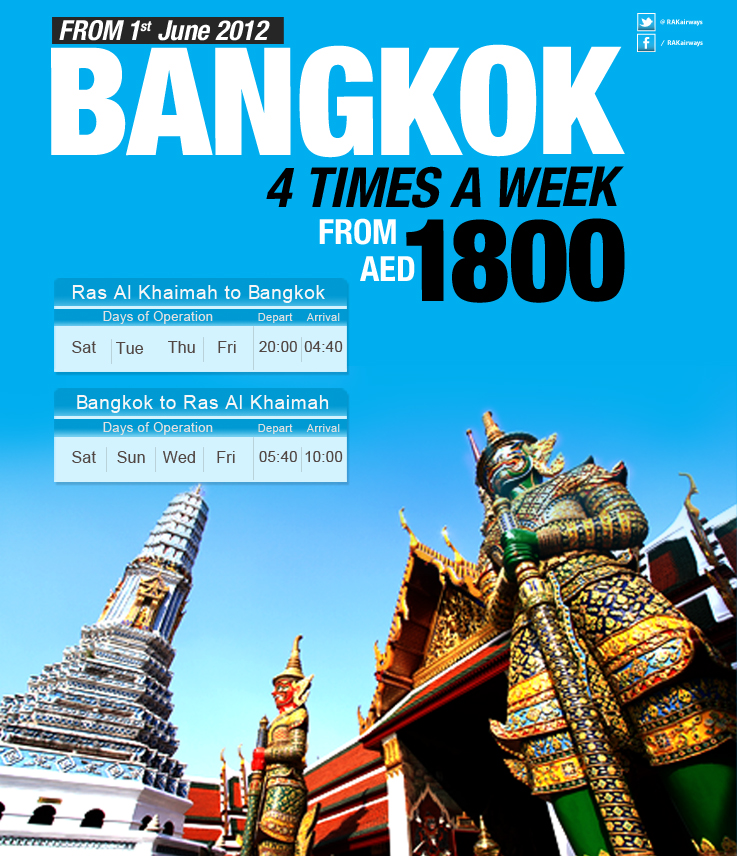
announced today that it will start flying to Kathmandu and Bangkok expanding
its route network to 12.
Starting on February 15th, RAK Airways will operate three flights a week to
Kathmandu.
Bangkok will see 4 weekly flights begins from
June 1st.
The Ras Al Khaimah
based carrier, which relaunched operations in 2010, stated that one-way,
all-inclusive fares to Kathmandu start at Dh499, while return fares start
from Dh899.
The schedules are:
Ras al-Khaimah – Bangkok
RT802 RKT2000 – 0440+1BKK 738 x137
RT801 BKK0540 – 1000RKT 738 x124
Ras al-Khaimah – Kathmandu
RT713 RKT0200 – 0735KTM 738 257
RT714 KTM0835 – 1150RKT 738 257
Existing
destinations are: Kozhikode, Jeddah, Dhaka, Chittagong, Cairo, Doha, Lahore,
Peshawar, Kuwait and Khartoum.
The web site is
www.rakairways.com. It is nice to
see RAK Airways is developing a sense of humour : this is their inflight
meal description: "because we know that not everybody out there is a fan of
things like eel, squid, or long green beans, we make sure that our on-board
food and beverage selection caters for everyone's tastes. If you have
special dietary requirements (like an irrational fear of carrots), simply
inform us when you make your reservation, and we'll make sure it's not a
part of your meal."
The rise and rise of the mega city
22 January 2012
The Guardian
Amid a clutter of
24-hour arc lights, gigantic cranes and dumper trucks, a behemoth is rising
out of a field of churned mud on the outskirts of Chengdu in south-west
China. Commuters skirt its vast perimeter fence on their way to the new
metro link that cuts under the city. They barely glance at what looks like
just another huge construction project in a cityscape that changes every
month.
This project, though, is different. When finished later this year, its
developers proudly boast, it will be the world's largest standalone
building. The New Century Global Centre is a leisure complex that will house
two 1,000-room five-star hotels, an ice rink, a luxury Imax cinema, vast
shopping malls and a 20,000-capacity indoor swimming pool with 400 metres of
"coastline" and a fake beach the size of 10 football pitches complete with
its own seaside village. Alongside will be another massive and futuristic
structure, a contemporary arts centre designed by the award-winning
Iraqi-born architect, Zaha Hadid.
The scale of the centre is a sign not just of the ambition of Chengdu,
capital of Sichuan province, but a potential vision of the future. Last week
Chinese authorities announced that for the first time more than half of the
country's population were living in cities, 690.79 million, an increase of
21 million, compared to 656.56 million rural dwellers. The new urban-rural
balance was a benchmark attained by the UK in the late 19th century and the
US in the first decades of the last century – in 1800, only 3% of the
world's people lived in cities. But the scale and speed of urbanisation
across the developing world today are unprecedented – throwing up a string
of megacities, from Jakarta to Istanbul, São Paulo to Cairo. Poor rural
families flooding into the world's urban population centres bring challenges
that have never before been seen – nor met.
Chengdu made the headlines in Britain late last year when it exported two
pandas to Scotland, and it is developing a reputation as the centre of
Sichuan's prized cuisine. But few in the west have paid much attention to
the astonishing rise of Chengdu, despite a population (including its rural
hinterland) of more than 14 million and its evident economic power and
growing sense of self-confidence. Few have heard much either of cities like
Ghaziabad, Surat or Faridabad in India, or of Toluca in Mexico, Palembang in
Indonesia or Chittagong, the Bangladeshi port. Or of Beihai, another Chinese
city on the northern coast. But this is likely to change. Each of these
cities is among the fastest-growing settlements in the world. Their
cumulative growth is set to usher in a new era of city living, changing the
face of the planet. Beihai, which already has 1.3 million inhabitants, is
set to double its population in seven years. The municipality of Chengdu
will reach 20 million. Ghaziabad, now itself part of the urban sprawl of the
Indian capital Delhi, is already home to nearly four million people.
Crucially, though experts estimate that the number of megacities of more
than 10 million inhabitants will double over the next 10 to 20 years, it is
these less well-known cities, particularly in south and east Asia, that will
see the biggest growth. Predicting what the new era will bring is taxing
economists, senior businessmen, security experts and strategists across the
world.
Optimists see a new network of powerful, stable and prosperous city states,
each bigger than many small countries, where the benefits of urban living,
the relative ease of delivering basic services compared to rural zones and
new civic identities combine to raise living standards for billions.
Pessimists see the opposite: a dystopic future where huge numbers of people
fight over scarce resources in sprawling, divided, anarchic
"non-communities" ravaged by disease and violence.
Nowhere is this more evident than in India, where years of underinvestment,
chaotic development and rapid population growth have combined with poor
governance and outdated financial systems to threaten an urban disaster.
In the middle of last week, Prakash Kumar spent a morning helping to push a
broken-down van loaded with bags of cement up a flyover in southern Delhi.
He was happy to do so, he told the Observer. A recent immigrant to the
capital from the poverty-stricken state of Bihar, the 24-year-old had picked
up work helping a relative – another migrant – on a building site. For the
equivalent of £3 a day, he was unloading emergency supplies of construction
materials for contractors busy putting up flats for the new Indian middle
classes. His dream is to get a job as a security guard, which pays around
the same but simply involves sitting on a stool guarding a shop at night.
For shelter, he shares a room in an illegal slum tenement with a dozen other
labourers.
"At least there's work," he said. "In my village there is nothing. I send
the money home to my family and we can eat."
The story of India's urbanisation – though slower than that of China or many
other developing countries – is made up of hundreds of millions of variants
on Kumar's story. Some 290 million people were living in cities in India in
2001, a figure that rose to 340 million in 2008 and is set to reach 590
million, around 40% of the population, by 2030. By that year, business
consultant McKinsey and Co predicts, there will be 68 Indian cities of more
than a million people, 13 with more than 4 million and six megacities with
populations of 10 million or more. More than 30 million people will live in
Mumbai and 26 million in Delhi.
It is far from sure that India's notoriously chaotic and inefficient systems
of government can cope. At current rates of investment, McKinsey says,
India's already congested cities will face gridlock with only a quarter of
the necessary trains and metros and a severe shortage of water. Many
inhabitants will have no drinking water at all and up to 80% of sewage will
go untreated. In all more than a trillion dollars needs to be invested in
infrastructure projects alone, it estimates.
According to Dr Rumi Aijaz, of the Delhi-based Observer Research Foundation,
it is unlikely that this can be achieved. "Our urban areas are in a raw
form. All the basics are at a very low level. And the Indian state has been
trying for a very long time to address this but a lack of capacity and
endemic corruption has meant not much success," Aijaz said. "The future is
bleak. The situation is going to worsen."
The new Chinese cities, too, have their problems – though arguably less
severe than those in south Asia. For every pound Indian authorities invest
in urban infrastructure, their Chinese counterparts spend seven. This,
however, is still insufficient to cope with the speed of urbanisation.
Chengdu has become a test case for how China resolves these varied
challenges. It has been named as one of China's "pilot reform regions",
giving local authorities extraordinary powers to experiment.
The issue is becoming ever more pressing – rural unrest over continuing
poverty as well as land seizures due to voracious development is widely
reported, even in China's heavily censored media. Chengdu's mayor, Ge
Honglin, claims that the city has avoided some of the problems associated
with migration into the cities by encouraging families to stay in the
countryside. "The first thing I did was to improve the conditions – schools,
shops, garbage collection, the sewage system. We had to cut the gap between
rural and urban areas. If people could have a brighter future in the
countryside, they'd stay there. So we're not seeing people swarm into the
city… Instead there are people in the city considering moving to the
country."|
Chengdu modified the household registration system in use across the
country, known as hukou, which previously prevented rural migrants from
registering as city dwellers and benefiting from the city's welfare
services. But at the same time it has extended such services into the
surrounding countryside. Farmers as well as urban workers can now receive
pension insurance, allowing women over 55 and men over 60 to claim a
rudimentary pension once they have paid premiums for at least 15 years.
Hundreds of new schools have been built in the villages surrounding Chengdu;
successful headteachers from city schools are being recruited to move into
the countryside, while partnerships between struggling rural schools and the
best urban schools are being set up.
The motivation for all these policies is clear – to persuade millions of
rural families around Chengdu that they have an economic stake in China's
rapid growth. Part of the strategy involves pouring resources into satellite
towns and villages, and creating thousands of new rural communities where
families can be rehoused. "Chengdu is the only super-large central city that
has narrowed the urban-rural income gap alongside rapid economic growth in
China," Ge says.
He has also taken a zero-tolerance approach to urban squalor – a policy
facilitated by China's authoritarian culture – which involves patrols with
mobile phones and cameras scouring the city reporting broken advertising
hoardings, missing manhole covers and other minor problems. "You can barely
see a beggar in Chengdu," Ge said. "We have a special system for monitoring
them, and it works. Beggars are taken to the assistance centre, where they
are given food and shelter and money to take them back to their home. If I
say there are no more than 10 beggars on the street you will think there's
some sort of tyranny, but there isn't. We're trying to solve their
problems."
Even if the demands for power, sanitation and security can be met, however,
the new cities, whether of 30 million or five million inhabitants, present a
cultural challenge: how to establish a sense of community in huge and
complex societies. In one recent book, The Spirit of Cities, two political
theorists argued that the distinctive spirit of the city states of ancient
Greece should be rediscovered. Daniel A Bell, of Tsinghua University in
Beijing, and Avner de-Shalit, of Hebrew University, Jerusalem, argue that "civicism",
or attachment to a city and the assertion of its local identity, brings
numerous benefits, ranging from curbing excesses of nationalism to
potentially sparking economic renaissance. "We say that though the scale is
different compared to ancient cities, modern cities can still express an
identity," Bell said last week.
In Chengdu, there is abundant evidence of the city's efforts to preserve a
sense of cultural identity amid bewildering change. Ancient districts that
were knocked down have been lovingly recreated to house market stalls
selling highly prized Sichuan delicacies. They are packed with locals, in
stark contrast to the cavernous and empty modern malls on the outskirts of
the city. Last autumn's Chengdu biennale, an exuberant exhibition of modern
art and architecture filled with tributes to traditional techniques and
rural themes, was housed in a refurbished Soviet-built factory complete with
original murals of workers and peasants, an ironic reference amid the
throngs of students and children who throng the cafes nearby.
There are few such initiatives in India but a sense of community among city
dwellers is nonetheless often present. Inhabitants of Mumbai can be fiercely
proud of their city, particularly when it is compared to Delhi. Smaller
"metros" such as Bengaluru and Hyderabad also have well-defined identities,
reinforced by local languages and cultures as well as a range of local
media.
For Prakash Kumar, the simple fact of making a living in the capital,
however basic, is a source of pride. "The rest of my family will come and
join me one day," he said.
Some of the
statistics in
this chart are remarkable - and for people planning tourism, airlines,
hotels, infrastructure etc they will shape the businesses of the future.
The threat hanging over Thailand
20 January 2012
The Nation
newspaper is gleefully reporting that four leaders of the People's Alliance
for Democracy (PAD) have vowed to resume the struggle against former prime
minister Thaksin Shinawatra.
The PAD leader Sondhi Limthongkul said the military should stage a coup in
cooperation with the people in order to wrestle a complete control of the
country from Thaksin.
"If the PAD is to make a move once again, this time will not just confine to
street protesting but a complete seizure of power," he said, pledging a
make-or break struggle.
Sondhi said he feared for the future of the monarchy if the Thaksin camp had
its way.
The PAD has not gone away; it is clearly opposed to any return of Thaksin
and to the long term government of Puea Thai. The PAD's position is that
Thaksin is a rogue capitalist seeking to plunder the country.
Another PAD leader Somkiat Pongpaiboon said he expected a final showdown
with the Thaksin regime. He claimed about the regime was contracting some
5,000 Cambodian and Vietnamese mercenaries to topple the monarchy in order
to inaugurate a republic.
I dont believe
that for a minute but I am sure there are many people in Thailand who will
be happy to believe it to justify their cause.
The PAD will pour into the streets at the first sign of changing charter
provisions pertaining the monarchy and granting amnesty for Thaksin, he
said.
PAD's Chamlong Srimuang said the PAD-led protests for 384 days and nights
were proof of the invincibility of the people's power.
Chamlong vowed to flex the PAD's power if the situation calls for. Remember
these are the same people that occupied the airport in 2008 for which no one
person has been sentenced.
Which is just part
of why this is a very nervous time in Thailand and why anyone seeking to
invest there needs to be very resilient and to have a high tolerance for
risk.
Cricket needs
to support its real fans
18 January 2012
I met plenty of
people yesterday at the Dubai cricket stadium who are spending plenty of
money in Dubai. Expensive hotel rooms; taxis to the stadium, drinks and
dinners. Some are here for a whole months to watch the cricket; these are
folk who set their whole calendar around England's cricket schedule.
So what happens
when they get to Dubai? The administrators treat the fans as though they are
a nuisance.
Dubai Sports City,
the ICC and the Pakistan cricket board have set up this match for
television. Not for real flesh and blood supporters.
The stadium grass
is stained in sponsors logos set for the cameras. The large video screen is
invisible to most spectators and spends more time showing adverts than
cricket.
The British
tourists have been sold the top price tickets. Above the pavilion and by the
press box. But without any sun all day.
Meanwhile the
remaining supporters are corralled into the West side of the stadium where
they squeeze into a sunny corner to catch the last of the mid afternoon sun
before sitting in cold and shade for the final session.
Meanwhile the east
side of the stadium is bathed in sunshine. Here as England celebrate
Hafeez's wicket you can see the supporters huddling in the last remaining
sunny spot.

Photograph: Paul
Childs/Action Images
Thursday, the
third day of this test match, could be a very good day of cricket. Time to
treat the real fans as an important part of this match rather than as an
unpleasant nuisance,
The coming
demise of the Metropolitan Hotel
18 January 2012
As rumoured last
month Dubai-based Al Habtoor Group has confirmed that it will demolish the
34-year-old Metropolitan Hotel and build three luxury hotels and a string of
tourist attractions including a theatre to stage Broadway-style shows.
The company said
that construction of the complex, which will include a shopping arcade, a
tennis and sports academy and themed restaurants, is set to begin in the
first quarter and be completed in 48 months.
Al Habtoor has yet to sign the hotel brands to operate the trio of
properties but said the announcement would be made soon; the plans call for
one luxury hotel – six stars – and the other two would be five-star.
The new plan is
based on the fact that tourist arrivals to Dubai increased 14 percent in the
first half of 2011 while hotel occupancy rates rose over 80 percent as Gulf
tourists avoided troubled traditional destinations such as Egypt and Syria,
according to data from EFG-Hermes.
The redevelopment
of the Metropolitan Hotel will also take advantage of neigbouring projects
such as Downtown and Burj Khalifa areas.
Strangely there is
an empty tower sat next to the Executive Towers development which was
originally planned as a Jumairah hotel which remains empty. If downtown is
such a prime location it is strange that this development has not been
completed.
The Metropolitan
hotel site on a plot of land that includes serviced apartments; a softball
park, a cinema complex and a number of bars including the infamous
Rattlesnake where taxis are queued in large numbers in the early hours of
every morning.
Dubai's missed
opportunity
17 January 2012
  
Over the last two years Dubai has been given a great
opportunity to put itself on the world cricket map.
The ICC has its
headquarters in Dubai.
The city has built
a fine training facility and a brand new 25,000 seat stadium.
As so often in
Dubai it sounds impressive but the reality is something different.
The stadium is in
Sports City on the east side of those endless roadworks known as Emirates
Rd.
England are
playing Pakistan in the first of a three match test series. Pakistan's home
games are all played in the UAE because of the terror threat in their home
country. Test matches have already been played against South Africa and Sri
Lanka. For UAE cricket this has been a windfall and a great opportunity to
showcase the sport and the new stadium.
So you would think
that the whole thing would be better marketed and better organised.

A crowd of less than 2,000 was there for the first day. It was a great day
of cricket desperately looking for an inspiring atmosphere.
Pakistan bowled
England out for 192. Seven wickets for Saeed Ajmal. But for the most part it
was England surrendering their wickets. There was not a lot in the wicket.
It was slow and took a little spin. It is a pitch that requires patience.
There were more
than 23,000 vacant blue seats. Pakistan are familiar with this and are
unbeaten in five previous Tests in the UAE against Sri Lanka and South
Africa over the last 15 months. They did get a bigger crowd in Sharjah, but
the England tests are in Dubai and Abu Dhabi.
The trouble is
that the Cricket Stadium is far out of town with no public transport. The
test also started on a Tuesday. It may be all over by Friday when Dubai's
large Pakistani population could attend.
Road access is a
mess unless you know it. The Al Khail Rd/Emirates Rd junction is not
complete. I drove along Al Khail Rd and you cannot turn North to the Stadium
- you can only turn towards Abu Dhabi in the wrong direction. There are no
signposts to the stadium. I took what I thought would be the correct exit to
U turn back onto Emirates Rd and next thing I knew I was in Jebel Ali and
back on Sheikh Zayeed Rd.
Parking is also on
a stoney wasteland; there is no proper car park; unless you are a VIP or
better still can use the access for VVIPs.
At the stadium
there is a small ticket office in a wasteland. Not at the entrance where it
should be! Water bottles are confiscated at the turnstiles by zealous
security guards.
You buy water
inside but the cap is taken off and disposed of - local rules apparently for
all drinks.
Most of the Brits
sat in the premium seats – probably because that is what their tour
operators sold them. Trouble was few of those seats gets the sun at any time
in the day. But it is the only part of the ground where alcohol is sold. It
cannot be taken to the seats and has to be drunk in the concrete shell of
the building.
I am cheap - there
was lots of space in the 20 dirham seats and more atmosphere. And there was
some sun until mid afternoon. So many of the Brits moved to the cheap seats.
There is sun
shining on the east stand all day. Trouble is that half of the ground was
closed. And it is only that half of the ground that gets a clear view of the
video screen - very useful at cricket when you miss something. so we are all
sat in the coldest part of the ground with no view of the big screen.
Bizarre.
To ensure that the atmosphere deteriorated to that of a morgue Billy Cooper,
the Barmy Army's long-serving trumpeter, apparently had his trumpet
confiscated in the tea interval.
And to finish the
day - the taxi queue took over an hour to clear after the match. The RTA and
Sports City should have arranged a fleet of buses to the nearest Metro
station or ensured that taxis would be available. This is the third test
match to be held in Dubai - they really should have sorted out marketing and
transport by now.
Those in peril on the sea
16 January 2012
I have never wanted to go on a cruise ship; and after the
events of this weekend I am sure I never will.
The Costa Concordia sunk quickly in relatively shallow water
off the Italian coast two nights ago after the ship struck a rock while
sailing far closer to land than it was authorised and programmed to do.
The vessel hit rocks off the tiny island of Giglio with a 160ft gash being
ripped in the ship's hull.
As I write this six people have died and sixteen are still
unaccounted for.
Costa Crociere, which is a subsidiary of US giant, Carnival,
is blaming the captain. They argue that the captain made an unauthorised
diversion from the ship's computer-programmed course.
Despite pushing all the blame on its captain Costa Crociere chairman and
chief executive Pier Luigi Foschi said that the company stood by captain
Francesco Schettino, and would provide him with legal assistance.
The captain may want to get his own lawyer.
Much of the video and commentaries comning from rescued
passengers has been critical of the evacuation efforts of the crew. However
as one crew member,
Katia Keyvanian, a hostess on the ship
has said "we evacuated 4,000 people from a ship lying on its side in the
dark, in less than two hours! Incompetent people would not have been able to
do that."
Did the Costa Concordia cruise ship run aground because the
captain wanted to show tourists a close-up of the coast? That is one theory.
But if that is the case have the Costa boats done that every time they
sailed this route? If that is the case the company is being miseading.
There are alarming smells of a cover up. It would be no
surprise if the investigation suggests a serious lack of safety awareness
within the company.
Even so the whole issue of cruising is fraught with problems
when things go wrong.
These ships are simply too big. There were 4,000 people on
board the Concordia. Assembling and evacuating that many people in the dark
is a cause for massive panic.
The ship had just started its cruise - it was two hours out
of its home port. Most passengers would not have even known their way around
the ship. Many passengers will have struggled to even find their cabins and
recover their life jackets.
There had been no emergency drill before the ship set sail.
So passengers would be unfamiliar with the emergency procedures. Apparently
the drill only has to be held withing 24 hours of leaving port.
Lifeboats are still launched according to a design that is
over 100 years old. When the ship is tilting at over 20 degrees then half of
the lifeboats cannot be launched.
There was no common language on board; passengers were from
many different nations - so many people would not understand any
instructions that they are being given.
Was there a proper safety management system in the company;
was it monitored; was it effective. The question being whether this was a
one off incident or the result of a corporate culture that allowed this
accident to happen.
There will be an investigation. And it is likely that safety
rules for cruise liners will change dramatically. For instance, as with
flying, there has to be a full safety briefing before leaving port.
And in time there will be changes in the equipment and
procedures for abandoning a ship. 2 hours of standing on deck fighting to
get into a lifeboat is not the future.
There is far more detail and some distressing pictures in
this Daily Mail report:
A world turned on its side: Divers reveal the chaotic mess survivors had to
brave to escape listing cruise liner.
And in the Guardian:
Costa Concordia cruise liner's company blames captain for disaster.
Some
alarming pictures here.
Dubai financial markets reality check
16 January 2011
You probably will not read this in the Dubai media but
Dubai’s benchmark stock index retreated on Sunday to the lowest level in
more than seven years on concern that full-year earnings may disappoint and
after France and Austria were stripped of top credit ratings.
Now this should not be too much of a surprise given the
global economy; but the other problem faced by Dubai is the lack of volume.
Fewer people are trading. Brokers have been shutting up shop.
The forecast is for more of the same. There is no positive catalyst. On
February 9 Emaar is expected to report a significant drop in full-year
earnings. The company’s third-quarter profit fell 34 percent as revenue
declined and property deliveries slowed. Income of developers in Dubai and
Abu Dhabi has suffered after real-estate prices tumbled by more than half
since their peak in 2008.
Standard & Poor’s cut France and Austria sovereign credit ratings one level
to AA+ from AAA last week and said they face the risk of further reductions.
Spain and Italy were also among nine nations downgraded, while Finland, the
Netherlands and Luxembourg kept their AAA ratings and were put on negative
watch.
Guess that just leaves Germany!
One glimmer of good news for consumers; albeit not so good
for producers. Crude oil for February delivery declined 0.4 percent to
$98.70 a barrel in New York on Jan. 13, the lowest settlement since Dec. 21,
after two European Union officials said an embargo on Iranian crude imports
may be postponed for six months.
AirAsia Ex?
13 January 2012
I am not sure what is going on in Malaysian aviation but the
closer co-operation of malaysian and air asia appears to be bad for
malaysian consumers with less choice available of many routes.
Just a couple of weeks ago Malaysian announced schedule
reductions and now Air Asia X has done the same.
On the other hand it may be good news for the middle east
carriers with Emirates for instance offering 3 daily flight to Kuala Lumpur
including an A380.
Budget carrier Air Asia X, part of the Air Asia group, has
said that it will stop flying to India and Europe by March this year.
The airline will close flights to Mumbai from January itself, while services
to New Delhi, London and Paris will cease in March. (LGW ceases on April
1st).
Chief Executive Azran Osman-Rani said continued high jet fuel
prices and weakening demand for air travel due to a depressed economy were a
double-whammy for the carrier and made it “economically impossible” for the
airline to sustain low fares to Europe.
But the whole idea of Air Asia X was to set up an alternative
hub for long distance flights for instance from Europe to Australia.
Oil prices have tripled since AirAsia X launched flights to London in early
2009, and are likely to remain high due to unrest in the Middle East and an
Iranian oil embargo, the airline said.
No question; but airlines do hedge their fuel costs.
Flights to Europe are also burdened by the implementation of an emissions
trading scheme this month and escalating air passenger duty taxes in
Britain, Azran said in a statement. Attempts to increase fares have led to
demand falling adversely. Add the fact that there are many alternative
flights through the Middle East at similar fares.
In India, Azran said visa restrictions for travel between India and
Malaysia, and a sharp spike in airport and handling charges made it tough
for the airline to operate. Airport and handling costs in India are already
more expensive than even Australia and are expected to rise by 280 percent
from April, the statement said.
Sounds a little too much like too many excuses.
“We intend to concentrate capacity in our core markets of Australasia,
China, Taiwan, Japan, and Korea where we have built up stable, profitable
routes … we intend to open up new routes within these markets, as well as
add frequencies on existing routes,” Azran said. I can see Air Asia X being
integrated into Air Asia's short hall network.
Once again it shows just how hard it is to operate low cost
long haul. Oasis Hong Kong had the same problem; Scoot will encounter
similar issues.
Security Alert, recall,
recalled....
13 January 2012
The US Embassy today issued a security alert for its
citizens in Bangkok.
There must be real knowledge of security issues for such an
alert to be issued. The alert was then recalled. And then the recall was
recalled and the alert confirmed.
At moments like this the US embassy officials appear
clueless. And its citizens left confused.
The alert said:
“This message alerts U.S. citizens in Thailand that foreign terrorists may
be currently looking to conduct attacks against tourist areas in Bangkok in
the near future. U.S. citizens are urged to exercise caution when visiting
public areas where large groups of Western tourists gather in Bangkok. U.S.
citizens are encouraged to maintain a heightened awareness when out in
public; be alert for unattended packages/bags in public/crowded places and
report any suspicious behavior to the nearest law enforcement personnel. We
also encourage you to keep a low profile in public areas, particularly areas
frequented by foreign tourists.”
After sending out the flash alert the
notice was then quickly recalled. A short while later, the recall was then
recalled with this message: “Due to a technical error, some recipients
received this message – followed by a recall message – a few minutes later.
Please disregard the recall message.” Chaos - on
something potentially so serious.
Note that the US Embassy alert is specific to tourist areas
in BKK and relates to foreign terrorists (so is unrelated to Domestic
politics).
Big question is how does one keep a low profile in
public places, especially those frequented by foreign tourists - keep low,
hide behind pillars? Wouldn't it be better just to avoid them all together?
But there is no way the embassy would have sent
this warning if they hadn't picked up major chatter about it. Of course,
that doesn't mean it isn't a bluff or that it will definitely happen.
But a good time to stay safe.
Rather late in the day Yuthasak, Thailand's Defense Minister
says intelligence reports advise that two terrorist have entered Bangkok
targeting Americans & Jews. The Thai government said it had been informed by
the US that a pair of suspected Muslim "terrorists" had entered the kingdom.
"The US contacted us last night about two terrorists who entered Thailand
and plan terrorist activities," Thai defence minister General Yutthasak
Sasiprapha said.
"Our intelligence officials are working closely with the US and following
the terrorists' movements closely.
"I believe we will arrest them tonight.
"For Thai citizens, there is no need to announce any warning because it will
cause panic and will affect our tourism"
Fail, fail fail ! We will arrest them tonight. Not a chance.
We wont issue any warning. So an attack in a tourist area will only target
Americans and somehow Thais and other foreigners will all be safe. Who lets
these people say anything?
"Accused slapper yet to appear"
13 January 2012
A wonderful headline from the Nation newspaper.
The story relates to a senior
Thai customs official, who slapped a Suvarnabhumi
Airport security officer in the ear for having asked him to undergo a
security check - an incident widely shown on YouTube - has not yet responded
to a police summons.
The Nation added that Suvarnabhumi Airport police
station superintendent Pol Col Natthanan Nanasombat said Thursday the senior
official Sombat Chatchaiwaiwit had been given a week, before January 18, to
contact police or an arrest warrant would be issued. The police investigator
also requested the victim's physical examination results from hospital to
use in the case investigation and has interviewed witnesses. Police are also
investigating who released the video clip of the incident on to the
Internet.
The last line is sadly predictable. The Thai official will be
moved sideways. The real witch-hunt will be for whoever released the video.
The end of Sodomy 2.0
14 January 2012
For anyone who has followed the career, accusations, trial, imprisonment and
retrial of Anwar Ibrahim this Economist leader sums up the background well.
The conclusions are legitimate. 20 years ago Ibrahim was a bright young
challenger to Mahathir Mohammed. Now he may be too out of touch and too
tarnished to lead a powerful and successful opposition.
"After more than two years of legal wrangling, sordid media
revelations and political point-scoring, on January 9th the High Court in
Malaysia’s capital finally handed down a verdict in Anwar Ibrahim’s sodomy
case—not guilty. Homosexuality is illegal in Muslim-majority Malaysia, and
if found guilty the former deputy prime minister and current leader of the
opposition could have been jailed for up to 20 years. Now, however, Mr
Anwar’s vindication allows him to throw his energies into fighting the
government in a general election expected later this year.
The case began in 2008 when a male aide reported to the police that Mr Anwar
had sodomised him. Mr Anwar, however, maintains that the whole trial was a
put-up job by a nervous government, desperate to discredit him after he came
close to winning a general election earlier that year. The whole affair
seemed an unlikely rerun of similar charges brought against Mr Anwar when he
was ousted from his post as deputy prime minister in 1998—hence the moniker
of Sodomy 2.0 for this case. Indeed, Mr Anwar claims that all the legal
suits over the past 14 years add up to a sustained vendetta against him by
the ruling party, the United Malays National Organisation (UMNO), which has
ruled the country continuously since independence from Britain in 1957. Once
the golden boy of UMNO, Mr Anwar claims the feud started after he fell out
with the autocratic and long-serving prime minister, Mahathir Mohamad. He
has been demonised by his former colleagues ever since.
After the first accusations in 1998, Mr Anwar spent six years in prison for
corruption and sodomy before being cleared of the second charge by the
country’s supreme court and released in 2004. This time the judge ruled that
the prosecution case against Mr Anwar was too flimsy for a conviction; the
DNA evidence, in particular, was ruled unreliable.
If the two sodomy charges really were invented by some in UMNO bent on
wrecking Mr Anwar’s career, then the strategy has backfired. The first case
in 1998 rallied huge public sympathy for Mr Anwar. With Sodomy 2.0 he has
been publicly vindicated, despite a widespread belief that he was going to
be convicted. Indeed, the government swiftly attempted to exploit this by
claiming that the verdict showed “the government does not hold sway over
judges’ decisions”, framing this as part of its vaunted reform programme.
The independence and quality of the judiciary has improved a little since
the days of Dr Mahathir, but many in Malaysia remain cynical and conspiracy
theories abound.
How will the verdict affect Malaysia’s politics? In the short term Mr
Anwar’s victory will give a much-needed boost to the coalition of opposition
parties that he leads. So much so, in fact, that the cautious prime
minister, Najib Razak, might even postpone going to the polls.
In the longer term, however, things are less clear-cut. Although Mr Anwar
remains a charismatic figure and a forceful speaker, his reputation has been
tarnished. That won’t matter to his acolytes, but at 64 he also seems a
distant and untrustworthy figure to many younger Malaysians. He has failed
to nurture a new generation of opposition leaders. Rather than turning his
party into a vibrant, modernising force in politics he has allowed it to
become something of a family-run affair, riven by infighting.
In prison, some political operators say, he could have served as a useful
martyr figure to rally the opposition. Now, they are stuck with him
indefinitely as a leader. Mr Anwar may still be popular enough to land a few
blows on the government. But he may also be too weakened to deliver the
knockout punch."
EK runway incursion at Sydney; how serious?
11 January 2012
A week ago an Emirates A380 was involved in a runway
incursion at Sydney. Quick action was taken by ATC and two other airplanes
which may have saved a potentially serious situation. There are more details
on pprune and on avherald.
The incident occurred just before 9.30 am last Friday, 6 January, when an
Emirates A380 under taxi appears to have intruded onto the main north-south
runway (16R) causing a Japan Airlines 777 to abort its takeoff, and come to
a halt and a Malaysia Airlines 747-400 cleared to land on 16R to break off
its approach and go around because of the obvious risk that neither the
Emirates or Japan Airlines flight would have cleared the active runway in
time.
The Malaysia flight go around is apparent on the Webtrak archive for Sydney
Airport, but the actual events on the ground aren’t clear because when jets
are stationary they do not appear on the radar based tracking app.
The Emirates Airlines A380, registration A6-EDN was
performing flight EK-412 from Sydney,NS (Australia) to Auckland (New
Zealand) and had been cleared to taxi for departure via taxiway G and A.
However it appears to have missed the turn onto taxiway A and went past the
hold short line of runway 16R at about 09:26L (22:26Z Jan 5th).
A JAL Japan Airlines Boeing 777-200, registration JA711J performing flight
JL-772 from Sydney,NS (Australia) to Tokyo Narita (Japan), had been cleared
for takeoff from runway 16R and was accelerating for takeoff, when the A380
went past the hold short line. JAL rejected its takeoff at low speed coming
to a stop before the intersection with taxiway G.
A Malaysia Airlines Boeing 747-400, registration 9M-MPB performing flight
MH-123 from Kuala Lumpur (Malaysia) to Sydney,NS (Australia), was on final
approach to Sydney's runway 16R and went around from low height due to the
rejected takeoff and the Boeing 777 on the runway, repositioned for another
approach and landed safely about 15 minutes later.
The JAL Boeing 777 was able to depart about 20 minutes later and reached
Tokyo on time.
The Emirates Airbus needed to cross runway 16R to resolve the conflict,
re-joined the departure queue departing Sydney about 30 minutes later and
reached Auckland with a delay of 30 minutes.
On Jan 9th (Australian time) Airservices Australia confirmed a runway
incursion on Jan 6th that resulted in a rejected takeoff and a go-around,
however declined to provide further details.
It is unclear what action, if any, the ATSB may chose to take. Of course
there is no mention of this incident in any of the UAE media.
How serious was this; well the good news is that all the
safeguards worked and air crews reacted quickly to ensure the safety of
their passengers and crew. But this was in daylight on a clear day and
something must have distracted the EK crew. And tiredness may well be a
factor again.
Sun setting
over Dubai
8 January 2012

Witch hunt for
red Joss Stick
8 January 2012
- The Bangkok Post
Hate mail and threats are the least of her worries. Being shunned by society
that has forced a young girl to become persona non grata should be
considered cruel and unusual punishment She had to change her name. She was
turned away from three universities despite passing the entrance exams.
She's hounded by the press and society. It has been more than three years,
and the witch hunt continues.
She calls herself ''Joss Stick'', or in Thai karn toop.
Her real name and the name she changed to were revealed to the public by
Manager Online, owned by Sondhi Limthongkul, leader of the yellow shirt
People's Alliance for Democracy (PAD).
But her name will not be revealed in this space.
Over three years ago, onstage at an event organised by the red shirt United
Front for Democracy against Dictatorship, a teenage girl made a speech to
support ousted former prime minister Thaksin Shinawatra. She also called on
the country's youth to take to the streets. But that wasn't what made her
infamous. There have been plenty of people young and old going on stage in
support of Thaksin. Her unfortunate saga originated in cyberspace when she
was still in high school.
According to reports, more than three years ago she allegedly posted
something on her Facebook page that was offensive to the monarchy. To this
day, she has not been charged with any crime. But she suffers nonetheless.
Mr Sondhi and his media organisation brought her to trial. The court of
public opinion delivered the guilty verdict. PAD supporters and others
continue to punish her relentlessly.
Hate mail and threats are the least of her worries. Being shunned by a
society that has forced a young girl to become persona non grata should be
considered cruel and unusual punishment, especially as she has never been
found guilty of any crime in court.
Joss Stick grew up in Ratchaburi province. She was said to be a good student
at Rattanarat Bamrung School, but she was kicked out of it. The reason given
for her expulsion was that she often criticised the monarchy.
She later graduated from Tanprasartpetch School in Nakhon Ratchasima
province.
In 2009, Joss Stick passed the entrance exam at Silpakorn University's
Communication and Arts Department.
According to a report by Manager Online, many people contacted the
university, complaining of her ''anti-monarchy'' stance and demanding the
school not accept her.
Manager Online cited Maneepin Promsuthirak, the department's dean, as saying
that despite Joss Stick's passing exam scores, the school deemed her
anti-monarchy activities as unfit and therefore her admittance was denied.
Joss Stick later changed her real name and in 2010 passed the entrance exam
to Prasarnmitr College.
In a recent interview with Matichon Online _ not to be confused with Manager
Online _ Joss Stick said her oral interview was cut short. According to Joss
Stick, the school interviewer told her that she knew what she had done and
that she should just return home to wait for the interview result.
She was denied entrance to the school.
In that same year, Joss Stick also applied to Kasetsart University. Her
opponents created a Facebook page called: ''We are confident that the people
of Kaset would not welcome someone who insults Father.''
On the day on which she was due for an oral interview, there was a mob at
the university demonstrating against her and Kasetsart. At the same time,
about 30-40 red shirts showed up to support her.
Fearing for her own safety, Joss Stick decided not to show up for the
interview.
The young girl then disappeared and many people were cheered that they
actually had hounded her into hiding, or even out of the country _ there was
a rumour that she received a private scholarship to study abroad.
For a while Joss Stick's unfortunate story died, but was then resurrected.
Recently Manager Online learned that Joss Stick is studying at Thammasat
University's Social Administration Department.
The media and the people who have been hounding her demanded to know why
Thammasat accepted the girl's enrollment.
Here is the response from the university's head, Somkid Lertpaitoon, as
taken from Manager Online. ''As for the girl Joss Stick, people have sent me
emails. But no one has sent me any facts. Thammasat knew from the beginning
who this girl was. When she passed the exam, the school had two meetings to
consider her admittance. The conclusion was to admit her. She passed the
exam, how could we not let her study? How can we punish her for something
she supposedly did before studying at Thammasat? I believe we should not
bully a child.''
''Words and behaviour that are aggressive, insulting and derogatory to the
royal institution _ are they true? I do not know. Nobody has told me. So we
can't presume anything. Not one person has given me any facts. But if it is
true, then Thammasat will investigate. To discipline [a student] is a normal
thing. But if you were to say this girl cannot study here because of this
and that reason, Thammsat cannot accept this. There's liberty in every
square inch of Thammasat. If she insulted the King, then she would have been
charged. Many people Facebook-ed me, saying this girl did this and that. I
ask you this: if she did it, why don't you inform the police? All the
teachers at Thammasat agreed that we should accept her. And if she does
wrong [while attending Thammasat], then we will handle it according to the
rules and regulations of Thammasat.''
In the Matichon Online interview, Joss Stick volunteered that she has had
some difficulties with her classmates at Thammasat.
She said everyone knew who she was, that people talked about her and that
there were many sarcastic remarks. Some had told her that if she doesn't
love the King, she should leave the country. She also claimed that someone
once threw a shoe at her, but missed.
When army chief Gen Prayuth Chan-ocha suggested a social boycott of lese
majeste offenders, is this what he had in mind?
There isn't much to say here. The story speaks for itself. The words of
Thammasat's Dr Somkid already echo this writer's sentiments.
But the story doesn't end here for Joss Stick.
With Manager leading the way in the witch hunt, the police have summoned
Joss Stick for questioning. She is due to report on Wednesday. However, she
asked for the date to be moved to Feb 11 due to ongoing final examinations.
Is this what our society has come to?
Joss Stick has never been charged with a lese majeste crime. What she
supposedly wrote on her Facebook, the public does not know. She has a
political stance, which she is entitled to. She's been active politically,
as young people often are for better or worse.
But because she supposedly, allegedly used words offensive to the monarchy,
she has been not only hounded by society, but victimised in a witch hunt led
by a major media organisation, revealing her identity so she could be
bullied and harassed. All the while she was underage, her education was
jeopardised and now a police summons.
Abu Dhabi
airport celebrates 30 years of success
7 January 2012
WAM
Abu Dhabi International Airport on Tuesday marked its 30th anniversary,
celebrating three successful decades of providing travellers and customers
with world-class services and state-of-the-art facilities.
The capital’s international gateway has seen more than 126 million
passengers pass through the airport since its opening at its current
location in 1982.
Having historically been based in Al Bateen since 1969, Abu Dhabi
International Airport started operation at its current location 38km outside
the city in 1982. Terminal 1 covered 5,200 square metres and catered for 3
million passengers per year, which was later increased to 5 million
passengers per year when Terminal 1A was opened. A growing number of
airlines have since established their operations at Abu Dhabi International
Airport, notably the UAE’s national carrier, Etihad Airways.
On the occasion of the 30th anniversary, Khalifa Al Mazrouei, Chairman of
ADAC, said: “Abu Dhabi Airports Company is proud to be celebrating this
special occasion and highlighting Abu Dhabi International Airport’s
achievements over the past 30 years. The emirate of Abu Dhabi has
experienced remarkable development in this short period of time, with Abu
Dhabi International Airport being a vital part of the capital’s growth.
Already established as a major international hub for travellers around the
globe, Abu Dhabi International Airport is committed to further developing
into a leading airport in the region, and a key contributor to the Abu Dhabi
2030 vision of economic diversification.”
The past 30 years have been particularly successful for Abu Dhabi
International Airport in terms of airline and infrastructure developments.
Etihad Airways launched in 2003 and was named the national carrier for the
UAE. Terminal 2 opened in 2005 with a passenger capacity of 2 million
passengers per year. Four years later in 2009, Terminal 3 was delivered,
providing Etihad Airways with a dedicated terminal and a handling capacity
of an additional 5 million passengers per year. In the same year, the 4,100
metres North Runway was completed doubling the airport’s runway capacity,
while being the first airport in the UAE with CATIIIB capability.
In 2011, Abu Dhabi International Airport saw the completion of the iconic
Air Traffic Control Complex, developed to enhance the capacity and
efficiency of air traffic services at the Capital airport and cater to the
anticipated growth in air traffic in the years to come. During the same
year, ADAC completed an enhancement and refurbishment project at Terminal 1
to align its facility and offerings to that of Terminal 3 and other world
class airports.
Today the airport caters to 53 international airlines connecting Abu Dhabi
with more than 85 destinations in over 49 countries globally. Passenger
numbers have also continued to increase over the past 30 years positioning
Abu Dhabi International Airport as one of the fastest growing hubs in the
world. Under Abu Dhabi Airport’s Company management, the airport has more
than doubled passenger numbers during the past six years from 5.3 million in
2006 to above 12 million in 2011. In July 2010, the airport surpassed the
one million passenger mark for the first time in a specific month.
Waiting for the man
6 January 2012
The Economist on Thaksin's
inevitable return
With the flood waters mercifully receding in much of the country, normal
service has resumed in Thai politics—and that means talking obsessively
about Thaksin Shinawatra. The former prime minister, ousted in a coup in
2006, has been living in exile since 2008 to avoid going to prison for
corruption on charges that he has always claimed were politically motivated.
But now, with a new government in power led, very handily, by his younger
sister Yingluck, it seems that it has become a matter of when not whether he
returns to his native land.
The new government has begun “exploring every avenue to bring Thaksin back”,
according to Pavin Chachavalpongpun, an analyst of Thai politics at the
Institute of South-East Asian Studies in Singapore. In mid-December it was
revealed that Mr Thaksin had been given a new Thai passport. Until then he
had been travelling on Nicaraguan and Montenegrin documents. Now the
government is working on an amnesty bill aimed at pardoning those jailed for
political offences over the past few years. This will cover not just many of
their own “red shirt” supporters but also leaders of the monarchist, anti-Thaksinites
known as the “yellow shirts”. Crucially, it will also find ways to take in
Mr Thaksin himself. The legislation might be passed by Parliament before the
middle of the year.
Mr Thaksin remains a highly controversial and divisive figure in Thailand.
So even his own sister’s government will have to proceed cautiously. The
government shied away from pressing for a royal pardon on the occasion of
King Bhumibol’s birthday on December 5th, wary of the backlash from the
yellow-shirt movement that this would surely have provoked. Indeed, many
fear that, however crafty the government is in eventually getting Mr Thaksin
back, the issue risks overshadowing much else that Ms Yingluck wants to do.
Her stress on national reconciliation, one of her main campaign themes last
year, will begin to look hollow if she exhausts all her political capital
merely to secure a safe passage back to Thailand for one man, simply out of
family loyalty.
Besides, some wonder whether Mr Thaksin really needs to come back at all,
given that he shows every sign of running the Thai government perfectly well
from abroad. He has a grip over appointments to the cabinet and he sends an
incessant stream of advice to ministers and members of Parliament. Mr
Thaksin also seems to have become as good as a foreign emissary for his
sister too.
He visited Myanmar last month. In his own words, this was to “smooth the
way” for Ms Yingluck’s meeting with the apparently reformist president,
Thein Sein. Before that, he was in Cambodia to ease tensions over a border
dispute with Thailand that blew up under the previous government of Abhisit
Vejjajiva. He has also been spotted on missions to Singapore and Hong Kong.
So much for claims from the man who said last year that he was in “no hurry”
to return home—and who before that had vowed that he would in future keep
out of Thai politics altogether.
EK Airbus in emergency landing at CPT
5 January 2012
(via Emirates 24/7 and avherald)
An Emirates Airline A340-500 made an emergency landing in Cape Town, South
Africa, with 243 passengers onboard late on Wednesday after its landing gear
failed to retract.
The Airbus,
registration A6-ERA performing flight EK-773 from Cape Town (South Africa)
to Dubai (United Arab Emirates) with 243 passengers, was climbing out of
Cape Town's runway 01 when the body gear did not retract and all gear doors
remained open following main gear retraction. The aircraft levelled off at
FL100, the crew declared emergency and returned to Cape Town's runway 01 for
a safe landing about 90 minutes after departure. The aircraft vacated Cape
Town's main runway onto runway 34 and was subsequently towed to the apron.
One observer reported all gear doors remained open after the gear had
retracted, the aircraft was climbing through about 2500 feet at that point.
Another observer on the ground reported the aircraft landed with the gear
doors open, when the landing gear is down the gear doors normally close on
the A340.
The airport said the aircraft returned to Cape Town due to a technical
problem.
The airline said the aircraft returned to Cape Town after a technical
problem developed with the landing gear. The passengers were taken to
hotels.
Quoting passengers onboard the flight, media reports in South Africa said
that there were two bangs immediately after the take-off and a third one was
heard a few moments later. These bangs created panic among the
passengers.....take that with a pinch of salt!
A statement sent to Emirates 24l7 by an Emirates spokesperson said:
"Emirates flight EK773, which departed Cape Town for Dubai at 13:55 (local
time) on 4th January, returned to Cape Town at 15:20 after a technical issue
developed with the aircraft's landing gear.
"The aircraft landed uneventfully. At no point was the safety of the 243
passengers or crew at risk. Passengers are being provided with hotel
accommodation until a replacement flight departs from Cape Town this
afternoon, 5th January. Emirates regards the safety and security of its
passengers and crew with the utmost importance."
The plane circled over the Indian Ocean for more than hour, apparently to
jettison fuel before landing, but at the time many passengers did not know
what was happening, IOL news reported.
dnata acquires travel republic and a potential headache!
4 January 2012
In travel news,
Travel Republic (www.travelrepublic.com) has been bought by dnata, the
airport operating subsidiary of Emirates Airlines. The deal was finalized
December 29 but not announced until this week.
The purchase price
has not been disclosed. dnata apparently acquired 75% of the company with
the option to buy the remaining 25% from the three founders in five years
time.
The acquisition represents one of Dnata's biggest business transactions in
the company's 52 year history, it said yesterday in a statement.
Travel Republic offers prices on a choice of 120,000 hotels, and flights
with some 100 airlines to 650 destinations. Last year Travel Republic
recorded an increase of more than 40 per cent in its annual turnover to over
£400 million (Dh2.29 billion), dnata said in the statement.
dnata believes
that it can capitalise on the increasing popularity of online travel
bookings by speeding the expansion of this business which will continue
under the Travel Republic branding and will likely be expanded into the
middle east and India.
Travel Republic
reflects a European trend of moving away from the traditional package tour
operators such as Tui and Thomas Cook with people instead booking individual
components. But Travel Republic's growth appears to have its own problems;
there are 16 pages of (mainly) complaints on the
holiday watchdog forum. Margins are thin in this industry. And the
consumer is really looking for the best value at the best price; there is
not a lot of brand loyalty. So Travel Republic appears to have built its
business by aggressive pricing which leaves little room for the costs of
hand holding customers and th main issue appears to be customer service, or
lack thereof.
In 2008 dnata acquired a 23 per cent share in worldwide corporate travel
company Hogg Robinson Group and a 49 per cent stake in the global outsource
provider Mind Pearl. This was followed by its December 2010 acquisition of
in-flight caterer Alpha Flight Limited, extending the company's reach to its
current presence in some 76 airports.
One suggestion is that dnata may now try and obtain a controlling interest
in Hogg Robinson.
One mystery - why keep the travel republic brand - it really is not that
well known. Why not leverage off the dnata brand.
EK to HCMC (Saigon) from June
4 January 2012
Effective 4th
June, Emirates Airline resumes service to Ho Chi Minh City (Saigon as was)
in Vietnam. The airline is resuming service to Vietnam after a hiatus of
almost 15 years.
The airline will launch service on the route on board two class Airbus
A330-200 aircraft, switching to the Boeing 777-300ER effective Winter
2012/13 season.
Schedule:
EK390 DXB 0925 - 1920 SGN 332 D
EK391 SGN 2050 - 0045+1 DXB 332 D
Interesting - some of the Asia flights are timed to return around 4 or 5 am
and connect with the morning departure bank to Europe and Africa.
The Vietnam flight
is about the same flight time and schedule as EK372 to Bangkok. There are
more flights beginning to arrive from Asia at the back end of the late night
(11.00pm to 00.30am) arrival bank. The implication is that there will be
more additions to the third departure bank to Europe around 3am. Manchester,
Gatwick, Heathrow and Frankfurt already have departures at this time; ideal
for connections from Saigon.
At some date I am
sure that EK's planners would like the 3am departure bank to Europe to be
similar to the 3pm bank with services to most of EK's European destinations.
Westjet's risky
path
3 January 2012
WestJet Airlines
Ltd. has announced plans to add smaller planes to its fleet to challenge Air
Canada for the top spot in carrying domestic traffic within five years.
WestJet chief executive officer Gregg Saretsky said in a year-end interview
that WestJet will focus on acquiring smaller aircraft for neglected domestic
markets before considering larger planes for routes to Europe and Asia in
the long term.
Calgary-based WestJet has focused on a single-fleet configuration of Boeing
737s since it launched in 1996. This model has been both simple and
profitable. Its expansion carries the risk of higher costs and lower yields.
In 2000, Air Canada had 77 per cent of the domestic market, while WestJet
held just 7 per cent. But Air Canada decided to devote greater attention to
its routes to the United States and overseas. By early 2011, the competitive
gap had narrowed to a point where Air Canada’s domestic market share slid to
56 per cent and WestJet’s grew to 36 per cent. Porter Airlines Inc. and
others had the remaining 8 per cent.
If WestJet decides to order smaller planes by late 2012, the aircraft will
likely start arriving by early 2014, positioning the airline to introduce
service to smaller Canadian cities. The carrier has 97 Boeing 737s in its
fleet, with another three of the jets to be added this year. The planes seat
119, 136 or 166 passengers, depending on the Boeing model.
On WestJet’s shortlist for smaller aircraft is the 70-seat Bombardier Q400
turboprop, a Canadian-built plane used by Toronto-based Porter. The Q400 is
also flown on portions of Air Canada’s regional service through Jazz Air and
Sky Regional Airlines Inc. at Billy Bishop Toronto City Airport.
Industry observers say WestJet will have an advantage over Air
Canada-affiliated regional operators that don’t have the fuel-efficient
Q400, such as Central Mountain Air, which flies older turboprops configured
to seat 18 or 30 passengers. Also on WestJet’s shortlist is the
French-Italian ATR 72 turboprop.
“The Q400 would be ideal as a regional airplane,” Mr. Erickson said. “But I
still think the end play will be WestJet’s entry into the international
arena in the longer term. That would be transatlantic routes for starters,
and at some point, transpacific, and the connecting passengers from smaller
Canadian cities could assist with that.”
Mr. Saretsky emphasized that no corporate decision has been finalized on
whether to order larger or smaller planes, but he favours nurturing the home
market first. He cited examples of new destinations that could benefit from
a WestJet expansion: Cranbrook, Prince Rupert, Fort St. John and Dawson
Creek in British Columbia; Lethbridge, Alta.; Saguenay, Que.; and Sudbury,
Sarnia and Timmins in Ontario.
Karl Moore, a professor at McGill University’s Desautels Faculty of
Management, said Mr. Saretsky understands the challenges because he worked
at Seattle-based Alaska Airlines Inc. It flies Boeing 737s, but its
affiliate, Horizon Air, operates Q400 turboprops.
“Certainly, you can see the success of the Q400 for thinner routes,” Prof.
Moore said. “If you can have a plane that better matches the volume of
passengers, it would be a winner.”
For WestJet, the key will be to selectively add domestic routes while
overcoming the complexity of training pilots and having new aircraft parts
on hand for the smaller aircraft, he said. WestJet will be able expand with
new planes, but “it’s getting away from the business model of simplicity
with the Boeing 737.”
The march of democracy
3 January 2012
- The Financial Times editorial
"In 1989, Francis
Fukuyama declared that democracy would eventually emerge as the universal
form of human government. The intervening years have given ample ammunition
to those who disagree. Indeed, the inexorable rise of China has led some to
dismiss democracy’s messy compromises in favour of authoritarian efficiency.
People are prepared to sacrifice their freedoms, the argument runs, as long
as the system under which they live can deliver economic growth.
The tumultuous events of 2011 have undermined this idea. Across the Arab
world – a region once held to be indifferent to the attractions of democracy
– long-oppressed peoples have risked everything to free themselves from the
grasp of authoritarian regimes. In Tunisia, Egypt, Libya and Yemen, brutal
tyrants were triumphantly toppled. And although Bashar al-Assad has so far
clung on in Syria, his grip on the country has been weakened by months of
protests.
Of course, the optimism should not be overplayed. The North African
revolutions have not yet spawned fully-fledged democracies. Tunisia may have
elected its first parliament, but the ongoing elections in Egypt have been
marred by renewed clashes between the military and demonstrators, and free
polls in Libya remain some way off. Beyond the Middle East, meanwhile, many
autocracies survived the year intact.
But the pessimism should not be overdone either. Building democracies from
the rubble of fallen dictatorships was always going to be a painstaking
process. And even those autocracies that made it through 2011 in one piece
were not impervious to the ripples of the Arab spring. Nervy crackdowns on
dissent in both Russia and China were a telling reminder of the fundamental
fragility of any system that rules without the consent of the governed.
Furthermore, the significance of the revolutions of 2011 lies not merely in
their success in sweeping away corrupt regimes. Just as importantly, the
uprisings – those that succeeded, and those still continuing – were a
reaffirmation of the enduring global appeal of the democratic idea, and the
values of freedom and equality it enshrines.
To prosper, however, democracies must meet the needs of their people. Over
the next year, the new leaders of the Arab world must establish the
institutions necessary to guarantee the rights and freedoms for which their
citizens have fought. Just as importantly, they will have to jump-start
their countries’ faltering economies. Unless people quickly see an
improvement in their lot, there is a risk that democracy will struggle to
take root.
Established democracies also have much to prove in 2012. In the last year,
countries on both sides of the Atlantic have grappled hopelessly with
problems that should not be insoluble. In the US, attempts to revive the
economy and rein in mushrooming public debt have been hobbled by partisan
feuding. Europe’s leaders have been almost as inept in the face of their own
political and economic crisis. It is not surprising that this year’s tide of
global protest swept through Athens, Madrid and New York, as well as Tunis,
Cairo and Benghazi. That the democracies survived while their authoritarian
counterparts collapsed is a testament to two of the key strengths of the
democratic system. It provides room for dissent. And it is better than most
other systems at getting rid of failed rulers.
In 2012, a number of countries not blessed with these advantages face
critical transitions. In some places, autocratic regimes may manage to
remain in power. But from a global perspective, there is room for hope. When
Mr Fukuyama gave his speech, the world contained 69 democracies. Today there
are close to twice as many. The march of democracy is not finished yet."
Looking ahead
to 2012
2 January 2012
2011 was a tough
year - tough if you were a soon to be ex-dictator; tough if you were the
world's most wanted terrorist; tough if you were job hunting in a severe
economic downturn; tough if you were hoping for a recovery in asset values.
A tough year for natural disasters from Christchurch to Fukushima. A tough
year for anyone living through the turmoil of the Arab Spring whether trying
to make a genuine difference or simply trying to protect and care for loved
ones. It was a tough year for many in Europe as their economies floundered
and austerity measures and new taxes eroded living standards. And it was an
appalling year in Thailand where an election that should have given hope has
instead further eroded freedom of expression. It was a tough year for the
needy as the gap between the haves and the have-nots has widened in too many
nations.
For some it was a
year of hope; in Burma there are signs of a new democracy. Aung San Suu
Khi's courage and sacrifice are giving hope to millions. The Arab Spring may
lead to real change; it has to to justify the sacrifices that have been
made.
Of course this
might all be meaningless if the world comes to an end on December 21, 2012
when the Mayan calendar ends and the winter solar solstice sees the
alignment of the sun with the Milky Way to form a galactic equinox.
But in one of the
easier 2012 predictions this year will not be the end of the world.
So what will happen in 2012:
The Euro
celebrates its tenth birthday and the Eurozone will survive. Those who are
committed to its survival are stronger than those who would gleefully
celebrate its demise. A weaker Euro and cuts in ECB interest rates will
help; IMF programmes will also support some weaker economies; Ireland and
Greece for instance. It will survive but the uncertainty and continuous
discussion will continue. This will harm Mrs Merkl and Mr Sarkovsky who will
probably both be replaced in 2012 elections.
Barack Obama will
be re-elected in 2012. He has been a massive disappointment. So much hope
has given way to weakness and compromise. But the Republicans are divided
and do not have a strong enough candidate. Mitt Romney will likely win the
Republican nomination. But as one paper described him - he is a vertebrae
short of a backbone.
Obama will be
hobbled from the start. The Republicans already control the House and will
probably also control the Senate from the start. The rest of the world
will know that he is a weak President.
The Olympics will
put London on the sporting map for two weeks in the summer. London will look
good. And despite the austerity tag we should expect a terrific sporting
event. After all where would the world's 20 something athletes most like to
party - Beijing or London?
Expect at least
one more UK newspaper to fail as the Leveson inquiry continues to show the
depths that some journalists and editors have been willing to sink to - and
as advertising revenues continue to drop. But note that Murdoch's news
corporation share price increased 10% in 2011 while around him so many
companies (hallo Thomson Reuters) were faltering. Cross the dirty digger at
your peril.
Vladimir Putin
will win a third presidential term. He has already prepared the results
announcement. Sadly he wont change. He is too conservative to launch the
legal, economic and political changes that Russia needs. He will continue to
play the nationalism card when he needs to prop up support.
Germany (with its
largely Turkish squad!) will win the 2012 European Championship.
Because I know you
care - Abu Dhabi financed Manchester City will win the Premiership. Arsenal,
because they have to win something, will go and lose the FA Cup final to
whoever they play against. And Wenger will be gone by the summer. He will
get a surprise appointment as manager of England....now that would be
something.
Relegated: QPR
(sorry Mr. Air Asia but that was a waste of your money); Bolton and sadly
(because I like the manager) Wigan.
Champions League -
Barcelona to be the first team to repeat.
Tiger Woods will
win one of the four golf majors. He is still that good.
Italy's
non-elected technocrat government will survive. And the politicians are
happy to take a back seat while Mr. Monti deals with the economic mess.
Bashar-al-Assad's
vicious Syrian regime has to fall one way or another. When it does Iran
loses a key regional ally. Iran's reaction to greater isolation and to
European sanctions will be continued belligerence and an acceleration of its
nuclear programme - which it sees as much as a massive bargaining tool as a
potential weapon.
Oil prices will
hit US$150 a barrel. Geopolitical turmoil and EU oil sanctions on Iran will
see to that. And US$150 will become the new benchmark instead of around
US$100 in 2011. This will have a painful impact on airline costs. The Gulf
airlines will manage; but there wll be more casualties and consolidation in
European and US airlines.
Expect USAir and
American to announce a merger.
European Airlines
are already dominated by three major groups (Air France/KLM, the Lufthansa
Group and BA/Iberia). The major groups will continue to acquire assets;
landing slots mainly, from smaller airlines that cannot continues as costs
escalate. Aer Lingus, SAS, Brussels Airlines are all in the firing line. And
I suspect that Richard Branson would happily sell a large part (maybe not a
controlling interest) in Virgin Atlantic.
Thailand will
continue in political chaos. Thaksin will return. There will be more
demonstrations; street protests and occupation of key buildings as a result.
Unfortunately the one event that is not openly discussed in Thailand looms
ever closer. And the Thais will at some stage have to deal with mourning,
grief and succession. And that will be a very uncertain time. And it may be
time that the military once again decides that it has to take charge. For
foreign investors in Thailand these are very uncertain times.
There will be a
collapse of another major European bank, arguably some have essentially
collapsed already and are being propped up by the ECB. All this contributes
to yet more job losses. And there will be plenty of those in 2012.
China will also be
more introverted this year and its growing international influence will
slow. Firstly there is the transition to a new President. Secondly the
country will be unable to hide the increasing discontent and rise in
protests among its people as they seek to deal with the wealth gap, corrupt
and inept officials and their own lack of representation. Attempts to censor
access to information; blocking facebook and twitter and other sources of
international influence are all doomed in the long term. China cannot play
the oppressed anymore. Its people are wealthier. They travel. They are
better educated. The sacrifice of personal freedom for wealth creation only
goes so far.
But the China
factor will loom large in business planning in 2012 - from the UAE trying to
sell real estate to cash investors from China to Australian travel business
looking to the 100million Chinese who can now afford to travel overseas. The
numbers are staggering.
As for the UAE;
Emirates Airline will announce new routes to the USA, Africa, Russia and the
FSU, and will add capacity on European routes. They should launch new routes
into China but it maybe that China will be given over for Etihad to grow
that market. Politically and economically it will be more of the same.
Maintaining stability. And protecting the nation from the events in the rest
of the middle east and north africa.
Sport will play a
growing role in the UAE. The Pakistan v England test series being the most
high profile cricket event to come to the UAE to date.
There is always
the unexpected in any year. In 2012 we will be commemorating the 100th
anniversary of the Titanic's disaster. She was said to be unsinkable. The
unexpected is inevitable; it is how we deal with it that defines us.
Firework
traffic chaos
2 January 2012
The trouble with
the Burj Khalifa fireworks is that access to the Dubai Mall and surrounding
developments remains chaotic.
Yes there was an extended service on the Dubai Metro; but using feeder buses
from the metro stations appeared to add to the chaos as the buses were
frequently driving into the arriving traffic.
By midnight the
Dubai bound side of Sheikh Zayeed Rd was completely blocked. The dirt paths
around Executive Towers were in gridlock. And people were walking through
sand, and dirt, and across unprotected building areas to try and get to the
lakeside by Dubai Mall.
And while people
were arriving from about 6pm for the midnight show as soon as it ended
everyone was trying to leave at the same time. There was chaos on Sheikh
Zayeed Road as people walked across it. Maybe this is why Abu Dhabi and
Dubai bound traffic was regularly halted at Junction 1. Some even walked
along the flyovers to hunt for taxis. Emaar Boulevard was in gridlock.
The Dubai Metro operated until 5.30am yesterday. Its stations were packed
with huge volumes of commuters. At the Dubai Mall station, according to the
Gulf News, there were heated exchanges between the guards and the commuters
who had babies and children in tow at the entrance at the Financial Centre
side of the station.
It was not until
after 3am that traffic had cleared.
The Burj is
visible from miles around. Setting up a viewing area at Meydan was sensible.
In future people need to be encouraged to view the fireworks from a variety
of remote locations to better manage the chaos.
How bad was the
traffic - look at Gerald Donovan's blog for his
timelapse videos.
Nakheel continues its abuses
1
January 2012
It is not the season of
goodwill if you are a resident in one of Nakheel's flagship developments.
Nakheel on Saturday
banned hundreds of residents from watching Dubai’s New Year’s Eve fireworks
from the Palm Jumeirah beaches, amid an escalating row over access to
communal facilities.
Dubai’s largest property developer brought in extra security to bar
residents in its luxury Shoreline project from accessing the beach to watch
the city’s dramatic firework displays.
Amid angry scenes, security guards were witnessed warning residents – many
with children - that they could be arrested if they tried to enter the beach
area without access cards.
Security staff spoken to by Arabian Business shortly before midnight said
they would use “whatever force necessary” to stop residents entering the
beach. One guard, patrolling three building entrances on the Shoreline,
said: “My job is to stop people entering; I don’t care if it’s New Year’s
Eve. If people want to get into a fight, I will fight them no problem.”
A spokesperson for Nakheel declined to comment. Typical Nakheel. Why appoint
a spokesperson and have them say nothing?
Nakheel stopped homeowners and tenants at the Palm Jumeirah property from
using its beach, swimming pools and gyms in December, as it moved to
privatise the communal facilities.
The developer plans to charge households up to AED12,000 a year for access
to these parts of the man- made island, a move opposed by homeowners who
claim they own the facilities.
The homeowners all
acquired property on the Palm based on the clear unedrstanding that they
would have access to the beaches as part of their property purchase.
Dubai’s property watchdog, RERA, said last month that Nakheel had no right
to deny residents access to communal facilities.
“By law, no one can stop an owner or a registered tenant from using the
communal areas once they have paid service fees,” Marwan bin Ghalita, CEO of
RERA, told Bloomberg.
“If you bought something based on an agreement with a developer, he can’t
change it.”
Which really shows just
how out of touch RERA is; because Dubai's developers clearly retain the
right to change the master plan in any development.
By midnight on Dec 31, the Palm Shoreline beach – traditionally one of the
busiest places to watch Dubai’s New Year’s Eve fireworks displays – was near
empty.
|
