Downtown Dubai from space!
31 October 2012
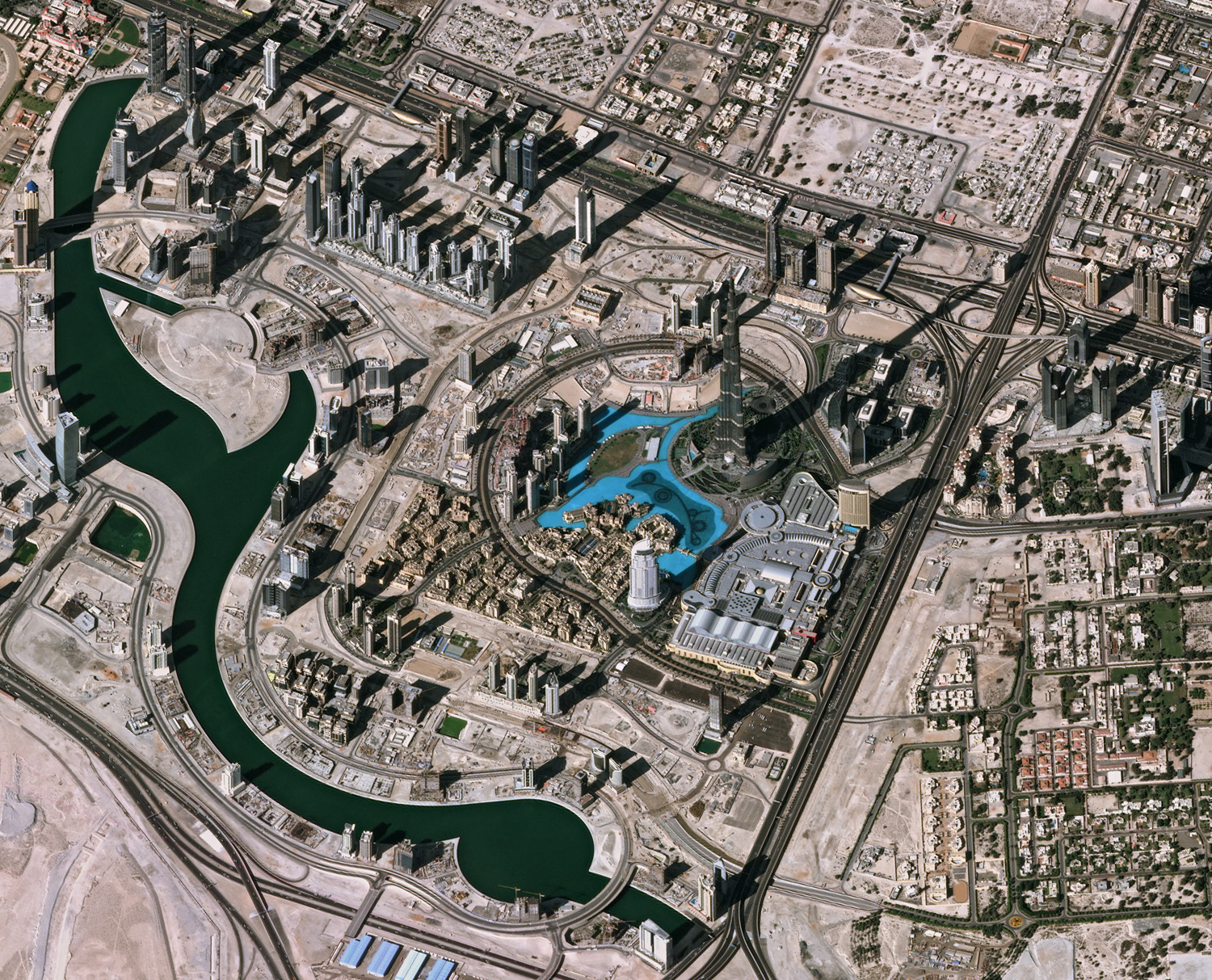
This image from
the Pleiades satellite shows part of Dubai in the United Arab Emirates. The
image was acquired by France’s Pleiades satellite on 4 January; there have
already been many changes to the road network shown in this picture.
The light blue area near the centre of the image is the man-made Burj
Khalifa Lake. Next to the lake sits the Burj Khalifa skyscraper. Its long
shadow is cast to the north (to the right in this image).
In the lake you can see the curves and circles of the Dubai Fountain. The
choreographed system shoots water 73 m into the air while accompanied by
music. The building, lake and fountain are part of a development called
Downtown Dubai. Covering an area of 2 sq km, the mixed-use complex is
estimated to cost US$20 billion.
Another notable structure of Downtown Dubai is the Dubai Mall, which appears
as a vast grey structure in this image. It is the world’s largest shopping
mall, and is also houses an aquarium and ice rink. The large, dark area is
where the saltwater Dubai Creek is being extended as part of the
construction of the Business Bay development. The area is expected to have
over 200 buildings for commercial and residential use.
Virgin takes on
Qantas
31 October 2012
It started with
Qantas jumping into bed with Emirates. in response Singapore Airlines has
taken a 10 per cent stake in Virgin Australia, the country’s second-biggest
airline, as it seeks to protect its position in the Australian aviation
market.
To add to the
confusion Etihad, also based in the UAE, already owns 10% of Virgin
Australia.
Routes between Australia and Europe are among the most fiercely contested in
the world, with Middle Eastern airlines such as Emirates and Etihad Airlines
battling a new breed of Chinese carriers and established players such as
Singapore Airlines and Thai Aiways.
The placement sees Singapore Airlines join Air New Zealand and Etihad on
Virgin Australia’s share register. Virgin Australia's biggest shareholder is
Sir Richard Branson, who owns 26 per cent.
The investment by Singapore Airlines was one of three deals announced by
Virgin Australia on Tuesday. The airline also launched a A$93m cash and
share offer to acquire Skywest, a regional airline focused on Western
Australia, and said it would pay A$35m for a 60 per cent stake in the
Australian operations of Tiger Airways, the Asian low-cost carrier 33-per
cent owned by Singapore Airlines.
The deals are the latest moves by chief executive John Borghetti to
reposition Virgin as direct competitor to Qantas, Australia’s biggest
airline. They will help Virgin diversify its earnings and allow it to
compete better with QantasLink, Qantas’s regional business, and its low-cost
arm Jetstar.
Mr Borghetti, a former Qantas executive, said "the acquisition of Tiger
Australia and Skywest provides Virgin Australia with a strong presence in
the budget, Fly-in Fly-out and regional markets, enabling us to fast-track
our expansions in these areas and become a stronger competitor.”
Tiger and Virgin plan to invest A$62.5m in lossmaking Tiger Australia to
fund growth and increase its fleet to 35 aircraft (from 11 now) by 2018.
The Skywest and Tiger transactions are subject to approval by industry
regulators and Australia’s Foreign Investment Review Board. The Singapore
stake sale has already received FIRB approval.
Aung San Suu Kyi's silence is wrong
29 October
2012
Aung San Suu Kyi
should understand hardship and suffering better than most.
Her silence as
Myanmar's Rohingya people are subject to violence and oppression is
therefore all the more unfortunate.
The violence in
her country's westernmost Rakhine State began in June, sparked by
allegations that a Buddhist girl had been raped by Muslim men. After an
uneasy lull, Buddhists again went on the rampage last week, killing more
than 100 members of the Muslim Rohingya minority community, who have been
suffering severe state persecution for decades.
Aerial photographs taken from the region show large areas of
Muslim-populated towns and villages razed to the ground. About 70,000 people
have so far lost their homes in the violence.
The Rohingya policy followed by the current government differs little from
the discrimination inflicted by the military junta that ruled Burma for the
past 50 years. Most Rohingya are regarded as non-Burmese Bengalis and are
locked out of Burma's political and social structure and denied fundamental
rights guaranteed by citizenship.
Suu Kyi's credibility is under threat; her moral authority evaporating as
she ignores a human rights tragedy in her own country.
Of course her
problem is that her political support depends upon Buddhist support. And she
has chosen to maintain her domestic support rather than aligning herself
with those same international human rights organisations and activists that
fought for her freedom.
Many young Burmese
are already critical of her, arguing that she has moved far too close to the
government and the military.
However, Maung Zarni, a Burma expert and visiting fellow at the London
School of Economics, has a different view, telling the Associated Press:
"Politically, Aung San Suu Kyi has absolutely nothing to gain from opening
her mouth on this. She is no longer a political dissident trying to stick to
her principles. She's a politician and her eyes are fixed on the prize,
which is the 2015 majority Buddhist vote."
It is hard to
agree - and can she and her supporters be that cynical when the long-term
consequences is that she will lose her moral credibility as well as the
support of most ethnic people.
The Rohingya are the little known Muslim people of the coastal Arakan state
of western Burma. Over the past three decades, the Rohingya have been
systematically pushed out of their homes by Burma’s military government and
subjected to widespread violence along with the complete negation of their
rights and even identity. They have become a stateless minority.
The new democratic reforms have not altered the perception of the Rohingya
with President Thein Sein stating in July 2012 in the wake of this violence
that he would not recognize the Rohingya or their rights and wished to turn
over the entire ethnic group to the United Nations’ High Commissioner for
Refugees. Buddhist monks, contrary to the teachings of Buddha, staged anti-Rohingya
marches in September to declare their support for the president’s proposal.
The Burmese government has blocked the Organization of Islamic Cooperation (OIC)
from opening an aid office to assist displaced Rohingya due to the violence
in Arakan state.
The systematic violence against the Rohingya must end before a truly
democratic Myanmar can be legitimate in the eyes of its own people and the
international community.
But the first step is for Aung San Suu Kyi and Burma to acknowledge the
Rohingya exist.
Meanwhile
Bangkok's Myanmar embassy has become a very busy place lately. The record
take in a day from visa fees, more than $32,000. Myanmar is open for
business. But its oppression of its own people cannot be ignored.
Europe's history lesson
19 October 2012
World War II: After the War (pictures and commentary)
It is to my great
shame that my understanding of the post WW2 history of Europe is as poor as
it is. After all I was a social and economic historian at University.
But like so many
Europeans from those bitter post war years I chose to leave. And while I had
always been fascinated y the migrants stories to Canada, the USA and
elsewhere I paid too little attention to the history of those who stayed
behind and who eventually rebuilt a continent
By the time the
Berlin Wall came down and eastern bloc communism has collapsed I was already
in Canada; experiencing my new world and not rebuilding an old world.
And it does take a
trip back to Europe, however short, to begin to appreciate the scale and
impact of change in a relatively short span of time
The end of the
Second World War in Europe was marked by brief triumph and then years of
retribution and hardship. Briefly cheering crowds filled the streets, danced
and drank. The period of anarchy and civil war that followed has been widely
forgotten.
The supreme irony
of the war is that across Europe, VE Day marked the end of one tyranny and
the beginning of another. Britain went to war to save Poland and actually
ended it by allowing the Polish nation and Eastern Europe to fall under
Stalin’s cruel despotism. It really was not much of a victory.
Landscapes had
been ravaged, entire cities razed and more than thirty million people had
been killed in the war.
For the rest it
was a matter of survival: in Allied-occupied Naples, the writer Norman Lewis
watched as local women, their faces identifying them as ‘ordinary
well-washed respectable shopping and gossiping housewives’, lined up to sell
themselves to young American GIs for a few tins of food.
Another observer, the war correspondent Alan Moorehead, wrote that he had
seen ‘the moral collapse’ of the Italian people, who had lost all pride in
their ‘animal struggle for existence’.
The institutions that we now take for granted - such as the police, the
media, transport, local and national government - were either entirely
absent or hopelessly compromised.
Crime rates were
soaring, economies collapsing, and the European population was hovering on
the brink of starvation. In Savage Continent, Keith Lowe describes a
continent still racked by violence, where large sections of the population
had yet to accept that the war was over or who were looking for new battles
to fight.
Individuals,
communities and sometimes whole nations sought vengeance for the wrongs that
had been done to them during the war.
Germans and
collaborators everywhere were rounded up, tormented and summarily executed.
The general rule,
though, was that the further east you went, the worse the horror became.
In Prague, captured German soldiers were ‘beaten, doused in petrol and
burned to death’. In the city’s sports stadium, Russian and Czech soldiers
gang-raped German women.
In the villages of Bohemia and Moravia, hundreds of German families were
brutally butchered. And in Polish prisons, German inmates were drowned face
down in manure, and one man reportedly choked to death after being forced to
swallow a live toad.
Yet at the time, many people saw this as just punishment for the Nazis’
crimes. Allied leaders refused to discuss the atrocities, far less condemn
them, because they did not want to alienate public support.
‘When you chop wood,’ the future Czech president, Antonin Zapotocky, said
dismissively, ‘the splinters fly.’
Not all the Germans who survived the war had supported Hitler. But in the
vast swathes of his former empire conquered by Stalin’s Red Army, the
terrible vengeance of the victors fell on them all, irrespective of their
past record.
In the little Prussian village of Nemmersdorf, the first German territory to
fall to the Russians, every single man, woman and child was brutally
murdered. ‘I will spare you the description of the mutilations and the
ghastly condition of the corpses,’ a Swiss war correspondent told his
readers adding ‘these are impressions that go beyond even the wildest
imagination.’
The same scenes
were repeated across Europe.
Concentration
camps were reopened and filled with new victims who were tortured and
starved. Violent anti-Semitism was reborn, sparking murders and new pogroms
across Europe.
Massacres were an
integral part of the chaos and in some places – particularly Greece,
Yugoslavia and Poland, as well as parts of Italy and France – they led to
brutal civil wars. In some of the greatest acts of ethnic cleansing the
world has ever seen, tens of millions were expelled from their ancestral
homelands, often with the implicit blessing of the Allied authorities.
Whereas war had
some sort of structure, leadership ad purpose post WW2 Europe was a
continent gone mad.
During WW2 Adolf
Hitler and Joseph Stalin had moved around entire populations like pieces on
a chessboard, seeking to reshape the demographic profile of Europe according
to their own preferences. But after the war the United States, Britain and
the Soviet Union were similarly guilty.
Between 1945 and 1950, Europe witnessed the largest episode of forced
migration, and perhaps the single greatest movement of population, in human
history. Between 12 million and 14 million German-speaking civilians—the
overwhelming majority of whom were women, old people, and children under
16—were forcibly ejected from their places of birth in Czechoslovakia,
Hungary, Romania, Yugoslavia, and what are today the western districts of
Poland.
As The New York
Times noted in December 1945, the number of people the Allies proposed to
transfer in just a few months was about the same as the total number of all
the immigrants admitted to the United States since the beginning of the 20th
century. They were deposited among the ruins of Allied-occupied Germany to
fend for themselves as best they could. The number who died as a result of
starvation, disease, beatings, or outright execution is unknown, but
conservative estimates suggest that at least 500,000 people lost their lives
in the course of the operation.
Most disturbingly of all, tens of thousands perished as a result of ill
treatment while being used as slave labor (or, in the Allies' cynical
formulation, "reparations in kind") in a vast network of camps extending
across central and southeastern Europe—many of which, like Auschwitz I and
Theresienstadt, were former German concentration camps kept in operation for
years after the war.
As Sir John
Colville, formerly Winston Churchill's private secretary, told his
colleagues in the British Foreign Office in 1946, it was clear that
"concentration camps and all they stand for did not come to an end with the
defeat of Germany." Ironically, no more than 100 or so miles away from the
camps being put to this new use, the surviving Nazi leaders were being tried
by the Allies in the courtroom at Nuremberg on a bill of indictment that
listed "deportation and other inhumane acts committed against any civilian
population" under the heading of "crimes against humanity."
The postwar expulsions amount to the most significant example of the mass
violation of human rights in modern history. Worse they are commonly
justified as retribution for Nazi Germany's wartime atrocities or a painful
but necessary expedient to ensure the future peace of Europe.
Even at the time,
not everyone agreed. George Orwell, an outspoken opponent of the expulsions,
pointed out in his essay "Politics and the English Language" that the
expression "transfer of population" was one of a number of euphemisms whose
purpose was "largely the defense of the indefensible."
Typical though was
this British view that widespread suffering was a salutary form of
re-education of the German population. "Everything that brings home to the
Germans the completeness and irrevocability of their defeat," Deputy Prime
Minister Clement Richard Attlee wrote in 1943, "is worthwhile in the end."
And the Americans,
as Laurence Steinhardt, ambassador to Prague, recorded, hoped that by
displaying an "understanding" and cooperative attitude toward the expelling
countries' desire to be rid of their German populations, the United States
could demonstrate its sympathy for those countries' national aspirations and
prevent them from drifting into the Communist orbit.
What saved Germany from catastrophe; a 30-year-long "economic miracle" that
made possible the housing, feeding, and employment of the largest homeless
population with which any industrial country has ever had to contend; the
same miracle that propelled Germany to economic leadership if the European
Union.
An attempt to
summarise the economic recovery of Europe and the growth of the European
Community as a counter to Russia's control of Eastern Europe can wait until
another day.
Succession Planning recommended for Thailand
24 October 2012
Since Bangkok
Pundit nails this rather then rewriting an article here is BP's take on
today's article in the Nation. The trouble is I dount that anyone at The
Nation realised the irony of what they were publishing. Because succession
planning at Thailand's royal family is the one matter that cannot be
discussed depsite its huge importance to the future of the country.
Bangkok Pundit: The Nation‘s business section has an article entitled
“Succession planning vital in family-owned businesses”. The opening:
In an exclusive interview with The Nation, Kevin Tay, managing director,
senior adviser and head of wealth and tax planning, Asia, at Julius Baer, a
global private banking institution, explains that family-owned businesses in
Asia have started to recognise the need for business succession planning
before their patriarch pass away. Wichit Chaitrong reports.
Those who do not produce a wealth and business succession plan before they
die are risking family disputes among later generations and losing business
to outsiders, said the wealth and tax planning expert.
“If you leave your entire asset succession plan open and nobody knows what
is going to happen, potentially you are leaving a problem for the future,”
he said.
Some people may think that the patriarch of a family should share assets
equally among his children, based on the fair-share principle, but such an
approach may not be practical when a business is involved, he said. For
instance, if the head of the family has five sons, each would get 20 per
cent under the equal-share approach. In this scenario, control of the
business would be given to the eldest son, and the other four would await
their dividends from the company.
Two things are possible in such a situation. Either all the brothers trust
one another to do the right thing for the family business, or the brother in
control of the business wonders why he is working so hard yet only has a
20-per-cent stake in the operation.
BP: Indeed. Wise words published in The Nation. Even if things now appear
clearer on the succession plan but without a clear succession plan that the
patriarch has not publicly endorsed, you are just creating uncertainty…
The American elections: He said, she said
24 October 2012 Editorial The Guardian
The US presidential campaign still has two weeks to run, but it is already
possible to say that whichever man wins, democracy will be one of the
losers. There has of course never ever been a perfectly fair and honest
election in any of the countries which claim the democratic title. Dirty
tricks are part of the process, understood, fallen for, seen through, and
sometimes even relished by the voters. Trollope wrote of an election agent
profoundly puzzled by the proposition that bribing citizens with free beer
was in some way unethical, while Mark Twain satirically advised politicians
to "Get the facts first. You can distort them later."
Yet the failings evident in the American contest this time may be of a new
order, and they could be critical. To put it at its simplest, the election
is so close that its outcome may be determined by whether the lies told
during the campaign, above all by the Republican side, stick or not. Because
the candidates are so close, because the country has been so submerged by
wave after wave of negative advertising, and because the falsehoods and
unacknowledged shifts of position have come so thick and fast, mendacity
could triumph over merit. If it does so, it will be because democracy's main
tool for checking deception, the media, have fallen short of their duties.
When politicians find they can make assertions and perpetrate falsehood
without fear of being exposed, or at least of being exposed in front of the
broader public, some of them will do so.
The reasons are various. Elements of the American media, like Fox News, are
partisan to the point of outright distortion, while others are hampered by
what Paul Krugman has called the "cult of balance", refusing to directly
contest misleading statements by politicians and instead only offering the
other side the opportunity of rebuttal, or leaving to columnists and
commentators the task of judging political assertions. Contradicting
politicians in news stories was not done. Barack Obama has himself
justifiably complained of "false balance", implying that this so-called "he
said, she said" narrative, ostensibly even-handed, misleads, confuses and
bores the citizen. Both partisanship and the problem of false equivalence,
assigning equal weight to each side's position in the search for balance,
have contributed to a steep decline in trust in the accuracy of reports in
the American media.
The United States is not alone in these developments, but it is,
unfortunately, further down this road than other nations in the democratic
family. Where the partisan press cannot be trusted to check the facts
offered by the politicians they favour or accept the versions offered by
those they do not, and the more independent or liberal press will not do so
in either case, democracy is clearly in trouble.
It is true that, as the campaign has run its course, some American
journalists have raised their game, nudged along, in part, by the social
media. Political assertions have been contested in news stories, while one
moderator, Candy Crowley, brusquely contradicted Mitt Romney in the second
presidential debate when he tried to maintain that Mr Obama had not termed
the attack on the Benghazi consulate an act of terror. The stunned
expression on Mr Romney's face when she did so showed, however, how rare
such interventions remain. Republicans then heaped abuse on her, helped by
the fact that she was herself guilty of an error, although a lesser one.
Whatever the rights or wrongs of that incident, the fact checkers have got
their act together rather late in the day. American voters will thus soon be
deciding on issues that have been presented to them in a particularly
distorted way, and making a judgment on character clouded by the way in
which one candidate, Mr Romney, has segued from the aggressive right of the
spectrum to somewhere near the centre, particularly in foreign policy, as
Monday night's debate showed.
Emerson said that if you threw a fact out of the window you would come back
later to find it sitting in the chimney corner. But that might well be after
you had voted.
PC Air grounded, passengers stranded
24 October 2012
Months after taking to the skies with Thailand's first transsexual cabin
crew, fledgling carrier PC Air has suspended services over financial
troubles that left passengers stranded in South Korea.
'The airline informed the Department of Civil Aviation on Friday that they
cannot operate their charter flights due to business problems,' Thai Deputy
Transport Minister Chadchart Sittipunt told AFP. 'So it will suspend its
services,' he added.
The move is expected to last until at least the end of the month.
PC Air hit the headlines earlier this year when it hired four transgender
cabin attendants in a highly publicised recruitment drive to operate charter
flights from Bangkok to Hong Kong and other Asian destinations.
But the privately owned carrier drew less welcome attention last week when
its only aircraft was unable to take off from Seoul's Incheon Airport
because the company could not pay its service and fuel fees.
PC Air has blamed its South Korean agent for the unpaid bill, which left
several hundred passengers stuck in Seoul.
PC Air has a
single Airbus A310.
Rather strangely
the Transport Ministry has said that is unlikely to strip PC Air of its
operating licence because if it does so the airline will be unable to
generate income to compensate hundreds of passengers it left stranded.
If its operational licence is revoked, it will go bankrupt while still
carrying the compensation burden, Deputy Transport Minister Chatchart
Sithipan said yesterday.
And there goes yet
another Thai airline added to the long list of failed Thai air carriers.
The Scottish
divorce
16 October 2012
I really have no
objections to this - if the Scottish want to end their 305 year old
political union with England then let them.
Although it is
entirely opportunist - if they had no offshore oil they would still be
looking for handouts. But fortune favours the geologically fortunate.
It is also a
wonderful political strategy for SNP leader Alex Salmond; as it quarantees
two years on investment and support for Scotland from the UK government who
will take no action that might increase support of the independence cause.
At the moment
around a third of Scotland's 4 million voters believe that Scotland should
leave the UK and become independent. They believe Scotland's economy, its
social policies and its creativity would flourish if it had much greater
autonomy. For now a majority of Scots disagree. They believe Scotland is
more secure within the UK, but many want the Scottish parliament to have
greater financial and legal powers; which suggests a middle line of some
kind of greater devolution - devolution plus?
On 15 October 2012 Alex Salmond, the first minister of Scotland, and David
Cameron, the UK prime minister, signed the "Edinburgh agreement." This gives
the Scottish parliament the legal power to stage an historic referendum on
independence before the end of 2014. Salmond is believed to favour October
2014 for the vote but has not yet revealed his preferred date.
The referendum will instead ask a single "yes or no" question on
independence.
The love hate relationship between England and Scotland has deep roots. 700
years ago the Scots were fighting for independence led by William Wallace
and then Robert the Bruce. He defeated Edward II, then attempting to
subjugate Scotland, at Bannockburn in 1314.
After other cross
border disputes, including Scotland's defeat at Flodden by the English in
1513, the Scottish and English crowns were unified in 1603 when King James
VI of Scotland became overall monarch of the British isles.
In 1707, that union was cemented by Scotland and England's political union,
forced on Scotland in part by a financial crisis following the abject
failure of its colony in Panama, the so-called Darien adventure. All
political power moved to London, but Scotland retained its own legal system,
churches and universities.
In 1745, the
pretender to the British throne, Bonnie Prince Charlie, led the Jacobite
revolt against Hanoverian (the Georges) rule by London. Despite reaching as
far south as Derby, that ended in crushing defeat at Culloden in 1746.
In the 1800s, Scotland's economy strengthened, its cities boomed and its
citizens took a leading role in the British empire. But proposals to give
Scotland some form of "home rule" within the UK have been live since William
Gladstone's era as Liberal leader in the 1880s. After several failed
attempts at Westminster, notably in 1913 and 1979, a Scottish parliament was
finally re-established in 1999 in Edinburgh with wide-ranging policy making
and legal powers but dependent on a direct grant from London.
In May 2011, Alex Salmond and the SNP unexpectedly won an historic landslide
victory giving the nationalists majority control of the Scottish parliament,
enabling the first minister to demand that independence referendum.
In spring 2013, the Scottish government is expected to table a referendum
bill, setting out the question, the size of the electorate – including
whether 16 and 17 year olds will be allowed to vote for the first time in a
major UK poll, and how much the "yes" and "no" campaigns can spend.
Alex Salmond has posed the question "Do you agree that Scotland should be an
independent country?" as his preferred question on independence. Election
and polling experts say that is not neutral enough, since people find it
harder to reject a question asking them to "agree" to something. The
Electoral Commission could well ask for that to be amended, to make it more
neutral.
The bill is timetabled to get royal assent in November 2013, when the
Scottish government will also publish a white paper detailing its
"prospectus for independence" and setting out the Scottish National party's
vision for an independent Scotland.
In June 2014, the final 16 week referendum campaign leading up to a
referendum expected to be held in October 2012 would be due to start. Then
both pro-independence and pro-UK campaigns will intensify, with millions of
pounds being spent on television broadcasts, advertising and rallies.
What would independence mean - well for someone born in Scotland it
should mean a greater direct say over one's government and more political
freedom, but also greater economic risks, less security and more differences
with England.
For the rest of
the UK it would mean that a shrinking UK economy will be even smaller, oil
and whisky might be more expensive, British identity would be diluted and
Britain's status overseas could be weaker.
Outside the UK Scotland is expected to remain in the EU, so there will be
few major changes for tourists or investors.
Fundamental to the
SNP's economic plans, Scotland would get a 90% geographical share of North
Sea oil and gas fields based on the division of the UK's territorial waters
after independence. This would mean Scotland would keep 81% of current oil
and gas receipts, recently worth between £6bn and £12bn a year.
The 2014 date is important as it touches on nationalist ideals. It is both
the 700th anniversary of the Battle of Bannockburn, an iconic event for
nationalists, and a year of significant cultural and sporting events in
Scotland, including the 2014 Commonwealth Games in Glasgow, the Ryder cup
golf tournament at Gleneagles and the Year of Homecoming, a celebration of
Scottish culture and the Scots diaspora. SNP ministers also believe the
Tories and Lib Dems in the UK coalition government will be in conflict in
the run-up to the 2015 general election.
David Cameron has since announced the UK government will be staging a series
of events to commemorate the 100th anniversary of the start of the First
World War, believing that will help shore up support for the UK and counter
Salmond's pro-Scotland initiatives.
If the pro independence group does win the referendum can Scotland simply
declare independence? Not immediately. All the key issues, like Scotland's
share of UK debt, dividing up North Sea oil fields, a possible currency
union, taking over military, naval and airforce bases and UK government
offices, would need to be negotiated. It is unclear how the UK parliament
would approve any deal. There would also be a transition period before that
process was complete which could take several years.
Is Lance Armstrong the ultimate dope?
11 October 2012
BBC Sport
When Lance Armstrong celebrated his record-breaking seventh Tour de France
title in 2005, he made the following prescient speech: "I'll say to the
people who don't believe, the cynics and the sceptics: I'm sorry for you.
I'm sorry you don't believe in miracles."
It was vintage Armstrong, at once belittling his critics, burnishing his own
legend and scripting another Hollywood-ready line to a story that spoke only
of heroism and sporting immorality.
That golden narrative, weakened and wobbled over the intervening years by a
drip-drip of accusation, evidence and testimony, may now have been washed
away forever.
The US Anti-Doping Agency's long-awaited report into the methods used by
Armstrong and his team-mates to achieve his sainted status is unequivocal.
The report describes those methods as "the most sophisticated,
professionalised and successful doping programme that sport has ever seen",
run by a "serial cheat" through "the use, administration and trafficking of
performance-enhancing drugs and methods".
Armstrong report key claims:
•Achievements of USPS/Discovery Channel pro cycling team accomplished
through the most sophisticated, professional and successful doping programme
that sport has ever seen
•Armstrong's career at the team was fuelled from start to finish by doping
•More than a dozen former team-mates, friends and former team employees
confirm a fraudulent course of conduct
•Armstrong acted with the help of a small army of enablers, including doping
doctors, drug smugglers and others within and outside the sport and his team
•He had ultimate control over not only his own personal drug use but over
the doping culture of the team
•Team staff were good at predicting when testers would turn up and seemed to
have inside information
•Evidence is beyond strong and as strong as any case brought by Usada in its
existence
Armstrong, a modern-day American icon way beyond the narrow confines of his
tainted sport, is accused of not just fixing a race, or a match, or even a
season. He has fixed an era. He has duped a nation.
"Say it ain't so, Joe," that young Chicago White Sox fan is supposed to have
asked of 'Shoeless' Joe Jackson as the first great American sporting scandal
broke almost a century ago.
Is there a chance, Lance? Could Armstrong emerge from this storm still
clinging to his halo, with any semblance of his reputation still intact?
His lawyers have declared Usada's report a witch-hunt, a kangaroo court
"based largely on axe-grinders, serial perjurers, coerced testimony,
sweetheart deals and threat-induced stories".
The 1,000 pages of forensic evidence would suggest otherwise. Armstrong
acolytes might scoff at the testimony of self-confessed dopers Tyler
Hamilton and Floyd Landis, even if others would not. But those two are
joined by nine other former US Postal team-mates, including such loyal
lieutenants as George Hincapie, Frankie Andreu and Levi Leipheimer.
Between them they describe, in rich, grotesque detail, both the broad scope
and the daily minutiae of an unprecedented doping regime. Alongside them
stand thousands of words of scientific evidence, financial records and email
exchanges. It is exhaustive, meticulous and damning.
Another line used by Armstrong advocates is that he was doing nothing that
his rivals weren't, that in a muddy playing-field made level by universal
doping he was still the best rider, the toughest in training, the worthiest
winner.
Usada's report renders this myth untenable. "The USPS Team doping
conspiracy," states chief executive Travis Tygart, "was professionally
designed to groom and pressure athletes to use dangerous drugs, to evade
detection, to ensure its secrecy and ultimately gain an unfair competitive
advantage through superior doping practices."
Armstrong, it is made clear, was not a helpless pawn forced by others to
cheat to keep up. He was an instigator, a ring-leader and a pioneer.
In Dr Michele Ferrari, he harnessed himself to the dark master of doping
science, paying the most to work with the best, less dancing to another's
tune than writing and playing it himself. Those who tried to ride clean -
"pan y agua", in the sport's parlance - were left with no chance.
Perhaps the most unpalatable paragraphs in the report relate to Armstrong's
coercion of younger riders.
Christian Vande Velde, dropped from US Postal for the 2002 Tour, says he was
told by his compatriot and mentor that "if I wanted to continue to ride for
the Postal Service team I would have to use what Dr Ferrari had been telling
me to use, and would have to follow Dr Ferrari's program to the letter".
Both Michael Barry and Dave Zabriskie were also lured in by Armstrong and
team director Johan Bruyneel. Zabriskie, who as a kid had used cycling as an
escape from his father's own drug addiction, admits in his testimony that he
"went back to my apartment and had a breakdown" after finally succumbing to
the pressure to dope himself.
Armstrong has frequently stated that he passed more than 500 drug-tests
during his career. It is another defence exploded by Usada's relentless
detail. Not only was that number probably closer to 250, but so easy were
the tests to evade or deceive that it appears Armstrong often found it
comical.
There was no test for EPO until 2000. The window for detection, when there
was, was tiny; when Ferrari advised injection direct into the vein rather
than skin, it almost closed entirely.
Blood transfusions remained undetectable. When testers were on their way,
Armstrong and his team frequently knew in advance; when they did arrive,
saline drips could mask any evidence.
Neither was Armstrong's doping a one-off reaction to unrelenting external
pressure. He doped before cancer; he doped after cancer; he doped through
his glory years; and he doped in his comeback. His blood values in his
valedictory 2009 and 2010 Tours, state an expert, had "less than a one in a
million chance" of being natural.
There is more - the intimidation by Armstrong and his handlers of witnesses
and their vitriolic attacks on critics, what Usada calls "a massive and
long-running scheme to cover their tracks, tarnish reputations, lie to
hearing panels and the press and do whatever was necessary to conceal the
truth". There are payments of $100,000 and $25,000 to the UCI, cycling's
governing body, to supposedly - and disturbingly - assist in anti-doping
efforts.
For some, none of that matters. Armstrong, through his foundation, has
raised an estimated $500m to fight cancer. That is enough, for those
unsurprised or unmoved by sporting fraud, to forever hold him in
unquestionable esteem.
Others may struggle with the contradictions of a man ostensibly promoting
health while compelling team-mates to take illegal and untested drugs, of a
fund-raiser who ran a team that fraudulently received "tens of millions of
American taxpayer dollars in funding", of an inspirational figure who
cheated to achieve the very triumphs he is venerated for.
Armstrong's comeback from cancer to dominate the world's toughest bike race
was such a wonderful story that people want to believe that it is true. So
great a hero was he to so many that some are still reluctant not to.
Heroes are often nuanced. Other greats have also ascended to the heights on
tarnished wings - sprinters Ben Johnson and Marion Jones, baseball player
Barry Bonds.
Armstrong, no simple doper but the head of an organisation that fostered and
administered it, now appears to have gone far beyond their nefarious deeds.
At least he told the truth about one thing: it wasn't about the bike, after
all.
Will he ever come clean, as each of his team-mates finally has? The US
culture of celebrity confession and subsequent forgiveness offers him one
path out of this mess, his foundation another.
Until then, he is likely to remain trapped in ever more outlandish,
embittered denials, lost to the real world, fighting a battle already lost
Why all the fuss over Fujairah?
9 October 2012 - Open Democracy (originally published in June 2012)
Behind the sabre rattling, analysts should not overlook growing
relationships between the emirates and Asian countries.
No-one knew where Dubai was 15 years ago. I remember summers in the UK,
attempting to explain to other kids exactly where it was that I lived. I
would grasp at Saudi Arabia, Oman, Iraq, even geographically distant Egypt
in an attempt to verbally construct a map of the Gulf. It’s quite the
opposite now - a mention of Dubai is met with knowing nods of recognition.
Instead, I’m often asked to clarify if Dubai is a city or a country in its
own right, such is its larger than life reputation. Abu Dhabi aside, the
other emirates are largely unknown and unreported.
But in the past week, it has been Fujairah making headlines in the
international press. Known by UAE expats for snorkelling and scuba diving, a
weekend trip is a welcome change of scenery; swapping high rises and sand
for the Hajar mountain range and the odd donkey. Now, the emirate has been
featured by the likes of Bloomberg Businessweek ↑ , (who called it “the
crucial Emirate”) and Monocle ↑ as the next possible boomtown.
Why all the fuss? Up until now, it has remained something of a small,
sleepy, backwater, subsidised by Abu Dhabi and underdeveloped in comparison.
But unlike the UAE’s six other emirates which sit on the Persian/Arabian
Gulf, Fujairah lies on the Gulf of Oman; beyond the infamous bottleneck of
the Strait of Hormuz ↑ . A 400km pipeline running from Abu Dhabi’s oil
fields in Habshan to Fujairah’s ports is due to open ‘soon’ (there are no
more specifics on the timeline of this delayed project). Carrying two thirds
↑ of the UAE’s oil, the pipeline by-passes the Strait of Hormuz and
effectively dampens Iranian threats of cutting off supply.
This news is clearly pertinent to the sabre-rattling relationship between
the UAE and Iran. But most intriguing is the partnership involved in
building the project. Helping to construct the pipeline was a subsidiary
company of the China National Petroleum Corporation.
Much has been reported on China’s involvement in Africa, but their dealings
in the Arab world have been less scrutinised (a notable exception is this
Foreign Policy article ↑ from 2010). Oil hungry, China juggles partnerships
in the GCC energy sector while pledging to pump $50 billion over five years
into Iranian projects. Collaboration in the UAE goes beyond energy needs.
Aside from Dragonmart, the 150,000 square metre mall facilitating Chinese
trade in the UAE, in May this year Abu Dhabi real estate firm Aabar signed a
construction deal ↑ with a Chinese state firm, while Dubai’s Meydan
Racecourse has invested to develop the equestrian scene ↑ in Tianjian.
But the Chinese aren’t the only country strengthening ties to the UAE.
Returning to Dubai from Seoul, what is apparent is the swelling South Korean
expatriate population. With partnerships in oil, gas, construction and
engineering, South Korea secured the $20bn contract to develop nuclear
energy in the UAE, which was widely expected to be given to a country with a
more established nuclear energy sector, such as France. The impact of these
developing links is subtle but evident. The influx of South Koreans means
that two out of five students in my Arabic class were Korean, new Korean
restaurants are opening, and cinemas are showing a Korean film.
The UAE has some of the largest Chinese and Korean populations in the Middle
East. While GGC-Iran relations are more visible in foreign affairs, analysts
should not overlook growing relationships with Asian countries.
Qatar Air joins One World
8 October 2012
The widely
rumoured, but also widely denied, entry of Qatar Airways into an airline
alliance has finally been confirmed at a press conference in New York this
afternoon as the Middle Eastern carrier officially joins the Oneworld
alliance.
Qatar Airways is the first of the three major airlines based in the Gulf
(the others being Emirates and Etihad) to sign for any of the global airline
alliances. The Doha-based airline's implementation into Oneworld is expected
to take between 12 and 18 months.
British Airways will serve as Qatar’s sponsor in joining Oneworld, supported
by the central alliance team, mentoring the recruit through its alliance
implementation programme.
Qatar Airways will be Oneworld's second member airline based in the Middle
East, alongside Royal Jordanian, which became the first airline from the
region to join any of the global alliances when it joined in 2007.
Qatar Airways' network serves 120 destinations in 70 countries in the Middle
East, Europe, Africa, North and South America, Asia and Australasia. Fifteen
of its destinations and three countries - Iran, Rwanda and the Seychelles -
will be new to Oneworld.
Qatar Airways already code-shares with Oneworld member designate Malaysia
Airlines.
Once Qatar becomes part of Oneworld its Privilege Club frequent flyer
members will be able to earn and redeem rewards on any other alliance
carriers, with top tier members able to use any of the group's 550 plus
airport lounges.
At the same time, frequent flyer cardholders of other Oneworld airlines will
be able to earn and redeem rewards when flying on Qatar Airways and can
access Qatar Airways' lounges.
Qatar Airways chief executive officer Akbar Al Baker said: "Alliances are
playing an increasingly important role in the airline industry today - and
that will continue long into the future. Qatar Airways has carefully
reviewed its strategic options and it is very clear that joining Oneworld is
by far the best way forward for us as we look to strengthen our competitive
offering and give passengers what they fully deserve - more choice.”
I suspect this may
not have much to do with the passengers but more to do with Qatar Airways
bottom line. There should be cost savings from the alliance though
centralised purchasing, shared information systems etc. There is also the
flow of passengers from other member airlines onto Qatar's airplanes filling
capacity and increasing yields.
Willie Walsh, chief executive of IAG, parent of British Airways and Iberia,
said: "In Qatar Airways, Oneworld is pleased to welcome another great
airline that will enhance Oneworld's network and product offerings in one of
the world's fastest growing regions for air travel demand.”
The news comes on the same day that Etihad, Air Berlin and Air France / KLM
announced a series of code shares which will see passengers from all four
airlines move across each others’ networks.
Only a week ago
when asked by Reuters if the carrier (Qatar) would join oneworld Al Baker
said: "No, we will not. It's all rumors." He was speaking on the sidelines
of a conference in the UAE capital.
Sometimes a simple
I cannot comment would be so much easier and engender some trust.
India is still
unravelling
8 October 2012 - Reuters Breakingviews
India is still
unravelling. Nine months ago, Reuters Breakingviews published a three-part
series on the state of the country's economy. At that time, most economists
projected GDP growth of around seven percent in 2012, a sharp drop from the
near-double digit expansion of the boom. Today, India has fallen further
behind. The case for economic reform - and a realignment of the political
system - remains as strong as ever.
Notwithstanding recent policies unveiled by Prime Minister Manmohan Singh on
what has been called "Big Bang Friday", growth expectations have fallen
further. And though the political gridlock that has dogged the Congress-led
government throughout its eight years in office may finally have been
broken, missed opportunities, government handouts and corruption scandals
have taken their toll.
India faces three big economic challenges: reforming its energy industry;
drawing a line under the era of crony capitalism; and reducing the burden of
regulation. Achieving these goals might require a new political force to put
its hands on the reins of power.
Indian energy is unsustainably cheap. The $35 billion debt of India's
state-run electricity boards - now in the process of being restructured - is
just one manifestation of how power has been under-priced. Fuel subsidies,
meanwhile, are crippling the government. The OECD estimates that cheap
diesel alone costs the government three percent of GDP every year:
equivalent to half of last year's budget deficit.
Pricing power properly would not only ease the pressure on government
finances: it would also boost the value of state-owned firms. For example,
Coal India sells its output at around 70 percent of international market
prices, according to The Children's Investment Fund. The company generates
$8.30 of EBITDA per tonne of coal: China's Shenhua makes $45.70 per tonne.
If Coal India could double its EBITDA per tonne that might add $20 billion
to its value. More efficient power pricing would also improve resource
allocation, stimulate investment, and increase supply. India's recent huge
power outage, which left half the nation without electricity in August,
demonstrates how critically that is needed.
Then there is the state's lackadaisical approach to guarding its assets.
Valuable telecom spectrum was given away for $29 billion less than it was
worth in 2008. Next came the "coalgate" fiasco, where the government stands
accused of handing out coal blocks to corporate giants at a loss of $33
billion. The Supreme Court has already insisted that the government must in
future auction such assets. That's sensible, but it's not the end of the
story. The government still needs to address the perception that there has
been a huge transfer of wealth from the state into private hands. Even if
the businesses were only following the rules, there's a case for levying a
one-off tax to claw back the windfall they received.
Finally, India needs deep structural reform which promotes productivity and
wealth creation. The reforms of 1991 heralded an end of the "License Raj"
during which time businesses were strictly controlled by the state. But
progress has been slow. The World Bank last year ranked Indian 132nd out of
183 countries in terms of ease of doing business. Starting a new business in
India still requires 57 different approvals. New Delhi, meanwhile, boasts a
total of 77 ministers with overlapping remits in areas such as drinking
water, sanitation and water resources.
A reforming government could set about rationalising bureaucracy and archive
archaic laws which are no longer relevant. Some in the Indian government are
already trying. Jyotiraditya Scindia, the Stanford-educated son of a
Maharaja who is now a junior commerce minister, has launched a website that
will allow entrepreneurs to apply for all the clearances they need to start
a business. Simplifications of this kind will make India friendlier to
business.
The key question is whether recent reforms can be sustained. A small
reduction in diesel subsidies is a good start, as is allowing foreign direct
investment (FDI) in the retail and aviation industries. But even these
measures face resistance. One of the least positive aspects has been the
right wing opposition's stance. Instead of holding Congress to account for
its economic mismanagement, the BJP has led the fight against recent
reforms.
India's youthful population is badly served by this system. In the last
decade, the country has alternated between coalition governments of either
the left-leading Congress Party or the Hindu nationalist BJP with a
collection of parochial regional parties. In India, the need for a new voice
is great. A party with a national agenda, not beholden to any one region,
could make the country's political system more effective.
Such a movement would need to develop a new style of political campaigning,
targeting 50 or so winnable seats. It would also need untainted cash. Mass
fundraising could be a way of both campaigning and building momentum.
India's 100 million internet users and 900 million mobile phone owners could
be tapped for small sums. And roping in a Bollywood hero like Aamir Khan,
whose TV show has made him the India's answer to Oprah Winfrey, could add
glamour and mass market appeal. With only two years to go before the next
election, time is running out. But if India's reformers get their act
together, they could change the nation.
All Three Airline Alliances Undergoing Big Changes
8 October 2012
- Aviation Week
"Qatar Airways is expected to finally announce it will join the Oneworld
alliance later today in New York. Oneworld will celebrate the deal as an
important milestone in the its development. The question is: what
development? The past few weeks have seen fundamental change in the
landscape of long-haul air travel. Qantas Airways was the first to announce
a U-turn by forming a bilateral partnership with archrival Emirates while
dropping a long-standing joint venture with British Airways. Etihad Airways
is pushing its German Oneworld partner Air Berlin to go for a bilateral deal
with Air France and put less emphasis on the global alliance. And Qatar
Airways, now welcomed into the camp of its former opponents, may simply
illustrate the surrender of European and Asian legacy carriers.
Increasingly, more of those legacy airlines are recognizing that they will
not be able to curtail the growth of Qatar, Etihad and Emirates. Attempts to
fend Persian Gulf carriers off have included limiting traffic rights,
lodging complaints about state subsidization, and filing arguments against
export credit support, citing unfair competition. None of the strategies
worked, partly because European and Asian carriers certainly also have
benefited from subsidies. Now the idea seems to be: “If you can't beat them,
join them.”
But there is another underlying trend that must have all the alliances
worried: Most carriers seem to prefer strong bilateral ties over the global
groups that are sometimes too restrictive in allowing their members other
partnerships and too demanding in terms of integration of sales tools.
In addition to Air Berlin and Qantas, TAM Brazil's experience highlights the
shift. TAM is expected to exit the Star Alliance as a result of its merger
with LAN. The two South American-based airlines formed the Latam Group this
year. That was TAM's first decision against alliances. Its second could be
that it might eschew Oneworld, even though LAN is a founding member.
Becoming an independent airline would enable TAM to retain its bilateral
ties with Star Alliance carriers while reaping the benefits of its merger
with LAN.
Qatar Airways has been negotiating its admission into Oneworld for months.
Oneworld has traditionally had a more relaxed approach toward what members
are allowed to do outside of the alliance. But it speaks volumes that it has
selected Qatar to strengthen its Asian operation. In a strange way, it is
countering the all-but defection of Qantas to Emirates by mirroring the
effort.
Admitting Qatar could also be a sign that Oneworld is not sure whether Hong
Kong's Cathay Pacific Airways is going to stay for the longterm. And even if
it does, the value may be limited: Cathay cannot introduce a joint venture
with British Airways on the all-important London route because such an
arrangement would never be allowed by the regulatory authorities. On the
other hand, Cathay is tied to Air China, a Star Alliance member, through
cross-ownership. Even traditionally restrictive Star had to accept this.
Etihad has an extensive network of nearly 40 bilateral code-sharing
agreements that contributes around 20%—or close to $1 billion—to its annual
revenues. It has abstained from alliances so far and if there was one option
for the airline, it would probably be Air France-KLM's SkyTeam. That is
because it is currently negotiating a code-sharing deal with Air France.
Talks have been “very good and are continuing,” says Etihad CEO James Hogan.
While the
negotiations primarily involve Air France and Etihad, an eventual deal would
also include its affiliate Air Berlin. “If there is an opportunity, we would
be keen to see that happen,” Hogan tells Aviation Week.
Linking Air Berlin with Air France would not automatically put into question
the German carrier's membership in Oneworld in the short term, but it would
shift the carrier's network priorities to align even more with the broader
Etihad strategy and raise the question of how much added value the alliance
membership brings. Hogan's opinion is that “Oneworld is secondary.”
Etihad bought a 29% stake in Air Berlin late last year for $105 million,
while also providing a $255 million loan to its new partner. The German
carrier's financial results have been deteriorating rapidly, but Hogan says
he is convinced the company will turn the corner. He predicts Air Berlin
will return to profitability “in the next 12-18 months.” And “they won't
need another loan.”
Hogan cites ex-BMI CEO Wolfgang Prock-Schauer's appointment as the head of
network and strategy at Air Berlin as important. The network “needs to be
refreshed” and Air Berlin executives “know they have to make tough
decisions.” Etihad has “no intentions” to fly North Atlantic routes from
Europe, even though the bilateral air service pact between Germany and the
United Arab Emirates grants UAE carriers limited fifth freedom rights to the
U.S.
Etihad is close to announcing ties with Garuda Indonesia. The arrangement
primarily concerns code sharing. Garuda's planned entry into the SkyTeam
alliance was recently pushed back until 2014, mainly to allow more time to
resolve information technology issues."
Gulf airline Etihad partners with Air France-KLM
October 8, 2012
UAE based Etihad Airways today announced that it will jointly market some of
its flights with Air France-KLM in what could be the beginning of a larger
strategic alliance.
For now the deal covers codesharing on flights between Etihad's hub in the
United Arab Emirates' capital Abu Dhabi and Amsterdam and Paris, as well as
some connecting flights to European, Asian and Australian destinations.
Codeshare deals, in which passengers can buy a single ticket to fly on
multiple airlines, are common in the airline industry. They allow carriers
to expand their reach without having to launch or acquire the right to
operate additional routes.
Etihad, though, is suggesting the agreement may lead to deeper ties with the
Franco-Dutch airline operator. Its statement envisions the codeshares as the
first phase of a "much larger strategic partnership" that could see the
airlines team up on frequent flier programs, and cut costs by cooperating on
procurement, aircraft maintenance and repairs.
Or that Etihad
could end up as part of the Skyteam air alliance.
Air France-KLM has also agreed to share its codes with Etihad partner Air
Berlin on routes between France and Germany. Etihad bought nearly 30 percent
of Air Berlin last year and has been a) funding the loss making airline and
b) strengthening business ties with Air Berlin as part of Etihad's expansion
in Europe.
The deal comes just over a month after Etihad rival Emirates, based in
nearby Dubai, signed a 10-year partnership deal with Qantas Airways. That
agreement calls for Qantas to move its hub for European flights from
Singapore to Dubai and coordinate with Emirates on ticket prices and
scheduling. It also spells the end to a long-term relationship between the
Australian carrier and British Airways.
Well-established European carriers have watched nervously as Gulf airlines
have grown into formidable competitors in recent years, enticing long-haul
passengers with efficient connections, relatively new planes and oftentimes
better amenities.
The Air France-KLM deal could prove significant in that it shows a
willingness by the company to work with a Gulf rival. It does not include
Etihad taking an equity stake in the airline.
Etihad has been more aggressive than larger Gulf rivals Emirates and Qatar
Airways in forging partnerships with foreign carriers. Besides the stake in
Air Berlin, in recent months it has bought 40 percent of Air Seychelles, the
tiny island country's national carrier, and smaller stakes in Aer Lingus of
Ireland and Virgin Australia. It now has codeshares with 40 carriers.
Etihad is owned by the Abu Dhabi government, it has 67 planes in its fleet
and another 100 on order.
Singapore
Undergoes a Glitzy Makeover
7 October 2012
The Wall Street Journal
For years, this affluent trade entrepôt was known as one of the sleepier
cities in Asia—a nice place to live and work, but nothing compared with the
flashy financial capitals of Hong Kong, London and New York.
But that is changing, as Singapore's central business district undergoes its
biggest makeover in a generation.
Rising across 360 hectares (889 acres) of reclaimed land downtown are a
number of new megadevelopments with an unusual mix of entertainment and
business, especially for the traditionally conservative city-state.
Marina Bay includes a more than $5 billion Sands casino-resort, with a
150-meter-long (492-foot) swimming pool on its 57th floor. It also has a $1
billion tropical sanctuary designed to be the Central Park of Singapore and
gleaming office buildings that are attracting some of the biggest names in
global business.
When the ambitious project was announced, many questioned whether Singapore
could create something on the scale of Paris's La Defense, London's Canary
Wharf or China's Pudong that would attract billions of dollars of
investment.
But today, less than two decades after the reclamation work was completed,
Marina Bay is well on its way toward accomplishing that goal. The district's
first condominium developments sold in weeks, and completed office towers
are more than 70% occupied. Marina Bay also has enough celebrity-branded
restaurants and luxury boutiques to put other major cities to shame.
Google Inc. established its new Southeast Asia headquarters in Marina Bay's
Asia Square earlier this year, and Citigroup Inc. is investing 85 million
Singapore dollars (US$69 million) to make the same complex home to its new
Singapore office and its largest trading floor by head count in the
Asian-Pacific region. In 2011, London-based Standard Chartered PLC opened
its largest office in the world in the district.
"As part of Singapore's new skyline, we believe that we are sending the
right message to our customers," said Rohinton Mehta, a senior real-estate
executive at Standard Chartered.
To be sure, most of Marina Bay's success has come during Asia's remarkable
growth spurt and has yet to be tested by a sustained downturn. That is
becoming more of a concern as Singapore cools along with the rest of the
Asian economy.
In August, Singapore's Ministry of Trade and Industry said it expects the
economy to expand a mere 1.5% to 2.5% in 2012, compared with 14.5% in 2010.
That has put a damper on office leasing and might cause problems for the
1.11 million square meters (11.9 million square feet) of space in the Marina
Bay development pipeline.
Still, the Singapore government, which already has paid for S$9 billion of
infrastructure, is continuing to invest heavily in the area. Unperturbed by
the city-state's slowing growth, it has committed to invest S$3.3 billion in
Marina Bay over the next 10 to 15 years.
Developers are continuing to search for available plots of land that may
soon be ready for development around Marina Bay, particularly as the
government pushes forward with plans to move the historic port about five
minutes from Marina Bay over to the West side of the island. "Given the
right space, we would be keen to bid for land parcels close to our existing
developments," said Warren Bishop, chief executive of Raffles Quay Asset
Management, which developed the Marina Bay Financial Center, one of the
district's flashiest projects.
Marina Bay was the brainchild of government planners in the 1970s who wanted
to ensure that Singapore, with limited space for expansion, kept competing
with Hong Kong and other hubs. Authorities set about reclaiming hundreds of
kilometers of land, creating an artificial bay at the city's southern end
where developers could build the next downtown out of swamp and sea.
The plans attracted some critics. Some believed the glitzy developments
would bring in more rich foreigners and drive prices out of reach for
locals. Many also questioned making a casino the centerpiece in
straight-laced Singapore, worried it might bring in crime.
But in 2005, the city-state approved casinos partly in a move to protect its
tourism industry against gambling centers opening throughout Asia. The
Sands, along with flashy events in Marina Bay like an annual Formula One
race, also are adding what some believe is much-needed glamour to Singapore.
"It is ironic that something primarily of entertainment value, the casino
resort, can make a city more attractive to financial firms," said Patrick
Phillips, chief executive of the Urban Land Institute in Washington. "But
that has really been Singapore's way of spicing things up—it was always seen
as boring in comparison to other Asian cities."
Designed by celebrity architect Moshe Safdie, the Las Vegas Sands complex
spans 100 hectares and includes Pangaea, a nightclub with an $80 cover
charge, as well as a floating Louis Vuitton store. The casino-resort
generated US$694.8 million in revenue in the first half of the year.
Marina Bay also has benefited from Singapore's tightly controlled political
system, which has helped leaders avoid the kind of infighting that delayed
other master-planned developments, like the new World Trade Center complex
in New York. The government support helped lure investments from big-name
developers, including Hong Kong's Cheung Kong (Holdings) Ltd., Hongkong Land
Ltd., Singapore's Keppel Land Ltd. and MGPA, a private-equity real-estate
company.
These developers built towers with some of the largest trading floors in
Singapore. Tenants like American Express Co.; Barclays Capital, a unit of
Barclays PLC; Société Générale SA; Bank of America Merrill Lynch, a unit of
Bank of America Corp.; and Bain & Co. have moved there, even though prices
per-square-foot are among the most expensive in Singapore.
Some middle-class Singapore residents say Marina Bay is a reminder of
Singapore's wealth gap, one of the widest in the world. The new developments
have been accompanied by "crass displays of wealth," said Manu Bhaskaran, a
research fellow at the Institute of Policy Studies in Singapore and a
partner at the Washington-based Centennial Group. Singaporeans have seen
more "expensive fast cars, gourmet restaurants and other high-end
conspicuous consumption flaunted publicly," he said.
Responding to these concerns, Singapore's government has made it harder for
expatriates to get permanent residency. New amenities are being added that
planners hope will make the district more enjoyable for locals, like the
Gardens by the Bay park, whose first phase opened in June.
Meanwhile, Marina Bay is attracting many fans. John Witter, a 35-year-old
relationship manager for a French bank who moved into the Marina Bay
Residences two years ago, said he was happy to pay over S$6,000 a month for
the two-bedroom flat because it is "hard to put a value on something like
quality of life."
"I see fireworks several times a year, can watch the F1 races and have a
light show outside my window every night," said Mr. Witter, a French
expatriate who moved to Singapore in 2010. "It makes me feel proud to live
in Singapore."