
Abraaj Capital
Abraaj Capital, later known as The Abraaj Group, was a major private equity firm based in Dubai that collapsed in 2018 amid massive fraud and financial mismanagement allegations.
Abraaj started up in 2002 led by Pakistani businessman Arif Naqvi with $3 million in initial capital.
One of its early investments was a 25% stake in Dubai based GEMS Education, controlled by the Varkey family. Disclosure: I was CFO at GEMS at the time that investment was completed.
Abraaj continued to grow becoming the largest buyout and private equity group in the Middle East, North Africa, and South Asia (MENASA), managing nearly $14 billion in assets.
But – in 2018, investors—including the Bill & Melinda Gates Foundation—raised alarms over the handling of a $1 billion healthcare fund. Investigations revealed the co-mingling and misappropriation of hundreds of millions of dollars.
The firm collapsed and entered official liquidation in the Cayman Islands and Dubai by 2019.
Regulatory authorities imposed record-shattering fines, including a $135.6 million penalty on founder Arif Naqvi for deceiving investors and misusing funds.
Several of Abraaj’s top executives and principals faced criminal charges, high-profile arrests, multi-million dollar fines, and ongoing legal battles orchestrated by regulators and prosecutors globally.
In 2019, Naqvi was arrested in London on a U.S. warrant charging him with 16 counts of fraud and money laundering for allegedly swindling hundreds of millions of dollars. After a lengthy legal saga, the U.K. High Court approved his extradition to the U.S.. He has remained under strict 24-hour house arrest/curfew in his London apartment on a record-setting £15 million bond.
The Dubai Financial Services Authority (DFSA) fined Naqvi a record $135.6 million and permanently banned him from practicing in Dubai’s financial center for his role in deceiving investors.UAE Convictions: UAE courts have additionally sentenced Naqvi in absentia to prison time over separate localized financial disputes, including a bounced check case and litigation involving portfolio company Air Arabia.
Mustafa Abdel-Wadood (Managing Partner) was the highest-profile executive to break ranks. Arrested in New York in 2019, Abdel-Wadood pleaded guilty to conspiracy charges and admitted to lying to global investors to mask massive losses. He entered a plea agreement to cooperate with U.S. federal prosecutors in their case against Naqvi, testifying that he acted under Naqvi’s direction.
Abdel-Wadood was hit with a $1.9 million fine and a lifetime industry ban by the DFSA.
Omar Lodhi, the former partner who led the investment into GEMS, was one of the executives thrust into the spotlight during the firm’s collapse. Lodhi was never criminally indicted or arrested by U.S. federal prosecutors. Instead, his involvement focused on handling the immediate fallout of the collapse and intense regulatory scrutiny.
When the scandal over the misused funds broke in February 2018, founder Arif Naqvi stepped aside from managing the active funds. He appointed Omar Lodhi and Selcuk Yorgancioglu as Co-CEOs of Abraaj Investment Management Limited (AIML) to stabilize the company.
Lodhi spent his final months at the firm cooperating with court-appointed provisional liquidators and trying to sell off Abraaj’s remaining regional funds to outside buyers like Colony Capital.
He stepped down from the board and ultimately departed the firm as it fully wound down.
During the post-collapse cleanup, the DFSA launched extensive investigations into how billions of investor dollars were commingled and hidden. Lodhi was among the top executives formally called in and questioned by Dubai regulators regarding the severe mismanagement.
Abraaj exited GEMS in 2014 before the 2018 collapse. In 2012 it restructured its 25% equity stake into a loan format. This financial restructuring allowed GEMS to eventually buy back or replace Abraaj’s position. By the time GEMS raised a new round of institutional capital in 2014 from a consortium led by Blackstone Group, Fajr Capital, and Bahrain’s Mumtalakat, Abraaj was entirely out of the GEMS equity structure.
This proved very timely for GEMS. While the collapse of Abraaj tainted the broader Middle Eastern private equity landscape for years, GEMS Education stands as a rare example of a company that successfully leveraged Abraaj’s early-stage capital and transitioned safely to other global buyout giants.
Why is all this relevant now?
Manchester City
Abraaj was the pin up child of the Dubai financial sector. It was a powerhouse. All supported by the rulers of Dubai and supporting their vision of Dubai as a regional and global hub for finance, tourism, aviation, healthcare, welfare etc.
Down the road in Abu Dhabi there was a search for a statement making investment:
Thailand’s Thaksin Shinawatra owned Manchester City. Ousted in a 2006 coup Thaksin was ironically living in Emirates Hills, Dubai.
The Thai government froze $1 billion of Thaksin’s assets. He needed to sell this grand, stoic old club.
In steps the Abu Dhabi ruling family in 2008. Yet by December 2018 – ironically the same year as the collapse of Abraaj – the Premier League has started its an investigation into financial irregularities at Manchester City that culminated last Friday in guilty findings on 114 out of 115 charges.
There is no precedent for the scale of these charges: that City failed to provide accurate financial information to the league for nine seasons from 2009-10 to 2017-18 inclusive; failed to provide full details of payment in their contracts with manager Roberto Mancini from 2009-10 to 2012-13; failed to include full payment details in player contracts from 2010-11 to 2015-16; that they breached Uefa’s financial fair play regulations from 2013-14 to 2017-18, the Premier League’s profitability and sustainability regulations from 2015-16 to 2017-18 – and that City failed to cooperate with the league’s investigation throughout, from its inception in 2018-19 to the 2022-23 season in which the club was charged, including the duty to provide “documents and information to the Premier League in the utmost good faith”.
News of the independent commission’s decision has finally emerged almost two years after the hearing of the charges in late 2024.
The period of the charges, 2009-10 to 2022-23, runs from the start of all the glittering success attained under the ownership of Sheikh Mansour bin Zayed Al Nahyan, of the Abu Dhabi ruling family, vice president and deputy prime minister of the United Arab Emirates.
The era of dominance began with FA Cup victory in 2011 after 35 trophy-less years for the club, then the breakthrough 2012 Premier League title won by Mancini through Sergio Agüero’s celebrated 94th-minute winner.
The investigation was precipitated in November 2018 by the German magazine Der Spiegel publishing internal City documents, leaked to it from a hack of City’s emails. Most damaging in that exposé were emails and financial documents that appeared to show Sheikh Mansour’s ownership group was paying the bulk of the multimillion-pound sponsorship of the club by the Abu Dhabi airline Etihad, which includes bearing the name of the stadium.
But why would that be such a shock – as the Abraaj story suggests the co-mingling of personal and institutional funds was simply how the UAE operated. The trouble came when they took their investments out of the UAE onto a global stage where there was a rules-based order.
The published documents suggested that City’s regime, in its determination to spend the vast money required to attain success in modern football, was circumventing the financial fair play (FFP) rules which the clubs themselves had signed up to. These rules seek to restrain overspending by clubs, particularly on soaring player wages, by limiting the financial losses that owners can fund. Money must be spent from a club’s earned revenue, including TV and commercial rights, income from supporters and sponsorships – owners cannot use a sponsor as a vehicle for putting more funding in.
The Abu Dhabi rulers understood from the outset that owning a Premier League club, and making it successful and attractive, was a showcase for Abu Dhabi. The football club, Etihad Airline, even the Abu Dhabi Tourism Authority were all co-mingled; partners in marketing Abu Dhabi to the world. Soft power.
Der Spiegel’s exposé was a bombshell to this image.
The walls went up around Manchester City, Club and owners were, and largely remain, in denial.
The Premier League started its investigation into possible rule-breaking in December 2018. City refused to supply information and documents requested by the league, which in August 2019 issued a disciplinary complaint. A commission was set up to decide on that, but City challenged the disciplinary system and commission, as not sufficiently independent or impartial. The Premier League suggested a different way of appointing a commission, but City objected to that too.
The Premier League then brought a legal arbitration process against the club, seeking to force it to provide the documents, and a tribunal of three senior lawyers was appointed to decide that process. City then challenged that, arguing that the league had no power to bring the arbitration and that the tribunal did not appear to be impartial. The tribunal rejected that challenge and on 2 November 2020 ordered City to provide the documents and information to the Premier League. City had appealed to the high court to strike the tribunal down, and finally in March 2021 a judge, Mrs Justice Moulder, decided the issue, ruling against the club.
Moulder also ruled that her judgment should be published, and that exposed the process, showing that the new Manchester City, rebooted into supreme excellence in every department, had spent two and a half years through its lawyers resisting providing information to its own league.
That was about the sum of public knowledge until February 2023, when the Premier League suddenly, solemnly, unveiled the staggering charges against City, alleging widespread, constant financial rule-breaking across almost the whole first decade of the Mansour project.
The headline charges of failing to provide accurate financial information, “in the utmost good faith” that “gives a true and fair view of the club’s financial position, in particular with respect to its revenue (including sponsorship revenue)”, went back to 2009-10, and ran through without a break until 2017-18.
Finally now, it appears that a verdict has been reached. Manchester City years had secured the greatest triumphs in football, in parallel with extraordinary accusations of cheating, misleading and bad faith.
For the record there is still no official confirmation from the Premier League or Manchester City, or any full judgment from the panel. City have said the process “remains ongoing, with significant elements to be completed, and subject to strict confidentiality”.
What next? Can City be stripped of their titles and how extreme could sanctions be? City will no doubt appeal against all the guilty findings.
What action will other clubs take against Manchester City or even the Premier League, arguing that they have been denied a title; lost revenue?
I guess in an ideal world Abu Dhabi would plead guilty, quietly sell the club and walk away from the Premier League, But they will not.
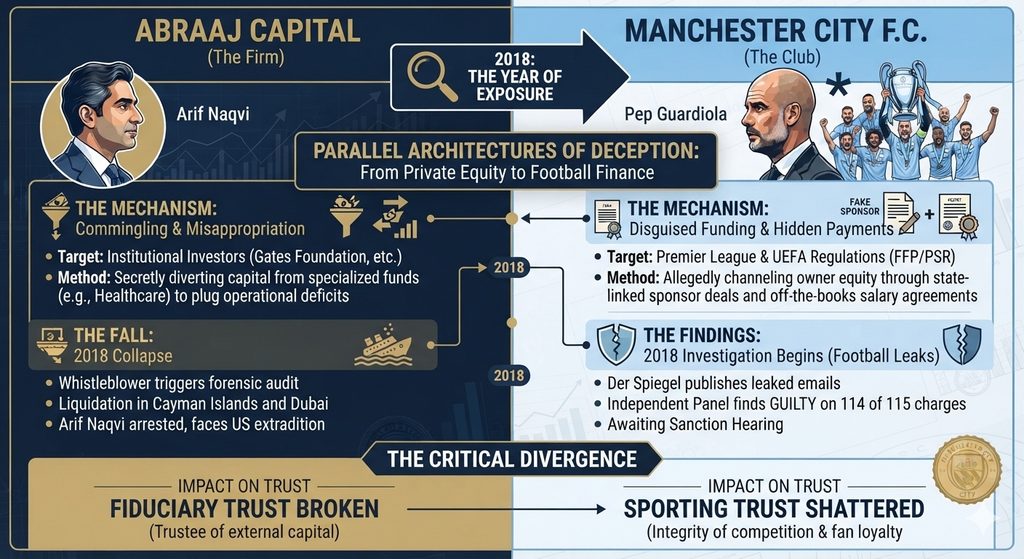
Abraaj and Manchester City – the Parallels.
Beyond simply the timing there are several distinct parallels to the historic downfall of Abraaj Capital.
While one is a football club owned by Abu Dhabi royalty and the other was a Dubai-based private equity giant, both cases serve as case studies in how entities utilize complex financial maneuvers to project artificial stability and growth.
The distinct parallels between the two financial scandals include:
1. The Core Mechanism: Disguising and Commingled Funds.
The foundational manipulation in both cases rests on misrepresenting where capital originated to pass strict regulatory audits:
The Abraaj Equivalence: Arif Naqvi and his team systematically commingled investor funds. They shifted money from specialized vehicles—like their $1 billion healthcare fund—to plug deficits in their operational funds, effectively fabricating the appearance of a highly liquid, booming firm.
The Manchester City Parallel: The independent panel found City guilty of failing to provide accurate financial information (accounting for 54 of the charges). According to leaks and court evidence, the club allegedly disguised direct equity funding from Sheikh Mansour’s Abu Dhabi United Group as “independent” commercial sponsorship revenue from state-linked entities like Etihad Airways, bypassing UEFA and Premier League Financial Fair Play (FFP/PSR) boundaries.
2. Off-the-Books “Shadow” Payments. Both organizations circumvented oversight by maintaining secondary, unrecorded payroll structures to attract and keep top-tier talent:
The Abraaj Equivalence: Abraaj executives utilized side contracts and unrecorded agreements—such as the secret $20 million politician contract handled by Omar Lodhi—to execute transactions away from the eyes of traditional auditors.
The Manchester City Parallel: The independent commission found City guilty of hiding the true scale of payments to key personnel. A major component of the investigation proved that former manager Roberto Mancini received secret “consultancy fees” through an off-the-books contract with an Abu Dhabi-based club (Al Jazira), effectively doubling his salary without registering it against Manchester City’s FFP books.
3. Exposed by Whistleblowers and Leaked Documents. Neither crisis originated from routine regulatory check-ups; both required external breaches to expose the internal books:
The Abraaj Equivalence: The firm survived for years until an anonymous whistleblower alerted the Bill & Melinda Gates Foundation, prompting a forensic audit that unravelled the entire multi-billion-dollar enterprise.
The Manchester City Parallel: The Premier League’s entire case was built upon the 2018 “Football Leaks” cache published by German magazine Der Spiegel. Internal executive emails laid bare how the club purposefully altered internal ledger balances to mislead accounting regulators.
4. Aggressive Non-Cooperation as a Strategy- When under fire, both groups utilized their immense legal and financial resources to stone-wall investigators:
The Abraaj Equivalence: As investors questioned where their money was, Naqvi launched aggressive PR campaigns, threatened legal blowback, and used localized influence to suppress regional financial regulators until the Cayman Islands liquidation forced their hand.
The Manchester City Parallel: Out of the 115 charges, 35 are entirely for failing to cooperate with Premier League investigations. For nearly eight years, City deployed elite legal defense teams to delay, restrict, and challenge the jurisdiction of the investigation, maintaining a public stance of absolute innocence.
The Critical Difference: Ultimate Survival
Despite the structural parallels in financial deception, their ultimate destinies may diverge sharply due to the nature of their backing: Abraaj is gone. Manchester City will continue in some form.
Abraaj was a fiduciary manager handling external institutional capital. When global investors pulled their funds and regulators levied a $135.6 million fine, the firm immediately entered terminal liquidation because its core product—trust—was gone.
Manchester City is an asset backed by sovereign-adjacent wealth. While the 114 guilty findings could result in unprecedented sporting penalties (such as severe points deductions or expulsion from the Premier League), the club itself will not cease to exist.
Backed by the Abu Dhabi royal family, they possess the financial liquidity to absorb whatever unlimited fines are leveled while they take their case through the multi-year appeals process.
But I argue that trust is key to Manchester City as well. The trust between the club and its fan base – now tarnished for ever; the trust between teams that recognises they are competing on a level playing field – they were not. The trust that a club will follow the rules that it has signed up to.
The trophy wins are all now tarnished. The fans have been along for the ride and also taken for a ride.
The structural survival of the club’s balance sheet does not mean the institution escaped unscathed; the destruction of trust operates on three devastating levels:
1. The Betrayal of the Fan Base (“Taken for a Ride”):
Fans are the fabric of a club. A private equity firm’s clients are institutional investors who look at spreadsheets. A football club’s “investors” are generational—people who invest their livelihoods, hard-earned money, emotions, and identities into the badge.For years, Manchester City fans fiercely defended the club against external critics. Now, those fans are forced to confront the painful reality that the historic highs—the Aguero moment, the Treble, the pure euphoria—are fundamentally compromised in the eyes of the footballing world. They were given memories, but those memories have been retroactively injected with an irreversible permanent asterisk.
2. The Illusion of a Level Playing Field:
In sport, as in financial markets, the entire system relies on the absolute baseline assumption that everyone is playing by the same rules. As figures like Arsene Wenger noted in the wake of the verdict, rivals like Arsenal F.C. or Liverpool F.C. spent years building within the rules, sacrificing transfer targets, and being told to “spend wisely” to chase a standard that was being artificially inflated by hidden cash injections.
Just as Abraaj broke the trust of the financial market by outcompeting honest funds using illicit capital, City broke the competitive trust of English football. They weren’t just better; the playing field was fundamentally tilted.
3. The Devaluation of the Trophies:
When the rules are systematically bypassed to build a squad, the silverware won during that period ceases to be a pure measure of sporting excellence. Even if the Premier League has little immediate appetite to formally strip past titles from the record books, public perception has already stripped them. A trophy is only valuable because of the collective agreement that it was won fairly. Without that agreement, the silver simply becomes a monument to financial engineering. In the end, while the Abu Dhabi ownership group has the capital to keep the stadium lights on, they cannot write a check to buy back the sporting integrity they eroded. The independent panel is now moving toward a sanction hearing to determine the final punishment.
Whatever the sanctions will be the reputational damage to English football will take years to fix.
When trust is eroded with investors and with long-standing supporters then Abraaj’s assets and Manchester City’s silverware become monuments to vanity and financial engineering – facilitated in no small part by inadequate regulation and casual oversight.
Sources: How drawn-out saga of Manchester City’s alleged cheating came to this Guardian.
The Fall of Abraaj Dawn
Ever feel you’ve been cheated? Consequences could be profound after Manchester City guilty verdict Guardian
The Manchester City case shows us how the global mega-rich now expect to operate with impunity Guardian
Disguised funding and dishonest witnesses: key findings in Manchester City case Guardian
Sham City: verdict on financial breaches is damning and punishment must be severe Guardian
Building of the Pep supremacy is an era that will be defined by sham-ball Guardian
You’re Manchester City and we know what you are JosimarFootball
How best to punish City? Restitution over retribution, then hand club to the fans Guardian
The football horse that Andy Burnham rode in on is now bucking his vibe Guardian
Manchester City’s guilty verdict brings football’s great sell-off crashing to earth Guardian
Mob Rule Josimar
Premier League statement: Manchester City FC
Manchester City statement
Thoughts on the Manchester City statement:
The lack of remorse in Man City’s statement is no surprise but it shows why, along with the club receiving the harshest punishments, their owners should be chased from English football through the Owners and Directors Trust. The sheer disregard for their competitors, the game and fans is staggering.
On X one message reads: “
It is a statement filled with absolute contempt.
Contempt for sporting integrity.
Contempt for the spirit of fair play.
Contempt for their peers.
Contempt for the pyramid of football and all the people who missed out on glory because they wanted to ignore the rules and laws.