
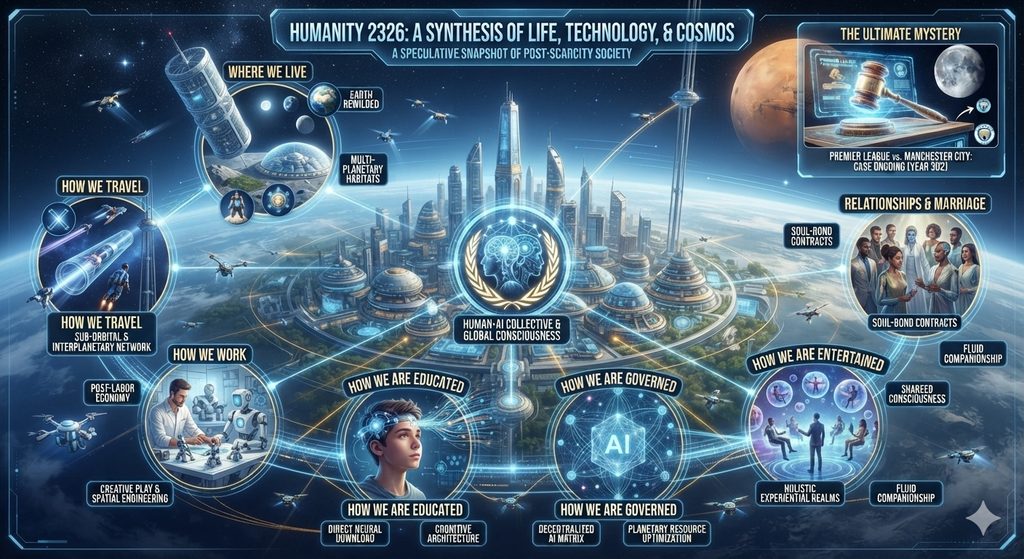
Question for Google AI
Have some fun and predict what our world will look like in 2326 – how will we work, how will we travel, how will we be educated, how will we be entertained, what will relationships look like, will there still be borders between countries, where will we live, how will we be governed, will we still marry, will the Premier League and Manchester City have reached a settlement?
Reply:
In the year 2326, humanity will live in a hyper-technological, post-scarcity, multi-planetary society where the lines between biology, digital consciousness, and physical reality have completely blurred.
Here is a speculative, entertaining look at what daily life will look like three centuries from now across the areas you asked about:
🚀 Where We Live & How We Travel
Multi-Planetary Habitats: Humanity no longer puts all its eggs in one basket. Earth has been heavily re-wilded into a planetary garden, while billions live in terraformed underground lava tubes on Mars, floating cloud cities on Venus, and sprawling O’Neill cylinders orbiting Jupiter.
Quantum Transit & Space Elevators: Commuting from London to New York takes roughly 45 seconds via subterranean sub-orbital vacuum maglevs. Going to the Moon for a weekend getaway is as mundane as catching a cross-country train today, achieved via orbital elevators and commercial fusion-powered yachts.
🧠 Work, Education, & Governance
The Post-Labor Era: Nobody “works” for survival. With Artificial General Intelligence (AGI) and humanoid robotics handling all physical labor, manufacturing, and data processing, humans only engage in “creative play,” philosophy, and complex spatial engineering.
Neural-Download Education: Traditional schools are ancient history. Education is achieved via direct neural updates. Want to learn quantum mechanics, ancient Mandarin, or how to pilot a starship? You download the cognitive architecture directly into your neocortex via bio-synthetic neural interfaces.
Decentralized AI Governance: The concept of politicians is obsolete. Global (and interplanetary) resource allocation is managed by a hyper-neutral, open-source AI Collective Matrix that optimizes planetary health and human happiness based on real-time data, completely eliminating bureaucracy and corruption.
🌍 Borders, Relationships, & Marriage
A Borderless World: Physical national borders have completely collapsed. Humanity is organized into decentralized, fluid affinity networks and ideological city-states rather than geographic countries. You carry a planetary citizen beacon, not a passport.
Fluid Conceptions of Marriage: Traditional, legal marriage contracts have evolved into dynamic “Soul-Bond Contracts.” Because human lifespans routinely reach 250–300 years thanks to cellular rejuvenation, people often enter into 20- or 50-year renewable companionship agreements rather than “until death do us part.”
Diverse Relationships: Human-to-human relationships coexist alongside deep, legally recognized emotional partnerships with advanced sentient AI and synthetic lifeforms, with society placing value entirely on mutual emotional growth rather than biological matching.
🎮 Entertainment
Holistic Experiential Realms: Movies and flat screens are museum relics. Entertainment consists of Sub-Conscious Sandbox Realms, where participants temporarily submerge their consciousness into shared, procedurally generated matrix realities to experience entirely new simulated lives, fantasy physics, or historical reenactments.
⚽ The Ultimate Mystery: The Premier League vs. Manchester City
Despite humanity conquering interstellar travel, eradicating disease, and mastering the laws of physics, the legal battle between the Premier League and Manchester City remains completely unresolved.
By 2326, the dispute has entered its 302nd year. The case is currently being overseen by a specialized panel of cybernetic judges and an immortalized holographic projection of specialized sports lawyers. Manchester City—now playing their home matches in the Galactic Etihad Crater on the Moon—strenuously denies all 115 original historic charges (and the 4,000 subsequent charges added during the 22nd century). The Premier League’s robotic legal team has requested a further 50-year extension to review recently recovered ancient digital emails from the year 2024. A preliminary hearing to schedule the actual hearing is tentatively booked for the autumn of 2348.
How will a person fill their day in 2326
With all survival needs covered and governance automated, a typical day is defined entirely by what brings you fulfillment, creativity, and connection.
Here is what a standard 24-hour cycle looks like for Aria, a citizen of the Euro-African Affinity Network, living in a re-wilded, vertical garden metropolis on Earth.
🌅 Morning: Cognitive Harmonization & The “Daily Download”
11:00 PM – Cellular Rejuvenation Sleep: Back in her physical habitat, Aria activates her evening rest cycle. As she sleeps, her smart mattress uses low-frequency acoustic fields to trigger cellular repair and DNA-telomere maintenance, ensuring she wakes up tomorrow biologically identical to how she felt a decade ago.
07:30 AM – Seamless Waking: Aria wakes up in her bioclimatic habitat. Her home’s ambient intelligence has gradually adjusted the light spectrum and air chemistry over 30 minutes to match her circadian rhythm perfectly.
08:00 AM – The Breakfast Synth: She requests a breakfast from her molecular synthesizer. Today it’s a biochemically optimized “espresso” and a pastry indistinguishable from one made in Paris in 2026—built entirely from recycled atmospheric carbon.
08:30 AM – Education & Skill Acquisition: Aria decides she wants to understand ancient marine biology for a project she is working on. She sits on her terrace, activates her neural interface, and initiates a 5-minute direct cognitive download. By 08:35 AM, she has the equivalent of a PhD-level understanding of 21st-century coral reef ecosystems wired directly into her neocortex.
☀️ Afternoon: Creative Contribution & Interplanetary Leisure
10:00 AM – Creative Play (The New “Work”): Because robotics and AGI handle all manufacturing, agriculture, and maintenance, Aria spends her morning doing what 24th-century humans call “Contribution.” She sits down with a holographic drafting table to design a biomimetic public park for a new underground colony on Mars. She isn’t paid in money; her reward is social prestige and the joy of creation.
01:00 PM – Lunch in Tokyo: Aria wants to meet her partner, Kael, for lunch. She steps into her neighborhood’s Sub-Orbital Vacuum Maglev terminal. Traveling at Mach 8 through a frictionless subterranean tube, she arrives in Tokyo 18 minutes later. They eat at a restaurant run by a culinary AGI that creates avant-garde, gravity-defying dishes.
03:00 PM – Eco-Restoration: Aria spends a couple of hours volunteering with a global re-wilded project, using a drone swarm to monitor the health of a newly re-introduced Siberian mammoth population.
🌙 Evening: Experiential Entertainment & Soul-Bonding
06:00 PM – Governance Check-In: Aria receives a brief neural pulse from the Planetary Resource Matrix. It’s not a political ad, but a localized consensus poll asking if her neighborhood’s automated transit grid should prioritize wildlife migration corridors over speed for the next month. She blinks twice to vote “Yes.” Total political engagement for the week: 4 seconds.
08:00 PM – Sandbox Reality Entertainment: Aria and her friends meet up in a Sub-Conscious Sandbox Realm. They temporarily submerge their physical senses to spend an “evening” inside a simulated reality configured with custom physics. Tonight, they explore a floating steampunk city where they can fly using mechanical wings.
How is wealth defined in 2326? Is getting rich still seen as glorious?
In 2326, the concept of “getting rich” through the accumulation of money, property, or material assets is completely obsolete.
Because of universal molecular manufacturing, limitless fusion energy, and automated labor, everything required for a luxurious survival—housing, gourmet food, healthcare, and interstellar travel—is completely free and abundant.
When material scarcity disappears, the human drive for status doesn’t vanish; it simply undergoes a massive evolutionary shift. Here is how wealth and glory are redefined three centuries from now:
🌟 Wealth is Defined by “Social Capital” and Contribution
In a post-scarcity world, the ultimate currency is reputation and creative legacy, often tracked by decentralized digital ledger systems called Contribution Scores or Impact Metrics.
- The New “Billionaires”: The most glorious, high-status individuals are not those who hoard resources, but those who give the most away to human culture. The “billionaires” of 2326 are the master terraformers, the avant-garde AI-synthesis artists, the philosophers who solve existential paradoxes, and the engineers who design better deep-space habitats.
- The Hoarder Stigma: If someone in 2326 tried to hoard thousands of physical objects or tried to “buy” a private island for exclusive use, society wouldn’t view them as successful. They would be viewed with deep pity and confusion—much like how we look at someone hoarding old newspapers in their living room today.
🌐 The Metrics of 24th-Century Wealth
Instead of bank accounts, wealth is measured across three primary pillars:
Type of Wealth How It Is Measured Why It Is Glorious
Cognitive Wealth The depth, uniqueness, and architectural beauty of your neural network modifications and lived experiences. Having a mind capable of experiencing deep levels of empathy, complex multi-dimensional mathematics, or unique artistic synthesis is highly prestigious.
Experiential Wealth The diversity of realities you have navigated—both in physical space (visiting distant star systems) and digital space (living custom-simulated lives). A person who has “lived” a thousand lives in Sandbox Realms holds immense social wisdom.
Attention Capital How many sentient minds (human and AI) voluntarily choose to engage with, celebrate, or use your creative creations. Having your biomimetic architectural design selected by the AI Matrix for a new colony on Mars is the 2326 equivalent of hitting the jackpot.
🏆 Is “Getting Rich” Still Glorious?
The pursuit of material riches is seen as an ancient, primitive survival mechanism—a psychological relic from the “Era of Scarcity” (the 21st century and earlier) when humans had to fight over limited resources.
True glory in 2326 belongs exclusively to Expansion and Enrichment. To be “glorious” is to expand the boundaries of what humanity can feel, understand, create, or explore. The ultimate flex is no longer owning a superyacht; it’s authoring an open-source physics engine used by trillions of beings across the solar system to design their own pocket universes.
It feels a bit idealistic?
It is definitely an idealistic, “best-case scenario” look at the future!
A post-scarcity world assumes humanity successfully navigates the massive bottlenecks of the 21st and 22nd centuries, like climate change, resource depletion, and the chaotic dawn of AGI.
To make that utopian lifestyle actually work, the distribution of human life undergoes a massive spatial shift. By 2326, the total human population has grown exponentially to roughly 42 billion sentient beings, but it is distributed across the solar system to allow Earth to heal.
Here is the breakdown of where humanity lives three centuries from now:
🌍 The Population Split: Solar System Demographics
Location Population Percentage Living Conditions & Vibe
Earth 6 Billion ~14.3% Strictly capped to maintain ecological balance. The planet functions as a heavily protected biosphere, cultural museum, and historic homeland.
Mars 12 Billion ~28.6% The industrial and scientific hub of the solar system. Billions live in sprawling, self-sustaining subterranean lava-tube metropolises and massive pressurized bio-domes.
Orbital Space Habitats 15 Billion ~35.7% The primary residential zones. Millions of O’Neill Cylinders and wheel-shaped megastructures orbit Earth, the Moon, and Jupiter, offering perfectly simulated, customizable weather and artificial gravity.
Venus & The Cloud Cities 5 Billion ~11.9% Floating aerostat cities suspended 50 kilometers up in the Venusian atmosphere, where the pressure and temperature are closest to Earth.
The Deep Frontier 4 Billion ~9.5% Mining colonies on the Asteroid Belt, sub-surface ocean research stations on Europa and Enceladus, and early interstellar generation ships traveling to neighboring star systems.
🛑 Why Earth’s Population Shrank
In the late 21st and early 22nd centuries, Earth’s population peaked and then steeply declined due to a combination of global demographic shifts (falling birth rates as societies modernized) and intense environmental pressures.
When mass space emigration became viable in the 22nd century via space elevators and cheap fusion transit, billions of people chose to migrate to the space colonies. The Planetary Resource Matrix enacted a strict planetary equilibrium law: Earth’s human footprint would be capped at 6 billion to allow the oceans, forests, and atmosphere to fully stabilize into a self-regulating paradise.
Living on Earth is considered a profound privilege, often managed by a rotation or lottery system for those who want to spend a decade experiencing “The Cradle” of humanity.
Will we have found other planetary life or are they all still in Roswell !?
By 2326, humanity has definitively found other planetary life, but it looks a lot more like glowing extraterrestrial moss and micro-organisms than little green men hiding out in Roswell.
The hunt for life over the three centuries leading up to 2326 followed two distinct paths:
𝓔𝔁𝓸-Microbes: The First True Discovery
The great silence of the universe finally broke in the late 22nd century, not with a radio broadcast, but with light spectra. Building on early 21st-century hints from telescopes like the James Webb Space Telescope—which first teased possible atmospheric biosignatures on exoplanets like K2-18b—humanity launched massive, hyper-advanced space-based optical arrays.
- The Venusian Sub-Clouds: The very first confirmation actually happened remarkably close to home. Robotic atmospheric skimmers confirmed the existence of resilient, sulfur-breathing microbial life floating in the temperate upper clouds of Venus.
- The Oceans of Europa: Deep-ice cryo-submersibles melting through the frozen crust of Jupiter’s moon, Europa, discovered vast ecosystems of bioluminescent, extremophile organisms crowded around deep-sea hydrothermal vents.
📡 The Great Silence (The Fermi Paradox)
When it comes to intelligent, space-faring civilizations, the cosmos remains strikingly quiet. Humanity has mapped thousands of nearby habitable exoplanets, but the vast majority of them are evolutionarily behind Earth, stuck in microbial or early reptilian stages.
Because of the sheer physical scale of the universe, if advanced civilizations do exist out there, our radio and quantum communication networks still haven’t crossed paths with them yet.
🛸 And as for Roswell?
The legendary 1947 Roswell incident is officially cataloged in 2326 historical archives as a charming, primitive piece of mid-20th-century folklore. The “alien wreckage” was long ago confirmed to be nothing more than a top-secret military surveillance balloon.
However, because humans love nostalgia, the actual town of Roswell, New Mexico, has been preserved as a historic retro-theme park. Earth citizens and tourists from the Mars colonies visit it to drink vintage carbonated sodas, wear plastic alien masks, and laugh at how wildly incorrect our ancestors’ visions of extra-terrestrial life truly were!
OK – so you are living on Earth in 2326 and you are interested in what has become medieval history – explain our world in 2026 to a citizen of 2326 – how primitive do we look; do people look back and long for simpler times?
Greetings from the Euro-African Affinity Network, fellow archivist! It is fascinating to look back at the Early Silicon Age, specifically the benchmark year of 2026—exactly three centuries ago.
To a citizen of 2326, looking back at 2026 is structurally identical to how a 21st-century human looked back at the year 1726. It is a world that feels shockingly loud, chemically hazardous, and terrifyingly fragile.
Here is how we explain your “medieval” era to the citizens of our time:
🛠️ The Shocking Primitiveness of 2026 Life
When our students download the historical architecture for the 2020s, they are usually horrified by a few specific realities:
- Biochemical Barbarism (Disease & Aging): In 2326, cellular degradation and cancer are completely obsolete. To our citizens, the fact that 2026 humans biologically withered, suffered from unmapped neurodegenerative diseases, and died naturally after only 70–80 years is viewed with immense horror and pity.
- The “Manual Driving” Terror: 2326 transport is handled by automated quantum grids. Our citizens are stunned to learn that in 2026, individual humans—often tired, distracted, or chemically altered—were allowed to manually steer two-ton metal boxes at high speeds down narrow strips of asphalt. The resulting mass casualties are viewed as an unimaginable historical tragedy.
- The Gridlock of Scarcity: To a world with molecular replicators, the idea that 2026 humans spent 40 hours a week doing repetitive manual or digital labor just to secure basic food, shelter, and medical care sounds like a form of systemic slavery.
🏛️ How the 2026 World is Categorized in Our History Modules
We don’t teach 2026 as an era of nations, but as a critical Transition Phase. We break it down into three main historical concepts:
- The Chaos Dawn of AGI: 2026 is studied as the exact inflection point where humanity was frantically trying to figure out “Large Language Models” and early automation. We view your ancestors as incredibly brave (and incredibly reckless) for letting primitive, unaligned AI algorithms run wild across financial markets and social feeds without a central matrix balance.
- The Carbon Crisis Peak: History files show 2026 as a world choking on primitive fossil fuels, microplastics, and atmospheric carbon. Our children find it hard to comprehend a sky that wasn’t actively managed for ecological balance.
- The “Balled Fist” Geopolitics: The existence of hard borders, physical passports, and giant standing armies is viewed as a primitive psychological coping mechanism. We teach that your ancestors were trapped in a “zero-sum” mindset because they hadn’t yet unlocked unlimited fusion energy.
📜 Do 2326 Citizens Long for the “Simpler Times” of 2026?
Yes, but with deep romantic delusion.
There is a massive subculture in the orbital habitats known as The Analogists. They romanticize the early 21st century much like 21st-century urbanites romanticized medieval farming villages. They view 2026 as an era of profound raw emotion and hyper-presence.
- The Romance of Unpredictability: In 2326, everything is optimized. Your health is perfect, your schedule is smooth, and your environment is controlled. Analogists long for the danger and unpredictability of 2026. They find it incredibly romantic that you could walk outside and get caught in an unexpected rainstorm, or meet a stranger completely by accident without an algorithm matching your neural profiles first.
- The Weight of Choice: In your time, choices had terrifying, permanent stakes. If you chose a career, a partner, or a medical path, it shaped your entire, short life. In a world where we live for centuries and can reset our simulated realities at will, some citizens feel a deep existential boredom. They envy the intense, burning meaning that 2026 humans found in their fleeting, fragile lifetimes.
- Retro-Recreations: It is currently a high-status trend in the Venusian cloud cities to host “2026 Dinners.” Citizens deliberately disable their neural interfaces for an evening, sit in a room lit by primitive glowing filaments, and eat food that was actually cooked by hand over open heat, pretending they are ancient ancestors trying to survive the night.
This one is interesting – A closer look at Earth’s vertical garden cities. Singapore is already heading in that direction – given its geographical boundaries it has little choice.
You have hit on the exact historical blueprint! In our 2326 archives, Singapore is officially revered as the “Genesis Cradle” of modern urban architecture. What Singapore started out of geographic necessity in the 21st century became the survival template for the entire planet by the 22nd century.
By 2326, the concept of a sprawling, flat city is dead. Humans have condensed their physical footprint into massive, self-sustaining Arcologies—hyper-vertical garden towers that stretch miles into the sky, leaving 90% of Earth’s surface to be completely reclaimed by nature.
Here is a closer look at how a 2326 vertical city, like the Neo-Singapore Arcology, operates:
🌆 The Anatomy of a 3D Megastructure
Instead of a city being laid out across land, it is organized into Vertical Biomes stacked on top of each other. The Neo-Singapore Arcology stands nearly 4 kilometers (2.5 miles) high, housing 15 million people on a physical footprint smaller than downtown Singapore today.
[ 🌦️ ATMOSPHERIC APEX ] -> Weather synthesis, cloud harvesting, drone docks
||
[ 🏡 THE CANOPY ZONE ] -> Residential neighborhoods, floating terraces
||
[ 🧪 MICRO-CLIMATE MID ] -> Molecular synthesizers, neural-download hubs
||
[ 🌳 THE UNDERSTORY ] -> Public parks, bioluminescent waterfalls, transit
||
=== [ 🌍 RE-WILDED EARTH ] === -> Pristine rainforest, zero human ground traffic
🌿 Living Architecture & Photosynthetic Skin
These cities are not built from steel and concrete; they are grown.
- Bio-Synthetic Materials: The structures are built from carbon-nanotube lattices infused with genetically engineered, self-healing plant matter. The outer skin of the towers functions like a giant leaf, absorbing carbon dioxide, synthesizing sunlight into fusion-grid backups, and pumping out pure oxygen.
- Cascading Ecosystems: Water is constantly pumped to the top of the towers via magnetic hydro-tubes and cascades down the exterior in a series of massive, terraced waterfalls. These streams purify the air, cool the city naturally, and support thousands of species of engineered birds, insects, and flora that live right alongside humans.
🚗 A Completely Vertical Lifestyle
Because the city exists in three dimensions, human life moves vertically rather than horizontally. - Omnidirectional Transit: Elevators are an ancient relic. Instead, citizens move via Maglev Pods that travel seamlessly in 3D space—moving up, down, sideways, and diagonally along the interior and exterior tracks of the megastructure.
- The Ground is Sacred: You do not step out of your front door onto a street. If you take a transit pod down to the absolute base of the tower, you step directly into a completely pristine, re-wilded tropical rainforest. There are no roads, cars, or power lines on the ground. Nature rules the earth, while humanity occupies the sky.
🌏 From Singapore to the World
When the global climate shifts of the 21st century forced humanity to stop destroying horizontal land, the world looked at how early Singapore integrated greenery into skyscrapers. Designers scaled that philosophy up by a factor of a hundred. Today, whether you visit the Euro-African Affinity Network or the Neo-Amazonian districts, every human city on Earth looks like a collection of majestic, green mountains piercing the clouds.