
Written by: Saad @AirlinePilotmax on X
Astrophysicist | FAA Airman| EASA ATPL (A)| AGI Instructor| Type Rated Examiner B737NG/Max| Rated on G550, A320|Flight Safety|Aviation Diplomacy
Ed: I have edited the X article by @airlinepilotmax to remove some duplicate paragraphs. The incident happened about 36 hours ago. The UAE authorities and flydubai have been predictably slow to say anything other than that there was a cockpit altercation and a diversion.
The Morning a Routine Sector Became a Fight for the Aircraft
Every pilot who has flown the corridor from the Gulf to the Levant knows the rhythm of an early departure out of Dubai. You push in the dark, climb through the haze, settle at cruise and brief the arrival somewhere over the Saudi interior. On Wednesday 30 September 2026, flydubai flight FZ1073 kept that rhythm for two hours and sixteen minutes. Then, in the space of half a minute, it broke it.
At about 05:22 UTC, close to the Saudi Jordanian border and with 174 passengers on board, the Boeing 737 MAX 8 fell more than 14,000 feet in under thirty seconds. Within minutes its transponder was showing 7700, and then 7500, the code every pilot learns in training and hopes never to select. By the time the aircraft touched down at Tabuk in north western Saudi Arabia, the captain was lying wounded on the flight deck, the first officer was being held down by passengers, and flydubai pilots who were Dead Heading in the cabin had taken control of the aeroplane.
The airline has urged everyone to wait for the facts. As a pilot who has spent years on the 737 NG and MAX, I want to set out what the evidence shows, what it does not yet show, and why this event will be discussed in every flight operations department for years to come.
The Facts as They Stand
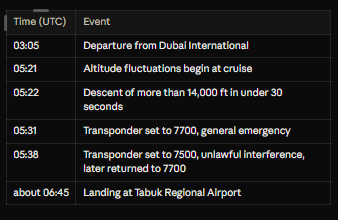
The aircraft was a flydubai Boeing 737 MAX 8, registration A6-FKF, operating FZ1073 from Dubai International to Ben Gurion. It left Dubai at 03:05 UTC and climbed to a cruising level of roughly FL340. The sequence that followed, as reconstructed from ADS-B data published by Flightradar24, is set out below.
The captain has been named and confirmed by the Indian Embassy in Riyadh as Captain Smit Machchhar, an Indian national and former SpiceJet commander who joined flydubai in 2022. He was stabbed during the attack, underwent surgery in Tabuk and is reported to be in stable condition.
The first officer has not been named. Neither flydubai nor the Saudi authorities have publicly confirmed his nationality. He was detained on arrival and questioned by Saudi investigators, with Israel participating, and Prime Minister Netanyahu has said he expects the suspect to be moved to Dubai.
flydubai has confirmed that an altercation took place on the flight deck, that crew members travelling on board secured and landed the aircraft, and that all passengers are safe. The airline sent two replacement aircraft to Tabuk, the passengers reached Ben Gurion the same evening, and all flydubai flights to and from Israel are suspended while the investigation continues. Israel’s Transport Minister, Miri Regev, has separately halted flydubai operations to Israel and ordered a review of whether the carrier breached bilateral aviation arrangements.
Reading the Trace: What a 737 Pilot Sees in the Data
The descent figure is the single most telling number in this event. Losing 14,000 feet in under thirty seconds means an average vertical speed of around 28,000 feet per minute, and AirNavRadar recorded a peak close to 31,000. To put that in context, a textbook emergency descent on the 737, flown from the QRH with thrust at idle, speedbrake extended and the aircraft held near its speed limits, typically produces something in the region of 6,000 to 8,000 feet per minute. FZ1073 came down three to four times faster than the most aggressive descent we ever train for.
That rate cannot be produced by an orderly, managed descent. It points to a steep nose down attitude flown by hand, with the autopilot disconnected and the airspeed racing towards, and quite possibly beyond, the MAX limits of 340 knots or Mach 0.82. Anyone who has heard the overspeed clacker in the simulator can imagine the noise on that flight deck. Recovering a 737 from a high speed, nose low upset demands smooth, deliberate unloading and roll control, not a violent pull, and whoever got the aircraft back to level flight near 15,000 feet did so under conditions no training scenario replicates.
A note of caution belongs here. Vertical speeds derived from ADS-B barometric altitude over a few seconds can exaggerate peaks, and published accounts differ, ranging from 14,000 feet in thirty seconds to 17,400 feet in under two minutes. Yet even the most conservative reading, around 8,700 feet per minute sustained for two minutes, is at the very edge of what the aeroplane is ever asked to do. Only the flight data recorder will settle the profile.
The transponder sequence tells its own story. The dive began at 05:22, but the first emergency code did not appear until 05:31. To me that nine minute gap speaks of a flight deck consumed by the oldest priority in aviation: fly the aeroplane first. Changing a squawk is trivial in normal operations; it is the last thing on anyone’s mind while fighting for the controls and pulling out of a dive. The move to 7500 at 05:38, followed by a return to 7700, is consistent with whoever had regained the seat first telling the world an unlawful interference event had occurred and then reverting to the general emergency code to secure priority handling. That is a plausible reading, not an established fact; the cockpit voice recorder will show who selected each code and why.
Finally, the routing. The aircraft briefly entered Jordanian airspace, turned back and headed south for Tabuk, while Israel scrambled fighters. Tabuk offered a long runway, an airfield already beneath the aircraft, and no ambiguity about the reception a 7500 squawk would meet on approach to Israeli airspace. From the left seat, it was the obvious choice.
The Fight for the Flight Deck
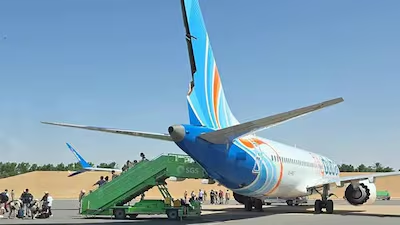
That [descent] speed had a price. Photographs taken by passengers at Tabuk show most of the rudder torn from the tail, shows that the rudder was damaged. The cause has not been established, but aerodynamic flutter or overload during an excursion well beyond the aircraft’s design speeds is the explanation most analysts are reaching for, and the fact that the fin itself held is fortunate in the extreme. For the crew who took over, it changed everything about how the rest of the flight had to be flown. The 737 has a single rudder surface, and without it there is no yaw damping, a greater tendency towards Dutch roll, and no means of countering asymmetric thrust. The aeroplane can still be steered with aileron and spoiler and held straight by the fin, but an engine failure on that approach could have been unrecoverable, because rudder is precisely what keeps a twin straight on one engine.
Flying it home would have meant taking nothing for granted. Faced with an unknown structural state, a disciplined crew would keep speed modest, avoid large or sudden thrust changes, and carry out a controllability check at a safe altitude, extending flap stage by stage and confirming the aircraft still handled before committing to the approach. On final, the usual technique of using rudder to remove the crab at touchdown is gone, so the landing is flown with the wings close to level and the drift accepted, which makes runway selection and the wind on the day decisive. Tabuk’s long runway helped. Landing a 737 with its tail damaged, after a violent upset, a fight on the flight deck and a captain bleeding on the floor, is airmanship of the highest order.
What We Do Not Yet Know
The motive is the largest unknown. Israel’s Defence Minister, Israel Katz, has called the event an attempted jihadist terrorist attack, and three Israeli officials told Reuters it is being investigated as such. Yet the Prime Minister’s own spokesperson has said nothing can be certain until everyone is debriefed, no group has claimed responsibility, and a senior US official said there is no indication of Iranian involvement. flydubai has said investigators are keeping every line of inquiry open, including a mental health crisis or a personal dispute, and has cautioned against premature speculation. As pilots, we should hold the same discipline we apply to any accident: the evidence first, the conclusion afterwards.
Several early details have already shifted. The first Hebrew language reports described the captain as Emirati; he has since been confirmed as Indian. Accounts of the weapon conflict, as do the published descent figures. Some reports suggest the injured captain helped bring the aircraft down, while the airline credits the travelling crew with securing and landing it. The state of the door selector at the moment of entry has not been established, and the first officer’s nationality rests on Israeli sources alone.
The structure of the investigation itself is also unsettled. Under ICAO Annex 13, Saudi Arabia, as the State of Occurrence, would ordinarily lead a safety investigation, with the United Arab Emirates as State of Registry and Operator and the United States as State of Design entitled to take part. Running alongside that is a criminal and security inquiry, already involving Saudi, Emirati and Israeli authorities. flydubai has said it will comment further once the cockpit voice recorder has been examined, and that recording will answer more questions than all of the reporting so far.
The Insider Threat We Have Seen Before
Aviation has confronted the pilot as a threat before, and the record is sobering. In 1999 the relief first officer of EgyptAir 990 put a Boeing 767 into the [North] Atlantic. In 2013 the captain of LAM 470 locked his colleague out and flew an Embraer 190 into the ground in Namibia. In 2015 the first officer of Germanwings 9525 did the same in the French Alps, killing all 150 on board, and his act reshaped mental health oversight across European aviation. The 2022 loss of China Eastern 5735, a 737 that dived from cruise in a profile chillingly similar to the start of FZ1073, still awaits a final report, though US officials were widely reported to believe the inputs were deliberate.
The pattern in almost every one of those cases is isolation: one pilot alone on the flight deck, the other locked outside. FZ1073 breaks that pattern. Both pilots were at their stations, the attack was physical, and the intended victim survived long enough to fight back and open the door. The closest parallel may be Alaska Airlines Flight 2059, operated by Horizon Air, in October 2023, when an off duty pilot in the jumpseat tried to pull the engine fire handles and was overpowered by the operating crew. Together they make an uncomfortable point. Our defences are built around keeping the threat out, but the most dangerous person is sometimes already sitting in the seat beside you.
The Implications
For pilot screening and wellbeing
After Germanwings, Europe introduced psychological assessment before line flying, peer support programmes and random alcohol and drug testing. Whatever motive emerges here, regulators across the Gulf will now face hard questions about how they assess, monitor and support a pilot workforce drawn from dozens of nationalities. The answer cannot be suspicion alone. A culture in which pilots feel unable to report stress, grievance or illness drives risk underground, and the industry has learned at great cost that genuine peer support catches what a medical certificate cannot.
For flight deck security design
The reinforced door was designed for the threat of 2001. FZ1073 shows again how an insider can turn it into a liability, and how its release can become a lifeline. Expect operators and manufacturers to revisit door access logic, the timing of emergency entry, and procedures that allow trusted crew in the cabin to reach the flight deck. If the crash axe is confirmed as the weapon, its stowage and accessibility will also come under review, a difficult problem because the axe exists for genuine emergencies.
For crew rostering and bilateral agreements
Israeli ministry officials say the arrangements between Israel and the UAE limit crews on these flights to nationals of states with diplomatic relations with Israel, and Oman has none. If that is confirmed, every Gulf carrier serving Israel will audit its rostering controls immediately. For a carrier such as flydubai, whose pilot body is overwhelmingly expatriate, nationality filters on specific routes add real complexity to crew planning and reserve cover, and the regulatory and reputational cost of getting them wrong has just become very clear.
For the network and the region
The immediate commercial effect is the suspension of flydubai’s Israel flying by both the airline and the Israeli government, with no restart date. Israel’s Foreign Minister has said he and his Emirati counterpart agreed to work together against extremist elements, a signal that both governments want to protect the wider relationship. For operators and dispatchers, the event adds a new layer to an already complex regional risk picture, in which the threat may now be assessed from inside the aircraft as well as from the airspace below it.
[ed: flydubai was operating up to ten return trips a day from Dubai to Tel Aviv]
For those of us at the controls
The lesson for line pilots is not paranoia but preparedness. Upset recovery training earned its place in this event, and so did crew resource management in its broadest sense: colleagues travelling in the cabin who stepped forward, passengers who acted, and a captain who used his last strength for the one action that mattered. We should also be candid with ourselves. We trust the person in the other seat with our lives every day, and that trust is the foundation of safe operations. Protecting it means looking after one another long before anything reaches a flight deck.
FZ1073 will be remembered for thirty seconds of terror and for the courage of the people who refused to let those seconds become the end. A captain who fought back while gravely wounded, passengers who forced their way forward, and professional pilots who happened to be in the right seats turned what could have been one of the worst events in Gulf aviation into a safe landing at Tabuk. The flight recorders now hold the rest of the story. Until they speak, the most professional thing any of us can do is honour those who acted, resist the rush to judgement, and prepare for the lessons that are certainly coming.